Writing is oneof the Four Macro Skills
that a student should possess.
1. Listening Skills
2. Speaking Skills
3. Reading Skills
4. Writing Skills
5.
ACADEMIC WRITING
is akind of writing that can be used in acade
mia or school.
it has a process that starts with posing a ques
tion, conceptualizing a problem, evaluating an
opinion and ends in answering a question pos
ed, clarifying a problem or arguing for a stand.
6.
ACADEMIC SPECIFIC PURPOSES:
•to inform - supplementing a lot of informat
ion about the topic
• to persuade - having the credibility to ma
ke audience or readers believe in you.
• to argue - making your readers or audien
ce respond on the information you are tell
ing them.
7.
4. Trade isthe action of buying and
selling goods and services.
• Academic writing requires formal language
or word that does not contain colloquial or
jargon words.
• it usually uses layman‘s term that is easy
to understand.
• it avoids the use of hifalutin words that
have deep meaning
8.
5. Academic textis usually written by
• it follows certain rules or standards
• Language to be used in writing aca
-demic text should be formal.
• audience should be the first
consideration.
9.
6. Process isa summons or writ requiring a
person to appear in court.
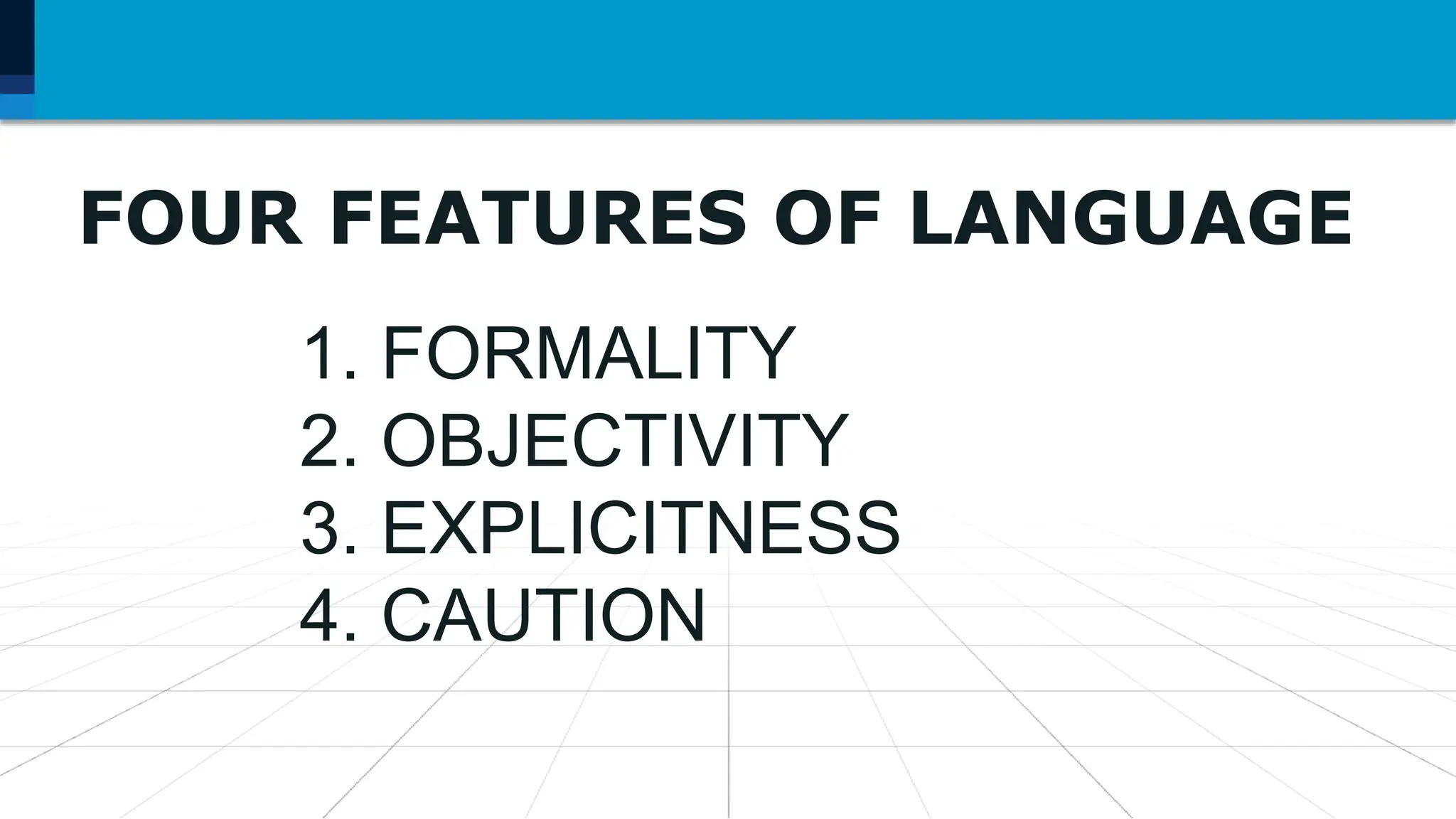
FOUR FEATURES OF LANGUAGE
1. FORMALITY
2. OBJECTIVITY
3. EXPLICITNESS
4. CAUTION
10.
7. Language maybe used as
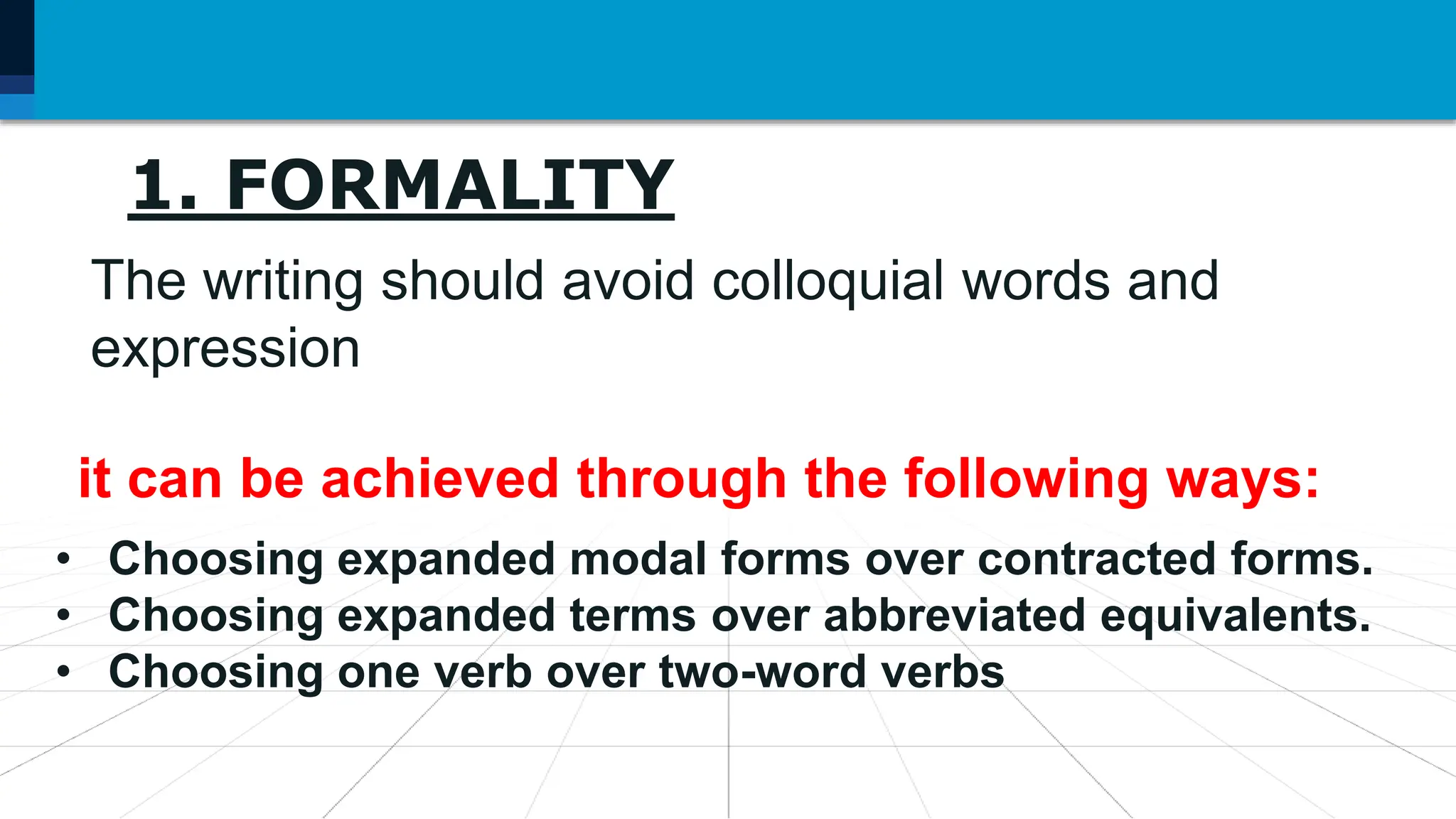
1. FORMALITY
The writing should avoid colloquial words and
expression
it can be achieved through the following ways:
• Choosing expanded modal forms over contracted forms.
• Choosing expanded terms over abbreviated equivalents.
• Choosing one verb over two-word verbs
11.
8. Mass isa measure of the amount
of matter in an object.
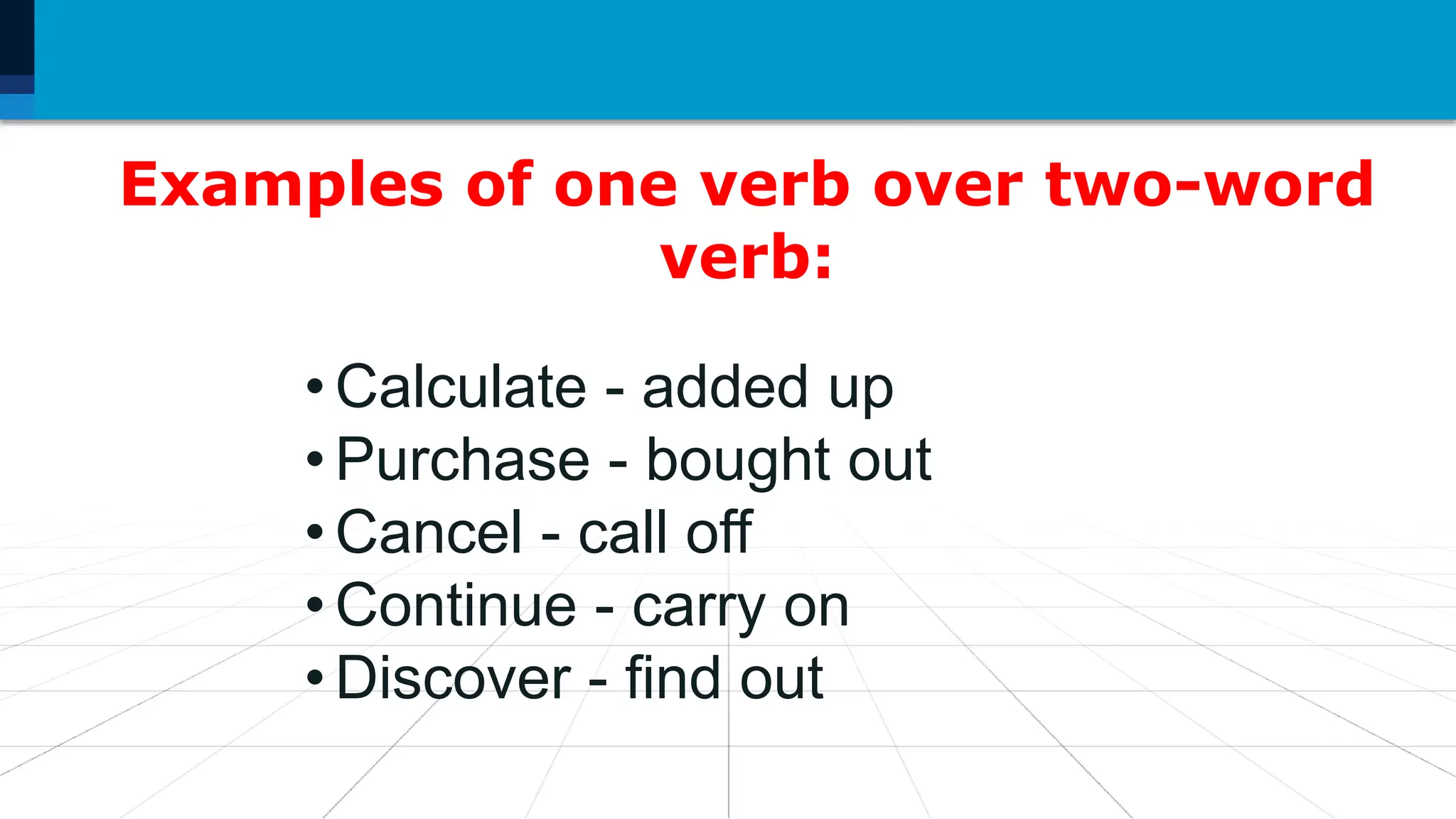
Examples of one verb over two-word
verb:
• Calculate - added up
• Purchase - bought out
• Cancel - call off
• Continue - carry on
• Discover - find out
12.
7. Language maybe used as
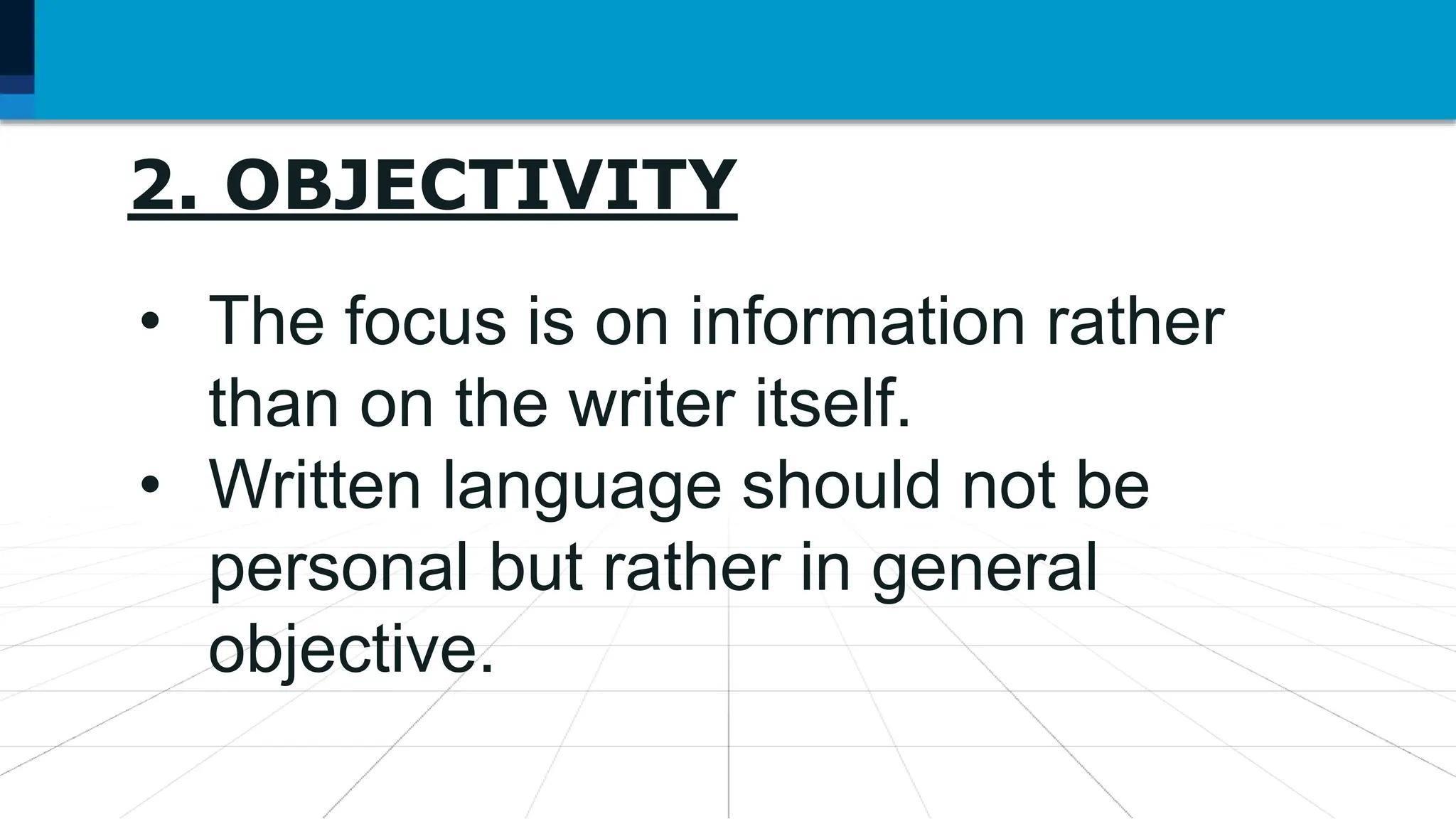
2. OBJECTIVITY
• The focus is on information rather
than on the writer itself.
• Written language should not be
personal but rather in general
objective.
13.
It can beachieved by:
• Avoiding the pronouns I, you, my and we.
Poor Example: You need to follow instruction.
Improved Version: The researchers need to
follow instruction.
• Avoiding rhetorical questions because the writer
should not assume that the reader know the
answer and the author should express the
information clearly.
14.
It can beachieved by:
Poor Example: How can these problems be
solved?
Improved Version: Certain procedures must be
discovered to solve problems.
• Avoiding emotive language that shows biases.
Giving overlay favorable opinion of someone can
eliminate objectivity.
15.
It can beachieved by:
Poor Example: the police investigators were
shocked to see the outcome of the tests.
Improved Version: the police investigators did
not expect the results.
16.
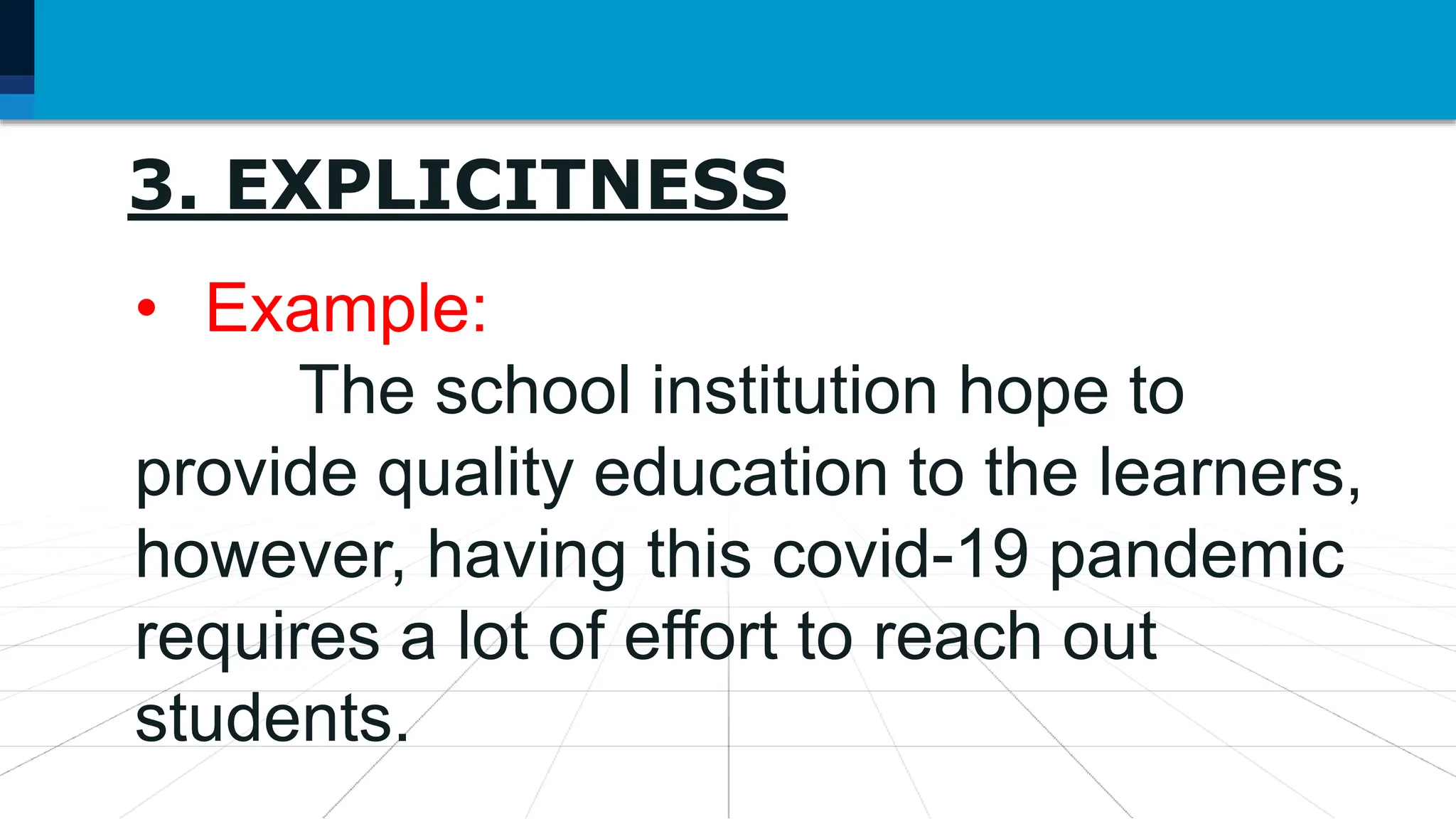
3. EXPLICITNESS
• Demandthe use of signposts that
allow the readers to trace the
relationships in the parts of the study.
• in order to show a change in your line
of arguments, make it clear by using
HOWEVER.
17.
3. EXPLICITNESS
• Example:
Theschool institution hope to
provide quality education to the learners,
however, having this covid-19 pandemic
requires a lot of effort to reach out
students.
18.
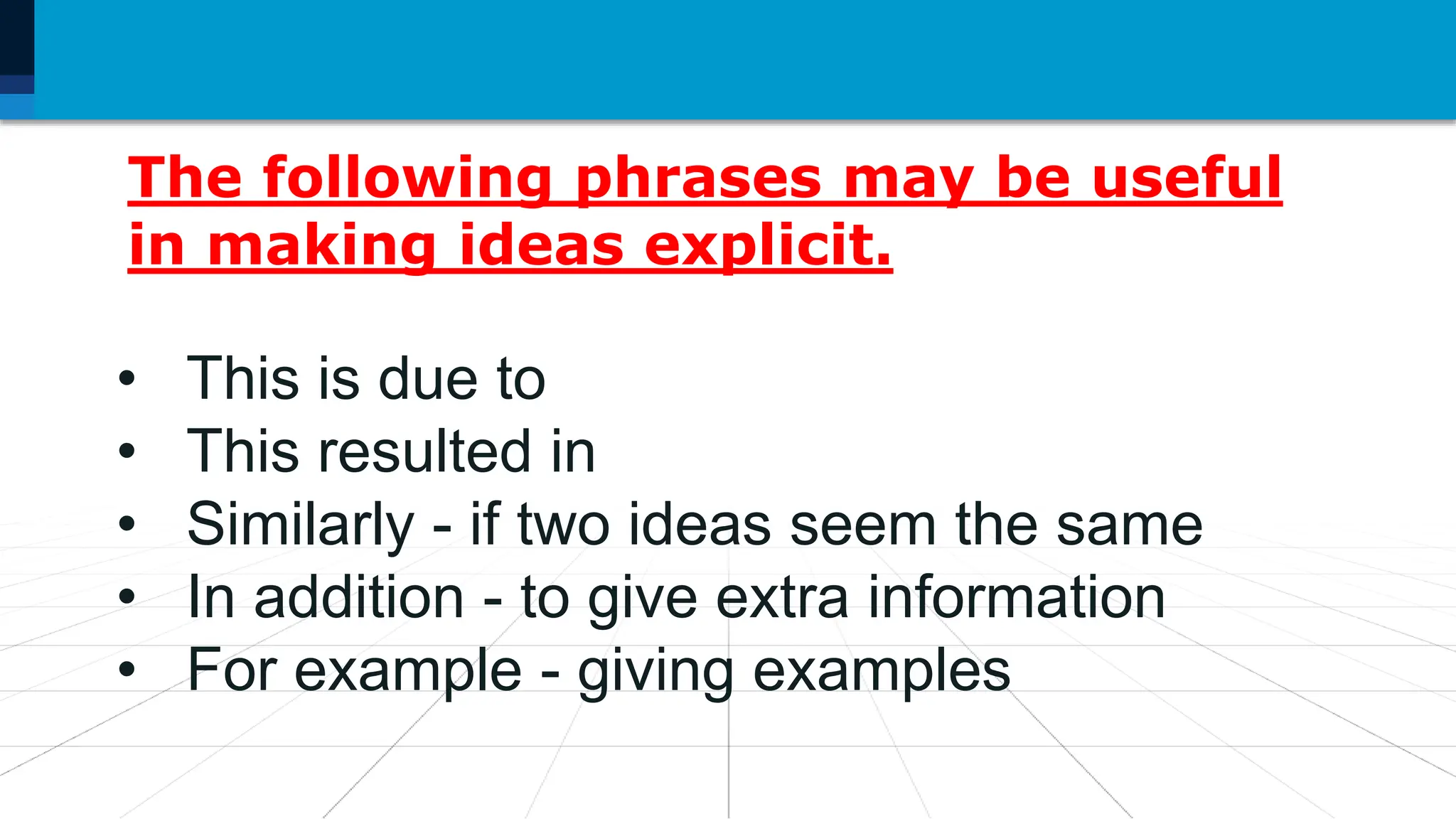
The following phrasesmay be useful
in making ideas explicit.
• This is due to
• This resulted in
• Similarly - if two ideas seem the same
• In addition - to give extra information
• For example - giving examples
19.
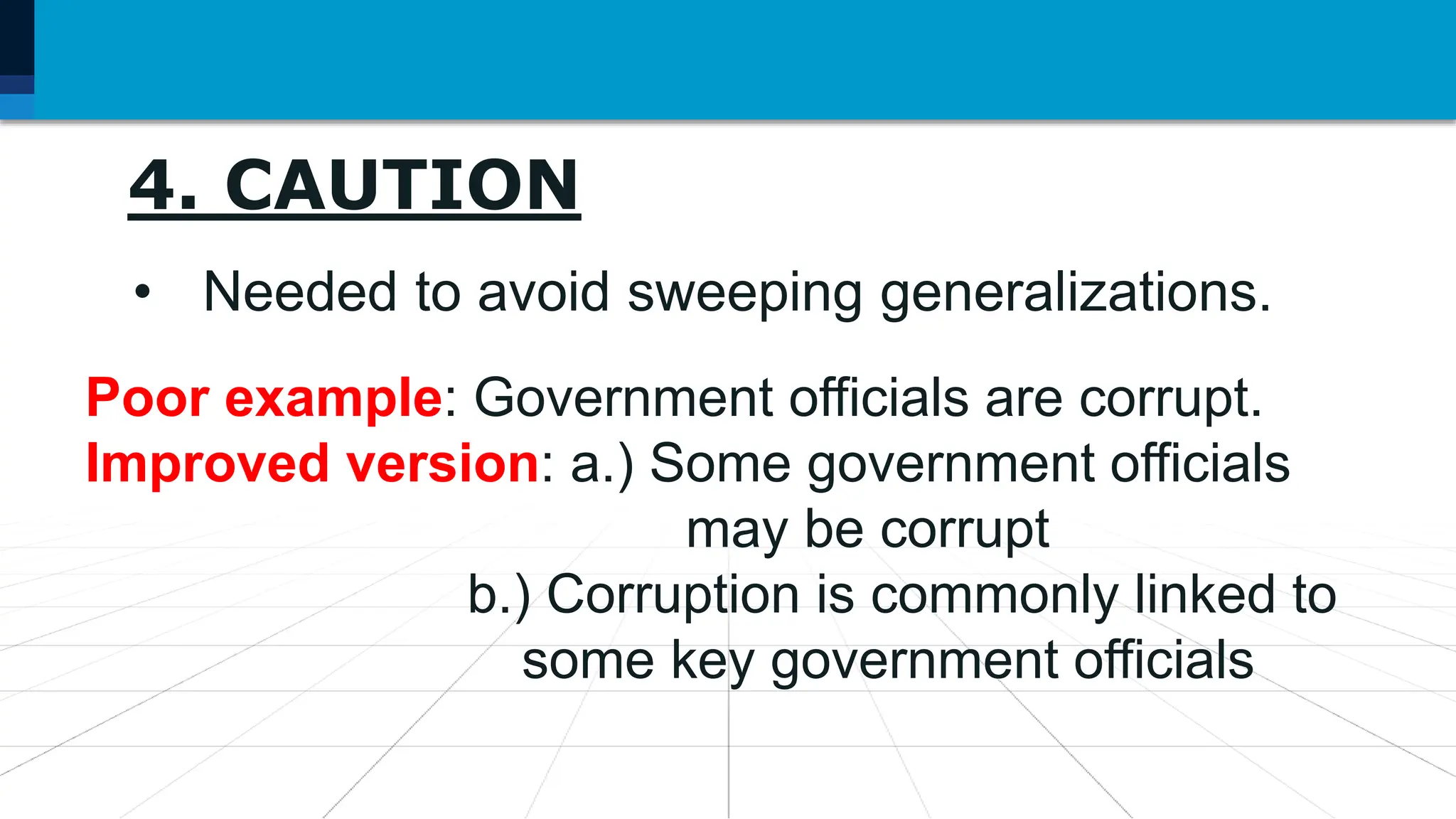
4. CAUTION
• Neededto avoid sweeping generalizations.
Poor example: Government officials are corrupt.
Improved version: a.) Some government officials
may be corrupt
b.) Corruption is commonly linked to
some key government officials
20.
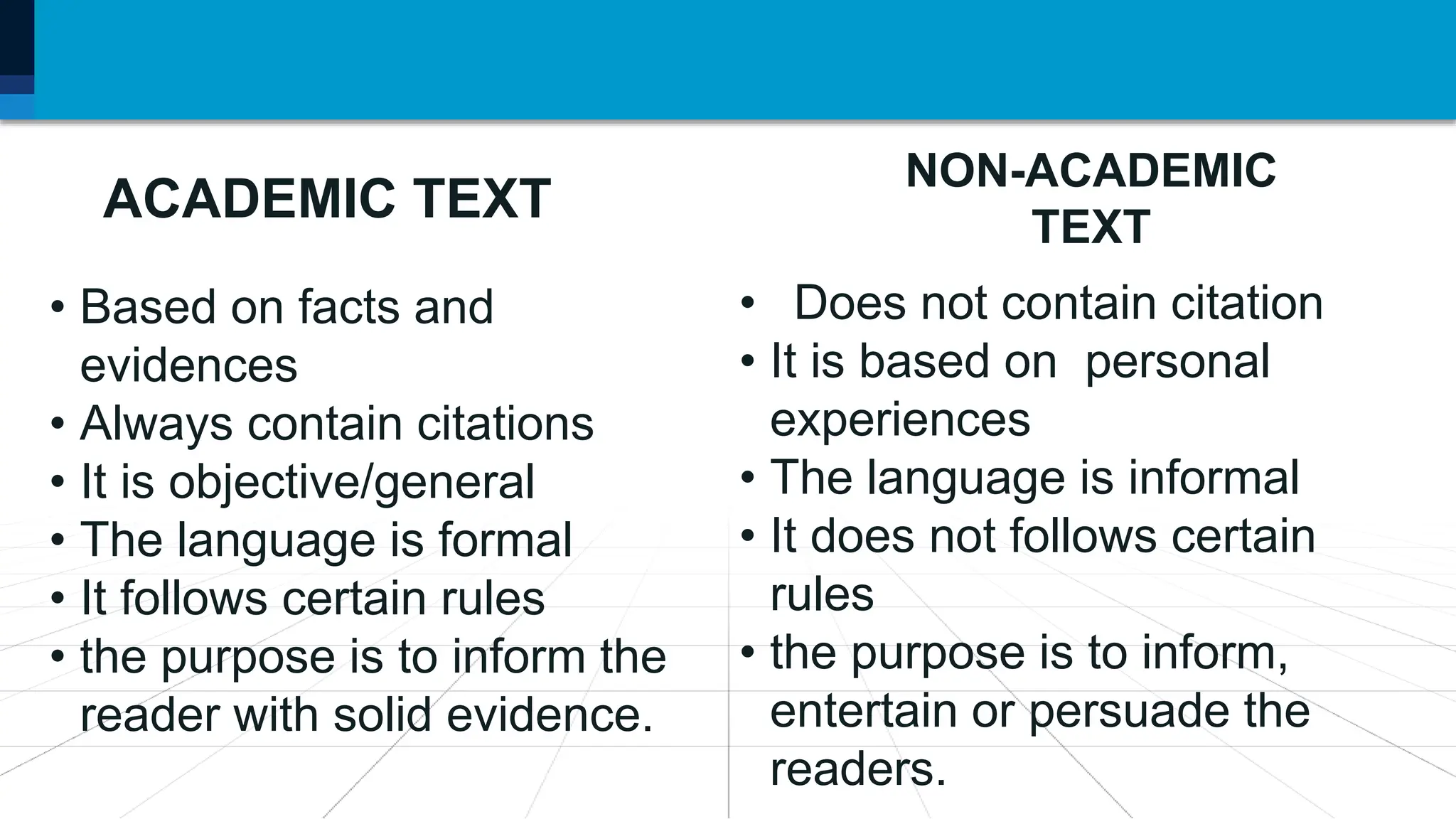
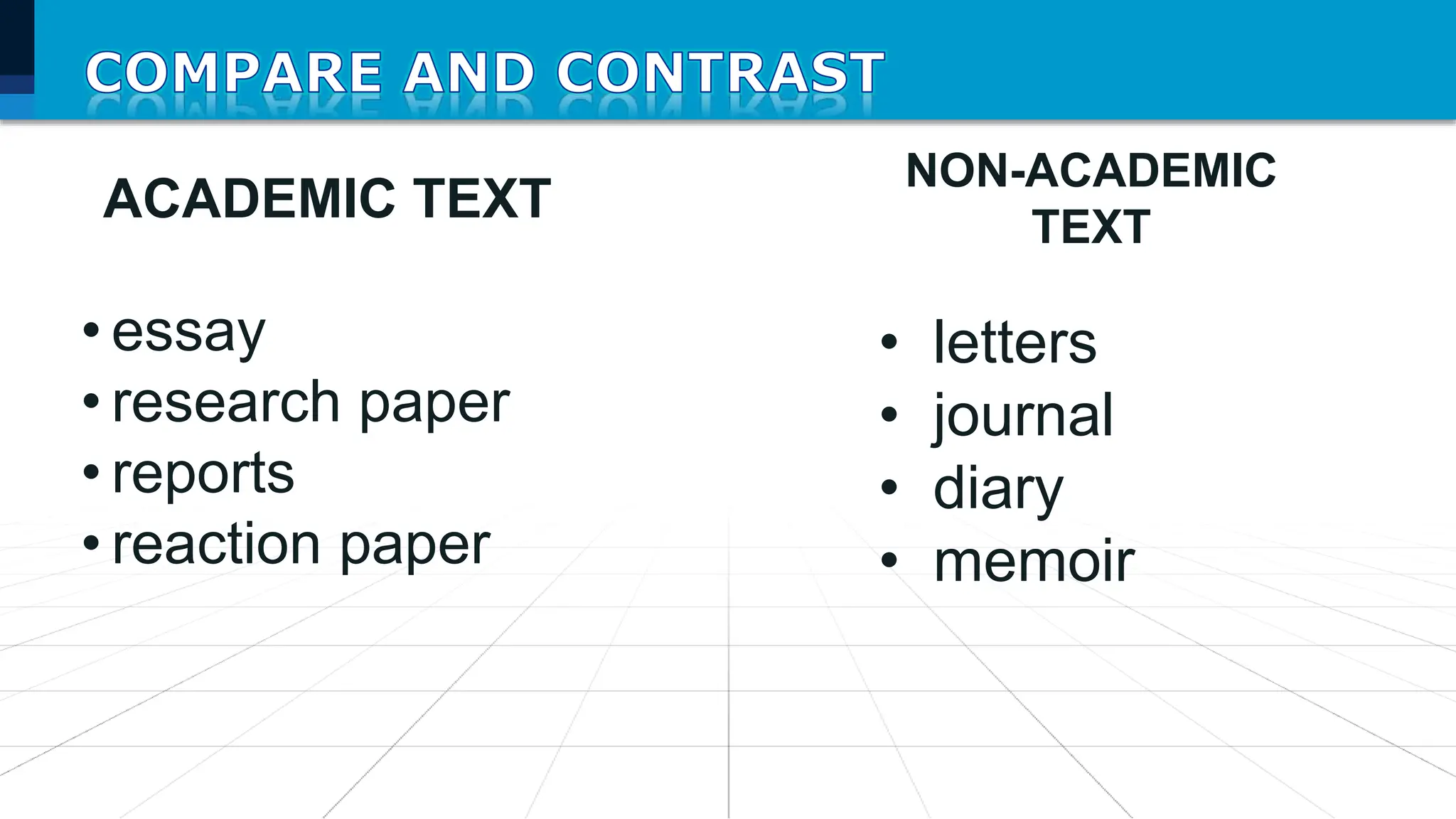
ACADEMIC TEXT
NON-ACADEMIC
TEXT
• Basedon facts and
evidences
• Always contain citations
• It is objective/general
• The language is formal
• It follows certain rules
• the purpose is to inform the
reader with solid evidence.
• Does not contain citation
• It is based on personal
experiences
• The language is informal
• It does not follows certain
rules
• the purpose is to inform,
entertain or persuade the
readers.
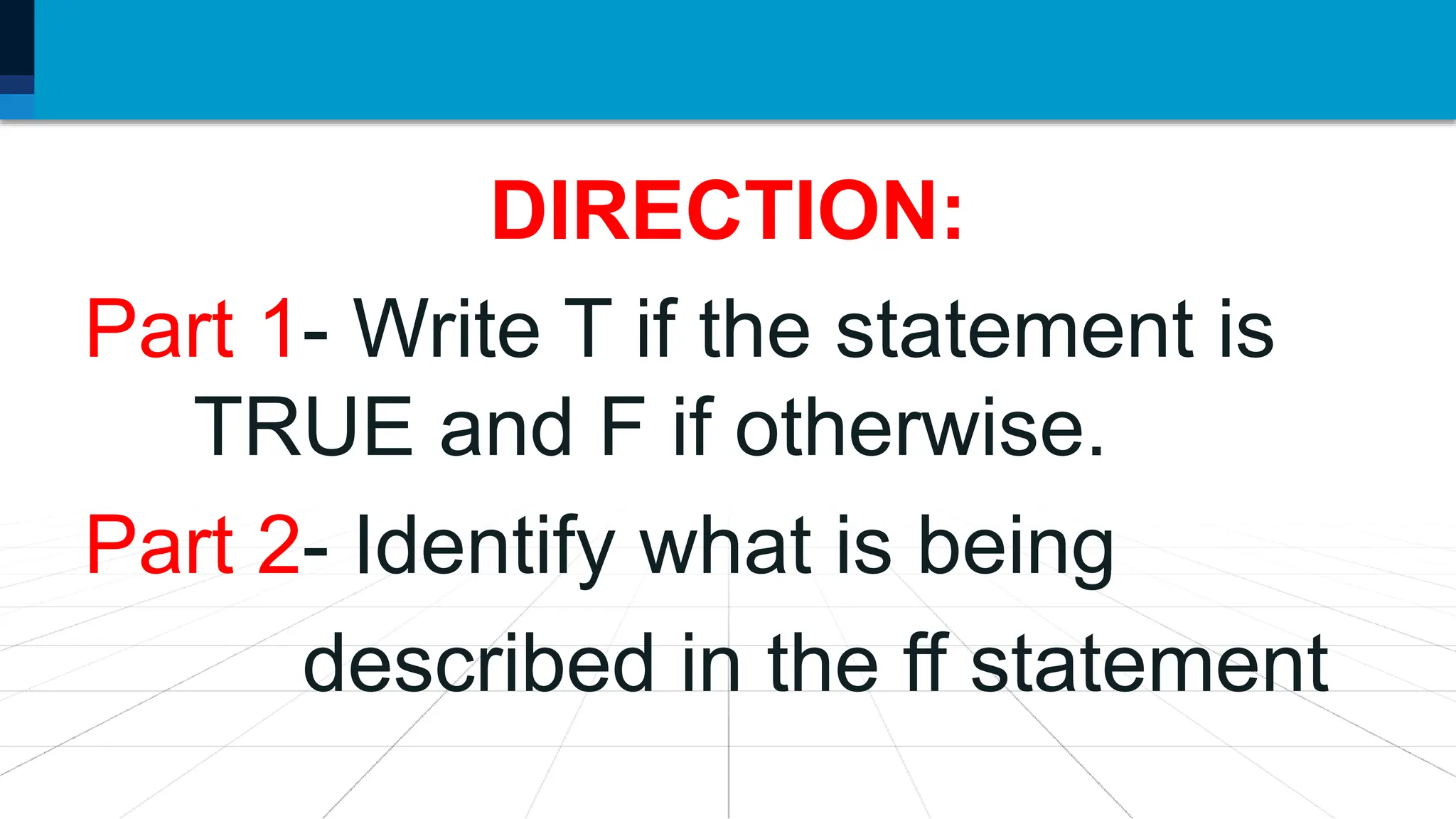
DIRECTION:
Part 1- WriteT if the statement is
TRUE and F if otherwise.
Part 2- Identify what is being
described in the ff statement
23.
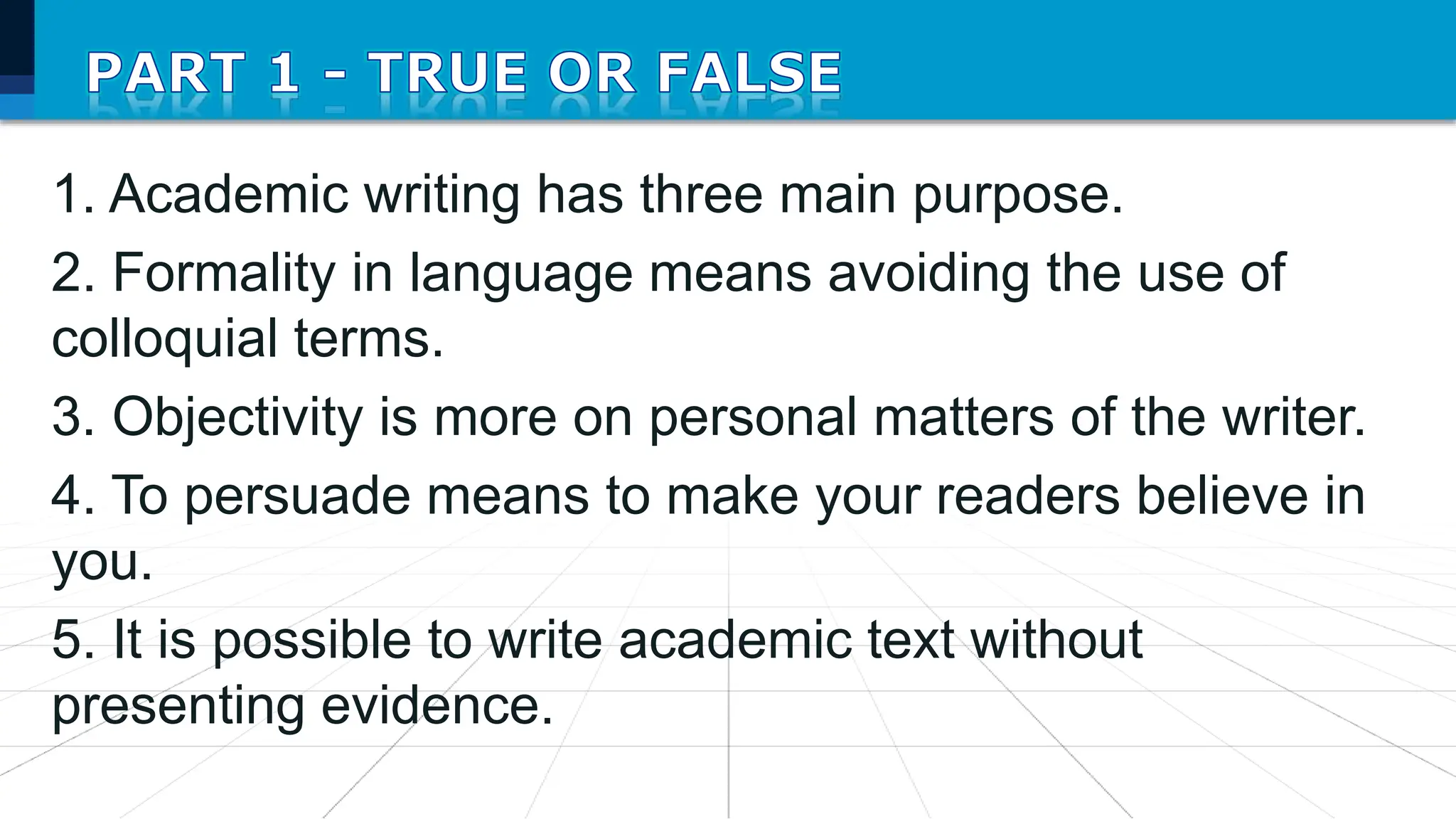
1. Academic writinghas three main purpose.
2. Formality in language means avoiding the use of
colloquial terms.
3. Objectivity is more on personal matters of the writer.
4. To persuade means to make your readers believe in
you.
5. It is possible to write academic text without
presenting evidence.
24.
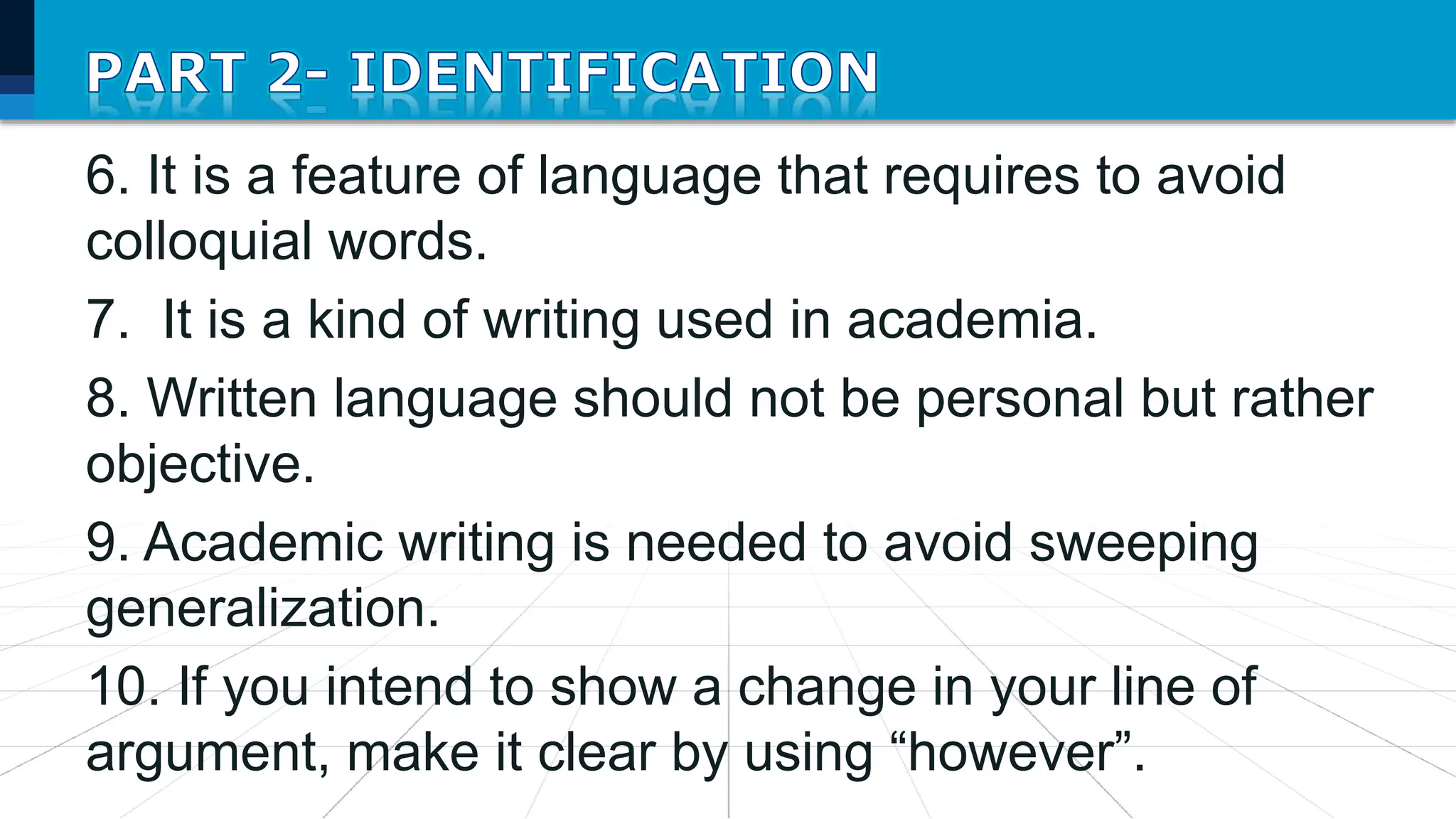
6. It isa feature of language that requires to avoid
colloquial words.
7. It is a kind of writing used in academia.
8. Written language should not be personal but rather
objective.
9. Academic writing is needed to avoid sweeping
generalization.
10. If you intend to show a change in your line of
argument, make it clear by using “however”.
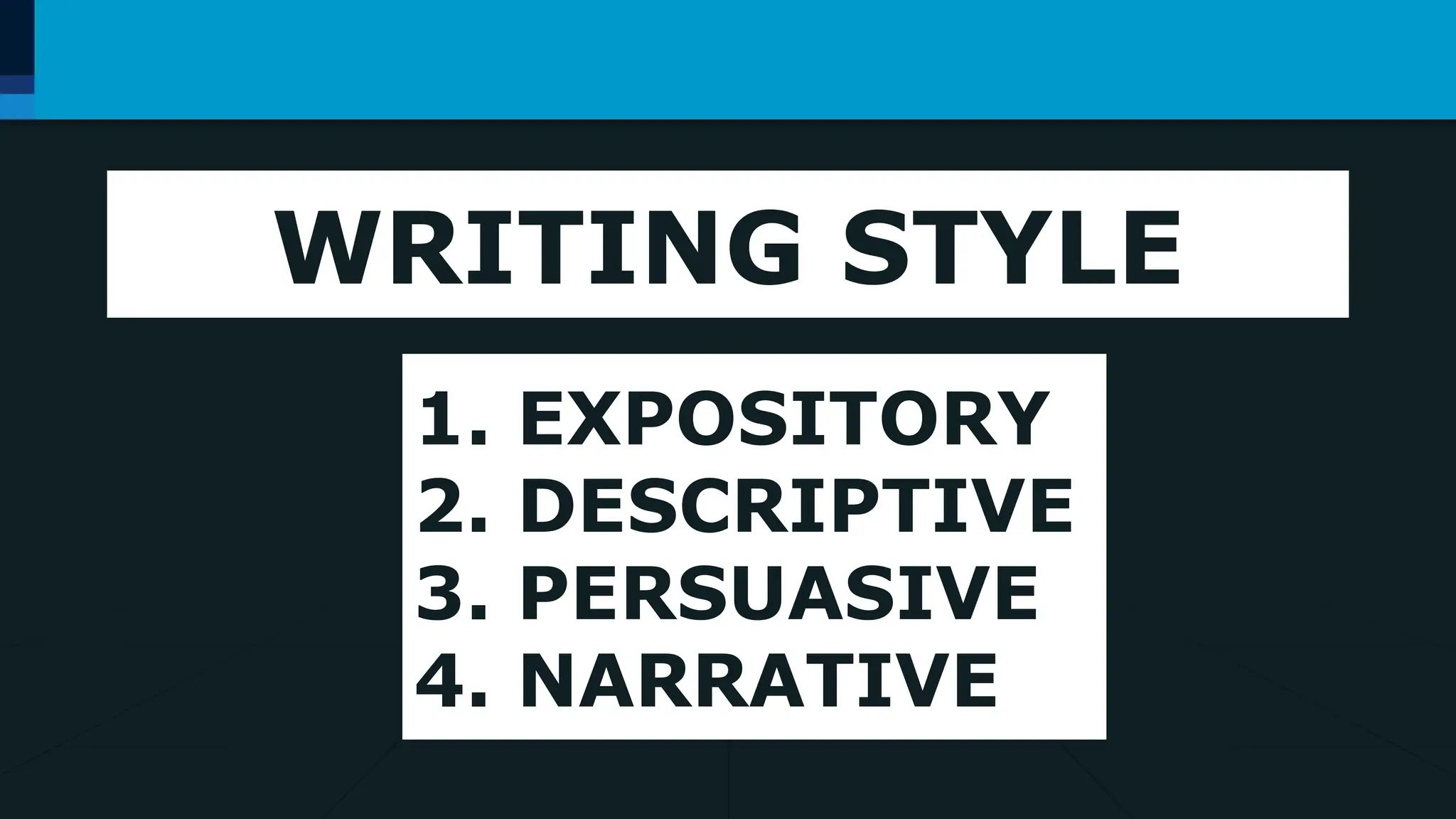
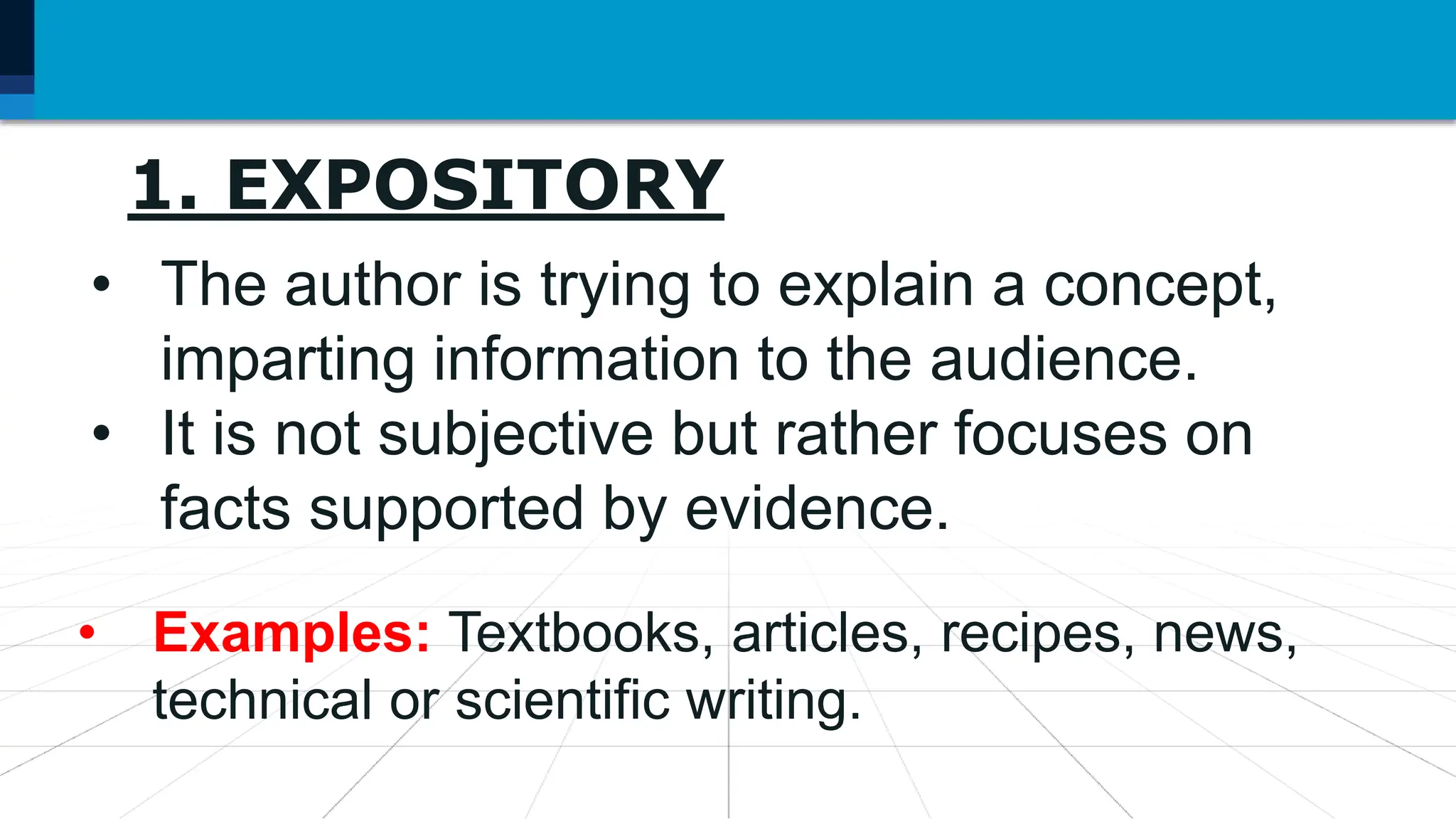
7. Language maybe used as
1. EXPOSITORY
• The author is trying to explain a concept,
imparting information to the audience.
• It is not subjective but rather focuses on
facts supported by evidence.
• Examples: Textbooks, articles, recipes, news,
technical or scientific writing.
27.
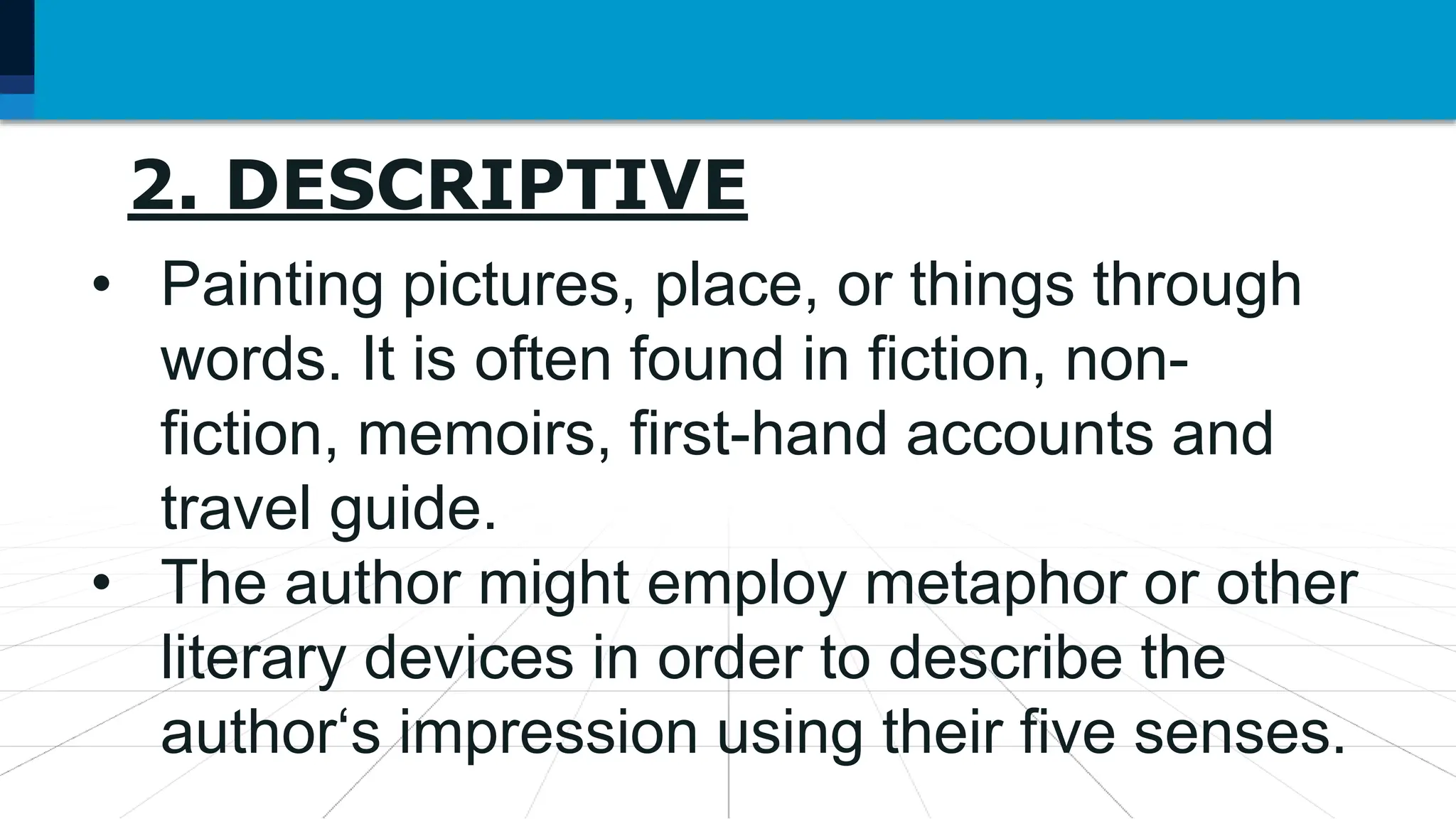
7. Language maybe used as
2. DESCRIPTIVE
• Painting pictures, place, or things through
words. It is often found in fiction, non-
fiction, memoirs, first-hand accounts and
travel guide.
• The author might employ metaphor or other
literary devices in order to describe the
author‘s impression using their five senses.
28.
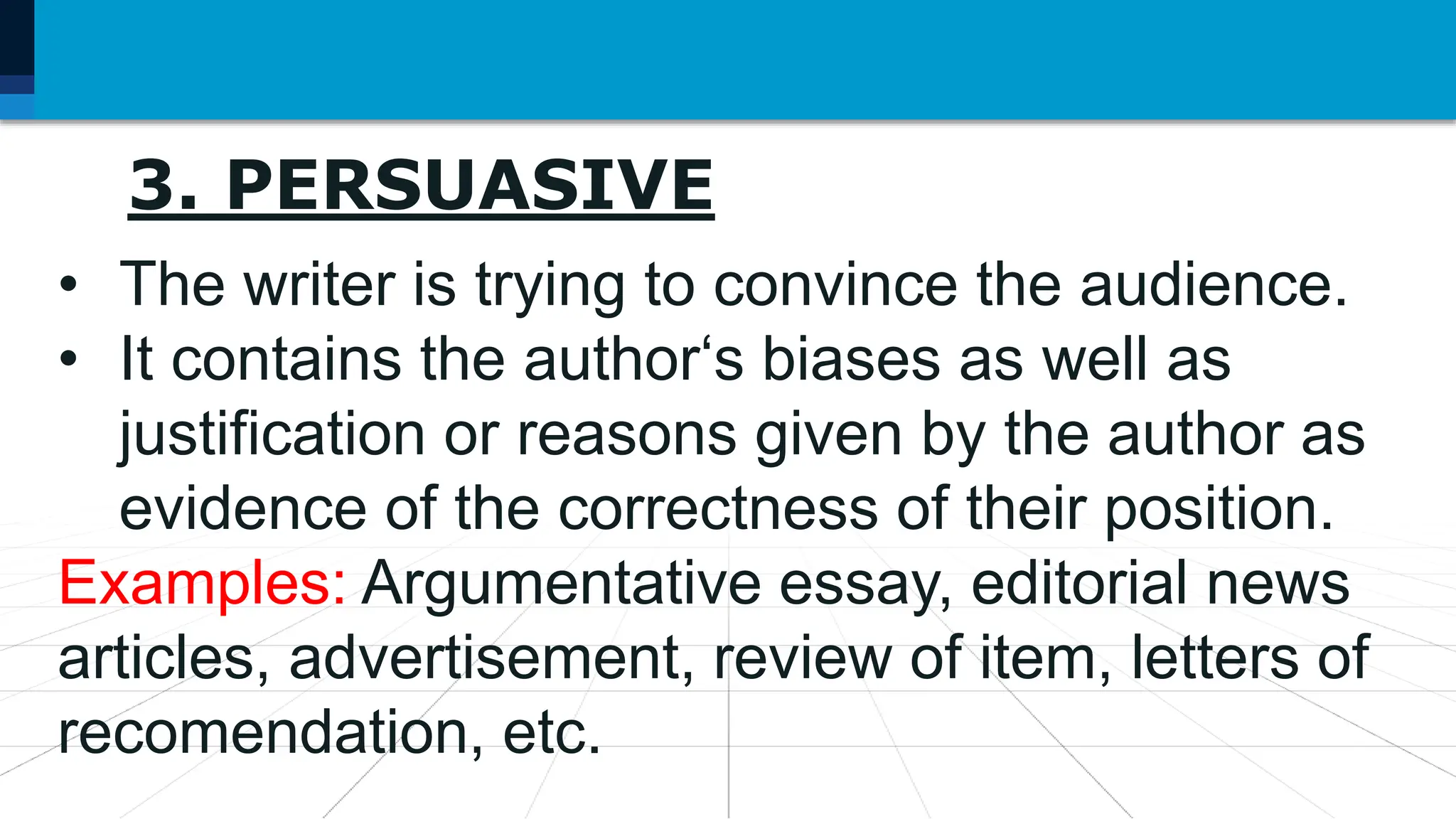
7. Language maybe used as
3. PERSUASIVE
• The writer is trying to convince the audience.
• It contains the author‘s biases as well as
justification or reasons given by the author as
evidence of the correctness of their position.
Examples: Argumentative essay, editorial news
articles, advertisement, review of item, letters of
recomendation, etc.
29.
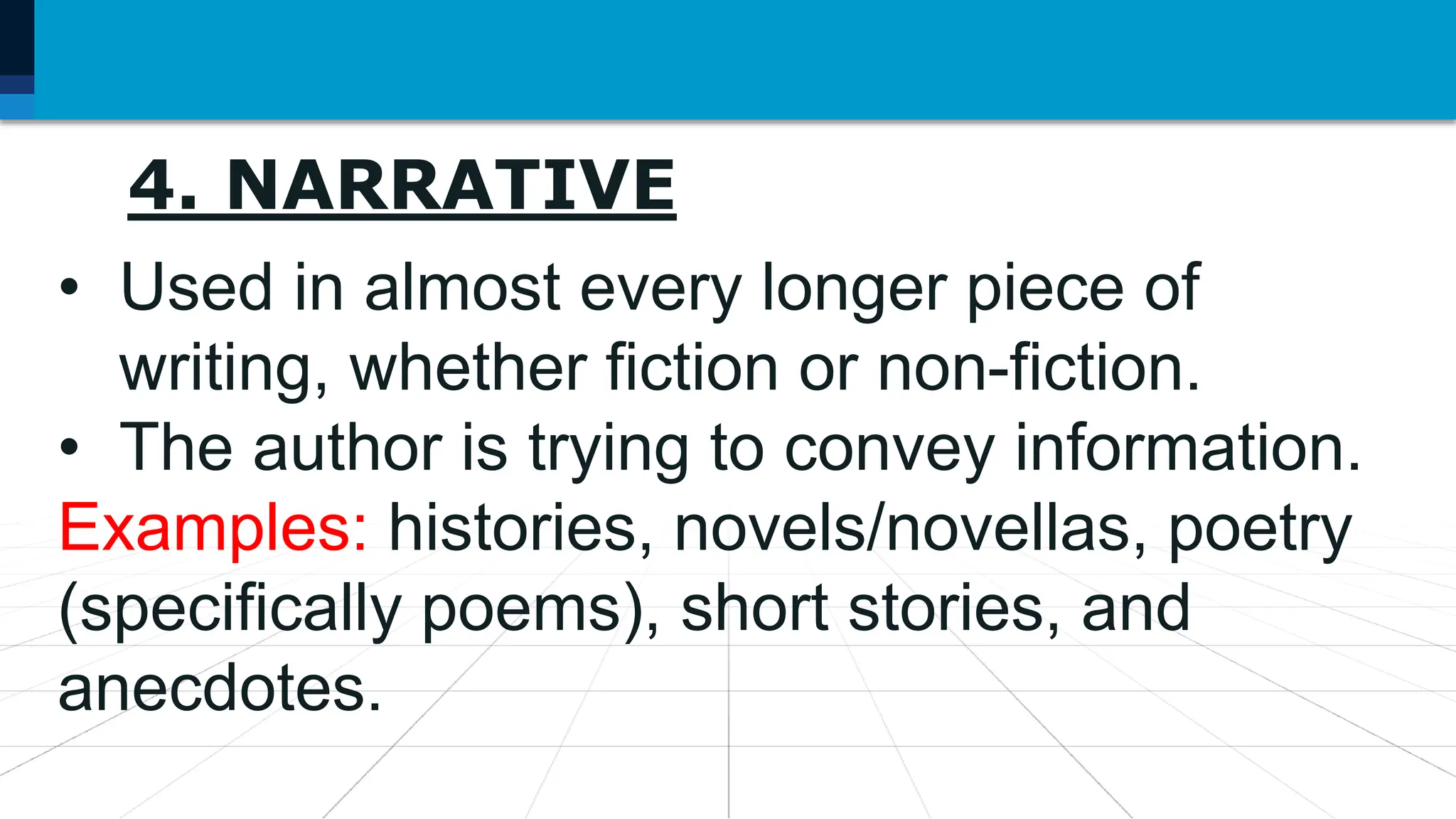
7. Language maybe used as
4. NARRATIVE
• Used in almost every longer piece of
writing, whether fiction or non-fiction.
• The author is trying to convey information.
Examples: histories, novels/novellas, poetry
(specifically poems), short stories, and
anecdotes.
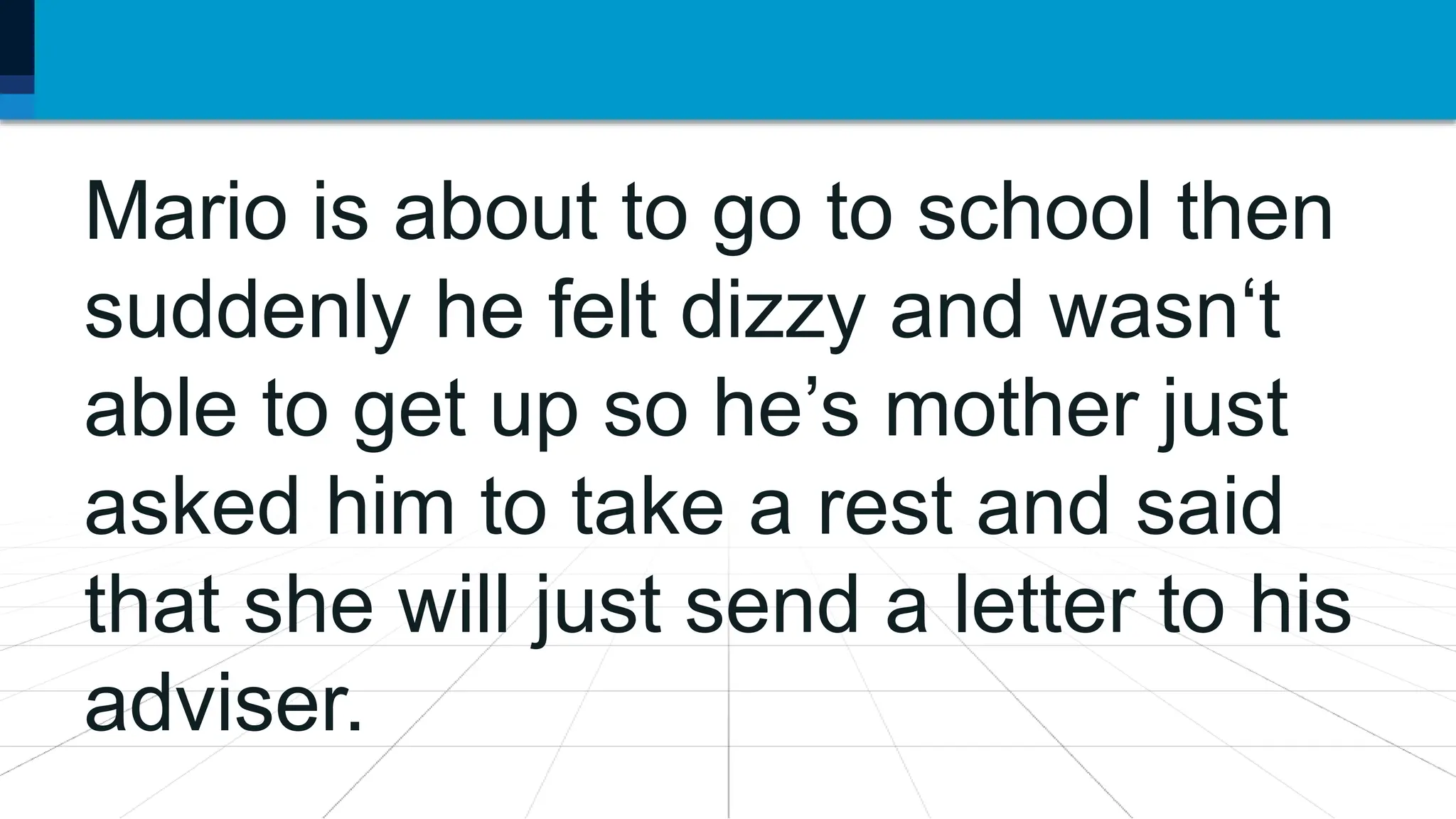
30.
Mario is aboutto go to school then
suddenly he felt dizzy and wasn‘t
able to get up so he’s mother just
asked him to take a rest and said
that she will just send a letter to his
adviser.
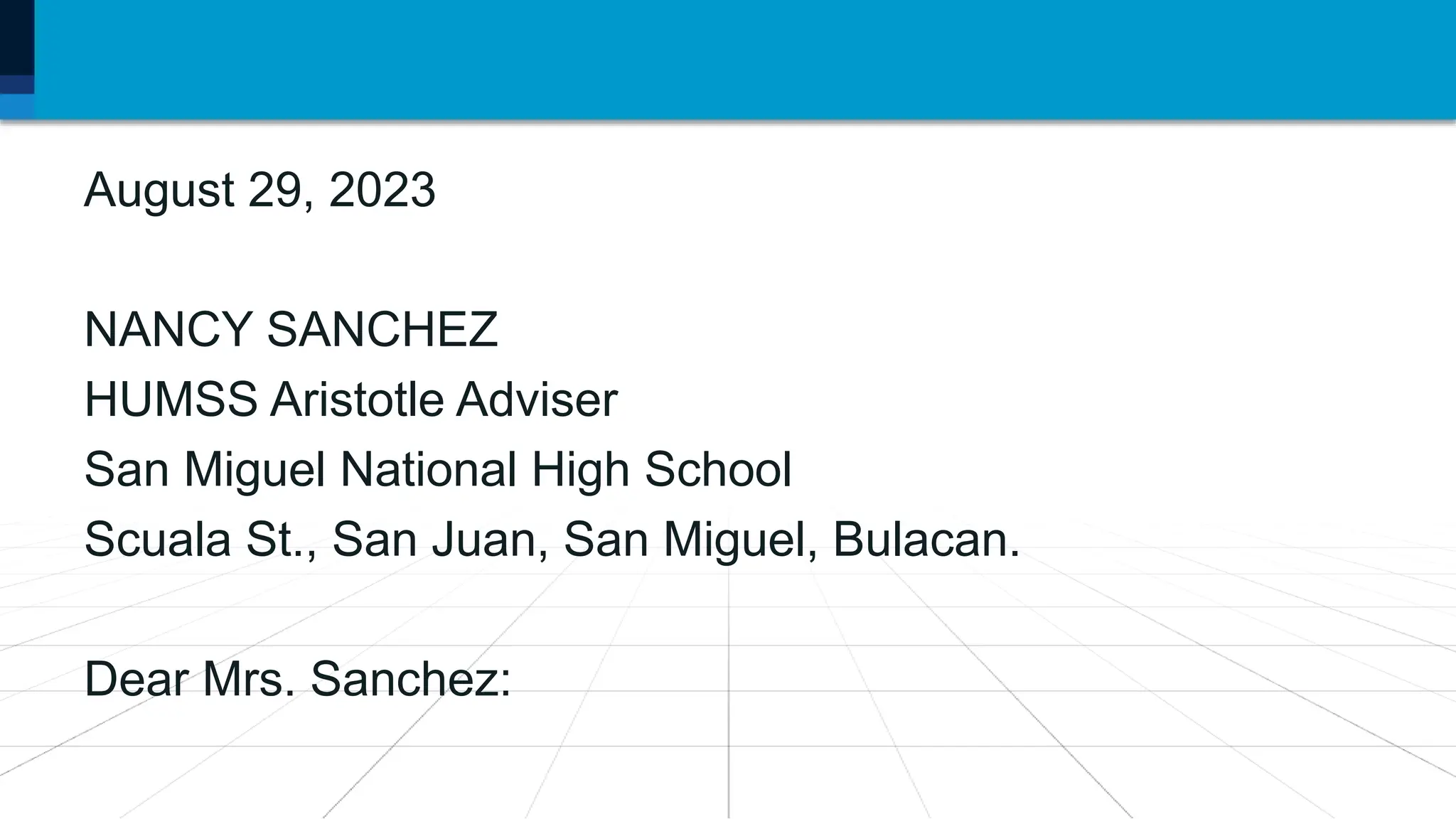
31.
August 29, 2023
NANCYSANCHEZ
HUMSS Aristotle Adviser
San Miguel National High School
Scuala St., San Juan, San Miguel, Bulacan.
Dear Mrs. Sanchez:
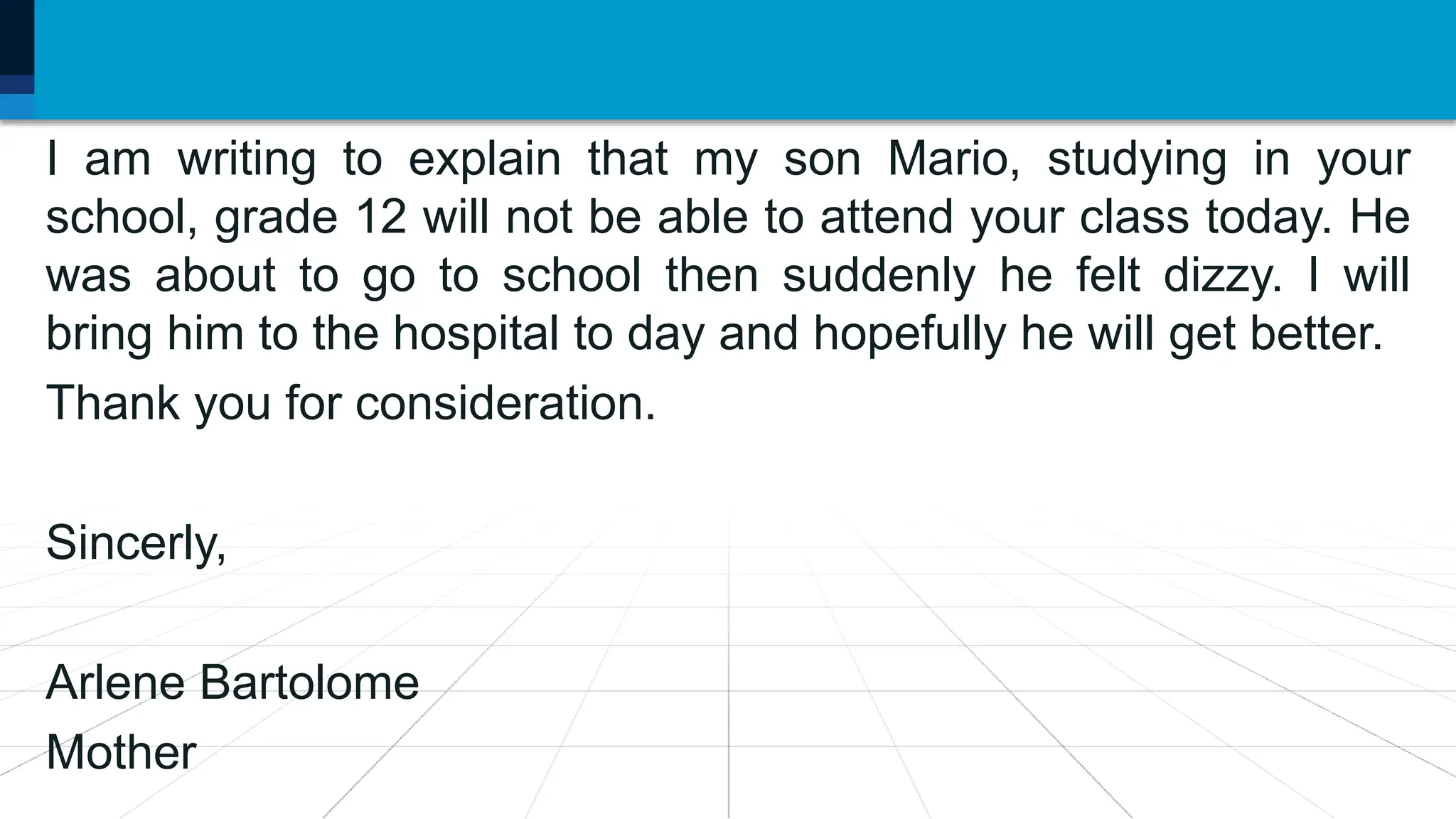
32.
I am writingto explain that my son Mario, studying in your
school, grade 12 will not be able to attend your class today. He
was about to go to school then suddenly he felt dizzy. I will
bring him to the hospital to day and hopefully he will get better.
Thank you for consideration.
Sincerly,
Arlene Bartolome
Mother
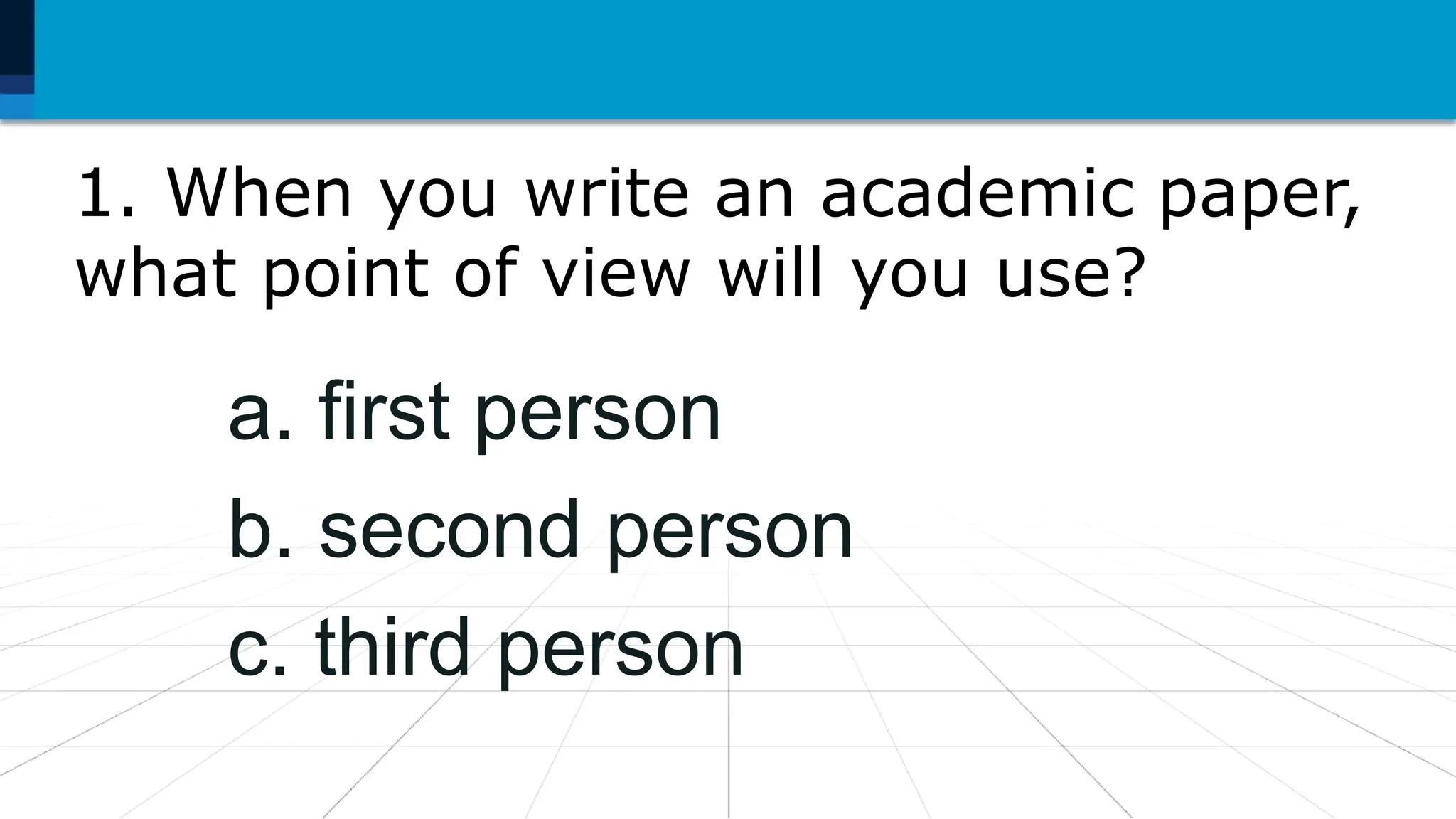
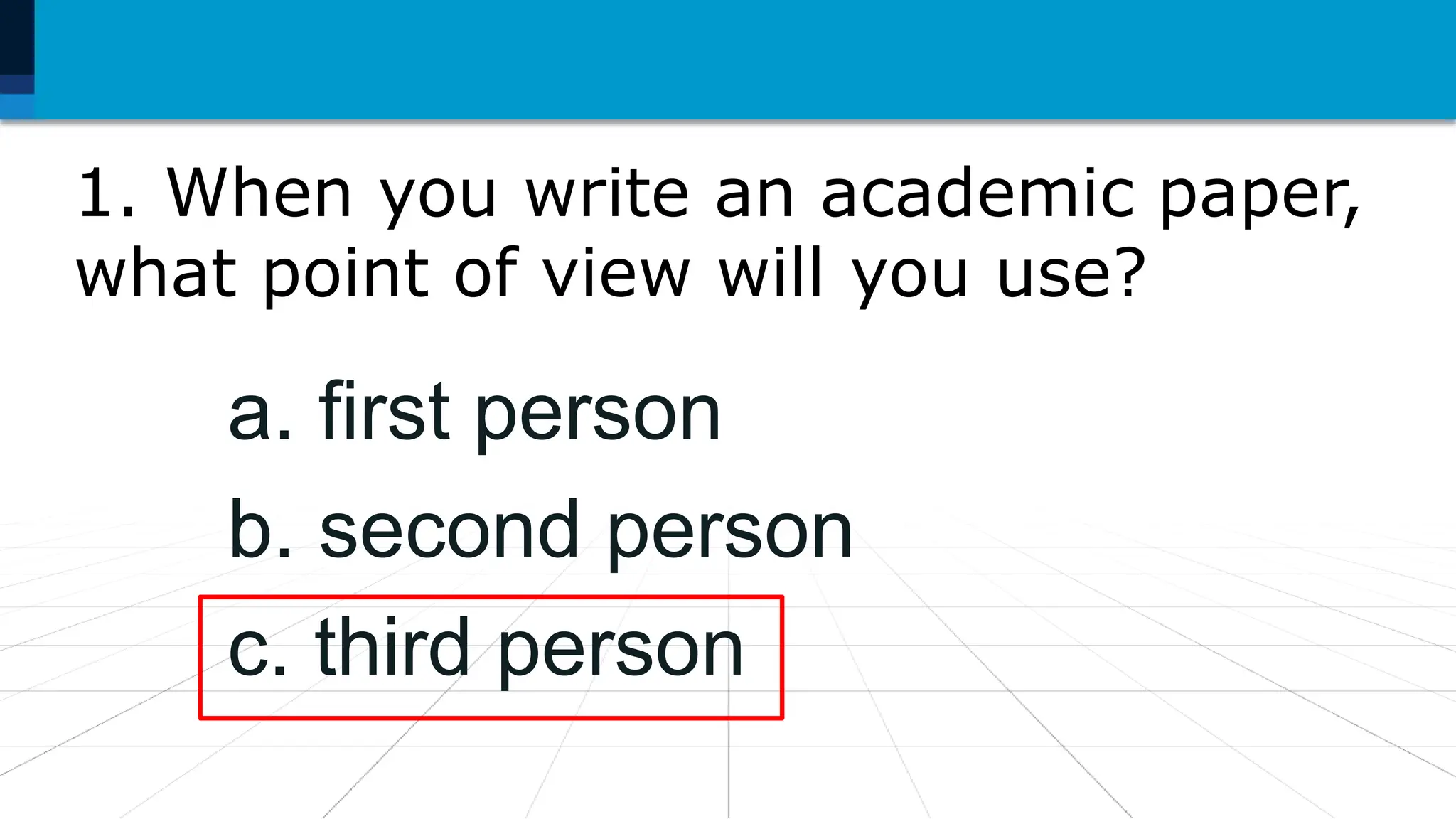
1. When youwrite an academic paper,
what point of view will you use?
a. first person
b. second person
c. third person
35.
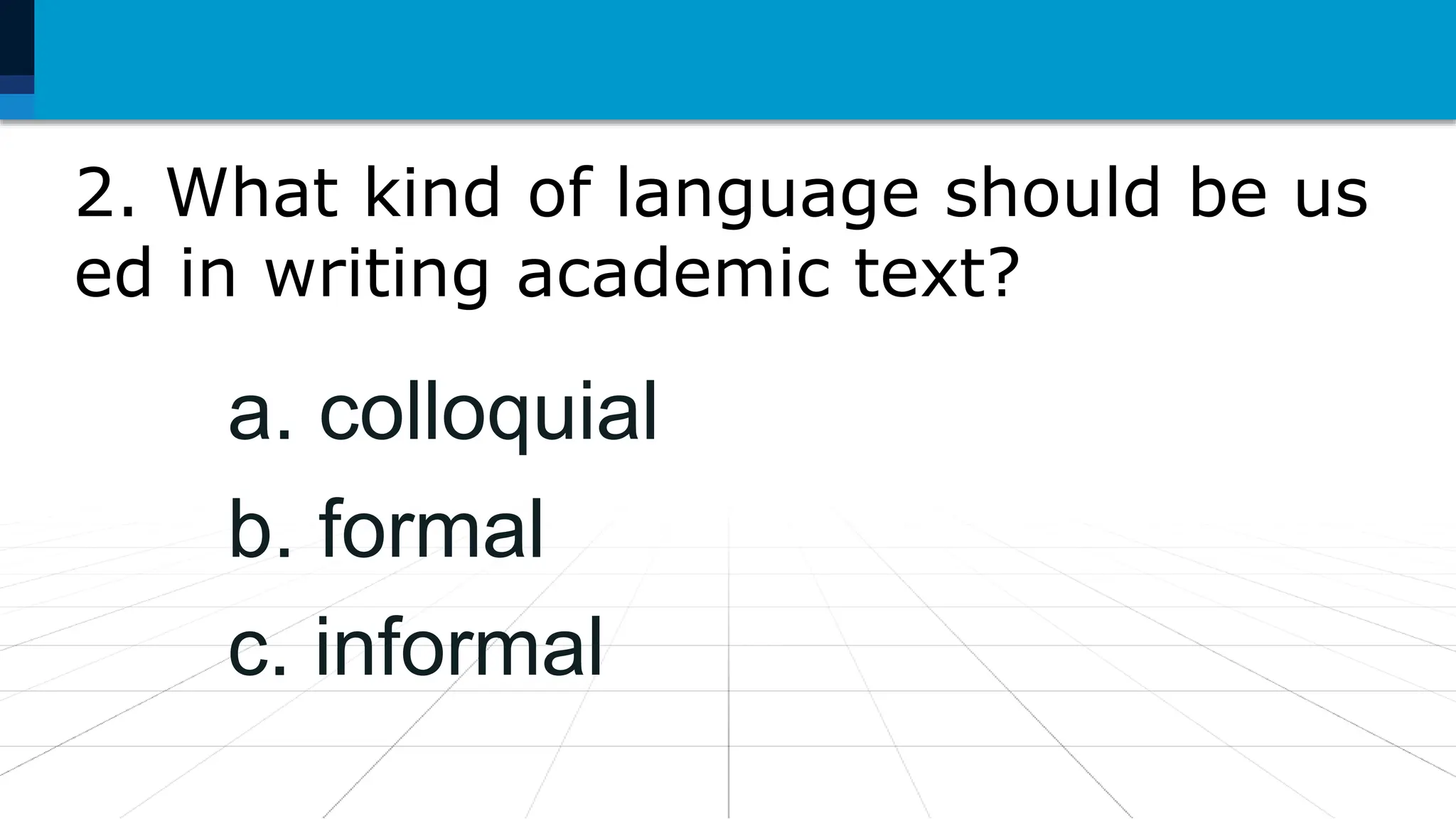
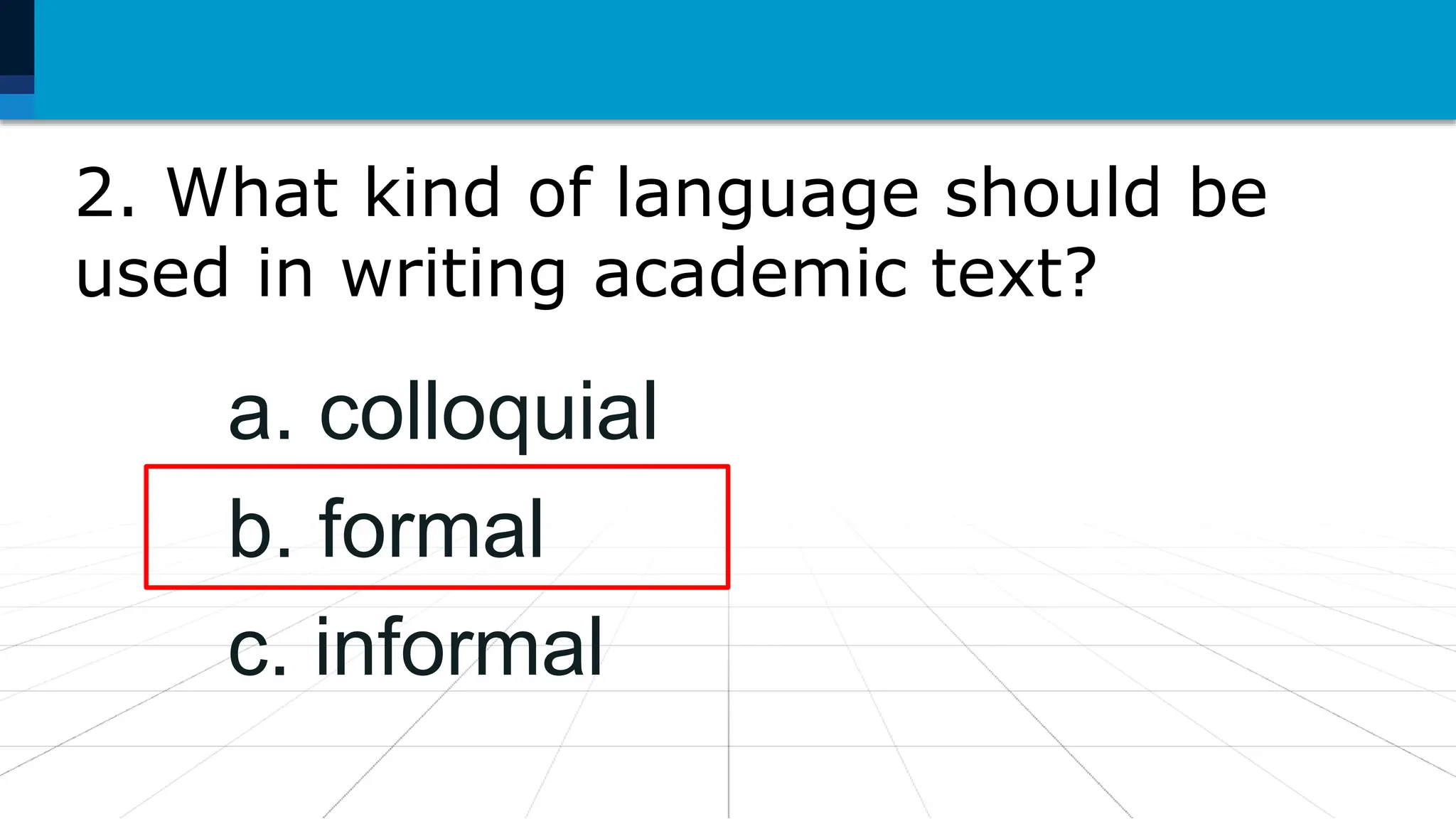
2. What kindof language should be us
ed in writing academic text?
a. colloquial
b. formal
c. informal
36.
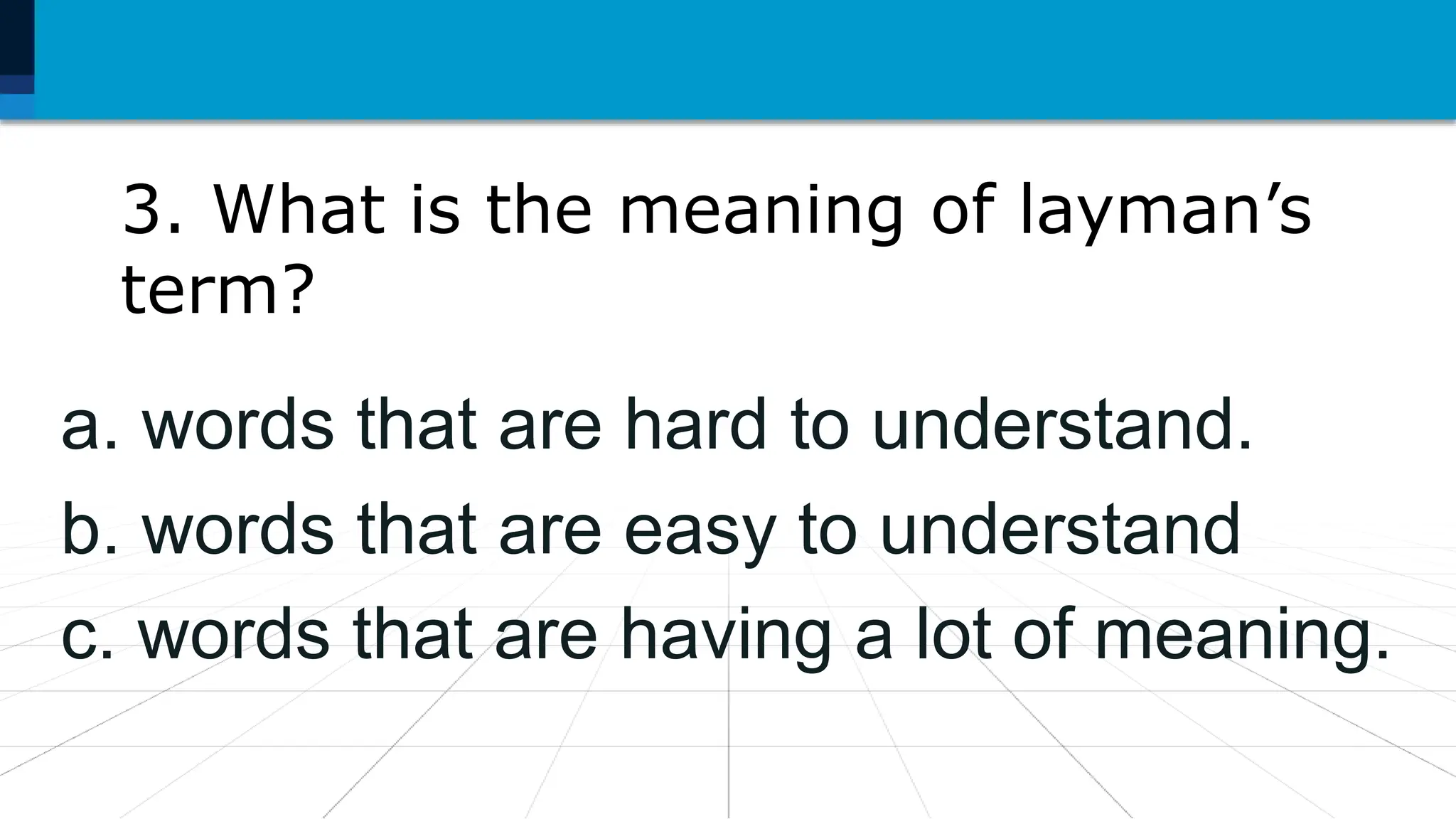
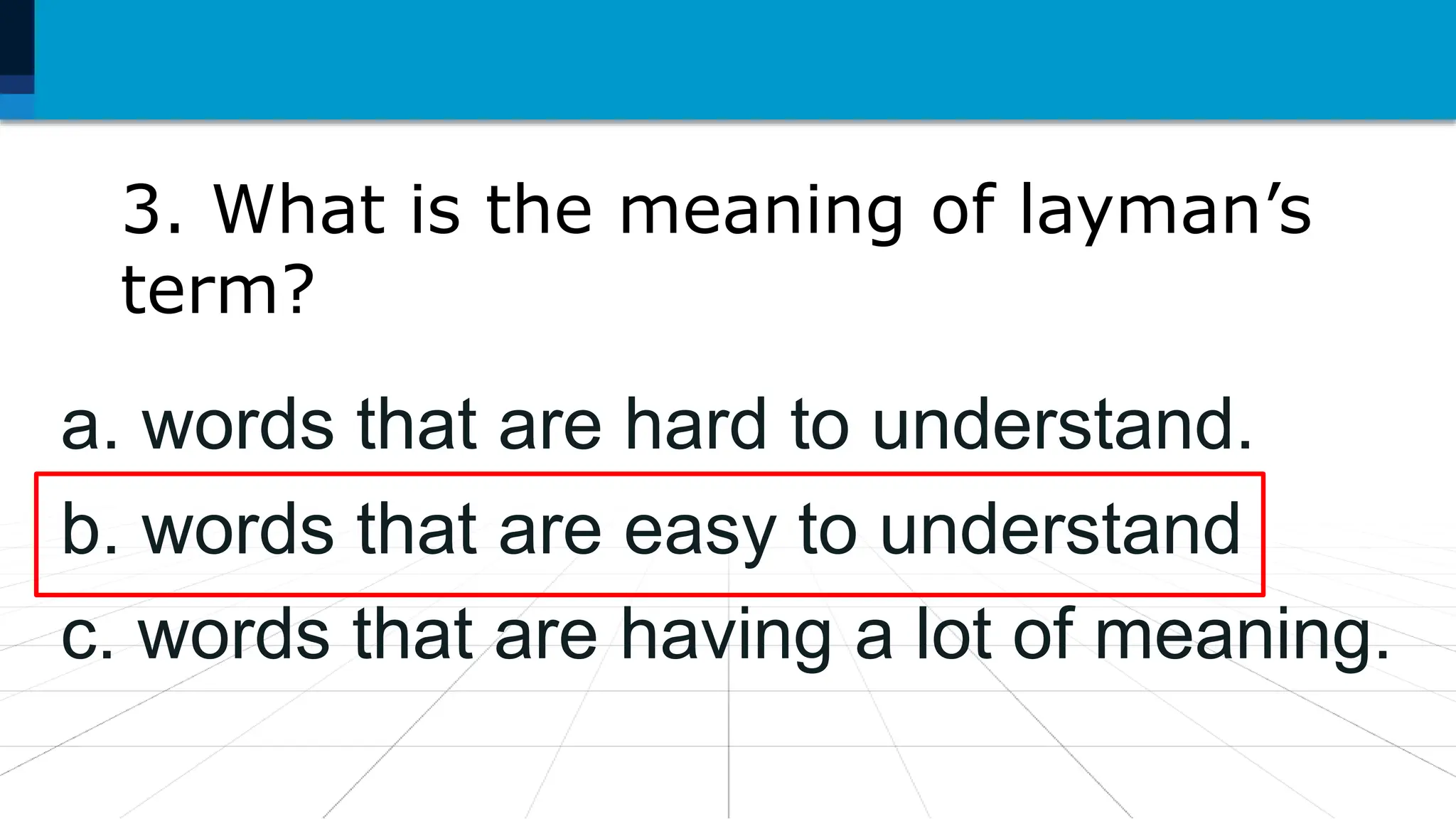
3. What isthe meaning of layman’s
term?
a. words that are hard to understand.
b. words that are easy to understand
c. words that are having a lot of meaning.
37.
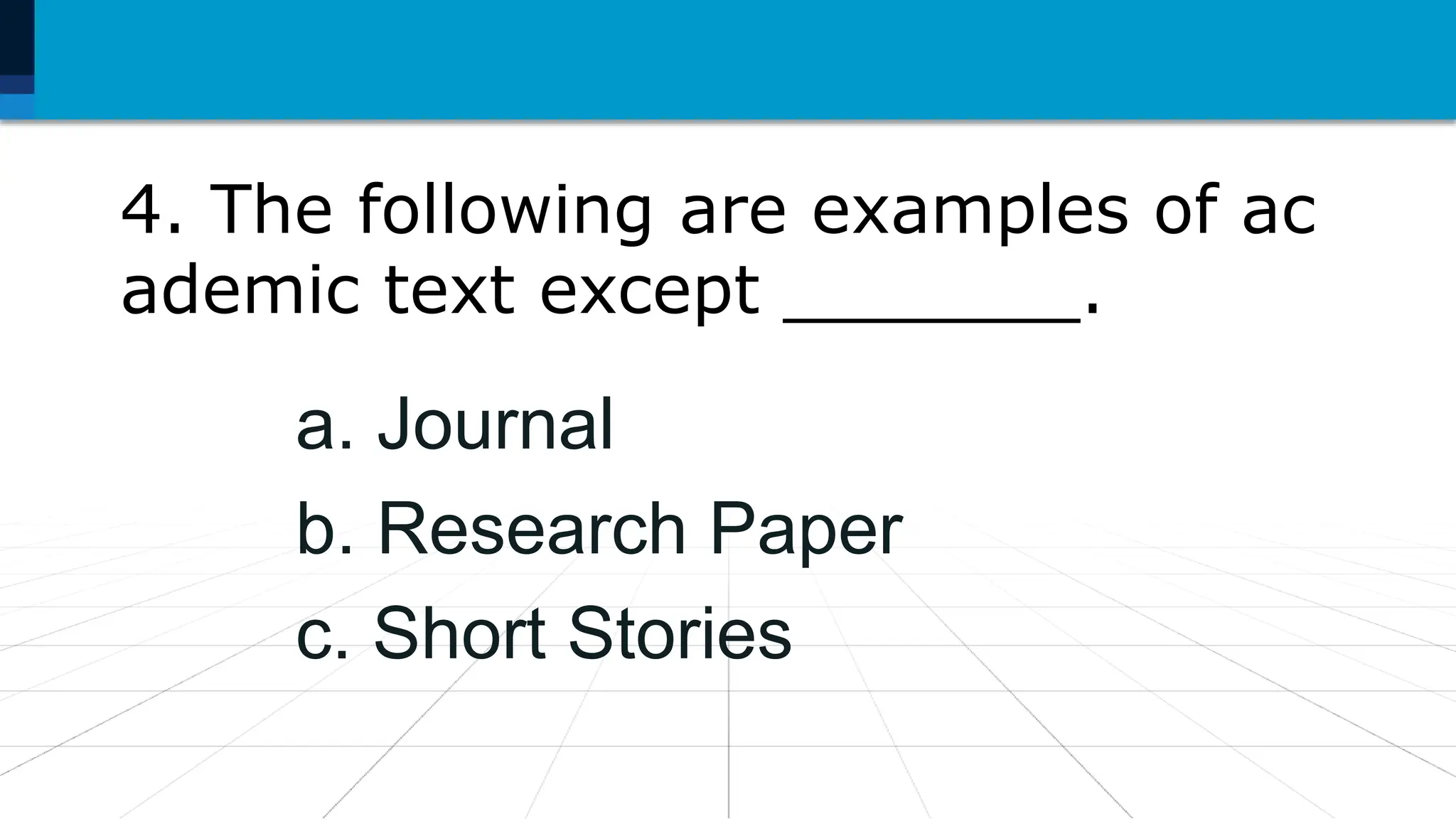
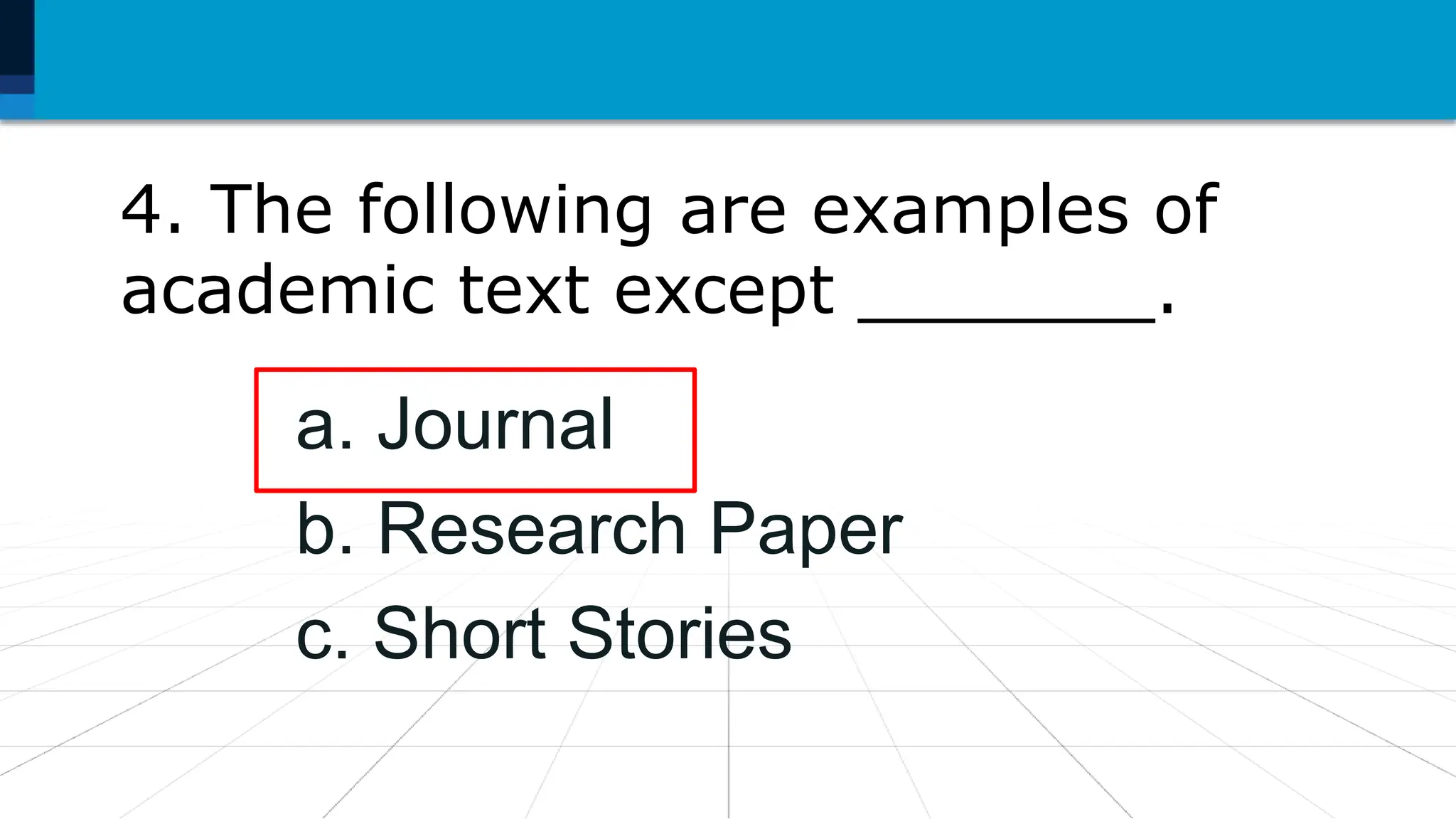
4. The followingare examples of ac
ademic text except _______.
a. Journal
b. Research Paper
c. Short Stories
38.
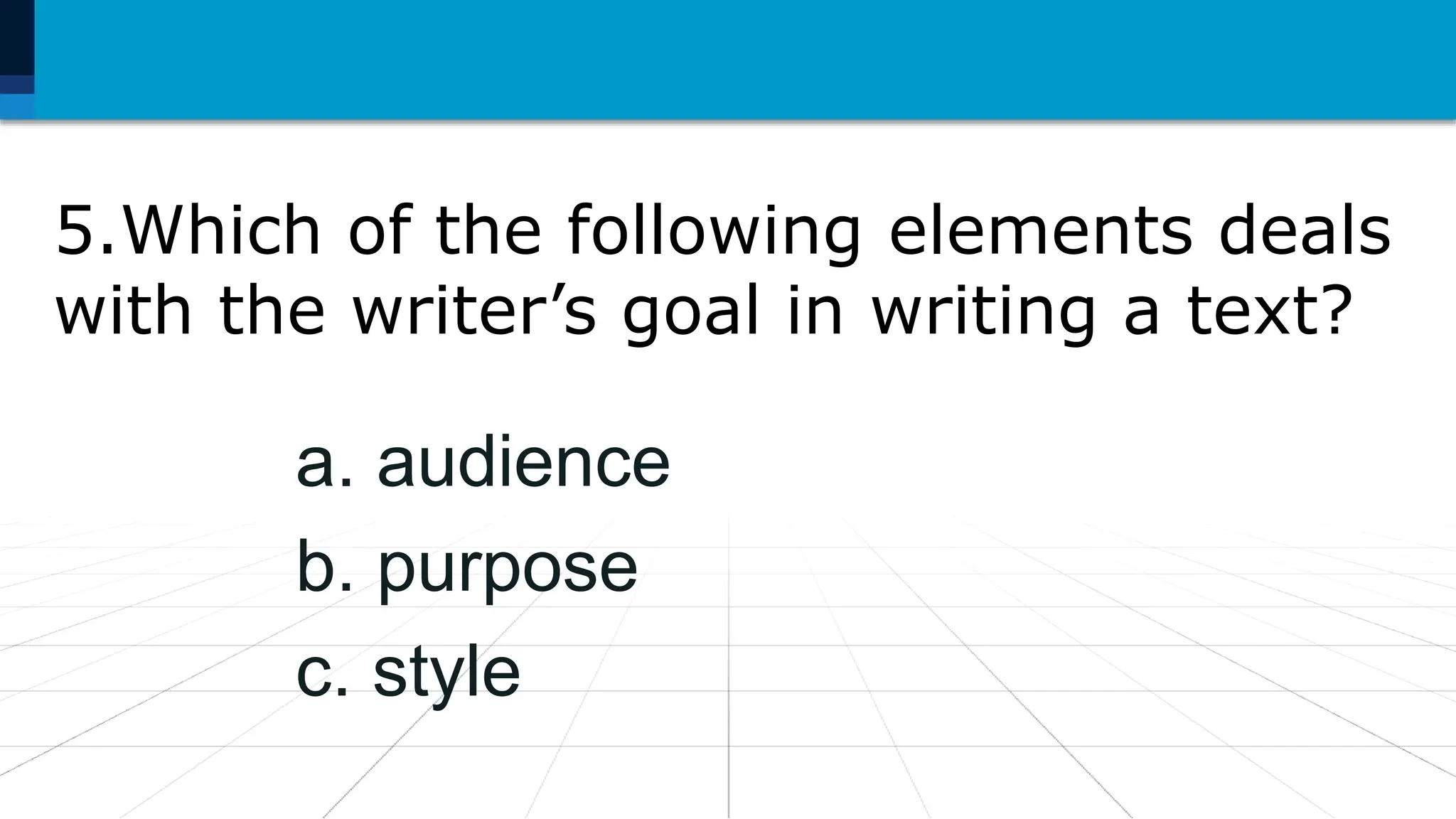
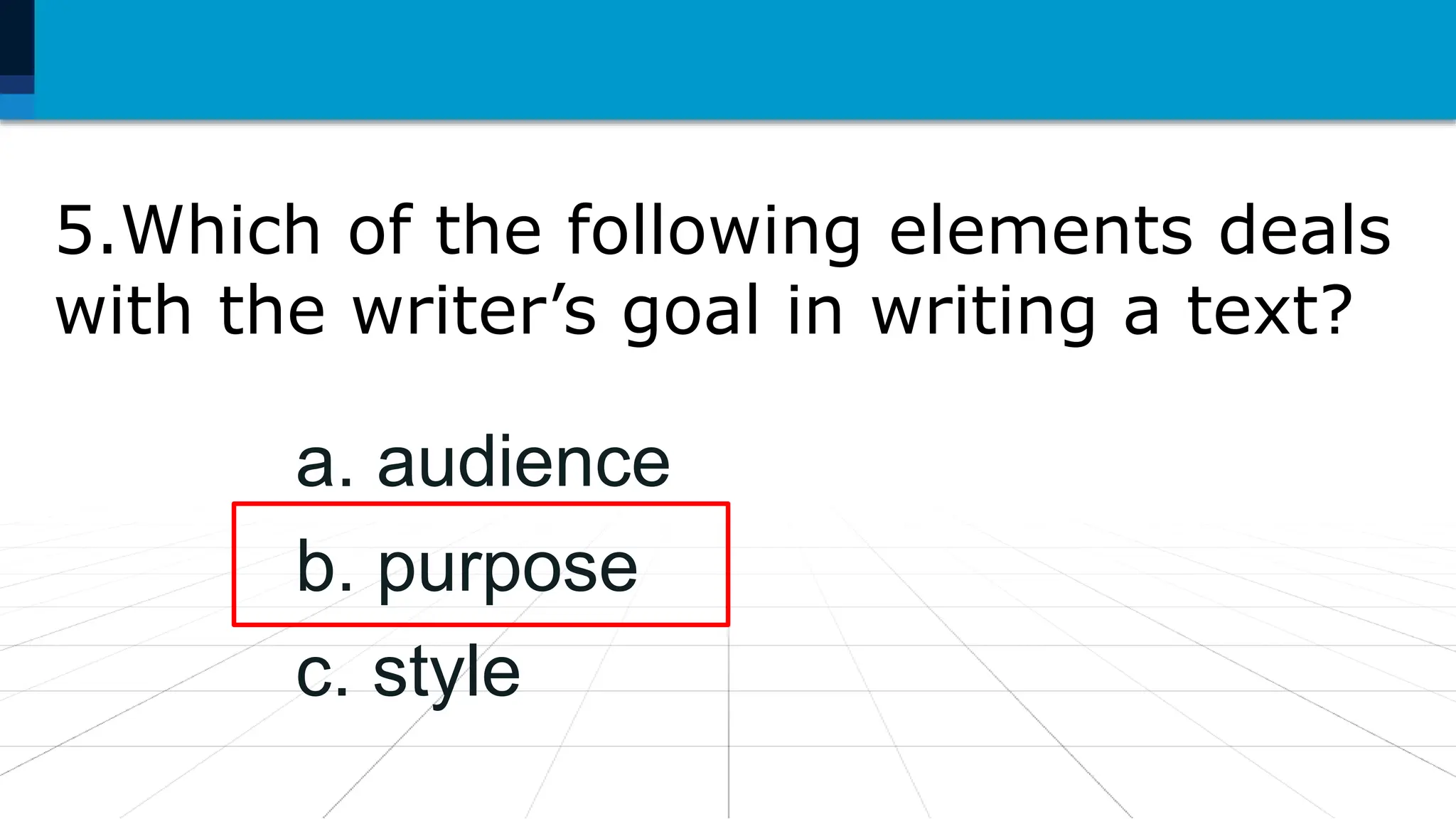
5.Which of thefollowing elements deals
with the writer’s goal in writing a text?
a. audience
b. purpose
c. style
39.
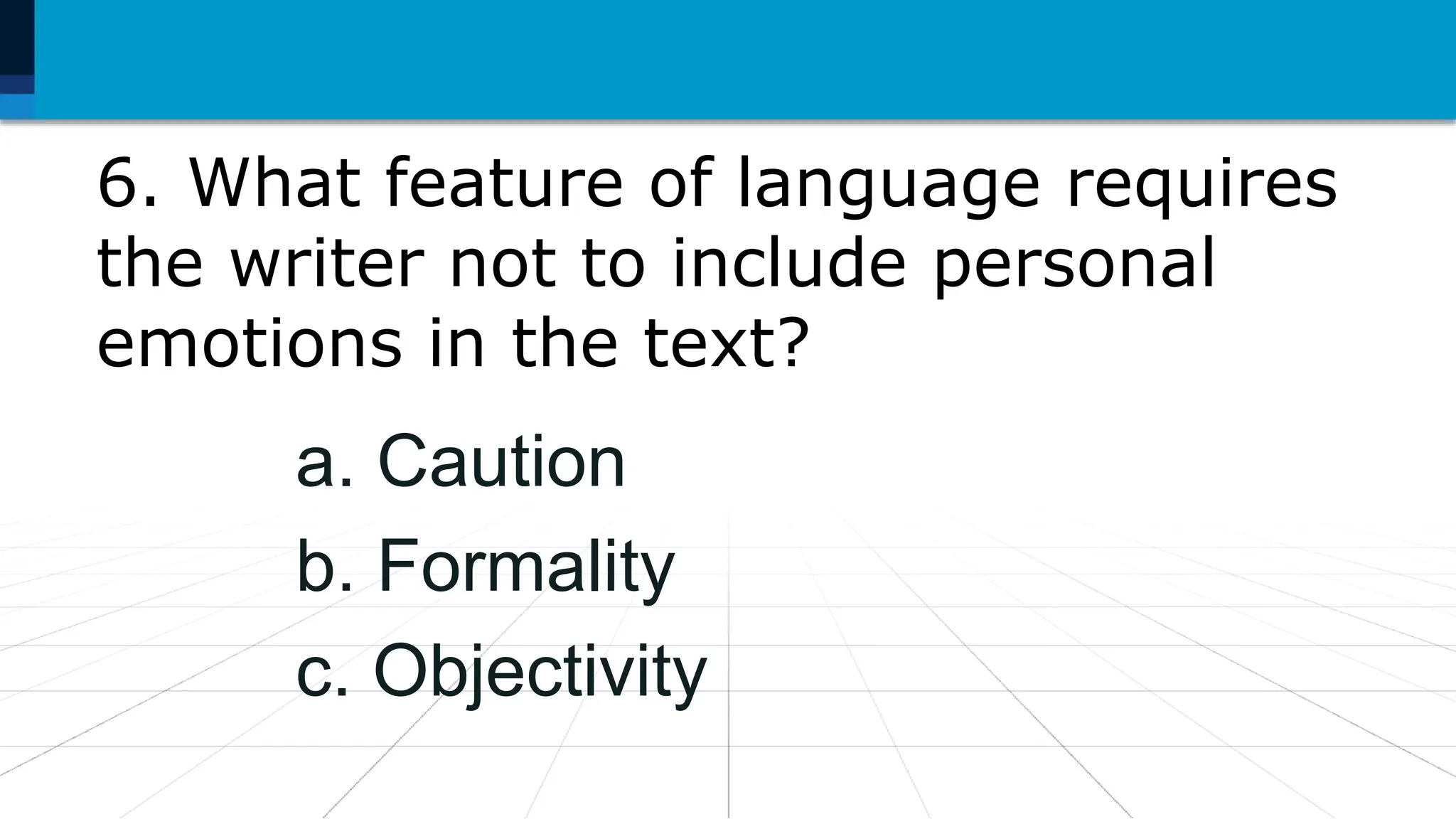
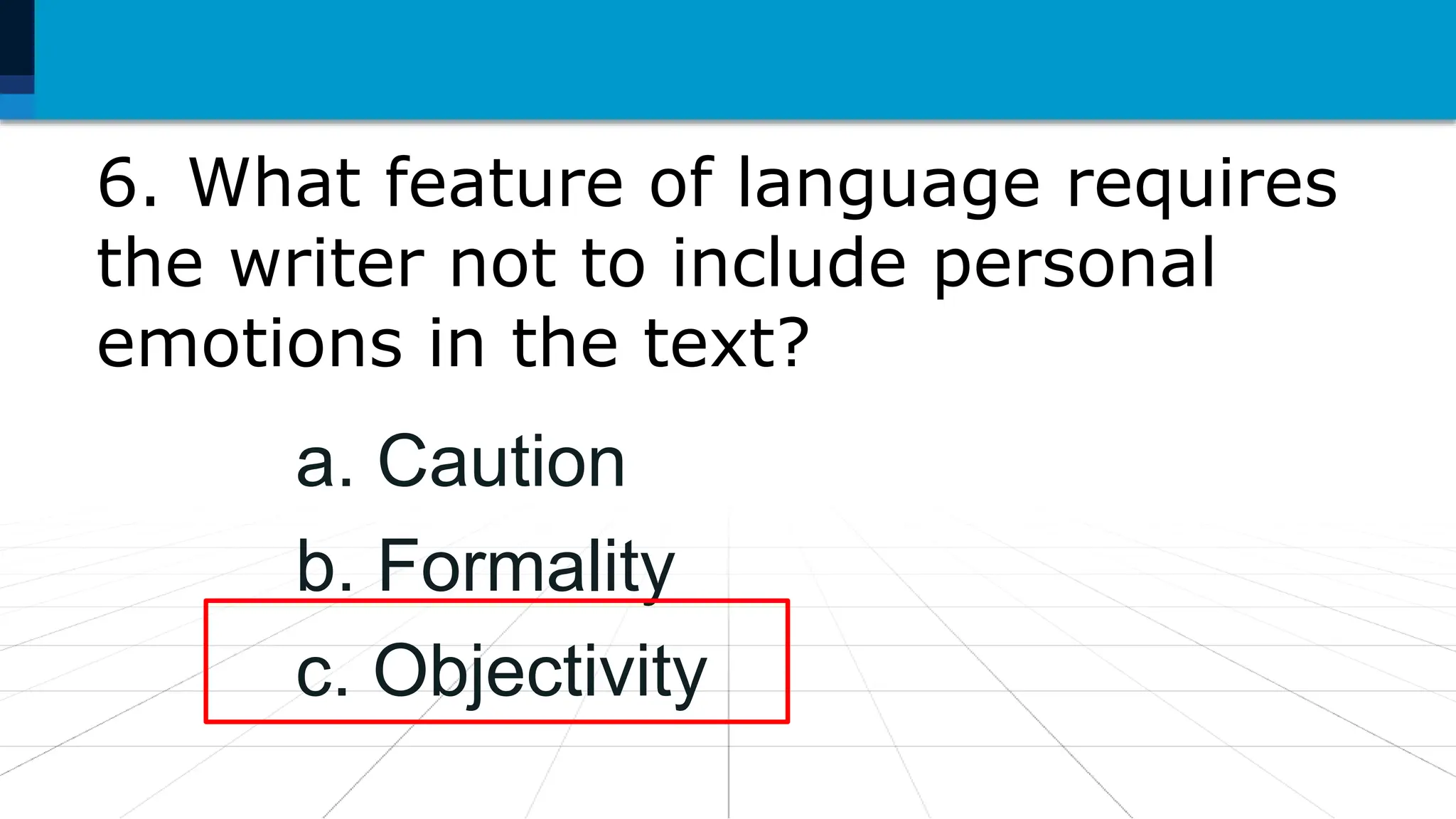
6. What featureof language requires
the writer not to include personal
emotions in the text?
a. Caution
b. Formality
c. Objectivity
40.
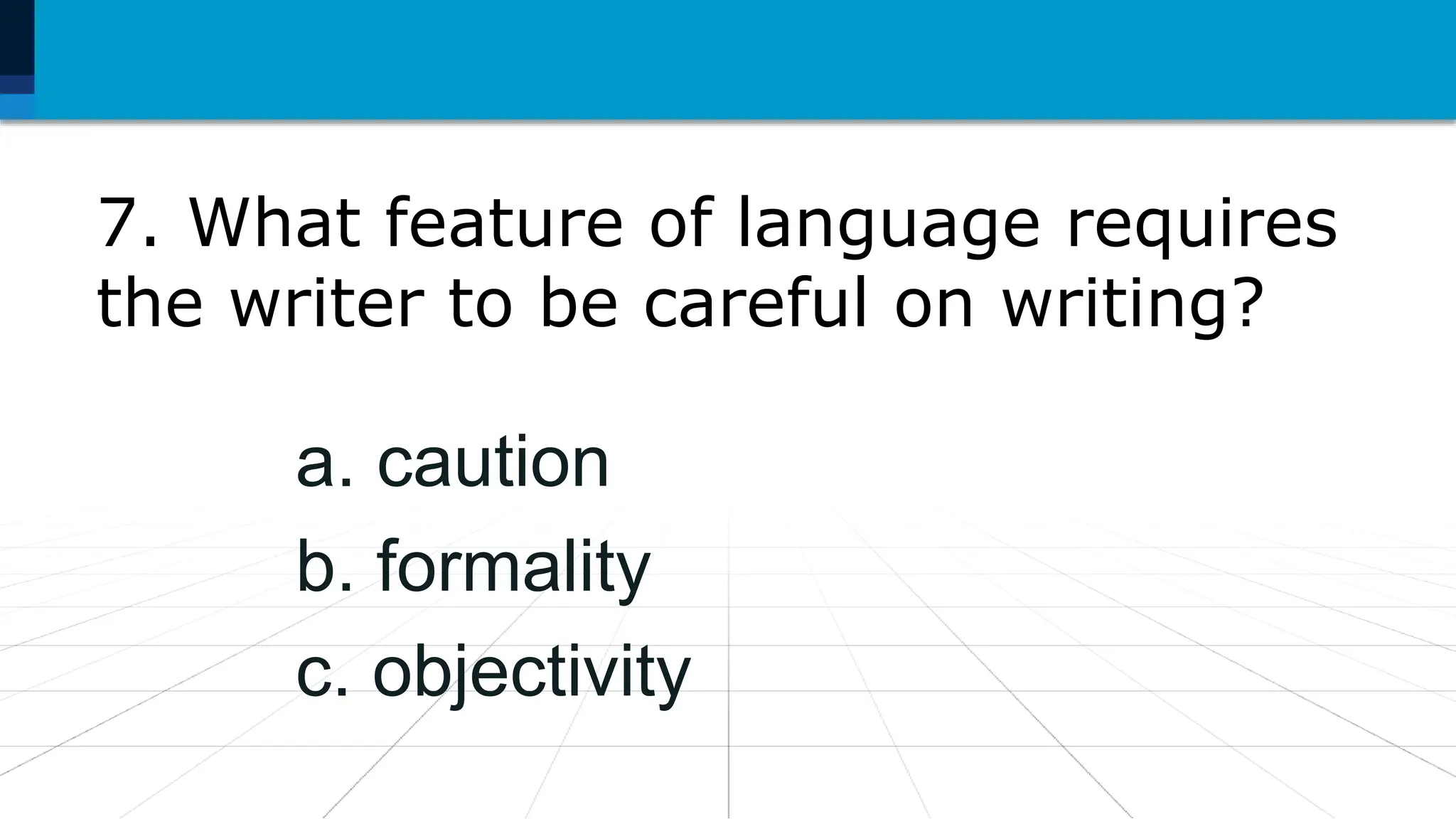
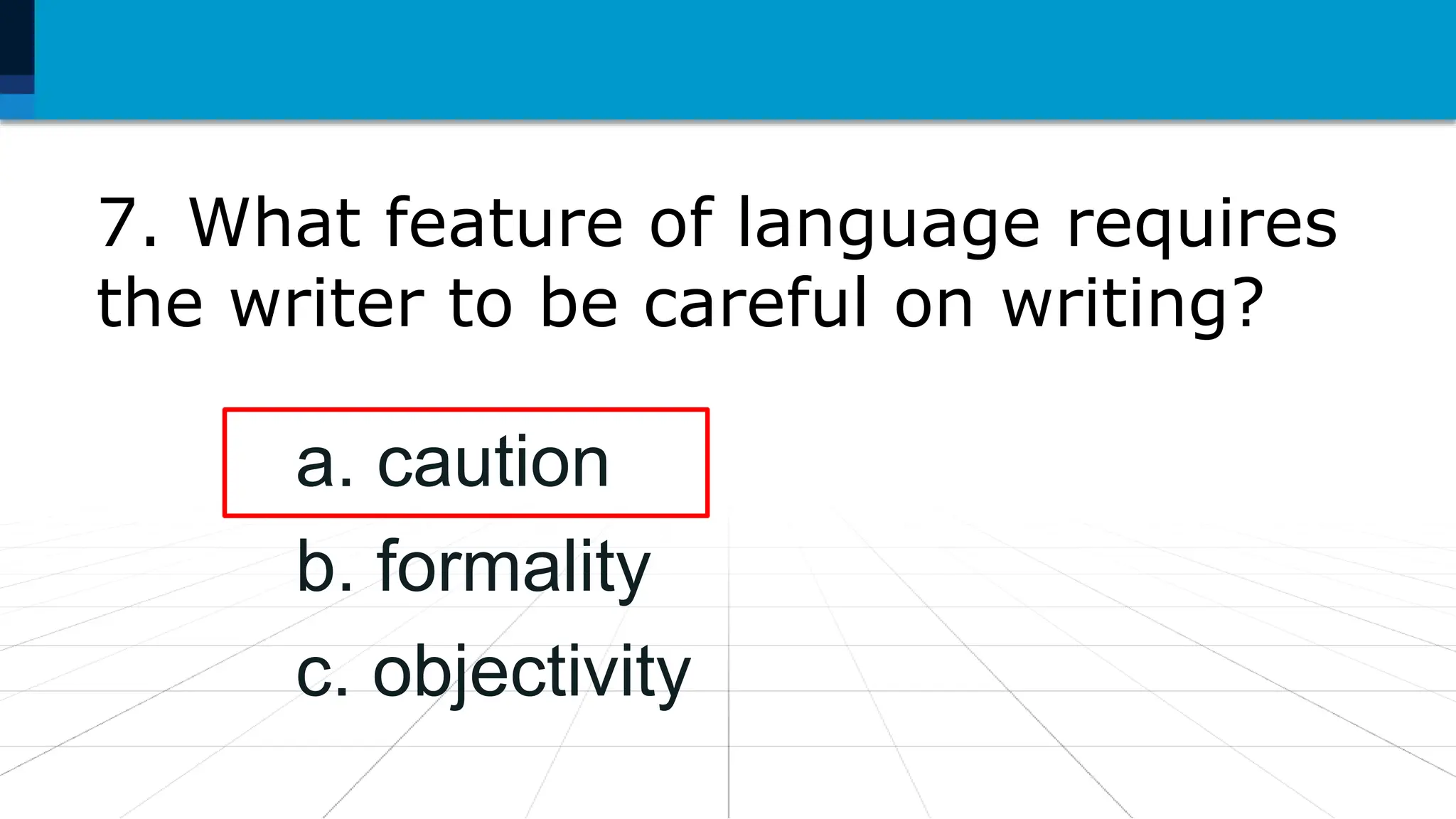
7. What featureof language requires
the writer to be careful on writing?
a. caution
b. formality
c. objectivity
41.
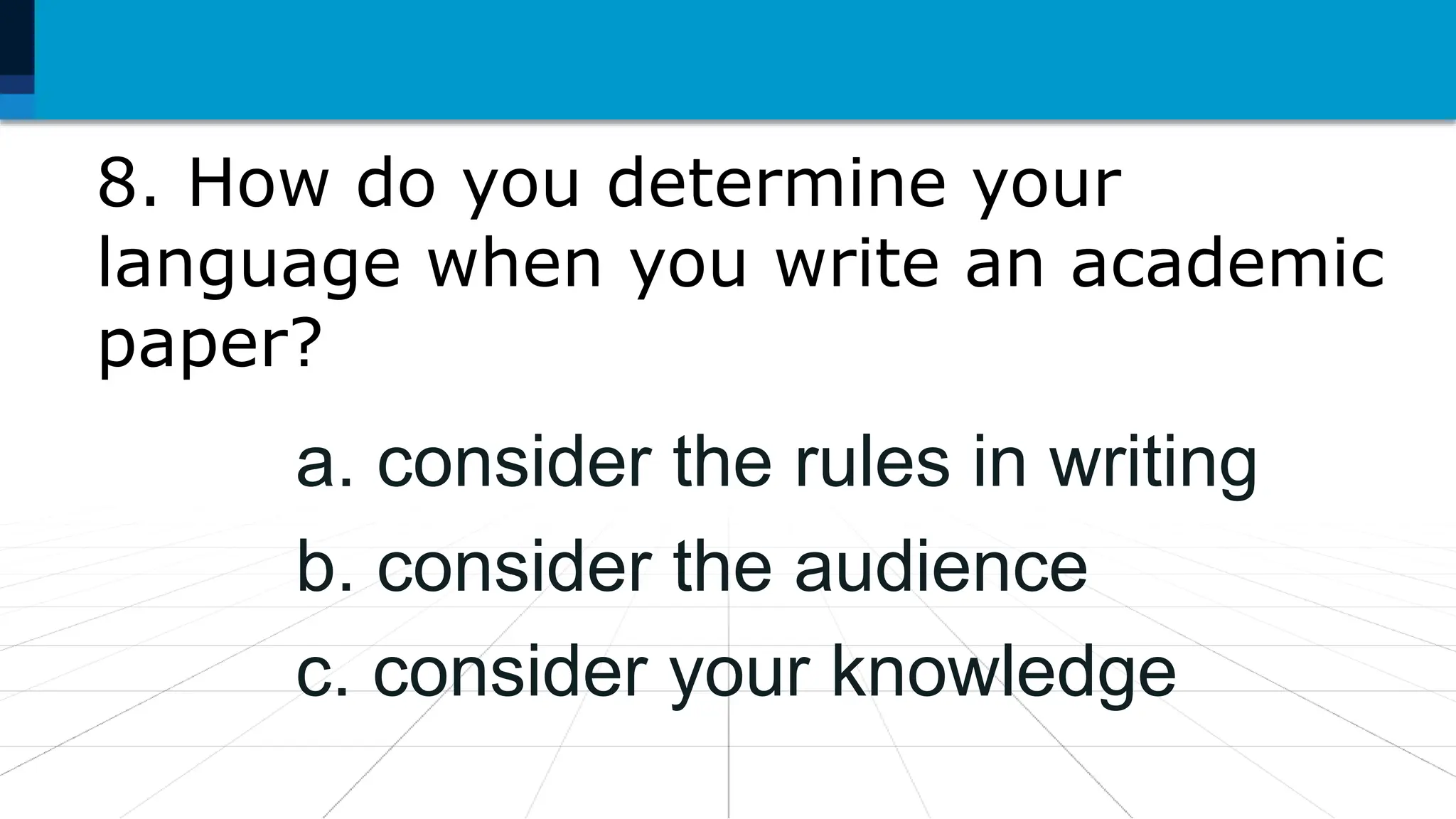
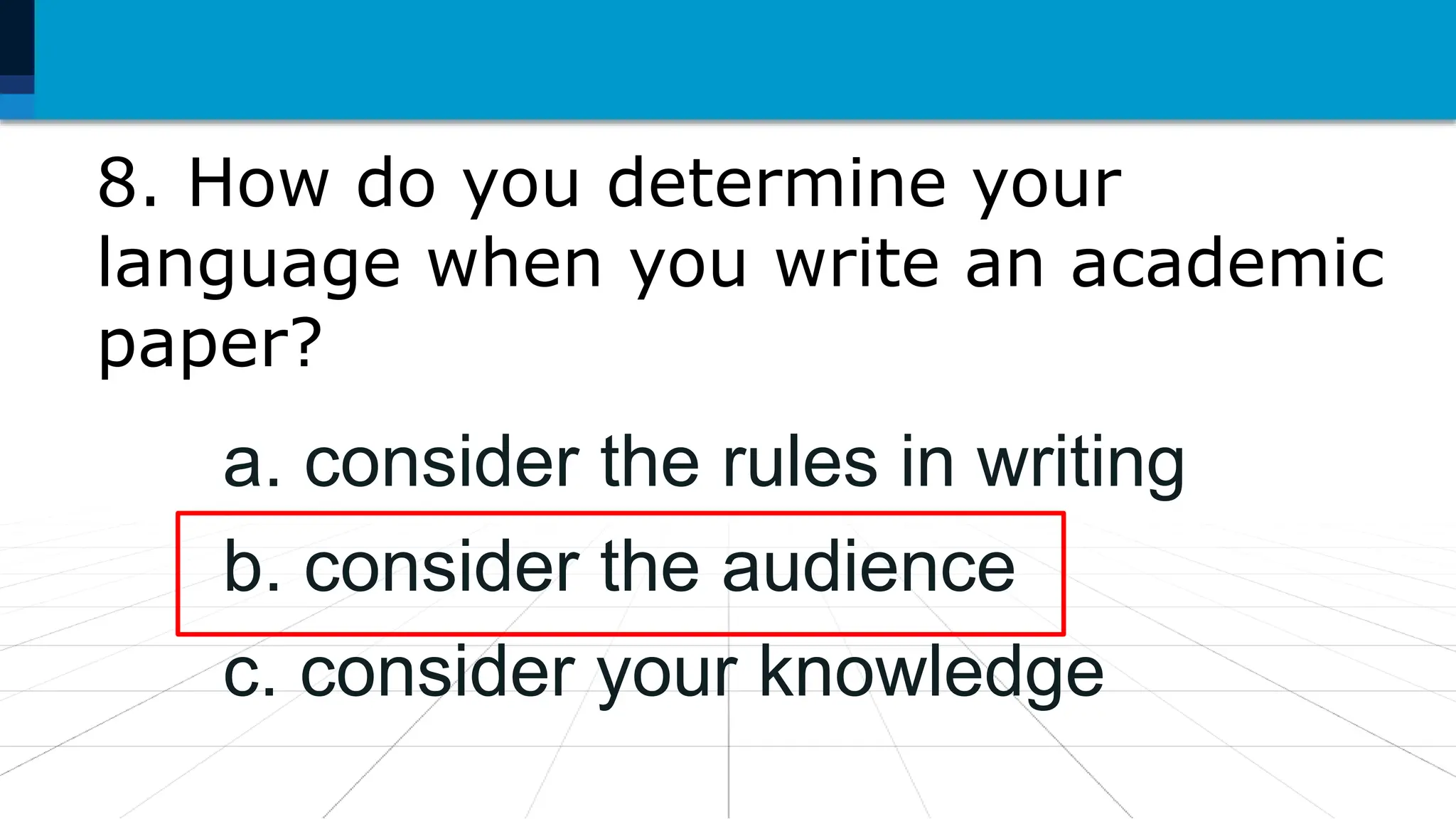
8. How doyou determine your
language when you write an academic
paper?
a. consider the rules in writing
b. consider the audience
c. consider your knowledge
42.
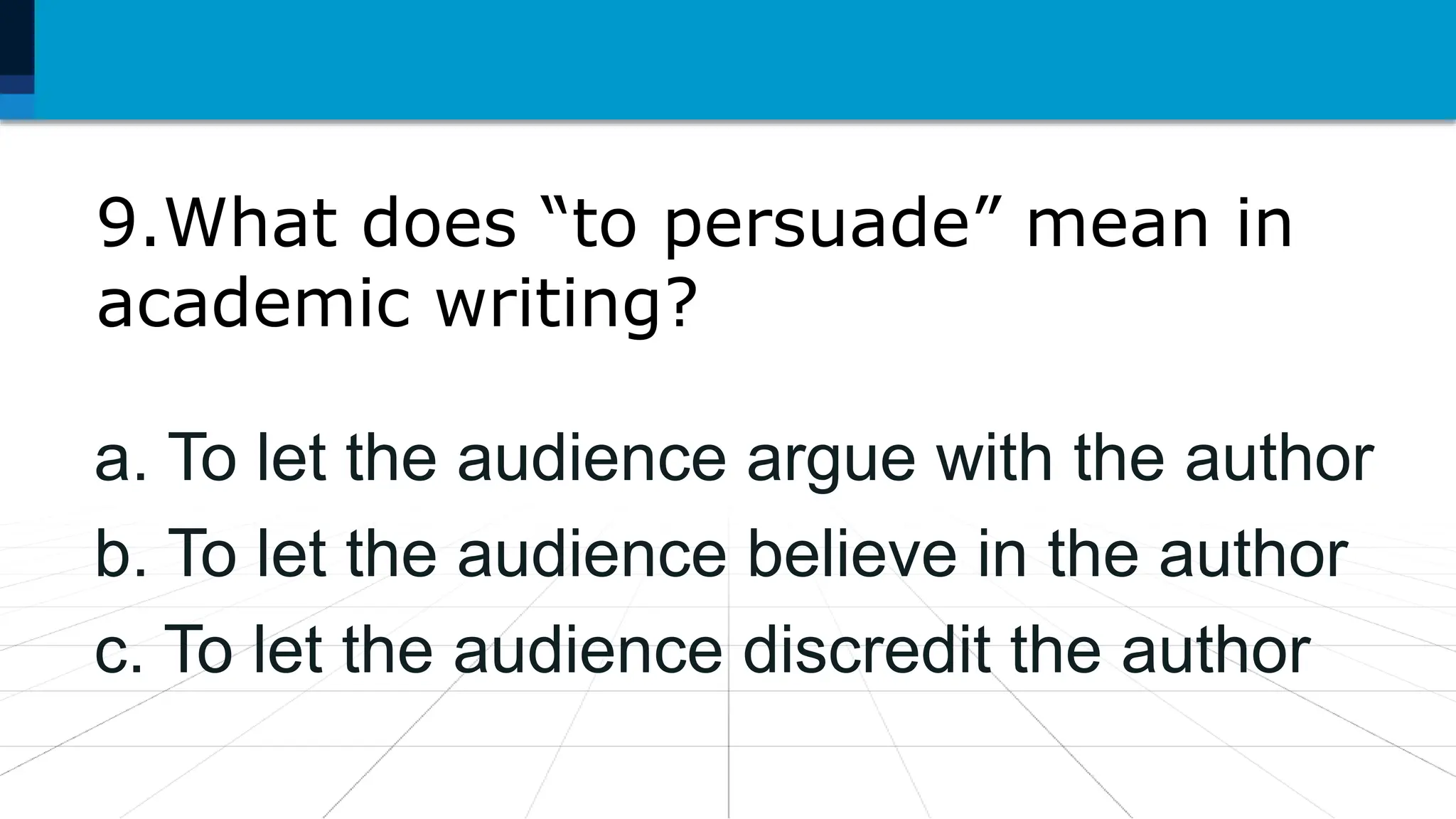
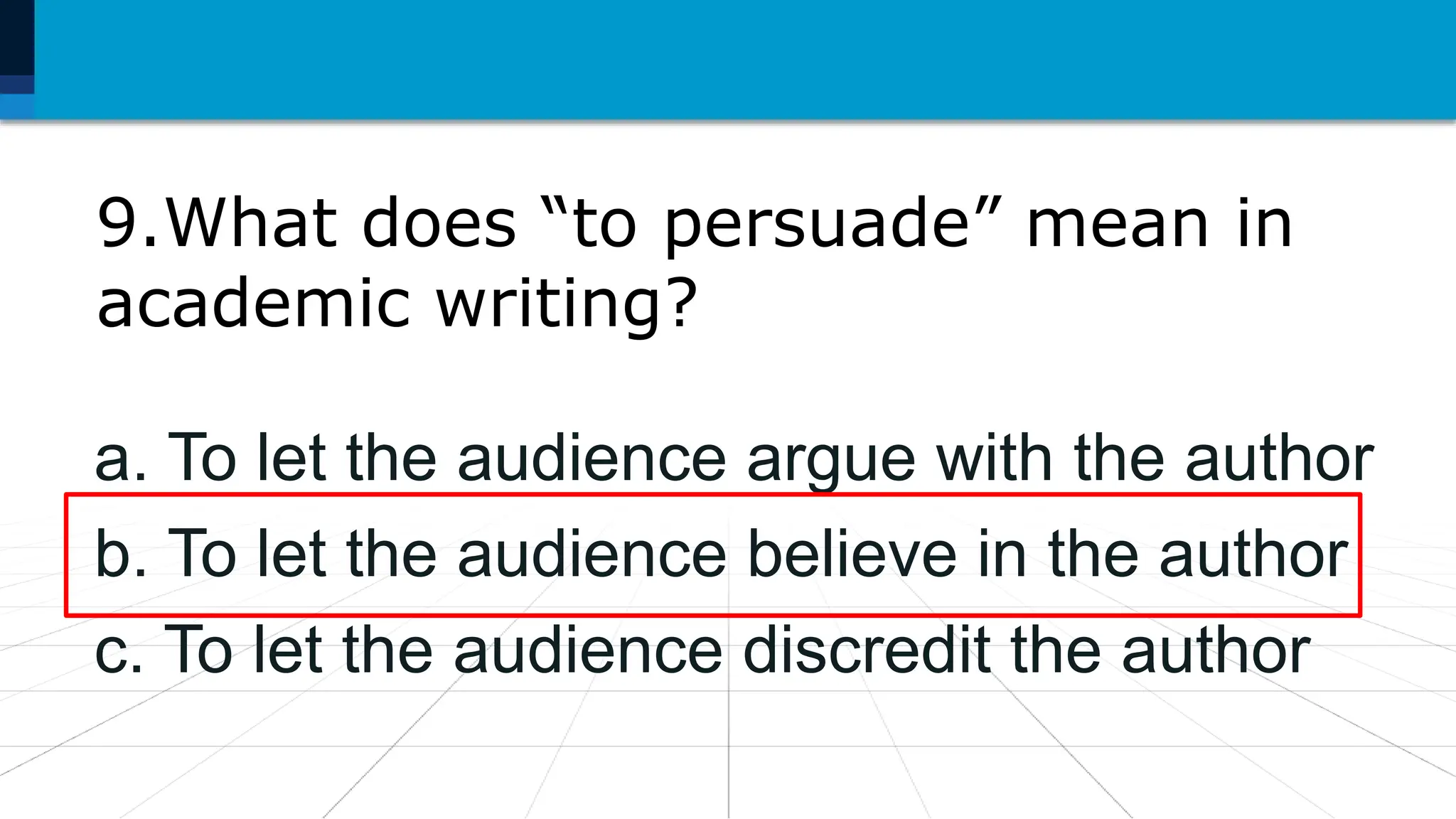
9.What does “topersuade” mean in
academic writing?
a. To let the audience argue with the author
b. To let the audience believe in the author
c. To let the audience discredit the author
43.
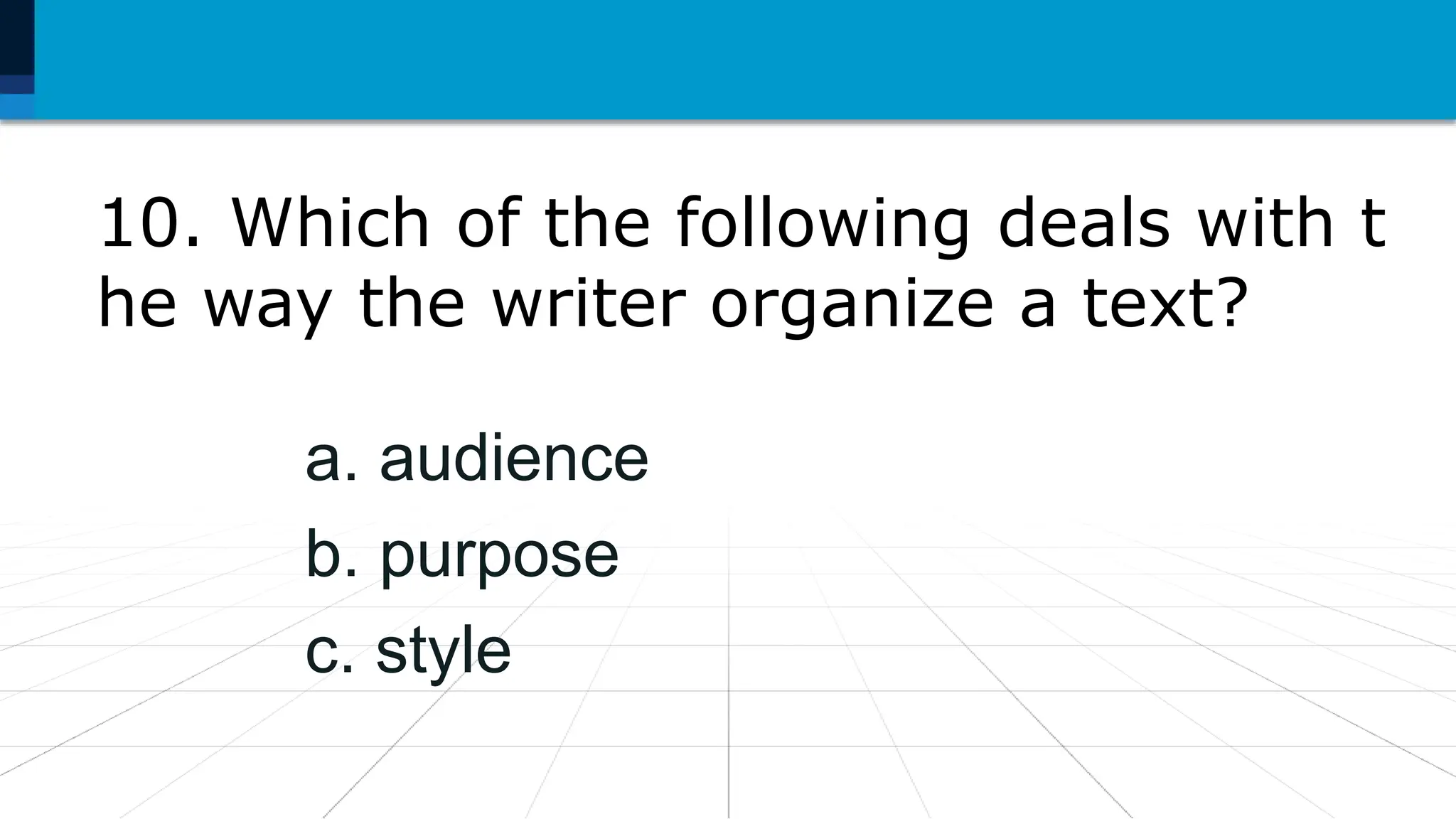
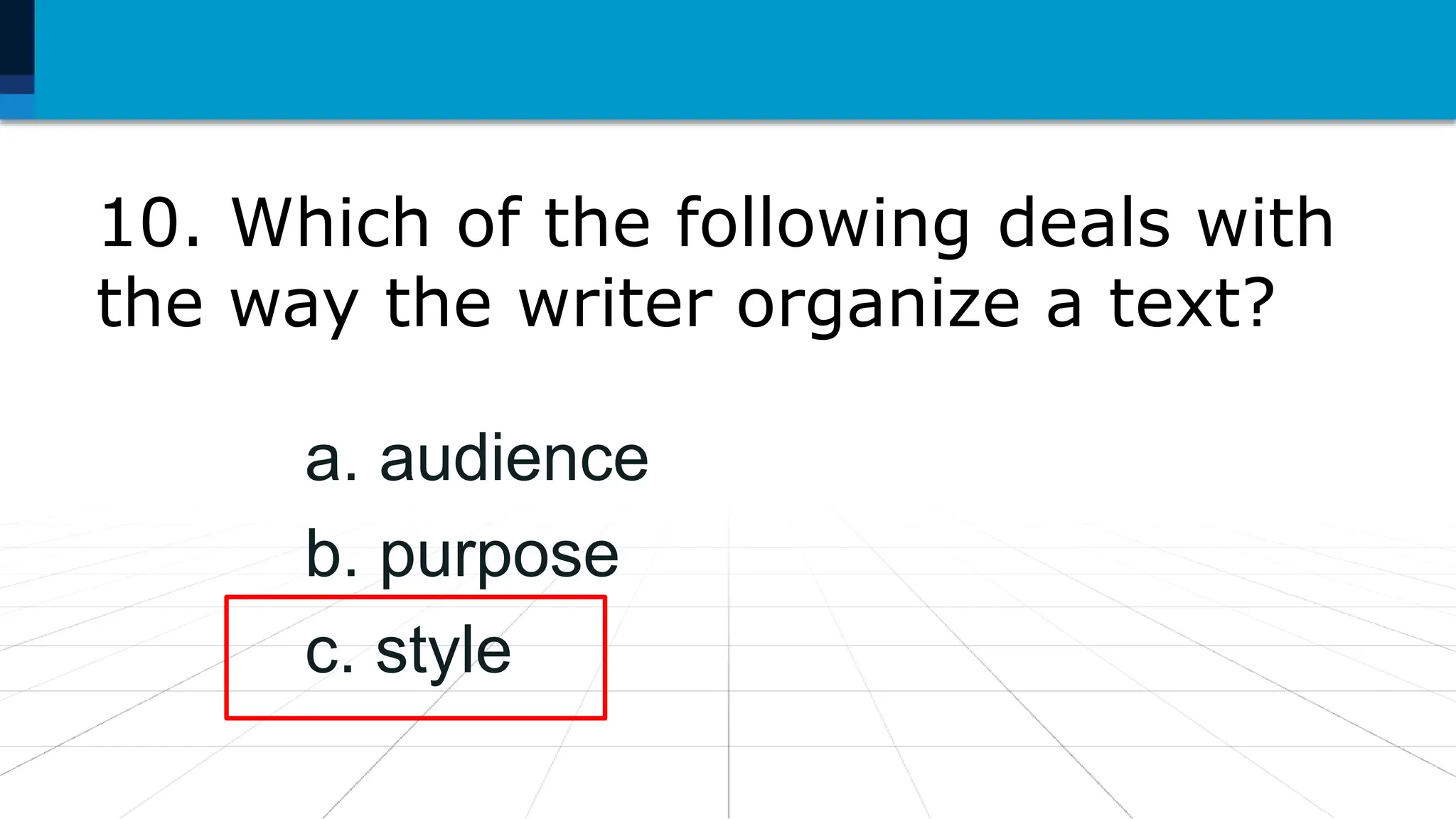
10. Which ofthe following deals with t
he way the writer organize a text?
a. audience
b. purpose
c. style
44.
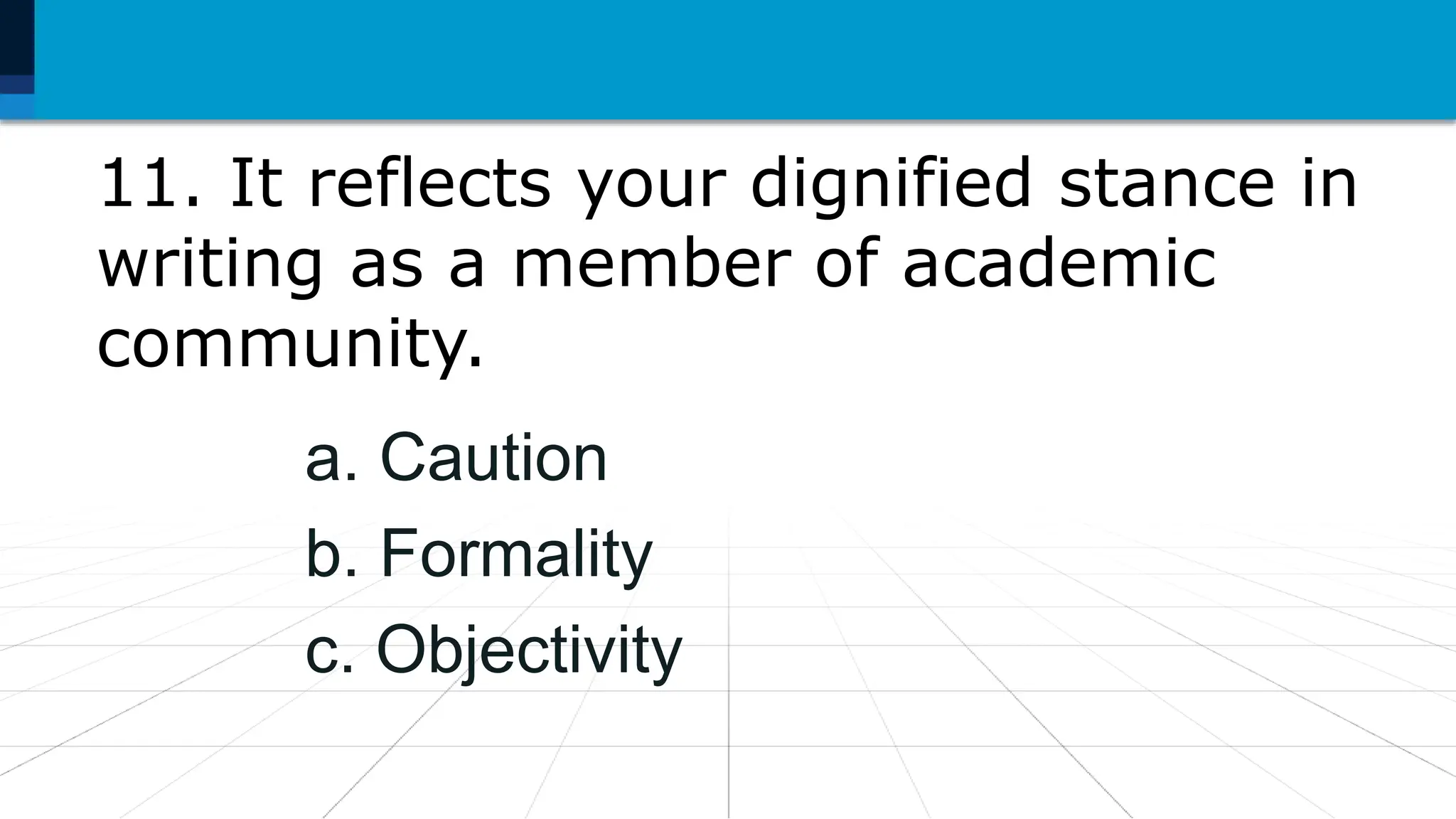
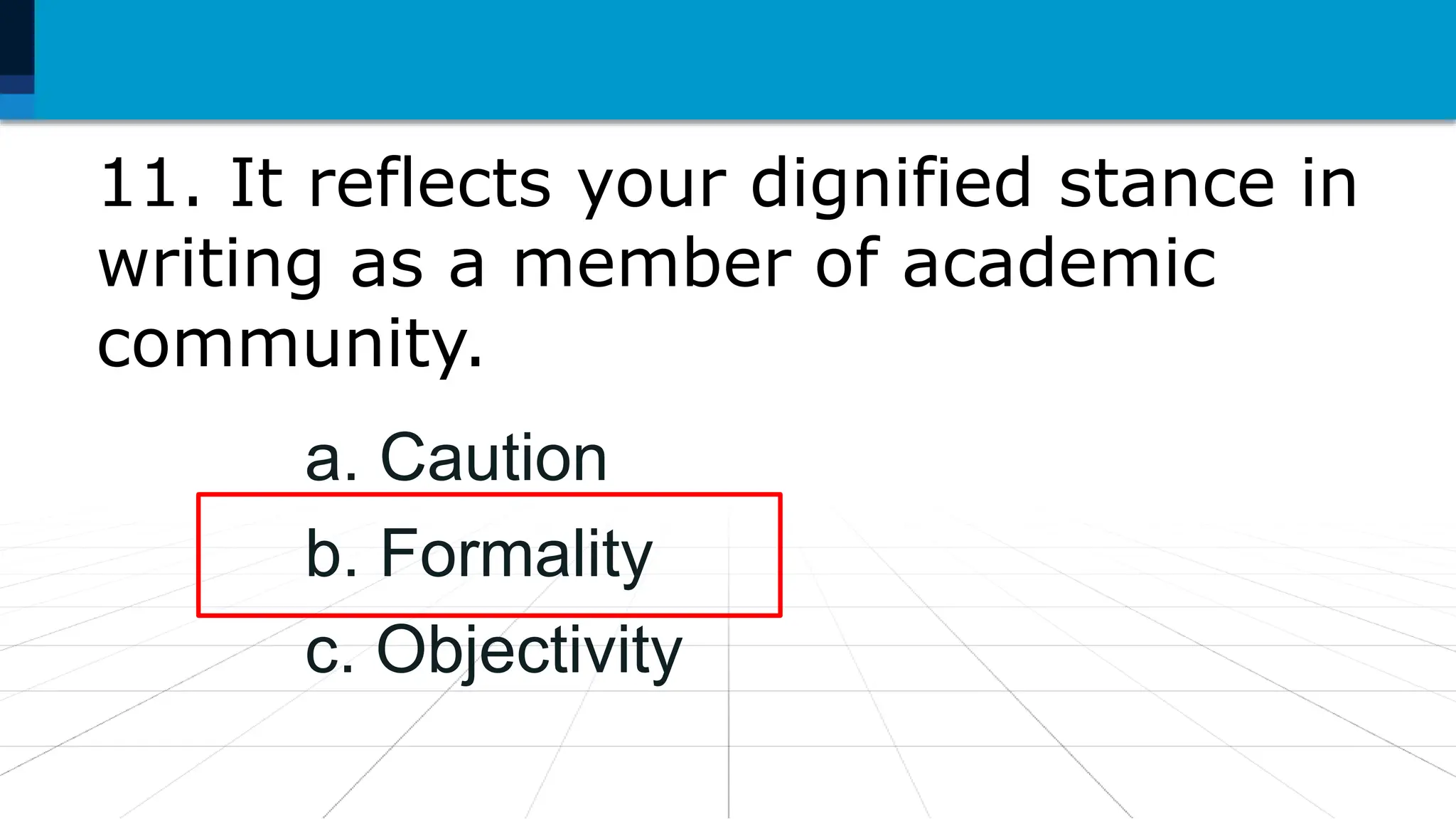
11. It reflectsyour dignified stance in
writing as a member of academic
community.
a. Caution
b. Formality
c. Objectivity
45.
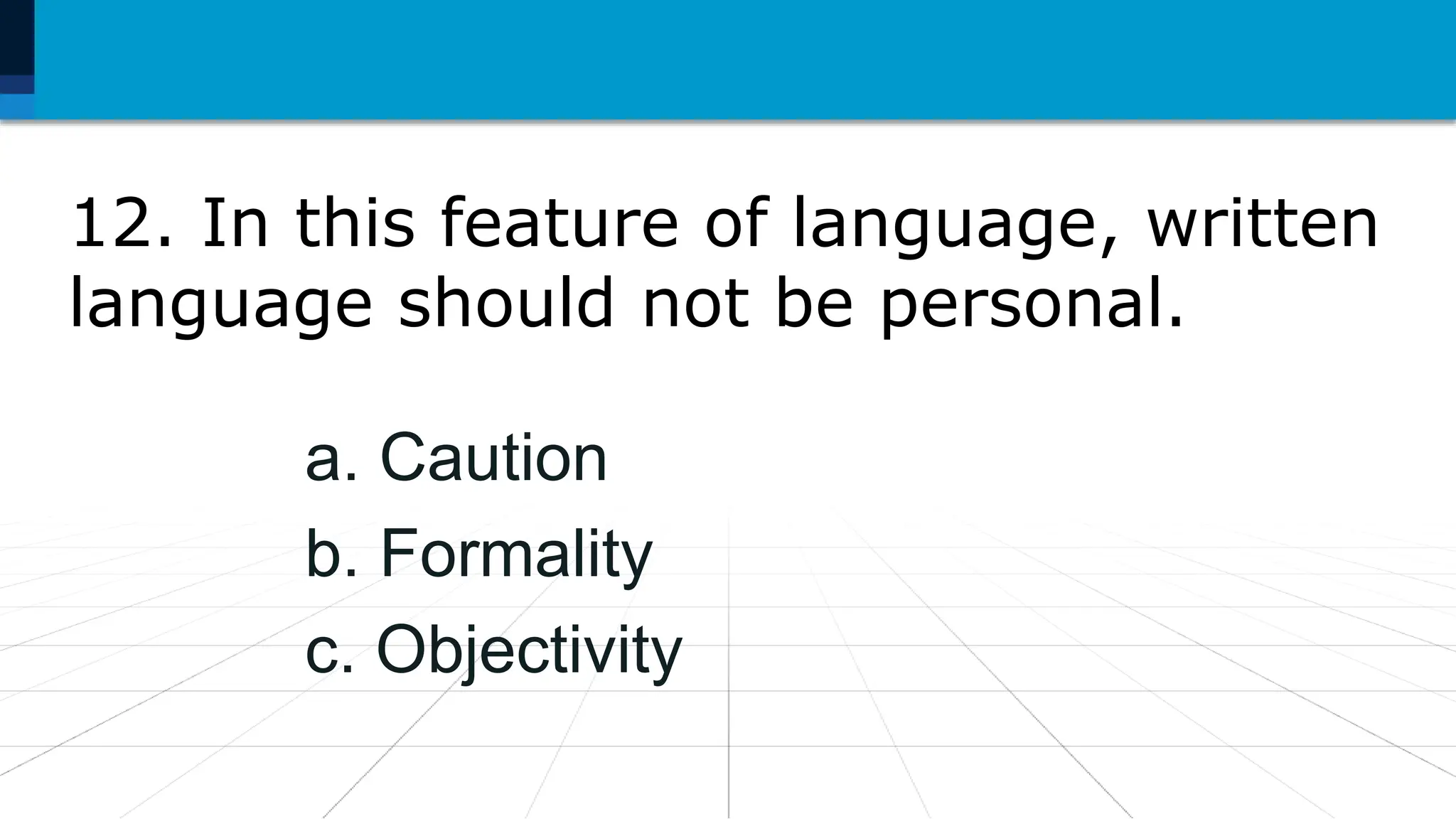
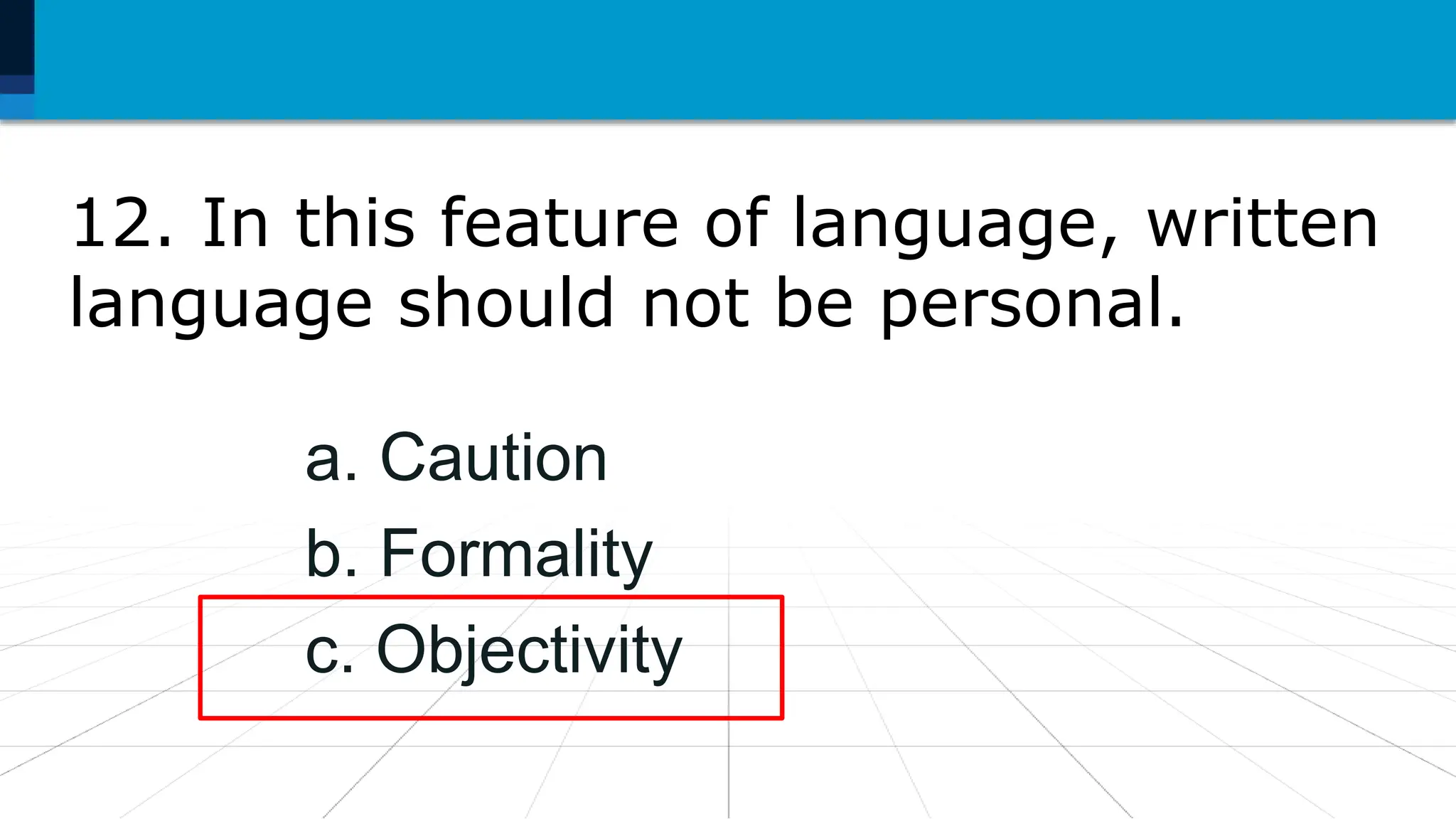
12. In thisfeature of language, written
language should not be personal.
a. Caution
b. Formality
c. Objectivity
46.
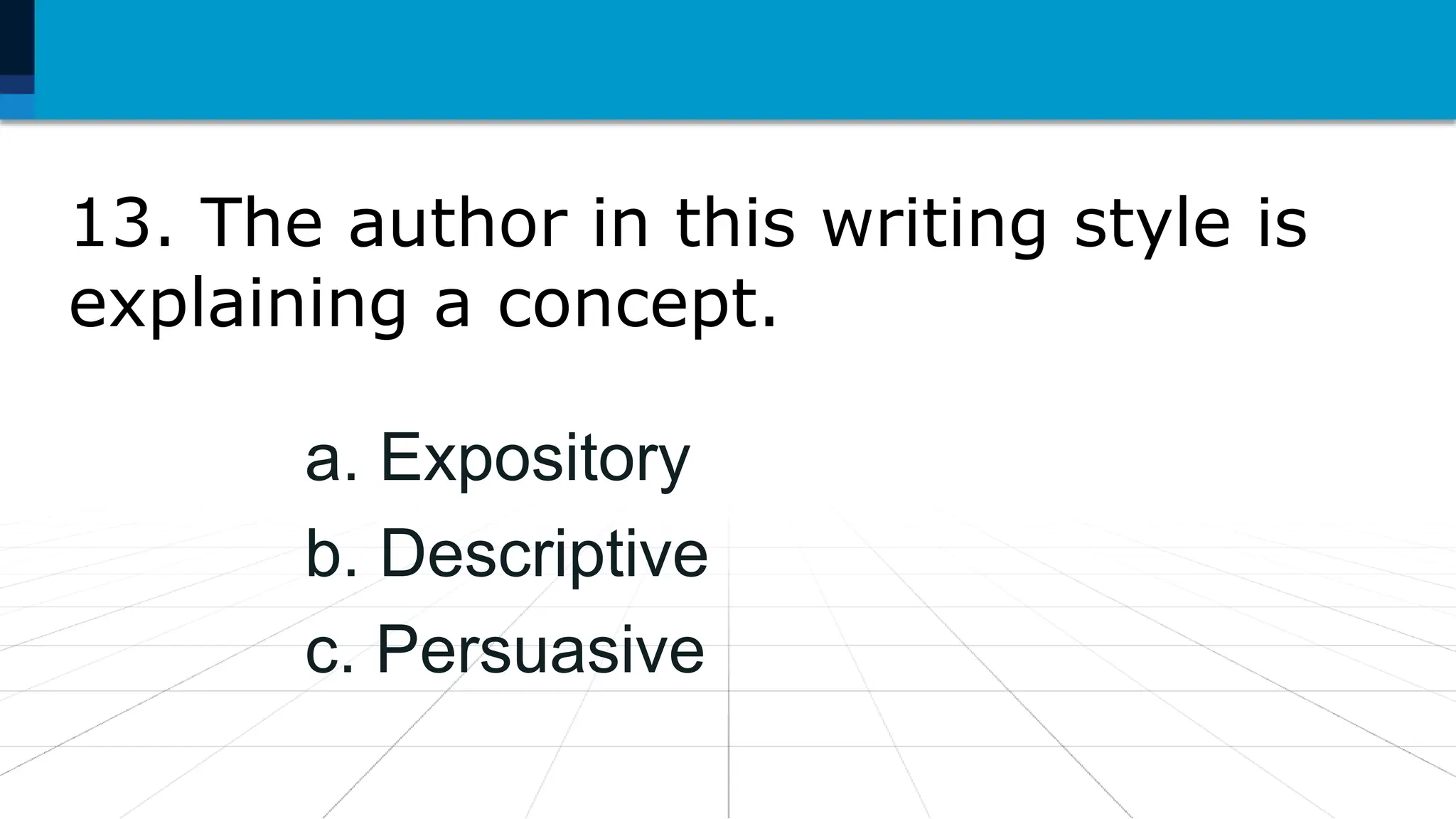
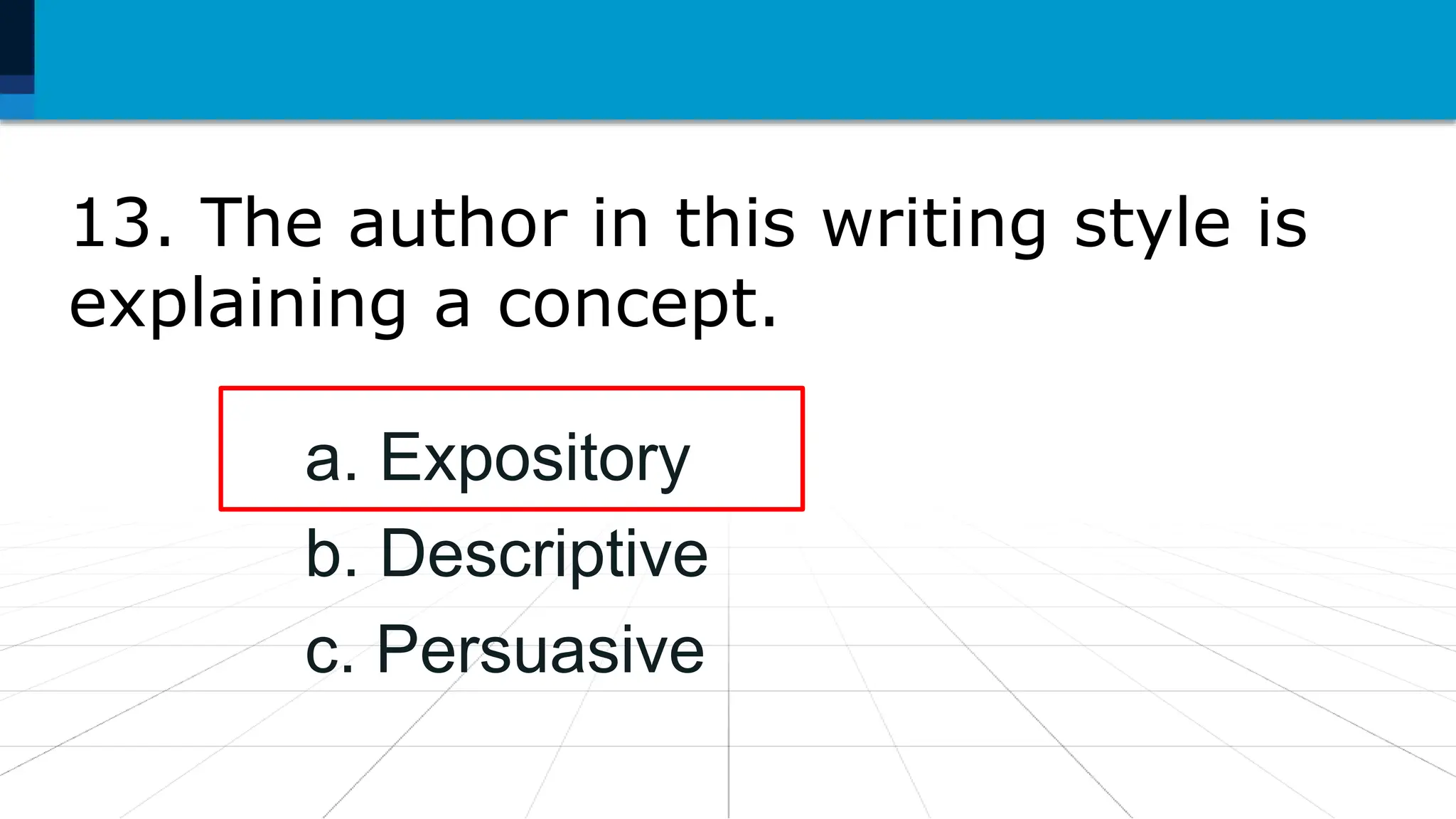
13. The authorin this writing style is
explaining a concept.
a. Expository
b. Descriptive
c. Persuasive
47.
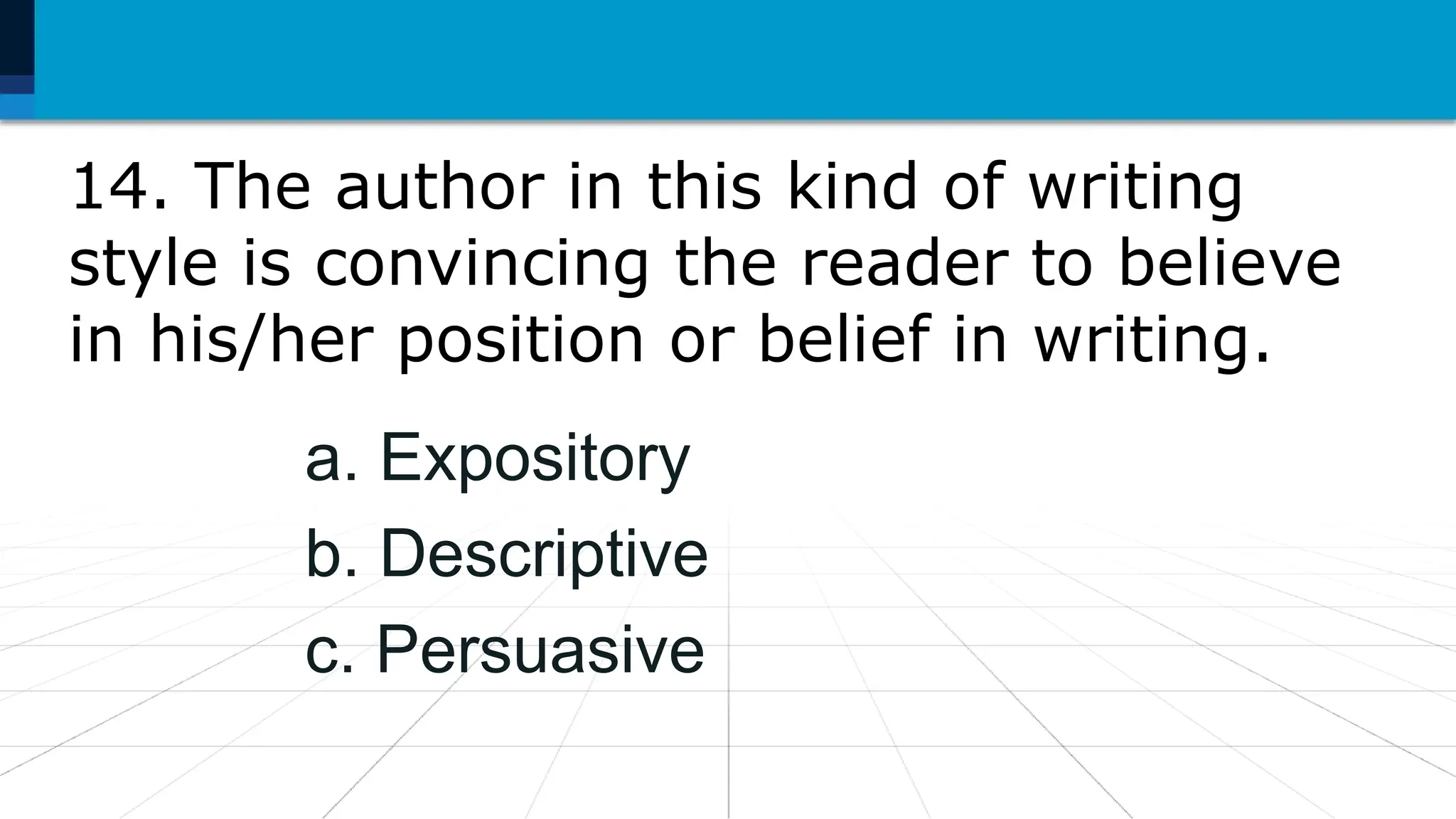
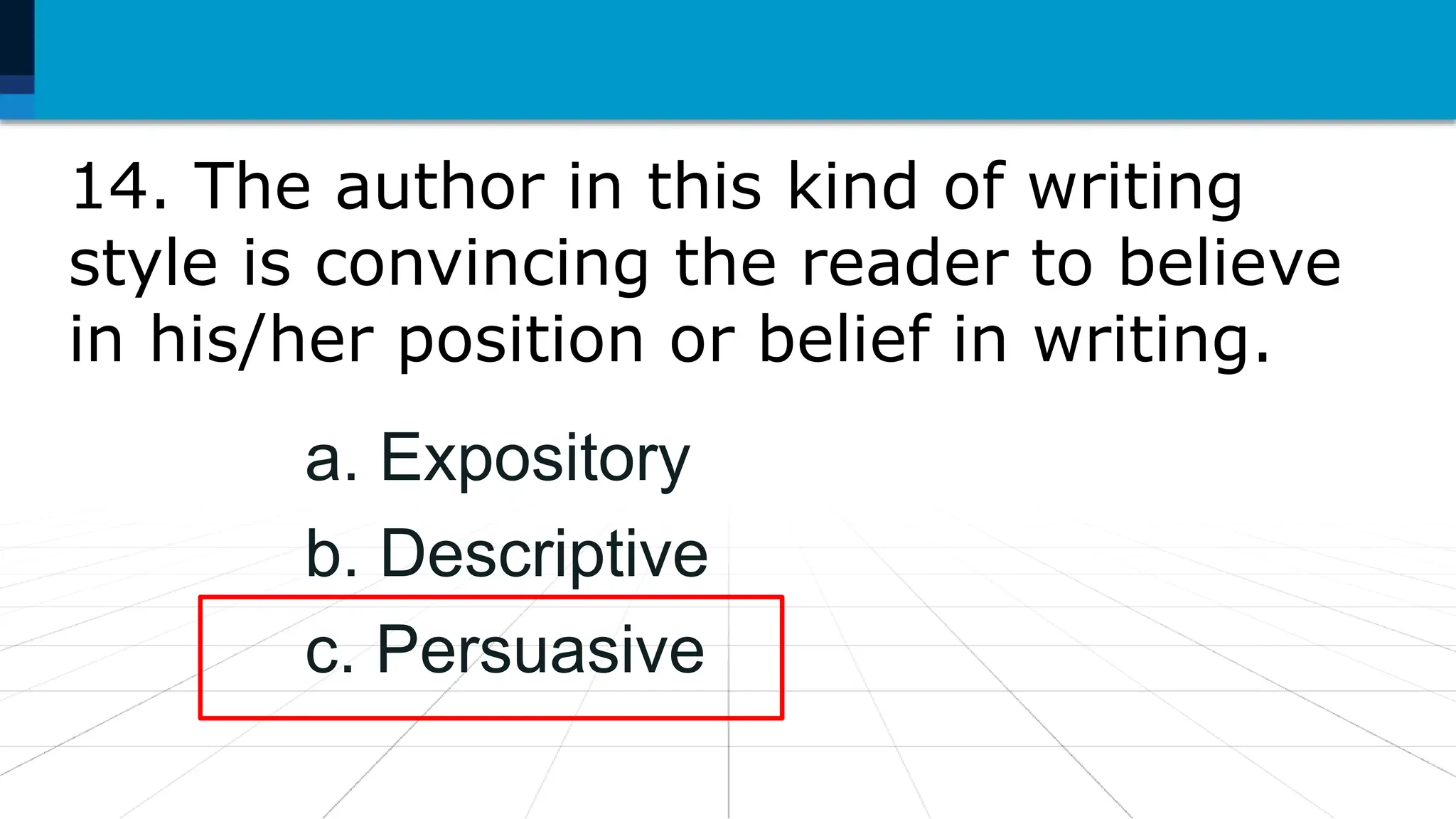
14. The authorin this kind of writing
style is convincing the reader to believe
in his/her position or belief in writing.
a. Expository
b. Descriptive
c. Persuasive
48.
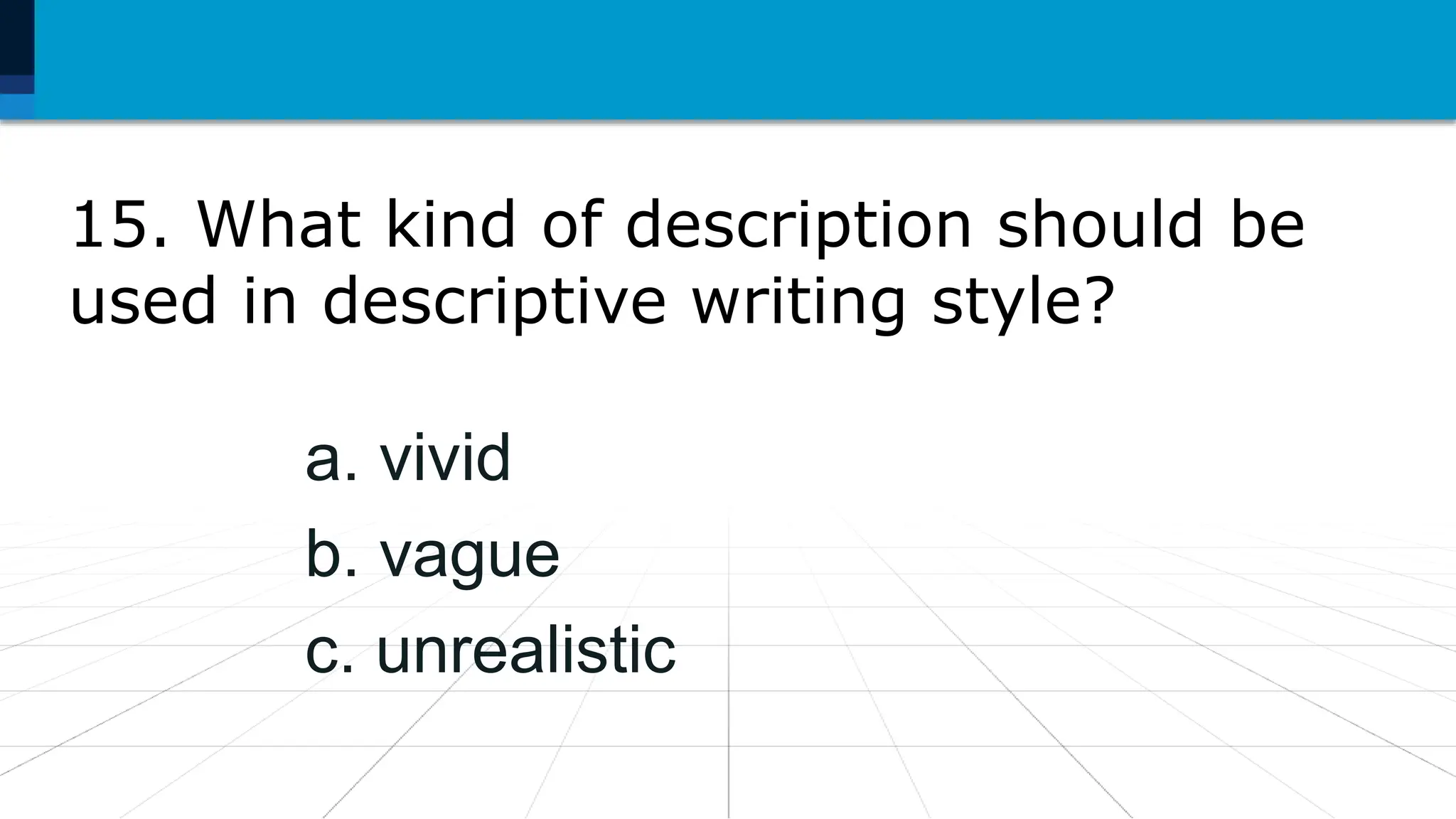
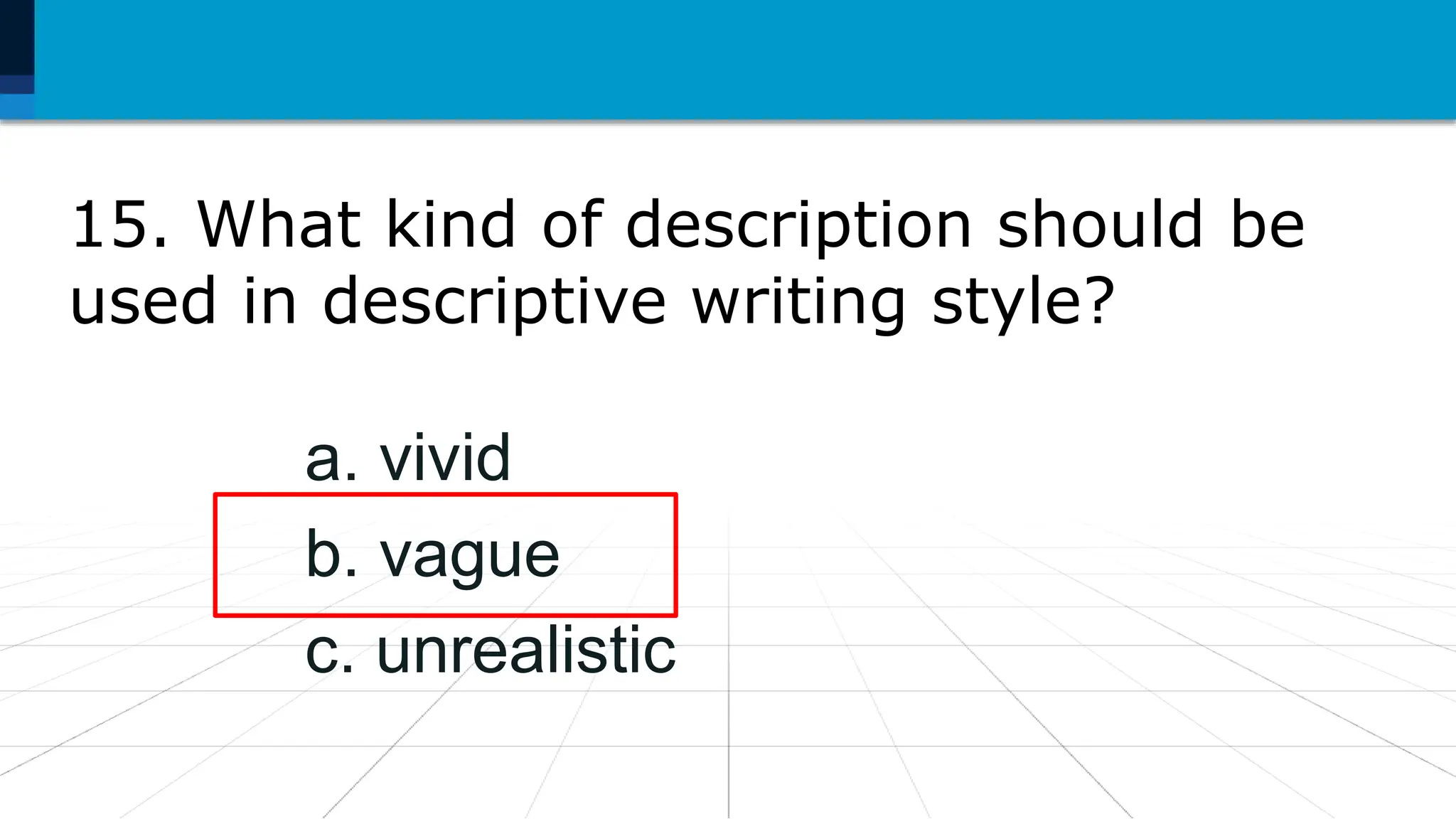
15. What kindof description should be
used in descriptive writing style?
a. vivid
b. vague
c. unrealistic
50.
1. When youwrite an academic paper,
what point of view will you use?
a. first person
b. second person
c. third person
51.
2. What kindof language should be
used in writing academic text?
a. colloquial
b. formal
c. informal
52.
3. What isthe meaning of layman’s
term?
a. words that are hard to understand.
b. words that are easy to understand
c. words that are having a lot of meaning.
53.
4. The followingare examples of
academic text except _______.
a. Journal
b. Research Paper
c. Short Stories
54.
5.Which of thefollowing elements deals
with the writer’s goal in writing a text?
a. audience
b. purpose
c. style
55.
6. What featureof language requires
the writer not to include personal
emotions in the text?
a. Caution
b. Formality
c. Objectivity
56.
7. What featureof language requires
the writer to be careful on writing?
a. caution
b. formality
c. objectivity
57.
8. How doyou determine your
language when you write an academic
paper?
a. consider the rules in writing
b. consider the audience
c. consider your knowledge
58.
9.What does “topersuade” mean in
academic writing?
a. To let the audience argue with the author
b. To let the audience believe in the author
c. To let the audience discredit the author
59.
10. Which ofthe following deals with
the way the writer organize a text?
a. audience
b. purpose
c. style
60.
11. It reflectsyour dignified stance in
writing as a member of academic
community.
a. Caution
b. Formality
c. Objectivity
61.
12. In thisfeature of language, written
language should not be personal.
a. Caution
b. Formality
c. Objectivity
62.
13. The authorin this writing style is
explaining a concept.
a. Expository
b. Descriptive
c. Persuasive
63.
14. The authorin this kind of writing
style is convincing the reader to believe
in his/her position or belief in writing.
a. Expository
b. Descriptive
c. Persuasive
64.
15. What kindof description should be
used in descriptive writing style?
a. vivid
b. vague
c. unrealistic