ACADEMIC WRITING IN ENGLISH
For Asian Students and Researchers
Dhirawit Pinyonatthagarn
Ph.D. (Linguistics)
2 ENGLISH FOR ACADEMIC WRITING
ACADEMIC WRITING IN ENGLISH
For Asian Students and Researchers
Second Edition (2012)
Copyright©2011 by Dhirawit Pinyonatthagarn. All rights
reserved. No part of this publication may be reproduced or
distributed in any form or by any means, or stored in a data
base or retrieval system, without the prior permission of the
publisher.
ข้อมูลทางบรรณานุกรม
ธีรวิทย์ ภิญโญณัฐกานต์
Academic Writing in English for Asian Students and Researchers
/ ธีรวิทย์ ภิญโญณัฐกานต์. นครราชสีมา : สาขาวิชาภาษาอังกฤษ สานักวิชา
เทคโนโลยีสังคม มหาวิทยาลัยเทคโนโลยีสุรนารี, 2555.
164 หน้า
ISBN 978-974-533-639-1
PE1475 ธ64 2554
1. ภาษาอังกฤษเทคนิค. I. มหาวิทยาลัยเทคโนโลยีสุรนารี. สาขาวิชา
ภาษาอังกฤษ.
II. ชื่อเรื่อง.
พิมพ์ครั้งที่ 2 (พ. ศ. 2555)
ลิขสิทธิ์ดร. ธีรวิทย์ ภิญโญณัฐกานต์
สงวนลิขสิทธิ์ตามพระราชบัญญัติลิขสิทธิ์ พ. ศ. ๒๕๓๗
จัดพิมพ์โดย ชมรมภาษาอังกฤษนครราชสีมา ถนนจอมสุรางคยาตร์ ตาบลในเมือง อาเภอ
เมือง จังหวัดนครราชสีมา โทร ๐๔๔ ๒๕๘๙๐๙, ๐๕๑ ๘๗๗๐๗๒๙ แฟกซ์ ๐๔๔ ๒๕๘๙๐๙
อีเมล dhirapin@gmail.com
www.ebooks.in.th/DiamondBooks
200 B
3
3
FOREWORD
Academic writing is a particular style of writing that is characteristic of
academic institutions. It is the style essential for undergraduates,
graduates, researchers and even lecturers when they explore particular
academic questions in essays, reports, dissertations or theses, and
academic papers. Although it shares many similarities with other styles
of writing, it has its own characteristic features.
As can be seen, the characteristic features that it exhibits give it
a distinct style, and the great majority of students wishing to
successfully complete a course of university study should ensure that
their work reflects this style. If students are unwilling or unable to adopt
an appropriate style, they are likely to have greater difficulties
throughout their course.There are a number of factors and these relate
to both the language itself and the structure.
This book was designed to provide undergraduate, graduate students
and young researchers, especially those of Asian background, with both
the theory and practice of academic writing in English, necessary skill for
them to complete their advanced studies and earn degrees in the field
of their choice in and outside their own country.
4 ENGLISH FOR ACADEMIC WRITING
CONTENTS
Page
CHAPTER 1 INTRODUCTION 5 – 9
CHAPTER 2 WRITING ESSAYS IN ENGLISH 10 – 55
CHAPTER 3 WRITING REPORTS IN ENGLISH 56 – 74
CHAPTER 4 PARAPHRASE, SUMMARY & SYNTHESIS 75 – 81
CHAPTER 5 WRITING RESEARCH PAPERS AND
ABSTRACTS
82 – 106
CHAPTER 6 WRITING A DISSERTATION 107 – 123
CHAPTER 7 WRITING A LIST OF REFERENCES AND
CITING SOURCES
124 – 140
CHAPTER 8 PUNCTUATION 141 – 150
REFERENCES 151 – 161
ABOUT THE AUTHOR 162 - 164
5
5
CHAPTER 1
INTRODUCTION
Academic writing is a particular style of writing that is characteristic of
academic institutions. In other words, it is the style that is used by
undergraduates, graduates and lecturers when they explore particular
academic questions in essays, dissertations, Ph.D theses and academic
papers. Although it shares many similarities with other styles of writing,
it also has its own characteristic features, and it is these features that
we will be examining.
The characteristic features that it exhibits give it a distinct style, and the
great majority of students wishing to successfully complete a course of
university study should ensure that their work reflects this style. If
students are unwilling or unable to adopt an appropriate style, they are
likely to have greater difficulties throughout their course. So what, in
general, characterises academic writing? There are a number of factors
and these relate to both the language itself and the structure.
A well-written academic essay will exhibit the following characteristics.
It will:
 put forward a coherent argument
 support that argument with evidence
 show the writer’s knowledge of the subject
 show evidence of reading
 reflect independent thinking
 contain quotations
 contain references and a bibliography
 adopt a formal style
 be logical and analytical
 be clearly structured.
This is not an exhaustive list but it provides an indication of the style of
essay that is expected at a college or university. Other examples of
formal writing may also reflect the elements listed here such as formal
reports, formal agreements, certificates, government papers and so on.
6 ENGLISH FOR ACADEMIC WRITING
However, it is likely that many undergraduates will not have been
required to adopt an academic style before their arrival at university.
While their pre-university courses may have necessitated writing essays,
these will probably not have reflected the formal language, the formal
structure and the presentation of a logical argument in quite the same
way.
In addition, many people now start their university course after a
significant period of work and so they may not have written much at all
for the ten years prior to starting their course. This will obviously make
it hard for them to pick up on the style of writing that is needed in
higher education.
If you are reading this, you are likely to be a student in a college on an
undergraduate or post-graduate course. You may be a native speaker of
English or English may be an additional language for you. When
preparing your essays, you may have found difficulties with self-
expression, essay structure, paragraphing, referencing, writing a
bibliography and even punctuating correctly and this may have veiled
some of your good ideas. You may not have achieved the grades that
you hoped for. When your essays were marked you may have found
comments reflecting the marker’s uncertainty about precisely what you
were trying to say.
 You need to think more carefully about word
order.
 Check your punctuation in this paragraph.
 This sentence is not clear.
 This is not academic language.
 Is this relevant?
 Reference?
 Is this a new paragraph or a continuation of the
last one?
If you are in a college or university and you wish to improve your
academic writing, skills and achieve higher marks in your assignments,
you may need to work carefully on some or all of the following areas:
 your basic writing skills
 planning your writing
 paragraph writing
 structuring your writing
 run-together sentences
7
7
 sentence fragments
 sentences, clauses and phrases
 making links in your writing
 writing in a formal style
 punctuation
 summarising and paraphrasing
 quoting, referencing and plagiarism
 parallelism and consistency
 preparing a bibliography.
If you wish to achieve high scores in your course, you will need to be
able to:
 plan your essay
 write a good introduction with a clear statement
of intent
 structure your essay clearly
 write paragraphs with clear topic sentences
 write grammatically coherent sentences
 use an appropriate academic style reflecting the
conventions of academic writing
 use appropriate academic vocabulary
 punctuate your essay correctly
 write a good conclusion.
Writing is necessary for all students in higher education. Academic
writing is clearly defined by having a clear purpose, either an exam
question to answer or a research project to report on. Most academic
writing in English is linear:
- It starts at the beginning and finishes at the end, with every part
contributing to the main line of argument, without digression or
repetition. What ever kind of writing your are producing, you, the writer,
is responsible for making your line of argument clear and presenting it in
an orderly fashion so that the reader can follow. Your written work
should have the following sections:
Preliminaries
8 ENGLISH FOR ACADEMIC WRITING
Main text
End matter
The preliminaries and end matter will depend on the kind of text you are
writing. The main text will, however, generally contain an introduction, a
main body and a conclusion. The introduction will usually consist of
some background information, which will give the reason for the writing
and explain, to some extent, how this will be done. This must be closely
connected to the essay or research question. The main body will then
contain some data - either experimental, from ideas or from reading -
and some argument. This will then lead to the conclusion, which will
refer back to the introduction and show that the purpose has been
fulfilled. The actual form of the main body will depend on the type of
writing.
1.1 Features of Academic Writing
Academic writing in English is linear, which means it has one central
point or theme with every part contributing to the main line of
argument, without digressions or repetitions. Its objective is to inform
rather than entertain. As well as this it is in the standard written form of
the language.There are six main features of academic writing that are
often discussed. Academic writing is to some extent: complex, formal,
objective, explicit, hedged, and responsible.
1) Complexity
Written language is relatively more complex than spoken
language. Written language has longer words, it is lexically more
dense and it has a more varied vocabulary. It uses more noun-
based phrases than verb-based phrases. Written texts are shorter
and the language has more grammatical complexity, including
more subordinate clauses and more passives.
2) Formality
Academic writing is relatively formal. In general this means that in
an essay you should avoid colloquial words and expressions.
3) Objectivity
9
9
Written language is in general objective rather than personal. It
therefore has fewer words that refer to the writer or the reader.
This means that the main emphasis should be on the information
that you want to give and the arguments you want to make,
rather than you.
4) Explicitness
Academic writing is explicit about the relationships int he text.
Furthermore, it is the responsibility of the writer in English to
make it clear to the reader how the various parts of the text are
related. These connections can be made explicit by the use of
different signalling words.
5) Hedging
In any kind of academic writing you do, it is necessary to make
decisions about your stance on a particular subject, or the
strength of the claims you are making. Different subjects prefer to
do this in different ways.
A technique common in certain kinds of academic writing is known
by linguists as a ‘hedge’.
6) Responsibility
In academic writing you must be responsible for, and must be able
to provide evidence and justification for, any claims you make.
You are also responsible for demonstrating an understanding of
any source texts you use.
The most common pieces of writing in the academic world are
essays, reports, and research papers.
10 ENGLISH FOR ACADEMIC WRITING
CHAPTER 2
WRITING ESSAYS IN ENGLISH
Almost all students will at some time be expected to write an essay, or
some other kind of argument, e.g. a review or discussion section, in a
longer piece of writing. In English, an essay is a piece of argumentative
writing several paragraphs long written about one topic, usually based
on your reading. The aim of the essay should be deduced strictly from
the wording of the title or question, and needs to be defined at the
beginning. The purpose of an essay is for you to say something for
yourself using the ideas of the subject, for you to present ideas you
have learned in your own way. The emphasis should be on working with
other people’s ideas, rather than reproducing their words, but your own
voice should show clearly. The ideas and people that you refer to need
to made explicit by a system of referencing.
2.1 Essay Sections
An essay should have the following sections:
1.
Preliminaries
 Title page
2. Main text
 Introduction
 Main body
 Conclusion
3. End
matter
 References
1) Preliminaries
Before you start the main part of your essay or assignment, there
should be a title page. The title page should contain information to
enable your lecturer and departmental office to identify exactly what
11
11
the piece of work is. It should include your name and course; the title
of the assignment and any references; the lecturer it is for etc. Check
with your department for clear information.
2) Main text
English essays are linear:
- They start at the beginning and finish at the end, with every part
contributing to the main line of argument, without digressions or
repetition. Writers are responsible for making their line of argument
clear and presenting it in an orderly fashion so that the reader can
follow. Each paragraph discusses one major point and each
paragraph should lead directly to the next. The paragraphs are tied
together with an introduction and a conclusion.
The main text of the essay has three main parts:
I. An introduction
II. A main body
III. A conclusion
I. The introduction.
The introduction consists of two parts:
a. It should include a few general statements about the
subject to provide a background to your essay and to
attract the reader’s attention. It should try to explain why
you are writing the essay. It may include a definition of
terms in the context of the essay, etc.
b. It should also include a statement of the specific
subdivisions of the topic and/or indication of how the
topic is going to be tackled in order to specifically address
the question.
12 ENGLISH FOR ACADEMIC WRITING
It should introduce the central idea or the main purpose of the
writing.
II. The main body.
The main body consists of one or more paragraphs of ideas and
arguments. Each paragraph develops a subdivision of the topic. The
paragraphs of the essay contain the main ideas and arguments of the
essay together with illustrations or examples. The paragraphs are
linked in order to connect the ideas. The purpose of the essay must
be made clear and the reader must be able to follow its development.
III. The conclusion.
The conclusion includes the writer’s final points.
It should recall the issues raised in the introduction and draw
together the points made in the main body and explain the overall
significance of the conclusions.
It should clearly signal to the reader that the essay is finished and
leave a clear impression that the purpose of the essay has been
achieved.
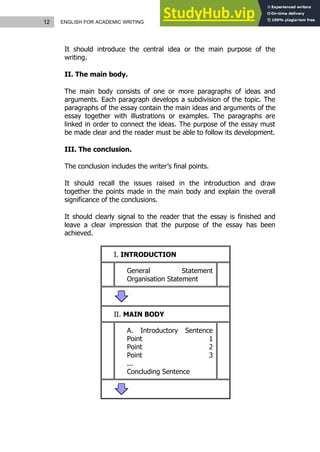
I. INTRODUCTION
General Statement
Organisation Statement
II. MAIN BODY
A. Introductory Sentence
Point 1
Point 2
Point 3
...
Concluding Sentence
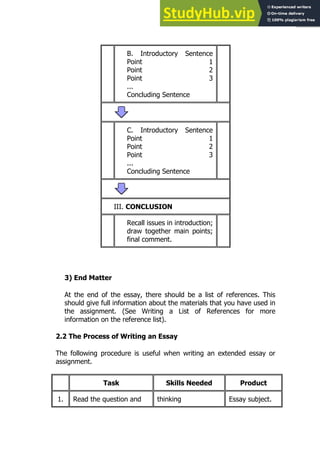
13
13
B. Introductory Sentence
Point 1
Point 2
Point 3
...
Concluding Sentence
C. Introductory Sentence
Point 1
Point 2
Point 3
...
Concluding Sentence
III. CONCLUSION
Recall issues in introduction;
draw together main points;
final comment.
3) End Matter
At the end of the essay, there should be a list of references. This
should give full information about the materials that you have used in
the assignment. (See Writing a List of References for more
information on the reference list).
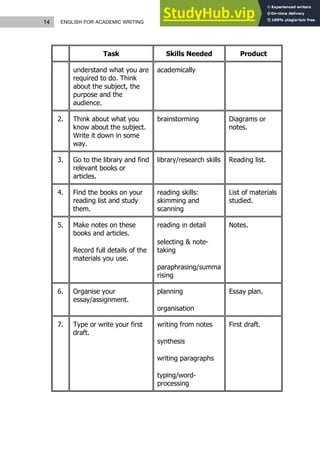
2.2 The Process of Writing an Essay
The following procedure is useful when writing an extended essay or
assignment.
Task Skills Needed Product
1. Read the question and thinking Essay subject.
14 ENGLISH FOR ACADEMIC WRITING
Task Skills Needed Product
understand what you are
required to do. Think
about the subject, the
purpose and the
audience.
academically
2. Think about what you
know about the subject.
Write it down in some
way.
brainstorming Diagrams or
notes.
3. Go to the library and find
relevant books or
articles.
library/research skills Reading list.
4. Find the books on your
reading list and study
them.
reading skills:
skimming and
scanning
List of materials
studied.
5. Make notes on these
books and articles.
Record full details of the
materials you use.
reading in detail
selecting & note-
taking
paraphrasing/summa
rising
Notes.
6. Organise your
essay/assignment.
planning
organisation
Essay plan.
7. Type or write your first
draft.
writing from notes
synthesis
writing paragraphs
typing/word-
processing
First draft.
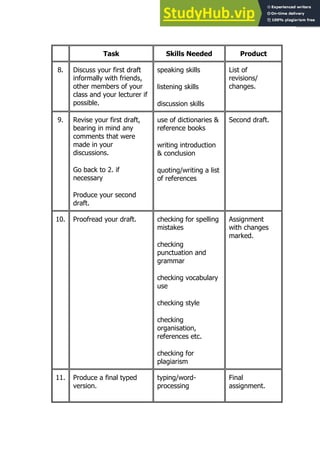
15
15
Task Skills Needed Product
8. Discuss your first draft
informally with friends,
other members of your
class and your lecturer if
possible.
speaking skills
listening skills
discussion skills
List of
revisions/
changes.
9. Revise your first draft,
bearing in mind any
comments that were
made in your
discussions.
Go back to 2. if
necessary
Produce your second
draft.
use of dictionaries &
reference books
writing introduction
& conclusion
quoting/writing a list
of references
Second draft.
10. Proofread your draft. checking for spelling
mistakes
checking
punctuation and
grammar
checking vocabulary
use
checking style
checking
organisation,
references etc.
checking for
plagiarism
Assignment
with changes
marked.
11. Produce a final typed
version.
typing/word-
processing
Final
assignment.
16 ENGLISH FOR ACADEMIC WRITING
Task Skills Needed Product
writing title/contents
page
12. Check everything. final check Hand in.
2.3 Writing in a Formal Style
Essays are formal entities, and the language we use should reflect that.
The style of an academic essay should be appropriate and consistent.
This is very different from an informal piece of writing.
When we speak, or write informally, we often use multi-word verbs but
this is not appropriate in formal writing. Here are some examples of
multi-word verbs:
call up
call off
give in
catch on
turn up
set up
find out
live down
bring up
look up
take in (deceive)
call on (visit)
look at
go into (a problem)
come by (a book)
ask for
believe in
care for
deal with
long for
object to
part with
17
17
One of the differences between some of these verbs is that some of
them can have an item inserted before the preposition:
he ran down the man - he ran the man down
he took on the challenge - he took the challenge on
the fire set back their plans - the fire set their plans back
In contrast, other verbs cannot have an item inserted before the
preposition.
ask for a number ? ask a number for
believe in a theory ? believe a theory in
part with a lot of money ? part a lot of money with
Multi-word verbs are very common in spoken English as they are less
formal than single verbs. In contrast, single verbs can sometimes sound
quite pompous in everyday speech. Compare:
I asked for another appointment.
I requested another appointment.
Now compare these pairs of verbs:
Informal More formal
He checked up on his accountant.
They put up with their neighbours.
She caught on very quickly.
She made up for it with
an early night.
He went down with a fever.
The cost of living went up.
He investigated his accountant.
They tolerated their neighbours.
She understood very quickly.
She compensatedfor it with an
early night.
He contracted a fever.
The cost of living increased.
18 ENGLISH FOR ACADEMIC WRITING
In formal writing, we use single verbs. This is an important element in
achieving the correct style in academic writing. An essay with good
ideas might well be marked down if the style is inappropriately informal.
Using single word verbs instead of multi-word verbs is not the only way
to achieve a more academic style. Here are some further points that you
may find useful.
In academic writing, you often find that actions, processes and events are
written in the form of a noun. This produces a more formal style. For
example:
The compound was discovered ….The discovery of the compound was….
They invaded the island and ….. The invasion of the island was …..
He achieved his goal and …… The achievement of his goal was…….
-Avoid addressing the reader with the general you. This is informal and
inappropriate. Look at this example:
As soon as you start to look carefully at children's home, you frequently
find evidence of abuse.
The sentence can be rephrased in different ways to avoid the use of
you.
Evidence of child abuse becomes apparent once careful investigative
work is carried out.
Careful investigation frequently leads to the discovery of child abuse.
- Do not use contractions in essays. They are inappropriate in academic
work. For example:
can't, won't, shouldn't, haven't, hasn't, couldn't
- State meaning very clearly. The reader can read the essay but not the
mind of the writer so do not use etc and expressions like and so on. Use
clear explanations and make a coherent argument.
The invasion of the island resulted in misery, starvation, destitution etc.
19
19
- Make sure every sentence makes sense. It is helpful to ask a friend or
relative to read your draft essay to ensure that it is clear. Avoid
ambiguous or confusing sentences. This proposal creates a way for
raising awareness in the UK of effective approaches to combat poverty
practised by overseas partners. We can take a guess at what the writer is
trying to say, but there is no doubt that the sentence is unclear.
- Do not overstate the argument that is being made in the essay by using
expressions like this:
It is obvious that …
It is clear that …
The evidence proves …
Anybody can clearly see that …
- Always comment upon your own conclusions in a quietly confident
manner, without attempting to claim too much. If a writer tries to claim
that the study proves something, you might find a later researcher
taking great pleasure in disproving the findings! Instead, use a less
strident and a more detached academic tone. This is called hedging.
Subsequent research may suggest other theories or produce results that
conflict with your own, but by describing your findings as we have done
below, your work can be seen as a further step in the academic road
rather than a barrier that other people can knock down.
The data reflect the fact that … (note: the word data is strictly speaking
plural but often used as an uncountable or mass noun)
These findings support this writer's view that …
The results suggest that …
The chart supports the theory that …
- Avoid the use of expressions such as I think/I believe unless your
own views have been specifically asked for, and use expression like
these:
It is believed…
20 ENGLISH FOR ACADEMIC WRITING
Many researchers have noted…
Some writers have stated..
The research suggests…
The evidence indicates...
- Use link words and expressions (however, nevertheless, as a result, in
contrast, despite this) as well as link words like firstly, secondly …………
finally quite regularly throughout your writing as these help to guide the
reader
- The passive form is often avoided in other written texts but you will
probably use more examples of the passive form in academic writing as
these tend to sound more detached and formal.
Active: They often found evidence of child abuse in rural areas.
Passive: Evidence of child abuse was often found in rural areas.
Active: The researchers have proposed a variety of solutions.
Passive: A variety of solutions have been proposed.
2.4 Planning and structuring your writing
Before you start writing you will need to ensure that you understand
very clearly what the question is asking you to do. Once you've done
that, you can start your planning. Remember that your plan need not be
slavishly followed as your ideas may well change to some degree as you
write your essay. As you read more widely or discover unexpectedly rich
sources of information, you can modify your plan. This might happen
several times before the essay is ready to hand in.
It is often very helpful to brainstorm ideas before you build a structure
into your essay. Brainstorming involves writing down all the ideas that
you have in your mind concerning one particular topic. They should be
written down in any order, just as they come into your mind. Many
students find it helpful to brainstorm by writing the topic in the centre of
21
21
a large piece of paper and then placing around this central
word/theme/topic a list of words/topics that they believe might be
appropriate. This is a task that you will do at the very early stages of
your writing and while some of the ideas you note down at this stage
will be central to the essay, others may be discarded at an early stage.
This is quite natural, and a part of the whole process of brainstorming.
Having gathered together as many points as you can, your next task is
to link them where possible, and provisionally order them into a
coherent structure.
2.5 The essay plan
Having put together as many relevant ideas as possible, the next stage
is ordering these points in an appropriate way. The important thing is to
try to build up a coherent picture of your essay so that you can use it as
the foundation for your writing. Your plan may be modified and
developed as you proceed but the important thing at each stage is to
focus precisely on the essay question and try to ensure that your essay
plan provides a logical response to the needs of the task.
An academic essay is likely to be divided into three main sections:
 an introduction
 the body of the essay
(a number of paragraphs exploring the topic)
 a conclusion
The introduction and the conclusion are likely to be moderately short,
while the main paragraphs in the body of the essay are likely to be
similar in length. There might, for example, be two or three paragraphs
to a page. If one paragraph is noticeably longer or shorter than others,
it would be well worth re-examining this paragraph. It may need to be
divided in two if it is too long, or expanded if it is too short. It would be
very unusual for a paragraph to be only two sentences. A paragraph
should never be merely one sentence in an academic essay.
It's very important to make your plan before you start to write. Try to
express each point in your plan simply and clearly in note form. This will
help you during the writing process. Look at this example:
22 ENGLISH FOR ACADEMIC WRITING
Topic: The pros and cons of tourism in Thailand
Thesis Statement: Tourism in Thailand is valuable, but only if it is
properly regulated and monitored by the central government.
Paragraph 1: A brief outline of Thailand's history.
a) Sukhothai Period
b) Ayuthaya Period
c) Thonburi Period
i) Rattanakosin Period
Paragraph 2: Tourism in Thailand.
a) General situation
b) Tourist attractions
i) Numbers of tourists
ii) Services
iii) Accommodation
iii) Attitudes of local people
c) Competition with neighboring countries
Paragraph 3: Economic reform brings about change.
a) The growth of private enterprise
b) The availability of foreign exchange
i) National funds
23
23
ii) International funds e.g. IMF
c) The expansion in foreign direct investment
i) Foreign funds
ii) Foreign companies
d) An increase in collaborative ventures
Paragraph 4: The growth of tourism has brought some benefits
to Thailand.
a) Foreign exchange
b) Employment
c) Opportunity
d) Reduced isolation
Paragraph 5: The growth of tourism has had a negative impact
on Thailand in some ways.
a) The growth of unsuitable hotels
i) Cultural clashes
ii) Limited local employment
b) A small increase in local jobs
i) Low skilled
ii) Poorly paid
c) An increase in exploitation; pandering to western needs
d) Additional damage in the public parks
e) A low percentage of tourist costs being paid in Thailand
24 ENGLISH FOR ACADEMIC WRITING
Conclusion: Tourism needs to be fully exploited in Thailand but it can
only bring significant benefits to the country is if is carefully regulated by
the government. Unless this is done, the tourists will exploit Thailand,
and then move on to new pastures, leaving a poorer country behind.
Task : Now write the essay from the outline above.
2.6 Essay Samples
Sample I
Why Buddhism As A National Religion In The New Constitution.
Dhirawit Pinyonatthagarn, Ph.D.
Suranaree University of Technology
Nakhon Ratchasima 30000 Thailand
(Written in response to the drafting of Thailand’s new
Constitution, sent to The Nation and Bangkok Post)
The new 2007 Constitution has now sparked off controversies as to
whether Buddhism should be stated as a state or national religion of the
Kingdom of Thailand. Most Buddhists, both monastic and lay people,
agree that the new constitution must clearly state Buddhism as a
national religion, whereas, some non-Buddhists feel that doing so would
lead to religious conflicts and downgrading people of other religions to
second and third grade citizens, and that, in turn, would undermine the
national security and reconciliatory attempts now underway, especially
in the 3 provinces of southern Thailand.
Whether or not should or must we include Buddhism as a national
religion in the new constitution, historical, cultural, and educational
landscapes of Thailand are some of the essential factors for Constitution
Drafting Committee (CDC) to carefully scrutinize before deciding to do or
not to do something about Buddhism.
Historically, Thailand has been practically a Buddhist state since
Sukhothai period, about 900 years ago, as evidenced in the King
Ramkhamhaeng’s Stone Inscription: King Ramkhamhaeng and His
people of all social strata have firm faiths in Buddhism; everyone
observes Buddhist precepts, especially during Buddhist Rain Retreat. In
the Ayudhya period, when King Luis XIV tried to convert Thai leaders
into Christianity, King Narai the Great expressed His strong opinion that:
This is a very significant matter for us because we and our ancestors
have long been embracing Buddhism, any attempt to convert us into
25
25
other religions would be an uphill task, and if God really created the sky,
the earth, and wished everyone should be a Christian, He should have
done so through his supernatural power. In the Thonburi period, King
Taksin the Great once declared: I am determined to promote, praise,
and protect Buddhism, my country, and my people. Down to the present
Rattanakosin period, King Mongkut, wrote in some of His literary works:
Buddhism is our national religion, our nation and religion cannot be
separated; therefore, it is essential that we all Thais maintain unflinching
faiths in Buddhism which is our national religion(special emphasis),
and preserve the Thai unique identities as we did in the past for many
generations.
Culturally, more than 90% of Thai people have been in one way or
another influenced by the teachings of Lord Buddha, the great founder
of Buddhism. Their minds, identities, and characteristics manifest
Buddhist ways of life: Loving kindness, compassion, neutrality,
sacrifices, honesty, self-detachment, and religious tolerance, under the
umbrella philosophy of “Do good, come good” or “What goes
around comes around” in the western way of thinking. The famous
sentence: Thailand is a smiling country, is inherently a result of the
Bwddhist teachings from generation to generation in the long but unified
history of Thailand.
Educationally, since ancient times, Thai people have received their
education under the cares of knowledgeable Buddhist monks and
scholars. Buddhist monasteries have served as a learning institution for
Thai children for a long long time, up until now, even though the
momentum or significance has to some extend reduced because of the
western model of education that penetrated every part of the world
under the globalization banner. The universal Buddhist philosophy of
educational training: Sila, Smadhi, and Panna (Good behaviors,
Concentration of Mind, and Wisdom), still plays a pivotal role in the Thai
educational system, be it elementary, secondary, or tertiary. Thus, it is
not at all an exaggerating to say that Buddhism has been an integral
part of the Thai ways of thinking and doing.
Now comes the most important question for CDC to answer and act on:
Should Buddhism be stated as a national religion in the new 2007
Constitution? This question will definitely encourage CDC members to do
some serious thinking about a place of Buddhism in the new
constitution.
As you may already know, most western or European constitutions do
not mention anything about a state or national religion because they
26 ENGLISH FOR ACADEMIC WRITING
believe in the strict separation of state and religion, which is deeply
rooted in the fears of increasing influence and power of the religion,
including some Asian countries, such as, China, India, and Japan.
However, most Buddhist countries inn Asia state the undeniable
importance of Buddhism in their constitutions, for instances, Sri Lanka,
Bhutan, Sikkhim, Kamphuchea. The two very clear examples of
countries in Asia that state their national religions are Malaysia and
Indonesia. Article 3, Section 1 of Malaysian constitution states “Islam is
the religion of the Federation but other religions may be
practiced in peace and harmony in any part of the Federation”,
and Article 29, Sections 1 and 2 of Indonesian constitution mentions
diplomatically, “ 1. The State shall be based upon belief in one god 2.
The State shall guarantee freedom to every resident to adhere to their
respective religion and to perform their religious duties in
accordance with their religion and that faith.”
In conclusion, to do or not to do something about Buddhism in the new
Thailand’ 18th
‘permanent’ constitution is up to all the CDC(Constitution
Drafting Committee) and NLA(National Legislative Assembly) members,
but to accept it or not in the coming popular referendum is up
to all the Thai people, particularly all Buddhists who constitute
more than 90% of the whole population in the country (around
57 millions out of 62 millions).
Sample II
Strategies for Promoting University-Industry – Government
Linkages
Dhirawit Pinyonatthagarn, Ph.D.
Suranaree University of Technology
Muang Nakhon Ratchasima 30000
Thailand
(Adapted from the paper presented in Poland, 1999)
Introduction
In the present age of globalization, the university system needs to
become more responsive to society and produce graduates with a higher
degree of responsibility and relevance to the needs of the country. It
must improve its capacity to cater more proactively to the increasing
demands of the economy and society and to strengthen it’s core mission
as society’s think tank or intellectual lighthouse. Likewise, the industrial
sector needs to play a more active role in supporting and interfacing
with universities for mutual benefits and integration of knowledge and
27
27
experiences.
General Strategies
These are the broad strategies and related actions recommended to
achieve the above-mentioned goals:
1. Build More Public Understanding and Awareness
The notion of university-industry-government linkages must be
incorporated into the mission of the universities. All public and private
universities should be encouraged to develop their own strategic
university-industry-government linkage plans which clearly set out
definitions, guidelines, structures, and procedures to govern and guide
the institution’s interface with society in general, and industry in
particular. The strategic plan must fit perfectly into the overall policy
goals of working towards increased self-sufficiency and supporting
industrial competitiveness. While building on a common theme and
concepts, each university’s plan must be appropriately based on the
resources, environment, strengths, and future development vision of the
relevant institution. Once the strategy plan has been complete,
universities should make more efforts to make known the details of the
plan both to university faculty and to outside which have a stake in the
relationship.
2. Have Commitment and Vision
Commitment and vision are the most essential factor that will determine
the success of university-industry-government linkage implementation.
These two components must prevail on three sides: university, industry
and government. What must be kept in mind is that commitment
without vision is blind and vision without commitment is useless. The
two elements should exist harmoniously together and complement each
other.
3. Stimulate Concerted Efforts to Meet New Demands
As things stand, the educational needs of society are shifting and there
is a clear path towards the provision of “life-long learning” and ongoing
and continual education, especially in the science and technology areas.
So, as universities move to meet these new demands and needs, the
importance of searching for mechanisms which more explicitly involve
28 ENGLISH FOR ACADEMIC WRITING
the productive sector as a core component of the eventual solution must
be stressed. On the government side, tax incentives to support the
establishment of private industry retraining centers should focus mainly
on supporting initiatives which involve university-industry-government
collaboration.
4. Include Co-operative Education or Practice School as Part of
the University Curriculum.
In the world of work, they do not require just graduates with a degree.
They need more than that; they need working knowledge, hands-on
experience, the ability to work and cooperate with others, good
personality, and initiatives. In short, graduate’s employability is the
heart of the matter. To cope with this new demand, Suranaree
University of Technology, Nakhon Ratchasima, Thailand introduced
Cooperative Education into its curriculum since its first year of operation,
1993. It has been regarded as the first autonomous and innovative
university in Thailand.
5. Promote Appropriate Mechanisms and Activities.
Relevant measures need to be put in place to support the development
of linkage activities and mechanisms. Existing measures and programs
that could relate to such activities should be refocused and redefined to
offer special consideration to university-industry-government linkage. A
number of these involve elements that could be modified slightly in
terms of emphasis to give particular support to initiatives. These
programs include the linkage development of the BOI(Board of
Investment), the research and technical assistance programs of
NSTDA(National Science and Technology Development Agency), the
industry support activities of the MOI(Ministry of Industries, and the
umbrella activities of NSDP(National Supplier Development Program).
6. Improve the Flow of Communications and Information
Technology
Communication is a key element of successful activities and measures
to be taken to strengthen the mechanisms to facilitate communications.
Liberalization in the telecommunications sector will finally deliver fruit
as the additional two million lines in Bangkok and one million lines in the
regional areas are coming on line. However, there remains the need to
remove other obstacles such as the outdated Telecom Act of 1923. In
addition to simply facilitating general communications and exchange of
29
29
information, the progressive introduction of information technologies will
also be able to contribute greatly to broadening the range of many
cooperation initiatives in all areas.
7. Promote University-Industry-Government Linkage as a Tool
for Development
Regional Thai universities, such as Suranaree University of Technology
Chiang Mai University, Khon Kaen University, and Prince of Songkhla
University, were established with the intention of supporting regional
development. They should play a critical role as a local knowledge base
and a window into world knowledge depositories for local industries.
Therefore, the linkage development for regional universities should be
given special priority as an explicit policy measure to compensate for
weaknesses in the level of knowledge infrastructure in the regional
areas as compared to what is available in Bangkok. The establishment of
interface mechanisms of all types can serve to supply services to the
private sector in the area as well as compensating to some extent for
the high communications costs of always having to go to Bangkok for
such services. Special technical and financial support should be given to
the regional universities in this respect.
8. Provide and Enhance Incentives and Support for Other
Cooperation
Currently, the tax laws of Thailand provide little incentive for charitable
donations. To facilitate the flow of resources, companies and individuals
to aid university development in the forms of scholarships, endowments,
professorial chairs, etc., full tax deductions should be provided.
Furthermore, a mentality of supporting educational institutions should
be encouraged through better organized alumni activities and specific
find-raising campaigns. To enhance the relevancy of university
education, more feedback should be encouraged, party through the
increased private sector participation in universities at all levels,
particularly in curricula development.
9. Establish a Proper Co-ordinating Center for the University–
Industry-Government Linkages.
A center for coordinating the activities and mechanisms for the linkages
between the university, industry, and government should be established
to implement plans and activities, and enhance productive relationship
among them. However, it has to be a real focal point with qualified
30 ENGLISH FOR ACADEMIC WRITING
personnel and up-to date facilities, not just a premise without
knowledgeable staff and modern facilities.
10. Be a Member of Professional Organizations.
It is necessary, in the present day, to be a part of each other to
coordinate, cooperate, communicate, and compete. Together, we
develop and prosper. So, partnership of the stakeholders should be
considered an important step towards more sustainable progress in the
implementation of university-industry-government linkages. Professional
associations should be encouraged to play a bigger role in the
development and accreditation of university programs.
Conclusion
All the ten strategies mentioned above, if followed appropriately, can
contribute to the sustainability and progress of the linkages among the
university, industry, and government in Thailand as well as in other
countries. They should constitute a common ground for the tripartite
linkages and serve as “Ten Commandments” for mutual advantages and
recognition. The ten strategies can be, nevertheless, summarized in just
three words: Actions, More Actions, and More and More Actions.
Sample III
The Impact of Science and Technology on Society
Dhirawit Pinyonatthagarn, Ph.D.
Suranaree University of Technology
Nakhon Ratchasima 30000 Thailand
(Adapted from the paper presented in Singapore, 1998)
Abstract
As we prepare to enter the twenty-first century, civilization is in its
greatest age of technological change. Society is in the midst of the
massive task of absorbing science and technology on a scale never
before experienced. Modern technology has given society new powers
but also the responsibility to use science and technology in a way that
enhances the quality of life. Throughout history, science and technology
has been pressed onward like a glacier, overturning everything in its
way and grinding all opposition into dust. Though the Industrial
31
31
Revolution created new and serious human problems for some people in
society, it was a great advance in the history of civilization. Technology
continues to grow because of people themselves. Human beings, have
tested the fruit of knowledge, cannot suppress their desire for it. They
forever to expand knowledge of their environment, probably because of
the excitement of learning and their belief that more knowledge will help
them control their environment. This paper takes a closer look at how
science and technology enhance or affect society as a whole with the
main focus on Thailand.
1. Introduction
To begin with, we must acknowledge the innumerable blessings
bestowed on us by science and technology. That is, nobody will dispute
the enormous value that science and technology provide. If we look
around at communications in the present day, we see radio, telephone,
fax machines, television, video, satellites and so on, all of which have
arisen from scientific and technological advances. Other obvious areas of
development are in the medical world, where so many contagious
diseases have now been virtually eradicated. Cholera is now quite rare,
in Asia it is almost extinct. Bubonic plague no longer exists. Smallpox
has all but vanished. We no longer have to fear these infectious
diseases. Even brain operations are getting easier. Sophisticated
examination and agnosis are more and more accessible. Then we have
electricity and countless labor-saving devices. The field of biology has
seen the development of genetic engineering, which may produce a new
or specially adapted species of plants and animals. In short, it is almost
impossible to list all those technological advances we have with us
today.
2. Benefit-Creating Technology Or Benefit-Seeking Technology
That application of science which effects the changes in the natural
world, changing it into a so-called artificial world, is that which we call
‘technology’. However, technology is dependent for its existence on the
knowledge obtained through science. Technology is the tool, or channel,
through which humanity has worked to manipulate nature in the pursuit
of material comfort, but at the same time, the dangers which threaten
humanity are also contingent on this technology. Technology is thus
both an instrument for finding happiness and a catalyst for danger.
If we can constrain ourselves to creating benefit, the repercussions
arising will be few and far between. But whenever technology is used to
32 ENGLISH FOR ACADEMIC WRITING
seek benefit, problems arise, as we can see in the present time.
Therefore we must clearly distinguish between technology for the
creation of benefit and that which is used to seek benefit.
All in all, the benefits created by science appear to the mass of people
through their technological manifestations. Humanity must, however,
learn to choose between technology for creating benefit and technology
for seeking benefit. ?(Bhikkhu P.A. Payutto, 1993: 9-17)
3. Features of Technology
The dominant features of technology are change then more change.
Technology forces change on people whether they are prepared for it or
not. In modern society it has brought so much change that it creates
what is called future shock, which means that change comes so fast and
furiously that it approaches the limits of human tolerance and people
lose their ability to cope with it successfully. Although technology is not
the only cause of change, it is the primary cause. It is either directly or
indirectly involved in most changes that occur in society
Another feature of technology is that its effects are widespread,
reaching for beyond the immediate point of technological impact.
Technology ripples through society until every community is affected by
it. The shock waves push their way into even the most isolated places.
People cannot escape it.
An additional feature of technology is that it is self-reinforcing. As stated
by Toffler, : “Technology feeds on itself. Technology makes more
technology possible.”( Toffler, 1971:26)
4. Phases of Technology and The Social Systems They Create
Looking at technology in very general way, five broad phases of
technology have developed. One phase at a time tends to dominate the
work of a nation, and in so doing it has a major influence on that nation
and creates its own distinct type of social system. In history, nations
have tended to move sequentially through each phase, beginning with
the lowest technology and moving higher with each step, so the five
phases of technology roughly and moving higher with each step, so the
five phases of technology roughly represent the progress of civilization
throughout history. Although one phase of technology tends to
dominate a nation’s activities at a particular time, other phases often will
be practiced at the same time. The five phases are these:
33
33
1) Nomadic Society
2) Agrarian Society
3) Industrial Society
4) Service Society
5) Knowledge Society
5. Technology As a Social Force
Throughout history, technology has been pressed onward like a glacier,
overturning everything in its way and grinding all opposition into dust.
In early nineteenth century England for example, a band of unhappy
workers known as Luddites challenged the Industrial Revolution by
roaming the countryside smashing machinery and burning factories.
From their narrow viewpoint, machines were enemies taking away jobs
and freedom and harming people. But the Luddites were soon overcome
by the benefits brought by the same machinery they opposed. Their
movement failed, much the same as their more modern successors did,
such as the glassblower who opposed glassmaking machinery. We know
now that they were largely mistaken about the broader significance of
industrial technology. Though the Industrial Revolution created new and
serious human problems for some people in society, it was a grate
advance in the history of civilization.
Technology continues to grow because of people themselves. Human
beings, have tested the fruit of knowledge, cannot suppress their desire
for it. They forever to expand knowledge of their environment, probably
because of the excitement of learning and their belief that more
knowledge will help them control their environment.
6. Social Consequences of Technological Change
Technological advances bring both benefits and costs to society over
long historical epochs, civilization has been carried to supreme heights
of material progress and accomplishment by technology and science.
34 ENGLISH FOR ACADEMIC WRITING
Economic growth-driven by the engine of technological progress-has
conferred wide benefits on humankind: supporting large populations at
higher levels of living, extending expected life spans, and expanding a
whole range of human potentialities that were the subject of science
fiction novels not too ago.
1) Social Costs
In the same way that a lifesaving engineering gene may have side
effects, technology also has had social side effects, when they are
negative, the become social costs. While a nation’s political
infrastructure lacks the capability to monitor and pass judgment
on the overall good or bad impact of every scientific advancement,
society values many provide mechanisms that evaluate new
technologies. On the political front, courts and legislatures can
regulate the use of certain was banned by technologies. When
coupled with a mobilization of public constituencies, similar
political forces have checked and curbed the use of technology in
business.
There are other social costs to technology as well. Pollution,
congestion, depleted natural resources, overpopulation, and the
use of technology in settings such as developing nations where
conditions for safe use may not exist all raise serious questions
about the balance between technology and society. Business is an
important actor in creating and resolving these dilemmas.
Production marketing, and strategic planning decisions should not
be made in a vacuum that ignores such social costs. The
responsibility of business to current and future stakeholders in
society requires careful attention to these costs.
2) Biotechnology-A New Frontier
Another good example of the problems associated with new
scientific and technological breakthroughs is the modern era of
genetic engineering, also called biotechnology. Genetic
engineering has a history over a century old, rooted in agriculture.
In the nineteenth century the botanist, Gregor Mendel, pioneered
the science of genetics. Ever since, genetic scientists have clones
and propagated crops that have helped farmers produce more
food per acre that is of better quality and less labor-intensive.
The new era of genetic engineering includes new techniques that
enable scientists to combine knowledge from various areas of
35
35
science, such as biochemistry, genetics, microbiology, and
ecology. Scientists can now identify and manipulate molecules in
genetic material with revolutionary applications in agriculture,
medicine, and industry.
One of the biggest worries surrounding biotechnology and genetic
engineering is the uncontrolled escape of synthetically developed
materials. For example, and engineered bacterium intended to
build disease into a plant might also accidentally kill off a
beneficial insect.
7. Business Applies Technology
As soon as new knowledge exists, people want to apply it in order to
reap its benefits. At this point business become important, because
business is the principle institution that translates discovery into
application for public use. Printing manufacturing, housing, education,
and television are all dependent on business activities to make them
work productively. Society depends on business to keep the stream of
discovery flowing into useful goods and services for all people. Less
developed nations have learned that scientific discoveries mean very
little to them unless they have competent business systems to produce
for their people what science has discovered. In a similar manner,
developed nations have learned that an innovative business system
helps translate technological developments into useful goods and
services for their people.
8. Some Economic Effects of Technology
1) Higher Productivity
2) More Emphasis on Research and Development
3) Upgraded Job Skills
4) More Scientific and Professional Workers
5) Greater Capital Requirements
9. Business Responsibility for Technological Change
36 ENGLISH FOR ACADEMIC WRITING
In one important sense, business has only responded to expressed or
potential public demands for more and better technology, in a private
enterprise society, people register their wants through the marketplace,
voting with their purchasing dollars. These free market demands have
encouraged business to push greater technological growth through the
introduction of new products and services. The enormous popularity and
demand for today’s many electronic inventions-whether video games,
videocassettes, pocket calculators, laptop computers, or digital
recordings- illustrate the powerful dynamics of combining modern
technology with a private enterprise system.
The idea of a broad institutional partnership for humane technological
advance belongs in the thinking of business leaders, as well as in the
minds action of all those in society who have a stake in the technological
future (Frederick, Post, and Davis, 1992)
10. Restraints on Technological Growth
1) Pollution
Pollution is an unavoidable consequence of industrial production
since waste by-products are produced along with useful things. In
addition, many useful consumer products (e.g., automobiles) are
themselves responsible for much pollution; and sooner or later, all
manufactured goods wear out and are discarded as useless. The
biosphere-the land, air, water, and natural conditions on which all
life on earth depends-can absorb and break down many of these
industrial contaminants without harm to people, animals, or plants.
But the biosphere is not an infinite sponge, and the buildup of
harmful chemicals in the ecosystem poses a threat all life and the
planet itself.
2) The Industrial Resources Base
A second, closely related factor limiting technological growth is the
possible depletion of the world’s industrial resource base. This base
is composed mainly of minerals, various forms of energy, water
supplies, a skilled labor force, and human knowledge. Some studies
have questioned whether the globe’s supplies of reasonably priced
minerals, energy, and water are sufficient to support unlimited
industrial and technological expansion.
37
37
3) Social Institution
A third factor limiting technology is social values and institutions
that many be inconsistent with the full productive potential that is
present in technology. Many societies, perhaps most of those adopt
modern technology, encounter similar but less dramatic problems in
arriving at a fit between their traditional social institutions and the
new trends of technological development.
11. Science and Technology In Thailand: Then And Now
Archeological evidence confirms the realities of life of the prehistoric
people who inhabited the region known as Thailand today, and their
level of technological development. Artifacts dating as far back as 3000
BC found at Ban Chiang in the Northeast of Thailand show that Thai
people used sophisticated methods of rice agriculture, metallurgy and
pottery-making. David Wyatt observed in Thailand: a Short History that
Southeast Asian people had long known, among other things, how to
make articles from bronze and copper.
After World War 2, various ideological and political forces prompted
governments to implement policies for the pursuit of what has been
widely referred to as “development.” Initial schools of thought
envisioned a linear and single path to development, or modernization,
that involved the mass adoption of Western science and technology. It
presumed that Western technology was appropriate for developing
countries and that once adopted, those countries would proceed along
the same path as Western countries. However, this notion was not
always true; it was evident that even though many countries adopted
Western technology they persisted in an underdeveloped state by
Western standards. Moreover, it did not explain why some countries
developed while others did not. As a result, reactionary schools of
thought emerged to assert that technology from the West is
inappropriate for developing countries, and that such countries should
rather build up an indigenous capability. Yet again, there are examples
of countries that followed these inward-looking policies that were not
successful in achieving development dictated by Western standards.
However, recent experience suggests that countries require a balance of
technologies but also calls into question the notion of development as
being defined by Western standards. This may be viewed as part of the
globalisation phenomena. In academic circles this has given rise to the
38 ENGLISH FOR ACADEMIC WRITING
questioning of the right of Western intellectuals to speak for humanity.
It has also allowed for the emergence of genuine questions about global
culture. Ultimately, the globalisation phenomena gives developing
countries the opportunity to search out their own goals and definitions
of development that derive from their own cultural and social values and
norms. Within this global environment, it may be possible for some real
“universal” goals of development to emerge that are based not only on
Western experiences but which also consider the experiences of non-
Western countries(Yuthavong and Wojcik, 1997).
12. Thailand as Part of the “Global Village”
It is clear that Thai society is changing rapidly. While several sources of
this change are internal, an important part of the change comes from
external sources. Internally, change has resulted from such factors as
the increase in population, the changing characteristics of employment,
and urban migration. External sources may have either direct influence
on the society or intermingle with the internal sources to cause a major
change. An important factor is the global trend for increased interaction
among societies, caused on the one hand by the trends towards freer
trade resulting from multilateral trade agreements, and on the other
hand by easier communication resulting from advances in
telecommunication and information technology, and transportation in
general. The external factors are the same all over the world, and
therefore the changes in Thai society are in many ways typical of those
taking place in other societies that are open by nature. The openness of
the Thai society, combined with traditional advantages in low labour
cost and natural resources have attracted outside investment, which is
significantly spurring the growth in the economy, but at the same time
fueling the rapid changes which are occurring at an increasingly greater
pace.
The changes in the mode of production and services in the Thai
economy are paralleled by perhaps even greater changes, at the
individual level, on the Thai people as consumers. Always receptive to
external influence, the Thai people are rapidly and deeply affected by
the new waves of change, to the extent that such change may wipe out
traditional cultures and unique characteristics of the society. Will the
society be transformed from one shaped by its unique history and
position in the world, into one with a “universal” culture, monotonously
common in the global village? Will a positive situation emerge, whereby
the unique society is maintained, but constantly evolving to reap the
benefits of globalisation without losing its identity? Science and
technology, with both their universal and location-specific
39
39
characteristics, will have a large role to play in the future transformation
of Thailand.
13. The Good and Bad Effects of Science and Technology in
Thai Society
The trends of change in the Thai society resulting from science and
technology have both desirable and undesirable components. Some of
the consequences of the development and application of science and
technology are direct, as for example optical fibre links, while others are
indirect and result from interactions with other aspects of the society, as
in human migration resulting from industrialization. In the attempt to
fulfil the vision for Thailand’s future, measures should be taken that
would as much as possible allow the desirable components to be
realized, while at the same time thwart the undesirable components. It
may not be possible to achieve the goals completely: some changes will
bring both good and bad news together.
For example, information technology will make available both new
educational tools and new tools for crime. It is therefore a matter of
creating a wholesome balance in development and in the use of science
and technology. In order to try to create such a wholesome balance, we
might compile a list of desirable and undesirable effects of science and
technology in some of the sectorial areas discussed in this book. The
tables below contain short lists for industry, agriculture, health and
communication. These are general effects for developing countries such
as Thailand only, and are subject to exceptions in many specific cases.
Nevertheless, they may show some important conclusions for us to set
the courses for optimal development.
14. The Place and Role of Science and Technology in Thai
Society
For a society to have the capability for the development and application
of science and technology, it should have a proper attitude towards
these important tools. Many people in non-Western countries such as
Thailand have the attitude that science and technology have their
origins in, and still belong to, the West. This attitude creates alienation
towards science and technology. We should look at the facts. The
content of science and technology as we know them today owe their
origins to the ancient Greeks and the Europeans of the Renaissance era,
but we should examine the origin of science and technology, not in
40 ENGLISH FOR ACADEMIC WRITING
terms of content, but in terms of concept and system. In so doing, we
find that science and technology should be the heritage of all mankind,
because the essence of science and technology-use of reason, curiosity-
generated observation and experimentation, making of tools--are the
traits of every human society. Thailand, as well as other civilized
societies old and new, possesses this universal trait irrespective of
“modern” science and technology. Carl Sagan(1980) used to mention
that the scientific world view works so well, explains so much and
resonates so harmoniously with the most advanced parts of our brains
that in time....virtually every culture on the earth, left to its own devices,
would have discovered science.
Science and technology, therefore, do not belong to any particular
human society, but are the results of human evolution, especially that of
the brain, over more than a million years. The fact that some
civilizations made more advances than others in the past few thousand
years does not mean that they “invented” science and technology, but
simply that the civilizations reached that crucial stage of development.
The status of science and technology is in a real sense a major
indication of societal achievements. In the broad sense, therefore,
scientific culture -- defined as a culture of reason, of systematic
investigation, of thinking in conjunction with action, of readiness to be
proven wrong -- is a desirable culture for any society. Scientific culture
is not the same as science-oriented culture. While a scientific culture
has attributes akin to those of the scientific process in the broad sense,
a science-oriented culture implies aspirations towards scientific
achievements per se. A culture may therefore be scientific without
being science-oriented. The status of a scientific culture is much more
difficult to discern. This can perhaps be roughly assessed by the
reflections in various activities in the society.
As these indicators show, Thailand should not be considered a science-
oriented society. This has some serious implications concerning the
ability to compete in world trade, and measures should therefore be
taken to achieve more science orientation in the society. Even more
serious is the fact that the Thai society is still a long way from having a
scientific culture. Bhikkhu P.A. Payutto(1993), a modern authority on
Buddhism observes that Thailand only has a “technology-minded”
culture, not a “scientific” culture. It is more attracted by the products of
technology, rather than the process of thinking and learning. A re-
orientation in the Thai society is needed to achieve a balance, where
science and technology can have an suitable slot, both because of their
contributions to material wealth and their spiritual role in human culture.
41
41
Conclusion
The rate of technological change-during the past century has been
greater than all of the technological advances made in the previous two
thousand years. As technology marches on into the twenty-first century,
society is presented with the opportCHAPTERy to capitalize on these
innovations and the challenge to utilize technology in a way that reflects
society’s moral standards. Society must weigh the benefits of technology
against its negative side effects to ensure that the mistakes of the past
are not repeated so that innovation will continue to improve the quality
of life.
However, since science and technology are a part of universal human
culture, and at the same time also have many local characteristics, Thai
society has a potential to grow its own science and technology, since it
is an open society with a tolerant religious and general outlook. Both
imported and indigenous science and technology can be important tools,
providing development options for all people in the society.
To reiterate here again, science and technology have contributed a
great deal to society as a whole. They have, so to say, tremendously
improved the quality of life and altered the ways we do things. There
are no disputes or doubts about the validity and usefulness of science
and technology for human consumption and inventions. However, we
must bear in mind that science and technology have some limits per si;
they can never answer all problems of human life; they can never reach
the bottom of the human mind; they can never go beyond the physical
world. In certain cases, science and technology can pose dangers to our
own existence and the existence of plants and animals, or even to the
universe. In other words, science and technology are not yet able to
correct their own handiwork. To quote Sir Arthur Eddington(1929,
p.282), “Science is incapable of leading mankind directly to the truth,
or reality as such, it can only leads him to a shadow world of symbols.”
Yet to quote Mack Plank(1984, p. 153), “Science cannot solve the
ultimate mystery of nature. And that is because, in the last analysis, we
ourselves are part of nature, and, therefore, part of the mystery that we
are trying to solve.” So, in the final analysis, what we need is a kind of
science and technology that is moderate, appropriate, constructive, and
serves to develop understanding for the improvement of human being.
42 ENGLISH FOR ACADEMIC WRITING
We perhaps must radically change our ways of thinking if we are to
survive on this planet.
Sample IV
Research Conduct from the Inside Out: Personal Account of a
Thai EFL Teacher
Dhirawit Pinyonatthagarn, Ph.D.
School of English
Suranaree University of Technology
Nakhon Ratchasima 30000 Thailand
(Full paper presented at the 20th
Annual International TESOL
Conference Sofitel Hotel, Khon Kaen, Thailand 30-31 January
2004)
Abstract
Being a university teacher means having to cope with several things at
the same time. The two main tasks that are mandatory for us are to
teach and do research: We are expected to teach well and research
more in order to create a novel body of organised knowledge that will
benefit both students and community alike. However, it is not always
easy to carry out those two missions with equal successes; there are
some pains and pleasure involved throughout the teacher's research life.
As the saying goes, no pains, no gains. Therefore, in this short talk, I
will share my pains and gains experienced during the period of my
experiments with the truths on the assumption that genius is 1 %
inspiration and 99% perspiration.
Introduction
With the new trend of research in Thailand, under Thaksin
Government (2001-2006), Thai teachers in universities, colleges,
schools and researchers in general are forced to concentrate on
grassroots level integrated and interdisciplinary research aiming to
eradicate or reduce poverty of rural people, and gear the country
toward knowledge-based economy and learning society So, the research
approach recommended at present is “Outside In” that takes into
43
43
consideration the needs and urgency of society on the very basic
assumption that research should serve the social needs, help solve
problems of the country, and lead the country to or beyond a new
frontier of knowledge and development. However, this does not mean
that “Inside Out” research is not encouraged. This “Inside Out”
approach is necessary in contexts that involve reflections and internal
investigations, such as Classroom Action Research and Case Studies.
Ultimately, and in my opinion, with the support of the 1994 National
Educational Reform Act of Thailand, the combination of “Inside
Out” and “Outside In” research should be a good answer to the
problem, depending on what, when, where, and how. My presentation
today follows the “Inside Out” approach. So, I will focus mainly on what
was and is happening in my mind that eventually led and lead to
research investigations.
Teacher as Researcher and Teaching as Research
In Thailand, traditionally, teachers and researchers were supposedly two
separate identities having their own things to do and look for. In the
absolute sense, they did not need to depend on or learn from each
other for their professional survival. But with the onset of globalization
that sweeps across the world making things faster and compact, every
sector has to adapt to changes and improve itself to catch up with new
facets of science and technology. Teachers are at the forefront to
immediately respond to the new change because they are primary
change agents in society. Traditional classroom has become learner-
centered, teachers have more autonomy and responsibility to manage
their students, and IT technology has been an essential part of the
learning-teaching process. Traditional teachers with the old style
teaching methods are to be replaced by progressive and IT oriented
ones.
Glenda Bissex (1986), in her exploration of teaching as research,
attempts to dispel some assumptions about the meaning of "research"
and how it relates to classroom teachers. She points out that a teacher-
researcher is an observer, a questioner, a learner. Teacher-researchers
focus on what is happening at hand; they try to understand the ongoing
events of their classrooms: I wonder how much students think about
reading outside of class? Teacher-researchers question their educational
assumptions; they're continually trying to make sense of their students'
interpretation of the tasks and activities they set them: I wonder if
children really have to learn to read before they can begin writing?
Problems become questions to investigate; new ways of teaching
44 ENGLISH FOR ACADEMIC WRITING
become opportunities for learning: what would happen if I shared my
writing with my students? Teacher-researchers are learners; they don't
make a separation between those who "know" and those who "do"; they
begin to trust their own ability to find out.
Parsons (2004) stresses that traditional educational research has limited
usefulness for classroom teachers. It often requires the carrying out of
specific research projects to the exclusion of their teaching. When
educators talk about teacher research, or teaching as research they
envision teachers extending their role to include critical reflection upon
their teaching. Some examples of teaching as research include
educators who wish to undertake research in their classrooms or schools
for the purpose of improving teaching, to test educational theory, or to
evaluate and implement an educational plan. Teacher researchers have
adopted the label "action research" to describe their particular approach
to classroom research.
Kurt Lewin (1946) has been credited with the development of the idea
of action research. The evolution of an action research agenda within
education has been influenced by people such as Kemmis (1983),
Ebbutt (1985), Elliott (1991), Hopkins (1985) and others. Hopkins
(1985:pp 58-60) offers good advice on teacher research when he
advocates the development of teacher's professional expertise and
judgment. He provides a basis for the selection of classroom research by
teachers:
a) The teacher's primary role is to teach and any research
project must not interfere with or disrupt this commitment;
b) The method of data collection should not be too demanding
on the teacher's time;
c) The methodology used must be reliable enough to allow
teachers to formulate hypotheses confidently and develop
strategies applicable to the classroom situation;
d) The teacher should be committed to the research problem
under study;
e) The teachers must follow ethical procedures when carrying
out research; and classroom research where possible should
adopt a perspective where all members of a school
community build and share a common vision.
Often the hardest part in classroom research is deciding on a focus.
Teacher research does not require a precise hypothesis. In fact you do
not have to begin with a problem. Hopkins (1985:pg 63) suggests that "
All you need is a general idea that something should be
45
45
improved. Your general idea may stem from a promising new
idea or the recognition that existing practice falls short of
aspiration." Once the focus of the research has been decided, planning
for data collection, followed by actual data collection and analysis
occurs.
Now, how to get started on a project. Based on Hollingsworth (1994)
and Hopkins (1985) we can benefit from the following practical
suggestions for the teacher research process:
a) Decide on a focus
Start with autobiographical data by locating your best professional self.
Some questions you might ask - What are your broad interests in
teaching and learning? What are your specific interests? What are
manageable questions? Choose something you feel passionate about.
b) Justify that the project is your best solution to the problem.
c) Develop a plan to gain insights
Develop a time-line to gather evidence or data to examine what you are
trying to accomplish/resolve/do in light of "what you do not know yet".
d) Decide what evidence you want to collect.
Evidence includes such things as questionnaires/surveys, observations
(video or written notes), collaborations (i.e. video or audio tape of
meetings, peer coaching) interviews, tests and records, student work,

video and audio tape transcripts, personal journal, library readings, etc.
e) Analyze the data by looking for patterns, or themes across
the evidence
Keep logs and journals, periodically read over the evidence, code data
from themes and patterns, draw or chart patterns, try to summarize
what you have learned as you go, by noting images, metaphors, and
any new questions.
f) Check out your understandings by triangulating evidence
(same theme, code, pattern appears in more than two types of data),
and by talking to peers, students, friends.
g) Report on what you have learned to your colleagues, to parents,
at conferences, in journals.
46 ENGLISH FOR ACADEMIC WRITING
h) Summarize what you learned -- in an essay, narrative,
poster, video, etc.
k) Tell how the problem changed, did not change, or became
worse because of changes in your practice.
A key component of Action Research is sharing what you have
learned. A number of techniques ranging from videos to formal
presentations have been suggested, but the following can be your
potential audiences as well:
- Colleagues at a staff development day
- Parents and students
- Email discussion groups (see On-line Resources)
- Publications from professional organizations
- Journals such as "Teacher Research: The Journal of Classroom
Inquiry" - a journal by teachers, for teachers.
When teacher research is shared, it allows for further action on the part
of the teacher, or the broader educational community to continue. So,
If you have not undertaken teacher research in your classroom
now is the time to try!
My Struggle with Research Adventure and Misadventure
To keep up with the new trend and new challenges, I started out as a
serious researcher in 2000, after 5 years of teaching only at Suranaree
University of Technology, and after ten years of my Ph.D. completion.
To be frank and honest I became a dead wood in research for several
years, and it is extremely hard to get back on tract again. Personally, I
hated doing research because it is a tedious and arduous job taking up
so much of my time with little or no impact on society at all, except for
your own personal gains, such as academic promotion, salary increase,
and some small illusory fame. Most of the Thai teachers’ research works
have been lying on shelves in the library or at home with no social or
market values whatsoever. Then, I thought to myself, “What’s the
point of doing research?”. I have been thinking a long that line for
several years and I still survive in my teaching career. Then with the
new policy, rules, and regulations of the current Government and my
own workplace, Suranaree University of Technology, I have to
reengineer and rekindle myself: my ways of thinking, my teaching
practices, and my world views as a professional teacher. I forced myself
a lot to recover and wake up from academic complacency and inertia, if
not deep slumber or oblivion to the outside world. I began by reading a
47
47
lot of modern literature on research for language teachers focusing first
on action research and case studies, both in Thai and English. As you
know, old habits die hard. It took me a lot of efforts and time to turn
over a new leaf and become research minded. The next step, after
extensive literature reading and surveying, was to write up a good
proposal to get funds from my university. The first research I carried
out, after I received Ph.D. in 1991, about ten years after, was a case
study, a kind of classroom action research. The proper title of my
research was An Analysis of Discourse Features That Affect
Students' Communication of Written Texts In English V
Academic Writing Classes At SUT. The final step in my search of
academic excellence was to look for successful mentors and experts in
the field who would guide me through and help me see the light at the
end of the tunnel. Fortunately, Dr. Maneepen Abhibalsri, then Chair of
the School of English, managed to secure UMAP funding for me to be in
Australia for a few months. She even recommended one expert in the
EFL field to me. That expert is here with us today. You would not get
surprised if I mention her name because she is an internationally
established EFL research and teaching expert who has been actively
involved in TESOL conferences around the world. Well, I cannot hold
you back any more. She is Jill Burton, a Professor from the University
of South Australia.
Done with my research with Jill Burton, I attempted and finished two
pieces of research with Richard K. Coll, University of Waikato, New
Zealand, and my colleague, Isra Pramoolsook, who is now on his
doctoral study in England. Our research works are interdisciplinary in
nature involving something far away from my field of teaching, but
within the university mission. The proper tile of the two researches are
1) An Investigation of Thai Students Co-Op Placement
Experiences; and 2) Internationalization of Cooperative
Education From Thai Students' Viewpoints, respectively.
Then, in June 2003, I went to Northern Illinois University, DeKalb, USA,
as Visiting Professor, on the Government scholarship allocated
specifically for Graduate School instructors to develop their research and
teaching skills abroad. At NIU, I met with many professors and experts.
To name a few, they are Deborah Pierce, Doris Macdonald, Casey
Bozek, Michael Day, Grant Olson, John Hartmaan, Richard A. Orem. But
I had a lengthy discussion about my research project on language
awareness raising for Thai EFL students with and benefited a lot from
Dr. Karen Carrier, School of Education, NIU. She is an expert in bilingual
literacy and TESL (Teaching English as a Second Language). She also
introduced me to other professors in her field. Like Jill Burton, she
48 ENGLISH FOR ACADEMIC WRITING
critically and carefully read my proposal and had good comments on it.
She also allowed me to sit through her graduate classes to learn and
observe how she teaches her graduate students from different countries
and ethnic groups and how they behave and interact in class. I learned
a lot from her and her students, and definitely enjoyed all the facilities:
library, office, computer, etc. at NIU throughout the period of my stay
there.
During the last week of my stay at NIU, I flew over (or down, I am not
so sure) to MIT in Boston, to meet with Alec Marantz, Professor of
Linguistics and Head of the Linguistics and Philosophy Department. We
discussed the possibilities of research cooperation but unluckily he is
more interested in pure linguistics and artificial intelligence about which
I know next to nothing. At MIT, I was also trying to meet with Noam
Chomsky, the Father of Modern Linguistics, to whom I owe so much in
the field of my study, Linguistics, but he was away in another country at
that time. Later on, he sent an e-mail to me saying “sorry” for being
unable to meet me at his own office. Somehow, his secretary allowed
me to sit in his chair and browse through several piles of his books and
monographs. I was tremendously impressed by his deep scholarship and
academic dedication and lifelong commitment to linguistics, world
peace, and American politics. I spent a big amount on his books at MIT
Press.
To make the best use of my time and learn more about American ways
of doing things in Boston, I also visited Harvard University during my
trip to MIT. I was overwhelmed with the atmosphere at the world class
campus and five star bookstore. I spent two days at Harvard doing what
I enjoy most: sipping at coffee and reading latest publications in
Linguistics and EFL/ESL in the Cozy Coffee Bar, second floor, of Harvard
Bookstore. Some American told me the special difference between
Harvard and Cambridge Universities: Cambridge thinks it is the
world but Harvard thinks it can change the world. There might be
some elements of truths in that statement but things can change upside
down. We can never be sure. Anyway, I bought a lot of good books
from that bookstore, some inside and some outside my field. But all of
them are very useful for me, my students, and my colleagues in
Thailand.
My Difficulties with Action Research
As pointed out by Newman (1987), the difficult thing about doing action
research is that you have to override most of what you've learned about
49
49
research as an activity. In a traditional research culture you begin by
framing a question, setting up a situation which might provide some
information, collecting data which bears on the question, then writing up
results. Action research isn't like that at all. The research activity begins
in the middle of whatever it is you're doing — something happens that
you did not expect, and you begin wondering about what's going on.
Another dilemma in an action research is that you may not even realize
something interesting has occurred that you ought to think about unless
you are already in the habit of keeping a journal or reflective log.
Because teaching, like other activities which occur in and around
schools, is so complex, we are accustomed to coping with the many
things demanding our attention at once without really thinking about
them; we generally do not make a point of recording those moments
which surprise or perplex us or stand out for some other reason during
the course of the day.
However, as I experienced it myself, the hardest part of beginning an
action research project is developing the discipline to keep a written
account, of recording on a regular basis the details of what is
happening, particularly when you have no idea what you are looking for.
Unlike traditional research, action research begins not with a research
question but with the muddle of daily work, with the moments that
stand out from the general flow, and unless we record those moments
they vanish, unavailable as data for reflection, for discerning some
larger pattern of experience. So it's necessary to keep fairly detailed
notes. Whether it's a journal, a daily log, critical incidents jotted on
index cards, or more extensive field notes, without a written account,
the enterprise cannot proceed.
In addition, everything we do in the classroom is grounded on a set of
assumptions about learning and teaching, about knowledge, and about
what counts as legitimate reading and writing. That is, each of us
operates on the basis of what Chris Argyris (1976) calls our "action
theories." Our beliefs about learning and teaching are largely tacit. We
operate a good deal of the time from an intuitive sense of what is going
on without actively reflecting on what our intentions might be and what
our actions could be saying to students. Our beliefs about learning and
teaching can only be uncovered by engaging in systematic self-critical
analysis of our current instructional practices.
We use critical incidents as a way of finding out more about our current
beliefs and about the assumptions underlying what we are doing in the
50 ENGLISH FOR ACADEMIC WRITING
classroom. We collect and share stories which contribute to our
understanding about language and learning and about our role as
teachers. Sometimes the incidents confirm what we believe; but more
often, we are forced to reappraise our assumptions. What these critical
incidents often reveal is a surprising gap between what we believe about
learning and teaching and what our actions are showing.
As a matter of fact, our learning opportunities come from many sources,
such as from comments made in passing, from a statement overheard,
from something a student might write in a journal, from something we
might read either because it confirms our experiences or because we
disagree and have to consider what we believe instead, or because it
opens possibilities we have not thought about before. We also realize
the learning remains hidden unless we have some reason for making it
explicit. Writing the stories down is important as it forces us to explain
the situation to ourselves. Engaging in this kind of analysis alone is not
easy. We need to ask more questions like:
Why was an incident memorable?
What made it significant?
What did we learn from it?
so as to see and understand the point of the story and to talk about the
underlying assumptions.
My other dilemma as a teacher is that I can not teach good judgement;
I can only create circumstances which make it possible for learners to
experience the consequences of their own decisions. My main role is to
structure conditions so that learners are willing to risk engaging in the
experience and exploring the unfamiliar things. And when my students
do not understand what is happening, when they encounter something
they are not sure how to handle, I need to be by their side to ask
questions, to give suggestions, and to provide moral support .
As we know, teaching and earning, therefore, involve a very complex
reciprocal relationship between student and teacher. In order for us to
provide the kind of learning environment that supports the development
of judgement, we have to face the fact that some of my own
interpretations and decisions are likely to be wrong. If I have learned
nothing else during my 15 years of teaching, I have learned that I can
not control how students interpret my intentions and actions. No matter
51
51
what I do, it will be supportive for some but definitely disruptive for
others. The crucial thing for me as a good teacher is to discover when
and how my instruction creates barriers. Observing ourselves learning
can offer important insight into our students' behavior and help us think
about teaching that supports learning as opposed to teaching that
interferes, disrupt, or undermines. In teacher/action research,
understanding is often a retrospective enterprise; lots of
events/experiences make sense only some time later.
The Four Noble Truths as Guiding Principles for Research to
Nirvana
At this section, I do not mean to be religious but I intend to introduce
the principles that we, especially Thai teachers, are familiar with by their
upbringing and profession. I apologize to those who are not familiar
with what I am talking about at this point. The Four Noble Truths are
the heart of Buddhism and the Laws of Nature discovered, not invented,
by the Buddha more than 2500 years ago. They are, in simple terms,
Statement of Problem, Diagnosis of Its Causes, Prognosis of Its
Antidote, and Prescription of the Remedy (Phra Dhammapidok, 2003, pp
45-47). I always keep these noble and natural truths in mind when I
begin my research. Prasertsan(2002, p. 113), mentions that most
research works succeed only up to the first and second truths, which
are considered half way to solving the problem. In fact, the true success
in research lies in the third and fourth truths which involve
‘downstream management’ or the appropriate applications or
implementation of research findings to the real situations for more
sustainable outcomes. Moreover, good research must avoid at all cost
these biases: biases caused by love or desire, biases caused by hatred
or enmity, biases caused by delusion or stupidity, and biases caused by
fear. And by using the term ‘Nirvana’ here, I do not mean to be
sacrilegious, but to be a metaphor for research that aims ultimately to
get rid of a specific problem in the professional life. Originally. The term
Nirvana (or Nibbana in Pali) means the cessation of all suffering
which is the highest spiritual achievement in Buddhism through
practicing the Noble Eightfold Path: Right View, Right Thought,
Right Speech, Right Action, Right Livelihood, Right Efforts,
Right Mindfulness, and Right Concentration (Phra Dhammapidok,
2003, pp 64-65). Nevertheless, I intentionally employ the term just to
mean cessation or end of a specific problem faced in performing our
duty and in developing our knowledge and skills. Let us be clear about
that, and I hope I have made myself clear enough on that point. Just to
be more explicit, I mean to assert that our research and its findings
should cover all four levels of the truths, not just being placed in shelves
52 ENGLISH FOR ACADEMIC WRITING
and sadly forgotten, in order to really solve the problem and serve the
needs of our country in a more sustainable fashion.
Conclusion
Research is an on-going dynamic process. We have to renew and
rekindle our enthusiasm at every step of our way. If we stop pondering
or reflecting on research, we are academically brain dead. Somehow, we
have to keep going even though we may at times feel lonely, isolated,
and desperate. In the end, it will be rewarded and the joy will reign
supreme. But we must remember, as Kevin, my friend from Oxford
University always put it, success or failure is not the end of the world
yet. Keep walking until you find something worthwhile in your life, and
do not get discouraged if you cannot find what you are looking for. Take
control of your life and be responsible for its consequences. You are the
great architect of your life, so design and redesign your destiny. The
future is not tomorrow but now. As a professional teaching and
researching CEO (Chief Executive Officer) in our own rights, we should
try to learn new ways, new strategies, and new concepts that will
eventually shape up our successful life. However, my last words of
warning is: Research may be everything for all researchers but
not everything is researchable!
References:
Argyris, Chris. Increasing Leadership Effectiveness. New York:
Wiley & Sons, 1976.
Barnes, Douglas. From Communication to Curriculum.
Harmondsworth, England: Penguin Books, 1976.
Bissex, Glenda. "On Becoming Teacher Experts: What's a Teacher-
Researcher?" Language Arts, 63 (1986):482-484.
Burton, Jill. “Current Development in Language Curriculum Design: An
Australian Perspective.” Annual Review of Applied Linguistics
(1998) 18, 287 – 303, 1998.
___________. “A Cross-Case Analysis of Teacher Involvement in
TESOL Research.” TESOL QUARTERLY, vol.32.No. 3 Autumn 1998.
53
53
___________. “Learning from Teaching Practice: A Case Study
Approach.” Prospect: A Journal of Australian TESOL Special
Issue 2000.
Dhammapidok, Phra. Phoomdham Chao Put. Bangkok:
Bhuddadham Foundation, 2003.
MacDonald, Mary. "Looking For Answers." Language Arts, 63 (1986):
436-437.
McConaghy, June. "On Becoming Teacher Experts: Research as a Way
of Knowing." Language Arts, 63 (1986): 724-728.
Newman, Judith M. “Learning to teach uncovering our assumptions.”
Language Arts, 1987, 64(7): 727-737
Parsons, Sharon. Teacher Research.
www.accessexcellence.org/21st
/TL/AR, 2004.
PerI, Sondra, & Nancy Wilson. Through Teachers' Eyes. Portsmouth,
N.H.: Heinemann Educational Books, 1986.
Pinyonatthagarn, Dhirawit. “Writing Is Thinking: A Critical Step for
Effective Writing.” Suranaree Journal of Science and Technology.
5 : 101 – 104, 1998.
_____________________. Second or Foreign Language
Acquisition Theories: How Do They Fit into Thai Contexts. The
Seminar on “Can Learner Independence Be Taught?”jointly organised
by Suranaree University of Technology, The English Language Centre of
Australia, and Supervisory Unit Region 11 of Nakhon Ratchasima, at
Surasammanakhan Seminar Center, Suranaree University of Technology, on
Saturday 27 March 1999.
____________________. An Analysis Of Discourse Features That
Affect Students'Communication Of Written Texts In English V
Academic Writing Classes At SUT: Research Report, 2002.
Prasertsan, Suthira. (2002). Sappasing Luan Wichai. Bangkok:
Office of Thailand Research Funds.
Serebrin, Wayne. "A Writer and an Author Collaborate." Language
54 ENGLISH FOR ACADEMIC WRITING
Arts, 63 (1986): 281-283.
Sukamolson, Suphat. “English Language Policy in Thailand.” In
Asian Englishes: An International Journal of the
Sociolinguistics of English in Asia/Pacific, pp.68 – 91. Tokyo: ALC,
1998.
Wongsothorn, Achara, et al. (1996). “National Profile of Language
Education: Thailand.” Paper presented at the 11th
World Congress of
Applied Linguistics, Finland, 5 –9 August.
1999 National Educational Reform Act.
Thai Government Policies, 2001.
Online Resources:
Action Research - Introduction
Teaching & Learning TEACHER RESEARCH. by Sharon Parsons San Jose
State University.
Introduction. ... Teacher research does not require a precise hypothesis.
...
www.accessexcellence.org/21st/TL/AR/ - 12k -
Teacher Research
Books, Papers and Conferences on Teacher Research. ... Papers. The
Nature and
Quality of Teacher Research by Jeff Northfield , Monash University; ...
educ.queensu.ca/~ar/teacherr.htm - 4k -
Teacher Research
Teacher Research Reports. The Maple Ridge Review of Special
Education. ... Changed
individual and organizational roles in teacher research. ...
www.bctf.bc.ca/inquirer/support/research.html - 6k -
ED355205 1993-03-00 Teacher-As-Researcher. ERIC Digest.
... developing policy. Teacher research has its roots in action research.
WHAT
IS ACTION RESEARCH? ... institution. WHY IS TEACHER RESEARCH
IMPORTANT? The ...
www.ed.gov/databases/ERIC_Digests/ed355205.html - 19k -
Virtual Science Center
... Teacher Research Center. Chabot ... Background on the Teacher
55
55
Research Center:
The key objectives of the Teacher Research Center are to: Provide ...
www.chabotspace.org/vsc/teacher/trc.asp - 16k – 19. 2004 -
Teacher Research
Teacher-Research at Deer Park School. ... To learn more about the
process of teacher
research, go to the Teacher Research web site
http://gse.gmu.edu/research/tr. ...
www.fcps.k12.va.us/DeerParkES/TR/tchrch.htm - 18k -
SAWP--Teacher Research
Facilitators: Sharon Miller and Carrie Brennan. The Teacher Research
and Inquiry
Institute, 2003-2004. ... Information Request Form For Teacher
Research and Inquiry: ...
info-center.ccit.arizona.edu/ ~sawp/teacher%20research.htm -
30k -
56 ENGLISH FOR ACADEMIC WRITING
CHAPTER 3
WRITING REPORTS IN ENGLISH
Report is a part of academic writings. It requires skills and knowledge of
the subject matter. Many students and reseachers will at some time be
expected to write a report. The report should have the following
sections:
3.1 Report Sections
1. Preliminaries
Title page
Abstract
Contents
2. Main text
Introduction
Methodology
Findings/Results
Discussion
Conclusion
3. End matter
References
Appendices
1) Preliminaries
Before you start the main part of your report, there should be a title
page. The title page should contain information to enable your lecturer
and departmental office to identify exactly what the piece of work is. It
should include your name and course; the title of the assignment and
any references; the lecturer it is for etc. Check with your department for
clear information. A report should also normally include an abstract and
a contents page. The abstract should give some background
information, clearly state the principal purpose of the report, give some
57
57
information about the methodology used, state the most important
results and the conclusion. The contents page will give page numbers
for the main sections.
2) The main text
The main body consists of several paragraphs of ideas, data and
argument. Each section develops a subdivision of the report purpose.
The introduction gives background knowledge that supports the reason
for writing the report and an organisation statement. The methodology
section gives details of how the information in the report was obtained.
Findings and results give the data that has been collected, while the
discussion argues that the results lead to the clearly expressed
conclusion. The sections are linked in order to connect the ideas. The
purpose of the report must be made clear and the reader must be able
to follow its development.
I. Introduction
II. Methodology
III. Findings/Results
IV. Discussion
V. Conclusion
I. The introduction.
The introduction consists of three parts:
a. It should include a short review of the literature to
provide a background to your report and to attract
the reader’s attention. It may include a definition of
terms in the context of the report, etc.
b. It should try to explain why you are writing the
report. You need to establish a gap in current
knowledge.
c. It should also include a statement of the specific
subdivisions of the topic and/or indication of how
the topic is going to be tackled in order to
specifically address the question.
II. Methodology.
The methodology section gives details of how the information in
the report was obtained. It may give details of the materials and
58 ENGLISH FOR ACADEMIC WRITING
procedures used. In any kind of experimental report, details of
the people involved will need to be included.
III. Findings/Results.
The findings and results give the data that has been collected.
This may be shown in the form of tables, graphs or diagrams. In
all cases, reference must be made to the location of the
information, the main details of the data and any comments on
this.
IV. Discussion.
The main purpose of the discussion is to show that the results
lead clearly to the conclusion being drawn. This may include any
limitations that might cause problems with any claims being
made as well as any possible explanations for these results.
V. The conclusion.
The conclusion includes the writer’s final points.
It should recall the issues raised in the introduction
and draw together the points made in the results
and discussion and come to a clear conclusion.
It should clearly signal to the reader that the report
is finished and leave a clear impression that the
purpose of the report has been achieved.
I. INTRODUCTION
Background
Identification of Gap
Organisation Statement
II. METHODOLOGY
59
59
Introductory Sentence - Overview
Procedures
Materials
Concluding Sentence
III. FINDINGS/RESULTS
Introductory Sentence
Locating Results
Findings
Comment
Concluding Sentence
IV. DISCUSSION
Introductory Sentence - Overview
Review of Findings
Possible Explanations
Limitations
Concluding Sentence
V. CONCLUSION
Recall Issues in Introduction - Report Purpose;
Draw Together Main Points;
Final Comment - Clear Conclusion.
3) End Matter
At the end of the report, there should be a list of references. This should
give full information about the materials that you have used in the
report. The appendices may contain full details of data collected.
60 ENGLISH FOR ACADEMIC WRITING
3.2 Report Sample
Correspondence to: Dr Richard K. Coll, email: r.coll@waikato.ac.nz 1
Asia-Pacific Journal of Cooperative Education
The Internationalization of Cooperative Education: A Thailand
Perspective Richard K. Coll
Cooperative Education Unit, School of Science and Technology,
University of Waikato, Private Bag 3105, Hamilton, New Zealand
Dhirawit Pinyonatthagarn and Issra Pramoolsook
Department of English, Suranaree University of Technology, Nakhon
Ratchasima, Thailand
Received 29 January 2003; accepted 3 April 2003
As the world moves to a situation of increasing globalization,
cooperative education has experienced growth in demand for
international placements. However, this globalization of cooperative
education has not been accompanied by research to
support the outcomes of such growth. Here we report on a case study
involving research into Thai students’ experiences of international work
placements in a variety of overseas countries, and overseas students
completing work placements in
Thailand. The research findings found similarities in this exchange
between non-Western and Western countries, with other exchange
arrangements between two Western countries. As might be expected,
the students encountered some difficulties with immigration, language
and communication difficulties. Advantages reported included
perceptions of improved selfconfidence and career enhancement. The
research also found that cultural differences are of particular importance
in international exchange arrangements between non-Western and
Western countries, or countries of different cultures. The findings
reported here provide placement coordinators with an understanding of
some of the challenges students face in a country different to their
homeland and we conclude with recommendations to smooth this
sometimes difficult transition.
Asia-Pacific Journal of Cooperative Education, 2003, 4(2), 1-6).
Keywords: Thailand; technology; engineering; international exchange;
student perceptions
61
61
Co-operative education (co-op) programs worldwide have experienced a
student-driven increase in demand for international placements. These
placements are typically carried out as exchange arrangements in
conjunction with other tertiary institutions. Securing international
placements is a complex and resource intensive process (McCallum &
Wilson, 1988; Reeve 2001; Reeve, Schultz & Laslett, 1998), which
frequently proves problematic (Heller & Geringer, 1984; Lee & Swinth,
1986)and there are now international organizations dedicated to
facilitating such exchange (e.g., International Association for the
Exchange of Students for Technical Experience [IAESTE], 2003). In
recognition of the difficulties associated with international co-op
exchange, the World Association for Cooperative Education (WACE)
recently produced a set of guidelines for facilitating international
placements (Reeve et al., 1998). This comprehensive document provides
suggestions for addressing the numerous logistical difficulties involved in
securing suitable international placements. However, there have been
few reports of students’ or employers’ experiences of international
exchange placements in the literature (but see, Coll, Owusu-Banno &
van Loon, 1999; Dowdle, 1996; Gorman & Scott, 1996).
The strong interest in the internationalization of co-op was highlighted
at the 12th World Conference on Cooperative Education held at
Suranaree University of Technology in Nakhon Ratchasima in Thailand in
July 2001 the theme of which was “Globalization of Cooperative
Education: Adoption of Borderless Systems”. The present inquiry adds to
the co-op literature in that it builds on a similar study of students’
perceptions of local placements in Thailand (Coll, Pinyonattagarn &
Pramoolsook, in press; Coll, Pinyonattagarn, Pramoolsook & Zegwaard,
2002), and of students involved in international exchange arrangements
between New Zealand and other Western countries (Coll & Chapman,
2000a). Co-op has been exhorted worldwide as an effective means for
the development of graduates with desirable work competencies (see,
e.g., Hodges, Rainsbury, Burchell & C Brown, 2001; Rainsbury, Hodges,
Burchell & Lay, 2002) and this is also true for international placements
in which technologies may be transferred (De Lange, 2001, 2002) or
graduates may add an important cultural dimension to their education
(Myers, 2001). Coll and Chapman (2000a) found that New Zealand and
European students reported a number of advantages in being involved
in international placements, including perceptions of enhanced career
profile.
However, the greatest growth was not in technical skills, but in terms of
personal growth with student reporting increased self-confidence and
enhanced communication skills as a result of their international
62 ENGLISH FOR ACADEMIC WRITING
placements. Similar perceptions were reported by Gorman and Scott
(1996) with these authors reporting that the difference with
international placement experiences came mostly in terms of personal
development: the placements produced more balanced, well-rounded
students with better interpersonal skills (see also, Dowdle, 1996; Cass,
Faraday, Schultz & Ward, 2001). As Hodges et al. (2001) point out, such
skills are valued by modern employers of business students and Coll,
Zegwaard and Hodges’s (2002a, 2002b) studies suggest this is also the
case for other disciplines such as science and technology.
Context
The context for this inquiry, namely the tertiary education system in
Thailand and technology and engineering at SUT, is described in detail
elsewhere (see Coll & Pinyonatthagarn, in press) and we briefly
summarize the main features here. Suranaree University of Technology
(SUT) is situated in the province of Nakhon Ratchasima in Thailand and
is the first university to operate as semi-autonomous institution
responsible to, but not under direct control of, the Thai civil service. The
University was established over 10 years ago to serve the peoples of the
eastern provinces. It is the first institution in the country to use
cooperative education as an educational strategy for preparing students
for Thailand’s workforce. The program was developed from
documentary reports, literature, and faculty visits to North American
tertiary co-op providers in an attempt to achieve best practice in
development of co-op in Thailand. The University is organized under five
institutes with schools the next level of administration (Suranaree
University of Technology [SUT], 2000; Teekachunhatean, 2001a).
Institutes and Schools are: Social Technology - incorporating General
Education, English, Management Technology, and Information
Technology; Engineering – with Agricultural, Transportation, Chemical,
Mechanical, Computer, Ceramic, Polymer, Electrical,
Telecommunications, Civil, Metallurgical, Environmental, Industrial
Engineering and Geotechnology; Agricultural Technology – with Animal
Production, Crop Production, Food Technologies, and Biotechnology;
Science – with Physics, Chemistry, Biology, Mathematics, Remote
Sensing and Laser Technology, and Photonics; and, Medicine – with
Environmental Health, and Occupational Health and Safety. After
beginning studies in his or her major field, a student is required to take
a co-op placement comprising a trimester out of a total of six trimesters
plus one month of the term
break resulting in three work terms each with a duration of 12-13
weeks. The University runs an international exchange arrangement
which is the focus of this study (Teekachunhatean, 2001b).
63
63
Research Objectives
The co-op program at SUT, based on an international model gleaned
from the literature, and in-depth consultation with overseas institutions
has been implemented and maintained at SUT to provide what the
University believes is superior education resulting in multi-skilled
graduates with workplace competencies desired by Thai and overseas
employers. Here, we have conducted an in-depth case study of
students’ perceptions of their international work experiences as it
pertains to the Thai perspective, including reports from Thai students
who did placements overseas, and overseas students who did work
placements in Thailand. These exchange arrangements are purely for
work placements and do not include a study and work exchange
arrangement. The research question for this study is: What are Thai and
international students’ views on their overseas work-placements? In
particular, we wished to probe students’ views on the best and worst
features of their overseas placements.
Theoretical Basis for the Inquiry
The research reported here subscribes to an interpretivist philosophy in
which the role of subjective experience (of participants and researchers)
is recognized and acknowledged (Guba & Lincoln, 1989, 1994). This
view means that the most appropriate research approach is via
qualitative means of inquiry typified by the use of in-depth techniques
such as interviews, examination of documentary evidence, unobtrusive
observation, and so forth. The subjective nature of such studies proves
to be both an advantage and a disadvantage. The main advantage lies
in the extra depth of understanding gained from intensive data
collection methods like interviews. As Patton (1990) points out, a
questionnaire-based survey may provide an overall view of a learning
context (e.g., the success or otherwise of SUT’s international co-op
program), but interviews provide underlying reasons for the findings of
a survey – which may ultimately be of more value to co-op practitioners
(e.g., why SUT’s international program has been successful, or ways in
which it might be improved). Interpretivist inquiries whilst recognizing
the importance of context and subjectivity are prone to problems with
reliability and validity. Guba and Lincoln (1989) provide some guidelines
to avoid such problems. In particular they and others (e.g., Denzin &
Lincoln, 1998) recommend the triangulation of data collection. That is,
the gathering of data from multiple sources, particularly by the use of
different methods (see, Coll & Chapman, 2000b, for more detail as this
issue pertains to co-op inquiries). Interviews in particular are prone to
misunderstandings and we have thereby employed the notion of the
translation interface in which no new terms were introduced during
discourse, and only the meaning ascribed by participants was deemed to
64 ENGLISH FOR ACADEMIC WRITING
be valid (Johnson & Gott, 1996). Interpretations of data are supported
by the so-called thick description (Merriam, 1970) including a detailed
description of the context of the inquiry (see above), and portions of
verbatim transcript reproduced from interview transcripts (see ‘Research
Findings’ below).
Methodology
Data Collection and Analysis
The main data-gathering tool used to gain a view of the students’ views
consisted of interviews of a cohort of five Thai students who completed
their placements overseas and three international students who
completed placements in Thailand. The interview protocol was based on
that used by Coll and Chapman (2000a) and consisted of a 35-point
checklist of issues that the authors considered might influence student
perceptions of their placement experiences (e.g., costs, immigration,
travel, health, loneliness, work culture, etc.). Interviews were conducted
in Thai for the Thai students and in English for the international
students. Interviews were tape-recorded, and for the Thai participants
transcribed verbatim in Thai, and translated into English. Two external
individuals bilingual in Thai and English with no contractual interest in
the research project checked all interview transcriptions. Pseudonyms
(using common Thai bnicknames) have been used in any quotations to
protect the identity of participants, allowing them to respond freely.
Other data of relevance were obtained from examination of student
placement reports. Data analysis involved the use of Concept Profile
Inventories (CPI) (see, Coll & Chapman, 2000a). The CPI procedure
consists of examination of interview transcripts for expressions and
statements that could be construed as bevidence for students’
perceptions (in this case of the badvantages and disadvantages of their
overseas placements). These expressions were summarized and formed
the unit of analysis. By examining the entire set of expressions in the
transcripts, we were then able to gain a global perspective of the
participants’ views of what represented advantages or disadvantages.
These views were then placed into a series of categories which form the
Conceptual Inventory for an bindividual participant. Commonality of
views among participant concept inventories was deduced from
examination of the individual inventories, and used to summarize the
research findings. Our interpretation of the research findings are
described here and are supported by extracts from the verbatim
transcripts.
65
65
Research Findings
Student Perceptions of the Benefits of their International
Placements Interpersonal Skills and other Gains
One of the principal benefits reported by the Thai students was
enhancement of their communication skills, specifically, their English
language skills. So, for example, Thai students in Malaysia and Croatia
communicated with work colleagues and local citizens in English. Sao
commented that “this is the most beneficial skill for co-op abroad. My
English skills, especially pronunciation and conversation, have been
improved very much.” Some students also reported picking up a bit of
local language. Sauy commented that her language competency in
English improved because “I had to speak English every day” and going
on to say “I also learned to speak a little Malay too,” becasue “people in
Croatia don’t speak much English.”
The Thai students clearly identified new business culture experiences as
important gains. Tum pointed out “I now understand more about
overseas companies and how they work. Their working situation is quite
different to Thailand.” Thus, it was evident that the participants felt they
had gained a better understanding of different cultures, this it appears,
gave them more some insight into how culture can influence workplace
customs as seen in Tor’s comment: “I understand more about overseas
companies and how they work. Each company has their own policy and
their own way. Laws, culture also affect their work. In Malaysia there
are two hours after lunch on Fridays because Muslim men have to pray.”
International students working in Thailand also reported enhancement
of English language skills. Samantha commented that her placement
“improved my language skills” and reported picking up some Thai
language at the same time. However, any language skills were closely
linked to gaining knowledge of Thai culture as well as language, as seen
in Jenny’s comment that she learned to “understand more about other
countries cultures and knowhow.” She went on to say this “allows us to
have a critical point of view on yourself, and to acquire an open mind.”
However, whilst this was seen as a benefit, it was impacted on by
placement duration with Tum commenting: “Because I just stayed there
for three months, it is quite short to learn everything in a different
culture.” Interestingly, the students did not specify that they gained in
self-confidence as such. However, the above comments suggest that
this did occur, mostly as a result of enhanced language skills and
understanding of different cultures. Jenny when discussing her
perceptions of career enhancement, provided evidence of her enhanced
confidence: I feel now that I am not a new graduate. I have work
66 ENGLISH FOR ACADEMIC WRITING
experience. I have learned how people work in the real world. I have
more self-confidence and am ready to work. I think these are
advantages and many companieslook for this kind of staff, even with
new graduates.”
Career Enhancement
All of the students reported that they felt an international placement
enhanced their career prospects. Son said: “I think I will have better
employment prospects and I will be considered before other
candidates,” and Sao likewise commented: “I hope so, I hope it should
be better. I met lots of people overseas and different cultures.” This, he
felt, would help satisfy immigration requirements:
“Yes of course. I hope this will now be fine for me,” and Ton saying “I
now know how to make contacts when I would like to go abroad again.”
One reason that international placements were deemed beneficial to
career aims for Thai students, was that it was considered to provide
good evidence for language ability. Tor comments: “Absolutely. At least
that can guarantee
your English ability.”
Travel, Lifestyle Issues, and Home Contacts
The participants experienced differences: cultural, climatic and others
from their home countries. Climate, although different to home for Thai
students, was generally similar enough to be of little concern. Tor said:
“The weather in Malaysia is very nice, a little bit cooler than in
Thailand.” Even in colder countries the cold was seen as novel and
interesting rather than particularly off-putting. Ton commented about
the weather in Croatia that is was “very good. I like cool weather.” The
international students,as might be expected, found Thailand rather hot:
“It’s too hot for me,” commented Samantha. The placements were of
relatively short duration (3-6 months). Nonetheless, the participants
reported forming strong ties with work colleagues and other locals. Tor
points out: “I think that it is a good time to make a lot of new friends,”
and Ton said “I had a great chance to participate in different cultural
activities with my work colleague.” Tum likewise said that he “formed a
good relationship of a friend to remember.” Local travel was typically
accessible for the participants and this enabled them to explore their
host countries: Tor said: “Transportation in Malaysia is very convenient.
I took the train around Kuala Lumpur nearly every weekend. I went to
visit my Malaysian friend and her parents in another town too.” Few,
however, reported engaging in any unusual recreational activities with
Tor saying she enjoyed “normal Muslim activities” and Tum likewise
67
67
enjoyed “some traditional dancing that I hadn’t seen before.” The short
duration of the placements may have mitigated against any concerns
about contact with home. Home contacts were maintained by phone
calls as seen in Tum’s comment: “I frequently made a telephone call.”
But overall communication was not seen to be a big issue for the
participants as there were a variety of options open as Tor pointed out:
“I called my parents at least once a weekend, often wrote to my friends
and also used email.”
Student Perceptions of the Difficulties of their International
Placements
Immigration Issues
Immigration procedures varied depending on the relationship between
the countries, and, for example, Tor said: I did not have a visa the first
time because we had planned for the co-op in Malaysia for only two
months. I could get a passport stamp for just one month and then
another month. Unfortunately, I needed two weeks more [to complete
the placement] but I could not get a
longer time. So we had to get a visa. I had some problem with the visa,
but the company took care of the process. Pre-planning did alleviate
immigration issues for students with Ton unconcerned about
immigration procedures, because “I had allowed enough time for
preparation.”
Overall, however, immigration procedures surfaced as a major logistical
difficulty for the students. In some cases this was due to the fact that
there was no embassy in the students’ home country: Tum comments:
“It took a long time, to wait for the visa because there is no Croatian
embassy in Thailand. We had to send the application form to Indonesia
and so it took a long time to get the permission
to enter Croatia.”
Language Difficulties
Despite seeing enhanced language skills as a significant benefit, all
respondents reported communication problems both at work and in daily
life, particularly at the beginning of their placements. Ton said: “This is
the most difficult problem for me at the initial co-op period. Because in
the first two months, my English was not improved very much.” Whilst
this was a problem initially, it soon improved. Ton
continues: “However, much later on, I can speak fluently and can
communicate much more efficiently.”
68 ENGLISH FOR ACADEMIC WRITING
Language problems were acute for international students placed in
Thailand with Samantha saying she found it “difficult to do the
internship because I was unable to
communicate well with others.” She felt it would be better to “improve
people’s English skills [i.e., in Thailand] because in some countries there
are not a lot of people who can speak English.”
Placement Preparation, Placement Tasks, and Employer
Expectations
The participants generally considered that they were under-prepared for
their overseas placements. Jenny comments that coordinators need to
“improve the local know-how” and the Thai students commented
likewise. Placements were not always deemed directly relevant to
studies but students felt they gained knowledge and skills that were
useful with Jenny seeing her placement was “relevant to my studies,”
Tor likewise commenting that her placement “project covered my
studies, it was very useful.” Tum likewise said his placement “was all
about crop production” clearly relevant to his program of study.
Unreasonable employer expectations were not deemed much of a
problem: “What the company wants is students to get the feeling of
working with people from different cultures, and to learn how to apply
knowledge in the real work.” Other comments included “my employer
just wanted to exchange knowledge about agriculture in Thailand” with
Tor the only participant to point out that he had “to learn new things in
a very short time, to adjust myself to a new environment.”
The final major issue was duration of placements, with all respondents
considering that their placements were too short in duration as seen in
Tor’s comment that “two and half months is just too short to complete
the project.” Another reason this was considered a problem was
because of the language issues described above as seen in Tum’s
comment that “I think for language skills the time should be extended
to around one year.”
A few students reported being homesick or lonely, but because of the
short placement duration and the communication options described
above this was not a big issue. Likewise, finances were not deemed a
problem for Thai students: “It wasn’t expensive to live there [Croatia],”
“I got enough salary for living,” nor for international students in
Thailand with Jenny saying it was “no problem.”
Discussion and Conclusions
69
69
The research findings reported here provide some insights into student
experiences as part of international exchange arrangements across
different cultures. Interestingly, similar issues were raised by the
students as were raised in a previous Western-based study by Coll and
Chapman (2000a), although it should be noted that it is possible that
this is a feature of the methodology used (i.e., a similar interview
protocol was used in both studies). Hence, immigration problems were
an issue, self-confidence was an advantage, but there were new issues
raised, mostly to do with language (as might be expected). Likewise,
cultural experiences added to the learning experiences, something not
easily achieved in one’s home country (see e.g., Cass, Faraday, Schultz
& Ward, 2001), and as reported by Gardner (2001) and Waryszak
(2000). Placement preparation and support were not generally provided
as desired. Gunn (2001) points out that communication skills are
important for co-op and non-co-ops, a finding confirmed by Hodges et
al. (2001). Friedrich and Gunn (2001) argue that international co-op has
the potential to enhance students’ interpersonal skills in a manner not
easily achieved via local co-op placements. The findings here suggest
these participants agree that this is the case.
Implications and Recommendations
Given the modest sample size and highly contextualized nature of this
study, it would be imprudent to attempt to over-generalize these
findings. Nonetheless, they provide an indication of some important
issues for international students and here we make some suggestions
that co-op practitioners may wish to consider.
First, is the issue of immigration: as has been reported elsewhere, good
lead times are essential in reducing student stress over immigration
procedures.
Likewise, the duration of the placements needs to be longer, say six
months. This seems especially relevant in the case of international
placements where language and other enculturation factors (e.g., into a
different working environment) are important. Although it should be
noted that being away for a short time can act to alleviate
homesickness. Better preparation of students is needed before
embarking overseas. On-going placement support by faculty during
placements is essential. Given that the co-op program at SUT was set up
as a model for co-op in the nation the findings from this case study
provides some food for thought for other practitioners in Thailand. The
study also highlights common, in some cases predictable, problems
associated with international work placements. It is interesting to note
that these issues are similar to other exchange programs, irrespective of
70 ENGLISH FOR ACADEMIC WRITING
the country of origin and destination although there were some
differences (e.g., language, living costs, etc.) that are peculiar to
exchanges between Western and non-western nations. Hence, the study
adds to the body of knowledge in the area of international co-op
exchange and presents findings that confirm similarity of issues across
different educational contexts, whilst identifying some differences.
Additional research in other education exchange arrangements may help
to better understand the complexities of internationalization of co-op.
References
Cass, A., Faraday, D.B.F., Schultz, R.A., & Ward, N.I.
(2001, July). International cooperative education: A case
study. Paper presented at the 12th World Conference on
Cooperative Education. Nakhon Ratchasima, Thailand.
World Association for Cooperative Education.
Coll, R.K., & Chapman, R. (2000a). Advantages and
disadvantages of international co-op placements: The
students’ perspective. Journal of Cooperative Education,
35 (2-3), 95-105.
Coll, R.K., & Chapman, R. (2000b). Choices of
methodology for cooperative education researchers. Asia-
Pacific Journal of Cooperative Education, 1(1), 1-8.
Coll, R.K., Owusu-Banno, A., & van Loon, N. (1999,
March). International co-op exchange for undergraduate
chemistry students: Perceptions of benefits and barriers.
Paper presented at the third annual Conference of the New
Zealand Association for Cooperative Education. Rotorura,
New Zealand.
Coll, R.K., Pinyonatthargarn, D., & Pramoolsook, I. (in
press). Cooperative education in Thailand: A national model
for cooperative education. Journal of Cooperative
Education, 37.
Coll, R.K., Pinyonatthargarn, D., & Pramoolsook, I. (in
press). Evaluation of a work-based learning program in a
developing country: Thai students’ views of their co-op
experiences. Journal of Cooperative Education, 37.
71
71
Coll, R.K., Pinyonatthagarn, D., Pramoolsook, I., &
Zegwaard, K. (2002, July). An investigation of Thai
students’ placement experiences: How well does a model for
cooperative education transfer from one context to another?
Paper presented at the biennial Asia-Pacific Conference on
cooperative education. Bandung, Indonesia.
Coll, R.K., Zegwaard, K., & Hodges, D. (2002a, March).
Ranking workplace competencies: Science and technology
student perceptions. Paper presented at the sixth annual
conference of the New Zealand Association for Cooperative
Coll, Pinyonatthagarn & Pramoolsook – The Internationalization of
Cooperative Education: A Thailand Perspective
Asia-Pacific Journal of Cooperative Education, 2003, 4(2), 1-6 6
Education. Wellington: New Zealand.
Coll, R.K., Zegwaard, K., & Hodges, D. (2002b, March).
Science and technology employers’ ranking of workplace
competencies. Paper presented at the sixth annual
conference of the New Zealand Association for Cooperative
Education. Wellington: New Zealand.
De Lange, G. (2001, July). Cooperative education
interventions aimed at transferring new technologies from a
developed to a developing country” German/South African
collaboration in the automotive industry. Paper presented at
the 12th World Conference on Cooperative Education.
Nakhon Ratchasima, Thailand. World Association for
Cooperative Education.
De Lange, G. (2002). Cooperative education
interventions aimed at transferring new technologies from a
developed to a developing country” German/South African
collaboration in the automotive industry. Asia-Pacific
Journal of Cooperative Education, 3(1), 13-17.
Denzin, N.K., & Lincoln, Y.S. (Eds.). (1998). Collecting
an interpreting qualitative materials. Thousand Oaks, CA:
Sage.
72 ENGLISH FOR ACADEMIC WRITING
Dowdle, K.L. (1996). A students’ perspective on
cooperative education exchange schemes: My time with
slime. In Proceedings of the Second Pacific Conference on
Cooperative Education (pp. 605-610). Melbourne:
Australian Cooperative Education Society.
Friedrich, B., & Gunn, C.J. (2001, July). Cooperative
education in the global marketplace: A borderless
experiences. Paper presented at the 12th World Conference
on Cooperative Education. Nakhon Ratchasima, Thailand.
World Association for Cooperative Education.
Gardner, P. (2001, July). Developing global skill sets: A
comparison of co-op and non- co-op students. Paper
presented at the 12th World Conference on Cooperative
Education. Nakhon Ratchasima, Thailand. World
Association for Cooperative Education.
Gorman J., & Scott, A. (1996). Blending Tetley GB with
Swinburne University students produces all rounders:
Experiences of the cooperative education exchange
program. In Proceedings of the Second Pacific Conference
on Cooperative Education (pp. 477-490). Melbourne:
Australian Cooperative Education Society.
Guba, E.G., & Lincoln, Y.S. (1989). Fourth generation
evaluation. Newbury Park, CA: Sage
Guba, E.G., & Lincoln, Y.S. (1994). Competing
paradigms in qualitative research. In N.K. Denzin & Y.S.
Lincoln (Eds.), Handbook of qualitative research (pp. 105-
1117). Thousand Oaks, CA: Sage.
Gunn, C.J. (2001, July). Communication in the global coop
marketplace. Paper presented at the 12th World
Conference on Cooperative Education. Nakhon Ratchasima,
Thailand. World Association for Cooperative Education.
Heller, B.R., & Geringer, W. (1984). Selected problems of
international cooperative education: The USA as a sender
and receiver of study-abroad students. Journal of
Cooperative Education, 20(3), 41-52.
73
73
Hodges, D., Rainsbury, E., Burchell, N., & Brown, E.
(2001, July). When East meets West: The impact of
language and cultural differences in cooperative education.
Paper presented at the 12th
World Conference on
Cooperative Education. Nakhon Ratchasima, Thailand.
World Association for Cooperative Education.
International Association for the Exchange of Students for
Technical Experience. Retrieved 3 April 2003, from:
http://www.iaeste.org/
Johnson, P., & Gott, R. (1996). Constructivism and
evidence from children’s ideas. Science Education, 80(5),
561-577.
Lee, J.B., & Swinth, R.L. (1986). Cooperative education as
a component of an international exchange program. Journal
of Cooperative Education, 22(3), 64-71.
McCallum, B.A., & Wilson, J.C. (1988). They said it
wouldn’t work (A history of cooperative education in
Canada). Journal of Cooperative Education, 24(2-3), 61-67.
Merriam, S.B. (1988). Case study research in education.
San Francisco: Jossey-Bass.
Myers, L. (2001, July). Crossing borders, sharing
visions: A community college/state university system
international internship partnership. Paper presented at the
12th World Conference on Cooperative Education. Nakhon
Ratchasima, Thailand. World Association for Cooperative
Education.
Patton, M.Q. (1990). Qualitative evaluation and research
methods. Newbury Park, CA: Sage.
Rainsbury, E., Hodges, D., Burchell, N., & Lay, M.
(2002). Ranking workplace competencies: Student and
graduate perceptions. Asia-Pacific Journal of Cooperative
Education, 3(2), 8-18.
Reeve, R. (2001). Employers’ guide to work-integrated
learning. Boston, MA: World Association for Cooperative
Education.
74 ENGLISH FOR ACADEMIC WRITING
Reeve, R. Schultz, R., Laslett, B. (1998). A guide for
developing international co-op programs. Victoria, BC:
Hillsdale Printing & Copy Centre.
Suranaree University of Technology. (2000). Suranaree
University of Technology: The first decade. Nakhon
Ratchasima, Thailand. (See also, http://www.sut.ac.th).
Teekachunhatean, T. (2001a, July). Cooperative
education: Suranaree University of Technology, Thailand
pilot project. Paper presented at the 12th World Conference
on Cooperative Education. Nakhon Ratchasima, Thailand.
World Association for Cooperative Education.
Teekachunhatean, T. (2001b, July). International co-op
placement for the Institute of Agricultural Technology,
Suranaree University of Technology, Thailand. Paper
presented at the 12th world conference on cooperative
education. Nakhon Ratchasima, Thailand. World
Association for Cooperative Education.
Waryszak, R.Z. (2000). Before, during and after:
International perspective of students’ perceptions of their
cooperative education placements in the tourism industry.
Journal of Cooperative Education, 35(2-3), 84-94.
75
75
CHAPTER 4
PARAPHRASE, SUMMARY & SYNTHESIS
It is well-known that one of the most important aspects of academic
writing is making use of the ideas of other people. This is important as
you need to show that you have understood the materials and that you
can use their ideas and findings in your own way. In fact, this is an
essential skill for every student. Spack (1988, p. 42) has pointed out
that the most important skill a student can engage in is "the complex
activity to write from other texts", which is "a major part of their
academic experience." It is very important when you do this to make
sure you use your own words, unless you are quoting. You must make it
clear when the words or ideas that you are using are your own and
when they are taken from another writer. You must not use another
person's words or ideas as if they were your own: this is plagiarism
which is regarded as a very serious offence.
The object of academic writing is for you to say something for yourself
using the ideas of the subject, for you to present ideas you have learned
in your own way. You can do this by reporting the works of others in
your own words. You can either paraphrase if you want to keep the
length the same, summarise if you want to make the text shorter or
synthesise if you need to use information from several sources. In all
cases you need to acknowledge other people's work.
4.1 Paraphrase
Paraphrasing is writing the ideas of another person in your own words.
You need to change the words and the structure but keep the meaning
the same. Please remember, though, that even when you paraphrase
someone's work, you must acknowledge it.
76 ENGLISH FOR ACADEMIC WRITING
Look at this example:
Source
It has long been known that Thailand is the
land of a thousand smiles, but few
foreigners know about this.
Paraphrase
Although Thailand has long been known as
the land of a thousand smiles for many
years, few foreigners know about this.
The following stages may be useful:
1. Read and understand the text.
2. Make a list of the main ideas.
a. Find the important ideas - the important
words/phrases. In some way mark them - write them
down, underline or highlight them.
b. Find alternative words/synonyms for these
words/phrases - do not change specialised vocabulary
and common words.
3. Change the structure of the text.
a. Identify the meaning relationships between the
words/ideas - e.g. cause/effect, generalisation,
contrast.
b. Express these relationships in a different way.
c. Change the grammar of the text: change nouns to
verbs, adjectives to adverbs, etc., break up long
sentences, combine short sentences.
4. Rewrite the main ideas in complete sentences. Combine your
notes into a piece of continuous writing.
5. Check your work.
a. Make sure the meaning is the same.
b. Make sure the length is the same.
c. Make sure the style is your own.
d. Remember to acknowledge other people's work.
77
77
4.2 Summary
A summary is a shortened version of a text. It contains the main points
in the text and is written in your own words. It is a mixture of reducing
a long text to a short text and selecting relevant information. A good
summary shows that you have understood the text. Please remember,
though, that even when you summarise someone's work, you must
acknowledge it. See Citation.
Look at this example:
Source
The amphibia, which is the animal class to
which our frogs and toads belong, were the
first animals to crawl from the sea and
inhabit the earth.
Summary
The first animals to leave the sea and live
on dry land were the amphibia.
The phrase "which is the animal class to which our frogs and toads
belong" is an example, not a main point, and can be deleted. The rest of
the text is rewritten in your own words.
The following stages may be useful:
1. Read and understand the text carefully.
2. Think about the purpose of the text.
a. Ask what the author's purpose is in writing the text?
b. What is your purpose in writing your summary?
c. Are you summarising to support your poins?
d. Or are you summarising so you can criticise the work
before you introduce your main points?
3. Select the relevant information. This depends on your
purpose.
4. Find the main ideas - what is important.
a. They may be found in topic sentences.
b. Distinguish between main and subsidiary information.
78 ENGLISH FOR ACADEMIC WRITING
c. Delete most details and examples, unimportant
information, anecdotes, examples, illustrations, data
etc.
d. Find alternative words/synonyms for these
words/phrases - do not change specialised vocabulary
and common words.
5. Change the structure of the text.
a. Identify the meaning relationships between the
words/ideas - e.g. cause/effect, generalisation,
contrast.
b. Change the grammar of the text: rearrange words and
sentences. Change nouns to verbs, adjectives to
adverbs, etc., break up long sentences, combine short
sentences.
c. Simplify the text. Reduce complex sentences to simple
sentences, simple sentences to phrases, phrases to
single words.
6. Rewrite the main ideas in complete sentences. Combine your
notes into a piece of continuous writing. Use conjunctions and
adverbs such as 'therefore', 'however', 'although', 'since', to
show the connections between the ideas.
7. Check your work.
a. Make sure your purpose is clear.
b. Make sure the meaning is the same.
c. Make sure the style is your own.
d. Remember to acknowledge other people's work.
4.3 Synthesis
A synthesis is a combination, usually a shortened version, of several
texts made into one. It contains the important points in the text and is
written in your own words.
To make a synthesis you need to find suitable sources, and then to
select the relevant parts in those sources. You will then use your
paraphrase and summary skills to write the information in your own
words. The information from all the sources has to fit together into one
continuous text. Please remember, though, that when you synthesise
work from different people, you must acknowledge it. The following
stages may be useful:
1. Find texts that are suitable for your assignment.
2. Read and understand the texts.
79
79
3. Find the relevant ideas in the texts. Mark them in some way -
write them down, take notes, underline them or highlight
them.
4. Make sure you identify the meaning relationships between the
words/ideas - use colours or numbers.
5. Read what you have marked very carefully.
6. Organise the information you have. You could give all similar
ideas in different texts the same number or letter or colour.
7. Transfer all the information on to one piece of paper. Write
down all simiar information together.
8. Paraphrase and summarise as necessary.
9. Check your notes with your original texts for accuracy and
relevance.
10. Combine your notes into one continuous text.
11. Check your work.
a. Make sure your purpose is clear
b. Make sure the language is correct
c. Make sure the style is your own
d. Remember to acknowledge other people's work
Tasks
1. Paraphrase
Read the following text and write a paraphrase - remember to use your
own words. Show your answers to someone. If you are in one of my
classes, e-mail the paraphrase to me.
There was a time, not so long ago, when the words 'correspondence
tuition' conjured up a method of learning which seemed drab, second-
rate and the private pursuit of a small and rather secretive minority. The
success of the Open University in Britain has certainly changed all that.
Open University course materials are so confidently and attractively
designed that they have occasionally even been accused of flashiness.
The University's materials and methods are open to anyone's inspection
- indeed they are also the basis of a brisk and growing export business.
The Open University has turned correspondence teaching into a major
and thoroughly respectable method of adult learning.
From Jennifer Rogers, Adults learning, 2nd edition. Published by Open
University Press in Milton Keynes in 1977, page 172.
80 ENGLISH FOR ACADEMIC WRITING
2. Summary
Read the following text and summarise Garfinkel's findings. Remember
to use your own words. Show your answers to someone. If you are in
one of my classes, e-mail the synthesis to me.
Garfinkel once asked some of his students to behave in their own homes
as if they were lodgers and to report back the results:
… family members were stupefied. They vigorously sought to make the
strange actions intelligible and to restore the situation to normal
appearances. Reports were filled with accounts of astonishment,
bewilderment, shock, anxiety, embarrassment and anger, and with
charges by various family members that the student was mean,
inconsiderate, nasty or impolite. Family members demanded
explanations: What's the matter? What has got into you? Did you get
fired? Are you sick? What are you being so superior about? Why are you
mad? Are you out of your mind or just stupid? One student acutely
embarrassed his mother in front of her friend by asking if she minded if
he had a snack from the refrigerator 'Mind if you have a little snack?
You've been eating little snacks around here for years without asking
me. What has got into you?' One mother, infuriated when her daughter
spoke to her only when she was spoken to, began to shriek in angry
denunciation of the daughter for her disrespect and insubordination and
refused to be calmed by the student's sister. A father berated his
daughter for being insufficiently concerned for the welfare of others and
for acting like a spoiled child.
Adapted from H. Garfinkel, Studies in Ethnomethodology, 1967, p. 45,
Prentice Hall, Englewood Cliffs, NJ. page 10.
3. Synthesis
Read the following texts and write a synthesis of about 200 words to
answer the following question: What is jazz? Remember to use your
own words.
81
81
The basic harmonies used in jazz are generally very simple. When
complexities do occur, they are usually as a result of an improvised
decoration or elaboration of what are basically simple cord patterns.
Since any such complexities are improvised, all the notation needs to
show is the essential notes of the chords around which the performer is
free to improvise.
(Page 62 of The AB guide to music theory. By Eric Taylor. Published by
ABRSM Publishing in London.)
Jazz, term used at least from 1914 for a type of American popular music
originating among Negroes of New Orleans and taken over also by
whites; also used generally for various types of dance music indebted to
this (though purists reserve the term for such music as retains the
original flavour and the original basis of improvisation). The jazz idiom,
characterised by certain syncopations over strongly reiterate rhythms,
influenced e.g. Stravinsky, Walton and Milhaud as well as many
American composers.
(From page 205 of the New Penguin dictionary of music, written by
Arthur Jacobs and published by Penguin in 1958.)
Although only as old as the century, jazz has grown so rapidly and in so
many different directions that a newcomer might well feel bewildered.
In a mere nine decades, the music has moved from the simple
structures and harmonies of its beginnings, through the developing
sophistication of the 1920s and 1930s, the complexities of bebop and
post-hop in the 1940s and 1950s, outright abstraction in the 1960s,
jazz-rock-fusion in the 1970s, and into the pluralism of the post-fusion
period. Further confusion is caused by the fact that even when a phase
or movement has passed its peak, it is still not over and done with.
Virtually all styles and approaches continue to exist simultaneously, and
any radical innovation is often accompanied by a reassertion of earlier
styles: with the advent of bebop there was also a revival of traditional
New Orleans, Chicago and Dixieland jazz, arid with the experimentations
of more recent years came a revival of bebop. The very notion of what
constitutes jazz is nowadays highly problematic - and doubtless this
book will add to the controversy, both by what it omits and by what it
includes.
(From page vii of Jazz: The rough guide. It was written by Ian Carr,
Digby Fairweather and Brian Priestley and published in London by The
Rough Guides in 1995.)
82 ENGLISH FOR ACADEMIC WRITING
CHAPTER 5
WRITING RESEARCH PAPERS AND ABSTRACTS
A major goal of this course is the development of effective technical
writing skills. To help you become an accomplished writer, you will
prepare several research papers based upon the studies completed in
lab. Our research papers are not typical "lab reports." In a teaching lab
a lab report might be nothing more than answers to a set of questions.
Such an assignment hardly represents the kind of writing you might be
doing in your eventual career.
Written and oral communications skills are probably the most universal
qualities sought by graduate and professional schools as well as by
employers. You alone are responsible for developing such skills to a high
level.
5.1 Resources for Learning Technical Writing
Before you begin your first writing assignment, please consult all of the
following resources, in order to gain the most benefit from the
experience.
 General form of a typical research article
 Specific guidelines (if any) for the assignment – see the writeups
on individual lab studies
 McMillan, VE. "Writing Papers in the Biological Sciences, Third
Ed." New York: Bedford/St. Martin's, 2001. ISBN 0-312-25857-7
(REQUIRED for Bios 211, 311, recommended for other science
courses that include writing)
 Writing portfolio examples (pdf)
As you polish up your writing skills please make use of the following
resources
 Instructor feedback on previous assignments
 Common errors in student research papers
 Selected writing rules (somewhat less serious than the other
resources)
83
83
For Biosciences majors the general guidelines apply to future course
work, as can be seen by examining the guidelines for the protein
purification lab paper (Bios 311). Instructions for authors from the
Journal of Biological Chemistry editorial board may be helpful as well.
Their statement of editorial policies and practices may give you an idea
of how material makes its way into the scientific literature.
5.2 General Form of a Research Paper
An objective of organizing a research paper is to allow people to read
your work selectively. When I research a topic, I may be interested in
just the methods, a specific result, the interpretation, or perhaps I just
want to see a summary of the paper to determine if it is relevant to my
study. To this end, many journals require the following sections,
submitted in the order listed, each section to start on a new page. There
are variations of course. Some journals call for a combined results and
discussion, for example, or include materials and methods after the
body of the paper. The well known journal Science does away with
separate sections altogether, except for the abstract.
Your papers are to adhere to the form and style required for the Journal
of Biological Chemistry, requirements that are shared by many journals
in the life sciences.
5.3 General Style
Specific editorial requirements for submission of a manuscript will
always supercede instructions in these general guidelines.
To make a paper readable
 Print or type using a 12 point standard font, such as Times,
Geneva, Bookman, Helvetica, etc.
 Text should be double spaced on 8 1/2" x 11" paper with 1 inch
margins, single sided
 Number pages consecutively
 Start each new section on a new page
 Adhere to recommended page limits
Mistakes to avoid
 Placing a heading at the bottom of a page with the following text
on the next page (insert a page break!)
84 ENGLISH FOR ACADEMIC WRITING
 Dividing a table or figure - confine each figure/table to a single
page
 Submitting a paper with pages out of order
In all sections of your paper
 Stay focused on the research topic of the paper
 Use paragraphs to separate each important point (except for the
abstract)
 Present your points in logical order
 Use present tense to report well accepted facts - for example,
'the grass is green'
 Use past tense to describe specific results - for example, 'When
weed killer was applied, the grass was brown'
 Avoid informal wording, don't address the reader directly, and
don't use jargon, slang terms, or superlatives
 Avoid use of superfluous pictures - include only those figures
necessary to presenting results
Title Page
Select an informative title as illustrated in the examples in your writing
portfolio example package. Include the name(s) and address(es) of all
authors, and date submitted. "Biology lab #1" would not be an
informative title, for example.
5.4 Abstract
The summary should be two hundred words or less.
General Intent
An abstract is a concise single paragraph summary of completed work or
work in progress. In a minute or less a reader can learn the rationale
behind the study, general approach to the problem, pertinent results,
and important conclusions or new questions.
Writing an Abstract
An abstract is a short summary of your completed research. If done
well, it makes the reader want to learn more about your research.
These are the basic components of an abstract in any discipline:
85
85
1) Motivation/problem statement: Why do we care about the
problem? What practical, scientific, theoretical or artistic gap is your
research filling?
2) Methods/procedure/approach: What did you actually do to get
your results? (e.g. analyzed 3 novels, completed a series of 5 oil
paintings, interviewed 17 students)
3) Results/findings/product: As a result of completing the above
procedure, what did you learn/invent/create?
4) Conclusion/implications: What are the larger implications of your
findings, especially for the problem/gap identified in step 1?
However, it's important to note that the weight accorded to the different
components can vary by discipline. For models, try to find abstracts of
research that is similar to your research.
Write your summary after the rest of the paper is completed. After all,
how can you summarize something that is not yet written? Economy of
words is important throughout any paper, but especially in an abstract.
However, use complete sentences and do not sacrifice readability for
brevity. You can keep it concise by wording sentences so that they serve
more than one purpose. For example, "In order to learn the role of
protein synthesis in early development of the sea urchin, newly fertilized
embryos were pulse-labeled with tritiated leucine, to provide a time
course of changes in synthetic rate, as measured by total counts per
minute (cpm)." This sentence provides the overall question, methods,
and type of analysis, all in one sentence. The writer can now go directly
to summarizing the results.
Summarize the study, including the following elements in any abstract.
Try to keep the first two items to no more than one sentence each.
 Purpose of the study - hypothesis, overall question, objective
 Model organism or system and brief description of the
experiment
 Results, including specific data - if the results are quantitative in
nature, report quantitative data; results of any statistical analysis
shoud be reported
 Important conclusions or questions that follow from the
experiment(s)
86 ENGLISH FOR ACADEMIC WRITING
Style:
 Single paragraph, and concise
 As a summary of work done, it is always written in past tense
 An abstract should stand on its own, and not refer to any other
part of the paper such as a figure or table
 Focus on summarizing results - limit background information to a
sentence or two, if absolutely necessary
 What you report in an abstract must be consistent with what you
reported in the paper
 Correct spelling, clarity of sentences and phrases, and proper
reporting of quantities (proper CHAPTERs, significant figures) are
just as important in an abstract as they are anywhere else
For conference papers, research papers, theses and dissertations, you
will almost always be asked to write an abstract. The main point to
remember is that it must be short, because it should give a summary of
your research. In fact, not only are abstracts short, they must almost
always be a certain, specified length. Many abstracts are, so, before you
begin writing, you must find out how long your abstract should be (for
example, 200 words for AIT master's theses) and you should come close
to - but not go over - this limit. Abstracts that exceed the maximum
word limit are often rejected because they cannot be used for
databases, summaries of conferences, etc.
An abstract should briefly:
Re-establish the topic of the research.
Give the research problem and/or main objective of
the research (this usually comes first).
Indicate the methodology used.
Present the main findings.
Present the main conclusions
It is essential that your abstract includes all the keywords of your
research, as it will enabled on databases which other researchers will
search. Obviously if you only have two hundred words, you can only
cover each of these areas briefly. The emphasis is generally on the main
findings and main conclusions since these areas are of most interest to
readers.
87
87
Common Problems
a) Too long. If your abstract is too long, it may be rejected - abstracts
are entered on databases, and there is usually a specified maximum
number of words. Abstracts are often too long because people forget to
count their words (remember that you can use your word processing
program to do this) and make their abstracts too detailed.
b) Too much detail. Abstracts that are too long often have
unnecessary details. The abstract is not the place for detailed
explanations of methodology or for details about the context of your
research problem because you simply do not have the space to present
anything but the main points of your research.
c) Too short. Shorter is not necessarily better. If your word limit is
200 but you only write 95 words, you probably have not written in
sufficient detail. You should review your abstract and see where you
could usefully give more explanation - remember that in many cases
readers decide whether to read the rest of your research from looking at
the abstract. Many writers do not give sufficient information about their
findings.
d) Failure to include important information. You need to be
careful to cover the points listed above. Often people do not cover all of
them because they spend too long explaining, for example, the
methodology and then do not have enough space to present their
conclusion.
Abstracts and Introductions Compared
At first glance, it might seem that the introduction and the abstract are
very similar because they both present the research problem and
objectives as well as briefly reviewing methodology, main findings and
main conclusions. However, there are important differences between
the two.
Introduction
Should be short, but does not have a word limit; main purpose is to
introduce the research by presenting its context or background.
88 ENGLISH FOR ACADEMIC WRITING
Introductions usually go from general to specific, introducing the
research problem and how it will be investigated
Abstract
An abstract has a maximum word limit. It is a summary of the whole
research; the main purpose is to summarize the research (particularly
the objective and the main finding/conclusion), NOT to introduce the
research area.
Samples
Sample 1
Here is an abstract from a published paper. It is 220 words long. Read it
through looking for the main purpose of each sentence (for example,
presenting research problem, objective, methodology, main findings, or
conclusion).
Abstract
Major problems of the arid region are transportation of agricultural
products and losses due to spoilage of the products, especially in
summer. This work presents the performance of a solar drying system
consisting of an air heater and a dryer chamber connected to a
greenhouse. The drying system is designed to dry a variety of
agricultural products. The effect of air mass flow rate on the drying
process is studied. Composite pebbles, which are constructed from
cement and sand, are used to store energy for night operation. The
pebbles are placed at the bottom of the drying chamber and are
charged during the drying process itself. A separate test is done using a
simulator, a packed bed storage CHAPTER, to find the thermal
characteristics of the pebbles during charging and discharging modes
with time. Accordingly, the packed bed is analyzed using a heat transfer
model with finite difference technique described before and during the
charging and discharging processes. Graphs are presented that depict
the thermal characteristics and performance of the pebble beds and the
drying patterns of different agricultural products. The results show that
the amount of energy stored in the pebbles depends on the air mass
flow rate, the inlet air temperature, and the properties of the storage
materials. The composite pebbles can be used efficiently as storing
media.
89
89
Helwa, N. H. and Abdel Rehim, Z. S. (1997). Experimental Study of the
Performance of Solar Dryers with Pebble Beds. Energy Sources, 19, 579-
591.
Sample 2
Here is a second abstract from a published paper. It is 162 words long.
Again, read it through looking for the main purpose of each sentence
(for example, presenting the research problem, objective, methodology,
main finding, or conclusion). You can find suggested answers by clicking
on the sentences.
Abstract
The long-term performance of various systems was determined and the
economic aspects of solar hot water production were investigated in this
work. The effect of the collector inclination angle, collector area and
storage volume was examined for all systems, and various climatic
conditions and their payback period was calculated. It was found that
the collector inclination angle does not have a significant effect on
system performance. Large collector areas have a diminishing effect on
the system’s overall efficiency. The increase in storage volume has a
detrimental effect for small daily load volumes, but a beneficial one
when there is a large daily consumption. Solar energy was found to be
truly competitive when the conventional fuel being substituted is
electricity, and it should not replace diesel oil on pure economic
grounds. Large daily load volumes and large collector areas are in
general associated with shorter payback periods. Overall, the systems
are oversized and are economically suitable for large daily hot water
load volumes.
Haralambopoulos, D., Paparsenost, G. F., and Kovras, H. (1997)
Assessing the Economic Aspects of Solar Hot Water Production in
Greece. Renewable Energy, 11, 153-167.
Other Sample Abstracts:
a) History/social science:
"Their War": The Perspective of the South Vietnamese Military in Their
Own Words
Author: Julie Pham (UCB participant in UC Day 2001)
90 ENGLISH FOR ACADEMIC WRITING
Despite the vast research by Americans on the Vietnam War, little is
known about the perspective of South Vietnamese military, officially
called the Republic of Vietnam Armed Forces (RVNAF). The overall
image that emerges from the literature is negative: lazy, corrupt,
unpatriotic, apathetic soldiers with poor fighting spirits. This study
recovers some of the South Vietnamese military perspective for an
American audience through qualitative interviews with 40 RVNAF
veterans now living in San José, Sacramento, and Seattle, home to three
of the top five largest Vietnamese American communities in the nation.
An analysis of these interviews yields the veterans' own explanations
that complicate and sometimes even challenge three widely held
assumptions about the South Vietnamese military: 1) the RVNAF was
rife with corruption at the top ranks, hurting the morale of the lower
ranks; 2) racial relations between the South Vietnamese military and the
Americans were tense and hostile; and 3) the RVNAF was apathetic in
defending South Vietnam from communism. The stories add nuance to
our understanding of who the South Vietnamese were in the Vietnam
War. This study is part of a growing body of research on non-American
perspectives of the war. In using a largely untapped source of
Vietnamese history &endash; oral histories with Vietnamese immigrants
&endash; this project will contribute to future research on similar topics.
b) Humanities:
Violence, Subalternity, and El Corrido Along the US/Mexican Border
Author: Roberto Hernandez (UCB participant in UC Day 2001)
The Geopolitical divide that separates the CHAPTERed States and
Mexico has long plagued the region with violence and conflict. However,
its extent and political nature is often overshadowed and undermined by
mainstream information outlets. The boundary inspires polarized
reactions: tough on crime/immigration rhetoric from politicians and
enforcement officials &endash; exemplified in current border
militarization &endash; and appeasement through feel-good news
reporting. Such contradictions desensitize and deny the essence and
root cause of the conflict &endash; an ongoing sociopolitical, cultural,
and economic struggle between the two nations. While information
transmission in the north has a U.S. focus, south of the divide
knowledge distribution is very Mexico-centered. However, the border
region acts as a third space t hat gives birth to a distinct border gnosis,
a unique form of knowledge construction among subaltern communities
on both its sides. One form of subalternity, corridos, (border folk
91
91
ballads), has functioned to create an alternative discourse to the
borderlands imaginary. This study is an examination of the analysis and
critique found in corridos that seek a critical approach to the violence at
the nations' shared edges and its ensuing political implications. To
illustrate their subaltern function, I will examine two incidents: the 1984
McDonalds shooting in San Ysidro, California, and the 1997 death of
Ezequiel Hernández in Redford, Texas. these cases are indicative of the
politically charged environment of a border region that in becoming an
increasingly militarized zone has also set the stage for a cultural battle
amongst different forms of knowledge construction and legitimation.
c) Biological Sciences:
"The Listeria monocytogenes p60 Protein is not Essential for Viability in
vitro, but Promotes Virulence in vivo"
Author: Sina Mohammedi, 2002 UC Day nominee and runner-up
Intracellular pathogens (agents which infect host cells), such as
Mycobacterium tuberculosis and Listeria monocytogenes, cause very
high mortality rates in the United States. Therefore, deciphering the
mechanisms through which the pathogens cause disease is of great
interest. Listeria infection of mice is a well-developed model system for
studying the fundamentals of host-pathogen interactions. In vitro assays
in animal cell cultures have helped show that Listeria causes illness by
secreting molecules, called virulence factors, to the outside of the
bacterial cell in order to affect the host organism. My work involves one
such secreted protein, called p60. P60 is an antigen (an agent seen by
the host immune system) implicated in regulated bacterial cell wall
breakdown. The objective of this study was to examine two questions:
first, is p60 essential to the viability of Listeria, as previously published?
and second, is p60 a virulence factor in Listeria? To examine these
questions, I contructed a Listeria strain lacking p60 (p60-). This new
strain displayed no defect in viability. In fact, most standard in vitro
pathogenicity assays were normal for p60-. However, when p60- was
tested in a mouse (in vivo), a 1000-fold reduction in virulence was
observed. This discovery suggests that p60 is indeed a key factor in the
disease-causing ability of Listeria, but not essential for viability. Future
studies will focus on the precise role of p60 in Listeria pathogenesis.
This work increases our understanding of such diseases as tuberculoses,
various food poisonings, and meningitis.
92 ENGLISH FOR ACADEMIC WRITING
d) Engineering:
"Quantifying the Mechanics of a Laryngoscopy"
Laryngoscopy is a medical procedure that provides a secure airway by
passing a breathing tube through the mouth and into the lungs of a
patient. The ability to successfully perform laryngoscopy is highly
dependent on operator skill; experienced physicians have failure rates of
0.1% or less, while less experienced paramedics may have failure rates
of 10-33%, which can lead to death or brain injury. Accordingly, there is
a need for improved training methods, and virtual reality technology
holds promise for this application. The immediate objective of this
research project is to measure the mechanics of laryngoscopy, so that
an advanced training mannequin can be developed. This summer an
instrumented laryngoscope has been developed which uses a 6-axis
force/torque sensor and a magnetic position/orientation sensor to
quantify the interactions between the laryngoscope and the patient.
Experienced physicians as well as residents in training have used this
device on an existing mannequin, and the force and motion trajectories
have been visualized in 3D. One objective is to use comparisons
between expert and novice users to identify the critical skill components
necessary for patients, to identify the mechanical properties of the
human anatomy that effect laryngoscopy, and thus enable the
development of a realistic training simulator. In the future an advanced
training mannequin will be developed whose physical properties will be
based on our sensor measurements, and where virtual reality tools will
be used to provide training feedback for novice users.
More Sample Abstracts (Asian Contexts)
Sample I
This research study aimed to 1) compare learning achievements
between the selected method of teaching and SorSorWorTor teaching
method, with 60% criteria; 2) compare learning achievements in
mathematic fractions at Grade 6 (Prathom 6) Level between the
selected method of teaching and SorSorWorTor teaching method; and
3) compare the level of retention in learning mathematic fractions at
Grade 6 (Prathom 6) Level between the selected method of teaching
and SorSorWorTor teaching method.
93
93
The sampling was a group of 48 Grade 6 students of Ban Rartpatthana
School, Serng Sarng District, under the Office of the 3rd
Nakhon
Ratchasima’s Educational Zone, during the First Semester, 2006 School
Year. They were divided into 2 groups from 2 different rooms, 24 each,
by using a cluster random sampling technique. The first group was
taught by a selected method whereas the second group by the
SorSorWorTor teaching method.
The research tools consisted of lesson plans based on the selected
method of teaching and SorSorWorTor teaching method, and the
Achievement Test for mathematic fractions. The collected data was then
analyzed by averaging X, S.D., and t-test for dependent and
independent variables.
Following are the research findings:
1. The post achievements in learning mathematic fractions by both
selected methods of teaching and SorSorWorTor teaching
method at Grade 6 (Prathom 6) Level were significantly
statistically higher than 60% criteria at .05.
2. The post achievements in learning mathematic fractions by both
selected methods of teaching and SorSorWorTor teaching
method at Grade 6 (Prathom 6) Level were significantly
statistically different at .05, with the selected method of teaching
having higher learning achievements.
3. By comparison, the level of retention in learning of mathematic
fractions at Grade 6 (Prathom 6) Level between the selected
method of teaching and SorSorWorTor teaching method was
significantly statistically different at .05, with the selected
method of teaching having a higher level of retention.
Sample II
This research aims to examine problems of academic administration,
and compare the problems prevalent in Buddhist General Education
Schools (or Pariyattitham Schools) in Nakhon Ratchasima using the
Deming’s Administrative Processes based on views of the selected
school administrators and teachers.
Sampling groups used in the study included 189 administrators and
teachers of Buddhist General Education Schools (or Pariyattitham
Schools) in Nakhon Ratchasima during Academic Year 2004. The
research tool employed to collect data was 48 value-scaled
94 ENGLISH FOR ACADEMIC WRITING
questionnaires and statistics used for the analysis of data was percentile
ranking with average X, S.D., and t-test.
The study yielded the following results:
1. The gravity of problems faced by Buddhist General
Education Schools (or Pariyattitham Schools) in
Nakhon Ratchasima using the Deming’s
Administrative Processes was found ‘medium’ when
considered its overall as well as 4 individual items.
2. The gravity of problems faced by Buddhist General
Education Schools (or Pariyattitham Schools) in
Nakhon Ratchasima using the Deming’s
Administrative Processes when considered items by
items was mostly found in ‘medium’ level; whereas 5
items were found in a ‘most’ level: Budget for
academic planning was insufficient, overall school
budget was not enough to implement the plan,
teaching media and library facilities were not
sufficient, there was no budget for monitoring and
supervising the academic administration, and finally;
there was little budget for solving academic
administration problems.
3. The comparative study of academic administration
problems as faced by administrators and teachers of
Buddhist General Education Schools (or Pariyattitham
Schools) in Nakhon Ratchasima using the Deming’s
Administrative Processes found that there was no
significant difference at .05 level in both overall and
items by items.
4. The comparative study of individual academic
administration problems as faced by Buddhist General
Education Schools (or Pariyattitham Schools) in
Nakhon Ratchasima using the Deming’s
Administrative Processes also found that there was
no significant difference at .05 level, except 1 item
relating the shortage of organization or authority
directly inspecting academic performance of
administrators and teachers.
95
95
Sample III
This research study aimed at investigating and comparing the guidance
operation in schools that come under the Office of Nakhon Ratchasima
Educational Service Area Zone 4, in the 2005 school year, classified by
sizes of the schools: small and large.
The sampling groups used in this study were 136 primary education
schools, further divided into 107 small schools and 29 large schools
through stratified random sampling.
The research tools utilized in collecting data were value rated 5 multiple
choice questionnaires containing 47 items. The data were analyzed
through distribution of frequency, percentage, X, standard deviation,
and t-test.
The findings of this study are summarized below:
1. The guidance operation in schools that come under the Office of
Nakhon Ratchasima Educational Service Area Zone 4 was in the
overall picture rated at a “much” level in the four areas of
atmosphere and environment management, the enhancement of
effectiveness and efficiency in curriculum and learning by using
guidance principles, guidance personnel management,
educational supervision, follow ups and evaluation; and a
“medium” level in guidance management and administration.
The highest average was in the area of atmosphere and
environment management, while the lowest was in the area of
guidance management and administration.
2. The results of the guidance operation in schools that come under
the Office of Nakhon Ratchasima Educational Service Area Zone
4 in the overall picture did not yield any statistically significant
differences at .05, except the area of guidance management and
administration, in which the large schools were more active on a
wider scale than the small ones.
Sample IV
This study aimed to synthesize the results of research works that
compared levels of the high school student’s ability to use English
acquired through the experiential instruction and teacher’s handbook
instruction by using meta-analysis. The samplings came from research
studies which were theses or dissertations that had been done in order
to experiment and compare levels of the high school student’s ability to
use English acquired through the experiential instruction and teacher’s
96 ENGLISH FOR ACADEMIC WRITING
handbook instruction. Nine theses or dissertations that passed the
criteria for research self-evaluation were used in this study. The
research tools used for collecting data consisted of research self-
evaluation questionnaires and summaries of detailed characteristics of
research constructed by the researcher. The quantity researches were
then synthesized by meta-analysis method in accordance with Schmidt-
Hunter’s approach. Statistics used in analyzing the collected data was to
establish the value of the magnitude of Schmidt-Hunter’s approach.
From the synthesis, it was found that the teaching of English through
experiential instruction method achieved the higher level of student’s
ability to listen, speak, read and write English than the one carried out
through teacher’s handbook instruction method, with the value of the
magnitude of results at 1.069, 0.792, and 0.791 times of the common
standard deviation between the experimental group and the controlled
group, respectively.
5.5 Introduction
An introduction should not exceed two pages (double spaced, typed).
See the examples in the writing portfolio package.
General intent
The purpose of an introduction is to familiar the reader with the
rationale behind the work, with the intention of defending it. It places
your work in a theoretical context, and enables the reader to understand
and appreciate your objectives.
Writing an introduction
The abstract is the only text in a research paper to be written without
using paragraphs in order to separate major points. Approaches vary
widely, however for our studies the following approach can produce an
effective introduction.
 Describe the importance (significance) of the study - why was
this worth doing in the first place? Provide a broad context.
 Defend the model - why did you use this particular organism or
system? What are its advantages? You might comment on its
97
97
suitability from a theoretical point of view as well as indicate
practical reasons for using it.
 Provide a rationale. State your specific hypothesis(es) or
objective(s), and describe the reasoning that led you to select
them.
 Very briefy describe the experimental design and how it
accomplished the stated objectives.
Style:
 Use past tense except when referring to established facts. After
all, the paper will be submitted after all of the work is completed.
 Organize your ideas, making one major point with each
paragraph. If you make the four points listed above, you will
need a minimum of four paragraphs.
 Present background information only as needed in order support
a position. The reader does not want to read everything you
know about a subject.
 State the hypothesis/objective precisely - do not oversimplify.
 As always, pay attention to spelling, clarity and appropriateness
of sentences and phrases.
5.6 Materials and Methods
There is no specific page limit, but a key concept is to keep this section
as concise as you possibly can. People will want to read this material
selectively. The reader may only be interested in one formula or part of
a procedure. Materials and methods may be reported under separate
subheadings within this section or can be incorporated together.
General intent
This should be the easiest section to write, but many students
misunderstand the purpose. The objective is to document all specialized
materials and general procedures, so that another individual may use
some or all of the methods in another study or judge the scientific merit
of your work. It is not to be a step by step description of everything you
did, nor is a methods section a set of instructions. In particular, it is not
supposed to tell a story. By the way, your notebook should contain all of
the information that you need for this section.
98 ENGLISH FOR ACADEMIC WRITING
Writing a materials and methods section
Materials:
 Describe materials separately only if the study is so complicated
that it saves space this way.
 Include specialized chemicals, biological materials, and any
equipment or supplies that are not commonly found in
laboratories.
 Do not include commonly found supplies such as test tubes,
pipet tips, beakers, etc., or standard lab equipment such as
centrifuges, spectrophotometers, pipettors, etc.
 If use of a specific type of equipment, a specific enzyme, or a
culture from a particular supplier is critical to the success of the
experiment, then it and the source should be singled out,
otherwise no.
 Materials may be reported in a separate paragraph or else they
may be identified along with your procedures.
 In biosciences we frequently work with solutions - refer to them
by name and describe completely, including concentrations of all
reagents, and pH of aqueous solutions, solvent if non-aqueous.
Methods:
 See the examples in the writing portfolio package
 Report the methodology (not details of each procedure that
employed the same methodology)
 Describe the methodology completely, including such specifics as
temperatures, incubation times, etc.
 To be concise, present methods under headings devoted to
specific procedures or groups of procedures
 Generalize - report how procedures were done, not how they
were specifically performed on a particular day. For example,
report "samples were diluted to a final concentration of 2 mg/ml
protein;" don't report that "135 microliters of sample one was
diluted with 330 microliters of buffer to make the protein
concentration 2 mg/ml." Always think about what would be
relevant to an investigator at another institution, working on
his/her own project.
 If well documented procedures were used, report the procedure
by name, perhaps with reference, and that's all. For example,
the Bradford assay is well known. You need not report the
procedure in full - just that you used a Bradford assay to
99
99
estimate protein concentration, and identify what you used as a
standard. The same is true for the SDS-PAGE method, and many
other well known procedures in biology and biochemistry.
Style
 It is awkward or impossible to use active voice when
documenting methods without using first person, which would
focus the reader's attention on the investigator rather than the
work. Therefore when writing up the methods most authors use
third person passive voice.
 Use normal prose in this and in every other section of the paper
– avoid informal lists, and use complete sentences.
What to avoid
 Materials and methods are not a set of instructions.
 Omit all explanatory information and background - save it for the
discussion.
 Omit information that is irrelevant to a third party, such as what
color ice bucket you used, or which individual logged in the data.
5.7 Results
The page length of this section is set by the amount and types of data
to be reported. Continue to be concise, using figures and tables, if
appropriate, to present results most effectively. See recommendations
for content, below.
General intent
The purpose of a results section is to present and illustrate your
findings. Make this section a completely objective report of the results,
and save all interpretation for the discussion.
Writing a results section
IMPORTANT: You must clearly distinguish material that would normally
be included in a research article from any raw data or other appendix
material that would not be published. In fact, such material should not
be submitted at all unless requested by the instructor.
100 ENGLISH FOR ACADEMIC WRITING
Content
 Summarize your findings in text and illustrate them, if
appropriate, with figures and tables.
 In text, describe each of your results, pointing the reader to
observations that are most relevant.
 Provide a context, such as by describing the question that was
addressed by making a particular observation.
 Describe results of control experiments and include observations
that are not presented in a formal figure or table, if appropriate.
 Analyze your data, then prepare the analyzed (converted) data in
the form of a figure (graph), table, or in text form.
What to avoid
 Do not discuss or interpret your results, report background
information, or attempt to explain anything.
 Never include raw data or intermediate calculations in a research
paper.
 Do not present the same data more than once.
 Text should complement any figures or tables, not repeat the
same information.
 Please do not confuse figures with tables - there is a difference.
Style
 As always, use past tense when you refer to your results, and
put everything in a logical order.
 In text, refer to each figure as "figure 1," "figure 2," etc. ;
number your tables as well (see the reference text for details)
 Place figures and tables, properly numbered, in order at the end
of the report (clearly distinguish them from any other material
such as raw data, standard curves, etc.)
 If you prefer, you may place your figures and tables
appropriately within the text of your results section.
101
101
Figures and tables
 Either place figures and tables within the text of the result, or
include them in the back of the report (following Literature Cited)
- do one or the other
 If you place figures and tables at the end of the report, make
sure they are clearly distinguished from any attached appendix
materials, such as raw data
 Regardless of placement, each figure must be numbered
consecutively and complete with caption (caption goes under the
figure)
 Regardless of placement, each table must be titled, numbered
consecutively and complete with heading (title with description
goes above the table)
 Each figure and table must be sufficiently complete that it could
stand on its own, separate from text
5.8 Discussion
Journal guidelines vary. Space is so valuable in the Journal of Biological
Chemistry, that authors are asked to restrict discussions to four pages or
less, double spaced, typed. That works out to one printed page. While
you are learning to write effectively, the limit will be extended to five
typed pages. If you practice economy of words,that should be plenty of
space within which to say all that you need to say.
General intent
The objective here is to provide an interpretation of your results and
support for all of your conclusions, using evidence from your experiment
and generally accepted knowledge, if appropriate. The significance of
findings should be clearly described.
Writing a discussion
Interpret your data in the discussion in appropriate depth. This means
that when you explain a phenomenon you must describe mechanisms
that may account for the observation. If your results differ from your
expectations, explain why that may have happened. If your results
agree, then describe the theory that the evidence supported. It is never
appropriate to simply state that the data agreed with expectations, and
let it drop at that.
102 ENGLISH FOR ACADEMIC WRITING
 Decide if each hypothesis is supported, rejected, or if you cannot
make a decision with confidence. Do not simply dismiss a study
or part of a study as "inconclusive."
 Research papers are not accepted if the work is incomplete.
Draw what conclusions you can based upon the results that you
have, and treat the study as a finished work
 You may suggest future directions, such as how the experiment
might be modified to accomplish another objective.
 Explain all of your observations as much as possible, focusing on
mechanisms.
 Decide if the experimental design adequately addressed the
hypothesis, and whether or not it was properly controlled.
 Try to offer alternative explanations if reasonable alternatives
exist.
 One experiment will not answer an overall question, so keeping
the big picture in mind, where do you go next? The best studies
open up new avenues of research. What questions remain?
 Recommendations for specific papers will provide additional
suggestions.
Style:
 When you refer to information, distinguish data generated by
your own studies from published information or from information
obtained from other students (verb tense is an important tool for
accomplishing that purpose).
 Refer to work done by specific individuals (including yourself) in
past tense.
 Refer to generally accepted facts and principles in present tense.
For example, "Doofus, in a 1989 survey, found that anemia in
basset hounds was correlated with advanced age. Anemia is a
condition in which there is insufficient hemoglobin in the blood."
The biggest mistake that students make in discussions is to present a
superficial interpretation that more or less re-states the results. It is
necessary to suggest why results came out as they did, focusing on the
mechanisms behind the observations.
5.9 Literature Cited
Please note that in the introductory laboratory course, you will not be
required to properly document sources of all of your information. One
reason is that your major source of information is this website, and
103
103
websites are inappropriate as primary sources. Second, it is problematic
to provide a hundred students with equal access to potential reference
materials. You may nevertheless find outside sources, and you should
cite any articles that the instructor provides or that you find for yourself.
List all literature cited in your paper, in alphabetical order, by first
author. In a proper research paper, only primary literature is used
(original research articles authored by the original investigators).
Never include a web site as a reference - anyone can put just
about anything on a web site, and you have no way of knowing if
it is truth or fiction. If you are citing an on line journal, use the
journal citation (name, volume, year, page numbers). Some of
your papers may not require references, and if that is the case
simply state that "no references were consulted."
5.10 Sample Research Report
Executive Summary (Summary or Abstract)
The aim of this report was to investigate UniLab staff attitudes to
personal mobile phone use in staff and team meetings. A staff
survey on attitudes towards the use of mobile phones in the staff /
team meetings was conducted. The results indicate that the
majority of staff find mobile phone use a major issue in staff
meetings. The report concludes that personal mobile phones are
disruptive and should be turned off in meetings. It is
recommended that UniLab develops a company policy banning the
use of mobile phones except in exceptional circumstances.
Introduction
There has been a massive increase in the use of personal mobile
phones over the past five years and there is every indication that
this will continue. According to Black(2002) by 2008 almost 100%
of working people in Australia will carry personal mobile phones.
Black describes this phenomenon as ‘serious in the extreme,
potentially undermining the foundations of communication in our
society’ (2002, p 167). Currently at UniLab 89% of staff have
personal mobile phones in meetings and asked what the official
company policy is. At present there is no official company policy
regarding phone use. This report examines the issue of mobile
phone usage in staff meetings and small team meetings. It does
not seek to examine the use of mobile phones in the workplace at
other times, although some concerns were raised. For the
purposes of this report a personal mobile phone is a personally
104 ENGLISH FOR ACADEMIC WRITING
funded phone for private calls as opposed to an employer funded
phone that directly relates to carrying out a particular job.
Methods
This research was conducted by questionnaire and investigated
UniLab staff members’ attitudes to the use of mobile phones in
staff / team meetings. A total of 412 questionnaires were
distributed with employees' fortnightly pay slips
The questionnaire used Lekert scales to assess social attitudes (see
Smith 2002) to mobile phone usage and provided open ended
responses for additional comments. Survey collection boxes were
located in every branch for a four week period. No personal
information was collected; the survey was voluntary and
anonymous.
Results
There was an 85% response rate to the questionnaire. A breakdown of
the responses is listed below in Table 1. It can be clearly seen from the
results that mobile phones are considered to be disruptive and should
be turned off in meetings.
Table 1 Personal Mobile Phone Usage in Staff and Team
Meetings Is
Content Agree Strongly
Agree
Disagree Strongly
Disagree
Not a
problem
5 7 65 23
An issue 40 45 10 5
Disruptive 80 10 7 3
Phones
should be
permissible
6 16 56 22
Phones
should be
turned off
85 10 3 2
Allowed in
some
circumstances
10 52 24 14
105
105
The survey also allowed participants to identify any circumstances where
mobile phones should be allowed in meetings and also assessed staff
attitudes towards receiving personal phone calls in staff meetings in
open ended questions. These results showed that staff thought that in
some circumstances, e.g. medical or emergencies, receiving personal
phone calls was acceptable, but generally receiving personal phone calls
was not necessary.
Discussion / Interpretation of Results
It can be seen from the results in Table 1 that personal mobile phone
use is considered to a problem; however it was acknowledged that in
some situations it should be permissible. 80% of recipients considered
mobile phones to be highly disruptive and there was strong support for
phones being turned off in meetings (85%). Only 12% thought that
mobile phone usage in staff and team meetings was not a problem,
whereas 85% felt it was an issue. The results are consistent throughout
the survey. Many of the respondents (62%) felt that in exceptional
circumstances mobile phones should be allowed, eg medical, but there
should be protocols regarding this.
These findings are consistent with other studies. According to Smith
(2005) many companies have identified mobile phones as disruptive and
have banned the use of mobile phones in meetings. Havir (2004) claims
that 29% of staff meeting time is wasted through unnecessary mobile
phone interruptions. This affects time management, productivity and
team focus.
Conclusion
The use of mobile phones in staff meetings is clearly disruptive and they
should be switched off. Most staff felt it is not necessary to receive
personal phone calls in staff meetings except under certain
circumstances, but permission should first be sought from the team
leader, manager or chair.
Recommendations
It is recommended that UniLab develops an official policy regarding the
use of mobile phones in staff meetings. The policy should recommend:
• mobile phones are banned in staff meetings
106 ENGLISH FOR ACADEMIC WRITING
• mobile phones may be used in exceptional circumstances but only with
the permission of the appropriate manager or chair
Finally, the policy needs to apply to all staff in the company.
107
107
CHAPTER 6
WRITING A DISSERTATION/THESIS
Writing a dissertation or thesis is a highly technical job. Students must
be familiar with forms and formats of a dissertation, and must be able to
follow them systematically and accurately. Here are a few points to keep
in mind while attempting to write one.
6.1 Good and Mediocre Dissetations/Theses
The advice given here is very general in nature: you must always check
with your supervisor and with course documentation what the specific
requirements are on your course.
A good dissertation/thesis will:
have a clear objective, based on a well worked out thesis or central
question.
be well planned and widely researched.
show that the student has a good grasp of relevant concepts and is
able to apply these in their own work.
include analysis, critical evaluation and discussion, rather than simple
description.
contain consistent and correct referencing.
be structured and expressed in an appropriate academic way.
show your tutors that you have learnt something on the course and
have been able to use this to produce a well argued extended piece
of academic work.
A mediocre dissertation/thesis will:
have a very general or unclear title.
be poorly planned, with a narrow field of research.
rely heavily on source material, with little or no attempt to apply this
to the student’s aims.
be mostly descriptive.
contain little or no referencing, perhaps in an incorrect format.
be poorly structured, with possible plagiarism of source material
not convince your tutors that you have learnt much.
108 ENGLISH FOR ACADEMIC WRITING
6.2 Some Tips on How to Produce a Good Dissertation
Your topic
Start thinking early on about what you would like to write about. Consult
as soon as possible with your supervisor for advice on the expected
scope of your dissertation. Remember that you will not simply be writing
about “IT in Primary Education”, but instead will be focussing on specific
aspects, perhaps trying to solve a problem, querying currently held
beliefs, or arguing a particular case or “thesis”. Your final title may
instead be something like:
A computer tablet for every pupil?
A critical analysis of the over-reliance on Information Technology in
current Thai primary education.
This title will therefore probably need to be refined over the weeks
before you agree the final version with your supervisor.
Planning and Research
Your dissertation is a major commitment and will be a long way to
deciding your final award. It is obviously very important, therefore, to
plan meticulously.
Work out a timetable and stick to it. You really have no excuse to leave
things to the last minute. There will always be problems: difficulties in
obtaining books or materials; delays in receiving replies to letters or
questionnaires; temperamental printers and floppy disks; mysterious
dissertation-eating dogs. You must allow for these, however: none is an
excuse for not handing in your work on time.
In consultation with your supervisor, draw up an initial reading list,
making sure that this is wide-ranging, relevant and as up-to-date as
possible. Approach this reading with specific questions in mind; if not,
you will waste a lot of valuable time reading irrelevant information.
If you’re going to include some sort of survey or questionnaire, make
this as wide as possible, but remember that companies and
organisations are swamped with this sort of thing and the response rate
will probably be very disappointing.
109
109
Most of your writing will probably need redrafting several times, and you
must carefully proofread everything you write, or perhaps get someone
else to do this for you. Any revisions needed will of course take time, as
will the binding of your finished dissertation, if this is necessary.
Structure of Dissertation
As stated, you must check with your supervisor and with course
literature what the required structure is, as there are many variations. A
basic framework would be:
Title page
Title, your name, course name, date, name of supervisor
Abstract One paragraph summarising the whole dissertation
Acknowledgements Thanks to those who have assisted you
Table of contents Chapters and/or sections & sub-sections with page
numbers
Table of figures
If appropriate
Introduction A presentation of your question/problem/thesis, with a
brief outline of the structure of your work
Main body/discussion
The facts, evidence, analysis, evaluation and discussion. All very well
structured: arts/social sciences tending towards paragraphs;
sciences/engineering towards sections; business a mixture of the two.
Conclusion/findings Where you bring it all together, stating very
clearly your answer to your central question and if appropriate making
recommendations, suggestions etc.
Bibliography
A complete list of your sources, correctly formatted.
Appendices
Any information not central to your main text or too large to be
included:
for example, complete questionnaires, copies of letters, maps etc.
110 ENGLISH FOR ACADEMIC WRITING
Other sections you may be asked to include could be terms of reference,
procedure, methodology, executive summary, literature review or
recommendations.
Avoid footnotes, unless you’re using a numerical referencing system.
Avoid too many brackets. Use bold and italics sparingly and consistently.
Avoid underlining. Avoid using “etc.”
Content and Style
Your dissertation is a piece of academic work; an intellectual
achievement. You are not expected to produce something completely
original, but instead, to should show understanding of key issues and
theories; evidence of thought and insight; critical analysis and
evaluation, and a demonstration that you have been able to research a
topic within your professional domain and present your findings
appropriately. Simple description is not enough, and will result in a low
mark.
You should write in an appropriate academic style, avoiding
colloquialisms, contractions, phrasal verbs and vagueness. You do not
need, however, to use long, over-formal vocabulary: you should aim at
all times for clear and concise expression.
You should normally avoid too much personal language (“I”, “my” etc),
although opinions on this vary. As a rule of thumb, only use it when you
are describing what you actually did and when you are expressing
personal opinions, probably in your conclusion. Don’t refer to yourself as
“we” unless you are describing some sort of groupwork, and don’t refer
to yourself as “the author”: it’s pompous and confusing.
Avoid using “he/she”, “her/his” etc. The best way to avoid this and still
be non-sexist is to make the subject plural whenever possible. (For
example, “Teachers should always be in control of their class”.)
In your conclusion, don’t start undermining your work by apologizing for
poor results or complaining about lack of time. Always be positive. If
there were problems, analyze these objectively in an appropriate place.
Any research has weaknesses; they’re part of the process.
Sentences should be well-punctuated, complete but not over-long.
Paragraphs should be adequately developed, withnormally at least five
or six sentences. You should use linking words or phrases to guide your
111
111
reader through your writing. Make sure all figures are integrated into
your text and referred to.
And remember to consistently and correctly make references to your
sources.
Referencing
Acknowledgement of your sources is a vital and integral part of the
academic process. If you do not do this, particularly at
dissertation/postgraduate level, you could be accused of plagiarism.
By the time you do your dissertation you should be very clear on how to
do this. If not, check with course tutors or in course literature what the
preferred method is (normally at UCE it is the “Harvard Method”) and
make sure you know how to use it. It can be a complicated area, but
there are many guides and staff to help you (us, for example).
Little or no referencing and a short bibliography indicate little research
carried out, a generally un-academic approach and maybe even copying
from source material.
Extensive referencing and bibliography indicate wide research, a correct
approach and the use of these sources as evidence to back up the
student’s argument.
6.3 Writing a Dissertation/Thesis
When you are preparing to write a Ph.D., there are two possible paths
to success:
o Planning Ahead.
Few take this path. The few who do leave the University
so quickly that they are hardly noticed. If you want to
make a lasting impression and have a long career as a
graduate student, do not choose it.
112 ENGLISH FOR ACADEMIC WRITING
o Perseverance.
All you really have to do is outlast your doctoral
committee. The good news is that they are much older
than you, so you can guess who will eventually expire
first. The bad news is that they are more practiced at this
game (after all, they persevered in the face of their
doctoral committee, didn't they?).
Here are a few guidelines that may help you when you finally get
serious about writing. The list goes on forever; you probably won't want
to read it all at once. But, please read it before you write anything.
The General Idea:
1. A thesis is a hypothesis or conjecture.
2. A PhD dissertation is a lengthy, formal document that argues in
defense of a particular thesis. (So many people use the term
``thesis'' to refer to the document that a current dictionary now
includes it as the third meaning of ``thesis'').
3. Two important adjectives used to describe a dissertation are
``original'' and ``substantial.'' The research performed to
support a thesis must be both, and the dissertation must show it
to be so. In particular, a dissertation highlights original
contributions.
4. The scientific method means starting with a hypothesis and then
collecting evidence to support or deny it. Before one can write a
dissertation defending a particular thesis, one must collect
evidence that supports it. Thus, the most difficult aspect of
writing a dissertation consists of organizing the evidence and
associated discussions into a coherent form.
5. The essence of a dissertation is critical thinking, not experimental
data. Analysis and concepts form the heart of the work.
6. A dissertation concentrates on principles: it states the lessons
learned, and not merely the facts behind them.
7. In general, every statement in a dissertation must be supported
either by a reference to published scientific literature or by
original work. Moreover, a dissertation does not repeat the
details of critical thinking and analysis found in published
sources; it uses the results as fact and refers the reader to the
source for further details.
8. Each sentence in a dissertation must be complete and correct in
a grammatical sense. Moreover, a dissertation must satisfy the
113
113
stringent rules of formal grammar (e.g., no contractions, no
colloquialisms, no slurs, no undefined technical jargon, no hidden
jokes, and no slang, even when such terms or phrases are in
common use in the spoken language). Indeed, the writing in a
dissertaton must be crystal clear. Shades of meaning matter; the
terminology and prose must make fine distinctions. The words
must convey exactly the meaning intended, nothing more and
nothing less.
9. Each statement in a dissertation must be correct and defensible
in a logical and scientific sense. Moreover, the discussions in a
dissertation must satisfy the most stringent rules of logic applied
to mathematics and science.
What One Should Learn From The Exercise:
1. All scientists need to communicate discoveries; the Ph.D.
dissertation provides training for communication with other
scientists.
2. Writing a dissertation requires a student to think deeply, to
organize technical discussion, to muster arguments that will
convince other scientists, and to follow rules for rigorous, formal
presentation of the arguments and discussion.
6. 4 A Rule of Thumb:
Good writing is essential in a dissertation. However, good writing cannot
compensate for a paucity of ideas or concepts. Quite the contrary, a
clear presentation always exposes weaknesses.
Definitions and Terminology:
1. Each technical term used in a dissertation must be defined either
by a reference to a previously published definition (for standard
terms with their usual meaning) or by a precise, unambiguous
definition that appears before the term is used (for a new term
or a standard term used in an unusual way).
2. Each term should be used in one and only one way throughout
the dissertation.
3. The easiest way to avoid a long series of definitions is to include
a statement: ``the terminology used throughout this document
follows that given in [CITATION].'' Then, only define exceptions.
114 ENGLISH FOR ACADEMIC WRITING
4. The introductory chapter can give the intuition (i.e., informal
definitions) of terms provided they are defined more precisely
later.
Terms and Phrases to Avoid:
 adverbs
Mostly, they are very often overly used. Use strong words
instead. For example, one could say, ``Writers abuse
adverbs.''
 jokes or puns
They have no place in a formal document.
 ``bad'', ``good'', ``nice'', ``terrible'', ``stupid''
A scientific dissertation does not make moral judgements.
Use ``incorrect/correct'' to refer to factual correctness or
errors. Use precise words or phrases to assess quality
(e.g., ``method A requires less computation than method
B''). In general, one should avoid all qualitative
judgements.
 ``true'', ``pure'',
In the sense of ``good'' (it is judgemental).
 ``perfect''
Nothing is.
 ``an ideal solution''
You're judging again.
 ``today'', ``modern times''
Today is tomorrow's yesterday.
115
115
 ``soon''
How soon? Later tonight? Next decade?
 ``we were surprised to learn...''
Even if you were, so what?
 ``seems'', ``seemingly'',
It doesn't matter how something appears;
 ``would seem to show''
all that matters are the facts.
 ``in terms of''
usually vague
 ``based on'', ``X-based'', ``as the basis of''
careful; can be vague
 ``different''
Does not mean ``various''; different than what?
 ``in light of''
colloquial
 ``lots of''
vague & colloquial
 ``kind of''
vague & colloquial
116 ENGLISH FOR ACADEMIC WRITING
 ``type of''
vague & colloquial
 ``something like''
vague & colloquial
 ``just about''
vague & colloquial
 ``number of''
vague; do you mean ``some'', ``many'', or ``most''? A
quantative statement is preferable.
 ``due to''
colloquial
 ``probably''
only if you know the statistical probability (if you do,
state it quantatively
 ``obviously, clearly''
be careful: obvious/clear to everyone?
 ``simple''
Can have a negative connotation, as in ``simpleton''
 ``along with''
Just use ``with''
 ``actually, really''
define terms precisely to eliminate the need to clarify
117
117
 ``the fact that''
makes it a meta-sentence; rephrase
 ``this'', ``that''
As in ``This causes concern.'' Reason: ``this'' can refer
to the subject of the previous sentence, the entire
previous sentence, the entire previous paragraph, the
entire previous section, etc. More important, it can be
interpreted in the concrete sense or in the meta-sense.
For example, in: ``X does Y. This means ...'' the reader
can assume ``this'' refers to Y or to the fact that X does
it. Even when restricted (e.g., ``this computation...''),
the phrase is weak and often ambiguous.
 ``You will read about...''
The second person has no place in a formal dissertation.
 ``I will describe...''
The first person has no place in a formal dissertation. If
self-reference is essential, phrase it as ``Section 10
describes...''
 ``we'' as in ``we see that''
 ``Hopefully, the program...''
Computer programs don't hope, not unless they
implement AI systems. By the way, if you are writing an
AI thesis, talk to someone else: AI people have their own
system of rules.
 ``...a famous researcher...''
It doesn't matter who said it or who did it. In fact, such
statements prejudice the reader.
118 ENGLISH FOR ACADEMIC WRITING
 Be Careful When Using ``few, most, all, any, every''.
A dissertation is precise. If a sentence says ``Most
computer systems contain X'', you must be able to defend
it. Are you sure you really know the facts? How many
computers were built and sold yesterday?
 ``must'', ``always''
Absolutely?
 ``should''
Who says so?
 ``proof'', ``prove''
Would a mathematician agree that it's a proof?
 ``show''
Used in the sense of ``prove''. To ``show'' something,
you need to provide a formal proof.
 ``can/may''
Your mother probably told you the difference.
Voice:
Use active constructions. For example, say ``the operating system
starts the device'' instead of ``the device is started by the operating
system.''
Tense:
Write in the present tense. For example, say ``The system writes a
page to the disk and then uses the frame...'' instead of ``The system
will use the frame after it wrote the page to disk...''
119
119
References to Extant Work:
One always cites papers, not authors. Thus, one uses a singular
verb to refer to a paper even though it has multiple authors. For
example ``Johnson and Smith [J&S90] reports that...''
Avoid the phrase ``the authors claim that X''. The use of
``claim'' casts doubt on ``X'' because it references the authors'
thoughts instead of the facts. If you agree ``X'' is correct, simply
state ``X'' followed by a reference. If one absolutely must
reference a paper instead of a result, say ``the paper states
that...'' or ``Johnson and Smith [J&S 90] presents evidence
that...''.
Concept vs. Instance:
A reader can become confused when a concept and an instance
of it are blurred. Common examples include: an algorithm and a
particular program that implements it, a programming language
and a compiler, a general abstraction and its particular
implementation in a computer system, a data structure and a
particular instance of it in memory.
Terminology for Concepts and Abstractions
When defining the terminology for a concept, be careful to
decide precisely how the idea translates to an implementation.
Knowledge vs. Data
The facts that result from an experiment are called ``data''. The
term ``knowledge'' implies that the facts have been analyzed,
condensed, or combined with facts from other experiments to
produce useful information.
Cause and Effect:
A dissertation must carefully separate cause-effect relationships
from simple statistical correlations. For example, even if all
computer programs written in Professor X's lab require more
120 ENGLISH FOR ACADEMIC WRITING
memory than the computer programs written in Professor Y's
lab, it may not have anything to do with the professors or the lab
or the programmers (e.g., maybe the people working in
professor X's lab are working on applications that require more
memory than the applications in professor Y's lab).
Drawing Only Warranted Conclusions:
One must be careful to only draw conclusions that the evidence
supports. For example, if programs run much slower on
computer A than on computer B, one cannot conclude that the
processor in A is slower than the processor in B unless one has
ruled out all differences in the computers' operating systems,
input or output devices, memory size, memory cache, or internal
bus bandwidth. In fact, one must still refrain from judgement
unless one has the results from a controlled experiment (e.g.,
running a set of several programs many times, each when the
computer is otherwise idle). Even if the cause of some
phenomenon seems obvious, one cannot draw a conclusion
without solid, supporting evidence.
Commerce and Science:
In a scientific dissertation, one never draws conclusions about
the economic viability or commercial success of an idea/method,
nor does one speculate about the history of development or
origins of an idea. A scientist must remain objective about the
merits of an idea independent of its commercial popularity. In
particular, a scientist never assumes that commercial success is a
valid measure of merit (many popular products are neither well-
designed nor well-engineered). Thus, statements such as ``over
four hundred vendors make products using technique Y'' are
irrelevant in a dissertation.
Politics and Science:
A scientist avoids all political influence when assessing ideas.
Obviously, it should not matter whether government bodies,
political parties, religious groups, or other organizations endorse
an idea. More important and often overlooked, it does not matter
121
121
whether an idea originated with a scientist who has already won
a Nobel prize or a first-year graduate student. One must assess
the idea independent of the source.
Canonical Organization:
In general, every dissertation must define the problem that motivated
the research, tell why that problem is important, tell what others have
done, describe the new contribution, document the experiments that
validate the contribution, and draw conclusions. There is no canonical
organization for a dissertation; each is unique. However, novices writing
a dissertation in the experimental areas of CS may find the following
example a good starting point:
o Chapter 1: Introduction
An overview of the problem; why it is important; a
summary of extant work and a statement of your
hypothesis or specific question to be explored.
Make it readable by anyone.
o Chapter 2: Definitions
New terms only. Make the definitions precise,
concise, and unambiguous.
o Chapter 3: Conceptual Model
Describe the central concept underlying your
work. Make it a ``theme'' that ties together all
your arguments. It should provide an answer to
the question posed in the introduction at a
conceptual level. If necessary, add another
chapter to give additional reasoning about the
problem or its solution.
o Chapter 4: Experimental Measurements
Describe the results of experiments that provide
evidence in support of your thesis. Usually
experiments either emphasize proof-of-concept
(demonstrating the viability of a
method/technique) or efficiency (demonstrating
122 ENGLISH FOR ACADEMIC WRITING
that a method/technique provides better
performance than those that exist).
o Chapter 5: Corollaries And Consequences
Describe variations, extensions, or other
applications of the central idea.
o Chapter 6: Conclusions
Summarize what was learned and how it can be
applied. Mention the possibilities for future
research.
o Abstract:
A short (few paragraphs) summary of the the
dissertation. Describe the problem and the
research approach. Emphasize the original
contributions.
Suggested Order for Writing:
The easiest way to build a dissertation is inside-out. Begin by
writing the chapters that describe your research (3, 4, and 5 in
the above outline). Collect terms as they arise and keep a
definition for each. Define each technical term, even if you use it
in a conventional manner.
Organize the definitions into a separate chapter. Make the
definitions precise and formal. Review later chapters to verify
that each use of a technical term adheres to its definition. After
reading the middle chapters to verify terminology, write the
conclusions. Write the introduction next. Finally, complete an
abstract.
Key to Success:
By the way, there is a key to success: practice. No one ever
learned to write by reading essays like this. Instead, you need to
practice, practice, practice every day.
123
123
Parting Thoughts:
Here are some great quotes for you to mull over. If they don't
mean anything to you now, revisit them after you finish wirting a
dissertation/thesis.
1) After great pain, a formal feeling comes.
-- Emily Dickinson
2) A man may write at any time, if he will set himself doggedly
to it. -- Samuel Johnson
3) Keep right on to the end of the road.
-- Harry Lauder
4) The average Ph.D. thesis is nothing but the transference of
bones from one graveyard to another.
-- Frank J. Dobie
5) Genius is 1% per cent inspiration and 99% perspiration
--Thomas Edison
124 ENGLISH FOR ACADEMIC WRITING
CHAPTER 7
WRITING A LIST OF REFERENCES AND CITING SOURCES
At the end of an academic writing, students need to write a list of
references and cite sources properly. Following are some of the key
points to ponder over.
7.1 Writing a List of References
At the end of all pieces of academic writing, you need a list of materials
that you have used or referred to. This usually has a heading:
references but may be bibliography or works cited depending on the
conventions of the system you use.
The object of your writing is for you to say something for yourself using
the ideas of the subject, for you to present ideas you have learned in
your own way. The emphasis should be on working with other people’s
ideas, rather than reproducing their words. The ideas and people that
you refer to need to be made explicit by a system of referencing. This
consists of a list of materials that you have used at the end of the piece
of writing and references to this list at various points throughout the
essay. The purpose of this is to supply the information needed to allow
a user to find a source.
Therefore, at the end of your assignment you need a list of the
materials you have used - a bibliography or a reference list.
There are many ways of writing a list of references - check with your
department for more information - but the one used here - the American
Psychological Association style - is well known and often used (American
Psychological Association, 1983, 1994, 1999, 2001). See Gibaldi (1999)
and Modern Languages Association (1998) for another way.
125
125
References
Abercrombie, D. (1968). Paralanguage. British Journal of Disorders of
Communication, 3, 55-59.
Barr, P., Clegg, J. & Wallace, C. (1981). Advanced reading skills.
London: Longman.
Chomsky, N. (1973). Linguistic theory. In J. W. Oller & J. C. Richards
(Eds.), Focus on the learner (pp. 29-35). Rowley, Massachusetts:
Newbury House.
Fromkin, V. & Rodman, R. (1983). An introduction to language. London:
Holt-Saunders.
Guiora, A. Z., Paluszny, M., Beit-Hallahmi, B., Catford, J. C., Cooley, R.
E. & Dull, C. Y. (1975). Language and person: Studies in language
behaviour. Language Learning, 25, 43-61.
GVU's 8th WWW user survey. (n.d.). Retrieved August 8, 2000, from
http://www.cc.gatech.edu/gvu/usersurveys/survey1997-10/
Kinsella, V. (Ed.). (1978). Language teaching and linguistics: Surveys.
Cambridge: Cambridge University Press.
Lipinsky, E. & Bender, R. (1980). Critical voices on the economy. Survey,
25, 38-42.
Oller, J. W. & Richards, J. C. (Eds.). (1973). Focus on the learner.
Rowley, Massachusetts: Newbury House.
Longman dictionary of contemporary English. (1978). London: Longman.
Smith, F. (1978). Reading. Cambridge: Cambridge University Press.
Stern, H. H. & Weinrib, A. (1978). Foreign languages for younger
children: Trends and assessment. In V. Kinsella (Ed.), Language
teaching and linguistics: Surveys (pp. 152-172). Cambridge: Cambridge
University Press.
Notes
Use heading: References.
Page numbers should be included for all articles in journals and in
collections.
Use italics (or underlining in handwriting) for titles of books, periodicals,
newspapers etc.
Use alphabetical order. Alphabetise works with no author by the first
significant word in the title.
All co-authors should be listed.
126 ENGLISH FOR ACADEMIC WRITING
Indent second etc. lines
Use (n.d.) if no date is given.
If the author of a document is not given, begin the reference with the
title of the document.
2. Books
a. One author:
Smith, F. (1978). Reading. Cambridge: Cambridge University Press.
b. Two authors:
Fromkin, V. & Rodman, R. (1983). An introduction to language. London:
Holt-Saunders.
c. More than two authors:
Barr, P., Clegg, J. & Wallace, C. (1981). Advanced reading skills.
London: Longman.
d. Edited collections:
Kinsella, V. (Ed.). (1978). Language teaching and linguistics: Surveys.
Cambridge: Cambridge University Press. Oller, J. W. & Richards, J. C.
(Eds.). (1973). Focus on the learner. Rowley, Massachusetts: Newbury
House.
e. Book, corporate author:
British Council Teaching Information Centre. (1978). Pre-sessional
courses for overseas students. London: British Council.
f. Book, no author, or editor:
Longman dictionary of contemporary English. (1978). London: Longman.
The Times atlas of the world (5th ed.). (1975). New York: New York
Times.
g. Book, third edition:
Fromkin, V. & Rodman, R. (1983). An introduction to language (3rd
ed.). London: Holt-Saunders.
h. Book, revised edition:
Cohen, J. (1977). Statistical power analysis for the behavioural sciences
(rev. ed.). New York: Plenum Press.
127
127
i. Non-English book:
Piaget, J. & Inhelder, B. (1951). La genèse de l’idée de hasard chez
l’enfant [The origin of the idea of danger in the child]. Paris: Presses
Universitaires de France.
j. English translation of a book:
Luria, A. R. (1969). The mind of a mnemonist (L. Solotaroff, Trans.).
New York: Avon Books. (Original work published 1965)
k. Books or articles, two or more by the same author in the
same year:
Lyons, J. (1981a). Language and linguistics. Cambridge: Cambridge
University Press.
Lyons, J. (1981b). Language, meaning and context. London: Fontana.
3. Periodical articles
a. One author:
Abercrombie, D. (1968). Paralanguage. British Journal of Disorders of
Communication, 3, 55-59.
b. Two authors:
Lipinsky, E. & Bender, R. (1980). Critical voices on the economy. Survey,
25, 38-42.
c. More than two authors:
Guiora, A. Z., Paluszny, M., Beit-Hallahmi, B., Catford, J. C., Cooley, R.
E. & Dull, C. Y. (1975). Language and person: Studies in language
behaviour. Language Learning, 25, 43-61.
d. Review of a book:
Carmody, T. P. (1982). A new look at medicine from a social perspective
[Review of the book Social contexts of health, illness and patient care].
Contemporary Psychology, 27, 208-209.
e. Review of a book, no title:
Maley, A. (1994). [Review of the book Critical language awareness].
Applied Linguistics, 15, 348-350.
f. Magazine article:
Gardner, H. (1981, December). Do babies sing a universal song?
Psychology Today, 70-76.
128 ENGLISH FOR ACADEMIC WRITING
g. Newspaper article:
James, R. (1991, December 15). Obesity affects economic social status.
The Guardian, p. 18
h. Newspaper/Magazine article, no author:
Acid attack ‘scarred girl for life’. (1986, October 21). The Guardian, p. 4.
(In the essay use a short form of the title for citation: ("Acid Attack."
1986))
i. Newspaper article, letter to the editor:
Hain, P. (1986, October 21). The police protection that women want
[Letter to the editor]. The Guardian, p. 4.
j. Journal article, in press:
Johns, A. M. (in press) Written argumenation for real audiences. TESOL
Quarterly.
4. Selections from edited collections
a. One author:
Chomsky, N. (1973). Linguistic theory. In J. W. Oller & J. C. Richards
(Eds.), Focus on the learner (pp. 29-35). Rowley, Massachusetts:
Newbury House.
b. Two authors:
Stern, H. H. & Weinrib, A. (1978). Foreign languages for younger
children: Trends and assessment. In V. Kinsella (Ed.), Language
teaching and linguistics: Surveys (pp. 152-172). Cambridge: Cambridge
University Press.
5. CD ROMs etc
a. Newspaper or magazine on CD-ROM:
Gardner, H. (1981, December). Do babies sing a universal song?
Psychology Today [CD-ROM], pp. 70-76.
b. Abstract on CD-ROM:
Meyer, A. S. & Bock, K. (1992). The tip-of-the-tongue phenomenon:
Blocking or partial activation? [CD-ROM]. Memory Cognition, 20, 715-
726. Abstract from: SilverPlatter File: PsycLIT Item: 80-16351
129
129
c. Article from CD-ROM Encyclopedia:
Crime. (1996). In Microsoft Encarta 1996 Encyclopedia [CD-ROM].
Redmond, WA: Microsoft Corporation.
d. Dictionary on CD-ROM:
Oxford English dictionary computer file: On compact disc (2nd ed.) [CD-
ROM]. (1992). Oxford: Oxford University Press.
6. Documents obtained from the Internet
All references begin with the same information that would be provided
for a printed source (or as much of that information as possible). The
WWW information is then placed at the end of the reference in the
same way as publishing information is given for books. It is important to
give the date of retrieval because documents on the Web may change in
content, move, or be removed from a site altogether. The object of this
is the same as all referencing - to supply the information needed to
allow a user to find a source. If you do not know the author or the date
and it does not have a clear title, think carefully before using it.
a. An article:
Jacobson, J. W., Mulick, J. A. Schwartz, A. A. (1995). A history of
facilitated communication: Science, pseudoscience, and antiscience:
Science working group on facilitated communication. American
Psychologist, 50, 750-765. Retrieved January 25, 1996, from
http://www.apa.org/journals/jacobson.html
b. A newspaper article:
Sleek, S. (1996, January). Psychologists build a culture of peace. APA
Monitor, pp. 1, 33 [Newspaper, selected stories on-line]. Retrieved
January 25, 1996, from http://www.apa.org/monitor/peacea.html
c. WWW Document:
Li, X. & Crane, N. (1996, May 20). Bibliographic formats for citing
electronic information. Retrieved March 10, 1997, from
http://www.uvm.edu/~xli/reference/estyles.html
d. WWW Document - corporate author:
World Wide Web Consortium (W3C). (1995, May 15). About the World
Wide Web. Retrieved December 30, 1996, from
http://www.w3.org/hypertext/WWW/
130 ENGLISH FOR ACADEMIC WRITING
e. WWW Document - corporate author:
American Psychological Association (1996). How to cite information from
the world wide web. Retrieved March 17, 1997, from
http://www.apa.org/journals/webref.html
f. WWW Document - no author:
A field guide to sources on, about and on the Internet: Citation formats.
(1995, Dec 18). Retrieved February 7th, 1996, from
http://www.cc.emory.edu/WHSCL/citation.formats.html
g. WWW Document - no author, no date:
WWW user survey. (n.d.). Retrieved August 8, 2005, from
http://www.wast.ac.uk/usersurveys/survey2000-10/
h. An abstract:
Rosenthal, R. (1995). State of New Jersey v. Margaret Kelly Michaels: An
overview [Abstract]. Psychology, Public Policy, and Law, 1, 247–271.
Retrieved January 25, 1996, from http://www.apa.org/journals/ab1.html
7. Others
a. Government report:
National Institute of Mental Health. (1982). Television and behaviour:
Ten years of scientific progress and implications for the eighties (DHHS
Publication No. ADM82-1195). Washington DC: US Government Printing
Office.
b. Publication with no date given:
Malachi, Z. (Ed.). (n.d.) Proceedings of the International Conference on
Literary and Linguistic Copmputing. Tel Aviv: Faculty of Humanities, Tel
Aviv University.
c. Unpublished dissertation or thesis:
Devins, G. M. (1981). Helplessness, depression, and mood in end-stage
renal disease. Unpublished doctoral dissertation, McGill University,
Montreal.
d. Unpublished conference paper:
Howarth, P. (1995, March). Phraseological standards in EAP. Paper
presented at the meeting of the British Association of Lecturers in
English for Academic Purposes, Nottingham.
131
131
e. Film or videotape:
Maas, J. B. (Producer), and Gluck, D. H. (Director). (1979). Deeper into
hypnosis [Film]. Englewood Cliffs, NJ: Prentice Hall.
7.2 Citing Sources
One of the most important aspects of academic writing is making use of
the ideas of other people. This is important as you need to show that
you have understood the materials that you have studied and that you
can use their ideas and findings in your own way. In fact, this is an
essential skill for every student. Spack (1988, p. 42) has pointed out
that the most important skill a student can engage in is "the complex
activity to write from other texts", which is "a major part of their
academic experience." For this reason, any academic text you read or
write will contain the voices of other writers as well as your own.
In your writing, however, the main voice should be your own and it
should be clear what your point of view is in relation to the topic or
essay question. The object of academic writing is for you to say
something for yourself using the ideas of the subject, for you to present
ideas you have learned in your own way. The emphasis should be on
working with other people’s ideas, rather than reproducing their words.
If your view is not clear, you will be told you have not answered the
question or something similar. It is essential therefore that it must
always be clear whose voice is speaking.
There are two main ways in which you can show your view (Tadros,
1993):
negatively  lack of mention of any other writer
positively  first person pronouns ("I")
 comments and evaluations ("two major drawbacks",
"of no great merit", " as X insightfully states", )
It will always be assumed that the words or ideas are your own if you
do not say otherwise. When the words or ideas you are using are taken
from another writer, you must make this clear. If you do not do this and
132 ENGLISH FOR ACADEMIC WRITING
use another person's words or ideas as if they were your own, this is
Plagiarism and plagiarism is regarded as a very serious offence.
The ideas and people that you refer to need to be made explicit by a
system of citation. The object of this is to supply the information needed
to allow a user to find a source.
You need to acknowledge the source of an idea unless it is common
knowledge in your subject area. It is difficult sometimes to know
whether something is common knowledge in your subject or needs
acknowledging. In general, if your lecturer, in lectures or handouts, do
not acknowledge the source you can assume that it is common
knowledge within your subject.
The object of academic writing is therefore for you to present your ideas
in your own way. To help you do this, however, you will need to use the
ideas of other people and when you do this, you need to say where the
words and ideas are from.
There are several reasons for this (See Thompson, 1994, pp. 178-187
for more information).
1. You need to show that you are aware of the major areas of
thought in your specific subject. This allows you to show how
your contribution fits in, by correcting previous research,
filling gaps, adding support or extending current research or
thinking.
2. You need to support the points you are making by referring to
other people's work. This will strengthen your argument. The
main way to do this is to cite authors that agree with the
points you are making. You can, however, cite authors who
do not agree with your points, as long as you explain why
they are wrong. Do not make a statement that will cause your
reader to ask, "Who says?"
3. If you are a student, you need to show that you have read
and understood specific texts. You need to show that you
have read around the subject, not just confined your reading
to one textbook or lecture notes.
4. You must not use another person's words or ideas as your
own so you need to say where they are from.
You usually do this by reporting the works of others in your own words.
You can either paraphrase if you want to keep the length the same,
133
133
summarise if you want to make the text shorter or synthesise if you
need to use information from several sources. Do not forget, though,
that the central line of argument, the main voice, should be your own.
This means that you will need to comment on or evaluate any other
works that you use. If you do not do this, you will be accused of being
too descriptive, of not being critical or analytical enough, or of not
producing a clear argument.
There are two ways in which you can refer to, or cite, another person's
work: a) by reporting or b) by direct quotation.
a) Reporting
This simply means reporting the other writer's ideas into your own
words. You can either paraphrase if you want to keep the length the
same or summarise if you want to make the text shorter. There are two
main ways (Swales, 1990, p. 148) of showing that you have used
another writer's ideas:
Integral
According to Peters (1983) evidence from first language acquisition
indicates that lexical phrases are learnt first as unanalysed lexical
chunks.
Evidence from first language acquisition indicating that lexical phrases
are learnt first as unanalysed lexical chunks was given by Peters (1983).
OR non-integral
Evidence from first language acquisition (Peters, 1983) indicates that
lexical phrases are learnt first as unanalysed lexical chunks.
Lexical phrases are learnt first as unanalysed lexical chunks (Peters,
1983).
depending on whether or not the name of the cited author occurs in the
citing sentence or in parenthesis.
If you want to refer to a particular part of the source:
134 ENGLISH FOR ACADEMIC WRITING
According to Peters (1983, p. 56) evidence from first language
acquisition indicates that lexical phrases are learnt first as unanalysed
lexical chunks.
(At end of essay)
References
Peters, A (1983). The CHAPTERs of language acquisition. Cambridge:
Cambridge University Press.
b) Direct Quotation
Occasionally you may want to quote another author's words exactly. For
example:
Hillocks (1982) similarly reviews dozens of research findings. He writes,
"The available research suggests that teaching by written comment on
compositions is generally ineffective" (p. 267).
(At end of essay)
References
Hillocks, G. (1982). The interaction of instruction, teacher comment, and
revision in teaching the composing process. Research in the Teaching of
English, 16, 261-278.
If you do so, keep the quotation as brief as possible and quote only
when it is necessary. You must always have a good reason for using a
quote - and feeling unable to paraphrase or summarise is never a good
reason. The idea of an essay is for you to say something for yourself
using the ideas of the subject; you present ideas you have learned in
your own way. The emphasis should be on working with other people’s
ideas, not reproducing their words. Your paper should be a synthesis of
information from sources, expressed in your own words, not a collection
of quotations. Any quote you use should not do your job for you, but
should add something to the point you are making. The quote should
support your point, by quoting evidence or giving examples or
illustrating, or add the weight of an authority. It should not repeat
information or disagree with your point.
135
135
Reasons for using quotations:
1. quote if you use another person's words: you must not use
another person's words as your own;
2. you need to support your points, quoting is one way to do
this;
3. quote if the language used in the quotation says what you
want to say particularly well.
Reasons for not using quotations:
1. do not quote if the information is well-known in your subject
area;
2. do not use a quotation that disagrees with your argument
unless you can prove it is wrong;
3. do not quote if you cannot understand the meaning of the
original source;
4. do not quote if you are not able to paraphrase the original;
5. do not use quotations to make your points for you; use them
to support your points.
If you decide to use a quotation, you must be very careful to make it
clear that the words or ideas that you are using are taken from another
writer.
This can be done in several ways, either integral or non-integral:
Widdowson (1979, p. 5) states that "there is a good deal of argument in
favour of extending the concept of competence to cover the ability to
use language to communicative effect."
According to Widdowson (1979),"there is a good deal of argument in
favour of extending the concept of competence to cover the ability to
use language to communicative effect" (p. 5).
According to Widdowson, "there is a good deal of argument in favour of
extending the concept of competence to cover the ability to use
language to communicative effect" (1979, p. 5).
According to one researcher, "there is a good deal of argument in favour
of extending the concept of competence to cover the ability to use
language to communicative effect" (Widdowson, 1979, p. 5).
136 ENGLISH FOR ACADEMIC WRITING
(In all cases at end of essay)
References
Widdowson, H. G. (1979). Explorations in applied linguistics. Oxford:
Oxford University Press.
When you are using a direct quotation of a single phrase or sentence,
quotation marks should be used around the words, which must be
quoted exactly as they are in the original. However, note the following:
1. You may wish to omit some of the author’s original words that
are not relevant to your writing. In this case, use three dots
(...) to indicate where you have omitted words. If you omit
any of the author’s original words, make sure you do not
change the meaning.
He stated, "The ‘placebo effect,’ ... disappeared when behaviours were
studied in this manner" (Smith, 1982, p. 276), but he did not clarify
which behaviours were studied.
2. If you need to insert material (additions or explanations) into
a quotation, use brackets, ([...]).
Smith (1982) found that "the placebo effect, which had been verified in
previous studies, disappeared when [his own and others’] behaviours
were studied in this manner" (p. 276).
3. If the material quoted already contains a quotation, use single
quotation marks for the original quotation (‘...’).
He stated,"The ‘placebo effect,’ ... disappeared when behaviours were
studied in this manner" (Smith, 1982, p. 276), but he did not clarify
which behaviours were studied.
4. If the direct quotation is long - more than two or three lines, it
should be indented as a separate paragraph with no quotation
marks.
According to Smith (1982, p. 276): The "placebo effect," which had
been verified in previous studies, disappeared when behaviours were
studied in this manner. Furthermore, the behaviours were never
exhibited again, even when real drugs were administered. Earlier studies
were clearly premature in attributing the results to the placebo effect.
137
137
Secondary Sources
In all cases, if you have not actually read the work you are referring to,
you should give the reference for the secondary source - what you have
read. In the text, you should then use the following method:
According to Jones (as cited in Smith, 1982, p. 276), the ....
(At end of essay)
References
Smith. G. (1982). The placebo effect. Psychology Today, 18, 273-278.
7.3 Language
Reporting - Paraphrasing and Summarising
Reporting uses paraphrase and summary to acknowledge another
author's ideas. You can extract and summarise important points, while
at the same time making it clear from whom and where you have got
the ideas you are discussing and what your point of view is. Compare,
for example:
Brown (1983, p. 231) claims that a far more effective approach is ...
Brown (1983, p. 231) points out that a far more effective approach is ...
A far more effective approach is ... (Brown, 1983, p. 231)
The first one is Brown's opinion with no indication about your opinion.
The second one is Brown's opinion, which you agree with, and the third
is your opinion, which is supported by Brown
Here are some more expressions you can use to refer to someone's
work that you are going to paraphrase:
If you agree with what the writer says.
The work of X indicates that ...
The work of X reveals that ...
The work of X shows that ...
138 ENGLISH FOR ACADEMIC WRITING
Turning to X, one finds that ...
Reference to X reveals that ...
In a study of Y, X found that ...
As X points out, ...
As X perceptively states, ...
As X has indicated ...
A study by X shows that ...
X has drawn attention to the fact that ...
X correctly argues that ...
X rightly points out that ...
X makes clear that ...
If you disagree with what the writer says.
X claims that ...
X states erroneously that ...
The work of X asserts that ...
X feels that ...
However, Y does not support X's argument that ...
If you do not want to give your opinion about what the writer says.
According to X...
It is the view of X that ...
The opinion of X is that ...
139
139
In an article by X, ...
Research by X suggests that ...
X has expressed a similar view.
X reports that ...
X notes that ...
X states that ...
X observes that ...
X concludes that ...
X argues that ...
X found that ...
X discovered that ...
Quoting
Sometimes you may want to quote an author's words exactly, not
paraphrase them. If you decide to quote directly from a text, you will
need an expression to introduce it and quotation marks will need to be
used:
As X said/says, "... ..."
As X stated/states, "... ..."
As X wrote/writes, "... ..."
As X commented/comments, "... ..."
As X observed/observes, "... ..."
As X pointed/points out, "... ..."
To quote from X, "... ..."
140 ENGLISH FOR ACADEMIC WRITING
It was X who said that "... ..."
This example is given by X: "... ..."
According to X, "... ..."
X claims that, "... ..."
X found that, "... ..."
The opinion of X is that, "... ..."
Concluding
After quoting evidence you reach a conclusion:
The evidence seems to indicate that...
It must therefore be recognised that...
The indications are therefore that...
It is clear therefore that ...
Thus it could be concluded that...
The evidence seems to be strong that...
On this basis it may be inferred that...
Given this evidence, it can be seen that...
141
141
CHAPTER 8
PUNCTUATION
8.1 What is Punctuation?
A punctuation mark is a sign or symbol which is used in a text to bring
out the meanings of the words in the text. In this section, we shall look
at twelve different punctuation marks. Each punctuation mark has its
own special way of bringing out the meanings of words. They are: full
stop, question mark, exclamation mark, comma, semi colon, colon,
dash/ hyphen, brackets, inverted commas, single inverted commas,
apostrophe, capital letters.
. full stop
? question mark
! exclamation mark
, comma
; semi colon
: colon
-, ¯ dash/ hyphen
( ) brackets
“ “ inverted commas
‘ ‘ single inverted commas
‘ apostrophe
ABC capital letters
8.2 Bringing Out Meaning
Punctuation is an essential feature of writing. Every effort is made to
bring out meaning in writing because the writer cannot help the readers
if the meaning is not clear to them. If the deader does not understand a
sentence, he cannot ask the writer to make the meaning clearer. This is
different from speech. When people speak they can do many things to
make the meaning of their words clear. They can make their voice go
higher or lower, they can speak softly or loudly. They can pause (stop)
for a short while. They can vary their facial expressions. A person who is
listening can ask a question and can keep asking questions until he or
she is satisfied with the answer.
142 ENGLISH FOR ACADEMIC WRITING
8.3 Punctuation in Contexts
a) The sentence and the full stop
The full stop is the most important punctuation mark. It shows the end
of the sentence. The English language also uses capital letters at the
beginning of sentences.
For example:
The first schools in what is now British Columbia were established by the
Hudson’s Bay Company in about 1853 on Vancouver Island. The present
public school system originated with the Public School Act of 1872.
Education is free and compulsory for children ages 7 to 15. Schools are
funded by the provincial government and local property taxes. The
province’s 75 school districts are administered by locally elected boards.
b) The comma
The comma is the most important punctuation mark after the full stop.
Its main use is for separating parts of sentences. Commas function in
five main ways:
1. Before or after adverbial clauses and groups.
2. Before various connectives to join two independent clauses.
3. To separate some non-defining phrases from the rest of the sentence.
4. To separate words, groups and clauses in a series.
5. To separate adjectives that separately modify the same noun.
1. Before or after adverbial clauses and phrases
For example:
Recently, the number of service enterprises in wealthier free-
market economies has grown rapidly. Subsequently, the aircraft
underwent numerous design changes before it was incorporated
into the Type 4 jet aircraft.
143
143
Although it might seem highly unlikely, there are considerable
similarities between the male and female body.
Similar feelings influenced middle-class shareholders and directors,
too.When the activity of our kidneys is considered, a bed-time
drink does not waken us by filling our bladders during the night.
Some businesses only seek to earn enough to cover their
operating costs, however.Because stocks are generally negotiable,
stockholders have the right to assign or transfer their shares to
another individual.
If we work at night and sleep during the daytime, we have
difficulty in adjusting our habits.
The patient's perception of his environment and his response to it
is likely to be grossly reduced, since he might be unconscious or
paralysed, for example.
2. Before various connectives to join two independent
clauses (and, but, or, so nor, for yet)
For example:
What we require is a National Emergency Government, but no two
men I meet can agree how this can be formed.
There was no Canadian Consulate in Paris at that time, so we had
to go to the American Consulate for ours.
It was clearly not an all-party government, yet it was something
more than a mere Conservative front.
These experiments led to theories about how development was
controlled in terms of cell and tissue properties, but it was very
difficult to link these theories with gene action.
144 ENGLISH FOR ACADEMIC WRITING
3. To separate certain phrases from the rest of the
sentence
For example:
Day-to-day television, in its regularity and its availability, seems
regulated by repetition and modulated by acceptable difference.
The chairman, getting to his feet, began to describe his plans.
The opposition parties, however, were unwilling to accept any
programme of economies which did not involve a cut in the
standard rate of benefit.
A nap after lunch, on the other hand, will help you to feel less
tired on the evening.
Some of the top clubs, who had never liked the system, were
worried about the growing tendency of the very best professionals
to leave the country to play in Italy and elsewhere.
4. To separate words, phrases and clauses in a series
For example:
Many U.S. firms attempt to tap emerging markets by pursuing
business in China, India, Latin America, and Russia and other
Eastern European countries.
The industrial power generator, electronics, and appliance
manufacturer Westinghouse Electric Corporation purchased media
production company CBS Inc.
Mitsubishi Heavy Industries manufactures a large variety of
industrial products and machinery, including ships, steel products,
power plants, transportation systems, printing presses, aircraft,
guided missiles, torpedoes, and air-conditioning and refrigeration
systems.
145
145
5. To separate adjectives that separately modify the same
noun.
For example:
Critics praise the novel's unaffected, unadorned style.
It was conceived of by all those who participated in it as a
temporary, emergency government.
He walked with long, slow, steady, deliberate strides.
Common Mistakes
A comma cannot separate subject from predicate. The following
sentences are not possible:
*A man of his great abilities, would always be successful.
*The number of service enterprises in wealthier free-market economies,
has grown rapidly.
*Only occupants of the deep oceans or the darkest recesses of caves,
will escape such rhythmic influences.
A comma cannot be used to join grammatically separate sentences.
The following sentences are not possible:
*London is a very cosmopolitan city, there are people from many culture
living there.
*Learning a new language is like learning to swim, it takes a lot of
practice.
*Students in Higher Education face many problems, for example, they
have to cope with a new culture.
146 ENGLISH FOR ACADEMIC WRITING
c) The apostrophe
The apostrophe has two main functions in English, but only one in
academic writing. It is used mainly to show possession or relationship. It
is also used in informal writing to show contraction or letters left out.
Possession or relationship
The apostrophe precedes the 's' in singular words and plurals that do
not end in 's'. It follows the 's' in plurals that end in 's'. The apostrophe
is not used with the possessive pronouns 'hers', 'yours', 'theirs' and 'its'.
For example:
Modern estimates of England’s total population vary between 1 and 3
million.
The annual per capita consumption of sugar, between the Queen's
accession and 1860, rose to 54 lb. in 1870-99 and 85 lb. in 1900-10.
Newly married, neatly permed and wearing the very latest in expensive
Western wedding garb, they head for the groom's sleek sports car under
a hail of rice.
In contrast to the all-inclusiveness of other countries' socialised medical
services, 40m Americans have no coverage at all.
The intention of this new alliance is to make the fight against the
administration's policy on cryptography a populist issue and to derail
potentially threatening legislation.
The third and main reason is the process of extracting fibre from the
plant's stem.
The weather's unpredictability makes this risky - farmers can easily lose
their whole crop.
Common Mistakes
An apostrophe cannot be used to make plurals. The following are not
possible:
147
147
Sale
CD’s, Record’s, Tape’s
Today
In SUT
d) Quotation Marks
In academic writing, quotation marks are used to show that you are
quoting directly from another author's work. The quotation marks should
enclose the actual words of the author and all bibliographical
information must be given.
For example:
Hillocks (1986) similarly reviews dozens of research findings. He writes,
" The available research suggests that teaching by written comment on
compositions is generally ineffective" (p. 167).
Hatch (1978, p. 104) wonders whether a more accurate portrayal might
be that the learner " learns how to do conversation, how to interact
verbally and out of this interaction syntactic structures are developed" .
Note the punctuation before the quotation marks:
When a reporting verb is used to introduce the quotation, a comma is
used.
He stated, " The ‘placebo effect,’ ... disappeared when behaviours were
studied in this manner" (Smith, 1982, p. 276), but he did not clarify
which behaviours were studied.
When the quotation is integrated into the structure of your
sentence, no punctuation is used.
Richterich and Chancerel (1980, p. 5) maintain that " assessment should
be an integral part of the learning material" .
148 ENGLISH FOR ACADEMIC WRITING
When the quotation is independent of the structure of the main
sentence, a colon is used.
Miele (1993, p. 276) found the following: " The placebo effect ...
disappeared when behaviors were studied in this manner" .
e) Colon
Colons are used to add extra information after a clause. This can be
divided into three main categories.
Lists
A colon can introduce a list.
We need three kinds of support: economic, moral and political.
The Labour government found itself under pressure from three
directions: from the left wing, from the TUC, and from Sir Oswald
Mosley and his supporters.
Explanations
A colon can be used before an explanation.
We decided not to go on holiday: we had too little money.
It was something very rarely seen in Britain, or in other democracies: an
emergency government.
Quotations
A colon is used before a quotation when the quotation is independent of
the structure of the main sentence.
Miele (1993, p. 276) found the following: " The placebo effect ...
disappeared when behaviors were studied in this manner."
Note
Do not use a colon directly after a verb or a preposition that introduces
the list, explanation or quotation.
149
149
8.6 Semi-Colon
Semi-Colons have two main uses in academic writing.
To separate closely-related sentences
A semi-colon can be used to separate two sentences which could be
written as independent sentences but are very closely related in
meaning.
A thorough and detailed biography of Arthur Henderson is also badly
needed; the recent short studies by F. M. Leventhal and Chris Wrigley
add little in so far as the events of 1931 are concerned.
Clearly, as the concentration of P rises, so will the proportion of enzyme
molecules to which P is bound; hence the rate of conversion of S to A,
and thence to P, will fall.
In both cases a full stop would be acceptable. A comma would
not.
Complicated Lists
A semi-colon can also be used to separate items in lists, especially if the
items are long and complicated and already contain commas.
Labour was the largest party with 288 MPs; the Conservatives, who had
gained more votes than Labour in the 1929 general election, were,
nevertheless, only the second largest party with, by 1931, 262 MPs; and
the Liberals had fifty-nine MPs.
Latin literature continued to be copied by Christian aristocrats; classical
learning survived in the teaching available, now in episcopal households
rather than public schools; Roman art continued to adorn the walls of
churches and the sides of sarcophagi.
f) Capital Letters
Capital letters have two main uses in English: they are used at the
beginning of sentences and for proper names.
150 ENGLISH FOR ACADEMIC WRITING
At the beginning of a sentence
If football was a business, it was a very peculiar one. Clubs did not
compete with one another to attract larger crowds by reducing their
prices. Nor did they make any serious efforts to derive income from a
huge fixed asset, which was used for only a few hours a week.
Proper Names
Personal names: Arya, Dhirawit, John, Ms Smith, Dr Brown, Mr Gates,
Elizabeth,
Titles: Mr, Ms, Dr, Colonel, Professor, President, Prime Minister, Judge
Geographical names: Argentinian, Europe, China, Mount Everest, Lake
Michigan Skye, Borneo, London, Bangkok, the River Thames, the Pacific
Ocean, the Panama Canal, Baker Street, Cambridge Road, Raffles Hotel,
St George's Hall
Company/Organisation names: Shell, Woolworths, Microsoft, Boots,
World Trade Organisation, World Health Organisation, Federal Trade
Commission, British Broadcasting Corporation
University/School names: Suranaree University of Technology, Harvard
University, Oxford University, Cambridege University
Religions: Buddhism, Christianity, Islam
Days, months, festivals - but not seasons: Monday, July, Christmas,
summer,
Magazines: Newsweek, New Scientist, Vogue, The Times,
Languages: Chinese, German English, French Hindi, Thai, Tibetan,
Russian
Nationalities: American, Chinese, English, French, Indian Japanese,
Spanish, Thai
151
151
REFERENCES
Adams, W. R. (1986). Think, read, react, plan, write, rewrite. New York:
Holt Rinehart and Winston.
American Psychological Association (1999). Electronic reference formats
recommended by the American Psychological association. Retrieved
June 6, 1999, from http://www.apa.org/journals/webref.html
Bailey, R. (2003). Academic writing: A Practical guide for students.
Cheltenham: Nelson Thornes.
Barnes, R. (1992). Successful study for degrees. London: Routledge.
Bell, J. (1999). Doing your research project. Buckingham: Open
University Press.
Berry, R. (1994). The research project: How to write it (3rd ed.).
London: Routledge.
Biber, D. (1988). Variation across speech and writing. Cambridge:
Cambridge University Press.
Biber, D. (2006). University language: A corpus-based study of spoken
and written registers. Amsterdam: John Benjamins.
Biber, D., Johansson, S., Leech, G., Conrad, S. & Finegan, E. (1999).
Longman grammar of spoken and written English. Harlow: Longman.
Bloor, M. (1994). English language proficiency in British universities:
Monitoring quality and raising standards. The Journal of International
Education, 5(1), 22-32.
Bonnett, A. (2001). How to argue. London: Longman.
Braine, G. & May, C. (1996). Writing from sources: A guide for ESL
students. Mountain View, California: Mayfield Publishing Company.
Brick, J. (2006). Academic culture: A student's guide to studying at
university. Sydney: NCELTR.
British Council (1994). English language requirements in British higher
education (3rd ed.). London: British Council.
152 ENGLISH FOR ACADEMIC WRITING
Brown, H. D., Cohen, D. S. & O'Day, J. (1991). Challenges: A process
approach to academic English. Upper Saddle River, New Jersey: Prentice
Hall.
Burgmeier, A., Eldred, G, & Zimmerman, C. B. (1991). Lexis: Academic
vocabulary study. Englewood Cliffs, NJ: Prentice Hall Regents.
Chambers, E. & Northedge, A. (1997). The arts good study guide. Milton
Keynes: The Open University Press.
Clanchy, J. & Ballard, B. (1992). How to write essays. Melbourne:
Longman.
Coles, M. (1995). A student’s guide to coursework writing. Stirling:
University of Stirling.
Collinson, D. J. (1982). Writing English. Aldershot: Wildwood House.
Comfort, J. (1995). Effective presentations. Oxford: Oxford University
Press.
Comfort, J. Schultz & Franklin, P. (2003). Business presentations. York:
York Associates.
Cooley, L. & Lewkowick, J. (2003). Dissertation writing in practice. Hong
Kong: Hong Kong University Press.
Cooper, B. M. (1964). Writing technical reports. Harmondsworth:
Pelican.
Cooper, J. (1979). Think and link. London: Edward Arnold.
Cottrell, S. (1999). The study skills handbook. London: Palgrave.
Cottrell, S. (2005). Critical thinking skills. London: Palgrave.
Creme, P. & Lea, M. (1997). Writing at university. Buckingham: Open
University Press.
Crystal, D. (1995). The Cambridge encyclopedia of the English language.
Cambridge: Cambridge University Press.
Currie, P. M. (1991). Basically academic. New York: Newbury House.
153
153
Davies, S. & West, R. (1984). The Pitman Guide To English Language
Examinations (2nd ed.). London: Pitman.
Day, R. A. (1989). How to write and publish a scientific paper (3rd ed.).
Cambridge: Cambridge University Press.
Dollahite, N. E & Haun, J. (2006). Sourcework: Academic writing from
sources. New York: Houghton Mifflin.
Drew, S. & Bingham, R. (1997). The student skills guide. Aldershot:
Gower.
Dudley-Evans, T. (1985). Writing laboratory reports. Walton on Thames:
Nelson.
Educational Testing Service (1992). TOEFL test of written English guide
Princeton, NJ: Educational Testing Service.
Elbow, P. (1991). Reflections on academic discourse: How it relates to
freshmen and colleagues. College English, 53, 135-155.
Ellis, M. & O'Driscoll, N. (1992). Giving presentations. London: Longman.
Fowler, W. G. (1968). Modern English usage. Oxford: Oxford University
Press.
Gefland, H. & Walker, C. J. (1990). Mastering APA style: Student's
workbook and training guide. Washington, DC: American Psychological
Association.
Gibaldi, J. (1999). MLA handbook for writers of research papers (5th
ed.). New York: Modern Language Association of America.
Good, S. & Jensen, B. (1995). The student’s only survival guide to essay
writing. Victoria, BC, Canada: Orca Book Publications.
Goodale, M. (1998). Professional presentations. Cambridge: Cambridge
University Press.
Goodman, A. & Payne, E. M. F. (1979). Longman dictionary of scientific
usage. Harlow: Longman.
154 ENGLISH FOR ACADEMIC WRITING
Gregory, R. (2005). Study skills made easy: A problem-based guide for
engineers and scientists. St Albans: MechAero Publishing
Halliday, M. A. K. (1989). Spoken and written language (2nd ed.).
Oxford: Oxford University Press.
Halliday, M. A. K. (1996). Literacy and linguistics: A functional
perspective. In R. Hasan & G. Williams (Eds.), Literacy in society (pp.
339-376). London: Longman.
Halliday, M. A. K. & Hasan, R. (1976). Cohesion in English. London:
Longman.
Hamp-Lyons, L. & Courter, K. B. (1984). Research matters. Rowley,
Mass: Newbury House.
Hamp-Lyons, L. & Heasley, B. (1987). Study writing. Cambridge:
Cambridge University Press
Hargreaves, R. & Fletcher, M. (1981). Arguing and discussing. London:
Evans.
Harman, C. & Freeman, R. (1972). How to study effectively. Cambridge:
NEC.
Herbert, A. J. (1965). The structure of technical English. Harlow:
Longman.
Hewings, M. (1999). Advanced grammar in use. Oxford: Oxford
University Press.
Hill, J. & Lewis, M. (Eds.). (1997). LTP dictionary of selected
collocations. Hove: LTP.
Hogue, A. (1996). First steps in academic writing. London: Longman.
Hopkins, A. & Dudley-Evans, T. (1988) A genre based investigation of
the discussions sections in articles and dissertations. English for Specific
Purposes, 7. 113-121.
Huckin, T. N. & Olsen, L. A. (1991). Technical writing and professional
communication for non-native speakers of English. New York: McGraw
Hill.
155
155
Huddleston, R. & Pullum, G. K. (2002). The Cambridge grammar of the
English language. Cambridge: Cambridge University Press.
Huntley, H. (2006). Essential academic vocabulary. New York:
Houghton Mifflin.
Inglis, J. & Lewis, R. (1979). Clear thinking. Cambridge: NEC.
James, D. V. (1992). English for academic purposes - Medicine. London:
Prentice Hall.
Jarvis, H. (2001). Internet usage of English for academic purposes
courses. ReCALL, 13, 206–212.
Johnson, D. & C. M. (1992). English for academic purposes - general
engineering. London: Prentice Hall.
Johnson, K. (1981). Communicate in writing. Harlow: Longman.
Jolly, D. (1984). Writing tasks. Cambridge: Cambridge University Press.
Jones, L. (1981). Functions of English. Cambridge: Cambridge University
Press
Jordan, R. R. (1990). Academic writing course (new ed.).Walton-on-
Thames: Nelson.
Jordan, R. R. (1999). Academic writing course (3rd ed.).London:
Longman.
Kayfetz, J. & Stice, R. (1987). Academically speaking. Boston: Heinle &
Heinle.
Kwan-Terry, A. (1988). Interactive writing. London: Prentice Hall.
Laird, E. (1977). English in focus: English in education. Oxford: Oxford
University Press.
Latulippe, L. D. (1992). Writing as a personal product. London: Prentice
Hall.
Lackstrom, J., Selinker, L. & Trimble, L. (1973). Technical rhetorical
principles and grammatical choice. TESOL Quarterly, 7, 127-136.
156 ENGLISH FOR ACADEMIC WRITING
Lawrence, M. (1972). Writing as a thinking process. Ann Arbor:
University of Michigan Press.
Leech, G. & Svartvik, J. (1975). A communicative grammar of English.
London: Longman.
Leki, I. (1998). Academic writing (2nd ed.). London: Cambridge
University Press.
Lewis, R. & Inglis, J. (1982). Report writing. Cambridge: NEC.
Lewis, R. (1983). How to write essays. Cambridge: NEC.
Lillis, T. (1997). Essay writing. In S. Drew & R. Bingham (Eds.), The
student skills guide (pp. 53-76 & 195-221). Aldershot: Gower.
MacLachlan, G. & Reid, I. (1994). Framing and interpretation.
Melbourne: Melbourne University Press.
Madden, C. G. & Rohlck, T. N. (1997). Discussion and interaction in the
academic commCHAPTERy. Ann Arbor: The University of Michigan Press.
Madsen, D. (1992). Successful dissertations and theses (2nd ed.). San
Francisco: Jossey-Bass.
Mason, A. (1983). Understanding academic lectures. Englewood Cliffs,
NJ: Prentice-Hall.
McCarthy, M. (1991). Discourse analysis for language teachers.
Cambridge: Cambridge University Press.
McCormack, J. & Slaght, J. (2005). English for academic study:
Extended writing & research skills. Reading: Garnet Education.
McCormack, J. & Watkins, S. (2007). English for academic study:
Speaking. Reading: Garnet Education.
McMurrey, D. A. (2002). Power tools for technical communication. New
York: Harcourt College Publishers
Menasche, L. (1997). Writing a research paper (Rev. ed.). Ann Arbor:
University of Michigan Press.
157
157
Methold, K. & Blatchford, R. (1983). Summary. London: Hutchinson.
Meyers, A. (2005). Gateways to academic writing. New York: Longman.
Modern Languages Association (1998). MLA style. Retrieved December
18, 1998, from http://www.mla.org/
Murphy, R. (1985). English grammar in use. Oxford: Oxford University
Press.
Neufeld, J. (1987). A handbook for technical communication. London:
Prentice Hall.
Northedge, A. (1990). The good study guide. Milton Keynes: The Open
University Press.
O'Brien, T. & Jordan, R. R. (1985). Developing reference skills. Glasgow:
Collins.
Oshima, A. & Hogue, A. (1991). Writing academic English (2nd ed.).
New York: Addison-Wesley.
Oshima, A. & Hogue, A. (1997). Introduction to academic writing (2nd
ed.). New York: Addison-Wesley.
Pallant, A. (2005). English for academic study: Writing. Reading: Garnet
Education.
Payne, P. (1983). Punctuation. London: Hutchinson.
Phillips, E. M. & Pugh, D. S. (1987). How to get a PhD. Milton Keynes:
Open University Press.
Pirie, D. B. (1985). How to write critical essays. London: Routledge.
Porter, D. (2001). Check your vocabulary for academic English. London:
Peter Collin Publishing.
Powell, M. (1996). Presenting in English. Hove: LTP.
Price, G. & Maier, P. (2007). Effective study skills. London: Longman.
158 ENGLISH FOR ACADEMIC WRITING
Quirk, R., Greenbaum, S., Leech, G. & Svartvik, J. (1985). A
comprehensive grammar of the English language. Harlow: Longman.
Raimes, A. (1999). Keys for writers: A brief handbook (2nd ed.). New
York: Houghton Mifflin Company.
Reid, J. M. (1994). The process of paragraph writing. Englewood Cliffs,
NJ: Prentice Hall Regents.
Reid, J. M. (2000). The process of composition (3rd ed.). Englewood
Cliffs, NJ: Prentice Hall Regents.
Reinhart, S. M. (2002). Giving academic presentations. Ann Arbor:
University of Michigan Press.
Ridley, D. (2008). The literature review: A step-by-step guide for
students. London: Sage.
Rooks, G. M. (1988). Paragraph power: Communicating ideas through
paragraphs. Englewood Cliffs, NJ: Prentice Hall Regents.
Rouse, S. (1978). Writing essays in social science. Cambridge: NEC.
Schmitt, D. & Schmitt, N. (2005). Focus on vocabulary: Mastering the
academic word list. New York: Longman.
Seal, B. (1997). Academic encounters. Cambridge: Cambridge
University Press.
Sherman, J. (1994). Feedback: Essential writing skills for intermediate
learners. Oxford: Oxford University Press.
Sim, D. D. & Laufer-Dvorkin, B. (1984). Vocabulary development.
Glasgow: Collins.
Slaght, J. (2004). English for academic study: Reading. Reading: Garnet
Education.
Smith, F. (1982). Writing and the writer. London: Heinemann.
Swales, J. (1971). Writing scientific English. Walton on Thames: Nelson.
159
159
Swales, J. M. & Feak, C. B. Second Edition.(2004). Academic writing for
graduate students. Ann Arbor: University of Michigan Press.
Swales, J. M. & Feak, C. B. (2000). English in today's research world.
Ann Arbor: University of Michigan Press.
Swales, J. M. (1990). Genre analysis Cambridge: Cambridge University
Press.
Tadros, A. (1993). The pragmatics of text averral and attribution in
academic texts. In M. Hoey (Ed.), Data, description, discourse (pp. 98-
114). London: HarperCollins.
Thompson, G. (1994). Collins COBUILD English Guides 5: Reporting.
London: Harper Collins.
Thurstun, J. & Candlin, C. N. (1998). Exploring academic English.
Sydney: NCELTR.
Toulmin, S. E. (1958). The uses of argument. New York: Cambridge
University Press.
Trzeciak, J. & Mackay, S. E. (1994). English for academic study series:
Study skills for academic writing. London: Prentice Hall.
Turabian, K. L. (1987). A manual for writers of term papers, theses and
dissertations. Chicago: University of Chicago Press.
Turk, C. & Kirkman, J. (1989). Effective writing. London: E. & F. N.
Spon.
Turley, R. M. (2000). Writing essays: A guide for students in English and
the humanities. London: Routledge/Falmer.
Turner, J. (2002). How to study. London: Sage.
Vaughan James, C. (1989). English for academic purposes - Business
Studies. London: Prentice Hall.
Walker, T. (1992). English for academic purposes - computer science.
London: Prentice Hall.
160 ENGLISH FOR ACADEMIC WRITING
Wallace, M. J. (2004). Study skills in English (2nd ed.). Cambridge:
Cambridge University Press.
Wallace, M. & Wray, A. (2006). Critical reading and writing for
postgraduates. London: Sage.
Weissberg, R. & Buker, S. (1990). Writing up research: Experimental
research report writing for students of English. Englewood Cliffs, NJ:
Prentice Hall.
Werlich, E. (1976). A text grammar of English. Heidelberg: Quelle and
Meyer.
White, R. & McGovern, D. (1994). English for academic study series:
Writing. London: Prentice Hall.
Widdowson, H. G. (1971). English studies series 8: Language teaching
texts. Oxford: Oxford University Press.
Winter, E. O. (1982). Towards a contextual grammar of English.
London: George Allen and Unwin.
Wong, R., Glendinning, E. & Mantell, H. (1994). Becoming a writer.
London: Longman.
Xue, G. Y. & Nation, I. S. P. (1984). A university word list. Language
Learning and Communication, 3, 215-229.
Yates, C. St. J. (1988). English for academic purposes - Earth Sciences.
London: Prentice Hall.
Yates, C. St. J. (1992). English for academic purposes - Agriculture.
London: Prentice Hall.
Yates, C. St. J. (1992). English for academic purposes - Economics.
London: Prentice Hall.
Zemach, D. E. & Rumisek, L. A. (2005). Academic writing: From
paragraph to essay. Oxford: Macmillan.
Zimmerman, F. (1989). English for science. London: Prentice Hall.
161
161
Zobel, J. (2004). Writing for computer science (2nd ed.). London:
Springer.
Zwier, L. J. (2002). Building academic vocabulary. Ann Arbor, MI:
University of Michigan Press.
162 ENGLISH FOR ACADEMIC WRITING
ABOUT THE AUTHOR
BIODATA
Dr. Dhirawit Pinyonatthagarn
Institute of Social Technology
Suranaree University of Technology
Nakhon Ratchasima 30000
Thailand
dhirapin@gmail.com
www.ebooks.in.th/DiamondBooks
www.twitter.com/LiveDhirawit
www.facebook.com/Dhirawitnatthagarn
Dr. Dhirawit Pinyonatthagarn, graduated with B.A. (Education) from
Mahachula Buddhist University (Bangkok), in 1979(GPA 3.61 out of
4.00), M.A.(Linguistics), M.Phil.(Linguistics), and Ph.D. (Linguistics) from
The University of Delhi, India, in 1981, 1983, and 1990, respectively,
with the scholarship for Ph.D. from the Ministry of Human Resource
Development, the Government of India.
He is currently Lecturer of School of English, Institute of Social
Technology, Suranaree University of Technology, Nakhon Ratchasima
30000,Thailand. He received his M.A., M.Phil., and Ph.D. in Linguistics
from the University of Delhi, India. His research experience includes: 1)
An Analysis Of Discourse Features That Affect Students'Communication
Of Written Texts In English V Academic Writing Classes At SUT; 2) An
Investigation Of Thai Students Co-Op Placement Experiences; 3)
Internationalization Of Cooperative Education From Thai Students'
Viewpoints. His research connections are: Jill Burton (University Of
163
163
South Australia, Australia), Richard Coll (University Of Waikato, New
Zealand) Teun Van Dijk (University Of Barcelona, Spain), and Karen
Carrier (Northern Illinois University, USA). He has had teaching and
supervising experience of both undergraduate and graduate levels. He
was Visiting Fellow of National University of Australia (1995), University
Of London (1999), University of South Australia (2000), and Visiting
Professor of Northern Illinois University (2003). He now serves on the
Editorial Board of Asia Pacific Journal of Cooperative
Education(http://www.apjce.org), based in New Zealand, and as
English Language Advisor to Global Think's E-Learning International
Consulting Corporation (Thailand), Advisor to Chairman of the
Commission on Religions, Arts, and Culture, House of Representatives,
Advisor to Chairman of The Chamber of Commerce in Nakhon
Ratchasima.He has been a frequent presenter and attendant of various
international conferences and seminars, in and outside Thailand.
In the past, he worked at several places in different positions, for
examples: The US Library of Congress (Cataloger),The Nation
(Rewriter), The Imperial Hotel(Assistant Secretary to the Chairman
Akorn Hoontrakul), Thammasat University(Instructor), Chulalongkorn
University(IUP Coordinator), Prince of Songkhla University(Instructor).
He has attended a number of national and international conferences,
seminars, and workshops, as both participant and presenter. In 1995,
he was invited as Visiting Fellow at Thai Studies Center, Australian
National University, Canberra, Australia. In 1999, he visited Goldsmiths
College, University of London, and in the same year, he presented a
paper and chaired a session in the UNESCO-UNISPAR International
Conference on University-Industry Cooperation, held in Lodz, Poland. He
was also a member of the Editorial Board for Senzor Journal, University
of Kosic, Slovak Republic. In 2002, he was invited as a Visiting Professor
at Northern Illinois University. While in USA, he visited MIT, Harvard
University, and Wat Thai Dhammaram in Chicago.
At Suranaree University of Technology, his current office in Nakhon
Ratchasima, he has had some administrative experience: Acting Chair of
the English School, Deputy Director of the Center for International
Affairs. He is now back to his teaching job and research and just
recently has been appointed as Chief of the Translation and
Interpretation Unit, Technopolis, Suranaree University of Technology.
On the other side of his educational activities, Dr. Dhirawit has been a
member of two major educational reform groups: National Education
Commission (Secretary-General, Dr. Rung Kaewdang) and Thai
Education in the Globalization Age Project (Chairman, Professor Dr.
164 ENGLISH FOR ACADEMIC WRITING
Sippanonda Ketutat). He was the Chairman and a member of Wat
Sakaew Elementary School (Nakhon Ratchsima) Board of Trustee.
On the business side of his activities, he has written a few books about
English usage and conversations, they are on sales at major bookstores
in Thailand, especially at Chulalongkorn University Bookstore in
Bangkok. He sometimes writes articles and stories for Thai newspapers,
including Korat Post (an English newspaper owned and edited by Frank
Anderson). He has been invited to teach English at Vongchavalitkul
University(Korat), Seagate (Korat), and the Federation of
Industry(Korat), Sima Thani Hotel(Korat), to name a few. He was an
invited simultaneous English and Thai interpreter for the seminar
organized by The Chamber of Commerce of Nakhon Ratchasima; and
speech writer and interpreter for Mr. Yothin Methachanan, The Governor
of Nakhon Ratchasima.
On the political front, he was appointed by Dr. Bhokin Palakul, then
Minister to the Prime Minister Office, member of the Committee on
Regional Political Reform Campaign; he was also a candidate (Nakhon
Ratchasima) for the Thailand's New Constitution Drafting Committee; he
had been a member of the defunct Thai Rak Thai Party for 5 years, then
he resigned to run for the 1996 Senatorial Election just before the 19
Sept 1996 Military Revolution.
Later on, he became a Democrat Party member but resigned after two
years. He has remained a political observer, researcher, and analyst up
until now, apart from his teaching job at the university. In the future, he
will devote more time to educational and political reforms in Thailand.
Now, he works and lives happily in his native town, Nakhon Ratchasima,
with his wife, Ploi, and three kids: Warin (Amy) Akrawit (Victor), and
Akraporn(Fairy). His favorite mottos are: 1) Hard work and big
dreams, 2) Genius is 1% inspiration and 99% perspiration, and
3) Tough times never last but tough people do.

ACADEMIC WRITING REVISED2012

  • 1.
    ACADEMIC WRITING INENGLISH For Asian Students and Researchers Dhirawit Pinyonatthagarn Ph.D. (Linguistics)
  • 2.
    2 ENGLISH FORACADEMIC WRITING ACADEMIC WRITING IN ENGLISH For Asian Students and Researchers Second Edition (2012) Copyright©2011 by Dhirawit Pinyonatthagarn. All rights reserved. No part of this publication may be reproduced or distributed in any form or by any means, or stored in a data base or retrieval system, without the prior permission of the publisher. ข้อมูลทางบรรณานุกรม ธีรวิทย์ ภิญโญณัฐกานต์ Academic Writing in English for Asian Students and Researchers / ธีรวิทย์ ภิญโญณัฐกานต์. นครราชสีมา : สาขาวิชาภาษาอังกฤษ สานักวิชา เทคโนโลยีสังคม มหาวิทยาลัยเทคโนโลยีสุรนารี, 2555. 164 หน้า ISBN 978-974-533-639-1 PE1475 ธ64 2554 1. ภาษาอังกฤษเทคนิค. I. มหาวิทยาลัยเทคโนโลยีสุรนารี. สาขาวิชา ภาษาอังกฤษ. II. ชื่อเรื่อง. พิมพ์ครั้งที่ 2 (พ. ศ. 2555) ลิขสิทธิ์ดร. ธีรวิทย์ ภิญโญณัฐกานต์ สงวนลิขสิทธิ์ตามพระราชบัญญัติลิขสิทธิ์ พ. ศ. ๒๕๓๗ จัดพิมพ์โดย ชมรมภาษาอังกฤษนครราชสีมา ถนนจอมสุรางคยาตร์ ตาบลในเมือง อาเภอ เมือง จังหวัดนครราชสีมา โทร ๐๔๔ ๒๕๘๙๐๙, ๐๕๑ ๘๗๗๐๗๒๙ แฟกซ์ ๐๔๔ ๒๕๘๙๐๙ อีเมล dhirapin@gmail.com www.ebooks.in.th/DiamondBooks 200 B
  • 3.
    3 3 FOREWORD Academic writing isa particular style of writing that is characteristic of academic institutions. It is the style essential for undergraduates, graduates, researchers and even lecturers when they explore particular academic questions in essays, reports, dissertations or theses, and academic papers. Although it shares many similarities with other styles of writing, it has its own characteristic features. As can be seen, the characteristic features that it exhibits give it a distinct style, and the great majority of students wishing to successfully complete a course of university study should ensure that their work reflects this style. If students are unwilling or unable to adopt an appropriate style, they are likely to have greater difficulties throughout their course.There are a number of factors and these relate to both the language itself and the structure. This book was designed to provide undergraduate, graduate students and young researchers, especially those of Asian background, with both the theory and practice of academic writing in English, necessary skill for them to complete their advanced studies and earn degrees in the field of their choice in and outside their own country.
  • 4.
    4 ENGLISH FORACADEMIC WRITING CONTENTS Page CHAPTER 1 INTRODUCTION 5 – 9 CHAPTER 2 WRITING ESSAYS IN ENGLISH 10 – 55 CHAPTER 3 WRITING REPORTS IN ENGLISH 56 – 74 CHAPTER 4 PARAPHRASE, SUMMARY & SYNTHESIS 75 – 81 CHAPTER 5 WRITING RESEARCH PAPERS AND ABSTRACTS 82 – 106 CHAPTER 6 WRITING A DISSERTATION 107 – 123 CHAPTER 7 WRITING A LIST OF REFERENCES AND CITING SOURCES 124 – 140 CHAPTER 8 PUNCTUATION 141 – 150 REFERENCES 151 – 161 ABOUT THE AUTHOR 162 - 164
  • 5.
    5 5 CHAPTER 1 INTRODUCTION Academic writingis a particular style of writing that is characteristic of academic institutions. In other words, it is the style that is used by undergraduates, graduates and lecturers when they explore particular academic questions in essays, dissertations, Ph.D theses and academic papers. Although it shares many similarities with other styles of writing, it also has its own characteristic features, and it is these features that we will be examining. The characteristic features that it exhibits give it a distinct style, and the great majority of students wishing to successfully complete a course of university study should ensure that their work reflects this style. If students are unwilling or unable to adopt an appropriate style, they are likely to have greater difficulties throughout their course. So what, in general, characterises academic writing? There are a number of factors and these relate to both the language itself and the structure. A well-written academic essay will exhibit the following characteristics. It will:  put forward a coherent argument  support that argument with evidence  show the writer’s knowledge of the subject  show evidence of reading  reflect independent thinking  contain quotations  contain references and a bibliography  adopt a formal style  be logical and analytical  be clearly structured. This is not an exhaustive list but it provides an indication of the style of essay that is expected at a college or university. Other examples of formal writing may also reflect the elements listed here such as formal reports, formal agreements, certificates, government papers and so on.
  • 6.
    6 ENGLISH FORACADEMIC WRITING However, it is likely that many undergraduates will not have been required to adopt an academic style before their arrival at university. While their pre-university courses may have necessitated writing essays, these will probably not have reflected the formal language, the formal structure and the presentation of a logical argument in quite the same way. In addition, many people now start their university course after a significant period of work and so they may not have written much at all for the ten years prior to starting their course. This will obviously make it hard for them to pick up on the style of writing that is needed in higher education. If you are reading this, you are likely to be a student in a college on an undergraduate or post-graduate course. You may be a native speaker of English or English may be an additional language for you. When preparing your essays, you may have found difficulties with self- expression, essay structure, paragraphing, referencing, writing a bibliography and even punctuating correctly and this may have veiled some of your good ideas. You may not have achieved the grades that you hoped for. When your essays were marked you may have found comments reflecting the marker’s uncertainty about precisely what you were trying to say.  You need to think more carefully about word order.  Check your punctuation in this paragraph.  This sentence is not clear.  This is not academic language.  Is this relevant?  Reference?  Is this a new paragraph or a continuation of the last one? If you are in a college or university and you wish to improve your academic writing, skills and achieve higher marks in your assignments, you may need to work carefully on some or all of the following areas:  your basic writing skills  planning your writing  paragraph writing  structuring your writing  run-together sentences
  • 7.
    7 7  sentence fragments sentences, clauses and phrases  making links in your writing  writing in a formal style  punctuation  summarising and paraphrasing  quoting, referencing and plagiarism  parallelism and consistency  preparing a bibliography. If you wish to achieve high scores in your course, you will need to be able to:  plan your essay  write a good introduction with a clear statement of intent  structure your essay clearly  write paragraphs with clear topic sentences  write grammatically coherent sentences  use an appropriate academic style reflecting the conventions of academic writing  use appropriate academic vocabulary  punctuate your essay correctly  write a good conclusion. Writing is necessary for all students in higher education. Academic writing is clearly defined by having a clear purpose, either an exam question to answer or a research project to report on. Most academic writing in English is linear: - It starts at the beginning and finishes at the end, with every part contributing to the main line of argument, without digression or repetition. What ever kind of writing your are producing, you, the writer, is responsible for making your line of argument clear and presenting it in an orderly fashion so that the reader can follow. Your written work should have the following sections: Preliminaries
  • 8.
    8 ENGLISH FORACADEMIC WRITING Main text End matter The preliminaries and end matter will depend on the kind of text you are writing. The main text will, however, generally contain an introduction, a main body and a conclusion. The introduction will usually consist of some background information, which will give the reason for the writing and explain, to some extent, how this will be done. This must be closely connected to the essay or research question. The main body will then contain some data - either experimental, from ideas or from reading - and some argument. This will then lead to the conclusion, which will refer back to the introduction and show that the purpose has been fulfilled. The actual form of the main body will depend on the type of writing. 1.1 Features of Academic Writing Academic writing in English is linear, which means it has one central point or theme with every part contributing to the main line of argument, without digressions or repetitions. Its objective is to inform rather than entertain. As well as this it is in the standard written form of the language.There are six main features of academic writing that are often discussed. Academic writing is to some extent: complex, formal, objective, explicit, hedged, and responsible. 1) Complexity Written language is relatively more complex than spoken language. Written language has longer words, it is lexically more dense and it has a more varied vocabulary. It uses more noun- based phrases than verb-based phrases. Written texts are shorter and the language has more grammatical complexity, including more subordinate clauses and more passives. 2) Formality Academic writing is relatively formal. In general this means that in an essay you should avoid colloquial words and expressions. 3) Objectivity
  • 9.
    9 9 Written language isin general objective rather than personal. It therefore has fewer words that refer to the writer or the reader. This means that the main emphasis should be on the information that you want to give and the arguments you want to make, rather than you. 4) Explicitness Academic writing is explicit about the relationships int he text. Furthermore, it is the responsibility of the writer in English to make it clear to the reader how the various parts of the text are related. These connections can be made explicit by the use of different signalling words. 5) Hedging In any kind of academic writing you do, it is necessary to make decisions about your stance on a particular subject, or the strength of the claims you are making. Different subjects prefer to do this in different ways. A technique common in certain kinds of academic writing is known by linguists as a ‘hedge’. 6) Responsibility In academic writing you must be responsible for, and must be able to provide evidence and justification for, any claims you make. You are also responsible for demonstrating an understanding of any source texts you use. The most common pieces of writing in the academic world are essays, reports, and research papers.
  • 10.
    10 ENGLISH FORACADEMIC WRITING CHAPTER 2 WRITING ESSAYS IN ENGLISH Almost all students will at some time be expected to write an essay, or some other kind of argument, e.g. a review or discussion section, in a longer piece of writing. In English, an essay is a piece of argumentative writing several paragraphs long written about one topic, usually based on your reading. The aim of the essay should be deduced strictly from the wording of the title or question, and needs to be defined at the beginning. The purpose of an essay is for you to say something for yourself using the ideas of the subject, for you to present ideas you have learned in your own way. The emphasis should be on working with other people’s ideas, rather than reproducing their words, but your own voice should show clearly. The ideas and people that you refer to need to made explicit by a system of referencing. 2.1 Essay Sections An essay should have the following sections: 1. Preliminaries  Title page 2. Main text  Introduction  Main body  Conclusion 3. End matter  References 1) Preliminaries Before you start the main part of your essay or assignment, there should be a title page. The title page should contain information to enable your lecturer and departmental office to identify exactly what
  • 11.
    11 11 the piece ofwork is. It should include your name and course; the title of the assignment and any references; the lecturer it is for etc. Check with your department for clear information. 2) Main text English essays are linear: - They start at the beginning and finish at the end, with every part contributing to the main line of argument, without digressions or repetition. Writers are responsible for making their line of argument clear and presenting it in an orderly fashion so that the reader can follow. Each paragraph discusses one major point and each paragraph should lead directly to the next. The paragraphs are tied together with an introduction and a conclusion. The main text of the essay has three main parts: I. An introduction II. A main body III. A conclusion I. The introduction. The introduction consists of two parts: a. It should include a few general statements about the subject to provide a background to your essay and to attract the reader’s attention. It should try to explain why you are writing the essay. It may include a definition of terms in the context of the essay, etc. b. It should also include a statement of the specific subdivisions of the topic and/or indication of how the topic is going to be tackled in order to specifically address the question.
  • 12.
    12 ENGLISH FORACADEMIC WRITING It should introduce the central idea or the main purpose of the writing. II. The main body. The main body consists of one or more paragraphs of ideas and arguments. Each paragraph develops a subdivision of the topic. The paragraphs of the essay contain the main ideas and arguments of the essay together with illustrations or examples. The paragraphs are linked in order to connect the ideas. The purpose of the essay must be made clear and the reader must be able to follow its development. III. The conclusion. The conclusion includes the writer’s final points. It should recall the issues raised in the introduction and draw together the points made in the main body and explain the overall significance of the conclusions. It should clearly signal to the reader that the essay is finished and leave a clear impression that the purpose of the essay has been achieved. I. INTRODUCTION General Statement Organisation Statement II. MAIN BODY A. Introductory Sentence Point 1 Point 2 Point 3 ... Concluding Sentence
  • 13.
    13 13 B. Introductory Sentence Point1 Point 2 Point 3 ... Concluding Sentence C. Introductory Sentence Point 1 Point 2 Point 3 ... Concluding Sentence III. CONCLUSION Recall issues in introduction; draw together main points; final comment. 3) End Matter At the end of the essay, there should be a list of references. This should give full information about the materials that you have used in the assignment. (See Writing a List of References for more information on the reference list). 2.2 The Process of Writing an Essay The following procedure is useful when writing an extended essay or assignment. Task Skills Needed Product 1. Read the question and thinking Essay subject.
  • 14.
    14 ENGLISH FORACADEMIC WRITING Task Skills Needed Product understand what you are required to do. Think about the subject, the purpose and the audience. academically 2. Think about what you know about the subject. Write it down in some way. brainstorming Diagrams or notes. 3. Go to the library and find relevant books or articles. library/research skills Reading list. 4. Find the books on your reading list and study them. reading skills: skimming and scanning List of materials studied. 5. Make notes on these books and articles. Record full details of the materials you use. reading in detail selecting & note- taking paraphrasing/summa rising Notes. 6. Organise your essay/assignment. planning organisation Essay plan. 7. Type or write your first draft. writing from notes synthesis writing paragraphs typing/word- processing First draft.
  • 15.
    15 15 Task Skills NeededProduct 8. Discuss your first draft informally with friends, other members of your class and your lecturer if possible. speaking skills listening skills discussion skills List of revisions/ changes. 9. Revise your first draft, bearing in mind any comments that were made in your discussions. Go back to 2. if necessary Produce your second draft. use of dictionaries & reference books writing introduction & conclusion quoting/writing a list of references Second draft. 10. Proofread your draft. checking for spelling mistakes checking punctuation and grammar checking vocabulary use checking style checking organisation, references etc. checking for plagiarism Assignment with changes marked. 11. Produce a final typed version. typing/word- processing Final assignment.
  • 16.
    16 ENGLISH FORACADEMIC WRITING Task Skills Needed Product writing title/contents page 12. Check everything. final check Hand in. 2.3 Writing in a Formal Style Essays are formal entities, and the language we use should reflect that. The style of an academic essay should be appropriate and consistent. This is very different from an informal piece of writing. When we speak, or write informally, we often use multi-word verbs but this is not appropriate in formal writing. Here are some examples of multi-word verbs: call up call off give in catch on turn up set up find out live down bring up look up take in (deceive) call on (visit) look at go into (a problem) come by (a book) ask for believe in care for deal with long for object to part with
  • 17.
    17 17 One of thedifferences between some of these verbs is that some of them can have an item inserted before the preposition: he ran down the man - he ran the man down he took on the challenge - he took the challenge on the fire set back their plans - the fire set their plans back In contrast, other verbs cannot have an item inserted before the preposition. ask for a number ? ask a number for believe in a theory ? believe a theory in part with a lot of money ? part a lot of money with Multi-word verbs are very common in spoken English as they are less formal than single verbs. In contrast, single verbs can sometimes sound quite pompous in everyday speech. Compare: I asked for another appointment. I requested another appointment. Now compare these pairs of verbs: Informal More formal He checked up on his accountant. They put up with their neighbours. She caught on very quickly. She made up for it with an early night. He went down with a fever. The cost of living went up. He investigated his accountant. They tolerated their neighbours. She understood very quickly. She compensatedfor it with an early night. He contracted a fever. The cost of living increased.
  • 18.
    18 ENGLISH FORACADEMIC WRITING In formal writing, we use single verbs. This is an important element in achieving the correct style in academic writing. An essay with good ideas might well be marked down if the style is inappropriately informal. Using single word verbs instead of multi-word verbs is not the only way to achieve a more academic style. Here are some further points that you may find useful. In academic writing, you often find that actions, processes and events are written in the form of a noun. This produces a more formal style. For example: The compound was discovered ….The discovery of the compound was…. They invaded the island and ….. The invasion of the island was ….. He achieved his goal and …… The achievement of his goal was……. -Avoid addressing the reader with the general you. This is informal and inappropriate. Look at this example: As soon as you start to look carefully at children's home, you frequently find evidence of abuse. The sentence can be rephrased in different ways to avoid the use of you. Evidence of child abuse becomes apparent once careful investigative work is carried out. Careful investigation frequently leads to the discovery of child abuse. - Do not use contractions in essays. They are inappropriate in academic work. For example: can't, won't, shouldn't, haven't, hasn't, couldn't - State meaning very clearly. The reader can read the essay but not the mind of the writer so do not use etc and expressions like and so on. Use clear explanations and make a coherent argument. The invasion of the island resulted in misery, starvation, destitution etc.
  • 19.
    19 19 - Make sureevery sentence makes sense. It is helpful to ask a friend or relative to read your draft essay to ensure that it is clear. Avoid ambiguous or confusing sentences. This proposal creates a way for raising awareness in the UK of effective approaches to combat poverty practised by overseas partners. We can take a guess at what the writer is trying to say, but there is no doubt that the sentence is unclear. - Do not overstate the argument that is being made in the essay by using expressions like this: It is obvious that … It is clear that … The evidence proves … Anybody can clearly see that … - Always comment upon your own conclusions in a quietly confident manner, without attempting to claim too much. If a writer tries to claim that the study proves something, you might find a later researcher taking great pleasure in disproving the findings! Instead, use a less strident and a more detached academic tone. This is called hedging. Subsequent research may suggest other theories or produce results that conflict with your own, but by describing your findings as we have done below, your work can be seen as a further step in the academic road rather than a barrier that other people can knock down. The data reflect the fact that … (note: the word data is strictly speaking plural but often used as an uncountable or mass noun) These findings support this writer's view that … The results suggest that … The chart supports the theory that … - Avoid the use of expressions such as I think/I believe unless your own views have been specifically asked for, and use expression like these: It is believed…
  • 20.
    20 ENGLISH FORACADEMIC WRITING Many researchers have noted… Some writers have stated.. The research suggests… The evidence indicates... - Use link words and expressions (however, nevertheless, as a result, in contrast, despite this) as well as link words like firstly, secondly ………… finally quite regularly throughout your writing as these help to guide the reader - The passive form is often avoided in other written texts but you will probably use more examples of the passive form in academic writing as these tend to sound more detached and formal. Active: They often found evidence of child abuse in rural areas. Passive: Evidence of child abuse was often found in rural areas. Active: The researchers have proposed a variety of solutions. Passive: A variety of solutions have been proposed. 2.4 Planning and structuring your writing Before you start writing you will need to ensure that you understand very clearly what the question is asking you to do. Once you've done that, you can start your planning. Remember that your plan need not be slavishly followed as your ideas may well change to some degree as you write your essay. As you read more widely or discover unexpectedly rich sources of information, you can modify your plan. This might happen several times before the essay is ready to hand in. It is often very helpful to brainstorm ideas before you build a structure into your essay. Brainstorming involves writing down all the ideas that you have in your mind concerning one particular topic. They should be written down in any order, just as they come into your mind. Many students find it helpful to brainstorm by writing the topic in the centre of
  • 21.
    21 21 a large pieceof paper and then placing around this central word/theme/topic a list of words/topics that they believe might be appropriate. This is a task that you will do at the very early stages of your writing and while some of the ideas you note down at this stage will be central to the essay, others may be discarded at an early stage. This is quite natural, and a part of the whole process of brainstorming. Having gathered together as many points as you can, your next task is to link them where possible, and provisionally order them into a coherent structure. 2.5 The essay plan Having put together as many relevant ideas as possible, the next stage is ordering these points in an appropriate way. The important thing is to try to build up a coherent picture of your essay so that you can use it as the foundation for your writing. Your plan may be modified and developed as you proceed but the important thing at each stage is to focus precisely on the essay question and try to ensure that your essay plan provides a logical response to the needs of the task. An academic essay is likely to be divided into three main sections:  an introduction  the body of the essay (a number of paragraphs exploring the topic)  a conclusion The introduction and the conclusion are likely to be moderately short, while the main paragraphs in the body of the essay are likely to be similar in length. There might, for example, be two or three paragraphs to a page. If one paragraph is noticeably longer or shorter than others, it would be well worth re-examining this paragraph. It may need to be divided in two if it is too long, or expanded if it is too short. It would be very unusual for a paragraph to be only two sentences. A paragraph should never be merely one sentence in an academic essay. It's very important to make your plan before you start to write. Try to express each point in your plan simply and clearly in note form. This will help you during the writing process. Look at this example:
  • 22.
    22 ENGLISH FORACADEMIC WRITING Topic: The pros and cons of tourism in Thailand Thesis Statement: Tourism in Thailand is valuable, but only if it is properly regulated and monitored by the central government. Paragraph 1: A brief outline of Thailand's history. a) Sukhothai Period b) Ayuthaya Period c) Thonburi Period i) Rattanakosin Period Paragraph 2: Tourism in Thailand. a) General situation b) Tourist attractions i) Numbers of tourists ii) Services iii) Accommodation iii) Attitudes of local people c) Competition with neighboring countries Paragraph 3: Economic reform brings about change. a) The growth of private enterprise b) The availability of foreign exchange i) National funds
  • 23.
    23 23 ii) International fundse.g. IMF c) The expansion in foreign direct investment i) Foreign funds ii) Foreign companies d) An increase in collaborative ventures Paragraph 4: The growth of tourism has brought some benefits to Thailand. a) Foreign exchange b) Employment c) Opportunity d) Reduced isolation Paragraph 5: The growth of tourism has had a negative impact on Thailand in some ways. a) The growth of unsuitable hotels i) Cultural clashes ii) Limited local employment b) A small increase in local jobs i) Low skilled ii) Poorly paid c) An increase in exploitation; pandering to western needs d) Additional damage in the public parks e) A low percentage of tourist costs being paid in Thailand
  • 24.
    24 ENGLISH FORACADEMIC WRITING Conclusion: Tourism needs to be fully exploited in Thailand but it can only bring significant benefits to the country is if is carefully regulated by the government. Unless this is done, the tourists will exploit Thailand, and then move on to new pastures, leaving a poorer country behind. Task : Now write the essay from the outline above. 2.6 Essay Samples Sample I Why Buddhism As A National Religion In The New Constitution. Dhirawit Pinyonatthagarn, Ph.D. Suranaree University of Technology Nakhon Ratchasima 30000 Thailand (Written in response to the drafting of Thailand’s new Constitution, sent to The Nation and Bangkok Post) The new 2007 Constitution has now sparked off controversies as to whether Buddhism should be stated as a state or national religion of the Kingdom of Thailand. Most Buddhists, both monastic and lay people, agree that the new constitution must clearly state Buddhism as a national religion, whereas, some non-Buddhists feel that doing so would lead to religious conflicts and downgrading people of other religions to second and third grade citizens, and that, in turn, would undermine the national security and reconciliatory attempts now underway, especially in the 3 provinces of southern Thailand. Whether or not should or must we include Buddhism as a national religion in the new constitution, historical, cultural, and educational landscapes of Thailand are some of the essential factors for Constitution Drafting Committee (CDC) to carefully scrutinize before deciding to do or not to do something about Buddhism. Historically, Thailand has been practically a Buddhist state since Sukhothai period, about 900 years ago, as evidenced in the King Ramkhamhaeng’s Stone Inscription: King Ramkhamhaeng and His people of all social strata have firm faiths in Buddhism; everyone observes Buddhist precepts, especially during Buddhist Rain Retreat. In the Ayudhya period, when King Luis XIV tried to convert Thai leaders into Christianity, King Narai the Great expressed His strong opinion that: This is a very significant matter for us because we and our ancestors have long been embracing Buddhism, any attempt to convert us into
  • 25.
    25 25 other religions wouldbe an uphill task, and if God really created the sky, the earth, and wished everyone should be a Christian, He should have done so through his supernatural power. In the Thonburi period, King Taksin the Great once declared: I am determined to promote, praise, and protect Buddhism, my country, and my people. Down to the present Rattanakosin period, King Mongkut, wrote in some of His literary works: Buddhism is our national religion, our nation and religion cannot be separated; therefore, it is essential that we all Thais maintain unflinching faiths in Buddhism which is our national religion(special emphasis), and preserve the Thai unique identities as we did in the past for many generations. Culturally, more than 90% of Thai people have been in one way or another influenced by the teachings of Lord Buddha, the great founder of Buddhism. Their minds, identities, and characteristics manifest Buddhist ways of life: Loving kindness, compassion, neutrality, sacrifices, honesty, self-detachment, and religious tolerance, under the umbrella philosophy of “Do good, come good” or “What goes around comes around” in the western way of thinking. The famous sentence: Thailand is a smiling country, is inherently a result of the Bwddhist teachings from generation to generation in the long but unified history of Thailand. Educationally, since ancient times, Thai people have received their education under the cares of knowledgeable Buddhist monks and scholars. Buddhist monasteries have served as a learning institution for Thai children for a long long time, up until now, even though the momentum or significance has to some extend reduced because of the western model of education that penetrated every part of the world under the globalization banner. The universal Buddhist philosophy of educational training: Sila, Smadhi, and Panna (Good behaviors, Concentration of Mind, and Wisdom), still plays a pivotal role in the Thai educational system, be it elementary, secondary, or tertiary. Thus, it is not at all an exaggerating to say that Buddhism has been an integral part of the Thai ways of thinking and doing. Now comes the most important question for CDC to answer and act on: Should Buddhism be stated as a national religion in the new 2007 Constitution? This question will definitely encourage CDC members to do some serious thinking about a place of Buddhism in the new constitution. As you may already know, most western or European constitutions do not mention anything about a state or national religion because they
  • 26.
    26 ENGLISH FORACADEMIC WRITING believe in the strict separation of state and religion, which is deeply rooted in the fears of increasing influence and power of the religion, including some Asian countries, such as, China, India, and Japan. However, most Buddhist countries inn Asia state the undeniable importance of Buddhism in their constitutions, for instances, Sri Lanka, Bhutan, Sikkhim, Kamphuchea. The two very clear examples of countries in Asia that state their national religions are Malaysia and Indonesia. Article 3, Section 1 of Malaysian constitution states “Islam is the religion of the Federation but other religions may be practiced in peace and harmony in any part of the Federation”, and Article 29, Sections 1 and 2 of Indonesian constitution mentions diplomatically, “ 1. The State shall be based upon belief in one god 2. The State shall guarantee freedom to every resident to adhere to their respective religion and to perform their religious duties in accordance with their religion and that faith.” In conclusion, to do or not to do something about Buddhism in the new Thailand’ 18th ‘permanent’ constitution is up to all the CDC(Constitution Drafting Committee) and NLA(National Legislative Assembly) members, but to accept it or not in the coming popular referendum is up to all the Thai people, particularly all Buddhists who constitute more than 90% of the whole population in the country (around 57 millions out of 62 millions). Sample II Strategies for Promoting University-Industry – Government Linkages Dhirawit Pinyonatthagarn, Ph.D. Suranaree University of Technology Muang Nakhon Ratchasima 30000 Thailand (Adapted from the paper presented in Poland, 1999) Introduction In the present age of globalization, the university system needs to become more responsive to society and produce graduates with a higher degree of responsibility and relevance to the needs of the country. It must improve its capacity to cater more proactively to the increasing demands of the economy and society and to strengthen it’s core mission as society’s think tank or intellectual lighthouse. Likewise, the industrial sector needs to play a more active role in supporting and interfacing with universities for mutual benefits and integration of knowledge and
  • 27.
    27 27 experiences. General Strategies These arethe broad strategies and related actions recommended to achieve the above-mentioned goals: 1. Build More Public Understanding and Awareness The notion of university-industry-government linkages must be incorporated into the mission of the universities. All public and private universities should be encouraged to develop their own strategic university-industry-government linkage plans which clearly set out definitions, guidelines, structures, and procedures to govern and guide the institution’s interface with society in general, and industry in particular. The strategic plan must fit perfectly into the overall policy goals of working towards increased self-sufficiency and supporting industrial competitiveness. While building on a common theme and concepts, each university’s plan must be appropriately based on the resources, environment, strengths, and future development vision of the relevant institution. Once the strategy plan has been complete, universities should make more efforts to make known the details of the plan both to university faculty and to outside which have a stake in the relationship. 2. Have Commitment and Vision Commitment and vision are the most essential factor that will determine the success of university-industry-government linkage implementation. These two components must prevail on three sides: university, industry and government. What must be kept in mind is that commitment without vision is blind and vision without commitment is useless. The two elements should exist harmoniously together and complement each other. 3. Stimulate Concerted Efforts to Meet New Demands As things stand, the educational needs of society are shifting and there is a clear path towards the provision of “life-long learning” and ongoing and continual education, especially in the science and technology areas. So, as universities move to meet these new demands and needs, the importance of searching for mechanisms which more explicitly involve
  • 28.
    28 ENGLISH FORACADEMIC WRITING the productive sector as a core component of the eventual solution must be stressed. On the government side, tax incentives to support the establishment of private industry retraining centers should focus mainly on supporting initiatives which involve university-industry-government collaboration. 4. Include Co-operative Education or Practice School as Part of the University Curriculum. In the world of work, they do not require just graduates with a degree. They need more than that; they need working knowledge, hands-on experience, the ability to work and cooperate with others, good personality, and initiatives. In short, graduate’s employability is the heart of the matter. To cope with this new demand, Suranaree University of Technology, Nakhon Ratchasima, Thailand introduced Cooperative Education into its curriculum since its first year of operation, 1993. It has been regarded as the first autonomous and innovative university in Thailand. 5. Promote Appropriate Mechanisms and Activities. Relevant measures need to be put in place to support the development of linkage activities and mechanisms. Existing measures and programs that could relate to such activities should be refocused and redefined to offer special consideration to university-industry-government linkage. A number of these involve elements that could be modified slightly in terms of emphasis to give particular support to initiatives. These programs include the linkage development of the BOI(Board of Investment), the research and technical assistance programs of NSTDA(National Science and Technology Development Agency), the industry support activities of the MOI(Ministry of Industries, and the umbrella activities of NSDP(National Supplier Development Program). 6. Improve the Flow of Communications and Information Technology Communication is a key element of successful activities and measures to be taken to strengthen the mechanisms to facilitate communications. Liberalization in the telecommunications sector will finally deliver fruit as the additional two million lines in Bangkok and one million lines in the regional areas are coming on line. However, there remains the need to remove other obstacles such as the outdated Telecom Act of 1923. In addition to simply facilitating general communications and exchange of
  • 29.
    29 29 information, the progressiveintroduction of information technologies will also be able to contribute greatly to broadening the range of many cooperation initiatives in all areas. 7. Promote University-Industry-Government Linkage as a Tool for Development Regional Thai universities, such as Suranaree University of Technology Chiang Mai University, Khon Kaen University, and Prince of Songkhla University, were established with the intention of supporting regional development. They should play a critical role as a local knowledge base and a window into world knowledge depositories for local industries. Therefore, the linkage development for regional universities should be given special priority as an explicit policy measure to compensate for weaknesses in the level of knowledge infrastructure in the regional areas as compared to what is available in Bangkok. The establishment of interface mechanisms of all types can serve to supply services to the private sector in the area as well as compensating to some extent for the high communications costs of always having to go to Bangkok for such services. Special technical and financial support should be given to the regional universities in this respect. 8. Provide and Enhance Incentives and Support for Other Cooperation Currently, the tax laws of Thailand provide little incentive for charitable donations. To facilitate the flow of resources, companies and individuals to aid university development in the forms of scholarships, endowments, professorial chairs, etc., full tax deductions should be provided. Furthermore, a mentality of supporting educational institutions should be encouraged through better organized alumni activities and specific find-raising campaigns. To enhance the relevancy of university education, more feedback should be encouraged, party through the increased private sector participation in universities at all levels, particularly in curricula development. 9. Establish a Proper Co-ordinating Center for the University– Industry-Government Linkages. A center for coordinating the activities and mechanisms for the linkages between the university, industry, and government should be established to implement plans and activities, and enhance productive relationship among them. However, it has to be a real focal point with qualified
  • 30.
    30 ENGLISH FORACADEMIC WRITING personnel and up-to date facilities, not just a premise without knowledgeable staff and modern facilities. 10. Be a Member of Professional Organizations. It is necessary, in the present day, to be a part of each other to coordinate, cooperate, communicate, and compete. Together, we develop and prosper. So, partnership of the stakeholders should be considered an important step towards more sustainable progress in the implementation of university-industry-government linkages. Professional associations should be encouraged to play a bigger role in the development and accreditation of university programs. Conclusion All the ten strategies mentioned above, if followed appropriately, can contribute to the sustainability and progress of the linkages among the university, industry, and government in Thailand as well as in other countries. They should constitute a common ground for the tripartite linkages and serve as “Ten Commandments” for mutual advantages and recognition. The ten strategies can be, nevertheless, summarized in just three words: Actions, More Actions, and More and More Actions. Sample III The Impact of Science and Technology on Society Dhirawit Pinyonatthagarn, Ph.D. Suranaree University of Technology Nakhon Ratchasima 30000 Thailand (Adapted from the paper presented in Singapore, 1998) Abstract As we prepare to enter the twenty-first century, civilization is in its greatest age of technological change. Society is in the midst of the massive task of absorbing science and technology on a scale never before experienced. Modern technology has given society new powers but also the responsibility to use science and technology in a way that enhances the quality of life. Throughout history, science and technology has been pressed onward like a glacier, overturning everything in its way and grinding all opposition into dust. Though the Industrial
  • 31.
    31 31 Revolution created newand serious human problems for some people in society, it was a great advance in the history of civilization. Technology continues to grow because of people themselves. Human beings, have tested the fruit of knowledge, cannot suppress their desire for it. They forever to expand knowledge of their environment, probably because of the excitement of learning and their belief that more knowledge will help them control their environment. This paper takes a closer look at how science and technology enhance or affect society as a whole with the main focus on Thailand. 1. Introduction To begin with, we must acknowledge the innumerable blessings bestowed on us by science and technology. That is, nobody will dispute the enormous value that science and technology provide. If we look around at communications in the present day, we see radio, telephone, fax machines, television, video, satellites and so on, all of which have arisen from scientific and technological advances. Other obvious areas of development are in the medical world, where so many contagious diseases have now been virtually eradicated. Cholera is now quite rare, in Asia it is almost extinct. Bubonic plague no longer exists. Smallpox has all but vanished. We no longer have to fear these infectious diseases. Even brain operations are getting easier. Sophisticated examination and agnosis are more and more accessible. Then we have electricity and countless labor-saving devices. The field of biology has seen the development of genetic engineering, which may produce a new or specially adapted species of plants and animals. In short, it is almost impossible to list all those technological advances we have with us today. 2. Benefit-Creating Technology Or Benefit-Seeking Technology That application of science which effects the changes in the natural world, changing it into a so-called artificial world, is that which we call ‘technology’. However, technology is dependent for its existence on the knowledge obtained through science. Technology is the tool, or channel, through which humanity has worked to manipulate nature in the pursuit of material comfort, but at the same time, the dangers which threaten humanity are also contingent on this technology. Technology is thus both an instrument for finding happiness and a catalyst for danger. If we can constrain ourselves to creating benefit, the repercussions arising will be few and far between. But whenever technology is used to
  • 32.
    32 ENGLISH FORACADEMIC WRITING seek benefit, problems arise, as we can see in the present time. Therefore we must clearly distinguish between technology for the creation of benefit and that which is used to seek benefit. All in all, the benefits created by science appear to the mass of people through their technological manifestations. Humanity must, however, learn to choose between technology for creating benefit and technology for seeking benefit. ?(Bhikkhu P.A. Payutto, 1993: 9-17) 3. Features of Technology The dominant features of technology are change then more change. Technology forces change on people whether they are prepared for it or not. In modern society it has brought so much change that it creates what is called future shock, which means that change comes so fast and furiously that it approaches the limits of human tolerance and people lose their ability to cope with it successfully. Although technology is not the only cause of change, it is the primary cause. It is either directly or indirectly involved in most changes that occur in society Another feature of technology is that its effects are widespread, reaching for beyond the immediate point of technological impact. Technology ripples through society until every community is affected by it. The shock waves push their way into even the most isolated places. People cannot escape it. An additional feature of technology is that it is self-reinforcing. As stated by Toffler, : “Technology feeds on itself. Technology makes more technology possible.”( Toffler, 1971:26) 4. Phases of Technology and The Social Systems They Create Looking at technology in very general way, five broad phases of technology have developed. One phase at a time tends to dominate the work of a nation, and in so doing it has a major influence on that nation and creates its own distinct type of social system. In history, nations have tended to move sequentially through each phase, beginning with the lowest technology and moving higher with each step, so the five phases of technology roughly and moving higher with each step, so the five phases of technology roughly represent the progress of civilization throughout history. Although one phase of technology tends to dominate a nation’s activities at a particular time, other phases often will be practiced at the same time. The five phases are these:
  • 33.
    33 33 1) Nomadic Society 2)Agrarian Society 3) Industrial Society 4) Service Society 5) Knowledge Society 5. Technology As a Social Force Throughout history, technology has been pressed onward like a glacier, overturning everything in its way and grinding all opposition into dust. In early nineteenth century England for example, a band of unhappy workers known as Luddites challenged the Industrial Revolution by roaming the countryside smashing machinery and burning factories. From their narrow viewpoint, machines were enemies taking away jobs and freedom and harming people. But the Luddites were soon overcome by the benefits brought by the same machinery they opposed. Their movement failed, much the same as their more modern successors did, such as the glassblower who opposed glassmaking machinery. We know now that they were largely mistaken about the broader significance of industrial technology. Though the Industrial Revolution created new and serious human problems for some people in society, it was a grate advance in the history of civilization. Technology continues to grow because of people themselves. Human beings, have tested the fruit of knowledge, cannot suppress their desire for it. They forever to expand knowledge of their environment, probably because of the excitement of learning and their belief that more knowledge will help them control their environment. 6. Social Consequences of Technological Change Technological advances bring both benefits and costs to society over long historical epochs, civilization has been carried to supreme heights of material progress and accomplishment by technology and science.
  • 34.
    34 ENGLISH FORACADEMIC WRITING Economic growth-driven by the engine of technological progress-has conferred wide benefits on humankind: supporting large populations at higher levels of living, extending expected life spans, and expanding a whole range of human potentialities that were the subject of science fiction novels not too ago. 1) Social Costs In the same way that a lifesaving engineering gene may have side effects, technology also has had social side effects, when they are negative, the become social costs. While a nation’s political infrastructure lacks the capability to monitor and pass judgment on the overall good or bad impact of every scientific advancement, society values many provide mechanisms that evaluate new technologies. On the political front, courts and legislatures can regulate the use of certain was banned by technologies. When coupled with a mobilization of public constituencies, similar political forces have checked and curbed the use of technology in business. There are other social costs to technology as well. Pollution, congestion, depleted natural resources, overpopulation, and the use of technology in settings such as developing nations where conditions for safe use may not exist all raise serious questions about the balance between technology and society. Business is an important actor in creating and resolving these dilemmas. Production marketing, and strategic planning decisions should not be made in a vacuum that ignores such social costs. The responsibility of business to current and future stakeholders in society requires careful attention to these costs. 2) Biotechnology-A New Frontier Another good example of the problems associated with new scientific and technological breakthroughs is the modern era of genetic engineering, also called biotechnology. Genetic engineering has a history over a century old, rooted in agriculture. In the nineteenth century the botanist, Gregor Mendel, pioneered the science of genetics. Ever since, genetic scientists have clones and propagated crops that have helped farmers produce more food per acre that is of better quality and less labor-intensive. The new era of genetic engineering includes new techniques that enable scientists to combine knowledge from various areas of
  • 35.
    35 35 science, such asbiochemistry, genetics, microbiology, and ecology. Scientists can now identify and manipulate molecules in genetic material with revolutionary applications in agriculture, medicine, and industry. One of the biggest worries surrounding biotechnology and genetic engineering is the uncontrolled escape of synthetically developed materials. For example, and engineered bacterium intended to build disease into a plant might also accidentally kill off a beneficial insect. 7. Business Applies Technology As soon as new knowledge exists, people want to apply it in order to reap its benefits. At this point business become important, because business is the principle institution that translates discovery into application for public use. Printing manufacturing, housing, education, and television are all dependent on business activities to make them work productively. Society depends on business to keep the stream of discovery flowing into useful goods and services for all people. Less developed nations have learned that scientific discoveries mean very little to them unless they have competent business systems to produce for their people what science has discovered. In a similar manner, developed nations have learned that an innovative business system helps translate technological developments into useful goods and services for their people. 8. Some Economic Effects of Technology 1) Higher Productivity 2) More Emphasis on Research and Development 3) Upgraded Job Skills 4) More Scientific and Professional Workers 5) Greater Capital Requirements 9. Business Responsibility for Technological Change
  • 36.
    36 ENGLISH FORACADEMIC WRITING In one important sense, business has only responded to expressed or potential public demands for more and better technology, in a private enterprise society, people register their wants through the marketplace, voting with their purchasing dollars. These free market demands have encouraged business to push greater technological growth through the introduction of new products and services. The enormous popularity and demand for today’s many electronic inventions-whether video games, videocassettes, pocket calculators, laptop computers, or digital recordings- illustrate the powerful dynamics of combining modern technology with a private enterprise system. The idea of a broad institutional partnership for humane technological advance belongs in the thinking of business leaders, as well as in the minds action of all those in society who have a stake in the technological future (Frederick, Post, and Davis, 1992) 10. Restraints on Technological Growth 1) Pollution Pollution is an unavoidable consequence of industrial production since waste by-products are produced along with useful things. In addition, many useful consumer products (e.g., automobiles) are themselves responsible for much pollution; and sooner or later, all manufactured goods wear out and are discarded as useless. The biosphere-the land, air, water, and natural conditions on which all life on earth depends-can absorb and break down many of these industrial contaminants without harm to people, animals, or plants. But the biosphere is not an infinite sponge, and the buildup of harmful chemicals in the ecosystem poses a threat all life and the planet itself. 2) The Industrial Resources Base A second, closely related factor limiting technological growth is the possible depletion of the world’s industrial resource base. This base is composed mainly of minerals, various forms of energy, water supplies, a skilled labor force, and human knowledge. Some studies have questioned whether the globe’s supplies of reasonably priced minerals, energy, and water are sufficient to support unlimited industrial and technological expansion.
  • 37.
    37 37 3) Social Institution Athird factor limiting technology is social values and institutions that many be inconsistent with the full productive potential that is present in technology. Many societies, perhaps most of those adopt modern technology, encounter similar but less dramatic problems in arriving at a fit between their traditional social institutions and the new trends of technological development. 11. Science and Technology In Thailand: Then And Now Archeological evidence confirms the realities of life of the prehistoric people who inhabited the region known as Thailand today, and their level of technological development. Artifacts dating as far back as 3000 BC found at Ban Chiang in the Northeast of Thailand show that Thai people used sophisticated methods of rice agriculture, metallurgy and pottery-making. David Wyatt observed in Thailand: a Short History that Southeast Asian people had long known, among other things, how to make articles from bronze and copper. After World War 2, various ideological and political forces prompted governments to implement policies for the pursuit of what has been widely referred to as “development.” Initial schools of thought envisioned a linear and single path to development, or modernization, that involved the mass adoption of Western science and technology. It presumed that Western technology was appropriate for developing countries and that once adopted, those countries would proceed along the same path as Western countries. However, this notion was not always true; it was evident that even though many countries adopted Western technology they persisted in an underdeveloped state by Western standards. Moreover, it did not explain why some countries developed while others did not. As a result, reactionary schools of thought emerged to assert that technology from the West is inappropriate for developing countries, and that such countries should rather build up an indigenous capability. Yet again, there are examples of countries that followed these inward-looking policies that were not successful in achieving development dictated by Western standards. However, recent experience suggests that countries require a balance of technologies but also calls into question the notion of development as being defined by Western standards. This may be viewed as part of the globalisation phenomena. In academic circles this has given rise to the
  • 38.
    38 ENGLISH FORACADEMIC WRITING questioning of the right of Western intellectuals to speak for humanity. It has also allowed for the emergence of genuine questions about global culture. Ultimately, the globalisation phenomena gives developing countries the opportunity to search out their own goals and definitions of development that derive from their own cultural and social values and norms. Within this global environment, it may be possible for some real “universal” goals of development to emerge that are based not only on Western experiences but which also consider the experiences of non- Western countries(Yuthavong and Wojcik, 1997). 12. Thailand as Part of the “Global Village” It is clear that Thai society is changing rapidly. While several sources of this change are internal, an important part of the change comes from external sources. Internally, change has resulted from such factors as the increase in population, the changing characteristics of employment, and urban migration. External sources may have either direct influence on the society or intermingle with the internal sources to cause a major change. An important factor is the global trend for increased interaction among societies, caused on the one hand by the trends towards freer trade resulting from multilateral trade agreements, and on the other hand by easier communication resulting from advances in telecommunication and information technology, and transportation in general. The external factors are the same all over the world, and therefore the changes in Thai society are in many ways typical of those taking place in other societies that are open by nature. The openness of the Thai society, combined with traditional advantages in low labour cost and natural resources have attracted outside investment, which is significantly spurring the growth in the economy, but at the same time fueling the rapid changes which are occurring at an increasingly greater pace. The changes in the mode of production and services in the Thai economy are paralleled by perhaps even greater changes, at the individual level, on the Thai people as consumers. Always receptive to external influence, the Thai people are rapidly and deeply affected by the new waves of change, to the extent that such change may wipe out traditional cultures and unique characteristics of the society. Will the society be transformed from one shaped by its unique history and position in the world, into one with a “universal” culture, monotonously common in the global village? Will a positive situation emerge, whereby the unique society is maintained, but constantly evolving to reap the benefits of globalisation without losing its identity? Science and technology, with both their universal and location-specific
  • 39.
    39 39 characteristics, will havea large role to play in the future transformation of Thailand. 13. The Good and Bad Effects of Science and Technology in Thai Society The trends of change in the Thai society resulting from science and technology have both desirable and undesirable components. Some of the consequences of the development and application of science and technology are direct, as for example optical fibre links, while others are indirect and result from interactions with other aspects of the society, as in human migration resulting from industrialization. In the attempt to fulfil the vision for Thailand’s future, measures should be taken that would as much as possible allow the desirable components to be realized, while at the same time thwart the undesirable components. It may not be possible to achieve the goals completely: some changes will bring both good and bad news together. For example, information technology will make available both new educational tools and new tools for crime. It is therefore a matter of creating a wholesome balance in development and in the use of science and technology. In order to try to create such a wholesome balance, we might compile a list of desirable and undesirable effects of science and technology in some of the sectorial areas discussed in this book. The tables below contain short lists for industry, agriculture, health and communication. These are general effects for developing countries such as Thailand only, and are subject to exceptions in many specific cases. Nevertheless, they may show some important conclusions for us to set the courses for optimal development. 14. The Place and Role of Science and Technology in Thai Society For a society to have the capability for the development and application of science and technology, it should have a proper attitude towards these important tools. Many people in non-Western countries such as Thailand have the attitude that science and technology have their origins in, and still belong to, the West. This attitude creates alienation towards science and technology. We should look at the facts. The content of science and technology as we know them today owe their origins to the ancient Greeks and the Europeans of the Renaissance era, but we should examine the origin of science and technology, not in
  • 40.
    40 ENGLISH FORACADEMIC WRITING terms of content, but in terms of concept and system. In so doing, we find that science and technology should be the heritage of all mankind, because the essence of science and technology-use of reason, curiosity- generated observation and experimentation, making of tools--are the traits of every human society. Thailand, as well as other civilized societies old and new, possesses this universal trait irrespective of “modern” science and technology. Carl Sagan(1980) used to mention that the scientific world view works so well, explains so much and resonates so harmoniously with the most advanced parts of our brains that in time....virtually every culture on the earth, left to its own devices, would have discovered science. Science and technology, therefore, do not belong to any particular human society, but are the results of human evolution, especially that of the brain, over more than a million years. The fact that some civilizations made more advances than others in the past few thousand years does not mean that they “invented” science and technology, but simply that the civilizations reached that crucial stage of development. The status of science and technology is in a real sense a major indication of societal achievements. In the broad sense, therefore, scientific culture -- defined as a culture of reason, of systematic investigation, of thinking in conjunction with action, of readiness to be proven wrong -- is a desirable culture for any society. Scientific culture is not the same as science-oriented culture. While a scientific culture has attributes akin to those of the scientific process in the broad sense, a science-oriented culture implies aspirations towards scientific achievements per se. A culture may therefore be scientific without being science-oriented. The status of a scientific culture is much more difficult to discern. This can perhaps be roughly assessed by the reflections in various activities in the society. As these indicators show, Thailand should not be considered a science- oriented society. This has some serious implications concerning the ability to compete in world trade, and measures should therefore be taken to achieve more science orientation in the society. Even more serious is the fact that the Thai society is still a long way from having a scientific culture. Bhikkhu P.A. Payutto(1993), a modern authority on Buddhism observes that Thailand only has a “technology-minded” culture, not a “scientific” culture. It is more attracted by the products of technology, rather than the process of thinking and learning. A re- orientation in the Thai society is needed to achieve a balance, where science and technology can have an suitable slot, both because of their contributions to material wealth and their spiritual role in human culture.
  • 41.
    41 41 Conclusion The rate oftechnological change-during the past century has been greater than all of the technological advances made in the previous two thousand years. As technology marches on into the twenty-first century, society is presented with the opportCHAPTERy to capitalize on these innovations and the challenge to utilize technology in a way that reflects society’s moral standards. Society must weigh the benefits of technology against its negative side effects to ensure that the mistakes of the past are not repeated so that innovation will continue to improve the quality of life. However, since science and technology are a part of universal human culture, and at the same time also have many local characteristics, Thai society has a potential to grow its own science and technology, since it is an open society with a tolerant religious and general outlook. Both imported and indigenous science and technology can be important tools, providing development options for all people in the society. To reiterate here again, science and technology have contributed a great deal to society as a whole. They have, so to say, tremendously improved the quality of life and altered the ways we do things. There are no disputes or doubts about the validity and usefulness of science and technology for human consumption and inventions. However, we must bear in mind that science and technology have some limits per si; they can never answer all problems of human life; they can never reach the bottom of the human mind; they can never go beyond the physical world. In certain cases, science and technology can pose dangers to our own existence and the existence of plants and animals, or even to the universe. In other words, science and technology are not yet able to correct their own handiwork. To quote Sir Arthur Eddington(1929, p.282), “Science is incapable of leading mankind directly to the truth, or reality as such, it can only leads him to a shadow world of symbols.” Yet to quote Mack Plank(1984, p. 153), “Science cannot solve the ultimate mystery of nature. And that is because, in the last analysis, we ourselves are part of nature, and, therefore, part of the mystery that we are trying to solve.” So, in the final analysis, what we need is a kind of science and technology that is moderate, appropriate, constructive, and serves to develop understanding for the improvement of human being.
  • 42.
    42 ENGLISH FORACADEMIC WRITING We perhaps must radically change our ways of thinking if we are to survive on this planet. Sample IV Research Conduct from the Inside Out: Personal Account of a Thai EFL Teacher Dhirawit Pinyonatthagarn, Ph.D. School of English Suranaree University of Technology Nakhon Ratchasima 30000 Thailand (Full paper presented at the 20th Annual International TESOL Conference Sofitel Hotel, Khon Kaen, Thailand 30-31 January 2004) Abstract Being a university teacher means having to cope with several things at the same time. The two main tasks that are mandatory for us are to teach and do research: We are expected to teach well and research more in order to create a novel body of organised knowledge that will benefit both students and community alike. However, it is not always easy to carry out those two missions with equal successes; there are some pains and pleasure involved throughout the teacher's research life. As the saying goes, no pains, no gains. Therefore, in this short talk, I will share my pains and gains experienced during the period of my experiments with the truths on the assumption that genius is 1 % inspiration and 99% perspiration. Introduction With the new trend of research in Thailand, under Thaksin Government (2001-2006), Thai teachers in universities, colleges, schools and researchers in general are forced to concentrate on grassroots level integrated and interdisciplinary research aiming to eradicate or reduce poverty of rural people, and gear the country toward knowledge-based economy and learning society So, the research approach recommended at present is “Outside In” that takes into
  • 43.
    43 43 consideration the needsand urgency of society on the very basic assumption that research should serve the social needs, help solve problems of the country, and lead the country to or beyond a new frontier of knowledge and development. However, this does not mean that “Inside Out” research is not encouraged. This “Inside Out” approach is necessary in contexts that involve reflections and internal investigations, such as Classroom Action Research and Case Studies. Ultimately, and in my opinion, with the support of the 1994 National Educational Reform Act of Thailand, the combination of “Inside Out” and “Outside In” research should be a good answer to the problem, depending on what, when, where, and how. My presentation today follows the “Inside Out” approach. So, I will focus mainly on what was and is happening in my mind that eventually led and lead to research investigations. Teacher as Researcher and Teaching as Research In Thailand, traditionally, teachers and researchers were supposedly two separate identities having their own things to do and look for. In the absolute sense, they did not need to depend on or learn from each other for their professional survival. But with the onset of globalization that sweeps across the world making things faster and compact, every sector has to adapt to changes and improve itself to catch up with new facets of science and technology. Teachers are at the forefront to immediately respond to the new change because they are primary change agents in society. Traditional classroom has become learner- centered, teachers have more autonomy and responsibility to manage their students, and IT technology has been an essential part of the learning-teaching process. Traditional teachers with the old style teaching methods are to be replaced by progressive and IT oriented ones. Glenda Bissex (1986), in her exploration of teaching as research, attempts to dispel some assumptions about the meaning of "research" and how it relates to classroom teachers. She points out that a teacher- researcher is an observer, a questioner, a learner. Teacher-researchers focus on what is happening at hand; they try to understand the ongoing events of their classrooms: I wonder how much students think about reading outside of class? Teacher-researchers question their educational assumptions; they're continually trying to make sense of their students' interpretation of the tasks and activities they set them: I wonder if children really have to learn to read before they can begin writing? Problems become questions to investigate; new ways of teaching
  • 44.
    44 ENGLISH FORACADEMIC WRITING become opportunities for learning: what would happen if I shared my writing with my students? Teacher-researchers are learners; they don't make a separation between those who "know" and those who "do"; they begin to trust their own ability to find out. Parsons (2004) stresses that traditional educational research has limited usefulness for classroom teachers. It often requires the carrying out of specific research projects to the exclusion of their teaching. When educators talk about teacher research, or teaching as research they envision teachers extending their role to include critical reflection upon their teaching. Some examples of teaching as research include educators who wish to undertake research in their classrooms or schools for the purpose of improving teaching, to test educational theory, or to evaluate and implement an educational plan. Teacher researchers have adopted the label "action research" to describe their particular approach to classroom research. Kurt Lewin (1946) has been credited with the development of the idea of action research. The evolution of an action research agenda within education has been influenced by people such as Kemmis (1983), Ebbutt (1985), Elliott (1991), Hopkins (1985) and others. Hopkins (1985:pp 58-60) offers good advice on teacher research when he advocates the development of teacher's professional expertise and judgment. He provides a basis for the selection of classroom research by teachers: a) The teacher's primary role is to teach and any research project must not interfere with or disrupt this commitment; b) The method of data collection should not be too demanding on the teacher's time; c) The methodology used must be reliable enough to allow teachers to formulate hypotheses confidently and develop strategies applicable to the classroom situation; d) The teacher should be committed to the research problem under study; e) The teachers must follow ethical procedures when carrying out research; and classroom research where possible should adopt a perspective where all members of a school community build and share a common vision. Often the hardest part in classroom research is deciding on a focus. Teacher research does not require a precise hypothesis. In fact you do not have to begin with a problem. Hopkins (1985:pg 63) suggests that " All you need is a general idea that something should be
  • 45.
    45 45 improved. Your generalidea may stem from a promising new idea or the recognition that existing practice falls short of aspiration." Once the focus of the research has been decided, planning for data collection, followed by actual data collection and analysis occurs. Now, how to get started on a project. Based on Hollingsworth (1994) and Hopkins (1985) we can benefit from the following practical suggestions for the teacher research process: a) Decide on a focus Start with autobiographical data by locating your best professional self. Some questions you might ask - What are your broad interests in teaching and learning? What are your specific interests? What are manageable questions? Choose something you feel passionate about. b) Justify that the project is your best solution to the problem. c) Develop a plan to gain insights Develop a time-line to gather evidence or data to examine what you are trying to accomplish/resolve/do in light of "what you do not know yet". d) Decide what evidence you want to collect. Evidence includes such things as questionnaires/surveys, observations (video or written notes), collaborations (i.e. video or audio tape of meetings, peer coaching) interviews, tests and records, student work, video and audio tape transcripts, personal journal, library readings, etc. e) Analyze the data by looking for patterns, or themes across the evidence Keep logs and journals, periodically read over the evidence, code data from themes and patterns, draw or chart patterns, try to summarize what you have learned as you go, by noting images, metaphors, and any new questions. f) Check out your understandings by triangulating evidence (same theme, code, pattern appears in more than two types of data), and by talking to peers, students, friends. g) Report on what you have learned to your colleagues, to parents, at conferences, in journals.
  • 46.
    46 ENGLISH FORACADEMIC WRITING h) Summarize what you learned -- in an essay, narrative, poster, video, etc. k) Tell how the problem changed, did not change, or became worse because of changes in your practice. A key component of Action Research is sharing what you have learned. A number of techniques ranging from videos to formal presentations have been suggested, but the following can be your potential audiences as well: - Colleagues at a staff development day - Parents and students - Email discussion groups (see On-line Resources) - Publications from professional organizations - Journals such as "Teacher Research: The Journal of Classroom Inquiry" - a journal by teachers, for teachers. When teacher research is shared, it allows for further action on the part of the teacher, or the broader educational community to continue. So, If you have not undertaken teacher research in your classroom now is the time to try! My Struggle with Research Adventure and Misadventure To keep up with the new trend and new challenges, I started out as a serious researcher in 2000, after 5 years of teaching only at Suranaree University of Technology, and after ten years of my Ph.D. completion. To be frank and honest I became a dead wood in research for several years, and it is extremely hard to get back on tract again. Personally, I hated doing research because it is a tedious and arduous job taking up so much of my time with little or no impact on society at all, except for your own personal gains, such as academic promotion, salary increase, and some small illusory fame. Most of the Thai teachers’ research works have been lying on shelves in the library or at home with no social or market values whatsoever. Then, I thought to myself, “What’s the point of doing research?”. I have been thinking a long that line for several years and I still survive in my teaching career. Then with the new policy, rules, and regulations of the current Government and my own workplace, Suranaree University of Technology, I have to reengineer and rekindle myself: my ways of thinking, my teaching practices, and my world views as a professional teacher. I forced myself a lot to recover and wake up from academic complacency and inertia, if not deep slumber or oblivion to the outside world. I began by reading a
  • 47.
    47 47 lot of modernliterature on research for language teachers focusing first on action research and case studies, both in Thai and English. As you know, old habits die hard. It took me a lot of efforts and time to turn over a new leaf and become research minded. The next step, after extensive literature reading and surveying, was to write up a good proposal to get funds from my university. The first research I carried out, after I received Ph.D. in 1991, about ten years after, was a case study, a kind of classroom action research. The proper title of my research was An Analysis of Discourse Features That Affect Students' Communication of Written Texts In English V Academic Writing Classes At SUT. The final step in my search of academic excellence was to look for successful mentors and experts in the field who would guide me through and help me see the light at the end of the tunnel. Fortunately, Dr. Maneepen Abhibalsri, then Chair of the School of English, managed to secure UMAP funding for me to be in Australia for a few months. She even recommended one expert in the EFL field to me. That expert is here with us today. You would not get surprised if I mention her name because she is an internationally established EFL research and teaching expert who has been actively involved in TESOL conferences around the world. Well, I cannot hold you back any more. She is Jill Burton, a Professor from the University of South Australia. Done with my research with Jill Burton, I attempted and finished two pieces of research with Richard K. Coll, University of Waikato, New Zealand, and my colleague, Isra Pramoolsook, who is now on his doctoral study in England. Our research works are interdisciplinary in nature involving something far away from my field of teaching, but within the university mission. The proper tile of the two researches are 1) An Investigation of Thai Students Co-Op Placement Experiences; and 2) Internationalization of Cooperative Education From Thai Students' Viewpoints, respectively. Then, in June 2003, I went to Northern Illinois University, DeKalb, USA, as Visiting Professor, on the Government scholarship allocated specifically for Graduate School instructors to develop their research and teaching skills abroad. At NIU, I met with many professors and experts. To name a few, they are Deborah Pierce, Doris Macdonald, Casey Bozek, Michael Day, Grant Olson, John Hartmaan, Richard A. Orem. But I had a lengthy discussion about my research project on language awareness raising for Thai EFL students with and benefited a lot from Dr. Karen Carrier, School of Education, NIU. She is an expert in bilingual literacy and TESL (Teaching English as a Second Language). She also introduced me to other professors in her field. Like Jill Burton, she
  • 48.
    48 ENGLISH FORACADEMIC WRITING critically and carefully read my proposal and had good comments on it. She also allowed me to sit through her graduate classes to learn and observe how she teaches her graduate students from different countries and ethnic groups and how they behave and interact in class. I learned a lot from her and her students, and definitely enjoyed all the facilities: library, office, computer, etc. at NIU throughout the period of my stay there. During the last week of my stay at NIU, I flew over (or down, I am not so sure) to MIT in Boston, to meet with Alec Marantz, Professor of Linguistics and Head of the Linguistics and Philosophy Department. We discussed the possibilities of research cooperation but unluckily he is more interested in pure linguistics and artificial intelligence about which I know next to nothing. At MIT, I was also trying to meet with Noam Chomsky, the Father of Modern Linguistics, to whom I owe so much in the field of my study, Linguistics, but he was away in another country at that time. Later on, he sent an e-mail to me saying “sorry” for being unable to meet me at his own office. Somehow, his secretary allowed me to sit in his chair and browse through several piles of his books and monographs. I was tremendously impressed by his deep scholarship and academic dedication and lifelong commitment to linguistics, world peace, and American politics. I spent a big amount on his books at MIT Press. To make the best use of my time and learn more about American ways of doing things in Boston, I also visited Harvard University during my trip to MIT. I was overwhelmed with the atmosphere at the world class campus and five star bookstore. I spent two days at Harvard doing what I enjoy most: sipping at coffee and reading latest publications in Linguistics and EFL/ESL in the Cozy Coffee Bar, second floor, of Harvard Bookstore. Some American told me the special difference between Harvard and Cambridge Universities: Cambridge thinks it is the world but Harvard thinks it can change the world. There might be some elements of truths in that statement but things can change upside down. We can never be sure. Anyway, I bought a lot of good books from that bookstore, some inside and some outside my field. But all of them are very useful for me, my students, and my colleagues in Thailand. My Difficulties with Action Research As pointed out by Newman (1987), the difficult thing about doing action research is that you have to override most of what you've learned about
  • 49.
    49 49 research as anactivity. In a traditional research culture you begin by framing a question, setting up a situation which might provide some information, collecting data which bears on the question, then writing up results. Action research isn't like that at all. The research activity begins in the middle of whatever it is you're doing — something happens that you did not expect, and you begin wondering about what's going on. Another dilemma in an action research is that you may not even realize something interesting has occurred that you ought to think about unless you are already in the habit of keeping a journal or reflective log. Because teaching, like other activities which occur in and around schools, is so complex, we are accustomed to coping with the many things demanding our attention at once without really thinking about them; we generally do not make a point of recording those moments which surprise or perplex us or stand out for some other reason during the course of the day. However, as I experienced it myself, the hardest part of beginning an action research project is developing the discipline to keep a written account, of recording on a regular basis the details of what is happening, particularly when you have no idea what you are looking for. Unlike traditional research, action research begins not with a research question but with the muddle of daily work, with the moments that stand out from the general flow, and unless we record those moments they vanish, unavailable as data for reflection, for discerning some larger pattern of experience. So it's necessary to keep fairly detailed notes. Whether it's a journal, a daily log, critical incidents jotted on index cards, or more extensive field notes, without a written account, the enterprise cannot proceed. In addition, everything we do in the classroom is grounded on a set of assumptions about learning and teaching, about knowledge, and about what counts as legitimate reading and writing. That is, each of us operates on the basis of what Chris Argyris (1976) calls our "action theories." Our beliefs about learning and teaching are largely tacit. We operate a good deal of the time from an intuitive sense of what is going on without actively reflecting on what our intentions might be and what our actions could be saying to students. Our beliefs about learning and teaching can only be uncovered by engaging in systematic self-critical analysis of our current instructional practices. We use critical incidents as a way of finding out more about our current beliefs and about the assumptions underlying what we are doing in the
  • 50.
    50 ENGLISH FORACADEMIC WRITING classroom. We collect and share stories which contribute to our understanding about language and learning and about our role as teachers. Sometimes the incidents confirm what we believe; but more often, we are forced to reappraise our assumptions. What these critical incidents often reveal is a surprising gap between what we believe about learning and teaching and what our actions are showing. As a matter of fact, our learning opportunities come from many sources, such as from comments made in passing, from a statement overheard, from something a student might write in a journal, from something we might read either because it confirms our experiences or because we disagree and have to consider what we believe instead, or because it opens possibilities we have not thought about before. We also realize the learning remains hidden unless we have some reason for making it explicit. Writing the stories down is important as it forces us to explain the situation to ourselves. Engaging in this kind of analysis alone is not easy. We need to ask more questions like: Why was an incident memorable? What made it significant? What did we learn from it? so as to see and understand the point of the story and to talk about the underlying assumptions. My other dilemma as a teacher is that I can not teach good judgement; I can only create circumstances which make it possible for learners to experience the consequences of their own decisions. My main role is to structure conditions so that learners are willing to risk engaging in the experience and exploring the unfamiliar things. And when my students do not understand what is happening, when they encounter something they are not sure how to handle, I need to be by their side to ask questions, to give suggestions, and to provide moral support . As we know, teaching and earning, therefore, involve a very complex reciprocal relationship between student and teacher. In order for us to provide the kind of learning environment that supports the development of judgement, we have to face the fact that some of my own interpretations and decisions are likely to be wrong. If I have learned nothing else during my 15 years of teaching, I have learned that I can not control how students interpret my intentions and actions. No matter
  • 51.
    51 51 what I do,it will be supportive for some but definitely disruptive for others. The crucial thing for me as a good teacher is to discover when and how my instruction creates barriers. Observing ourselves learning can offer important insight into our students' behavior and help us think about teaching that supports learning as opposed to teaching that interferes, disrupt, or undermines. In teacher/action research, understanding is often a retrospective enterprise; lots of events/experiences make sense only some time later. The Four Noble Truths as Guiding Principles for Research to Nirvana At this section, I do not mean to be religious but I intend to introduce the principles that we, especially Thai teachers, are familiar with by their upbringing and profession. I apologize to those who are not familiar with what I am talking about at this point. The Four Noble Truths are the heart of Buddhism and the Laws of Nature discovered, not invented, by the Buddha more than 2500 years ago. They are, in simple terms, Statement of Problem, Diagnosis of Its Causes, Prognosis of Its Antidote, and Prescription of the Remedy (Phra Dhammapidok, 2003, pp 45-47). I always keep these noble and natural truths in mind when I begin my research. Prasertsan(2002, p. 113), mentions that most research works succeed only up to the first and second truths, which are considered half way to solving the problem. In fact, the true success in research lies in the third and fourth truths which involve ‘downstream management’ or the appropriate applications or implementation of research findings to the real situations for more sustainable outcomes. Moreover, good research must avoid at all cost these biases: biases caused by love or desire, biases caused by hatred or enmity, biases caused by delusion or stupidity, and biases caused by fear. And by using the term ‘Nirvana’ here, I do not mean to be sacrilegious, but to be a metaphor for research that aims ultimately to get rid of a specific problem in the professional life. Originally. The term Nirvana (or Nibbana in Pali) means the cessation of all suffering which is the highest spiritual achievement in Buddhism through practicing the Noble Eightfold Path: Right View, Right Thought, Right Speech, Right Action, Right Livelihood, Right Efforts, Right Mindfulness, and Right Concentration (Phra Dhammapidok, 2003, pp 64-65). Nevertheless, I intentionally employ the term just to mean cessation or end of a specific problem faced in performing our duty and in developing our knowledge and skills. Let us be clear about that, and I hope I have made myself clear enough on that point. Just to be more explicit, I mean to assert that our research and its findings should cover all four levels of the truths, not just being placed in shelves
  • 52.
    52 ENGLISH FORACADEMIC WRITING and sadly forgotten, in order to really solve the problem and serve the needs of our country in a more sustainable fashion. Conclusion Research is an on-going dynamic process. We have to renew and rekindle our enthusiasm at every step of our way. If we stop pondering or reflecting on research, we are academically brain dead. Somehow, we have to keep going even though we may at times feel lonely, isolated, and desperate. In the end, it will be rewarded and the joy will reign supreme. But we must remember, as Kevin, my friend from Oxford University always put it, success or failure is not the end of the world yet. Keep walking until you find something worthwhile in your life, and do not get discouraged if you cannot find what you are looking for. Take control of your life and be responsible for its consequences. You are the great architect of your life, so design and redesign your destiny. The future is not tomorrow but now. As a professional teaching and researching CEO (Chief Executive Officer) in our own rights, we should try to learn new ways, new strategies, and new concepts that will eventually shape up our successful life. However, my last words of warning is: Research may be everything for all researchers but not everything is researchable! References: Argyris, Chris. Increasing Leadership Effectiveness. New York: Wiley & Sons, 1976. Barnes, Douglas. From Communication to Curriculum. Harmondsworth, England: Penguin Books, 1976. Bissex, Glenda. "On Becoming Teacher Experts: What's a Teacher- Researcher?" Language Arts, 63 (1986):482-484. Burton, Jill. “Current Development in Language Curriculum Design: An Australian Perspective.” Annual Review of Applied Linguistics (1998) 18, 287 – 303, 1998. ___________. “A Cross-Case Analysis of Teacher Involvement in TESOL Research.” TESOL QUARTERLY, vol.32.No. 3 Autumn 1998.
  • 53.
    53 53 ___________. “Learning fromTeaching Practice: A Case Study Approach.” Prospect: A Journal of Australian TESOL Special Issue 2000. Dhammapidok, Phra. Phoomdham Chao Put. Bangkok: Bhuddadham Foundation, 2003. MacDonald, Mary. "Looking For Answers." Language Arts, 63 (1986): 436-437. McConaghy, June. "On Becoming Teacher Experts: Research as a Way of Knowing." Language Arts, 63 (1986): 724-728. Newman, Judith M. “Learning to teach uncovering our assumptions.” Language Arts, 1987, 64(7): 727-737 Parsons, Sharon. Teacher Research. www.accessexcellence.org/21st /TL/AR, 2004. PerI, Sondra, & Nancy Wilson. Through Teachers' Eyes. Portsmouth, N.H.: Heinemann Educational Books, 1986. Pinyonatthagarn, Dhirawit. “Writing Is Thinking: A Critical Step for Effective Writing.” Suranaree Journal of Science and Technology. 5 : 101 – 104, 1998. _____________________. Second or Foreign Language Acquisition Theories: How Do They Fit into Thai Contexts. The Seminar on “Can Learner Independence Be Taught?”jointly organised by Suranaree University of Technology, The English Language Centre of Australia, and Supervisory Unit Region 11 of Nakhon Ratchasima, at Surasammanakhan Seminar Center, Suranaree University of Technology, on Saturday 27 March 1999. ____________________. An Analysis Of Discourse Features That Affect Students'Communication Of Written Texts In English V Academic Writing Classes At SUT: Research Report, 2002. Prasertsan, Suthira. (2002). Sappasing Luan Wichai. Bangkok: Office of Thailand Research Funds. Serebrin, Wayne. "A Writer and an Author Collaborate." Language
  • 54.
    54 ENGLISH FORACADEMIC WRITING Arts, 63 (1986): 281-283. Sukamolson, Suphat. “English Language Policy in Thailand.” In Asian Englishes: An International Journal of the Sociolinguistics of English in Asia/Pacific, pp.68 – 91. Tokyo: ALC, 1998. Wongsothorn, Achara, et al. (1996). “National Profile of Language Education: Thailand.” Paper presented at the 11th World Congress of Applied Linguistics, Finland, 5 –9 August. 1999 National Educational Reform Act. Thai Government Policies, 2001. Online Resources: Action Research - Introduction Teaching & Learning TEACHER RESEARCH. by Sharon Parsons San Jose State University. Introduction. ... Teacher research does not require a precise hypothesis. ... www.accessexcellence.org/21st/TL/AR/ - 12k - Teacher Research Books, Papers and Conferences on Teacher Research. ... Papers. The Nature and Quality of Teacher Research by Jeff Northfield , Monash University; ... educ.queensu.ca/~ar/teacherr.htm - 4k - Teacher Research Teacher Research Reports. The Maple Ridge Review of Special Education. ... Changed individual and organizational roles in teacher research. ... www.bctf.bc.ca/inquirer/support/research.html - 6k - ED355205 1993-03-00 Teacher-As-Researcher. ERIC Digest. ... developing policy. Teacher research has its roots in action research. WHAT IS ACTION RESEARCH? ... institution. WHY IS TEACHER RESEARCH IMPORTANT? The ... www.ed.gov/databases/ERIC_Digests/ed355205.html - 19k - Virtual Science Center ... Teacher Research Center. Chabot ... Background on the Teacher
  • 55.
    55 55 Research Center: The keyobjectives of the Teacher Research Center are to: Provide ... www.chabotspace.org/vsc/teacher/trc.asp - 16k – 19. 2004 - Teacher Research Teacher-Research at Deer Park School. ... To learn more about the process of teacher research, go to the Teacher Research web site http://gse.gmu.edu/research/tr. ... www.fcps.k12.va.us/DeerParkES/TR/tchrch.htm - 18k - SAWP--Teacher Research Facilitators: Sharon Miller and Carrie Brennan. The Teacher Research and Inquiry Institute, 2003-2004. ... Information Request Form For Teacher Research and Inquiry: ... info-center.ccit.arizona.edu/ ~sawp/teacher%20research.htm - 30k -
  • 56.
    56 ENGLISH FORACADEMIC WRITING CHAPTER 3 WRITING REPORTS IN ENGLISH Report is a part of academic writings. It requires skills and knowledge of the subject matter. Many students and reseachers will at some time be expected to write a report. The report should have the following sections: 3.1 Report Sections 1. Preliminaries Title page Abstract Contents 2. Main text Introduction Methodology Findings/Results Discussion Conclusion 3. End matter References Appendices 1) Preliminaries Before you start the main part of your report, there should be a title page. The title page should contain information to enable your lecturer and departmental office to identify exactly what the piece of work is. It should include your name and course; the title of the assignment and any references; the lecturer it is for etc. Check with your department for clear information. A report should also normally include an abstract and a contents page. The abstract should give some background information, clearly state the principal purpose of the report, give some
  • 57.
    57 57 information about themethodology used, state the most important results and the conclusion. The contents page will give page numbers for the main sections. 2) The main text The main body consists of several paragraphs of ideas, data and argument. Each section develops a subdivision of the report purpose. The introduction gives background knowledge that supports the reason for writing the report and an organisation statement. The methodology section gives details of how the information in the report was obtained. Findings and results give the data that has been collected, while the discussion argues that the results lead to the clearly expressed conclusion. The sections are linked in order to connect the ideas. The purpose of the report must be made clear and the reader must be able to follow its development. I. Introduction II. Methodology III. Findings/Results IV. Discussion V. Conclusion I. The introduction. The introduction consists of three parts: a. It should include a short review of the literature to provide a background to your report and to attract the reader’s attention. It may include a definition of terms in the context of the report, etc. b. It should try to explain why you are writing the report. You need to establish a gap in current knowledge. c. It should also include a statement of the specific subdivisions of the topic and/or indication of how the topic is going to be tackled in order to specifically address the question. II. Methodology. The methodology section gives details of how the information in the report was obtained. It may give details of the materials and
  • 58.
    58 ENGLISH FORACADEMIC WRITING procedures used. In any kind of experimental report, details of the people involved will need to be included. III. Findings/Results. The findings and results give the data that has been collected. This may be shown in the form of tables, graphs or diagrams. In all cases, reference must be made to the location of the information, the main details of the data and any comments on this. IV. Discussion. The main purpose of the discussion is to show that the results lead clearly to the conclusion being drawn. This may include any limitations that might cause problems with any claims being made as well as any possible explanations for these results. V. The conclusion. The conclusion includes the writer’s final points. It should recall the issues raised in the introduction and draw together the points made in the results and discussion and come to a clear conclusion. It should clearly signal to the reader that the report is finished and leave a clear impression that the purpose of the report has been achieved. I. INTRODUCTION Background Identification of Gap Organisation Statement II. METHODOLOGY
  • 59.
    59 59 Introductory Sentence -Overview Procedures Materials Concluding Sentence III. FINDINGS/RESULTS Introductory Sentence Locating Results Findings Comment Concluding Sentence IV. DISCUSSION Introductory Sentence - Overview Review of Findings Possible Explanations Limitations Concluding Sentence V. CONCLUSION Recall Issues in Introduction - Report Purpose; Draw Together Main Points; Final Comment - Clear Conclusion. 3) End Matter At the end of the report, there should be a list of references. This should give full information about the materials that you have used in the report. The appendices may contain full details of data collected.
  • 60.
    60 ENGLISH FORACADEMIC WRITING 3.2 Report Sample Correspondence to: Dr Richard K. Coll, email: r.coll@waikato.ac.nz 1 Asia-Pacific Journal of Cooperative Education The Internationalization of Cooperative Education: A Thailand Perspective Richard K. Coll Cooperative Education Unit, School of Science and Technology, University of Waikato, Private Bag 3105, Hamilton, New Zealand Dhirawit Pinyonatthagarn and Issra Pramoolsook Department of English, Suranaree University of Technology, Nakhon Ratchasima, Thailand Received 29 January 2003; accepted 3 April 2003 As the world moves to a situation of increasing globalization, cooperative education has experienced growth in demand for international placements. However, this globalization of cooperative education has not been accompanied by research to support the outcomes of such growth. Here we report on a case study involving research into Thai students’ experiences of international work placements in a variety of overseas countries, and overseas students completing work placements in Thailand. The research findings found similarities in this exchange between non-Western and Western countries, with other exchange arrangements between two Western countries. As might be expected, the students encountered some difficulties with immigration, language and communication difficulties. Advantages reported included perceptions of improved selfconfidence and career enhancement. The research also found that cultural differences are of particular importance in international exchange arrangements between non-Western and Western countries, or countries of different cultures. The findings reported here provide placement coordinators with an understanding of some of the challenges students face in a country different to their homeland and we conclude with recommendations to smooth this sometimes difficult transition. Asia-Pacific Journal of Cooperative Education, 2003, 4(2), 1-6). Keywords: Thailand; technology; engineering; international exchange; student perceptions
  • 61.
    61 61 Co-operative education (co-op)programs worldwide have experienced a student-driven increase in demand for international placements. These placements are typically carried out as exchange arrangements in conjunction with other tertiary institutions. Securing international placements is a complex and resource intensive process (McCallum & Wilson, 1988; Reeve 2001; Reeve, Schultz & Laslett, 1998), which frequently proves problematic (Heller & Geringer, 1984; Lee & Swinth, 1986)and there are now international organizations dedicated to facilitating such exchange (e.g., International Association for the Exchange of Students for Technical Experience [IAESTE], 2003). In recognition of the difficulties associated with international co-op exchange, the World Association for Cooperative Education (WACE) recently produced a set of guidelines for facilitating international placements (Reeve et al., 1998). This comprehensive document provides suggestions for addressing the numerous logistical difficulties involved in securing suitable international placements. However, there have been few reports of students’ or employers’ experiences of international exchange placements in the literature (but see, Coll, Owusu-Banno & van Loon, 1999; Dowdle, 1996; Gorman & Scott, 1996). The strong interest in the internationalization of co-op was highlighted at the 12th World Conference on Cooperative Education held at Suranaree University of Technology in Nakhon Ratchasima in Thailand in July 2001 the theme of which was “Globalization of Cooperative Education: Adoption of Borderless Systems”. The present inquiry adds to the co-op literature in that it builds on a similar study of students’ perceptions of local placements in Thailand (Coll, Pinyonattagarn & Pramoolsook, in press; Coll, Pinyonattagarn, Pramoolsook & Zegwaard, 2002), and of students involved in international exchange arrangements between New Zealand and other Western countries (Coll & Chapman, 2000a). Co-op has been exhorted worldwide as an effective means for the development of graduates with desirable work competencies (see, e.g., Hodges, Rainsbury, Burchell & C Brown, 2001; Rainsbury, Hodges, Burchell & Lay, 2002) and this is also true for international placements in which technologies may be transferred (De Lange, 2001, 2002) or graduates may add an important cultural dimension to their education (Myers, 2001). Coll and Chapman (2000a) found that New Zealand and European students reported a number of advantages in being involved in international placements, including perceptions of enhanced career profile. However, the greatest growth was not in technical skills, but in terms of personal growth with student reporting increased self-confidence and enhanced communication skills as a result of their international
  • 62.
    62 ENGLISH FORACADEMIC WRITING placements. Similar perceptions were reported by Gorman and Scott (1996) with these authors reporting that the difference with international placement experiences came mostly in terms of personal development: the placements produced more balanced, well-rounded students with better interpersonal skills (see also, Dowdle, 1996; Cass, Faraday, Schultz & Ward, 2001). As Hodges et al. (2001) point out, such skills are valued by modern employers of business students and Coll, Zegwaard and Hodges’s (2002a, 2002b) studies suggest this is also the case for other disciplines such as science and technology. Context The context for this inquiry, namely the tertiary education system in Thailand and technology and engineering at SUT, is described in detail elsewhere (see Coll & Pinyonatthagarn, in press) and we briefly summarize the main features here. Suranaree University of Technology (SUT) is situated in the province of Nakhon Ratchasima in Thailand and is the first university to operate as semi-autonomous institution responsible to, but not under direct control of, the Thai civil service. The University was established over 10 years ago to serve the peoples of the eastern provinces. It is the first institution in the country to use cooperative education as an educational strategy for preparing students for Thailand’s workforce. The program was developed from documentary reports, literature, and faculty visits to North American tertiary co-op providers in an attempt to achieve best practice in development of co-op in Thailand. The University is organized under five institutes with schools the next level of administration (Suranaree University of Technology [SUT], 2000; Teekachunhatean, 2001a). Institutes and Schools are: Social Technology - incorporating General Education, English, Management Technology, and Information Technology; Engineering – with Agricultural, Transportation, Chemical, Mechanical, Computer, Ceramic, Polymer, Electrical, Telecommunications, Civil, Metallurgical, Environmental, Industrial Engineering and Geotechnology; Agricultural Technology – with Animal Production, Crop Production, Food Technologies, and Biotechnology; Science – with Physics, Chemistry, Biology, Mathematics, Remote Sensing and Laser Technology, and Photonics; and, Medicine – with Environmental Health, and Occupational Health and Safety. After beginning studies in his or her major field, a student is required to take a co-op placement comprising a trimester out of a total of six trimesters plus one month of the term break resulting in three work terms each with a duration of 12-13 weeks. The University runs an international exchange arrangement which is the focus of this study (Teekachunhatean, 2001b).
  • 63.
    63 63 Research Objectives The co-opprogram at SUT, based on an international model gleaned from the literature, and in-depth consultation with overseas institutions has been implemented and maintained at SUT to provide what the University believes is superior education resulting in multi-skilled graduates with workplace competencies desired by Thai and overseas employers. Here, we have conducted an in-depth case study of students’ perceptions of their international work experiences as it pertains to the Thai perspective, including reports from Thai students who did placements overseas, and overseas students who did work placements in Thailand. These exchange arrangements are purely for work placements and do not include a study and work exchange arrangement. The research question for this study is: What are Thai and international students’ views on their overseas work-placements? In particular, we wished to probe students’ views on the best and worst features of their overseas placements. Theoretical Basis for the Inquiry The research reported here subscribes to an interpretivist philosophy in which the role of subjective experience (of participants and researchers) is recognized and acknowledged (Guba & Lincoln, 1989, 1994). This view means that the most appropriate research approach is via qualitative means of inquiry typified by the use of in-depth techniques such as interviews, examination of documentary evidence, unobtrusive observation, and so forth. The subjective nature of such studies proves to be both an advantage and a disadvantage. The main advantage lies in the extra depth of understanding gained from intensive data collection methods like interviews. As Patton (1990) points out, a questionnaire-based survey may provide an overall view of a learning context (e.g., the success or otherwise of SUT’s international co-op program), but interviews provide underlying reasons for the findings of a survey – which may ultimately be of more value to co-op practitioners (e.g., why SUT’s international program has been successful, or ways in which it might be improved). Interpretivist inquiries whilst recognizing the importance of context and subjectivity are prone to problems with reliability and validity. Guba and Lincoln (1989) provide some guidelines to avoid such problems. In particular they and others (e.g., Denzin & Lincoln, 1998) recommend the triangulation of data collection. That is, the gathering of data from multiple sources, particularly by the use of different methods (see, Coll & Chapman, 2000b, for more detail as this issue pertains to co-op inquiries). Interviews in particular are prone to misunderstandings and we have thereby employed the notion of the translation interface in which no new terms were introduced during discourse, and only the meaning ascribed by participants was deemed to
  • 64.
    64 ENGLISH FORACADEMIC WRITING be valid (Johnson & Gott, 1996). Interpretations of data are supported by the so-called thick description (Merriam, 1970) including a detailed description of the context of the inquiry (see above), and portions of verbatim transcript reproduced from interview transcripts (see ‘Research Findings’ below). Methodology Data Collection and Analysis The main data-gathering tool used to gain a view of the students’ views consisted of interviews of a cohort of five Thai students who completed their placements overseas and three international students who completed placements in Thailand. The interview protocol was based on that used by Coll and Chapman (2000a) and consisted of a 35-point checklist of issues that the authors considered might influence student perceptions of their placement experiences (e.g., costs, immigration, travel, health, loneliness, work culture, etc.). Interviews were conducted in Thai for the Thai students and in English for the international students. Interviews were tape-recorded, and for the Thai participants transcribed verbatim in Thai, and translated into English. Two external individuals bilingual in Thai and English with no contractual interest in the research project checked all interview transcriptions. Pseudonyms (using common Thai bnicknames) have been used in any quotations to protect the identity of participants, allowing them to respond freely. Other data of relevance were obtained from examination of student placement reports. Data analysis involved the use of Concept Profile Inventories (CPI) (see, Coll & Chapman, 2000a). The CPI procedure consists of examination of interview transcripts for expressions and statements that could be construed as bevidence for students’ perceptions (in this case of the badvantages and disadvantages of their overseas placements). These expressions were summarized and formed the unit of analysis. By examining the entire set of expressions in the transcripts, we were then able to gain a global perspective of the participants’ views of what represented advantages or disadvantages. These views were then placed into a series of categories which form the Conceptual Inventory for an bindividual participant. Commonality of views among participant concept inventories was deduced from examination of the individual inventories, and used to summarize the research findings. Our interpretation of the research findings are described here and are supported by extracts from the verbatim transcripts.
  • 65.
    65 65 Research Findings Student Perceptionsof the Benefits of their International Placements Interpersonal Skills and other Gains One of the principal benefits reported by the Thai students was enhancement of their communication skills, specifically, their English language skills. So, for example, Thai students in Malaysia and Croatia communicated with work colleagues and local citizens in English. Sao commented that “this is the most beneficial skill for co-op abroad. My English skills, especially pronunciation and conversation, have been improved very much.” Some students also reported picking up a bit of local language. Sauy commented that her language competency in English improved because “I had to speak English every day” and going on to say “I also learned to speak a little Malay too,” becasue “people in Croatia don’t speak much English.” The Thai students clearly identified new business culture experiences as important gains. Tum pointed out “I now understand more about overseas companies and how they work. Their working situation is quite different to Thailand.” Thus, it was evident that the participants felt they had gained a better understanding of different cultures, this it appears, gave them more some insight into how culture can influence workplace customs as seen in Tor’s comment: “I understand more about overseas companies and how they work. Each company has their own policy and their own way. Laws, culture also affect their work. In Malaysia there are two hours after lunch on Fridays because Muslim men have to pray.” International students working in Thailand also reported enhancement of English language skills. Samantha commented that her placement “improved my language skills” and reported picking up some Thai language at the same time. However, any language skills were closely linked to gaining knowledge of Thai culture as well as language, as seen in Jenny’s comment that she learned to “understand more about other countries cultures and knowhow.” She went on to say this “allows us to have a critical point of view on yourself, and to acquire an open mind.” However, whilst this was seen as a benefit, it was impacted on by placement duration with Tum commenting: “Because I just stayed there for three months, it is quite short to learn everything in a different culture.” Interestingly, the students did not specify that they gained in self-confidence as such. However, the above comments suggest that this did occur, mostly as a result of enhanced language skills and understanding of different cultures. Jenny when discussing her perceptions of career enhancement, provided evidence of her enhanced confidence: I feel now that I am not a new graduate. I have work
  • 66.
    66 ENGLISH FORACADEMIC WRITING experience. I have learned how people work in the real world. I have more self-confidence and am ready to work. I think these are advantages and many companieslook for this kind of staff, even with new graduates.” Career Enhancement All of the students reported that they felt an international placement enhanced their career prospects. Son said: “I think I will have better employment prospects and I will be considered before other candidates,” and Sao likewise commented: “I hope so, I hope it should be better. I met lots of people overseas and different cultures.” This, he felt, would help satisfy immigration requirements: “Yes of course. I hope this will now be fine for me,” and Ton saying “I now know how to make contacts when I would like to go abroad again.” One reason that international placements were deemed beneficial to career aims for Thai students, was that it was considered to provide good evidence for language ability. Tor comments: “Absolutely. At least that can guarantee your English ability.” Travel, Lifestyle Issues, and Home Contacts The participants experienced differences: cultural, climatic and others from their home countries. Climate, although different to home for Thai students, was generally similar enough to be of little concern. Tor said: “The weather in Malaysia is very nice, a little bit cooler than in Thailand.” Even in colder countries the cold was seen as novel and interesting rather than particularly off-putting. Ton commented about the weather in Croatia that is was “very good. I like cool weather.” The international students,as might be expected, found Thailand rather hot: “It’s too hot for me,” commented Samantha. The placements were of relatively short duration (3-6 months). Nonetheless, the participants reported forming strong ties with work colleagues and other locals. Tor points out: “I think that it is a good time to make a lot of new friends,” and Ton said “I had a great chance to participate in different cultural activities with my work colleague.” Tum likewise said that he “formed a good relationship of a friend to remember.” Local travel was typically accessible for the participants and this enabled them to explore their host countries: Tor said: “Transportation in Malaysia is very convenient. I took the train around Kuala Lumpur nearly every weekend. I went to visit my Malaysian friend and her parents in another town too.” Few, however, reported engaging in any unusual recreational activities with Tor saying she enjoyed “normal Muslim activities” and Tum likewise
  • 67.
    67 67 enjoyed “some traditionaldancing that I hadn’t seen before.” The short duration of the placements may have mitigated against any concerns about contact with home. Home contacts were maintained by phone calls as seen in Tum’s comment: “I frequently made a telephone call.” But overall communication was not seen to be a big issue for the participants as there were a variety of options open as Tor pointed out: “I called my parents at least once a weekend, often wrote to my friends and also used email.” Student Perceptions of the Difficulties of their International Placements Immigration Issues Immigration procedures varied depending on the relationship between the countries, and, for example, Tor said: I did not have a visa the first time because we had planned for the co-op in Malaysia for only two months. I could get a passport stamp for just one month and then another month. Unfortunately, I needed two weeks more [to complete the placement] but I could not get a longer time. So we had to get a visa. I had some problem with the visa, but the company took care of the process. Pre-planning did alleviate immigration issues for students with Ton unconcerned about immigration procedures, because “I had allowed enough time for preparation.” Overall, however, immigration procedures surfaced as a major logistical difficulty for the students. In some cases this was due to the fact that there was no embassy in the students’ home country: Tum comments: “It took a long time, to wait for the visa because there is no Croatian embassy in Thailand. We had to send the application form to Indonesia and so it took a long time to get the permission to enter Croatia.” Language Difficulties Despite seeing enhanced language skills as a significant benefit, all respondents reported communication problems both at work and in daily life, particularly at the beginning of their placements. Ton said: “This is the most difficult problem for me at the initial co-op period. Because in the first two months, my English was not improved very much.” Whilst this was a problem initially, it soon improved. Ton continues: “However, much later on, I can speak fluently and can communicate much more efficiently.”
  • 68.
    68 ENGLISH FORACADEMIC WRITING Language problems were acute for international students placed in Thailand with Samantha saying she found it “difficult to do the internship because I was unable to communicate well with others.” She felt it would be better to “improve people’s English skills [i.e., in Thailand] because in some countries there are not a lot of people who can speak English.” Placement Preparation, Placement Tasks, and Employer Expectations The participants generally considered that they were under-prepared for their overseas placements. Jenny comments that coordinators need to “improve the local know-how” and the Thai students commented likewise. Placements were not always deemed directly relevant to studies but students felt they gained knowledge and skills that were useful with Jenny seeing her placement was “relevant to my studies,” Tor likewise commenting that her placement “project covered my studies, it was very useful.” Tum likewise said his placement “was all about crop production” clearly relevant to his program of study. Unreasonable employer expectations were not deemed much of a problem: “What the company wants is students to get the feeling of working with people from different cultures, and to learn how to apply knowledge in the real work.” Other comments included “my employer just wanted to exchange knowledge about agriculture in Thailand” with Tor the only participant to point out that he had “to learn new things in a very short time, to adjust myself to a new environment.” The final major issue was duration of placements, with all respondents considering that their placements were too short in duration as seen in Tor’s comment that “two and half months is just too short to complete the project.” Another reason this was considered a problem was because of the language issues described above as seen in Tum’s comment that “I think for language skills the time should be extended to around one year.” A few students reported being homesick or lonely, but because of the short placement duration and the communication options described above this was not a big issue. Likewise, finances were not deemed a problem for Thai students: “It wasn’t expensive to live there [Croatia],” “I got enough salary for living,” nor for international students in Thailand with Jenny saying it was “no problem.” Discussion and Conclusions
  • 69.
    69 69 The research findingsreported here provide some insights into student experiences as part of international exchange arrangements across different cultures. Interestingly, similar issues were raised by the students as were raised in a previous Western-based study by Coll and Chapman (2000a), although it should be noted that it is possible that this is a feature of the methodology used (i.e., a similar interview protocol was used in both studies). Hence, immigration problems were an issue, self-confidence was an advantage, but there were new issues raised, mostly to do with language (as might be expected). Likewise, cultural experiences added to the learning experiences, something not easily achieved in one’s home country (see e.g., Cass, Faraday, Schultz & Ward, 2001), and as reported by Gardner (2001) and Waryszak (2000). Placement preparation and support were not generally provided as desired. Gunn (2001) points out that communication skills are important for co-op and non-co-ops, a finding confirmed by Hodges et al. (2001). Friedrich and Gunn (2001) argue that international co-op has the potential to enhance students’ interpersonal skills in a manner not easily achieved via local co-op placements. The findings here suggest these participants agree that this is the case. Implications and Recommendations Given the modest sample size and highly contextualized nature of this study, it would be imprudent to attempt to over-generalize these findings. Nonetheless, they provide an indication of some important issues for international students and here we make some suggestions that co-op practitioners may wish to consider. First, is the issue of immigration: as has been reported elsewhere, good lead times are essential in reducing student stress over immigration procedures. Likewise, the duration of the placements needs to be longer, say six months. This seems especially relevant in the case of international placements where language and other enculturation factors (e.g., into a different working environment) are important. Although it should be noted that being away for a short time can act to alleviate homesickness. Better preparation of students is needed before embarking overseas. On-going placement support by faculty during placements is essential. Given that the co-op program at SUT was set up as a model for co-op in the nation the findings from this case study provides some food for thought for other practitioners in Thailand. The study also highlights common, in some cases predictable, problems associated with international work placements. It is interesting to note that these issues are similar to other exchange programs, irrespective of
  • 70.
    70 ENGLISH FORACADEMIC WRITING the country of origin and destination although there were some differences (e.g., language, living costs, etc.) that are peculiar to exchanges between Western and non-western nations. Hence, the study adds to the body of knowledge in the area of international co-op exchange and presents findings that confirm similarity of issues across different educational contexts, whilst identifying some differences. Additional research in other education exchange arrangements may help to better understand the complexities of internationalization of co-op. References Cass, A., Faraday, D.B.F., Schultz, R.A., & Ward, N.I. (2001, July). International cooperative education: A case study. Paper presented at the 12th World Conference on Cooperative Education. Nakhon Ratchasima, Thailand. World Association for Cooperative Education. Coll, R.K., & Chapman, R. (2000a). Advantages and disadvantages of international co-op placements: The students’ perspective. Journal of Cooperative Education, 35 (2-3), 95-105. Coll, R.K., & Chapman, R. (2000b). Choices of methodology for cooperative education researchers. Asia- Pacific Journal of Cooperative Education, 1(1), 1-8. Coll, R.K., Owusu-Banno, A., & van Loon, N. (1999, March). International co-op exchange for undergraduate chemistry students: Perceptions of benefits and barriers. Paper presented at the third annual Conference of the New Zealand Association for Cooperative Education. Rotorura, New Zealand. Coll, R.K., Pinyonatthargarn, D., & Pramoolsook, I. (in press). Cooperative education in Thailand: A national model for cooperative education. Journal of Cooperative Education, 37. Coll, R.K., Pinyonatthargarn, D., & Pramoolsook, I. (in press). Evaluation of a work-based learning program in a developing country: Thai students’ views of their co-op experiences. Journal of Cooperative Education, 37.
  • 71.
    71 71 Coll, R.K., Pinyonatthagarn,D., Pramoolsook, I., & Zegwaard, K. (2002, July). An investigation of Thai students’ placement experiences: How well does a model for cooperative education transfer from one context to another? Paper presented at the biennial Asia-Pacific Conference on cooperative education. Bandung, Indonesia. Coll, R.K., Zegwaard, K., & Hodges, D. (2002a, March). Ranking workplace competencies: Science and technology student perceptions. Paper presented at the sixth annual conference of the New Zealand Association for Cooperative Coll, Pinyonatthagarn & Pramoolsook – The Internationalization of Cooperative Education: A Thailand Perspective Asia-Pacific Journal of Cooperative Education, 2003, 4(2), 1-6 6 Education. Wellington: New Zealand. Coll, R.K., Zegwaard, K., & Hodges, D. (2002b, March). Science and technology employers’ ranking of workplace competencies. Paper presented at the sixth annual conference of the New Zealand Association for Cooperative Education. Wellington: New Zealand. De Lange, G. (2001, July). Cooperative education interventions aimed at transferring new technologies from a developed to a developing country” German/South African collaboration in the automotive industry. Paper presented at the 12th World Conference on Cooperative Education. Nakhon Ratchasima, Thailand. World Association for Cooperative Education. De Lange, G. (2002). Cooperative education interventions aimed at transferring new technologies from a developed to a developing country” German/South African collaboration in the automotive industry. Asia-Pacific Journal of Cooperative Education, 3(1), 13-17. Denzin, N.K., & Lincoln, Y.S. (Eds.). (1998). Collecting an interpreting qualitative materials. Thousand Oaks, CA: Sage.
  • 72.
    72 ENGLISH FORACADEMIC WRITING Dowdle, K.L. (1996). A students’ perspective on cooperative education exchange schemes: My time with slime. In Proceedings of the Second Pacific Conference on Cooperative Education (pp. 605-610). Melbourne: Australian Cooperative Education Society. Friedrich, B., & Gunn, C.J. (2001, July). Cooperative education in the global marketplace: A borderless experiences. Paper presented at the 12th World Conference on Cooperative Education. Nakhon Ratchasima, Thailand. World Association for Cooperative Education. Gardner, P. (2001, July). Developing global skill sets: A comparison of co-op and non- co-op students. Paper presented at the 12th World Conference on Cooperative Education. Nakhon Ratchasima, Thailand. World Association for Cooperative Education. Gorman J., & Scott, A. (1996). Blending Tetley GB with Swinburne University students produces all rounders: Experiences of the cooperative education exchange program. In Proceedings of the Second Pacific Conference on Cooperative Education (pp. 477-490). Melbourne: Australian Cooperative Education Society. Guba, E.G., & Lincoln, Y.S. (1989). Fourth generation evaluation. Newbury Park, CA: Sage Guba, E.G., & Lincoln, Y.S. (1994). Competing paradigms in qualitative research. In N.K. Denzin & Y.S. Lincoln (Eds.), Handbook of qualitative research (pp. 105- 1117). Thousand Oaks, CA: Sage. Gunn, C.J. (2001, July). Communication in the global coop marketplace. Paper presented at the 12th World Conference on Cooperative Education. Nakhon Ratchasima, Thailand. World Association for Cooperative Education. Heller, B.R., & Geringer, W. (1984). Selected problems of international cooperative education: The USA as a sender and receiver of study-abroad students. Journal of Cooperative Education, 20(3), 41-52.
  • 73.
    73 73 Hodges, D., Rainsbury,E., Burchell, N., & Brown, E. (2001, July). When East meets West: The impact of language and cultural differences in cooperative education. Paper presented at the 12th World Conference on Cooperative Education. Nakhon Ratchasima, Thailand. World Association for Cooperative Education. International Association for the Exchange of Students for Technical Experience. Retrieved 3 April 2003, from: http://www.iaeste.org/ Johnson, P., & Gott, R. (1996). Constructivism and evidence from children’s ideas. Science Education, 80(5), 561-577. Lee, J.B., & Swinth, R.L. (1986). Cooperative education as a component of an international exchange program. Journal of Cooperative Education, 22(3), 64-71. McCallum, B.A., & Wilson, J.C. (1988). They said it wouldn’t work (A history of cooperative education in Canada). Journal of Cooperative Education, 24(2-3), 61-67. Merriam, S.B. (1988). Case study research in education. San Francisco: Jossey-Bass. Myers, L. (2001, July). Crossing borders, sharing visions: A community college/state university system international internship partnership. Paper presented at the 12th World Conference on Cooperative Education. Nakhon Ratchasima, Thailand. World Association for Cooperative Education. Patton, M.Q. (1990). Qualitative evaluation and research methods. Newbury Park, CA: Sage. Rainsbury, E., Hodges, D., Burchell, N., & Lay, M. (2002). Ranking workplace competencies: Student and graduate perceptions. Asia-Pacific Journal of Cooperative Education, 3(2), 8-18. Reeve, R. (2001). Employers’ guide to work-integrated learning. Boston, MA: World Association for Cooperative Education.
  • 74.
    74 ENGLISH FORACADEMIC WRITING Reeve, R. Schultz, R., Laslett, B. (1998). A guide for developing international co-op programs. Victoria, BC: Hillsdale Printing & Copy Centre. Suranaree University of Technology. (2000). Suranaree University of Technology: The first decade. Nakhon Ratchasima, Thailand. (See also, http://www.sut.ac.th). Teekachunhatean, T. (2001a, July). Cooperative education: Suranaree University of Technology, Thailand pilot project. Paper presented at the 12th World Conference on Cooperative Education. Nakhon Ratchasima, Thailand. World Association for Cooperative Education. Teekachunhatean, T. (2001b, July). International co-op placement for the Institute of Agricultural Technology, Suranaree University of Technology, Thailand. Paper presented at the 12th world conference on cooperative education. Nakhon Ratchasima, Thailand. World Association for Cooperative Education. Waryszak, R.Z. (2000). Before, during and after: International perspective of students’ perceptions of their cooperative education placements in the tourism industry. Journal of Cooperative Education, 35(2-3), 84-94.
  • 75.
    75 75 CHAPTER 4 PARAPHRASE, SUMMARY& SYNTHESIS It is well-known that one of the most important aspects of academic writing is making use of the ideas of other people. This is important as you need to show that you have understood the materials and that you can use their ideas and findings in your own way. In fact, this is an essential skill for every student. Spack (1988, p. 42) has pointed out that the most important skill a student can engage in is "the complex activity to write from other texts", which is "a major part of their academic experience." It is very important when you do this to make sure you use your own words, unless you are quoting. You must make it clear when the words or ideas that you are using are your own and when they are taken from another writer. You must not use another person's words or ideas as if they were your own: this is plagiarism which is regarded as a very serious offence. The object of academic writing is for you to say something for yourself using the ideas of the subject, for you to present ideas you have learned in your own way. You can do this by reporting the works of others in your own words. You can either paraphrase if you want to keep the length the same, summarise if you want to make the text shorter or synthesise if you need to use information from several sources. In all cases you need to acknowledge other people's work. 4.1 Paraphrase Paraphrasing is writing the ideas of another person in your own words. You need to change the words and the structure but keep the meaning the same. Please remember, though, that even when you paraphrase someone's work, you must acknowledge it.
  • 76.
    76 ENGLISH FORACADEMIC WRITING Look at this example: Source It has long been known that Thailand is the land of a thousand smiles, but few foreigners know about this. Paraphrase Although Thailand has long been known as the land of a thousand smiles for many years, few foreigners know about this. The following stages may be useful: 1. Read and understand the text. 2. Make a list of the main ideas. a. Find the important ideas - the important words/phrases. In some way mark them - write them down, underline or highlight them. b. Find alternative words/synonyms for these words/phrases - do not change specialised vocabulary and common words. 3. Change the structure of the text. a. Identify the meaning relationships between the words/ideas - e.g. cause/effect, generalisation, contrast. b. Express these relationships in a different way. c. Change the grammar of the text: change nouns to verbs, adjectives to adverbs, etc., break up long sentences, combine short sentences. 4. Rewrite the main ideas in complete sentences. Combine your notes into a piece of continuous writing. 5. Check your work. a. Make sure the meaning is the same. b. Make sure the length is the same. c. Make sure the style is your own. d. Remember to acknowledge other people's work.
  • 77.
    77 77 4.2 Summary A summaryis a shortened version of a text. It contains the main points in the text and is written in your own words. It is a mixture of reducing a long text to a short text and selecting relevant information. A good summary shows that you have understood the text. Please remember, though, that even when you summarise someone's work, you must acknowledge it. See Citation. Look at this example: Source The amphibia, which is the animal class to which our frogs and toads belong, were the first animals to crawl from the sea and inhabit the earth. Summary The first animals to leave the sea and live on dry land were the amphibia. The phrase "which is the animal class to which our frogs and toads belong" is an example, not a main point, and can be deleted. The rest of the text is rewritten in your own words. The following stages may be useful: 1. Read and understand the text carefully. 2. Think about the purpose of the text. a. Ask what the author's purpose is in writing the text? b. What is your purpose in writing your summary? c. Are you summarising to support your poins? d. Or are you summarising so you can criticise the work before you introduce your main points? 3. Select the relevant information. This depends on your purpose. 4. Find the main ideas - what is important. a. They may be found in topic sentences. b. Distinguish between main and subsidiary information.
  • 78.
    78 ENGLISH FORACADEMIC WRITING c. Delete most details and examples, unimportant information, anecdotes, examples, illustrations, data etc. d. Find alternative words/synonyms for these words/phrases - do not change specialised vocabulary and common words. 5. Change the structure of the text. a. Identify the meaning relationships between the words/ideas - e.g. cause/effect, generalisation, contrast. b. Change the grammar of the text: rearrange words and sentences. Change nouns to verbs, adjectives to adverbs, etc., break up long sentences, combine short sentences. c. Simplify the text. Reduce complex sentences to simple sentences, simple sentences to phrases, phrases to single words. 6. Rewrite the main ideas in complete sentences. Combine your notes into a piece of continuous writing. Use conjunctions and adverbs such as 'therefore', 'however', 'although', 'since', to show the connections between the ideas. 7. Check your work. a. Make sure your purpose is clear. b. Make sure the meaning is the same. c. Make sure the style is your own. d. Remember to acknowledge other people's work. 4.3 Synthesis A synthesis is a combination, usually a shortened version, of several texts made into one. It contains the important points in the text and is written in your own words. To make a synthesis you need to find suitable sources, and then to select the relevant parts in those sources. You will then use your paraphrase and summary skills to write the information in your own words. The information from all the sources has to fit together into one continuous text. Please remember, though, that when you synthesise work from different people, you must acknowledge it. The following stages may be useful: 1. Find texts that are suitable for your assignment. 2. Read and understand the texts.
  • 79.
    79 79 3. Find therelevant ideas in the texts. Mark them in some way - write them down, take notes, underline them or highlight them. 4. Make sure you identify the meaning relationships between the words/ideas - use colours or numbers. 5. Read what you have marked very carefully. 6. Organise the information you have. You could give all similar ideas in different texts the same number or letter or colour. 7. Transfer all the information on to one piece of paper. Write down all simiar information together. 8. Paraphrase and summarise as necessary. 9. Check your notes with your original texts for accuracy and relevance. 10. Combine your notes into one continuous text. 11. Check your work. a. Make sure your purpose is clear b. Make sure the language is correct c. Make sure the style is your own d. Remember to acknowledge other people's work Tasks 1. Paraphrase Read the following text and write a paraphrase - remember to use your own words. Show your answers to someone. If you are in one of my classes, e-mail the paraphrase to me. There was a time, not so long ago, when the words 'correspondence tuition' conjured up a method of learning which seemed drab, second- rate and the private pursuit of a small and rather secretive minority. The success of the Open University in Britain has certainly changed all that. Open University course materials are so confidently and attractively designed that they have occasionally even been accused of flashiness. The University's materials and methods are open to anyone's inspection - indeed they are also the basis of a brisk and growing export business. The Open University has turned correspondence teaching into a major and thoroughly respectable method of adult learning. From Jennifer Rogers, Adults learning, 2nd edition. Published by Open University Press in Milton Keynes in 1977, page 172.
  • 80.
    80 ENGLISH FORACADEMIC WRITING 2. Summary Read the following text and summarise Garfinkel's findings. Remember to use your own words. Show your answers to someone. If you are in one of my classes, e-mail the synthesis to me. Garfinkel once asked some of his students to behave in their own homes as if they were lodgers and to report back the results: … family members were stupefied. They vigorously sought to make the strange actions intelligible and to restore the situation to normal appearances. Reports were filled with accounts of astonishment, bewilderment, shock, anxiety, embarrassment and anger, and with charges by various family members that the student was mean, inconsiderate, nasty or impolite. Family members demanded explanations: What's the matter? What has got into you? Did you get fired? Are you sick? What are you being so superior about? Why are you mad? Are you out of your mind or just stupid? One student acutely embarrassed his mother in front of her friend by asking if she minded if he had a snack from the refrigerator 'Mind if you have a little snack? You've been eating little snacks around here for years without asking me. What has got into you?' One mother, infuriated when her daughter spoke to her only when she was spoken to, began to shriek in angry denunciation of the daughter for her disrespect and insubordination and refused to be calmed by the student's sister. A father berated his daughter for being insufficiently concerned for the welfare of others and for acting like a spoiled child. Adapted from H. Garfinkel, Studies in Ethnomethodology, 1967, p. 45, Prentice Hall, Englewood Cliffs, NJ. page 10. 3. Synthesis Read the following texts and write a synthesis of about 200 words to answer the following question: What is jazz? Remember to use your own words.
  • 81.
    81 81 The basic harmoniesused in jazz are generally very simple. When complexities do occur, they are usually as a result of an improvised decoration or elaboration of what are basically simple cord patterns. Since any such complexities are improvised, all the notation needs to show is the essential notes of the chords around which the performer is free to improvise. (Page 62 of The AB guide to music theory. By Eric Taylor. Published by ABRSM Publishing in London.) Jazz, term used at least from 1914 for a type of American popular music originating among Negroes of New Orleans and taken over also by whites; also used generally for various types of dance music indebted to this (though purists reserve the term for such music as retains the original flavour and the original basis of improvisation). The jazz idiom, characterised by certain syncopations over strongly reiterate rhythms, influenced e.g. Stravinsky, Walton and Milhaud as well as many American composers. (From page 205 of the New Penguin dictionary of music, written by Arthur Jacobs and published by Penguin in 1958.) Although only as old as the century, jazz has grown so rapidly and in so many different directions that a newcomer might well feel bewildered. In a mere nine decades, the music has moved from the simple structures and harmonies of its beginnings, through the developing sophistication of the 1920s and 1930s, the complexities of bebop and post-hop in the 1940s and 1950s, outright abstraction in the 1960s, jazz-rock-fusion in the 1970s, and into the pluralism of the post-fusion period. Further confusion is caused by the fact that even when a phase or movement has passed its peak, it is still not over and done with. Virtually all styles and approaches continue to exist simultaneously, and any radical innovation is often accompanied by a reassertion of earlier styles: with the advent of bebop there was also a revival of traditional New Orleans, Chicago and Dixieland jazz, arid with the experimentations of more recent years came a revival of bebop. The very notion of what constitutes jazz is nowadays highly problematic - and doubtless this book will add to the controversy, both by what it omits and by what it includes. (From page vii of Jazz: The rough guide. It was written by Ian Carr, Digby Fairweather and Brian Priestley and published in London by The Rough Guides in 1995.)
  • 82.
    82 ENGLISH FORACADEMIC WRITING CHAPTER 5 WRITING RESEARCH PAPERS AND ABSTRACTS A major goal of this course is the development of effective technical writing skills. To help you become an accomplished writer, you will prepare several research papers based upon the studies completed in lab. Our research papers are not typical "lab reports." In a teaching lab a lab report might be nothing more than answers to a set of questions. Such an assignment hardly represents the kind of writing you might be doing in your eventual career. Written and oral communications skills are probably the most universal qualities sought by graduate and professional schools as well as by employers. You alone are responsible for developing such skills to a high level. 5.1 Resources for Learning Technical Writing Before you begin your first writing assignment, please consult all of the following resources, in order to gain the most benefit from the experience.  General form of a typical research article  Specific guidelines (if any) for the assignment – see the writeups on individual lab studies  McMillan, VE. "Writing Papers in the Biological Sciences, Third Ed." New York: Bedford/St. Martin's, 2001. ISBN 0-312-25857-7 (REQUIRED for Bios 211, 311, recommended for other science courses that include writing)  Writing portfolio examples (pdf) As you polish up your writing skills please make use of the following resources  Instructor feedback on previous assignments  Common errors in student research papers  Selected writing rules (somewhat less serious than the other resources)
  • 83.
    83 83 For Biosciences majorsthe general guidelines apply to future course work, as can be seen by examining the guidelines for the protein purification lab paper (Bios 311). Instructions for authors from the Journal of Biological Chemistry editorial board may be helpful as well. Their statement of editorial policies and practices may give you an idea of how material makes its way into the scientific literature. 5.2 General Form of a Research Paper An objective of organizing a research paper is to allow people to read your work selectively. When I research a topic, I may be interested in just the methods, a specific result, the interpretation, or perhaps I just want to see a summary of the paper to determine if it is relevant to my study. To this end, many journals require the following sections, submitted in the order listed, each section to start on a new page. There are variations of course. Some journals call for a combined results and discussion, for example, or include materials and methods after the body of the paper. The well known journal Science does away with separate sections altogether, except for the abstract. Your papers are to adhere to the form and style required for the Journal of Biological Chemistry, requirements that are shared by many journals in the life sciences. 5.3 General Style Specific editorial requirements for submission of a manuscript will always supercede instructions in these general guidelines. To make a paper readable  Print or type using a 12 point standard font, such as Times, Geneva, Bookman, Helvetica, etc.  Text should be double spaced on 8 1/2" x 11" paper with 1 inch margins, single sided  Number pages consecutively  Start each new section on a new page  Adhere to recommended page limits Mistakes to avoid  Placing a heading at the bottom of a page with the following text on the next page (insert a page break!)
  • 84.
    84 ENGLISH FORACADEMIC WRITING  Dividing a table or figure - confine each figure/table to a single page  Submitting a paper with pages out of order In all sections of your paper  Stay focused on the research topic of the paper  Use paragraphs to separate each important point (except for the abstract)  Present your points in logical order  Use present tense to report well accepted facts - for example, 'the grass is green'  Use past tense to describe specific results - for example, 'When weed killer was applied, the grass was brown'  Avoid informal wording, don't address the reader directly, and don't use jargon, slang terms, or superlatives  Avoid use of superfluous pictures - include only those figures necessary to presenting results Title Page Select an informative title as illustrated in the examples in your writing portfolio example package. Include the name(s) and address(es) of all authors, and date submitted. "Biology lab #1" would not be an informative title, for example. 5.4 Abstract The summary should be two hundred words or less. General Intent An abstract is a concise single paragraph summary of completed work or work in progress. In a minute or less a reader can learn the rationale behind the study, general approach to the problem, pertinent results, and important conclusions or new questions. Writing an Abstract An abstract is a short summary of your completed research. If done well, it makes the reader want to learn more about your research. These are the basic components of an abstract in any discipline:
  • 85.
    85 85 1) Motivation/problem statement:Why do we care about the problem? What practical, scientific, theoretical or artistic gap is your research filling? 2) Methods/procedure/approach: What did you actually do to get your results? (e.g. analyzed 3 novels, completed a series of 5 oil paintings, interviewed 17 students) 3) Results/findings/product: As a result of completing the above procedure, what did you learn/invent/create? 4) Conclusion/implications: What are the larger implications of your findings, especially for the problem/gap identified in step 1? However, it's important to note that the weight accorded to the different components can vary by discipline. For models, try to find abstracts of research that is similar to your research. Write your summary after the rest of the paper is completed. After all, how can you summarize something that is not yet written? Economy of words is important throughout any paper, but especially in an abstract. However, use complete sentences and do not sacrifice readability for brevity. You can keep it concise by wording sentences so that they serve more than one purpose. For example, "In order to learn the role of protein synthesis in early development of the sea urchin, newly fertilized embryos were pulse-labeled with tritiated leucine, to provide a time course of changes in synthetic rate, as measured by total counts per minute (cpm)." This sentence provides the overall question, methods, and type of analysis, all in one sentence. The writer can now go directly to summarizing the results. Summarize the study, including the following elements in any abstract. Try to keep the first two items to no more than one sentence each.  Purpose of the study - hypothesis, overall question, objective  Model organism or system and brief description of the experiment  Results, including specific data - if the results are quantitative in nature, report quantitative data; results of any statistical analysis shoud be reported  Important conclusions or questions that follow from the experiment(s)
  • 86.
    86 ENGLISH FORACADEMIC WRITING Style:  Single paragraph, and concise  As a summary of work done, it is always written in past tense  An abstract should stand on its own, and not refer to any other part of the paper such as a figure or table  Focus on summarizing results - limit background information to a sentence or two, if absolutely necessary  What you report in an abstract must be consistent with what you reported in the paper  Correct spelling, clarity of sentences and phrases, and proper reporting of quantities (proper CHAPTERs, significant figures) are just as important in an abstract as they are anywhere else For conference papers, research papers, theses and dissertations, you will almost always be asked to write an abstract. The main point to remember is that it must be short, because it should give a summary of your research. In fact, not only are abstracts short, they must almost always be a certain, specified length. Many abstracts are, so, before you begin writing, you must find out how long your abstract should be (for example, 200 words for AIT master's theses) and you should come close to - but not go over - this limit. Abstracts that exceed the maximum word limit are often rejected because they cannot be used for databases, summaries of conferences, etc. An abstract should briefly: Re-establish the topic of the research. Give the research problem and/or main objective of the research (this usually comes first). Indicate the methodology used. Present the main findings. Present the main conclusions It is essential that your abstract includes all the keywords of your research, as it will enabled on databases which other researchers will search. Obviously if you only have two hundred words, you can only cover each of these areas briefly. The emphasis is generally on the main findings and main conclusions since these areas are of most interest to readers.
  • 87.
    87 87 Common Problems a) Toolong. If your abstract is too long, it may be rejected - abstracts are entered on databases, and there is usually a specified maximum number of words. Abstracts are often too long because people forget to count their words (remember that you can use your word processing program to do this) and make their abstracts too detailed. b) Too much detail. Abstracts that are too long often have unnecessary details. The abstract is not the place for detailed explanations of methodology or for details about the context of your research problem because you simply do not have the space to present anything but the main points of your research. c) Too short. Shorter is not necessarily better. If your word limit is 200 but you only write 95 words, you probably have not written in sufficient detail. You should review your abstract and see where you could usefully give more explanation - remember that in many cases readers decide whether to read the rest of your research from looking at the abstract. Many writers do not give sufficient information about their findings. d) Failure to include important information. You need to be careful to cover the points listed above. Often people do not cover all of them because they spend too long explaining, for example, the methodology and then do not have enough space to present their conclusion. Abstracts and Introductions Compared At first glance, it might seem that the introduction and the abstract are very similar because they both present the research problem and objectives as well as briefly reviewing methodology, main findings and main conclusions. However, there are important differences between the two. Introduction Should be short, but does not have a word limit; main purpose is to introduce the research by presenting its context or background.
  • 88.
    88 ENGLISH FORACADEMIC WRITING Introductions usually go from general to specific, introducing the research problem and how it will be investigated Abstract An abstract has a maximum word limit. It is a summary of the whole research; the main purpose is to summarize the research (particularly the objective and the main finding/conclusion), NOT to introduce the research area. Samples Sample 1 Here is an abstract from a published paper. It is 220 words long. Read it through looking for the main purpose of each sentence (for example, presenting research problem, objective, methodology, main findings, or conclusion). Abstract Major problems of the arid region are transportation of agricultural products and losses due to spoilage of the products, especially in summer. This work presents the performance of a solar drying system consisting of an air heater and a dryer chamber connected to a greenhouse. The drying system is designed to dry a variety of agricultural products. The effect of air mass flow rate on the drying process is studied. Composite pebbles, which are constructed from cement and sand, are used to store energy for night operation. The pebbles are placed at the bottom of the drying chamber and are charged during the drying process itself. A separate test is done using a simulator, a packed bed storage CHAPTER, to find the thermal characteristics of the pebbles during charging and discharging modes with time. Accordingly, the packed bed is analyzed using a heat transfer model with finite difference technique described before and during the charging and discharging processes. Graphs are presented that depict the thermal characteristics and performance of the pebble beds and the drying patterns of different agricultural products. The results show that the amount of energy stored in the pebbles depends on the air mass flow rate, the inlet air temperature, and the properties of the storage materials. The composite pebbles can be used efficiently as storing media.
  • 89.
    89 89 Helwa, N. H.and Abdel Rehim, Z. S. (1997). Experimental Study of the Performance of Solar Dryers with Pebble Beds. Energy Sources, 19, 579- 591. Sample 2 Here is a second abstract from a published paper. It is 162 words long. Again, read it through looking for the main purpose of each sentence (for example, presenting the research problem, objective, methodology, main finding, or conclusion). You can find suggested answers by clicking on the sentences. Abstract The long-term performance of various systems was determined and the economic aspects of solar hot water production were investigated in this work. The effect of the collector inclination angle, collector area and storage volume was examined for all systems, and various climatic conditions and their payback period was calculated. It was found that the collector inclination angle does not have a significant effect on system performance. Large collector areas have a diminishing effect on the system’s overall efficiency. The increase in storage volume has a detrimental effect for small daily load volumes, but a beneficial one when there is a large daily consumption. Solar energy was found to be truly competitive when the conventional fuel being substituted is electricity, and it should not replace diesel oil on pure economic grounds. Large daily load volumes and large collector areas are in general associated with shorter payback periods. Overall, the systems are oversized and are economically suitable for large daily hot water load volumes. Haralambopoulos, D., Paparsenost, G. F., and Kovras, H. (1997) Assessing the Economic Aspects of Solar Hot Water Production in Greece. Renewable Energy, 11, 153-167. Other Sample Abstracts: a) History/social science: "Their War": The Perspective of the South Vietnamese Military in Their Own Words Author: Julie Pham (UCB participant in UC Day 2001)
  • 90.
    90 ENGLISH FORACADEMIC WRITING Despite the vast research by Americans on the Vietnam War, little is known about the perspective of South Vietnamese military, officially called the Republic of Vietnam Armed Forces (RVNAF). The overall image that emerges from the literature is negative: lazy, corrupt, unpatriotic, apathetic soldiers with poor fighting spirits. This study recovers some of the South Vietnamese military perspective for an American audience through qualitative interviews with 40 RVNAF veterans now living in San José, Sacramento, and Seattle, home to three of the top five largest Vietnamese American communities in the nation. An analysis of these interviews yields the veterans' own explanations that complicate and sometimes even challenge three widely held assumptions about the South Vietnamese military: 1) the RVNAF was rife with corruption at the top ranks, hurting the morale of the lower ranks; 2) racial relations between the South Vietnamese military and the Americans were tense and hostile; and 3) the RVNAF was apathetic in defending South Vietnam from communism. The stories add nuance to our understanding of who the South Vietnamese were in the Vietnam War. This study is part of a growing body of research on non-American perspectives of the war. In using a largely untapped source of Vietnamese history &endash; oral histories with Vietnamese immigrants &endash; this project will contribute to future research on similar topics. b) Humanities: Violence, Subalternity, and El Corrido Along the US/Mexican Border Author: Roberto Hernandez (UCB participant in UC Day 2001) The Geopolitical divide that separates the CHAPTERed States and Mexico has long plagued the region with violence and conflict. However, its extent and political nature is often overshadowed and undermined by mainstream information outlets. The boundary inspires polarized reactions: tough on crime/immigration rhetoric from politicians and enforcement officials &endash; exemplified in current border militarization &endash; and appeasement through feel-good news reporting. Such contradictions desensitize and deny the essence and root cause of the conflict &endash; an ongoing sociopolitical, cultural, and economic struggle between the two nations. While information transmission in the north has a U.S. focus, south of the divide knowledge distribution is very Mexico-centered. However, the border region acts as a third space t hat gives birth to a distinct border gnosis, a unique form of knowledge construction among subaltern communities on both its sides. One form of subalternity, corridos, (border folk
  • 91.
    91 91 ballads), has functionedto create an alternative discourse to the borderlands imaginary. This study is an examination of the analysis and critique found in corridos that seek a critical approach to the violence at the nations' shared edges and its ensuing political implications. To illustrate their subaltern function, I will examine two incidents: the 1984 McDonalds shooting in San Ysidro, California, and the 1997 death of Ezequiel Hernández in Redford, Texas. these cases are indicative of the politically charged environment of a border region that in becoming an increasingly militarized zone has also set the stage for a cultural battle amongst different forms of knowledge construction and legitimation. c) Biological Sciences: "The Listeria monocytogenes p60 Protein is not Essential for Viability in vitro, but Promotes Virulence in vivo" Author: Sina Mohammedi, 2002 UC Day nominee and runner-up Intracellular pathogens (agents which infect host cells), such as Mycobacterium tuberculosis and Listeria monocytogenes, cause very high mortality rates in the United States. Therefore, deciphering the mechanisms through which the pathogens cause disease is of great interest. Listeria infection of mice is a well-developed model system for studying the fundamentals of host-pathogen interactions. In vitro assays in animal cell cultures have helped show that Listeria causes illness by secreting molecules, called virulence factors, to the outside of the bacterial cell in order to affect the host organism. My work involves one such secreted protein, called p60. P60 is an antigen (an agent seen by the host immune system) implicated in regulated bacterial cell wall breakdown. The objective of this study was to examine two questions: first, is p60 essential to the viability of Listeria, as previously published? and second, is p60 a virulence factor in Listeria? To examine these questions, I contructed a Listeria strain lacking p60 (p60-). This new strain displayed no defect in viability. In fact, most standard in vitro pathogenicity assays were normal for p60-. However, when p60- was tested in a mouse (in vivo), a 1000-fold reduction in virulence was observed. This discovery suggests that p60 is indeed a key factor in the disease-causing ability of Listeria, but not essential for viability. Future studies will focus on the precise role of p60 in Listeria pathogenesis. This work increases our understanding of such diseases as tuberculoses, various food poisonings, and meningitis.
  • 92.
    92 ENGLISH FORACADEMIC WRITING d) Engineering: "Quantifying the Mechanics of a Laryngoscopy" Laryngoscopy is a medical procedure that provides a secure airway by passing a breathing tube through the mouth and into the lungs of a patient. The ability to successfully perform laryngoscopy is highly dependent on operator skill; experienced physicians have failure rates of 0.1% or less, while less experienced paramedics may have failure rates of 10-33%, which can lead to death or brain injury. Accordingly, there is a need for improved training methods, and virtual reality technology holds promise for this application. The immediate objective of this research project is to measure the mechanics of laryngoscopy, so that an advanced training mannequin can be developed. This summer an instrumented laryngoscope has been developed which uses a 6-axis force/torque sensor and a magnetic position/orientation sensor to quantify the interactions between the laryngoscope and the patient. Experienced physicians as well as residents in training have used this device on an existing mannequin, and the force and motion trajectories have been visualized in 3D. One objective is to use comparisons between expert and novice users to identify the critical skill components necessary for patients, to identify the mechanical properties of the human anatomy that effect laryngoscopy, and thus enable the development of a realistic training simulator. In the future an advanced training mannequin will be developed whose physical properties will be based on our sensor measurements, and where virtual reality tools will be used to provide training feedback for novice users. More Sample Abstracts (Asian Contexts) Sample I This research study aimed to 1) compare learning achievements between the selected method of teaching and SorSorWorTor teaching method, with 60% criteria; 2) compare learning achievements in mathematic fractions at Grade 6 (Prathom 6) Level between the selected method of teaching and SorSorWorTor teaching method; and 3) compare the level of retention in learning mathematic fractions at Grade 6 (Prathom 6) Level between the selected method of teaching and SorSorWorTor teaching method.
  • 93.
    93 93 The sampling wasa group of 48 Grade 6 students of Ban Rartpatthana School, Serng Sarng District, under the Office of the 3rd Nakhon Ratchasima’s Educational Zone, during the First Semester, 2006 School Year. They were divided into 2 groups from 2 different rooms, 24 each, by using a cluster random sampling technique. The first group was taught by a selected method whereas the second group by the SorSorWorTor teaching method. The research tools consisted of lesson plans based on the selected method of teaching and SorSorWorTor teaching method, and the Achievement Test for mathematic fractions. The collected data was then analyzed by averaging X, S.D., and t-test for dependent and independent variables. Following are the research findings: 1. The post achievements in learning mathematic fractions by both selected methods of teaching and SorSorWorTor teaching method at Grade 6 (Prathom 6) Level were significantly statistically higher than 60% criteria at .05. 2. The post achievements in learning mathematic fractions by both selected methods of teaching and SorSorWorTor teaching method at Grade 6 (Prathom 6) Level were significantly statistically different at .05, with the selected method of teaching having higher learning achievements. 3. By comparison, the level of retention in learning of mathematic fractions at Grade 6 (Prathom 6) Level between the selected method of teaching and SorSorWorTor teaching method was significantly statistically different at .05, with the selected method of teaching having a higher level of retention. Sample II This research aims to examine problems of academic administration, and compare the problems prevalent in Buddhist General Education Schools (or Pariyattitham Schools) in Nakhon Ratchasima using the Deming’s Administrative Processes based on views of the selected school administrators and teachers. Sampling groups used in the study included 189 administrators and teachers of Buddhist General Education Schools (or Pariyattitham Schools) in Nakhon Ratchasima during Academic Year 2004. The research tool employed to collect data was 48 value-scaled
  • 94.
    94 ENGLISH FORACADEMIC WRITING questionnaires and statistics used for the analysis of data was percentile ranking with average X, S.D., and t-test. The study yielded the following results: 1. The gravity of problems faced by Buddhist General Education Schools (or Pariyattitham Schools) in Nakhon Ratchasima using the Deming’s Administrative Processes was found ‘medium’ when considered its overall as well as 4 individual items. 2. The gravity of problems faced by Buddhist General Education Schools (or Pariyattitham Schools) in Nakhon Ratchasima using the Deming’s Administrative Processes when considered items by items was mostly found in ‘medium’ level; whereas 5 items were found in a ‘most’ level: Budget for academic planning was insufficient, overall school budget was not enough to implement the plan, teaching media and library facilities were not sufficient, there was no budget for monitoring and supervising the academic administration, and finally; there was little budget for solving academic administration problems. 3. The comparative study of academic administration problems as faced by administrators and teachers of Buddhist General Education Schools (or Pariyattitham Schools) in Nakhon Ratchasima using the Deming’s Administrative Processes found that there was no significant difference at .05 level in both overall and items by items. 4. The comparative study of individual academic administration problems as faced by Buddhist General Education Schools (or Pariyattitham Schools) in Nakhon Ratchasima using the Deming’s Administrative Processes also found that there was no significant difference at .05 level, except 1 item relating the shortage of organization or authority directly inspecting academic performance of administrators and teachers.
  • 95.
    95 95 Sample III This researchstudy aimed at investigating and comparing the guidance operation in schools that come under the Office of Nakhon Ratchasima Educational Service Area Zone 4, in the 2005 school year, classified by sizes of the schools: small and large. The sampling groups used in this study were 136 primary education schools, further divided into 107 small schools and 29 large schools through stratified random sampling. The research tools utilized in collecting data were value rated 5 multiple choice questionnaires containing 47 items. The data were analyzed through distribution of frequency, percentage, X, standard deviation, and t-test. The findings of this study are summarized below: 1. The guidance operation in schools that come under the Office of Nakhon Ratchasima Educational Service Area Zone 4 was in the overall picture rated at a “much” level in the four areas of atmosphere and environment management, the enhancement of effectiveness and efficiency in curriculum and learning by using guidance principles, guidance personnel management, educational supervision, follow ups and evaluation; and a “medium” level in guidance management and administration. The highest average was in the area of atmosphere and environment management, while the lowest was in the area of guidance management and administration. 2. The results of the guidance operation in schools that come under the Office of Nakhon Ratchasima Educational Service Area Zone 4 in the overall picture did not yield any statistically significant differences at .05, except the area of guidance management and administration, in which the large schools were more active on a wider scale than the small ones. Sample IV This study aimed to synthesize the results of research works that compared levels of the high school student’s ability to use English acquired through the experiential instruction and teacher’s handbook instruction by using meta-analysis. The samplings came from research studies which were theses or dissertations that had been done in order to experiment and compare levels of the high school student’s ability to use English acquired through the experiential instruction and teacher’s
  • 96.
    96 ENGLISH FORACADEMIC WRITING handbook instruction. Nine theses or dissertations that passed the criteria for research self-evaluation were used in this study. The research tools used for collecting data consisted of research self- evaluation questionnaires and summaries of detailed characteristics of research constructed by the researcher. The quantity researches were then synthesized by meta-analysis method in accordance with Schmidt- Hunter’s approach. Statistics used in analyzing the collected data was to establish the value of the magnitude of Schmidt-Hunter’s approach. From the synthesis, it was found that the teaching of English through experiential instruction method achieved the higher level of student’s ability to listen, speak, read and write English than the one carried out through teacher’s handbook instruction method, with the value of the magnitude of results at 1.069, 0.792, and 0.791 times of the common standard deviation between the experimental group and the controlled group, respectively. 5.5 Introduction An introduction should not exceed two pages (double spaced, typed). See the examples in the writing portfolio package. General intent The purpose of an introduction is to familiar the reader with the rationale behind the work, with the intention of defending it. It places your work in a theoretical context, and enables the reader to understand and appreciate your objectives. Writing an introduction The abstract is the only text in a research paper to be written without using paragraphs in order to separate major points. Approaches vary widely, however for our studies the following approach can produce an effective introduction.  Describe the importance (significance) of the study - why was this worth doing in the first place? Provide a broad context.  Defend the model - why did you use this particular organism or system? What are its advantages? You might comment on its
  • 97.
    97 97 suitability from atheoretical point of view as well as indicate practical reasons for using it.  Provide a rationale. State your specific hypothesis(es) or objective(s), and describe the reasoning that led you to select them.  Very briefy describe the experimental design and how it accomplished the stated objectives. Style:  Use past tense except when referring to established facts. After all, the paper will be submitted after all of the work is completed.  Organize your ideas, making one major point with each paragraph. If you make the four points listed above, you will need a minimum of four paragraphs.  Present background information only as needed in order support a position. The reader does not want to read everything you know about a subject.  State the hypothesis/objective precisely - do not oversimplify.  As always, pay attention to spelling, clarity and appropriateness of sentences and phrases. 5.6 Materials and Methods There is no specific page limit, but a key concept is to keep this section as concise as you possibly can. People will want to read this material selectively. The reader may only be interested in one formula or part of a procedure. Materials and methods may be reported under separate subheadings within this section or can be incorporated together. General intent This should be the easiest section to write, but many students misunderstand the purpose. The objective is to document all specialized materials and general procedures, so that another individual may use some or all of the methods in another study or judge the scientific merit of your work. It is not to be a step by step description of everything you did, nor is a methods section a set of instructions. In particular, it is not supposed to tell a story. By the way, your notebook should contain all of the information that you need for this section.
  • 98.
    98 ENGLISH FORACADEMIC WRITING Writing a materials and methods section Materials:  Describe materials separately only if the study is so complicated that it saves space this way.  Include specialized chemicals, biological materials, and any equipment or supplies that are not commonly found in laboratories.  Do not include commonly found supplies such as test tubes, pipet tips, beakers, etc., or standard lab equipment such as centrifuges, spectrophotometers, pipettors, etc.  If use of a specific type of equipment, a specific enzyme, or a culture from a particular supplier is critical to the success of the experiment, then it and the source should be singled out, otherwise no.  Materials may be reported in a separate paragraph or else they may be identified along with your procedures.  In biosciences we frequently work with solutions - refer to them by name and describe completely, including concentrations of all reagents, and pH of aqueous solutions, solvent if non-aqueous. Methods:  See the examples in the writing portfolio package  Report the methodology (not details of each procedure that employed the same methodology)  Describe the methodology completely, including such specifics as temperatures, incubation times, etc.  To be concise, present methods under headings devoted to specific procedures or groups of procedures  Generalize - report how procedures were done, not how they were specifically performed on a particular day. For example, report "samples were diluted to a final concentration of 2 mg/ml protein;" don't report that "135 microliters of sample one was diluted with 330 microliters of buffer to make the protein concentration 2 mg/ml." Always think about what would be relevant to an investigator at another institution, working on his/her own project.  If well documented procedures were used, report the procedure by name, perhaps with reference, and that's all. For example, the Bradford assay is well known. You need not report the procedure in full - just that you used a Bradford assay to
  • 99.
    99 99 estimate protein concentration,and identify what you used as a standard. The same is true for the SDS-PAGE method, and many other well known procedures in biology and biochemistry. Style  It is awkward or impossible to use active voice when documenting methods without using first person, which would focus the reader's attention on the investigator rather than the work. Therefore when writing up the methods most authors use third person passive voice.  Use normal prose in this and in every other section of the paper – avoid informal lists, and use complete sentences. What to avoid  Materials and methods are not a set of instructions.  Omit all explanatory information and background - save it for the discussion.  Omit information that is irrelevant to a third party, such as what color ice bucket you used, or which individual logged in the data. 5.7 Results The page length of this section is set by the amount and types of data to be reported. Continue to be concise, using figures and tables, if appropriate, to present results most effectively. See recommendations for content, below. General intent The purpose of a results section is to present and illustrate your findings. Make this section a completely objective report of the results, and save all interpretation for the discussion. Writing a results section IMPORTANT: You must clearly distinguish material that would normally be included in a research article from any raw data or other appendix material that would not be published. In fact, such material should not be submitted at all unless requested by the instructor.
  • 100.
    100 ENGLISH FORACADEMIC WRITING Content  Summarize your findings in text and illustrate them, if appropriate, with figures and tables.  In text, describe each of your results, pointing the reader to observations that are most relevant.  Provide a context, such as by describing the question that was addressed by making a particular observation.  Describe results of control experiments and include observations that are not presented in a formal figure or table, if appropriate.  Analyze your data, then prepare the analyzed (converted) data in the form of a figure (graph), table, or in text form. What to avoid  Do not discuss or interpret your results, report background information, or attempt to explain anything.  Never include raw data or intermediate calculations in a research paper.  Do not present the same data more than once.  Text should complement any figures or tables, not repeat the same information.  Please do not confuse figures with tables - there is a difference. Style  As always, use past tense when you refer to your results, and put everything in a logical order.  In text, refer to each figure as "figure 1," "figure 2," etc. ; number your tables as well (see the reference text for details)  Place figures and tables, properly numbered, in order at the end of the report (clearly distinguish them from any other material such as raw data, standard curves, etc.)  If you prefer, you may place your figures and tables appropriately within the text of your results section.
  • 101.
    101 101 Figures and tables Either place figures and tables within the text of the result, or include them in the back of the report (following Literature Cited) - do one or the other  If you place figures and tables at the end of the report, make sure they are clearly distinguished from any attached appendix materials, such as raw data  Regardless of placement, each figure must be numbered consecutively and complete with caption (caption goes under the figure)  Regardless of placement, each table must be titled, numbered consecutively and complete with heading (title with description goes above the table)  Each figure and table must be sufficiently complete that it could stand on its own, separate from text 5.8 Discussion Journal guidelines vary. Space is so valuable in the Journal of Biological Chemistry, that authors are asked to restrict discussions to four pages or less, double spaced, typed. That works out to one printed page. While you are learning to write effectively, the limit will be extended to five typed pages. If you practice economy of words,that should be plenty of space within which to say all that you need to say. General intent The objective here is to provide an interpretation of your results and support for all of your conclusions, using evidence from your experiment and generally accepted knowledge, if appropriate. The significance of findings should be clearly described. Writing a discussion Interpret your data in the discussion in appropriate depth. This means that when you explain a phenomenon you must describe mechanisms that may account for the observation. If your results differ from your expectations, explain why that may have happened. If your results agree, then describe the theory that the evidence supported. It is never appropriate to simply state that the data agreed with expectations, and let it drop at that.
  • 102.
    102 ENGLISH FORACADEMIC WRITING  Decide if each hypothesis is supported, rejected, or if you cannot make a decision with confidence. Do not simply dismiss a study or part of a study as "inconclusive."  Research papers are not accepted if the work is incomplete. Draw what conclusions you can based upon the results that you have, and treat the study as a finished work  You may suggest future directions, such as how the experiment might be modified to accomplish another objective.  Explain all of your observations as much as possible, focusing on mechanisms.  Decide if the experimental design adequately addressed the hypothesis, and whether or not it was properly controlled.  Try to offer alternative explanations if reasonable alternatives exist.  One experiment will not answer an overall question, so keeping the big picture in mind, where do you go next? The best studies open up new avenues of research. What questions remain?  Recommendations for specific papers will provide additional suggestions. Style:  When you refer to information, distinguish data generated by your own studies from published information or from information obtained from other students (verb tense is an important tool for accomplishing that purpose).  Refer to work done by specific individuals (including yourself) in past tense.  Refer to generally accepted facts and principles in present tense. For example, "Doofus, in a 1989 survey, found that anemia in basset hounds was correlated with advanced age. Anemia is a condition in which there is insufficient hemoglobin in the blood." The biggest mistake that students make in discussions is to present a superficial interpretation that more or less re-states the results. It is necessary to suggest why results came out as they did, focusing on the mechanisms behind the observations. 5.9 Literature Cited Please note that in the introductory laboratory course, you will not be required to properly document sources of all of your information. One reason is that your major source of information is this website, and
  • 103.
    103 103 websites are inappropriateas primary sources. Second, it is problematic to provide a hundred students with equal access to potential reference materials. You may nevertheless find outside sources, and you should cite any articles that the instructor provides or that you find for yourself. List all literature cited in your paper, in alphabetical order, by first author. In a proper research paper, only primary literature is used (original research articles authored by the original investigators). Never include a web site as a reference - anyone can put just about anything on a web site, and you have no way of knowing if it is truth or fiction. If you are citing an on line journal, use the journal citation (name, volume, year, page numbers). Some of your papers may not require references, and if that is the case simply state that "no references were consulted." 5.10 Sample Research Report Executive Summary (Summary or Abstract) The aim of this report was to investigate UniLab staff attitudes to personal mobile phone use in staff and team meetings. A staff survey on attitudes towards the use of mobile phones in the staff / team meetings was conducted. The results indicate that the majority of staff find mobile phone use a major issue in staff meetings. The report concludes that personal mobile phones are disruptive and should be turned off in meetings. It is recommended that UniLab develops a company policy banning the use of mobile phones except in exceptional circumstances. Introduction There has been a massive increase in the use of personal mobile phones over the past five years and there is every indication that this will continue. According to Black(2002) by 2008 almost 100% of working people in Australia will carry personal mobile phones. Black describes this phenomenon as ‘serious in the extreme, potentially undermining the foundations of communication in our society’ (2002, p 167). Currently at UniLab 89% of staff have personal mobile phones in meetings and asked what the official company policy is. At present there is no official company policy regarding phone use. This report examines the issue of mobile phone usage in staff meetings and small team meetings. It does not seek to examine the use of mobile phones in the workplace at other times, although some concerns were raised. For the purposes of this report a personal mobile phone is a personally
  • 104.
    104 ENGLISH FORACADEMIC WRITING funded phone for private calls as opposed to an employer funded phone that directly relates to carrying out a particular job. Methods This research was conducted by questionnaire and investigated UniLab staff members’ attitudes to the use of mobile phones in staff / team meetings. A total of 412 questionnaires were distributed with employees' fortnightly pay slips The questionnaire used Lekert scales to assess social attitudes (see Smith 2002) to mobile phone usage and provided open ended responses for additional comments. Survey collection boxes were located in every branch for a four week period. No personal information was collected; the survey was voluntary and anonymous. Results There was an 85% response rate to the questionnaire. A breakdown of the responses is listed below in Table 1. It can be clearly seen from the results that mobile phones are considered to be disruptive and should be turned off in meetings. Table 1 Personal Mobile Phone Usage in Staff and Team Meetings Is Content Agree Strongly Agree Disagree Strongly Disagree Not a problem 5 7 65 23 An issue 40 45 10 5 Disruptive 80 10 7 3 Phones should be permissible 6 16 56 22 Phones should be turned off 85 10 3 2 Allowed in some circumstances 10 52 24 14
  • 105.
    105 105 The survey alsoallowed participants to identify any circumstances where mobile phones should be allowed in meetings and also assessed staff attitudes towards receiving personal phone calls in staff meetings in open ended questions. These results showed that staff thought that in some circumstances, e.g. medical or emergencies, receiving personal phone calls was acceptable, but generally receiving personal phone calls was not necessary. Discussion / Interpretation of Results It can be seen from the results in Table 1 that personal mobile phone use is considered to a problem; however it was acknowledged that in some situations it should be permissible. 80% of recipients considered mobile phones to be highly disruptive and there was strong support for phones being turned off in meetings (85%). Only 12% thought that mobile phone usage in staff and team meetings was not a problem, whereas 85% felt it was an issue. The results are consistent throughout the survey. Many of the respondents (62%) felt that in exceptional circumstances mobile phones should be allowed, eg medical, but there should be protocols regarding this. These findings are consistent with other studies. According to Smith (2005) many companies have identified mobile phones as disruptive and have banned the use of mobile phones in meetings. Havir (2004) claims that 29% of staff meeting time is wasted through unnecessary mobile phone interruptions. This affects time management, productivity and team focus. Conclusion The use of mobile phones in staff meetings is clearly disruptive and they should be switched off. Most staff felt it is not necessary to receive personal phone calls in staff meetings except under certain circumstances, but permission should first be sought from the team leader, manager or chair. Recommendations It is recommended that UniLab develops an official policy regarding the use of mobile phones in staff meetings. The policy should recommend: • mobile phones are banned in staff meetings
  • 106.
    106 ENGLISH FORACADEMIC WRITING • mobile phones may be used in exceptional circumstances but only with the permission of the appropriate manager or chair Finally, the policy needs to apply to all staff in the company.
  • 107.
    107 107 CHAPTER 6 WRITING ADISSERTATION/THESIS Writing a dissertation or thesis is a highly technical job. Students must be familiar with forms and formats of a dissertation, and must be able to follow them systematically and accurately. Here are a few points to keep in mind while attempting to write one. 6.1 Good and Mediocre Dissetations/Theses The advice given here is very general in nature: you must always check with your supervisor and with course documentation what the specific requirements are on your course. A good dissertation/thesis will: have a clear objective, based on a well worked out thesis or central question. be well planned and widely researched. show that the student has a good grasp of relevant concepts and is able to apply these in their own work. include analysis, critical evaluation and discussion, rather than simple description. contain consistent and correct referencing. be structured and expressed in an appropriate academic way. show your tutors that you have learnt something on the course and have been able to use this to produce a well argued extended piece of academic work. A mediocre dissertation/thesis will: have a very general or unclear title. be poorly planned, with a narrow field of research. rely heavily on source material, with little or no attempt to apply this to the student’s aims. be mostly descriptive. contain little or no referencing, perhaps in an incorrect format. be poorly structured, with possible plagiarism of source material not convince your tutors that you have learnt much.
  • 108.
    108 ENGLISH FORACADEMIC WRITING 6.2 Some Tips on How to Produce a Good Dissertation Your topic Start thinking early on about what you would like to write about. Consult as soon as possible with your supervisor for advice on the expected scope of your dissertation. Remember that you will not simply be writing about “IT in Primary Education”, but instead will be focussing on specific aspects, perhaps trying to solve a problem, querying currently held beliefs, or arguing a particular case or “thesis”. Your final title may instead be something like: A computer tablet for every pupil? A critical analysis of the over-reliance on Information Technology in current Thai primary education. This title will therefore probably need to be refined over the weeks before you agree the final version with your supervisor. Planning and Research Your dissertation is a major commitment and will be a long way to deciding your final award. It is obviously very important, therefore, to plan meticulously. Work out a timetable and stick to it. You really have no excuse to leave things to the last minute. There will always be problems: difficulties in obtaining books or materials; delays in receiving replies to letters or questionnaires; temperamental printers and floppy disks; mysterious dissertation-eating dogs. You must allow for these, however: none is an excuse for not handing in your work on time. In consultation with your supervisor, draw up an initial reading list, making sure that this is wide-ranging, relevant and as up-to-date as possible. Approach this reading with specific questions in mind; if not, you will waste a lot of valuable time reading irrelevant information. If you’re going to include some sort of survey or questionnaire, make this as wide as possible, but remember that companies and organisations are swamped with this sort of thing and the response rate will probably be very disappointing.
  • 109.
    109 109 Most of yourwriting will probably need redrafting several times, and you must carefully proofread everything you write, or perhaps get someone else to do this for you. Any revisions needed will of course take time, as will the binding of your finished dissertation, if this is necessary. Structure of Dissertation As stated, you must check with your supervisor and with course literature what the required structure is, as there are many variations. A basic framework would be: Title page Title, your name, course name, date, name of supervisor Abstract One paragraph summarising the whole dissertation Acknowledgements Thanks to those who have assisted you Table of contents Chapters and/or sections & sub-sections with page numbers Table of figures If appropriate Introduction A presentation of your question/problem/thesis, with a brief outline of the structure of your work Main body/discussion The facts, evidence, analysis, evaluation and discussion. All very well structured: arts/social sciences tending towards paragraphs; sciences/engineering towards sections; business a mixture of the two. Conclusion/findings Where you bring it all together, stating very clearly your answer to your central question and if appropriate making recommendations, suggestions etc. Bibliography A complete list of your sources, correctly formatted. Appendices Any information not central to your main text or too large to be included: for example, complete questionnaires, copies of letters, maps etc.
  • 110.
    110 ENGLISH FORACADEMIC WRITING Other sections you may be asked to include could be terms of reference, procedure, methodology, executive summary, literature review or recommendations. Avoid footnotes, unless you’re using a numerical referencing system. Avoid too many brackets. Use bold and italics sparingly and consistently. Avoid underlining. Avoid using “etc.” Content and Style Your dissertation is a piece of academic work; an intellectual achievement. You are not expected to produce something completely original, but instead, to should show understanding of key issues and theories; evidence of thought and insight; critical analysis and evaluation, and a demonstration that you have been able to research a topic within your professional domain and present your findings appropriately. Simple description is not enough, and will result in a low mark. You should write in an appropriate academic style, avoiding colloquialisms, contractions, phrasal verbs and vagueness. You do not need, however, to use long, over-formal vocabulary: you should aim at all times for clear and concise expression. You should normally avoid too much personal language (“I”, “my” etc), although opinions on this vary. As a rule of thumb, only use it when you are describing what you actually did and when you are expressing personal opinions, probably in your conclusion. Don’t refer to yourself as “we” unless you are describing some sort of groupwork, and don’t refer to yourself as “the author”: it’s pompous and confusing. Avoid using “he/she”, “her/his” etc. The best way to avoid this and still be non-sexist is to make the subject plural whenever possible. (For example, “Teachers should always be in control of their class”.) In your conclusion, don’t start undermining your work by apologizing for poor results or complaining about lack of time. Always be positive. If there were problems, analyze these objectively in an appropriate place. Any research has weaknesses; they’re part of the process. Sentences should be well-punctuated, complete but not over-long. Paragraphs should be adequately developed, withnormally at least five or six sentences. You should use linking words or phrases to guide your
  • 111.
    111 111 reader through yourwriting. Make sure all figures are integrated into your text and referred to. And remember to consistently and correctly make references to your sources. Referencing Acknowledgement of your sources is a vital and integral part of the academic process. If you do not do this, particularly at dissertation/postgraduate level, you could be accused of plagiarism. By the time you do your dissertation you should be very clear on how to do this. If not, check with course tutors or in course literature what the preferred method is (normally at UCE it is the “Harvard Method”) and make sure you know how to use it. It can be a complicated area, but there are many guides and staff to help you (us, for example). Little or no referencing and a short bibliography indicate little research carried out, a generally un-academic approach and maybe even copying from source material. Extensive referencing and bibliography indicate wide research, a correct approach and the use of these sources as evidence to back up the student’s argument. 6.3 Writing a Dissertation/Thesis When you are preparing to write a Ph.D., there are two possible paths to success: o Planning Ahead. Few take this path. The few who do leave the University so quickly that they are hardly noticed. If you want to make a lasting impression and have a long career as a graduate student, do not choose it.
  • 112.
    112 ENGLISH FORACADEMIC WRITING o Perseverance. All you really have to do is outlast your doctoral committee. The good news is that they are much older than you, so you can guess who will eventually expire first. The bad news is that they are more practiced at this game (after all, they persevered in the face of their doctoral committee, didn't they?). Here are a few guidelines that may help you when you finally get serious about writing. The list goes on forever; you probably won't want to read it all at once. But, please read it before you write anything. The General Idea: 1. A thesis is a hypothesis or conjecture. 2. A PhD dissertation is a lengthy, formal document that argues in defense of a particular thesis. (So many people use the term ``thesis'' to refer to the document that a current dictionary now includes it as the third meaning of ``thesis''). 3. Two important adjectives used to describe a dissertation are ``original'' and ``substantial.'' The research performed to support a thesis must be both, and the dissertation must show it to be so. In particular, a dissertation highlights original contributions. 4. The scientific method means starting with a hypothesis and then collecting evidence to support or deny it. Before one can write a dissertation defending a particular thesis, one must collect evidence that supports it. Thus, the most difficult aspect of writing a dissertation consists of organizing the evidence and associated discussions into a coherent form. 5. The essence of a dissertation is critical thinking, not experimental data. Analysis and concepts form the heart of the work. 6. A dissertation concentrates on principles: it states the lessons learned, and not merely the facts behind them. 7. In general, every statement in a dissertation must be supported either by a reference to published scientific literature or by original work. Moreover, a dissertation does not repeat the details of critical thinking and analysis found in published sources; it uses the results as fact and refers the reader to the source for further details. 8. Each sentence in a dissertation must be complete and correct in a grammatical sense. Moreover, a dissertation must satisfy the
  • 113.
    113 113 stringent rules offormal grammar (e.g., no contractions, no colloquialisms, no slurs, no undefined technical jargon, no hidden jokes, and no slang, even when such terms or phrases are in common use in the spoken language). Indeed, the writing in a dissertaton must be crystal clear. Shades of meaning matter; the terminology and prose must make fine distinctions. The words must convey exactly the meaning intended, nothing more and nothing less. 9. Each statement in a dissertation must be correct and defensible in a logical and scientific sense. Moreover, the discussions in a dissertation must satisfy the most stringent rules of logic applied to mathematics and science. What One Should Learn From The Exercise: 1. All scientists need to communicate discoveries; the Ph.D. dissertation provides training for communication with other scientists. 2. Writing a dissertation requires a student to think deeply, to organize technical discussion, to muster arguments that will convince other scientists, and to follow rules for rigorous, formal presentation of the arguments and discussion. 6. 4 A Rule of Thumb: Good writing is essential in a dissertation. However, good writing cannot compensate for a paucity of ideas or concepts. Quite the contrary, a clear presentation always exposes weaknesses. Definitions and Terminology: 1. Each technical term used in a dissertation must be defined either by a reference to a previously published definition (for standard terms with their usual meaning) or by a precise, unambiguous definition that appears before the term is used (for a new term or a standard term used in an unusual way). 2. Each term should be used in one and only one way throughout the dissertation. 3. The easiest way to avoid a long series of definitions is to include a statement: ``the terminology used throughout this document follows that given in [CITATION].'' Then, only define exceptions.
  • 114.
    114 ENGLISH FORACADEMIC WRITING 4. The introductory chapter can give the intuition (i.e., informal definitions) of terms provided they are defined more precisely later. Terms and Phrases to Avoid:  adverbs Mostly, they are very often overly used. Use strong words instead. For example, one could say, ``Writers abuse adverbs.''  jokes or puns They have no place in a formal document.  ``bad'', ``good'', ``nice'', ``terrible'', ``stupid'' A scientific dissertation does not make moral judgements. Use ``incorrect/correct'' to refer to factual correctness or errors. Use precise words or phrases to assess quality (e.g., ``method A requires less computation than method B''). In general, one should avoid all qualitative judgements.  ``true'', ``pure'', In the sense of ``good'' (it is judgemental).  ``perfect'' Nothing is.  ``an ideal solution'' You're judging again.  ``today'', ``modern times'' Today is tomorrow's yesterday.
  • 115.
    115 115  ``soon'' How soon?Later tonight? Next decade?  ``we were surprised to learn...'' Even if you were, so what?  ``seems'', ``seemingly'', It doesn't matter how something appears;  ``would seem to show'' all that matters are the facts.  ``in terms of'' usually vague  ``based on'', ``X-based'', ``as the basis of'' careful; can be vague  ``different'' Does not mean ``various''; different than what?  ``in light of'' colloquial  ``lots of'' vague & colloquial  ``kind of'' vague & colloquial
  • 116.
    116 ENGLISH FORACADEMIC WRITING  ``type of'' vague & colloquial  ``something like'' vague & colloquial  ``just about'' vague & colloquial  ``number of'' vague; do you mean ``some'', ``many'', or ``most''? A quantative statement is preferable.  ``due to'' colloquial  ``probably'' only if you know the statistical probability (if you do, state it quantatively  ``obviously, clearly'' be careful: obvious/clear to everyone?  ``simple'' Can have a negative connotation, as in ``simpleton''  ``along with'' Just use ``with''  ``actually, really'' define terms precisely to eliminate the need to clarify
  • 117.
    117 117  ``the factthat'' makes it a meta-sentence; rephrase  ``this'', ``that'' As in ``This causes concern.'' Reason: ``this'' can refer to the subject of the previous sentence, the entire previous sentence, the entire previous paragraph, the entire previous section, etc. More important, it can be interpreted in the concrete sense or in the meta-sense. For example, in: ``X does Y. This means ...'' the reader can assume ``this'' refers to Y or to the fact that X does it. Even when restricted (e.g., ``this computation...''), the phrase is weak and often ambiguous.  ``You will read about...'' The second person has no place in a formal dissertation.  ``I will describe...'' The first person has no place in a formal dissertation. If self-reference is essential, phrase it as ``Section 10 describes...''  ``we'' as in ``we see that''  ``Hopefully, the program...'' Computer programs don't hope, not unless they implement AI systems. By the way, if you are writing an AI thesis, talk to someone else: AI people have their own system of rules.  ``...a famous researcher...'' It doesn't matter who said it or who did it. In fact, such statements prejudice the reader.
  • 118.
    118 ENGLISH FORACADEMIC WRITING  Be Careful When Using ``few, most, all, any, every''. A dissertation is precise. If a sentence says ``Most computer systems contain X'', you must be able to defend it. Are you sure you really know the facts? How many computers were built and sold yesterday?  ``must'', ``always'' Absolutely?  ``should'' Who says so?  ``proof'', ``prove'' Would a mathematician agree that it's a proof?  ``show'' Used in the sense of ``prove''. To ``show'' something, you need to provide a formal proof.  ``can/may'' Your mother probably told you the difference. Voice: Use active constructions. For example, say ``the operating system starts the device'' instead of ``the device is started by the operating system.'' Tense: Write in the present tense. For example, say ``The system writes a page to the disk and then uses the frame...'' instead of ``The system will use the frame after it wrote the page to disk...''
  • 119.
    119 119 References to ExtantWork: One always cites papers, not authors. Thus, one uses a singular verb to refer to a paper even though it has multiple authors. For example ``Johnson and Smith [J&S90] reports that...'' Avoid the phrase ``the authors claim that X''. The use of ``claim'' casts doubt on ``X'' because it references the authors' thoughts instead of the facts. If you agree ``X'' is correct, simply state ``X'' followed by a reference. If one absolutely must reference a paper instead of a result, say ``the paper states that...'' or ``Johnson and Smith [J&S 90] presents evidence that...''. Concept vs. Instance: A reader can become confused when a concept and an instance of it are blurred. Common examples include: an algorithm and a particular program that implements it, a programming language and a compiler, a general abstraction and its particular implementation in a computer system, a data structure and a particular instance of it in memory. Terminology for Concepts and Abstractions When defining the terminology for a concept, be careful to decide precisely how the idea translates to an implementation. Knowledge vs. Data The facts that result from an experiment are called ``data''. The term ``knowledge'' implies that the facts have been analyzed, condensed, or combined with facts from other experiments to produce useful information. Cause and Effect: A dissertation must carefully separate cause-effect relationships from simple statistical correlations. For example, even if all computer programs written in Professor X's lab require more
  • 120.
    120 ENGLISH FORACADEMIC WRITING memory than the computer programs written in Professor Y's lab, it may not have anything to do with the professors or the lab or the programmers (e.g., maybe the people working in professor X's lab are working on applications that require more memory than the applications in professor Y's lab). Drawing Only Warranted Conclusions: One must be careful to only draw conclusions that the evidence supports. For example, if programs run much slower on computer A than on computer B, one cannot conclude that the processor in A is slower than the processor in B unless one has ruled out all differences in the computers' operating systems, input or output devices, memory size, memory cache, or internal bus bandwidth. In fact, one must still refrain from judgement unless one has the results from a controlled experiment (e.g., running a set of several programs many times, each when the computer is otherwise idle). Even if the cause of some phenomenon seems obvious, one cannot draw a conclusion without solid, supporting evidence. Commerce and Science: In a scientific dissertation, one never draws conclusions about the economic viability or commercial success of an idea/method, nor does one speculate about the history of development or origins of an idea. A scientist must remain objective about the merits of an idea independent of its commercial popularity. In particular, a scientist never assumes that commercial success is a valid measure of merit (many popular products are neither well- designed nor well-engineered). Thus, statements such as ``over four hundred vendors make products using technique Y'' are irrelevant in a dissertation. Politics and Science: A scientist avoids all political influence when assessing ideas. Obviously, it should not matter whether government bodies, political parties, religious groups, or other organizations endorse an idea. More important and often overlooked, it does not matter
  • 121.
    121 121 whether an ideaoriginated with a scientist who has already won a Nobel prize or a first-year graduate student. One must assess the idea independent of the source. Canonical Organization: In general, every dissertation must define the problem that motivated the research, tell why that problem is important, tell what others have done, describe the new contribution, document the experiments that validate the contribution, and draw conclusions. There is no canonical organization for a dissertation; each is unique. However, novices writing a dissertation in the experimental areas of CS may find the following example a good starting point: o Chapter 1: Introduction An overview of the problem; why it is important; a summary of extant work and a statement of your hypothesis or specific question to be explored. Make it readable by anyone. o Chapter 2: Definitions New terms only. Make the definitions precise, concise, and unambiguous. o Chapter 3: Conceptual Model Describe the central concept underlying your work. Make it a ``theme'' that ties together all your arguments. It should provide an answer to the question posed in the introduction at a conceptual level. If necessary, add another chapter to give additional reasoning about the problem or its solution. o Chapter 4: Experimental Measurements Describe the results of experiments that provide evidence in support of your thesis. Usually experiments either emphasize proof-of-concept (demonstrating the viability of a method/technique) or efficiency (demonstrating
  • 122.
    122 ENGLISH FORACADEMIC WRITING that a method/technique provides better performance than those that exist). o Chapter 5: Corollaries And Consequences Describe variations, extensions, or other applications of the central idea. o Chapter 6: Conclusions Summarize what was learned and how it can be applied. Mention the possibilities for future research. o Abstract: A short (few paragraphs) summary of the the dissertation. Describe the problem and the research approach. Emphasize the original contributions. Suggested Order for Writing: The easiest way to build a dissertation is inside-out. Begin by writing the chapters that describe your research (3, 4, and 5 in the above outline). Collect terms as they arise and keep a definition for each. Define each technical term, even if you use it in a conventional manner. Organize the definitions into a separate chapter. Make the definitions precise and formal. Review later chapters to verify that each use of a technical term adheres to its definition. After reading the middle chapters to verify terminology, write the conclusions. Write the introduction next. Finally, complete an abstract. Key to Success: By the way, there is a key to success: practice. No one ever learned to write by reading essays like this. Instead, you need to practice, practice, practice every day.
  • 123.
    123 123 Parting Thoughts: Here aresome great quotes for you to mull over. If they don't mean anything to you now, revisit them after you finish wirting a dissertation/thesis. 1) After great pain, a formal feeling comes. -- Emily Dickinson 2) A man may write at any time, if he will set himself doggedly to it. -- Samuel Johnson 3) Keep right on to the end of the road. -- Harry Lauder 4) The average Ph.D. thesis is nothing but the transference of bones from one graveyard to another. -- Frank J. Dobie 5) Genius is 1% per cent inspiration and 99% perspiration --Thomas Edison
  • 124.
    124 ENGLISH FORACADEMIC WRITING CHAPTER 7 WRITING A LIST OF REFERENCES AND CITING SOURCES At the end of an academic writing, students need to write a list of references and cite sources properly. Following are some of the key points to ponder over. 7.1 Writing a List of References At the end of all pieces of academic writing, you need a list of materials that you have used or referred to. This usually has a heading: references but may be bibliography or works cited depending on the conventions of the system you use. The object of your writing is for you to say something for yourself using the ideas of the subject, for you to present ideas you have learned in your own way. The emphasis should be on working with other people’s ideas, rather than reproducing their words. The ideas and people that you refer to need to be made explicit by a system of referencing. This consists of a list of materials that you have used at the end of the piece of writing and references to this list at various points throughout the essay. The purpose of this is to supply the information needed to allow a user to find a source. Therefore, at the end of your assignment you need a list of the materials you have used - a bibliography or a reference list. There are many ways of writing a list of references - check with your department for more information - but the one used here - the American Psychological Association style - is well known and often used (American Psychological Association, 1983, 1994, 1999, 2001). See Gibaldi (1999) and Modern Languages Association (1998) for another way.
  • 125.
    125 125 References Abercrombie, D. (1968).Paralanguage. British Journal of Disorders of Communication, 3, 55-59. Barr, P., Clegg, J. & Wallace, C. (1981). Advanced reading skills. London: Longman. Chomsky, N. (1973). Linguistic theory. In J. W. Oller & J. C. Richards (Eds.), Focus on the learner (pp. 29-35). Rowley, Massachusetts: Newbury House. Fromkin, V. & Rodman, R. (1983). An introduction to language. London: Holt-Saunders. Guiora, A. Z., Paluszny, M., Beit-Hallahmi, B., Catford, J. C., Cooley, R. E. & Dull, C. Y. (1975). Language and person: Studies in language behaviour. Language Learning, 25, 43-61. GVU's 8th WWW user survey. (n.d.). Retrieved August 8, 2000, from http://www.cc.gatech.edu/gvu/usersurveys/survey1997-10/ Kinsella, V. (Ed.). (1978). Language teaching and linguistics: Surveys. Cambridge: Cambridge University Press. Lipinsky, E. & Bender, R. (1980). Critical voices on the economy. Survey, 25, 38-42. Oller, J. W. & Richards, J. C. (Eds.). (1973). Focus on the learner. Rowley, Massachusetts: Newbury House. Longman dictionary of contemporary English. (1978). London: Longman. Smith, F. (1978). Reading. Cambridge: Cambridge University Press. Stern, H. H. & Weinrib, A. (1978). Foreign languages for younger children: Trends and assessment. In V. Kinsella (Ed.), Language teaching and linguistics: Surveys (pp. 152-172). Cambridge: Cambridge University Press. Notes Use heading: References. Page numbers should be included for all articles in journals and in collections. Use italics (or underlining in handwriting) for titles of books, periodicals, newspapers etc. Use alphabetical order. Alphabetise works with no author by the first significant word in the title. All co-authors should be listed.
  • 126.
    126 ENGLISH FORACADEMIC WRITING Indent second etc. lines Use (n.d.) if no date is given. If the author of a document is not given, begin the reference with the title of the document. 2. Books a. One author: Smith, F. (1978). Reading. Cambridge: Cambridge University Press. b. Two authors: Fromkin, V. & Rodman, R. (1983). An introduction to language. London: Holt-Saunders. c. More than two authors: Barr, P., Clegg, J. & Wallace, C. (1981). Advanced reading skills. London: Longman. d. Edited collections: Kinsella, V. (Ed.). (1978). Language teaching and linguistics: Surveys. Cambridge: Cambridge University Press. Oller, J. W. & Richards, J. C. (Eds.). (1973). Focus on the learner. Rowley, Massachusetts: Newbury House. e. Book, corporate author: British Council Teaching Information Centre. (1978). Pre-sessional courses for overseas students. London: British Council. f. Book, no author, or editor: Longman dictionary of contemporary English. (1978). London: Longman. The Times atlas of the world (5th ed.). (1975). New York: New York Times. g. Book, third edition: Fromkin, V. & Rodman, R. (1983). An introduction to language (3rd ed.). London: Holt-Saunders. h. Book, revised edition: Cohen, J. (1977). Statistical power analysis for the behavioural sciences (rev. ed.). New York: Plenum Press.
  • 127.
    127 127 i. Non-English book: Piaget,J. & Inhelder, B. (1951). La genèse de l’idée de hasard chez l’enfant [The origin of the idea of danger in the child]. Paris: Presses Universitaires de France. j. English translation of a book: Luria, A. R. (1969). The mind of a mnemonist (L. Solotaroff, Trans.). New York: Avon Books. (Original work published 1965) k. Books or articles, two or more by the same author in the same year: Lyons, J. (1981a). Language and linguistics. Cambridge: Cambridge University Press. Lyons, J. (1981b). Language, meaning and context. London: Fontana. 3. Periodical articles a. One author: Abercrombie, D. (1968). Paralanguage. British Journal of Disorders of Communication, 3, 55-59. b. Two authors: Lipinsky, E. & Bender, R. (1980). Critical voices on the economy. Survey, 25, 38-42. c. More than two authors: Guiora, A. Z., Paluszny, M., Beit-Hallahmi, B., Catford, J. C., Cooley, R. E. & Dull, C. Y. (1975). Language and person: Studies in language behaviour. Language Learning, 25, 43-61. d. Review of a book: Carmody, T. P. (1982). A new look at medicine from a social perspective [Review of the book Social contexts of health, illness and patient care]. Contemporary Psychology, 27, 208-209. e. Review of a book, no title: Maley, A. (1994). [Review of the book Critical language awareness]. Applied Linguistics, 15, 348-350. f. Magazine article: Gardner, H. (1981, December). Do babies sing a universal song? Psychology Today, 70-76.
  • 128.
    128 ENGLISH FORACADEMIC WRITING g. Newspaper article: James, R. (1991, December 15). Obesity affects economic social status. The Guardian, p. 18 h. Newspaper/Magazine article, no author: Acid attack ‘scarred girl for life’. (1986, October 21). The Guardian, p. 4. (In the essay use a short form of the title for citation: ("Acid Attack." 1986)) i. Newspaper article, letter to the editor: Hain, P. (1986, October 21). The police protection that women want [Letter to the editor]. The Guardian, p. 4. j. Journal article, in press: Johns, A. M. (in press) Written argumenation for real audiences. TESOL Quarterly. 4. Selections from edited collections a. One author: Chomsky, N. (1973). Linguistic theory. In J. W. Oller & J. C. Richards (Eds.), Focus on the learner (pp. 29-35). Rowley, Massachusetts: Newbury House. b. Two authors: Stern, H. H. & Weinrib, A. (1978). Foreign languages for younger children: Trends and assessment. In V. Kinsella (Ed.), Language teaching and linguistics: Surveys (pp. 152-172). Cambridge: Cambridge University Press. 5. CD ROMs etc a. Newspaper or magazine on CD-ROM: Gardner, H. (1981, December). Do babies sing a universal song? Psychology Today [CD-ROM], pp. 70-76. b. Abstract on CD-ROM: Meyer, A. S. & Bock, K. (1992). The tip-of-the-tongue phenomenon: Blocking or partial activation? [CD-ROM]. Memory Cognition, 20, 715- 726. Abstract from: SilverPlatter File: PsycLIT Item: 80-16351
  • 129.
    129 129 c. Article fromCD-ROM Encyclopedia: Crime. (1996). In Microsoft Encarta 1996 Encyclopedia [CD-ROM]. Redmond, WA: Microsoft Corporation. d. Dictionary on CD-ROM: Oxford English dictionary computer file: On compact disc (2nd ed.) [CD- ROM]. (1992). Oxford: Oxford University Press. 6. Documents obtained from the Internet All references begin with the same information that would be provided for a printed source (or as much of that information as possible). The WWW information is then placed at the end of the reference in the same way as publishing information is given for books. It is important to give the date of retrieval because documents on the Web may change in content, move, or be removed from a site altogether. The object of this is the same as all referencing - to supply the information needed to allow a user to find a source. If you do not know the author or the date and it does not have a clear title, think carefully before using it. a. An article: Jacobson, J. W., Mulick, J. A. Schwartz, A. A. (1995). A history of facilitated communication: Science, pseudoscience, and antiscience: Science working group on facilitated communication. American Psychologist, 50, 750-765. Retrieved January 25, 1996, from http://www.apa.org/journals/jacobson.html b. A newspaper article: Sleek, S. (1996, January). Psychologists build a culture of peace. APA Monitor, pp. 1, 33 [Newspaper, selected stories on-line]. Retrieved January 25, 1996, from http://www.apa.org/monitor/peacea.html c. WWW Document: Li, X. & Crane, N. (1996, May 20). Bibliographic formats for citing electronic information. Retrieved March 10, 1997, from http://www.uvm.edu/~xli/reference/estyles.html d. WWW Document - corporate author: World Wide Web Consortium (W3C). (1995, May 15). About the World Wide Web. Retrieved December 30, 1996, from http://www.w3.org/hypertext/WWW/
  • 130.
    130 ENGLISH FORACADEMIC WRITING e. WWW Document - corporate author: American Psychological Association (1996). How to cite information from the world wide web. Retrieved March 17, 1997, from http://www.apa.org/journals/webref.html f. WWW Document - no author: A field guide to sources on, about and on the Internet: Citation formats. (1995, Dec 18). Retrieved February 7th, 1996, from http://www.cc.emory.edu/WHSCL/citation.formats.html g. WWW Document - no author, no date: WWW user survey. (n.d.). Retrieved August 8, 2005, from http://www.wast.ac.uk/usersurveys/survey2000-10/ h. An abstract: Rosenthal, R. (1995). State of New Jersey v. Margaret Kelly Michaels: An overview [Abstract]. Psychology, Public Policy, and Law, 1, 247–271. Retrieved January 25, 1996, from http://www.apa.org/journals/ab1.html 7. Others a. Government report: National Institute of Mental Health. (1982). Television and behaviour: Ten years of scientific progress and implications for the eighties (DHHS Publication No. ADM82-1195). Washington DC: US Government Printing Office. b. Publication with no date given: Malachi, Z. (Ed.). (n.d.) Proceedings of the International Conference on Literary and Linguistic Copmputing. Tel Aviv: Faculty of Humanities, Tel Aviv University. c. Unpublished dissertation or thesis: Devins, G. M. (1981). Helplessness, depression, and mood in end-stage renal disease. Unpublished doctoral dissertation, McGill University, Montreal. d. Unpublished conference paper: Howarth, P. (1995, March). Phraseological standards in EAP. Paper presented at the meeting of the British Association of Lecturers in English for Academic Purposes, Nottingham.
  • 131.
    131 131 e. Film orvideotape: Maas, J. B. (Producer), and Gluck, D. H. (Director). (1979). Deeper into hypnosis [Film]. Englewood Cliffs, NJ: Prentice Hall. 7.2 Citing Sources One of the most important aspects of academic writing is making use of the ideas of other people. This is important as you need to show that you have understood the materials that you have studied and that you can use their ideas and findings in your own way. In fact, this is an essential skill for every student. Spack (1988, p. 42) has pointed out that the most important skill a student can engage in is "the complex activity to write from other texts", which is "a major part of their academic experience." For this reason, any academic text you read or write will contain the voices of other writers as well as your own. In your writing, however, the main voice should be your own and it should be clear what your point of view is in relation to the topic or essay question. The object of academic writing is for you to say something for yourself using the ideas of the subject, for you to present ideas you have learned in your own way. The emphasis should be on working with other people’s ideas, rather than reproducing their words. If your view is not clear, you will be told you have not answered the question or something similar. It is essential therefore that it must always be clear whose voice is speaking. There are two main ways in which you can show your view (Tadros, 1993): negatively  lack of mention of any other writer positively  first person pronouns ("I")  comments and evaluations ("two major drawbacks", "of no great merit", " as X insightfully states", ) It will always be assumed that the words or ideas are your own if you do not say otherwise. When the words or ideas you are using are taken from another writer, you must make this clear. If you do not do this and
  • 132.
    132 ENGLISH FORACADEMIC WRITING use another person's words or ideas as if they were your own, this is Plagiarism and plagiarism is regarded as a very serious offence. The ideas and people that you refer to need to be made explicit by a system of citation. The object of this is to supply the information needed to allow a user to find a source. You need to acknowledge the source of an idea unless it is common knowledge in your subject area. It is difficult sometimes to know whether something is common knowledge in your subject or needs acknowledging. In general, if your lecturer, in lectures or handouts, do not acknowledge the source you can assume that it is common knowledge within your subject. The object of academic writing is therefore for you to present your ideas in your own way. To help you do this, however, you will need to use the ideas of other people and when you do this, you need to say where the words and ideas are from. There are several reasons for this (See Thompson, 1994, pp. 178-187 for more information). 1. You need to show that you are aware of the major areas of thought in your specific subject. This allows you to show how your contribution fits in, by correcting previous research, filling gaps, adding support or extending current research or thinking. 2. You need to support the points you are making by referring to other people's work. This will strengthen your argument. The main way to do this is to cite authors that agree with the points you are making. You can, however, cite authors who do not agree with your points, as long as you explain why they are wrong. Do not make a statement that will cause your reader to ask, "Who says?" 3. If you are a student, you need to show that you have read and understood specific texts. You need to show that you have read around the subject, not just confined your reading to one textbook or lecture notes. 4. You must not use another person's words or ideas as your own so you need to say where they are from. You usually do this by reporting the works of others in your own words. You can either paraphrase if you want to keep the length the same,
  • 133.
    133 133 summarise if youwant to make the text shorter or synthesise if you need to use information from several sources. Do not forget, though, that the central line of argument, the main voice, should be your own. This means that you will need to comment on or evaluate any other works that you use. If you do not do this, you will be accused of being too descriptive, of not being critical or analytical enough, or of not producing a clear argument. There are two ways in which you can refer to, or cite, another person's work: a) by reporting or b) by direct quotation. a) Reporting This simply means reporting the other writer's ideas into your own words. You can either paraphrase if you want to keep the length the same or summarise if you want to make the text shorter. There are two main ways (Swales, 1990, p. 148) of showing that you have used another writer's ideas: Integral According to Peters (1983) evidence from first language acquisition indicates that lexical phrases are learnt first as unanalysed lexical chunks. Evidence from first language acquisition indicating that lexical phrases are learnt first as unanalysed lexical chunks was given by Peters (1983). OR non-integral Evidence from first language acquisition (Peters, 1983) indicates that lexical phrases are learnt first as unanalysed lexical chunks. Lexical phrases are learnt first as unanalysed lexical chunks (Peters, 1983). depending on whether or not the name of the cited author occurs in the citing sentence or in parenthesis. If you want to refer to a particular part of the source:
  • 134.
    134 ENGLISH FORACADEMIC WRITING According to Peters (1983, p. 56) evidence from first language acquisition indicates that lexical phrases are learnt first as unanalysed lexical chunks. (At end of essay) References Peters, A (1983). The CHAPTERs of language acquisition. Cambridge: Cambridge University Press. b) Direct Quotation Occasionally you may want to quote another author's words exactly. For example: Hillocks (1982) similarly reviews dozens of research findings. He writes, "The available research suggests that teaching by written comment on compositions is generally ineffective" (p. 267). (At end of essay) References Hillocks, G. (1982). The interaction of instruction, teacher comment, and revision in teaching the composing process. Research in the Teaching of English, 16, 261-278. If you do so, keep the quotation as brief as possible and quote only when it is necessary. You must always have a good reason for using a quote - and feeling unable to paraphrase or summarise is never a good reason. The idea of an essay is for you to say something for yourself using the ideas of the subject; you present ideas you have learned in your own way. The emphasis should be on working with other people’s ideas, not reproducing their words. Your paper should be a synthesis of information from sources, expressed in your own words, not a collection of quotations. Any quote you use should not do your job for you, but should add something to the point you are making. The quote should support your point, by quoting evidence or giving examples or illustrating, or add the weight of an authority. It should not repeat information or disagree with your point.
  • 135.
    135 135 Reasons for usingquotations: 1. quote if you use another person's words: you must not use another person's words as your own; 2. you need to support your points, quoting is one way to do this; 3. quote if the language used in the quotation says what you want to say particularly well. Reasons for not using quotations: 1. do not quote if the information is well-known in your subject area; 2. do not use a quotation that disagrees with your argument unless you can prove it is wrong; 3. do not quote if you cannot understand the meaning of the original source; 4. do not quote if you are not able to paraphrase the original; 5. do not use quotations to make your points for you; use them to support your points. If you decide to use a quotation, you must be very careful to make it clear that the words or ideas that you are using are taken from another writer. This can be done in several ways, either integral or non-integral: Widdowson (1979, p. 5) states that "there is a good deal of argument in favour of extending the concept of competence to cover the ability to use language to communicative effect." According to Widdowson (1979),"there is a good deal of argument in favour of extending the concept of competence to cover the ability to use language to communicative effect" (p. 5). According to Widdowson, "there is a good deal of argument in favour of extending the concept of competence to cover the ability to use language to communicative effect" (1979, p. 5). According to one researcher, "there is a good deal of argument in favour of extending the concept of competence to cover the ability to use language to communicative effect" (Widdowson, 1979, p. 5).
  • 136.
    136 ENGLISH FORACADEMIC WRITING (In all cases at end of essay) References Widdowson, H. G. (1979). Explorations in applied linguistics. Oxford: Oxford University Press. When you are using a direct quotation of a single phrase or sentence, quotation marks should be used around the words, which must be quoted exactly as they are in the original. However, note the following: 1. You may wish to omit some of the author’s original words that are not relevant to your writing. In this case, use three dots (...) to indicate where you have omitted words. If you omit any of the author’s original words, make sure you do not change the meaning. He stated, "The ‘placebo effect,’ ... disappeared when behaviours were studied in this manner" (Smith, 1982, p. 276), but he did not clarify which behaviours were studied. 2. If you need to insert material (additions or explanations) into a quotation, use brackets, ([...]). Smith (1982) found that "the placebo effect, which had been verified in previous studies, disappeared when [his own and others’] behaviours were studied in this manner" (p. 276). 3. If the material quoted already contains a quotation, use single quotation marks for the original quotation (‘...’). He stated,"The ‘placebo effect,’ ... disappeared when behaviours were studied in this manner" (Smith, 1982, p. 276), but he did not clarify which behaviours were studied. 4. If the direct quotation is long - more than two or three lines, it should be indented as a separate paragraph with no quotation marks. According to Smith (1982, p. 276): The "placebo effect," which had been verified in previous studies, disappeared when behaviours were studied in this manner. Furthermore, the behaviours were never exhibited again, even when real drugs were administered. Earlier studies were clearly premature in attributing the results to the placebo effect.
  • 137.
    137 137 Secondary Sources In allcases, if you have not actually read the work you are referring to, you should give the reference for the secondary source - what you have read. In the text, you should then use the following method: According to Jones (as cited in Smith, 1982, p. 276), the .... (At end of essay) References Smith. G. (1982). The placebo effect. Psychology Today, 18, 273-278. 7.3 Language Reporting - Paraphrasing and Summarising Reporting uses paraphrase and summary to acknowledge another author's ideas. You can extract and summarise important points, while at the same time making it clear from whom and where you have got the ideas you are discussing and what your point of view is. Compare, for example: Brown (1983, p. 231) claims that a far more effective approach is ... Brown (1983, p. 231) points out that a far more effective approach is ... A far more effective approach is ... (Brown, 1983, p. 231) The first one is Brown's opinion with no indication about your opinion. The second one is Brown's opinion, which you agree with, and the third is your opinion, which is supported by Brown Here are some more expressions you can use to refer to someone's work that you are going to paraphrase: If you agree with what the writer says. The work of X indicates that ... The work of X reveals that ... The work of X shows that ...
  • 138.
    138 ENGLISH FORACADEMIC WRITING Turning to X, one finds that ... Reference to X reveals that ... In a study of Y, X found that ... As X points out, ... As X perceptively states, ... As X has indicated ... A study by X shows that ... X has drawn attention to the fact that ... X correctly argues that ... X rightly points out that ... X makes clear that ... If you disagree with what the writer says. X claims that ... X states erroneously that ... The work of X asserts that ... X feels that ... However, Y does not support X's argument that ... If you do not want to give your opinion about what the writer says. According to X... It is the view of X that ... The opinion of X is that ...
  • 139.
    139 139 In an articleby X, ... Research by X suggests that ... X has expressed a similar view. X reports that ... X notes that ... X states that ... X observes that ... X concludes that ... X argues that ... X found that ... X discovered that ... Quoting Sometimes you may want to quote an author's words exactly, not paraphrase them. If you decide to quote directly from a text, you will need an expression to introduce it and quotation marks will need to be used: As X said/says, "... ..." As X stated/states, "... ..." As X wrote/writes, "... ..." As X commented/comments, "... ..." As X observed/observes, "... ..." As X pointed/points out, "... ..." To quote from X, "... ..."
  • 140.
    140 ENGLISH FORACADEMIC WRITING It was X who said that "... ..." This example is given by X: "... ..." According to X, "... ..." X claims that, "... ..." X found that, "... ..." The opinion of X is that, "... ..." Concluding After quoting evidence you reach a conclusion: The evidence seems to indicate that... It must therefore be recognised that... The indications are therefore that... It is clear therefore that ... Thus it could be concluded that... The evidence seems to be strong that... On this basis it may be inferred that... Given this evidence, it can be seen that...
  • 141.
    141 141 CHAPTER 8 PUNCTUATION 8.1 Whatis Punctuation? A punctuation mark is a sign or symbol which is used in a text to bring out the meanings of the words in the text. In this section, we shall look at twelve different punctuation marks. Each punctuation mark has its own special way of bringing out the meanings of words. They are: full stop, question mark, exclamation mark, comma, semi colon, colon, dash/ hyphen, brackets, inverted commas, single inverted commas, apostrophe, capital letters. . full stop ? question mark ! exclamation mark , comma ; semi colon : colon -, ¯ dash/ hyphen ( ) brackets “ “ inverted commas ‘ ‘ single inverted commas ‘ apostrophe ABC capital letters 8.2 Bringing Out Meaning Punctuation is an essential feature of writing. Every effort is made to bring out meaning in writing because the writer cannot help the readers if the meaning is not clear to them. If the deader does not understand a sentence, he cannot ask the writer to make the meaning clearer. This is different from speech. When people speak they can do many things to make the meaning of their words clear. They can make their voice go higher or lower, they can speak softly or loudly. They can pause (stop) for a short while. They can vary their facial expressions. A person who is listening can ask a question and can keep asking questions until he or she is satisfied with the answer.
  • 142.
    142 ENGLISH FORACADEMIC WRITING 8.3 Punctuation in Contexts a) The sentence and the full stop The full stop is the most important punctuation mark. It shows the end of the sentence. The English language also uses capital letters at the beginning of sentences. For example: The first schools in what is now British Columbia were established by the Hudson’s Bay Company in about 1853 on Vancouver Island. The present public school system originated with the Public School Act of 1872. Education is free and compulsory for children ages 7 to 15. Schools are funded by the provincial government and local property taxes. The province’s 75 school districts are administered by locally elected boards. b) The comma The comma is the most important punctuation mark after the full stop. Its main use is for separating parts of sentences. Commas function in five main ways: 1. Before or after adverbial clauses and groups. 2. Before various connectives to join two independent clauses. 3. To separate some non-defining phrases from the rest of the sentence. 4. To separate words, groups and clauses in a series. 5. To separate adjectives that separately modify the same noun. 1. Before or after adverbial clauses and phrases For example: Recently, the number of service enterprises in wealthier free- market economies has grown rapidly. Subsequently, the aircraft underwent numerous design changes before it was incorporated into the Type 4 jet aircraft.
  • 143.
    143 143 Although it mightseem highly unlikely, there are considerable similarities between the male and female body. Similar feelings influenced middle-class shareholders and directors, too.When the activity of our kidneys is considered, a bed-time drink does not waken us by filling our bladders during the night. Some businesses only seek to earn enough to cover their operating costs, however.Because stocks are generally negotiable, stockholders have the right to assign or transfer their shares to another individual. If we work at night and sleep during the daytime, we have difficulty in adjusting our habits. The patient's perception of his environment and his response to it is likely to be grossly reduced, since he might be unconscious or paralysed, for example. 2. Before various connectives to join two independent clauses (and, but, or, so nor, for yet) For example: What we require is a National Emergency Government, but no two men I meet can agree how this can be formed. There was no Canadian Consulate in Paris at that time, so we had to go to the American Consulate for ours. It was clearly not an all-party government, yet it was something more than a mere Conservative front. These experiments led to theories about how development was controlled in terms of cell and tissue properties, but it was very difficult to link these theories with gene action.
  • 144.
    144 ENGLISH FORACADEMIC WRITING 3. To separate certain phrases from the rest of the sentence For example: Day-to-day television, in its regularity and its availability, seems regulated by repetition and modulated by acceptable difference. The chairman, getting to his feet, began to describe his plans. The opposition parties, however, were unwilling to accept any programme of economies which did not involve a cut in the standard rate of benefit. A nap after lunch, on the other hand, will help you to feel less tired on the evening. Some of the top clubs, who had never liked the system, were worried about the growing tendency of the very best professionals to leave the country to play in Italy and elsewhere. 4. To separate words, phrases and clauses in a series For example: Many U.S. firms attempt to tap emerging markets by pursuing business in China, India, Latin America, and Russia and other Eastern European countries. The industrial power generator, electronics, and appliance manufacturer Westinghouse Electric Corporation purchased media production company CBS Inc. Mitsubishi Heavy Industries manufactures a large variety of industrial products and machinery, including ships, steel products, power plants, transportation systems, printing presses, aircraft, guided missiles, torpedoes, and air-conditioning and refrigeration systems.
  • 145.
    145 145 5. To separateadjectives that separately modify the same noun. For example: Critics praise the novel's unaffected, unadorned style. It was conceived of by all those who participated in it as a temporary, emergency government. He walked with long, slow, steady, deliberate strides. Common Mistakes A comma cannot separate subject from predicate. The following sentences are not possible: *A man of his great abilities, would always be successful. *The number of service enterprises in wealthier free-market economies, has grown rapidly. *Only occupants of the deep oceans or the darkest recesses of caves, will escape such rhythmic influences. A comma cannot be used to join grammatically separate sentences. The following sentences are not possible: *London is a very cosmopolitan city, there are people from many culture living there. *Learning a new language is like learning to swim, it takes a lot of practice. *Students in Higher Education face many problems, for example, they have to cope with a new culture.
  • 146.
    146 ENGLISH FORACADEMIC WRITING c) The apostrophe The apostrophe has two main functions in English, but only one in academic writing. It is used mainly to show possession or relationship. It is also used in informal writing to show contraction or letters left out. Possession or relationship The apostrophe precedes the 's' in singular words and plurals that do not end in 's'. It follows the 's' in plurals that end in 's'. The apostrophe is not used with the possessive pronouns 'hers', 'yours', 'theirs' and 'its'. For example: Modern estimates of England’s total population vary between 1 and 3 million. The annual per capita consumption of sugar, between the Queen's accession and 1860, rose to 54 lb. in 1870-99 and 85 lb. in 1900-10. Newly married, neatly permed and wearing the very latest in expensive Western wedding garb, they head for the groom's sleek sports car under a hail of rice. In contrast to the all-inclusiveness of other countries' socialised medical services, 40m Americans have no coverage at all. The intention of this new alliance is to make the fight against the administration's policy on cryptography a populist issue and to derail potentially threatening legislation. The third and main reason is the process of extracting fibre from the plant's stem. The weather's unpredictability makes this risky - farmers can easily lose their whole crop. Common Mistakes An apostrophe cannot be used to make plurals. The following are not possible:
  • 147.
    147 147 Sale CD’s, Record’s, Tape’s Today InSUT d) Quotation Marks In academic writing, quotation marks are used to show that you are quoting directly from another author's work. The quotation marks should enclose the actual words of the author and all bibliographical information must be given. For example: Hillocks (1986) similarly reviews dozens of research findings. He writes, " The available research suggests that teaching by written comment on compositions is generally ineffective" (p. 167). Hatch (1978, p. 104) wonders whether a more accurate portrayal might be that the learner " learns how to do conversation, how to interact verbally and out of this interaction syntactic structures are developed" . Note the punctuation before the quotation marks: When a reporting verb is used to introduce the quotation, a comma is used. He stated, " The ‘placebo effect,’ ... disappeared when behaviours were studied in this manner" (Smith, 1982, p. 276), but he did not clarify which behaviours were studied. When the quotation is integrated into the structure of your sentence, no punctuation is used. Richterich and Chancerel (1980, p. 5) maintain that " assessment should be an integral part of the learning material" .
  • 148.
    148 ENGLISH FORACADEMIC WRITING When the quotation is independent of the structure of the main sentence, a colon is used. Miele (1993, p. 276) found the following: " The placebo effect ... disappeared when behaviors were studied in this manner" . e) Colon Colons are used to add extra information after a clause. This can be divided into three main categories. Lists A colon can introduce a list. We need three kinds of support: economic, moral and political. The Labour government found itself under pressure from three directions: from the left wing, from the TUC, and from Sir Oswald Mosley and his supporters. Explanations A colon can be used before an explanation. We decided not to go on holiday: we had too little money. It was something very rarely seen in Britain, or in other democracies: an emergency government. Quotations A colon is used before a quotation when the quotation is independent of the structure of the main sentence. Miele (1993, p. 276) found the following: " The placebo effect ... disappeared when behaviors were studied in this manner." Note Do not use a colon directly after a verb or a preposition that introduces the list, explanation or quotation.
  • 149.
    149 149 8.6 Semi-Colon Semi-Colons havetwo main uses in academic writing. To separate closely-related sentences A semi-colon can be used to separate two sentences which could be written as independent sentences but are very closely related in meaning. A thorough and detailed biography of Arthur Henderson is also badly needed; the recent short studies by F. M. Leventhal and Chris Wrigley add little in so far as the events of 1931 are concerned. Clearly, as the concentration of P rises, so will the proportion of enzyme molecules to which P is bound; hence the rate of conversion of S to A, and thence to P, will fall. In both cases a full stop would be acceptable. A comma would not. Complicated Lists A semi-colon can also be used to separate items in lists, especially if the items are long and complicated and already contain commas. Labour was the largest party with 288 MPs; the Conservatives, who had gained more votes than Labour in the 1929 general election, were, nevertheless, only the second largest party with, by 1931, 262 MPs; and the Liberals had fifty-nine MPs. Latin literature continued to be copied by Christian aristocrats; classical learning survived in the teaching available, now in episcopal households rather than public schools; Roman art continued to adorn the walls of churches and the sides of sarcophagi. f) Capital Letters Capital letters have two main uses in English: they are used at the beginning of sentences and for proper names.
  • 150.
    150 ENGLISH FORACADEMIC WRITING At the beginning of a sentence If football was a business, it was a very peculiar one. Clubs did not compete with one another to attract larger crowds by reducing their prices. Nor did they make any serious efforts to derive income from a huge fixed asset, which was used for only a few hours a week. Proper Names Personal names: Arya, Dhirawit, John, Ms Smith, Dr Brown, Mr Gates, Elizabeth, Titles: Mr, Ms, Dr, Colonel, Professor, President, Prime Minister, Judge Geographical names: Argentinian, Europe, China, Mount Everest, Lake Michigan Skye, Borneo, London, Bangkok, the River Thames, the Pacific Ocean, the Panama Canal, Baker Street, Cambridge Road, Raffles Hotel, St George's Hall Company/Organisation names: Shell, Woolworths, Microsoft, Boots, World Trade Organisation, World Health Organisation, Federal Trade Commission, British Broadcasting Corporation University/School names: Suranaree University of Technology, Harvard University, Oxford University, Cambridege University Religions: Buddhism, Christianity, Islam Days, months, festivals - but not seasons: Monday, July, Christmas, summer, Magazines: Newsweek, New Scientist, Vogue, The Times, Languages: Chinese, German English, French Hindi, Thai, Tibetan, Russian Nationalities: American, Chinese, English, French, Indian Japanese, Spanish, Thai
  • 151.
    151 151 REFERENCES Adams, W. R.(1986). Think, read, react, plan, write, rewrite. New York: Holt Rinehart and Winston. American Psychological Association (1999). Electronic reference formats recommended by the American Psychological association. Retrieved June 6, 1999, from http://www.apa.org/journals/webref.html Bailey, R. (2003). Academic writing: A Practical guide for students. Cheltenham: Nelson Thornes. Barnes, R. (1992). Successful study for degrees. London: Routledge. Bell, J. (1999). Doing your research project. Buckingham: Open University Press. Berry, R. (1994). The research project: How to write it (3rd ed.). London: Routledge. Biber, D. (1988). Variation across speech and writing. Cambridge: Cambridge University Press. Biber, D. (2006). University language: A corpus-based study of spoken and written registers. Amsterdam: John Benjamins. Biber, D., Johansson, S., Leech, G., Conrad, S. & Finegan, E. (1999). Longman grammar of spoken and written English. Harlow: Longman. Bloor, M. (1994). English language proficiency in British universities: Monitoring quality and raising standards. The Journal of International Education, 5(1), 22-32. Bonnett, A. (2001). How to argue. London: Longman. Braine, G. & May, C. (1996). Writing from sources: A guide for ESL students. Mountain View, California: Mayfield Publishing Company. Brick, J. (2006). Academic culture: A student's guide to studying at university. Sydney: NCELTR. British Council (1994). English language requirements in British higher education (3rd ed.). London: British Council.
  • 152.
    152 ENGLISH FORACADEMIC WRITING Brown, H. D., Cohen, D. S. & O'Day, J. (1991). Challenges: A process approach to academic English. Upper Saddle River, New Jersey: Prentice Hall. Burgmeier, A., Eldred, G, & Zimmerman, C. B. (1991). Lexis: Academic vocabulary study. Englewood Cliffs, NJ: Prentice Hall Regents. Chambers, E. & Northedge, A. (1997). The arts good study guide. Milton Keynes: The Open University Press. Clanchy, J. & Ballard, B. (1992). How to write essays. Melbourne: Longman. Coles, M. (1995). A student’s guide to coursework writing. Stirling: University of Stirling. Collinson, D. J. (1982). Writing English. Aldershot: Wildwood House. Comfort, J. (1995). Effective presentations. Oxford: Oxford University Press. Comfort, J. Schultz & Franklin, P. (2003). Business presentations. York: York Associates. Cooley, L. & Lewkowick, J. (2003). Dissertation writing in practice. Hong Kong: Hong Kong University Press. Cooper, B. M. (1964). Writing technical reports. Harmondsworth: Pelican. Cooper, J. (1979). Think and link. London: Edward Arnold. Cottrell, S. (1999). The study skills handbook. London: Palgrave. Cottrell, S. (2005). Critical thinking skills. London: Palgrave. Creme, P. & Lea, M. (1997). Writing at university. Buckingham: Open University Press. Crystal, D. (1995). The Cambridge encyclopedia of the English language. Cambridge: Cambridge University Press. Currie, P. M. (1991). Basically academic. New York: Newbury House.
  • 153.
    153 153 Davies, S. &West, R. (1984). The Pitman Guide To English Language Examinations (2nd ed.). London: Pitman. Day, R. A. (1989). How to write and publish a scientific paper (3rd ed.). Cambridge: Cambridge University Press. Dollahite, N. E & Haun, J. (2006). Sourcework: Academic writing from sources. New York: Houghton Mifflin. Drew, S. & Bingham, R. (1997). The student skills guide. Aldershot: Gower. Dudley-Evans, T. (1985). Writing laboratory reports. Walton on Thames: Nelson. Educational Testing Service (1992). TOEFL test of written English guide Princeton, NJ: Educational Testing Service. Elbow, P. (1991). Reflections on academic discourse: How it relates to freshmen and colleagues. College English, 53, 135-155. Ellis, M. & O'Driscoll, N. (1992). Giving presentations. London: Longman. Fowler, W. G. (1968). Modern English usage. Oxford: Oxford University Press. Gefland, H. & Walker, C. J. (1990). Mastering APA style: Student's workbook and training guide. Washington, DC: American Psychological Association. Gibaldi, J. (1999). MLA handbook for writers of research papers (5th ed.). New York: Modern Language Association of America. Good, S. & Jensen, B. (1995). The student’s only survival guide to essay writing. Victoria, BC, Canada: Orca Book Publications. Goodale, M. (1998). Professional presentations. Cambridge: Cambridge University Press. Goodman, A. & Payne, E. M. F. (1979). Longman dictionary of scientific usage. Harlow: Longman.
  • 154.
    154 ENGLISH FORACADEMIC WRITING Gregory, R. (2005). Study skills made easy: A problem-based guide for engineers and scientists. St Albans: MechAero Publishing Halliday, M. A. K. (1989). Spoken and written language (2nd ed.). Oxford: Oxford University Press. Halliday, M. A. K. (1996). Literacy and linguistics: A functional perspective. In R. Hasan & G. Williams (Eds.), Literacy in society (pp. 339-376). London: Longman. Halliday, M. A. K. & Hasan, R. (1976). Cohesion in English. London: Longman. Hamp-Lyons, L. & Courter, K. B. (1984). Research matters. Rowley, Mass: Newbury House. Hamp-Lyons, L. & Heasley, B. (1987). Study writing. Cambridge: Cambridge University Press Hargreaves, R. & Fletcher, M. (1981). Arguing and discussing. London: Evans. Harman, C. & Freeman, R. (1972). How to study effectively. Cambridge: NEC. Herbert, A. J. (1965). The structure of technical English. Harlow: Longman. Hewings, M. (1999). Advanced grammar in use. Oxford: Oxford University Press. Hill, J. & Lewis, M. (Eds.). (1997). LTP dictionary of selected collocations. Hove: LTP. Hogue, A. (1996). First steps in academic writing. London: Longman. Hopkins, A. & Dudley-Evans, T. (1988) A genre based investigation of the discussions sections in articles and dissertations. English for Specific Purposes, 7. 113-121. Huckin, T. N. & Olsen, L. A. (1991). Technical writing and professional communication for non-native speakers of English. New York: McGraw Hill.
  • 155.
    155 155 Huddleston, R. &Pullum, G. K. (2002). The Cambridge grammar of the English language. Cambridge: Cambridge University Press. Huntley, H. (2006). Essential academic vocabulary. New York: Houghton Mifflin. Inglis, J. & Lewis, R. (1979). Clear thinking. Cambridge: NEC. James, D. V. (1992). English for academic purposes - Medicine. London: Prentice Hall. Jarvis, H. (2001). Internet usage of English for academic purposes courses. ReCALL, 13, 206–212. Johnson, D. & C. M. (1992). English for academic purposes - general engineering. London: Prentice Hall. Johnson, K. (1981). Communicate in writing. Harlow: Longman. Jolly, D. (1984). Writing tasks. Cambridge: Cambridge University Press. Jones, L. (1981). Functions of English. Cambridge: Cambridge University Press Jordan, R. R. (1990). Academic writing course (new ed.).Walton-on- Thames: Nelson. Jordan, R. R. (1999). Academic writing course (3rd ed.).London: Longman. Kayfetz, J. & Stice, R. (1987). Academically speaking. Boston: Heinle & Heinle. Kwan-Terry, A. (1988). Interactive writing. London: Prentice Hall. Laird, E. (1977). English in focus: English in education. Oxford: Oxford University Press. Latulippe, L. D. (1992). Writing as a personal product. London: Prentice Hall. Lackstrom, J., Selinker, L. & Trimble, L. (1973). Technical rhetorical principles and grammatical choice. TESOL Quarterly, 7, 127-136.
  • 156.
    156 ENGLISH FORACADEMIC WRITING Lawrence, M. (1972). Writing as a thinking process. Ann Arbor: University of Michigan Press. Leech, G. & Svartvik, J. (1975). A communicative grammar of English. London: Longman. Leki, I. (1998). Academic writing (2nd ed.). London: Cambridge University Press. Lewis, R. & Inglis, J. (1982). Report writing. Cambridge: NEC. Lewis, R. (1983). How to write essays. Cambridge: NEC. Lillis, T. (1997). Essay writing. In S. Drew & R. Bingham (Eds.), The student skills guide (pp. 53-76 & 195-221). Aldershot: Gower. MacLachlan, G. & Reid, I. (1994). Framing and interpretation. Melbourne: Melbourne University Press. Madden, C. G. & Rohlck, T. N. (1997). Discussion and interaction in the academic commCHAPTERy. Ann Arbor: The University of Michigan Press. Madsen, D. (1992). Successful dissertations and theses (2nd ed.). San Francisco: Jossey-Bass. Mason, A. (1983). Understanding academic lectures. Englewood Cliffs, NJ: Prentice-Hall. McCarthy, M. (1991). Discourse analysis for language teachers. Cambridge: Cambridge University Press. McCormack, J. & Slaght, J. (2005). English for academic study: Extended writing & research skills. Reading: Garnet Education. McCormack, J. & Watkins, S. (2007). English for academic study: Speaking. Reading: Garnet Education. McMurrey, D. A. (2002). Power tools for technical communication. New York: Harcourt College Publishers Menasche, L. (1997). Writing a research paper (Rev. ed.). Ann Arbor: University of Michigan Press.
  • 157.
    157 157 Methold, K. &Blatchford, R. (1983). Summary. London: Hutchinson. Meyers, A. (2005). Gateways to academic writing. New York: Longman. Modern Languages Association (1998). MLA style. Retrieved December 18, 1998, from http://www.mla.org/ Murphy, R. (1985). English grammar in use. Oxford: Oxford University Press. Neufeld, J. (1987). A handbook for technical communication. London: Prentice Hall. Northedge, A. (1990). The good study guide. Milton Keynes: The Open University Press. O'Brien, T. & Jordan, R. R. (1985). Developing reference skills. Glasgow: Collins. Oshima, A. & Hogue, A. (1991). Writing academic English (2nd ed.). New York: Addison-Wesley. Oshima, A. & Hogue, A. (1997). Introduction to academic writing (2nd ed.). New York: Addison-Wesley. Pallant, A. (2005). English for academic study: Writing. Reading: Garnet Education. Payne, P. (1983). Punctuation. London: Hutchinson. Phillips, E. M. & Pugh, D. S. (1987). How to get a PhD. Milton Keynes: Open University Press. Pirie, D. B. (1985). How to write critical essays. London: Routledge. Porter, D. (2001). Check your vocabulary for academic English. London: Peter Collin Publishing. Powell, M. (1996). Presenting in English. Hove: LTP. Price, G. & Maier, P. (2007). Effective study skills. London: Longman.
  • 158.
    158 ENGLISH FORACADEMIC WRITING Quirk, R., Greenbaum, S., Leech, G. & Svartvik, J. (1985). A comprehensive grammar of the English language. Harlow: Longman. Raimes, A. (1999). Keys for writers: A brief handbook (2nd ed.). New York: Houghton Mifflin Company. Reid, J. M. (1994). The process of paragraph writing. Englewood Cliffs, NJ: Prentice Hall Regents. Reid, J. M. (2000). The process of composition (3rd ed.). Englewood Cliffs, NJ: Prentice Hall Regents. Reinhart, S. M. (2002). Giving academic presentations. Ann Arbor: University of Michigan Press. Ridley, D. (2008). The literature review: A step-by-step guide for students. London: Sage. Rooks, G. M. (1988). Paragraph power: Communicating ideas through paragraphs. Englewood Cliffs, NJ: Prentice Hall Regents. Rouse, S. (1978). Writing essays in social science. Cambridge: NEC. Schmitt, D. & Schmitt, N. (2005). Focus on vocabulary: Mastering the academic word list. New York: Longman. Seal, B. (1997). Academic encounters. Cambridge: Cambridge University Press. Sherman, J. (1994). Feedback: Essential writing skills for intermediate learners. Oxford: Oxford University Press. Sim, D. D. & Laufer-Dvorkin, B. (1984). Vocabulary development. Glasgow: Collins. Slaght, J. (2004). English for academic study: Reading. Reading: Garnet Education. Smith, F. (1982). Writing and the writer. London: Heinemann. Swales, J. (1971). Writing scientific English. Walton on Thames: Nelson.
  • 159.
    159 159 Swales, J. M.& Feak, C. B. Second Edition.(2004). Academic writing for graduate students. Ann Arbor: University of Michigan Press. Swales, J. M. & Feak, C. B. (2000). English in today's research world. Ann Arbor: University of Michigan Press. Swales, J. M. (1990). Genre analysis Cambridge: Cambridge University Press. Tadros, A. (1993). The pragmatics of text averral and attribution in academic texts. In M. Hoey (Ed.), Data, description, discourse (pp. 98- 114). London: HarperCollins. Thompson, G. (1994). Collins COBUILD English Guides 5: Reporting. London: Harper Collins. Thurstun, J. & Candlin, C. N. (1998). Exploring academic English. Sydney: NCELTR. Toulmin, S. E. (1958). The uses of argument. New York: Cambridge University Press. Trzeciak, J. & Mackay, S. E. (1994). English for academic study series: Study skills for academic writing. London: Prentice Hall. Turabian, K. L. (1987). A manual for writers of term papers, theses and dissertations. Chicago: University of Chicago Press. Turk, C. & Kirkman, J. (1989). Effective writing. London: E. & F. N. Spon. Turley, R. M. (2000). Writing essays: A guide for students in English and the humanities. London: Routledge/Falmer. Turner, J. (2002). How to study. London: Sage. Vaughan James, C. (1989). English for academic purposes - Business Studies. London: Prentice Hall. Walker, T. (1992). English for academic purposes - computer science. London: Prentice Hall.
  • 160.
    160 ENGLISH FORACADEMIC WRITING Wallace, M. J. (2004). Study skills in English (2nd ed.). Cambridge: Cambridge University Press. Wallace, M. & Wray, A. (2006). Critical reading and writing for postgraduates. London: Sage. Weissberg, R. & Buker, S. (1990). Writing up research: Experimental research report writing for students of English. Englewood Cliffs, NJ: Prentice Hall. Werlich, E. (1976). A text grammar of English. Heidelberg: Quelle and Meyer. White, R. & McGovern, D. (1994). English for academic study series: Writing. London: Prentice Hall. Widdowson, H. G. (1971). English studies series 8: Language teaching texts. Oxford: Oxford University Press. Winter, E. O. (1982). Towards a contextual grammar of English. London: George Allen and Unwin. Wong, R., Glendinning, E. & Mantell, H. (1994). Becoming a writer. London: Longman. Xue, G. Y. & Nation, I. S. P. (1984). A university word list. Language Learning and Communication, 3, 215-229. Yates, C. St. J. (1988). English for academic purposes - Earth Sciences. London: Prentice Hall. Yates, C. St. J. (1992). English for academic purposes - Agriculture. London: Prentice Hall. Yates, C. St. J. (1992). English for academic purposes - Economics. London: Prentice Hall. Zemach, D. E. & Rumisek, L. A. (2005). Academic writing: From paragraph to essay. Oxford: Macmillan. Zimmerman, F. (1989). English for science. London: Prentice Hall.
  • 161.
    161 161 Zobel, J. (2004).Writing for computer science (2nd ed.). London: Springer. Zwier, L. J. (2002). Building academic vocabulary. Ann Arbor, MI: University of Michigan Press.
  • 162.
    162 ENGLISH FORACADEMIC WRITING ABOUT THE AUTHOR BIODATA Dr. Dhirawit Pinyonatthagarn Institute of Social Technology Suranaree University of Technology Nakhon Ratchasima 30000 Thailand dhirapin@gmail.com www.ebooks.in.th/DiamondBooks www.twitter.com/LiveDhirawit www.facebook.com/Dhirawitnatthagarn Dr. Dhirawit Pinyonatthagarn, graduated with B.A. (Education) from Mahachula Buddhist University (Bangkok), in 1979(GPA 3.61 out of 4.00), M.A.(Linguistics), M.Phil.(Linguistics), and Ph.D. (Linguistics) from The University of Delhi, India, in 1981, 1983, and 1990, respectively, with the scholarship for Ph.D. from the Ministry of Human Resource Development, the Government of India. He is currently Lecturer of School of English, Institute of Social Technology, Suranaree University of Technology, Nakhon Ratchasima 30000,Thailand. He received his M.A., M.Phil., and Ph.D. in Linguistics from the University of Delhi, India. His research experience includes: 1) An Analysis Of Discourse Features That Affect Students'Communication Of Written Texts In English V Academic Writing Classes At SUT; 2) An Investigation Of Thai Students Co-Op Placement Experiences; 3) Internationalization Of Cooperative Education From Thai Students' Viewpoints. His research connections are: Jill Burton (University Of
  • 163.
    163 163 South Australia, Australia),Richard Coll (University Of Waikato, New Zealand) Teun Van Dijk (University Of Barcelona, Spain), and Karen Carrier (Northern Illinois University, USA). He has had teaching and supervising experience of both undergraduate and graduate levels. He was Visiting Fellow of National University of Australia (1995), University Of London (1999), University of South Australia (2000), and Visiting Professor of Northern Illinois University (2003). He now serves on the Editorial Board of Asia Pacific Journal of Cooperative Education(http://www.apjce.org), based in New Zealand, and as English Language Advisor to Global Think's E-Learning International Consulting Corporation (Thailand), Advisor to Chairman of the Commission on Religions, Arts, and Culture, House of Representatives, Advisor to Chairman of The Chamber of Commerce in Nakhon Ratchasima.He has been a frequent presenter and attendant of various international conferences and seminars, in and outside Thailand. In the past, he worked at several places in different positions, for examples: The US Library of Congress (Cataloger),The Nation (Rewriter), The Imperial Hotel(Assistant Secretary to the Chairman Akorn Hoontrakul), Thammasat University(Instructor), Chulalongkorn University(IUP Coordinator), Prince of Songkhla University(Instructor). He has attended a number of national and international conferences, seminars, and workshops, as both participant and presenter. In 1995, he was invited as Visiting Fellow at Thai Studies Center, Australian National University, Canberra, Australia. In 1999, he visited Goldsmiths College, University of London, and in the same year, he presented a paper and chaired a session in the UNESCO-UNISPAR International Conference on University-Industry Cooperation, held in Lodz, Poland. He was also a member of the Editorial Board for Senzor Journal, University of Kosic, Slovak Republic. In 2002, he was invited as a Visiting Professor at Northern Illinois University. While in USA, he visited MIT, Harvard University, and Wat Thai Dhammaram in Chicago. At Suranaree University of Technology, his current office in Nakhon Ratchasima, he has had some administrative experience: Acting Chair of the English School, Deputy Director of the Center for International Affairs. He is now back to his teaching job and research and just recently has been appointed as Chief of the Translation and Interpretation Unit, Technopolis, Suranaree University of Technology. On the other side of his educational activities, Dr. Dhirawit has been a member of two major educational reform groups: National Education Commission (Secretary-General, Dr. Rung Kaewdang) and Thai Education in the Globalization Age Project (Chairman, Professor Dr.
  • 164.
    164 ENGLISH FORACADEMIC WRITING Sippanonda Ketutat). He was the Chairman and a member of Wat Sakaew Elementary School (Nakhon Ratchsima) Board of Trustee. On the business side of his activities, he has written a few books about English usage and conversations, they are on sales at major bookstores in Thailand, especially at Chulalongkorn University Bookstore in Bangkok. He sometimes writes articles and stories for Thai newspapers, including Korat Post (an English newspaper owned and edited by Frank Anderson). He has been invited to teach English at Vongchavalitkul University(Korat), Seagate (Korat), and the Federation of Industry(Korat), Sima Thani Hotel(Korat), to name a few. He was an invited simultaneous English and Thai interpreter for the seminar organized by The Chamber of Commerce of Nakhon Ratchasima; and speech writer and interpreter for Mr. Yothin Methachanan, The Governor of Nakhon Ratchasima. On the political front, he was appointed by Dr. Bhokin Palakul, then Minister to the Prime Minister Office, member of the Committee on Regional Political Reform Campaign; he was also a candidate (Nakhon Ratchasima) for the Thailand's New Constitution Drafting Committee; he had been a member of the defunct Thai Rak Thai Party for 5 years, then he resigned to run for the 1996 Senatorial Election just before the 19 Sept 1996 Military Revolution. Later on, he became a Democrat Party member but resigned after two years. He has remained a political observer, researcher, and analyst up until now, apart from his teaching job at the university. In the future, he will devote more time to educational and political reforms in Thailand. Now, he works and lives happily in his native town, Nakhon Ratchasima, with his wife, Ploi, and three kids: Warin (Amy) Akrawit (Victor), and Akraporn(Fairy). His favorite mottos are: 1) Hard work and big dreams, 2) Genius is 1% inspiration and 99% perspiration, and 3) Tough times never last but tough people do.