Academic teaching techniques in 
physiotherapy 
-Hemaxi kosada
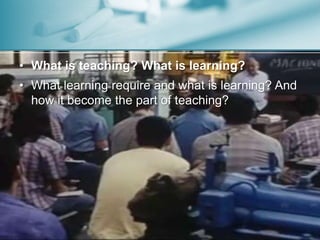
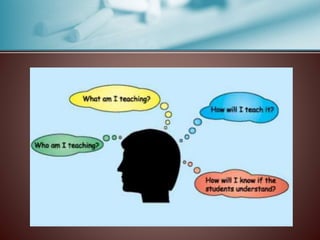
• What is teaching? What is learning? 
• What learning require and what is learning? And 
how it become the part of teaching?
• From the perspective of many experienced 
educators, teaching involves the following: 
(1) comprehending 
(2) transform 
(3) active collaboration 
(4) inquiry and reflection.
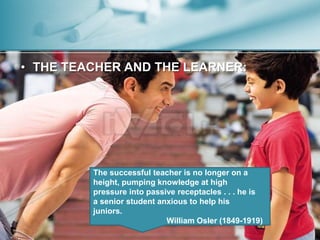
• THE TEACHER AND THE LEARNER: 
The successful teacher is no longer on a 
height, pumping knowledge at high 
pressure into passive receptacles . . . he is 
a senior student anxious to help his 
juniors. 
William Osler (1849-1919)
• THE CHARACTARISTIC OF GOOD TEACHER:
• Being an enthusiastic and passionate 
teacher 
• Knowing what works best 
• Checking your performance as a teacher and 
keeping up-to-date.
OBJECTIVES: 
1. Describe the components of practical model in 
teaching 
2. Discuss lecture planning. 
3. Discuss discussion, questioning techniques. 
4. Discuss other teaching techniques. 
5. Discuss traditional technique.
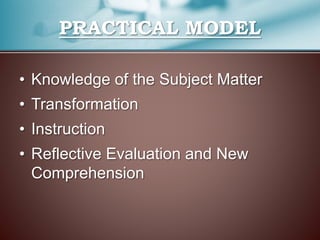
PRACTICAL MODEL 
• Knowledge of the Subject Matter 
• Transformation 
• Instruction 
• Reflective Evaluation and New 
Comprehension
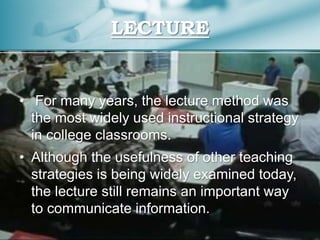
LECTURE 
• For many years, the lecture method was 
the most widely used instructional strategy 
in college classrooms. 
• Although the usefulness of other teaching 
strategies is being widely examined today, 
the lecture still remains an important way 
to communicate information.
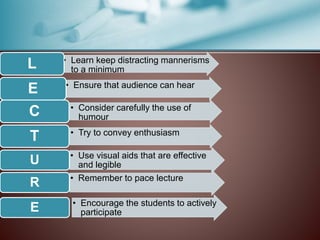
• Learn keep distracting mannerisms 
to a minimum L 
E • Ensure that audience can hear 
• Consider carefully the use of 
humour C 
T • Try to convey enthusiasm 
• Use visual aids that are effective 
and legible U 
• Remember to pace lecture R 
• Encourage the students to actively 
participate E
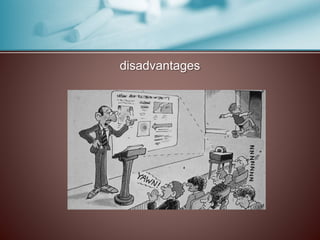
disadvantages
Following recommendations can help make 
lecture approach more effective (Cashin, 
1990) 
1. Fit the lecture to the audience 
2. Focus topic - remember everything cannot 
be covered in one lecture 
3. Prepare an outline that includes 5-9 major 
points to cover in one lecture 
4. Organize points for clarity
5. Select appropriate examples 
6. Present more than one side of an issue and be 
sensitive to other perspectives 
7. Repeat points when necessary 
8. Be aware of the audience - notice their feedback 
9. Be enthusiastic – no need to be an entertainer 
but one should be excited by the topic.
DISSCUSION AND QUESTIONNING 
• Discussion and questioning are two tool 
for moving to a more interactive lecture. 
• Teacher can move from lecture to 
discussion to question and again back to 
the lecture.
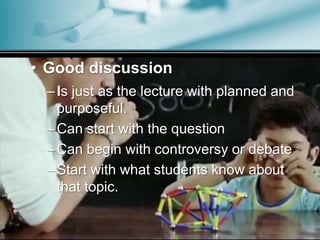
• Good discussion 
– Is just as the lecture with planned and 
purposeful. 
–Can start with the question 
– Can begin with controversy or debate 
– Start with what students know about 
that topic.
• Problem with discussion 
– Students who talk so less 
– Students who talk much.
• Questioning 
– Is an important teaching strategy that can 
facilitate the process of active learning. 
– In that students are asked to link to the 
concept, ideas and knowledge.
• Use open-ended, not closed-answered with "yes" 
or no" 
• Avoid combining too many question. 
• Ask questions logically 
• Use different levels of questions, like simple to 
complex or higher level question. 
• Allow thinking time for student. 
• Try to ask question that broad the students 
participation.
OTHER TEACHING 
TECHNIQUES 
• Seminar 
• Tutorials 
• Peer teaching
• Seminar: 
– Is a guided discussion in which students 
take the intellectual . 
– Using seminars as a teaching method 
requires 
• Prior planning 
• guidelines linked to objectives. 
• Clear structure for the students.
• Progress from teacher-led to student-led 
seminars. 
• Assign topics or allow students to select from a 
list of suggested topics. 
• Give responsibility for resources to students. 
• Use guidelines for presentation format. 
• Use peer evaluation.
• Tutorials: 
–Small group technique. 
–Tutor help student in their learning.
• Peer teaching: 
–More effective technique. 
– Why it is effective?
• Other techniques: 
1. Brain storming 
2. Debate 
3. Role play, game, expert panel.
• Traditional techniques: 
1. Chalkboard 
2. Overhead transparencies. 
3. Slides. 
4. Videotape and films.
• Other terms for teaching: 
1. Active learning 
2. Cooperative learning 
3. Distance learning. 
4. Problem based learning 
5. Case method. 
6. Portfolio. 
7. Web learning
References: 
• Teaching for physical therapist. Ketherine 
shephard. 
• ABC of learning and teaching in medicine. peter 
cantillon. 
• Essential skill for medical teacher. Ronald M. 
Harden. 
• APTA guidelines for teaching in PT colleges.
• Thank you………..

Academic teaching techniques

  • 1.
    Academic teaching techniquesin physiotherapy -Hemaxi kosada
  • 2.
    • What isteaching? What is learning? • What learning require and what is learning? And how it become the part of teaching?
  • 3.
    • From theperspective of many experienced educators, teaching involves the following: (1) comprehending (2) transform (3) active collaboration (4) inquiry and reflection.
  • 4.
    • THE TEACHERAND THE LEARNER: The successful teacher is no longer on a height, pumping knowledge at high pressure into passive receptacles . . . he is a senior student anxious to help his juniors. William Osler (1849-1919)
  • 5.
    • THE CHARACTARISTICOF GOOD TEACHER:
  • 7.
    • Being anenthusiastic and passionate teacher • Knowing what works best • Checking your performance as a teacher and keeping up-to-date.
  • 8.
    OBJECTIVES: 1. Describethe components of practical model in teaching 2. Discuss lecture planning. 3. Discuss discussion, questioning techniques. 4. Discuss other teaching techniques. 5. Discuss traditional technique.
  • 9.
    PRACTICAL MODEL •Knowledge of the Subject Matter • Transformation • Instruction • Reflective Evaluation and New Comprehension
  • 10.
    LECTURE • Formany years, the lecture method was the most widely used instructional strategy in college classrooms. • Although the usefulness of other teaching strategies is being widely examined today, the lecture still remains an important way to communicate information.
  • 12.
    • Learn keepdistracting mannerisms to a minimum L E • Ensure that audience can hear • Consider carefully the use of humour C T • Try to convey enthusiasm • Use visual aids that are effective and legible U • Remember to pace lecture R • Encourage the students to actively participate E
  • 13.
  • 14.
    Following recommendations canhelp make lecture approach more effective (Cashin, 1990) 1. Fit the lecture to the audience 2. Focus topic - remember everything cannot be covered in one lecture 3. Prepare an outline that includes 5-9 major points to cover in one lecture 4. Organize points for clarity
  • 15.
    5. Select appropriateexamples 6. Present more than one side of an issue and be sensitive to other perspectives 7. Repeat points when necessary 8. Be aware of the audience - notice their feedback 9. Be enthusiastic – no need to be an entertainer but one should be excited by the topic.
  • 16.
    DISSCUSION AND QUESTIONNING • Discussion and questioning are two tool for moving to a more interactive lecture. • Teacher can move from lecture to discussion to question and again back to the lecture.
  • 17.
    • Good discussion – Is just as the lecture with planned and purposeful. –Can start with the question – Can begin with controversy or debate – Start with what students know about that topic.
  • 18.
    • Problem withdiscussion – Students who talk so less – Students who talk much.
  • 19.
    • Questioning –Is an important teaching strategy that can facilitate the process of active learning. – In that students are asked to link to the concept, ideas and knowledge.
  • 20.
    • Use open-ended,not closed-answered with "yes" or no" • Avoid combining too many question. • Ask questions logically • Use different levels of questions, like simple to complex or higher level question. • Allow thinking time for student. • Try to ask question that broad the students participation.
  • 21.
    OTHER TEACHING TECHNIQUES • Seminar • Tutorials • Peer teaching
  • 22.
    • Seminar: –Is a guided discussion in which students take the intellectual . – Using seminars as a teaching method requires • Prior planning • guidelines linked to objectives. • Clear structure for the students.
  • 23.
    • Progress fromteacher-led to student-led seminars. • Assign topics or allow students to select from a list of suggested topics. • Give responsibility for resources to students. • Use guidelines for presentation format. • Use peer evaluation.
  • 24.
    • Tutorials: –Smallgroup technique. –Tutor help student in their learning.
  • 25.
    • Peer teaching: –More effective technique. – Why it is effective?
  • 26.
    • Other techniques: 1. Brain storming 2. Debate 3. Role play, game, expert panel.
  • 27.
    • Traditional techniques: 1. Chalkboard 2. Overhead transparencies. 3. Slides. 4. Videotape and films.
  • 28.
    • Other termsfor teaching: 1. Active learning 2. Cooperative learning 3. Distance learning. 4. Problem based learning 5. Case method. 6. Portfolio. 7. Web learning
  • 30.
    References: • Teachingfor physical therapist. Ketherine shephard. • ABC of learning and teaching in medicine. peter cantillon. • Essential skill for medical teacher. Ronald M. Harden. • APTA guidelines for teaching in PT colleges.
  • 31.

Editor's Notes

  • #4 1, to understand,give the knowledge. 2, material or the way they understand same for the learner.
  • #5 Two side of a coin. Just like the kinesthetic sense and the movement. Both are separate but either process to work well both process to work well.
  • #7 1.Teacher shld knw the topic. 2. knw the studnt :listn d stdnt , wht they undrstand? Hw they think and response.3. shld knw d diffrnt tools n technqs more tech. = more flexible in teaching.
  • #10 t. shld knw the max. thing abt the subjct. More the knwldge more the confidnt. Hv the concpt n ideas r connectd , if less knwldfe = only content, more knwldge= corelate practicaly controvrses wt is knwn n wht unknwn T: 1. matreial:cntnt abt subjct 2. errors 3. thngs changed? 2: how to represent. 3: match d knwldge : stdnt dnt knw mch so approriate ex.
  • #12 You entr into d class room… hoping for covr al d contnt in 45 min studnt js fnishd community medicine lec. Student look hardly to stay awake nd Nd ur topin is pathways .
  • #14 The disadvantages are that lecturing minimizes feedback from students, assumes an unrealistic level of student understanding and comprehension, and often disengages students from the learning process causing information to be quickly forgotten.
  • #18 Simple que tht focus on experiances. Debt n controvry divide 2 grp
  • #19 Be like traffic police at tht time: Give opportunity to student who speak less
  • #20 Que = guide them level type n when to ask tht que. Concrete: abstract:creative
  • #25 1 tutor will be there- guide the stdent. Student will be more active and student will sole the problem but they will supervised by d tutor.
  • #27 Debate: two group points use controversial issue, STOP