What is strategies?
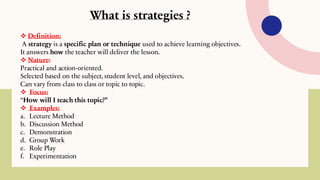
❖ Definition:
A strategy is a specific plan or technique used to achieve learning objectives.
It answers how the teacher will deliver the lesson.
❖ Nature:
Practical and action-oriented.
Selected based on the subject, student level, and objectives.
Can vary from class to class or topic to topic.
❖ Focus:
“How will I teach this topic?”
❖ Examples:
a. Lecture Method
b. Discussion Method
c. Demonstration
d. Group Work
e. Role Play
f. Experimentation
4.
1.LECTURE METHOD
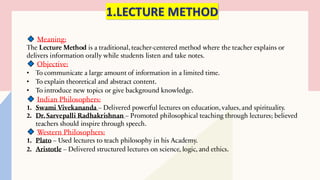
Meaning:
The LectureMethod is a traditional, teacher-centered method where the teacher explains or
delivers information orally while students listen and take notes.
Objective:
• To communicate a large amount of information in a limited time.
• To explain theoretical and abstract content.
• To introduce new topics or give background knowledge.
Indian Philosophers:
1. Swami Vivekananda – Delivered powerful lectures on education, values, and spirituality.
2. Dr. Sarvepalli Radhakrishnan – Promoted philosophical teaching through lectures; believed
teachers should inspire through speech.
Western Philosophers:
1. Plato – Used lectures to teach philosophy in his Academy.
2. Aristotle – Delivered structured lectures on science, logic, and ethics.
5.
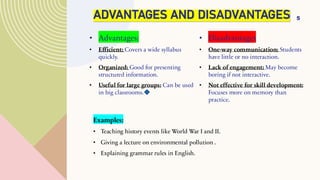
ADVANTAGES AND DISADVANTAGES
•Advantages:
• Efficient: Covers a wide syllabus
quickly.
• Organized: Good for presenting
structured information.
• Useful for large groups: Can be used
in big classrooms.
• Disadvantages
• One-way communication: Students
have little or no interaction.
• Lack of engagement: May become
boring if not interactive.
• Not effective for skill development:
Focuses more on memory than
practice.
5
Examples:
• Teaching history events like World War I and II.
• Giving a lecture on environmental pollution .
• Explaining grammar rules in English.
6.
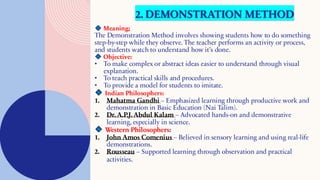
2. DEMONSTRATION METHOD
Meaning:
TheDemonstration Method involves showing students how to do something
step-by-step while they observe. The teacher performs an activity or process,
and students watch to understand how it’s done.
Objective:
• To make complex or abstract ideas easier to understand through visual
explanation.
• To teach practical skills and procedures.
• To provide a model for students to imitate.
Indian Philosophers:
1. Mahatma Gandhi – Emphasized learning through productive work and
demonstration in Basic Education (Nai Talim).
2. Dr. A.P.J. Abdul Kalam – Advocated hands-on and demonstrative
learning, especially in science.
Western Philosophers:
1. John Amos Comenius – Believed in sensory learning and using real-life
demonstrations.
2. Rousseau – Supported learning through observation and practical
activities.
7.
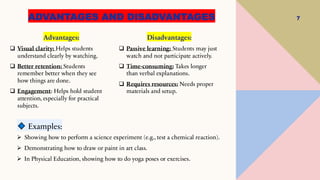
ADVANTAGES AND DISADVANTAGES7
Advantages:
❑ Visual clarity: Helps students
understand clearly by watching.
❑ Better retention: Students
remember better when they see
how things are done.
❑ Engagement: Helps hold student
attention, especially for practical
subjects.
Disadvantages:
❑ Passive learning: Students may just
watch and not participate actively.
❑ Time-consuming: Takes longer
than verbal explanations.
❑ Requires resources: Needs proper
materials and setup.
Examples:
➢ Showing how to perform a science experiment (e.g., test a chemical reaction).
➢ Demonstrating how to draw or paint in art class.
➢ In Physical Education, showing how to do yoga poses or exercises.
8.
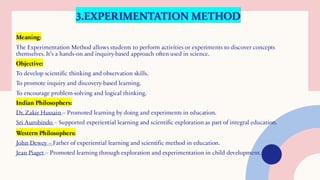
3.EXPERIMENTATION METHOD
Meaning:
The ExperimentationMethod allows students to perform activities or experiments to discover concepts
themselves. It’s a hands-on and inquiry-based approach often used in science.
Objective:
To develop scientific thinking and observation skills.
To promote inquiry and discovery-based learning.
To encourage problem-solving and logical thinking.
Indian Philosophers:
Dr. Zakir Hussain – Promoted learning by doing and experiments in education.
Sri Aurobindo – Supported experiential learning and scientific exploration as part of integral education.
Western Philosophers:
John Dewey – Father of experiential learning and scientific method in education.
Jean Piaget – Promoted learning through exploration and experimentation in child development.
9.
ADVANTAGES AND DISADVANTAGES
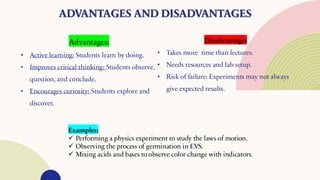
Advantages:
•Active learning: Students learn by doing.
• Improves critical thinking: Students observe,
question, and conclude.
• Encourages curiosity: Students explore and
discover.
Disadvantages
• Takes more time than lectures.
• Needs resources and lab setup.
• Risk of failure: Experiments may not always
give expected results.
Examples:
✓ Performing a physics experiment to study the laws of motion.
✓ Observing the process of germination in EVS.
✓ Mixing acids and bases to observe color change with indicators.
10.
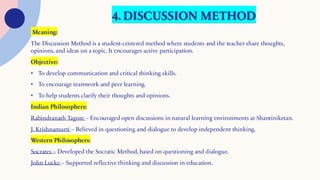
4. DISCUSSION METHOD
Meaning:
TheDiscussion Method is a student-centered method where students and the teacher share thoughts,
opinions, and ideas on a topic. It encourages active participation.
Objective:
• To develop communication and critical thinking skills.
• To encourage teamwork and peer learning.
• To help students clarify their thoughts and opinions.
Indian Philosophers:
Rabindranath Tagore – Encouraged open discussions in natural learning environments at Shantiniketan.
J. Krishnamurti – Believed in questioning and dialogue to develop independent thinking.
Western Philosophers:
Socrates – Developed the Socratic Method, based on questioning and dialogue.
John Locke – Supported reflective thinking and discussion in education.
11.
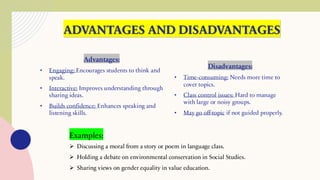
ADVANTAGES AND DISADVANTAGES
Advantages:
•Engaging: Encourages students to think and
speak.
• Interactive: Improves understanding through
sharing ideas.
• Builds confidence: Enhances speaking and
listening skills.
Disadvantages:
• Time-consuming: Needs more time to
cover topics.
• Class control issues: Hard to manage
with large or noisy groups.
• May go off-topic if not guided properly.
Examples:
➢ Discussing a moral from a story or poem in language class.
➢ Holding a debate on environmental conservation in Social Studies.
➢ Sharing views on gender equality in value education.