Plant physiology
Is a branch of Biology that deals with the life functions or
metabolism of plant.
It includes functioning of cells, tissues, organs, organ-
systems and the organisms as a whole.
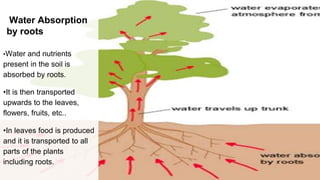
Water Absorption
by roots
•Water and nutrients
present in the soil is
absorbed by roots.
•It is then transported
upwards to the leaves,
flowers, fruits, etc..
•In leaves food is produced
and it is transported to all
parts of the plants
including roots.
1
2
3
4
Photosynthesis Transportation
Transpiration Mechanical stiffness
Need of water and minerals for the plant
Minerals
Minerals are naturally occurring inorganic
nutrients found in the soil and food that is
essential for the proper functioning of
animal and plant body.
Minerals are essential for the plants to
grow well and complete their life-cycle
properly.
Minerals
Some of these nutrients are absorbed as salts as nitrates, phosphates,
sulphates, etc…
Some of them are absorbed as ions like Potassium, Calcium, magnesium,
Chlorine, etc...
Importance of minerals
Nutrients are required as constituents of cell and cell organelles.
It is required for the synthesis of a variety of compounds or
enzymes within the cell.
1 2 3
Characteristics of roots for absorbing water
A huge surface
area
Concentration of
cell sap is higher
than the
surrounding soil
water.
Root hairs having
thin walls.
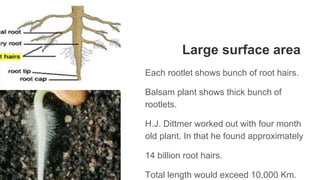
Large surface area
Each rootlet shows bunch of root hairs.
Balsam plant shows thick bunch of
rootlets.
H.J. Dittmer worked out with four month
old plant. In that he found approximately
14 billion root hairs.
Total length would exceed 10,000 Km.
Concentration of cell
sap
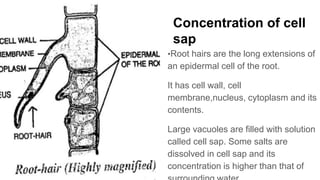
•Root hairs are the long extensions of
an epidermal cell of the root.
It has cell wall, cell
membrane,nucleus, cytoplasm and its
contents.
Large vacuoles are filled with solution
called cell sap. Some salts are
dissolved in cell sap and its
concentration is higher than that of
Thin walls
Plant cell have two outer layers
1. Cell wall is thin and permeable
2. Cell membrane is very thin and semi-
permeable.
It allows water molecules to pass
through but not the larger molecules of
the dissolved salts.
Absorption and conduction of water
and minerals
Five main phenomena involved
1. Imbibition
2. Diffusion
3. Osmosis
4. Active transport
5. Turgidity and Flaccidity
Imbibition
Is a phenomenon by which living or dead plant cells absorb
water by surface attraction.
Substances made up of cellulose or proteins are hydrophilic.
They imbibe water and swell up.
Eg. Dry seeds, wooden doors
Diffusion
Is a free movement of molecules of a substance( solute or
solvent, gas, liquid) from the region of higher concentration
to the region of their lower concentration when the two are
in direct contact.
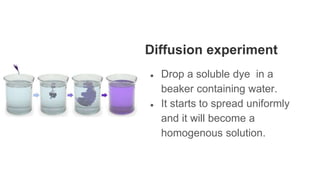
Diffusion experiment
● Drop a soluble dye in a
beaker containing water.
● It starts to spread uniformly
and it will become a
homogenous solution.
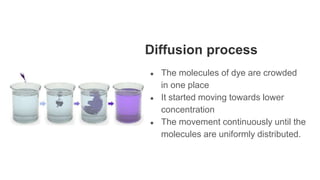
Diffusion process
● The molecules of dye are crowded
in one place
● It started moving towards lower
concentration
● The movement continuously until the
molecules are uniformly distributed.
Draw conclusions
What conclusions do you draw from the information?
If the concentration of the cell is same as the
surrounding medium, in which direction the water will
flow across the cell membrane?
Osmosis
The movement of molecules from a higher concentration to
lower concentration through a semipermeable membrane.
There are two types of osmosis.
1. Endosmosis
2. Exosmosis
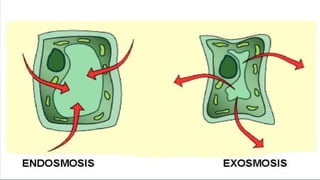
Endosmosis
Endo means inward
Ozmo means push
It is the inward diffusion of water through a semi-permeable
membrane.
It happens when the surrounding solution is less concentration.
This tends to swell up the cell.
Exosmosis
Exo means outward
Outward diffusion of water through semi-permeable
membrane .
Happens when the surrounding solution is more
concentrated.
This leads to shrinkage of cells.
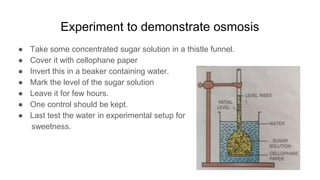
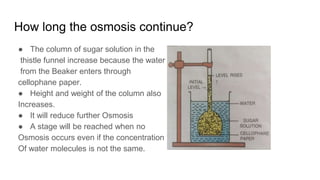
Experiment to demonstrate osmosis
● Take some concentrated sugar solution in a thistle funnel.
● Cover it with cellophane paper
● Invert this in a beaker containing water.
● Mark the level of the sugar solution
● Leave it for few hours.
● One control should be kept.
● Last test the water in experimental setup for
sweetness.
Main Conclusions
● Some of the water from the beaker entered the
thistle funnel through the cellophane paper.
● Sugar from the thistle funnel didn’t pass through
the beaker.
● The cellophane paper acted as a semipermeable
membrane. It allowed only water and not sugar.
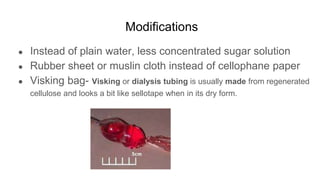
Modifications
● Instead of plain water, less concentrated sugar solution
● Rubber sheet or muslin cloth instead of cellophane paper
● Visking bag- Visking or dialysis tubing is usually made from regenerated
cellulose and looks a bit like sellotape when in its dry form.
Isotonic solution
● Iso means same
● Tonic means concentration or strength
● Isotonic solution means the cell and the
surrounding medium have same concentration
Osmosis using visking bag
How long the osmosis continue?
● The column of sugar solution in the
thistle funnel increase because the water
from the Beaker enters through
cellophane paper.
● Height and weight of the column also
Increases.
● It will reduce further Osmosis
● A stage will be reached when no
Osmosis occurs even if the concentration
Of water molecules is not the same.
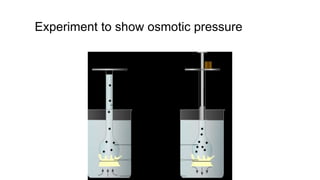
Osmotic pressure
● Osmotic pressure of a solution is a measure of its tendency
to take in water by osmosis.
OR
Osmotic pressure is the minimum pressure that must be exerted
to prevent the passage of the pure solvent into the solution
When the two or separated by semi-permeable membrane.
Experiment to show osmotic pressure
Tonicity
● Tonicity is the relative concentration of solutes dissolved
in solution which determine the direction and extent of
diffusion.
● Two regions of different concentrations of water
molecules.
● Two regions of different concentrations of sugar
molecules.
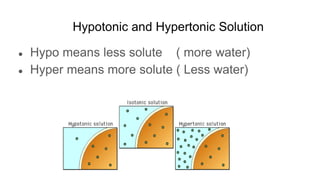
Hypotonic and Hypertonic Solution
● Hypo means less solute ( more water)
● Hyper means more solute ( Less water)
● Based on the tonicity the solutions are divided
into three types.
● Isotonic
● Hypotonic
● Hypertonic
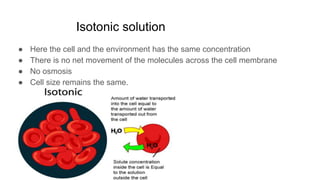
Isotonic solution
● Here the cell and the environment has the same concentration
● There is no net movement of the molecules across the cell membrane
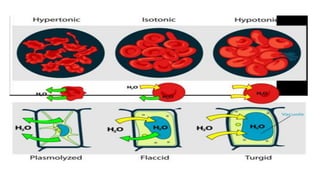
● No osmosis
● Cell size remains the same.
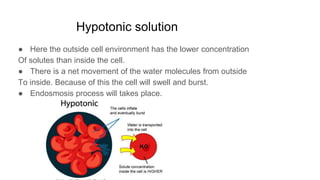
Hypotonic solution
● Here the outside cell environment has the lower concentration
Of solutes than inside the cell.
● There is a net movement of the water molecules from outside
To inside. Because of this the cell will swell and burst.
● Endosmosis process will takes place.
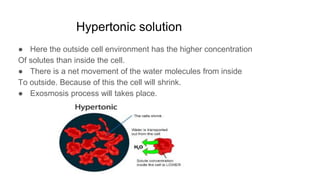
Hypertonic solution
● Here the outside cell environment has the higher concentration
Of solutes than inside the cell.
● There is a net movement of the water molecules from inside
To outside. Because of this the cell will shrink.
● Exosmosis process will takes place.
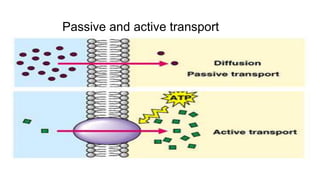
Active transport
● Is the passage of a substance from its lower to higher concentration through a
living cell membrane using energy from the cell.
● Nutrients such as nitrates, sulphates, potassium, zinc, manganese cannot
pass through the cells easily.
Passive and active transport
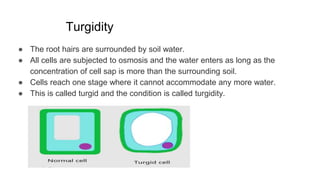
Turgidity
● The root hairs are surrounded by soil water.
● All cells are subjected to osmosis and the water enters as long as the
concentration of cell sap is more than the surrounding soil.
● Cells reach one stage where it cannot accommodate any more water.
● This is called turgid and the condition is called turgidity.
Turgor pressure and wall pressure
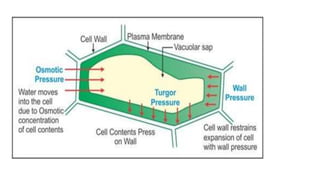
● When a cell is rigid, the cell wall is stretched under pressure from inside by
the cell contents.
● In turn the cell wall presses the contents towards the centre of the cell.
● The pressure of the cell contents on the cell wall is called turgor pressure.
● The pressure exerted by the cell wall on the cell content is called wall
pressure.
● Turgor pressure is the pressure exerted by the cytoplasm on the cell wall.
... As the cell walls are strong, cells do not rupture but enlarge in size to
cause extension in growth. Wall pressure is the pressure applied by the
cell wall on the contents of the cell. Wall pressure is opposite to the turgor
pressure
Effects of turgidity
● When turgid, the cell is in a somewhat balanced state
● No water enters or leaves
● Its turgor pressure counterbalances wall pressure.
● No further absorption of water takes place even though the concentration of
solutes inside the cell is greater.
● But, in some cases, the cell wall is unable to bear the turgor pressure, it
ruptures and burst.
Flaccidity
● Reverse of turgidity
● In Aquatic plants due to osmosis, the cells always be in turgid condition.
● Suppose if you keep it in 5% salt solution for few minutes
● The cell will start to lose water, the cytoplasm started to shrink and
the cell membrane will withdraw from the cell wall.
● The shrinkage from the cell wall is called plasmolysis and the cells become
flaccid.
● This condition is called flaccidity.
Plasmolysis and de-plasmolysis
● The shrinkage from the cell wall is called PLASMOLYSIS.
● If again the cell is placed in water, the cytoplasm again swell up and the cell
membrane press tight against cell wall.
● This is called de-plasmolysis.
● Plasmolysis is the result of outflow of water
● De-plasmolysis is the result of its reentry.
Uses of Turgidity to plants
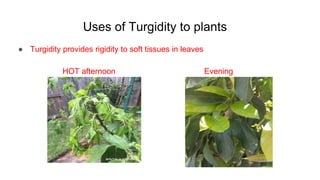
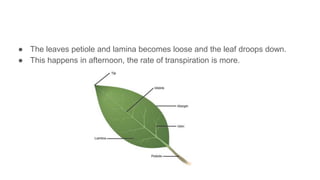
● Turgidity provides rigidity to soft tissues in leaves
HOT afternoon Evening
● The leaves petiole and lamina becomes loose and the leaf droops down.
● This happens in afternoon, the rate of transpiration is more.
Uses of Turgidity to plants
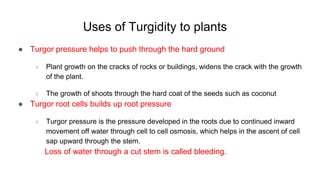
● Turgor pressure helps to push through the hard ground
○ Plant growth on the cracks of rocks or buildings, widens the crack with the growth
of the plant.
○ The growth of shoots through the hard coat of the seeds such as coconut
● Turgor root cells builds up root pressure
○ Turgor pressure is the pressure developed in the roots due to continued inward
movement off water through cell to cell osmosis, which helps in the ascent of cell
sap upward through the stem.
Loss of water through a cut stem is called bleeding.
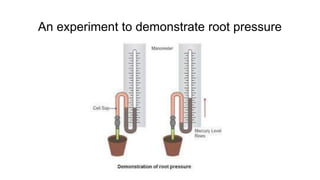
An experiment to demonstrate root pressure
Important definitions
● Turgidity
is a state of a cell in which the cell wall is rigid and stretched by an
increase in the volume of vacuoles due to the absorption of water.
The cell is rigid.
● Plasmolysis
is the contraction of cytoplasm from the cell wall caused due to
the withdrawal of water when placed in a strong hypertonic solution.
● Flaccidity
is the condition in which the cell content is shrunken and the cell
is no more tight.
The cell is flaccid.
Uses of Turgidity to plants
● Turgidity provides rigidity to soft tissues in leaves
● Turgor pressure helps to push through the hard ground
● Turgor root cells builds up root pressure
● Turgor in the opening and closing of stomata
● Turgor movements
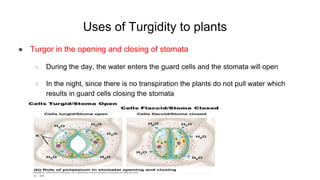
Uses of Turgidity to plants
● Turgor in the opening and closing of stomata
○ During the day, the water enters the guard cells and the stomata will open
○ In the night, since there is no transpiration the plants do not pull water which
results in guard cells closing the stomata
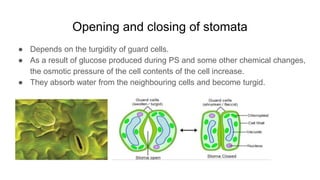
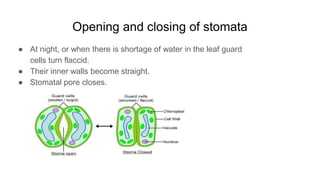
Opening and closing of stomata
● Depends on the turgidity of guard cells.
● As a result of glucose produced during PS and some other chemical changes,
the osmotic pressure of the cell contents of the cell increase.
● They absorb water from the neighbouring cells and become turgid.
Opening and closing of stomata
● At night, or when there is shortage of water in the leaf guard
cells turn flaccid.
● Their inner walls become straight.
● Stomatal pore closes.
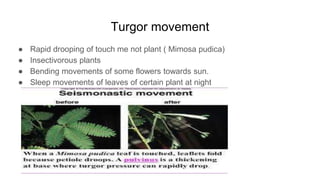
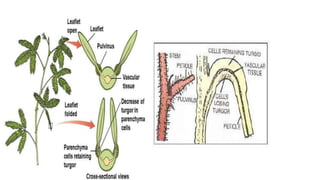
Turgor movement
● Rapid drooping of touch me not plant ( Mimosa pudica)
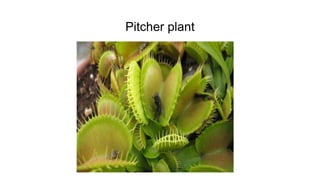
● Insectivorous plants
● Bending movements of some flowers towards sun.
● Sleep movements of leaves of certain plant at night
Pitcher plant
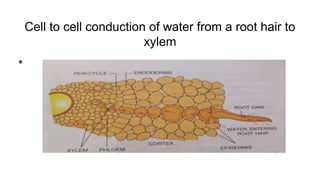
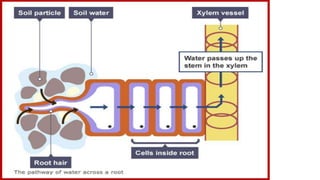
Cell to cell conduction of water from a root hair to
xylem
●
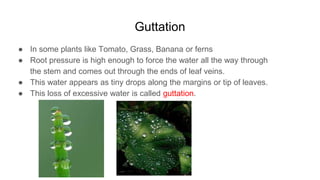
Guttation
● In some plants like Tomato, Grass, Banana or ferns
● Root pressure is high enough to force the water all the way through
the stem and comes out through the ends of leaf veins.
● This water appears as tiny drops along the margins or tip of leaves.
● This loss of excessive water is called guttation.
Ascent of sap
● Ascent of sap: Ascent of sap is the upward movement of absorbed water as
sap from root to the top of the plant against the force of gravity.
● Forces contributing to Ascent of sap:
● 1. Root pressure:
Root pressure is the pressure developed in the roots due to continued inward
movement of water through cell- to-cell osmosis which helps in the ascent of sap
upward through the stem. Root pressure also leads to Bleeding and Guttation.
a) Bleeding : loss of water (cell sap) through a cut stem is called bleeding.
b) Guttation: Guttation is the loss of water as droplets along the margins of
leaves (through hydathodes) is called guttation.
Ascent of sap
2. Capillary Force:
Xylem vessels acts as fine capillary tubes wherein water from lower level rise to
fill up the vacuum created by the loss water due to transpiration from the leaves.
3. Transpiration pull:
As the water is lost from the leaf surface by transpiration, more water molecules
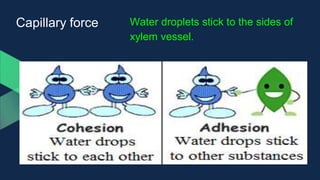
are pulled up due to cohesion (attraction between the molecules of water)
4. Adhesion : Attraction between the water molecules and the walls of the xylem
vessels.
Capillary force Water droplets stick to the sides of
xylem vessel.
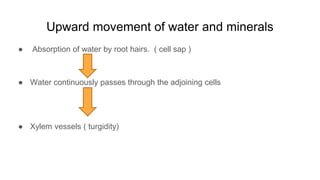
Upward movement of water and minerals
● Absorption of water by root hairs. ( cell sap )
● Water continuously passes through the adjoining cells
● Xylem vessels ( turgidity)
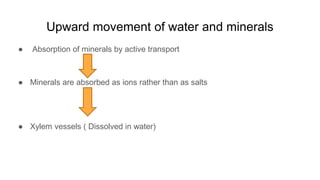
Upward movement of water and minerals
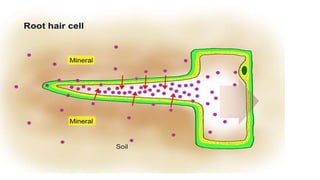
● Absorption of minerals by active transport
● Minerals are absorbed as ions rather than as salts
● Xylem vessels ( Dissolved in water)
Active transport of Minerals
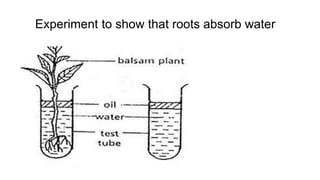
Experiment to show that roots absorb water
● le
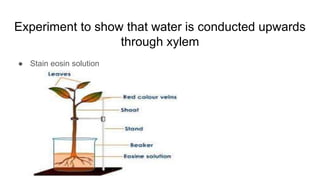
Experiment to show that water is conducted upwards
through xylem
● Stain eosin solution
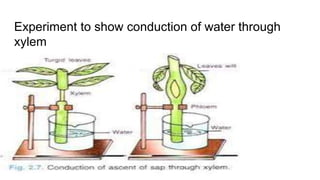
Experiment to show conduction of water through
xylem
● Girdling – Keeping the central part intact
● Leaves in A turgid
● Leaves in B droop down
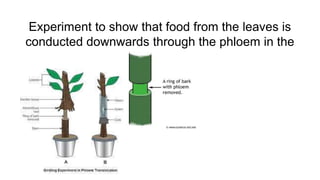
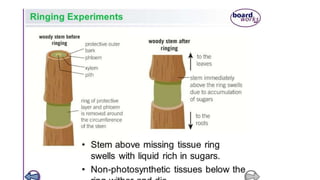
Experiment to show that food from the leaves is
conducted downwards through the phloem in the
stem
Downward movement of sap – food dissolved in
water and flows down due to the force of gravity

Absorption in plants icse

  • 1.
    Plant physiology Is abranch of Biology that deals with the life functions or metabolism of plant. It includes functioning of cells, tissues, organs, organ- systems and the organisms as a whole.
  • 2.
    Water Absorption by roots •Waterand nutrients present in the soil is absorbed by roots. •It is then transported upwards to the leaves, flowers, fruits, etc.. •In leaves food is produced and it is transported to all parts of the plants including roots.
  • 3.
    1 2 3 4 Photosynthesis Transportation Transpiration Mechanicalstiffness Need of water and minerals for the plant
  • 4.
    Minerals Minerals are naturallyoccurring inorganic nutrients found in the soil and food that is essential for the proper functioning of animal and plant body. Minerals are essential for the plants to grow well and complete their life-cycle properly.
  • 5.
    Minerals Some of thesenutrients are absorbed as salts as nitrates, phosphates, sulphates, etc… Some of them are absorbed as ions like Potassium, Calcium, magnesium, Chlorine, etc...
  • 6.
    Importance of minerals Nutrientsare required as constituents of cell and cell organelles. It is required for the synthesis of a variety of compounds or enzymes within the cell.
  • 7.
    1 2 3 Characteristicsof roots for absorbing water A huge surface area Concentration of cell sap is higher than the surrounding soil water. Root hairs having thin walls.
  • 8.
    Large surface area Eachrootlet shows bunch of root hairs. Balsam plant shows thick bunch of rootlets. H.J. Dittmer worked out with four month old plant. In that he found approximately 14 billion root hairs. Total length would exceed 10,000 Km.
  • 9.
    Concentration of cell sap •Roothairs are the long extensions of an epidermal cell of the root. It has cell wall, cell membrane,nucleus, cytoplasm and its contents. Large vacuoles are filled with solution called cell sap. Some salts are dissolved in cell sap and its concentration is higher than that of
  • 10.
    Thin walls Plant cellhave two outer layers 1. Cell wall is thin and permeable 2. Cell membrane is very thin and semi- permeable. It allows water molecules to pass through but not the larger molecules of the dissolved salts.
  • 11.
    Absorption and conductionof water and minerals Five main phenomena involved 1. Imbibition 2. Diffusion 3. Osmosis 4. Active transport 5. Turgidity and Flaccidity
  • 12.
    Imbibition Is a phenomenonby which living or dead plant cells absorb water by surface attraction. Substances made up of cellulose or proteins are hydrophilic. They imbibe water and swell up. Eg. Dry seeds, wooden doors
  • 13.
    Diffusion Is a freemovement of molecules of a substance( solute or solvent, gas, liquid) from the region of higher concentration to the region of their lower concentration when the two are in direct contact.
  • 14.
    Diffusion experiment ● Dropa soluble dye in a beaker containing water. ● It starts to spread uniformly and it will become a homogenous solution.
  • 15.
    Diffusion process ● Themolecules of dye are crowded in one place ● It started moving towards lower concentration ● The movement continuously until the molecules are uniformly distributed.
  • 16.
    Draw conclusions What conclusionsdo you draw from the information? If the concentration of the cell is same as the surrounding medium, in which direction the water will flow across the cell membrane?
  • 17.
    Osmosis The movement ofmolecules from a higher concentration to lower concentration through a semipermeable membrane. There are two types of osmosis. 1. Endosmosis 2. Exosmosis
  • 18.
    Endosmosis Endo means inward Ozmomeans push It is the inward diffusion of water through a semi-permeable membrane. It happens when the surrounding solution is less concentration. This tends to swell up the cell.
  • 20.
    Exosmosis Exo means outward Outwarddiffusion of water through semi-permeable membrane . Happens when the surrounding solution is more concentrated. This leads to shrinkage of cells.
  • 21.
    Experiment to demonstrateosmosis ● Take some concentrated sugar solution in a thistle funnel. ● Cover it with cellophane paper ● Invert this in a beaker containing water. ● Mark the level of the sugar solution ● Leave it for few hours. ● One control should be kept. ● Last test the water in experimental setup for sweetness.
  • 23.
    Main Conclusions ● Someof the water from the beaker entered the thistle funnel through the cellophane paper. ● Sugar from the thistle funnel didn’t pass through the beaker. ● The cellophane paper acted as a semipermeable membrane. It allowed only water and not sugar.
  • 24.
    Modifications ● Instead ofplain water, less concentrated sugar solution ● Rubber sheet or muslin cloth instead of cellophane paper ● Visking bag- Visking or dialysis tubing is usually made from regenerated cellulose and looks a bit like sellotape when in its dry form.
  • 25.
    Isotonic solution ● Isomeans same ● Tonic means concentration or strength ● Isotonic solution means the cell and the surrounding medium have same concentration
  • 26.
  • 28.
    How long theosmosis continue? ● The column of sugar solution in the thistle funnel increase because the water from the Beaker enters through cellophane paper. ● Height and weight of the column also Increases. ● It will reduce further Osmosis ● A stage will be reached when no Osmosis occurs even if the concentration Of water molecules is not the same.
  • 30.
    Osmotic pressure ● Osmoticpressure of a solution is a measure of its tendency to take in water by osmosis. OR Osmotic pressure is the minimum pressure that must be exerted to prevent the passage of the pure solvent into the solution When the two or separated by semi-permeable membrane.
  • 31.
    Experiment to showosmotic pressure
  • 32.
    Tonicity ● Tonicity isthe relative concentration of solutes dissolved in solution which determine the direction and extent of diffusion. ● Two regions of different concentrations of water molecules. ● Two regions of different concentrations of sugar molecules.
  • 33.
    Hypotonic and HypertonicSolution ● Hypo means less solute ( more water) ● Hyper means more solute ( Less water)
  • 34.
    ● Based onthe tonicity the solutions are divided into three types. ● Isotonic ● Hypotonic ● Hypertonic
  • 35.
    Isotonic solution ● Herethe cell and the environment has the same concentration ● There is no net movement of the molecules across the cell membrane ● No osmosis ● Cell size remains the same.
  • 36.
    Hypotonic solution ● Herethe outside cell environment has the lower concentration Of solutes than inside the cell. ● There is a net movement of the water molecules from outside To inside. Because of this the cell will swell and burst. ● Endosmosis process will takes place.
  • 37.
    Hypertonic solution ● Herethe outside cell environment has the higher concentration Of solutes than inside the cell. ● There is a net movement of the water molecules from inside To outside. Because of this the cell will shrink. ● Exosmosis process will takes place.
  • 39.
    Active transport ● Isthe passage of a substance from its lower to higher concentration through a living cell membrane using energy from the cell. ● Nutrients such as nitrates, sulphates, potassium, zinc, manganese cannot pass through the cells easily.
  • 40.
  • 41.
    Turgidity ● The roothairs are surrounded by soil water. ● All cells are subjected to osmosis and the water enters as long as the concentration of cell sap is more than the surrounding soil. ● Cells reach one stage where it cannot accommodate any more water. ● This is called turgid and the condition is called turgidity.
  • 42.
    Turgor pressure andwall pressure ● When a cell is rigid, the cell wall is stretched under pressure from inside by the cell contents. ● In turn the cell wall presses the contents towards the centre of the cell. ● The pressure of the cell contents on the cell wall is called turgor pressure. ● The pressure exerted by the cell wall on the cell content is called wall pressure. ● Turgor pressure is the pressure exerted by the cytoplasm on the cell wall. ... As the cell walls are strong, cells do not rupture but enlarge in size to cause extension in growth. Wall pressure is the pressure applied by the cell wall on the contents of the cell. Wall pressure is opposite to the turgor pressure
  • 43.
    Effects of turgidity ●When turgid, the cell is in a somewhat balanced state ● No water enters or leaves ● Its turgor pressure counterbalances wall pressure. ● No further absorption of water takes place even though the concentration of solutes inside the cell is greater. ● But, in some cases, the cell wall is unable to bear the turgor pressure, it ruptures and burst.
  • 44.
    Flaccidity ● Reverse ofturgidity ● In Aquatic plants due to osmosis, the cells always be in turgid condition. ● Suppose if you keep it in 5% salt solution for few minutes ● The cell will start to lose water, the cytoplasm started to shrink and the cell membrane will withdraw from the cell wall. ● The shrinkage from the cell wall is called plasmolysis and the cells become flaccid. ● This condition is called flaccidity.
  • 45.
    Plasmolysis and de-plasmolysis ●The shrinkage from the cell wall is called PLASMOLYSIS. ● If again the cell is placed in water, the cytoplasm again swell up and the cell membrane press tight against cell wall. ● This is called de-plasmolysis. ● Plasmolysis is the result of outflow of water ● De-plasmolysis is the result of its reentry.
  • 46.
    Uses of Turgidityto plants ● Turgidity provides rigidity to soft tissues in leaves HOT afternoon Evening
  • 47.
    ● The leavespetiole and lamina becomes loose and the leaf droops down. ● This happens in afternoon, the rate of transpiration is more.
  • 48.
    Uses of Turgidityto plants ● Turgor pressure helps to push through the hard ground ○ Plant growth on the cracks of rocks or buildings, widens the crack with the growth of the plant. ○ The growth of shoots through the hard coat of the seeds such as coconut ● Turgor root cells builds up root pressure ○ Turgor pressure is the pressure developed in the roots due to continued inward movement off water through cell to cell osmosis, which helps in the ascent of cell sap upward through the stem. Loss of water through a cut stem is called bleeding.
  • 49.
    An experiment todemonstrate root pressure
  • 51.
    Important definitions ● Turgidity isa state of a cell in which the cell wall is rigid and stretched by an increase in the volume of vacuoles due to the absorption of water. The cell is rigid. ● Plasmolysis is the contraction of cytoplasm from the cell wall caused due to the withdrawal of water when placed in a strong hypertonic solution. ● Flaccidity is the condition in which the cell content is shrunken and the cell is no more tight. The cell is flaccid.
  • 52.
    Uses of Turgidityto plants ● Turgidity provides rigidity to soft tissues in leaves ● Turgor pressure helps to push through the hard ground ● Turgor root cells builds up root pressure ● Turgor in the opening and closing of stomata ● Turgor movements
  • 53.
    Uses of Turgidityto plants ● Turgor in the opening and closing of stomata ○ During the day, the water enters the guard cells and the stomata will open ○ In the night, since there is no transpiration the plants do not pull water which results in guard cells closing the stomata
  • 54.
    Opening and closingof stomata ● Depends on the turgidity of guard cells. ● As a result of glucose produced during PS and some other chemical changes, the osmotic pressure of the cell contents of the cell increase. ● They absorb water from the neighbouring cells and become turgid.
  • 55.
    Opening and closingof stomata ● At night, or when there is shortage of water in the leaf guard cells turn flaccid. ● Their inner walls become straight. ● Stomatal pore closes.
  • 56.
    Turgor movement ● Rapiddrooping of touch me not plant ( Mimosa pudica) ● Insectivorous plants ● Bending movements of some flowers towards sun. ● Sleep movements of leaves of certain plant at night
  • 58.
  • 59.
    Cell to cellconduction of water from a root hair to xylem ●
  • 61.
    Guttation ● In someplants like Tomato, Grass, Banana or ferns ● Root pressure is high enough to force the water all the way through the stem and comes out through the ends of leaf veins. ● This water appears as tiny drops along the margins or tip of leaves. ● This loss of excessive water is called guttation.
  • 62.
    Ascent of sap ●Ascent of sap: Ascent of sap is the upward movement of absorbed water as sap from root to the top of the plant against the force of gravity. ● Forces contributing to Ascent of sap: ● 1. Root pressure: Root pressure is the pressure developed in the roots due to continued inward movement of water through cell- to-cell osmosis which helps in the ascent of sap upward through the stem. Root pressure also leads to Bleeding and Guttation. a) Bleeding : loss of water (cell sap) through a cut stem is called bleeding. b) Guttation: Guttation is the loss of water as droplets along the margins of leaves (through hydathodes) is called guttation.
  • 63.
    Ascent of sap 2.Capillary Force: Xylem vessels acts as fine capillary tubes wherein water from lower level rise to fill up the vacuum created by the loss water due to transpiration from the leaves. 3. Transpiration pull: As the water is lost from the leaf surface by transpiration, more water molecules are pulled up due to cohesion (attraction between the molecules of water) 4. Adhesion : Attraction between the water molecules and the walls of the xylem vessels.
  • 64.
    Capillary force Waterdroplets stick to the sides of xylem vessel.
  • 65.
    Upward movement ofwater and minerals ● Absorption of water by root hairs. ( cell sap ) ● Water continuously passes through the adjoining cells ● Xylem vessels ( turgidity)
  • 66.
    Upward movement ofwater and minerals ● Absorption of minerals by active transport ● Minerals are absorbed as ions rather than as salts ● Xylem vessels ( Dissolved in water)
  • 68.
  • 69.
    Experiment to showthat roots absorb water ● le
  • 70.
    Experiment to showthat water is conducted upwards through xylem ● Stain eosin solution
  • 72.
    Experiment to showconduction of water through xylem
  • 73.
    ● Girdling –Keeping the central part intact ● Leaves in A turgid ● Leaves in B droop down
  • 74.
    Experiment to showthat food from the leaves is conducted downwards through the phloem in the stem
  • 76.
    Downward movement ofsap – food dissolved in water and flows down due to the force of gravity

Editor's Notes

  • #17 Drawing Conclusions Being able to draw a conclusion after hearing new information is an important skill. Ask students to articulate the conclusions they are drawing from the new information. Show the responses anonymously on the projector screen to see if students came to different conclusions, then discuss. 🍐 This is a Pear Deck Drawing Slide 🍐 To edit the type of question, go back to the "Ask Students a Question" in the Pear Deck sidebar.