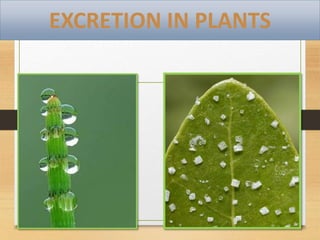
EXCRETION IN PLANTS
Introduction
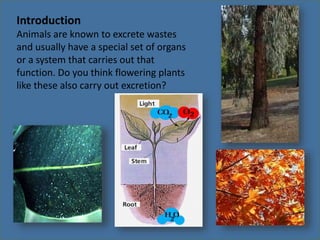
Animals are known to excrete wastes
and usually have a special set of organs
or a system that carries out that
function. Do you think flowering plants
like these also carry out excretion?
Objectives
You should be able to:
1. give examples of waste substances and how they are excreted
by plants.
2. state the importance of excretion to plants.
3
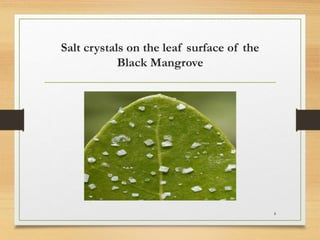
Salt crystals on the leaf surface of the
Black Mangrove
4
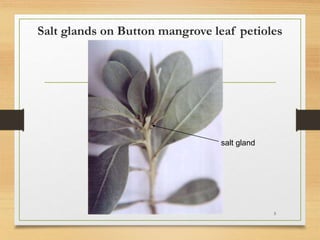
Salt glands on Button mangrove leaf petioles
5
salt gland
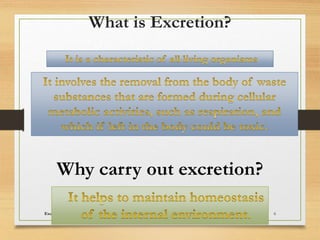
What is Excretion?
Excretion in Plants 6
Why carry out excretion?
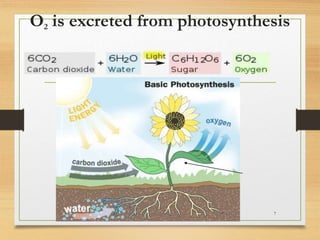
O2 is excreted from photosynthesis
7
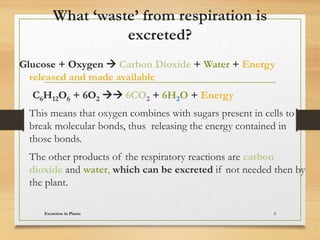
What ‘waste’ from respiration is
excreted?
Glucose + Oxygen  Carbon Dioxide + Water + Energy
released and made available
C6H12O6 + 6O2  6CO2 + 6H2O + Energy
This means that oxygen combines with sugars present in cells to
break molecular bonds, thus releasing the energy contained in
those bonds.
The other products of the respiratory reactions are carbon
dioxide and water, which can be excreted if not needed then by
the plant.
Excretion in Plants 8
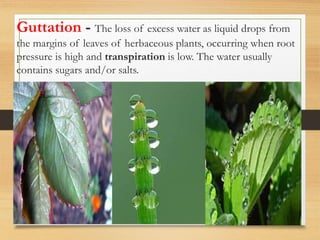
Guttation - The loss of excess water as liquid drops from
the margins of leaves of herbaceous plants, occurring when root
pressure is high and transpiration is low. The water usually
contains sugars and/or salts.
Excretion in Plants 9
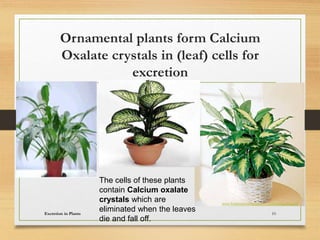
Ornamental plants form Calcium
Oxalate crystals in (leaf) cells for
excretion
Excretion in Plants 10
The cells of these plants
contain Calcium oxalate
crystals which are
eliminated when the leaves
die and fall off.
www.flowersgrowing.com/.../12/diefenbachia.jpg
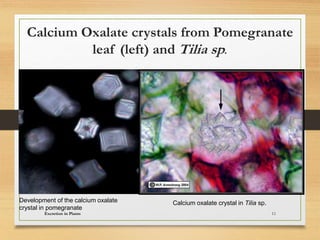
Calcium Oxalate crystals from Pomegranate
leaf (left) and Tilia sp.
Excretion in Plants 11
Development of the calcium oxalate
crystal in pomegranate
Calcium oxalate crystal in Tilia sp.
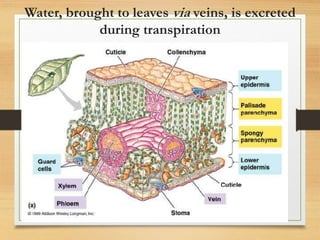
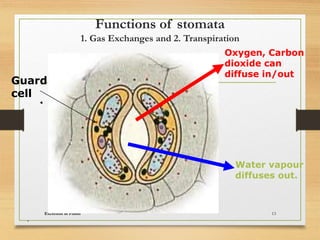
Water, brought to leaves via veins, is excreted
during transpiration
Excretion in Plants 12
Functions of stomata
1. Gas Exchanges and 2. Transpiration
Excretion in Plants 13
Oxygen, Carbon
dioxide can
diffuse in/out
Water vapour
diffuses out.
Guard
cell
,
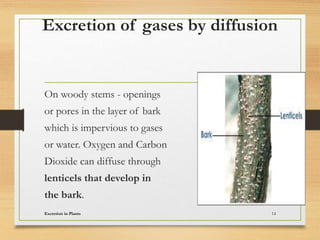
Excretion of gases by diffusion
On woody stems - openings
or pores in the layer of bark
which is impervious to gases
or water. Oxygen and Carbon
Dioxide can diffuse through
lenticels that develop in
the bark.
Excretion in Plants 14
Various wastes are removed during leaf fall
• Waste compounds are often stored in dead heartwood,
bark and leaves which die/fall off.
Excretion in Plants 15
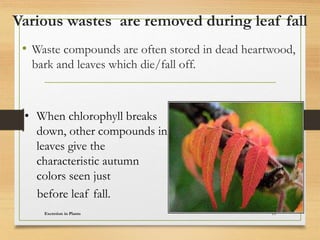
• When chlorophyll breaks
down, other compounds in
leaves give the
characteristic autumn
colors seen just
before leaf fall.
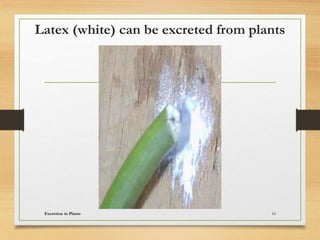
Latex (white) can be excreted from plants
Excretion in Plants 16
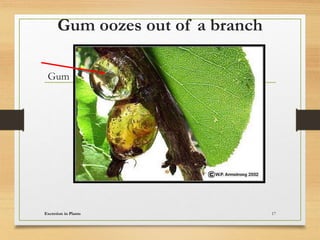
Gum oozes out of a branch
Gum
Excretion in Plants 17
Summary
• Excretion is the removal from the organism’s body of waste
substances produced during cellular metabolism.
• Plants do not have any set excretory system, so, getting rid of
wastes often involves storing the substance (e.g. Calcium Oxalate,
tannins) in some plant tissue, passing it out onto leaf surfaces
(e.g. salts) or diffusion (e.g. O2, CO2).
• Because salts are so removed, excretion also serves the important
function of osmo-regulation which maintains homeostasis.
Excretion in Plants 18
Excretion in Plants 19

Excretion in plants

  • 1.
  • 2.
    Introduction Animals are knownto excrete wastes and usually have a special set of organs or a system that carries out that function. Do you think flowering plants like these also carry out excretion?
  • 3.
    Objectives You should beable to: 1. give examples of waste substances and how they are excreted by plants. 2. state the importance of excretion to plants. 3
  • 4.
    Salt crystals onthe leaf surface of the Black Mangrove 4
  • 5.
    Salt glands onButton mangrove leaf petioles 5 salt gland
  • 6.
    What is Excretion? Excretionin Plants 6 Why carry out excretion?
  • 7.
    O2 is excretedfrom photosynthesis 7
  • 8.
    What ‘waste’ fromrespiration is excreted? Glucose + Oxygen  Carbon Dioxide + Water + Energy released and made available C6H12O6 + 6O2  6CO2 + 6H2O + Energy This means that oxygen combines with sugars present in cells to break molecular bonds, thus releasing the energy contained in those bonds. The other products of the respiratory reactions are carbon dioxide and water, which can be excreted if not needed then by the plant. Excretion in Plants 8
  • 9.
    Guttation - Theloss of excess water as liquid drops from the margins of leaves of herbaceous plants, occurring when root pressure is high and transpiration is low. The water usually contains sugars and/or salts. Excretion in Plants 9
  • 10.
    Ornamental plants formCalcium Oxalate crystals in (leaf) cells for excretion Excretion in Plants 10 The cells of these plants contain Calcium oxalate crystals which are eliminated when the leaves die and fall off. www.flowersgrowing.com/.../12/diefenbachia.jpg
  • 11.
    Calcium Oxalate crystalsfrom Pomegranate leaf (left) and Tilia sp. Excretion in Plants 11 Development of the calcium oxalate crystal in pomegranate Calcium oxalate crystal in Tilia sp.
  • 12.
    Water, brought toleaves via veins, is excreted during transpiration Excretion in Plants 12
  • 13.
    Functions of stomata 1.Gas Exchanges and 2. Transpiration Excretion in Plants 13 Oxygen, Carbon dioxide can diffuse in/out Water vapour diffuses out. Guard cell ,
  • 14.
    Excretion of gasesby diffusion On woody stems - openings or pores in the layer of bark which is impervious to gases or water. Oxygen and Carbon Dioxide can diffuse through lenticels that develop in the bark. Excretion in Plants 14
  • 15.
    Various wastes areremoved during leaf fall • Waste compounds are often stored in dead heartwood, bark and leaves which die/fall off. Excretion in Plants 15 • When chlorophyll breaks down, other compounds in leaves give the characteristic autumn colors seen just before leaf fall.
  • 16.
    Latex (white) canbe excreted from plants Excretion in Plants 16
  • 17.
    Gum oozes outof a branch Gum Excretion in Plants 17
  • 18.
    Summary • Excretion isthe removal from the organism’s body of waste substances produced during cellular metabolism. • Plants do not have any set excretory system, so, getting rid of wastes often involves storing the substance (e.g. Calcium Oxalate, tannins) in some plant tissue, passing it out onto leaf surfaces (e.g. salts) or diffusion (e.g. O2, CO2). • Because salts are so removed, excretion also serves the important function of osmo-regulation which maintains homeostasis. Excretion in Plants 18
  • 19.