
Absorption Study

Group Members
Usha Rijal Joshi
Rajan Ghimire
Prashant Basnet
Om Prakash
Sajan Maharjan
DEFINITION
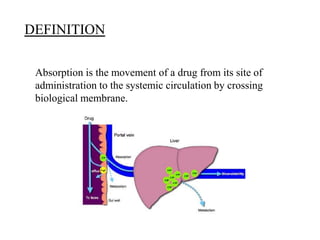
Absorption is the movement of a drug from its site of
administration to the systemic circulation by crossing
biological membrane.
Factors Affecting Absorptions
Related to Drugs
Lipid water solubility
Molecular size
Particle size
Degree of ionization
Physical forms
Chemical nature
Dosage form
Formulation, concentration

Related to Body
Area of Absorptive surface
Vascularity
PH
Presence of other substances
GI motility
Diseases
































ABSORPTION STUDY
•An absorption study should be conducted using the route of
administration as the rate and efficiency of absorption depend on
the route of administration.
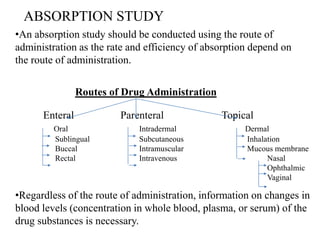
Routes of Drug Administration
Enteral
Oral
Sublingual
Buccal
Rectal

Parenteral
Intradermal
Subcutaneous
Intramuscular
Intravenous

Topical
Dermal
Inhalation
Mucous membrane
Nasal
Ophthalmic
Vaginal

•Regardless of the route of administration, information on changes in
blood levels (concentration in whole blood, plasma, or serum) of the
drug substances is necessary.
STUDY METHOD
Subjects
•Studies with humans must be carefully evaluated with a concern
that there is an optimal risk/benefit ratio.
•Studies should be conducted under well-controlled conditions
usually with an appropriate number of healthy volunteers.
•If investigation of a drug poses a significant risk to healthy
volunteers, the studies should be conducted in patients with the
target disease.
Factors of concern
1.Health
•Each subject will act as their own control. So, it is usually best
to have subjects of similar kinetic characteristic so that major
variations are not introduced. Thus healthy volunteers are often
preferred.
2. Age
•Elderly patients and children can have quite different kinetics
compared with young adults. In the interest of a better matched
group, subjects between the ages of 18 to 35 years are
preferred.
3. Weight
•In overweight or underweight subjects the Volume of
distribution may be somewhat different. So, to match the
subjects, normal weights are preferred.
4. Enzyme status
•Smokers or subjects taking certain other drugs may have altered
kinetics for the drug of interest. This can be caused by alteration of
enzyme activity or by drug-drug interactions. These effects add
complications to a study and an attempt is usually made to minimize
these factors.
5. Number
•The number of subjects included in the study should be sufficient to
see any real differences in the study. Usually 10 - 20 subjects are used
in these studies.
Types of Study
1.Standard Pharmacokinetic study
•subjects are given a single dose or repeated doses of an
investigational drug.
•Then, blood and urine samples are collected in compliance with a
fixed schedule. Fecal samples may also be necessary.
•Then, the concentration of the investigational drug and its
metabolites is measured in these samples and the pharmacokinetic
profile of the investigational drug is evaluated.
2. Population Pharmacokinetic Approach
•a large number of subjects participate in the study, while the
number of samples collected from each subject can be small.
•includes less inconvenience and stress on the subjects involved.
Sampling
•The number of blood samples should be large enough and the
timing must be appropriate to allow an adequate determination of
the absorption phases.
•Plasma concentrations in the post-absorptive phase
should, whenever possible, be determined over at least two or three
half-lives to avoid confusion between distribution, and elimination
half-lives.
•If urinary data are obtained, the urine should be collected until
there is no further detectable excretion of parent substance or
metabolites within the limits of the method used.
Parameters to be considered
•For the drugs that show efficacy via the systemic circulation,
pharmacokinetic parameters such as the absorption ratio,
bioavailability, and absorption rate should be estimated.
•In cases of oral administration, comparison with results from
intravenous administration is useful in order to estimate the
absorption ratio and bioavailability, and to clarify the extent of
first-pass effects.
•In the case of the drugs that are intended to be used locally,
absorption from the application sites should be investigated.
As absorption from the gastrointestinal tract is likely to be
affected by meals, the effects of a meal on gastrointestinal
absorption should be evaluated for the drugs that are administered
orally.
References:
•Clinical Pharmacokinetic Studies of Pharmaceuticals (an
informal translation of the official text that was promulgated
in Japanese on 1 June 2001 by Ministry of Health, Labour, and
Welfare)
•Pharmacokinetic Studies in Man, Guidance formulated as per
Directive 75/318/EEC.
•Biopharmaceutics and Pharmacokinetics, by David W.A.
Bourne, B.Pharm., Ph.D. ( www.boomer.org )
THANK YOU!

Absorption

  • 1.
    Absorption Study Group Members UshaRijal Joshi Rajan Ghimire Prashant Basnet Om Prakash Sajan Maharjan
  • 2.
    DEFINITION Absorption is themovement of a drug from its site of administration to the systemic circulation by crossing biological membrane.
  • 3.
    Factors Affecting Absorptions Relatedto Drugs Lipid water solubility Molecular size Particle size Degree of ionization Physical forms Chemical nature Dosage form Formulation, concentration Related to Body Area of Absorptive surface Vascularity PH Presence of other substances GI motility Diseases                
  • 4.
    ABSORPTION STUDY •An absorptionstudy should be conducted using the route of administration as the rate and efficiency of absorption depend on the route of administration. Routes of Drug Administration Enteral Oral Sublingual Buccal Rectal Parenteral Intradermal Subcutaneous Intramuscular Intravenous Topical Dermal Inhalation Mucous membrane Nasal Ophthalmic Vaginal •Regardless of the route of administration, information on changes in blood levels (concentration in whole blood, plasma, or serum) of the drug substances is necessary.
  • 5.
    STUDY METHOD Subjects •Studies withhumans must be carefully evaluated with a concern that there is an optimal risk/benefit ratio. •Studies should be conducted under well-controlled conditions usually with an appropriate number of healthy volunteers. •If investigation of a drug poses a significant risk to healthy volunteers, the studies should be conducted in patients with the target disease.
  • 6.
    Factors of concern 1.Health •Eachsubject will act as their own control. So, it is usually best to have subjects of similar kinetic characteristic so that major variations are not introduced. Thus healthy volunteers are often preferred. 2. Age •Elderly patients and children can have quite different kinetics compared with young adults. In the interest of a better matched group, subjects between the ages of 18 to 35 years are preferred. 3. Weight •In overweight or underweight subjects the Volume of distribution may be somewhat different. So, to match the subjects, normal weights are preferred.
  • 7.
    4. Enzyme status •Smokersor subjects taking certain other drugs may have altered kinetics for the drug of interest. This can be caused by alteration of enzyme activity or by drug-drug interactions. These effects add complications to a study and an attempt is usually made to minimize these factors. 5. Number •The number of subjects included in the study should be sufficient to see any real differences in the study. Usually 10 - 20 subjects are used in these studies.
  • 8.
    Types of Study 1.StandardPharmacokinetic study •subjects are given a single dose or repeated doses of an investigational drug. •Then, blood and urine samples are collected in compliance with a fixed schedule. Fecal samples may also be necessary. •Then, the concentration of the investigational drug and its metabolites is measured in these samples and the pharmacokinetic profile of the investigational drug is evaluated. 2. Population Pharmacokinetic Approach •a large number of subjects participate in the study, while the number of samples collected from each subject can be small. •includes less inconvenience and stress on the subjects involved.
  • 9.
    Sampling •The number ofblood samples should be large enough and the timing must be appropriate to allow an adequate determination of the absorption phases. •Plasma concentrations in the post-absorptive phase should, whenever possible, be determined over at least two or three half-lives to avoid confusion between distribution, and elimination half-lives. •If urinary data are obtained, the urine should be collected until there is no further detectable excretion of parent substance or metabolites within the limits of the method used.
  • 10.
    Parameters to beconsidered •For the drugs that show efficacy via the systemic circulation, pharmacokinetic parameters such as the absorption ratio, bioavailability, and absorption rate should be estimated. •In cases of oral administration, comparison with results from intravenous administration is useful in order to estimate the absorption ratio and bioavailability, and to clarify the extent of first-pass effects. •In the case of the drugs that are intended to be used locally, absorption from the application sites should be investigated. As absorption from the gastrointestinal tract is likely to be affected by meals, the effects of a meal on gastrointestinal absorption should be evaluated for the drugs that are administered orally.
  • 11.
    References: •Clinical Pharmacokinetic Studiesof Pharmaceuticals (an informal translation of the official text that was promulgated in Japanese on 1 June 2001 by Ministry of Health, Labour, and Welfare) •Pharmacokinetic Studies in Man, Guidance formulated as per Directive 75/318/EEC. •Biopharmaceutics and Pharmacokinetics, by David W.A. Bourne, B.Pharm., Ph.D. ( www.boomer.org )
  • 12.