ABORTION
Introduction
• Any bleeding in pregnancy is abnormal. It is
also known as haemorrhage in early
pregnancy. The term miscarriage and abortion
are synonymous.
DEFINITION
• The expulsion or extraction of the fetus or
embryo from the uterus weighing less than
1000gm is called abortion.
OR
• Termination of pregnancy before 28wks. Of
gestation or before the period of viability either
spontaneously or by induction is called abortion
CLASSIFICATION
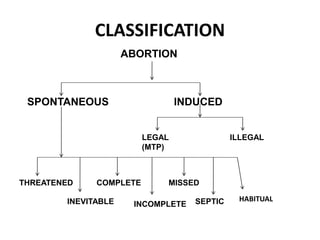
ABORTION
SPONTANEOUS INDUCED
THREATENED
INEVITABLE
COMPLETE
INCOMPLETE
MISSED
SEPTIC
LEGAL
(MTP)
ILLEGAL
HABITUAL
Incidence
• Approximately 20% of all pregnancies are
terminated spontaneously and 80% are
terminated by induction with in 2- 5 months of
gestation.
SPONTANEOUS ABORTION
• Spontaneous abortion is defined as the
involuntary loss of the products of conception
prior to 28 weeks of gestation, when the fetus
weighs approximately 1,000 gm or less.
CAUSES OF SPONTANEOUS ABORTION
• Maternal cause-
• Structural abnormalities of the genital organ such as
retroversion of uterus, bicornuate uterus and fibroids
• Maternal Infections such as rubella, UTI, hyperpyrexia,
hepatitis
• Medical condition such as diabetes, renal disease and
thyroid dysfunction, when not well controlled
• Genetic factor
• Immunological factor- placental infarction,
placental thrombosis.
• Blood group incompatibility
• Drugs- antimalarial, antipsychotic,
anticonvulsant drugs.
• Environmental factors- excessive consumption of
alcohol & smoking
• Lack of iron & vitamin in diet.
• Exposure to radiation
• Fetal cause-
• Chromosomal abnormalities
• Blighted ovum (structural abnormality of ovum)
• Multiple congenital defects
• Multiple pregnancy
TYPES
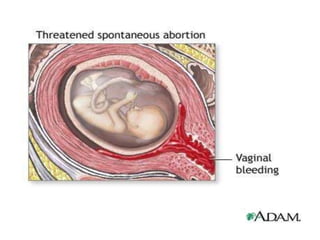
1.Threatened abortion-
• It is a clinical entity where the process of abortion has
started but has not progressed to a state from which the
recovery is impossible.
• Signs & symptoms-
• Amenorrhea more than 6 wks.
• it is an abortion characterized by vaginal bleeding with or
without uterine contraction.
• The blood loss may be scanty with or without accompanying
backache and cramp like pain(resembling dysmenorrhoea).
• The cervix and uterus feels soft
• Os may be closed, and blood seen in the
external os.
• The outcome of a threatened abortion could be
either stoppage of bleeding by management and
continuation of pregnancy to term.
• continuation of bleeding and uterine contraction
to expel the products of conception if not
treated.
investigations
• Blood- HB estimation, ABO & RH factor, cross
match, VDRL, HIV, torch test, thyroid function
test.
• USG- sometimes a blood clot may be seen
around the gestational sac.
• Urine test- UPT is always +ve. Culture test,
sugar & albumin
treatment
• 1. complete bed rest
• 2. drugs- hormonal supportive therapy- HCG
5000 IU ( inj. Proluton 500mg(2ml) deep I/M
twice a week)
• Sedative- T. phenobarb- 30mg HS
T. diazepam 5 mg bd
Laxative- milk of mag or cremaffin 2tsf- HS
enema should be avoided
Nursing management
• Advice the woman to Preserve all the vulval pads to observe
amount of bleeding.
• Anything is expelled out from the vagina should be reported
immediately.
• Note the vital signs.
• If bleeding & abdominal pains is aggravated should be reported
immediately.
• Advice patient should limit her activities at least 2 wks.
• Avoid heavy weight lifting
• Avoid unnecessary journey
• Coitus should be avoided in this period
• Advice to continue the treatment & follow-up
• Nutritive diet may be advice that may contain
high protein, vitamin & Iron
• Perineal care should be given twice daily with
aseptic technique
2. Inevitable abortion-
• It is a clinical type of abortion where the changes
have progressed to a state from where continuation
of pregnancy is impossible.
• Signs & symptoms-
• In this type of abortion the women present with
bleeding, often heavy, with clots or products of
conception.
• The vaginal examination cervix feels soft, os is open
& blood clot may be seen in the vagina or protruding
through the os.
• ↑ pain in the lower abdomen which may be
colicky or like labour pains
• Cervical dilatation & uterine contraction are
present
• Patient may look pallor due to blood loss
• Tachycardia, hypotension, cold & clammy
extrimities, patient may go in shock.
• Investigations- HB%, bloodgroup, RH factor, USG
Treatment
• If pregnancy is less than 12 wks. S/E is done
• Intravenous fluids & blood transfusion to treat
shock.
• If pregnancy is more than 12 wks. Tab. Misoprost
400 µg p/v or Inj. Oxytocin 20 unit with 5% dext.
Should be given for spontaneous expulsion.
• If fetus is expelled out & placenta is retained
should be removed by D&C.
• Inj. T.T should be given
• If mother is RH-ve than Anti-D 50- 150 µmg. I/M
given.
• If bleeding is excessive should be controlled by
administering inj. Methargin (0.2mg) or
inj. Prostadin 250 mg I/M
3 . Complete abortion –
when the products of conception is expelled
Completely from the uterus & the uterine cavity
is empty it is called complete abotion
S/S- decreased amount of vaginal bleeding &
lower abdominal pain.
- Uterus is smaller than the period of
amenorrhea
- Cervical os is closed
• Management-
• Antibiotic, T.T, anti-D( if Rh-ve), methergin
• If bleeding is continous than D&C should be
done.
4. Incomplete abortion-
• When the entire products of conception are
partialy expelled and some products are left
inside the uterine cavity is called incomplete
abotion.
• S/S- continous and profuse vaginal bleeding
• Lower abdominal pain
• Pallor and signs of shock
• Internal os is open
• Uterus feels soft, smaller than the period of
amenorrhea.
management
• If pregnancy is less than 12 wks. S/E done.
• If pregnancy is more than 12 wks. I/V oxytocin 20 unit
may be given for spontaneous expulsion
• If fetus is expelled & placenta is retained should be
removed by D&C. if placenta is not separated than S/E
is done under G.A
• Inj. Morphine 15 mg should be given before S/E. inj.T.T,
antibiotic should be given before D&C
• Excessive bleeding may be controlled by administering
inj. Methergin/ prostadin or tab. Misoprost 200µg P/R
5. Missed abortion-
This is also known as silent miscarriage
• The embryo dies despite the presence of
viable placenta and retained inside of the
uterus
• Death of the embryo occurs but the mothers
body fails to recognize the demise.
Signs & symptoms
• H/O brownish vaginal discharge or spotting
• Retrogression of breast changes
• Ceasation of uterine growth
• FHS may not be audible (after 20 wks.) in late
pregnancy
• Cervix feels firm, internal os closed
• ↓fetal movement in late pregnancy
• Uterus size is smaller than period of gestation
investigations
• UPT- becomes –ve
• USG- reveals absence of FHS
• X-ray- shows patchy skeletal shadows
• Blood- B.T,C.T, platelet count, HB should be
done
management
• If pregnancy is less than 12 wks.- D&C/ S&E of
uterine cavity under G.A
• Antibiotic should be given without delay
• If more than 12 wks.- induction is done by
oxytocin (10-20 unit with 5%D) at the rate of
30 drops/min
• Prostaglandin ( tab. misoprost/carboprost)
should be given for cervical dilatation
6. Habitual abortion
• Occurrence of spontaneous abortion in 3 or
more successive pregnancy is called recurrent
of habitual abortion, it may be occur in first or
second trimester
• Causes-
maternal diseases- syphilis, diabetes, chronic
nephritis, hypertension, RH incompatibility,
metritis, TORCH test is +ve
Progestrone defficiency- luteal phase defect
investigations
• Blood group & Rh factor
• HB, complete blood count
• Urine- routine, microscopic & culture
• Glucose tolerance test
• Liver, thyroid, renal function test
• TORCH test
• Cervical swab culture
• USG, hysterosalpingogram- to visualize the
uterus & fallopian tube for any infection
management
• Systemic illness should be treated promptly
• Hormonal therapy is useful in case of luteal
defects.
• The patient should be advice for adequate rest
& appropriate diet
• In case of cervical incompetence cervical
encircling should be done between 3- 4 month
of pregnancy ( this operation is called shirodkar
suture/ macdonald suture)
• At the time of delivery(37- 38wks.)this suture
is cut to allow the vaginal delivery.
7. Septic abortion- characterized by infection of the
products of conception in uterus, this condition is mostly
common in induced or incomplete abortion, some illegal
abortion carried out in non- sterile conditions often lead
to septic abortion.
C/M- pyrexia 100.4 & above chills with rigor
• c/o vomiting & diarrohea
• Abdominal pain
• Foul smelling vaginal discharge which is often purulent
• Vaginal bleeding with products of conception
• Pallor & sweating
• Tachycardia and ↓ B.P
• Abdominal distension and tenderness
• Signs of toxemia
• Clinical grading of infection-
• Grade-I- localized in the uterus- involves endometrium
& myometrium
• Grade-II- infection spread beyond the uterus, tubes,
ovaries & pelvic structure also.
• Grade-III- generalized peritonitis or endotoxic shock,
jaundice & acute renal failure.
investigations
• Complete blood count & urinalysis
• BUN & serum electrolytes
• High vaginal swab
• Blood culture if septicemia suspected
• Pelvic USG
• Blood coagulation profile
• X-ray of pelvis & abdomen.
complications
• Hemorrhage
• Injury may occur to uterus & other organs
• Peritonitis
• Perforation of the uterus
• Endotoxic shock
• Acute renal failure
• thrombophlebitis
management
• Hospitalized the patient- start I/V fluids
• Broad spectrum antibiotics I/V should be started
• Take high vaginal swab & blood culture for
investigations
• If pelvic abscess is present should be drain out
• Vital signs should be monitored- if pyrexia should be
treated with antipyretic
• Strict I/O charting
• Uterus should be evacuated to remove the source of
infection
Cont.
• Blood transfusion should be done if needed
• If patient is having respiratory difficulty O2
should be provided
• Laporotomy will also be needed if there is no
response to evacuation & adequate medical therapy.
MEDICAL TERMINATION OF PREGNANCY
(LEGAL ABORTION)
• It is the deliberate induction of labour prior
to viability of the fetus (before 28 weeks
gestation) by a registered medical
practitioner in the interest of mother’s
health and life.
Provision of MTP under the MTP Act
indications
• The pregnancy would involve serious risk of life or
grave injury to the physical and mental health of the
pregnant women
• There is risk of child being born with serious physical
and mental abnormalities.
• The pregnancy is result of rape
• The pregnancy is caused as a result of failure of
contraceptives where there are social or economic
environment which could lead to risk or injury to the
health of the mother
• Chronic diseases like cervical or breast
malignancy, psychiatric illness
• Exposure to teratogenic drugs or radiation in
early pregnancy
• Rubella infection in 1st trimester
• Congenital malformation of the fetus.
Methods of termination in first
trimester
• MVA (manual vaccum aspiration- before 7wks.)
• Suction evacuation & curretage (upto 12 wks.)
• Dilatation and evacuation (slow method)
• Pharmacological methods (mifepristone,
methotrexate)
Methods of termination in second
trimester
• Intrauterine instillation
• Extra uterine instillation
• Prostaglandin and oxytocin
• Hysterotomy
Intrauterine (intra-amniotic) instillation
• Between 16-20 wks.- (Hypertonic solution 20% saline)
• Preliminary amniocentesis is done (18 no. needle) I/V
drip set is connected with hypertonic solution. The
amount of saline to be instilled is calculated as no. of
wks. Of gestation multiplied by 10. the rate of infusion
is 10ml/min.
• Eg. G.A = 16 wks. X 10= 160 ml should be run in 16 min.
•
complications
• Should not used in cardiac, renal or severe
anemic patient because of sodium load.
• Hypernatremia
• Retained products
• Infection- endometriosis
• Sometimes hypotension & shock
• Cervical tear & laceration
• Fever, nausea & vomiting, abdominal pain
Extra uterine (extra-amniotic) instillation
• Instillation of 0.1% ethacrydine lactate (M-cradil,
vicradyl)
• No.16 foleys catheter is introduced through the
cervical canal about 10 cm. above the internal os
b/w the membrane & myometrium and the
balloon is inflatted (10-15ml saline) this method
is less hazardous and effective 90-95%.
Complications of extra uterine instillation
• trauma to the cervix leading to haemorrhage &
shock.
• Atonic uterus
menstrual disturbance
• Chronic pelvic inflamation
• Endometriosis
• Infertility
• Recurrent mid trimester abortion due to cervical
incompetence
( cervix become weak)
Cont.
• Ectopic pregnancy
• Premature labour pains
• Rupture uterus
• Dysmaturity
• Rh-isoimmunization in Rh-ve woman if not
protected with immunoglobulin.
• Oxytocin & prostaglandin is used with intra-
uterine & extra-uterine instillation.
• Hysterotomy is done when the extra- uterine
instillation is failed.

ABORTION_ppt.ppt

  • 1.
  • 2.
    Introduction • Any bleedingin pregnancy is abnormal. It is also known as haemorrhage in early pregnancy. The term miscarriage and abortion are synonymous.
  • 3.
    DEFINITION • The expulsionor extraction of the fetus or embryo from the uterus weighing less than 1000gm is called abortion. OR • Termination of pregnancy before 28wks. Of gestation or before the period of viability either spontaneously or by induction is called abortion
  • 4.
  • 5.
    Incidence • Approximately 20%of all pregnancies are terminated spontaneously and 80% are terminated by induction with in 2- 5 months of gestation.
  • 6.
    SPONTANEOUS ABORTION • Spontaneousabortion is defined as the involuntary loss of the products of conception prior to 28 weeks of gestation, when the fetus weighs approximately 1,000 gm or less.
  • 7.
    CAUSES OF SPONTANEOUSABORTION • Maternal cause- • Structural abnormalities of the genital organ such as retroversion of uterus, bicornuate uterus and fibroids • Maternal Infections such as rubella, UTI, hyperpyrexia, hepatitis • Medical condition such as diabetes, renal disease and thyroid dysfunction, when not well controlled • Genetic factor
  • 8.
    • Immunological factor-placental infarction, placental thrombosis. • Blood group incompatibility • Drugs- antimalarial, antipsychotic, anticonvulsant drugs. • Environmental factors- excessive consumption of alcohol & smoking • Lack of iron & vitamin in diet. • Exposure to radiation
  • 9.
    • Fetal cause- •Chromosomal abnormalities • Blighted ovum (structural abnormality of ovum) • Multiple congenital defects • Multiple pregnancy
  • 10.
    TYPES 1.Threatened abortion- • Itis a clinical entity where the process of abortion has started but has not progressed to a state from which the recovery is impossible. • Signs & symptoms- • Amenorrhea more than 6 wks. • it is an abortion characterized by vaginal bleeding with or without uterine contraction. • The blood loss may be scanty with or without accompanying backache and cramp like pain(resembling dysmenorrhoea).
  • 12.
    • The cervixand uterus feels soft • Os may be closed, and blood seen in the external os. • The outcome of a threatened abortion could be either stoppage of bleeding by management and continuation of pregnancy to term. • continuation of bleeding and uterine contraction to expel the products of conception if not treated.
  • 13.
    investigations • Blood- HBestimation, ABO & RH factor, cross match, VDRL, HIV, torch test, thyroid function test. • USG- sometimes a blood clot may be seen around the gestational sac. • Urine test- UPT is always +ve. Culture test, sugar & albumin
  • 14.
    treatment • 1. completebed rest • 2. drugs- hormonal supportive therapy- HCG 5000 IU ( inj. Proluton 500mg(2ml) deep I/M twice a week) • Sedative- T. phenobarb- 30mg HS T. diazepam 5 mg bd Laxative- milk of mag or cremaffin 2tsf- HS enema should be avoided
  • 15.
    Nursing management • Advicethe woman to Preserve all the vulval pads to observe amount of bleeding. • Anything is expelled out from the vagina should be reported immediately. • Note the vital signs. • If bleeding & abdominal pains is aggravated should be reported immediately. • Advice patient should limit her activities at least 2 wks. • Avoid heavy weight lifting • Avoid unnecessary journey • Coitus should be avoided in this period
  • 16.
    • Advice tocontinue the treatment & follow-up • Nutritive diet may be advice that may contain high protein, vitamin & Iron • Perineal care should be given twice daily with aseptic technique
  • 17.
    2. Inevitable abortion- •It is a clinical type of abortion where the changes have progressed to a state from where continuation of pregnancy is impossible. • Signs & symptoms- • In this type of abortion the women present with bleeding, often heavy, with clots or products of conception. • The vaginal examination cervix feels soft, os is open & blood clot may be seen in the vagina or protruding through the os.
  • 18.
    • ↑ painin the lower abdomen which may be colicky or like labour pains • Cervical dilatation & uterine contraction are present • Patient may look pallor due to blood loss • Tachycardia, hypotension, cold & clammy extrimities, patient may go in shock. • Investigations- HB%, bloodgroup, RH factor, USG
  • 19.
    Treatment • If pregnancyis less than 12 wks. S/E is done • Intravenous fluids & blood transfusion to treat shock. • If pregnancy is more than 12 wks. Tab. Misoprost 400 µg p/v or Inj. Oxytocin 20 unit with 5% dext. Should be given for spontaneous expulsion. • If fetus is expelled out & placenta is retained should be removed by D&C. • Inj. T.T should be given
  • 20.
    • If motheris RH-ve than Anti-D 50- 150 µmg. I/M given. • If bleeding is excessive should be controlled by administering inj. Methargin (0.2mg) or inj. Prostadin 250 mg I/M
  • 21.
    3 . Completeabortion – when the products of conception is expelled Completely from the uterus & the uterine cavity is empty it is called complete abotion S/S- decreased amount of vaginal bleeding & lower abdominal pain. - Uterus is smaller than the period of amenorrhea - Cervical os is closed
  • 22.
    • Management- • Antibiotic,T.T, anti-D( if Rh-ve), methergin • If bleeding is continous than D&C should be done.
  • 23.
    4. Incomplete abortion- •When the entire products of conception are partialy expelled and some products are left inside the uterine cavity is called incomplete abotion. • S/S- continous and profuse vaginal bleeding • Lower abdominal pain • Pallor and signs of shock • Internal os is open • Uterus feels soft, smaller than the period of amenorrhea.
  • 24.
    management • If pregnancyis less than 12 wks. S/E done. • If pregnancy is more than 12 wks. I/V oxytocin 20 unit may be given for spontaneous expulsion • If fetus is expelled & placenta is retained should be removed by D&C. if placenta is not separated than S/E is done under G.A • Inj. Morphine 15 mg should be given before S/E. inj.T.T, antibiotic should be given before D&C • Excessive bleeding may be controlled by administering inj. Methergin/ prostadin or tab. Misoprost 200µg P/R
  • 25.
    5. Missed abortion- Thisis also known as silent miscarriage • The embryo dies despite the presence of viable placenta and retained inside of the uterus • Death of the embryo occurs but the mothers body fails to recognize the demise.
  • 26.
    Signs & symptoms •H/O brownish vaginal discharge or spotting • Retrogression of breast changes • Ceasation of uterine growth • FHS may not be audible (after 20 wks.) in late pregnancy • Cervix feels firm, internal os closed • ↓fetal movement in late pregnancy • Uterus size is smaller than period of gestation
  • 27.
    investigations • UPT- becomes–ve • USG- reveals absence of FHS • X-ray- shows patchy skeletal shadows • Blood- B.T,C.T, platelet count, HB should be done
  • 28.
    management • If pregnancyis less than 12 wks.- D&C/ S&E of uterine cavity under G.A • Antibiotic should be given without delay • If more than 12 wks.- induction is done by oxytocin (10-20 unit with 5%D) at the rate of 30 drops/min • Prostaglandin ( tab. misoprost/carboprost) should be given for cervical dilatation
  • 29.
    6. Habitual abortion •Occurrence of spontaneous abortion in 3 or more successive pregnancy is called recurrent of habitual abortion, it may be occur in first or second trimester • Causes- maternal diseases- syphilis, diabetes, chronic nephritis, hypertension, RH incompatibility, metritis, TORCH test is +ve Progestrone defficiency- luteal phase defect
  • 30.
    investigations • Blood group& Rh factor • HB, complete blood count • Urine- routine, microscopic & culture • Glucose tolerance test • Liver, thyroid, renal function test • TORCH test • Cervical swab culture • USG, hysterosalpingogram- to visualize the uterus & fallopian tube for any infection
  • 31.
    management • Systemic illnessshould be treated promptly • Hormonal therapy is useful in case of luteal defects. • The patient should be advice for adequate rest & appropriate diet • In case of cervical incompetence cervical encircling should be done between 3- 4 month of pregnancy ( this operation is called shirodkar suture/ macdonald suture) • At the time of delivery(37- 38wks.)this suture is cut to allow the vaginal delivery.
  • 32.
    7. Septic abortion-characterized by infection of the products of conception in uterus, this condition is mostly common in induced or incomplete abortion, some illegal abortion carried out in non- sterile conditions often lead to septic abortion. C/M- pyrexia 100.4 & above chills with rigor • c/o vomiting & diarrohea • Abdominal pain • Foul smelling vaginal discharge which is often purulent • Vaginal bleeding with products of conception
  • 33.
    • Pallor &sweating • Tachycardia and ↓ B.P • Abdominal distension and tenderness • Signs of toxemia • Clinical grading of infection- • Grade-I- localized in the uterus- involves endometrium & myometrium • Grade-II- infection spread beyond the uterus, tubes, ovaries & pelvic structure also. • Grade-III- generalized peritonitis or endotoxic shock, jaundice & acute renal failure.
  • 34.
    investigations • Complete bloodcount & urinalysis • BUN & serum electrolytes • High vaginal swab • Blood culture if septicemia suspected • Pelvic USG • Blood coagulation profile • X-ray of pelvis & abdomen.
  • 35.
    complications • Hemorrhage • Injurymay occur to uterus & other organs • Peritonitis • Perforation of the uterus • Endotoxic shock • Acute renal failure • thrombophlebitis
  • 36.
    management • Hospitalized thepatient- start I/V fluids • Broad spectrum antibiotics I/V should be started • Take high vaginal swab & blood culture for investigations • If pelvic abscess is present should be drain out • Vital signs should be monitored- if pyrexia should be treated with antipyretic • Strict I/O charting • Uterus should be evacuated to remove the source of infection
  • 37.
    Cont. • Blood transfusionshould be done if needed • If patient is having respiratory difficulty O2 should be provided • Laporotomy will also be needed if there is no response to evacuation & adequate medical therapy.
  • 38.
    MEDICAL TERMINATION OFPREGNANCY (LEGAL ABORTION) • It is the deliberate induction of labour prior to viability of the fetus (before 28 weeks gestation) by a registered medical practitioner in the interest of mother’s health and life.
  • 39.
    Provision of MTPunder the MTP Act indications • The pregnancy would involve serious risk of life or grave injury to the physical and mental health of the pregnant women • There is risk of child being born with serious physical and mental abnormalities. • The pregnancy is result of rape • The pregnancy is caused as a result of failure of contraceptives where there are social or economic environment which could lead to risk or injury to the health of the mother
  • 40.
    • Chronic diseaseslike cervical or breast malignancy, psychiatric illness • Exposure to teratogenic drugs or radiation in early pregnancy • Rubella infection in 1st trimester • Congenital malformation of the fetus.
  • 41.
    Methods of terminationin first trimester • MVA (manual vaccum aspiration- before 7wks.) • Suction evacuation & curretage (upto 12 wks.) • Dilatation and evacuation (slow method) • Pharmacological methods (mifepristone, methotrexate)
  • 42.
    Methods of terminationin second trimester • Intrauterine instillation • Extra uterine instillation • Prostaglandin and oxytocin • Hysterotomy
  • 43.
    Intrauterine (intra-amniotic) instillation •Between 16-20 wks.- (Hypertonic solution 20% saline) • Preliminary amniocentesis is done (18 no. needle) I/V drip set is connected with hypertonic solution. The amount of saline to be instilled is calculated as no. of wks. Of gestation multiplied by 10. the rate of infusion is 10ml/min. • Eg. G.A = 16 wks. X 10= 160 ml should be run in 16 min. •
  • 44.
    complications • Should notused in cardiac, renal or severe anemic patient because of sodium load. • Hypernatremia • Retained products • Infection- endometriosis • Sometimes hypotension & shock • Cervical tear & laceration • Fever, nausea & vomiting, abdominal pain
  • 45.
    Extra uterine (extra-amniotic)instillation • Instillation of 0.1% ethacrydine lactate (M-cradil, vicradyl) • No.16 foleys catheter is introduced through the cervical canal about 10 cm. above the internal os b/w the membrane & myometrium and the balloon is inflatted (10-15ml saline) this method is less hazardous and effective 90-95%.
  • 46.
    Complications of extrauterine instillation • trauma to the cervix leading to haemorrhage & shock. • Atonic uterus menstrual disturbance • Chronic pelvic inflamation • Endometriosis • Infertility • Recurrent mid trimester abortion due to cervical incompetence ( cervix become weak)
  • 47.
    Cont. • Ectopic pregnancy •Premature labour pains • Rupture uterus • Dysmaturity • Rh-isoimmunization in Rh-ve woman if not protected with immunoglobulin.
  • 48.
    • Oxytocin &prostaglandin is used with intra- uterine & extra-uterine instillation. • Hysterotomy is done when the extra- uterine instillation is failed.

Editor's Notes