Single Entry System
Or
Accounts from Incomplete Records
BUSINESS ENTERPRISES
 A business owned by one person is generally a proprietorship
(owner’s equity).
 A business owned by two or more persons associated as partners is
a partnership (partners’ equity).
 A business organized as a separate legal entity under corporation
law and having ownership divided into transferable shares is called
a corporation (shareholders’ equity).
 Limited Liability Company
(LLC) is a relatively new type of
business structure that combines
the benefits of a partnership and
corporation.
Types of ownership
The four basic legal forms of ownership for small businesses are
a Sole Proprietorship, Partnership, Corporation, and Limited
Liability Company.
There are advantages and disadvantages as well
as income tax ramifications associated with each
type of organization.
All the different types of organizations listed
above have some unique methods and rules for
accounting for their transactions associated
with their equity (ownership) accounts.
Types Of Business Activity
Our society is made up of all kinds of different types of
businesses.
 Some perform services – Service Business.
 Some sell products directly to the consumer and are
known as retailers – Merchandising Business
 Some do both
Some businesses produce/make the products and are called
manufacturers –Manufacturing Business.
to keep it simple and since many small
businesses start out organized as sole
proprietorships will focus on bookkeeping
for a Service Business sole proprietorship.
Accounting Period
A business needs to select an annual tax year. Your two main
choices are a calendar or fiscal tax year.
A Calendar Tax Year is 12 consecutive months
beginning January 1 and ending December 31.
A Fiscal Tax Year is 12 consecutive months
ending on the last day of any month except
December 31.
The calendar tax year is used by most businesses.
A reason a business might choose a fiscal tax year is that they
could select an ending month for their fiscal year when business
activity is low.
This makes the process of what is called
closing the books a little easier.
Types Of Bookkeeping Systems
A business also needs to determine the type of bookkeeping
system that will be used for recording their business transactions.
 There are two major systems that are used:
1. Single Entry System
2. Double Entry System
 Many small businesses start out using the single entry
system, then change over once their business grows.
Single Entry System
The single entry system is an "informal“ accounting/bookkeeping
system where a user of this system makes only one entry to enter
a business financial transaction.
A cheque book, for example, is a single entry bookkeeping system
where one entry is made for each deposit or check written.
 Receipts are entered as a deposit and a source of
revenue.
 Checks and withdrawals are entered
as expenses
The emphasis of this system is placed on determining the
profit or loss of a business.
It got its name because you record each
transaction only once as either revenue
(deposit) or as an expense (cheque).
While the single entry system may be acceptable for tax
purposes, it does not provide a business with all the
financial information needed to adequately report the
financial affairs of a business.
In the near future, we'll probably see the
single entry system follow the same path as
the dinosaur - extinction.
Double Entry System
The double entry system is the standard system used by
businesses and other organizations to record financial
transactions.
all business transactions consist of an exchange of one thing
for another, double entry bookkeeping uses debits (Dr) and
credits (Cr), to show this two-fold effect.
The double entry system also has built-in checks and balances.
As a result of using of debits and credits, the double-entry
system is self-balancing.
The total of the debit values recorded must equal the total of the
credit values recorded.
This system, when used along with the
accrual method of accounting, is a
complete accounting system
and focuses on the income statement
and balance sheet.
This system has worldwide support
as the system to use by businesses
for recording their financial
transactions.
Accounting Methods
Another decision faced by a new business is what
accounting/bookkeeping method is going to be used to
track revenues and expenses.
An accounting method is just a set of rules used to
determine when and how income and expenses are
reported.
Business can choose from the two following methods:
1. Cash Basis
2. Accrual Basis
 Use of the cash basis generally is not considered to be in
conformity with generally accepted accounting principles
(GAAP).
Cash Method
The cash method or basis of accounting recognizes
revenues (earnings) in the period the cash is received and
expenses in the period when the cash payments are made.
Actually, two types of cash methods (basis) of accounting
exist:
1. strict cash method (basis)
• A strict cash method follows the cash flow exactly
2. modified cash method (basis)
• A modified cash method includes some elements
from the accrual method of accounting.
Accrual Method
The accrual method or basis of accounting records income in
the period earned and records expenses and capital expenditures
such as buildings, land, equipment, and vehicles in the period
incurred.
The purpose of the accrual method of
accounting is to properly match income and
expenses in the correct period
This is the accounting method that is required to
be used in order to conform to generally
accepted accounting principles (GAAP) in
preparing financial statements for external
users.
Meaning of Single Entry System
• Single entry system is an incomplete form of
recording financial transactions. It is the system,
which does not record two aspects or accounts of
all the financial transactions. It is the system,
which has no fixed set of rules to record the
financial transactions of the business. Single entry
system records only one aspect of transaction.
Thus, single entry system is not a proper system of
recording financial transactions, which fails to
present complete information required by the
management.
Features Of Single Entry System
• No Fixed Rules
• Incomplete System
• Maintenance of Cash Book
• Maintenance of personal accounts
• Suitability for small business firms
• Dependence on original vouchers
Advantages Of Single Entry System
• Simple And Easy
• Economy
• Easy To Calculate Profit
• Suitable For Small Business
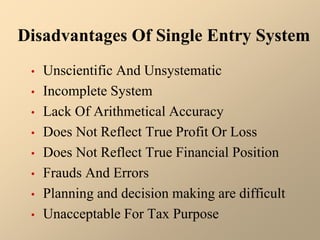
Disadvantages Of Single Entry System
• Unscientific And Unsystematic
• Incomplete System
• Lack Of Arithmetical Accuracy
• Does Not Reflect True Profit Or Loss
• Does Not Reflect True Financial Position
• Frauds And Errors
• Planning and decision making are difficult
• Unacceptable For Tax Purpose
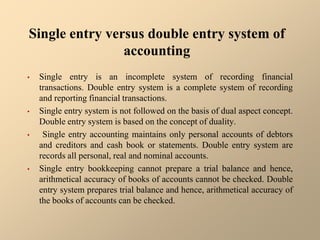
Single entry versus double entry system of
accounting
• Single entry is an incomplete system of recording financial
transactions. Double entry system is a complete system of recording
and reporting financial transactions.
• Single entry system is not followed on the basis of dual aspect concept.
Double entry system is based on the concept of duality.
• Single entry accounting maintains only personal accounts of debtors
and creditors and cash book or statements. Double entry system are
records all personal, real and nominal accounts.
• Single entry bookkeeping cannot prepare a trial balance and hence,
arithmetical accuracy of books of accounts cannot be checked. Double
entry system prepares trial balance and hence, arithmetical accuracy of
the books of accounts can be checked.
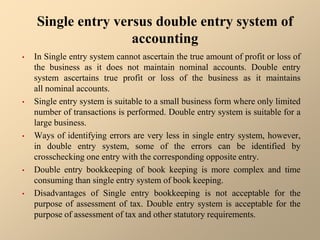
Single entry versus double entry system of
accounting
• In Single entry system cannot ascertain the true amount of profit or loss of
the business as it does not maintain nominal accounts. Double entry
system ascertains true profit or loss of the business as it maintains
all nominal accounts.
• Single entry system is suitable to a small business form where only limited
number of transactions is performed. Double entry system is suitable for a
large business.
• Ways of identifying errors are very less in single entry system, however,
in double entry system, some of the errors can be identified by
crosschecking one entry with the corresponding opposite entry.
• Double entry bookkeeping of book keeping is more complex and time
consuming than single entry system of book keeping.
• Disadvantages of Single entry bookkeeping is not acceptable for the
purpose of assessment of tax. Double entry system is acceptable for the
purpose of assessment of tax and other statutory requirements.
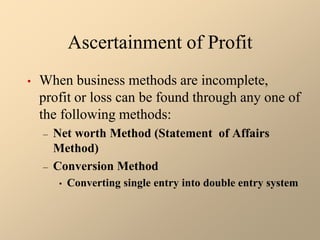
Ascertainment of Profit
• When business methods are incomplete,
profit or loss can be found through any one of
the following methods:
– Net worth Method (Statement of Affairs
Method)
– Conversion Method
• Converting single entry into double entry system
Steps to be followed to ascertainment of
Profit through Net worth method
• 1. Calculating Opening Capital
• 2. Ascertainment of Drawings during the year
• 3. Ascertaining Capital introduced during the year
• 4.Computing closing capital
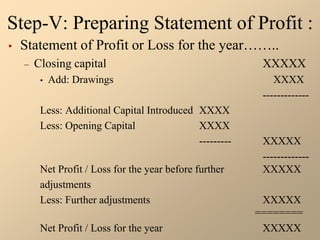
Step-V: Preparing Statement of Profit :
• Statement of Profit or Loss for the year……..
– Closing capital XXXXX
• Add: Drawings XXXX
-------------
Less: Additional Capital Introduced XXXX
Less: Opening Capital XXXX
--------- XXXXX
-------------
Net Profit / Loss for the year before further XXXXX
adjustments
Less: Further adjustments XXXXX
========
Net Profit / Loss for the year XXXXX
Statement of Affairs Method
• Statement of Affairs is a statement in which
there are two sections left and right. The left
section represents liabilities, whereas the right
one is for assets. It is prepared on the basis of a
single entry system of bookkeeping. As
incomplete records are maintained, many times
assumed figures are taken into consideration to
find out the opening or closing capital.
Differences between Balance Sheet and
Statement of Affairs
• A Balance Sheet shows assets at book values, while a Statement of Affairs shows
assets at book values, as well as realizable value.
• A Balance Sheet shows fictitious assets such as goodwill, prepaid expenses while
a Statement of Affairs does not show such items.
• In a Statement of Affairs, creditors arc classified as unsecured, fully secured,
partly secured and preferential creditors. No such classification is usually found
in a Balance Sheet.
• A Balance Sheet gives information about capital, profit or loss, drawings and
interest on capital whereas a Statement of Affairs excludes all such items.
• A Statement of Affairs shows the amount (i.e., deficiency) which the insolvent
debtor is not able to pay to his creditors while a Balance Sheet does not show
such a figure.
• A Statement of Affairs is prepared on the date on which order of adjudication is
passed against the debtor whereas a Balance Sheet is prepared usually at the end
of each accounting period.
Thank You

5_6165808149094728806.pptx

  • 1.
    Single Entry System Or Accountsfrom Incomplete Records
  • 2.
    BUSINESS ENTERPRISES  Abusiness owned by one person is generally a proprietorship (owner’s equity).  A business owned by two or more persons associated as partners is a partnership (partners’ equity).  A business organized as a separate legal entity under corporation law and having ownership divided into transferable shares is called a corporation (shareholders’ equity).  Limited Liability Company (LLC) is a relatively new type of business structure that combines the benefits of a partnership and corporation.
  • 3.
    Types of ownership Thefour basic legal forms of ownership for small businesses are a Sole Proprietorship, Partnership, Corporation, and Limited Liability Company. There are advantages and disadvantages as well as income tax ramifications associated with each type of organization. All the different types of organizations listed above have some unique methods and rules for accounting for their transactions associated with their equity (ownership) accounts.
  • 4.
    Types Of BusinessActivity Our society is made up of all kinds of different types of businesses.  Some perform services – Service Business.  Some sell products directly to the consumer and are known as retailers – Merchandising Business  Some do both Some businesses produce/make the products and are called manufacturers –Manufacturing Business. to keep it simple and since many small businesses start out organized as sole proprietorships will focus on bookkeeping for a Service Business sole proprietorship.
  • 5.
    Accounting Period A businessneeds to select an annual tax year. Your two main choices are a calendar or fiscal tax year. A Calendar Tax Year is 12 consecutive months beginning January 1 and ending December 31. A Fiscal Tax Year is 12 consecutive months ending on the last day of any month except December 31. The calendar tax year is used by most businesses. A reason a business might choose a fiscal tax year is that they could select an ending month for their fiscal year when business activity is low. This makes the process of what is called closing the books a little easier.
  • 6.
    Types Of BookkeepingSystems A business also needs to determine the type of bookkeeping system that will be used for recording their business transactions.  There are two major systems that are used: 1. Single Entry System 2. Double Entry System  Many small businesses start out using the single entry system, then change over once their business grows.
  • 7.
    Single Entry System Thesingle entry system is an "informal“ accounting/bookkeeping system where a user of this system makes only one entry to enter a business financial transaction. A cheque book, for example, is a single entry bookkeeping system where one entry is made for each deposit or check written.  Receipts are entered as a deposit and a source of revenue.  Checks and withdrawals are entered as expenses
  • 8.
    The emphasis ofthis system is placed on determining the profit or loss of a business. It got its name because you record each transaction only once as either revenue (deposit) or as an expense (cheque). While the single entry system may be acceptable for tax purposes, it does not provide a business with all the financial information needed to adequately report the financial affairs of a business. In the near future, we'll probably see the single entry system follow the same path as the dinosaur - extinction.
  • 9.
    Double Entry System Thedouble entry system is the standard system used by businesses and other organizations to record financial transactions. all business transactions consist of an exchange of one thing for another, double entry bookkeeping uses debits (Dr) and credits (Cr), to show this two-fold effect. The double entry system also has built-in checks and balances. As a result of using of debits and credits, the double-entry system is self-balancing. The total of the debit values recorded must equal the total of the credit values recorded.
  • 10.
    This system, whenused along with the accrual method of accounting, is a complete accounting system and focuses on the income statement and balance sheet. This system has worldwide support as the system to use by businesses for recording their financial transactions.
  • 11.
    Accounting Methods Another decisionfaced by a new business is what accounting/bookkeeping method is going to be used to track revenues and expenses. An accounting method is just a set of rules used to determine when and how income and expenses are reported. Business can choose from the two following methods: 1. Cash Basis 2. Accrual Basis
  • 12.
     Use ofthe cash basis generally is not considered to be in conformity with generally accepted accounting principles (GAAP). Cash Method The cash method or basis of accounting recognizes revenues (earnings) in the period the cash is received and expenses in the period when the cash payments are made. Actually, two types of cash methods (basis) of accounting exist: 1. strict cash method (basis) • A strict cash method follows the cash flow exactly 2. modified cash method (basis) • A modified cash method includes some elements from the accrual method of accounting.
  • 13.
    Accrual Method The accrualmethod or basis of accounting records income in the period earned and records expenses and capital expenditures such as buildings, land, equipment, and vehicles in the period incurred. The purpose of the accrual method of accounting is to properly match income and expenses in the correct period This is the accounting method that is required to be used in order to conform to generally accepted accounting principles (GAAP) in preparing financial statements for external users.
  • 14.
    Meaning of SingleEntry System • Single entry system is an incomplete form of recording financial transactions. It is the system, which does not record two aspects or accounts of all the financial transactions. It is the system, which has no fixed set of rules to record the financial transactions of the business. Single entry system records only one aspect of transaction. Thus, single entry system is not a proper system of recording financial transactions, which fails to present complete information required by the management.
  • 15.
    Features Of SingleEntry System • No Fixed Rules • Incomplete System • Maintenance of Cash Book • Maintenance of personal accounts • Suitability for small business firms • Dependence on original vouchers
  • 16.
    Advantages Of SingleEntry System • Simple And Easy • Economy • Easy To Calculate Profit • Suitable For Small Business
  • 17.
    Disadvantages Of SingleEntry System • Unscientific And Unsystematic • Incomplete System • Lack Of Arithmetical Accuracy • Does Not Reflect True Profit Or Loss • Does Not Reflect True Financial Position • Frauds And Errors • Planning and decision making are difficult • Unacceptable For Tax Purpose
  • 18.
    Single entry versusdouble entry system of accounting • Single entry is an incomplete system of recording financial transactions. Double entry system is a complete system of recording and reporting financial transactions. • Single entry system is not followed on the basis of dual aspect concept. Double entry system is based on the concept of duality. • Single entry accounting maintains only personal accounts of debtors and creditors and cash book or statements. Double entry system are records all personal, real and nominal accounts. • Single entry bookkeeping cannot prepare a trial balance and hence, arithmetical accuracy of books of accounts cannot be checked. Double entry system prepares trial balance and hence, arithmetical accuracy of the books of accounts can be checked.
  • 19.
    Single entry versusdouble entry system of accounting • In Single entry system cannot ascertain the true amount of profit or loss of the business as it does not maintain nominal accounts. Double entry system ascertains true profit or loss of the business as it maintains all nominal accounts. • Single entry system is suitable to a small business form where only limited number of transactions is performed. Double entry system is suitable for a large business. • Ways of identifying errors are very less in single entry system, however, in double entry system, some of the errors can be identified by crosschecking one entry with the corresponding opposite entry. • Double entry bookkeeping of book keeping is more complex and time consuming than single entry system of book keeping. • Disadvantages of Single entry bookkeeping is not acceptable for the purpose of assessment of tax. Double entry system is acceptable for the purpose of assessment of tax and other statutory requirements.
  • 20.
    Ascertainment of Profit •When business methods are incomplete, profit or loss can be found through any one of the following methods: – Net worth Method (Statement of Affairs Method) – Conversion Method • Converting single entry into double entry system
  • 21.
    Steps to befollowed to ascertainment of Profit through Net worth method • 1. Calculating Opening Capital • 2. Ascertainment of Drawings during the year • 3. Ascertaining Capital introduced during the year • 4.Computing closing capital
  • 22.
    Step-V: Preparing Statementof Profit : • Statement of Profit or Loss for the year…….. – Closing capital XXXXX • Add: Drawings XXXX ------------- Less: Additional Capital Introduced XXXX Less: Opening Capital XXXX --------- XXXXX ------------- Net Profit / Loss for the year before further XXXXX adjustments Less: Further adjustments XXXXX ======== Net Profit / Loss for the year XXXXX
  • 23.
    Statement of AffairsMethod • Statement of Affairs is a statement in which there are two sections left and right. The left section represents liabilities, whereas the right one is for assets. It is prepared on the basis of a single entry system of bookkeeping. As incomplete records are maintained, many times assumed figures are taken into consideration to find out the opening or closing capital.
  • 24.
    Differences between BalanceSheet and Statement of Affairs • A Balance Sheet shows assets at book values, while a Statement of Affairs shows assets at book values, as well as realizable value. • A Balance Sheet shows fictitious assets such as goodwill, prepaid expenses while a Statement of Affairs does not show such items. • In a Statement of Affairs, creditors arc classified as unsecured, fully secured, partly secured and preferential creditors. No such classification is usually found in a Balance Sheet. • A Balance Sheet gives information about capital, profit or loss, drawings and interest on capital whereas a Statement of Affairs excludes all such items. • A Statement of Affairs shows the amount (i.e., deficiency) which the insolvent debtor is not able to pay to his creditors while a Balance Sheet does not show such a figure. • A Statement of Affairs is prepared on the date on which order of adjudication is passed against the debtor whereas a Balance Sheet is prepared usually at the end of each accounting period.
  • 25.