ABORTION
Objective
At the end of session, learner able to:-
• Define abortion
• Identify types of abortion
• Explain the managements of abortion
• Identify abortion law in Ethiopia
ABORTION:
• DEFINITION: Abortion is the expulsion or extraction from its
mother of an embryo or fetus weighing 500 gms or less when it
is not capable of independent survival (WHO)
• This 500 gm of fetal develop is attained approximately at 20 to
22 weeks (154 days) of gestation
Abortion is the termination of pregnancy by any means, resulting
in the expulsion of an immature, nonviable fetus
• The term “miscarriage,” although imprecise, has been used for
all types of pregnancy losses up to a gestational age of 20 to 22
weeks
• The term miscarriage is used often in the lay language and refers
to spontaneous abortion
ETIOLOGY:
• The etiology of miscarriage is often complex and obscure. The
following factors (embryonic or parker important:
• Genetic
• Endocrine and metabolic
• Anatomic
• Infection
CONT….
Genetic: Chromosomal abnormalities: majority of at least
50% of early abortions are due to chromosomal abnormality
e.g. trisomy, monosomy X (XO) and triploidy
CONT…
• Endocrine causes:
• Luteal phase defect (LPD) results in early miscarriage.
Implantation and placentation are not supported adequately
• Deficient Progesterone secretion from corpus luteum or
poor endometrial response to progesterone is cause abortion
between 8-12 weeks
• Diabetes mellitus
• Hyperthyroidism
CONT…
• Anatomical abnormalities: These are related mostly to second
trimester abortions
• Cervico uterine factors: cervical incompetence.
• Congenital uterus malformation in the form of bicornuate or
separate uterus.
• Intrauterine adhesions
CONT….
• Infections:
• Viral: rubella,cytomegalo, variola or HIV.
• Parasitic: toxoplasma, malaria
• Bacteria: Chlamydia,
• Brucella: Spirochaetes causes abortion before 20th
week
because of effective thickness of placental barrier
• Immunological causes:
• Systemic lupus erythematosus
• Maternal infections:
• Cyanotic heart disease, cytomegalovirus and
toxoplasmagondii which causes abortion if there is acute
infection early in pregnancy. Acute fever for whatever the
cause can induce abortion
• Blood group incompatibility: couple with group ‘A’ husband and group
‘O’ wife have higher incidences of abortion
• Premature rupture of membranes
• Parental factor: sperm chromosomal anomaly(translocation)
• Drugs: e.g. quinine, ergots, severe purgatives,
• Environmental causes: cigarette smoking , tobacco, alcohol, arsenic,
lead, formaldehyde, benzene and radiation
• Trauma: external to the abdomen or during abdominal or pelvic
operations
• Maternal anoxia and malnutrition
• Over distension of the uterus: e.g. acute hydramnios
• Ageing sperm or ovum
• Nervous, psychological conditions and over fatigue
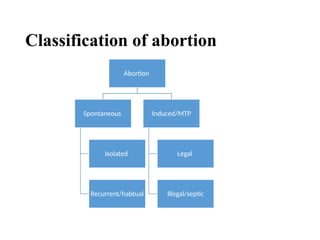
Classification of abortion
Abortion
Spontaneous
Isolated
Recurrent/habtual
Induced/MTP
Legal
Illegal/septic
Types of abortion
•Threatened abortion
•Inevitable abortion
•Complete abortion
•Incomplete abortion
•Missed abortion (silent miscarriage)
•Septic abortion
•Recurrent(habitual) abortion
THREATENED ABORTION
DEFINITION:
•A threatened abortion is vaginal bleeding that occurs in the
first 20 weeks of pregnancy and is sometimes accompanied
by abdominal cramps
•It is a clinical entity where the process of miscarriage has
started but has not progress to a state from which recovery
is impossible
•The exact cause of a threatened abortion usually isn’t
known. But it’s more common among people who
previously had a miscarriage.
Risk for a threatened abortion
•A bacterial or viral infection during pregnancy
•Trauma to the abdomen
•Advanced parental age (over age 35)
•Exposure to certain medications or chemicals
CLINICAL FEATURES
•Mild Bleeding per vaginam is usually slight and may
be brownish or bright red in color
•On rare the bleeding may be brisk, especially in the
late second trimester. The bleeding usually stops
spontaneously
•Mild Pain: Bleeding is usually painless but there may
be mild backache or dull pain in lower abdomen
•Pain appears usually following hemorrhage
•Cervix is closed
TREATMENT:
•Rest: the patient should be in bed until one week
after stoppage of bleeding
•Drugs: Relief of pain may be ensured by diazepam 5
mg tablet or phenobarbitone 30 mg twice daily
•Treatment of controversy: Progestogens:
e.g. hydroxyprogesteronecaproate (Primulot depot) 250
mg IM twice weekly is given by some if there is
evidence of progesterone deficiency
 However, low plasmaprogesterone level is an indication
of pregnancy failure
Progestogens may cause retention of the dead ovum
leads to missed abortion
Gonadotrophins may be of benefit in cases of luteal
phase deficiency and those get pregnant with ovulatory
drugs
MANAGEMENT:
•The patient is advised to preserve the vulval pads and
anything expelled out per vaginam, for inspection.
•To report if bleeding and/or pain becomes aggravated.
•Routine note of pulse, temperature and vaginal
bleeding.
INEVITABLE ABORTION
DEFINITION:
•Pregnancy is complicated by both vaginal bleeding and
cramp like lower abdominal pain
•An inevitable abortion occurs when the membranes
rupture, the cervix dilates, and bleeding increases
CLINICAL FEATURES:
•Increased vaginal bleeding and may accomplanied with clots
•Aggravation of pain in the lower
•Internal examination reveals internal os of the cervix is
dilated and products of conception may be felt through
cervical canal, but no passage of tissue
•Rupture of membranes between 12-28 weeks is a sign of the
inevitability of abortion
MANAGEMENT:
•The principles in the management are:
A. To look after general condition
B. Accelerate the process of expulsion
C. To maintain strict asepsis
General measures:
•Excessive bleeding should be promptly controlled
by administering methergin 0.2 mg if the cervix is
dilated and the size of the uterus is less than 12
weeks.
•The shock is corrected by intravenous fluid therapy
and blood transfusion
COMPLETE ABORTION
DEFINITION:
When the products of conception are expelled as an masses, it
is called complete miscarriage
• POC expelled completely from uterus & cervix
• Cervical os is closed
• Uterus small in size (GA)
• Resolved or minimal vaginal bleeding & pain
CLINICAL FEATURES:
1. Subsidence of abdominal pain
2. Vaginal bleeding becomes trace or absent
3. Internal examinations reveals:
a. Uterus is smaller than the period of amenorrhea and
a little firmer
b. Cervical os is close
c. Bleeding is trace
4. Examination of the expelled fleshy mass is found
complete
MANAGEMENT:
•The effect of blood loss, if any, should be assessed
and treated. If there is doubt about complete
expulsion of product, uterine curettage should be
done
•Transvaginal sonography is useful to see that uterine
cavity is empty; other evacuat done
Cont….
•A Rh-negative patient without antibody in her system
should be protected Anti-D gamma globulin-50
microgram or 100 microgram intramuscularly in cases of
early miscarriage or, miscarriage respectively within 72
hours.
•However, Anti-D may not be required in a case with
complete miscarriage before 12 weeks gestation where
no instrumentation has been done.
INCOMPLETE ABORTION
DEFINITION:
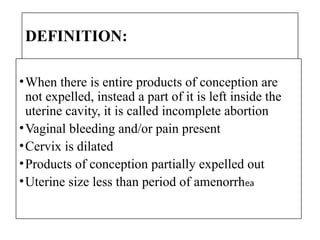
•When there is entire products of conception are
not expelled, instead a part of it is left inside the
uterine cavity, it is called incomplete abortion
•Vaginal bleeding and/or pain present
•Cervix is dilated
•Products of conception partially expelled out
•Uterine size less than period of amenorrhea
CLINICAL FEATURES:
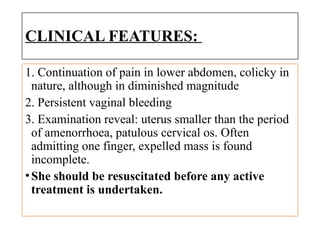
1. Continuation of pain in lower abdomen, colicky in
nature, although in diminished magnitude
2. Persistent vaginal bleeding
3. Examination reveal: uterus smaller than the period
of amenorrhoea, patulous cervical os. Often
admitting one finger, expelled mass is found
incomplete.
•She should be resuscitated before any active
treatment is undertaken.
MANAGEMENT:
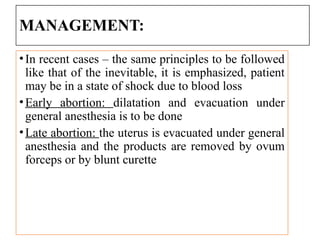
•In recent cases – the same principles to be followed
like that of the inevitable, it is emphasized, patient
may be in a state of shock due to blood loss
•Early abortion: dilatation and evacuation under
general anesthesia is to be done
•Late abortion: the uterus is evacuated under general
anesthesia and the products are removed by ovum
forceps or by blunt curette
MISSED ABORTION
(SILENT MISCARRIAGE)
DEFINITION:
•When the fetus is dead and retained inside the uterus
for a variable period, it is called missed abortion or
silent miscarriage or early fetal demise
•Non viable intrauterine pregnancy
•Cervical os is closed
•POC not expelled
•May notice that symptoms associated with early
pregnancy have abated
CLINICAL FEATURES:
 Persistence of brownish vaginal discharge
 Subsidence of pregnancy symptoms
 Retrogression of breast changes
 Cessation of uterine growth which in fact becomes
smaller in size
 Non audibility of the fetal heart sound even with
Doppler ultrasound if it had been audible before
Cont…
•Cervix feels firm
•Immunological test for pregnancy becomes negative
•Real time Ultrasonography reveals an empty sac
early in the pregnancy or the absence of fetal motion
or fetal cardiac movements
MANAGEMENT:
•If the uterus size is less than 12 weeks: Vaginal
evacuation can be carried out without delay
•This can be done effectively done by suction
evacuation or slow dilatation of cervix by laminar tent
followed by D&E of the uterus under general
anesthesia
•The risk of damage to the uterine walls and brisk
h’age during the operation should be kept in mind
Cont…
Induction is done by following methods:
•Oxytocin: to start with 10-20 units of oxytocin in
500 ml of normal saline at 30 drops/minute
•Prostaglandins: are more effective than oxytocin in
such cases. The methods used are :
•Prostaglandin E1 analogue( misoprostol) 200 µg
tablet is inserted into the posterior vaginal fornix
every 4
SEPTIC
ABORTION
DEFINITION:
•Any abortion associated with clinical evidences of
infection of the uterus and its contents, is called
septic abortion
•Although clinical criteria vary, abortion is usually
considered septic when the:
l) Rise of temperature of at least 100.4°F (38°C)
for 24 hours or more
2) Offensive or purulent vaginal discharge
3) Other evidences of pelvic infection such as lower
abdominal pain and tenderness
CLINICAL FEATURES:
•Pyrexia is an important clinical manifestation.
•Pain abdomen of varying degrees is almost a constant
feature.
•A rising pulse rate of 100-120/minute or more
MANAGEMENT:
•Isolate the patient
• Bed rest
•An intravenous line is established for therapy
•In case of shock a central venous pressure (CVP)
line to aid in the control of fluid and blood
transfusion is added
•Observation for vital signs: pulse, temperature and
blood pressure as well as fluid intake and urinary
output.
•A cervico-vaginal swab is taken for culture (aerobic
and anaerobic) and sensitivity,
• Antibiotic therapy: Ampicillin or cephalosporin (as a
broad spectrum)
Cont…
•Gentamycin (for gram -ve organisms) +
metronidazole (for anaerobic infection)are given by
intravenous route while awaiting the results of the
bacteriological culture.
•Another regimen to cover the different causative
organism is clindamycin + gentamycin
•Fluid therapy: e.g. glucose 5% normal saline
and/or lactated ringer solutions can be given as
long as there is no manifestations of acute renal
failure particularly the urinary output is more than
30 ml/hour.
•Blood transfusion: is given if CVP is low
•Oxytocin infusion: to control bleeding and enhances
expulsion of the retained products
•Surgical evacuation of the uterus can be done after 6
hours of commencing IV therapy but may be earlier in
case of severe bleeding or deteriorating condition in
spite of the previous therapy
Cont…
•Surgical evacuation of the uterus can be done after 6
hours of commencing IV therapy but may be earlier in
case of severe bleeding or deteriorating condition in spite
of the previous therapy
•Hysterectomy may be needed in endotoxic shock not
responding to treatment particularly due to gas gangrene
RECURRENT (HABITUAL)
ABORTION:
DEFINITION:
•It is define as a sequence of Three (two by some
authors) or more consecutive spontaneous abortions
before 20 weeks
MANAGEMENT:
Treatment of the cause as:
•Anemia and malnutrition,
•Diabetes,
• Renal diseases
• Infections as Chlamydia and mycoplasma (tetracycline
or doxycycline) and toxoplasma (spiramycin) which may
need another coarse(s) of treatment during pregnancy
ABORTION LAW IN ETHIOPIA:
• Induced abortion or the deliberate termination of pregnancy
is one of the most controversial
• As a legal issue, abortion is usually discussed in light of the
principles of criminal law
• Depending on circumstances, however, abortion can also be
discussed from the standpoint of constitutional law
1. The History of Abortion
• Abortion is not a recent phenomenon but a practice that is at
least as old as recorded history
• Abortion techniques appeared in China around 2737 B.C
more than 4,700 years ago”
• Greek and Roman civilizations considered abortion an
integral part of maintaining a stable population
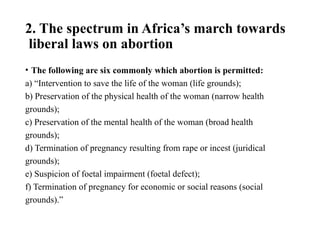
2. The spectrum in Africa’s march towards
liberal laws on abortion
• The following are six commonly which abortion is permitted:
a) “Intervention to save the life of the woman (life grounds);
b) Preservation of the physical health of the woman (narrow health
grounds);
c) Preservation of the mental health of the woman (broad health
grounds);
d) Termination of pregnancy resulting from rape or incest (juridical
grounds);
e) Suspicion of foetal impairment (foetal defect);
f) Termination of pregnancy for economic or social reasons (social
grounds).”
3.Ethiopia’s Abortion Laws up to 2004
• Christianity, Judaism, Islam as well as other religions were
practiced in Ethiopia before the 15th Century
• Moreover, as a country of multiple nations,nationalities and
peoples, there are a number of customary laws that can serve
as bases of laws and may have bearing on abortion
4. The 1930 Penal Code
• According to Article 381, abortion or consent to abortion was
punishable by imprisonment from one up to three years
and/or a fine ranging from 10 up to 50 Birr
• Performing an abortion upon the consent of the woman was
punishable by imprisonment (Article 382) from one month
up to one year and a fine ranging from 50 up to 200 Birr
• The punishment for a middle man who brought together the
abortionist and the pregnant woman was the same
punishment provided for physicians and mid wives plus one -
third, when the abortion is consummated (Article 383)
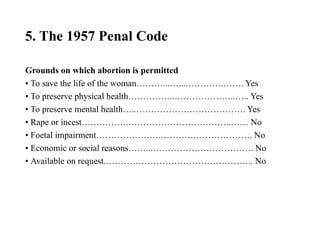
5. The 1957 Penal Code
Grounds on which abortion is permitted
• To save the life of the woman………...…...………….……. Yes
• To preserve physical health……………..………………..….. Yes
• To preserve mental health…..………………………………. Yes
• Rape or incest…………….……………………………..…… No
• Foetal impairment………………….…………………………. No
• Economic or social reasons……...……………………………. No
• Available on request.………………………………………….. No
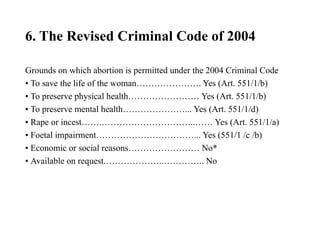
6. The Revised Criminal Code of 2004
Grounds on which abortion is permitted under the 2004 Criminal Code
• To save the life of the woman…………………. Yes (Art. 551/1/b)
• To preserve physical health…………………… Yes (Art. 551/1/b)
• To preserve mental health…………………... Yes (Art. 551/1/d)
• Rape or incest…….…………………………..…… Yes (Art. 551/1/a)
• Foetal impairment……………………………... Yes (551/1 /c /b)
• Economic or social reasons…………………… No*
• Available on request.………………..………….. No

Abortion Group3 assignment.pptx for bsc nurse

  • 1.
  • 2.
    Objective At the endof session, learner able to:- • Define abortion • Identify types of abortion • Explain the managements of abortion • Identify abortion law in Ethiopia
  • 3.
    ABORTION: • DEFINITION: Abortionis the expulsion or extraction from its mother of an embryo or fetus weighing 500 gms or less when it is not capable of independent survival (WHO) • This 500 gm of fetal develop is attained approximately at 20 to 22 weeks (154 days) of gestation Abortion is the termination of pregnancy by any means, resulting in the expulsion of an immature, nonviable fetus • The term “miscarriage,” although imprecise, has been used for all types of pregnancy losses up to a gestational age of 20 to 22 weeks • The term miscarriage is used often in the lay language and refers to spontaneous abortion
  • 4.
    ETIOLOGY: • The etiologyof miscarriage is often complex and obscure. The following factors (embryonic or parker important: • Genetic • Endocrine and metabolic • Anatomic • Infection
  • 5.
    CONT…. Genetic: Chromosomal abnormalities:majority of at least 50% of early abortions are due to chromosomal abnormality e.g. trisomy, monosomy X (XO) and triploidy
  • 6.
    CONT… • Endocrine causes: •Luteal phase defect (LPD) results in early miscarriage. Implantation and placentation are not supported adequately • Deficient Progesterone secretion from corpus luteum or poor endometrial response to progesterone is cause abortion between 8-12 weeks • Diabetes mellitus • Hyperthyroidism
  • 7.
    CONT… • Anatomical abnormalities:These are related mostly to second trimester abortions • Cervico uterine factors: cervical incompetence. • Congenital uterus malformation in the form of bicornuate or separate uterus. • Intrauterine adhesions
  • 8.
    CONT…. • Infections: • Viral:rubella,cytomegalo, variola or HIV. • Parasitic: toxoplasma, malaria • Bacteria: Chlamydia, • Brucella: Spirochaetes causes abortion before 20th week because of effective thickness of placental barrier • Immunological causes: • Systemic lupus erythematosus
  • 9.
    • Maternal infections: •Cyanotic heart disease, cytomegalovirus and toxoplasmagondii which causes abortion if there is acute infection early in pregnancy. Acute fever for whatever the cause can induce abortion
  • 10.
    • Blood groupincompatibility: couple with group ‘A’ husband and group ‘O’ wife have higher incidences of abortion • Premature rupture of membranes • Parental factor: sperm chromosomal anomaly(translocation) • Drugs: e.g. quinine, ergots, severe purgatives, • Environmental causes: cigarette smoking , tobacco, alcohol, arsenic, lead, formaldehyde, benzene and radiation • Trauma: external to the abdomen or during abdominal or pelvic operations • Maternal anoxia and malnutrition • Over distension of the uterus: e.g. acute hydramnios • Ageing sperm or ovum • Nervous, psychological conditions and over fatigue
  • 11.
  • 12.
    Types of abortion •Threatenedabortion •Inevitable abortion •Complete abortion •Incomplete abortion •Missed abortion (silent miscarriage) •Septic abortion •Recurrent(habitual) abortion
  • 13.
  • 14.
    DEFINITION: •A threatened abortionis vaginal bleeding that occurs in the first 20 weeks of pregnancy and is sometimes accompanied by abdominal cramps •It is a clinical entity where the process of miscarriage has started but has not progress to a state from which recovery is impossible •The exact cause of a threatened abortion usually isn’t known. But it’s more common among people who previously had a miscarriage.
  • 15.
    Risk for athreatened abortion •A bacterial or viral infection during pregnancy •Trauma to the abdomen •Advanced parental age (over age 35) •Exposure to certain medications or chemicals
  • 16.
    CLINICAL FEATURES •Mild Bleedingper vaginam is usually slight and may be brownish or bright red in color •On rare the bleeding may be brisk, especially in the late second trimester. The bleeding usually stops spontaneously •Mild Pain: Bleeding is usually painless but there may be mild backache or dull pain in lower abdomen •Pain appears usually following hemorrhage •Cervix is closed
  • 17.
    TREATMENT: •Rest: the patientshould be in bed until one week after stoppage of bleeding •Drugs: Relief of pain may be ensured by diazepam 5 mg tablet or phenobarbitone 30 mg twice daily
  • 18.
    •Treatment of controversy:Progestogens: e.g. hydroxyprogesteronecaproate (Primulot depot) 250 mg IM twice weekly is given by some if there is evidence of progesterone deficiency  However, low plasmaprogesterone level is an indication of pregnancy failure Progestogens may cause retention of the dead ovum leads to missed abortion Gonadotrophins may be of benefit in cases of luteal phase deficiency and those get pregnant with ovulatory drugs
  • 19.
    MANAGEMENT: •The patient isadvised to preserve the vulval pads and anything expelled out per vaginam, for inspection. •To report if bleeding and/or pain becomes aggravated. •Routine note of pulse, temperature and vaginal bleeding.
  • 20.
  • 21.
    DEFINITION: •Pregnancy is complicatedby both vaginal bleeding and cramp like lower abdominal pain •An inevitable abortion occurs when the membranes rupture, the cervix dilates, and bleeding increases
  • 22.
    CLINICAL FEATURES: •Increased vaginalbleeding and may accomplanied with clots •Aggravation of pain in the lower •Internal examination reveals internal os of the cervix is dilated and products of conception may be felt through cervical canal, but no passage of tissue •Rupture of membranes between 12-28 weeks is a sign of the inevitability of abortion
  • 23.
    MANAGEMENT: •The principles inthe management are: A. To look after general condition B. Accelerate the process of expulsion C. To maintain strict asepsis
  • 24.
    General measures: •Excessive bleedingshould be promptly controlled by administering methergin 0.2 mg if the cervix is dilated and the size of the uterus is less than 12 weeks. •The shock is corrected by intravenous fluid therapy and blood transfusion
  • 25.
  • 26.
    DEFINITION: When the productsof conception are expelled as an masses, it is called complete miscarriage • POC expelled completely from uterus & cervix • Cervical os is closed • Uterus small in size (GA) • Resolved or minimal vaginal bleeding & pain
  • 27.
    CLINICAL FEATURES: 1. Subsidenceof abdominal pain 2. Vaginal bleeding becomes trace or absent 3. Internal examinations reveals: a. Uterus is smaller than the period of amenorrhea and a little firmer b. Cervical os is close c. Bleeding is trace 4. Examination of the expelled fleshy mass is found complete
  • 28.
    MANAGEMENT: •The effect ofblood loss, if any, should be assessed and treated. If there is doubt about complete expulsion of product, uterine curettage should be done •Transvaginal sonography is useful to see that uterine cavity is empty; other evacuat done
  • 29.
    Cont…. •A Rh-negative patientwithout antibody in her system should be protected Anti-D gamma globulin-50 microgram or 100 microgram intramuscularly in cases of early miscarriage or, miscarriage respectively within 72 hours. •However, Anti-D may not be required in a case with complete miscarriage before 12 weeks gestation where no instrumentation has been done.
  • 30.
  • 31.
    DEFINITION: •When there isentire products of conception are not expelled, instead a part of it is left inside the uterine cavity, it is called incomplete abortion •Vaginal bleeding and/or pain present •Cervix is dilated •Products of conception partially expelled out •Uterine size less than period of amenorrhea
  • 32.
    CLINICAL FEATURES: 1. Continuationof pain in lower abdomen, colicky in nature, although in diminished magnitude 2. Persistent vaginal bleeding 3. Examination reveal: uterus smaller than the period of amenorrhoea, patulous cervical os. Often admitting one finger, expelled mass is found incomplete. •She should be resuscitated before any active treatment is undertaken.
  • 33.
    MANAGEMENT: •In recent cases– the same principles to be followed like that of the inevitable, it is emphasized, patient may be in a state of shock due to blood loss •Early abortion: dilatation and evacuation under general anesthesia is to be done •Late abortion: the uterus is evacuated under general anesthesia and the products are removed by ovum forceps or by blunt curette
  • 34.
  • 35.
    DEFINITION: •When the fetusis dead and retained inside the uterus for a variable period, it is called missed abortion or silent miscarriage or early fetal demise •Non viable intrauterine pregnancy •Cervical os is closed •POC not expelled •May notice that symptoms associated with early pregnancy have abated
  • 36.
    CLINICAL FEATURES:  Persistenceof brownish vaginal discharge  Subsidence of pregnancy symptoms  Retrogression of breast changes  Cessation of uterine growth which in fact becomes smaller in size  Non audibility of the fetal heart sound even with Doppler ultrasound if it had been audible before
  • 37.
    Cont… •Cervix feels firm •Immunologicaltest for pregnancy becomes negative •Real time Ultrasonography reveals an empty sac early in the pregnancy or the absence of fetal motion or fetal cardiac movements
  • 38.
    MANAGEMENT: •If the uterussize is less than 12 weeks: Vaginal evacuation can be carried out without delay •This can be done effectively done by suction evacuation or slow dilatation of cervix by laminar tent followed by D&E of the uterus under general anesthesia •The risk of damage to the uterine walls and brisk h’age during the operation should be kept in mind
  • 39.
    Cont… Induction is doneby following methods: •Oxytocin: to start with 10-20 units of oxytocin in 500 ml of normal saline at 30 drops/minute •Prostaglandins: are more effective than oxytocin in such cases. The methods used are : •Prostaglandin E1 analogue( misoprostol) 200 µg tablet is inserted into the posterior vaginal fornix every 4
  • 40.
  • 41.
    DEFINITION: •Any abortion associatedwith clinical evidences of infection of the uterus and its contents, is called septic abortion •Although clinical criteria vary, abortion is usually considered septic when the: l) Rise of temperature of at least 100.4°F (38°C) for 24 hours or more 2) Offensive or purulent vaginal discharge 3) Other evidences of pelvic infection such as lower abdominal pain and tenderness
  • 42.
    CLINICAL FEATURES: •Pyrexia isan important clinical manifestation. •Pain abdomen of varying degrees is almost a constant feature. •A rising pulse rate of 100-120/minute or more
  • 43.
    MANAGEMENT: •Isolate the patient •Bed rest •An intravenous line is established for therapy •In case of shock a central venous pressure (CVP) line to aid in the control of fluid and blood transfusion is added
  • 44.
    •Observation for vitalsigns: pulse, temperature and blood pressure as well as fluid intake and urinary output. •A cervico-vaginal swab is taken for culture (aerobic and anaerobic) and sensitivity, • Antibiotic therapy: Ampicillin or cephalosporin (as a broad spectrum)
  • 45.
    Cont… •Gentamycin (for gram-ve organisms) + metronidazole (for anaerobic infection)are given by intravenous route while awaiting the results of the bacteriological culture. •Another regimen to cover the different causative organism is clindamycin + gentamycin
  • 46.
    •Fluid therapy: e.g.glucose 5% normal saline and/or lactated ringer solutions can be given as long as there is no manifestations of acute renal failure particularly the urinary output is more than 30 ml/hour. •Blood transfusion: is given if CVP is low
  • 47.
    •Oxytocin infusion: tocontrol bleeding and enhances expulsion of the retained products •Surgical evacuation of the uterus can be done after 6 hours of commencing IV therapy but may be earlier in case of severe bleeding or deteriorating condition in spite of the previous therapy
  • 48.
    Cont… •Surgical evacuation ofthe uterus can be done after 6 hours of commencing IV therapy but may be earlier in case of severe bleeding or deteriorating condition in spite of the previous therapy •Hysterectomy may be needed in endotoxic shock not responding to treatment particularly due to gas gangrene
  • 49.
  • 50.
    DEFINITION: •It is defineas a sequence of Three (two by some authors) or more consecutive spontaneous abortions before 20 weeks
  • 51.
    MANAGEMENT: Treatment of thecause as: •Anemia and malnutrition, •Diabetes, • Renal diseases • Infections as Chlamydia and mycoplasma (tetracycline or doxycycline) and toxoplasma (spiramycin) which may need another coarse(s) of treatment during pregnancy
  • 52.
    ABORTION LAW INETHIOPIA: • Induced abortion or the deliberate termination of pregnancy is one of the most controversial • As a legal issue, abortion is usually discussed in light of the principles of criminal law • Depending on circumstances, however, abortion can also be discussed from the standpoint of constitutional law
  • 53.
    1. The Historyof Abortion • Abortion is not a recent phenomenon but a practice that is at least as old as recorded history • Abortion techniques appeared in China around 2737 B.C more than 4,700 years ago” • Greek and Roman civilizations considered abortion an integral part of maintaining a stable population
  • 54.
    2. The spectrumin Africa’s march towards liberal laws on abortion • The following are six commonly which abortion is permitted: a) “Intervention to save the life of the woman (life grounds); b) Preservation of the physical health of the woman (narrow health grounds); c) Preservation of the mental health of the woman (broad health grounds); d) Termination of pregnancy resulting from rape or incest (juridical grounds); e) Suspicion of foetal impairment (foetal defect); f) Termination of pregnancy for economic or social reasons (social grounds).”
  • 55.
    3.Ethiopia’s Abortion Lawsup to 2004 • Christianity, Judaism, Islam as well as other religions were practiced in Ethiopia before the 15th Century • Moreover, as a country of multiple nations,nationalities and peoples, there are a number of customary laws that can serve as bases of laws and may have bearing on abortion
  • 56.
    4. The 1930Penal Code • According to Article 381, abortion or consent to abortion was punishable by imprisonment from one up to three years and/or a fine ranging from 10 up to 50 Birr • Performing an abortion upon the consent of the woman was punishable by imprisonment (Article 382) from one month up to one year and a fine ranging from 50 up to 200 Birr • The punishment for a middle man who brought together the abortionist and the pregnant woman was the same punishment provided for physicians and mid wives plus one - third, when the abortion is consummated (Article 383)
  • 57.
    5. The 1957Penal Code Grounds on which abortion is permitted • To save the life of the woman………...…...………….……. Yes • To preserve physical health……………..………………..….. Yes • To preserve mental health…..………………………………. Yes • Rape or incest…………….……………………………..…… No • Foetal impairment………………….…………………………. No • Economic or social reasons……...……………………………. No • Available on request.………………………………………….. No
  • 58.
    6. The RevisedCriminal Code of 2004 Grounds on which abortion is permitted under the 2004 Criminal Code • To save the life of the woman…………………. Yes (Art. 551/1/b) • To preserve physical health…………………… Yes (Art. 551/1/b) • To preserve mental health…………………... Yes (Art. 551/1/d) • Rape or incest…….…………………………..…… Yes (Art. 551/1/a) • Foetal impairment……………………………... Yes (551/1 /c /b) • Economic or social reasons…………………… No* • Available on request.………………..………….. No