BLEEDING IN EARLY
PREGNANCY
Bymembers of PBL3
Parity &Gravida
 Gravidity
 In human medicine, "gravidity" refers to the number of times a woman has been
pregnant.regardless of whether the pregnancies were interrupted or resulted in a live birth.

 The term "gravida" can be used to refer to a pregnant woman.
 A "nulligravida" is a woman who has never been pregnant.
 A "primigravida" is a woman who is pregnant for the first time or has been pregnant one time.
 A "multigravida" or "secundigravida" is a woman who has been pregnant more than one time.
 Terms such as "gravida 0", referring to a nulligravida, "gravida 1" for a primigravida, and so on,
can also be used. The term "elderly primigravida" has also been used to refer to a woman in her
first pregnancy, who is at least 35 years old
 Parity
 is the number of pregnancies carried to viable gestational age.

 A woman who has never carried a pregnancy beyond 20 weeks is nulliparous, and is
a nullipara or para 0
 A woman who has given birth once, and is referred to as a primipara; moreover, a
woman who has given birth two or more times is multiparous. Finally, grand multipara
describes the condition of having given birth three or more times.
 Like gravidity, parity may also be counted. A woman who has given birth one or more
times can also be referred to as para 1, para 2, para 3 and so on.

 Viable gestational age varies from region to region.
Examination of pregnant women with
vaginal bleeding
 General examination
Pallor, tachycardia and hypotension can be found with very heavy bleeding but this is
uncommon.
 Abdominal exmination
 you need to do an abdominal examination to detect any palpable mass.
 Any point of tenderness, guarding or rigidity should be elicited.
 Tenderness and guarding can be present in cases of ectopic pregnancy because of intraperitoneal
bleeding.
 Molar pregnancy can present with uterine size more than the period of gestation but is now usually
diagnosed on ultrasound scan.
Pelvic examination
Look for signs of bleeding and assess how much she is
bleeding.
If she is wearing a pad, note if the pad is soaked or if her
underwear is stained.
You should note if there is active bleeding with blood
trickling as this is a sign of a significant bleed
Speculum examination
Gently insert the speculum and see if there is bleeding
in the vagina.
Use a sponge on sponge holder to see if there is any
fresh bleeding.
If bleeding is seen you need to identify if it is heavy.
Check the cervical os:
look to see whether the external os is open or closed.
look for any products of conception.
Check for any local lesion such as a polyp or cervical erosion
Bimanual Examination
Definition
Two fingers inserted into the vagina until they isolate the cervix.
The health care professional tests for cervical motions tenderness
As seen in pelvic inflammatory diseases.
The examiner presses down on the abdomen with the external hand to locate the fundus of
the uterus and the adnexal stracture.
If these woman with vaginal infection or vaginismus,she will fell pain.
Woman with imprforated hymen,these examination is impossible.
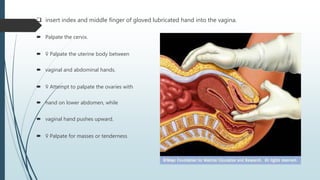
 insert index and middle finger of gloved lubricated hand into the vagina.
 Palpate the cervix.
 ♀ Palpate the uterine body between
 vaginal and abdominal hands.
 ♀ Attempt to palpate the ovaries with
 hand on lower abdomen, while
 vaginal hand pushes upward.
 ♀ Palpate for masses or tenderness
Bleeding in early pregnancy
 Vaginal bleeding during pregnancy can occur in the first trimester of pregnancy, bleeding
that occurs in the second and third trimester of pregnancy can often be a sign of a
possible complication. 1- Miscarriage
• Bleeding is a sign of miscarriage, but does not mean that miscarriage is imminent.
• 20-30% of women have degree of bleeding in early pregnancy.
• Approximately half of pregnant woman who bleed do not have miscarriages.
• 15-20% result in a miscarriage, and occur during the first 12 weeks.
It is probably miscarriage if there are :
Vaginal bleeding.
Cramping pain stronger than menstrual
Tissue passing through the vagina.
Most miscarriages can not be prevented.
Miscarriage does not mean that woman can not
have a future healthy pregnancy or she is not
healthy
2- Ectopic pregnancy
 Implantation occurs somewhere out side the uterus.fallopian tube accounts for the
majority of ectopic pregnancies.
 Less common than miscarriages, occurring in 1 of 60 pregnancies.
It is probably ectopic pregnancy if there are :
 Severe pain in the abdomen.
 Low level of B-hCG.
 Vaginal bleeding
Woman at high risk if they have :-
Infection in the tube
Previous ectopic pregnancy (15-20%)
Previous pelvic surgery
3- Molar pregnancy :
It is probably molar pregnancy if there are
• Vaginal bleeding.
• High hCG levels.
• Absent fetal heart tones.
• Grap-like clusters are seen in the uterus by an ultrasound.
• Rare cause of early bleeding.
• Term molar because pregnancy involves the growth of abnormal
tissue instead of an embryo.
 Placental abruption.
 Placental previa.
 After intercourse, some women may bleed, because the cervix
is very tender and sensitive.
4- other causes :
signs of miscarriage
1. vaginal bleeding.
2. uncomfortable stomach cramps.
3. the neck of the cervix starts to open up.
4. There may be a brownish discharge from the vagina when
the baby dies but is not expelled from the cervix.
symptoms of miscarriage
1. Bleeding is the first warning sign of miscarriage.
2. severe back pain.
3. Aches and abdominal pains
Common causes of miscarriage
Genetic causes
Most spontaneous miscarriages are caused by an abnormal karyotype
of the embryo.
Immunological causes
Tests for antiphospholipid antibodies (APLAs), signaling the
presence of the autoimmune disease antiphospholipid antibody
syndrome (APS), have reportedly been positive in 10-20% of
women with early pregnancy losses.
3. Anatomic causes
• Anatomic uterine defects can cause obstetric
complications, including recurrent pregnancy loss,
preterm labor and delivery, and malpresentation.
4. Environmental causes
• Approximately 10% of human malformations result
from environmental causes. Clinicians should
encourage life-style changes and counseling for
preventable exposures to reduce the risk of
environmentally related pregnancy loss.
5. Endocrine causes
• Hormonal Imbalances
• Sometimes a woman's body doesn't produce
enough of the hormone progesterone, which
is necessary to help the uterine lining to
support the fetus and help the placenta take
hold. "Because this is not very common, we
usually wouldn't test for it unless a woman's
had multiple miscarriages,"
6. Hematologic causes
• Many recurrent miscarriages are characterized
by defective placentation and microthrombi in
the placental vasculature. In addition, certain
inherited disorders that predispose women to
venous and/or arterial thrombus formation are
associated with pregnancy loss.
7. Age of the mother
• An early miscarriage may happen by chance.
But there are several things known
to increase risk
• The age of the mother has an influence:
• in women under 30, 1 in 10 pregnancies will
end in miscarriage
• in women aged 35-39, up to 2 in 10
pregnancies will end in miscarriage
• in women over 45, more than half of all
pregnancies will end in miscarriage
8. Other causes
• Lifestyle. Self-destructive lifestyle habits, such
as drug abuse, alcohol use during pregnancy,
and smoking can all lead to a miscarriage early
on or later during a pregnancy.
• Chronic diseases as : PCOS
• Placental problems
• If there's a problem with the development of
the placenta, it can also lead to a miscarriage.
COMPLICATIONS OF MISCARIAGE:
 1-INCOMPLETE MISCARRIAGE: Some tissues remained in the uterus so you must
do D&C to clear all products and prevent septicemia.

 2-Exessive bleeding: many bleeding may be dangerous for the pregnant
 3-Infection after Miscarriage: about 3% pregnant may acquire infection related
to miscarriage and may be dangerous.
 4-Asherman syndrome : it is rare complication of D&C. Scar tissue (adhesion) is
formed and may cause infertility problems and further miscarriage .
 5-Recurrent miscarriages: very rare and may happen in less than 1% of
pregnants
 6- Depression
 7- Anexity disorder
How does age affect pregnancy?
Though most older mums have a healthy pregnancy and
birth, you do have an increased risk of ongoing health
conditions, and some may only be discovered when
you're pregnant. The older you are, the more likely you
are to have conditions such as diabetes, and high blood
pressure (Franz and Husslein 2010, Utting and Bewley
2011). These conditions can affect how well your
pregnancy and birth goes, as well as your health (Franz
and Husslein 2010, Utting and Bewley 2011).
Sadly, both miscarriage and ectopic pregnancy are more
common in older women (Franz and Husslein 2010,
Johnson and Tough 2012, RCOG 2011). The rate of
miscarriage increases steadily, so that by the age of 45,
you have about a one-in-two risk of miscarrying if you
conceived naturally with your own eggs rather than
donor eggs (Johnson and Tough 2012, RCOG 2011).
 Other pregnancy complications that are more common include:
 multiple pregnancy, both naturally conceived or as a result of
assisted conception
 gestational diabetes
 placenta praevia
 pre-eclampsia
 placental abruption
However, if you're an older mum, you do have a higher
chance of having a baby with a chromosomal abnormality
(Johnson and Tough 2012, RCOG 2011, Utting and Bewley
2011). These include Down's syndrome and the rarer
chromosomal condition Edwards' syndrome.
The risk of Down's syndrome, according to age, is:
age 20: one in 1,500
age 30: one in 900
age 40: one in 100
age 45: one in 50 or greater
Precautions to prevent mischarge
There are 3 methods to prevent mischarge :-
1-before pregnancy
2-during pregnancy
3- following the fertility diet
1- before pregnancy
1- get a STD check
2- know vaccinaton history
3- understand that some chronic conditions may
increase risk of mischarge
4- take at least 600 mg of folic acid per day
5- limit caffeine intake
2- during pregnancy
1- exercise lightly
2- avoid un pasteurized dairy products and raw meat
3- refrain from using tobacco,alcohol or illegal drugs
4- avoid radiation and poisons
5- reduce stress level
6- again limiting caffeine intake
7- explore the possibility of taking progesterone
3- following the fertility diet
1-consume organic vegetables and fruits
2- eat cold water fish high in omega3 fatty acids
“salmon”
3- reduce intake of refined sugars
4- choose organic,grass fed, whole fat and raw
dairy products
5- Be sure to drink an adequate amount of water
Management of miscarriage
 surgical, medical, natural
Surgically:an operation, usually called Surgical Management of
Miscarriage, or SMM.
Medically: with medication to begin the process of miscarriage.
Naturally: letting nature take its course
Surgical management of miscarriage (SMM)
 This is an operation to remove the remains of your pregnancy and it is usually
done under general anaesthetic ..
 For many years, surgical management of miscarriage was called ERPC, an
abbreviation for Evacuation of Retained Products of Conception, which means
the removal of the remains of the pregnancy and surrounding tissue. Many
people find this term distressing, which is why it should not be used any more,
but it’s possible that you will still hear it or see it written.
 Some hospitals offer surgical management with local rather than general
anaesthetic. This is called MVA, which is an abbreviation for Manual Vacuum
Aspiration.
Medical management
 Some hospitals offer a combination of pills and vaginal pessaries
which can “kick-start” the process of a delayed or missed
miscarriage. Some women experience quite severe abdominal
cramps as well as heavy bleeding with this option, but they may
prefer this to an operation.
 If your baby has died after about 14 or 15 weeks, you are most
likely to be managed medically.
 Hospitals sometimes differ in the way they give the treatment –
for example, whether treatment is carried out in hospital or at
home. In all cases, though, they should give you clear
information about what to expect.
Natural management (also called Expectant or
Conservative management): letting nature take its
course)
Some women prefer to wait and let the
miscarriage happen naturally – and hospitals may
recommend this too, especially in the first three
months of pregnancy.
It can be difficult to know what to expect and
when (it may take days or weeks before the
miscarriage begins) but most women will
experience abdominal cramps, possibly quite
severe, and pass blood clots as well as blood.
What women should do if she had a misscarege?
A miscarriage is when a woman loses a
pregnancy before the 20th week. It’s
impossible to know how many pregnancies
end in miscarriage, since many occur before
the woman even knows she’s pregnant. But
for women who know they are pregnant, the
estimates range from 10 to 20 percent. If
you think you are having a miscarriage, get
medical help immediately.
1-Call your physician or go to the emergency room if tissue,
fluid, or what appears to be clumps of blood come out of your
vagina
If you do pass tissue that you think might be fetal tissue, put it in a
clean, sealed container and take it with you to the doctor.
2-Recognize that you may be at risk of miscarrying if you have
spotting or vaginal bleeding
3-Take note if you experience lower back pain
4-Recognize the symptoms of a septic miscarriage.
Symptoms include:[7][8]
•Fluid coming from your vagina that smells bad.
•Vaginal bleeding.
•Fever and chills.
•Cramping and pain in your abdomen
Knowing What to Expect at the Doctor’s Office
1-Get a medical check-up
2-Understand the diagnoses you may be given. There several
possibilities
Types of misscarege
3-Follow your doctor’s advice if you have been diagnosed with a
threatened miscarriage.
4-Know what to expect if you have miscarried, but not passed all
of the tissues.What your doctor recommends may depend on your
preferences
5-Give yourself time to recover physically if you have miscarried
6-Take the time to heal psychologically
Thinking about Future Pregnancies
1. Understand the common causes of miscarriage
2. Lower your risk for future miscarriages as much as
possible
3. Know what does not cause miscarriage.
THANK YOu

bleeding in early pregnancy

  • 1.
  • 2.
    Parity &Gravida  Gravidity In human medicine, "gravidity" refers to the number of times a woman has been pregnant.regardless of whether the pregnancies were interrupted or resulted in a live birth.   The term "gravida" can be used to refer to a pregnant woman.  A "nulligravida" is a woman who has never been pregnant.  A "primigravida" is a woman who is pregnant for the first time or has been pregnant one time.  A "multigravida" or "secundigravida" is a woman who has been pregnant more than one time.  Terms such as "gravida 0", referring to a nulligravida, "gravida 1" for a primigravida, and so on, can also be used. The term "elderly primigravida" has also been used to refer to a woman in her first pregnancy, who is at least 35 years old
  • 3.
     Parity  isthe number of pregnancies carried to viable gestational age.   A woman who has never carried a pregnancy beyond 20 weeks is nulliparous, and is a nullipara or para 0  A woman who has given birth once, and is referred to as a primipara; moreover, a woman who has given birth two or more times is multiparous. Finally, grand multipara describes the condition of having given birth three or more times.  Like gravidity, parity may also be counted. A woman who has given birth one or more times can also be referred to as para 1, para 2, para 3 and so on.   Viable gestational age varies from region to region.
  • 4.
    Examination of pregnantwomen with vaginal bleeding  General examination Pallor, tachycardia and hypotension can be found with very heavy bleeding but this is uncommon.
  • 5.
     Abdominal exmination you need to do an abdominal examination to detect any palpable mass.  Any point of tenderness, guarding or rigidity should be elicited.  Tenderness and guarding can be present in cases of ectopic pregnancy because of intraperitoneal bleeding.  Molar pregnancy can present with uterine size more than the period of gestation but is now usually diagnosed on ultrasound scan.
  • 6.
    Pelvic examination Look forsigns of bleeding and assess how much she is bleeding. If she is wearing a pad, note if the pad is soaked or if her underwear is stained. You should note if there is active bleeding with blood trickling as this is a sign of a significant bleed
  • 7.
    Speculum examination Gently insertthe speculum and see if there is bleeding in the vagina. Use a sponge on sponge holder to see if there is any fresh bleeding. If bleeding is seen you need to identify if it is heavy. Check the cervical os: look to see whether the external os is open or closed. look for any products of conception. Check for any local lesion such as a polyp or cervical erosion
  • 8.
    Bimanual Examination Definition Two fingersinserted into the vagina until they isolate the cervix. The health care professional tests for cervical motions tenderness As seen in pelvic inflammatory diseases. The examiner presses down on the abdomen with the external hand to locate the fundus of the uterus and the adnexal stracture. If these woman with vaginal infection or vaginismus,she will fell pain. Woman with imprforated hymen,these examination is impossible.
  • 9.
     insert indexand middle finger of gloved lubricated hand into the vagina.  Palpate the cervix.  ♀ Palpate the uterine body between  vaginal and abdominal hands.  ♀ Attempt to palpate the ovaries with  hand on lower abdomen, while  vaginal hand pushes upward.  ♀ Palpate for masses or tenderness
  • 10.
    Bleeding in earlypregnancy  Vaginal bleeding during pregnancy can occur in the first trimester of pregnancy, bleeding that occurs in the second and third trimester of pregnancy can often be a sign of a possible complication. 1- Miscarriage • Bleeding is a sign of miscarriage, but does not mean that miscarriage is imminent. • 20-30% of women have degree of bleeding in early pregnancy. • Approximately half of pregnant woman who bleed do not have miscarriages. • 15-20% result in a miscarriage, and occur during the first 12 weeks.
  • 11.
    It is probablymiscarriage if there are : Vaginal bleeding. Cramping pain stronger than menstrual Tissue passing through the vagina. Most miscarriages can not be prevented. Miscarriage does not mean that woman can not have a future healthy pregnancy or she is not healthy
  • 12.
    2- Ectopic pregnancy Implantation occurs somewhere out side the uterus.fallopian tube accounts for the majority of ectopic pregnancies.  Less common than miscarriages, occurring in 1 of 60 pregnancies.
  • 13.
    It is probablyectopic pregnancy if there are :  Severe pain in the abdomen.  Low level of B-hCG.  Vaginal bleeding Woman at high risk if they have :- Infection in the tube Previous ectopic pregnancy (15-20%) Previous pelvic surgery
  • 14.
    3- Molar pregnancy: It is probably molar pregnancy if there are • Vaginal bleeding. • High hCG levels. • Absent fetal heart tones. • Grap-like clusters are seen in the uterus by an ultrasound. • Rare cause of early bleeding. • Term molar because pregnancy involves the growth of abnormal tissue instead of an embryo.
  • 15.
     Placental abruption. Placental previa.  After intercourse, some women may bleed, because the cervix is very tender and sensitive. 4- other causes :
  • 16.
    signs of miscarriage 1.vaginal bleeding. 2. uncomfortable stomach cramps. 3. the neck of the cervix starts to open up. 4. There may be a brownish discharge from the vagina when the baby dies but is not expelled from the cervix.
  • 17.
    symptoms of miscarriage 1.Bleeding is the first warning sign of miscarriage. 2. severe back pain. 3. Aches and abdominal pains
  • 18.
    Common causes ofmiscarriage Genetic causes Most spontaneous miscarriages are caused by an abnormal karyotype of the embryo. Immunological causes Tests for antiphospholipid antibodies (APLAs), signaling the presence of the autoimmune disease antiphospholipid antibody syndrome (APS), have reportedly been positive in 10-20% of women with early pregnancy losses.
  • 19.
    3. Anatomic causes •Anatomic uterine defects can cause obstetric complications, including recurrent pregnancy loss, preterm labor and delivery, and malpresentation. 4. Environmental causes • Approximately 10% of human malformations result from environmental causes. Clinicians should encourage life-style changes and counseling for preventable exposures to reduce the risk of environmentally related pregnancy loss.
  • 20.
    5. Endocrine causes •Hormonal Imbalances • Sometimes a woman's body doesn't produce enough of the hormone progesterone, which is necessary to help the uterine lining to support the fetus and help the placenta take hold. "Because this is not very common, we usually wouldn't test for it unless a woman's had multiple miscarriages,"
  • 21.
    6. Hematologic causes •Many recurrent miscarriages are characterized by defective placentation and microthrombi in the placental vasculature. In addition, certain inherited disorders that predispose women to venous and/or arterial thrombus formation are associated with pregnancy loss.
  • 22.
    7. Age ofthe mother • An early miscarriage may happen by chance. But there are several things known to increase risk • The age of the mother has an influence: • in women under 30, 1 in 10 pregnancies will end in miscarriage • in women aged 35-39, up to 2 in 10 pregnancies will end in miscarriage • in women over 45, more than half of all pregnancies will end in miscarriage
  • 23.
    8. Other causes •Lifestyle. Self-destructive lifestyle habits, such as drug abuse, alcohol use during pregnancy, and smoking can all lead to a miscarriage early on or later during a pregnancy. • Chronic diseases as : PCOS • Placental problems • If there's a problem with the development of the placenta, it can also lead to a miscarriage.
  • 24.
    COMPLICATIONS OF MISCARIAGE: 1-INCOMPLETE MISCARRIAGE: Some tissues remained in the uterus so you must do D&C to clear all products and prevent septicemia.   2-Exessive bleeding: many bleeding may be dangerous for the pregnant  3-Infection after Miscarriage: about 3% pregnant may acquire infection related to miscarriage and may be dangerous.  4-Asherman syndrome : it is rare complication of D&C. Scar tissue (adhesion) is formed and may cause infertility problems and further miscarriage .  5-Recurrent miscarriages: very rare and may happen in less than 1% of pregnants  6- Depression  7- Anexity disorder
  • 25.
    How does ageaffect pregnancy? Though most older mums have a healthy pregnancy and birth, you do have an increased risk of ongoing health conditions, and some may only be discovered when you're pregnant. The older you are, the more likely you are to have conditions such as diabetes, and high blood pressure (Franz and Husslein 2010, Utting and Bewley 2011). These conditions can affect how well your pregnancy and birth goes, as well as your health (Franz and Husslein 2010, Utting and Bewley 2011).
  • 26.
    Sadly, both miscarriageand ectopic pregnancy are more common in older women (Franz and Husslein 2010, Johnson and Tough 2012, RCOG 2011). The rate of miscarriage increases steadily, so that by the age of 45, you have about a one-in-two risk of miscarrying if you conceived naturally with your own eggs rather than donor eggs (Johnson and Tough 2012, RCOG 2011).
  • 27.
     Other pregnancycomplications that are more common include:  multiple pregnancy, both naturally conceived or as a result of assisted conception  gestational diabetes  placenta praevia  pre-eclampsia  placental abruption
  • 28.
    However, if you'rean older mum, you do have a higher chance of having a baby with a chromosomal abnormality (Johnson and Tough 2012, RCOG 2011, Utting and Bewley 2011). These include Down's syndrome and the rarer chromosomal condition Edwards' syndrome. The risk of Down's syndrome, according to age, is: age 20: one in 1,500 age 30: one in 900 age 40: one in 100 age 45: one in 50 or greater
  • 29.
    Precautions to preventmischarge There are 3 methods to prevent mischarge :- 1-before pregnancy 2-during pregnancy 3- following the fertility diet
  • 30.
    1- before pregnancy 1-get a STD check 2- know vaccinaton history 3- understand that some chronic conditions may increase risk of mischarge 4- take at least 600 mg of folic acid per day 5- limit caffeine intake
  • 31.
    2- during pregnancy 1-exercise lightly 2- avoid un pasteurized dairy products and raw meat 3- refrain from using tobacco,alcohol or illegal drugs 4- avoid radiation and poisons 5- reduce stress level 6- again limiting caffeine intake 7- explore the possibility of taking progesterone
  • 32.
    3- following thefertility diet 1-consume organic vegetables and fruits 2- eat cold water fish high in omega3 fatty acids “salmon” 3- reduce intake of refined sugars 4- choose organic,grass fed, whole fat and raw dairy products 5- Be sure to drink an adequate amount of water
  • 33.
    Management of miscarriage surgical, medical, natural Surgically:an operation, usually called Surgical Management of Miscarriage, or SMM. Medically: with medication to begin the process of miscarriage. Naturally: letting nature take its course
  • 34.
    Surgical management ofmiscarriage (SMM)  This is an operation to remove the remains of your pregnancy and it is usually done under general anaesthetic ..  For many years, surgical management of miscarriage was called ERPC, an abbreviation for Evacuation of Retained Products of Conception, which means the removal of the remains of the pregnancy and surrounding tissue. Many people find this term distressing, which is why it should not be used any more, but it’s possible that you will still hear it or see it written.  Some hospitals offer surgical management with local rather than general anaesthetic. This is called MVA, which is an abbreviation for Manual Vacuum Aspiration.
  • 35.
    Medical management  Somehospitals offer a combination of pills and vaginal pessaries which can “kick-start” the process of a delayed or missed miscarriage. Some women experience quite severe abdominal cramps as well as heavy bleeding with this option, but they may prefer this to an operation.  If your baby has died after about 14 or 15 weeks, you are most likely to be managed medically.  Hospitals sometimes differ in the way they give the treatment – for example, whether treatment is carried out in hospital or at home. In all cases, though, they should give you clear information about what to expect.
  • 36.
    Natural management (alsocalled Expectant or Conservative management): letting nature take its course) Some women prefer to wait and let the miscarriage happen naturally – and hospitals may recommend this too, especially in the first three months of pregnancy. It can be difficult to know what to expect and when (it may take days or weeks before the miscarriage begins) but most women will experience abdominal cramps, possibly quite severe, and pass blood clots as well as blood.
  • 37.
    What women shoulddo if she had a misscarege? A miscarriage is when a woman loses a pregnancy before the 20th week. It’s impossible to know how many pregnancies end in miscarriage, since many occur before the woman even knows she’s pregnant. But for women who know they are pregnant, the estimates range from 10 to 20 percent. If you think you are having a miscarriage, get medical help immediately.
  • 38.
    1-Call your physicianor go to the emergency room if tissue, fluid, or what appears to be clumps of blood come out of your vagina If you do pass tissue that you think might be fetal tissue, put it in a clean, sealed container and take it with you to the doctor. 2-Recognize that you may be at risk of miscarrying if you have spotting or vaginal bleeding 3-Take note if you experience lower back pain 4-Recognize the symptoms of a septic miscarriage. Symptoms include:[7][8] •Fluid coming from your vagina that smells bad. •Vaginal bleeding. •Fever and chills. •Cramping and pain in your abdomen
  • 39.
    Knowing What toExpect at the Doctor’s Office 1-Get a medical check-up 2-Understand the diagnoses you may be given. There several possibilities Types of misscarege 3-Follow your doctor’s advice if you have been diagnosed with a threatened miscarriage. 4-Know what to expect if you have miscarried, but not passed all of the tissues.What your doctor recommends may depend on your preferences 5-Give yourself time to recover physically if you have miscarried 6-Take the time to heal psychologically
  • 40.
    Thinking about FuturePregnancies 1. Understand the common causes of miscarriage 2. Lower your risk for future miscarriages as much as possible 3. Know what does not cause miscarriage.
  • 41.