SEMINAR
ON
ABORTION
Presented By:
Mandeep Kaur
M.Sc. (N) Final
Year
INTRODUCTION:
DEFINITION
 Abortion is the process of partial or
complete separation of the products of
conception from the uterine wall with or
without partial or complete expulsion from
the uterine cavity before the age of viability.
 The age of viability is 28 weeks in India.
Conti...
 Abortion is the expulsion or extraction from
its mother of an embryo or foetus weighing
500gm or less when it is not capable of
independent survival (WHO). This 500gm
of fetal development is attained
approximately at 22 weeks (154 days) of
gestation.
 The expelled foetus is called abortus.
INCIDENCE:
 The incidence of abortion is difficult to
work out but probably 10-20% of all clinical
pregnancies end in miscarriage and another
optimistic figure of 10% are induced
illegally. 75% abortions occur before the
16th week and of these, about 75% occur
before the 8th week of pregnancy.
ETIOLOGY:
 The etiology of miscarriage is often complex and
obscure. The following factors (embryonic or parental)
are important:
 Genetic factors (50%)
 Endocrine and metabolic factors (10-15%)
 Anatomic abnormalities (10-15%)
 Infections(5%)
 Blood group incompatibility
 Unexplained (40-60%)
CLASSIFICATION
Spontaneous
abortion
Threatened abortion
Inevitable abortion
Complete abortion
Incomplete abortion
Missed abortion
Septic abortion
Induced abortion
Legal abortion
Illegal abortion
Spontaneous Abortion:
 Spontaneous abortion is defined as the
involuntary loss of products of conception prior to
28 weeks of gestation, when the fetus weights
approximately 1000gm or less.
 Spontaneous abortions occur in every 15
pregnancies.
 In India it has been computed that about 6 million
abortions take place, every year of which 2
million are spontaneous and the 4 million are
induced.
Causes:
 The causes of spontaneous abortion in most cases
are not known. Where a cause is determined, 50%
of miscarriages are due to chromosomal
abnormalities of the conceptus.
 Genetic and structural causes are also attributed to
pregnancy loss.
 Maternal causes are:
 Structural abnormalities of the genital organs.
 Infections such as rubella and Chlamydia.
 Medical conditions
Threatened abortion:
 It is clinical entity where the process of
miscarriage has started but has not
progressed to a state from which recovery is
impossible.
Clinical features
 Vaginal bleeding with or without recognized uterine
contractions.
 The blood loss may be scanty with or without
accompanying backache and cramp like pain. The
pain may resemble dysmenorrhoea.
 The cervix remains closed and the uterus soft with no
tenderness when palpated.
 The outcome of threatened abortion could be either
stoppage of bleeding and continuance of bleeding
and uterine contractions to expel the products of
conception.
Investigations:
 Blood: for Hb, haematocrit, ABO and
grouping
 Urine for immunoglogical test of pregnancy.
 Ultrasonography.
Treatment:
Rest
Drugs: For Relief of pain.
Inevitable Abortion:
 The women presents with bleeding,
often heavy, with clots or products
of conception. Blood loss may be
heavy and the mother in a shocked
state.
 The cervix is dilated and on
examination, products may be seen
in the vagina or protruding trough
the os.
 The uterus if palpable may be
smaller than expected.
Management:
 Management is aimed:
a) to accelerate the process of expulsion.
b) to maintain strict asepsis.
 General measures: Excessive bleeding should be
promptly controlled by administering methergin
0.2mg if the cervix is dilated and the size of the
uterus is less than 12 weeks.
 The blood loss is corrected by intravenous fluid
therapy and blood transfusion.
Active treatment
Before 12 weeks:
 Dilatation and evacuation followed by curettage using
analgesia or under general anaesthesia.
 Alternatively, suction evacuation followed by curettage is
done.
After 12 weeks: The uterine contraction is accelarted by
oxytocin drip (10 units in 500ml of normal saline) 40-60
drops per minute.
If the fetus is expelled and the placenta is retained, it is
removed by ovum forceps, if trying separated.
If the placenta is not separated, digital separation followed by
its evacuation is to be done under general anaesthesia.
Complete Abortion:
 The conceptus, placenta and
membranes are expelled completely
from the uterus.
Clinical features:
There is history of expulsion of a fleshy mass per vagina
followed by:
 Subsidence of abdominal pain
 Vaginal bleeding becomes trace or absent
 Internal examination reveals: uterus is smaller than the
period of amenorrhoea and a little firmer. Cervical os is
closed. Bleeding is trace.
 Examination of the expelled fleshy mass is found
complete
Management:
 Transvaginal ultra sonography is usefull to
see that uterine cavity is empty, otherwise
evacuation of uterine curettage should be
done.
Incomplete Abortion
 When the entire
products of conception
are not expelled,
instead a part of it is
left inside the uterine
cavity it is called
incomplete
miscarriage or
abortion.
Clinical features
History of expulsion of a fleshy mass per vagina
followed by:
 Continuation of pain lower abdomen.
 Persistence of vaginal bleeding.
 Internal examination reveals-
a) uterus smaller than the period of amenorrhoea.
b) patulous cervical os often admitting tip of the finger and
c) varying amount of bleeding.
 On examination, the expelled mass is found
incomplete
Complications
The retained products may cause:
 Profuse bleeding
 Sepsis
 Placental polyp
Management:
In recent cases: Evacuation of the retained
products of conception (ERCP) is done.
 Medical management of incomplete
abortion may be done. Tablet Misoprostal
200μg is used vaginally every 4 hours.
 Compared to surgical methods,
complications are less with medical
methods.
Missed Abortion
 When the fetus is dead and retained
inside the uterus for a viable period, it is
called missed abortion or early fetal
desmise.
Clinical features
The patient usually presents with features of threatened
abortion followed by:
 Persistence of brownish vaginal discharge.
 Subsidence of pregnancy symptoms.
 Retrogression of breast changes.
 Cessation of uterine growth which in fact becomes
smaller in size.
 Non audibility of the fetal heart sound even with
Doppler ultrasound if it had been audible before.
Conti...
 Cervix feels firm
 Immunological test for pregnancy becomes
negative.
 Real time ultrasonography reveals an
empty sac early in the pregnancy or the
absence of fetal motion or fetal cardiac
movements.
Management:
Uterus is less than 12 weeks:
 Expectant management: many women expel
the conceptus spontaneously.
 Medical management: prostaglandin E1
(Misoprostal) 800mg vaginally in the posterior
fornix is given and repeated after 24 hours if
needed. Expulsion usually occurs within 48
hours.
 Suction evacuation or dilatation and evacuation
is done either as a definitive treatment.
Conti...
Uterus more than 12 weeks:
 Induction is done by the following methods:
 Prostaglandin E1 (misoprostal) 200μg tablet is inserted
into the posterior vaginal fornix every 4 hours for a
maximum of 5 such.
 Oxytocin-10-20 units of oxytocin in 500ml of normal
saline at 30 drops per minute is started.
 Many patients need surgical evacuation following
medical treatment.
 Dilatation and evacuation is done once the cervix
becomes soft with use of PGE1.
Septic Abortion
Any abortion associated with clinical evidences of
Infection of the uterus and its contents, is called
septic abortion.
Although clinical criteria vary, abortion is usually
considered septic when there are:
 Rise of temperature of atleast 100ºF for 24 hours
or more.
 Offensive or purulent vaginal discharge.
 Other evidences of pelvic infection such as lower
abdominal pain and tenderness.
Incidence:
 About 10% abortions requiring admission to
hospital are septic.
 The majority of septic abortions are associated
with incomplete abortion.
 While in the majority of cases the infection
occurs following illegal induced abortion but
infection can occur even after spontaneous
abortion.
Causes:
 Criminal abortion which is inexpert attempts
at termination of pregnancy by passing
sticks, catheters, pastes or soap solution into
the uterine cavity.
 Inevitable abortion with infection.
 Medical termination of pregnancy with
infection.
Clinical features:
 Depending upon the severity and the extent of
infection, the clinical picture varies widely.
 Pyrexia associated with chills and rigor suggest of
blood stream spread of infection.
 Pain abdomen
 A rising pulse rate of 100-120/min or more is a
significant finding then even pyrexia. It indicates
spread of infection beyond the uterus.
 Internal examination reveals offensive purulent
discharge or a tender uterus usually with patulous os or
a boggy feel of the uterus.
Clinical grading:
 Grade 1: The infection is localised in the
uterus.
 Grade 2: The infection spreads beyond the
uterus to the parametrium, tubes and ovaries
or pelvic peritoneum.
 Grade 3: Generalised peritonitis and/or
endotoxic shock or jaundice or acute renal
faiure.
Investigations:
 Routine investigations include:
 Cervical or high vaginal swab is taken
prior to internal examination.
 Blood for haemoglobin estimation, total
and differential count of white cells,
ABO and Rh grouping.
 Urine analysis for culture.
Special investigations include:
 Ultrasonography of pelvis and
abdomen.
 Blood culture- if associated with spell of
chills and rigors, Serum electrolytes and
coagulation profile.
 Plain X-ray.
Complications:
Immediate complications:
 Haemorrhage related to abortion.
 Injury may occur to uterus and also to the adjacent structures
particularly gut.
 Spread of infection leads to generalised peritonitis, endotoxic
shock, acute renal failure, etc.
Remote complications:
 Chronic pelvic pain and backache
 Dyspareunia
 Ectopic pregnancy
 Secondary infertility
 Emotional depression
Management of septic abortion:
 Hospitalization is essential for all cases of septic abortion. The
patient is kept in isolation.
 To take high vaginal or cervical swab for culture, drug sensitivity
test and gram stain.
 Vaginal examination is done to note the state of abortion.
 Overall assessment and patient is levelled in accordance with
clinical grading.
 Investigation protocols.
 Drugs: Antibiotics, analgesics and sedatives.
 Pelvic abscess if present will be drained.
 Evacuation of the uterus.
 Laparotomy : Removal of the uterus should be done irrespective
of parity.
Induced abortion:
 This is deliberate interruption of an intact
pregnancy. Induced abortions are
performed legally in India since the
Medical termination pregnancy (MTP) Act
of 1971 (revised in 1975).
MTPACT
PROVISIONS:-
 The continuation of pregnancy would involve serious
risk of life of the pregnant women.
 There is also risk of child being born with serious
physical and mental abnormalities.
 The pregnancy as the result of rape.
 Pregnancy caused as a result of failure of
contraceptive.
 When there are actual or reasonably foreseeable
environments which may lead to risk or injury to the
health of the mother.
 A registered medical practitioner is qualified to perform
MTP.
 Termination can only be performed in Government
hospital or places approved by the Government.
 Pregnancy can only be terminated on the written consent
of the women.
 Termination is permitted up to 20 weeks of pregnancy.
 Pregnancy in a minor girl or lunatic cannot be terminated
without written consent of the parents or legal guardian.
 The abortion has to be performed confidentially.
RECOMMENDATIONS
 THERAPEUTIC OR MEDICAL
TERMINATION:
 Cardiac disease
 Chronic glomerulonephritis.
 Cervical or breast malignancy
 Diabetes mellitus
 Psychiatric illness
INDICATIONS FOR MTP
Cont…
 SOCIAL INDICATIONS:
 Porous women having unplanned pregnancy with
low socioeconomic status.
 Pregnancy caused by rape.
 Pregnancy due to failure of contraceptive methods.
Cont…
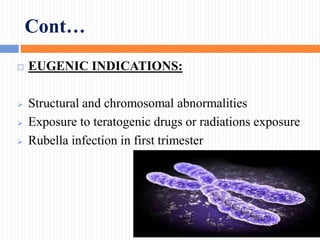
 EUGENIC INDICATIONS:
 Structural and chromosomal abnormalities
 Exposure to teratogenic drugs or radiations exposure
 Rubella infection in first trimester
 IMMEDIATE:
 Injury to the cervix
 Uterine perforation
 Haemorrhage and shock
 Post abortal triad of pain, bleeding and low grade
fever
 Due to prostaglandins: vomiting, diarrhoea and
fever.
COMPLICATION
S
Cont….
 REMOTE:
 GYNAECOLOGICAL COMPLICATIONS:
 Menstrual disturbances
 Chronic pelvic inflammation
 OBSTETRICAL COMPLICATIONS:
 Preterm labour
 Dysmaturity
 Rupture uterus
Role of nurse
Assessment: Assess for the following
manifestations:
 Vaginal bleeding, spotting, clots.
 Low abdominal cramping.
 Passing of tissue through the vagina.
 Shock-decreased blood pressure, increased
pulse rate.
 Women may verbalize fear, disappointment or
feelings of guilt.
Nursing diagnosis:
 Risk for fetal injury.
 Risk for infection related abortion.
 Fluid volume deficit related to vaginal bleeding as
evidenced by cool and clamy skin, dry mucosa.
 Anticipatory grieving related to loss of pregnancy.
 Anxiety related to outcomes of abortion and its effect
on future pregnancies.
 Altered family processes related to abortion.
 Knowledge deficit related to abortion and its
complications.
Planning:
 Provide information regarding
treatment plan.
 Provide support and reassurance
regarding nursing care.
 Promote maternal physical well-being.
 Provide opportunities for counselling
and support.
 Provide teaching related to self care.
Implementation:
 Observe for vaginal bleeding and cramping.
 Save expelled tissue and clot for examination.
 Monitor vital signs every 5 minutes to 4 hours
depending on maternal status.
 Maintain women on bed rest.
 Observe for signs of shock and institute
treatment measures.
 Prepare for dilatation and curettage if
appropriate.
 Provide support, but avoid offering false
Summarization:
 Definition of abortion.
 Incidence of abortion.
 Aetiology of abortion.
 Classification of abortion.
 MTP act.
 Role of nurse for the client with abortion
REFERENCES:
 Jacob annamma. A comprehensive textbook of
midwifery. Edi 2nd. Jaypee publishers. P.275-282.
 Fraser M. Diane, cooper A. Margaret. Myles
texebook of midwives. Edi. 14th. Churchill
livingstone. P.600-18.
 Dutta’s DC. Textbook of obstetrics. Edi. 7th.
Hiralal konar. P.158-168.
 Daftary N. Shirish, chakravarti sudip. Manual of
obstetrics. Edi ; 3rd. Elsevier publishers. P. 364-
69
 Salhan sudha. Textbook of obstetrics. Edi; 1st.
Jaypee publishers. P. 705-0.
abortion ...pptx
abortion ...pptx

abortion ...pptx

  • 1.
  • 2.
  • 3.
    DEFINITION  Abortion isthe process of partial or complete separation of the products of conception from the uterine wall with or without partial or complete expulsion from the uterine cavity before the age of viability.  The age of viability is 28 weeks in India.
  • 4.
    Conti...  Abortion isthe expulsion or extraction from its mother of an embryo or foetus weighing 500gm or less when it is not capable of independent survival (WHO). This 500gm of fetal development is attained approximately at 22 weeks (154 days) of gestation.  The expelled foetus is called abortus.
  • 5.
    INCIDENCE:  The incidenceof abortion is difficult to work out but probably 10-20% of all clinical pregnancies end in miscarriage and another optimistic figure of 10% are induced illegally. 75% abortions occur before the 16th week and of these, about 75% occur before the 8th week of pregnancy.
  • 6.
    ETIOLOGY:  The etiologyof miscarriage is often complex and obscure. The following factors (embryonic or parental) are important:  Genetic factors (50%)  Endocrine and metabolic factors (10-15%)  Anatomic abnormalities (10-15%)  Infections(5%)  Blood group incompatibility  Unexplained (40-60%)
  • 7.
    CLASSIFICATION Spontaneous abortion Threatened abortion Inevitable abortion Completeabortion Incomplete abortion Missed abortion Septic abortion Induced abortion Legal abortion Illegal abortion
  • 8.
    Spontaneous Abortion:  Spontaneousabortion is defined as the involuntary loss of products of conception prior to 28 weeks of gestation, when the fetus weights approximately 1000gm or less.  Spontaneous abortions occur in every 15 pregnancies.  In India it has been computed that about 6 million abortions take place, every year of which 2 million are spontaneous and the 4 million are induced.
  • 9.
    Causes:  The causesof spontaneous abortion in most cases are not known. Where a cause is determined, 50% of miscarriages are due to chromosomal abnormalities of the conceptus.  Genetic and structural causes are also attributed to pregnancy loss.  Maternal causes are:  Structural abnormalities of the genital organs.  Infections such as rubella and Chlamydia.  Medical conditions
  • 10.
    Threatened abortion:  Itis clinical entity where the process of miscarriage has started but has not progressed to a state from which recovery is impossible.
  • 11.
    Clinical features  Vaginalbleeding with or without recognized uterine contractions.  The blood loss may be scanty with or without accompanying backache and cramp like pain. The pain may resemble dysmenorrhoea.  The cervix remains closed and the uterus soft with no tenderness when palpated.  The outcome of threatened abortion could be either stoppage of bleeding and continuance of bleeding and uterine contractions to expel the products of conception.
  • 12.
    Investigations:  Blood: forHb, haematocrit, ABO and grouping  Urine for immunoglogical test of pregnancy.  Ultrasonography.
  • 13.
  • 14.
    Inevitable Abortion:  Thewomen presents with bleeding, often heavy, with clots or products of conception. Blood loss may be heavy and the mother in a shocked state.  The cervix is dilated and on examination, products may be seen in the vagina or protruding trough the os.  The uterus if palpable may be smaller than expected.
  • 15.
    Management:  Management isaimed: a) to accelerate the process of expulsion. b) to maintain strict asepsis.  General measures: Excessive bleeding should be promptly controlled by administering methergin 0.2mg if the cervix is dilated and the size of the uterus is less than 12 weeks.  The blood loss is corrected by intravenous fluid therapy and blood transfusion.
  • 16.
    Active treatment Before 12weeks:  Dilatation and evacuation followed by curettage using analgesia or under general anaesthesia.  Alternatively, suction evacuation followed by curettage is done. After 12 weeks: The uterine contraction is accelarted by oxytocin drip (10 units in 500ml of normal saline) 40-60 drops per minute. If the fetus is expelled and the placenta is retained, it is removed by ovum forceps, if trying separated. If the placenta is not separated, digital separation followed by its evacuation is to be done under general anaesthesia.
  • 17.
    Complete Abortion:  Theconceptus, placenta and membranes are expelled completely from the uterus.
  • 18.
    Clinical features: There ishistory of expulsion of a fleshy mass per vagina followed by:  Subsidence of abdominal pain  Vaginal bleeding becomes trace or absent  Internal examination reveals: uterus is smaller than the period of amenorrhoea and a little firmer. Cervical os is closed. Bleeding is trace.  Examination of the expelled fleshy mass is found complete
  • 19.
    Management:  Transvaginal ultrasonography is usefull to see that uterine cavity is empty, otherwise evacuation of uterine curettage should be done.
  • 20.
    Incomplete Abortion  Whenthe entire products of conception are not expelled, instead a part of it is left inside the uterine cavity it is called incomplete miscarriage or abortion.
  • 21.
    Clinical features History ofexpulsion of a fleshy mass per vagina followed by:  Continuation of pain lower abdomen.  Persistence of vaginal bleeding.  Internal examination reveals- a) uterus smaller than the period of amenorrhoea. b) patulous cervical os often admitting tip of the finger and c) varying amount of bleeding.  On examination, the expelled mass is found incomplete
  • 22.
    Complications The retained productsmay cause:  Profuse bleeding  Sepsis  Placental polyp
  • 23.
    Management: In recent cases:Evacuation of the retained products of conception (ERCP) is done.  Medical management of incomplete abortion may be done. Tablet Misoprostal 200μg is used vaginally every 4 hours.  Compared to surgical methods, complications are less with medical methods.
  • 24.
    Missed Abortion  Whenthe fetus is dead and retained inside the uterus for a viable period, it is called missed abortion or early fetal desmise.
  • 25.
    Clinical features The patientusually presents with features of threatened abortion followed by:  Persistence of brownish vaginal discharge.  Subsidence of pregnancy symptoms.  Retrogression of breast changes.  Cessation of uterine growth which in fact becomes smaller in size.  Non audibility of the fetal heart sound even with Doppler ultrasound if it had been audible before.
  • 26.
    Conti...  Cervix feelsfirm  Immunological test for pregnancy becomes negative.  Real time ultrasonography reveals an empty sac early in the pregnancy or the absence of fetal motion or fetal cardiac movements.
  • 27.
    Management: Uterus is lessthan 12 weeks:  Expectant management: many women expel the conceptus spontaneously.  Medical management: prostaglandin E1 (Misoprostal) 800mg vaginally in the posterior fornix is given and repeated after 24 hours if needed. Expulsion usually occurs within 48 hours.  Suction evacuation or dilatation and evacuation is done either as a definitive treatment.
  • 28.
    Conti... Uterus more than12 weeks:  Induction is done by the following methods:  Prostaglandin E1 (misoprostal) 200μg tablet is inserted into the posterior vaginal fornix every 4 hours for a maximum of 5 such.  Oxytocin-10-20 units of oxytocin in 500ml of normal saline at 30 drops per minute is started.  Many patients need surgical evacuation following medical treatment.  Dilatation and evacuation is done once the cervix becomes soft with use of PGE1.
  • 29.
    Septic Abortion Any abortionassociated with clinical evidences of Infection of the uterus and its contents, is called septic abortion. Although clinical criteria vary, abortion is usually considered septic when there are:  Rise of temperature of atleast 100ºF for 24 hours or more.  Offensive or purulent vaginal discharge.  Other evidences of pelvic infection such as lower abdominal pain and tenderness.
  • 30.
    Incidence:  About 10%abortions requiring admission to hospital are septic.  The majority of septic abortions are associated with incomplete abortion.  While in the majority of cases the infection occurs following illegal induced abortion but infection can occur even after spontaneous abortion.
  • 31.
    Causes:  Criminal abortionwhich is inexpert attempts at termination of pregnancy by passing sticks, catheters, pastes or soap solution into the uterine cavity.  Inevitable abortion with infection.  Medical termination of pregnancy with infection.
  • 32.
    Clinical features:  Dependingupon the severity and the extent of infection, the clinical picture varies widely.  Pyrexia associated with chills and rigor suggest of blood stream spread of infection.  Pain abdomen  A rising pulse rate of 100-120/min or more is a significant finding then even pyrexia. It indicates spread of infection beyond the uterus.  Internal examination reveals offensive purulent discharge or a tender uterus usually with patulous os or a boggy feel of the uterus.
  • 33.
    Clinical grading:  Grade1: The infection is localised in the uterus.  Grade 2: The infection spreads beyond the uterus to the parametrium, tubes and ovaries or pelvic peritoneum.  Grade 3: Generalised peritonitis and/or endotoxic shock or jaundice or acute renal faiure.
  • 34.
    Investigations:  Routine investigationsinclude:  Cervical or high vaginal swab is taken prior to internal examination.  Blood for haemoglobin estimation, total and differential count of white cells, ABO and Rh grouping.  Urine analysis for culture.
  • 35.
    Special investigations include: Ultrasonography of pelvis and abdomen.  Blood culture- if associated with spell of chills and rigors, Serum electrolytes and coagulation profile.  Plain X-ray.
  • 36.
    Complications: Immediate complications:  Haemorrhagerelated to abortion.  Injury may occur to uterus and also to the adjacent structures particularly gut.  Spread of infection leads to generalised peritonitis, endotoxic shock, acute renal failure, etc. Remote complications:  Chronic pelvic pain and backache  Dyspareunia  Ectopic pregnancy  Secondary infertility  Emotional depression
  • 37.
    Management of septicabortion:  Hospitalization is essential for all cases of septic abortion. The patient is kept in isolation.  To take high vaginal or cervical swab for culture, drug sensitivity test and gram stain.  Vaginal examination is done to note the state of abortion.  Overall assessment and patient is levelled in accordance with clinical grading.  Investigation protocols.  Drugs: Antibiotics, analgesics and sedatives.  Pelvic abscess if present will be drained.  Evacuation of the uterus.  Laparotomy : Removal of the uterus should be done irrespective of parity.
  • 38.
    Induced abortion:  Thisis deliberate interruption of an intact pregnancy. Induced abortions are performed legally in India since the Medical termination pregnancy (MTP) Act of 1971 (revised in 1975).
  • 39.
    MTPACT PROVISIONS:-  The continuationof pregnancy would involve serious risk of life of the pregnant women.  There is also risk of child being born with serious physical and mental abnormalities.  The pregnancy as the result of rape.  Pregnancy caused as a result of failure of contraceptive.  When there are actual or reasonably foreseeable environments which may lead to risk or injury to the health of the mother.
  • 40.
     A registeredmedical practitioner is qualified to perform MTP.  Termination can only be performed in Government hospital or places approved by the Government.  Pregnancy can only be terminated on the written consent of the women.  Termination is permitted up to 20 weeks of pregnancy.  Pregnancy in a minor girl or lunatic cannot be terminated without written consent of the parents or legal guardian.  The abortion has to be performed confidentially. RECOMMENDATIONS
  • 41.
     THERAPEUTIC ORMEDICAL TERMINATION:  Cardiac disease  Chronic glomerulonephritis.  Cervical or breast malignancy  Diabetes mellitus  Psychiatric illness INDICATIONS FOR MTP
  • 42.
    Cont…  SOCIAL INDICATIONS: Porous women having unplanned pregnancy with low socioeconomic status.  Pregnancy caused by rape.  Pregnancy due to failure of contraceptive methods.
  • 43.
    Cont…  EUGENIC INDICATIONS: Structural and chromosomal abnormalities  Exposure to teratogenic drugs or radiations exposure  Rubella infection in first trimester
  • 44.
     IMMEDIATE:  Injuryto the cervix  Uterine perforation  Haemorrhage and shock  Post abortal triad of pain, bleeding and low grade fever  Due to prostaglandins: vomiting, diarrhoea and fever. COMPLICATION S
  • 45.
    Cont….  REMOTE:  GYNAECOLOGICALCOMPLICATIONS:  Menstrual disturbances  Chronic pelvic inflammation  OBSTETRICAL COMPLICATIONS:  Preterm labour  Dysmaturity  Rupture uterus
  • 46.
    Role of nurse Assessment:Assess for the following manifestations:  Vaginal bleeding, spotting, clots.  Low abdominal cramping.  Passing of tissue through the vagina.  Shock-decreased blood pressure, increased pulse rate.  Women may verbalize fear, disappointment or feelings of guilt.
  • 47.
    Nursing diagnosis:  Riskfor fetal injury.  Risk for infection related abortion.  Fluid volume deficit related to vaginal bleeding as evidenced by cool and clamy skin, dry mucosa.  Anticipatory grieving related to loss of pregnancy.  Anxiety related to outcomes of abortion and its effect on future pregnancies.  Altered family processes related to abortion.  Knowledge deficit related to abortion and its complications.
  • 48.
    Planning:  Provide informationregarding treatment plan.  Provide support and reassurance regarding nursing care.  Promote maternal physical well-being.  Provide opportunities for counselling and support.  Provide teaching related to self care.
  • 49.
    Implementation:  Observe forvaginal bleeding and cramping.  Save expelled tissue and clot for examination.  Monitor vital signs every 5 minutes to 4 hours depending on maternal status.  Maintain women on bed rest.  Observe for signs of shock and institute treatment measures.  Prepare for dilatation and curettage if appropriate.  Provide support, but avoid offering false
  • 50.
    Summarization:  Definition ofabortion.  Incidence of abortion.  Aetiology of abortion.  Classification of abortion.  MTP act.  Role of nurse for the client with abortion
  • 51.
    REFERENCES:  Jacob annamma.A comprehensive textbook of midwifery. Edi 2nd. Jaypee publishers. P.275-282.  Fraser M. Diane, cooper A. Margaret. Myles texebook of midwives. Edi. 14th. Churchill livingstone. P.600-18.  Dutta’s DC. Textbook of obstetrics. Edi. 7th. Hiralal konar. P.158-168.  Daftary N. Shirish, chakravarti sudip. Manual of obstetrics. Edi ; 3rd. Elsevier publishers. P. 364- 69  Salhan sudha. Textbook of obstetrics. Edi; 1st. Jaypee publishers. P. 705-0.