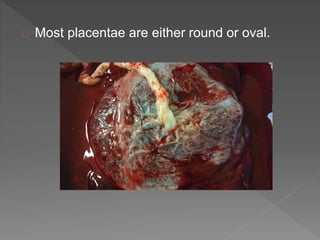
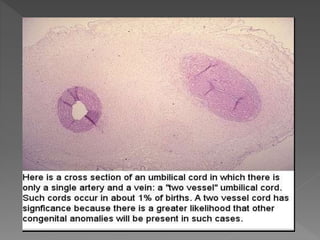
Most placentae are either round or oval.
Variations are comman –
Multiple placentae with a single fetus
Cord insertion between 2 placentae : either
into the chorionic bridge / into the
membranes
Bilobed or placenta bilobata
Placenta succenturata
Placenta memranacea
Ring shaped placenta
Placenta fenestrata
Extrachorial placenta
-circumvallate placenta
-Placenta marginata
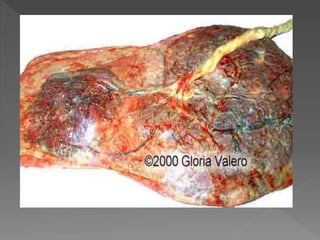
Multilobed placenta
Bilobed or placenta bilobata
› Incidence 2-8% of placentas
› Roughly equal size lobes are separated by a
segment membranes
› Umbilical cord may insert in either of the lobes or
in velamentous fashion or in between the lobes
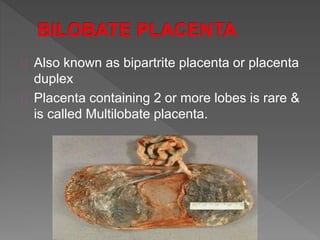
Also known as bipartrite placenta or placenta
duplex
Placenta containing 2 or more lobes is rare &
is called Multilobate placenta.
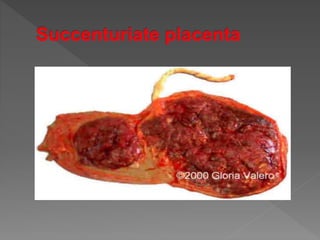
Incidence :5%
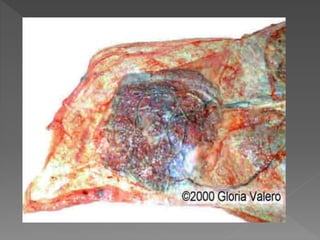
Small accessory lobes develop at a small
distance from the main placenta.
2 fold increase in twin placentae
Accessory lobe may be retained after
delivery causing PPH
Accompanying vasa praevia may cause fetal
hemorrhage (APH)
If the communicating membranes do not
have vessels it is called placenta supuria.
Pathogenesis: Abnormal placentation
- Arise due to implantation in areas of
decreased uterine perfusion
- Lateral implantation in between anterior and
posterior walls of the uterus with one lobe on the
anteriors and one on the posterior wall
Other local factors leading to multilobulation:
› Implantation over leiomyomas
› Area of previous surgeries
› In the cornu
› Over the cervical os
› Succenturate lobe : Results when one or more small
accessory lobes are developed in the membranes at
the a distance from the periphery of the main
placenta
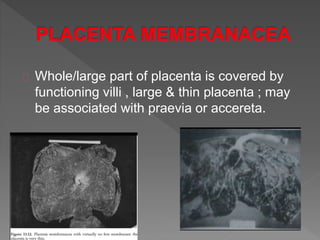
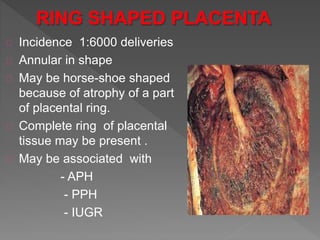
Whole/large part of placenta is covered by
functioning villi , large & thin placenta ; may
be associated with praevia or accereta.
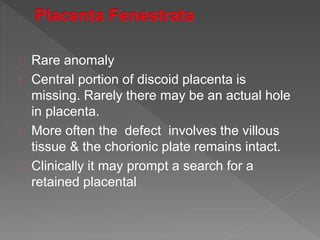
Incidence 1:6000 deliveries
Annular in shape
May be horse-shoe shaped
because of atrophy of a part
of placental ring.
Complete ring of placental
tissue may be present .
May be associated with
- APH
- PPH
- IUGR
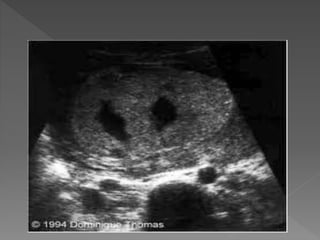
Rare anomaly
Central portion of discoid placenta is
missing. Rarely there may be an actual hole
in placenta.
More often the defect involves the villous
tissue & the chorionic plate remains intact.
Clinically it may prompt a search for a
retained placental
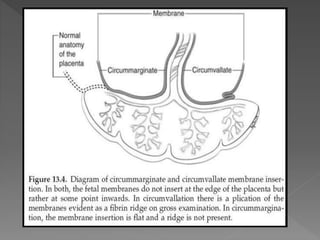
Chorionic plate (fetal side ) is smaller than
basal plate .
So membranes are not inserted at the
periphery of placenta.
These may be fibrin deposition in b/w the
membranes.
There may be plication or folding of
membranes ( circumvallate placenta)
In placenta circummarginata there is no
folding of membranes
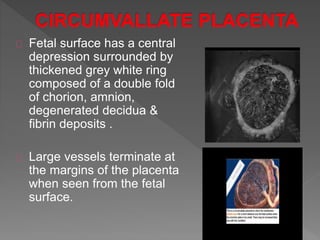
Fetal surface has a central
depression surrounded by
thickened grey white ring
composed of a double fold
of chorion, amnion,
degenerated decidua &
fibrin deposits .
Large vessels terminate at
the margins of the placenta
when seen from the fetal
surface.
Risks of circumvallate placenta
APH
Fetal Hemorrhage
PT delivery
Placental insufficiency
Perinatal mortality
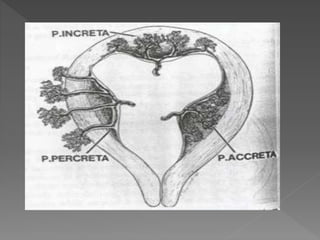
PLACENTA ACCERATA , INCRETA &
PERCRETA
Abnormalities are serious variations.
Trophoblastic cells invade the myometrium
to varying depths.
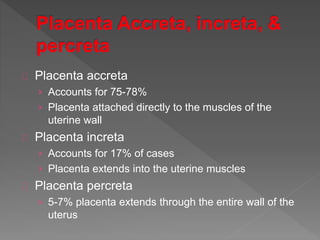
Placenta accreta
› Accounts for 75-78%
› Placenta attached directly to the muscles of the
uterine wall
Placenta increta
› Accounts for 17% of cases
› Placenta extends into the uterine muscles
Placenta percreta
› 5-7% placenta extends through the entire wall of the
uterus
Incidence of 1 in 7,000 deliveries
Incidence maybe increase because of the
increase no. of women with prev CS
Risk factors:
› Placenta previa
› Placental located underlying the previous uterine
scar
› Multiple pregnancies
› Prev. D & C
Torrential hemorrhage is a frequent
complication.
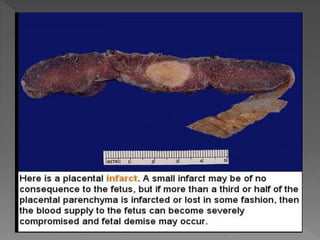
¼ of term pregnancies
2/3 pregnancies complicated by severe
HPNsive disease
Result from occlusion of maternal vascular
supply
Principal histopath features:
› Fibrinoid degeneration of trophoblast
› Calcification
› Ischemic infarction from adhesion of spiral arteries
Placental perfusion disorders many disrupt
blood flow.
a) To the placenta
b) With in placenta
c) To the fetus through the villi. Many of these
lesions are found in normal mature placenta
Functional reserve of placenta is great. It
may loose 30% of it’s villi without any fetal
effects.
Maternal floor infarcts:
Deposition of dense fibrinoid layer on
placental basal plate
thick white & fibrin corrugated surface acts as
a blockade to blood flow.
Associated with:
IUGR
PT Labor
Still births May recur in
subsequent pregnancies.
Etiology is not well defined.
May be associated with maternal
thrombophillias.
Degenerative lesions of placenta have 2
etiological factors:
› Changes assoc with aging of trophoblast
› Impairment of uteroplacental circulation causing
infarction
Small calcareous nodules or plaques
frequently observed on the maternal surface
of the placenta
Visualized in USG
>33 weeks POG
› More than half of the placenta have some degree
of calcification w/c increase until term
Thrombosis of a stem artery produces
sharply demarcated area of avascularity
Single artery thrombosis
› (+) 4.5% of placenta from normal pregnancy
› (+)10% involving diabetic women
Thrombosis of single fetal stem artery will
deprive only 5% of the villi of their blood
supply
Length
› Mean length at term 50-60 cm
› Vascular occlusion by thrombi & true knots
› Excessively short umbilical cords may be
instrumental in abruptio placenta & uterine inversion
› Short cords are associated with
› - IUGR & OLIGOHYDRAMNIOS
› - CMF & CHROMOSOMAL ABERRATIONS
› - Intrapartum fetal death
› - 2 folds risk of death
Long cords are associated with-
Cord entanglement
Cord prolapse
CMF
FETAL DISTRESS& DEMISE
Lean cords are associated with IUGR
Large diameter cords are associated with
macrosomia
Clinical utility of parameter – unclear
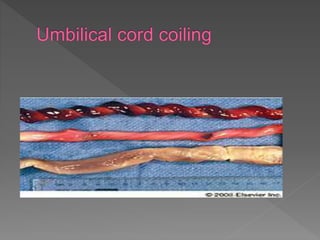
Cord vessels spiral through the cord
UCI - is the no. of complete coils divided by
the cord length in cm
Antenatal UCI has the lower sensitivity than
the measurement postpartum
Hyper coiling is linked with fetal demise,
IUGR & intrapartum hypoxia
Abnormal UCI has been related to trisomies
& single umbilical artery
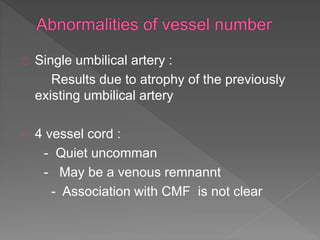
Single umbilical artery :
Results due to atrophy of the previously
existing umbilical artery
4 vessel cord :
- Quiet uncomman
- May be a venous remnannt
- Association with CMF is not clear
Absence of one umbilical artery
INCIDENCE : - 0.63 % in live births
- 1.92 % in perinatal deaths
- 3 % in twins
Incidence is increased in women with :
Diabetes
Epilepsy
PET
APH
Oligohydramnios
Hydramnios
Chromosomal abnormalities
About 30% of all infants with only one umbilical artery
have congenital anomalies
› Associated CMF :
› Aneuploidies
 Tracheo-oesophagial fistula
 Renal agenesis
 Imperforate anus
› Vertebral defects
› 34% are growth restricted
› 17% deliver preterm
Rarely umbilical artery may fail to split
Shared ,fused lumen
May involve the entire length or may be
partial (towards the placental insertion site)
Hyrtl Anastomosis :
Anastomosis b/w the two umb. Arteries with in 3
cm of placental incertion site
Acts as a pressure equalising system b/w the two
umbilical Aa.
Improves placental perfusion during uterine
contractions /during compression of one of the
umbilicalarteries.
Usually the cord is inserted at or near the
center of the fetal surface of placenta.
Various cord insertion variations are:
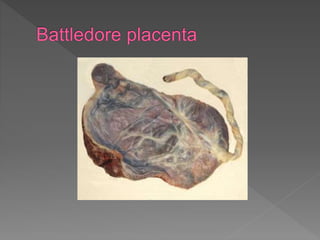
› Battledore placenta
› Furcate insertion
› Velamentous insertion
› Vasa praevia
Insertion site is normal
Umbilical vessels lose their protective
wharton’s jelly shortly before insertion.
Vessels are covered only by the
amnion(vulnerable to compression)
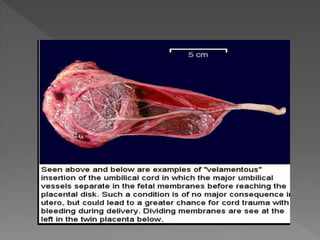
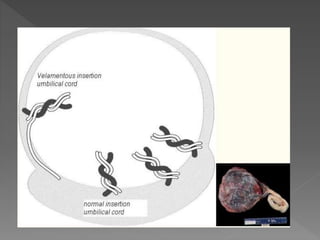
An abnormal condition in which umbilical vessel does not
insert into the placental mass but instead, traverse the fetal
membrane at a short distance from the placental margin.
They are surrounded only by a fold of amnion(vulnerable to
compression).
More common with placenta praevia and multiple pregency
Incidence :
› 1.1% in singleton pregnancies
› 8.7% in twin gestations
› Spontaneous abortion
33% between 9th & 12th wks AOG
26 % between 13th & 16th
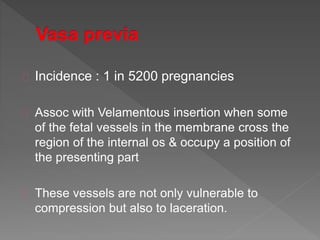
Incidence : 1 in 5200 pregnancies
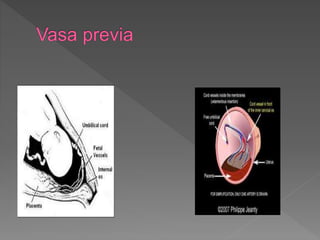
Assoc with Velamentous insertion when some
of the fetal vessels in the membrane cross the
region of the internal os & occupy a position of
the presenting part
These vessels are not only vulnerable to
compression but also to laceration.
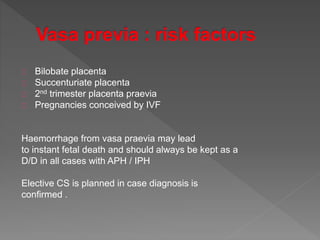
Bilobate placenta
Succenturiate placenta
2nd trimester placenta praevia
Pregnancies conceived by IVF
Haemorrhage from vasa praevia may lead
to instant fetal death and should always be kept as a
D/D in all cases with APH / IPH
Elective CS is planned in case diagnosis is
confirmed .
Identified as echogenic parrallel / circular line
near the cervix
USG has low sensitivity
Doppler is recommended in suspected cases
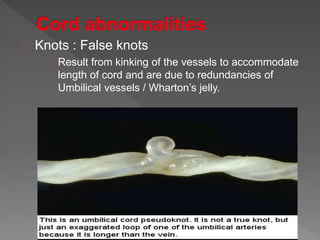
Knots : False knots
Result from kinking of the vessels to accommodate
length of cord and are due to redundancies of
Umbilical vessels / Wharton’s jelly.
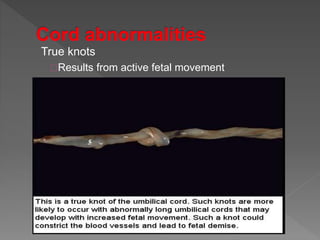
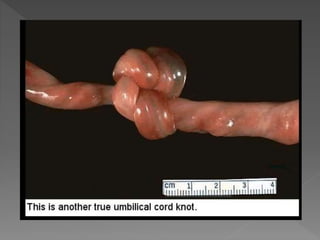
True knots
Results from active fetal movement
Incidence 1%
More common in monoamniotic twins
Active fetal movements create true knots
Risk of still births is increased 5 to 10 folds in
those with true knots.
FHR abnormalities are common during labor
but cord blood PH values are normal
The cord is frequently coiled around the fetus
More likely with longer cords
Loops around fetal neck are termed a nuchal cord
(uncommon cause of adverse PN outcome)
Contractions may compress the nuchal cord and cause
FHR decelerations and low umbilical artery
Incidence :
› 1 loop of Nuchal cord 20-34%
› 2 loops of nuchal cord 2.5-5%
› 3 loops of nuchal cord 0.2-0.5%
Associated with-
› Short cord
› Trauma
› Entanglement
May result from rupture of varyx(venous)
May be iatrogenic
May be found along the course of the cord
True cysts:
› Epithelium lined
› Remnants of the allantois
› Coexist with patent urachus
False Cysts:
Due to degeneration of wharton’s jelly.
Single cyst may resolve completely
Multiple cysts may be associated with miscarriage
/aneuploidy.
Focal narrowing of cord diameter near fetal
insertion
Pathological findings- absent of wharton’s
jelly and stenosis of cord vessels.
Most cases are still borns.
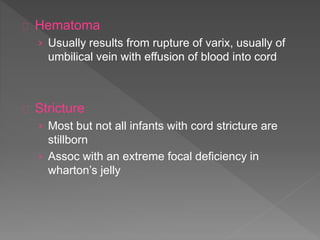
Hematoma
› Usually results from rupture of varix, usually of
umbilical vein with effusion of blood into cord
Stricture
› Most but not all infants with cord stricture are
stillborn
› Assoc with an extreme focal deficiency in
wharton’s jelly
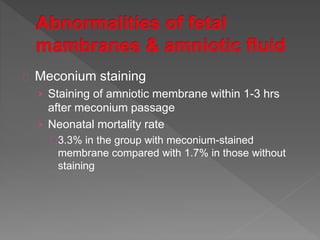
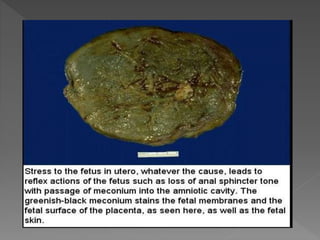
Meconium staining
› Staining of amniotic membrane within 1-3 hrs
after meconium passage
› Neonatal mortality rate
3.3% in the group with meconium-stained
membrane compared with 1.7% in those without
staining
Abnormalities of cord & placenta

Abnormalities of cord & placenta

  • 2.
    Most placentae areeither round or oval.
  • 3.
    Variations are comman– Multiple placentae with a single fetus Cord insertion between 2 placentae : either into the chorionic bridge / into the membranes
  • 4.
    Bilobed or placentabilobata Placenta succenturata Placenta memranacea Ring shaped placenta Placenta fenestrata Extrachorial placenta -circumvallate placenta -Placenta marginata
  • 5.
    Multilobed placenta Bilobed orplacenta bilobata › Incidence 2-8% of placentas › Roughly equal size lobes are separated by a segment membranes › Umbilical cord may insert in either of the lobes or in velamentous fashion or in between the lobes
  • 6.
    Also known asbipartrite placenta or placenta duplex Placenta containing 2 or more lobes is rare & is called Multilobate placenta.
  • 7.
    Incidence :5% Small accessorylobes develop at a small distance from the main placenta. 2 fold increase in twin placentae Accessory lobe may be retained after delivery causing PPH Accompanying vasa praevia may cause fetal hemorrhage (APH) If the communicating membranes do not have vessels it is called placenta supuria.
  • 11.
    Pathogenesis: Abnormal placentation -Arise due to implantation in areas of decreased uterine perfusion - Lateral implantation in between anterior and posterior walls of the uterus with one lobe on the anteriors and one on the posterior wall
  • 12.
    Other local factorsleading to multilobulation: › Implantation over leiomyomas › Area of previous surgeries › In the cornu › Over the cervical os › Succenturate lobe : Results when one or more small accessory lobes are developed in the membranes at the a distance from the periphery of the main placenta
  • 13.
    Whole/large part ofplacenta is covered by functioning villi , large & thin placenta ; may be associated with praevia or accereta.
  • 14.
    Incidence 1:6000 deliveries Annularin shape May be horse-shoe shaped because of atrophy of a part of placental ring. Complete ring of placental tissue may be present . May be associated with - APH - PPH - IUGR
  • 15.
    Rare anomaly Central portionof discoid placenta is missing. Rarely there may be an actual hole in placenta. More often the defect involves the villous tissue & the chorionic plate remains intact. Clinically it may prompt a search for a retained placental
  • 17.
    Chorionic plate (fetalside ) is smaller than basal plate . So membranes are not inserted at the periphery of placenta. These may be fibrin deposition in b/w the membranes. There may be plication or folding of membranes ( circumvallate placenta) In placenta circummarginata there is no folding of membranes
  • 19.
    Fetal surface hasa central depression surrounded by thickened grey white ring composed of a double fold of chorion, amnion, degenerated decidua & fibrin deposits . Large vessels terminate at the margins of the placenta when seen from the fetal surface.
  • 20.
    Risks of circumvallateplacenta APH Fetal Hemorrhage PT delivery Placental insufficiency Perinatal mortality PLACENTA ACCERATA , INCRETA & PERCRETA Abnormalities are serious variations. Trophoblastic cells invade the myometrium to varying depths.
  • 22.
    Placenta accreta › Accountsfor 75-78% › Placenta attached directly to the muscles of the uterine wall Placenta increta › Accounts for 17% of cases › Placenta extends into the uterine muscles Placenta percreta › 5-7% placenta extends through the entire wall of the uterus
  • 23.
    Incidence of 1in 7,000 deliveries Incidence maybe increase because of the increase no. of women with prev CS Risk factors: › Placenta previa › Placental located underlying the previous uterine scar › Multiple pregnancies › Prev. D & C
  • 24.
    Torrential hemorrhage isa frequent complication.
  • 25.
    ¼ of termpregnancies 2/3 pregnancies complicated by severe HPNsive disease Result from occlusion of maternal vascular supply Principal histopath features: › Fibrinoid degeneration of trophoblast › Calcification › Ischemic infarction from adhesion of spiral arteries
  • 26.
    Placental perfusion disordersmany disrupt blood flow. a) To the placenta b) With in placenta c) To the fetus through the villi. Many of these lesions are found in normal mature placenta Functional reserve of placenta is great. It may loose 30% of it’s villi without any fetal effects.
  • 27.
    Maternal floor infarcts: Depositionof dense fibrinoid layer on placental basal plate thick white & fibrin corrugated surface acts as a blockade to blood flow. Associated with: IUGR PT Labor Still births May recur in subsequent pregnancies. Etiology is not well defined. May be associated with maternal thrombophillias.
  • 29.
    Degenerative lesions ofplacenta have 2 etiological factors: › Changes assoc with aging of trophoblast › Impairment of uteroplacental circulation causing infarction
  • 30.
    Small calcareous nodulesor plaques frequently observed on the maternal surface of the placenta Visualized in USG >33 weeks POG › More than half of the placenta have some degree of calcification w/c increase until term
  • 31.
    Thrombosis of astem artery produces sharply demarcated area of avascularity Single artery thrombosis › (+) 4.5% of placenta from normal pregnancy › (+)10% involving diabetic women Thrombosis of single fetal stem artery will deprive only 5% of the villi of their blood supply
  • 32.
    Length › Mean lengthat term 50-60 cm › Vascular occlusion by thrombi & true knots › Excessively short umbilical cords may be instrumental in abruptio placenta & uterine inversion › Short cords are associated with › - IUGR & OLIGOHYDRAMNIOS › - CMF & CHROMOSOMAL ABERRATIONS › - Intrapartum fetal death › - 2 folds risk of death
  • 33.
    Long cords areassociated with- Cord entanglement Cord prolapse CMF FETAL DISTRESS& DEMISE
  • 34.
    Lean cords areassociated with IUGR Large diameter cords are associated with macrosomia Clinical utility of parameter – unclear
  • 35.
    Cord vessels spiralthrough the cord UCI - is the no. of complete coils divided by the cord length in cm Antenatal UCI has the lower sensitivity than the measurement postpartum Hyper coiling is linked with fetal demise, IUGR & intrapartum hypoxia Abnormal UCI has been related to trisomies & single umbilical artery
  • 37.
    Single umbilical artery: Results due to atrophy of the previously existing umbilical artery 4 vessel cord : - Quiet uncomman - May be a venous remnannt - Association with CMF is not clear
  • 38.
    Absence of oneumbilical artery INCIDENCE : - 0.63 % in live births - 1.92 % in perinatal deaths - 3 % in twins Incidence is increased in women with : Diabetes Epilepsy PET APH Oligohydramnios Hydramnios Chromosomal abnormalities
  • 40.
    About 30% ofall infants with only one umbilical artery have congenital anomalies › Associated CMF : › Aneuploidies  Tracheo-oesophagial fistula  Renal agenesis  Imperforate anus › Vertebral defects › 34% are growth restricted › 17% deliver preterm
  • 41.
    Rarely umbilical arterymay fail to split Shared ,fused lumen May involve the entire length or may be partial (towards the placental insertion site)
  • 42.
    Hyrtl Anastomosis : Anastomosisb/w the two umb. Arteries with in 3 cm of placental incertion site Acts as a pressure equalising system b/w the two umbilical Aa. Improves placental perfusion during uterine contractions /during compression of one of the umbilicalarteries.
  • 43.
    Usually the cordis inserted at or near the center of the fetal surface of placenta. Various cord insertion variations are: › Battledore placenta › Furcate insertion › Velamentous insertion › Vasa praevia
  • 45.
    Insertion site isnormal Umbilical vessels lose their protective wharton’s jelly shortly before insertion. Vessels are covered only by the amnion(vulnerable to compression)
  • 46.
    An abnormal conditionin which umbilical vessel does not insert into the placental mass but instead, traverse the fetal membrane at a short distance from the placental margin. They are surrounded only by a fold of amnion(vulnerable to compression). More common with placenta praevia and multiple pregency Incidence : › 1.1% in singleton pregnancies › 8.7% in twin gestations › Spontaneous abortion 33% between 9th & 12th wks AOG 26 % between 13th & 16th
  • 49.
    Incidence : 1in 5200 pregnancies Assoc with Velamentous insertion when some of the fetal vessels in the membrane cross the region of the internal os & occupy a position of the presenting part These vessels are not only vulnerable to compression but also to laceration.
  • 50.
    Bilobate placenta Succenturiate placenta 2ndtrimester placenta praevia Pregnancies conceived by IVF Haemorrhage from vasa praevia may lead to instant fetal death and should always be kept as a D/D in all cases with APH / IPH Elective CS is planned in case diagnosis is confirmed .
  • 51.
    Identified as echogenicparrallel / circular line near the cervix USG has low sensitivity Doppler is recommended in suspected cases
  • 53.
    Knots : Falseknots Result from kinking of the vessels to accommodate length of cord and are due to redundancies of Umbilical vessels / Wharton’s jelly.
  • 54.
    True knots Results fromactive fetal movement
  • 56.
    Incidence 1% More commonin monoamniotic twins Active fetal movements create true knots Risk of still births is increased 5 to 10 folds in those with true knots. FHR abnormalities are common during labor but cord blood PH values are normal
  • 57.
    The cord isfrequently coiled around the fetus More likely with longer cords Loops around fetal neck are termed a nuchal cord (uncommon cause of adverse PN outcome) Contractions may compress the nuchal cord and cause FHR decelerations and low umbilical artery Incidence : › 1 loop of Nuchal cord 20-34% › 2 loops of nuchal cord 2.5-5% › 3 loops of nuchal cord 0.2-0.5%
  • 58.
    Associated with- › Shortcord › Trauma › Entanglement May result from rupture of varyx(venous) May be iatrogenic
  • 59.
    May be foundalong the course of the cord True cysts: › Epithelium lined › Remnants of the allantois › Coexist with patent urachus False Cysts: Due to degeneration of wharton’s jelly. Single cyst may resolve completely Multiple cysts may be associated with miscarriage /aneuploidy.
  • 60.
    Focal narrowing ofcord diameter near fetal insertion Pathological findings- absent of wharton’s jelly and stenosis of cord vessels. Most cases are still borns.
  • 63.
    Hematoma › Usually resultsfrom rupture of varix, usually of umbilical vein with effusion of blood into cord Stricture › Most but not all infants with cord stricture are stillborn › Assoc with an extreme focal deficiency in wharton’s jelly
  • 64.
    Meconium staining › Stainingof amniotic membrane within 1-3 hrs after meconium passage › Neonatal mortality rate 3.3% in the group with meconium-stained membrane compared with 1.7% in those without staining