PLACENTA
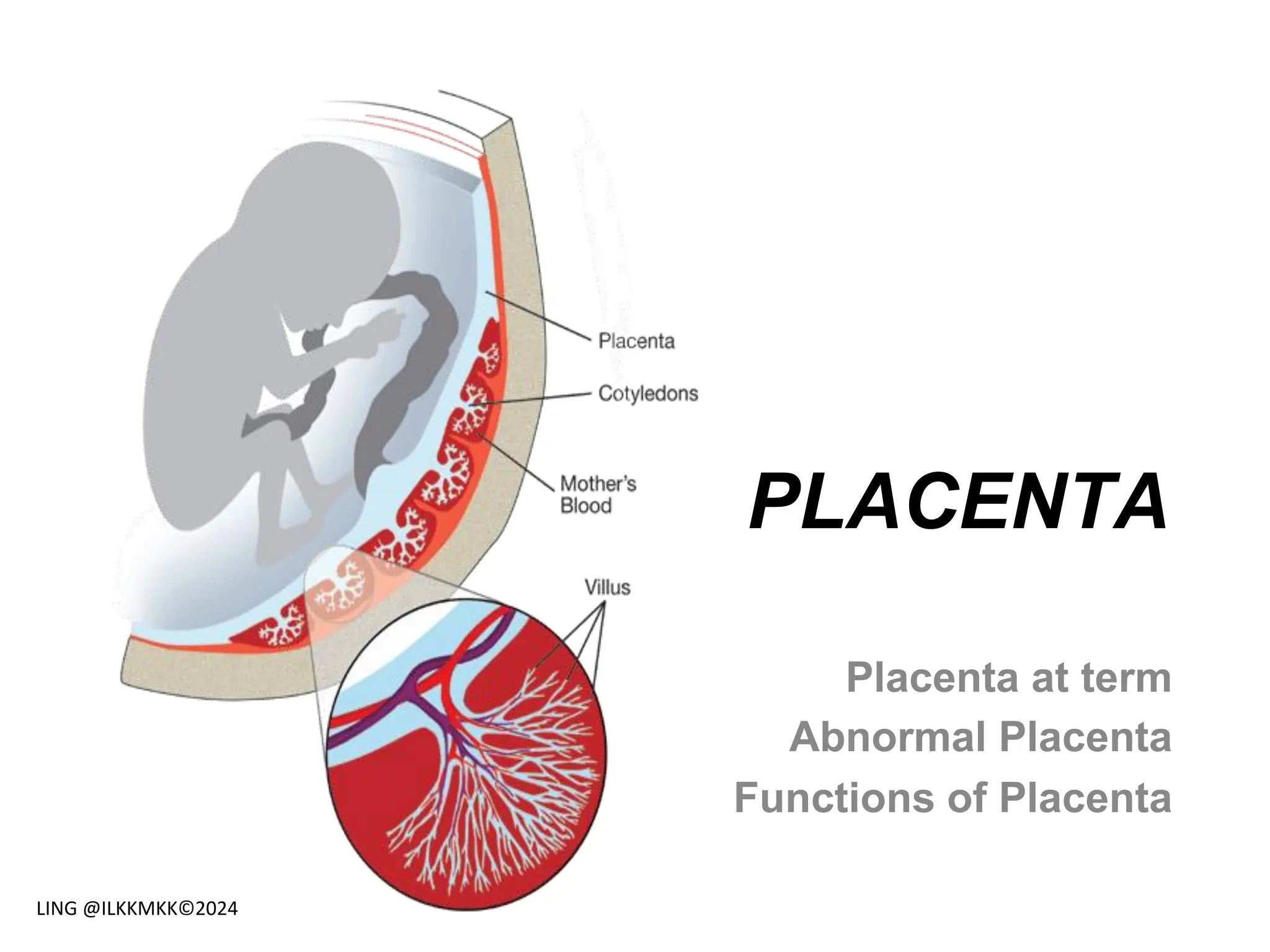
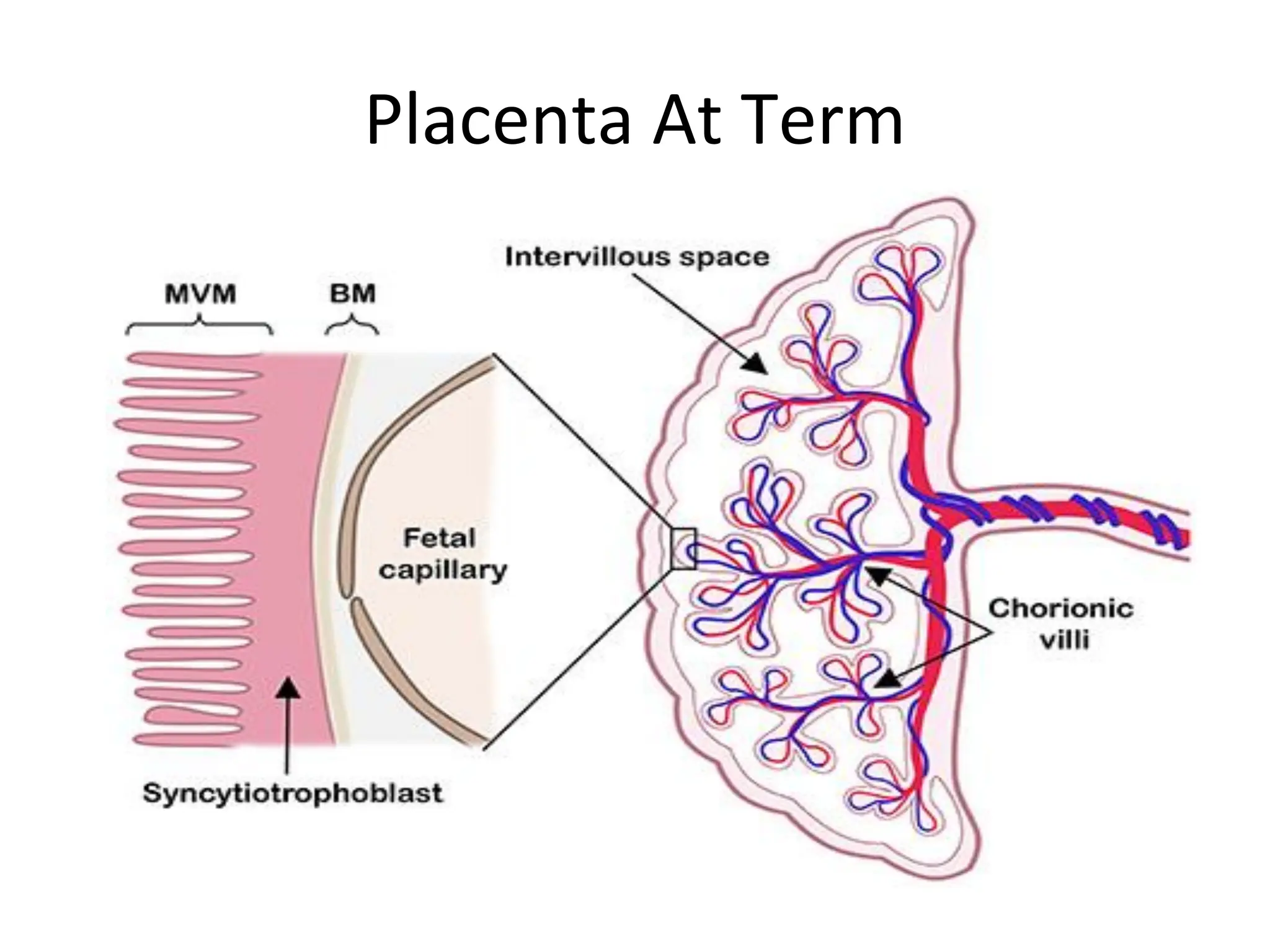
Placenta at term
Abnormal Placenta
Functions of Placenta
LING @ILKKMKK©2024
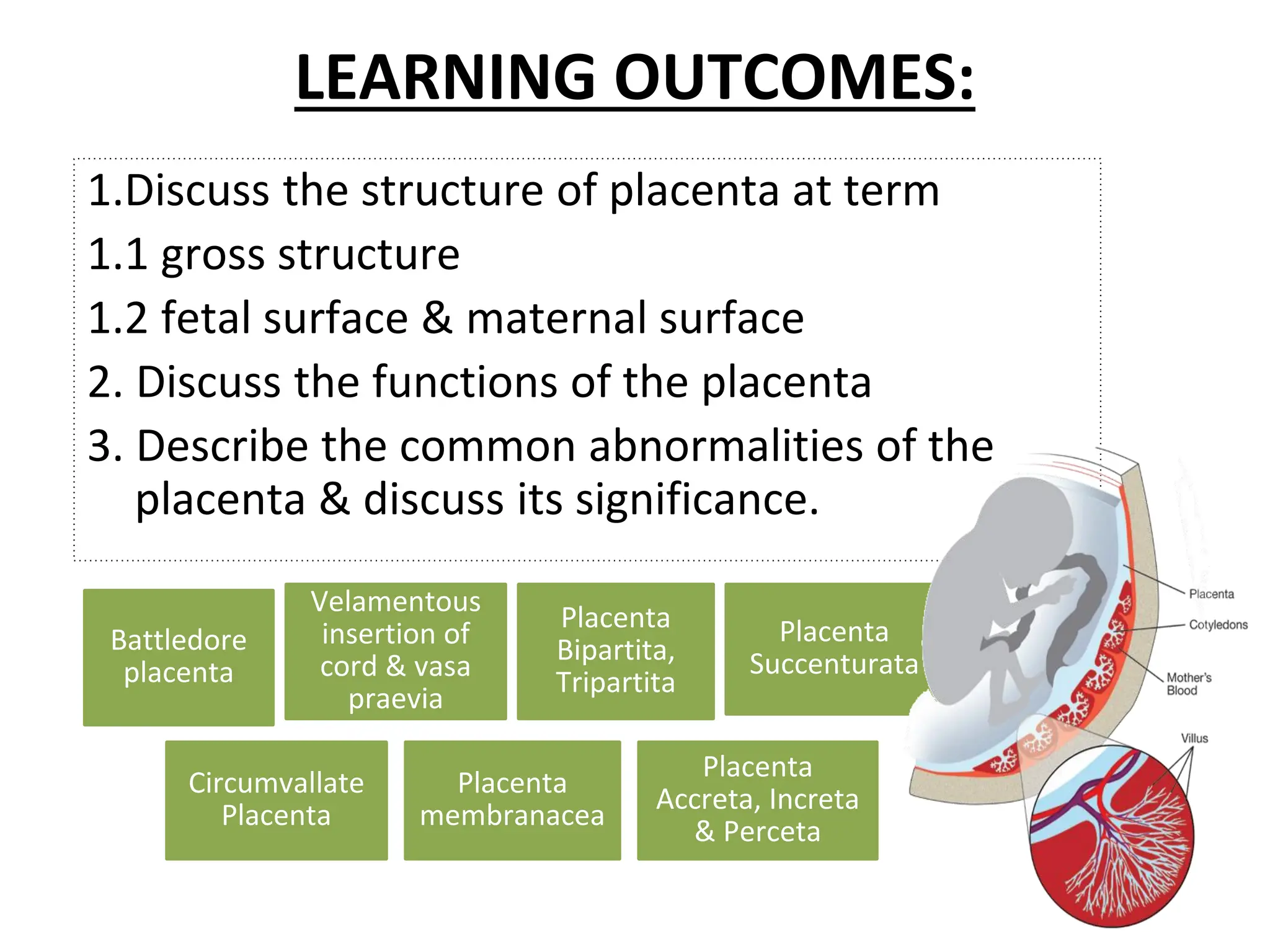
LEARNING OUTCOMES:
1.Discuss the structure of placenta at term
1.1 gross structure
1.2 fetal surface & maternal surface
2. Discuss the functions of the placenta
3. Describe the common abnormalities of the
placenta & discuss its significance.
Battledore
placenta
Velamentous
insertion of
cord & vasa
praevia
Placenta
Bipartita,
Tripartita
Placenta
Succenturata
Circumvallate
Placenta
Placenta
membranacea
Placenta
Accreta, Increta
& Perceta
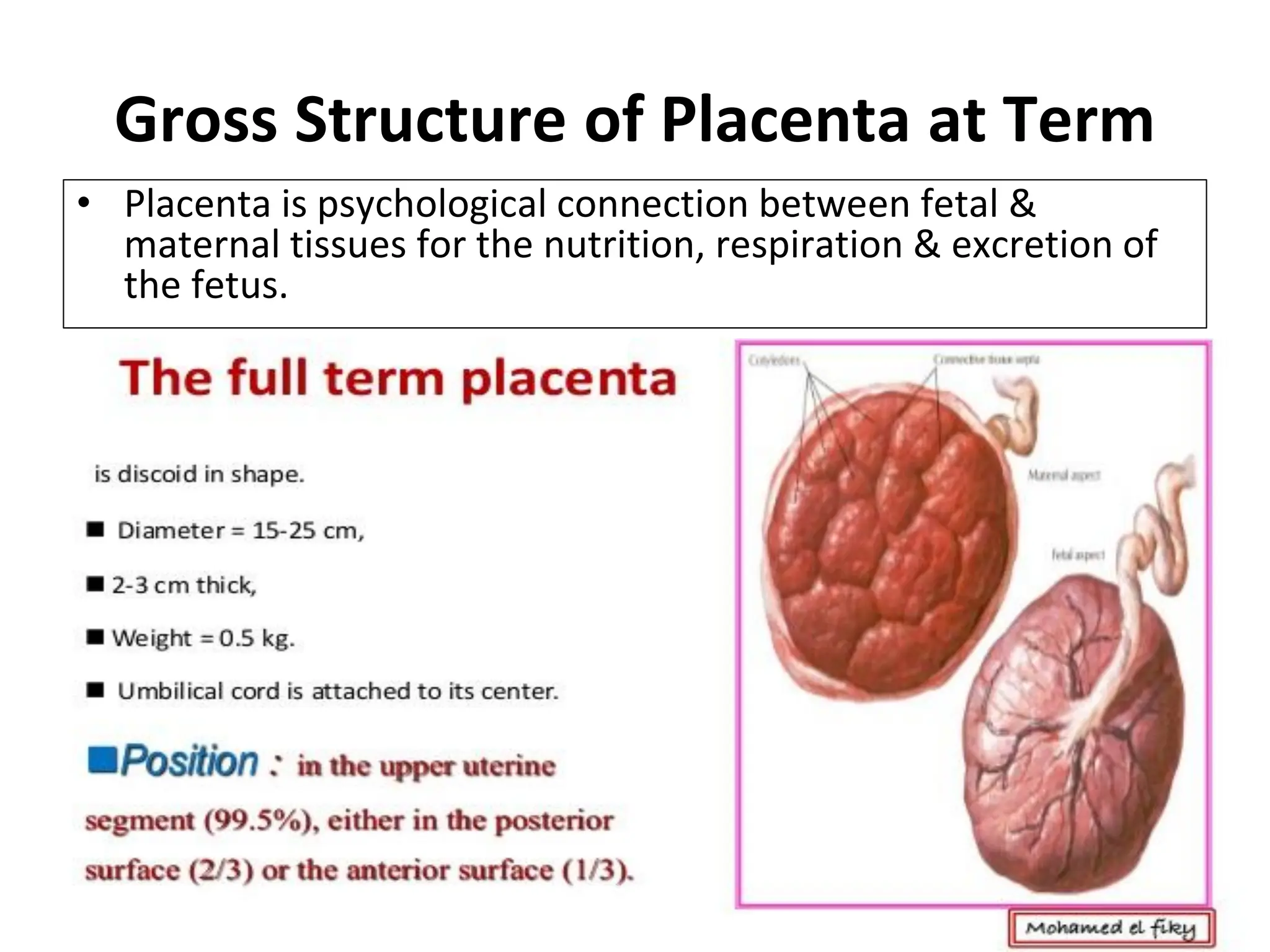
Gross Structure of Placenta at Term
• Placenta is psychological connection between fetal &
maternal tissues for the nutrition, respiration & excretion of
the fetus.
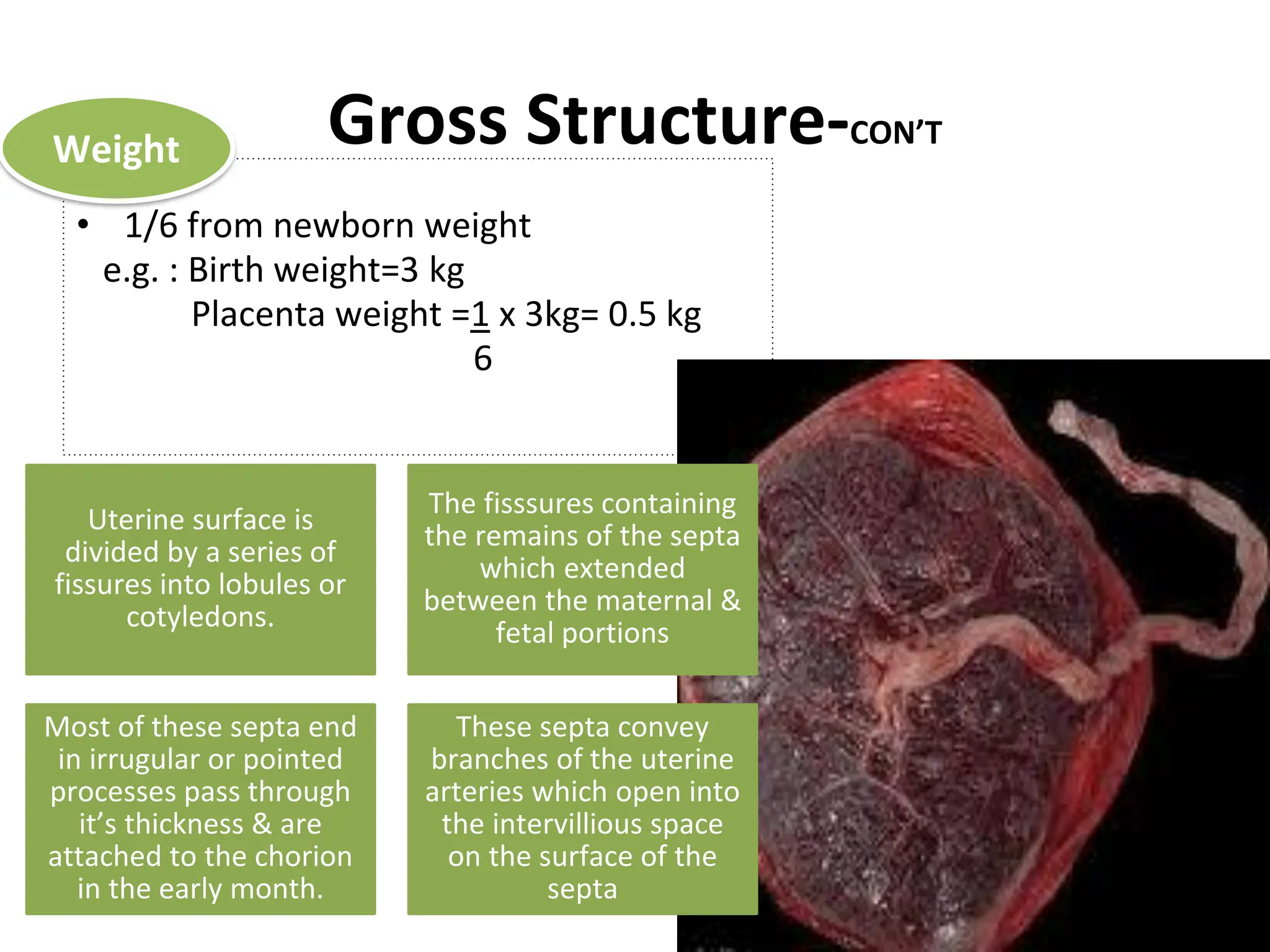
Gross Structure-CON’T
• 1/6 from newborn weight
e.g. : Birth weight=3 kg
Placenta weight =1 x 3kg= 0.5 kg
6
Weight
Uterine surface is
divided by a series of
fissures into lobules or
cotyledons.
The fisssures containing
the remains of the septa
which extended
between the maternal &
fetal portions
Most of these septa end
in irrugular or pointed
processes pass through
it’s thickness & are
attached to the chorion
in the early month.
These septa convey
branches of the uterine
arteries which open into
the intervillious space
on the surface of the
septa
Gross Structure-CON’T
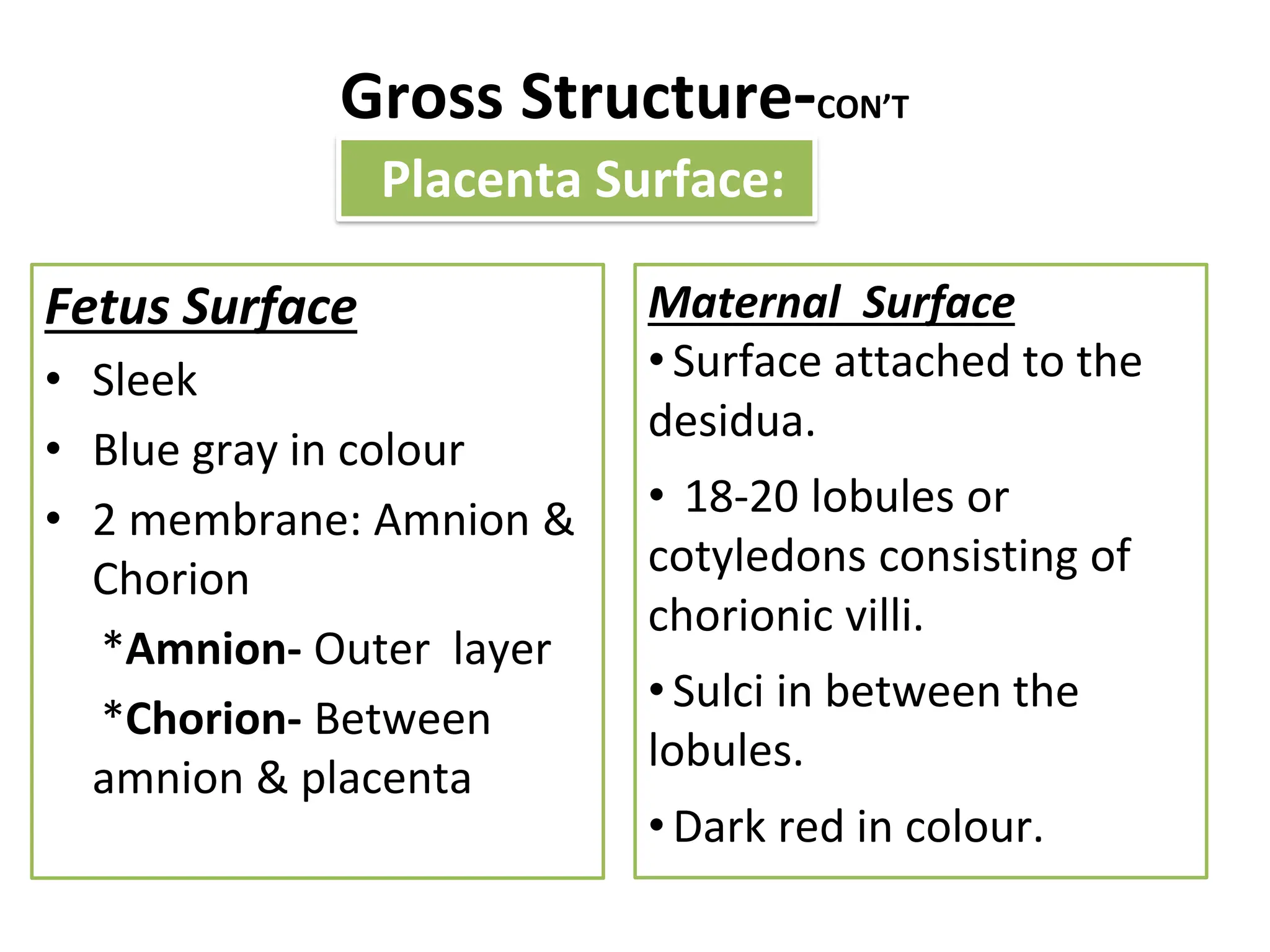
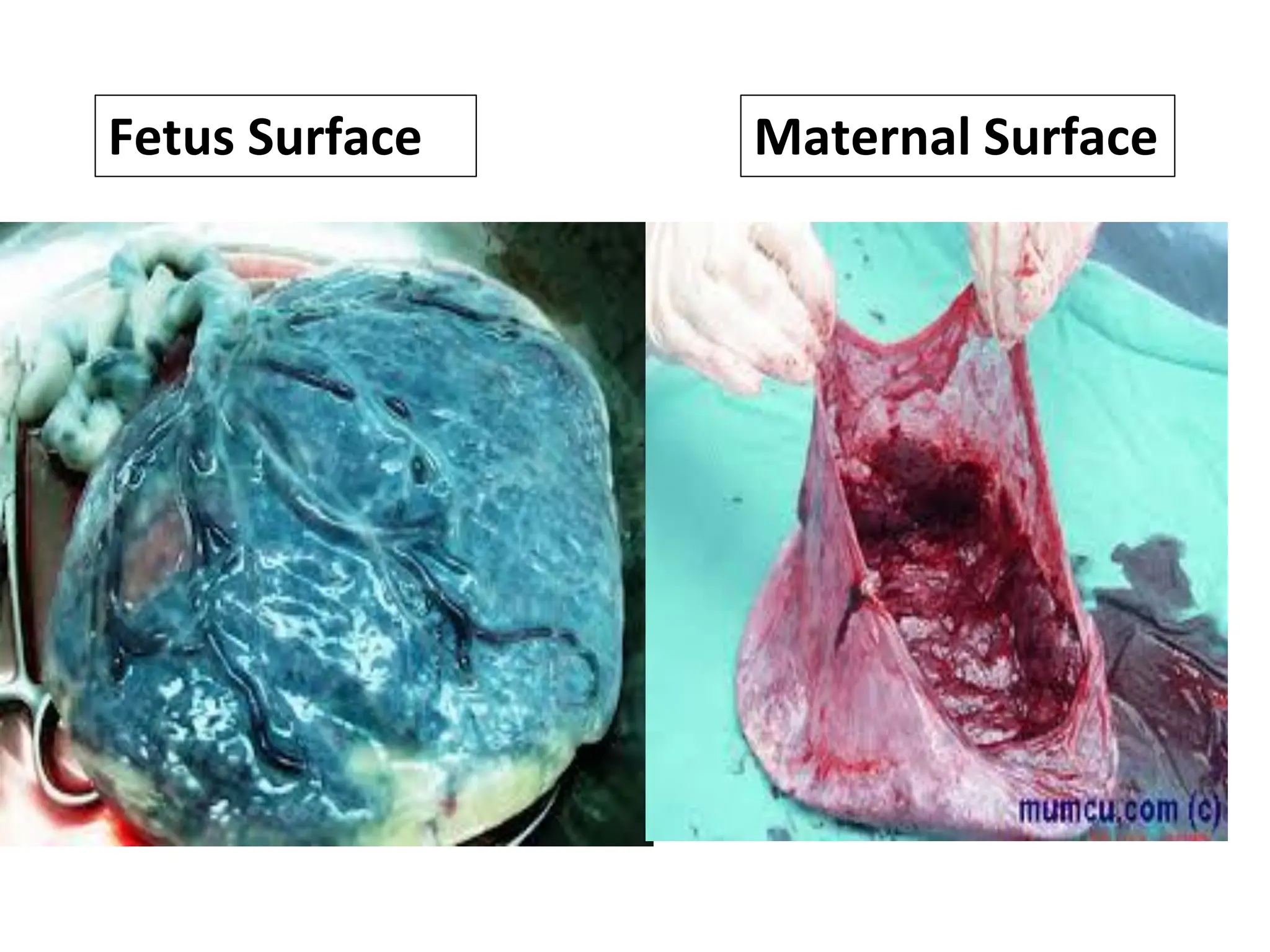
Fetus Surface
• Sleek
• Blue gray in colour
• 2 membrane: Amnion &
Chorion
*Amnion- Outer layer
*Chorion- Between
amnion & placenta
Maternal Surface
• Surface attached to the
desidua.
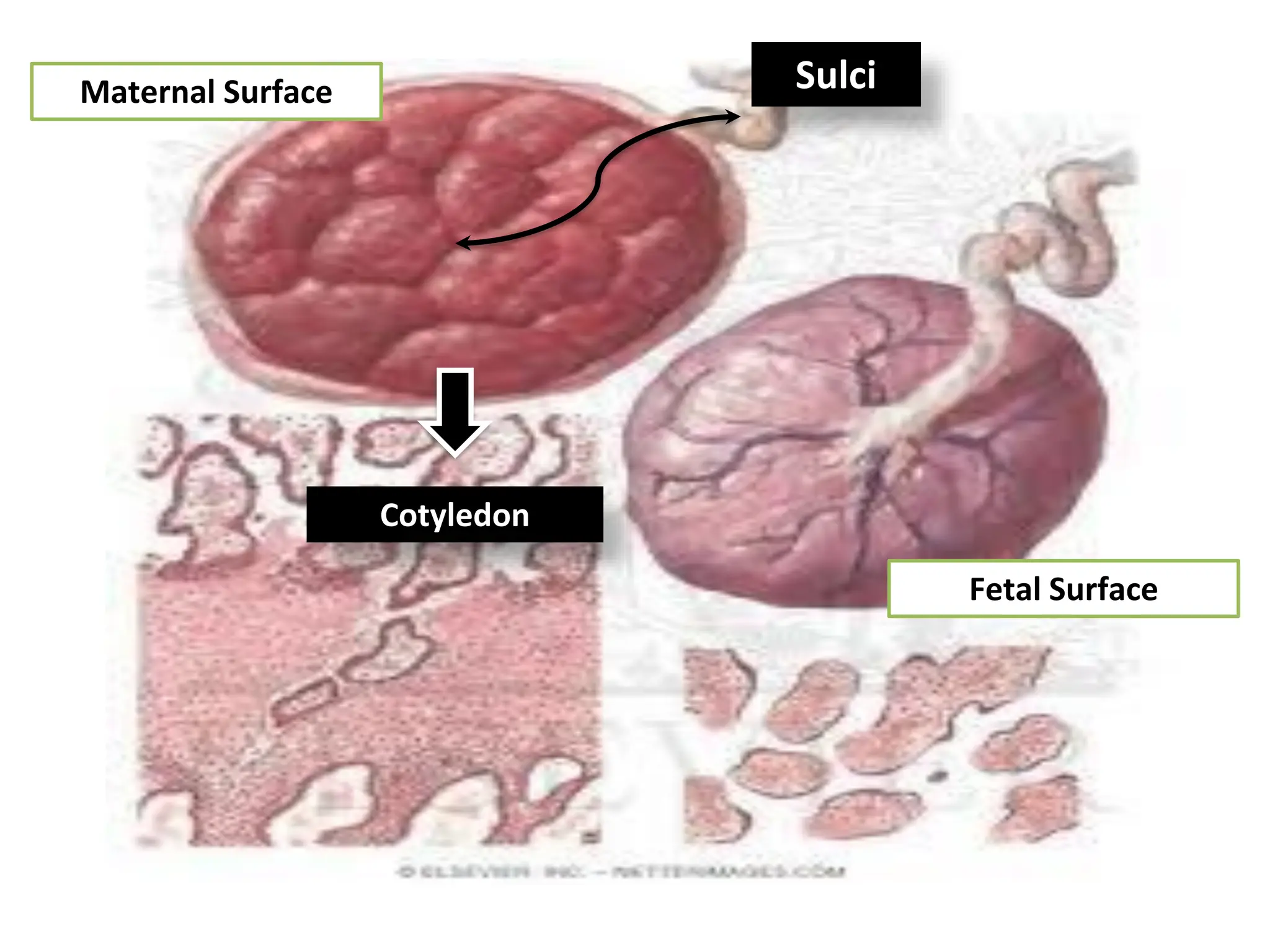
• 18-20 lobules or
cotyledons consisting of
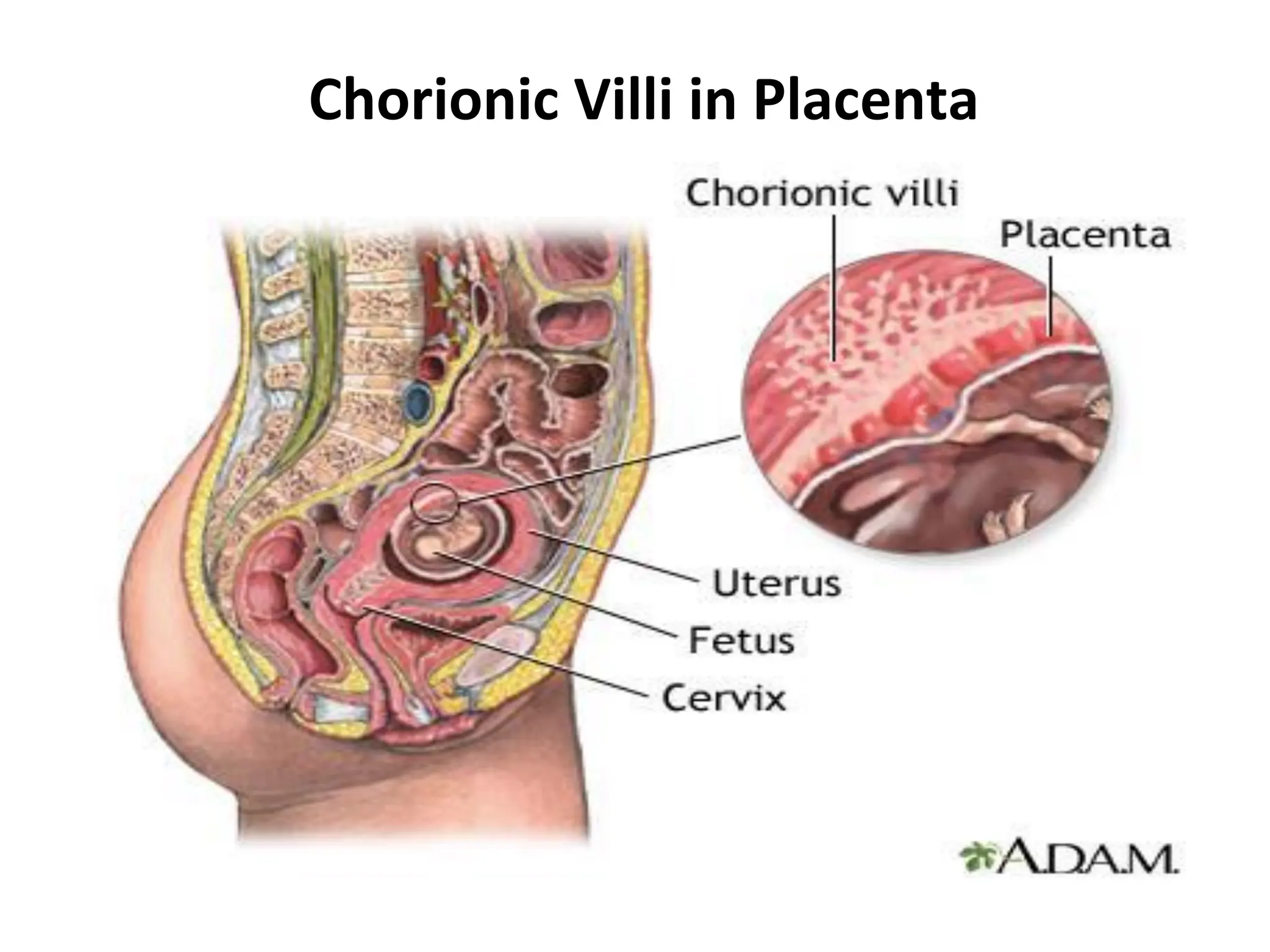
chorionic villi.
• Sulci in between the
lobules.
• Dark red in colour.
Placenta Surface:
Maternal Surface
Fetus Surface
Maternal Surface
Fetal Surface
Sulci
Cotyledon
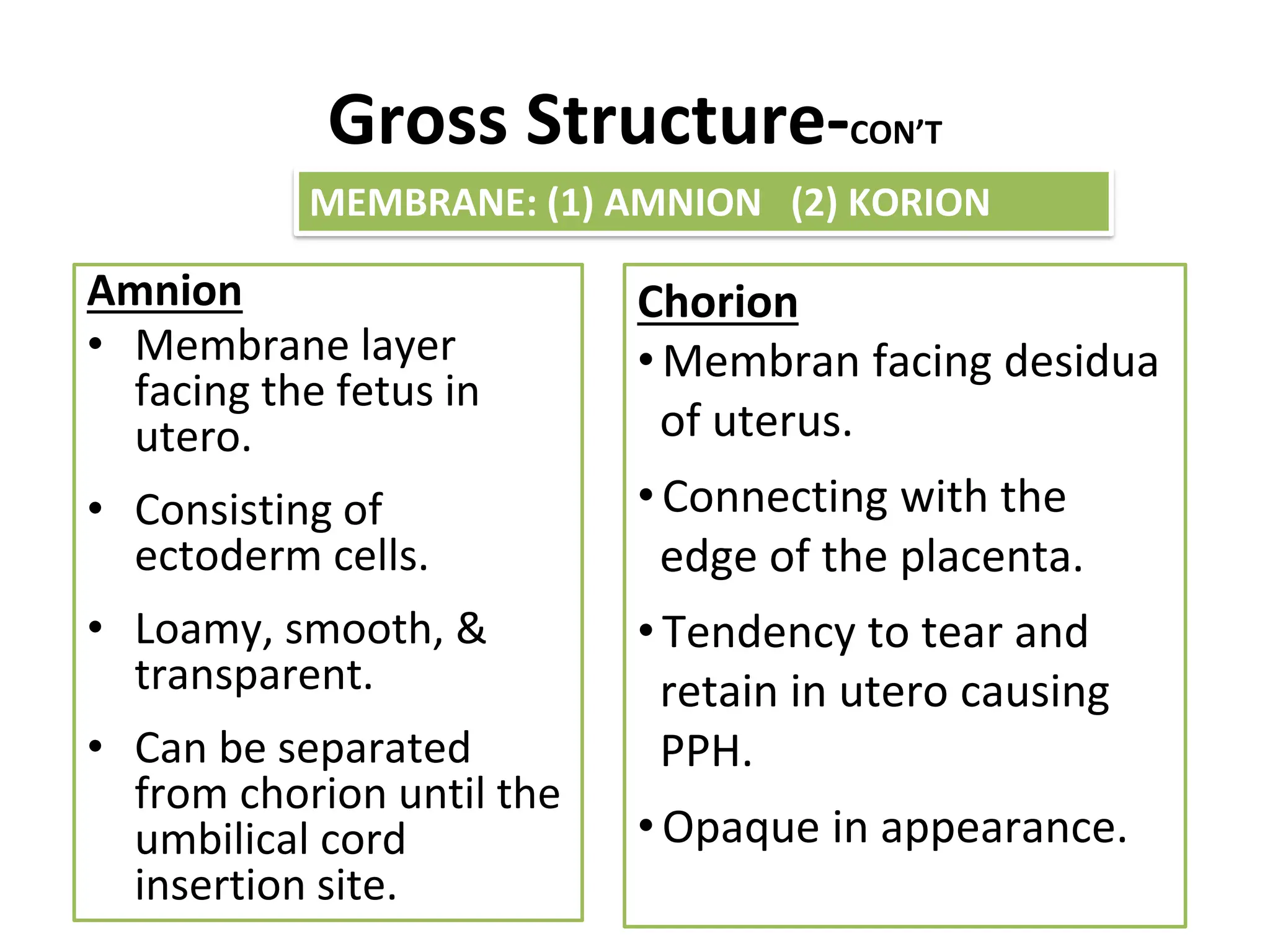
Gross Structure-CON’T
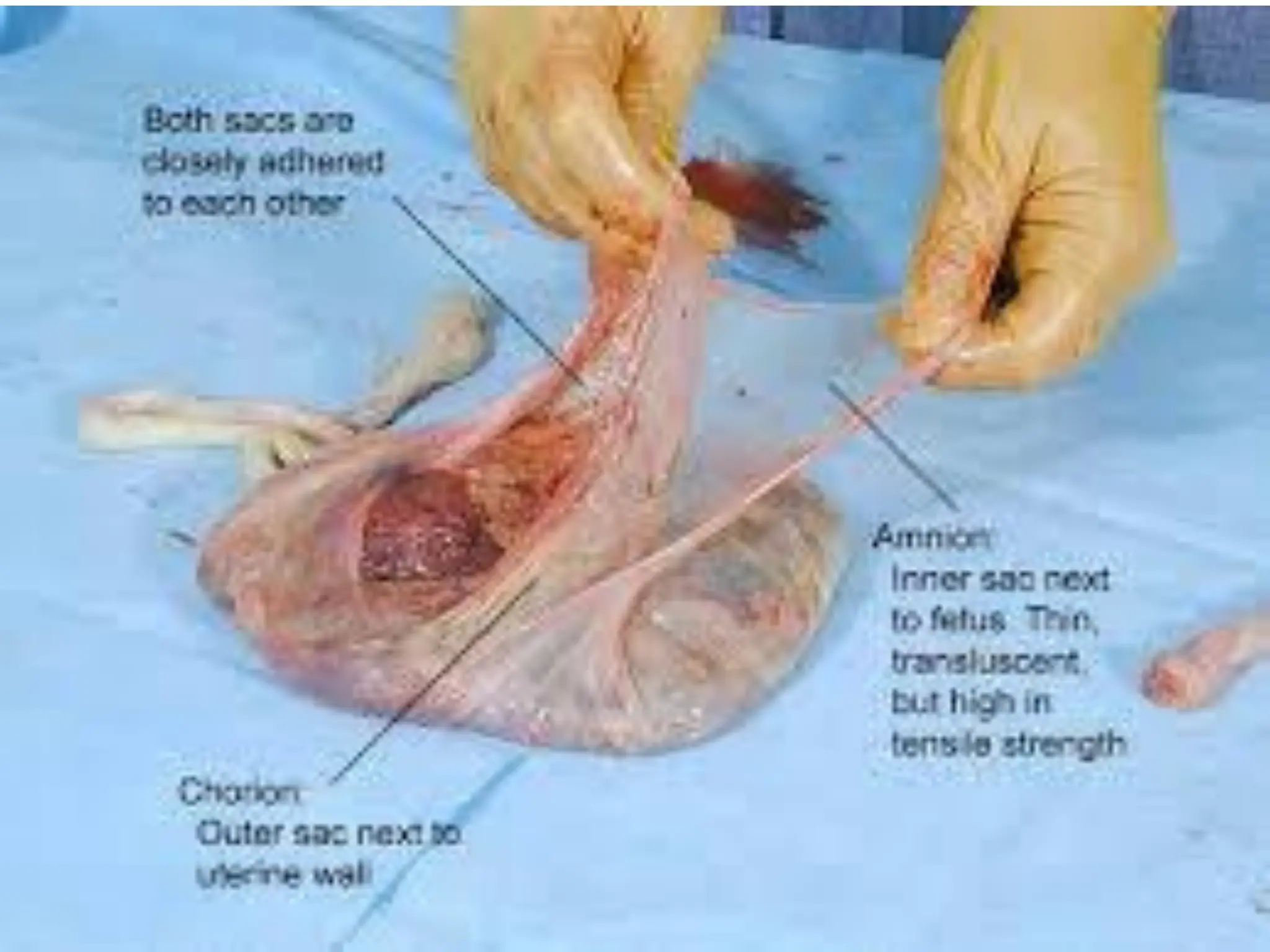
Amnion
• Membrane layer
facing the fetus in
utero.
• Consisting of
ectoderm cells.
• Loamy, smooth, &
transparent.
• Can be separated
from chorion until the
umbilical cord
insertion site.
Chorion
• Membran facing desidua
of uterus.
• Connecting with the
edge of the placenta.
• Tendency to tear and
retain in utero causing
PPH.
• Opaque in appearance.
MEMBRANE: (1) AMNION (2) KORION
Placenta At Term
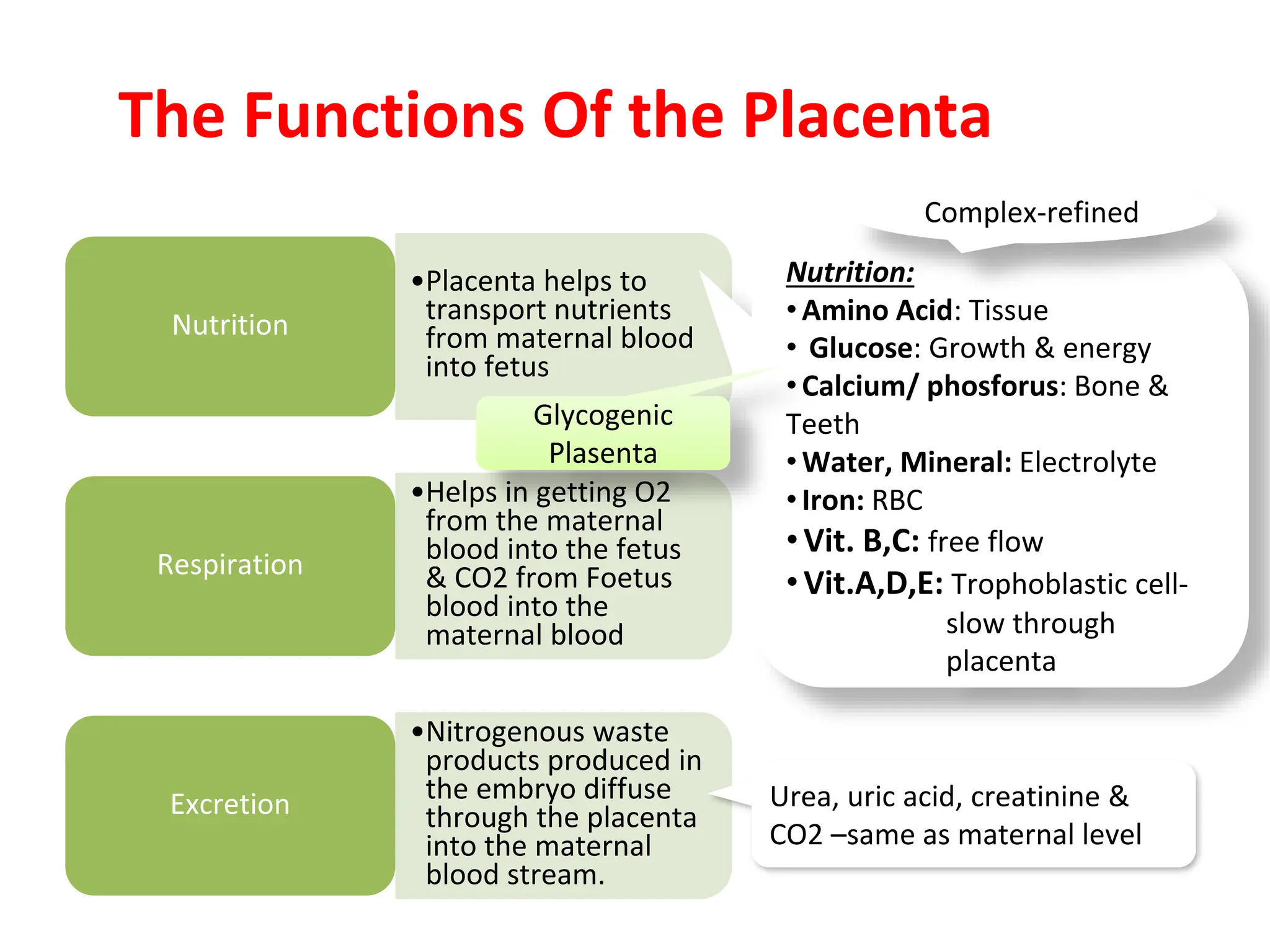
The Functions Of the Placenta
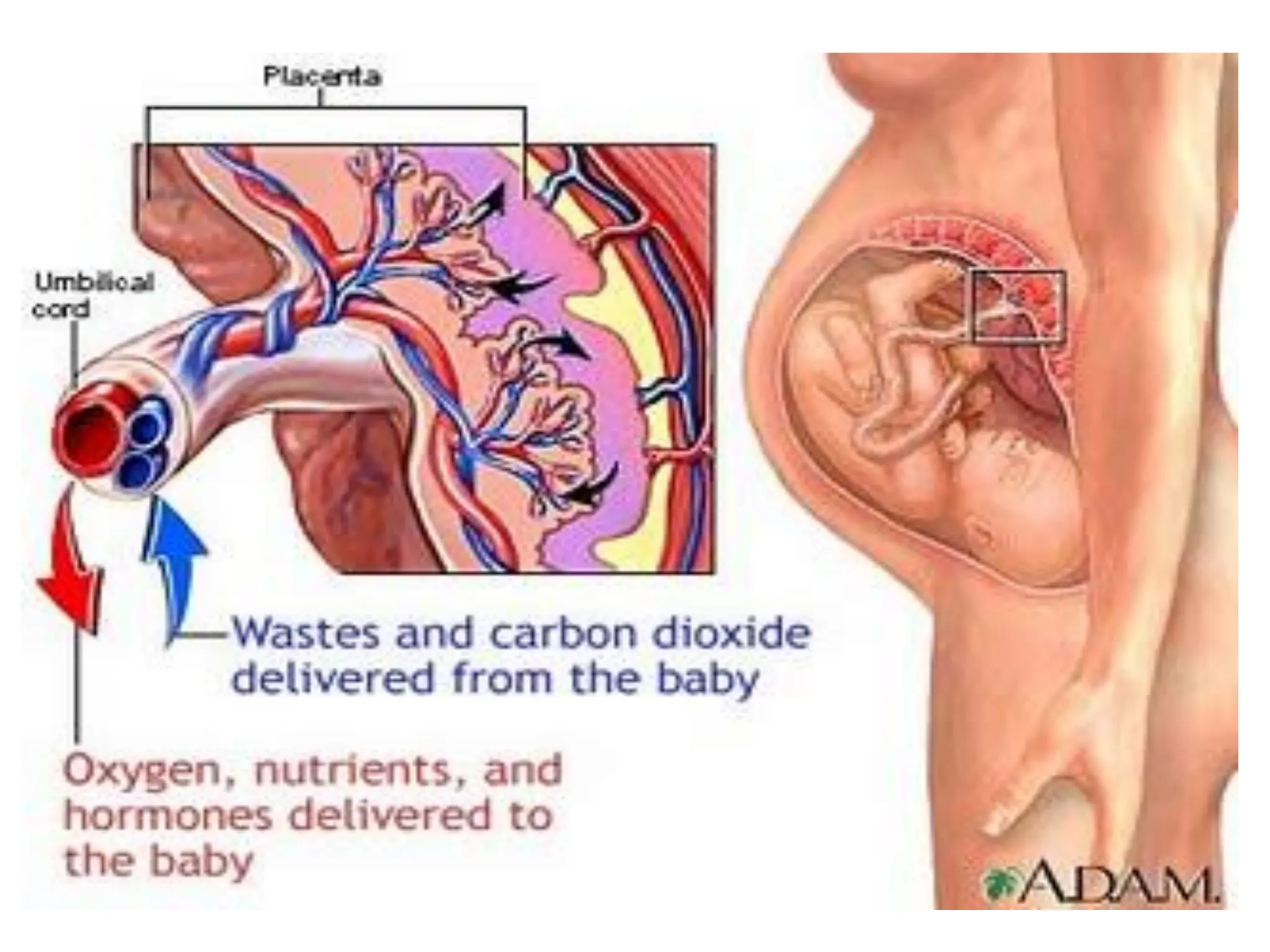
Nutrition
•Placenta helps to
transport nutrients
from maternal blood
into fetus
Respiration
•Helps in getting O2
from the maternal
blood into the fetus
& CO2 from Foetus
blood into the
maternal blood
Excretion
•Nitrogenous waste
products produced in
the embryo diffuse
through the placenta
into the maternal
blood stream.
Nutrition:
•Amino Acid: Tissue
• Glucose: Growth & energy
•Calcium/ phosforus: Bone &
Teeth
•Water, Mineral: Electrolyte
•Iron: RBC
•Vit. B,C: free flow
•Vit.A,D,E: Trophoblastic cell-
slow through
placenta
Glycogenic
Plasenta
Complex-refined
Urea, uric acid, creatinine &
CO2 –same as maternal level
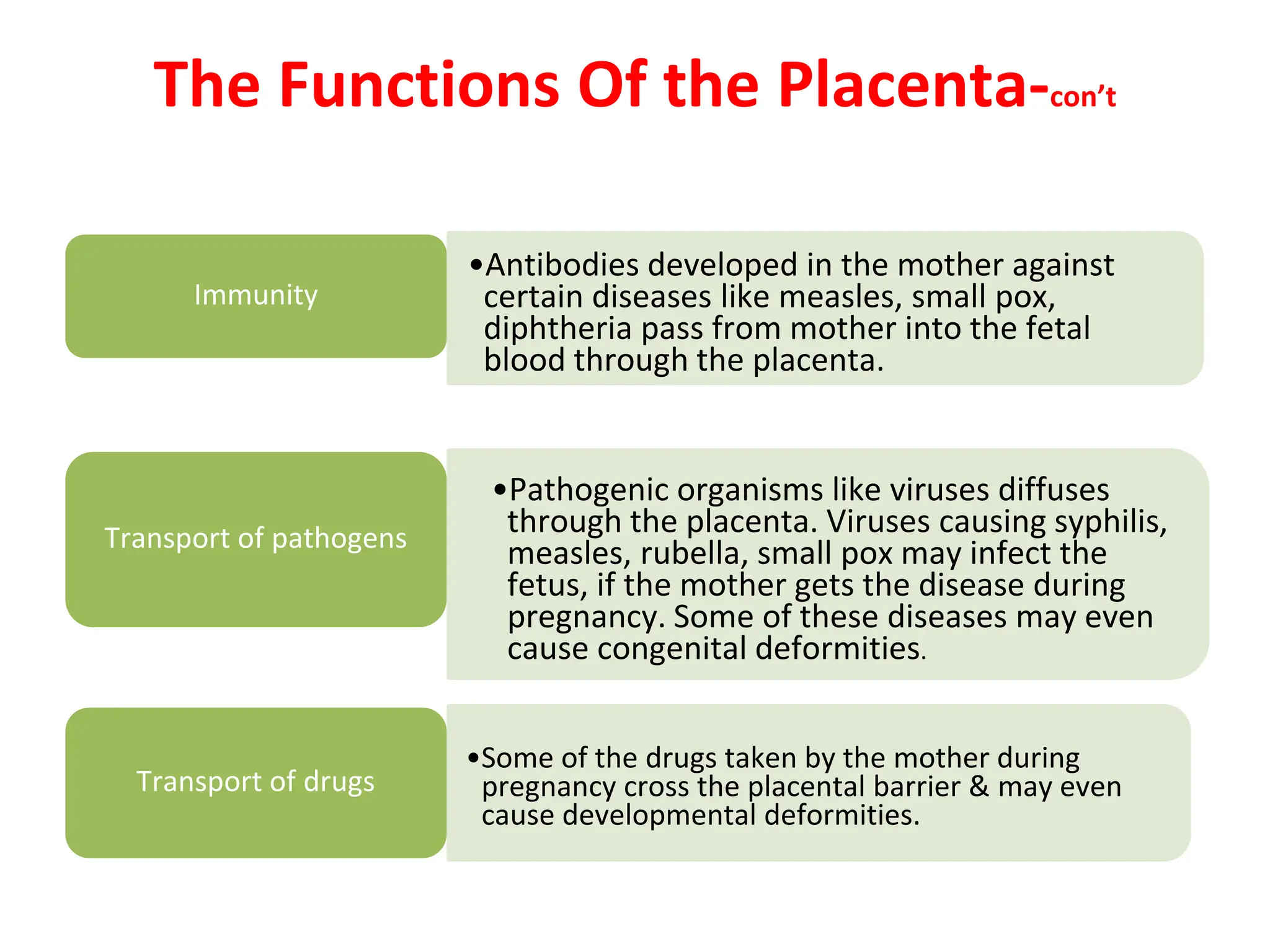
The Functions Of the Placenta-con’t
Immunity
•Antibodies developed in the mother against
certain diseases like measles, small pox,
diphtheria pass from mother into the fetal
blood through the placenta.
Transport of pathogens
•Pathogenic organisms like viruses diffuses
through the placenta. Viruses causing syphilis,
measles, rubella, small pox may infect the
fetus, if the mother gets the disease during
pregnancy. Some of these diseases may even
cause congenital deformities.
Transport of drugs
•Some of the drugs taken by the mother during
pregnancy cross the placental barrier & may even
cause developmental deformities.
The Functions Of the Placenta-con’t
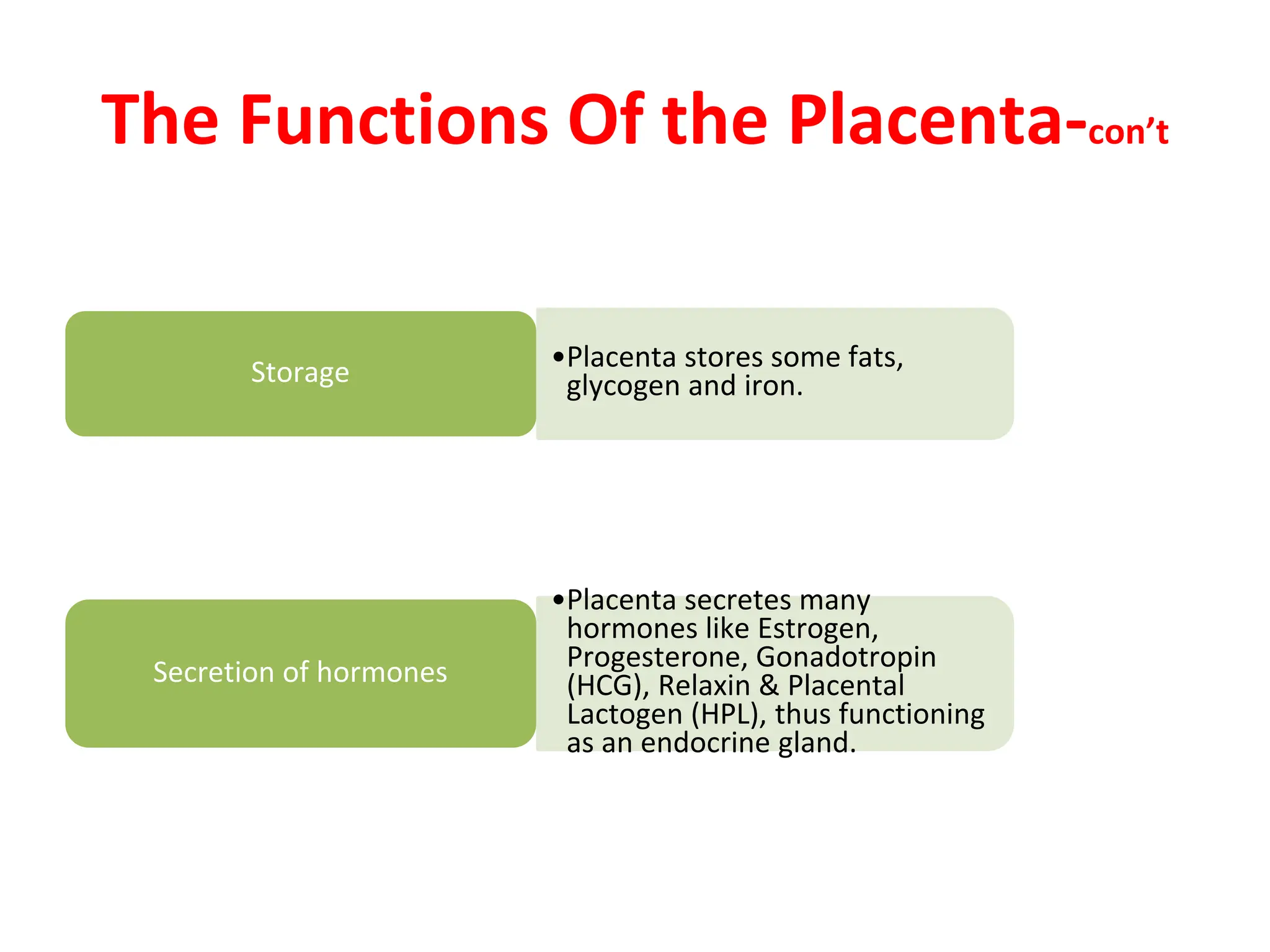
Storage •Placenta stores some fats,
glycogen and iron.
Secretion of hormones
•Placenta secretes many
hormones like Estrogen,
Progesterone, Gonadotropin
(HCG), Relaxin & Placental
Lactogen (HPL), thus functioning
as an endocrine gland.
Chorionic Villi in Placenta
Indication Of Examine Placenta
To check the completeness of
placenta and membranes.
To detect abnormalities which
might provide information about
any intrauterine problems.
Common Abnormalities & its significance
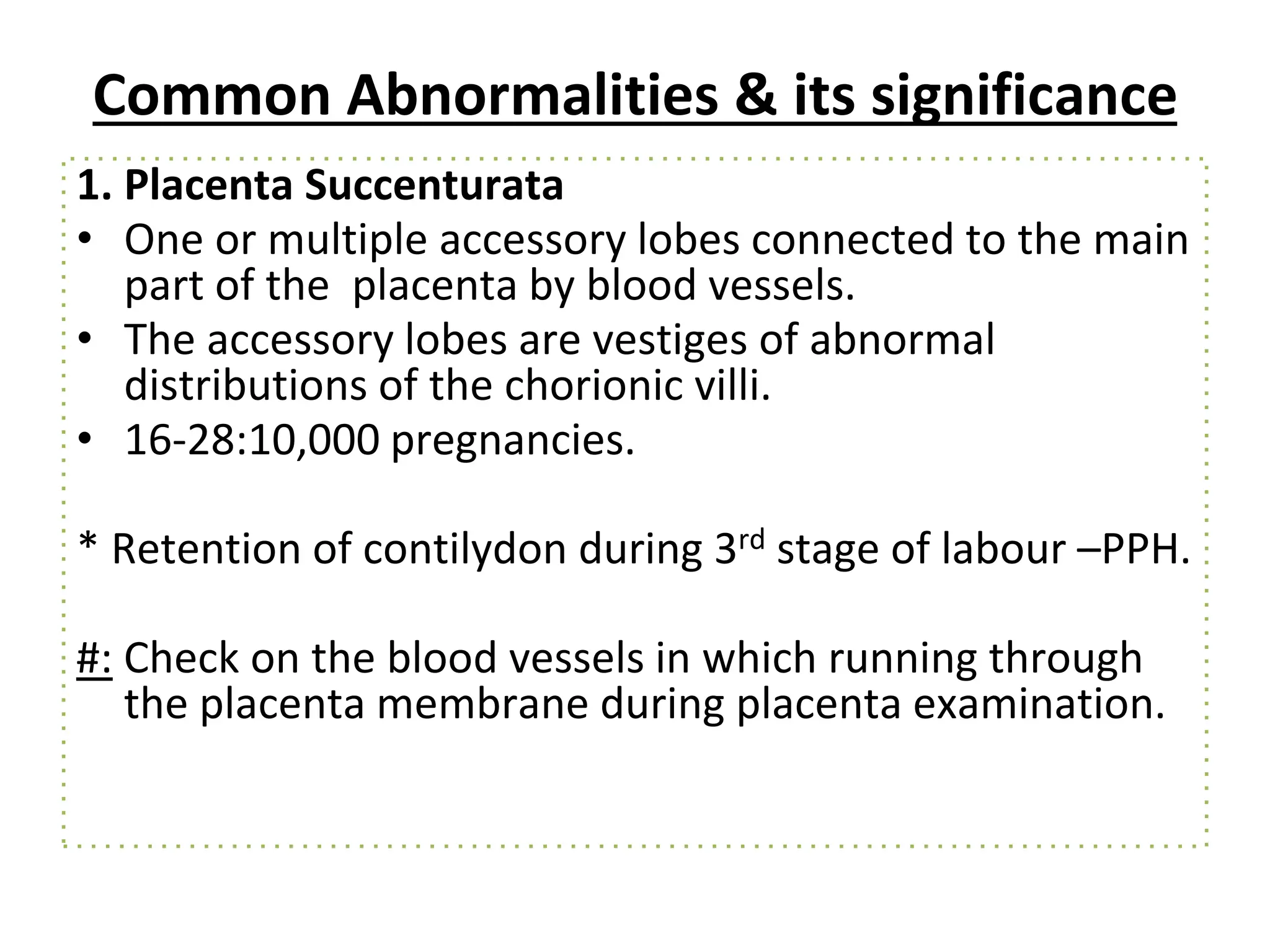
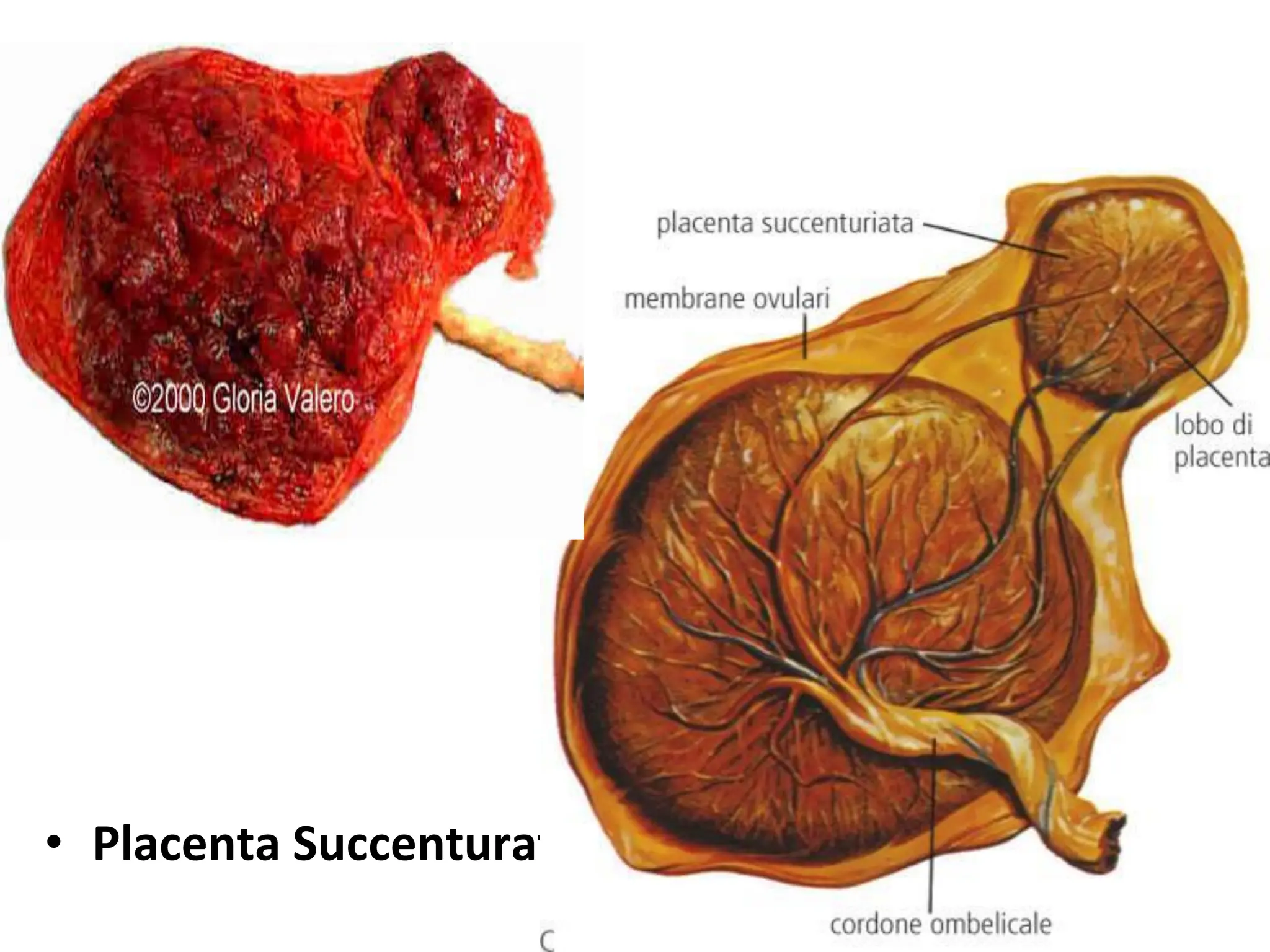
1. Placenta Succenturata
• One or multiple accessory lobes connected to the main
part of the placenta by blood vessels.
• The accessory lobes are vestiges of abnormal
distributions of the chorionic villi.
• 16-28:10,000 pregnancies.
* Retention of contilydon during 3rd stage of labour –PPH.
#: Check on the blood vessels in which running through
the placenta membrane during placenta examination.
• Placenta Succenturata
Abnormal Placenta-con’t
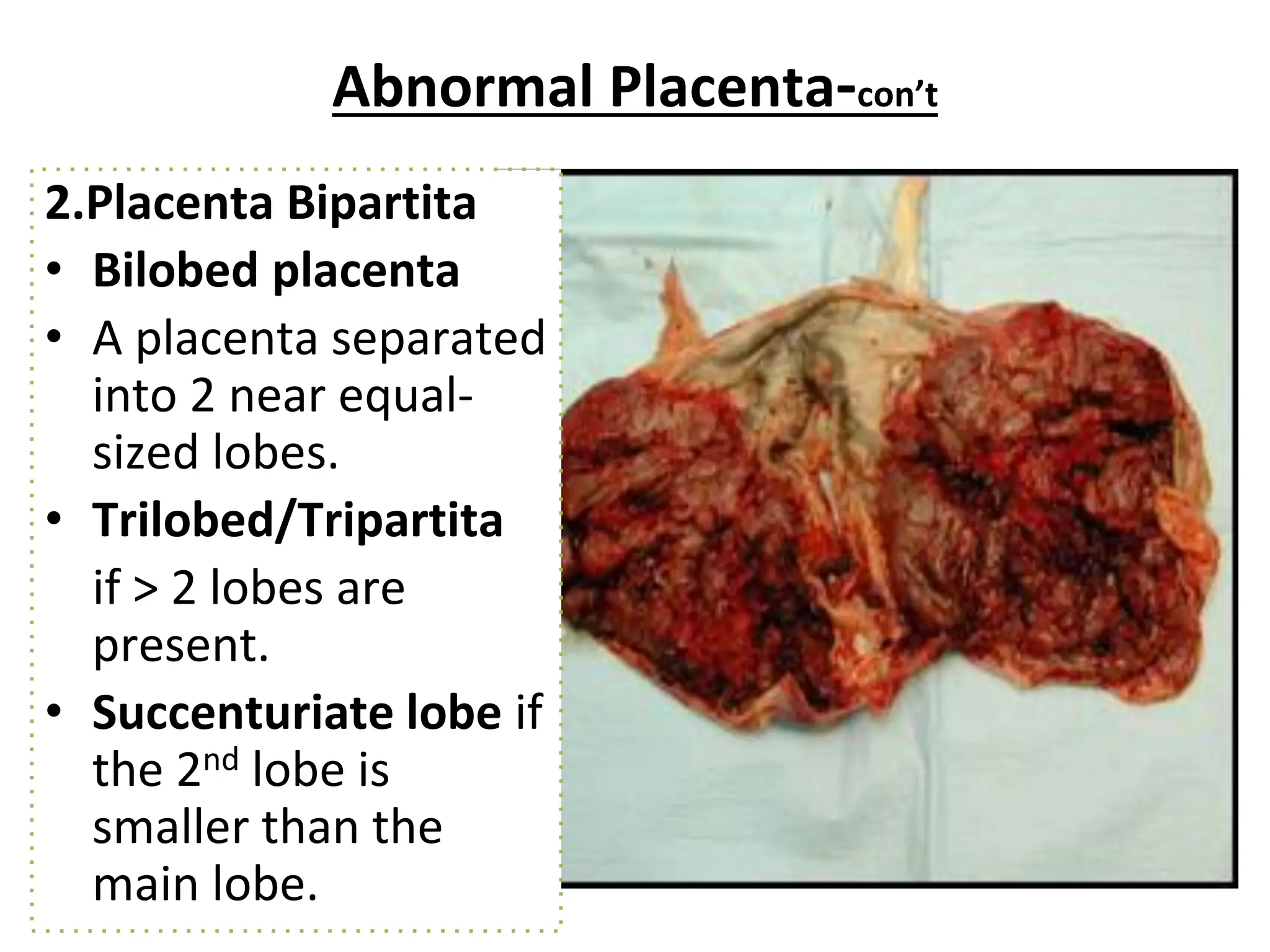
2.Placenta Bipartita
• Bilobed placenta
• A placenta separated
into 2 near equal-
sized lobes.
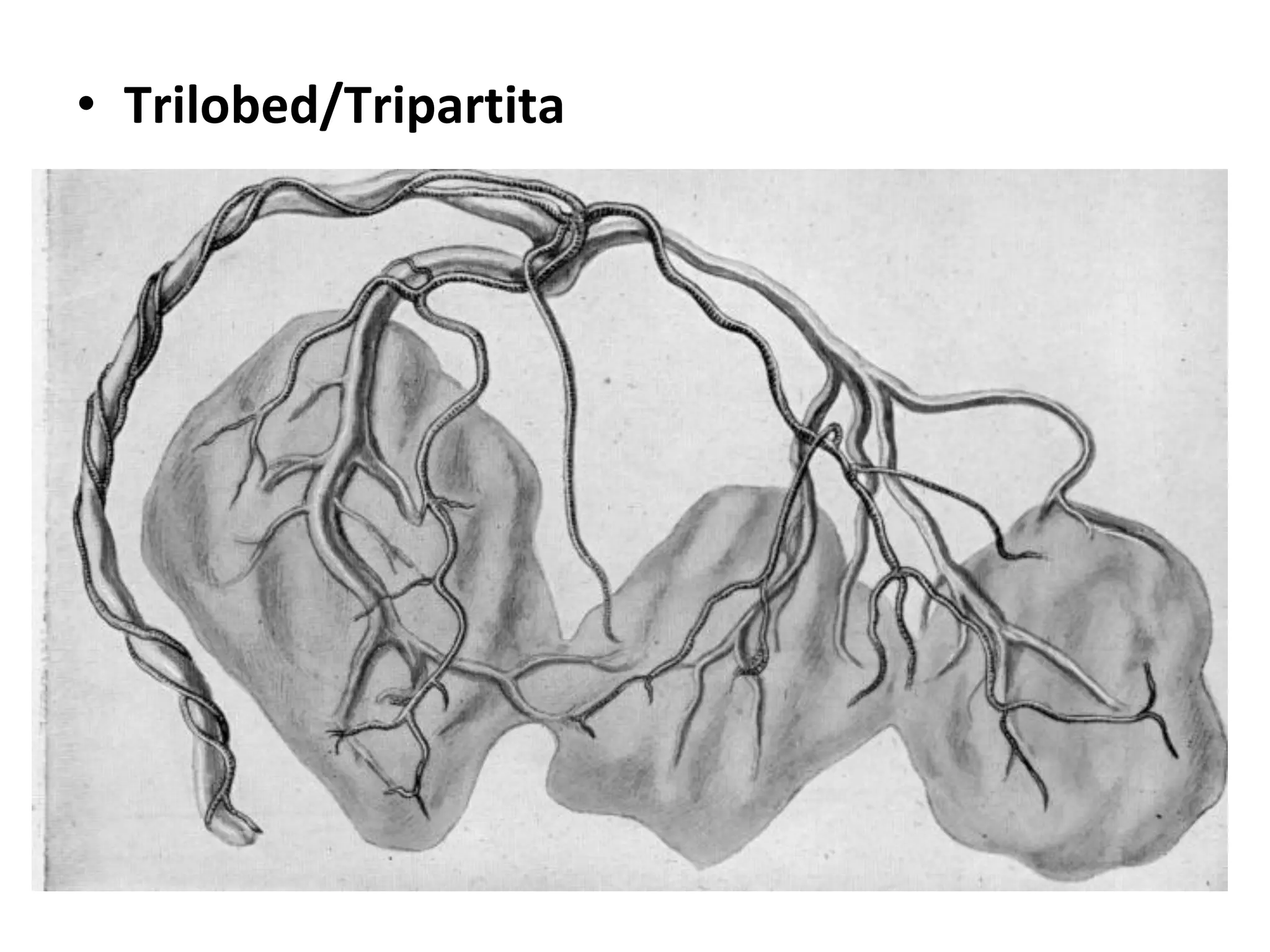
• Trilobed/Tripartita
if > 2 lobes are
present.
• Succenturiate lobe if
the 2nd lobe is
smaller than the
main lobe.
• Trilobed/Tripartita
Abnormal Placenta-con’t
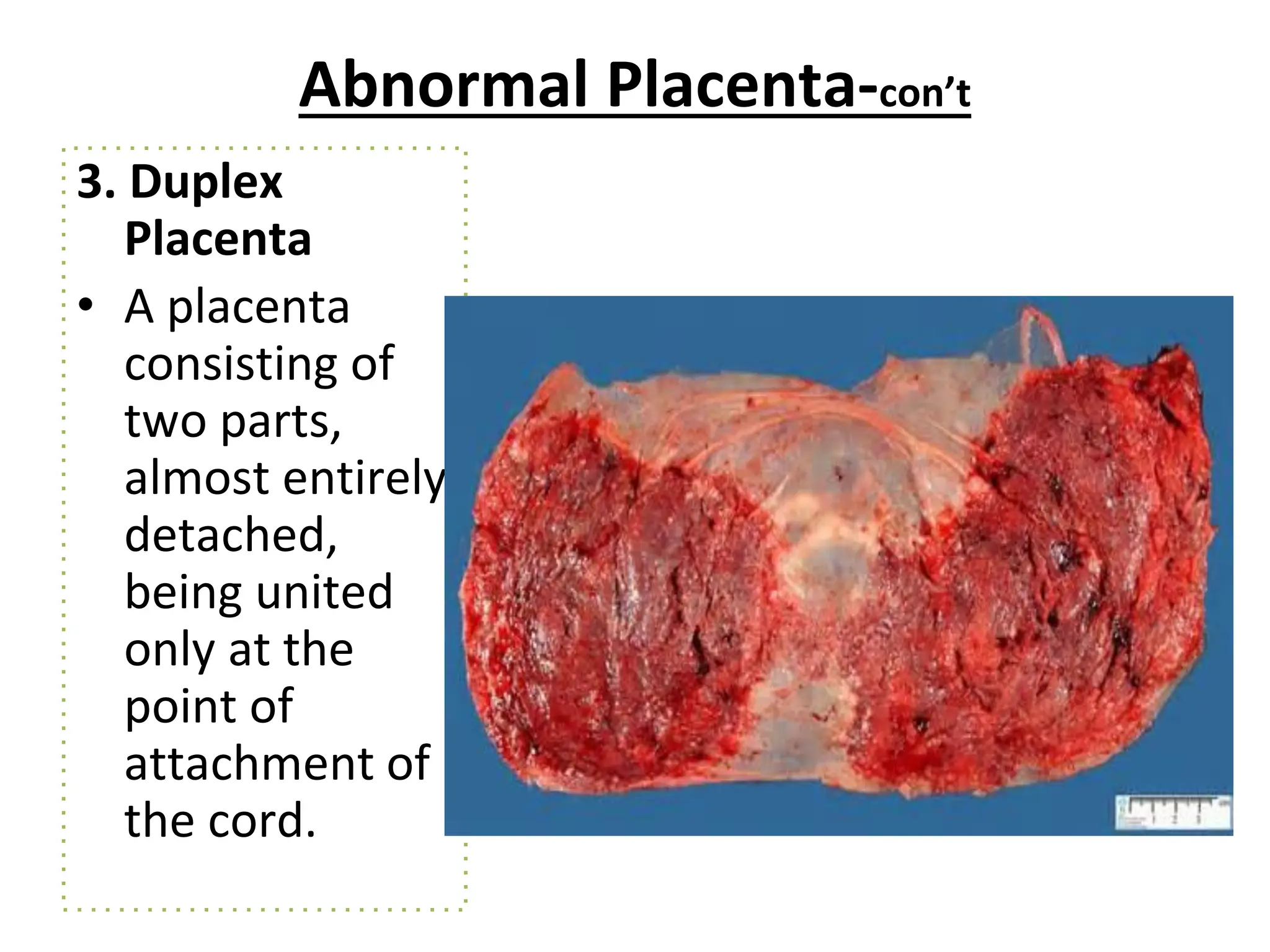
3. Duplex
Placenta
• A placenta
consisting of
two parts,
almost entirely
detached,
being united
only at the
point of
attachment of
the cord.
Abnormal Placenta-con’t
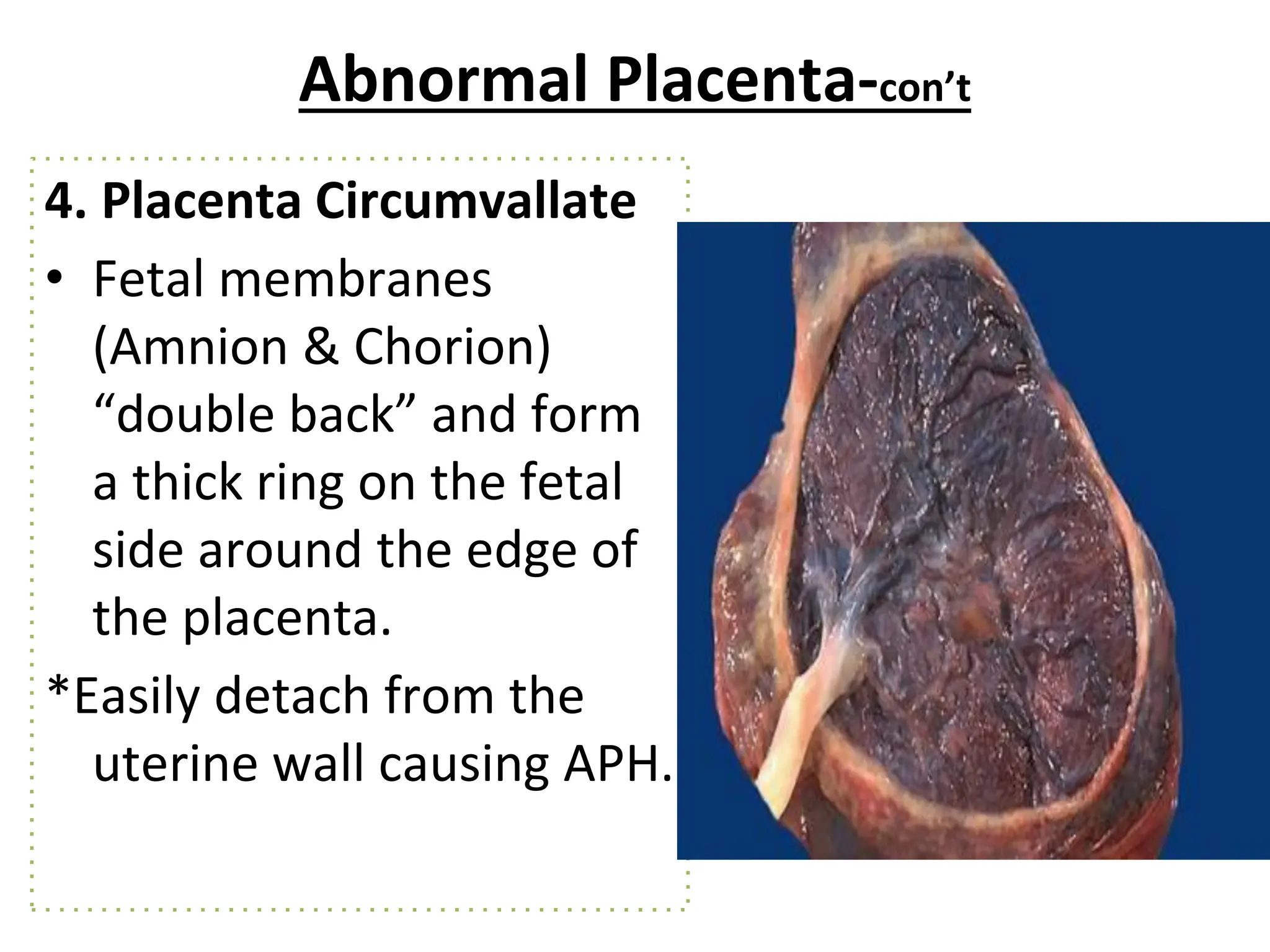
4. Placenta Circumvallate
• Fetal membranes
(Amnion & Chorion)
“double back” and form
a thick ring on the fetal
side around the edge of
the placenta.
*Easily detach from the
uterine wall causing APH.
Abnormal Placenta-con’t
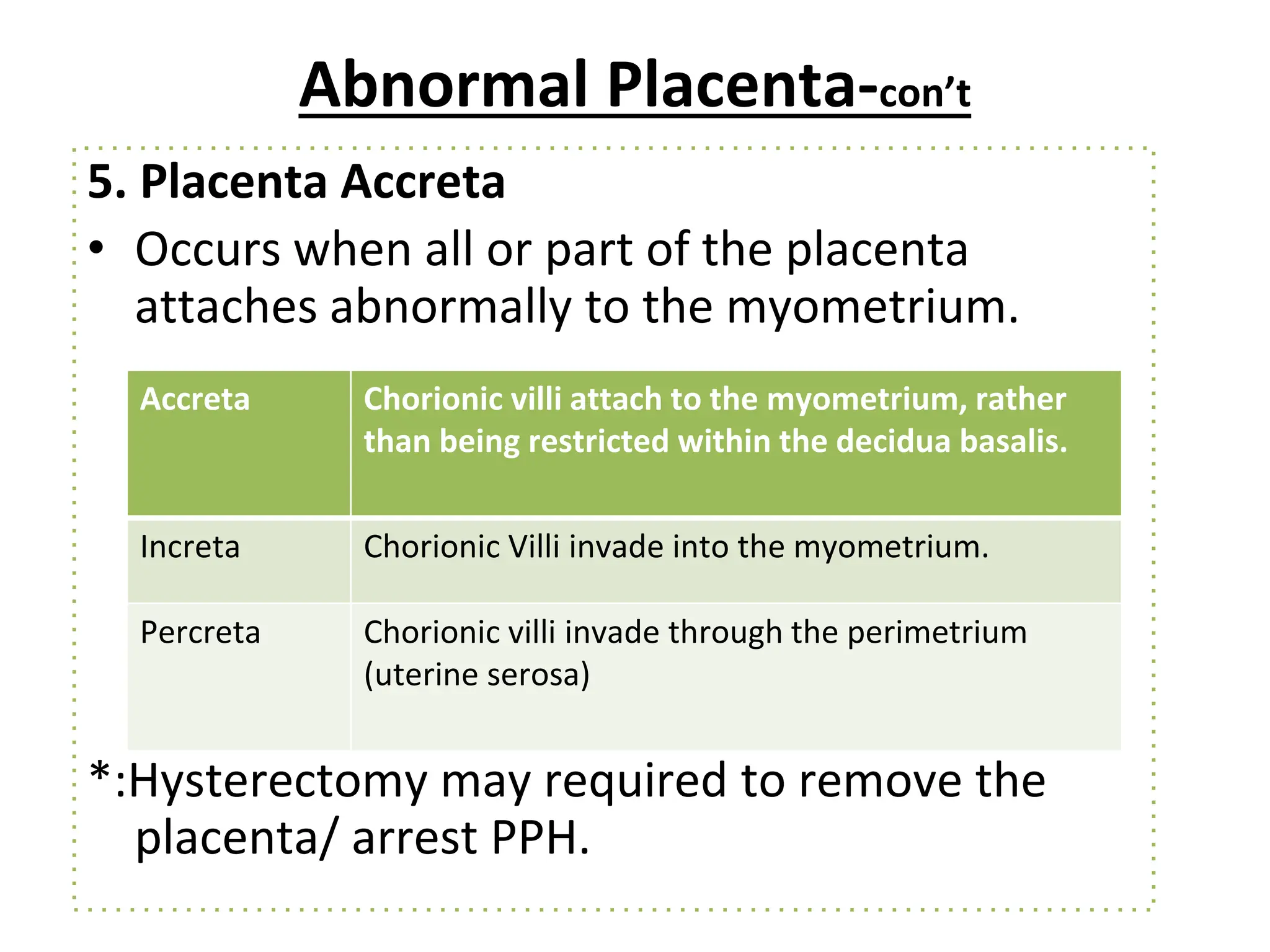
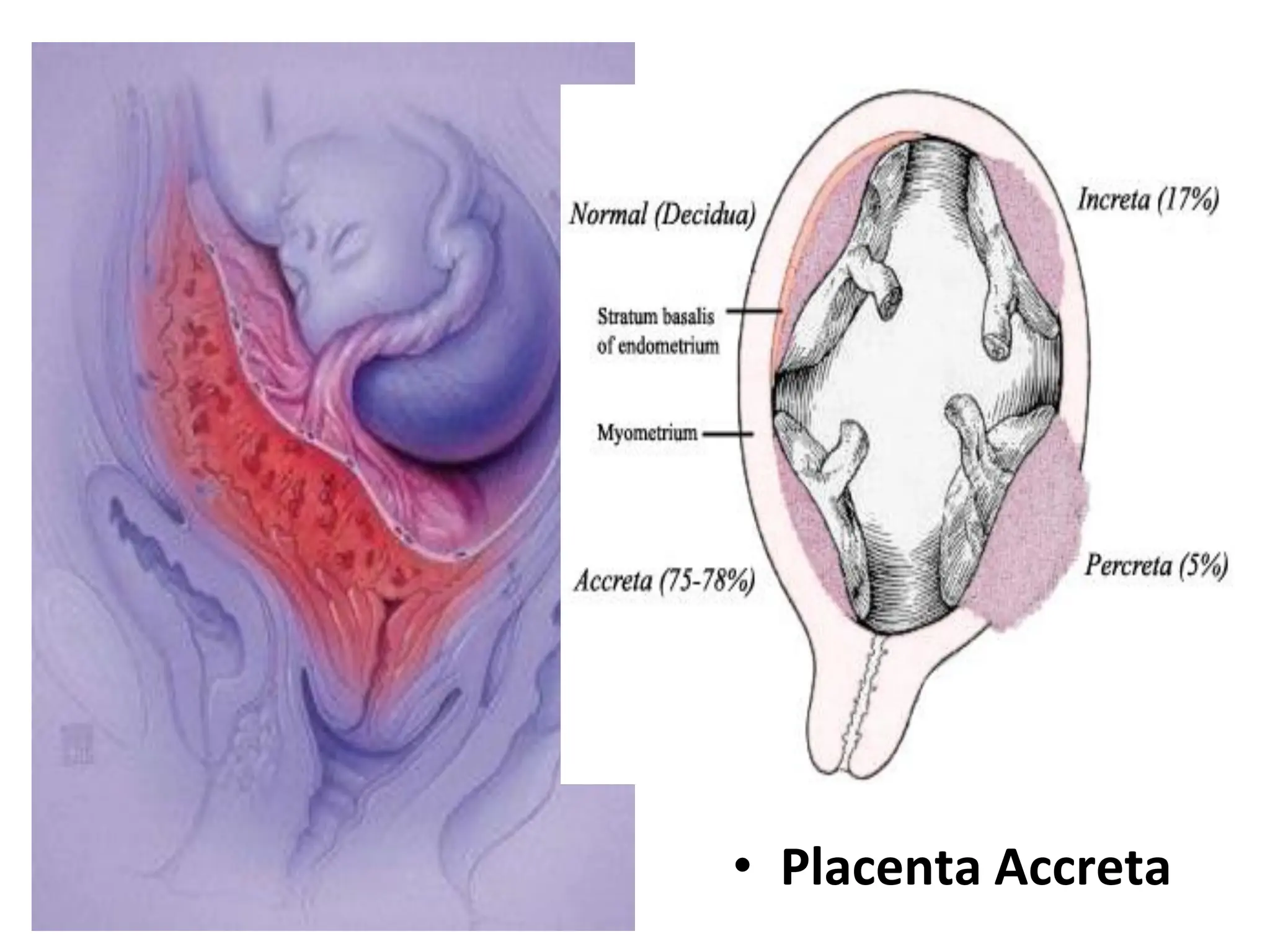
5. Placenta Accreta
• Occurs when all or part of the placenta
attaches abnormally to the myometrium.
*:Hysterectomy may required to remove the
placenta/ arrest PPH.
Accreta Chorionic villi attach to the myometrium, rather
than being restricted within the decidua basalis.
Increta Chorionic Villi invade into the myometrium.
Percreta Chorionic villi invade through the perimetrium
(uterine serosa)
• Placenta Accreta
Abnormal Placenta-con’t
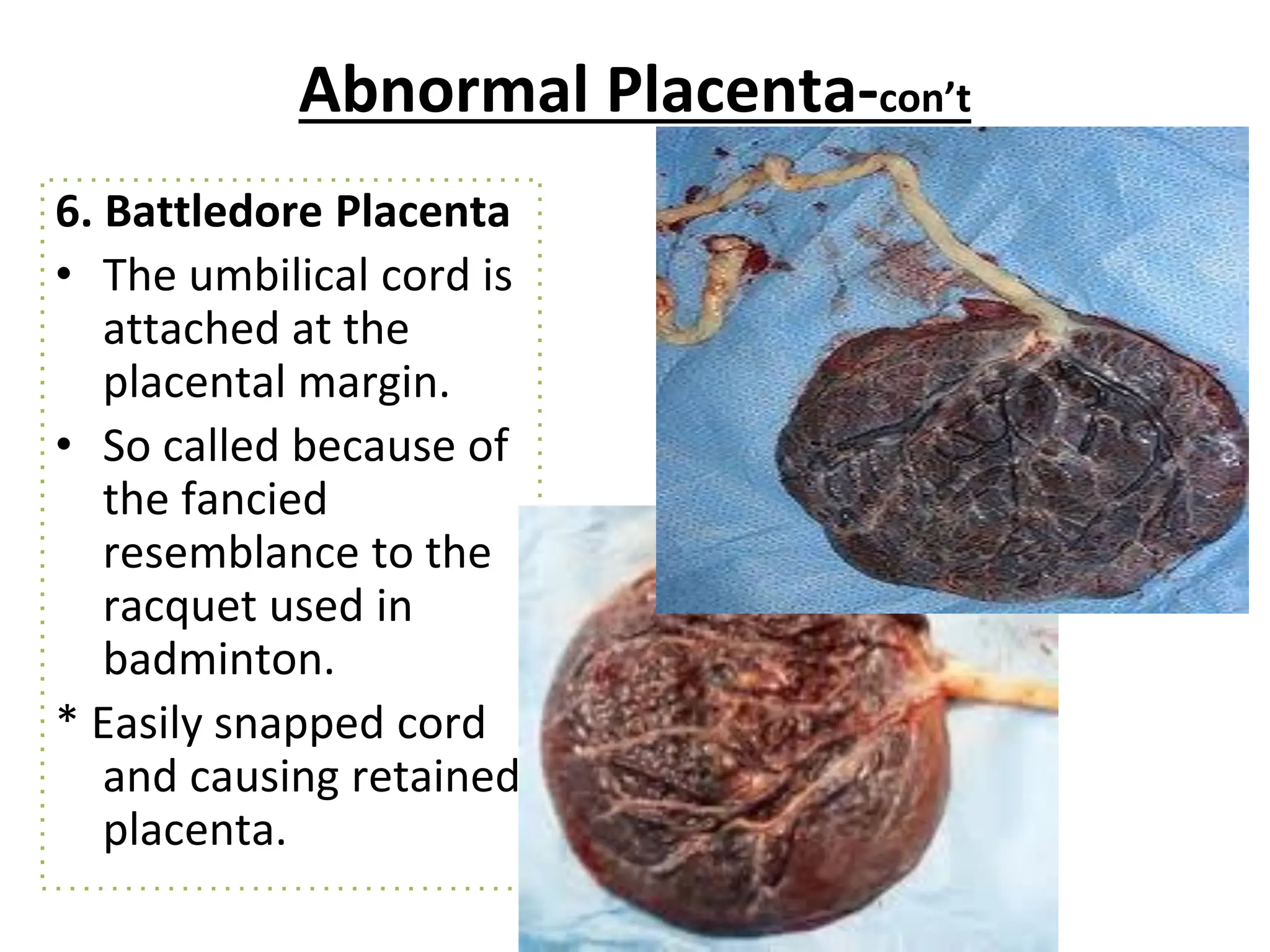
6. Battledore Placenta
• The umbilical cord is
attached at the
placental margin.
• So called because of
the fancied
resemblance to the
racquet used in
badminton.
* Easily snapped cord
and causing retained
placenta.
Abnormal Placenta-con’t
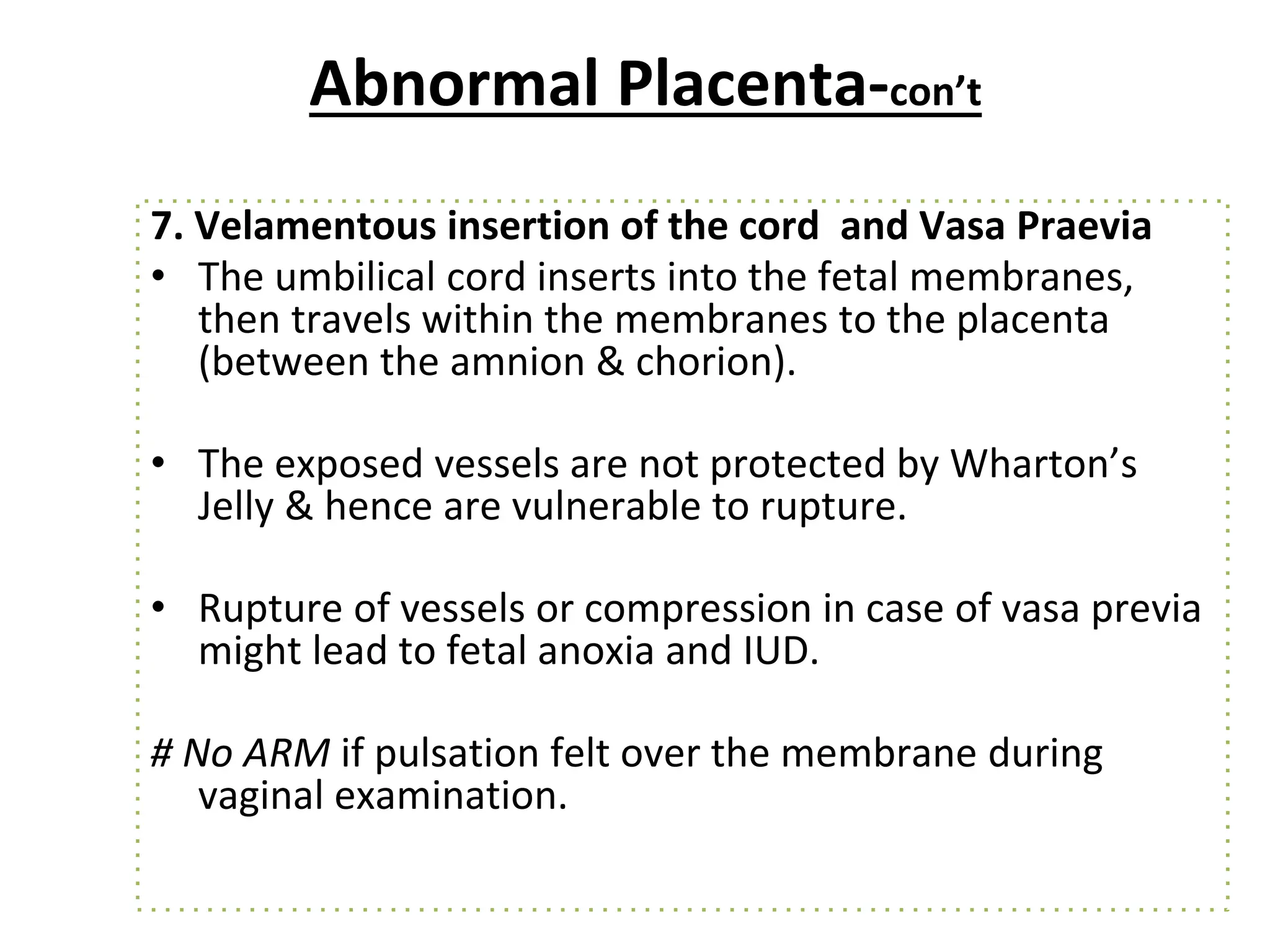
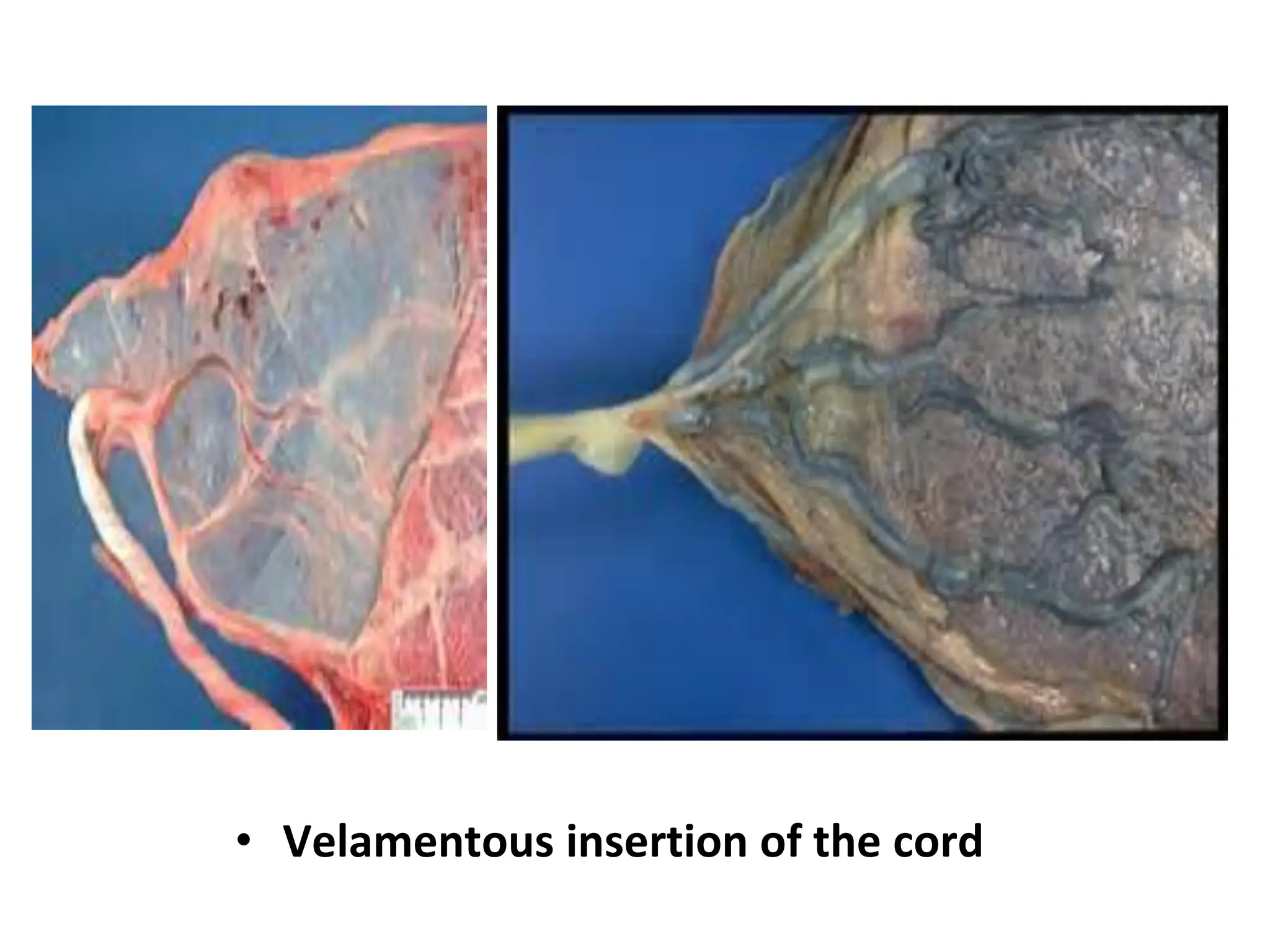
7. Velamentous insertion of the cord and Vasa Praevia
• The umbilical cord inserts into the fetal membranes,
then travels within the membranes to the placenta
(between the amnion & chorion).
• The exposed vessels are not protected by Wharton’s
Jelly & hence are vulnerable to rupture.
• Rupture of vessels or compression in case of vasa previa
might lead to fetal anoxia and IUD.
# No ARM if pulsation felt over the membrane during
vaginal examination.
Abnormal Placenta-con’t
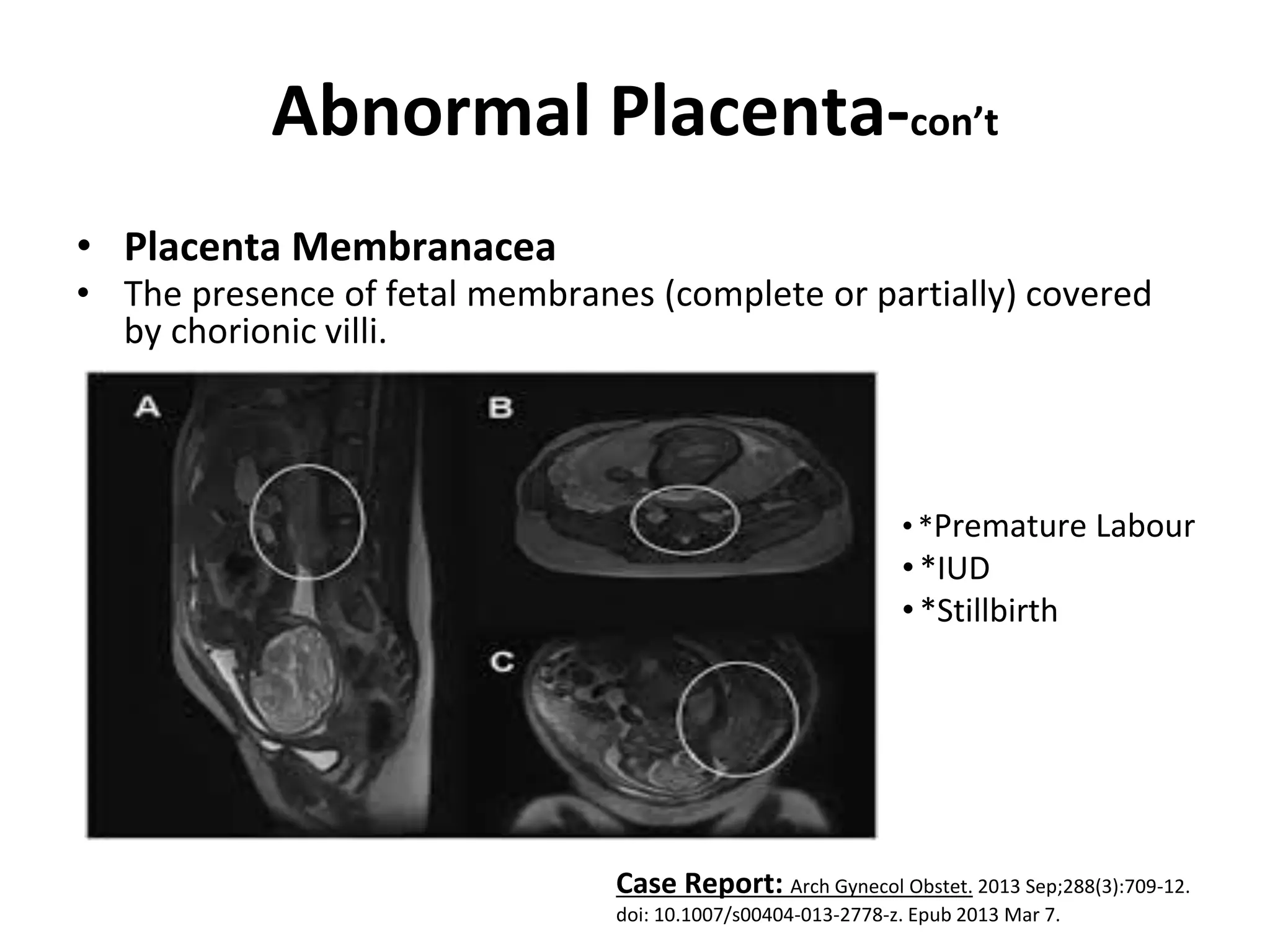
• Placenta Membranacea
• The presence of fetal membranes (complete or partially) covered
by chorionic villi.
Case Report: Arch Gynecol Obstet. 2013 Sep;288(3):709-12.
doi: 10.1007/s00404-013-2778-z. Epub 2013 Mar 7.
• *Premature Labour
•*IUD
•*Stillbirth
• Velamentous insertion of the cord
Abnormal Placenta
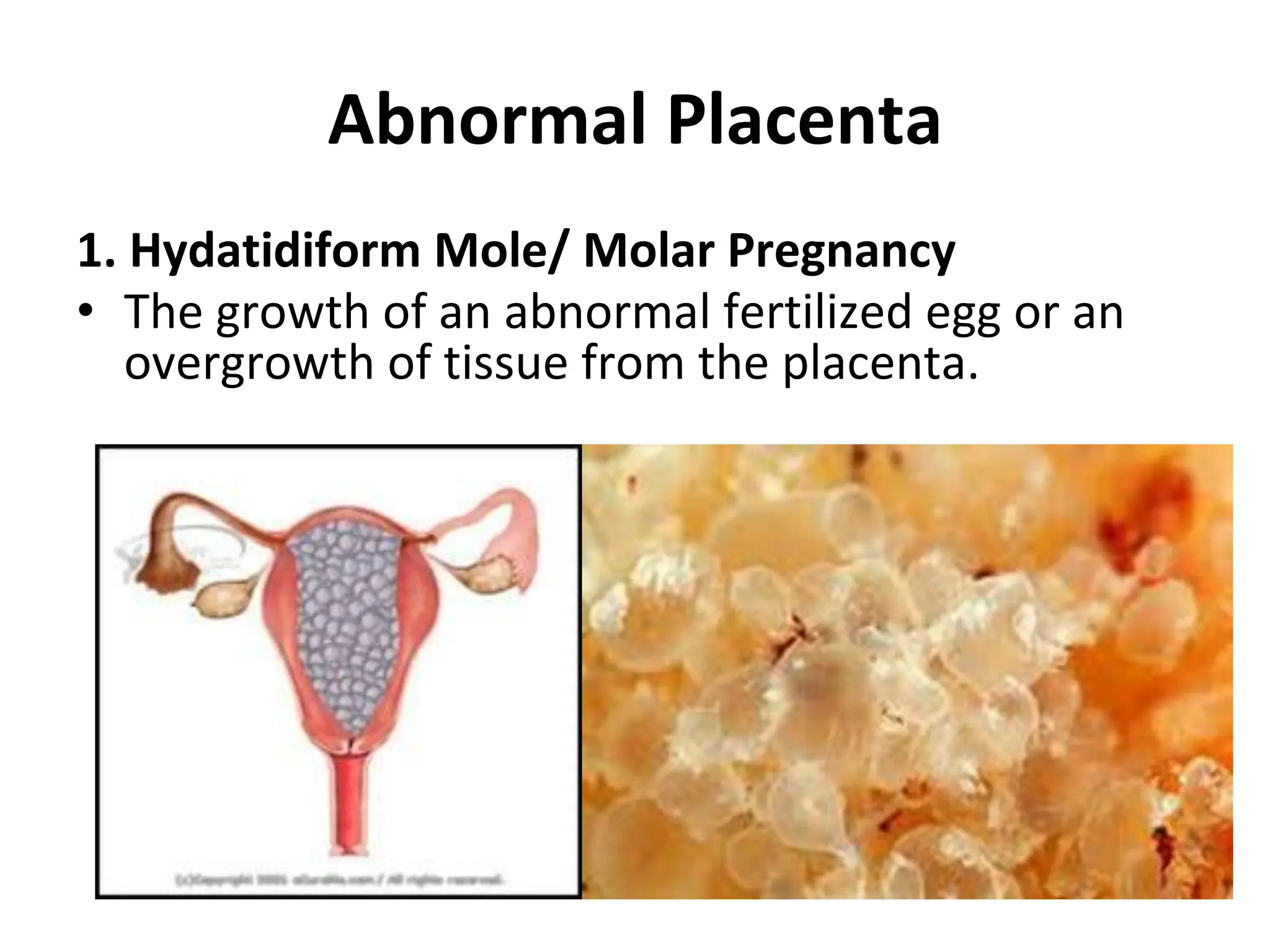
1. Hydatidiform Mole/ Molar Pregnancy
• The growth of an abnormal fertilized egg or an
overgrowth of tissue from the placenta.
Abnormal Placenta-con’t
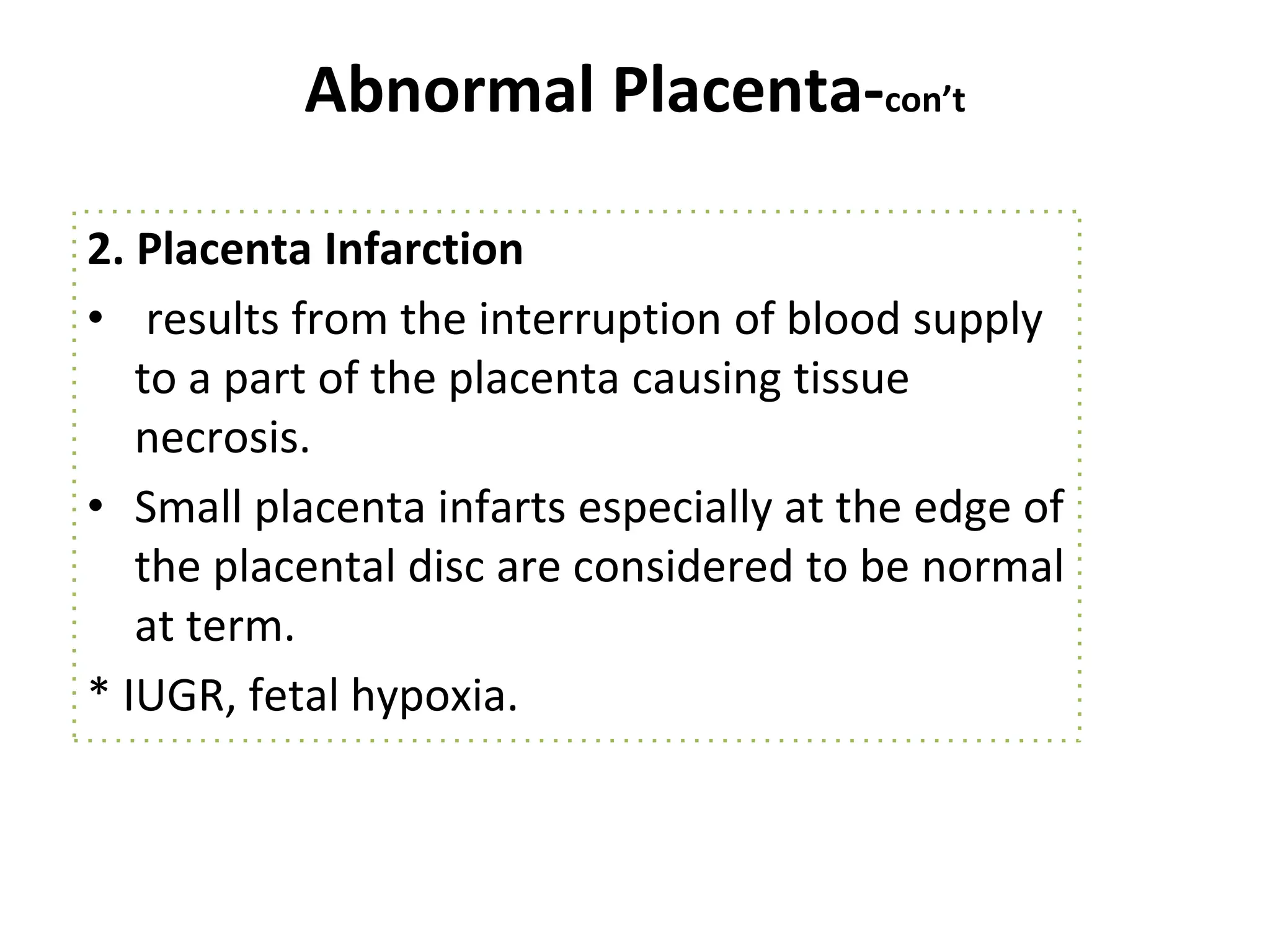
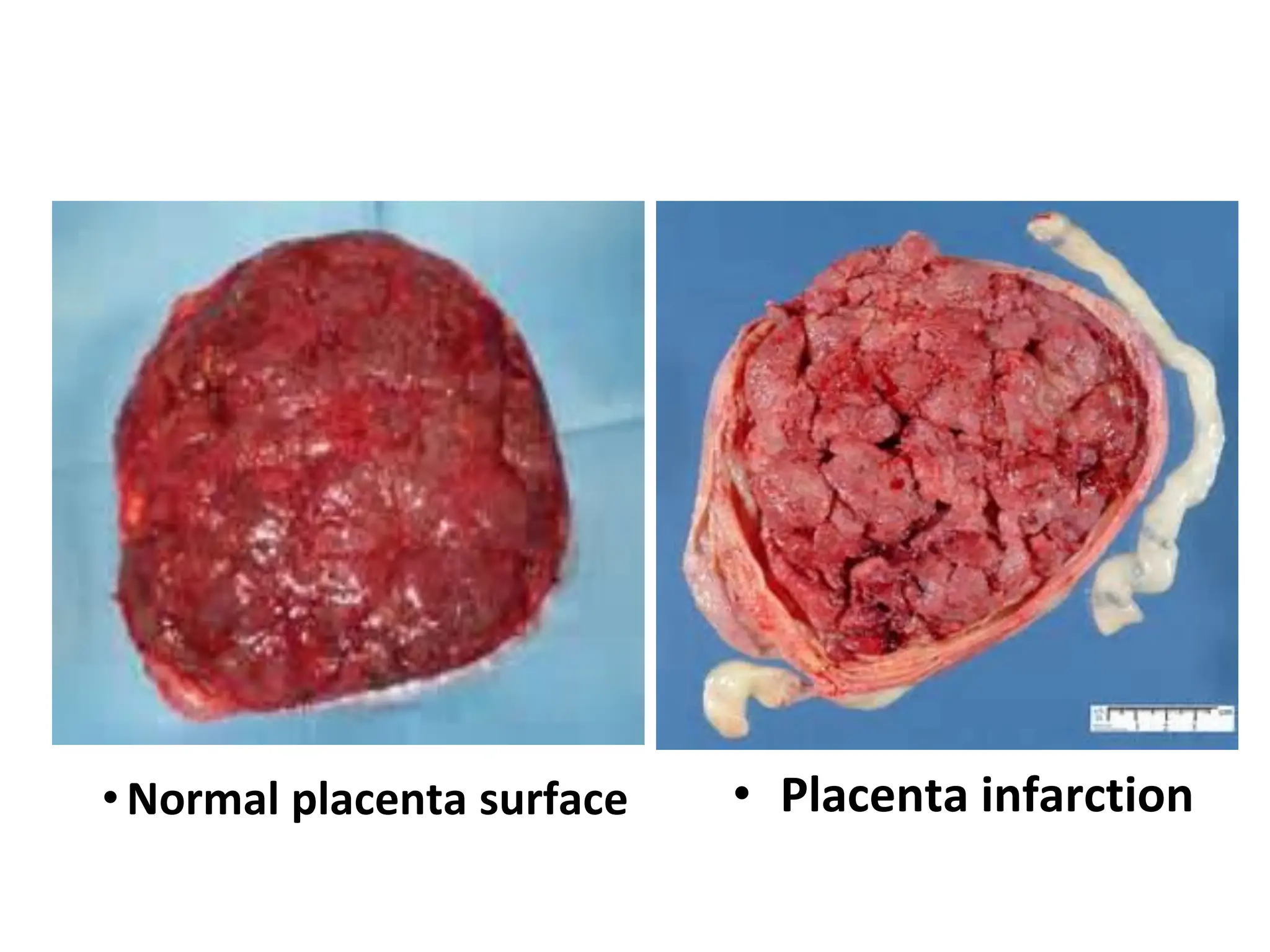
2. Placenta Infarction
• results from the interruption of blood supply
to a part of the placenta causing tissue
necrosis.
• Small placenta infarts especially at the edge of
the placental disc are considered to be normal
at term.
* IUGR, fetal hypoxia.
• Placenta infarction
• Normal placenta surface
Abnormal Placenta-con’t
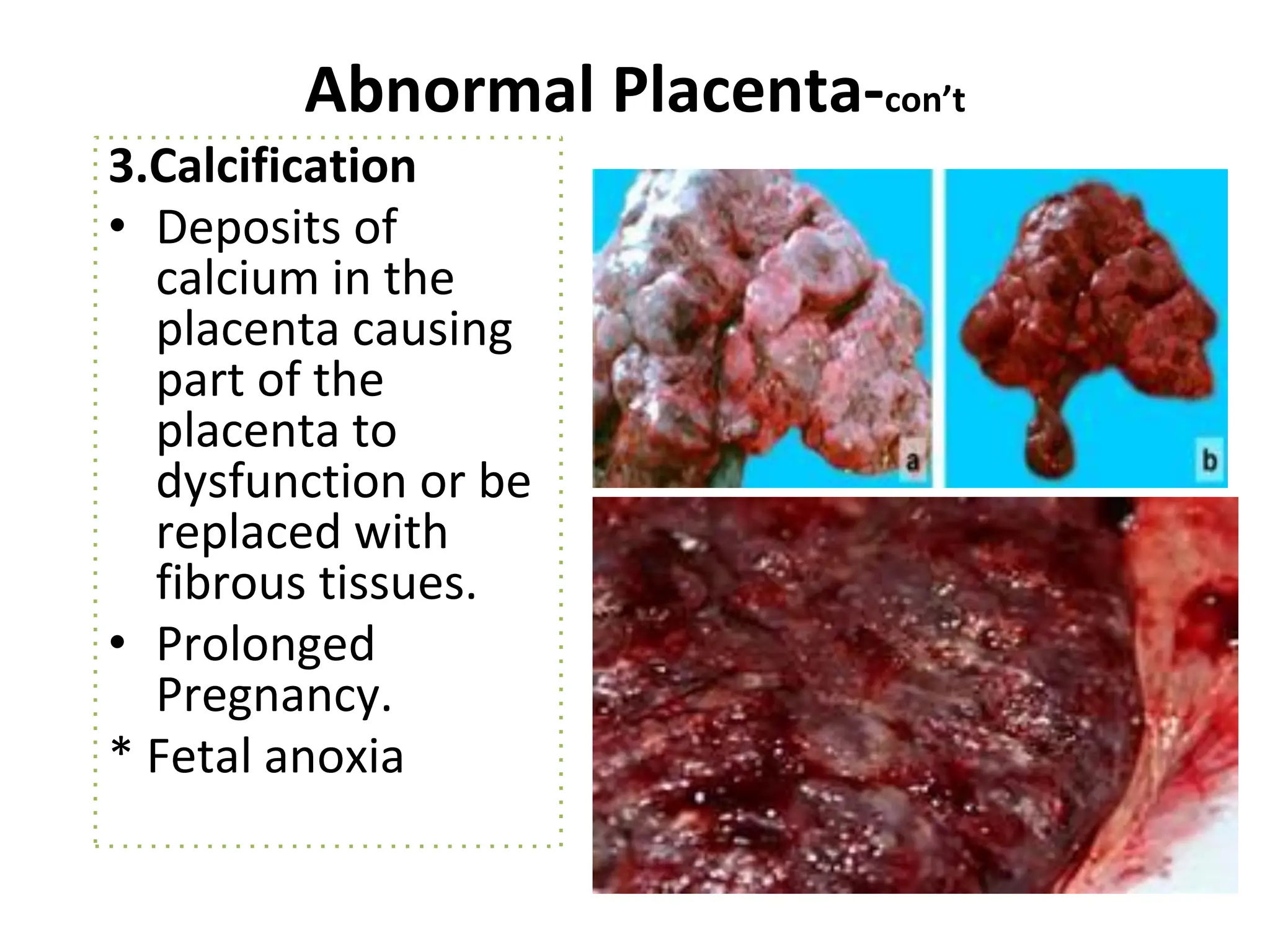
3.Calcification
• Deposits of
calcium in the
placenta causing
part of the
placenta to
dysfunction or be
replaced with
fibrous tissues.
• Prolonged
Pregnancy.
* Fetal anoxia
Abnormal Placenta-con’t
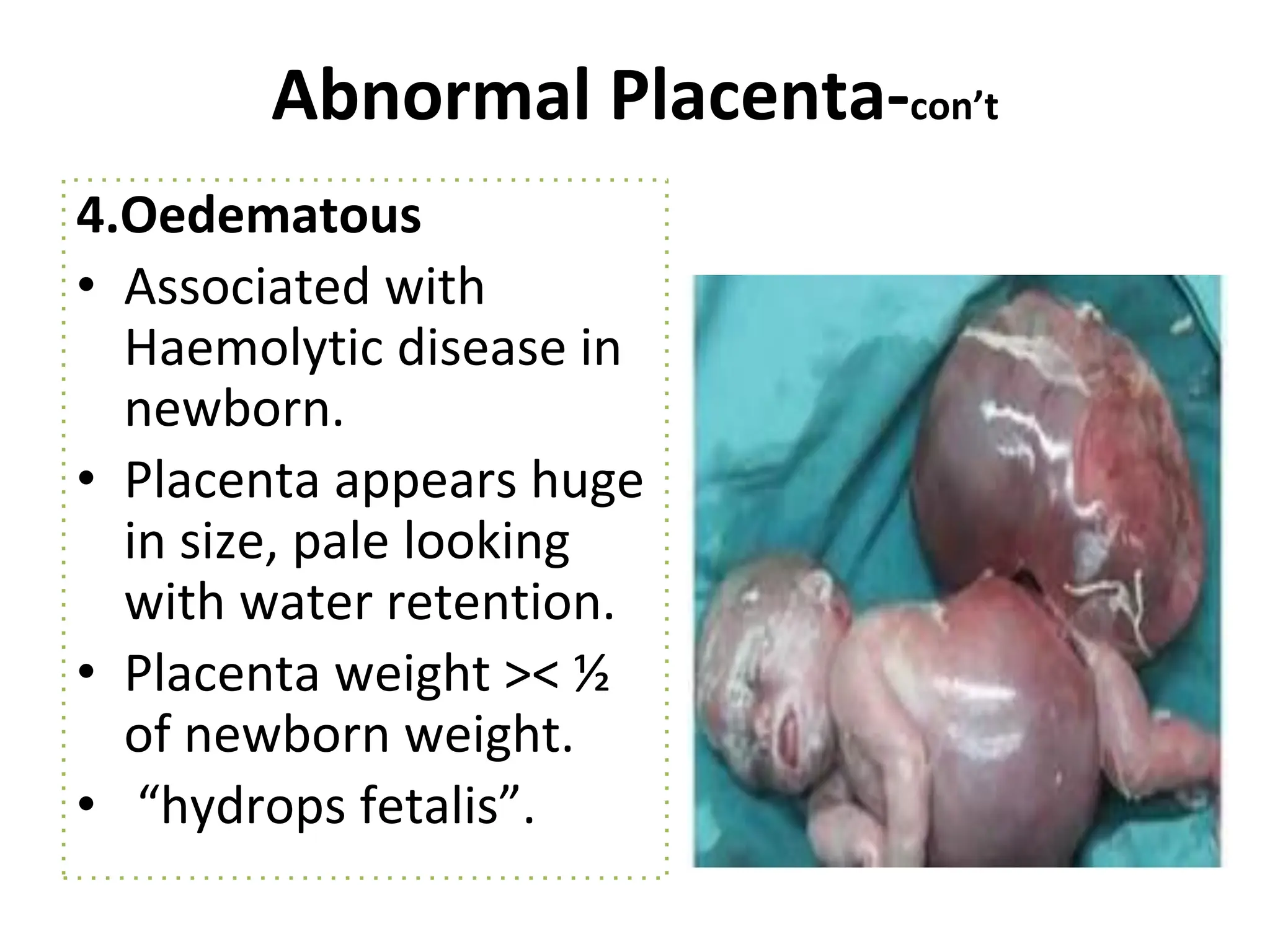
4.Oedematous
• Associated with
Haemolytic disease in
newborn.
• Placenta appears huge
in size, pale looking
with water retention.
• Placenta weight >< ½
of newborn weight.
• “hydrops fetalis”.
Abnormal Placenta-con’t
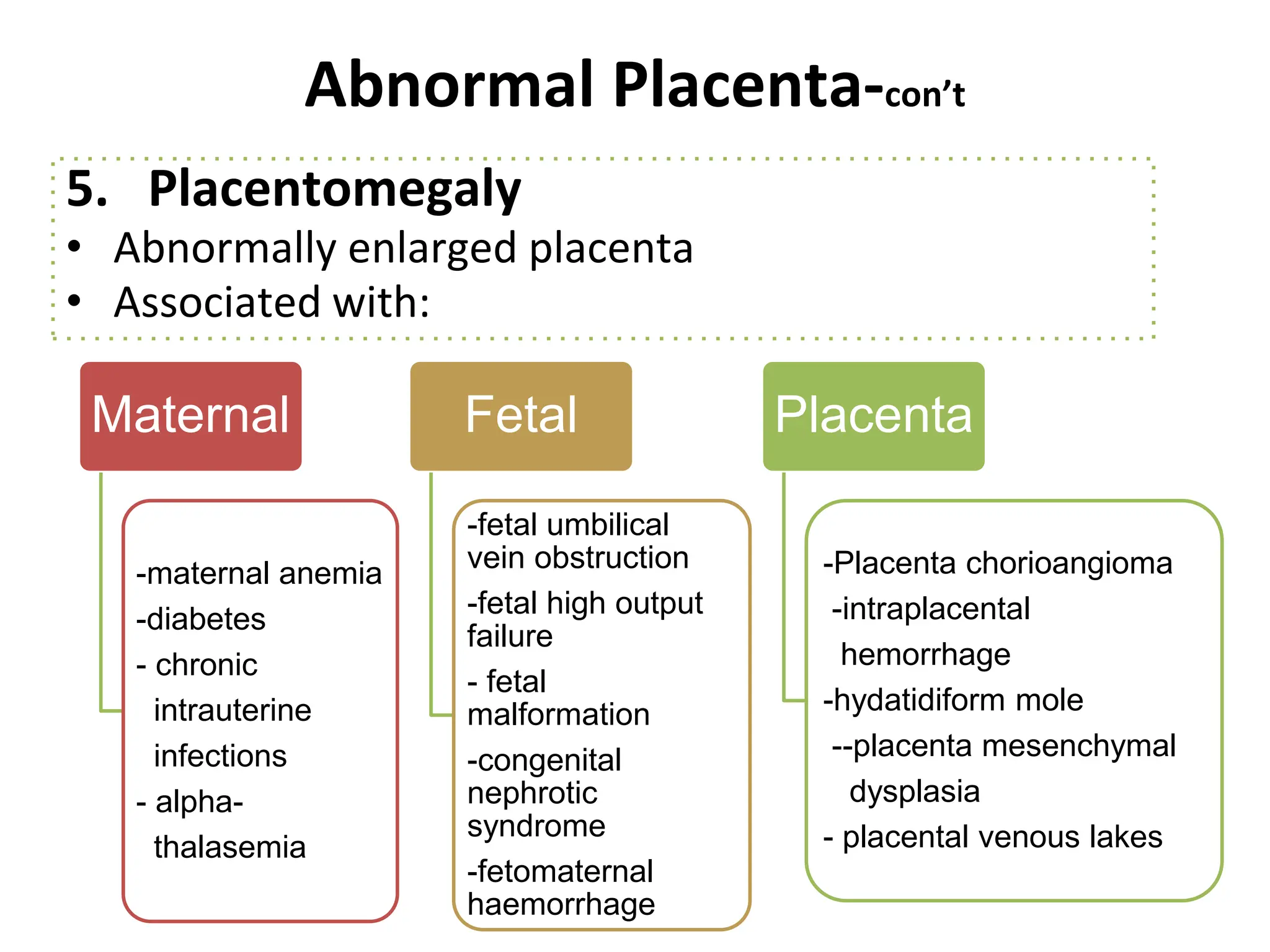
5. Placentomegaly
• Abnormally enlarged placenta
• Associated with:
Maternal
-maternal anemia
-diabetes
- chronic
intrauterine
infections
- alpha-
thalasemia
Fetal
-fetal umbilical
vein obstruction
-fetal high output
failure
- fetal
malformation
-congenital
nephrotic
syndrome
-fetomaternal
haemorrhage
Placenta
-Placenta chorioangioma
-intraplacental
hemorrhage
-hydatidiform mole
--placenta mesenchymal
dysplasia
- placental venous lakes
Placenta at term, abnormal placenta and functions of placenta

Placenta at term, abnormal placenta and functions of placenta

  • 1.
    PLACENTA Placenta at term AbnormalPlacenta Functions of Placenta LING @ILKKMKK©2024
  • 2.
    LEARNING OUTCOMES: 1.Discuss thestructure of placenta at term 1.1 gross structure 1.2 fetal surface & maternal surface 2. Discuss the functions of the placenta 3. Describe the common abnormalities of the placenta & discuss its significance. Battledore placenta Velamentous insertion of cord & vasa praevia Placenta Bipartita, Tripartita Placenta Succenturata Circumvallate Placenta Placenta membranacea Placenta Accreta, Increta & Perceta
  • 3.
    Gross Structure ofPlacenta at Term • Placenta is psychological connection between fetal & maternal tissues for the nutrition, respiration & excretion of the fetus.
  • 4.
    Gross Structure-CON’T • 1/6from newborn weight e.g. : Birth weight=3 kg Placenta weight =1 x 3kg= 0.5 kg 6 Weight Uterine surface is divided by a series of fissures into lobules or cotyledons. The fisssures containing the remains of the septa which extended between the maternal & fetal portions Most of these septa end in irrugular or pointed processes pass through it’s thickness & are attached to the chorion in the early month. These septa convey branches of the uterine arteries which open into the intervillious space on the surface of the septa
  • 5.
    Gross Structure-CON’T Fetus Surface •Sleek • Blue gray in colour • 2 membrane: Amnion & Chorion *Amnion- Outer layer *Chorion- Between amnion & placenta Maternal Surface • Surface attached to the desidua. • 18-20 lobules or cotyledons consisting of chorionic villi. • Sulci in between the lobules. • Dark red in colour. Placenta Surface:
  • 6.
  • 7.
  • 8.
    Gross Structure-CON’T Amnion • Membranelayer facing the fetus in utero. • Consisting of ectoderm cells. • Loamy, smooth, & transparent. • Can be separated from chorion until the umbilical cord insertion site. Chorion • Membran facing desidua of uterus. • Connecting with the edge of the placenta. • Tendency to tear and retain in utero causing PPH. • Opaque in appearance. MEMBRANE: (1) AMNION (2) KORION
  • 10.
  • 11.
    The Functions Ofthe Placenta Nutrition •Placenta helps to transport nutrients from maternal blood into fetus Respiration •Helps in getting O2 from the maternal blood into the fetus & CO2 from Foetus blood into the maternal blood Excretion •Nitrogenous waste products produced in the embryo diffuse through the placenta into the maternal blood stream. Nutrition: •Amino Acid: Tissue • Glucose: Growth & energy •Calcium/ phosforus: Bone & Teeth •Water, Mineral: Electrolyte •Iron: RBC •Vit. B,C: free flow •Vit.A,D,E: Trophoblastic cell- slow through placenta Glycogenic Plasenta Complex-refined Urea, uric acid, creatinine & CO2 –same as maternal level
  • 12.
    The Functions Ofthe Placenta-con’t Immunity •Antibodies developed in the mother against certain diseases like measles, small pox, diphtheria pass from mother into the fetal blood through the placenta. Transport of pathogens •Pathogenic organisms like viruses diffuses through the placenta. Viruses causing syphilis, measles, rubella, small pox may infect the fetus, if the mother gets the disease during pregnancy. Some of these diseases may even cause congenital deformities. Transport of drugs •Some of the drugs taken by the mother during pregnancy cross the placental barrier & may even cause developmental deformities.
  • 13.
    The Functions Ofthe Placenta-con’t Storage •Placenta stores some fats, glycogen and iron. Secretion of hormones •Placenta secretes many hormones like Estrogen, Progesterone, Gonadotropin (HCG), Relaxin & Placental Lactogen (HPL), thus functioning as an endocrine gland.
  • 15.
  • 16.
    Indication Of ExaminePlacenta To check the completeness of placenta and membranes. To detect abnormalities which might provide information about any intrauterine problems.
  • 17.
    Common Abnormalities &its significance 1. Placenta Succenturata • One or multiple accessory lobes connected to the main part of the placenta by blood vessels. • The accessory lobes are vestiges of abnormal distributions of the chorionic villi. • 16-28:10,000 pregnancies. * Retention of contilydon during 3rd stage of labour –PPH. #: Check on the blood vessels in which running through the placenta membrane during placenta examination.
  • 18.
  • 19.
    Abnormal Placenta-con’t 2.Placenta Bipartita •Bilobed placenta • A placenta separated into 2 near equal- sized lobes. • Trilobed/Tripartita if > 2 lobes are present. • Succenturiate lobe if the 2nd lobe is smaller than the main lobe.
  • 20.
  • 21.
    Abnormal Placenta-con’t 3. Duplex Placenta •A placenta consisting of two parts, almost entirely detached, being united only at the point of attachment of the cord.
  • 22.
    Abnormal Placenta-con’t 4. PlacentaCircumvallate • Fetal membranes (Amnion & Chorion) “double back” and form a thick ring on the fetal side around the edge of the placenta. *Easily detach from the uterine wall causing APH.

  • 23.
    Abnormal Placenta-con’t 5. PlacentaAccreta • Occurs when all or part of the placenta attaches abnormally to the myometrium. *:Hysterectomy may required to remove the placenta/ arrest PPH. Accreta Chorionic villi attach to the myometrium, rather than being restricted within the decidua basalis. Increta Chorionic Villi invade into the myometrium. Percreta Chorionic villi invade through the perimetrium (uterine serosa)
  • 24.
  • 25.
    Abnormal Placenta-con’t 6. BattledorePlacenta • The umbilical cord is attached at the placental margin. • So called because of the fancied resemblance to the racquet used in badminton. * Easily snapped cord and causing retained placenta.
  • 26.
    Abnormal Placenta-con’t 7. Velamentousinsertion of the cord and Vasa Praevia • The umbilical cord inserts into the fetal membranes, then travels within the membranes to the placenta (between the amnion & chorion). • The exposed vessels are not protected by Wharton’s Jelly & hence are vulnerable to rupture. • Rupture of vessels or compression in case of vasa previa might lead to fetal anoxia and IUD. # No ARM if pulsation felt over the membrane during vaginal examination.
  • 27.
    Abnormal Placenta-con’t • PlacentaMembranacea • The presence of fetal membranes (complete or partially) covered by chorionic villi. Case Report: Arch Gynecol Obstet. 2013 Sep;288(3):709-12. doi: 10.1007/s00404-013-2778-z. Epub 2013 Mar 7. • *Premature Labour •*IUD •*Stillbirth
  • 28.
  • 29.
    Abnormal Placenta 1. HydatidiformMole/ Molar Pregnancy • The growth of an abnormal fertilized egg or an overgrowth of tissue from the placenta.
  • 30.
    Abnormal Placenta-con’t 2. PlacentaInfarction • results from the interruption of blood supply to a part of the placenta causing tissue necrosis. • Small placenta infarts especially at the edge of the placental disc are considered to be normal at term. * IUGR, fetal hypoxia.
  • 31.
    • Placenta infarction •Normal placenta surface
  • 32.
    Abnormal Placenta-con’t 3.Calcification • Depositsof calcium in the placenta causing part of the placenta to dysfunction or be replaced with fibrous tissues. • Prolonged Pregnancy. * Fetal anoxia
  • 33.
    Abnormal Placenta-con’t 4.Oedematous • Associatedwith Haemolytic disease in newborn. • Placenta appears huge in size, pale looking with water retention. • Placenta weight >< ½ of newborn weight. • “hydrops fetalis”.
  • 34.
    Abnormal Placenta-con’t 5. Placentomegaly •Abnormally enlarged placenta • Associated with: Maternal -maternal anemia -diabetes - chronic intrauterine infections - alpha- thalasemia Fetal -fetal umbilical vein obstruction -fetal high output failure - fetal malformation -congenital nephrotic syndrome -fetomaternal haemorrhage Placenta -Placenta chorioangioma -intraplacental hemorrhage -hydatidiform mole --placenta mesenchymal dysplasia - placental venous lakes