Optical Aberrations
Resident Lecture
The Perfect Image
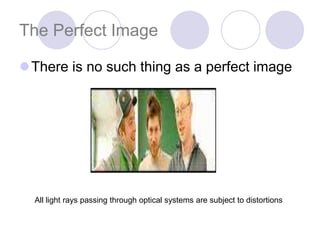
There is no such thing as a perfect image
All light rays passing through optical systems are subject to distortions
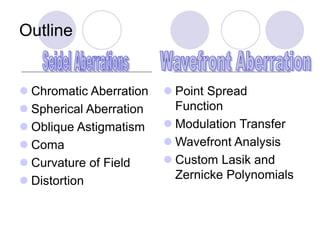
Outline
 Chromatic Aberration
 Spherical Aberration
 Oblique Astigmatism
 Coma
 Curvature of Field
 Distortion
Chromatic Aberration
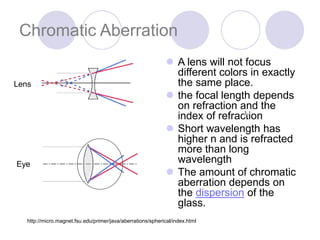
 A lens will not focus
different colors in exactly
the same place.
 the focal length depends
on refraction and the
index of refraction
 Short wavelength has
higher n and is refracted
more than long
wavelength
 The amount of chromatic
aberration depends on
the dispersion of the
glass.
Lens
Eye
http://micro.magnet.fsu.edu/primer/java/aberrations/spherical/index.html
Chromatic Aberration
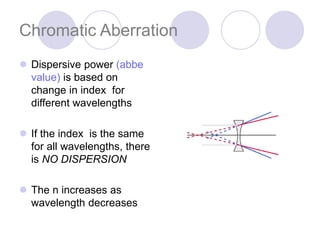
 Dispersive power (abbe
value) is based on
change in index for
different wavelengths
 If the index is the same
for all wavelengths, there
is NO DISPERSION
 The n increases as
wavelength decreases
Chromatic Aberration
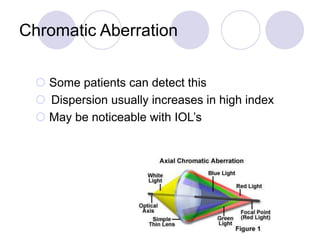
 Some patients can detect this
 Dispersion usually increases in high index
 May be noticeable with IOL’s
Chromatic Aberration
Duochrome Test
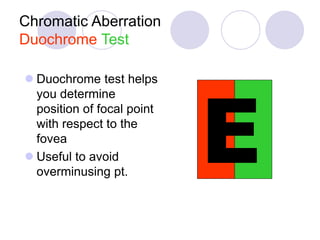
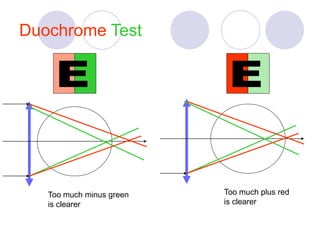
 Duochrome test helps
you determine
position of focal point
with respect to the
fovea
 Useful to avoid
overminusing pt.
Duochrome Test
Too much minus green
is clearer
Too much plus red
is clearer
Chromatic Aberration-
Duochrome Test
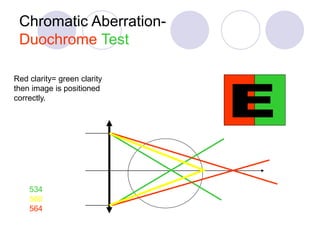
Red clarity= green clarity
then image is positioned
correctly.
534
560
564
Correction of Chromatic Aberration
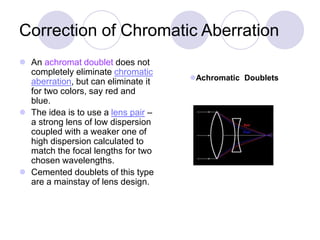
 An achromat doublet does not
completely eliminate chromatic
aberration, but can eliminate it
for two colors, say red and
blue.
 The idea is to use a lens pair –
a strong lens of low dispersion
coupled with a weaker one of
high dispersion calculated to
match the focal lengths for two
chosen wavelengths.
 Cemented doublets of this type
are a mainstay of lens design.
Achromatic Doublets
Correction of Chromatic Aberration
APOCHROMATIC LENS
The addition of a third lens corrects for three colors
(red, blue and green), greatly reducing the fuzziness
caused by the colors uncorrected in the achromatic
doublet.
Correction of Chromatic Aberration
In the human eye, chromatic aberration is
reduced by the lens, which changes index
from the nucleus outward.
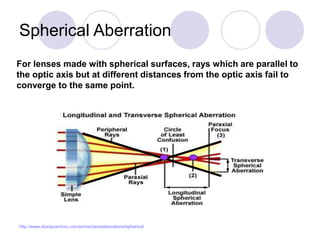
Spherical Aberration
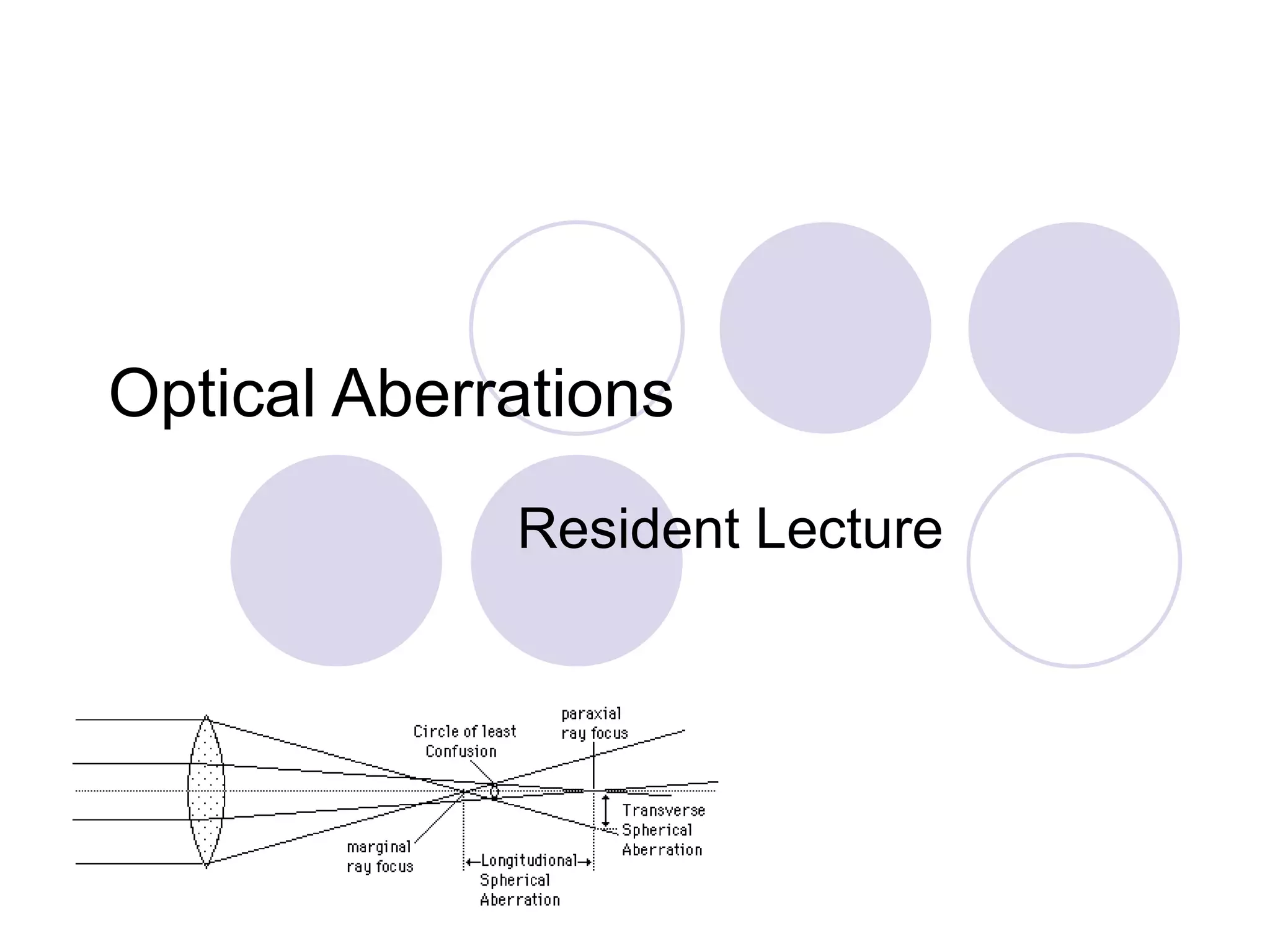
For lenses made with spherical surfaces, rays which are parallel to
the optic axis but at different distances from the optic axis fail to
converge to the same point.
http://www.olympusmicro.com/primer/java/aberrations/spherical
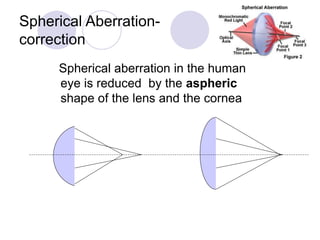
Spherical Aberration-
correction
Spherical aberration in the human
eye is reduced by the aspheric
shape of the lens and the cornea
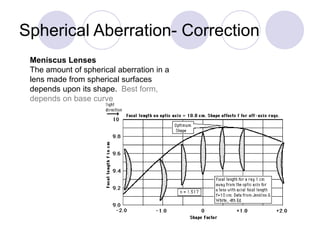
Spherical Aberration- Correction
Meniscus Lenses
The amount of spherical aberration in a
lens made from spherical surfaces
depends upon its shape. Best form,
depends on base curve
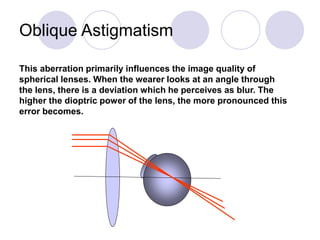
Oblique Astigmatism
This aberration primarily influences the image quality of
spherical lenses. When the wearer looks at an angle through
the lens, there is a deviation which he perceives as blur. The
higher the dioptric power of the lens, the more pronounced this
error becomes.
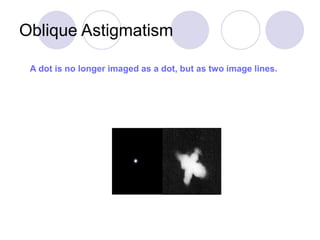
Oblique Astigmatism
A dot is no longer imaged as a dot, but as two image lines.
Oblique astigmatism- correction
Mitigated by deviating from the
spherical shape
Aspheric Surfaces to the Rescue
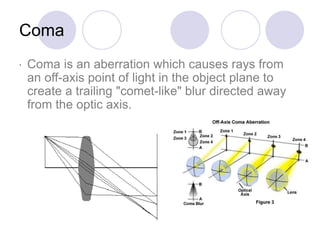
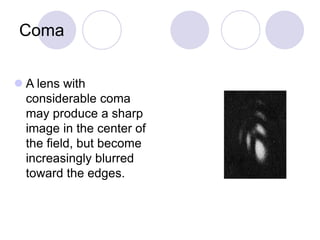
Coma
. Coma is an aberration which causes rays from
an off-axis point of light in the object plane to
create a trailing "comet-like" blur directed away
from the optic axis.
Coma
 A lens with
considerable coma
may produce a sharp
image in the center of
the field, but become
increasingly blurred
toward the edges.
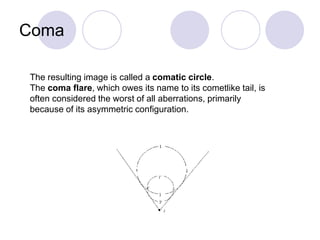
Coma
The resulting image is called a comatic circle.
The coma flare, which owes its name to its cometlike tail, is
often considered the worst of all aberrations, primarily
because of its asymmetric configuration.
Coma- correction
For a single lens, coma can be partially
corrected by bending the lens. More
complete correction can be achieved by
using a combination of lenses symmetric
about a central stop.
Coma is not well compensated for in the
human eye.
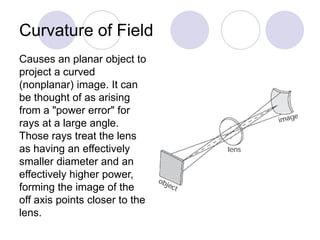
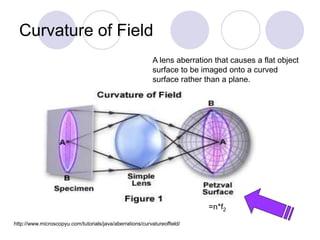
Curvature of Field
Causes an planar object to
project a curved
(nonplanar) image. It can
be thought of as arising
from a "power error" for
rays at a large angle.
Those rays treat the lens
as having an effectively
smaller diameter and an
effectively higher power,
forming the image of the
off axis points closer to the
lens.
Curvature of Field
A lens aberration that causes a flat object
surface to be imaged onto a curved
surface rather than a plane.
http://www.microscopyu.com/tutorials/java/aberrations/curvatureoffield/
=n*f2
Curvature of Field- Correction
The surface of the image formed by the
eye is also curved, fortunately, the retina is
also curved!
For lens systems, using best form lenses
with non-spherical shapes can help.
Image Distortion
 Not about sharpness, but faithful reproduction of
the shape of the object.
 It occurs when magnification varies with the
distance of the object from the optic axis.
 Problem only for high powers
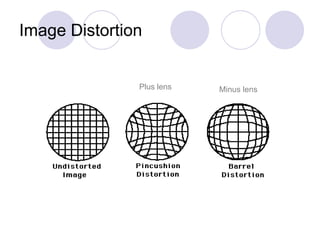
 Tends to falsify the positions of objects and
cause vertical lines to wave
 Aphakes!
 Minimized by very steep back base curves
Image Distortion
Plus lens Minus lens
Outline
 Chromatic Aberration
 Spherical Aberration
 Oblique Astigmatism
 Coma
 Curvature of Field
 Distortion
 Point Spread
Function
 Modulation Transfer
 Wavefront Analysis
 Custom Lasik and
Zernicke Polynomials
Beyond sphere and cylinder…
Higher order aberrations have been
traditionally ignored clinically
Now are routinely considered
Post lasik increase in higher order aberrations
Can be easily measured
Wavefront guided correction available
Patient expectations

optical-aberrations-.ppt

  • 1.
  • 2.
    The Perfect Image Thereis no such thing as a perfect image All light rays passing through optical systems are subject to distortions
  • 3.
    Outline  Chromatic Aberration Spherical Aberration  Oblique Astigmatism  Coma  Curvature of Field  Distortion
  • 4.
    Chromatic Aberration  Alens will not focus different colors in exactly the same place.  the focal length depends on refraction and the index of refraction  Short wavelength has higher n and is refracted more than long wavelength  The amount of chromatic aberration depends on the dispersion of the glass. Lens Eye http://micro.magnet.fsu.edu/primer/java/aberrations/spherical/index.html
  • 5.
    Chromatic Aberration  Dispersivepower (abbe value) is based on change in index for different wavelengths  If the index is the same for all wavelengths, there is NO DISPERSION  The n increases as wavelength decreases
  • 6.
    Chromatic Aberration  Somepatients can detect this  Dispersion usually increases in high index  May be noticeable with IOL’s
  • 7.
    Chromatic Aberration Duochrome Test Duochrome test helps you determine position of focal point with respect to the fovea  Useful to avoid overminusing pt.
  • 8.
    Duochrome Test Too muchminus green is clearer Too much plus red is clearer
  • 9.
    Chromatic Aberration- Duochrome Test Redclarity= green clarity then image is positioned correctly. 534 560 564
  • 10.
    Correction of ChromaticAberration  An achromat doublet does not completely eliminate chromatic aberration, but can eliminate it for two colors, say red and blue.  The idea is to use a lens pair – a strong lens of low dispersion coupled with a weaker one of high dispersion calculated to match the focal lengths for two chosen wavelengths.  Cemented doublets of this type are a mainstay of lens design. Achromatic Doublets
  • 11.
    Correction of ChromaticAberration APOCHROMATIC LENS The addition of a third lens corrects for three colors (red, blue and green), greatly reducing the fuzziness caused by the colors uncorrected in the achromatic doublet.
  • 12.
    Correction of ChromaticAberration In the human eye, chromatic aberration is reduced by the lens, which changes index from the nucleus outward.
  • 13.
    Spherical Aberration For lensesmade with spherical surfaces, rays which are parallel to the optic axis but at different distances from the optic axis fail to converge to the same point. http://www.olympusmicro.com/primer/java/aberrations/spherical
  • 14.
    Spherical Aberration- correction Spherical aberrationin the human eye is reduced by the aspheric shape of the lens and the cornea
  • 15.
    Spherical Aberration- Correction MeniscusLenses The amount of spherical aberration in a lens made from spherical surfaces depends upon its shape. Best form, depends on base curve
  • 16.
    Oblique Astigmatism This aberrationprimarily influences the image quality of spherical lenses. When the wearer looks at an angle through the lens, there is a deviation which he perceives as blur. The higher the dioptric power of the lens, the more pronounced this error becomes.
  • 17.
    Oblique Astigmatism A dotis no longer imaged as a dot, but as two image lines.
  • 18.
    Oblique astigmatism- correction Mitigatedby deviating from the spherical shape Aspheric Surfaces to the Rescue
  • 19.
    Coma . Coma isan aberration which causes rays from an off-axis point of light in the object plane to create a trailing "comet-like" blur directed away from the optic axis.
  • 20.
    Coma  A lenswith considerable coma may produce a sharp image in the center of the field, but become increasingly blurred toward the edges.
  • 21.
    Coma The resulting imageis called a comatic circle. The coma flare, which owes its name to its cometlike tail, is often considered the worst of all aberrations, primarily because of its asymmetric configuration.
  • 22.
    Coma- correction For asingle lens, coma can be partially corrected by bending the lens. More complete correction can be achieved by using a combination of lenses symmetric about a central stop. Coma is not well compensated for in the human eye.
  • 23.
    Curvature of Field Causesan planar object to project a curved (nonplanar) image. It can be thought of as arising from a "power error" for rays at a large angle. Those rays treat the lens as having an effectively smaller diameter and an effectively higher power, forming the image of the off axis points closer to the lens.
  • 24.
    Curvature of Field Alens aberration that causes a flat object surface to be imaged onto a curved surface rather than a plane. http://www.microscopyu.com/tutorials/java/aberrations/curvatureoffield/ =n*f2
  • 25.
    Curvature of Field-Correction The surface of the image formed by the eye is also curved, fortunately, the retina is also curved! For lens systems, using best form lenses with non-spherical shapes can help.
  • 26.
    Image Distortion  Notabout sharpness, but faithful reproduction of the shape of the object.  It occurs when magnification varies with the distance of the object from the optic axis.  Problem only for high powers  Tends to falsify the positions of objects and cause vertical lines to wave  Aphakes!  Minimized by very steep back base curves
  • 27.
  • 28.
    Outline  Chromatic Aberration Spherical Aberration  Oblique Astigmatism  Coma  Curvature of Field  Distortion  Point Spread Function  Modulation Transfer  Wavefront Analysis  Custom Lasik and Zernicke Polynomials
  • 29.
    Beyond sphere andcylinder… Higher order aberrations have been traditionally ignored clinically Now are routinely considered Post lasik increase in higher order aberrations Can be easily measured Wavefront guided correction available Patient expectations