Strategic Management
 An organization or enterprising entity
engaged in commercial, industrial or
professional activities. A business can be a
for-profit entity, such as a publicly-traded
corporation, or a nonprofit organization
engaged in business activities, such as an
agricultural cooperative.
 Understanding business is vital to defining it
and answering the question
 What is our business?
 What will it be?
 What should it be?
 Vision and mission statements can use the
ideas generated through the process of
understanding and defining business.
 Keeping in view above three dimensions of
business could be
 Customers group could be individual or
industrial
 Customer function could be recording time,
finding time, for fashion, for gift etc
 Alternative technology could be mechanical,
quartz digital etc
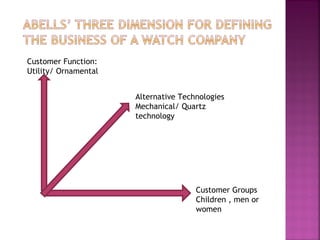
Customer Function:
Utility/ Ornamental
Alternative Technologies
Mechanical/ Quartz
technology
Customer Groups
Children , men or
women
 Business model is a buzzword that everybody
used (or overused) during the dotcom boom.
In fact, poorly thought out business models
were the downfall of many dotcoms.
 However, the business model dates back to
the earliest days of business; it merely
describes the way in which a company makes
money. A business model can be simple or
very complex.
 A representation of a firm’s underlying core
logic and strategic choices for creating and
capturing value within a value network
 Business model for economy airlines is
characterised by e-ticketing, no frills
service, uniform planes etc.
 A restaurant's business model is to make
money by cooking and serving food to hungry
customers.
 A website's business model might not be so
clear, as there are many ways in which these
types of companies can generate revenue.
For example, some make money (or try to)
by providing a free service and then selling
advertising to other companies, while others
might sell a product or service directly to
online customers.
 TCS uses a traditional fixed price, fixed time
business model in which clients make
payments on the basis of time related
milestones. On the other hand , infosys and
wipro depend on a time and material
business model under which clients pay on an
ongoing basis, according to volume of work
done
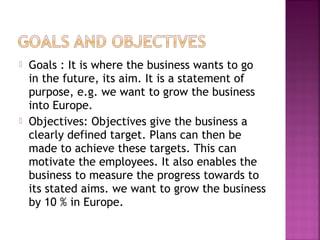
 Goals : It is where the business wants to go
in the future, its aim. It is a statement of
purpose, e.g. we want to grow the business
into Europe.
 Objectives: Objectives give the business a
clearly defined target. Plans can then be
made to achieve these targets. This can
motivate the employees. It also enables the
business to measure the progress towards to
its stated aims. we want to grow the business
by 10 % in Europe.
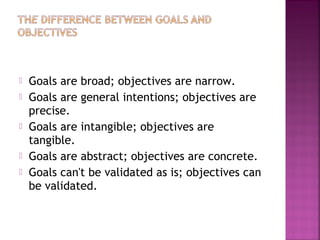
 Goals are broad; objectives are narrow.
 Goals are general intentions; objectives are
precise.
 Goals are intangible; objectives are
tangible. 
 Goals are abstract; objectives are concrete.
 Goals can't be validated as is; objectives can
be validated. 
What do we need to be successful ?
Something that must happen if service, process, plan,
project or other activity is to succeed.
CSF are crucial for organizational success.
Tooth paste: form, flavour, foam and freshness
Courier : speedy dispatch, reliability, and price
As a definition, critical success factors refer to “the
limited number of areas in which satisfactory results will
ensure successful competitive performance for the
individual, department, or organization”.
    
The following as an example of generic CSF’s:
•New product development,
•Good distribution, and
•Effective advertising      
 Industry : Vary with industry
 Competition and position in reference to
competition
 Environmental Factors
 Temporal Factors : company specific
situation
 Industry: There are some CSF’s common to
all companies operating within the same
industry. Different industries will have
unique, industry-specific CSF’s. sales
promotion in fmcg, high capital investment
for petroleum companies
 An industry’s set of characteristics define its
own CSF’s Different industries will thus have
different CSF’s. Thus CSF will vary for the
Call centre, retail, business services, health
care and education sectors
 In reality each organization has its own
unique goals so while there may be some
industry standard – not all firms in one
industry will have identical CSF’s.
 Competitive position or strategy: The nature
of position in the marketplace or the
adopted strategy to gain market share gives
rise to different CSFs.
 Not all firms in an industry will have the
same CSF’s in a particular industry. A firm’s
current position in the industry (where it is
relative to other competitors in the industry
and also the market leader), its strategy, and
its resources and capabilities will define its
CSF’s
 Some firms and leaders create their own
CSFs. For e.g. Advertising became CSF in
textile industry largely due to Reliance
Industries ltd
 Environmental changes: Economic,
regulatory, political, and demographic
changes create CSF’s for an organization.
 These relate to environmental factors that
are not in the control of the organization but
which an organization must consider in
developing CSF’s
 E.g. Customer service emerged as CSF after
deregulation and entry of private
telecommunication
 Temporal factors: These relate to short-term
situations, often crises. These CSF’s may be
important, but are usually short-lived.
 Temporal factors are temporary or one-off
CSF’s resulting from a specific event
necessitating their inclusion.
 E.g. After division of family business CSF
would be to rebuild everything
 Shoe Industry: high product quality, low cost,
flexible product mix, sophisticated retailing
and product image
 Automobiles: Styling, dealer network, cost
control, meeting environment standards
 PI are well understood as being metrics or measures in
terms of which performance is measured, evaluated or
compared
 Key performance indicators are used to measure the
achievement of critical success factors
 E.g.
 Customer satisfaction may be measured by number of
customer complaints related to service
 KPIs are helpful even in measuring the
success achieved by organization towards its
vision. Identification of which KPIs to use is
important.
 To be the most popular company may not
work if there is no way to measure
company’s and competitors popularity
 To be the leader can be measured in terms
of market share
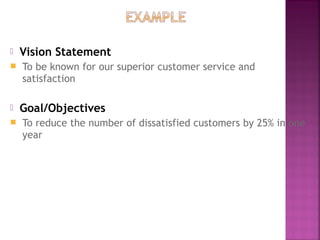
 Vision Statement
 To be known for our superior customer service and
satisfaction
 Goal/Objectives
 To reduce the number of dissatisfied customers by 25% in one
year
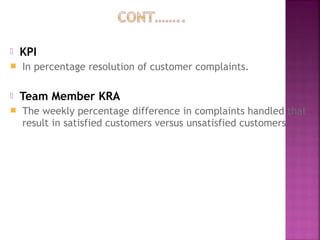
 KPI
 In percentage resolution of customer complaints.
 Team Member KRA
 The weekly percentage difference in complaints handled that
result in satisfied customers versus unsatisfied customers

Abell's 3 dimensions critical sucess factor-kpi

  • 1.
  • 2.
     An organizationor enterprising entity engaged in commercial, industrial or professional activities. A business can be a for-profit entity, such as a publicly-traded corporation, or a nonprofit organization engaged in business activities, such as an agricultural cooperative.
  • 3.
     Understanding businessis vital to defining it and answering the question  What is our business?  What will it be?  What should it be?  Vision and mission statements can use the ideas generated through the process of understanding and defining business.
  • 6.
     Keeping inview above three dimensions of business could be  Customers group could be individual or industrial  Customer function could be recording time, finding time, for fashion, for gift etc  Alternative technology could be mechanical, quartz digital etc
  • 7.
    Customer Function: Utility/ Ornamental AlternativeTechnologies Mechanical/ Quartz technology Customer Groups Children , men or women
  • 8.
     Business modelis a buzzword that everybody used (or overused) during the dotcom boom. In fact, poorly thought out business models were the downfall of many dotcoms.  However, the business model dates back to the earliest days of business; it merely describes the way in which a company makes money. A business model can be simple or very complex.
  • 9.
     A representationof a firm’s underlying core logic and strategic choices for creating and capturing value within a value network  Business model for economy airlines is characterised by e-ticketing, no frills service, uniform planes etc.
  • 10.
     A restaurant'sbusiness model is to make money by cooking and serving food to hungry customers.  A website's business model might not be so clear, as there are many ways in which these types of companies can generate revenue. For example, some make money (or try to) by providing a free service and then selling advertising to other companies, while others might sell a product or service directly to online customers.
  • 11.
     TCS usesa traditional fixed price, fixed time business model in which clients make payments on the basis of time related milestones. On the other hand , infosys and wipro depend on a time and material business model under which clients pay on an ongoing basis, according to volume of work done
  • 15.
     Goals :It is where the business wants to go in the future, its aim. It is a statement of purpose, e.g. we want to grow the business into Europe.  Objectives: Objectives give the business a clearly defined target. Plans can then be made to achieve these targets. This can motivate the employees. It also enables the business to measure the progress towards to its stated aims. we want to grow the business by 10 % in Europe.
  • 16.
     Goals arebroad; objectives are narrow.  Goals are general intentions; objectives are precise.  Goals are intangible; objectives are tangible.   Goals are abstract; objectives are concrete.  Goals can't be validated as is; objectives can be validated. 
  • 17.
    What do weneed to be successful ? Something that must happen if service, process, plan, project or other activity is to succeed. CSF are crucial for organizational success. Tooth paste: form, flavour, foam and freshness Courier : speedy dispatch, reliability, and price As a definition, critical success factors refer to “the limited number of areas in which satisfactory results will ensure successful competitive performance for the individual, department, or organization”.
  • 18.
         The following asan example of generic CSF’s: •New product development, •Good distribution, and •Effective advertising      
  • 19.
     Industry :Vary with industry  Competition and position in reference to competition  Environmental Factors  Temporal Factors : company specific situation
  • 20.
     Industry: Thereare some CSF’s common to all companies operating within the same industry. Different industries will have unique, industry-specific CSF’s. sales promotion in fmcg, high capital investment for petroleum companies
  • 21.
     An industry’sset of characteristics define its own CSF’s Different industries will thus have different CSF’s. Thus CSF will vary for the Call centre, retail, business services, health care and education sectors
  • 22.
     In realityeach organization has its own unique goals so while there may be some industry standard – not all firms in one industry will have identical CSF’s.  Competitive position or strategy: The nature of position in the marketplace or the adopted strategy to gain market share gives rise to different CSFs.
  • 23.
     Not allfirms in an industry will have the same CSF’s in a particular industry. A firm’s current position in the industry (where it is relative to other competitors in the industry and also the market leader), its strategy, and its resources and capabilities will define its CSF’s  Some firms and leaders create their own CSFs. For e.g. Advertising became CSF in textile industry largely due to Reliance Industries ltd
  • 24.
     Environmental changes:Economic, regulatory, political, and demographic changes create CSF’s for an organization.  These relate to environmental factors that are not in the control of the organization but which an organization must consider in developing CSF’s  E.g. Customer service emerged as CSF after deregulation and entry of private telecommunication
  • 25.
     Temporal factors:These relate to short-term situations, often crises. These CSF’s may be important, but are usually short-lived.  Temporal factors are temporary or one-off CSF’s resulting from a specific event necessitating their inclusion.  E.g. After division of family business CSF would be to rebuild everything
  • 26.
     Shoe Industry:high product quality, low cost, flexible product mix, sophisticated retailing and product image  Automobiles: Styling, dealer network, cost control, meeting environment standards
  • 27.
     PI arewell understood as being metrics or measures in terms of which performance is measured, evaluated or compared  Key performance indicators are used to measure the achievement of critical success factors  E.g.  Customer satisfaction may be measured by number of customer complaints related to service
  • 28.
     KPIs arehelpful even in measuring the success achieved by organization towards its vision. Identification of which KPIs to use is important.  To be the most popular company may not work if there is no way to measure company’s and competitors popularity  To be the leader can be measured in terms of market share
  • 29.
     Vision Statement To be known for our superior customer service and satisfaction  Goal/Objectives  To reduce the number of dissatisfied customers by 25% in one year
  • 30.
     KPI  Inpercentage resolution of customer complaints.  Team Member KRA  The weekly percentage difference in complaints handled that result in satisfied customers versus unsatisfied customers

Editor's Notes

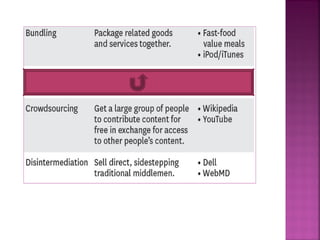
  • #13 Fast food includes different items together. Apple offer ipod and itunes. Bank and insurance