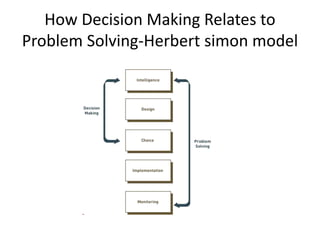
How Decision Making Relates to
Problem Solving-Herbert simon model
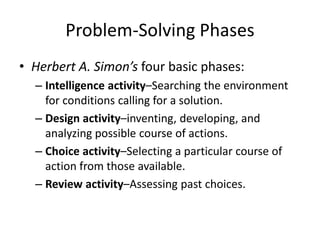
Problem-Solving Phases
• Herbert A. Simon’s four basic phases:
– Intelligence activity–Searching the environment
for conditions calling for a solution.
– Design activity–inventing, developing, and
analyzing possible course of actions.
– Choice activity–Selecting a particular course of
action from those available.
– Review activity–Assessing past choices.
Types of Decisions
• Programmed decisions are “repetitive and routine, to
the extent that a definite procedure has been
worked out for handling them so that they don’t
have to be treated de novo (as new) each time they
occur.”
• Nonprogrammed decisions are “novel, unstructured, and
unusually consequential. There’s no cut-and-dried
method for handling the problem because its precise
nature and structure are elusive or complex, and or
because it is so important that it deserves a custom-
tailored treatment.”
Decision support systems
• Decision support systems (DSS) are
computer-based systems that provide
managers and business professionals
interactive information support for semi-
structured and unstructured decisions
It supports in decision making and not give
decision itself
A DSS Model
• Originally the DSS was conceived to produce periodic and
special reports (responses to database queries), and
outputs from mathematical models.
• An ability was added to permit problem solvers to work
in groups.
• The addition of groupware enabled the system to
function as a group decision support system (GDSS).
• More recently, artificial intelligence (AI) capability has
been added, along with an ability to engage in on-line
analytical programming (OLAP).
Types of decision support systems
• Status inquiry system
– Does not call for any elaborate computations, analysis, choice
etc. for decision making. If status is known decision is automatic.
• Data Analysis System
– Decision system are based on comparative analysis and use of
formula or algorithm. But, these processes are not structured.
• Information Analysis System
– Data is analysis and reports are generated.
• Accounting System
– It is desirable to keep track of major aspects of the business or
function.
Types of decision support systems
• Model Based Systems
– These systems are the simulation models of optimization
models for decision making.
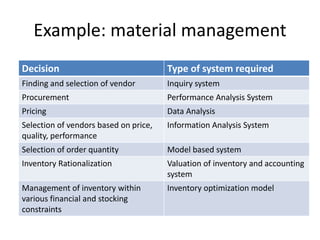
Example: material management
Decision Type of system required
Finding and selection of vendor Inquiry system
Procurement Performance Analysis System
Pricing Data Analysis
Selection of vendors based on price,
quality, performance
Information Analysis System
Selection of order quantity Model based system
Inventory Rationalization Valuation of inventory and accounting
system
Management of inventory within
various financial and stocking
constraints
Inventory optimization model
Some more facts
• DSS are developed by the users and System Analysts jointly.
• They uses the principle of economics, science and engineering
and also tools and techniques of management.
• The data used in the DSS is drawn from the information
systems developed in the company.
• The DSS are developed in isolation and form an independent
system subset of the MIS.
• The data and information
DSS Models
• Behavioral Model: helps in understanding
behavior amongst business variables
• E.g. forecasting , regression anlaysis, ratio
analysis
• Management science models
• Developed on principles of business
management, accounting, econometrics etc.
• E.g. Budgetary system, cost accounting system
• Du pont model, EOQ model PERT CPM, COST
accounting etc
• Operation Research Models
• These are real life simulation of problems in
form of variables, parameters, constraints,
constants etc.
• MRP, ABC, linear programming
GDSS
• The GDSS is the interactive computer-based
system that facilitates the solution of semi-
structured and unstructured problems by the
group of decision makers.
• The goal of GDSS is to improve the
productivity of decision making meetings,
either by speeding up the decision making
process, by improving the quality of resulting
decisions or both.
Cont….
• The GDSS started originally from the Management
Information System at University of Arizona. Some kind
of problems have always been observed that are
associated more with large meetings than with small
meetings. By large meetings we mean meetings with
generally more than 15 participants, but can go much
beyond that, e.g. 40 or even 50. Some of the identified
problems are:
• time consuming;
• dominance over the meeting; and
• honesty and participation.
• E.g. : ThinkTank and MeetingWorks
Process
• One computer each:In a GDSS environment,
there is usually a big room with something like
40 seats, which means that 40 people can be
at the meeting at any one time. There are not
only 40 seats but also 40 microcomputers.
This enables every participant to have the use
of one microcomputer during the course of
the meeting. The reason why each participant
needs a microcomputer depends on how
GDSS works.
• Facilitator Software: In the GDSS, with special computer
software, the facilitator of each meeting will first make the
agenda of the meeting, which will be projected onto a big
screen that everyone can see. Then the participants will
type simultaneously in their ideas of the topic of discussion
on the individual microcomputers next to them.
• Results: Then the computer will sort the ideas, and then
the participants will then vote or comment on which ideas
they like or they dislike. In the course of the whole meeting,
GDSS stores, categorizes and prints out all the ideas,
comments and vote tallies, so that each of the meeting
participants will get a summary of the meeting when it
ends.
Why Use GDSS?
• High level managers can spend 80% of their
time making decisions in groups. Applied
correctly, GDSS can reduce this time, arriving
at a better decision faster.
• GDSS provides the hardware, software,
databases and procedures for effective
decision making.
Characteristics of GDSS
• Special Design
• Ease of use
• Specific and general support
• Suppressing negative group behavior
• Supporting positive group behavior
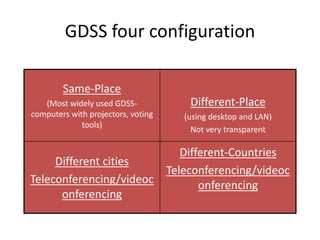
GDSS four configuration
Same-Place
(Most widely used GDSS-
computers with projectors, voting
tools)
Different-Place
(using desktop and LAN)
Not very transparent
Different cities
Teleconferencing/videoc
onferencing
Different-Countries
Teleconferencing/videoc
onferencing

Dss

  • 1.
    How Decision MakingRelates to Problem Solving-Herbert simon model
  • 2.
    Problem-Solving Phases • HerbertA. Simon’s four basic phases: – Intelligence activity–Searching the environment for conditions calling for a solution. – Design activity–inventing, developing, and analyzing possible course of actions. – Choice activity–Selecting a particular course of action from those available. – Review activity–Assessing past choices.
  • 3.
    Types of Decisions •Programmed decisions are “repetitive and routine, to the extent that a definite procedure has been worked out for handling them so that they don’t have to be treated de novo (as new) each time they occur.” • Nonprogrammed decisions are “novel, unstructured, and unusually consequential. There’s no cut-and-dried method for handling the problem because its precise nature and structure are elusive or complex, and or because it is so important that it deserves a custom- tailored treatment.”
  • 4.
    Decision support systems •Decision support systems (DSS) are computer-based systems that provide managers and business professionals interactive information support for semi- structured and unstructured decisions It supports in decision making and not give decision itself
  • 5.
    A DSS Model •Originally the DSS was conceived to produce periodic and special reports (responses to database queries), and outputs from mathematical models. • An ability was added to permit problem solvers to work in groups. • The addition of groupware enabled the system to function as a group decision support system (GDSS). • More recently, artificial intelligence (AI) capability has been added, along with an ability to engage in on-line analytical programming (OLAP).
  • 6.
    Types of decisionsupport systems • Status inquiry system – Does not call for any elaborate computations, analysis, choice etc. for decision making. If status is known decision is automatic. • Data Analysis System – Decision system are based on comparative analysis and use of formula or algorithm. But, these processes are not structured. • Information Analysis System – Data is analysis and reports are generated. • Accounting System – It is desirable to keep track of major aspects of the business or function.
  • 7.
    Types of decisionsupport systems • Model Based Systems – These systems are the simulation models of optimization models for decision making.
  • 8.
    Example: material management DecisionType of system required Finding and selection of vendor Inquiry system Procurement Performance Analysis System Pricing Data Analysis Selection of vendors based on price, quality, performance Information Analysis System Selection of order quantity Model based system Inventory Rationalization Valuation of inventory and accounting system Management of inventory within various financial and stocking constraints Inventory optimization model
  • 9.
    Some more facts •DSS are developed by the users and System Analysts jointly. • They uses the principle of economics, science and engineering and also tools and techniques of management. • The data used in the DSS is drawn from the information systems developed in the company. • The DSS are developed in isolation and form an independent system subset of the MIS. • The data and information
  • 10.
    DSS Models • BehavioralModel: helps in understanding behavior amongst business variables • E.g. forecasting , regression anlaysis, ratio analysis • Management science models • Developed on principles of business management, accounting, econometrics etc. • E.g. Budgetary system, cost accounting system
  • 11.
    • Du pontmodel, EOQ model PERT CPM, COST accounting etc • Operation Research Models • These are real life simulation of problems in form of variables, parameters, constraints, constants etc. • MRP, ABC, linear programming
  • 12.
    GDSS • The GDSSis the interactive computer-based system that facilitates the solution of semi- structured and unstructured problems by the group of decision makers. • The goal of GDSS is to improve the productivity of decision making meetings, either by speeding up the decision making process, by improving the quality of resulting decisions or both.
  • 13.
    Cont…. • The GDSSstarted originally from the Management Information System at University of Arizona. Some kind of problems have always been observed that are associated more with large meetings than with small meetings. By large meetings we mean meetings with generally more than 15 participants, but can go much beyond that, e.g. 40 or even 50. Some of the identified problems are: • time consuming; • dominance over the meeting; and • honesty and participation. • E.g. : ThinkTank and MeetingWorks
  • 14.
    Process • One computereach:In a GDSS environment, there is usually a big room with something like 40 seats, which means that 40 people can be at the meeting at any one time. There are not only 40 seats but also 40 microcomputers. This enables every participant to have the use of one microcomputer during the course of the meeting. The reason why each participant needs a microcomputer depends on how GDSS works.
  • 15.
    • Facilitator Software:In the GDSS, with special computer software, the facilitator of each meeting will first make the agenda of the meeting, which will be projected onto a big screen that everyone can see. Then the participants will type simultaneously in their ideas of the topic of discussion on the individual microcomputers next to them. • Results: Then the computer will sort the ideas, and then the participants will then vote or comment on which ideas they like or they dislike. In the course of the whole meeting, GDSS stores, categorizes and prints out all the ideas, comments and vote tallies, so that each of the meeting participants will get a summary of the meeting when it ends.
  • 16.
    Why Use GDSS? •High level managers can spend 80% of their time making decisions in groups. Applied correctly, GDSS can reduce this time, arriving at a better decision faster. • GDSS provides the hardware, software, databases and procedures for effective decision making.
  • 17.
    Characteristics of GDSS •Special Design • Ease of use • Specific and general support • Suppressing negative group behavior • Supporting positive group behavior
  • 18.
    GDSS four configuration Same-Place (Mostwidely used GDSS- computers with projectors, voting tools) Different-Place (using desktop and LAN) Not very transparent Different cities Teleconferencing/videoc onferencing Different-Countries Teleconferencing/videoc onferencing