Management Control System
• A management control system is a logical
  integration of management accounting tools to
  gather and report data and to evaluate performance

Purposes of a management control system
• clearly communicate the organization’s goals
• ensure that every manager and employee
  understands the specific actions required of him/her
  to achieve organizational goals
• communicate the results of actions across the
  organization
• ensure that the management control system adjusts
  to changes in the environment
Management Control System Steps
1. Begin by specifying the organization's goals, subgoals and objectives
      – Goals are what the organization hopes to achieve in the
        long run
      – Subgoals or key success factors are more specific and
        provide more focus to guide daily actions
      – Objectives are specific benchmarks which management
        would like to see achieved
      – Important to keep all three in balance to avoid
        concentrating solely on short-run achievements at the
        expense of long run goals
2.   Establish responsibility centers
3.   Develop performance measures
4.   Measure and report on financial performance
5.   Measure and report on non-financial performance
The Management Control
       System
          Set Goals,
          Measures,
           Targets


 Plan     Feedback
  and       and        Evaluate,
Execute   Learning      Reward


          Monitor,
          Report
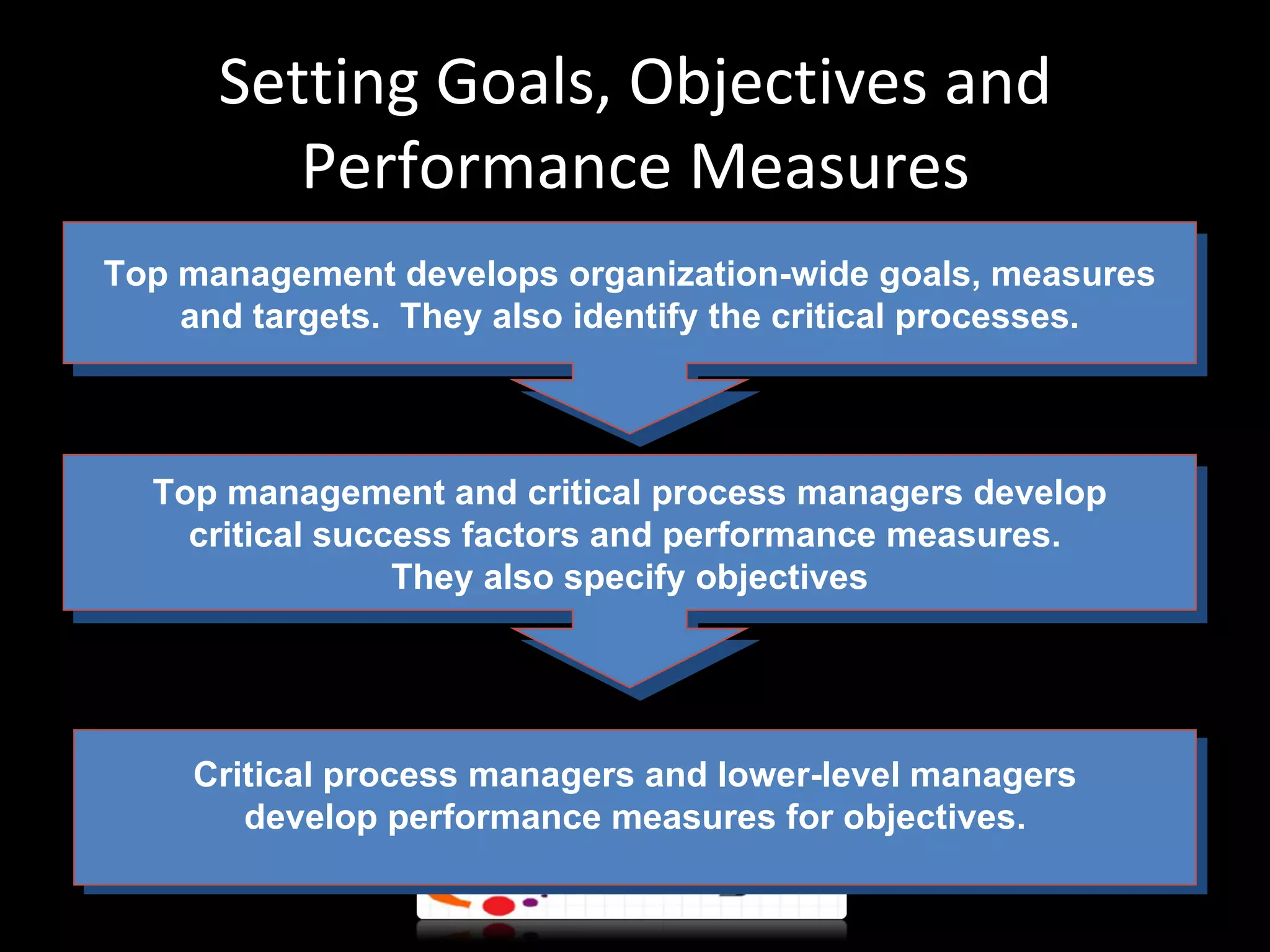
Setting Goals, Objectives and
         Performance Measures
Top management develops organization-wide goals, measures
    and targets. They also identify the critical processes.


  Top management and critical process managers develop
    critical success factors and performance measures.
                 They also specify objectives


     Critical process managers and lower-level managers
        develop performance measures for objectives.
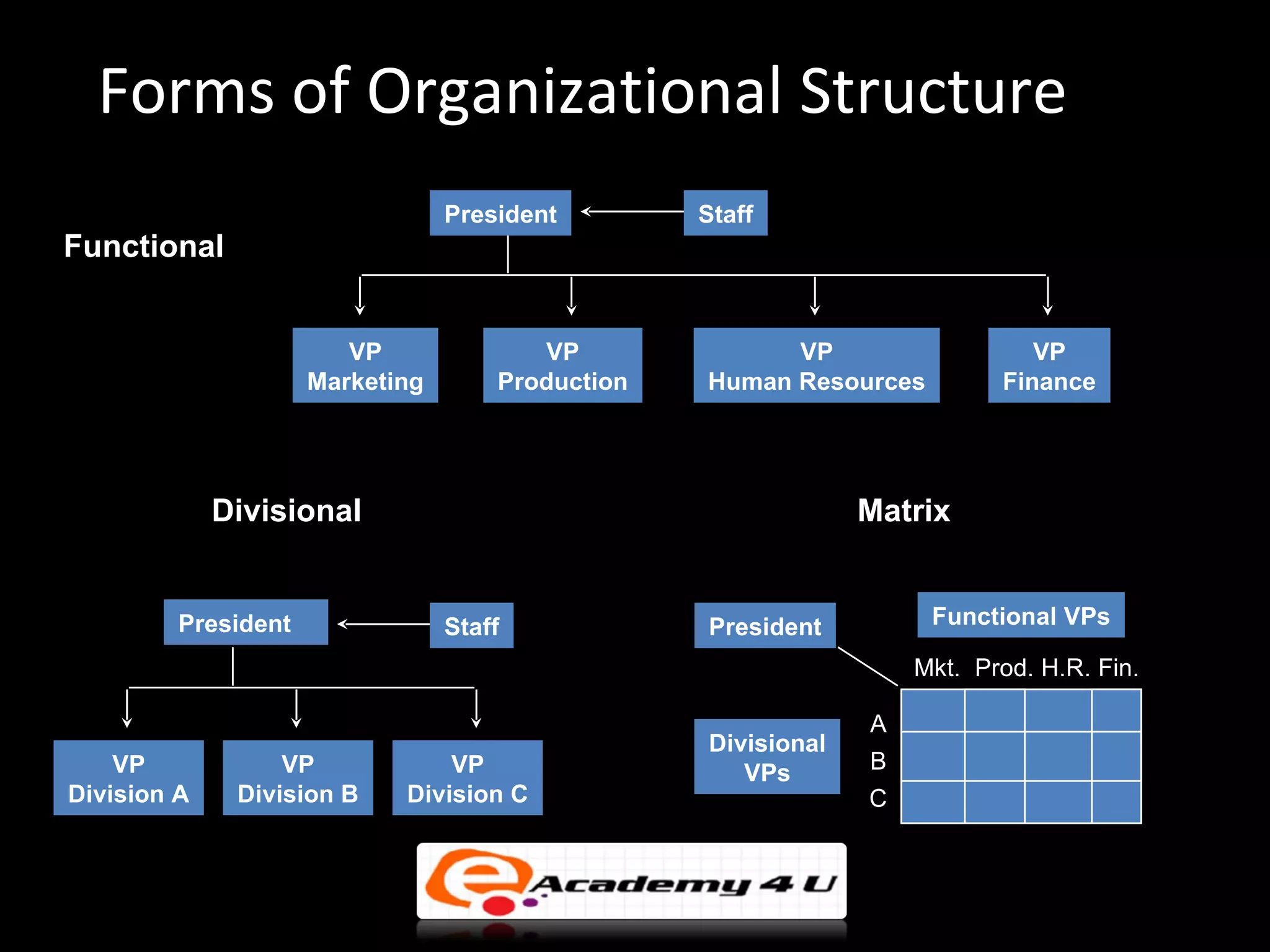
Forms of Organizational Structure
                                 President        Staff
Functional


                        VP              VP              VP                   VP
                     Marketing       Production   Human Resources         Finance


             Divisional                                        Matrix


         President               Staff            President         Functional VPs

                                                                   Mkt. Prod. H.R. Fin.

                                                               A
                                                  Divisional
    VP            VP            VP                   VPs       B
Division A    Division B    Division C                         C
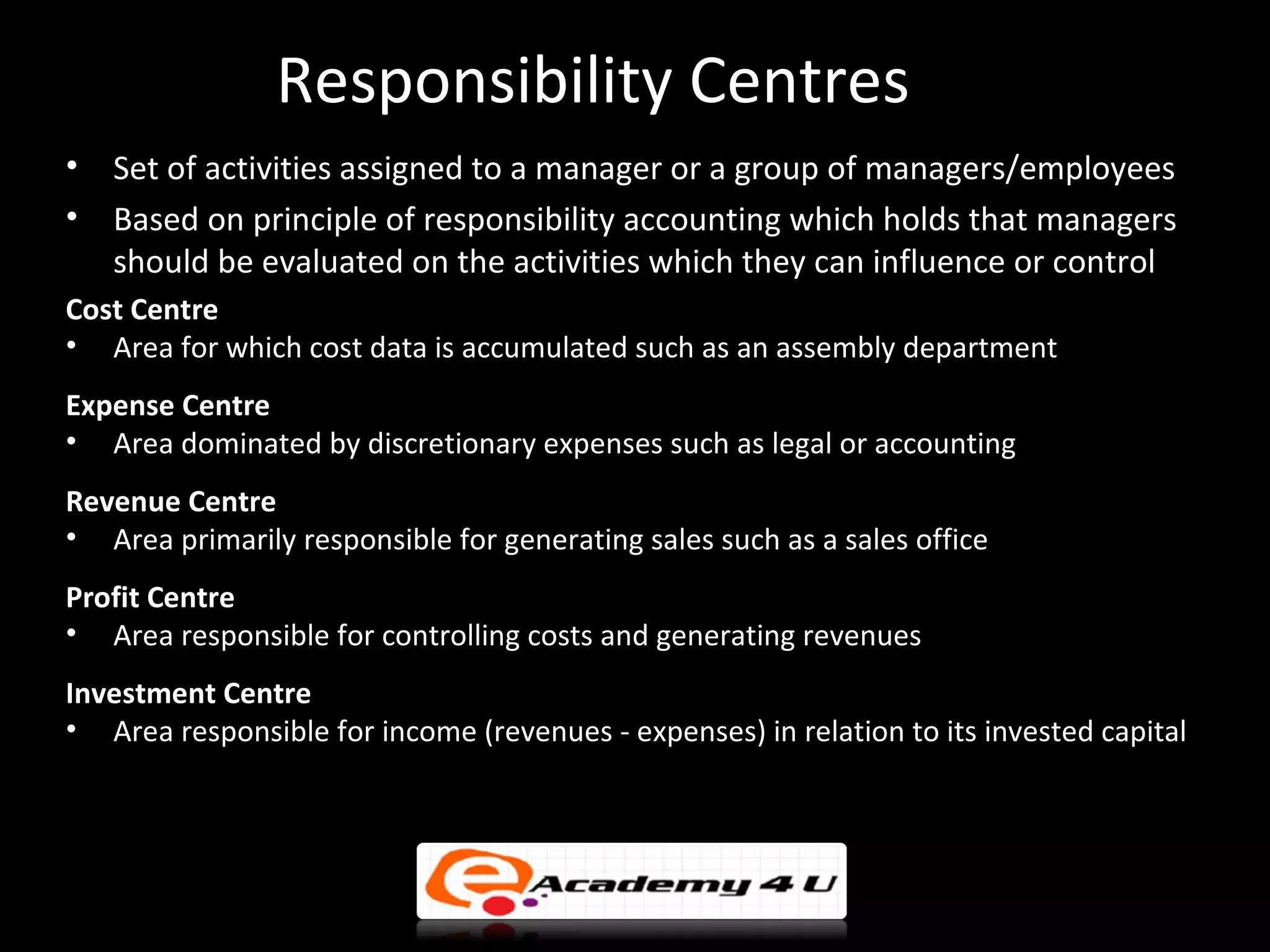
Responsibility Centres
•   Set of activities assigned to a manager or a group of managers/employees
•   Based on principle of responsibility accounting which holds that managers
    should be evaluated on the activities which they can influence or control
Cost Centre
• Area for which cost data is accumulated such as an assembly department
Expense Centre
• Area dominated by discretionary expenses such as legal or accounting
Revenue Centre
• Area primarily responsible for generating sales such as a sales office
Profit Centre
• Area responsible for controlling costs and generating revenues
Investment Centre
• Area responsible for income (revenues - expenses) in relation to its invested capital
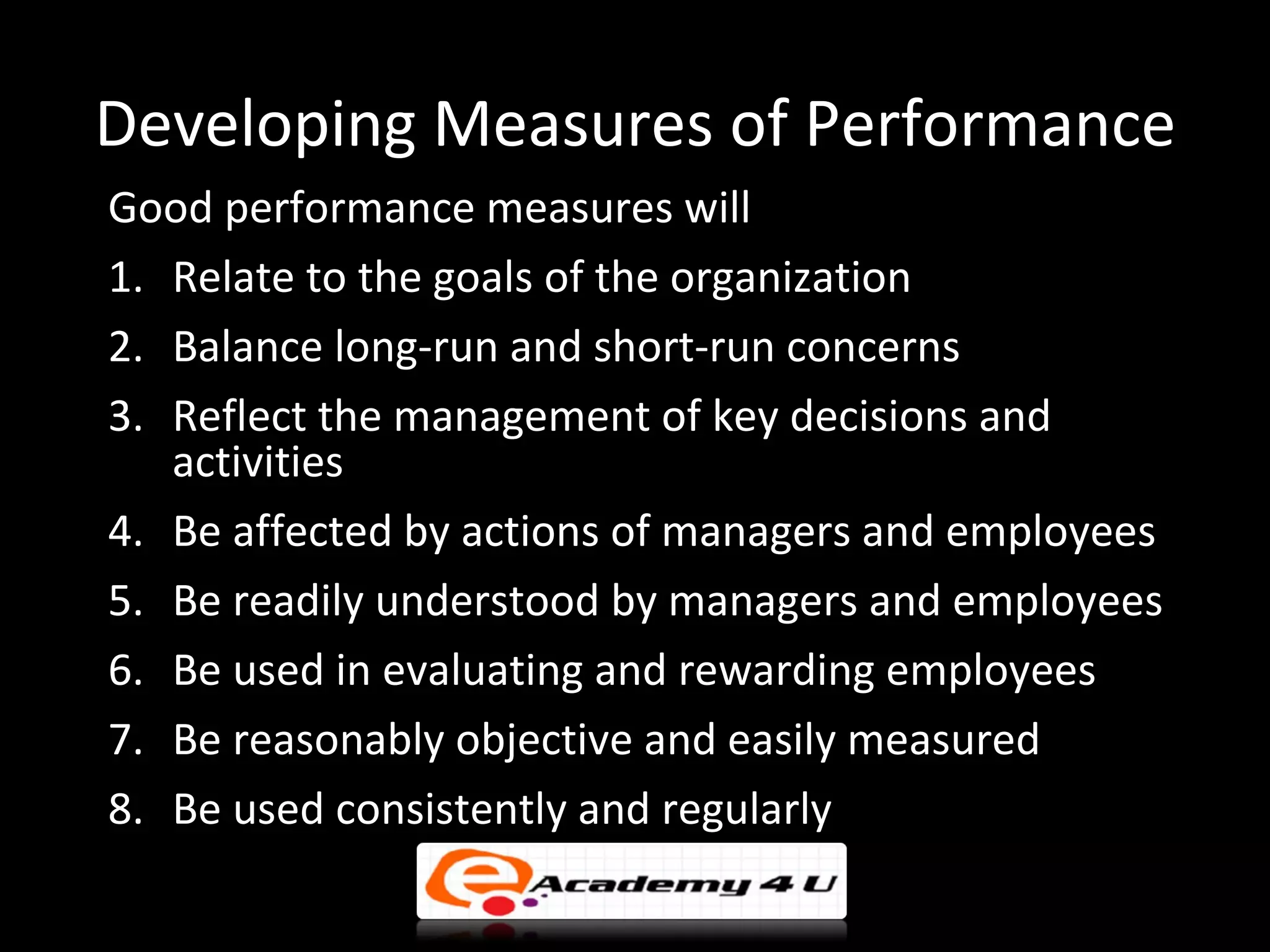
Developing Measures of Performance
Good performance measures will
1. Relate to the goals of the organization
2. Balance long-run and short-run concerns
3. Reflect the management of key decisions and
   activities
4. Be affected by actions of managers and employees
5. Be readily understood by managers and employees
6. Be used in evaluating and rewarding employees
7. Be reasonably objective and easily measured
8. Be used consistently and regularly
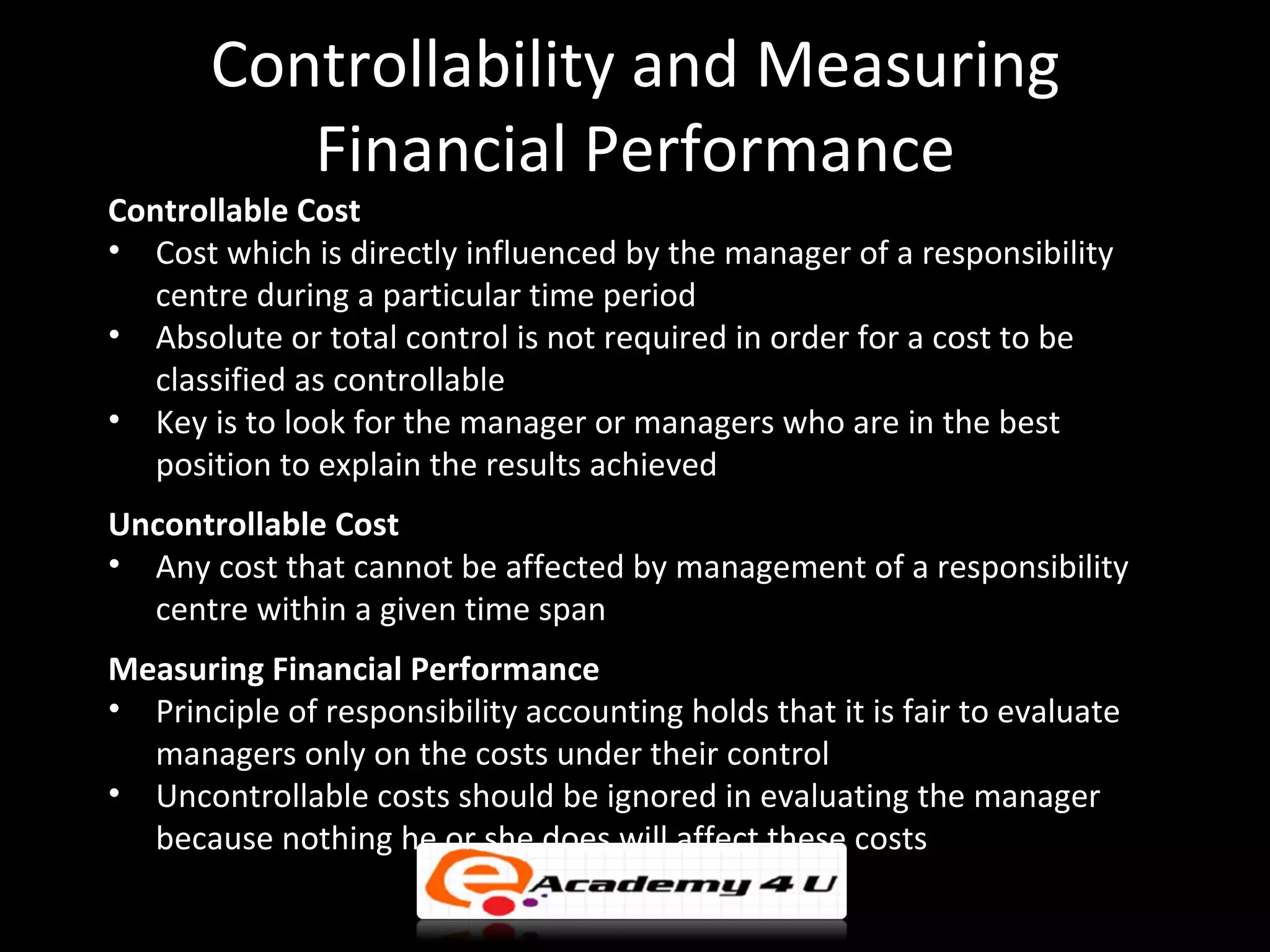
Controllability and Measuring
          Financial Performance
Controllable Cost
• Cost which is directly influenced by the manager of a responsibility
   centre during a particular time period
• Absolute or total control is not required in order for a cost to be
   classified as controllable
• Key is to look for the manager or managers who are in the best
   position to explain the results achieved
Uncontrollable Cost
• Any cost that cannot be affected by management of a responsibility
  centre within a given time span
Measuring Financial Performance
• Principle of responsibility accounting holds that it is fair to evaluate
  managers only on the costs under their control
• Uncontrollable costs should be ignored in evaluating the manager
  because nothing he or she does will affect these costs
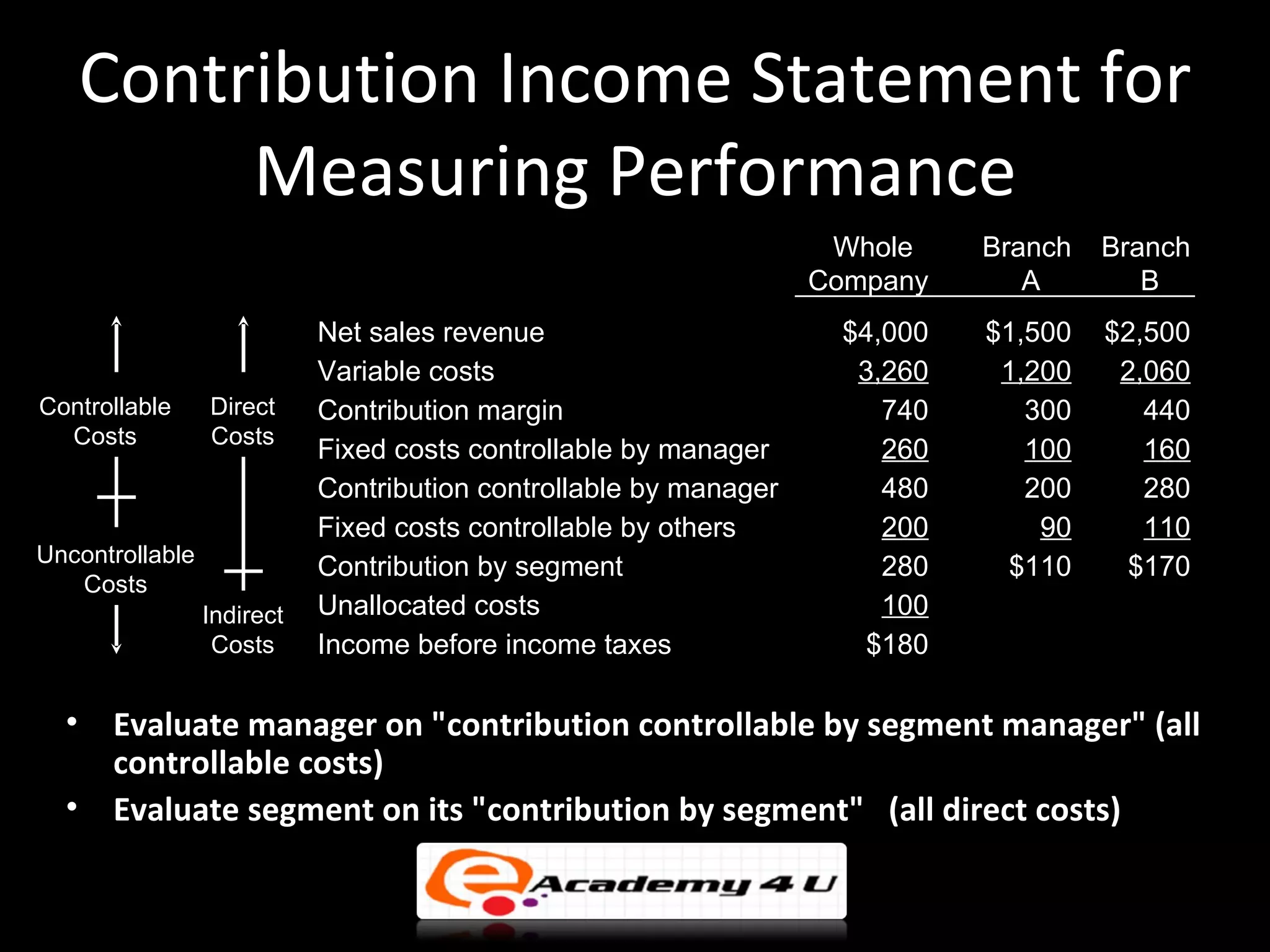
Contribution Income Statement for
           Measuring Performance
                                                                    Whole    Branch   Branch
                                                                   Company      A        B
                            Net sales revenue                       $4,000   $1,500   $2,500
                            Variable costs                           3,260    1,200    2,060
Controllable     Direct     Contribution margin                        740      300      440
  Costs          Costs
                            Fixed costs controllable by manager        260      100      160
                            Contribution controllable by manager       480      200      280
                            Fixed costs controllable by others         200       90      110
Uncontrollable
                            Contribution by segment                    280     $110     $170
   Costs
                 Indirect   Unallocated costs                          100
                  Costs     Income before income taxes                $180

  •    Evaluate manager on "contribution controllable by segment manager" (all
       controllable costs)
  •    Evaluate segment on its "contribution by segment" (all direct costs)
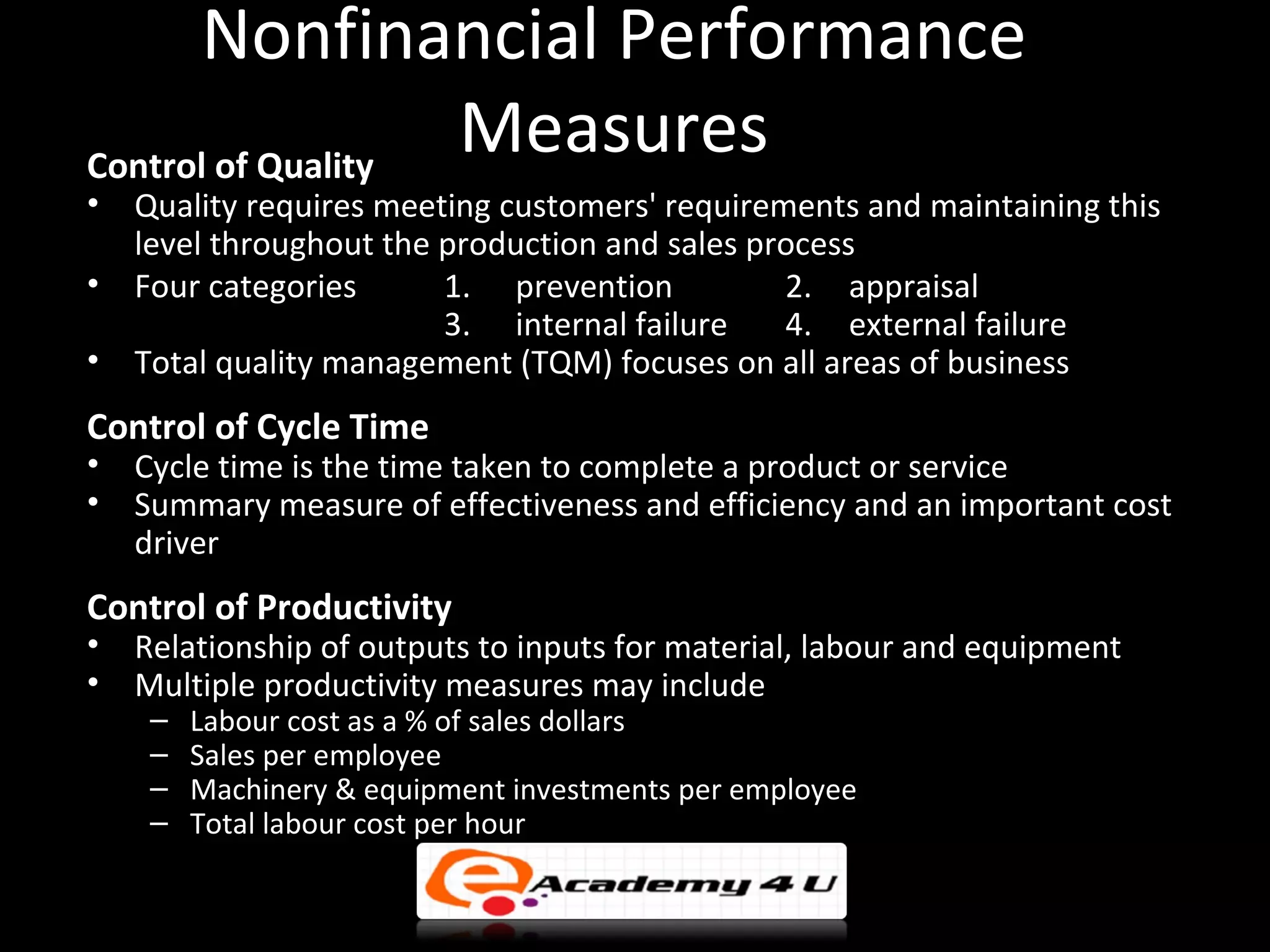
Nonfinancial Performance
Control of Quality
                   Measures
•   Quality requires meeting customers' requirements and maintaining this
    level throughout the production and sales process
•   Four categories      1. prevention          2. appraisal
                         3. internal failure    4. external failure
•   Total quality management (TQM) focuses on all areas of business
Control of Cycle Time
•   Cycle time is the time taken to complete a product or service
•   Summary measure of effectiveness and efficiency and an important cost
    driver
Control of Productivity
•   Relationship of outputs to inputs for material, labour and equipment
•   Multiple productivity measures may include
     –   Labour cost as a % of sales dollars
     –   Sales per employee
     –   Machinery & equipment investments per employee
     –   Total labour cost per hour
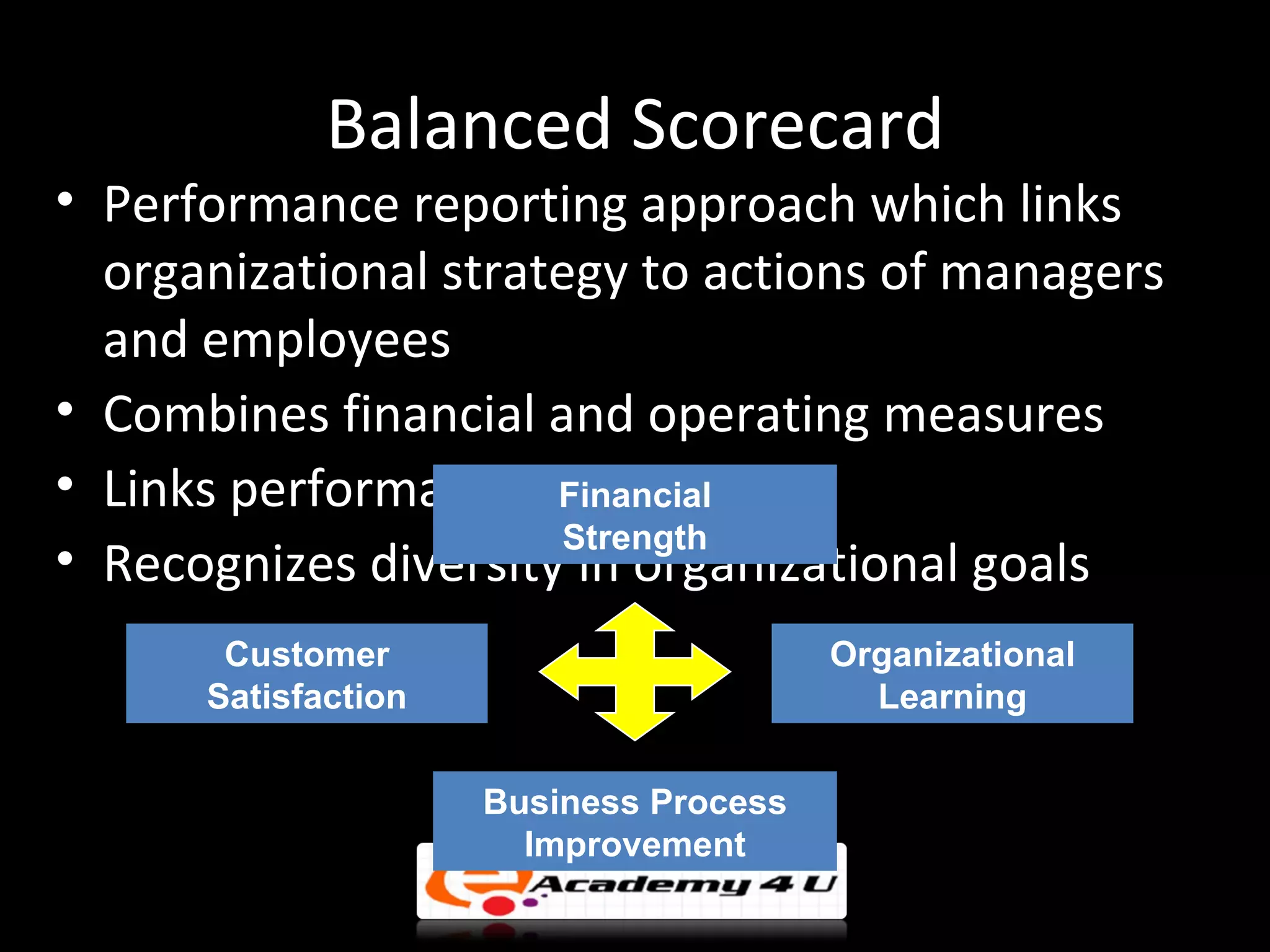
Balanced Scorecard
• Performance reporting approach which links
  organizational strategy to actions of managers
  and employees
• Combines financial and operating measures
• Links performance to rewards
                      Financial
                       Strength
• Recognizes diversity in organizational goals
       Customer                         Organizational
      Satisfaction                        Learning

                     Business Process
                       Improvement
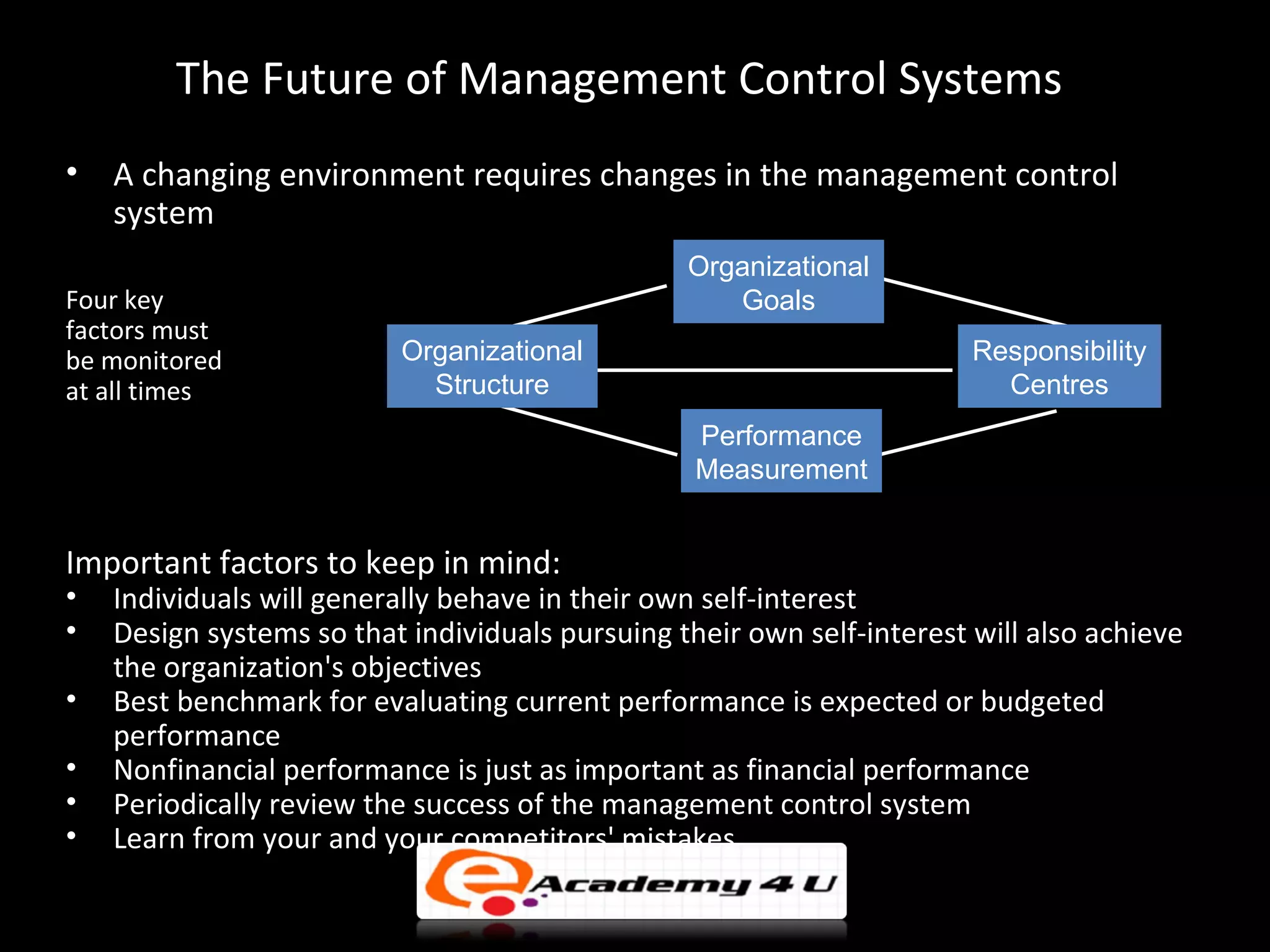
The Future of Management Control Systems
•   A changing environment requires changes in the management control
    system
                                                 Organizational
Four key                                            Goals
factors must
be monitored              Organizational                                Responsibility
at all times                Structure                                     Centres
                                                  Performance
                                                  Measurement


Important factors to keep in mind:
•   Individuals will generally behave in their own self-interest
•   Design systems so that individuals pursuing their own self-interest will also achieve
    the organization's objectives
•   Best benchmark for evaluating current performance is expected or budgeted
    performance
•   Nonfinancial performance is just as important as financial performance
•   Periodically review the success of the management control system
•   Learn from your and your competitors' mistakes

Management control system

  • 1.
  • 2.
    Management Control System •A management control system is a logical integration of management accounting tools to gather and report data and to evaluate performance Purposes of a management control system • clearly communicate the organization’s goals • ensure that every manager and employee understands the specific actions required of him/her to achieve organizational goals • communicate the results of actions across the organization • ensure that the management control system adjusts to changes in the environment
  • 3.
    Management Control SystemSteps 1. Begin by specifying the organization's goals, subgoals and objectives – Goals are what the organization hopes to achieve in the long run – Subgoals or key success factors are more specific and provide more focus to guide daily actions – Objectives are specific benchmarks which management would like to see achieved – Important to keep all three in balance to avoid concentrating solely on short-run achievements at the expense of long run goals 2. Establish responsibility centers 3. Develop performance measures 4. Measure and report on financial performance 5. Measure and report on non-financial performance
  • 4.
    The Management Control System Set Goals, Measures, Targets Plan Feedback and and Evaluate, Execute Learning Reward Monitor, Report
  • 5.
    Setting Goals, Objectivesand Performance Measures Top management develops organization-wide goals, measures and targets. They also identify the critical processes. Top management and critical process managers develop critical success factors and performance measures. They also specify objectives Critical process managers and lower-level managers develop performance measures for objectives.
  • 6.
    Forms of OrganizationalStructure President Staff Functional VP VP VP VP Marketing Production Human Resources Finance Divisional Matrix President Staff President Functional VPs Mkt. Prod. H.R. Fin. A Divisional VP VP VP VPs B Division A Division B Division C C
  • 7.
    Responsibility Centres • Set of activities assigned to a manager or a group of managers/employees • Based on principle of responsibility accounting which holds that managers should be evaluated on the activities which they can influence or control Cost Centre • Area for which cost data is accumulated such as an assembly department Expense Centre • Area dominated by discretionary expenses such as legal or accounting Revenue Centre • Area primarily responsible for generating sales such as a sales office Profit Centre • Area responsible for controlling costs and generating revenues Investment Centre • Area responsible for income (revenues - expenses) in relation to its invested capital
  • 8.
    Developing Measures ofPerformance Good performance measures will 1. Relate to the goals of the organization 2. Balance long-run and short-run concerns 3. Reflect the management of key decisions and activities 4. Be affected by actions of managers and employees 5. Be readily understood by managers and employees 6. Be used in evaluating and rewarding employees 7. Be reasonably objective and easily measured 8. Be used consistently and regularly
  • 9.
    Controllability and Measuring Financial Performance Controllable Cost • Cost which is directly influenced by the manager of a responsibility centre during a particular time period • Absolute or total control is not required in order for a cost to be classified as controllable • Key is to look for the manager or managers who are in the best position to explain the results achieved Uncontrollable Cost • Any cost that cannot be affected by management of a responsibility centre within a given time span Measuring Financial Performance • Principle of responsibility accounting holds that it is fair to evaluate managers only on the costs under their control • Uncontrollable costs should be ignored in evaluating the manager because nothing he or she does will affect these costs
  • 10.
    Contribution Income Statementfor Measuring Performance Whole Branch Branch Company A B Net sales revenue $4,000 $1,500 $2,500 Variable costs 3,260 1,200 2,060 Controllable Direct Contribution margin 740 300 440 Costs Costs Fixed costs controllable by manager 260 100 160 Contribution controllable by manager 480 200 280 Fixed costs controllable by others 200 90 110 Uncontrollable Contribution by segment 280 $110 $170 Costs Indirect Unallocated costs 100 Costs Income before income taxes $180 • Evaluate manager on "contribution controllable by segment manager" (all controllable costs) • Evaluate segment on its "contribution by segment" (all direct costs)
  • 11.
    Nonfinancial Performance Control ofQuality Measures • Quality requires meeting customers' requirements and maintaining this level throughout the production and sales process • Four categories 1. prevention 2. appraisal 3. internal failure 4. external failure • Total quality management (TQM) focuses on all areas of business Control of Cycle Time • Cycle time is the time taken to complete a product or service • Summary measure of effectiveness and efficiency and an important cost driver Control of Productivity • Relationship of outputs to inputs for material, labour and equipment • Multiple productivity measures may include – Labour cost as a % of sales dollars – Sales per employee – Machinery & equipment investments per employee – Total labour cost per hour
  • 12.
    Balanced Scorecard • Performancereporting approach which links organizational strategy to actions of managers and employees • Combines financial and operating measures • Links performance to rewards Financial Strength • Recognizes diversity in organizational goals Customer Organizational Satisfaction Learning Business Process Improvement
  • 13.
    The Future ofManagement Control Systems • A changing environment requires changes in the management control system Organizational Four key Goals factors must be monitored Organizational Responsibility at all times Structure Centres Performance Measurement Important factors to keep in mind: • Individuals will generally behave in their own self-interest • Design systems so that individuals pursuing their own self-interest will also achieve the organization's objectives • Best benchmark for evaluating current performance is expected or budgeted performance • Nonfinancial performance is just as important as financial performance • Periodically review the success of the management control system • Learn from your and your competitors' mistakes