Expert System
• Most wide application of AI. An expert system is
knowledge based IS that uses its knowledge
about a specific , complex application area to act
as an expert consultant to end user.
• Expert system provide answers on specific issues
by making human like inferences (like a
consultant or expert) about knowledge
contained in knowledge base.
• This indicates that knowledge is essential for
expert system to work
components
1. Knowledge base i.e facts about specific area
(e.g A is student) alongwith heurisitics (rules
of thumb)-(A will appear for exams)
• Machine learns the above mainly by:
• Case-Based Reasoning- in past this has
happened so now..................
• Rule based Knowledge- If this happens then
do this.......
KMS
• H:KMS.doc
components
• 2. System resources
• Expert system software package consist of
inference engine. The inference engine
program processes the knowledge related to
specific problem. It then makes associations
and inferences resulting in recommended
courses of action for user
Link showing components
• H:IMG_20160315_151243.jpg
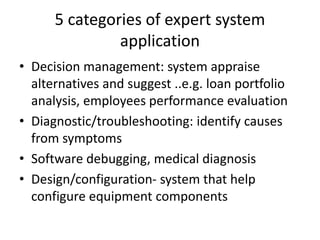
5 categories of expert system
application
• Decision management: system appraise
alternatives and suggest ..e.g. loan portfolio
analysis, employees performance evaluation
• Diagnostic/troubleshooting: identify causes
from symptoms
• Software debugging, medical diagnosis
• Design/configuration- system that help
configure equipment components
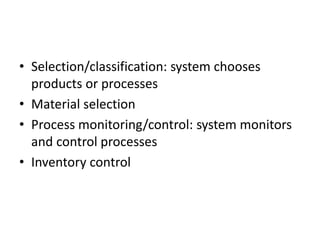
• Selection/classification: system chooses
products or processes
• Material selection
• Process monitoring/control: system monitors
and control processes
• Inventory control
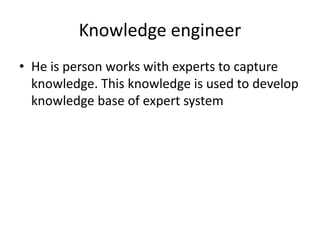
Knowledge engineer
• He is person works with experts to capture
knowledge. This knowledge is used to develop
knowledge base of expert system
OLAP
• Online analytical processing
• It enables managers to interactively examine
and manipulate large amounts of detailed and
consolidated data from many perspectives.
OLAP involves analyzing complex relationships
among thousands or even millions of data
item stored in data marts, data warehouses
and other multidimensional databases to
discover trends, patterns and exceptions
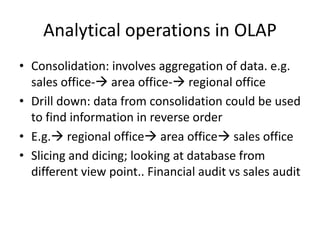
Analytical operations in OLAP
• Consolidation: involves aggregation of data. e.g.
sales office- area office- regional office
• Drill down: data from consolidation could be used
to find information in reverse order
• E.g. regional office area office sales office
• Slicing and dicing; looking at database from
different view point.. Financial audit vs sales audit
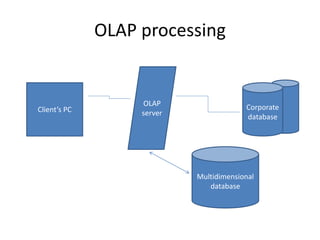
OLAP processing
Client’s PC
OLAP
server
Multidimensional
database
Corporate
database
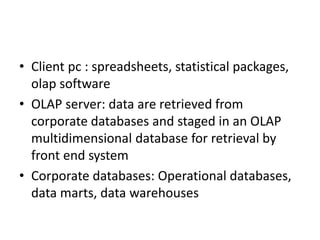
• Client pc : spreadsheets, statistical packages,
olap software
• OLAP server: data are retrieved from
corporate databases and staged in an OLAP
multidimensional database for retrieval by
front end system
• Corporate databases: Operational databases,
data marts, data warehouses

Expert system

  • 1.
    Expert System • Mostwide application of AI. An expert system is knowledge based IS that uses its knowledge about a specific , complex application area to act as an expert consultant to end user. • Expert system provide answers on specific issues by making human like inferences (like a consultant or expert) about knowledge contained in knowledge base. • This indicates that knowledge is essential for expert system to work
  • 2.
    components 1. Knowledge basei.e facts about specific area (e.g A is student) alongwith heurisitics (rules of thumb)-(A will appear for exams) • Machine learns the above mainly by: • Case-Based Reasoning- in past this has happened so now.................. • Rule based Knowledge- If this happens then do this.......
  • 3.
  • 4.
    components • 2. Systemresources • Expert system software package consist of inference engine. The inference engine program processes the knowledge related to specific problem. It then makes associations and inferences resulting in recommended courses of action for user
  • 5.
    Link showing components •H:IMG_20160315_151243.jpg
  • 6.
    5 categories ofexpert system application • Decision management: system appraise alternatives and suggest ..e.g. loan portfolio analysis, employees performance evaluation • Diagnostic/troubleshooting: identify causes from symptoms • Software debugging, medical diagnosis • Design/configuration- system that help configure equipment components
  • 7.
    • Selection/classification: systemchooses products or processes • Material selection • Process monitoring/control: system monitors and control processes • Inventory control
  • 8.
    Knowledge engineer • Heis person works with experts to capture knowledge. This knowledge is used to develop knowledge base of expert system
  • 9.
    OLAP • Online analyticalprocessing • It enables managers to interactively examine and manipulate large amounts of detailed and consolidated data from many perspectives. OLAP involves analyzing complex relationships among thousands or even millions of data item stored in data marts, data warehouses and other multidimensional databases to discover trends, patterns and exceptions
  • 10.
    Analytical operations inOLAP • Consolidation: involves aggregation of data. e.g. sales office- area office- regional office • Drill down: data from consolidation could be used to find information in reverse order • E.g. regional office area office sales office • Slicing and dicing; looking at database from different view point.. Financial audit vs sales audit
  • 11.
  • 12.
    • Client pc: spreadsheets, statistical packages, olap software • OLAP server: data are retrieved from corporate databases and staged in an OLAP multidimensional database for retrieval by front end system • Corporate databases: Operational databases, data marts, data warehouses