Abdominal Trauma Nestor Nestor, M.D., M.Sc. January 17, 2007
The Plan Abdominal Anatomy Mechanisms of Injury Common Pathology Evaluation Management
Part 1: Abdominal Anatomy
Abdominal Anatomy Basics ABC’s Many organs receiving substantial blood flow Potential spaces that can hide hemorrhage Hollow organ damage   > Peritonitis
Abdominal Anatomy Basics ABC’s Many organs receiving substantial blood flow Potential spaces that can hide hemorrhage Hollow organ damage > Peritonitis
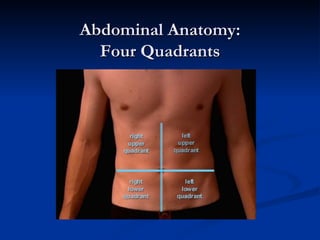
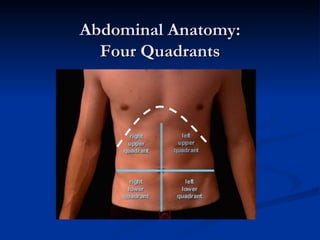
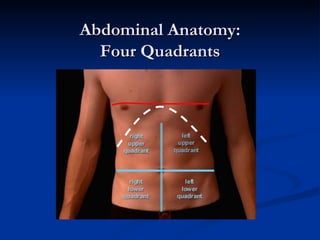
Abdominal Anatomy: Four Quadrants
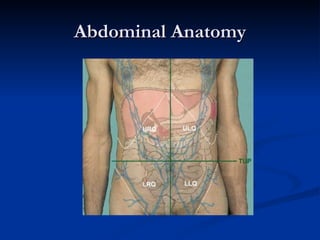
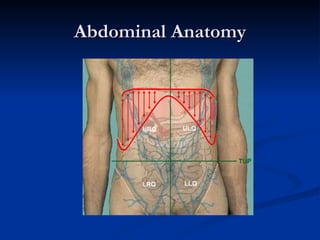
Abdominal Anatomy
Abdominal Anatomy
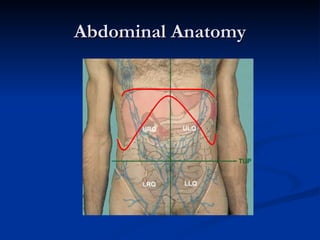
Abdominal Anatomy
Abdominal Anatomy
Abdominal Anatomy: Four Quadrants
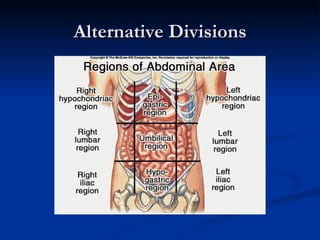
Alternative Divisions
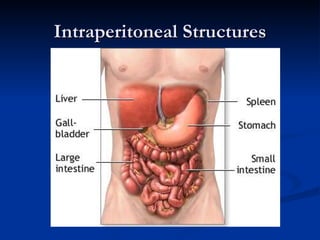
Intraperitoneal Structures
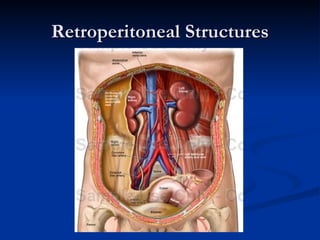
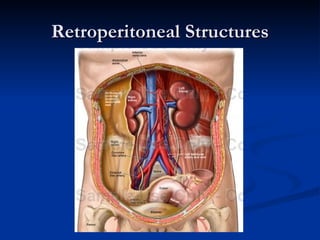
Retroperitoneal Structures
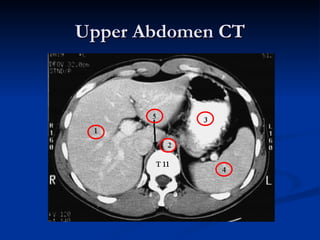
Upper Abdomen CT
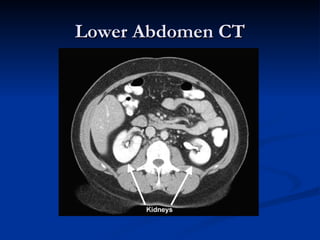
Lower Abdomen CT
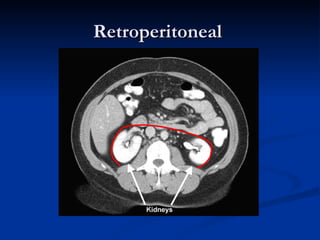
Retroperitoneal
Part 2: Mechanisms and Pathology
Abdominal Injuries Blunt vs. Penetrating Often both occur simultaneously Blunt is the most common mechanism in US
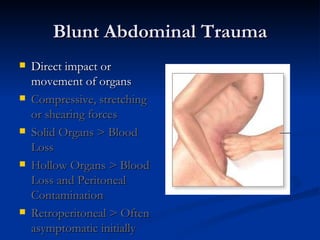
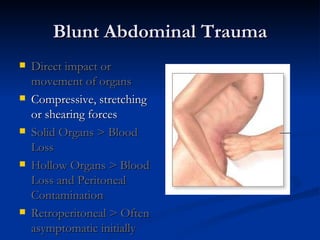
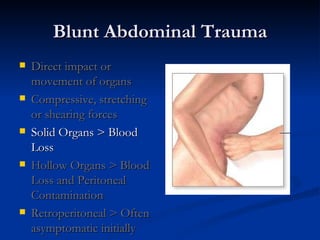
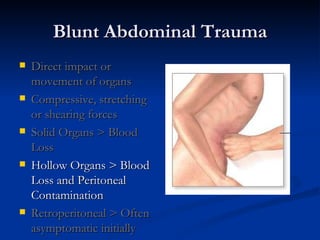
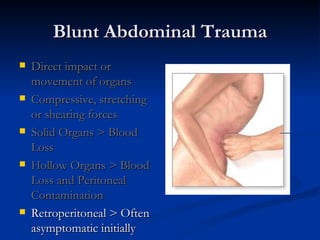
Blunt Abdominal Trauma Direct impact or movement of organs Compressive, stretching or shearing forces Solid Organs > Blood Loss Hollow Organs > Blood Loss and Peritoneal Contamination Retroperitoneal > Often asymptomatic initially
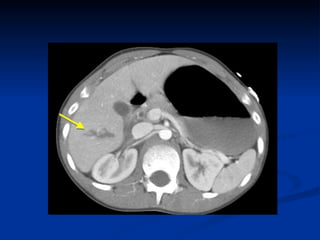
Liver Lacerations I.    Subcapsular Hematoma <10% Surface Area II.  Subcapsular Hematoma 10-50%  III. Subcapsular Hematoma >50%  IV. Parenchymal Disruption of 25-75% V.  Parenchymal Disruption of >75% VI. Liver Avulsion
 
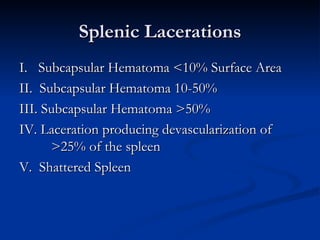
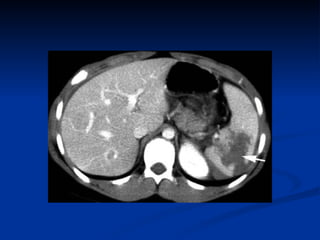
Splenic Lacerations I.    Subcapsular Hematoma <10% Surface Area II.  Subcapsular Hematoma 10-50%  III. Subcapsular Hematoma >50%  IV. Laceration producing devascularization of  >25% of the spleen V.  Shattered Spleen
 
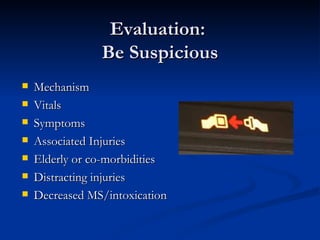
Evaluation:  Be Suspicious Mechanism Vitals Symptoms Associated Injuries Elderly or co-morbidities Distracting injuries Decreased MS/intoxication
Techniques for Evaluation Physical Exam Serial exams in awake, alert and reliable pt Plain Films Abd films little or no use, pelvic are the standard Screening Diagnostic Peritoneal Lavage (DPL) Ultrasound:   FAST (serial exams)
Techniques for Evaluation Physical Exam Serial exams in awake, alert and reliable pt Plain Films Abd films little or no use, pelvis are the standard Screening Diagnostic Peritoneal Lavage (DPL) Ultrasound:   FAST (serial exams)
Techniques for Evaluation Physical Exam Serial exams in awake, alert and reliable pt Plain Films Abd films little or no use, pelvis are the standard Screening Diagnostic Peritoneal Lavage (DPL) Ultrasound: FAST (serial exams)
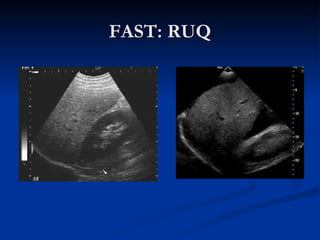
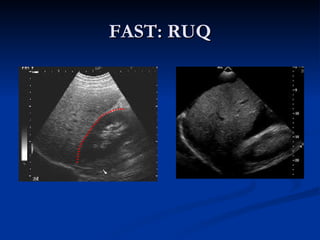
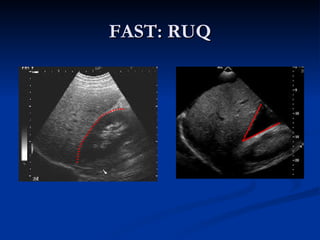
FAST: RUQ
FAST: RUQ
FAST: RUQ
Techniques for Evaluation Organ Specific Dx Only CT  Also evaluates retroperitoneum Expensive Radiation Ex Lap Laparotomy gold standard for evaluation  Concomitant treatment Retroperitoneum difficult to explore/assess
Techniques for Evaluation Organ Specific Dx Only CT  Also evaluates retroperitoneum Expensive Radiation Ex Lap Laparotomy is the gold standard for evaluation  Concomitant treatment Retroperitoneum difficult to explore/assess
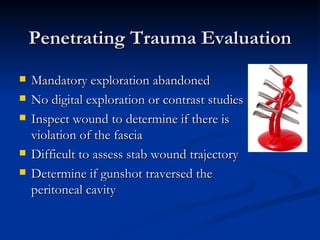
Penetrating Trauma Evaluation Mandatory exploration abandoned No digital exploration or contrast studies Inspect wound to determine if there is violation of the fascia Difficult to assess stab wound trajectory Determine if gunshot traversed the peritoneal cavity
Management ABC’s Fluid resuscitate To lap or not to lap? Unstable (with no other reason) Free air/peritonitis (antibiotics) Unexplained free fluid Many splenic/liver lacs managed non-operatively or by VIR
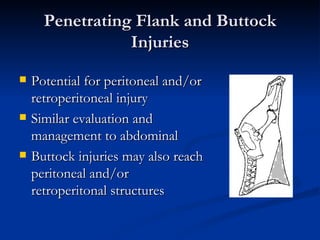
Penetrating Flank and Buttock Injuries Potential for peritoneal and/or retroperitoneal injury Similar evaluation and management to abdominal Buttock injuries may also reach peritoneal and/or retroperitonal structures
Genitourinary Trauma
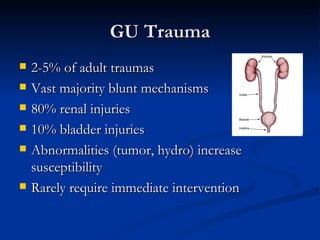
GU Trauma 2-5% of adult traumas Vast majority blunt mechanisms 80% renal injuries 10% bladder injuries Abnormalities (tumor, hydro) increase susceptibility  Rarely require immediate intervention
Evaluation Rectal - high riding prostate Perineum - ecchymosis, lacs Genitals - meatal/vaginal blood Difficult catheter placement (may need suprapubic) UA – hematuria (poor correlation to degree of injury)
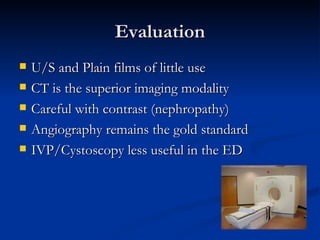
Evaluation U/S and Plain films of little use CT is the superior imaging modality Careful with contrast (nephropathy) Angiography remains the gold standard  IVP/Cystoscopy less useful in the ED
GU Injuries: The Kidneys Kidneys are well protected Most commonly bruised Pts with a shattered kidney become rapidly unstable Renal vascular injuries may result in thrombosed vessels
GU Injuries: The Kidneys Operative management for: uncontrolled hemorrhage Penetrating injuries Multiple lacs Shattered kidney Avulsed vessels
GU Injuries: The Bladder Contusion Rupture: Intra vs. Extraperitoneal Extraperitoneal presents with pain, hematuria and inability to void Urethral injuries: Anterior vs. posterior No Foley for urethral injuries
Retroperitoneal Structures
In Summary... Basic knowledge of anatomy necessary for initial assessment of abdominal trauma Peritoneal vs. Retroperitoneal Blunt vs. Penetrating Don’t miss GU injuries
Thank You

Abdominal Trauma Nestor 2007

  • 1.
    Abdominal Trauma NestorNestor, M.D., M.Sc. January 17, 2007
  • 2.
    The Plan AbdominalAnatomy Mechanisms of Injury Common Pathology Evaluation Management
  • 3.
  • 4.
    Abdominal Anatomy BasicsABC’s Many organs receiving substantial blood flow Potential spaces that can hide hemorrhage Hollow organ damage > Peritonitis
  • 5.
    Abdominal Anatomy BasicsABC’s Many organs receiving substantial blood flow Potential spaces that can hide hemorrhage Hollow organ damage > Peritonitis
  • 6.
    Abdominal Anatomy BasicsABC’s Many organs receiving substantial blood flow Potential spaces that can hide hemorrhage Hollow organ damage > Peritonitis
  • 7.
    Abdominal Anatomy BasicsABC’s Many organs receiving substantial blood flow Potential spaces that can hide hemorrhage Hollow organ damage > Peritonitis
  • 8.
  • 9.
  • 10.
  • 11.
  • 12.
  • 13.
  • 14.
  • 15.
  • 16.
  • 17.
  • 18.
  • 19.
  • 20.
  • 21.
    Part 2: Mechanismsand Pathology
  • 22.
    Abdominal Injuries Bluntvs. Penetrating Often both occur simultaneously Blunt is the most common mechanism in US
  • 23.
    Blunt Abdominal TraumaDirect impact or movement of organs Compressive, stretching or shearing forces Solid Organs > Blood Loss Hollow Organs > Blood Loss and Peritoneal Contamination Retroperitoneal > Often asymptomatic initially
  • 24.
    Blunt Abdominal TraumaDirect impact or movement of organs Compressive, stretching or shearing forces Solid Organs > Blood Loss Hollow Organs > Blood Loss and Peritoneal Contamination Retroperitoneal > Often asymptomatic initially
  • 25.
    Blunt Abdominal TraumaDirect impact or movement of organs Compressive, stretching or shearing forces Solid Organs > Blood Loss Hollow Organs > Blood Loss and Peritoneal Contamination Retroperitoneal > Often asymptomatic initially
  • 26.
    Blunt Abdominal TraumaDirect impact or movement of organs Compressive, stretching or shearing forces Solid Organs > Blood Loss Hollow Organs > Blood Loss and Peritoneal Contamination Retroperitoneal > Often asymptomatic initially
  • 27.
    Blunt Abdominal TraumaDirect impact or movement of organs Compressive, stretching or shearing forces Solid Organs > Blood Loss Hollow Organs > Blood Loss and Peritoneal Contamination Retroperitoneal > Often asymptomatic initially
  • 28.
    Liver Lacerations I. Subcapsular Hematoma <10% Surface Area II. Subcapsular Hematoma 10-50% III. Subcapsular Hematoma >50% IV. Parenchymal Disruption of 25-75% V. Parenchymal Disruption of >75% VI. Liver Avulsion
  • 29.
  • 30.
    Splenic Lacerations I. Subcapsular Hematoma <10% Surface Area II. Subcapsular Hematoma 10-50% III. Subcapsular Hematoma >50% IV. Laceration producing devascularization of >25% of the spleen V. Shattered Spleen
  • 31.
  • 32.
    Evaluation: BeSuspicious Mechanism Vitals Symptoms Associated Injuries Elderly or co-morbidities Distracting injuries Decreased MS/intoxication
  • 33.
    Techniques for EvaluationPhysical Exam Serial exams in awake, alert and reliable pt Plain Films Abd films little or no use, pelvic are the standard Screening Diagnostic Peritoneal Lavage (DPL) Ultrasound: FAST (serial exams)
  • 34.
    Techniques for EvaluationPhysical Exam Serial exams in awake, alert and reliable pt Plain Films Abd films little or no use, pelvis are the standard Screening Diagnostic Peritoneal Lavage (DPL) Ultrasound: FAST (serial exams)
  • 35.
    Techniques for EvaluationPhysical Exam Serial exams in awake, alert and reliable pt Plain Films Abd films little or no use, pelvis are the standard Screening Diagnostic Peritoneal Lavage (DPL) Ultrasound: FAST (serial exams)
  • 36.
  • 37.
  • 38.
  • 39.
    Techniques for EvaluationOrgan Specific Dx Only CT Also evaluates retroperitoneum Expensive Radiation Ex Lap Laparotomy gold standard for evaluation Concomitant treatment Retroperitoneum difficult to explore/assess
  • 40.
    Techniques for EvaluationOrgan Specific Dx Only CT Also evaluates retroperitoneum Expensive Radiation Ex Lap Laparotomy is the gold standard for evaluation Concomitant treatment Retroperitoneum difficult to explore/assess
  • 41.
    Penetrating Trauma EvaluationMandatory exploration abandoned No digital exploration or contrast studies Inspect wound to determine if there is violation of the fascia Difficult to assess stab wound trajectory Determine if gunshot traversed the peritoneal cavity
  • 42.
    Management ABC’s Fluidresuscitate To lap or not to lap? Unstable (with no other reason) Free air/peritonitis (antibiotics) Unexplained free fluid Many splenic/liver lacs managed non-operatively or by VIR
  • 43.
    Penetrating Flank andButtock Injuries Potential for peritoneal and/or retroperitoneal injury Similar evaluation and management to abdominal Buttock injuries may also reach peritoneal and/or retroperitonal structures
  • 44.
  • 45.
    GU Trauma 2-5%of adult traumas Vast majority blunt mechanisms 80% renal injuries 10% bladder injuries Abnormalities (tumor, hydro) increase susceptibility Rarely require immediate intervention
  • 46.
    Evaluation Rectal -high riding prostate Perineum - ecchymosis, lacs Genitals - meatal/vaginal blood Difficult catheter placement (may need suprapubic) UA – hematuria (poor correlation to degree of injury)
  • 47.
    Evaluation U/S andPlain films of little use CT is the superior imaging modality Careful with contrast (nephropathy) Angiography remains the gold standard IVP/Cystoscopy less useful in the ED
  • 48.
    GU Injuries: TheKidneys Kidneys are well protected Most commonly bruised Pts with a shattered kidney become rapidly unstable Renal vascular injuries may result in thrombosed vessels
  • 49.
    GU Injuries: TheKidneys Operative management for: uncontrolled hemorrhage Penetrating injuries Multiple lacs Shattered kidney Avulsed vessels
  • 50.
    GU Injuries: TheBladder Contusion Rupture: Intra vs. Extraperitoneal Extraperitoneal presents with pain, hematuria and inability to void Urethral injuries: Anterior vs. posterior No Foley for urethral injuries
  • 51.
  • 52.
    In Summary... Basicknowledge of anatomy necessary for initial assessment of abdominal trauma Peritoneal vs. Retroperitoneal Blunt vs. Penetrating Don’t miss GU injuries
  • 53.