Diagnostic imaging of small HCC
in liver cirrhosis : The current
approach
Dr.Tony Loke
United Christian Hospital
Disclosure
No conflict of interest
Contents
•  Step wise progression of hepatocarcinogenesis
•  MR I can image this histhopathological process - Gadoxetic
enhanced MRI + DWI
•  Definite Criteria for HCC – Low sensitivity
•  Gadoxetic enhanced MRI alone - ↑sensitivity
•  Diffusion weighted MRI -↑ specificity
•  Combined Ga MRI and DWI – current approach
•  Proposed Algorithm – Best diagnostic accuracy
Multistep progression of Hepatocarcinogenesis

Kudo M Oncology 2010;78:87-93
Intranodular blood supplyunpaired arteries / portal tracts	

Tajima T AJR 2002:178;885
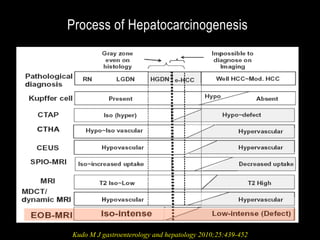
Histopathological pathway of Carcinogenesis	

•  Replacement of normal liver cells by abnormal liver
malignant cells -↓ OATP8 expression
•  Hypointensity – HBP Primovist enhanced MRI

•  Unpaired arteries ↑ + Portal tract ↓
•  Wash in/ Wash out – Dynamic CT and MRI

•  Increased cell density with progressive undifferentiated
nodules
•  Hyperintensity - DWI
Process of Hepatocarcinogenesis

Kudo M J gastroenterology and hepatology 2010;25:439-452
Diagnostic criteria for typical HCC

Bruix J, Sherman M Hepatology 2011;53:1020-1022
Definite HCC	
• Wash in (arterial phase hyperenhancement) /
Wash out– AASLD, EASL criteria (>1 cm) and
JSH (any size)
•  Dynamic MDCT, MRI (Primovist enhanced MRI),
CEUS

• Only 71% - have ‘wash in’ and ‘wash out’ on
more than one test
Marrero JA et al Liver Transpl 2005;11:281-289
↑ Sensitivity - Malignant liver nodules	
•  Absence of OATP8 expression / kupffer
cells
•  Liver specific contrast agents
•  Primovist MRI, SPIO-MRI, Sonazoid- CEUS

•  Restricted diffusion
•  Diffusion weighted MRI
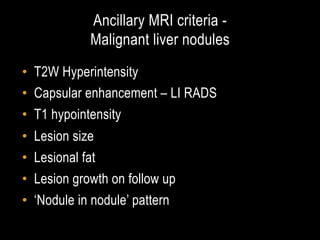
Ancillary MRI criteria -

Malignant liver nodules	
•  T2W Hyperintensity
•  Capsular enhancement – LI RADS
•  T1 hypointensity
•  Lesion size
•  Lesional fat
•  Lesion growth on follow up
•  ‘Nodule in nodule’ pattern
PRIMOVIST alone has higher sensitivity
-? Compromised specificity

•  Comparing primovist and magnevist,
•  Significant increased sensitivity with primovist.
•  Hepatocellular phase imaging with Primovist improves HCC detection.

•  Primovist MRI has higher diagnostic accuracy (0.88 vs 0.74, p<.
001) and higher sensitivity (0.85 vs0.69, p<.001) than triple phase
MDCT
•  Particularly in smaller lesions (<2cm)

•  MRI with primovist has equal accuracy as dual-contrast MRI for
HCC detection
•  Combined use of extracellular gadolinium and SPIO.
Marin D et al Radiology 2009;251:85-95
Park G et al BJR 2010;83:1010-1016
Kim YK et al Invest Radiol 2010:45:740-746
Martino et al Radiology 2010;256:806
Hypervascular nodule
Size does not matter!
Hypervascular nodule without washout

Primovist
Negative uptake

HCC

Positive uptake

Biopsy or Follow up
Kudo M Oncology 2010;78:87-93
Hypovascular Nodule- size matters!
Hypovascular nodule

Primovist
Negative uptake

≥1.5cm
HCC – 98%
LGDN – 2%

Positive uptake

<1.5cm

≥1.5cm

<1.5cm

Follow up

Biopsy or
FU

Follow up

17% progress to
HCC in 1 year

HCC

LGDN
PRIMOVIST (GD-EOB-DTPA)
GADOXETIC ACID

HCC-Hypointense at 20 min HBP (e)
DIFFUSION WEIGHTED MRI - ↑ Specificity
•  SI ratio significantly differentiates malignant and benign
lesions at all b-values.
•  Optimal threshold b=600
•  SI ratio 1.25.
•  For detection of HCC, DWI with b=600 has
•  sensitivity of 95.2% compared to 80.6% for
conventional MRI (p=0.023)
•  specificity of 82.7% compared to 65.4% (p=0.064%).
•  The improved accuracy was most beneficial for differentiating
lesions smaller than 2cm.	
Vandecaveye V Eur Radiol 2009;may:1431
Classic HCC -SI ratio 1.83 for b600 (g)
Small HCC -No lesion seen on T1, T2 or enhanced MRI.
SI ratio=1.5 at b600
CURRENT APPROACH
•  Combined Primovist enhanced MRI
and Diffusion weighted imaging – able
to image the step wise pathogenesis of
HCC
•  Dynamic Primovist MRI - Wash in / Wash out
•  Hepatobiliary phase Primovist enhanced MRI - OATP8
expression
•  DWI - cell density
•  Ancillary features
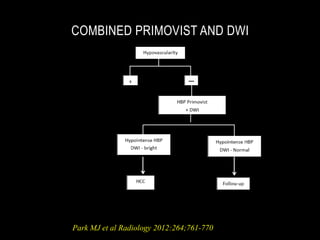
COMBINED PRIMOVIST MRI AND DWI
•  Criteria for HCC
•  Hypervascular nodules with washout
•  Hypervascular nodules without washout, hypointense on HBP
phase (irrespective of DWI)
•  Hypervascular nodules without wash out, iso/hyperintense on
HBP phase + Hyperintense DWI
•  Hypovascular nodules, hypointense on HBP phase +
Hyperintensity DWI

•  Combined Primovist and DWI has better diagnostic
accuracy and sensitivity (93.3%) in detection of HCC <
2cm
•  False positive – HGDN

Park MJ et al Radiology 2012:264;761-770
COMBINED PRIMOVIST AND DWI
	

Park MJ et al Radiology 2012:264;761-770
COMBINED PRIMOVIST AND DWI
	

Park MJ et al Radiology 2012:264;761-770
Typical small HCC

Small hypervascular HCC –DWI b=100, 800
Segment 6 hypervascular HCC < 1.5 CM
Atypical small HCC

Hypervascular HCC- hypointense on HBP but DWI normal
Hypervascular HCC
– and DN (DWI and HBP-Normal)
CT hypervascular lesionSegment 5 pseudolesion
Hypovascular HCC < 1.5 CM
Hypointense HBP + Hypertintense DWI
SEGMENT 2/3 HCC
Hypo/hypervascular component (HBP+DWI = +ve)
HGDN simulating HCC

Hypovascular DN- hypointense on HBP and DWI hyperintense
Segment 5 HGDN – Hypointense HBP (DWI-Normal)
DN > 1.5CM
HBP + DWI = negative
Summary - Current Approach
•  Nodule detected on USG
•  Dynamic CT
•  Hypervascular with washout (>1cm)
•  Atypical features

•  Combined Primovist enhanced MRI and DWI
•  Hypervascular without washout, hypointense on HBP phase
•  Hypervascular without washout, isointense on HBP phase + Hyperintense DWI
•  Hypovascular nodules, hypointense on HBP phase + Hyperintensity DWI
•  Ancillary features

•  Higher diagnostic accuracy and sensitivity
•  Particularly for HCC < 2cm
•  False positive for HGDN
Conclusion - Current Approach
•  Combined Primovist and DWI
•  Higher diagnostic accuracy and sensitivity
•  Particularly for HCC < 2cm
•  false positive include HGDN
•  Combined Primovist enhanced MRI and DWI
•  Hypervascular without washout, hypointense on HBP phase
•  Hypervascular nodules, isointense on HBP phase +
Hyperintense DWI
•  Hypovascular nodules, hypointense on HBP phase +
Hyperintensity DWI
SEG 2/3 HYPERVASCULAR HCC WITH
PARADOXICAL UPTAKE (DWI-hyperintense)
SEGMENT 6 HCC WITH NORMAL ARTERIAL,
T2W AND DWI
FOCAL NODULAR LIVER LESIONS:
1994 INTERNATIONAL CLASSIFICATION	
•  Regenerative nodule
•  Cirrhotic nodule
•  Low grade dysplastic nodule (adenomatous
hyperplasia)
•  High grade dysplastic nodule (adenomatous
hyperplasia with atypia)
•  Dysplastic nodule with subfoci of HCC (early HCC)
•  HCC (overt HCC)	
International Working Party. Hepatology
1995;22:983-993
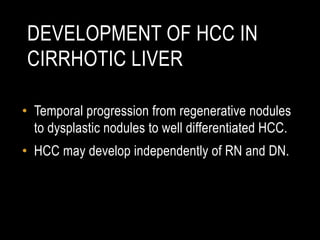
DEVELOPMENT OF HCC IN
CIRRHOTIC LIVER 	
•  Temporal progression from regenerative nodules
to dysplastic nodules to well differentiated HCC.
•  HCC may develop independently of RN and DN.
PRIMOVIST MRI MOST SENSITIVE TECHNIQUE IN
DETECTING EARLY HEPATOCARCINOGENESIS
CONSENSUS STATEMENTSJAPAN SOCIETY OF HEPATOLOGY
•  Typical HCC can be diagnosed by imaging regardless
of the size if a typical vascular pattern is obtained on
dynamic CT, dynamic MRI, CEUS or a combination of
CTHA and CTAP.
•  Different from Western guidelines, only one dynamic
study showing the typical pattern is sufficient to
diagnose HCC.
•  The typical imaging pattern include hypervascularity in
the arterial phase and washes-out in the portal venous
phase.
CONSENSUS STATEMENTSJAPAN SOCIETY OF HEPATOLOGY
•  Sonazoid-enhanced ultrasound is more sensitive for
detection of intranodular hypervascularity than MDCT
or dynamic MRI. Therefore to confirm true
hypovascularity, sonazoid-enhanced CEUS is
recommended.
•  Nodules with hypovascularity and negative findings on
SPIO-MRI, Kupffer imaging of Sonazoid CEUS,
primovist MRI are likely to be benign. They can be
followed up without treatment.
JAPAN SOCIETY OF HEPATOLOGY
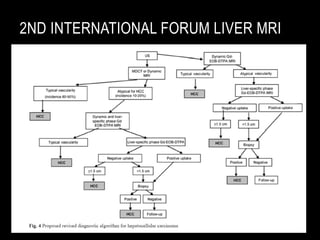
2ND INTERNATIONAL FORUM LIVER MRI
PRIMOVIST CONTRAST ENHANCED
MRI- PROTOCOL OPTIMIZATION AND
EVALUATION OF HEPATIC NODULES IN
LIVER CIRRHOSIS
Dr. Tony Loke
Consultant Radiologist
United Christian Hospital
PRIMOVIST - GADOLINIUM-ETHOXYBENZYLDIETHYLENETRIAMINEPENTAACETIC ACID (GDEOB-DTPA)
•  Combined extracellular hepatobiliary gadolinium
based contrast agents with liver specific properties
•  Multihance and Primovist

•  These agents able to assess both vascularity and
hepatocellular function.
PROTOCOL OPTIMIZATION - PHARMACOKINETIC
AND PHARMACODYNAMIC PROPERTIES OF
PRIMOVIST IN LIVER CIRRHOSIS.
•  Patients with advanced cirrhosis, three important differences are
present.
•  Diminished and delayed liver parenchyma enhancement
•  diminished parenchymal enhancement in the hepatocyte phase
•  time to peak enhancement may be delayed.

•  Diminished and delayed biliary excretion.
•  In the noncirrhotic liver, primovist produces intense biliary tree
enhancement beginning as early as 5 minutes after contrast injection.
•  Enhancement of bile ducts in the cirrhotic liver is delayed and of limited
intensity
PROTOCOL OPTIMIZATION - PHARMACOKINETIC
AND PHARMACODYNAMIC PROPERTIES OF
PRIMOVIST IN LIVER CIRRHOSIS.
•  Patients with advanced cirrhosis, three important differences are
present.

•  Prolonged blood pool enhancement.
•  50% of primovist is cleared by the liver and 50% via the kidneys.
•  Patients with advanced cirrhosis, the hepatic elimination pathway is
impaired and the blood vessels appear hyperintense for a longer
duration.
•  The relatively low contrast enhancement in portal and hepatic veins
is relevant because it reduces the sensitivity for detecting venous
obstruction and invasion.
PROTOCOL OPTIMIZATION – PRIMOVIST
ENHANCED MRI IN CIRRHOTIC LIVER
•  Problems with on-label approved dose Gd-EOB-DTPA of
0.025mmol/kg.
•  Selecting the appropriate scan delay is difficult from low dose and
small amount of on-label approved dose
•  Studies have shown the signal intensity of vessels in the arterial phase
is less with primovist than extracellular gadolinium-based agents using
on-label approved dose.
•  Standard dose provide low sensitivity for detection of hypervascular
HCC/lesions despite its higher T1 relaxivitiy

Cruite I et al AJR 2010;195:29-41
PROTOCOL OPTIMIZATION-SOLUTION FOR
ACHIEVING OPTIMAL ARTERIAL PHASE
•  Optimal arterial phase increases sensitivity for detection of hypervascular
lesions
•  Perform consecutive arterial phase data sets.
•  Administer the agent at a higher off-label dose (0.0375 – 0.05 mmol/kg).
•  This is 50%-100% higher than the approved dose.
•  Injecting all 10ml (20ml if patient exceeds the dose rate calculation) -rounded
up to the nearest bottle
•  For patients with estimated GFR of less than 60mL/min, a weightadjusted dose is administered without rounding.
•  Inject contrast at slower rate of 1cc/second followed by 20ml of saline chaser
at 2cc/second.
•  2cc/sec with higher dose
PRIMOVIST PROTOCOL - DIFFERENCE WITH
CONVENTIONAL GD
UCH PROTOCOL - PRIMOVIST ENHANCED MRI
LIVER
• 

MRCP performed before contrast injection

• 

Bolus timing method is used
•  Contrast seen at LVOT or ascending aorta, patient asked to take 2 breath holds (8 -10
seconds) and 2 consecutive arterial phases imaging is acquired using 3D VIBE (15
seconds).
•  late arterial phase is performed after 2 breath holds.

• 

Hepatic phase is performed after another 2 breath holds

• 

Equilibrium phase is performed at 120 minutes.

• 

Diffusion weighted imaging and 2D axial SPAIR is performed while waiting for delayed 20
mins hepatocyte phase.

• 

Hepatocyte phase - 20 minutes delay.

• 

Hepatocyte phase - 40 minutes delay
•  if hepatic veins and portal veins not cleared
•  contrast not visible in biliary tree.

• 

Hepatocyte phase - 60 minutes delay may be necessary.
UCH PROTOCOL –
PRIMOVIST ENHANCED MRI LIVER
WHEN TO USE PRIMOVIST IN PATIENTS WITH
LIVER CIRRHOSIS
•  Primovist is routinely use in cirrhosis except for:
•  Assessment of ablated lesions for residual or recurrent
disease.
•  Reduced vascularity

•  Patients whose bilirubin is above 3 mg/dL.
•  Sensitivity for lesion detection reduced from diminished liver
enhancement

•  Evaluation of vascular patency
•  PV and HV remains hyperintense from prolonged blood pool

•  Evaluation of hemangiomas
•  Appearance same as HCC
IS PRIMOVIST BETTER FOR DETECTING HCC?
-COMPARED WITH OTHER AGENTS /IMAGING
MODALITIES

•  Combined dynamic and hepatocyte phase of Primovist has greater
diagnoctic accuracy for HCC detection than either dynamic or
MDCT alone
•  Comparing primovist and magnevist, significant increase in
sensitivity was achieved with primovist.
•  Hepatocellular phase imaging with Primovist improves HCC detection
compared with conventional extracellular gadolinium chelates.

•  MRI with primovist has equal accuracy as dual-contrast MRI for HCC
detection (simultaneous use of conventional extracellular gadolinium and
superparamagnetic iron oxide agent). 
Marin D et al Radiology 2009;251:85-95
Park G et al BJR 2010;83:1010-1016
Kim YK et al Invest Radiol 2010:45:740-746
PRIMOVIST UPTAKE BY HEPATOCYTE BY OATP1
EXCRETION TO BILE JUICE REGULATED BY MRP2

Kudo M J gastroenterology and hepatology 2010;25:439-452
Kudo M Oncology 2010;78:87-93
HCC (87 lesions)
Hepatobiliary phase

In one study

Hypointense
92%

Isointense
6%

Hyperintense
2%

WDHCC (39 lesions)
Hepatobiliary phase

Another study

Hypointense
35

Isointense
2

Hyperintense
2

DN (8)
Hypointense
3

Isointense
3

Hyperintense
2

Kudo M J gastroenterology and hepatology 2010;25:439-452
CRITERIA FOR HCC
•  Reading Hepatobiliary phase alone insufficient
•  Result in false positives and negatives
•  Hepatocyte phase
•  Post contrast EOB ratio

•  Read the whole exam
•  T1 (hypointense)
•  T2 (hyperintense)
•  Dynamic contrast (hypervascularity +/- washout)
•  DWI (restricted diffusion)
CRITERIA FOR HCC DIAGNOSIS
•  A nodule with increased enhancement on arterial phase and washout on late venous or equilibrium phase
•  A nodule with arterial enhancement and hyperintensity on T2WI
(and/or DWI)
•  A nodule with isointensity during contrast enhanced arterial phase,
hyperintensity on T2WI (and/or DWI) and no uptake of contrast on
hepatobiliary phase (even < 1.5cm)
•  Nodule > 1.5cm with no uptake of contrast agent on hepatobiliary
phase images.
HYPOVASCULAR NODULE – SIZE MATTERS
•  Hypovascular nodules (on arterial phase) with
negative uptake on hepatobiliary phase are thought to
represent DN or WDHCC
•  Lesion > 1.5 will progress to hypervascular nodules in 80%
in 1 year
•  Lesion < 1.5 will progress to hypervascular nodules in 17%
in 1 year

Kudo M Oncology 2010;78:87-93
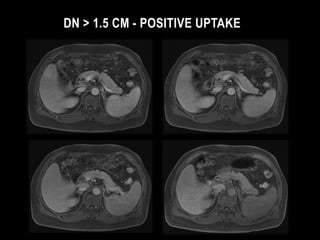
DN > 1.5CM - POSITIVE UPTAKE
DN > 1.5 CM - POSITIVE UPTAKE
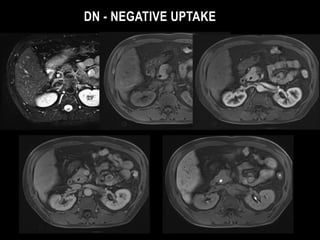
DN - NEGATIVE UPTAKE
SEGMENT 3 HCC
– LESION DEMARCATION BETTER
HYPERVASCULAR RECURRENT HCC
– OTHER DN +VE UPTAKE
SEG 2/3 HYPERVASCULAR HCC WITH
PARADOXICAL UPTAKE
HYPERVASCULAR SEG 7 DN - POSITIVE UPTAKE
HYPOVASCULAR < 1.5 CM HCC – T2/DWI BRIGHT
DN –NOT VISIBLE IN OTHER SEQUENCES EXCEPT
HEPATOCYTE PHASE
SEGMENT 6 HCC WITH NORMAL ARTERIAL,
T2W AND DWI
CT SEGMENT 6 HYPOENHANCING NODULE
- HCC IN HEPATOCYTE PHASE > 1.5 CM
CT HYPERVASCULAR LESIONS – SEG 5 HCC
SEGMENT 6 HCC < 1.5 CM
CT HYPERVASCULAR LESION – SEG 5
PSEUDOLESION
SMALL HYPERVASCULAR HCC
SEGMENT 6 HCC & 2 HEMANGIOMAS
SEGMENT 5 – DN FEATURES ON T1/2
SEGMENT 5 HCC – NEGATIVE UPTAKE
COMBINED PRIMOVIST AND DWI
	

Park MJ et al Radiology 2012:264;761-770
FALSE POSITIVE – HEPATOBILIARY PHASE
•  Hypointense lesions seen only on hepatobiliary phase (without arterial
enhancement and T2 hyperintensity) can either be WDHCC or Cirrhotic
nodules
•  HCC tend to be larger(>1.5cm) than benign nodules(0.5-1.2cm)
•  Lesions <1.5cm seen on hepatobiliary phase can still be well-differentiated
HCC and should not be ignored.
•  Close monitoring, biopsy or resected in patients with coexisting overt HCC.

•  Hypervascular pseudolesions
•  15% shows negative uptake on hepatobiliary phase
•  13% showed T2 hyperintensity
•  DWI normal
FALSE NEGATIVE - HEPATOBILIARY PHASE
•  HCC which are T1 hyperintense may be isointense on
hepatobiliary phase.
•  Look for hypervascularity on arterial phase, T2/DWI
hyperintensity
•  Hepatic dysfunction or hyperbilirubinemia reduces hepatic
uptake of the contrast agent
•  lesion conspicuity on hepatobiliary phase images is
decreased, although false-negative cases can occur in
patients with normal bilirubin level.
•  Lesions are less conspicuous in fatty liver
•  do 20 min delay without fat sat

•  Paradoxical uptake – Green hepatomas
•  2.5 to 8.5% of HCC appear iso/hyperintense
•  Altered transporter mechanism
SUMMARY- CRITERIA FOR HCC
•  Hypervascular nodules with washout – irrespective of delayed
phase
•  Hypervascular nodules and hyperintensity on T2WI (and/or DWI) –
irrespective of delayed phase
•  Isointense nodule (arterial phase) with hyperintensity on T2WI
(and/or DWI) and negative uptake of contrast on hepatobiliary
phase (even < 1.5cm)
•  Nodule > 1.5cm with no uptake of Primovist on hepatobiliary
phase images– irrespective of vascularity
SUMMARY
•  Negative uptake in hypovascular lesions <1.5 cm can still be
HCC
•  FU required as 17% becomes hypervascular in 1 year
•  Positive uptake can still be HCC
•  DWI (+/- hepatocyte SI ratio) to exclude pseudolesion
•  Hypointense rim and/or focal defect on delayed phase
•  Nodule in nodule and internal septation helps

•  FU(+/-biopsy) necessary

Abdominal imaging hcc t loke

  • 1.
    Diagnostic imaging ofsmall HCC in liver cirrhosis : The current approach Dr.Tony Loke United Christian Hospital
  • 2.
  • 3.
    Contents •  Step wiseprogression of hepatocarcinogenesis •  MR I can image this histhopathological process - Gadoxetic enhanced MRI + DWI •  Definite Criteria for HCC – Low sensitivity •  Gadoxetic enhanced MRI alone - ↑sensitivity •  Diffusion weighted MRI -↑ specificity •  Combined Ga MRI and DWI – current approach •  Proposed Algorithm – Best diagnostic accuracy
  • 4.
    Multistep progression ofHepatocarcinogenesis Kudo M Oncology 2010;78:87-93
  • 5.
    Intranodular blood supplyunpairedarteries / portal tracts Tajima T AJR 2002:178;885
  • 6.
    Histopathological pathway ofCarcinogenesis •  Replacement of normal liver cells by abnormal liver malignant cells -↓ OATP8 expression •  Hypointensity – HBP Primovist enhanced MRI •  Unpaired arteries ↑ + Portal tract ↓ •  Wash in/ Wash out – Dynamic CT and MRI •  Increased cell density with progressive undifferentiated nodules •  Hyperintensity - DWI
  • 7.
    Process of Hepatocarcinogenesis KudoM J gastroenterology and hepatology 2010;25:439-452
  • 8.
    Diagnostic criteria fortypical HCC Bruix J, Sherman M Hepatology 2011;53:1020-1022
  • 9.
    Definite HCC • Wash in(arterial phase hyperenhancement) / Wash out– AASLD, EASL criteria (>1 cm) and JSH (any size) •  Dynamic MDCT, MRI (Primovist enhanced MRI), CEUS • Only 71% - have ‘wash in’ and ‘wash out’ on more than one test Marrero JA et al Liver Transpl 2005;11:281-289
  • 10.
    ↑ Sensitivity -Malignant liver nodules •  Absence of OATP8 expression / kupffer cells •  Liver specific contrast agents •  Primovist MRI, SPIO-MRI, Sonazoid- CEUS •  Restricted diffusion •  Diffusion weighted MRI
  • 11.
    Ancillary MRI criteria-
 Malignant liver nodules •  T2W Hyperintensity •  Capsular enhancement – LI RADS •  T1 hypointensity •  Lesion size •  Lesional fat •  Lesion growth on follow up •  ‘Nodule in nodule’ pattern
  • 12.
    PRIMOVIST alone hashigher sensitivity -? Compromised specificity •  Comparing primovist and magnevist, •  Significant increased sensitivity with primovist. •  Hepatocellular phase imaging with Primovist improves HCC detection. •  Primovist MRI has higher diagnostic accuracy (0.88 vs 0.74, p<. 001) and higher sensitivity (0.85 vs0.69, p<.001) than triple phase MDCT •  Particularly in smaller lesions (<2cm) •  MRI with primovist has equal accuracy as dual-contrast MRI for HCC detection •  Combined use of extracellular gadolinium and SPIO. Marin D et al Radiology 2009;251:85-95 Park G et al BJR 2010;83:1010-1016 Kim YK et al Invest Radiol 2010:45:740-746 Martino et al Radiology 2010;256:806
  • 14.
    Hypervascular nodule Size doesnot matter! Hypervascular nodule without washout Primovist Negative uptake HCC Positive uptake Biopsy or Follow up Kudo M Oncology 2010;78:87-93
  • 15.
    Hypovascular Nodule- sizematters! Hypovascular nodule Primovist Negative uptake ≥1.5cm HCC – 98% LGDN – 2% Positive uptake <1.5cm ≥1.5cm <1.5cm Follow up Biopsy or FU Follow up 17% progress to HCC in 1 year HCC LGDN
  • 16.
  • 17.
    DIFFUSION WEIGHTED MRI- ↑ Specificity •  SI ratio significantly differentiates malignant and benign lesions at all b-values. •  Optimal threshold b=600 •  SI ratio 1.25. •  For detection of HCC, DWI with b=600 has •  sensitivity of 95.2% compared to 80.6% for conventional MRI (p=0.023) •  specificity of 82.7% compared to 65.4% (p=0.064%). •  The improved accuracy was most beneficial for differentiating lesions smaller than 2cm. Vandecaveye V Eur Radiol 2009;may:1431
  • 18.
    Classic HCC -SIratio 1.83 for b600 (g)
  • 19.
    Small HCC -Nolesion seen on T1, T2 or enhanced MRI. SI ratio=1.5 at b600
  • 20.
    CURRENT APPROACH •  CombinedPrimovist enhanced MRI and Diffusion weighted imaging – able to image the step wise pathogenesis of HCC •  Dynamic Primovist MRI - Wash in / Wash out •  Hepatobiliary phase Primovist enhanced MRI - OATP8 expression •  DWI - cell density •  Ancillary features
  • 21.
    COMBINED PRIMOVIST MRIAND DWI •  Criteria for HCC •  Hypervascular nodules with washout •  Hypervascular nodules without washout, hypointense on HBP phase (irrespective of DWI) •  Hypervascular nodules without wash out, iso/hyperintense on HBP phase + Hyperintense DWI •  Hypovascular nodules, hypointense on HBP phase + Hyperintensity DWI •  Combined Primovist and DWI has better diagnostic accuracy and sensitivity (93.3%) in detection of HCC < 2cm •  False positive – HGDN Park MJ et al Radiology 2012:264;761-770
  • 22.
    COMBINED PRIMOVIST ANDDWI Park MJ et al Radiology 2012:264;761-770
  • 23.
    COMBINED PRIMOVIST ANDDWI Park MJ et al Radiology 2012:264;761-770
  • 24.
    Typical small HCC Smallhypervascular HCC –DWI b=100, 800
  • 25.
  • 26.
    Atypical small HCC HypervascularHCC- hypointense on HBP but DWI normal
  • 27.
    Hypervascular HCC – andDN (DWI and HBP-Normal)
  • 28.
  • 29.
    Hypovascular HCC <1.5 CM Hypointense HBP + Hypertintense DWI
  • 30.
    SEGMENT 2/3 HCC Hypo/hypervascularcomponent (HBP+DWI = +ve)
  • 31.
    HGDN simulating HCC HypovascularDN- hypointense on HBP and DWI hyperintense
  • 32.
    Segment 5 HGDN– Hypointense HBP (DWI-Normal)
  • 33.
    DN > 1.5CM HBP+ DWI = negative
  • 34.
    Summary - CurrentApproach •  Nodule detected on USG •  Dynamic CT •  Hypervascular with washout (>1cm) •  Atypical features •  Combined Primovist enhanced MRI and DWI •  Hypervascular without washout, hypointense on HBP phase •  Hypervascular without washout, isointense on HBP phase + Hyperintense DWI •  Hypovascular nodules, hypointense on HBP phase + Hyperintensity DWI •  Ancillary features •  Higher diagnostic accuracy and sensitivity •  Particularly for HCC < 2cm •  False positive for HGDN
  • 36.
    Conclusion - CurrentApproach •  Combined Primovist and DWI •  Higher diagnostic accuracy and sensitivity •  Particularly for HCC < 2cm •  false positive include HGDN •  Combined Primovist enhanced MRI and DWI •  Hypervascular without washout, hypointense on HBP phase •  Hypervascular nodules, isointense on HBP phase + Hyperintense DWI •  Hypovascular nodules, hypointense on HBP phase + Hyperintensity DWI
  • 37.
    SEG 2/3 HYPERVASCULARHCC WITH PARADOXICAL UPTAKE (DWI-hyperintense)
  • 38.
    SEGMENT 6 HCCWITH NORMAL ARTERIAL, T2W AND DWI
  • 39.
    FOCAL NODULAR LIVERLESIONS: 1994 INTERNATIONAL CLASSIFICATION •  Regenerative nodule •  Cirrhotic nodule •  Low grade dysplastic nodule (adenomatous hyperplasia) •  High grade dysplastic nodule (adenomatous hyperplasia with atypia) •  Dysplastic nodule with subfoci of HCC (early HCC) •  HCC (overt HCC) International Working Party. Hepatology 1995;22:983-993
  • 40.
    DEVELOPMENT OF HCCIN CIRRHOTIC LIVER •  Temporal progression from regenerative nodules to dysplastic nodules to well differentiated HCC. •  HCC may develop independently of RN and DN.
  • 41.
    PRIMOVIST MRI MOSTSENSITIVE TECHNIQUE IN DETECTING EARLY HEPATOCARCINOGENESIS
  • 42.
    CONSENSUS STATEMENTSJAPAN SOCIETYOF HEPATOLOGY •  Typical HCC can be diagnosed by imaging regardless of the size if a typical vascular pattern is obtained on dynamic CT, dynamic MRI, CEUS or a combination of CTHA and CTAP. •  Different from Western guidelines, only one dynamic study showing the typical pattern is sufficient to diagnose HCC. •  The typical imaging pattern include hypervascularity in the arterial phase and washes-out in the portal venous phase.
  • 43.
    CONSENSUS STATEMENTSJAPAN SOCIETYOF HEPATOLOGY •  Sonazoid-enhanced ultrasound is more sensitive for detection of intranodular hypervascularity than MDCT or dynamic MRI. Therefore to confirm true hypovascularity, sonazoid-enhanced CEUS is recommended. •  Nodules with hypovascularity and negative findings on SPIO-MRI, Kupffer imaging of Sonazoid CEUS, primovist MRI are likely to be benign. They can be followed up without treatment.
  • 44.
    JAPAN SOCIETY OFHEPATOLOGY
  • 45.
    JAPAN SOCIETY OFHEPATOLOGY
  • 46.
  • 47.
    PRIMOVIST CONTRAST ENHANCED MRI-PROTOCOL OPTIMIZATION AND EVALUATION OF HEPATIC NODULES IN LIVER CIRRHOSIS Dr. Tony Loke Consultant Radiologist United Christian Hospital
  • 48.
    PRIMOVIST - GADOLINIUM-ETHOXYBENZYLDIETHYLENETRIAMINEPENTAACETICACID (GDEOB-DTPA) •  Combined extracellular hepatobiliary gadolinium based contrast agents with liver specific properties •  Multihance and Primovist •  These agents able to assess both vascularity and hepatocellular function.
  • 49.
    PROTOCOL OPTIMIZATION -PHARMACOKINETIC AND PHARMACODYNAMIC PROPERTIES OF PRIMOVIST IN LIVER CIRRHOSIS. •  Patients with advanced cirrhosis, three important differences are present. •  Diminished and delayed liver parenchyma enhancement •  diminished parenchymal enhancement in the hepatocyte phase •  time to peak enhancement may be delayed. •  Diminished and delayed biliary excretion. •  In the noncirrhotic liver, primovist produces intense biliary tree enhancement beginning as early as 5 minutes after contrast injection. •  Enhancement of bile ducts in the cirrhotic liver is delayed and of limited intensity
  • 50.
    PROTOCOL OPTIMIZATION -PHARMACOKINETIC AND PHARMACODYNAMIC PROPERTIES OF PRIMOVIST IN LIVER CIRRHOSIS. •  Patients with advanced cirrhosis, three important differences are present. •  Prolonged blood pool enhancement. •  50% of primovist is cleared by the liver and 50% via the kidneys. •  Patients with advanced cirrhosis, the hepatic elimination pathway is impaired and the blood vessels appear hyperintense for a longer duration. •  The relatively low contrast enhancement in portal and hepatic veins is relevant because it reduces the sensitivity for detecting venous obstruction and invasion.
  • 51.
    PROTOCOL OPTIMIZATION –PRIMOVIST ENHANCED MRI IN CIRRHOTIC LIVER •  Problems with on-label approved dose Gd-EOB-DTPA of 0.025mmol/kg. •  Selecting the appropriate scan delay is difficult from low dose and small amount of on-label approved dose •  Studies have shown the signal intensity of vessels in the arterial phase is less with primovist than extracellular gadolinium-based agents using on-label approved dose. •  Standard dose provide low sensitivity for detection of hypervascular HCC/lesions despite its higher T1 relaxivitiy Cruite I et al AJR 2010;195:29-41
  • 52.
    PROTOCOL OPTIMIZATION-SOLUTION FOR ACHIEVINGOPTIMAL ARTERIAL PHASE •  Optimal arterial phase increases sensitivity for detection of hypervascular lesions •  Perform consecutive arterial phase data sets. •  Administer the agent at a higher off-label dose (0.0375 – 0.05 mmol/kg). •  This is 50%-100% higher than the approved dose. •  Injecting all 10ml (20ml if patient exceeds the dose rate calculation) -rounded up to the nearest bottle •  For patients with estimated GFR of less than 60mL/min, a weightadjusted dose is administered without rounding. •  Inject contrast at slower rate of 1cc/second followed by 20ml of saline chaser at 2cc/second. •  2cc/sec with higher dose
  • 53.
    PRIMOVIST PROTOCOL -DIFFERENCE WITH CONVENTIONAL GD
  • 54.
    UCH PROTOCOL -PRIMOVIST ENHANCED MRI LIVER •  MRCP performed before contrast injection •  Bolus timing method is used •  Contrast seen at LVOT or ascending aorta, patient asked to take 2 breath holds (8 -10 seconds) and 2 consecutive arterial phases imaging is acquired using 3D VIBE (15 seconds). •  late arterial phase is performed after 2 breath holds. •  Hepatic phase is performed after another 2 breath holds •  Equilibrium phase is performed at 120 minutes. •  Diffusion weighted imaging and 2D axial SPAIR is performed while waiting for delayed 20 mins hepatocyte phase. •  Hepatocyte phase - 20 minutes delay. •  Hepatocyte phase - 40 minutes delay •  if hepatic veins and portal veins not cleared •  contrast not visible in biliary tree. •  Hepatocyte phase - 60 minutes delay may be necessary.
  • 55.
    UCH PROTOCOL – PRIMOVISTENHANCED MRI LIVER
  • 56.
    WHEN TO USEPRIMOVIST IN PATIENTS WITH LIVER CIRRHOSIS •  Primovist is routinely use in cirrhosis except for: •  Assessment of ablated lesions for residual or recurrent disease. •  Reduced vascularity •  Patients whose bilirubin is above 3 mg/dL. •  Sensitivity for lesion detection reduced from diminished liver enhancement •  Evaluation of vascular patency •  PV and HV remains hyperintense from prolonged blood pool •  Evaluation of hemangiomas •  Appearance same as HCC
  • 57.
    IS PRIMOVIST BETTERFOR DETECTING HCC? -COMPARED WITH OTHER AGENTS /IMAGING MODALITIES •  Combined dynamic and hepatocyte phase of Primovist has greater diagnoctic accuracy for HCC detection than either dynamic or MDCT alone •  Comparing primovist and magnevist, significant increase in sensitivity was achieved with primovist. •  Hepatocellular phase imaging with Primovist improves HCC detection compared with conventional extracellular gadolinium chelates. •  MRI with primovist has equal accuracy as dual-contrast MRI for HCC detection (simultaneous use of conventional extracellular gadolinium and superparamagnetic iron oxide agent). Marin D et al Radiology 2009;251:85-95 Park G et al BJR 2010;83:1010-1016 Kim YK et al Invest Radiol 2010:45:740-746
  • 58.
    PRIMOVIST UPTAKE BYHEPATOCYTE BY OATP1 EXCRETION TO BILE JUICE REGULATED BY MRP2 Kudo M J gastroenterology and hepatology 2010;25:439-452
  • 59.
    Kudo M Oncology2010;78:87-93
  • 60.
    HCC (87 lesions) Hepatobiliaryphase In one study Hypointense 92% Isointense 6% Hyperintense 2% WDHCC (39 lesions) Hepatobiliary phase Another study Hypointense 35 Isointense 2 Hyperintense 2 DN (8) Hypointense 3 Isointense 3 Hyperintense 2 Kudo M J gastroenterology and hepatology 2010;25:439-452
  • 61.
    CRITERIA FOR HCC • Reading Hepatobiliary phase alone insufficient •  Result in false positives and negatives •  Hepatocyte phase •  Post contrast EOB ratio •  Read the whole exam •  T1 (hypointense) •  T2 (hyperintense) •  Dynamic contrast (hypervascularity +/- washout) •  DWI (restricted diffusion)
  • 62.
    CRITERIA FOR HCCDIAGNOSIS •  A nodule with increased enhancement on arterial phase and washout on late venous or equilibrium phase •  A nodule with arterial enhancement and hyperintensity on T2WI (and/or DWI) •  A nodule with isointensity during contrast enhanced arterial phase, hyperintensity on T2WI (and/or DWI) and no uptake of contrast on hepatobiliary phase (even < 1.5cm) •  Nodule > 1.5cm with no uptake of contrast agent on hepatobiliary phase images.
  • 63.
    HYPOVASCULAR NODULE –SIZE MATTERS •  Hypovascular nodules (on arterial phase) with negative uptake on hepatobiliary phase are thought to represent DN or WDHCC •  Lesion > 1.5 will progress to hypervascular nodules in 80% in 1 year •  Lesion < 1.5 will progress to hypervascular nodules in 17% in 1 year Kudo M Oncology 2010;78:87-93
  • 64.
    DN > 1.5CM- POSITIVE UPTAKE
  • 65.
    DN > 1.5CM - POSITIVE UPTAKE
  • 66.
  • 67.
    SEGMENT 3 HCC –LESION DEMARCATION BETTER
  • 68.
  • 69.
    SEG 2/3 HYPERVASCULARHCC WITH PARADOXICAL UPTAKE
  • 70.
    HYPERVASCULAR SEG 7DN - POSITIVE UPTAKE
  • 71.
    HYPOVASCULAR < 1.5CM HCC – T2/DWI BRIGHT
  • 72.
    DN –NOT VISIBLEIN OTHER SEQUENCES EXCEPT HEPATOCYTE PHASE
  • 73.
    SEGMENT 6 HCCWITH NORMAL ARTERIAL, T2W AND DWI
  • 74.
    CT SEGMENT 6HYPOENHANCING NODULE - HCC IN HEPATOCYTE PHASE > 1.5 CM
  • 75.
  • 76.
    SEGMENT 6 HCC< 1.5 CM
  • 77.
    CT HYPERVASCULAR LESION– SEG 5 PSEUDOLESION
  • 78.
  • 79.
    SEGMENT 6 HCC& 2 HEMANGIOMAS
  • 80.
    SEGMENT 5 –DN FEATURES ON T1/2
  • 81.
    SEGMENT 5 HCC– NEGATIVE UPTAKE
  • 82.
    COMBINED PRIMOVIST ANDDWI Park MJ et al Radiology 2012:264;761-770
  • 83.
    FALSE POSITIVE –HEPATOBILIARY PHASE •  Hypointense lesions seen only on hepatobiliary phase (without arterial enhancement and T2 hyperintensity) can either be WDHCC or Cirrhotic nodules •  HCC tend to be larger(>1.5cm) than benign nodules(0.5-1.2cm) •  Lesions <1.5cm seen on hepatobiliary phase can still be well-differentiated HCC and should not be ignored. •  Close monitoring, biopsy or resected in patients with coexisting overt HCC. •  Hypervascular pseudolesions •  15% shows negative uptake on hepatobiliary phase •  13% showed T2 hyperintensity •  DWI normal
  • 84.
    FALSE NEGATIVE -HEPATOBILIARY PHASE •  HCC which are T1 hyperintense may be isointense on hepatobiliary phase. •  Look for hypervascularity on arterial phase, T2/DWI hyperintensity •  Hepatic dysfunction or hyperbilirubinemia reduces hepatic uptake of the contrast agent •  lesion conspicuity on hepatobiliary phase images is decreased, although false-negative cases can occur in patients with normal bilirubin level. •  Lesions are less conspicuous in fatty liver •  do 20 min delay without fat sat •  Paradoxical uptake – Green hepatomas •  2.5 to 8.5% of HCC appear iso/hyperintense •  Altered transporter mechanism
  • 85.
    SUMMARY- CRITERIA FORHCC •  Hypervascular nodules with washout – irrespective of delayed phase •  Hypervascular nodules and hyperintensity on T2WI (and/or DWI) – irrespective of delayed phase •  Isointense nodule (arterial phase) with hyperintensity on T2WI (and/or DWI) and negative uptake of contrast on hepatobiliary phase (even < 1.5cm) •  Nodule > 1.5cm with no uptake of Primovist on hepatobiliary phase images– irrespective of vascularity
  • 86.
    SUMMARY •  Negative uptakein hypovascular lesions <1.5 cm can still be HCC •  FU required as 17% becomes hypervascular in 1 year •  Positive uptake can still be HCC •  DWI (+/- hepatocyte SI ratio) to exclude pseudolesion •  Hypointense rim and/or focal defect on delayed phase •  Nodule in nodule and internal septation helps •  FU(+/-biopsy) necessary