The document discusses the anatomy and imaging of the liver. It provides details on:
1) The liver's dual blood supply and Couinaud classification which divides it into 8 functionally independent segments based on vascular inflow, outflow, and biliary drainage.
2) Imaging modalities like ultrasound, CT, and MRI which are used to evaluate the liver and characterize lesions using contrast enhancement in arterial and portal venous phases.
3) Developmental anomalies and anatomic variants of the liver that are important to recognize as incidental findings.
Overview of liver's function, blood supply, and anatomy; significance of functional anatomy in surgery.
Details on Couinaud classification which divides liver into eight segments, crucial for surgical procedures. Describes how liver segments are spatially divided by hepatic veins and the portal vein.
Discusses various imaging methods for liver such as ultrasound and CT, highlighting uses and contrast phases.
Indications and advantages of MRI over CT, discussing various techniques and sequences for liver assessment.
Explores embryonic development and anatomical variants of the liver, with examples of agenesis and structural anomalies.
What is The
LIVER?
Anorgan in the upper
abdomen that aids in
digestion and remove
waste products and
worn-out cells from the
blood. It is the largest
solid& glandular organ
in the body.
2.
What is theblood supply of the liver?
Liver has a dual blood supply; portal vein(75%) &
hepatic artery (25%),The hepatic veins are
responsible for drainage of filtered blood from
the liver into the IVC.
3.
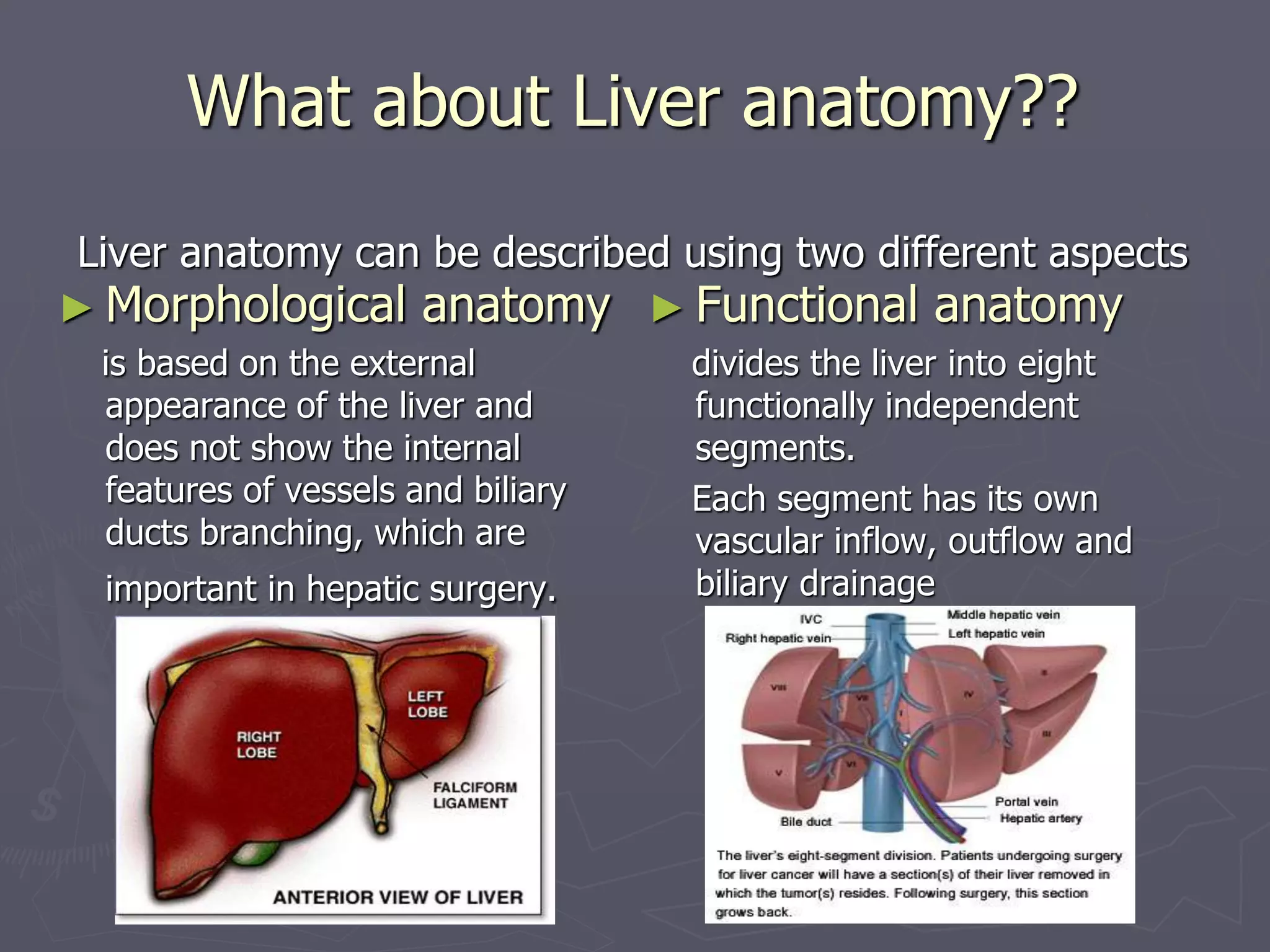
What about Liveranatomy??
Liver anatomy can be described using two different aspects
► Morphological anatomy
is based on the external
appearance of the liver and
does not show the internal
features of vessels and biliary
ducts branching, which are
important in hepatic surgery.
► Functional anatomy
divides the liver into eight
functionally independent
segments.
Each segment has its own
vascular inflow, outflow and
biliary drainage
4.
What’s the significanceof functional
anatomy!?
In order to perform segmental or
subsegmental resection of the liver, the
surgeon must know exactly which parts of
the liver are diseased so that vascular
supply and venous and biliary drainage can
be preserved& also Because of this division
into self-contained units, each segment can
be resected without damaging those
remaining.
5.
►There are manyanatomical and
functional descriptions of the liver
anatomy such as Classical Anatomy
&Bismuth's classification however
(Couinaud classification) is the
most commonly used classification.
6.
Couinaud classification
► TheCouinaud classification of liver
anatomy divides the liver into eight
functionally independent segments.
►Each segment has its own vascular inflow
(hepatic artery & portal vein), outflow
(hepatic vein) and biliary drainage
7.
How are thesegments spatially
separated?
► Right hepatic vein divides the right lobe into anterior
and posterior segments (segment 6& 7 usually not
visulaized at the frontal view).
► Middle hepatic vein divides the liver into right and
left lobes (or right and left hemiliver). This plane runs from
the inferior vena cava to the gallbladder fossa (Cantlie's
line)
► Left hepatic vein divides the left lobe into a medial
and lateral part.
► Portal vein divides the liver
into upper & lower segments.
8.
What are liversegments??
► Couinaud's numbering
system:
1-Caudate Lobe (posteriorly)
2-Left Superior Lateral segment
3-Left Inferior Lateral segment
4a-Left Superior Medial segment
4b-Left Inferior Medial segment
5-Right Inferior Anterior segment
6-Right Inferior Postrior segment
7-Right Superior Postrior segment
8-Right Superior Anterior segment
9.
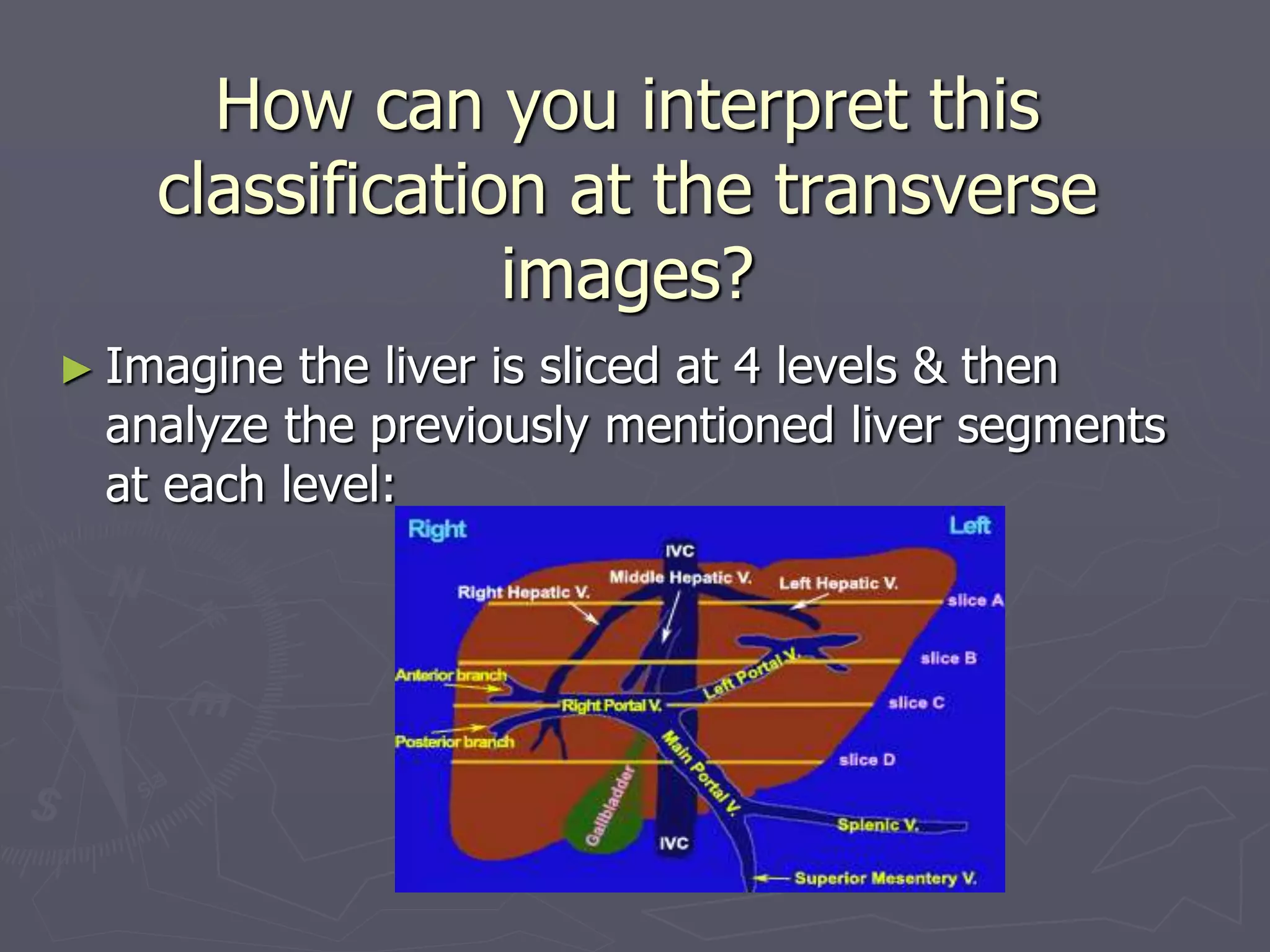
How can youinterpret this
classification at the transverse
images?
► Imagine the liver is sliced at 4 levels & then
analyze the previously mentioned liver segments
at each level:
10.
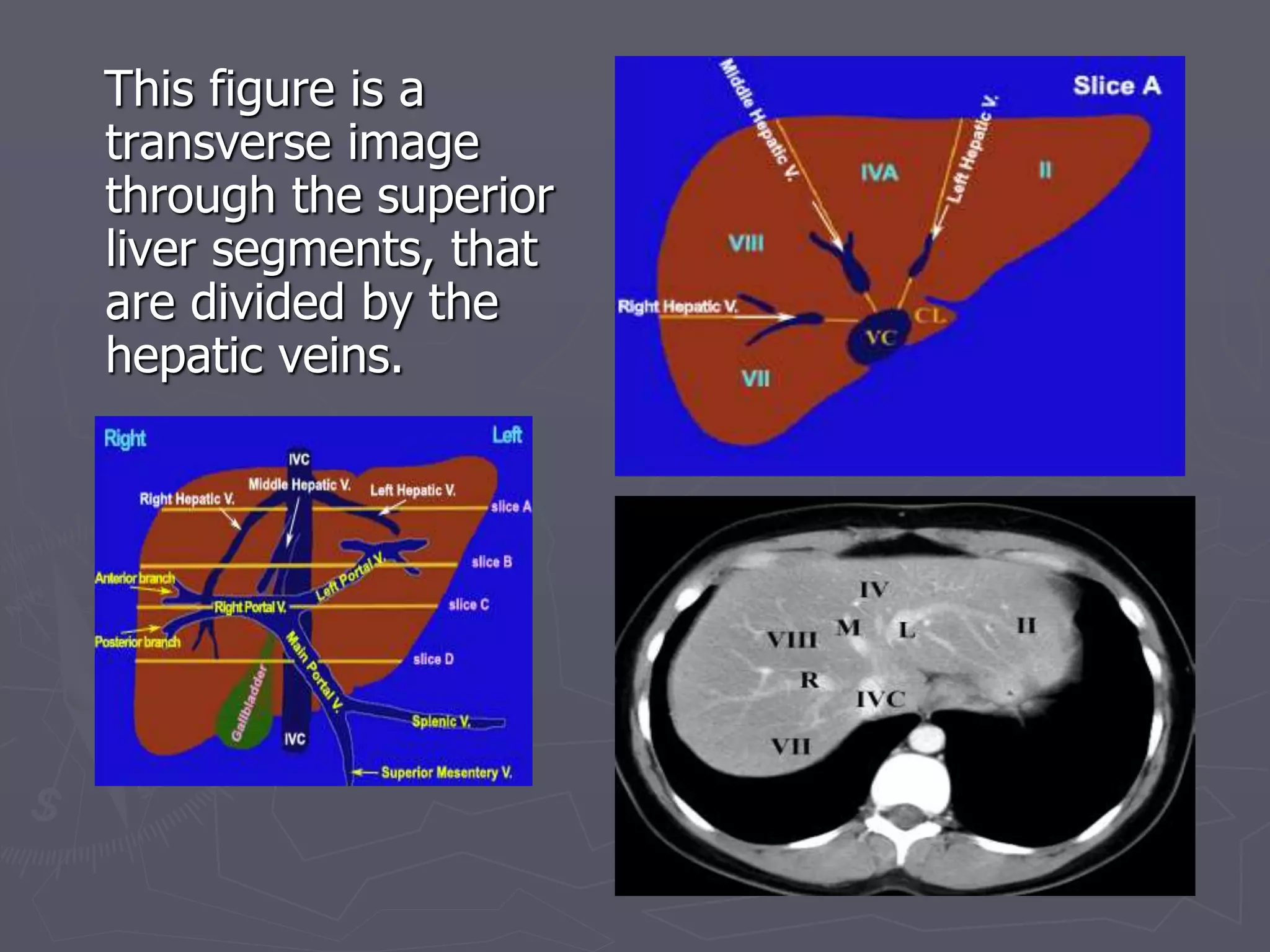
This figure isa
transverse image
through the superior
liver segments, that
are divided by the
hepatic veins.
11.
This figure showstransverse
image at the level of the left
portal vein.
At this level the left portal
vein divides the left lobe of
liver into superior segments
(2 and 4A) and inferior
segments (3 and 4B).
12.
The image onthe left is at
the level of right portal
vein. At this level right
portal vein divides the right
lobe of the liver into
superior segments (7 and
8) and the inferior
segments (5 and 6).
The level of right portal
vein is inferior to the level
of left portal vein
13.
► below thelevel of the main
portal vein:
The gallbladder separates
segment(V) from segment
(IVB).
The ligamentum teres divides
segment(IVB) and (III)
segments.
14.
TO REMEMBER
Level ofsplenic v&main portl v
►Above the level of this image segments
from left to right are7,8,4,2
►Below & at this level segments from left
to right are 6,5,4,3
Ultrasound
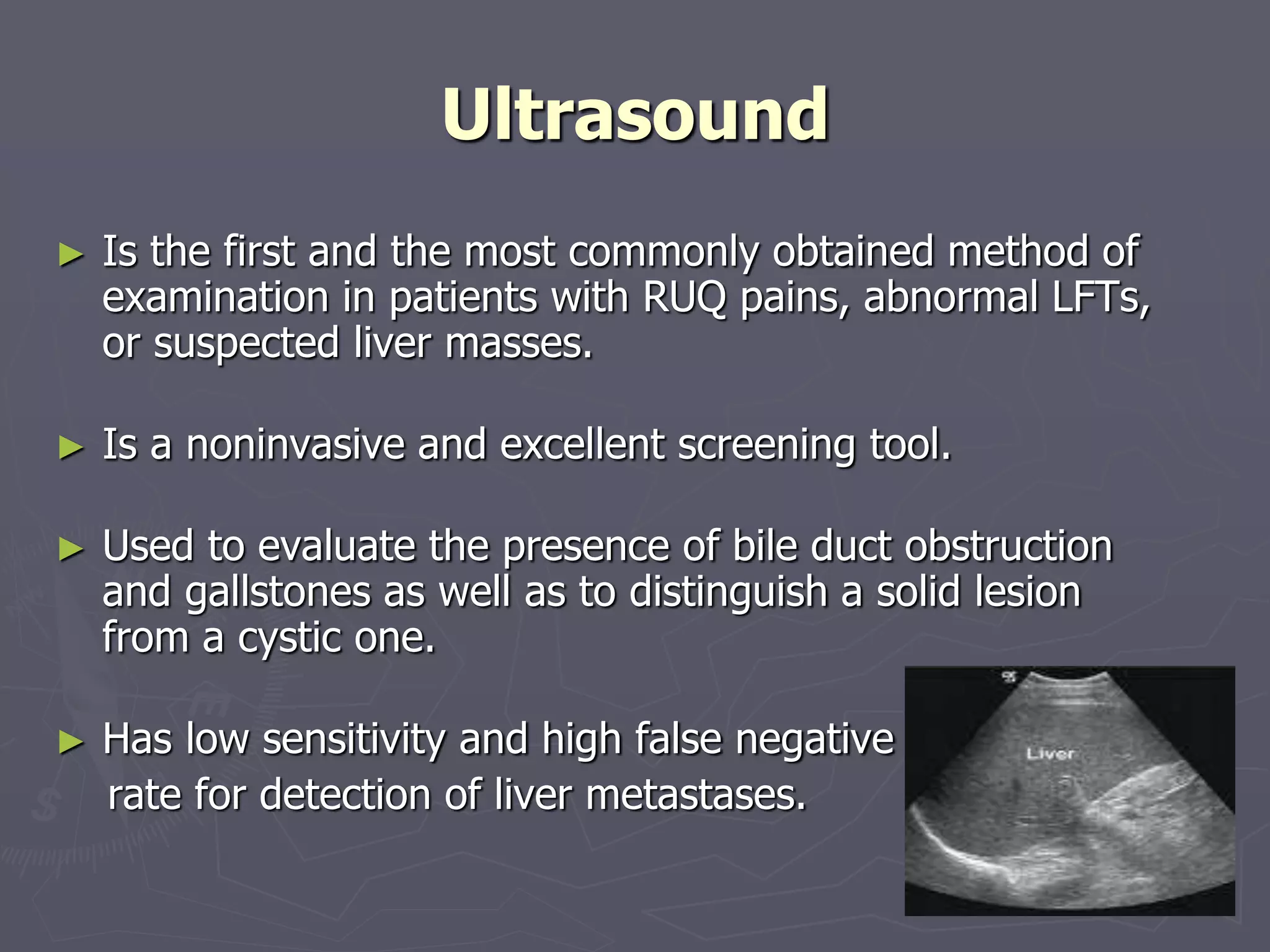
► Is thefirst and the most commonly obtained method of
examination in patients with RUQ pains, abnormal LFTs,
or suspected liver masses.
► Is a noninvasive and excellent screening tool.
► Used to evaluate the presence of bile duct obstruction
and gallstones as well as to distinguish a solid lesion
from a cystic one.
► Has low sensitivity and high false negative
rate for detection of liver metastases.
17.
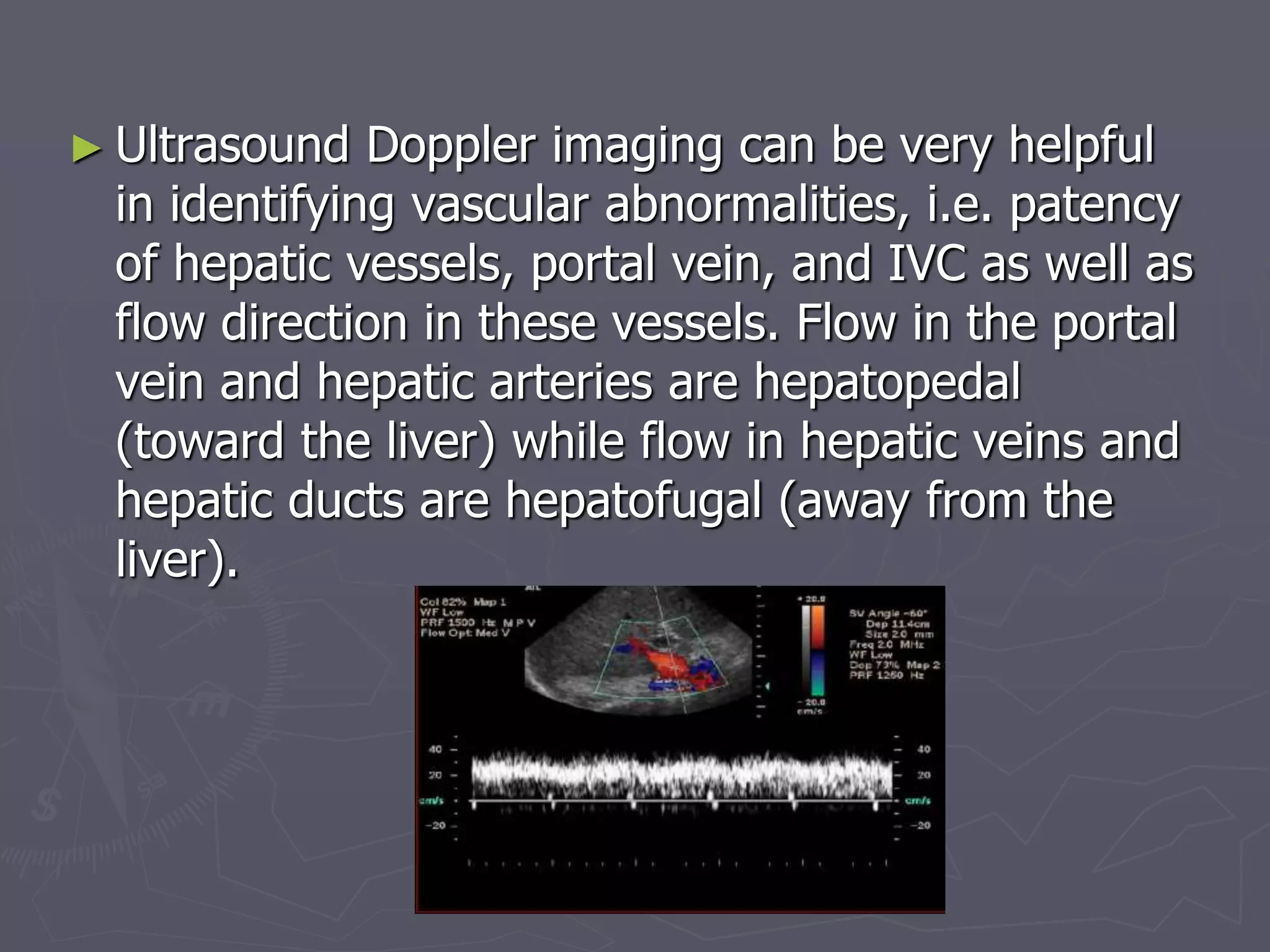
► Ultrasound Dopplerimaging can be very helpful
in identifying vascular abnormalities, i.e. patency
of hepatic vessels, portal vein, and IVC as well as
flow direction in these vessels. Flow in the portal
vein and hepatic arteries are hepatopedal
(toward the liver) while flow in hepatic veins and
hepatic ducts are hepatofugal (away from the
liver).
18.
CT
► Uses X-rayto acquire data that can be displayed in axial,
coronal, and sagittal planes.
► I.V. iodinated contrast is commonly used in liver imaging to
demonstrate any abnormal enhancement of a hepatic
lesion and to show vascular structures.
► An I.V. bolus of 100 to 150 ml of iodinated contrast is often
used. The contrast agent is injected into veins, travels to
the heart, aorta, celiac trunk, hepatic arteries, liver
parenchyma and mixes with blood in portal veins drained
into venules and then hepatic veins and then out to the
IVC.
19.
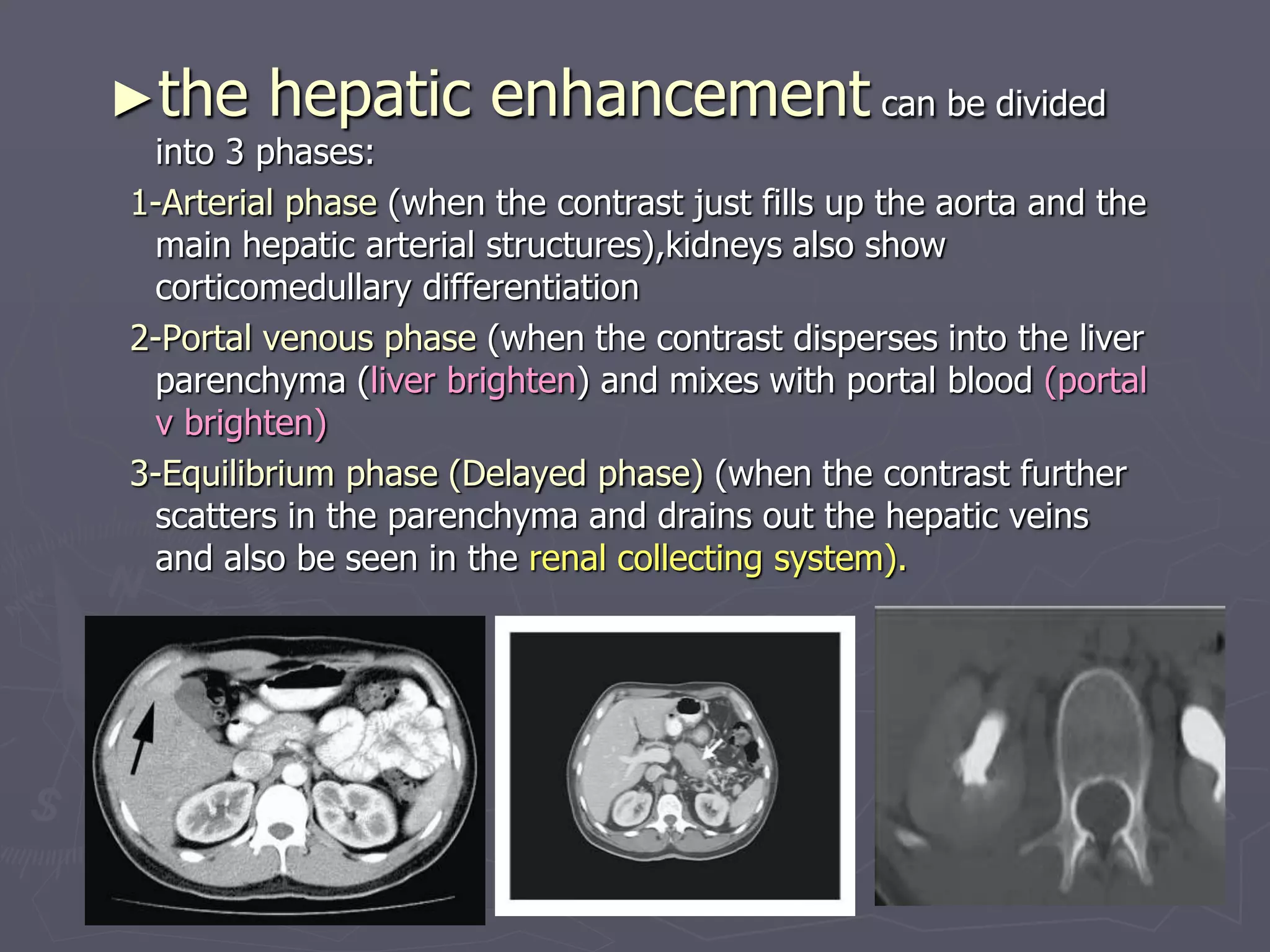
►the hepatic enhancementcan be divided
into 3 phases:
1-Arterial phase (when the contrast just fills up the aorta and the
main hepatic arterial structures),kidneys also show
corticomedullary differentiation
2-Portal venous phase (when the contrast disperses into the liver
parenchyma (liver brighten) and mixes with portal blood (portal
v brighten)
3-Equilibrium phase (Delayed phase) (when the contrast further
scatters in the parenchyma and drains out the hepatic veins
and also be seen in the renal collecting system).
20.
► When searchingfor hypervascular lesions, such as
hepatoma or metastastic disease, a three-phase technique
often should be used: non-contrast phase, arterial phase,
and portal venous phase.
► The appropriate delay times for scanning in the arterial
phase and portal venous phase for a 2-3 ml/sec injection
are 25 seconds and 70 seconds, respectively.
► The rationale behind this technique is that primary and
secondary malignancies of the liver typically have hepatic
arterial supply, thus will enhance during the arterial phase,
whereas benign entities and normal liver parenchyma have
primarily portal venous supply, therefore, will enhance
during portal-venous phase of I.V. contrast.
21.
Rapid Wash out
Notehere also the lesion at the
non contrast image then early
enhancement at the arterial phase
and rapid wash out a the portal
phase
(yellow arrows)
very characterstic of HCC
Progressive fill in
(note the lesion at non enhanced
image,then peripheral
enhancement in arterial phase
&further central filling at portal
phase then total enhancement at
the delayed image)
Very characterstic of hemangioma
22.
MRI
►Indications for LiverMRI
1- Patients are allergic to iodinated
contrast agents.
2-Lesion detection & characterization .
3-Anatomic location .
4-Hepatic vascular patency .
5-Biliary duct system.
23.
►MRI has manyadvantages over CT:
High soft tissue contrast resolution (can see
smaller lesions),
Multiple sequences,
Multiplanar capability,
MRA, MRV, MRCP,
No radiation, no iodinated contrast·etc.
24.
►However, MRI issimilar to CT in that it has
the same dynamic multiphase contrast
enhancement capability.
►MRI can be helpful in the characterization of
a small (< 2 cm) benign hemangioma that
is equivocal on CT.
25.
► A widerange of MRI sequences is available for liver
imaging thanks to the numerous manipulations of field
strength, pulse sequence, and interdependent sequence
parameters which can affect image quality. Since there is
little agreement on the best technique, MRI sequences are
often unique to the institution. At UVa, we use the
following:
Breath hold T1 spoiled gradient echo (In phase and out of
phase): can be used to detect fatty liver, fat in HCC, focal
fatty infiltration/sparing, adrenal adenomas.
Breath Hold T2: can be used to evaluate hemangiomas and
cysts.
Turbo spin echo with fat sat or STIR
HASTE -Half Fourier acquisition single shot turbo spin echo
Dynamic Gad T1 (Arterial, portal venous, delayed, timing
bolus, or smart prep): can be used to characterize
hypervascular lesions.
26.
► For mosttechniques, the intensity of normal
liver parenchyma is the same as or slightly
higher than that of adjacent muscle. Normally,
the liver should be brighter than (hyperintense
to) the spleen on T1-weighted images and
darker than (hypointense to) the spleen on T2-
weighted images.
27.
Developmental Anomalies and
AnatomicVariants of the liver
Embryonic development of the
liver, pancreas, extrahepatic
biliary apparatus, and duodenum.
28.
Agenesis of theright
hepatic lobe. A. CT
reveals agenesis of the
right lobe of the liver
with compensatory
hypertrophy of the left
lobe
29.
Agenesis of theleft
hepatic lobe. CT
shows tongue like
projection (arrow) of
caudate lobe at the
upper image.
30.
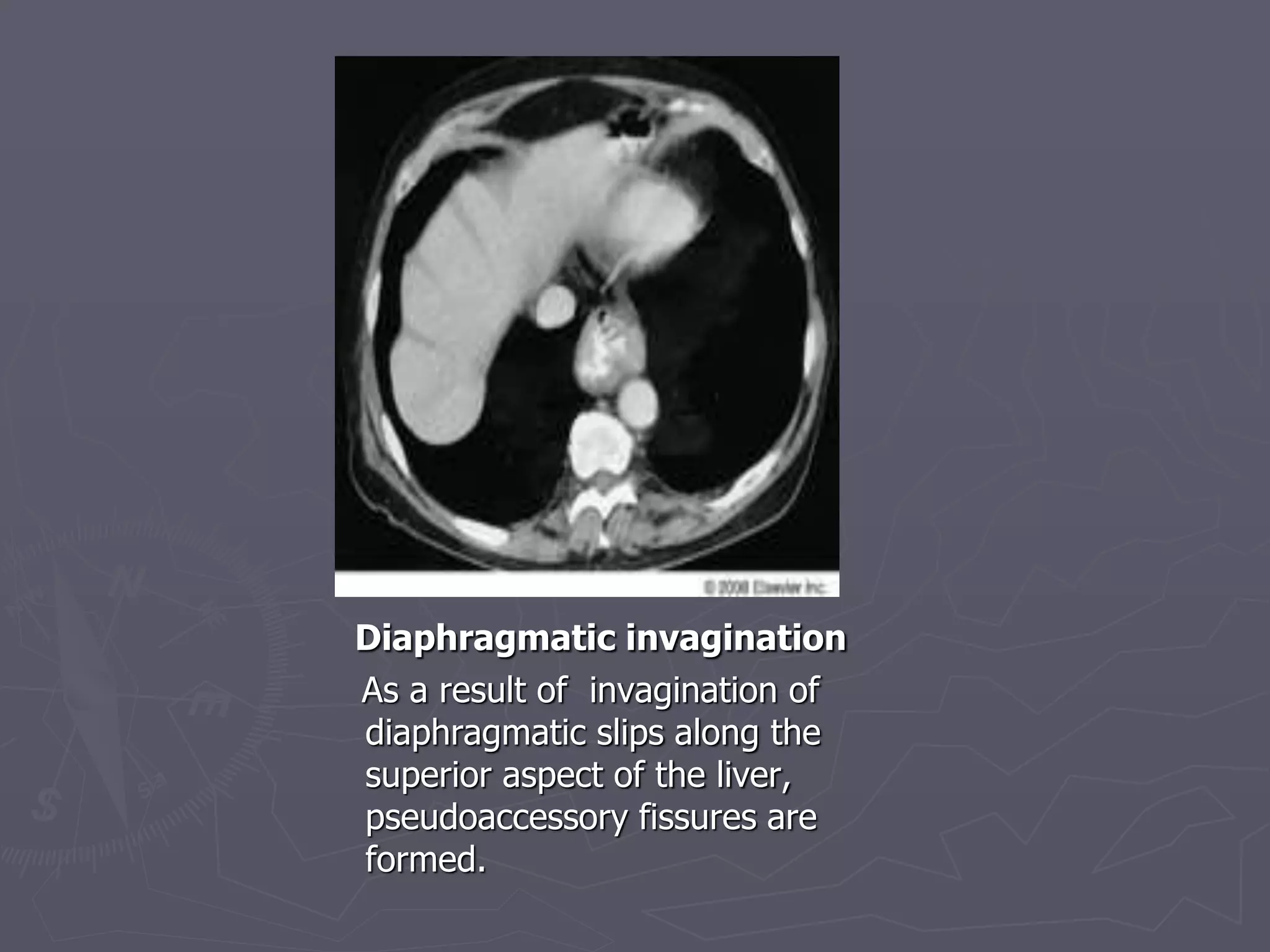
Diaphragmatic invagination
As aresult of invagination of
diaphragmatic slips along the
superior aspect of the liver,
pseudoaccessory fissures are
formed.
Accessory fissure inthe
under surface of the
liver. The accessory
fissure in the right lobe
33.
Sliver of liver.The T2-
weighted image of the upper
abdomen reveals leftward
lateral extension of the left lobe
of the liver ,which appears as a
crescentic low-intensity
structure wrapping around the
lateral aspect of the spleen. If
the communication is not seen,
it can mimic abnormal structure
lateral to the spleen. This
occasionally is the case in
abdominal ultrasound.
34.
Papillary process of
thecaudate lobe.
The contrast-enhanced
CT scan shows medial
and posterior
extension of the
papillary process near
the head of the
pancreas mimicking a
mass lesion.
35.
Papillary and caudate
processpseudomass.
The T1-weighted fat-
suppression images reveal
medial extension of the
papillary process near the
head of the pancreas.
Notice the signal
characteristics of this mass
being similar to the
remainder of the liver and
not of the pancreas.
36.
Riedel's lobe. A.
Topogramfrom the
patient's CT scan
displays an
elongated inferior
extension of the
right lobe of the
liver (arrows)
characteristic of a
Reidel lobe