Liver fibrosis and
steatosis – the role
of radiology
P.Prieditis
P.Stradins Clinical University Hospital
Riga, Latvia
9.X 2010.

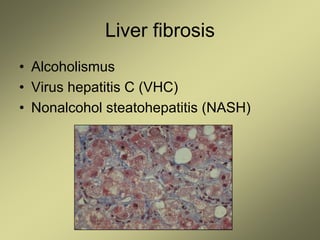
Liver fibrosis
• Alcoholismus
• Virus hepatitis C (VHC)
• Nonalcohol steatohepatitis (NASH)
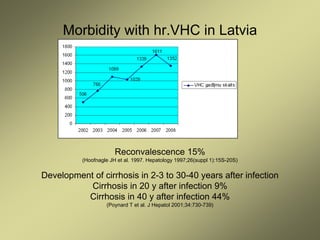
Morbidity with hr.VHC in Latvia
Reconvalescence 15%
(Hoofnagle JH et al. 1997. Hepatology 1997;26(suppl 1):15S-20S)
Development of cirrhosis in 2-3 to 30-40 years after infection
Cirrhosis in 20 y after infection 9%
Cirrhosis in 40 y after infection 44%
(Poynard T et al. J Hepatol 2001;34:730-739)
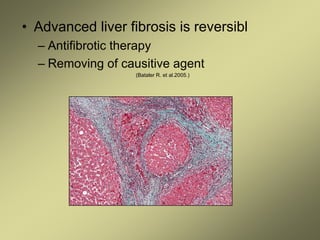
• Advanced liver fibrosis is reversibl
– Antifibrotic therapy
– Removing of causitive agent
(Bataler R. et al.2005.)
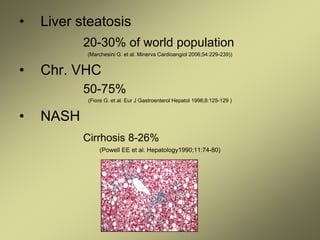
• Liver steatosis
20-30% of world population
(Marchesini G. et al. Minerva Cardioangiol 2006;54:229-239))
• Chr. VHC
50-75%
(Fiore G. et al. Eur J Gastroenterol Hepatol 1998;8:125-129 )
• NASH
Cirrhosis 8-26%
(Powell EE et al. Hepatology1990;11:74-80)
Liver biopsy – golden standart
• Complications
– “Large complications” 0,4% - 2,8%
– Letality 0% - 0,2% (
(Buscarini E. Complications of abdominal interventional ultrasound. Poleto edizioni 1996.34-47)
• Follow up
• Diagnostic accuracy
Liver biopsy – golden standart
Morphology - absolut truth?
Chronic hepatitis
• Size of tissue sample
• Number of samples
• Punction site
• Morphologist
Liver biopsy – golden standart
Morphology - absolut truth?
Chronic hepatitis
• Size of tissue sample
15mm sample length – corect estimation 65%
25 mm – 75%
Longer – diagnostic accuracy do not improve
(Bedosa P. Hepatology 2003;38:1449-1457)
30 mm/1,4mm 15 mm/1mm 10mm/1mm
Slight inflamation 49,7% 62,2% 86,6%
Slight fibrosis 59% 63,3% 80,1%
(Colloredo G. J Hepatol 2003;39:239-244)
Liver biopsy – golden standart
Morphology - absolut truth?
Chronic hepatitis
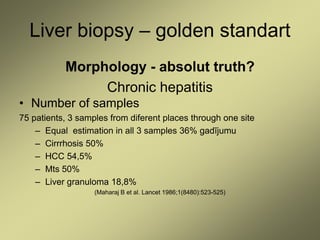
• Number of samples
75 patients, 3 samples from diferent places through one site
– Equal estimation in all 3 samples 36% gadījumu
– Cirrrhosis 50%
– HCC 54,5%
– Mts 50%
– Liver granuloma 18,8%
(Maharaj B et al. Lancet 1986;1(8480):523-525)
Liver biopsy – golden standart
Morphology - absolut truth?
Chronic hepatitis
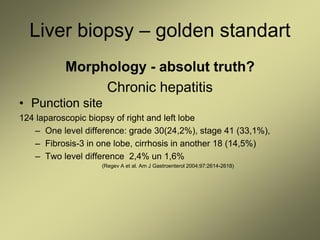
• Punction site
124 laparoscopic biopsy of right and left lobe
– One level difference: grade 30(24,2%), stage 41 (33,1%),
– Fibrosis-3 in one lobe, cirrhosis in another 18 (14,5%)
– Two level difference 2,4% un 1,6%
(Regev A et al. Am J Gastroenterol 2004;97:2614-2618)
Liver biopsy – golden standart
Morphology - absolut truth?
Chronic hepatitis
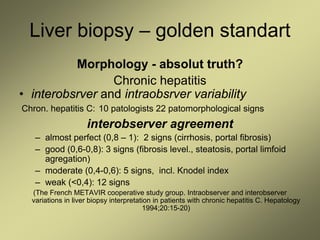
• interobsrver and intraobsrver variability
Chron. hepatitis C: 10 patologists 22 patomorphological signs
interobserver agreement
– almost perfect (0,8 – 1): 2 signs (cirrhosis, portal fibrosis)
– good (0,6-0,8): 3 signs (fibrosis level., steatosis, portal limfoid
agregation)
– moderate (0,4-0,6): 5 signs, incl. Knodel index
– weak (<0,4): 12 signs
(The French METAVIR cooperative study group. Intraobserver and interobserver
variations in liver biopsy interpretation in patients with chronic hepatitis C. Hepatology
1994;20:15-20)
Liver biopsy – golden standart
Morphology - absolut truth?
Chronic hepatitis
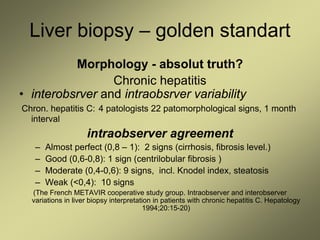
• interobsrver and intraobsrver variability
Chron. hepatitis C: 4 patologists 22 patomorphological signs, 1 month
interval
intraobserver agreement
– Almost perfect (0,8 – 1): 2 signs (cirrhosis, fibrosis level.)
– Good (0,6-0,8): 1 sign (centrilobular fibrosis )
– Moderate (0,4-0,6): 9 signs, incl. Knodel index, steatosis
– Weak (<0,4): 10 signs
(The French METAVIR cooperative study group. Intraobserver and interobserver
variations in liver biopsy interpretation in patients with chronic hepatitis C. Hepatology
1994;20:15-20)
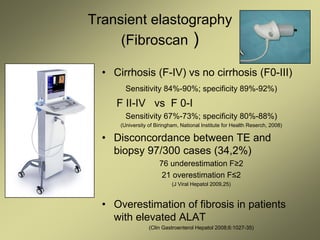
Transient elastography
(Fibroscan )
• Cirrhosis (F-IV) vs no cirrhosis (F0-III)
Sensitivity 84%-90%; specificity 89%-92%)
F II-IV vs F 0-I
Sensitivity 67%-73%; specificity 80%-88%)
(University of Biringham, National Institute for Health Reserch, 2008)
• Disconcordance between TE and
biopsy 97/300 cases (34,2%)
76 underestimation F≥2
21 overestimation F≤2
(J Viral Hepatol 2009,25)
• Overestimation of fibrosis in patients
with elevated ALAT
(Clin Gastroenterol Hepatol 2008;6:1027-35)
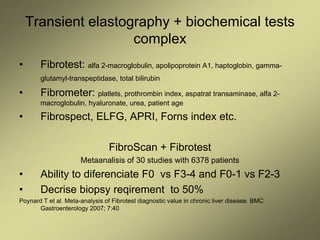
Transient elastography + biochemical tests
complex
• Fibrotest: alfa 2-macroglobulin, apolipoprotein A1, haptoglobin, gamma-
glutamyl-transpeptidase, total bilirubin
• Fibrometer: platlets, prothrombin index, aspatrat transaminase, alfa 2-
macroglobulin, hyaluronate, urea, patient age
• Fibrospect, ELFG, APRI, Forns index etc.
FibroScan + Fibrotest
Metaanalisis of 30 studies with 6378 patients
• Ability to diferenciate F0 vs F3-4 and F0-1 vs F2-3
• Decrise biopsy reqirement to 50%
Poynard T et al. Meta-analysis of Fibrotest diagnostic value in chronic liver disease. BMC
Gastroenterology 2007; 7:40
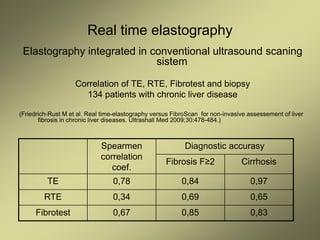
Real time elastography
Elastography integrated in conventional ultrasound scaning
sistem
Correlation of TE, RTE, Fibrotest and biopsy
134 patients with chronic liver disease
(Friedrich-Rust M et al. Real time-elastography versus FibroScan for non-invasive assessement of liver
fibrosis in chronic liver diseases. Ultrashall Med 2009;30:478-484.)
Spearmen
correlation
coef.
Diagnostic accurasy
Fibrosis F≥2 Cirrhosis
TE 0,78 0,84 0,97
RTE 0,34 0,69 0,65
Fibrotest 0,67 0,85 0,83
Liver fibrosis
• MR
• CT
• US
Liver fibrosis
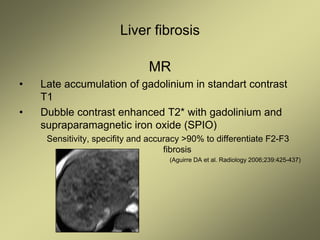
MR
• Late accumulation of gadolinium in standart contrast
T1
• Dubble contrast enhanced T2* with gadolinium and
supraparamagnetic iron oxide (SPIO)
Sensitivity, specifity and accuracy >90% to differentiate F2-F3
fibrosis
(Aguirre DA et al. Radiology 2006;239:425-437)
Liver fibrosis
MR
Diffusion-weigted imaging:
Fibrosis F≥2: sensitivity 83,3%, specificity 88,9%
Fibrosis F≥3 ; sensitivity 83,3%, specificity 80,0%
Diffusion-weighted MR can be usefull for prediction of moderate and
severe fibrosis
(Taouli B et al.AJR 2007 189;799-806.)
MR spectroscopy: F0-2 vs F3-4 sensitivity 81%,
specificity 69% or 93% and 54%
(Norden B et al. Eur J Radiol 2008;66(2):313-320.)
MR elastography: sensitivity 100%, specificity 83%, 98%, 95% and
100% (fibrosis F 1-2-3-4)
(Huvart L et al. NMR in biomedicine 2008. 19/2;173-179)
Liver fibrosis
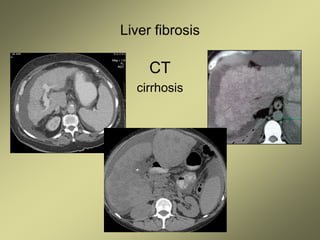
CT
cirrhosis
Liver fibrosis
US
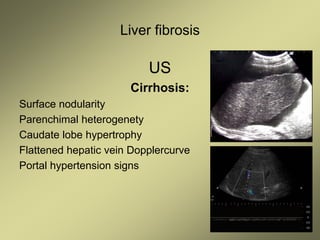
Cirrhosis:
Surface nodularity
Parenchimal heterogenety
Caudate lobe hypertrophy
Flattened hepatic vein Dopplercurve
Portal hypertension signs
Liver fibrosis
US
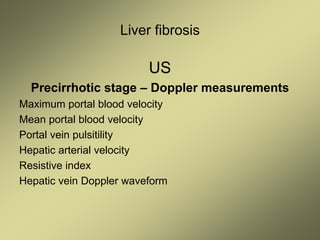
Precirrhotic stage – Doppler measurements
Maximum portal blood velocity
Mean portal blood velocity
Portal vein pulsitility
Hepatic arterial velocity
Resistive index
Hepatic vein Doppler waveform
Liver fibrosis
US
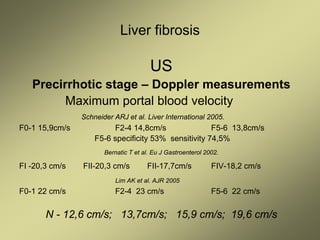
Precirrhotic stage – Doppler measurements
Maximum portal blood velocity
Schneider ARJ et al. Liver International 2005.
F0-1 15,9cm/s F2-4 14,8cm/s F5-6 13,8cm/s
F5-6 specificity 53% sensitivity 74,5%
Bernatic T et al. Eu J Gastroenterol 2002.
FI -20,3 cm/s FII-20,3 cm/s FII-17,7cm/s FIV-18,2 cm/s
Lim AK et al. AJR 2005
F0-1 22 cm/s F2-4 23 cm/s F5-6 22 cm/s
N - 12,6 cm/s; 13,7cm/s; 15,9 cm/s; 19,6 cm/s
Liver fibrosis
US
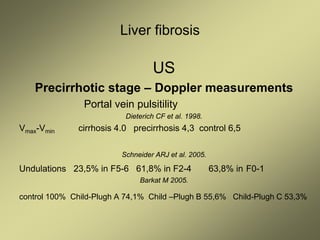
Precirrhotic stage – Doppler measurements
Portal vein pulsitility
Dieterich CF et al. 1998.
Vmax-Vmin cirrhosis 4.0 precirrhosis 4,3 control 6,5
Schneider ARJ et al. 2005.
Undulations 23,5% in F5-6 61,8% in F2-4 63,8% in F0-1
Barkat M 2005.
control 100% Child-Plugh A 74,1% Child –Plugh B 55,6% Child-Plugh C 53,3%
Liver fibrosis
US
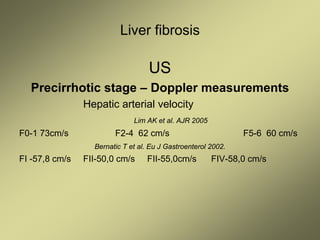
Precirrhotic stage – Doppler measurements
Hepatic arterial velocity
Lim AK et al. AJR 2005
F0-1 73cm/s F2-4 62 cm/s F5-6 60 cm/s
Bernatic T et al. Eu J Gastroenterol 2002.
FI -57,8 cm/s FII-50,0 cm/s FII-55,0cm/s FIV-58,0 cm/s
Liver fibrosis
US
Precirrhotic stage – Doppler measurements
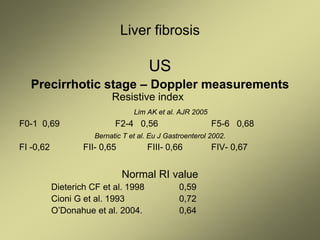
Resistive index
Lim AK et al. AJR 2005
F0-1 0,69 F2-4 0,56 F5-6 0,68
Bernatic T et al. Eu J Gastroenterol 2002.
FI -0,62 FII- 0,65 FIII- 0,66 FIV- 0,67
Normal RI value
Dieterich CF et al. 1998 0,59
Cioni G et al. 1993 0,72
O’Donahue et al. 2004. 0,64
Liver fibrosis
US
Precirrhotic stage – Doppler measurements
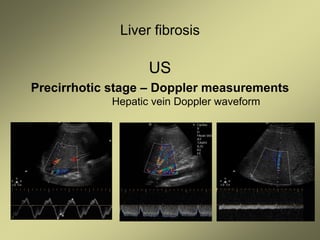
Hepatic vein Doppler waveform
Liver fibrosis
US
Precirrhotic stage – Doppler measurements
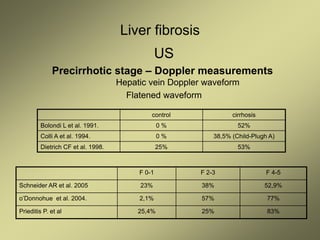
Hepatic vein Doppler waveform
Flatened waveform
control cirrhosis
Bolondi L et al. 1991. 0 % 52%
Colli A et al. 1994. 0 % 38,5% (Child-Plugh A)
Dietrich CF et al. 1998. 25% 53%
F 0-1 F 2-3 F 4-5
Schneider AR et al. 2005 23% 38% 52,9%
o’Donnohue et al. 2004. 2,1% 57% 77%
Prieditis P. et al 25,4% 25% 83%
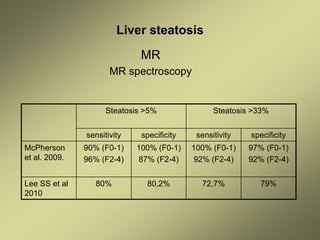
Liver steatosis
MR
MR spectroscopy
Steatosis >5% Steatosis >33%
sensitivity specificity sensitivity specificity
McPherson
et al. 2009.
90% (F0-1)
96% (F2-4)
100% (F0-1)
87% (F2-4)
100% (F0-1)
92% (F2-4)
97% (F0-1)
92% (F2-4)
Lee SS et al
2010
80% 80,2% 72,7% 79%
Liver steatosis
MR
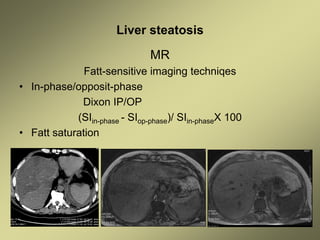
Fatt-sensitive imaging techniqes
• In-phase/opposit-phase
Dixon IP/OP
(SIin-phase - SIop-phase)/ SIin-phaseX 100
• Fatt saturation
Liver steatosis
MR
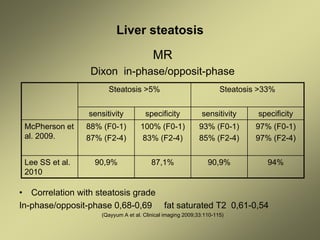
Dixon in-phase/opposit-phase
• Correlation with steatosis grade
In-phase/opposit-phase 0,68-0,69 fat saturated T2 0,61-0,54
(Qayyum A et al. Clinical imaging 2009;33:110-115)
Steatosis >5% Steatosis >33%
sensitivity specificity sensitivity specificity
McPherson et
al. 2009.
88% (F0-1)
87% (F2-4)
100% (F0-1)
83% (F2-4)
93% (F0-1)
85% (F2-4)
97% (F0-1)
97% (F2-4)
Lee SS et al.
2010
90,9% 87,1% 90,9% 94%
Liver steatosis
CT
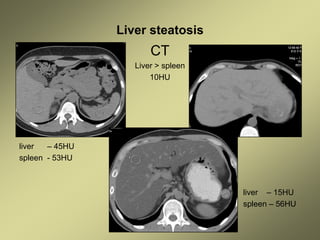
Liver > spleen
10HU
liver – 45HU
spleen - 53HU
liver – 15HU
spleen – 56HU
Liver steatosis
CT
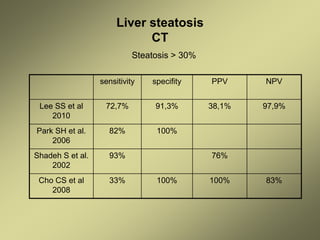
Steatosis > 30%
sensitivity specifity PPV NPV
Lee SS et al
2010
72,7% 91,3% 38,1% 97,9%
Park SH et al.
2006
82% 100%
Shadeh S et al.
2002
93% 76%
Cho CS et al
2008
33% 100% 100% 83%
Liver steatosis
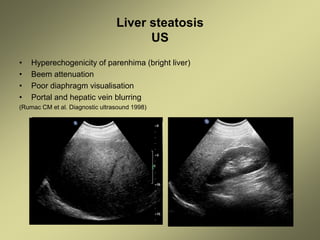
US
• Hyperechogenicity of parenhima (bright liver)
• Beem attenuation
• Poor diaphragm visualisation
• Portal and hepatic vein blurring
(Rumac CM et al. Diagnostic ultrasound 1998)
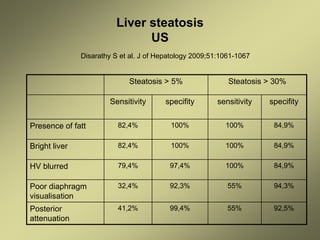
Liver steatosis
US
Disarathy S et al. J of Hepatology 2009;51:1061-1067
Steatosis > 5% Steatosis > 30%
Sensitivity specifity sensitivity specifity
Presence of fatt 82,4% 100% 100% 84,9%
Bright liver 82,4% 100% 100% 84,9%
HV blurred 79,4% 97,4% 100% 84,9%
Poor diaphragm
visualisation
32,4% 92,3% 55% 94,3%
Posterior
attenuation
41,2% 99,4% 55% 92,5%
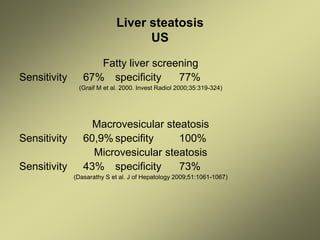
Liver steatosis
US
Fatty liver screening
Sensitivity 67% specificity 77%
(Graif M et al. 2000. Invest Radiol 2000;35:319-324)
Macrovesicular steatosis
Sensitivity 60,9% specifity 100%
Microvesicular steatosis
Sensitivity 43% specificity 73%
(Dasarathy S et al. J of Hepatology 2009;51:1061-1067)
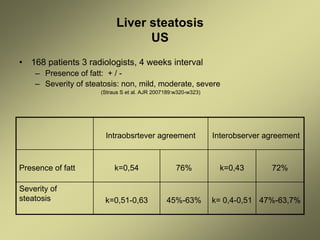
Liver steatosis
US
• 168 patients 3 radiologists, 4 weeks interval
– Presence of fatt: + / -
– Severity of steatosis: non, mild, moderate, severe
(Straus S et al. AJR 2007189:w320-w323)
Intraobsrtever agreement Interobserver agreement
Presence of fatt k=0,54 76% k=0,43 72%
Severity of
steatosis k=0,51-0,63 45%-63% k= 0,4-0,51 47%-63,7%
Liver steatosis
US
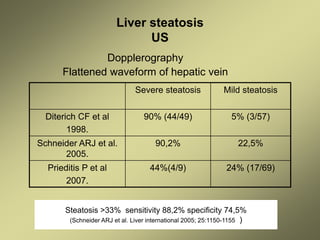
Dopplerography
Flattened waveform of hepatic vein
Severe steatosis Mild steatosis
Diterich CF et al
1998.
90% (44/49) 5% (3/57)
Schneider ARJ et al.
2005.
90,2% 22,5%
Prieditis P et al
2007.
44%(4/9) 24% (17/69)
Steatosis >33% sensitivity 88,2% specificity 74,5%
(Schneider ARJ et al. Liver international 2005; 25:1150-1155 )
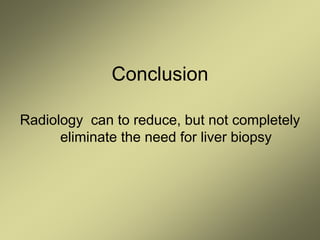
Conclusion
Radiology can to reduce, but not completely
eliminate the need for liver biopsy
Thank you for your attention !

Prieditis steatosis bcr10

  • 1.
    Liver fibrosis and steatosis– the role of radiology P.Prieditis P.Stradins Clinical University Hospital Riga, Latvia 9.X 2010.
  • 2.
    Liver fibrosis • Alcoholismus •Virus hepatitis C (VHC) • Nonalcohol steatohepatitis (NASH)
  • 3.
    Morbidity with hr.VHCin Latvia Reconvalescence 15% (Hoofnagle JH et al. 1997. Hepatology 1997;26(suppl 1):15S-20S) Development of cirrhosis in 2-3 to 30-40 years after infection Cirrhosis in 20 y after infection 9% Cirrhosis in 40 y after infection 44% (Poynard T et al. J Hepatol 2001;34:730-739)
  • 4.
    • Advanced liverfibrosis is reversibl – Antifibrotic therapy – Removing of causitive agent (Bataler R. et al.2005.)
  • 5.
    • Liver steatosis 20-30%of world population (Marchesini G. et al. Minerva Cardioangiol 2006;54:229-239)) • Chr. VHC 50-75% (Fiore G. et al. Eur J Gastroenterol Hepatol 1998;8:125-129 ) • NASH Cirrhosis 8-26% (Powell EE et al. Hepatology1990;11:74-80)
  • 6.
    Liver biopsy –golden standart • Complications – “Large complications” 0,4% - 2,8% – Letality 0% - 0,2% ( (Buscarini E. Complications of abdominal interventional ultrasound. Poleto edizioni 1996.34-47) • Follow up • Diagnostic accuracy
  • 7.
    Liver biopsy –golden standart Morphology - absolut truth? Chronic hepatitis • Size of tissue sample • Number of samples • Punction site • Morphologist
  • 8.
    Liver biopsy –golden standart Morphology - absolut truth? Chronic hepatitis • Size of tissue sample 15mm sample length – corect estimation 65% 25 mm – 75% Longer – diagnostic accuracy do not improve (Bedosa P. Hepatology 2003;38:1449-1457) 30 mm/1,4mm 15 mm/1mm 10mm/1mm Slight inflamation 49,7% 62,2% 86,6% Slight fibrosis 59% 63,3% 80,1% (Colloredo G. J Hepatol 2003;39:239-244)
  • 9.
    Liver biopsy –golden standart Morphology - absolut truth? Chronic hepatitis • Number of samples 75 patients, 3 samples from diferent places through one site – Equal estimation in all 3 samples 36% gadījumu – Cirrrhosis 50% – HCC 54,5% – Mts 50% – Liver granuloma 18,8% (Maharaj B et al. Lancet 1986;1(8480):523-525)
  • 10.
    Liver biopsy –golden standart Morphology - absolut truth? Chronic hepatitis • Punction site 124 laparoscopic biopsy of right and left lobe – One level difference: grade 30(24,2%), stage 41 (33,1%), – Fibrosis-3 in one lobe, cirrhosis in another 18 (14,5%) – Two level difference 2,4% un 1,6% (Regev A et al. Am J Gastroenterol 2004;97:2614-2618)
  • 11.
    Liver biopsy –golden standart Morphology - absolut truth? Chronic hepatitis • interobsrver and intraobsrver variability Chron. hepatitis C: 10 patologists 22 patomorphological signs interobserver agreement – almost perfect (0,8 – 1): 2 signs (cirrhosis, portal fibrosis) – good (0,6-0,8): 3 signs (fibrosis level., steatosis, portal limfoid agregation) – moderate (0,4-0,6): 5 signs, incl. Knodel index – weak (<0,4): 12 signs (The French METAVIR cooperative study group. Intraobserver and interobserver variations in liver biopsy interpretation in patients with chronic hepatitis C. Hepatology 1994;20:15-20)
  • 12.
    Liver biopsy –golden standart Morphology - absolut truth? Chronic hepatitis • interobsrver and intraobsrver variability Chron. hepatitis C: 4 patologists 22 patomorphological signs, 1 month interval intraobserver agreement – Almost perfect (0,8 – 1): 2 signs (cirrhosis, fibrosis level.) – Good (0,6-0,8): 1 sign (centrilobular fibrosis ) – Moderate (0,4-0,6): 9 signs, incl. Knodel index, steatosis – Weak (<0,4): 10 signs (The French METAVIR cooperative study group. Intraobserver and interobserver variations in liver biopsy interpretation in patients with chronic hepatitis C. Hepatology 1994;20:15-20)
  • 13.
    Transient elastography (Fibroscan ) •Cirrhosis (F-IV) vs no cirrhosis (F0-III) Sensitivity 84%-90%; specificity 89%-92%) F II-IV vs F 0-I Sensitivity 67%-73%; specificity 80%-88%) (University of Biringham, National Institute for Health Reserch, 2008) • Disconcordance between TE and biopsy 97/300 cases (34,2%) 76 underestimation F≥2 21 overestimation F≤2 (J Viral Hepatol 2009,25) • Overestimation of fibrosis in patients with elevated ALAT (Clin Gastroenterol Hepatol 2008;6:1027-35)
  • 14.
    Transient elastography +biochemical tests complex • Fibrotest: alfa 2-macroglobulin, apolipoprotein A1, haptoglobin, gamma- glutamyl-transpeptidase, total bilirubin • Fibrometer: platlets, prothrombin index, aspatrat transaminase, alfa 2- macroglobulin, hyaluronate, urea, patient age • Fibrospect, ELFG, APRI, Forns index etc. FibroScan + Fibrotest Metaanalisis of 30 studies with 6378 patients • Ability to diferenciate F0 vs F3-4 and F0-1 vs F2-3 • Decrise biopsy reqirement to 50% Poynard T et al. Meta-analysis of Fibrotest diagnostic value in chronic liver disease. BMC Gastroenterology 2007; 7:40
  • 15.
    Real time elastography Elastographyintegrated in conventional ultrasound scaning sistem Correlation of TE, RTE, Fibrotest and biopsy 134 patients with chronic liver disease (Friedrich-Rust M et al. Real time-elastography versus FibroScan for non-invasive assessement of liver fibrosis in chronic liver diseases. Ultrashall Med 2009;30:478-484.) Spearmen correlation coef. Diagnostic accurasy Fibrosis F≥2 Cirrhosis TE 0,78 0,84 0,97 RTE 0,34 0,69 0,65 Fibrotest 0,67 0,85 0,83
  • 16.
  • 17.
    Liver fibrosis MR • Lateaccumulation of gadolinium in standart contrast T1 • Dubble contrast enhanced T2* with gadolinium and supraparamagnetic iron oxide (SPIO) Sensitivity, specifity and accuracy >90% to differentiate F2-F3 fibrosis (Aguirre DA et al. Radiology 2006;239:425-437)
  • 18.
    Liver fibrosis MR Diffusion-weigted imaging: FibrosisF≥2: sensitivity 83,3%, specificity 88,9% Fibrosis F≥3 ; sensitivity 83,3%, specificity 80,0% Diffusion-weighted MR can be usefull for prediction of moderate and severe fibrosis (Taouli B et al.AJR 2007 189;799-806.) MR spectroscopy: F0-2 vs F3-4 sensitivity 81%, specificity 69% or 93% and 54% (Norden B et al. Eur J Radiol 2008;66(2):313-320.) MR elastography: sensitivity 100%, specificity 83%, 98%, 95% and 100% (fibrosis F 1-2-3-4) (Huvart L et al. NMR in biomedicine 2008. 19/2;173-179)
  • 19.
  • 20.
    Liver fibrosis US Cirrhosis: Surface nodularity Parenchimalheterogenety Caudate lobe hypertrophy Flattened hepatic vein Dopplercurve Portal hypertension signs
  • 21.
    Liver fibrosis US Precirrhotic stage– Doppler measurements Maximum portal blood velocity Mean portal blood velocity Portal vein pulsitility Hepatic arterial velocity Resistive index Hepatic vein Doppler waveform
  • 22.
    Liver fibrosis US Precirrhotic stage– Doppler measurements Maximum portal blood velocity Schneider ARJ et al. Liver International 2005. F0-1 15,9cm/s F2-4 14,8cm/s F5-6 13,8cm/s F5-6 specificity 53% sensitivity 74,5% Bernatic T et al. Eu J Gastroenterol 2002. FI -20,3 cm/s FII-20,3 cm/s FII-17,7cm/s FIV-18,2 cm/s Lim AK et al. AJR 2005 F0-1 22 cm/s F2-4 23 cm/s F5-6 22 cm/s N - 12,6 cm/s; 13,7cm/s; 15,9 cm/s; 19,6 cm/s
  • 23.
    Liver fibrosis US Precirrhotic stage– Doppler measurements Portal vein pulsitility Dieterich CF et al. 1998. Vmax-Vmin cirrhosis 4.0 precirrhosis 4,3 control 6,5 Schneider ARJ et al. 2005. Undulations 23,5% in F5-6 61,8% in F2-4 63,8% in F0-1 Barkat M 2005. control 100% Child-Plugh A 74,1% Child –Plugh B 55,6% Child-Plugh C 53,3%
  • 24.
    Liver fibrosis US Precirrhotic stage– Doppler measurements Hepatic arterial velocity Lim AK et al. AJR 2005 F0-1 73cm/s F2-4 62 cm/s F5-6 60 cm/s Bernatic T et al. Eu J Gastroenterol 2002. FI -57,8 cm/s FII-50,0 cm/s FII-55,0cm/s FIV-58,0 cm/s
  • 25.
    Liver fibrosis US Precirrhotic stage– Doppler measurements Resistive index Lim AK et al. AJR 2005 F0-1 0,69 F2-4 0,56 F5-6 0,68 Bernatic T et al. Eu J Gastroenterol 2002. FI -0,62 FII- 0,65 FIII- 0,66 FIV- 0,67 Normal RI value Dieterich CF et al. 1998 0,59 Cioni G et al. 1993 0,72 O’Donahue et al. 2004. 0,64
  • 26.
    Liver fibrosis US Precirrhotic stage– Doppler measurements Hepatic vein Doppler waveform
  • 27.
    Liver fibrosis US Precirrhotic stage– Doppler measurements Hepatic vein Doppler waveform Flatened waveform control cirrhosis Bolondi L et al. 1991. 0 % 52% Colli A et al. 1994. 0 % 38,5% (Child-Plugh A) Dietrich CF et al. 1998. 25% 53% F 0-1 F 2-3 F 4-5 Schneider AR et al. 2005 23% 38% 52,9% o’Donnohue et al. 2004. 2,1% 57% 77% Prieditis P. et al 25,4% 25% 83%
  • 28.
    Liver steatosis MR MR spectroscopy Steatosis>5% Steatosis >33% sensitivity specificity sensitivity specificity McPherson et al. 2009. 90% (F0-1) 96% (F2-4) 100% (F0-1) 87% (F2-4) 100% (F0-1) 92% (F2-4) 97% (F0-1) 92% (F2-4) Lee SS et al 2010 80% 80,2% 72,7% 79%
  • 29.
    Liver steatosis MR Fatt-sensitive imagingtechniqes • In-phase/opposit-phase Dixon IP/OP (SIin-phase - SIop-phase)/ SIin-phaseX 100 • Fatt saturation
  • 30.
    Liver steatosis MR Dixon in-phase/opposit-phase •Correlation with steatosis grade In-phase/opposit-phase 0,68-0,69 fat saturated T2 0,61-0,54 (Qayyum A et al. Clinical imaging 2009;33:110-115) Steatosis >5% Steatosis >33% sensitivity specificity sensitivity specificity McPherson et al. 2009. 88% (F0-1) 87% (F2-4) 100% (F0-1) 83% (F2-4) 93% (F0-1) 85% (F2-4) 97% (F0-1) 97% (F2-4) Lee SS et al. 2010 90,9% 87,1% 90,9% 94%
  • 31.
    Liver steatosis CT Liver >spleen 10HU liver – 45HU spleen - 53HU liver – 15HU spleen – 56HU
  • 32.
    Liver steatosis CT Steatosis >30% sensitivity specifity PPV NPV Lee SS et al 2010 72,7% 91,3% 38,1% 97,9% Park SH et al. 2006 82% 100% Shadeh S et al. 2002 93% 76% Cho CS et al 2008 33% 100% 100% 83%
  • 33.
    Liver steatosis US • Hyperechogenicityof parenhima (bright liver) • Beem attenuation • Poor diaphragm visualisation • Portal and hepatic vein blurring (Rumac CM et al. Diagnostic ultrasound 1998)
  • 34.
    Liver steatosis US Disarathy Set al. J of Hepatology 2009;51:1061-1067 Steatosis > 5% Steatosis > 30% Sensitivity specifity sensitivity specifity Presence of fatt 82,4% 100% 100% 84,9% Bright liver 82,4% 100% 100% 84,9% HV blurred 79,4% 97,4% 100% 84,9% Poor diaphragm visualisation 32,4% 92,3% 55% 94,3% Posterior attenuation 41,2% 99,4% 55% 92,5%
  • 35.
    Liver steatosis US Fatty liverscreening Sensitivity 67% specificity 77% (Graif M et al. 2000. Invest Radiol 2000;35:319-324) Macrovesicular steatosis Sensitivity 60,9% specifity 100% Microvesicular steatosis Sensitivity 43% specificity 73% (Dasarathy S et al. J of Hepatology 2009;51:1061-1067)
  • 36.
    Liver steatosis US • 168patients 3 radiologists, 4 weeks interval – Presence of fatt: + / - – Severity of steatosis: non, mild, moderate, severe (Straus S et al. AJR 2007189:w320-w323) Intraobsrtever agreement Interobserver agreement Presence of fatt k=0,54 76% k=0,43 72% Severity of steatosis k=0,51-0,63 45%-63% k= 0,4-0,51 47%-63,7%
  • 37.
    Liver steatosis US Dopplerography Flattened waveformof hepatic vein Severe steatosis Mild steatosis Diterich CF et al 1998. 90% (44/49) 5% (3/57) Schneider ARJ et al. 2005. 90,2% 22,5% Prieditis P et al 2007. 44%(4/9) 24% (17/69) Steatosis >33% sensitivity 88,2% specificity 74,5% (Schneider ARJ et al. Liver international 2005; 25:1150-1155 )
  • 38.
    Conclusion Radiology can toreduce, but not completely eliminate the need for liver biopsy
  • 39.
    Thank you foryour attention !