ABDOMINAL AORTIC ANEURYSM
ABDOMINAL AORTIC ANEYRSUM
AN EXPANDING PROBLEM ??
Do you people know one of the greatest minds
in the history died due to AAA
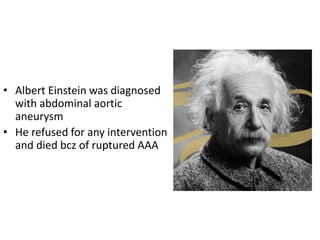
• Albert Einstein was diagnosed
with abdominal aortic
aneurysm
• He refused for any intervention
and died bcz of ruptured AAA
ABDOMINAL AORTIC ANEURYSUM
• AAA is permanent localized dilatation of the
abdominal aorta
• The disorder is diagnosed if the aortic
diameter is greater than 3 cm or more than
50 % larger than a normal proximal segment
of aorta
Why are AAA a serious health care
issue ??
• An estimated 80 million people aged 60 years
and older are at risk in western Europe
• AAA is the 12th leading cause of death in
western societies
• It is a silent killer because there are often no
symptoms that an aneurysm is developing in
the abdominal aorta
Epidemiology
• Incidence of AAA is estimated between 4 % to 8
% of the male population aged 65 years or older
• Comparatively ,it is between 0.5 % to 1 % in
females of the same age
Pathophysiology of AAA
Pathological changes in the aortic wall ;
Inflammatory process in aortic wall
Causing breakdown of elastin & collagen
Decrease tensile strength
Leading to aortic wall expansion
Pathophysiology of a AAA - Risk factors
Main risk factors
 Male gender
 Smoking history
 Hypertension
 Family history
 Increasing age
 Atherosclerosis
 Infection / inflammation
 connective tissue disorder
 vasculitis
Types of AAA
Morphological classification
True aneurysm
Fusiform aneurysm
Saccular aneurysm
Pseudo aneurysm
Why is early diagnosis of AAA so
important ?
• The operative mortality of treating ruptured
aneurysm is 80 %
• For elective AAA cases , the operative mortality rate
is drastically reduced , approximately only 2-7% of
cases result in death
If untreated ,the AAA may rupture
• Risk of rupture for untreated aneurysm within 5 yrs
5-5.9 cm -----25%
6-7cm----------35%
> 7% -----------75%
• When the aneurysm diameter reaches 5 cm, the risk of
rupture is generally considered to be higher than the
operative risk
How can you diagnose a AAA??
Clinical Features;
Majority are asymptomatic
Symptomatic aneurysm can present with spectrum of
symptoms
Physical Examination;
pulsating mass in the upper abdomen
However ,you may miss up to 80 % of AAA, If the
diagnosis is limited to physical examination ONLY
How can you diagnose a AAA
Ultrasound scan has proven to be reliable and cost
effective way to diagnose a AAA
• It is extremely sensitive test for all AAA sizes
• It is painless and non invasive
• It is cost effective
What if a AAA is diagnosed ?
• Clinical practice suggests that
Aneurysm diameter follow up action
Less than 4cm Recall annually
> 4cm BUT < 5 cm Recall every 6 months
More than 5 cm , symptomatic or
growing by more than 1 cm /year
Endovascular or surgical management
INDICATION FOR INTERVENTION
• Asymptomatic aneurysm > 5.5 cm in males & > 5 cm
in females
• Symptomatic aneurysm of any size ( abdominal pain
,evidence of embolization )
• Growth rate > 0.5 mm in 6 months or 1 cm /year
• Saccular aneurysm of any size
• Ruptured or leaking aneurysm
Treatment option
• Open surgery
• Endovascular stent grafting
Treatment option
• Endovascular stent graft repair (EVAR )
EVAR
Open surgical repair
Advantages;
• Aneurysm opened , graft proximal and distally
anastomosed , Aorta wrapped and closed
around graft
• Established procedure with more than 40 yrs
of clinical experience .
• Excludes aneurysm and prevents sac growth
• Proven long term results
Open surgical repair;
Drawbacks
• Significant incision on the abdomen
• 30- 90 minutes cross clamping
• Upto 4 hours procedure
• Contraindicated in some patients
• Long post operative recovery ;
1-2 days intensive care
5-7 days hospitalization
4-6 weeks recovery time
Open surgery ;
Drawbacks
• Many patients considered ‘unfit’;
High anesthesia risk
Significant co morbidities
Previous abdominal surgery/hostile abdomen
• High perioperative morbidity
• 5 % risk of mortality
Endovascular stent grafting ;
Advantages
Minimally invasive
Reduced risk of death that is <2%
Faster recovery
Improved functional outcomes
Endovascular stent grafting ;
Drawbacks
Complications and re interventions
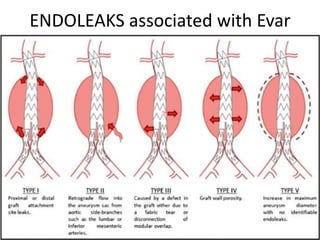
Endoleaks
Stent graft migration
Modular dislocation
Most complication are benign and treatable by
endovascular techniques
New stent grafts generations are associated with fewer
complications
ENDOLEAKS associated with Evar
Endovascular stent grafting
• Endovascular aortic repair needs
Adequate vascular access
Appropriate landing zones
Tortuosity ,calcification ,thrombus
• Needs Precise sizing
• Good imaging equipment in the lab or in the
operating room
Typical patient follow up
Following open surgery
Ultrasound every year for patients treated via
open repair
Following endovascular repair
Plain x-ray and CT scan at 6 months and then
annually for patients treated with an
endovascular stent graft
Which treatment for which patients
Case by case basis
• Endovascular stent grafting
should be proposed to all patients who are 70 yrs or older and
having an anatomy compatible with stent graft repair
• Open surgery should be proposed to all patients fit for open repair
or those who refuse EVAR and are fit for open repair
• In patients with comorbidities who are unsuitable for open
surgery, endovascular stent graft repair may be but balanced
against life expectancy
Take HOME MESSAGE
An ultrasound examination is the excellent screening
imaging to check the presence of AAA. Palpation is
not effective in all patients.
AAA.pptx

AAA.pptx

  • 1.
  • 2.
    ABDOMINAL AORTIC ANEYRSUM ANEXPANDING PROBLEM ??
  • 3.
    Do you peopleknow one of the greatest minds in the history died due to AAA
  • 4.
    • Albert Einsteinwas diagnosed with abdominal aortic aneurysm • He refused for any intervention and died bcz of ruptured AAA
  • 5.
    ABDOMINAL AORTIC ANEURYSUM •AAA is permanent localized dilatation of the abdominal aorta • The disorder is diagnosed if the aortic diameter is greater than 3 cm or more than 50 % larger than a normal proximal segment of aorta
  • 6.
    Why are AAAa serious health care issue ?? • An estimated 80 million people aged 60 years and older are at risk in western Europe • AAA is the 12th leading cause of death in western societies • It is a silent killer because there are often no symptoms that an aneurysm is developing in the abdominal aorta
  • 7.
    Epidemiology • Incidence ofAAA is estimated between 4 % to 8 % of the male population aged 65 years or older • Comparatively ,it is between 0.5 % to 1 % in females of the same age
  • 8.
    Pathophysiology of AAA Pathologicalchanges in the aortic wall ; Inflammatory process in aortic wall Causing breakdown of elastin & collagen Decrease tensile strength Leading to aortic wall expansion
  • 9.
    Pathophysiology of aAAA - Risk factors Main risk factors  Male gender  Smoking history  Hypertension  Family history  Increasing age  Atherosclerosis  Infection / inflammation  connective tissue disorder  vasculitis
  • 10.
    Types of AAA Morphologicalclassification True aneurysm Fusiform aneurysm Saccular aneurysm Pseudo aneurysm
  • 12.
    Why is earlydiagnosis of AAA so important ? • The operative mortality of treating ruptured aneurysm is 80 % • For elective AAA cases , the operative mortality rate is drastically reduced , approximately only 2-7% of cases result in death
  • 13.
    If untreated ,theAAA may rupture • Risk of rupture for untreated aneurysm within 5 yrs 5-5.9 cm -----25% 6-7cm----------35% > 7% -----------75% • When the aneurysm diameter reaches 5 cm, the risk of rupture is generally considered to be higher than the operative risk
  • 14.
    How can youdiagnose a AAA?? Clinical Features; Majority are asymptomatic Symptomatic aneurysm can present with spectrum of symptoms Physical Examination; pulsating mass in the upper abdomen However ,you may miss up to 80 % of AAA, If the diagnosis is limited to physical examination ONLY
  • 15.
    How can youdiagnose a AAA Ultrasound scan has proven to be reliable and cost effective way to diagnose a AAA • It is extremely sensitive test for all AAA sizes • It is painless and non invasive • It is cost effective
  • 16.
    What if aAAA is diagnosed ? • Clinical practice suggests that Aneurysm diameter follow up action Less than 4cm Recall annually > 4cm BUT < 5 cm Recall every 6 months More than 5 cm , symptomatic or growing by more than 1 cm /year Endovascular or surgical management
  • 17.
    INDICATION FOR INTERVENTION •Asymptomatic aneurysm > 5.5 cm in males & > 5 cm in females • Symptomatic aneurysm of any size ( abdominal pain ,evidence of embolization ) • Growth rate > 0.5 mm in 6 months or 1 cm /year • Saccular aneurysm of any size • Ruptured or leaking aneurysm
  • 18.
    Treatment option • Opensurgery • Endovascular stent grafting
  • 19.
    Treatment option • Endovascularstent graft repair (EVAR )
  • 20.
  • 21.
    Open surgical repair Advantages; •Aneurysm opened , graft proximal and distally anastomosed , Aorta wrapped and closed around graft • Established procedure with more than 40 yrs of clinical experience . • Excludes aneurysm and prevents sac growth • Proven long term results
  • 22.
    Open surgical repair; Drawbacks •Significant incision on the abdomen • 30- 90 minutes cross clamping • Upto 4 hours procedure • Contraindicated in some patients • Long post operative recovery ; 1-2 days intensive care 5-7 days hospitalization 4-6 weeks recovery time
  • 23.
    Open surgery ; Drawbacks •Many patients considered ‘unfit’; High anesthesia risk Significant co morbidities Previous abdominal surgery/hostile abdomen • High perioperative morbidity • 5 % risk of mortality
  • 24.
    Endovascular stent grafting; Advantages Minimally invasive Reduced risk of death that is <2% Faster recovery Improved functional outcomes
  • 25.
    Endovascular stent grafting; Drawbacks Complications and re interventions Endoleaks Stent graft migration Modular dislocation Most complication are benign and treatable by endovascular techniques New stent grafts generations are associated with fewer complications
  • 26.
  • 27.
    Endovascular stent grafting •Endovascular aortic repair needs Adequate vascular access Appropriate landing zones Tortuosity ,calcification ,thrombus • Needs Precise sizing • Good imaging equipment in the lab or in the operating room
  • 28.
    Typical patient followup Following open surgery Ultrasound every year for patients treated via open repair Following endovascular repair Plain x-ray and CT scan at 6 months and then annually for patients treated with an endovascular stent graft
  • 29.
    Which treatment forwhich patients Case by case basis • Endovascular stent grafting should be proposed to all patients who are 70 yrs or older and having an anatomy compatible with stent graft repair • Open surgery should be proposed to all patients fit for open repair or those who refuse EVAR and are fit for open repair • In patients with comorbidities who are unsuitable for open surgery, endovascular stent graft repair may be but balanced against life expectancy
  • 30.
    Take HOME MESSAGE Anultrasound examination is the excellent screening imaging to check the presence of AAA. Palpation is not effective in all patients.