Catheter Related Blood
Stream Infection (CRBSI)
Diagnosis & Management Step-Wise
Practical Approach in HD Patients
Mohammed Abdel Gawad
Nephrology Specialist
Kidney & Urology Center (KUC)
Alexandria – EGY
drgawad@gmail.com
1st Annual Interventional Nephrology Meeting – ESNT
Mansoura, 26-27/Oct/2017
Talk Outline
• Diagnosis
• Management
• Prevention
Talk Outline
• Diagnosis
• Management
• Prevention
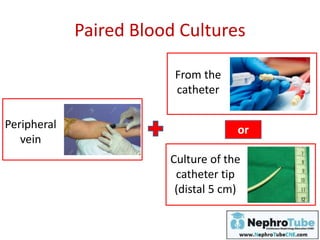
Paired Blood Cultures
Peripheral
vein
From the
catheter
Culture of the
catheter tip
(distal 5 cm)
or
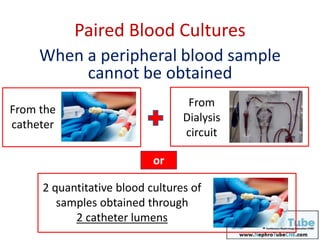
Paired Blood Cultures
or
When a peripheral blood sample
cannot be obtained
From the
catheter
From
Dialysis
circuit
2 quantitative blood cultures of
samples obtained through
2 catheter lumens
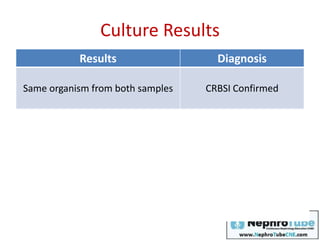
Culture Results
Results Diagnosis
Same organism from both samples CRBSI Confirmed
Both negative CRBSI Unlikely
Negative peripheral blood culture
BUT
Positive central blood culture
Probably contamination
(don’t treat EXCEPT if
Staph. Aureus)
Talk Outline
• Diagnosis
• Management
• Prevention
Talk Outline
• Diagnosis
• Management
• Prevention
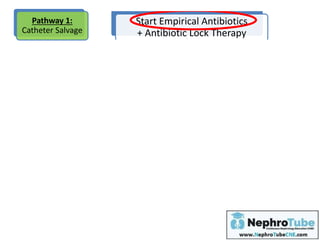
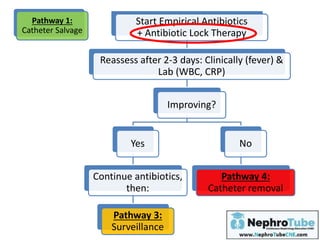
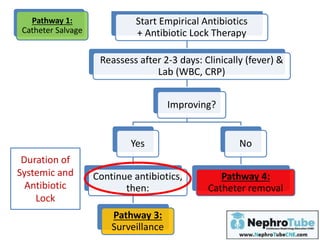
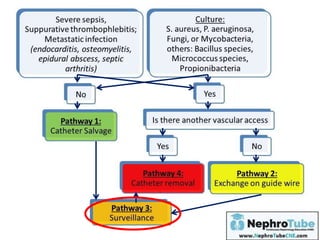
Start Empirical Antibiotics
+ Antibiotic Lock Therapy
Reassess after 2-3 days: Clinically (fever) &
Lab (WBC, CRP)
Improving?
Yes
Continue antibotics,
then:
Pathway 3:
Surveillance
No
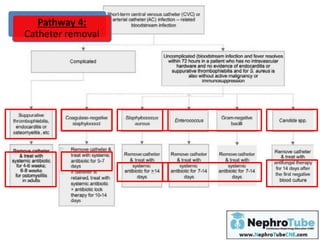
Pathway 4:
Catheter removal
Pathway 1:
Catheter Salvage
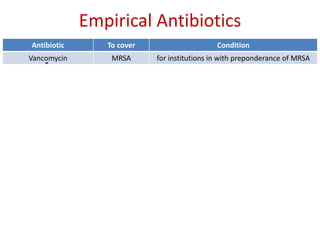
Empirical Antibiotics
Antibiotic To cover Condition
Vancomycin MRSA for institutions in with preponderance of MRSA
Gentamycin
(if absolutely
contraindicated use
Quinolones)
Gram –ve
---------------------
Meropenem, Imipenem
or Etrapenem
or
Piperacillin/Tazobactam
in community with low
incidence of antibiotic
resistance
MDR Gram –ve In neutropenic patients, severely ill patients with
sepsis, or patients
known to be colonized with such pathogens
Fluconazole or
Echinocandin
Candidemia total parenteral nutrition, prolonged use of
broad-spectrum antibiotics, hematologic
malignancy, receipt of bone marrow or solid-
organ transplant, femoral catheterization,
or colonization due to Candida species at
multiple sites
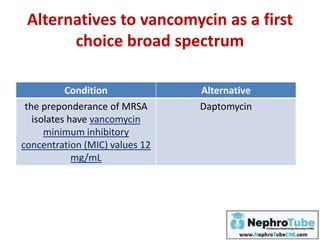
Alternatives to vancomycin as a first
choice broad spectrum
Condition Alternative
the preponderance of MRSA
isolates have vancomycin
minimum inhibitory
concentration (MIC) values 12
mg/mL
Daptomycin
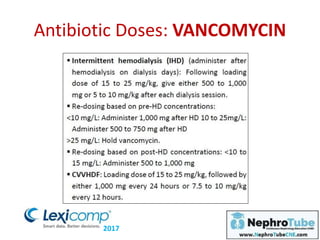
Antibiotic Doses: VANCOMYCIN
2017
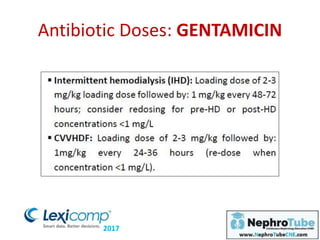
Antibiotic Doses: GENTAMICIN
2017
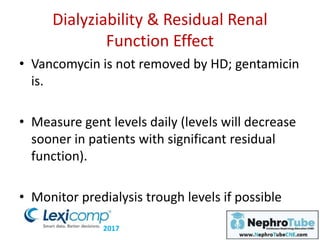
Dialyziability & Residual Renal
Function Effect
• Vancomycin is not removed by HD; gentamicin
is.
• Measure gent levels daily (levels will decrease
sooner in patients with significant residual
function).
• Monitor predialysis trough levels if possible
2017
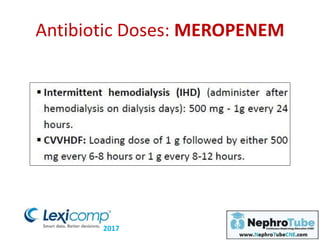
Antibiotic Doses: MEROPENEM
2017
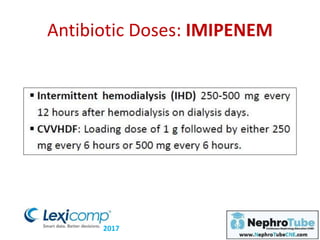
Antibiotic Doses: IMIPENEM
2017
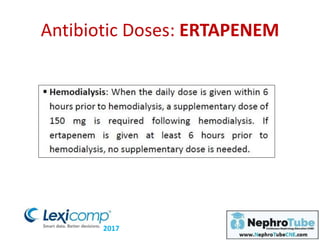
Antibiotic Doses: ERTAPENEM
2017
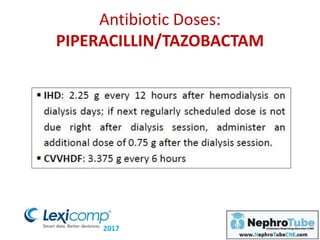
Antibiotic Doses:
PIPERACILLIN/TAZOBACTAM
2017
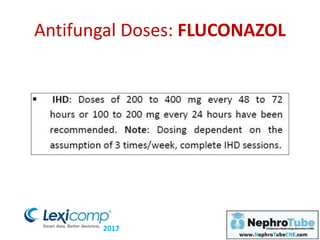
Antifungal Doses: FLUCONAZOL
2017
Start Empirical Antibiotics
+ Antibiotic Lock Therapy
Reassess after 2-3 days: Clinically (fever) &
Lab (WBC, CRP)
Improving?
Yes
Continue antibiotics,
then:
Pathway 3:
Surveillance
No
Pathway 4:
Catheter removal
Pathway 1:
Catheter Salvage
Start Empirical Antibiotics
+ Antibiotic Lock Therapy
Reassess after 2-3 days: Clinically (fever) &
Lab (WBC, CRP)
Improving?
Yes
Continue antibiotics,
then:
Pathway 3:
Surveillance
No
Pathway 4:
Catheter removal
Pathway 1:
Catheter Salvage
Duration of
Systemic and
Antibiotic
Lock
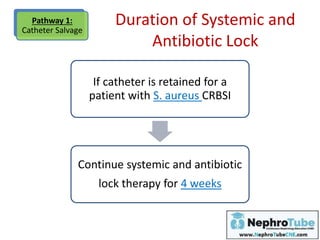
Duration of Systemic and
Antibiotic Lock
Pathway 1:
Catheter Salvage
If catheter is retained for a
patient with S. aureus CRBSI
Continue systemic and antibiotic
lock therapy for 4 weeks
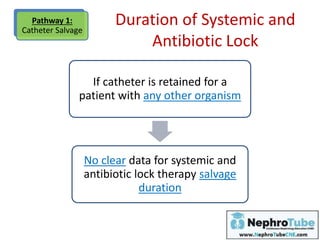
Duration of Systemic and
Antibiotic Lock
Pathway 1:
Catheter Salvage
If catheter is retained for a
patient with any other organism
No clear data for systemic and
antibiotic lock therapy salvage
duration
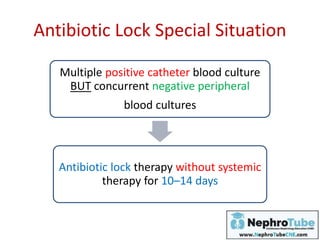
Antibiotic Lock Special Situation
Multiple positive catheter blood culture
BUT concurrent negative peripheral
blood cultures
Antibiotic lock therapy without systemic
therapy for 10–14 days
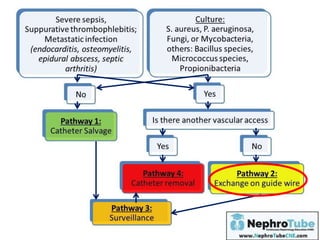
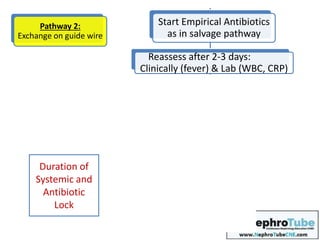
guide wire
Start Empirical Antibiotics
as in salvage pathway
Reassess after 2-3 days:
Clinically (fever) & Lab (WBC, CRP)
Improving?
Yes
Exchange on
guide wire
Continue antibiotics
Pathway 3:
Surveillance
No
Pathway 4:
Catheter removal
Pathway 2:
Exchange on guide wire
Duration of
Systemic and
Antibiotic
Lock
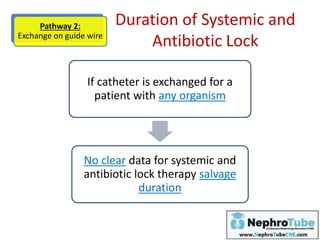
Duration of Systemic and
Antibiotic Lock
If catheter is exchanged for a
patient with any organism
No clear data for systemic and
antibiotic lock therapy salvage
duration
Pathway 2:
Exchange on guide wire
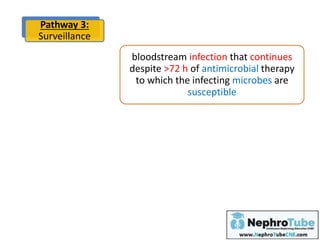
Pathway 3:
Surveillance
bloodstream infection that continues
despite >72 h of antimicrobial therapy
to which the infecting microbes are
susceptible
2 sets of blood cultures obtained on a
given day
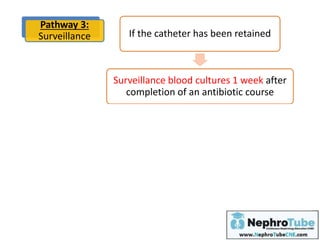
Pathway 3:
Surveillance If the catheter has been retained
Surveillance blood cultures 1 week after
completion of an antibiotic course
If blood cultures +ve →
the catheter should be removed
New, long term dialysis catheter after
additional –ve blood cultures
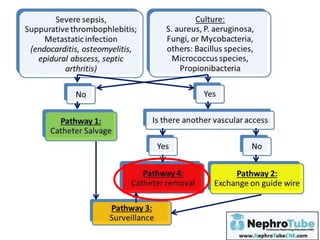
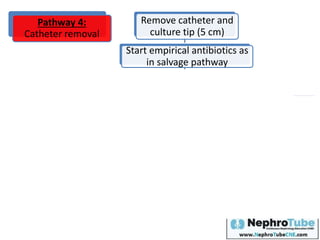
Pathway 4:
Catheter removal
Remove catheter and
culture tip (5 cm)
Start empirical antibiotics as
in salvage pathway
Is access is needed urgently for dialysis?
Yes
Insert
temporary
catheter in
another site
for short
period of time
No
Continue antibiotics
Insert long term catheter
ONLY if:
1- afebrile for 48-72 hours
2- CRP is normal
3- Blood cultures are -ve
Duration?
Pathway 4:
Catheter removal
Persistent fungemia or
bacteremia >72 h after catheter
removal
4 to 6 weeks of
antibiotic therapy
should be administered
Additional TEE should
be obtained
Catheter Removal Special Situation (1)
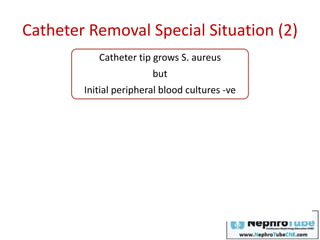
Catheter Removal Special Situation (2)
Catheter tip grows S. aureus
but
Initial peripheral blood cultures -ve
5–7-day course of antibiotics
Close monitoring for signs and symptoms of ongoing infection,
including additional blood cultures, as indicated
Talk Outline
• Diagnosis
• Management
• Prevention
Talk Outline
• Diagnosis
• Management
• Prevention
Prevention - Catheter
• Strict aseptic circumstances.
• Avoid as much as possible:
– using non-tunneled catheters.
– using femoral
• Monitor the catheter:
– visually when changing the dressing
– or by palpation through an intact dressing on a
regular basis.
Prevention – Exit Site
• Application of antibiotic ointment at the exit
site until the insertion site has healed
• The catheter exit site should be covered by a
dressing as long as the catheter remains in
place.
Prevention – Antimicrobial Lock
• Its use is debated.
• Its use may be saved to patients with:
– history of multiple CRBSI
– those with high risk of severe sequelae (patients
with pacemakers, prosthetic valve or IV devices).
• Citrate locks have, for the time being, most
extensively been studied. (The 4% solution seems
to offer at present the best benefit/risk ratio).
Prevention – Staphylococcus
• Eradication of Staphylococcus carriage (nasal
mupirocin cream).
• Consider IV antibiotics at insertion for patients
with Staphylococcal skin colonisation.
Always re-evaluate for alternative access
(AVF or AVG).
References
References
Thank You

Dr mohammed abdelgawad crbsi

  • 1.
    Catheter Related Blood StreamInfection (CRBSI) Diagnosis & Management Step-Wise Practical Approach in HD Patients Mohammed Abdel Gawad Nephrology Specialist Kidney & Urology Center (KUC) Alexandria – EGY drgawad@gmail.com 1st Annual Interventional Nephrology Meeting – ESNT Mansoura, 26-27/Oct/2017
  • 2.
    Talk Outline • Diagnosis •Management • Prevention
  • 3.
    Talk Outline • Diagnosis •Management • Prevention
  • 4.
    Paired Blood Cultures Peripheral vein Fromthe catheter Culture of the catheter tip (distal 5 cm) or
  • 5.
    Paired Blood Cultures or Whena peripheral blood sample cannot be obtained From the catheter From Dialysis circuit 2 quantitative blood cultures of samples obtained through 2 catheter lumens
  • 6.
    Culture Results Results Diagnosis Sameorganism from both samples CRBSI Confirmed Both negative CRBSI Unlikely Negative peripheral blood culture BUT Positive central blood culture Probably contamination (don’t treat EXCEPT if Staph. Aureus)
  • 7.
    Talk Outline • Diagnosis •Management • Prevention
  • 8.
    Talk Outline • Diagnosis •Management • Prevention
  • 11.
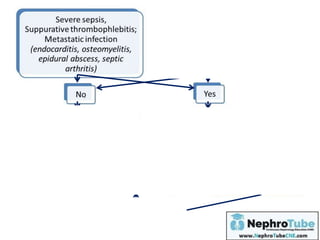
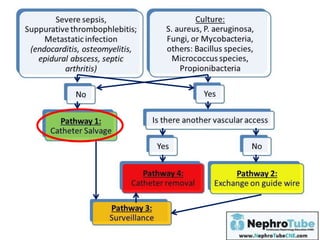
    Start Empirical Antibiotics +Antibiotic Lock Therapy Reassess after 2-3 days: Clinically (fever) & Lab (WBC, CRP) Improving? Yes Continue antibotics, then: Pathway 3: Surveillance No Pathway 4: Catheter removal Pathway 1: Catheter Salvage
  • 12.
    Empirical Antibiotics Antibiotic Tocover Condition Vancomycin MRSA for institutions in with preponderance of MRSA Gentamycin (if absolutely contraindicated use Quinolones) Gram –ve --------------------- Meropenem, Imipenem or Etrapenem or Piperacillin/Tazobactam in community with low incidence of antibiotic resistance MDR Gram –ve In neutropenic patients, severely ill patients with sepsis, or patients known to be colonized with such pathogens Fluconazole or Echinocandin Candidemia total parenteral nutrition, prolonged use of broad-spectrum antibiotics, hematologic malignancy, receipt of bone marrow or solid- organ transplant, femoral catheterization, or colonization due to Candida species at multiple sites
  • 13.
    Alternatives to vancomycinas a first choice broad spectrum Condition Alternative the preponderance of MRSA isolates have vancomycin minimum inhibitory concentration (MIC) values 12 mg/mL Daptomycin
  • 14.
  • 15.
  • 16.
    Dialyziability & ResidualRenal Function Effect • Vancomycin is not removed by HD; gentamicin is. • Measure gent levels daily (levels will decrease sooner in patients with significant residual function). • Monitor predialysis trough levels if possible 2017
  • 17.
  • 18.
  • 19.
  • 20.
  • 21.
  • 22.
    Start Empirical Antibiotics +Antibiotic Lock Therapy Reassess after 2-3 days: Clinically (fever) & Lab (WBC, CRP) Improving? Yes Continue antibiotics, then: Pathway 3: Surveillance No Pathway 4: Catheter removal Pathway 1: Catheter Salvage
  • 25.
    Start Empirical Antibiotics +Antibiotic Lock Therapy Reassess after 2-3 days: Clinically (fever) & Lab (WBC, CRP) Improving? Yes Continue antibiotics, then: Pathway 3: Surveillance No Pathway 4: Catheter removal Pathway 1: Catheter Salvage Duration of Systemic and Antibiotic Lock
  • 26.
    Duration of Systemicand Antibiotic Lock Pathway 1: Catheter Salvage If catheter is retained for a patient with S. aureus CRBSI Continue systemic and antibiotic lock therapy for 4 weeks
  • 27.
    Duration of Systemicand Antibiotic Lock Pathway 1: Catheter Salvage If catheter is retained for a patient with any other organism No clear data for systemic and antibiotic lock therapy salvage duration
  • 28.
    Antibiotic Lock SpecialSituation Multiple positive catheter blood culture BUT concurrent negative peripheral blood cultures Antibiotic lock therapy without systemic therapy for 10–14 days
  • 30.
    guide wire Start EmpiricalAntibiotics as in salvage pathway Reassess after 2-3 days: Clinically (fever) & Lab (WBC, CRP) Improving? Yes Exchange on guide wire Continue antibiotics Pathway 3: Surveillance No Pathway 4: Catheter removal Pathway 2: Exchange on guide wire Duration of Systemic and Antibiotic Lock
  • 31.
    Duration of Systemicand Antibiotic Lock If catheter is exchanged for a patient with any organism No clear data for systemic and antibiotic lock therapy salvage duration Pathway 2: Exchange on guide wire
  • 33.
    Pathway 3: Surveillance bloodstream infectionthat continues despite >72 h of antimicrobial therapy to which the infecting microbes are susceptible 2 sets of blood cultures obtained on a given day
  • 34.
    Pathway 3: Surveillance Ifthe catheter has been retained Surveillance blood cultures 1 week after completion of an antibiotic course If blood cultures +ve → the catheter should be removed New, long term dialysis catheter after additional –ve blood cultures
  • 36.
    Pathway 4: Catheter removal Removecatheter and culture tip (5 cm) Start empirical antibiotics as in salvage pathway Is access is needed urgently for dialysis? Yes Insert temporary catheter in another site for short period of time No Continue antibiotics Insert long term catheter ONLY if: 1- afebrile for 48-72 hours 2- CRP is normal 3- Blood cultures are -ve Duration?
  • 37.
  • 38.
    Persistent fungemia or bacteremia>72 h after catheter removal 4 to 6 weeks of antibiotic therapy should be administered Additional TEE should be obtained Catheter Removal Special Situation (1)
  • 39.
    Catheter Removal SpecialSituation (2) Catheter tip grows S. aureus but Initial peripheral blood cultures -ve 5–7-day course of antibiotics Close monitoring for signs and symptoms of ongoing infection, including additional blood cultures, as indicated
  • 40.
    Talk Outline • Diagnosis •Management • Prevention
  • 41.
    Talk Outline • Diagnosis •Management • Prevention
  • 42.
    Prevention - Catheter •Strict aseptic circumstances. • Avoid as much as possible: – using non-tunneled catheters. – using femoral • Monitor the catheter: – visually when changing the dressing – or by palpation through an intact dressing on a regular basis.
  • 43.
    Prevention – ExitSite • Application of antibiotic ointment at the exit site until the insertion site has healed • The catheter exit site should be covered by a dressing as long as the catheter remains in place.
  • 44.
    Prevention – AntimicrobialLock • Its use is debated. • Its use may be saved to patients with: – history of multiple CRBSI – those with high risk of severe sequelae (patients with pacemakers, prosthetic valve or IV devices). • Citrate locks have, for the time being, most extensively been studied. (The 4% solution seems to offer at present the best benefit/risk ratio).
  • 45.
    Prevention – Staphylococcus •Eradication of Staphylococcus carriage (nasal mupirocin cream). • Consider IV antibiotics at insertion for patients with Staphylococcal skin colonisation.
  • 46.
    Always re-evaluate foralternative access (AVF or AVG).
  • 47.
  • 48.
  • 49.