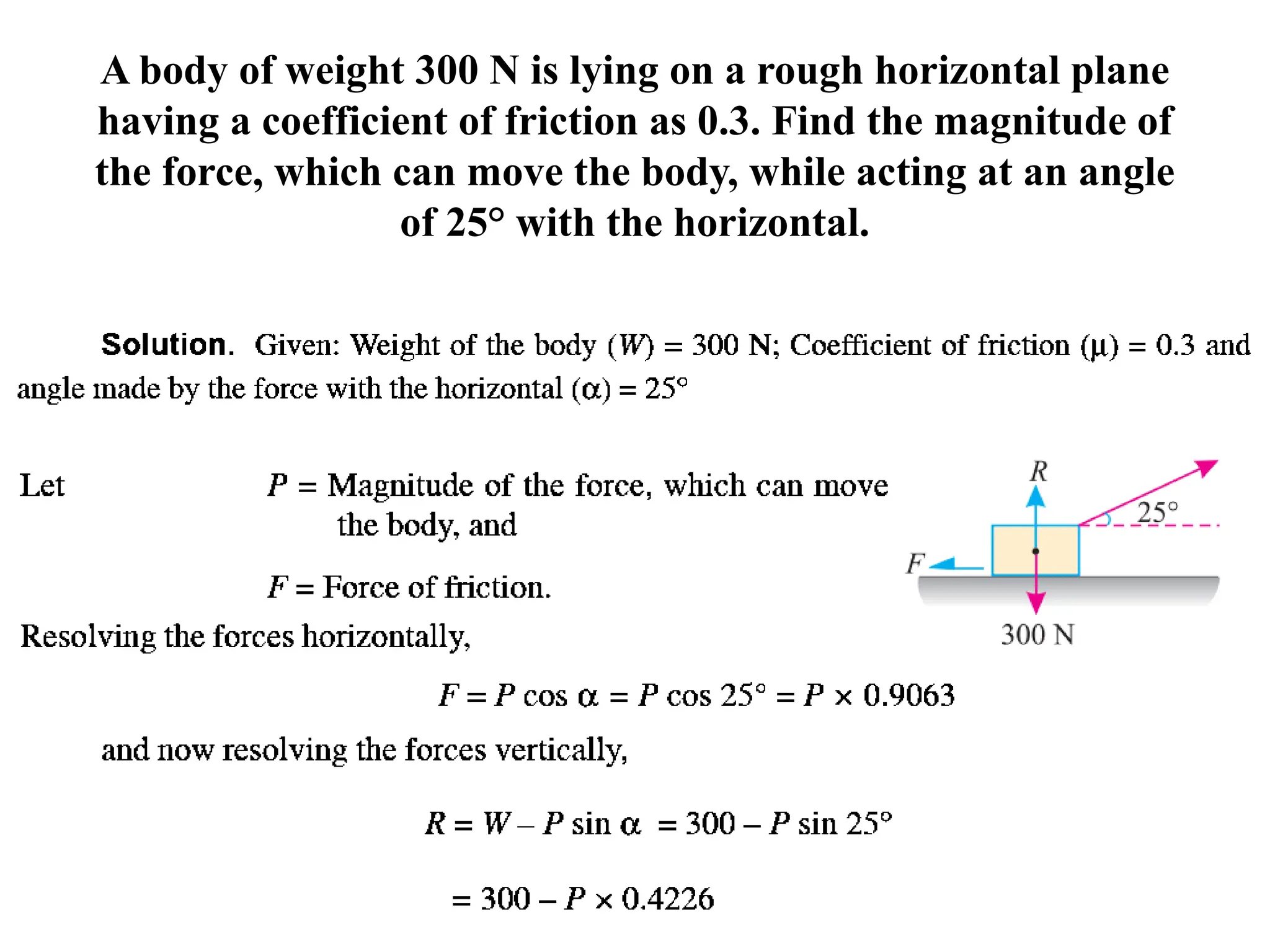
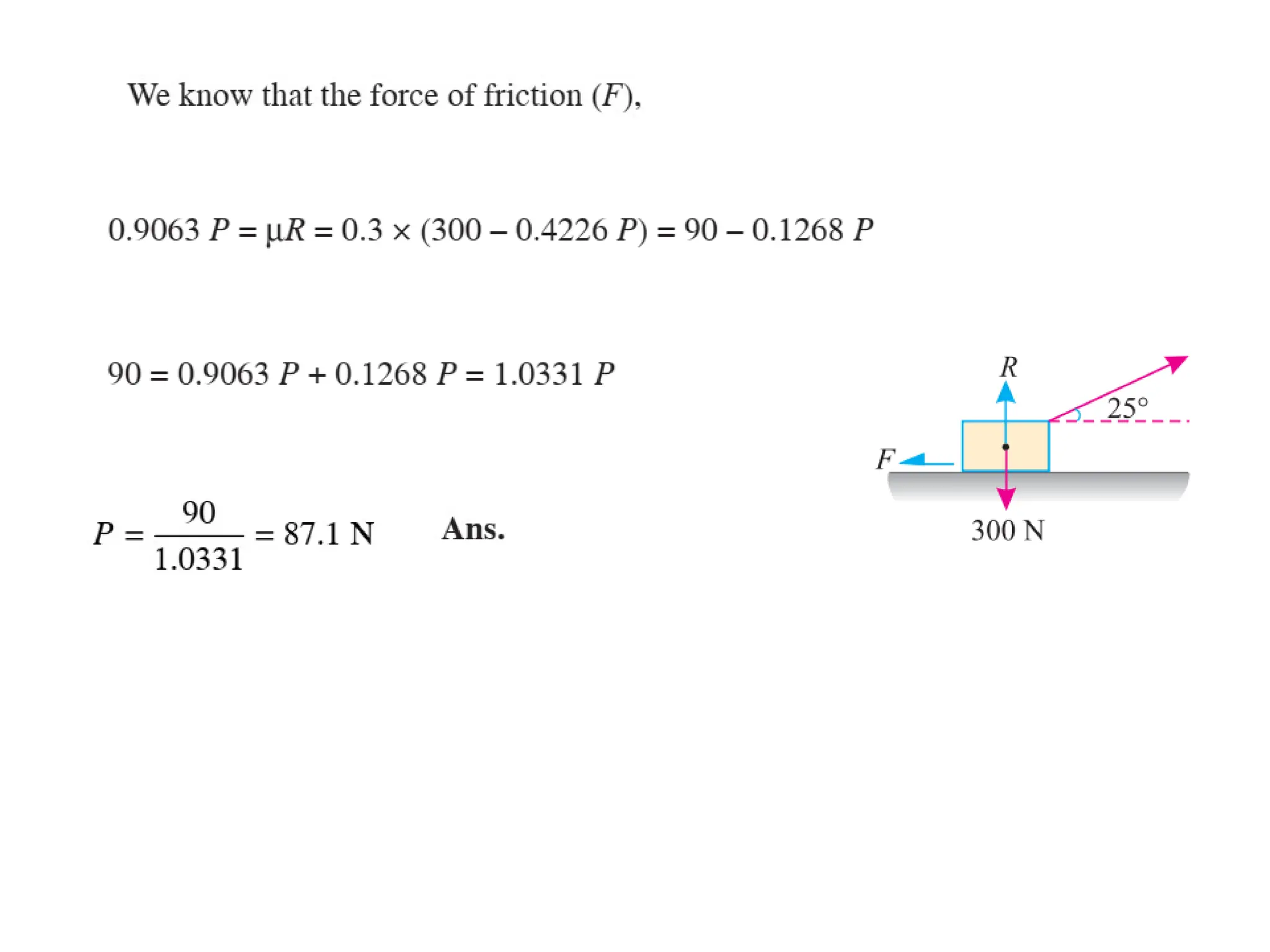
A body ofweight 300 N is lying on a rough horizontal plane
having a coefficient of friction as 0.3. Find the magnitude of
the force, which can move the body, while acting at an angle
of 25° with the horizontal.
14.
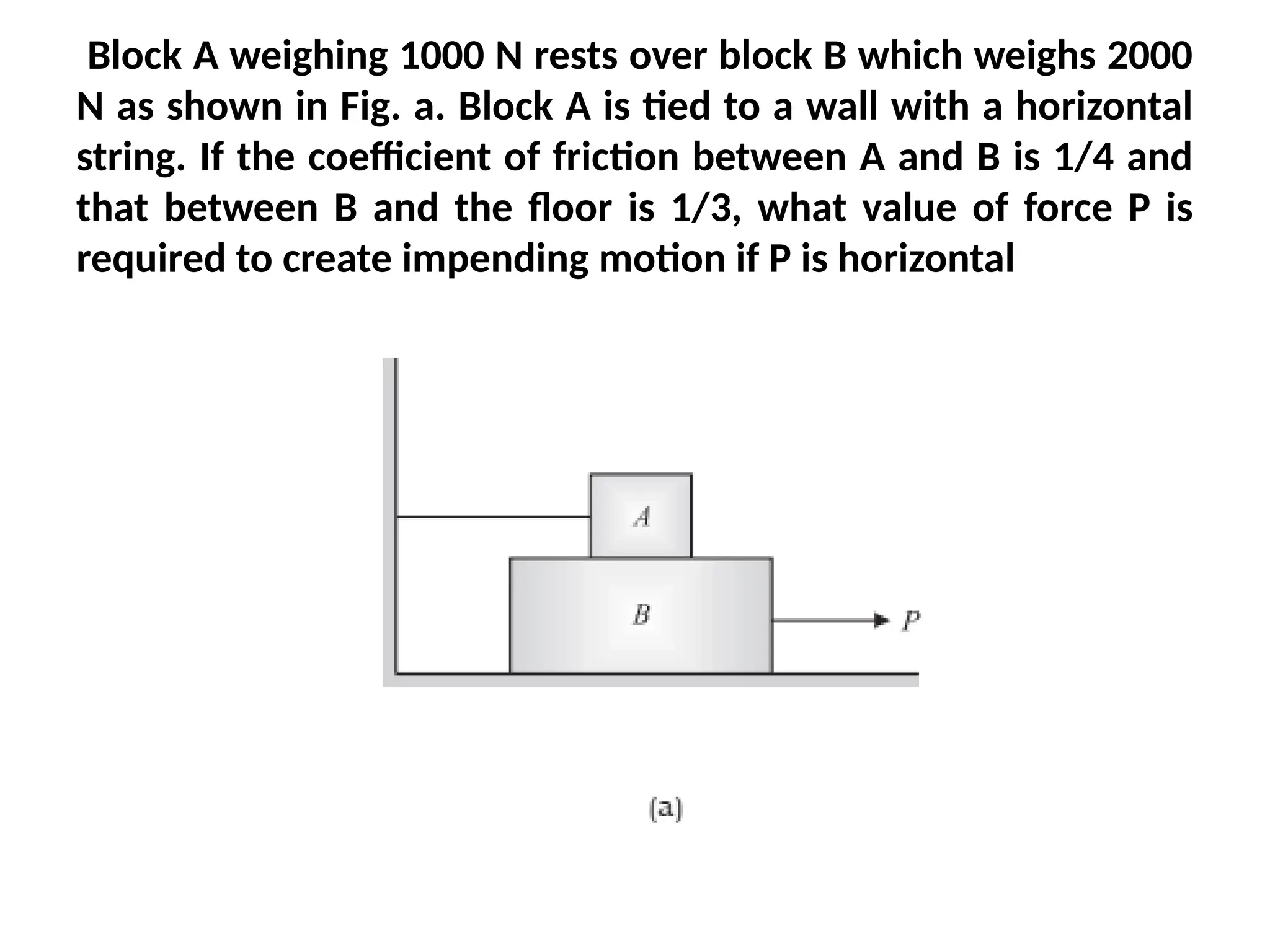
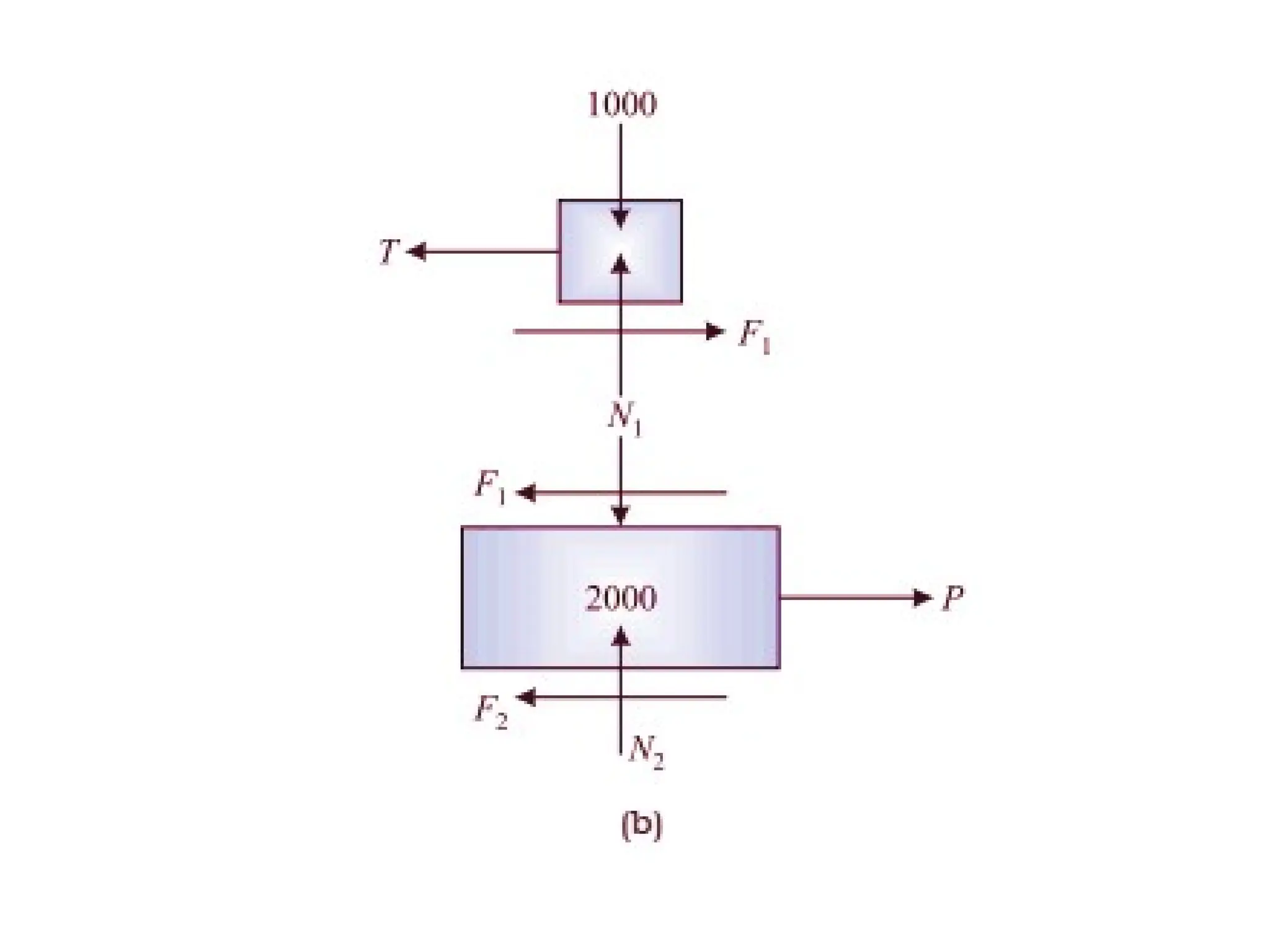
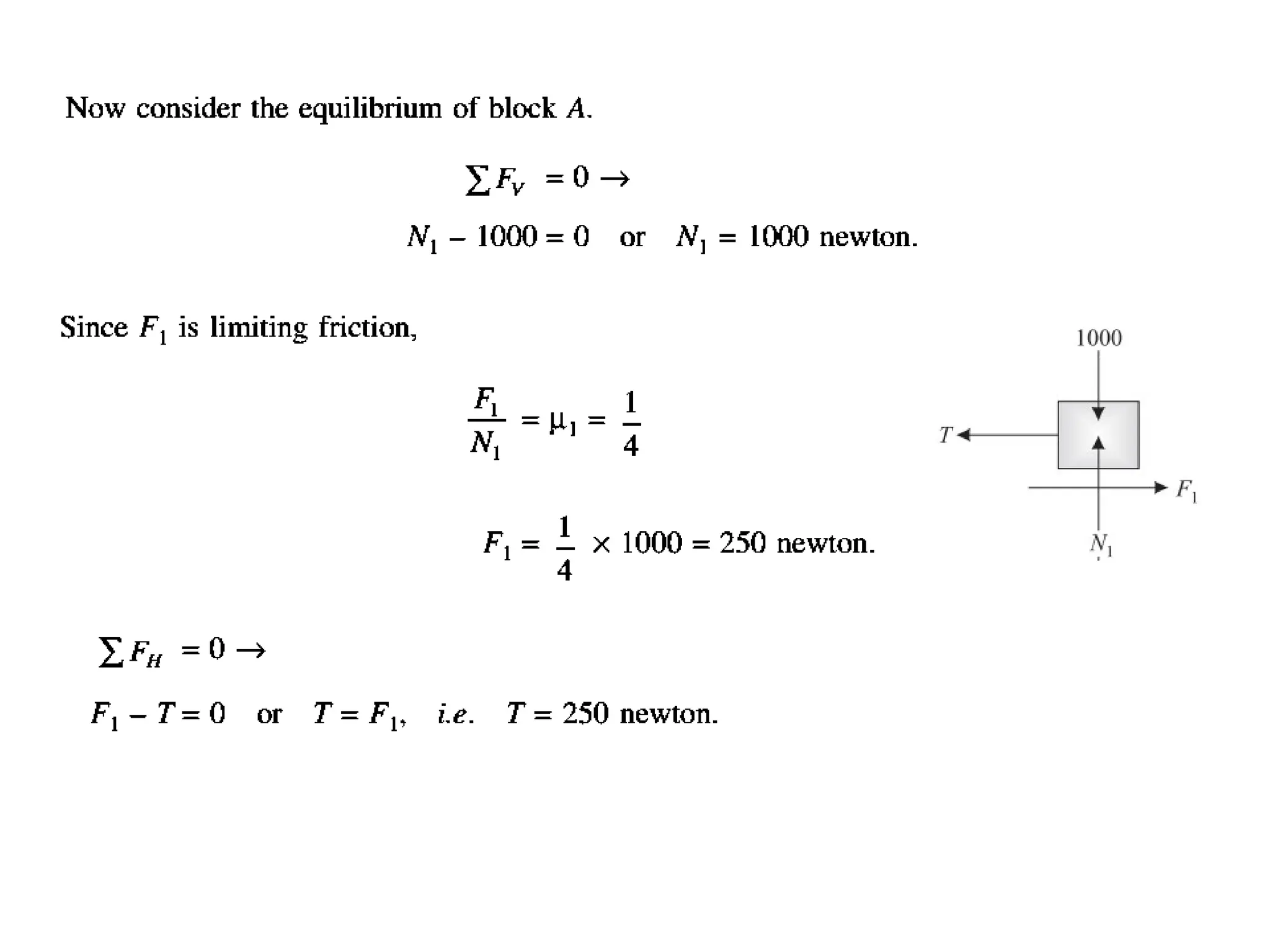
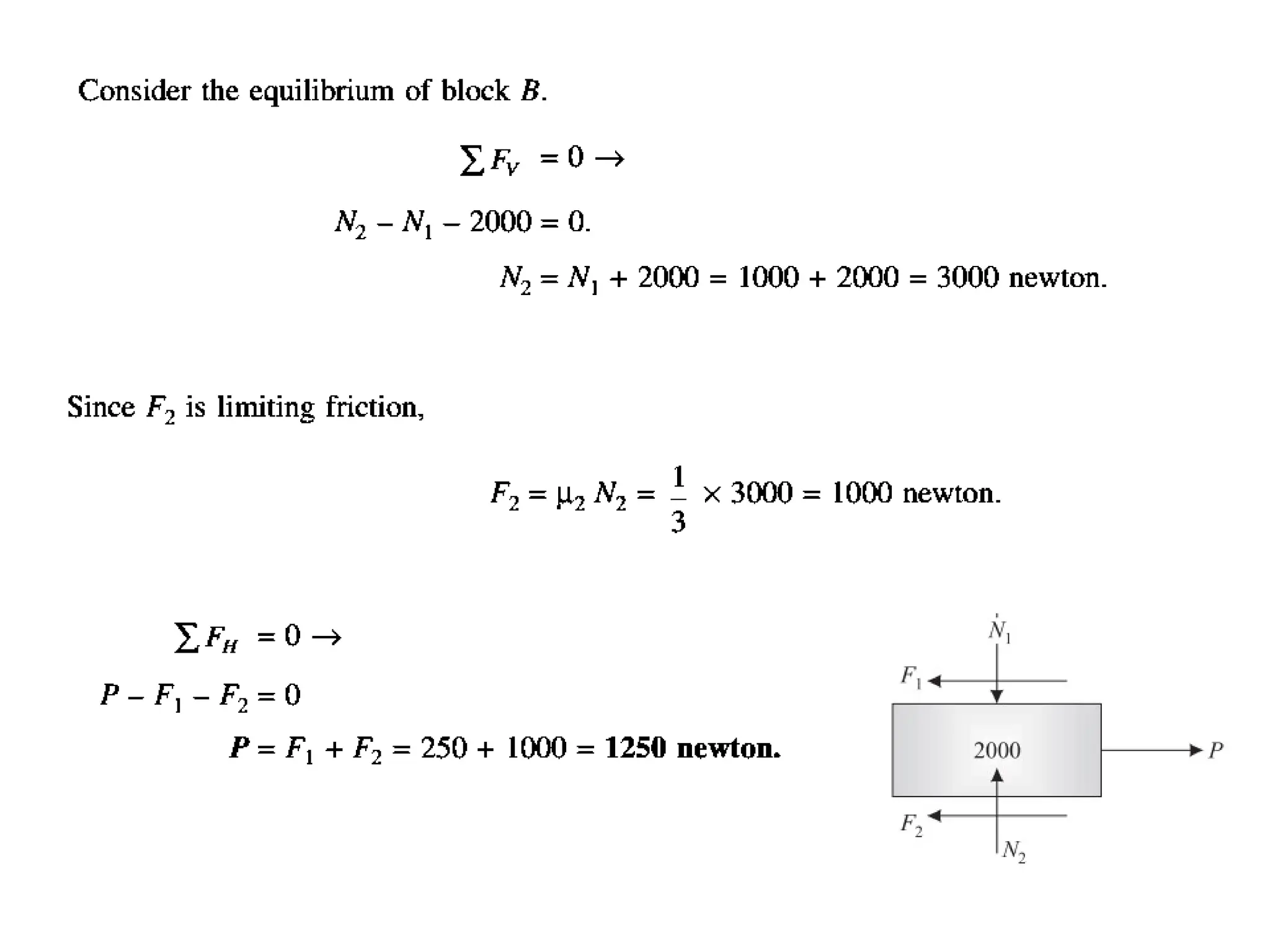
Block A weighing1000 N rests over block B which weighs 2000
N as shown in Fig. a. Block A is tied to a wall with a horizontal
string. If the coefficient of friction between A and B is 1/4 and
that between B and the floor is 1/3, what value of force P is
required to create impending motion if P is horizontal
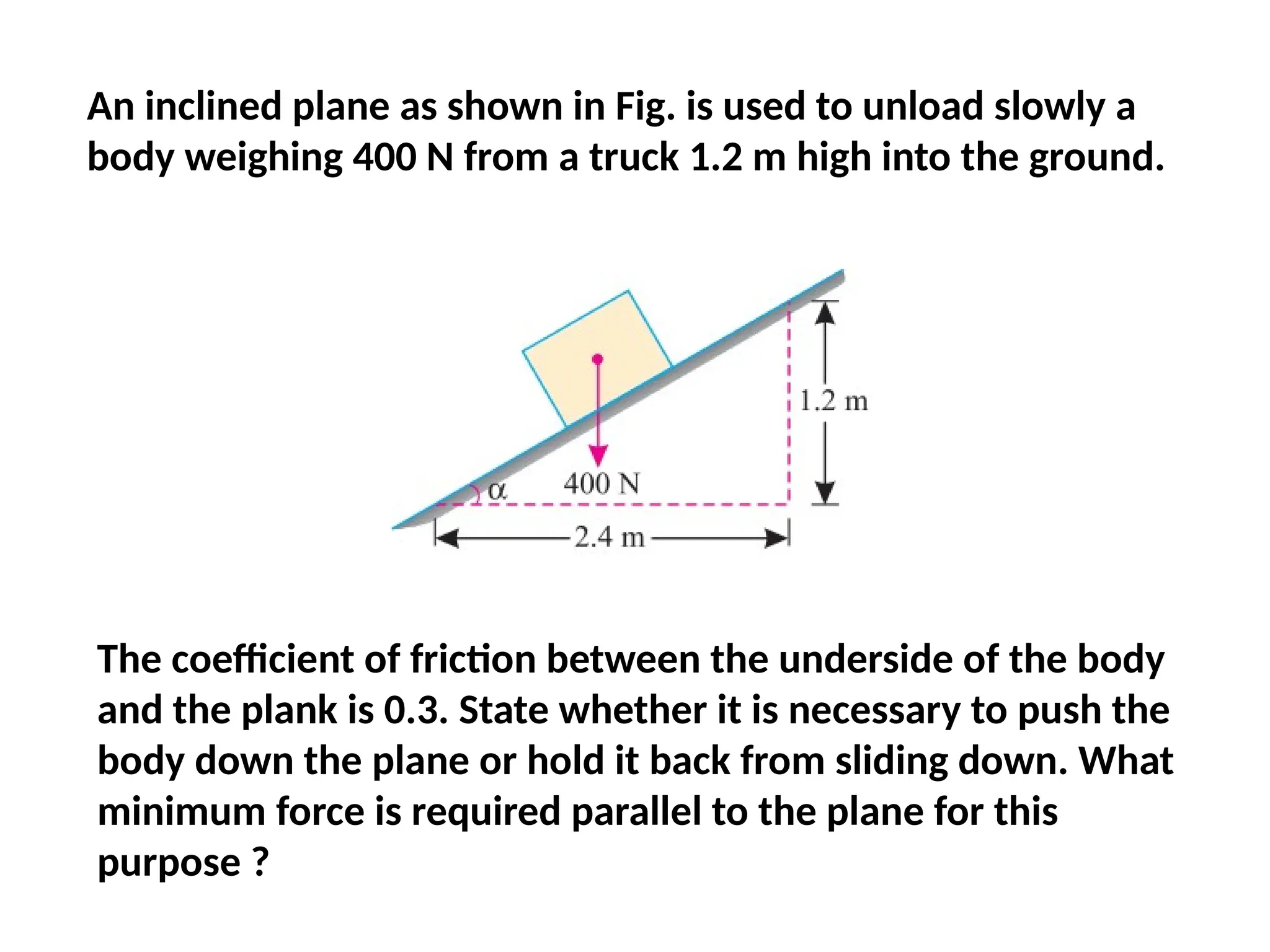
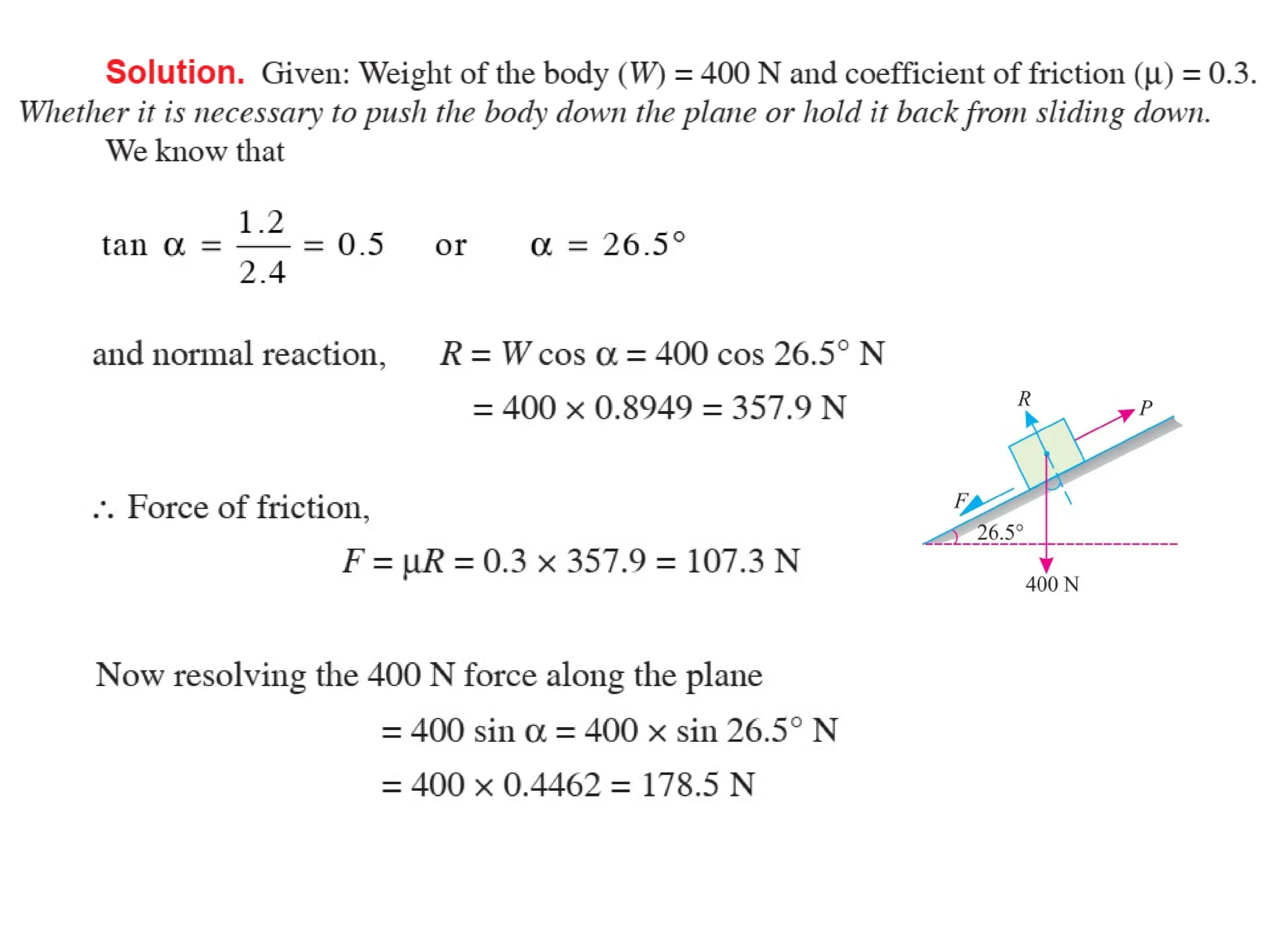
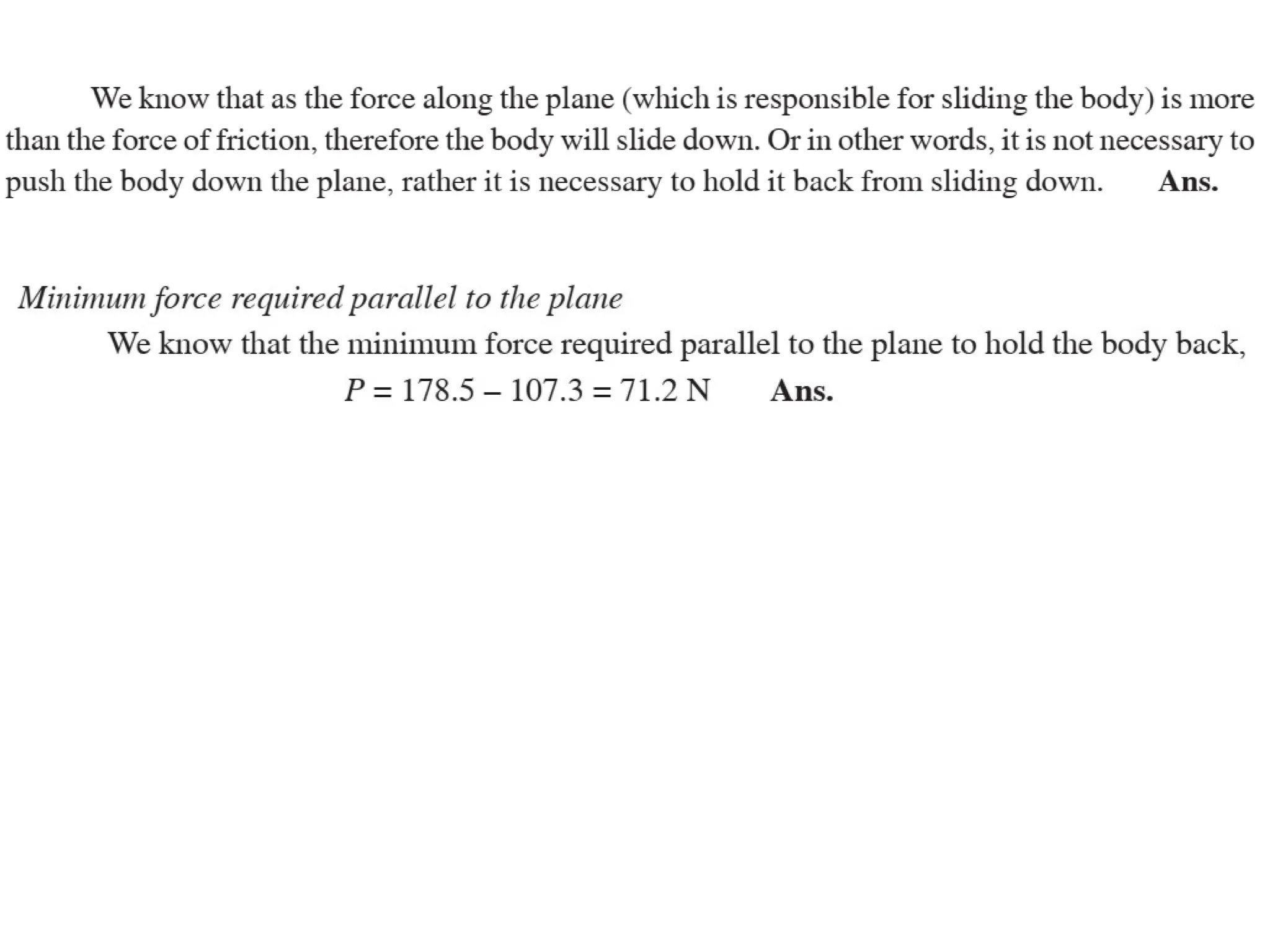
An inclined planeas shown in Fig. is used to unload slowly a
body weighing 400 N from a truck 1.2 m high into the ground.
The coefficient of friction between the underside of the body
and the plank is 0.3. State whether it is necessary to push the
body down the plane or hold it back from sliding down. What
minimum force is required parallel to the plane for this
purpose ?
Wedge Friction
• Awedge is a simple device made up of wood
or metal pieces, commonly used for raising or
lowering heavy loads. It is usually of a
triangular or trapezoidal in cross section. The
problems on wedges are basically the problems
of equilibrium on inclined planes.
• Therefore, the problems on wedges may be
solved either by the equilibrium method or by
applying Lami’s theorem.
25.
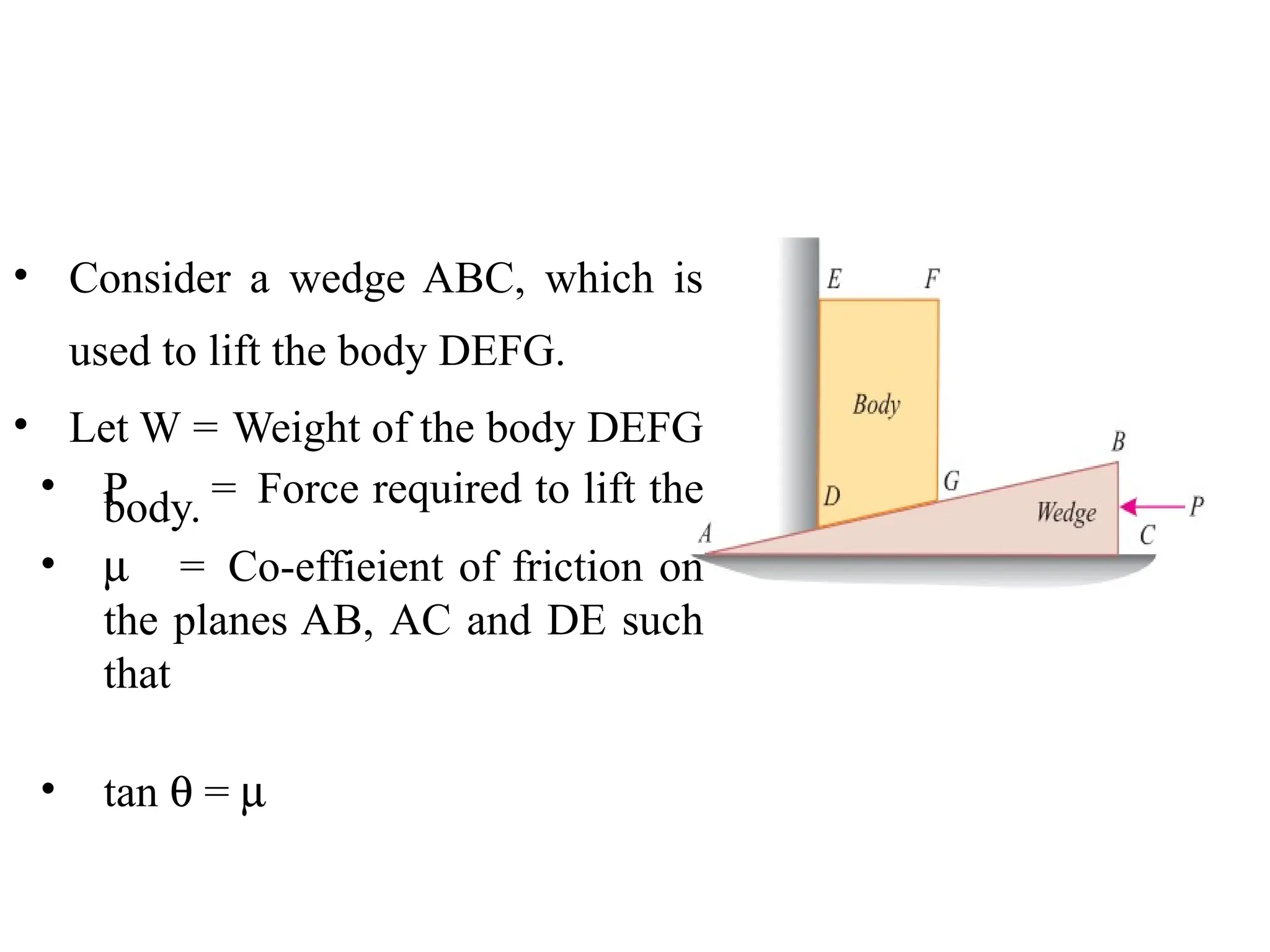
• Consider awedge ABC, which is
used to lift the body DEFG.
• Let W = Weight of the body DEFG
• P = Force required to lift the
body.
• m = Co-effieient of friction on
the planes AB, AC and DE such
that
• tan q = m
26.
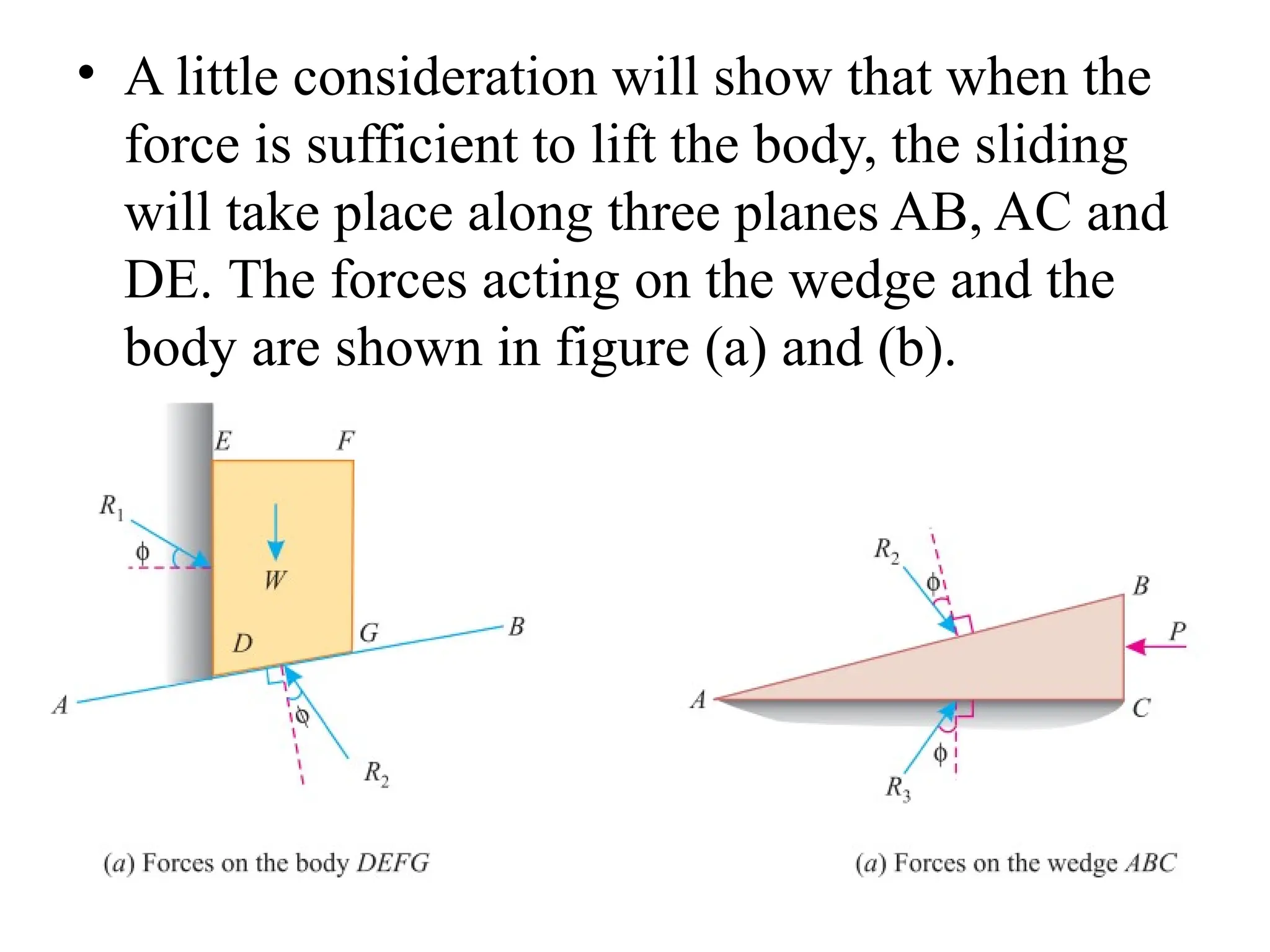
• A littleconsideration will show that when the
force is sufficient to lift the body, the sliding
will take place along three planes AB, AC and
DE. The forces acting on the wedge and the
body are shown in figure (a) and (b).
27.
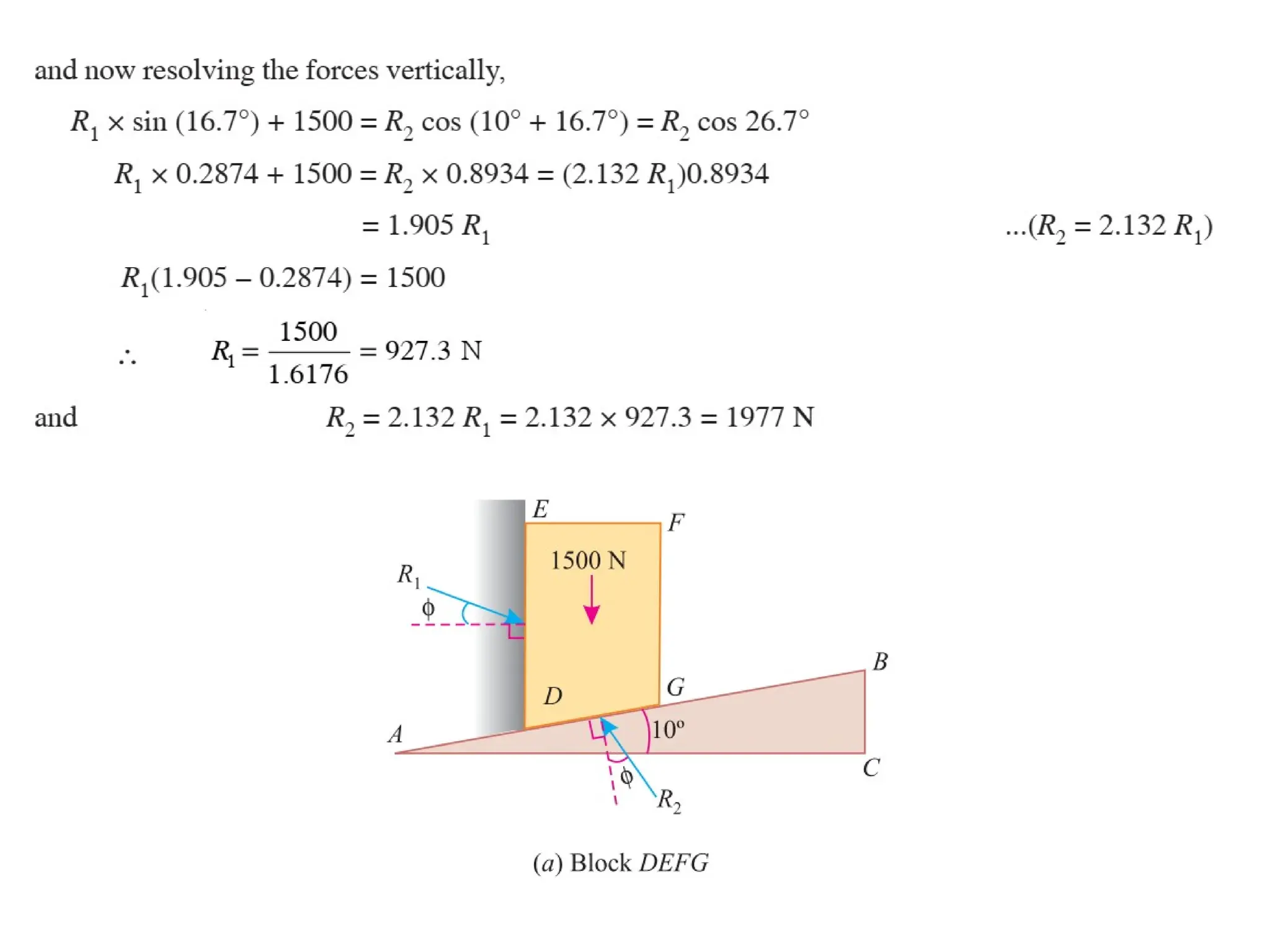
A block weighing1500 N, overlying a 10° wedge on a horizontal floor and
leaning against a vertical wall, is to be raised by applying a horizontal force to the
wedge.
Assuming the coefficient of friction between all the surface in contact to be 0.3,
determine the minimum horizontal force required to raise the block.
Weight of the block (W) = 1500 N;
Angle of the wedge (α) = 10° and
coefficient of friction between all the four surfaces of contact
(μ) = 0.3 = tan φ or φ = 16.7°.
28.
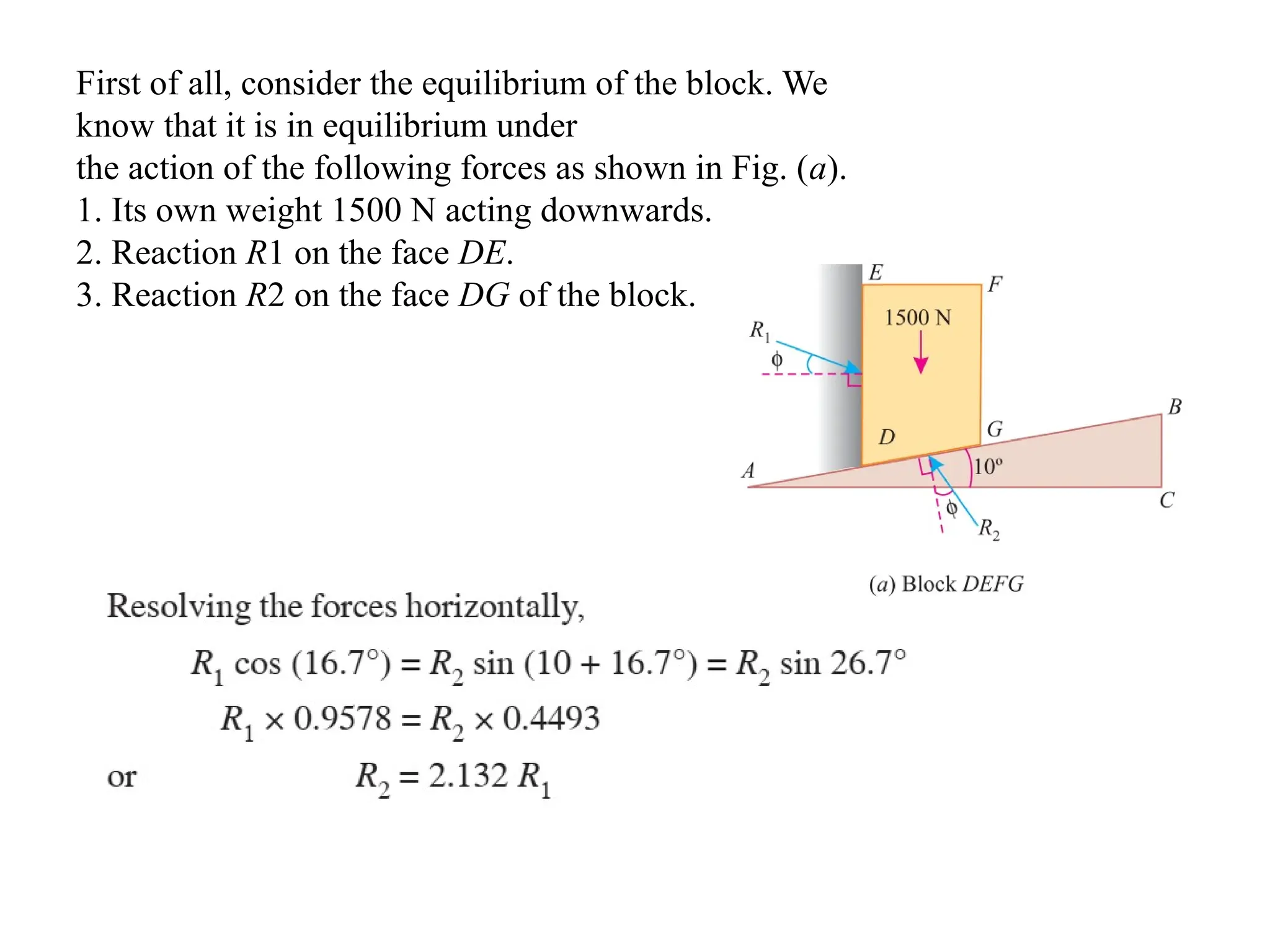
First of all,consider the equilibrium of the block. We
know that it is in equilibrium under
the action of the following forces as shown in Fig. (a).
1. Its own weight 1500 N acting downwards.
2. Reaction R1 on the face DE.
3. Reaction R2 on the face DG of the block.
30.
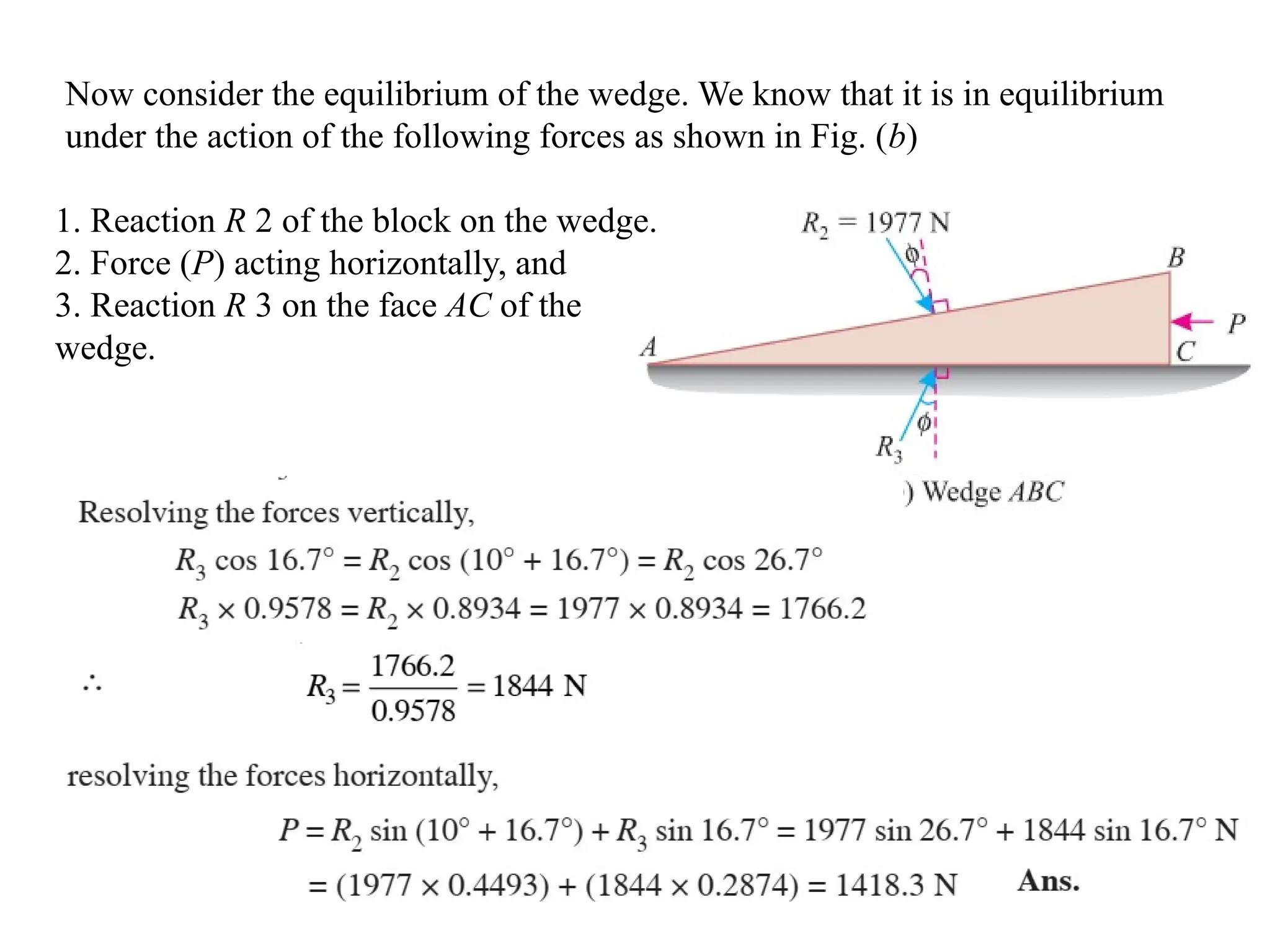
Now consider theequilibrium of the wedge. We know that it is in equilibrium
under the action of the following forces as shown in Fig. (b)
1. Reaction R 2 of the block on the wedge.
2. Force (P) acting horizontally, and
3. Reaction R 3 on the face AC of the
wedge.