EXPERIMENTAL WIDEBAND CHARACTERIZATION OF A PARALLEL-PLATE CAPACITOR: VNA VS TDR COMPARISON Piero Belforte Feb 1 2021
1
A parallel-plate capacitor implemented by a rectangular double-sided printed circuit board (p.c.b.) is
characterized by means a stimulus signal injected at a corner. Both frequency-domain (VNA) and
time-domain (TDR) techniques are utilized to determine the step response of the reflected wave
(S11) to be compared to the theoretical behavior of the equivalent parallel plate capacitance. A
commercial application is utilized to convert the frequency domain tabulated data of the frequency
response into the corresponding TDR response. A simple, very accurate and fast 2D TLM
(Transmission Line Model) model can be easily extracted from these single time-domain
experimental responses. This kind of models can be utilized to simulate very efficiently the Power
Distribution Networks of p.c.b.s [2] using the Digital Wave Simulator (DWS) [3]
Figure 1
Calculation of theoretical capacitance taking into account the dimensions of the p.c.b.
under test. Two values of FR4 relative dielectric constant Er are taken into acccount:4.7
and 4.9. From the http://www.calctool.org/CALC/eng/electronics/parallel_plate website.
EXPERIMENTAL WIDEBAND CHARACTERIZATION OF A PARALLEL-PLATE CAPACITOR: VNA VS TDR COMPARISON Piero Belforte Feb 1 2021
2
Figure 2
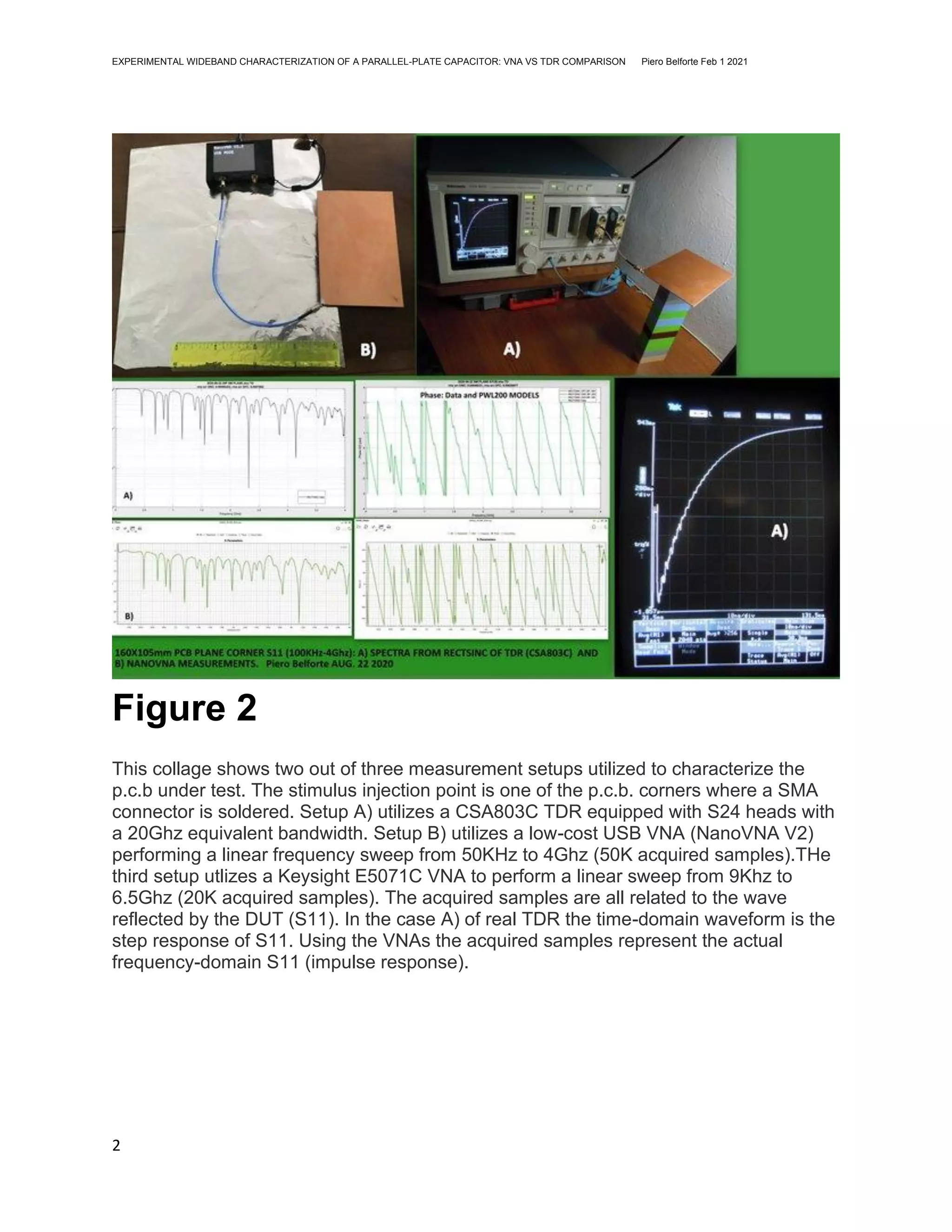
This collage shows two out of three measurement setups utilized to characterize the
p.c.b under test. The stimulus injection point is one of the p.c.b. corners where a SMA
connector is soldered. Setup A) utilizes a CSA803C TDR equipped with S24 heads with
a 20Ghz equivalent bandwidth. Setup B) utilizes a low-cost USB VNA (NanoVNA V2)
performing a linear frequency sweep from 50KHz to 4Ghz (50K acquired samples).THe
third setup utlizes a Keysight E5071C VNA to perform a linear sweep from 9Khz to
6.5Ghz (20K acquired samples). The acquired samples are all related to the wave
reflected by the DUT (S11). In the case A) of real TDR the time-domain waveform is the
step response of S11. Using the VNAs the acquired samples represent the actual
frequency-domain S11 (impulse response).
EXPERIMENTAL WIDEBAND CHARACTERIZATION OF A PARALLEL-PLATE CAPACITOR: VNA VS TDR COMPARISON Piero Belforte Feb 1 2021
3
Figure 3
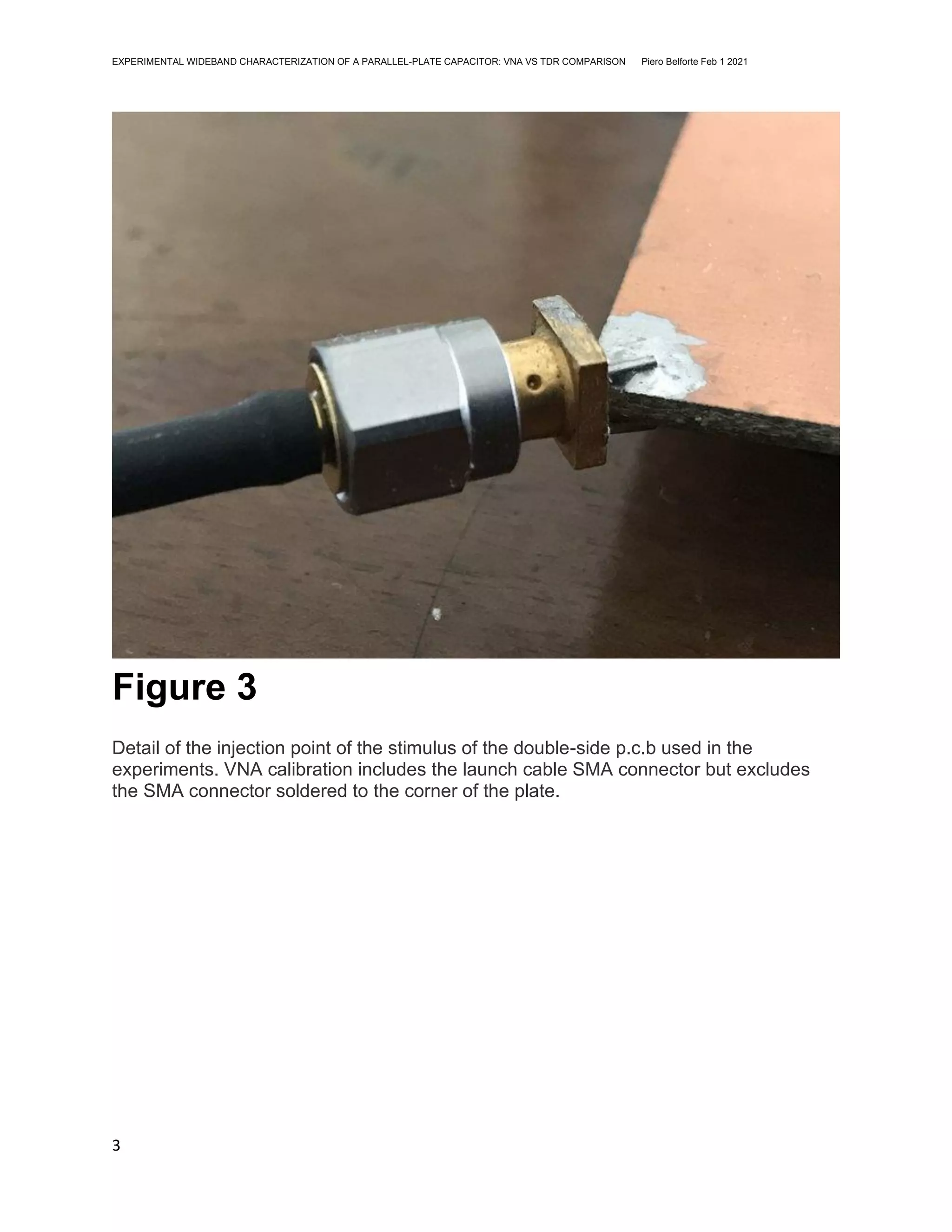
Detail of the injection point of the stimulus of the double-side p.c.b used in the
experiments. VNA calibration includes the launch cable SMA connector but excludes
the SMA connector soldered to the corner of the plate.
EXPERIMENTAL WIDEBAND CHARACTERIZATION OF A PARALLEL-PLATE CAPACITOR: VNA VS TDR COMPARISON Piero Belforte Feb 1 2021
4
Figure 4
Comparison between the S11 step responses obtained from the measurements and the
theoretical ideal capacitors simulated by DWS. The tabulated frequency responses of
the VNAs (touchstone files .s1p) are converted into the step responses by means of the
MAUI application available from Teledyne Lecroy [4]. In this case the equivalent step
risetime is set to 200ps to minimize the ringing of the transformed waveform. MAUI
calculates the voltage at the injection port V1 instead of the reflected waveform. Some
additional calculation is needed: in particular a unity value is subtracted from V1
samples. Moreover the initial samples with negative time values are deleted. The overall
behaviors look very similar. The measured responses are characterized by reflections
occurring at the edges of the p.cb. . The static capacitance calculated using the
theoretical formula matches the experimental measurements, obvioulsly excluding the
reflections. The fringe capacitance effect is negligible on the static value.
EXPERIMENTAL WIDEBAND CHARACTERIZATION OF A PARALLEL-PLATE CAPACITOR: VNA VS TDR COMPARISON Piero Belforte Feb 1 2021
5
Figure 5
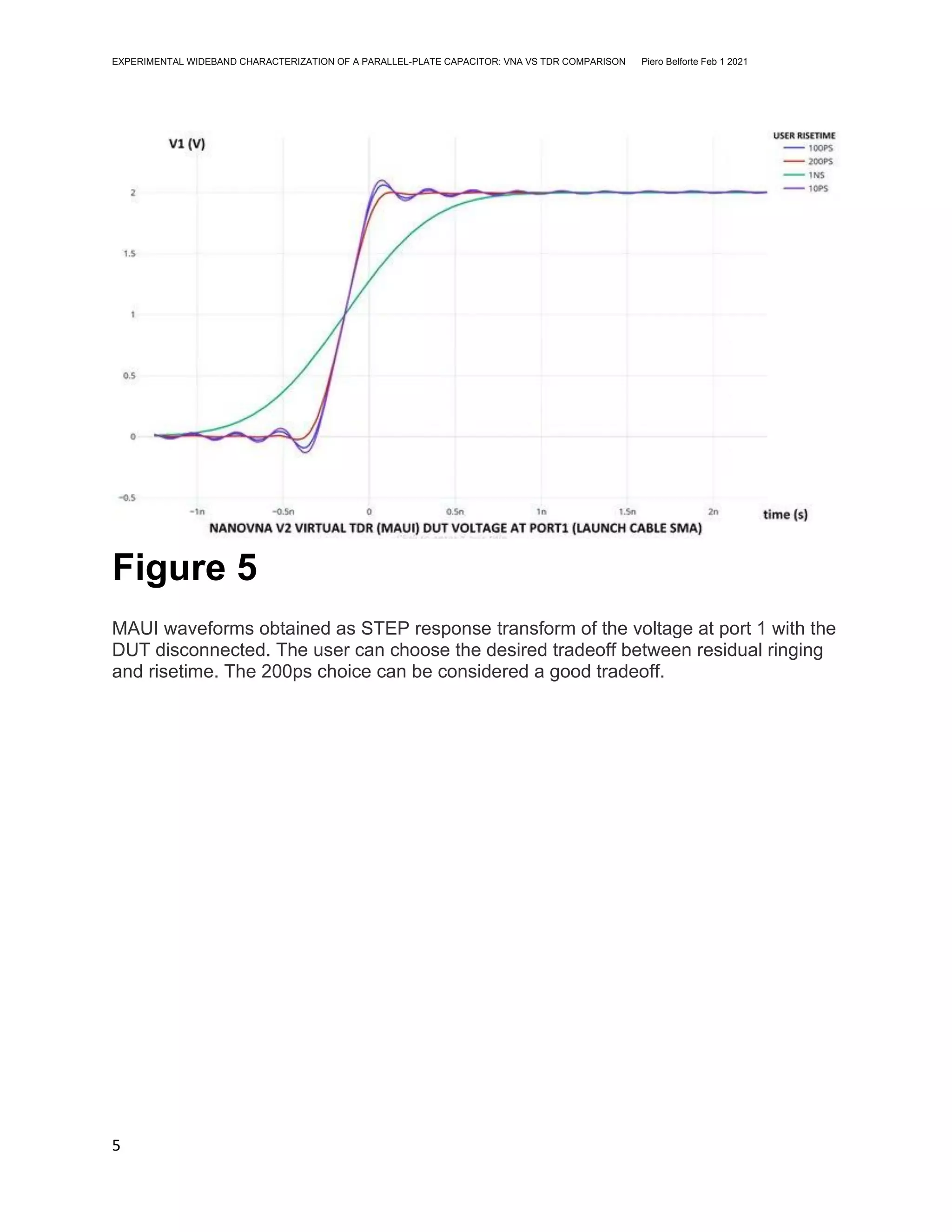
MAUI waveforms obtained as STEP response transform of the voltage at port 1 with the
DUT disconnected. The user can choose the desired tradeoff between residual ringing
and risetime. The 200ps choice can be considered a good tradeoff.
EXPERIMENTAL WIDEBAND CHARACTERIZATION OF A PARALLEL-PLATE CAPACITOR: VNA VS TDR COMPARISON Piero Belforte Feb 1 2021
6
Figure 6
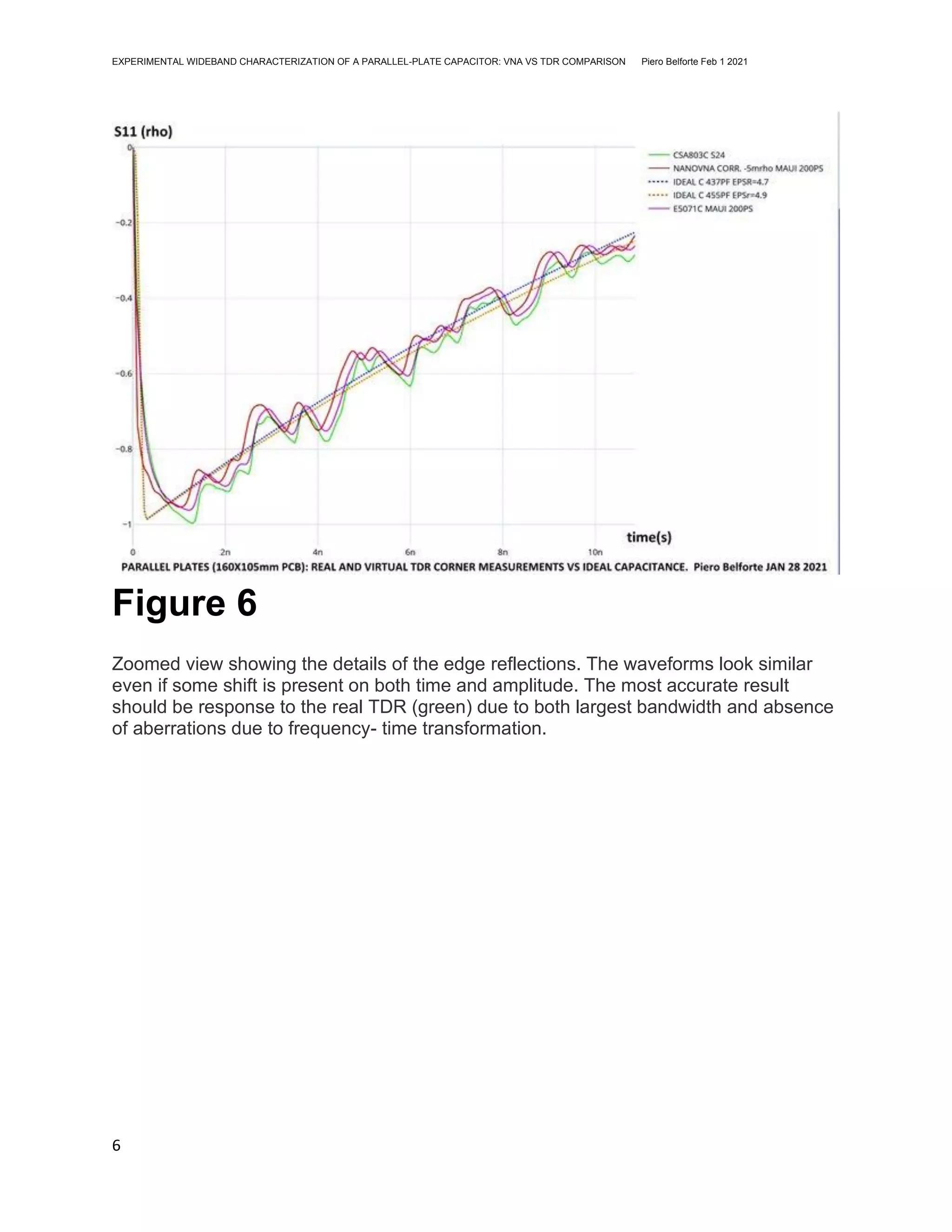
Zoomed view showing the details of the edge reflections. The waveforms look similar
even if some shift is present on both time and amplitude. The most accurate result
should be response to the real TDR (green) due to both largest bandwidth and absence
of aberrations due to frequency- time transformation.
EXPERIMENTAL WIDEBAND CHARACTERIZATION OF A PARALLEL-PLATE CAPACITOR: VNA VS TDR COMPARISON Piero Belforte Feb 1 2021
7
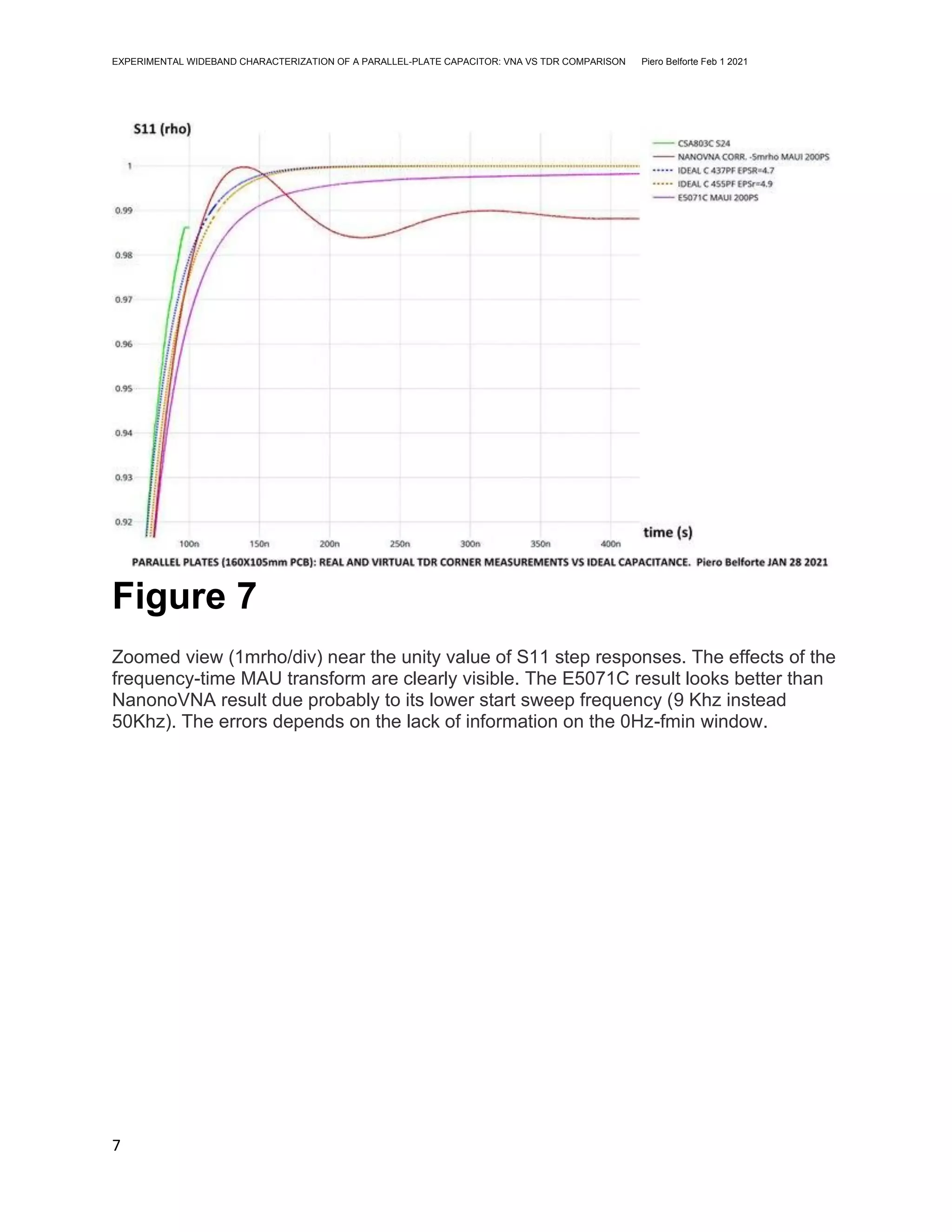
Figure 7
Zoomed view (1mrho/div) near the unity value of S11 step responses. The effects of the
frequency-time MAU transform are clearly visible. The E5071C result looks better than
NanonoVNA result due probably to its lower start sweep frequency (9 Khz instead
50Khz). The errors depends on the lack of information on the 0Hz-fmin window.
EXPERIMENTAL WIDEBAND CHARACTERIZATION OF A PARALLEL-PLATE CAPACITOR: VNA VS TDR COMPARISON Piero Belforte Feb 1 2021
8
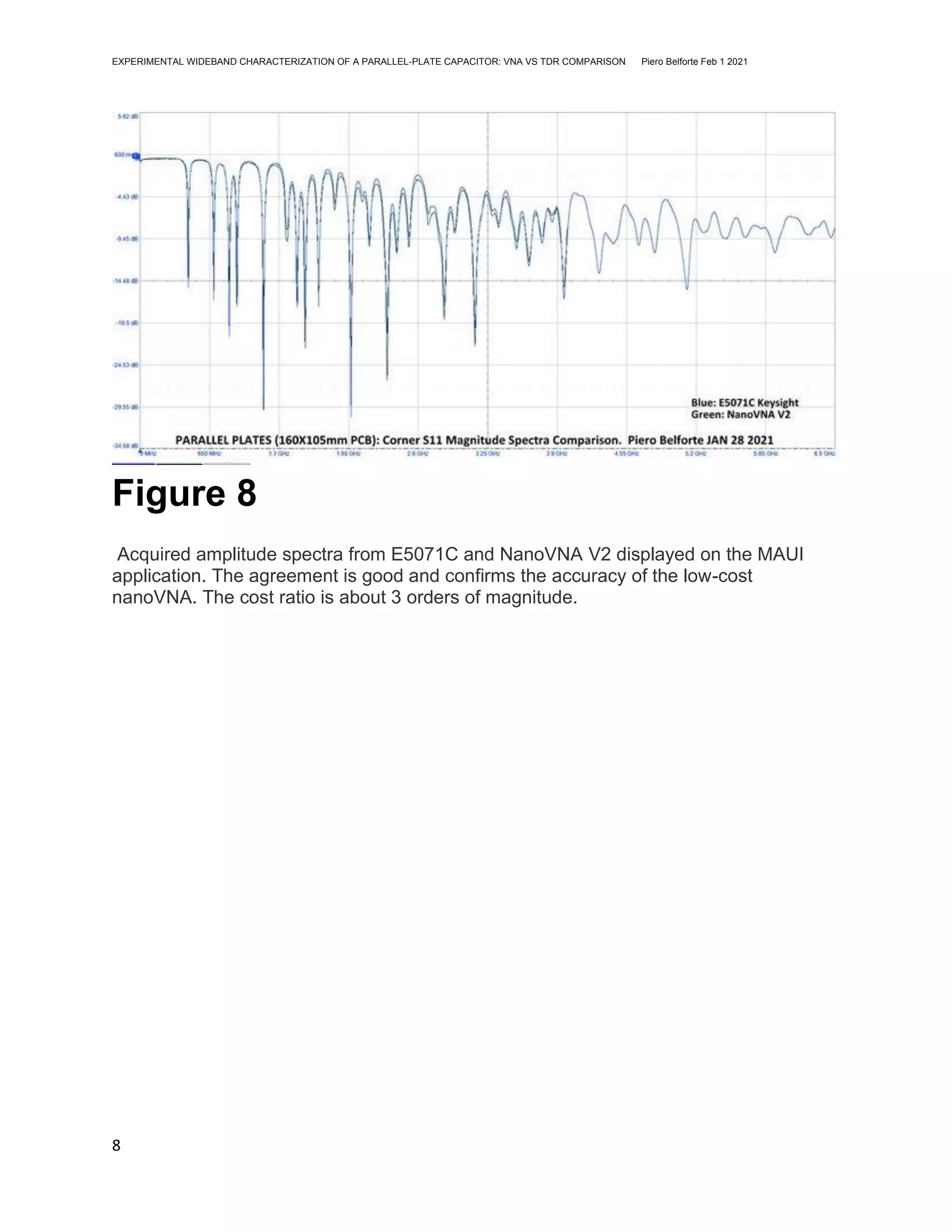
Figure 8
Acquired amplitude spectra from E5071C and NanoVNA V2 displayed on the MAUI
application. The agreement is good and confirms the accuracy of the low-cost
nanoVNA. The cost ratio is about 3 orders of magnitude.
EXPERIMENTAL WIDEBAND CHARACTERIZATION OF A PARALLEL-PLATE CAPACITOR: VNA VS TDR COMPARISON Piero Belforte Feb 1 2021
9
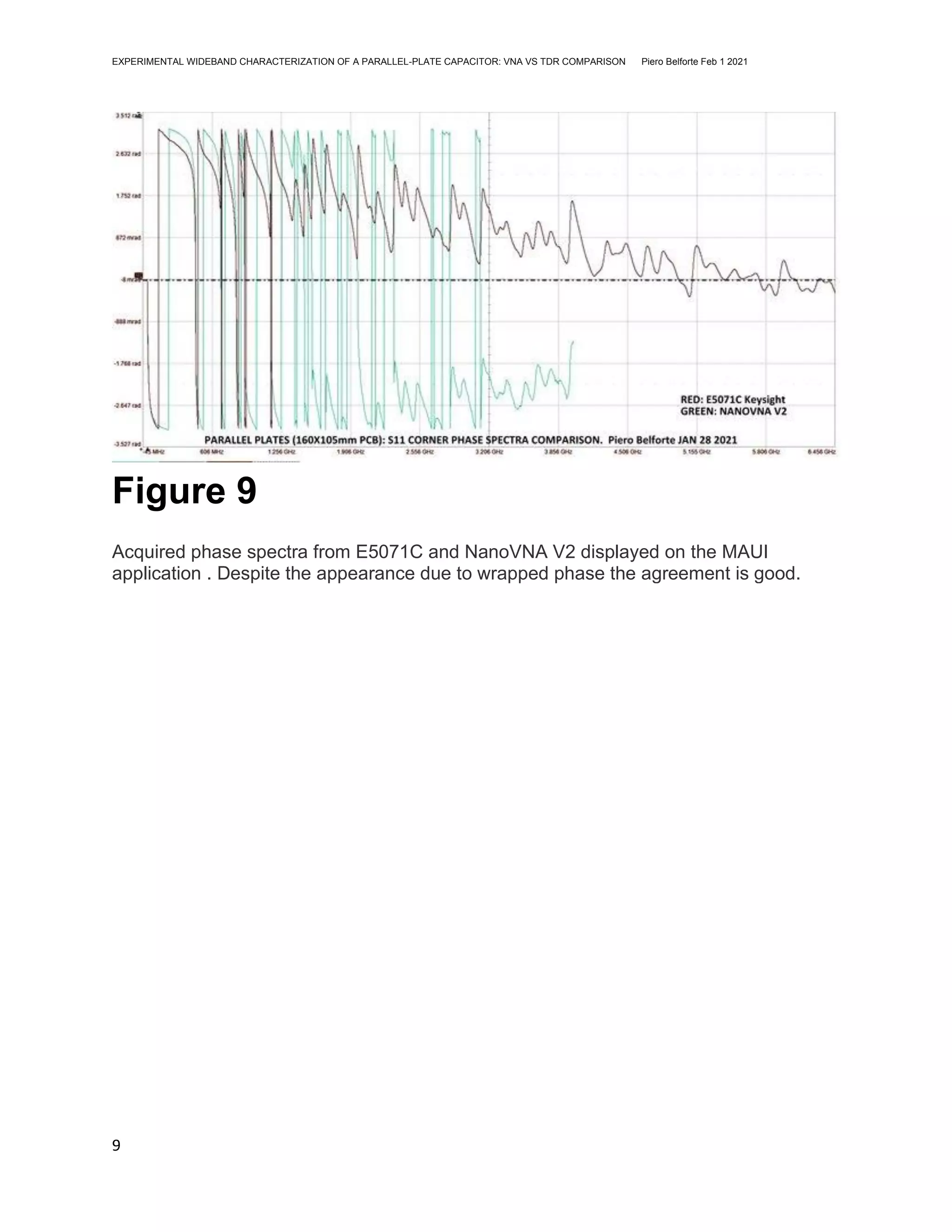
Figure 9
Acquired phase spectra from E5071C and NanoVNA V2 displayed on the MAUI
application . Despite the appearance due to wrapped phase the agreement is good.
EXPERIMENTAL WIDEBAND CHARACTERIZATION OF A PARALLEL-PLATE CAPACITOR: VNA VS TDR COMPARISON Piero Belforte Feb 1 2021
10
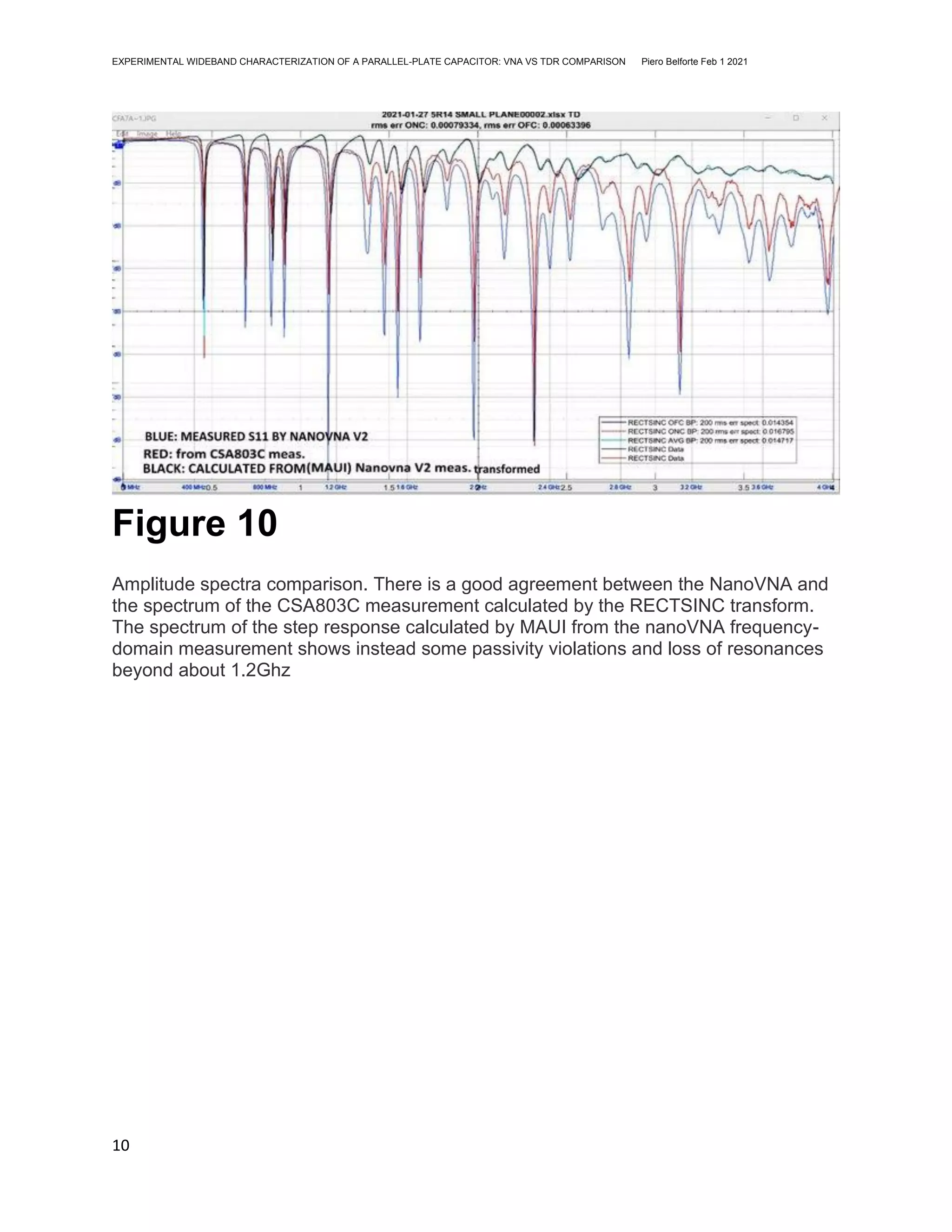
Figure 10
Amplitude spectra comparison. There is a good agreement between the NanoVNA and
the spectrum of the CSA803C measurement calculated by the RECTSINC transform.
The spectrum of the step response calculated by MAUI from the nanoVNA frequency-
domain measurement shows instead some passivity violations and loss of resonances
beyond about 1.2Ghz
EXPERIMENTAL WIDEBAND CHARACTERIZATION OF A PARALLEL-PLATE CAPACITOR: VNA VS TDR COMPARISON Piero Belforte Feb 1 2021
11
Figure 11
Unwrapped phase spectrum of the original response data and the PWL200_OFC
macromodel of S11 calculated by PWLFIT+ from the CSA803C measurement [5].
EXPERIMENTAL WIDEBAND CHARACTERIZATION OF A PARALLEL-PLATE CAPACITOR: VNA VS TDR COMPARISON Piero Belforte Feb 1 2021
12
Figure 12
Comparison of the S11 macromodels calculated using both the PWLFIT and Vector
Fitting (VF) algorithms starting from the actual TDR measurement data. A model order
of 200 is chosen for the comparison. As depicted in the figure, VF performs slightly
better on spectrum error but shows a time-domain rms error abot one order of
magnitude larger. than PWLFIT. In the DWS implementation the PWL200 is about 20X
faster than VF200 and more stable due to the FIR implementation. [1]
EXPERIMENTAL WIDEBAND CHARACTERIZATION OF A PARALLEL-PLATE CAPACITOR: VNA VS TDR COMPARISON Piero Belforte Feb 1 2021
13
Figure 13
An example of accurate wideband and very fast model of the parallel plate capacitor as a grid of
lossy Transmission Lines. Only 5 parameters are needed to describe this model that can be
extracted from a single TDR measurement. This kind of 2D lossy TLM models can be applied for
example in the prediction of the noise generated by switching drivers on actual p.c.b. boards [2], [3]
EXPERIMENTAL WIDEBAND CHARACTERIZATION OF A PARALLEL-PLATE CAPACITOR: VNA VS TDR COMPARISON Piero Belforte Feb 1 2021
14
References
[1] Piero Belforte et aliii : Automated Framework for Time-Domain Piecewise- Linear Fitting Method
Based on Digital Wave Processing of S-Parameters IEEE Transactions on Circuits and Systems Jan. 2020
https://www.researchgate.net/publication/336912388_Automated_Framework_for_Time-
Domain_Piecewise-_Linear_Fitting_Method_Based_on_Digital_Wave_Processing_of_S-Parameters
[2] Piero Belforte: PCB PLANE, INTERCONNECT SWITCHING NOISE
SIMULATION,https://www.researchgate.net/publication/281714186_SpicySWAN_report_PCB_PLANE_I
NTERCONNECT_SWITCHING_NOISE_SIMULATION
[3] Piero Belforte, Giancarlo Guaschino: DWS 9.0 Digital Wave Simulator,
https://www.researchgate.net/publication/338337640_DWS_90_Digital_Wave_Simulator
[4} Teledyne LeCroy: Oscilloscopes Remote Control and Automation
http://cdn.teledynelecroy.com/files/manuals/maui-remote-control-and-automation-manual.pdf
[5] Piero Belforte et alii: Frequency Domain Behavior of S-Parameters Piecewise-Linear Fitting
in a Digital-Wave Framework, to be published
Content subject to copyright.

3 experimental wideband_characterization_of_a parallel-plate_capacitor

  • 1.
    EXPERIMENTAL WIDEBAND CHARACTERIZATIONOF A PARALLEL-PLATE CAPACITOR: VNA VS TDR COMPARISON Piero Belforte Feb 1 2021 1 A parallel-plate capacitor implemented by a rectangular double-sided printed circuit board (p.c.b.) is characterized by means a stimulus signal injected at a corner. Both frequency-domain (VNA) and time-domain (TDR) techniques are utilized to determine the step response of the reflected wave (S11) to be compared to the theoretical behavior of the equivalent parallel plate capacitance. A commercial application is utilized to convert the frequency domain tabulated data of the frequency response into the corresponding TDR response. A simple, very accurate and fast 2D TLM (Transmission Line Model) model can be easily extracted from these single time-domain experimental responses. This kind of models can be utilized to simulate very efficiently the Power Distribution Networks of p.c.b.s [2] using the Digital Wave Simulator (DWS) [3] Figure 1 Calculation of theoretical capacitance taking into account the dimensions of the p.c.b. under test. Two values of FR4 relative dielectric constant Er are taken into acccount:4.7 and 4.9. From the http://www.calctool.org/CALC/eng/electronics/parallel_plate website.
  • 2.
    EXPERIMENTAL WIDEBAND CHARACTERIZATIONOF A PARALLEL-PLATE CAPACITOR: VNA VS TDR COMPARISON Piero Belforte Feb 1 2021 2 Figure 2 This collage shows two out of three measurement setups utilized to characterize the p.c.b under test. The stimulus injection point is one of the p.c.b. corners where a SMA connector is soldered. Setup A) utilizes a CSA803C TDR equipped with S24 heads with a 20Ghz equivalent bandwidth. Setup B) utilizes a low-cost USB VNA (NanoVNA V2) performing a linear frequency sweep from 50KHz to 4Ghz (50K acquired samples).THe third setup utlizes a Keysight E5071C VNA to perform a linear sweep from 9Khz to 6.5Ghz (20K acquired samples). The acquired samples are all related to the wave reflected by the DUT (S11). In the case A) of real TDR the time-domain waveform is the step response of S11. Using the VNAs the acquired samples represent the actual frequency-domain S11 (impulse response).
  • 3.
    EXPERIMENTAL WIDEBAND CHARACTERIZATIONOF A PARALLEL-PLATE CAPACITOR: VNA VS TDR COMPARISON Piero Belforte Feb 1 2021 3 Figure 3 Detail of the injection point of the stimulus of the double-side p.c.b used in the experiments. VNA calibration includes the launch cable SMA connector but excludes the SMA connector soldered to the corner of the plate.
  • 4.
    EXPERIMENTAL WIDEBAND CHARACTERIZATIONOF A PARALLEL-PLATE CAPACITOR: VNA VS TDR COMPARISON Piero Belforte Feb 1 2021 4 Figure 4 Comparison between the S11 step responses obtained from the measurements and the theoretical ideal capacitors simulated by DWS. The tabulated frequency responses of the VNAs (touchstone files .s1p) are converted into the step responses by means of the MAUI application available from Teledyne Lecroy [4]. In this case the equivalent step risetime is set to 200ps to minimize the ringing of the transformed waveform. MAUI calculates the voltage at the injection port V1 instead of the reflected waveform. Some additional calculation is needed: in particular a unity value is subtracted from V1 samples. Moreover the initial samples with negative time values are deleted. The overall behaviors look very similar. The measured responses are characterized by reflections occurring at the edges of the p.cb. . The static capacitance calculated using the theoretical formula matches the experimental measurements, obvioulsly excluding the reflections. The fringe capacitance effect is negligible on the static value.
  • 5.
    EXPERIMENTAL WIDEBAND CHARACTERIZATIONOF A PARALLEL-PLATE CAPACITOR: VNA VS TDR COMPARISON Piero Belforte Feb 1 2021 5 Figure 5 MAUI waveforms obtained as STEP response transform of the voltage at port 1 with the DUT disconnected. The user can choose the desired tradeoff between residual ringing and risetime. The 200ps choice can be considered a good tradeoff.
  • 6.
    EXPERIMENTAL WIDEBAND CHARACTERIZATIONOF A PARALLEL-PLATE CAPACITOR: VNA VS TDR COMPARISON Piero Belforte Feb 1 2021 6 Figure 6 Zoomed view showing the details of the edge reflections. The waveforms look similar even if some shift is present on both time and amplitude. The most accurate result should be response to the real TDR (green) due to both largest bandwidth and absence of aberrations due to frequency- time transformation.
  • 7.
    EXPERIMENTAL WIDEBAND CHARACTERIZATIONOF A PARALLEL-PLATE CAPACITOR: VNA VS TDR COMPARISON Piero Belforte Feb 1 2021 7 Figure 7 Zoomed view (1mrho/div) near the unity value of S11 step responses. The effects of the frequency-time MAU transform are clearly visible. The E5071C result looks better than NanonoVNA result due probably to its lower start sweep frequency (9 Khz instead 50Khz). The errors depends on the lack of information on the 0Hz-fmin window.
  • 8.
    EXPERIMENTAL WIDEBAND CHARACTERIZATIONOF A PARALLEL-PLATE CAPACITOR: VNA VS TDR COMPARISON Piero Belforte Feb 1 2021 8 Figure 8 Acquired amplitude spectra from E5071C and NanoVNA V2 displayed on the MAUI application. The agreement is good and confirms the accuracy of the low-cost nanoVNA. The cost ratio is about 3 orders of magnitude.
  • 9.
    EXPERIMENTAL WIDEBAND CHARACTERIZATIONOF A PARALLEL-PLATE CAPACITOR: VNA VS TDR COMPARISON Piero Belforte Feb 1 2021 9 Figure 9 Acquired phase spectra from E5071C and NanoVNA V2 displayed on the MAUI application . Despite the appearance due to wrapped phase the agreement is good.
  • 10.
    EXPERIMENTAL WIDEBAND CHARACTERIZATIONOF A PARALLEL-PLATE CAPACITOR: VNA VS TDR COMPARISON Piero Belforte Feb 1 2021 10 Figure 10 Amplitude spectra comparison. There is a good agreement between the NanoVNA and the spectrum of the CSA803C measurement calculated by the RECTSINC transform. The spectrum of the step response calculated by MAUI from the nanoVNA frequency- domain measurement shows instead some passivity violations and loss of resonances beyond about 1.2Ghz
  • 11.
    EXPERIMENTAL WIDEBAND CHARACTERIZATIONOF A PARALLEL-PLATE CAPACITOR: VNA VS TDR COMPARISON Piero Belforte Feb 1 2021 11 Figure 11 Unwrapped phase spectrum of the original response data and the PWL200_OFC macromodel of S11 calculated by PWLFIT+ from the CSA803C measurement [5].
  • 12.
    EXPERIMENTAL WIDEBAND CHARACTERIZATIONOF A PARALLEL-PLATE CAPACITOR: VNA VS TDR COMPARISON Piero Belforte Feb 1 2021 12 Figure 12 Comparison of the S11 macromodels calculated using both the PWLFIT and Vector Fitting (VF) algorithms starting from the actual TDR measurement data. A model order of 200 is chosen for the comparison. As depicted in the figure, VF performs slightly better on spectrum error but shows a time-domain rms error abot one order of magnitude larger. than PWLFIT. In the DWS implementation the PWL200 is about 20X faster than VF200 and more stable due to the FIR implementation. [1]
  • 13.
    EXPERIMENTAL WIDEBAND CHARACTERIZATIONOF A PARALLEL-PLATE CAPACITOR: VNA VS TDR COMPARISON Piero Belforte Feb 1 2021 13 Figure 13 An example of accurate wideband and very fast model of the parallel plate capacitor as a grid of lossy Transmission Lines. Only 5 parameters are needed to describe this model that can be extracted from a single TDR measurement. This kind of 2D lossy TLM models can be applied for example in the prediction of the noise generated by switching drivers on actual p.c.b. boards [2], [3]
  • 14.
    EXPERIMENTAL WIDEBAND CHARACTERIZATIONOF A PARALLEL-PLATE CAPACITOR: VNA VS TDR COMPARISON Piero Belforte Feb 1 2021 14 References [1] Piero Belforte et aliii : Automated Framework for Time-Domain Piecewise- Linear Fitting Method Based on Digital Wave Processing of S-Parameters IEEE Transactions on Circuits and Systems Jan. 2020 https://www.researchgate.net/publication/336912388_Automated_Framework_for_Time- Domain_Piecewise-_Linear_Fitting_Method_Based_on_Digital_Wave_Processing_of_S-Parameters [2] Piero Belforte: PCB PLANE, INTERCONNECT SWITCHING NOISE SIMULATION,https://www.researchgate.net/publication/281714186_SpicySWAN_report_PCB_PLANE_I NTERCONNECT_SWITCHING_NOISE_SIMULATION [3] Piero Belforte, Giancarlo Guaschino: DWS 9.0 Digital Wave Simulator, https://www.researchgate.net/publication/338337640_DWS_90_Digital_Wave_Simulator [4} Teledyne LeCroy: Oscilloscopes Remote Control and Automation http://cdn.teledynelecroy.com/files/manuals/maui-remote-control-and-automation-manual.pdf [5] Piero Belforte et alii: Frequency Domain Behavior of S-Parameters Piecewise-Linear Fitting in a Digital-Wave Framework, to be published Content subject to copyright.