CFD Study on Controlling Aerosol
Dispersion Inside Closed Ventilated Spaces
Studies to showcase effectiveness of prevention measures
Zeus Numerix Pvt Ltd 2 June 2020 White Paper
DISCLAIMER
The CFD study is executed on typical office geometry. The report is however not generic and does not
intend to provide a generic solution of all offices. Report states the results in simple language for the
benefit of ordinary reader. For more scientific assessment of individual offices, reader is advised to
contact professionals in the field. The report disclaims all responsibility for damages arising out of
reading this report or implementation of its guidelines. For any professional guidance contact us at
contact@zeusnumerix.com or call at +91 9819009836.
White Paper on “CFD Study on Controlling Aerosol Dispersion Inside Closed Ventilated Spaces”
© Zeus Numerix Private Limited; No part may be reproduced without permission 1 | P a g e
1 Introduction
The current scenario has presented a difficult choice of protection of lives from the
pandemic or restarting the economic engine. In most of the cases, the economic engine is
dependant on the functioning of offices or factories. It is observed that the offices (or
closed ventilated spaces in the paper) pose a significant risk in spread of aerosols due to
the nature of ventilation system installed. Guidelines issued like “ASHRAE Position
Document on Infectious Aerosols” recommends CFD studies to estimate the flow
pattern in individual offices. The current study aims at simulating a typical office space
with its ventilation system to establish the difference in dispersion of aerosols w.r.t social
distancing and use of Local Exhaust Ventilation (LEVs) or Air Purifier (APs).
1.1 Aim
A recent study conducted in South Korea says that office workplaces are heavily
susceptible to the spread of infections with an estimated an attack rate of more than 40%
in the office spaces. To prevent the dispersion of aerosols there are various conjectures
being put forth like switching off the ventilation system, operating the offices at less than
half the strength, use of local APs to time consuming ones like revamping the entire
system. Switching off the entire ventilation system can be very uncomfortable in most
working environments or can be dangerous in some not having direct access to fresh air.
Revamping the entire system may be costly or not possible due to space constraints. This
study aims at providing a scientific basis to the arguments and establish if LEVs/APs are
useful in the prevention of aerosol dispersion. Simulations have been completed and
compared for the following cases
1. Office working in Normal Days (full occupancy)
2. Office working with 50% capacity
3. Office working with full capacity and operating LEVs
4. Office working with full capacity with operating LEVs and retrofit of ventilation
system
The paper aims to augment the efforts in preventing the infectious aerosols from causing
further damage.
1.2 Guidelines
In new guidelines, ASHRAE’s focus remains on the use of LEV, APs or Filtration System
(FS). LEVs are small potable air purification systems which uses differential temperature
or UV radiation to kill the pathogens in the room. LEVs along with the regular air-
conditioning can help control the transmission of infectious aerosols in closed ventilated
spaces. Apart from LEVs, ASHRAE also suggest other strategies like air distribution
patterns, differential room pressurization, source capture ventilation.
White Paper on “CFD Study on Controlling Aerosol Dispersion Inside Closed Ventilated Spaces”
© Zeus Numerix Private Limited; No part may be reproduced without permission 2 | P a g e
Though it is recommended to use LEVs to control the virus transmission in closed
ventilated space but no standards are defined yet to define the use of LEVs for different
size and structured work spaces. However, section 3.2 of the same ASHRAE guidelines
recommend that Computational Fluid Dynamics (CFD) analysis can predict the airflow
patterns and potential flow path of the airborne contaminants provided the CFD is
performed appropriately by adequate expertise. The next sections of this paper explain
how CFD is used by Zeus Numerix to achieve what ASHRAE has recommended in the new
guidelines for infectious aerosols.
2 CFD Study
For the benefit of readers who are not familiar with computational fluid dynamics (CFD),
process is briefly explained. Office geometries imported into a software and it is divided
into small parts that are called meshes. This part of division of full office geometry smaller
meshes is called pre-processing. After the pre-processing is complete, simulation module
is run that calculates basic flow parameters like pressure and velocity at each place inside
the geometry. These values are then showcased using graphs, charts, plots and
streamlines etc.
2.1 Pre-processing
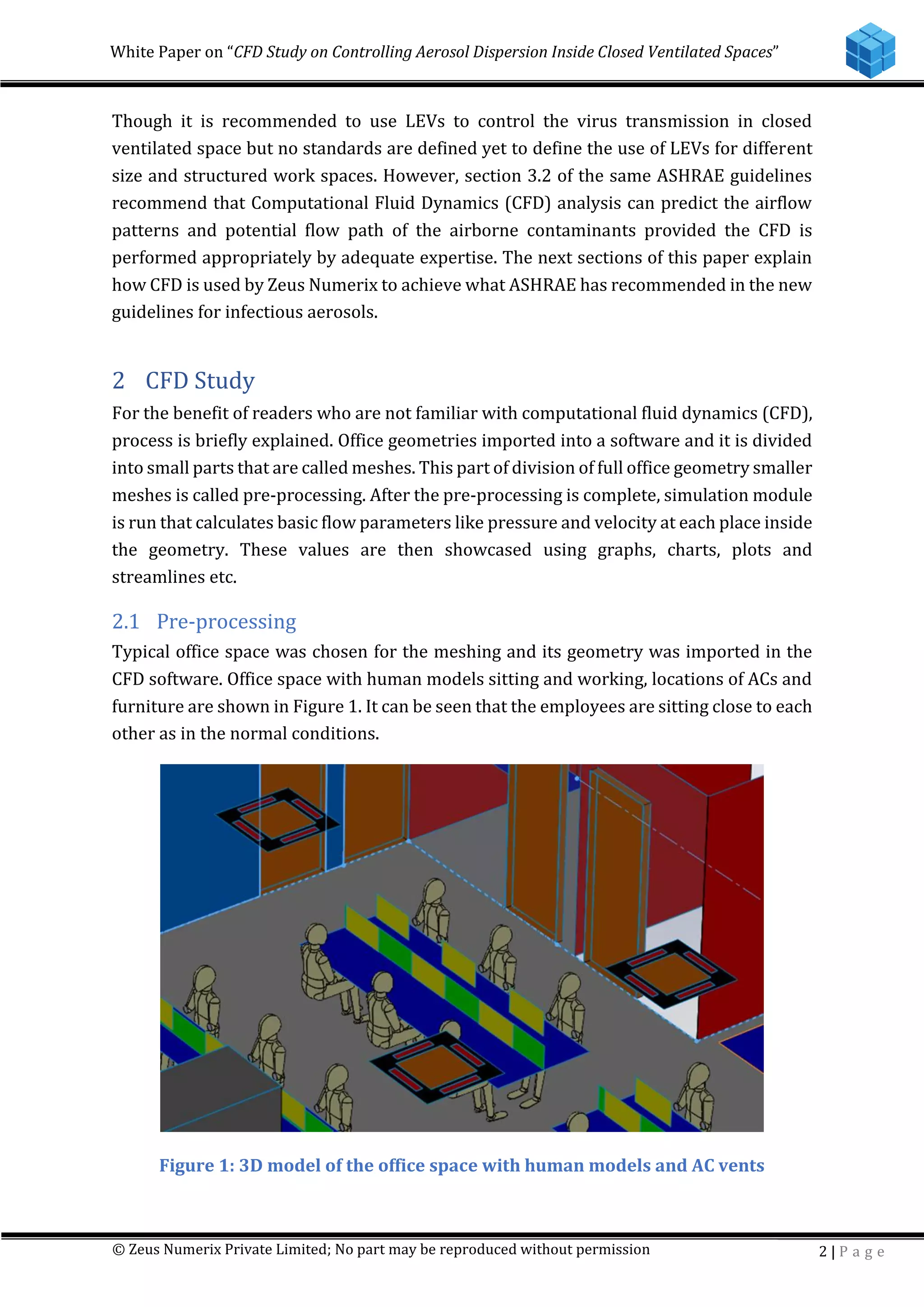
Typical office space was chosen for the meshing and its geometry was imported in the
CFD software. Office space with human models sitting and working, locations of ACs and
furniture are shown in Figure 1. It can be seen that the employees are sitting close to each
other as in the normal conditions.
Figure 1: 3D model of the office space with human models and AC vents
White Paper on “CFD Study on Controlling Aerosol Dispersion Inside Closed Ventilated Spaces”
© Zeus Numerix Private Limited; No part may be reproduced without permission 3 | P a g e
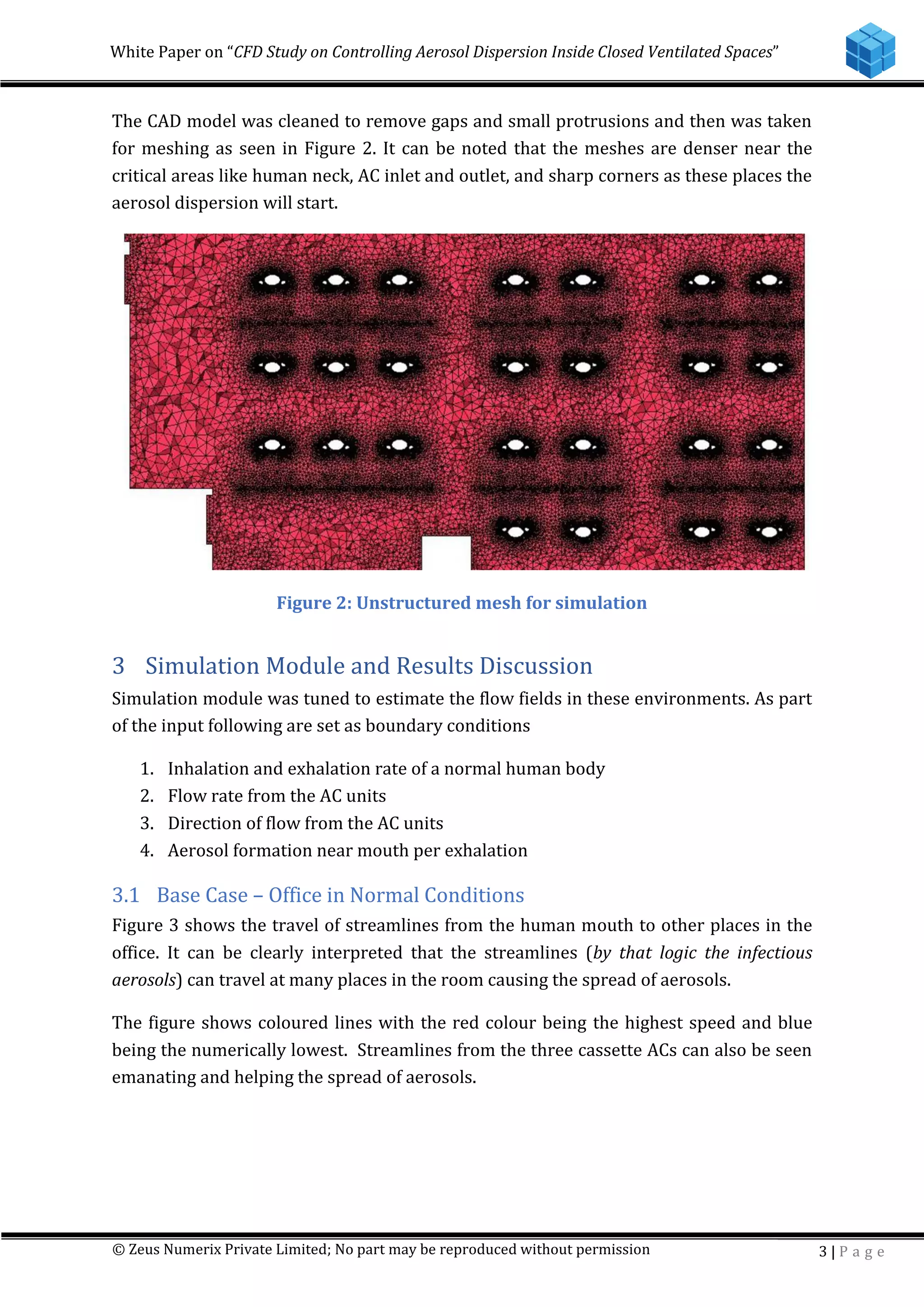
The CAD model was cleaned to remove gaps and small protrusions and then was taken
for meshing as seen in Figure 2. It can be noted that the meshes are denser near the
critical areas like human neck, AC inlet and outlet, and sharp corners as these places the
aerosol dispersion will start.
Figure 2: Unstructured mesh for simulation
3 Simulation Module and Results Discussion
Simulation module was tuned to estimate the flow fields in these environments. As part
of the input following are set as boundary conditions
1. Inhalation and exhalation rate of a normal human body
2. Flow rate from the AC units
3. Direction of flow from the AC units
4. Aerosol formation near mouth per exhalation
3.1 Base Case – Office in Normal Conditions
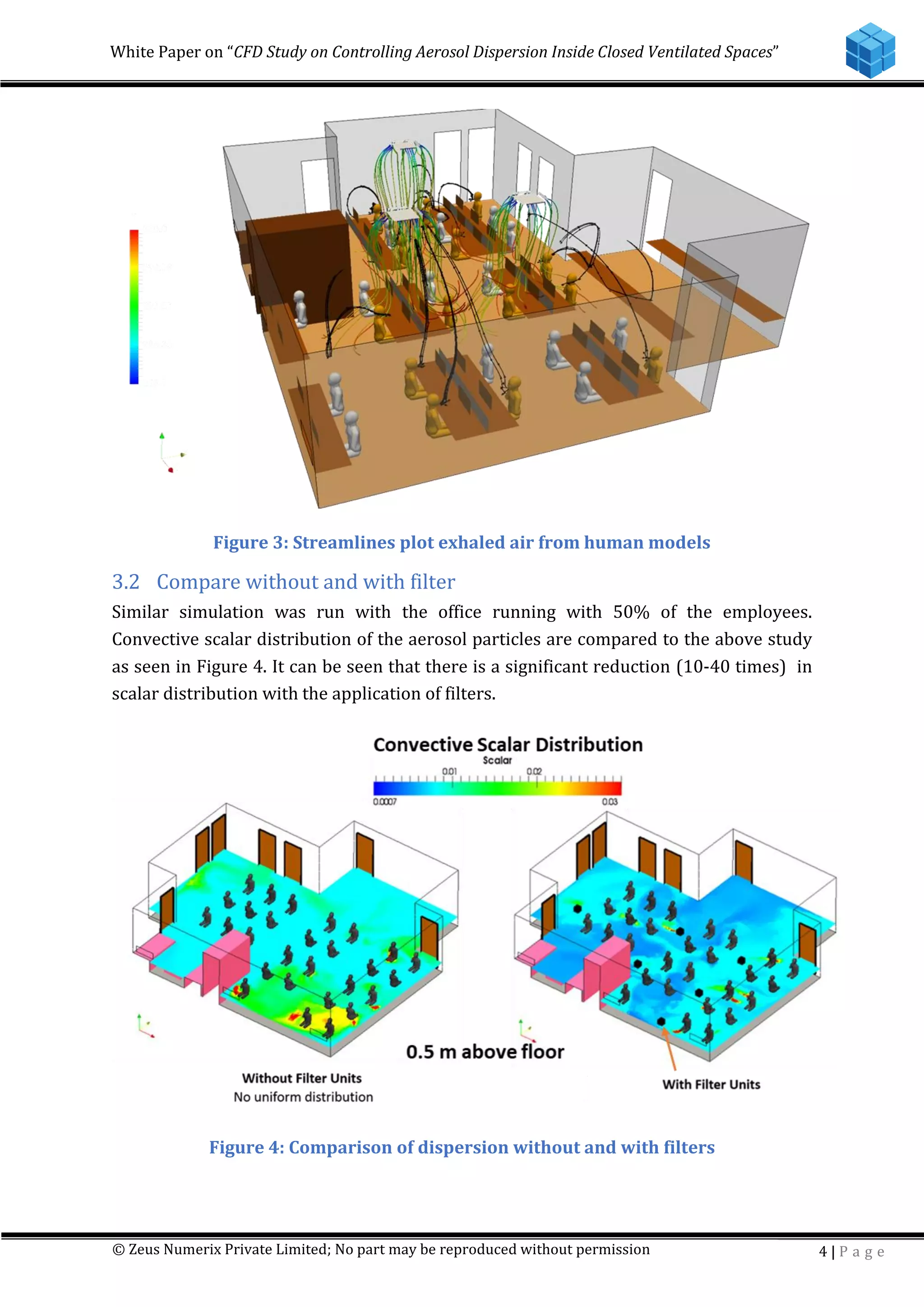
Figure 3 shows the travel of streamlines from the human mouth to other places in the
office. It can be clearly interpreted that the streamlines (by that logic the infectious
aerosols) can travel at many places in the room causing the spread of aerosols.
The figure shows coloured lines with the red colour being the highest speed and blue
being the numerically lowest. Streamlines from the three cassette ACs can also be seen
emanating and helping the spread of aerosols.
White Paper on “CFD Study on Controlling Aerosol Dispersion Inside Closed Ventilated Spaces”
© Zeus Numerix Private Limited; No part may be reproduced without permission 4 | P a g e
Figure 3: Streamlines plot exhaled air from human models
3.2 Compare without and with filter
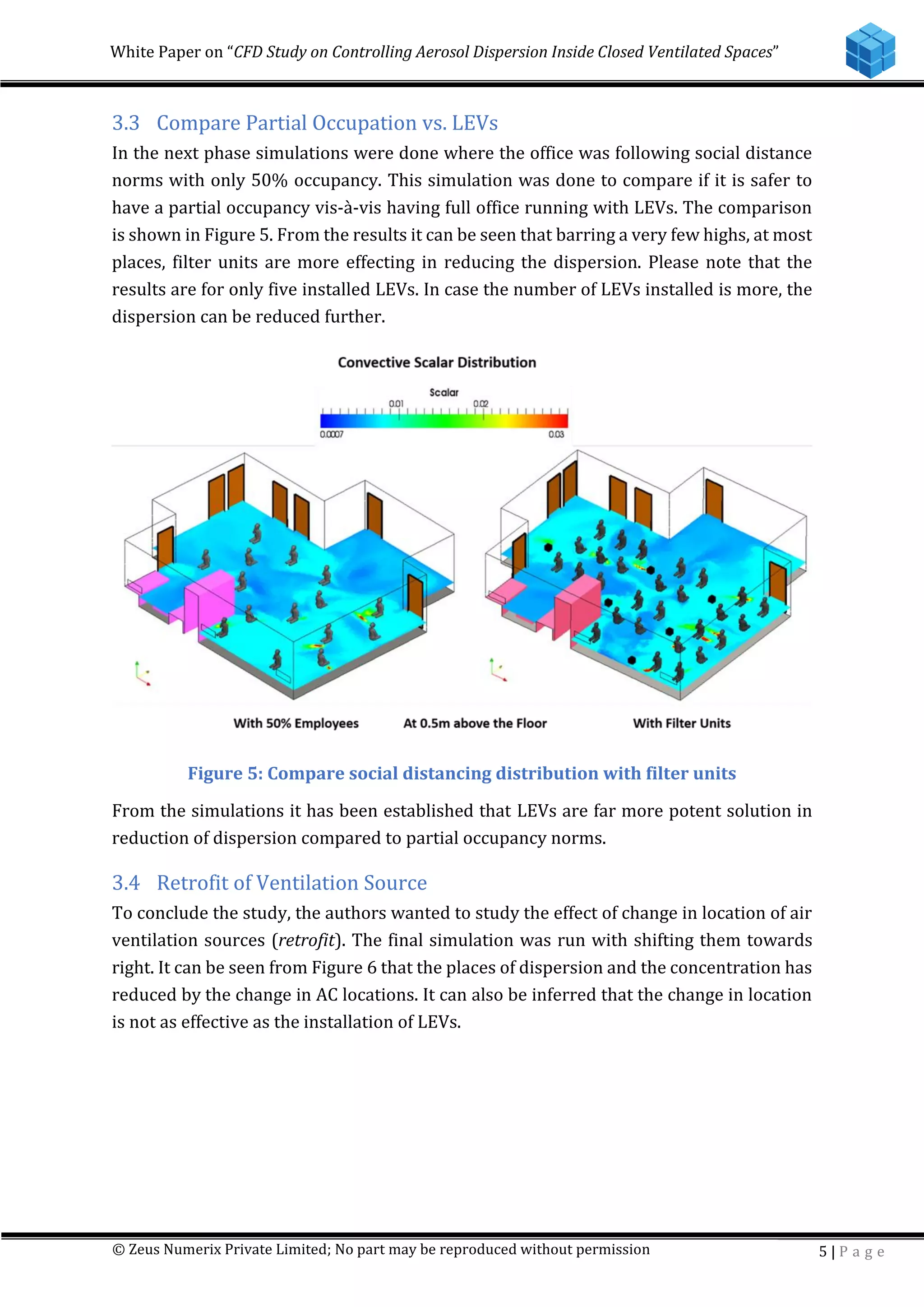
Similar simulation was run with the office running with 50% of the employees.
Convective scalar distribution of the aerosol particles are compared to the above study
as seen in Figure 4. It can be seen that there is a significant reduction (10-40 times) in
scalar distribution with the application of filters.
Figure 4: Comparison of dispersion without and with filters
White Paper on “CFD Study on Controlling Aerosol Dispersion Inside Closed Ventilated Spaces”
© Zeus Numerix Private Limited; No part may be reproduced without permission 5 | P a g e
3.3 Compare Partial Occupation vs. LEVs
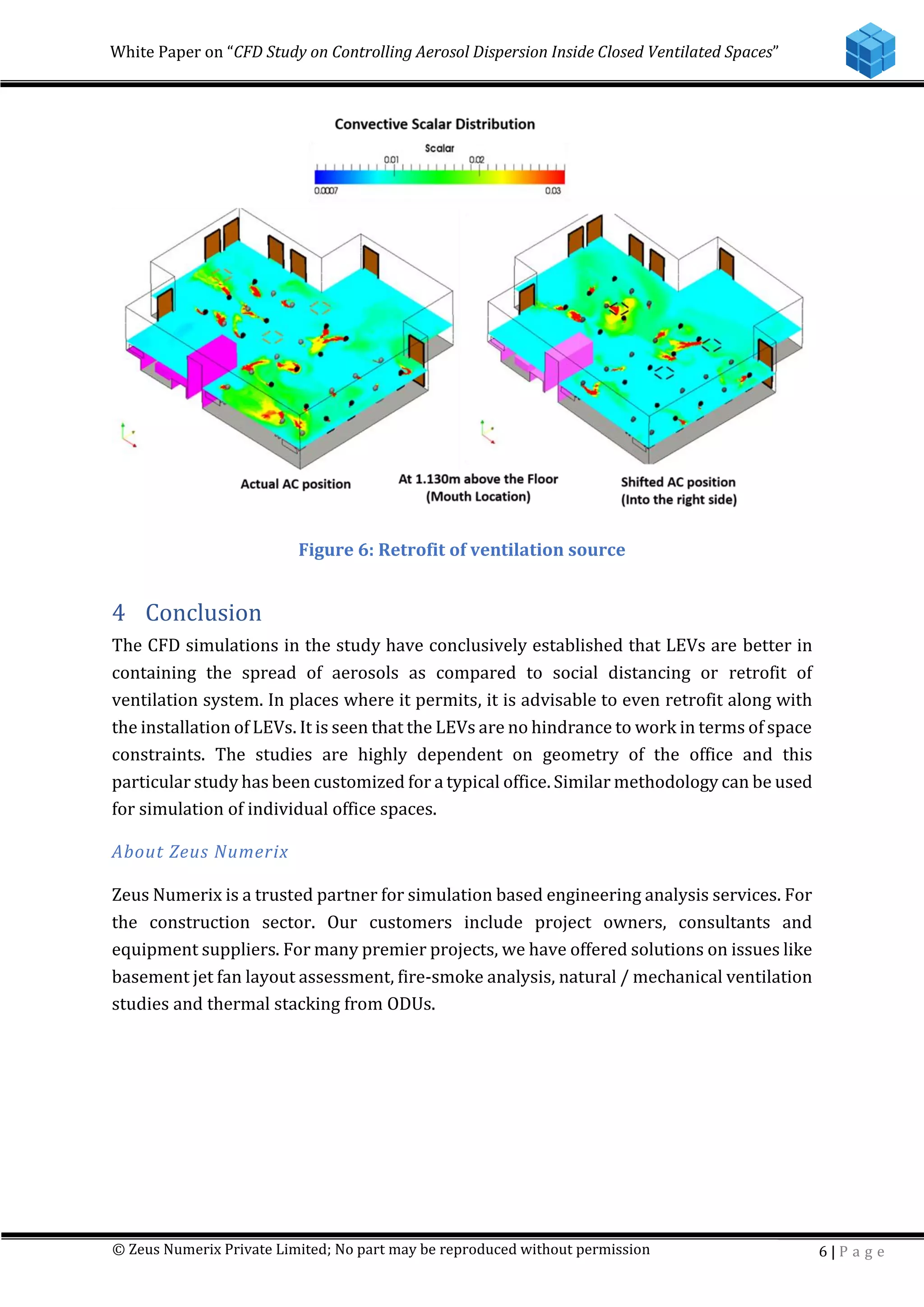
In the next phase simulations were done where the office was following social distance
norms with only 50% occupancy. This simulation was done to compare if it is safer to
have a partial occupancy vis-à-vis having full office running with LEVs. The comparison
is shown in Figure 5. From the results it can be seen that barring a very few highs, at most
places, filter units are more effecting in reducing the dispersion. Please note that the
results are for only five installed LEVs. In case the number of LEVs installed is more, the
dispersion can be reduced further.
Figure 5: Compare social distancing distribution with filter units
From the simulations it has been established that LEVs are far more potent solution in
reduction of dispersion compared to partial occupancy norms.
3.4 Retrofit of Ventilation Source
To conclude the study, the authors wanted to study the effect of change in location of air
ventilation sources (retrofit). The final simulation was run with shifting them towards
right. It can be seen from Figure 6 that the places of dispersion and the concentration has
reduced by the change in AC locations. It can also be inferred that the change in location
is not as effective as the installation of LEVs.
White Paper on “CFD Study on Controlling Aerosol Dispersion Inside Closed Ventilated Spaces”
© Zeus Numerix Private Limited; No part may be reproduced without permission 6 | P a g e
Figure 6: Retrofit of ventilation source
4 Conclusion
The CFD simulations in the study have conclusively established that LEVs are better in
containing the spread of aerosols as compared to social distancing or retrofit of
ventilation system. In places where it permits, it is advisable to even retrofit along with
the installation of LEVs. It is seen that the LEVs are no hindrance to work in terms of space
constraints. The studies are highly dependent on geometry of the office and this
particular study has been customized for a typical office. Similar methodology can be used
for simulation of individual office spaces.
About Zeus Numerix
Zeus Numerix is a trusted partner for simulation based engineering analysis services. For
the construction sector. Our customers include project owners, consultants and
equipment suppliers. For many premier projects, we have offered solutions on issues like
basement jet fan layout assessment, fire-smoke analysis, natural / mechanical ventilation
studies and thermal stacking from ODUs.

CFD Study on Controlling Aerosol Dispersion Inside Closed Ventilated Spaces

  • 1.
    CFD Study onControlling Aerosol Dispersion Inside Closed Ventilated Spaces Studies to showcase effectiveness of prevention measures Zeus Numerix Pvt Ltd 2 June 2020 White Paper DISCLAIMER The CFD study is executed on typical office geometry. The report is however not generic and does not intend to provide a generic solution of all offices. Report states the results in simple language for the benefit of ordinary reader. For more scientific assessment of individual offices, reader is advised to contact professionals in the field. The report disclaims all responsibility for damages arising out of reading this report or implementation of its guidelines. For any professional guidance contact us at contact@zeusnumerix.com or call at +91 9819009836.
  • 2.
    White Paper on“CFD Study on Controlling Aerosol Dispersion Inside Closed Ventilated Spaces” © Zeus Numerix Private Limited; No part may be reproduced without permission 1 | P a g e 1 Introduction The current scenario has presented a difficult choice of protection of lives from the pandemic or restarting the economic engine. In most of the cases, the economic engine is dependant on the functioning of offices or factories. It is observed that the offices (or closed ventilated spaces in the paper) pose a significant risk in spread of aerosols due to the nature of ventilation system installed. Guidelines issued like “ASHRAE Position Document on Infectious Aerosols” recommends CFD studies to estimate the flow pattern in individual offices. The current study aims at simulating a typical office space with its ventilation system to establish the difference in dispersion of aerosols w.r.t social distancing and use of Local Exhaust Ventilation (LEVs) or Air Purifier (APs). 1.1 Aim A recent study conducted in South Korea says that office workplaces are heavily susceptible to the spread of infections with an estimated an attack rate of more than 40% in the office spaces. To prevent the dispersion of aerosols there are various conjectures being put forth like switching off the ventilation system, operating the offices at less than half the strength, use of local APs to time consuming ones like revamping the entire system. Switching off the entire ventilation system can be very uncomfortable in most working environments or can be dangerous in some not having direct access to fresh air. Revamping the entire system may be costly or not possible due to space constraints. This study aims at providing a scientific basis to the arguments and establish if LEVs/APs are useful in the prevention of aerosol dispersion. Simulations have been completed and compared for the following cases 1. Office working in Normal Days (full occupancy) 2. Office working with 50% capacity 3. Office working with full capacity and operating LEVs 4. Office working with full capacity with operating LEVs and retrofit of ventilation system The paper aims to augment the efforts in preventing the infectious aerosols from causing further damage. 1.2 Guidelines In new guidelines, ASHRAE’s focus remains on the use of LEV, APs or Filtration System (FS). LEVs are small potable air purification systems which uses differential temperature or UV radiation to kill the pathogens in the room. LEVs along with the regular air- conditioning can help control the transmission of infectious aerosols in closed ventilated spaces. Apart from LEVs, ASHRAE also suggest other strategies like air distribution patterns, differential room pressurization, source capture ventilation.
  • 3.
    White Paper on“CFD Study on Controlling Aerosol Dispersion Inside Closed Ventilated Spaces” © Zeus Numerix Private Limited; No part may be reproduced without permission 2 | P a g e Though it is recommended to use LEVs to control the virus transmission in closed ventilated space but no standards are defined yet to define the use of LEVs for different size and structured work spaces. However, section 3.2 of the same ASHRAE guidelines recommend that Computational Fluid Dynamics (CFD) analysis can predict the airflow patterns and potential flow path of the airborne contaminants provided the CFD is performed appropriately by adequate expertise. The next sections of this paper explain how CFD is used by Zeus Numerix to achieve what ASHRAE has recommended in the new guidelines for infectious aerosols. 2 CFD Study For the benefit of readers who are not familiar with computational fluid dynamics (CFD), process is briefly explained. Office geometries imported into a software and it is divided into small parts that are called meshes. This part of division of full office geometry smaller meshes is called pre-processing. After the pre-processing is complete, simulation module is run that calculates basic flow parameters like pressure and velocity at each place inside the geometry. These values are then showcased using graphs, charts, plots and streamlines etc. 2.1 Pre-processing Typical office space was chosen for the meshing and its geometry was imported in the CFD software. Office space with human models sitting and working, locations of ACs and furniture are shown in Figure 1. It can be seen that the employees are sitting close to each other as in the normal conditions. Figure 1: 3D model of the office space with human models and AC vents
  • 4.
    White Paper on“CFD Study on Controlling Aerosol Dispersion Inside Closed Ventilated Spaces” © Zeus Numerix Private Limited; No part may be reproduced without permission 3 | P a g e The CAD model was cleaned to remove gaps and small protrusions and then was taken for meshing as seen in Figure 2. It can be noted that the meshes are denser near the critical areas like human neck, AC inlet and outlet, and sharp corners as these places the aerosol dispersion will start. Figure 2: Unstructured mesh for simulation 3 Simulation Module and Results Discussion Simulation module was tuned to estimate the flow fields in these environments. As part of the input following are set as boundary conditions 1. Inhalation and exhalation rate of a normal human body 2. Flow rate from the AC units 3. Direction of flow from the AC units 4. Aerosol formation near mouth per exhalation 3.1 Base Case – Office in Normal Conditions Figure 3 shows the travel of streamlines from the human mouth to other places in the office. It can be clearly interpreted that the streamlines (by that logic the infectious aerosols) can travel at many places in the room causing the spread of aerosols. The figure shows coloured lines with the red colour being the highest speed and blue being the numerically lowest. Streamlines from the three cassette ACs can also be seen emanating and helping the spread of aerosols.
  • 5.
    White Paper on“CFD Study on Controlling Aerosol Dispersion Inside Closed Ventilated Spaces” © Zeus Numerix Private Limited; No part may be reproduced without permission 4 | P a g e Figure 3: Streamlines plot exhaled air from human models 3.2 Compare without and with filter Similar simulation was run with the office running with 50% of the employees. Convective scalar distribution of the aerosol particles are compared to the above study as seen in Figure 4. It can be seen that there is a significant reduction (10-40 times) in scalar distribution with the application of filters. Figure 4: Comparison of dispersion without and with filters
  • 6.
    White Paper on“CFD Study on Controlling Aerosol Dispersion Inside Closed Ventilated Spaces” © Zeus Numerix Private Limited; No part may be reproduced without permission 5 | P a g e 3.3 Compare Partial Occupation vs. LEVs In the next phase simulations were done where the office was following social distance norms with only 50% occupancy. This simulation was done to compare if it is safer to have a partial occupancy vis-à-vis having full office running with LEVs. The comparison is shown in Figure 5. From the results it can be seen that barring a very few highs, at most places, filter units are more effecting in reducing the dispersion. Please note that the results are for only five installed LEVs. In case the number of LEVs installed is more, the dispersion can be reduced further. Figure 5: Compare social distancing distribution with filter units From the simulations it has been established that LEVs are far more potent solution in reduction of dispersion compared to partial occupancy norms. 3.4 Retrofit of Ventilation Source To conclude the study, the authors wanted to study the effect of change in location of air ventilation sources (retrofit). The final simulation was run with shifting them towards right. It can be seen from Figure 6 that the places of dispersion and the concentration has reduced by the change in AC locations. It can also be inferred that the change in location is not as effective as the installation of LEVs.
  • 7.
    White Paper on“CFD Study on Controlling Aerosol Dispersion Inside Closed Ventilated Spaces” © Zeus Numerix Private Limited; No part may be reproduced without permission 6 | P a g e Figure 6: Retrofit of ventilation source 4 Conclusion The CFD simulations in the study have conclusively established that LEVs are better in containing the spread of aerosols as compared to social distancing or retrofit of ventilation system. In places where it permits, it is advisable to even retrofit along with the installation of LEVs. It is seen that the LEVs are no hindrance to work in terms of space constraints. The studies are highly dependent on geometry of the office and this particular study has been customized for a typical office. Similar methodology can be used for simulation of individual office spaces. About Zeus Numerix Zeus Numerix is a trusted partner for simulation based engineering analysis services. For the construction sector. Our customers include project owners, consultants and equipment suppliers. For many premier projects, we have offered solutions on issues like basement jet fan layout assessment, fire-smoke analysis, natural / mechanical ventilation studies and thermal stacking from ODUs.