International Conference on Computer Aided Engineering (CAE-2013)
Department of Mechanical Engineering, IIT Madras, India
1
Development of Software for Sizing of Axial Flow Fans
Abhishek Jain 1
, Ketan Bhokray 2
1
Zeus Numerix Pvt Ltd, Pune, Maharashtra, India, 411057
2
IIT Bombay, Mumbai, Maharashtra, India, 400076
*Corresponding Author

abhishek@zeusnumerix.com
ABSTRACT
Axial fans have numerous applications in Industry. Large axial fans are used in cooling towers and even the propeller of
an aircraft is an axial fan though in a different flow physics. Since these fans require economical and fast installation at various
places, their design cycle has to be less time consuming. Software has been designed using the blade momentum theory to design
the axial flow fans bounded by tubes. The software is able to design large cooling tower fans and has provided results that predict
the performance between 5-7%.
Keywords: Axial fan, cooling tower, blade momentum theory, efficiency
1. MOTIVATION
Axial flow fans are capable of producing high volume
flows rates at low pressure rise. They are extensively
used in process industry and energy sector. Even
rudimentary analysis of axial flow fans produces
efficiencies better than meticulously designed radial
flow fans. No wonder that they are extensively used in
industry. In the industry, axial fans are classified
mostly by the materials of construction of their blades
clearly indicating the emphasis is on cost of
procurement rather than the operating cost. With the
emphasis on energy savings and efficiency, the
material used for the blades, which also accounts for
the major cost is becoming less important. The
aerodynamically designed fan is gaining more
importance and engineers in various sectors are
demanding rigorous scientific basis for sizing and
theoretical performance from the manufacturers.
Naturally there is a need for tools and software capable
for design and performance estimation of axial fans.
The software should be affordable, simple to use and it
should cater to a large number of manufacturers.
This paper explains simple software aimed toward
improving efficiency of axial flow fans to be
developed by scores of fabricators who are unable to
accept the duration and cost incurred in design and
development of axial fans. Since most industrial fans
are ducted the software is mainly aimed at only ducted
fans, extensively used in ventilation, heat exchangers
and air-conditioning.
2. INTRODUCTION
Axial Flow fans belong to a class of machines called
“turbo-machines”, where energy is either extracted
from or injected into fluid streams. Therefore,
fundamentally, the turbo-machinery flow is unsteady as
energy in the flow stream can’t be stationary with time.
This has led to engineers using simpler methods of
analysis and design, as unsteady problem are an order
of magnitude difficult compared to steady state
problems. In fact, traditionally, the turbo-machines are
designed using “fan laws”, having their roots in
Buckingham theorem for arriving at non-dimensional
numbers based on zeroth – dimensional flow-analysis
methods. To improve the accuracy experimental
correlations are used to correct for the limitations of
fan laws. For axial cooling fans there are three non-
dimensional quantities: the flow coefficient, the
pressure coefficient, and the power coefficient.
Arguably, there are methods which take care of the
finer physics and hence accuracy of analysis to
improve the analysis and design of turbo-machinery.
The two alternate methods could be (a) usage of
instruments such as laser Doppler velocimetry or
particle image velocimetry in experimental set-ups and
(b) numerical solution of unsteady Navier Stokes
equations valid for complex geometry with realistic
boundary conditions. But both these approaches are
costly and require high initial investment and highly
skilled manpower as operational cost.
3. FAN DESIGN AND ANALYSIS
An axial-flow fan is essentially a low-pressure
compressor having high space–chord (solidity) ratio.
Abhishek Jain et. al.
2
Therefore, a simplified theoretical approach based on
isolated airfoil theory, called blade element theory,
rather than theories based on velocity triangles, can be
used. Similar theories are used for analysis and design
of propellers. To improve the accuracy, actuator disk
theory [1] and effect of interference between two
blades can be included.
In blade element theory, it is assumed that fan
consists of blades of airfoil shaped cross sections of
varying chord but vanishingly small size compared to
the radius at the various radial locations as in Fig. 1.
The forces on the airfoil section are calculated as lift
and drag coefficients based aerodynamic
characteristics of the chosen airfoil section. The two
dimensional loads are integrated along the radius to
calculate the thrust and torque on the blades. These
quantities are multiplied by an integer equal to the
number of blades in the fan. Thrust on the all the
blades is divided by the area swept by the blades to get
the total pressure rise across the fan by conservation.
The novel feature of the methodology incorporated in
the code is the interference effects from adjacent
blades in modifying the lift curve slope of the airfoil
by a factor considered in detail by Wallis [2].
3.1. Equations
An airfoil section of a blade of length R , at radial
distance r from the hub of the fan and a thickness dr
as illustrated in Fig. 2, obtained from [3], is considered
for analysis
Fig. 2: The lateral view of an axial flow fan showing
different flow parameters.
 is the geometric pitch angle of the cross section,  is the
angle of attack the flow makes with this cross-section.
lift and drag are the force vectors normal to and tangential to
the cross section
thrust, torque/radius are forces perpendicular and parallel to
the surface of the fan.
0V and 2V are the magnitudes of the axial and tangential
velocities of the flow at the section, 1V being their resultant
The difference in angle between thrust and lift directions is
given by  =  
The density of the air is 
The Velocities 0V and 2V are obtained from the Mass
Flow Rate m and the Flow Angular Velocity  at the
section
20
.. R
m
V

 (1)
RV .2  (2)
From the velocity vector triangle 0V , 1V and 2V
2
2
2
01 VVV  (3)







2
0
tan
V
V
a (4)
From the force vector triangle, the torque/radius is
observed to be
)sin()cos(  LDQ  (5)
The flow angular velocity is then obtained from the
torque/radius
R
m
Q
.
 (6)
Fig. 1: The blades of an axial flow fan are assumed
to be made of airfoil shaped cross sections with the
same airfoil throughout but different with chord
lengths at different radial positions
Development of Software for Sizing of Axial Flow Fans
3
RVdrR
Q
...2 0


 (7)
There now exists a nonlinear system of equations (1),
(2), (3), (4), (5), and (7) containing the primary
unknown variables Q ,  ,  , 2V and 1V . So, an
iterative solution to this system is possible by initially
substituting  by the Fan Angular Velocity f . The
torque thus obtained is for a single section. The torque
on the whole blade is then obtained by adding the
elemental quantity and Q for all the sections.
4. RESULTS AND DISCUSSION
The software has been configured to: (1) Design of
high efficiency fan (2) Off-design analysis of a fan, (3)
Performance prediction of fan made of given blades.
For design the user requirements are to be known.
These are dictated usually by the space constraint,
amount of heat to be taken out, availability of pre-
manufactured components, manufacturability of airfoil
sections, availability of motor and gear ratios etc.
These constraints in turn technically decide (a) total
and hub diameter, (b) volume flow rate, (c) pressure
rise, (d) rpm, (e) airfoil section and (f) number of
blades (g) bounds of angle of attack.
The software has an automatic module for trying
various settings to arrive at the performance of the fan
for maximum efficiency. The fan can then be exported
to AutoCAD DXF file format in 3D and each section
to be provided directly to the manufacturing process.
Besides efficiency which is the main concern, the
software also provides the torque, thrust, power
required and the sound level.
4.1. Fan Design
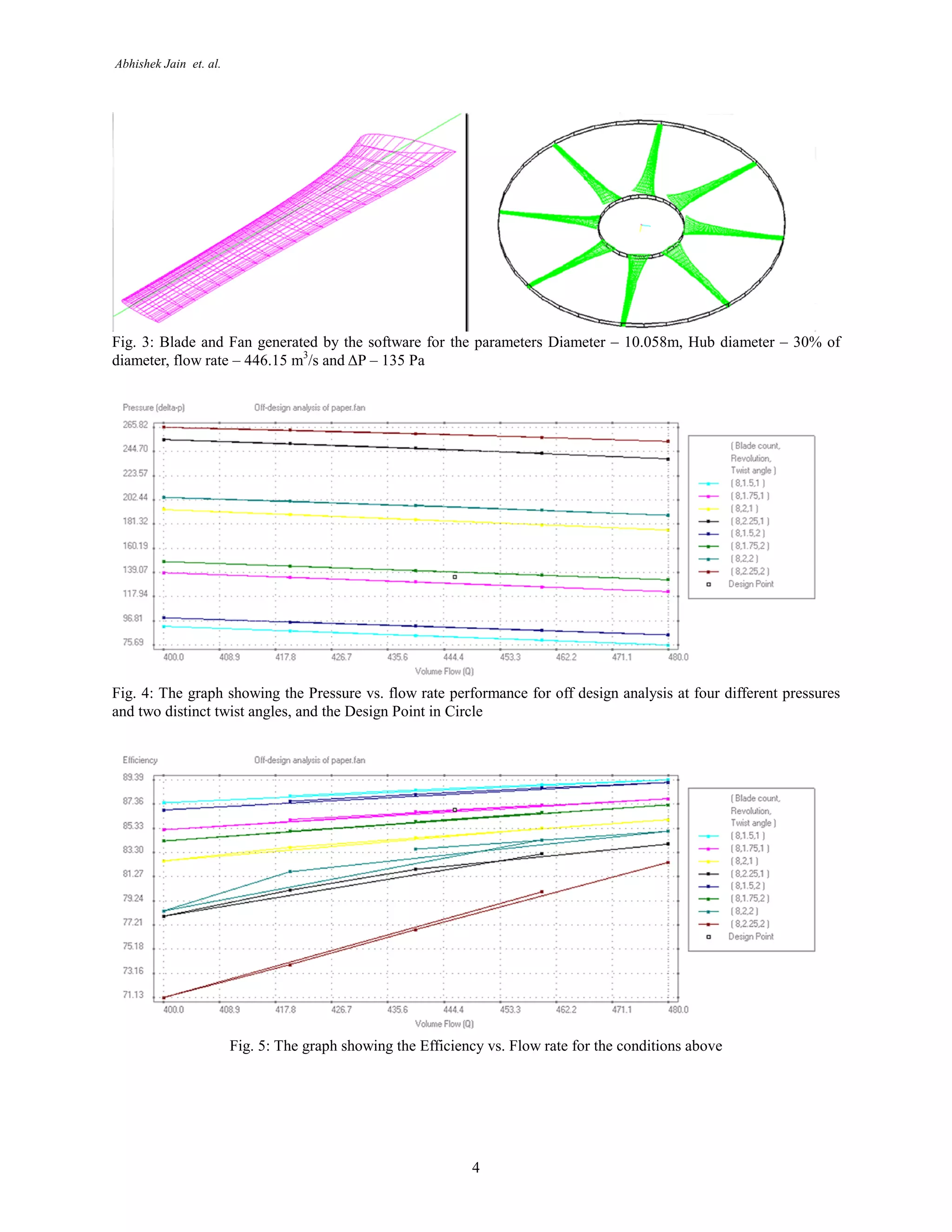
Cooling tower fan has been designed using the inputs
as given: Diameter – 10.058m, Hub diameter – 30% of
diameter, flow rate – 446.15 m3
/s and ΔP – 135 Pa. It
has been seen that 23012 airfoil is suitable for these
shapes and hence that same has been used to design the
fan. Maximum efficiency possible predicted has been
86.84%. In practice it has been seen that the results
have been consistently over predicted by 5-7% based
on the actual efficiency measured. It is important that
the over prediction is consistent and hence the designer
is in the know of actual efficiency. Fig. 3 shows the
blade of the fan and the fan that is generated for the
above case.
4.2. Off-design performance
Industry does not always have the same performance
requirement from the fan. Change in the heat load may
require significant alteration on the working of the fan
e.g. lower heat production may require the fan to
temporarily slow down. Performance of the fan in
these conditions has to be studied and the same has
been done for variation of various properties. The
design can be obtained for a variety of RPMs, flow
rates and a typical result is shown in Fig. 4. The graph
contains a pressure vs. flow rate for variation of five
flow rates, two additional twists and four different
rotational speeds. Fig. 5 shows the same for efficiency
vs. flow rate.
5. CONCLUSIONS
It is seen that the design of low speed axial fans with
cooling tower and other flow applications is possible.
The implemented procedure has been tested and the
manufactured fans show a predictable behavior
compared to the theoretical data. With the proving of
base codes it is advisable to extend the methodology to
other applications of axial flow such as small diameter
fans, propellers at high speed and possibly to radial
flow applications. No marked difference has been seen
with the variation of number of blades in the
performance of the fan. The same has been reported in
[4].
6. REFERENCES
[1] Ingram, Grant. "Wind Turbine Blade Analysis
using the Blade Element Momentum Method. Version
1.0." (2005): 1-21.
[2] Wallis, R. A., and F. I. E. Aust. "A Rationalized
Approach to Blade Element Design, Axial Flow Fans.
Institute of Engineers." Australia Conference on
Hydraulic and Fluid Mechanics. 1968.
[3] D.J, Auld, and Srinivas K. "Aerodynamics for
Students." Aerodynamics for Students. University of
Sydney, n.d. Web.
[4] “Basics of Axial flow Fans”, M0100-186 5M
W1/00, Hudson Product Corporation, 2000
Abhishek Jain et. al.
4
Fig. 3: Blade and Fan generated by the software for the parameters Diameter – 10.058m, Hub diameter – 30% of
diameter, flow rate – 446.15 m3
/s and ΔP – 135 Pa
Fig. 4: The graph showing the Pressure vs. flow rate performance for off design analysis at four different pressures
and two distinct twist angles, and the Design Point in Circle
Fig. 5: The graph showing the Efficiency vs. Flow rate for the conditions above

Development of Software for Sizing of Axial Flow Fans -- Zeus Numerix

  • 1.
    International Conference onComputer Aided Engineering (CAE-2013) Department of Mechanical Engineering, IIT Madras, India 1 Development of Software for Sizing of Axial Flow Fans Abhishek Jain 1 , Ketan Bhokray 2 1 Zeus Numerix Pvt Ltd, Pune, Maharashtra, India, 411057 2 IIT Bombay, Mumbai, Maharashtra, India, 400076 *Corresponding Author  abhishek@zeusnumerix.com ABSTRACT Axial fans have numerous applications in Industry. Large axial fans are used in cooling towers and even the propeller of an aircraft is an axial fan though in a different flow physics. Since these fans require economical and fast installation at various places, their design cycle has to be less time consuming. Software has been designed using the blade momentum theory to design the axial flow fans bounded by tubes. The software is able to design large cooling tower fans and has provided results that predict the performance between 5-7%. Keywords: Axial fan, cooling tower, blade momentum theory, efficiency 1. MOTIVATION Axial flow fans are capable of producing high volume flows rates at low pressure rise. They are extensively used in process industry and energy sector. Even rudimentary analysis of axial flow fans produces efficiencies better than meticulously designed radial flow fans. No wonder that they are extensively used in industry. In the industry, axial fans are classified mostly by the materials of construction of their blades clearly indicating the emphasis is on cost of procurement rather than the operating cost. With the emphasis on energy savings and efficiency, the material used for the blades, which also accounts for the major cost is becoming less important. The aerodynamically designed fan is gaining more importance and engineers in various sectors are demanding rigorous scientific basis for sizing and theoretical performance from the manufacturers. Naturally there is a need for tools and software capable for design and performance estimation of axial fans. The software should be affordable, simple to use and it should cater to a large number of manufacturers. This paper explains simple software aimed toward improving efficiency of axial flow fans to be developed by scores of fabricators who are unable to accept the duration and cost incurred in design and development of axial fans. Since most industrial fans are ducted the software is mainly aimed at only ducted fans, extensively used in ventilation, heat exchangers and air-conditioning. 2. INTRODUCTION Axial Flow fans belong to a class of machines called “turbo-machines”, where energy is either extracted from or injected into fluid streams. Therefore, fundamentally, the turbo-machinery flow is unsteady as energy in the flow stream can’t be stationary with time. This has led to engineers using simpler methods of analysis and design, as unsteady problem are an order of magnitude difficult compared to steady state problems. In fact, traditionally, the turbo-machines are designed using “fan laws”, having their roots in Buckingham theorem for arriving at non-dimensional numbers based on zeroth – dimensional flow-analysis methods. To improve the accuracy experimental correlations are used to correct for the limitations of fan laws. For axial cooling fans there are three non- dimensional quantities: the flow coefficient, the pressure coefficient, and the power coefficient. Arguably, there are methods which take care of the finer physics and hence accuracy of analysis to improve the analysis and design of turbo-machinery. The two alternate methods could be (a) usage of instruments such as laser Doppler velocimetry or particle image velocimetry in experimental set-ups and (b) numerical solution of unsteady Navier Stokes equations valid for complex geometry with realistic boundary conditions. But both these approaches are costly and require high initial investment and highly skilled manpower as operational cost. 3. FAN DESIGN AND ANALYSIS An axial-flow fan is essentially a low-pressure compressor having high space–chord (solidity) ratio.
  • 2.
    Abhishek Jain et.al. 2 Therefore, a simplified theoretical approach based on isolated airfoil theory, called blade element theory, rather than theories based on velocity triangles, can be used. Similar theories are used for analysis and design of propellers. To improve the accuracy, actuator disk theory [1] and effect of interference between two blades can be included. In blade element theory, it is assumed that fan consists of blades of airfoil shaped cross sections of varying chord but vanishingly small size compared to the radius at the various radial locations as in Fig. 1. The forces on the airfoil section are calculated as lift and drag coefficients based aerodynamic characteristics of the chosen airfoil section. The two dimensional loads are integrated along the radius to calculate the thrust and torque on the blades. These quantities are multiplied by an integer equal to the number of blades in the fan. Thrust on the all the blades is divided by the area swept by the blades to get the total pressure rise across the fan by conservation. The novel feature of the methodology incorporated in the code is the interference effects from adjacent blades in modifying the lift curve slope of the airfoil by a factor considered in detail by Wallis [2]. 3.1. Equations An airfoil section of a blade of length R , at radial distance r from the hub of the fan and a thickness dr as illustrated in Fig. 2, obtained from [3], is considered for analysis Fig. 2: The lateral view of an axial flow fan showing different flow parameters.  is the geometric pitch angle of the cross section,  is the angle of attack the flow makes with this cross-section. lift and drag are the force vectors normal to and tangential to the cross section thrust, torque/radius are forces perpendicular and parallel to the surface of the fan. 0V and 2V are the magnitudes of the axial and tangential velocities of the flow at the section, 1V being their resultant The difference in angle between thrust and lift directions is given by  =   The density of the air is  The Velocities 0V and 2V are obtained from the Mass Flow Rate m and the Flow Angular Velocity  at the section 20 .. R m V   (1) RV .2  (2) From the velocity vector triangle 0V , 1V and 2V 2 2 2 01 VVV  (3)        2 0 tan V V a (4) From the force vector triangle, the torque/radius is observed to be )sin()cos(  LDQ  (5) The flow angular velocity is then obtained from the torque/radius R m Q .  (6) Fig. 1: The blades of an axial flow fan are assumed to be made of airfoil shaped cross sections with the same airfoil throughout but different with chord lengths at different radial positions
  • 3.
    Development of Softwarefor Sizing of Axial Flow Fans 3 RVdrR Q ...2 0    (7) There now exists a nonlinear system of equations (1), (2), (3), (4), (5), and (7) containing the primary unknown variables Q ,  ,  , 2V and 1V . So, an iterative solution to this system is possible by initially substituting  by the Fan Angular Velocity f . The torque thus obtained is for a single section. The torque on the whole blade is then obtained by adding the elemental quantity and Q for all the sections. 4. RESULTS AND DISCUSSION The software has been configured to: (1) Design of high efficiency fan (2) Off-design analysis of a fan, (3) Performance prediction of fan made of given blades. For design the user requirements are to be known. These are dictated usually by the space constraint, amount of heat to be taken out, availability of pre- manufactured components, manufacturability of airfoil sections, availability of motor and gear ratios etc. These constraints in turn technically decide (a) total and hub diameter, (b) volume flow rate, (c) pressure rise, (d) rpm, (e) airfoil section and (f) number of blades (g) bounds of angle of attack. The software has an automatic module for trying various settings to arrive at the performance of the fan for maximum efficiency. The fan can then be exported to AutoCAD DXF file format in 3D and each section to be provided directly to the manufacturing process. Besides efficiency which is the main concern, the software also provides the torque, thrust, power required and the sound level. 4.1. Fan Design Cooling tower fan has been designed using the inputs as given: Diameter – 10.058m, Hub diameter – 30% of diameter, flow rate – 446.15 m3 /s and ΔP – 135 Pa. It has been seen that 23012 airfoil is suitable for these shapes and hence that same has been used to design the fan. Maximum efficiency possible predicted has been 86.84%. In practice it has been seen that the results have been consistently over predicted by 5-7% based on the actual efficiency measured. It is important that the over prediction is consistent and hence the designer is in the know of actual efficiency. Fig. 3 shows the blade of the fan and the fan that is generated for the above case. 4.2. Off-design performance Industry does not always have the same performance requirement from the fan. Change in the heat load may require significant alteration on the working of the fan e.g. lower heat production may require the fan to temporarily slow down. Performance of the fan in these conditions has to be studied and the same has been done for variation of various properties. The design can be obtained for a variety of RPMs, flow rates and a typical result is shown in Fig. 4. The graph contains a pressure vs. flow rate for variation of five flow rates, two additional twists and four different rotational speeds. Fig. 5 shows the same for efficiency vs. flow rate. 5. CONCLUSIONS It is seen that the design of low speed axial fans with cooling tower and other flow applications is possible. The implemented procedure has been tested and the manufactured fans show a predictable behavior compared to the theoretical data. With the proving of base codes it is advisable to extend the methodology to other applications of axial flow such as small diameter fans, propellers at high speed and possibly to radial flow applications. No marked difference has been seen with the variation of number of blades in the performance of the fan. The same has been reported in [4]. 6. REFERENCES [1] Ingram, Grant. "Wind Turbine Blade Analysis using the Blade Element Momentum Method. Version 1.0." (2005): 1-21. [2] Wallis, R. A., and F. I. E. Aust. "A Rationalized Approach to Blade Element Design, Axial Flow Fans. Institute of Engineers." Australia Conference on Hydraulic and Fluid Mechanics. 1968. [3] D.J, Auld, and Srinivas K. "Aerodynamics for Students." Aerodynamics for Students. University of Sydney, n.d. Web. [4] “Basics of Axial flow Fans”, M0100-186 5M W1/00, Hudson Product Corporation, 2000
  • 4.
    Abhishek Jain et.al. 4 Fig. 3: Blade and Fan generated by the software for the parameters Diameter – 10.058m, Hub diameter – 30% of diameter, flow rate – 446.15 m3 /s and ΔP – 135 Pa Fig. 4: The graph showing the Pressure vs. flow rate performance for off design analysis at four different pressures and two distinct twist angles, and the Design Point in Circle Fig. 5: The graph showing the Efficiency vs. Flow rate for the conditions above