1Build-to-Specifications | Product Approval | Engineering Services | Software Development
Numerical Modeling Of Radar
Absorbing Materials
RAM simulations
V3
2
©ZeusNumerixPvtLtd:ConfidentialDocument
Contents
19-Jul-2019 Numerical Modeling Of Radar Absorbing Materials
 Design of radar absorbing materials
 Why pure materials do not work as RAM, need for composite materials
 Calculation of effective properties of composite medium using various effective
medium models along with examples of simulation
 Simulation of random simulation and use of CEM methods in effective medium
theory along with example of simulation
2
3
©ZeusNumerixPvtLtd:ConfidentialDocument
RADAR Absorbing Materials
19-Jul-2019 Numerical Modeling Of Radar Absorbing Materials
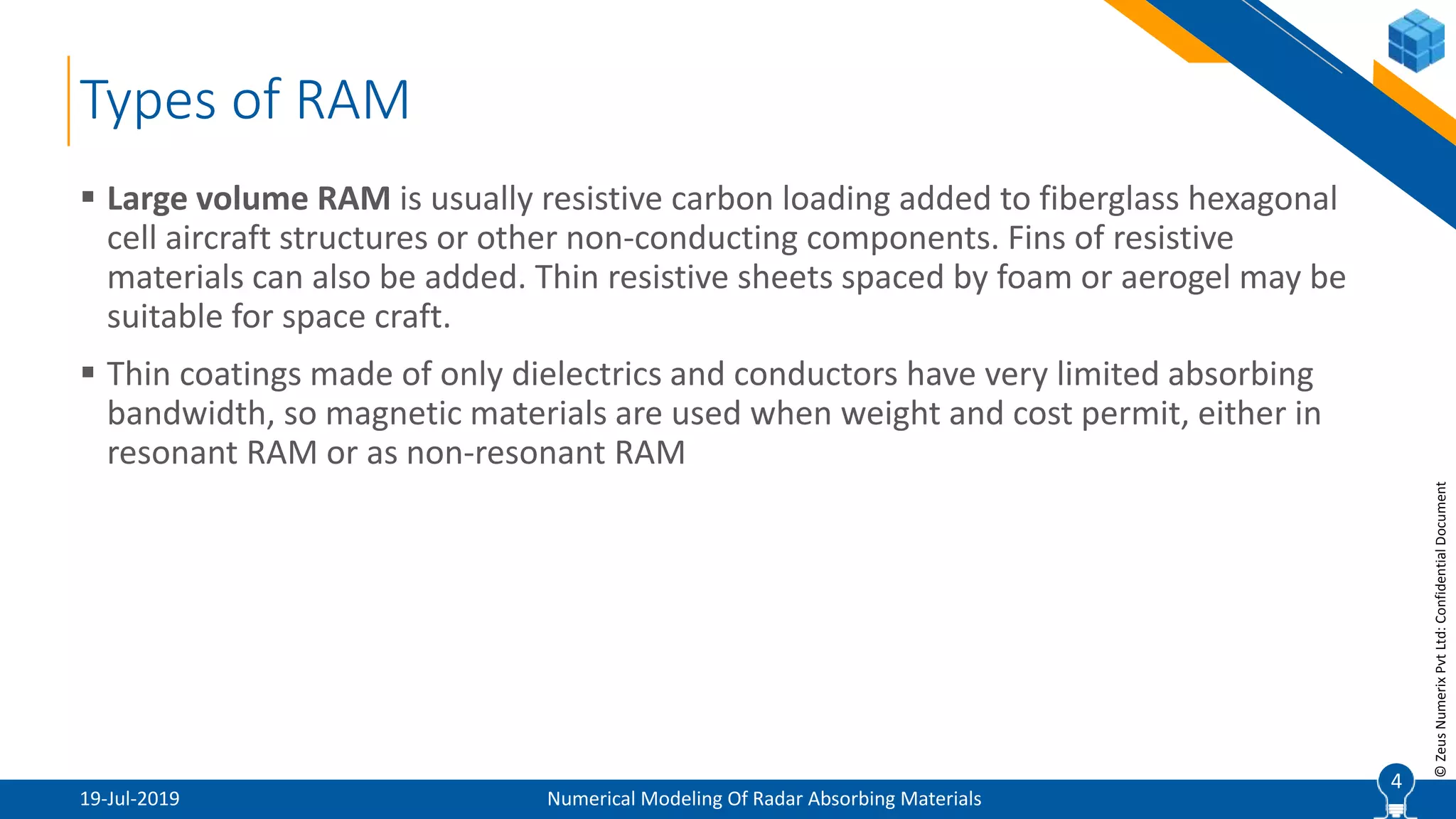
 Radar cross section has implications to survivability and mission capability
 The materials for reduction of radar cross section rely on magnetic permeability and
electric permittivity, while principles from physical optics are used to design absorber
structure. It is a combination of optics and materials that lead to signature reduction
 Advanced techniques are used for absorber optimization
 Radar absorbers can be classified as impedance matching or resonant absorbers
 Dynamic absorbers should be studied in order to counter frequency agile radars
3
4
©ZeusNumerixPvtLtd:ConfidentialDocument
Types of RAM
19-Jul-2019 Numerical Modeling Of Radar Absorbing Materials
 Large volume RAM is usually resistive carbon loading added to fiberglass hexagonal
cell aircraft structures or other non-conducting components. Fins of resistive
materials can also be added. Thin resistive sheets spaced by foam or aerogel may be
suitable for space craft.
 Thin coatings made of only dielectrics and conductors have very limited absorbing
bandwidth, so magnetic materials are used when weight and cost permit, either in
resonant RAM or as non-resonant RAM
4
5
©ZeusNumerixPvtLtd:ConfidentialDocument
Types of RAM
19-Jul-2019 Numerical Modeling Of Radar Absorbing Materials
 Resonant but somewhat 'lossy' materials are applied to the reflecting surfaces of the
target. The thickness of the material corresponds to /4 of the incident radar-wave.
The incident radar energy is reflected from the outside and inside surfaces of the
RAM to create a destructive wave interference pattern. Deviation from the resonant
frequency will cause losses in radar absorption, so this type of RAM is only useful
against radar with a single frequency
 Non-resonant magnetic RAM uses ferrite particles suspended in epoxy or paint to
reduce the reflectivity of the surface to incident radar waves. Because the non-
resonant RAM dissipates incident radar energy over a larger surface area, it usually
results in a trivial increase in surface temperature, thus reducing RCS at the cost of
an increase in infrared signature. A major advantage of non-resonant RAM is that it
can be effective over a wide range of frequencies, whereas resonant RAM is limited
to a narrow range of design frequencies.
5
6
©ZeusNumerixPvtLtd:ConfidentialDocument
Design of RAM
19-Jul-2019 Numerical Modeling Of Radar Absorbing Materials
 Requires application of electromagnetic theory and CEM along with Materials
Science and statistical principles (For modelling random heterogenous media)
 EM theory requires impedance matching at interface between free space and
coating of RAM on PEC- This is possible only if = for the RAM material
 Pure ferrites have  ~ 1 and  ~ 15, hence desirable to disperse ferrite in low 
material (epoxy) for better impedance matching
 Computational problem is thus study of dispersion of particles with specified , in
host matrix with different = as a function of volume/ weight fill factor
 Need to calculate effective properties of this composite medium
 Approximate effective medium theory
6
7
©ZeusNumerixPvtLtd:ConfidentialDocument
Effective Medium Theory
19-Jul-2019 Numerical Modeling Of Radar Absorbing Materials
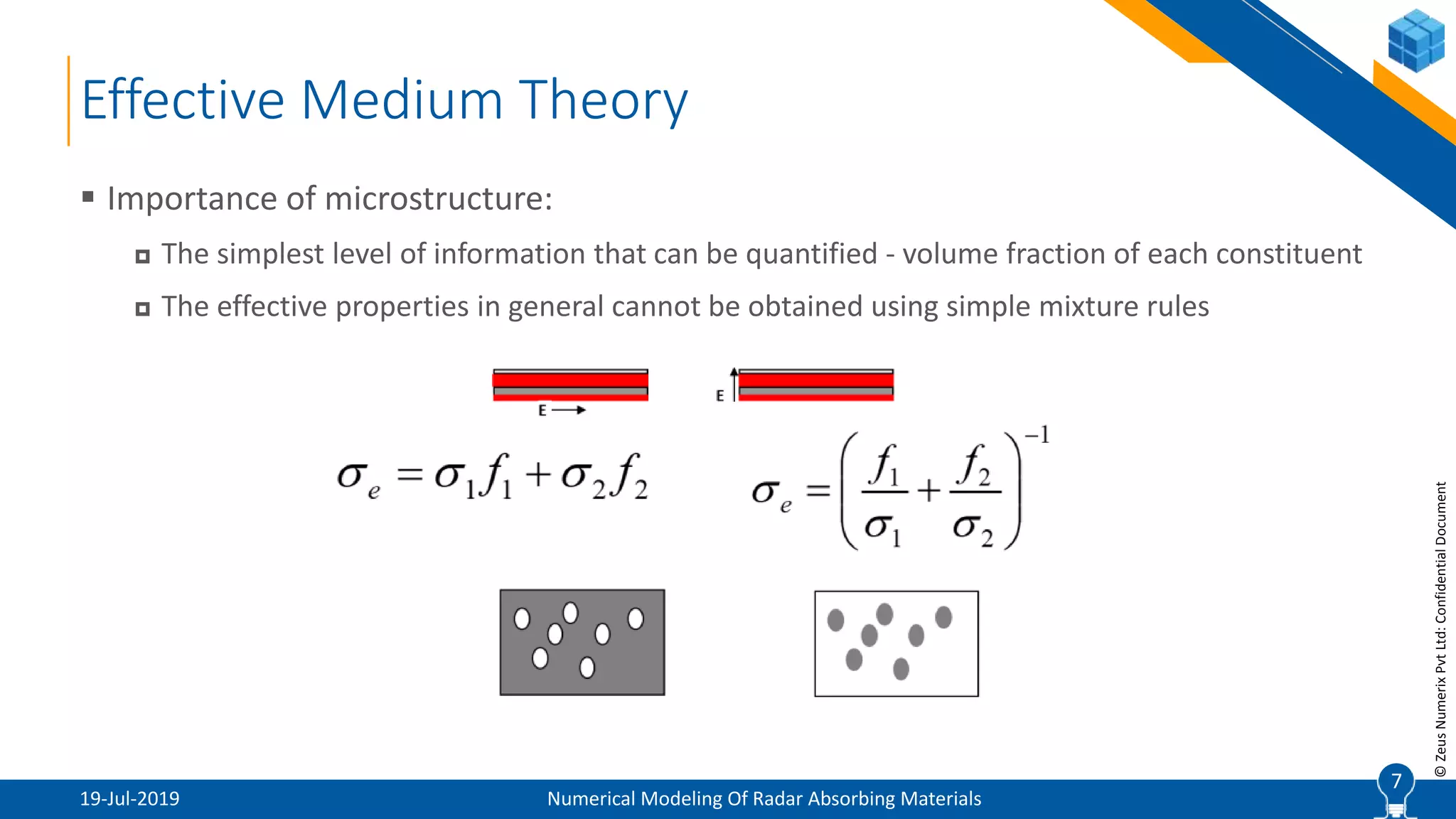
 Importance of microstructure:
 The simplest level of information that can be quantified - volume fraction of each constituent
 The effective properties in general cannot be obtained using simple mixture rules
7
8
©ZeusNumerixPvtLtd:ConfidentialDocument
 Importance of microstructure:
 Various features of the microstructure
 Volume fraction
 Orientation, size and shape of
inclusions
 Spatial distribution of inclusions
 Connectivity of phases etc.
 Quantitatively described by n point
correlation functions
 Cluster formation
 Maxwell Garnett (MG)
 Percolation
 Mainly three models for calculation
of effective properties
 Self consistent approximation (SC)
 Differential effective medium (DEM)
approximation
19-Jul-2019 Numerical Modeling Of Radar Absorbing Materials
8
Effective Medium Theory
9
©ZeusNumerixPvtLtd:ConfidentialDocument
Effective Medium Theory
19-Jul-2019 Numerical Modeling Of Radar Absorbing Materials
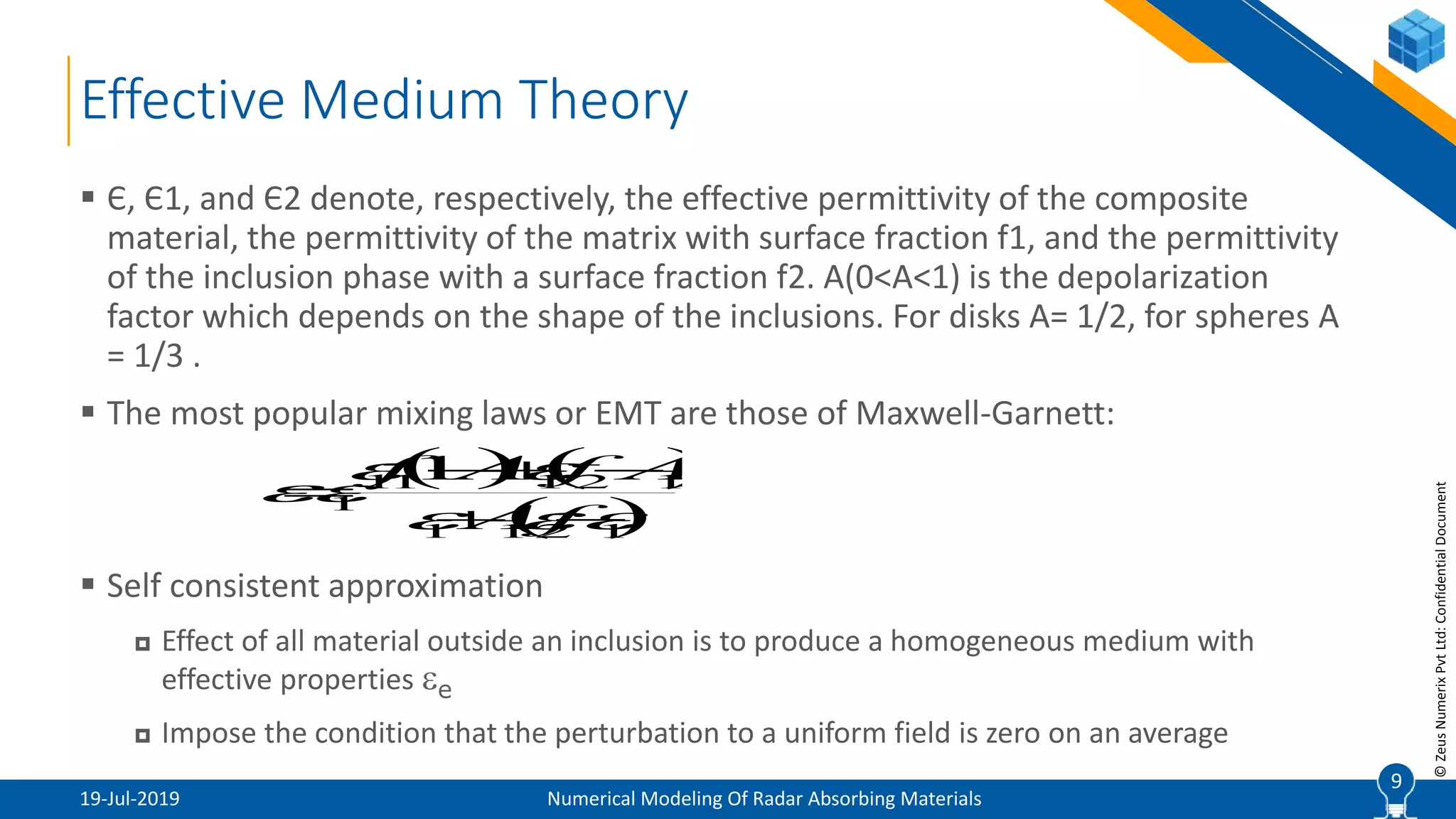
 Є, Є1, and Є2 denote, respectively, the effective permittivity of the composite
material, the permittivity of the matrix with surface fraction f1, and the permittivity
of the inclusion phase with a surface fraction f2. A(0<A<1) is the depolarization
factor which depends on the shape of the inclusions. For disks A= 1/2, for spheres A
= 1/3 .
 The most popular mixing laws or EMT are those of Maxwell-Garnett:
 Self consistent approximation
 Effect of all material outside an inclusion is to produce a homogeneous medium with
effective properties e
 Impose the condition that the perturbation to a uniform field is zero on an average
9
   
 1211
12111
1
1

 


Af
AffAf
10
©ZeusNumerixPvtLtd:ConfidentialDocument
Effective Medium Theory
19-Jul-2019 Numerical Modeling Of Radar Absorbing Materials
 Differential Effective Medium Approximation (DEM):
 Similar to SC approximation (incremental homogenization)
 Phase 2 treated as matrix phase with volume fraction v2 and property 2
 Phase 1 with volume fraction f1 property 1 is treated as filler
 Assume the effective property e (f1) known
 Treat e (f1) as host matrix dielectric constant and lete(f1+f1) represent
effective property after a fraction f1 (1- f1 ) has been replaced by inclusion of
phase 1
 Using the dilute inclusion formula obtain a differential equation for e with
initial condition e (f1=0) = 2.
 Solve the differential equation to get the effective properties
10
11
©ZeusNumerixPvtLtd:ConfidentialDocument
Effective Medium Theory
19-Jul-2019 Numerical Modeling Of Radar Absorbing Materials
 In general Maxwell and DEM approximation fail for dispersion which forms clusters
 SC approximation gives better results in such cases
 Summary :
 Maxwell approximation works only for dilute dispersions
 SC works only for dispersion with phase inversion symmetry in which no connectivity exists
between any phase It can consider cluster formation
 DEM works well even for connected phase even in high concentration but can not account
for clusters
11
12
©ZeusNumerixPvtLtd:ConfidentialDocument
Effective Medium Theory
19-Jul-2019 Numerical Modeling Of Radar Absorbing Materials
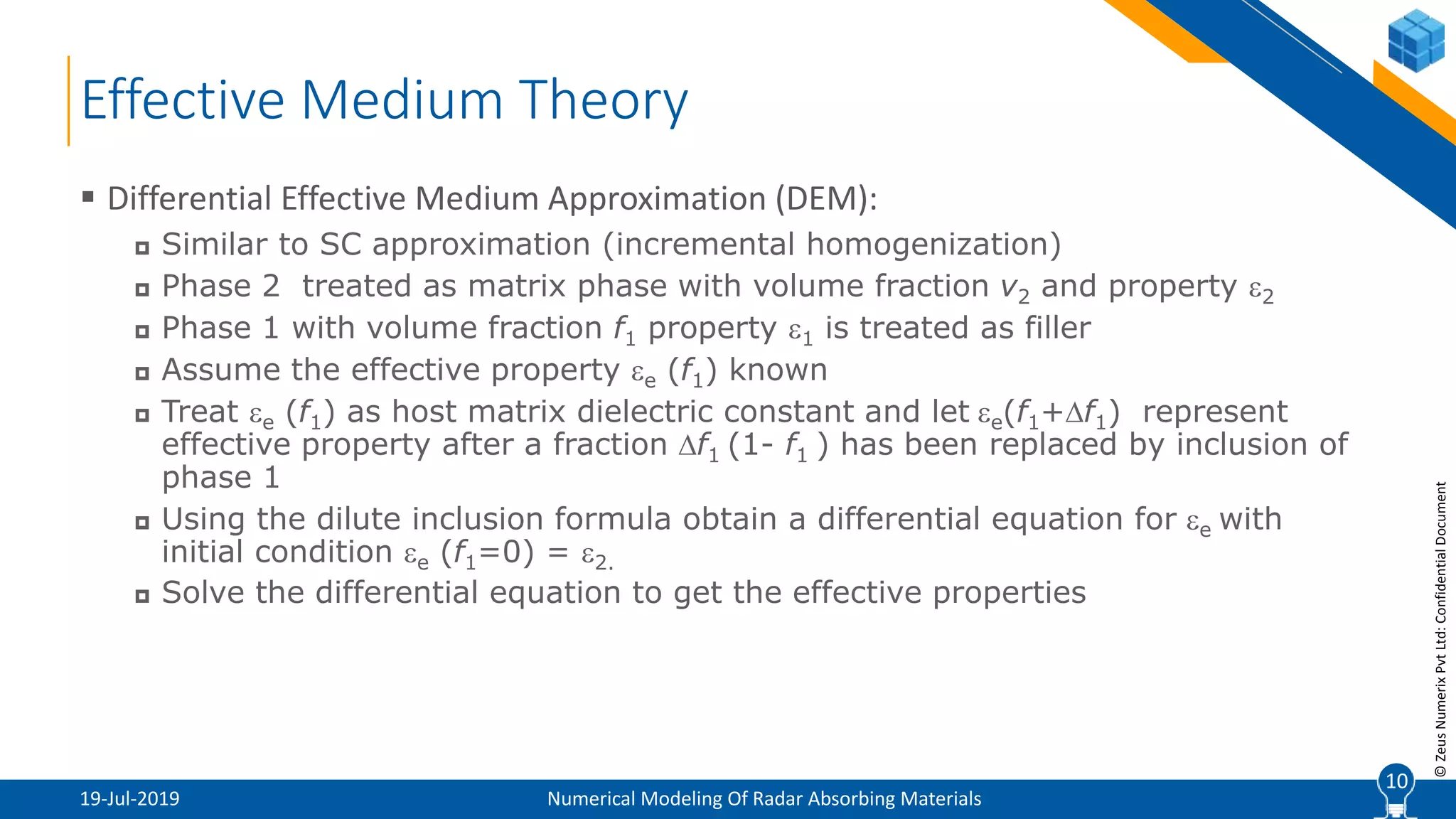
 Filler prolate spheroid aspect ratio = 1 (spherical)
12
13
©ZeusNumerixPvtLtd:ConfidentialDocument
Effective Medium Theory
19-Jul-2019 Numerical Modeling Of Radar Absorbing Materials
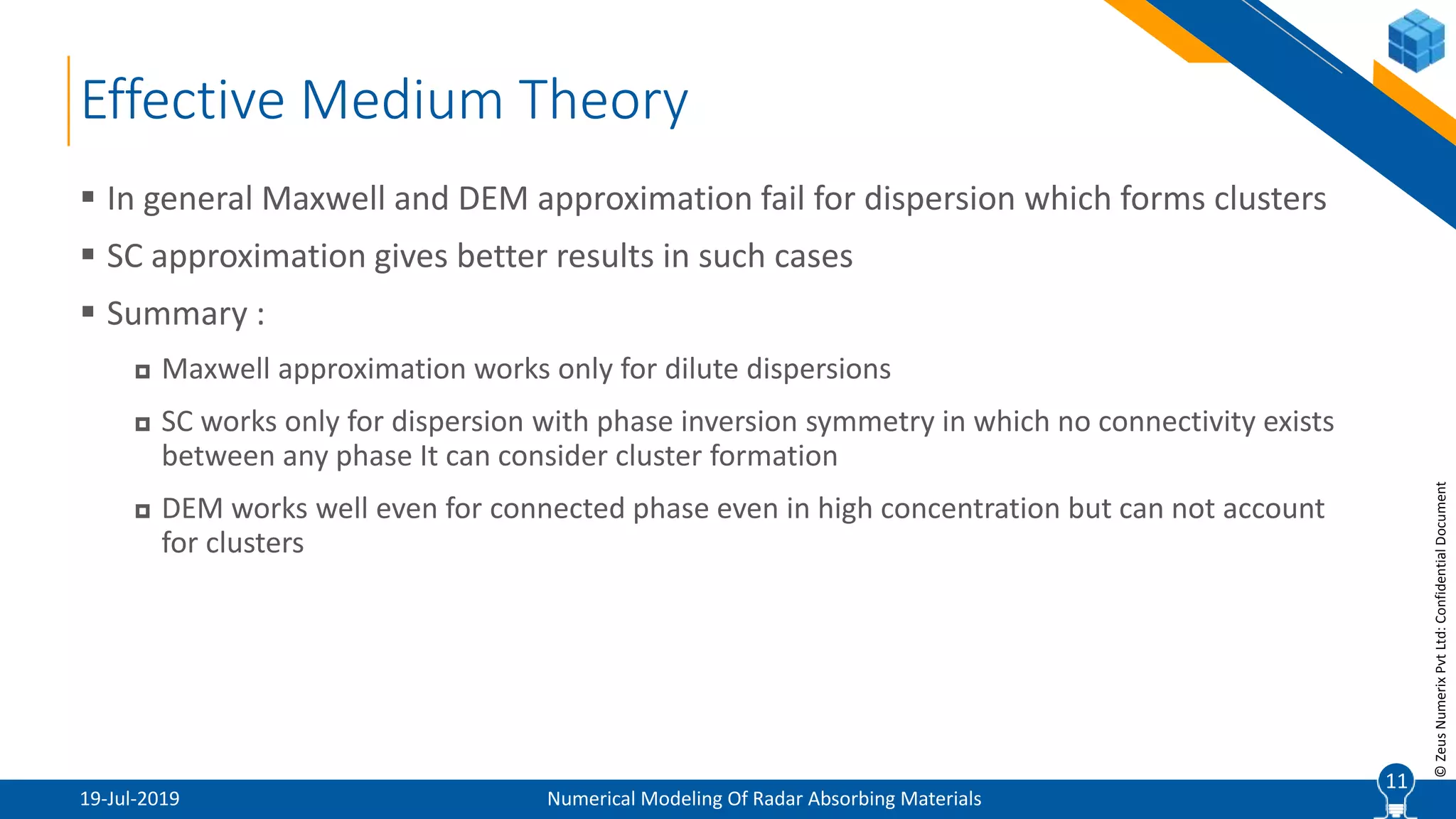
 Filler prolate spheroid aspect ratio = 1.5
13
14
©ZeusNumerixPvtLtd:ConfidentialDocument
Effective Medium Theory
19-Jul-2019 Numerical Modeling Of Radar Absorbing Materials
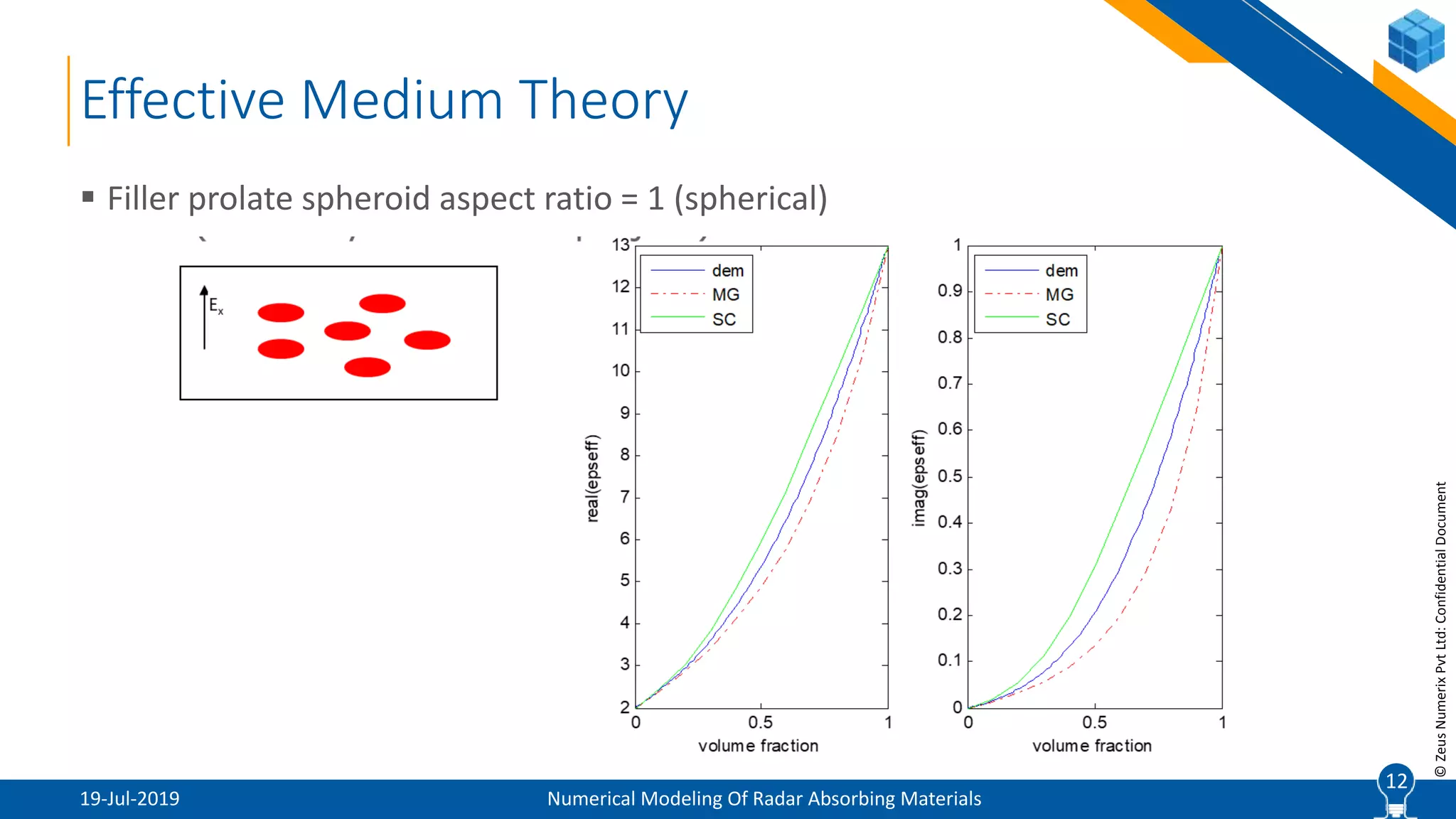
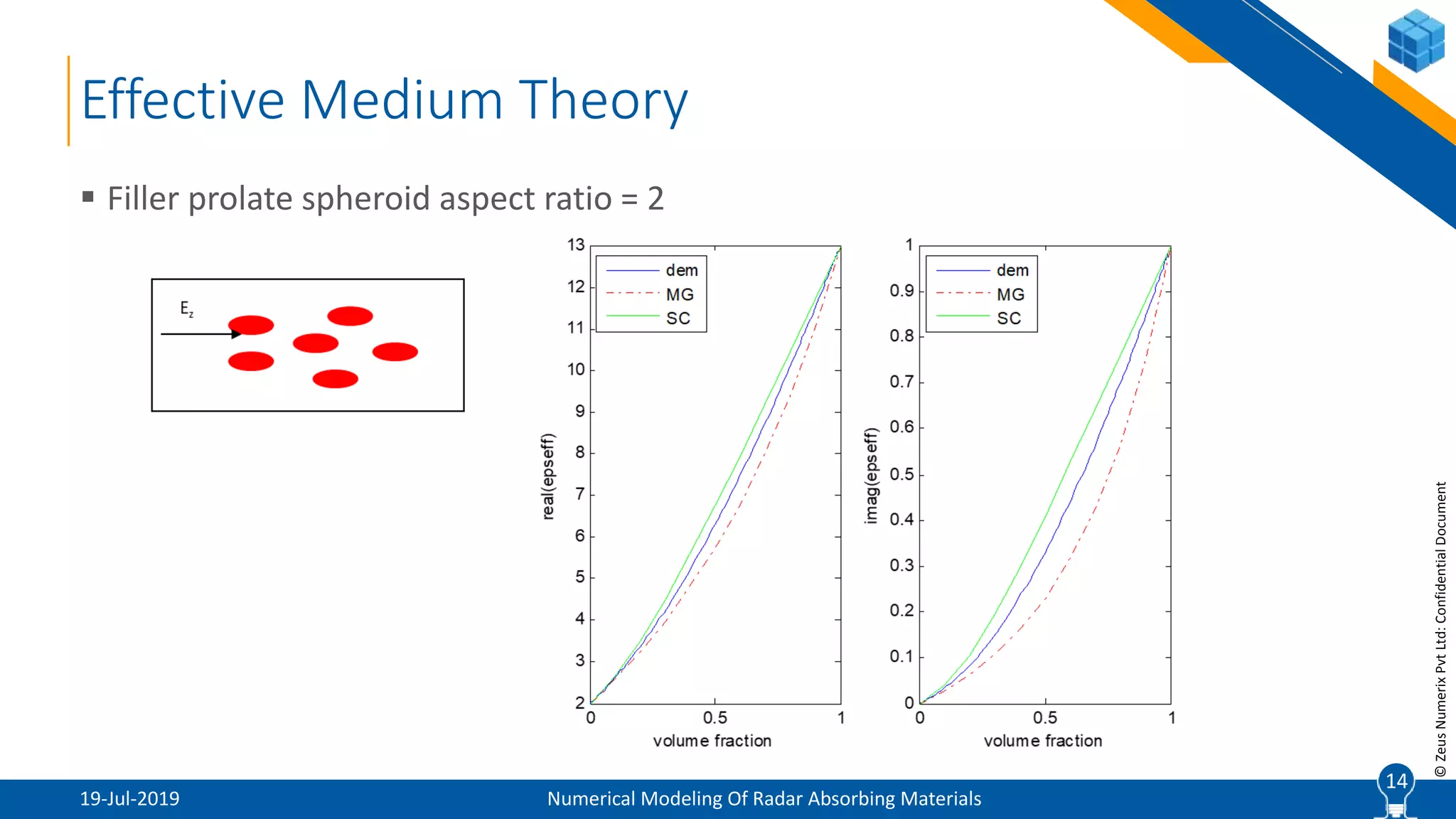
 Filler prolate spheroid aspect ratio = 2
14
15
©ZeusNumerixPvtLtd:ConfidentialDocument
Effective Medium Theory
19-Jul-2019 Numerical Modeling Of Radar Absorbing Materials
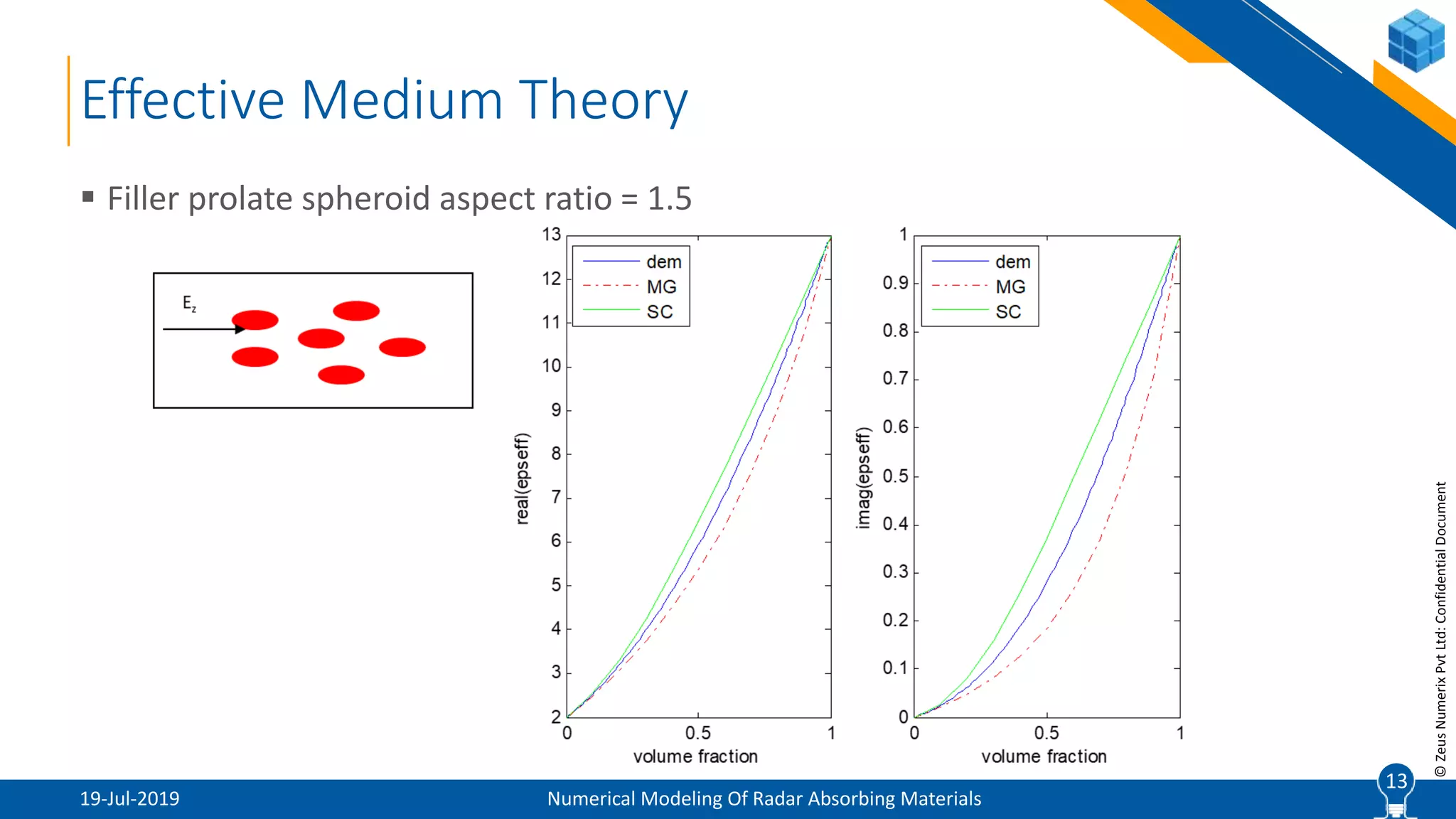
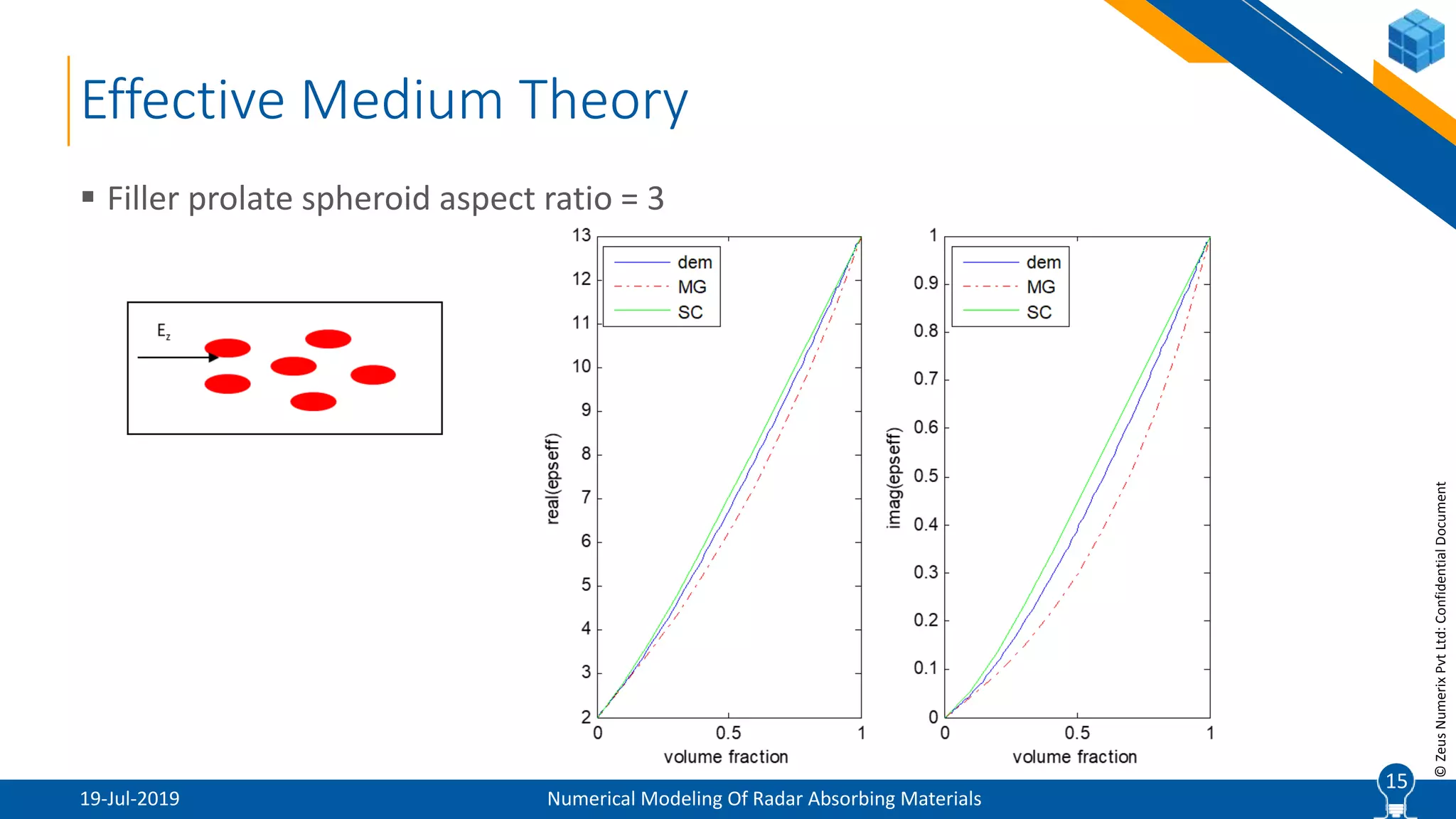
 Filler prolate spheroid aspect ratio = 3
15
16
©ZeusNumerixPvtLtd:ConfidentialDocument
Effective Medium Theory
19-Jul-2019 Numerical Modeling Of Radar Absorbing Materials
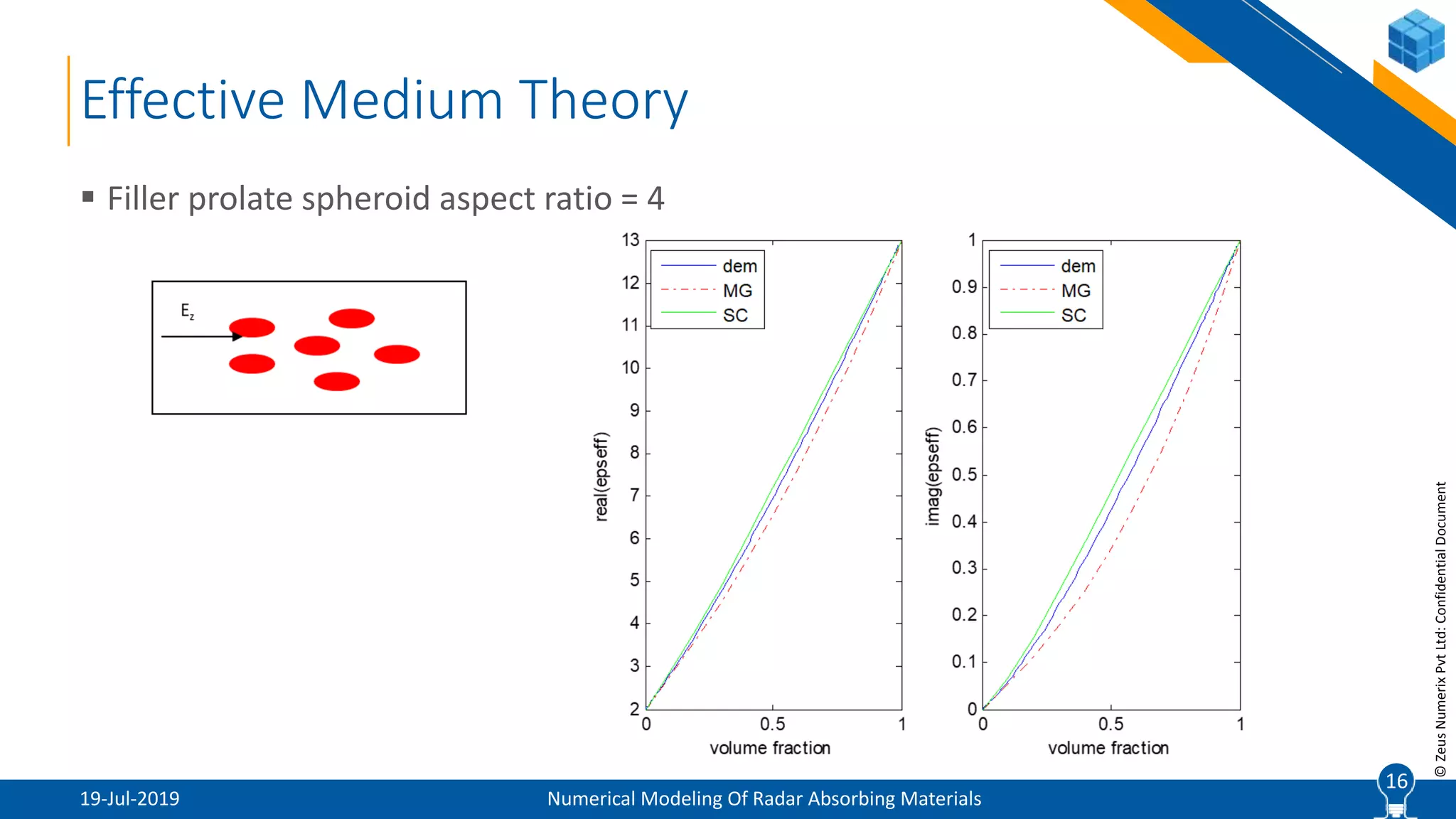
 Filler prolate spheroid aspect ratio = 4
16
17
©ZeusNumerixPvtLtd:ConfidentialDocument
Effective Medium Theory
19-Jul-2019 Numerical Modeling Of Radar Absorbing Materials
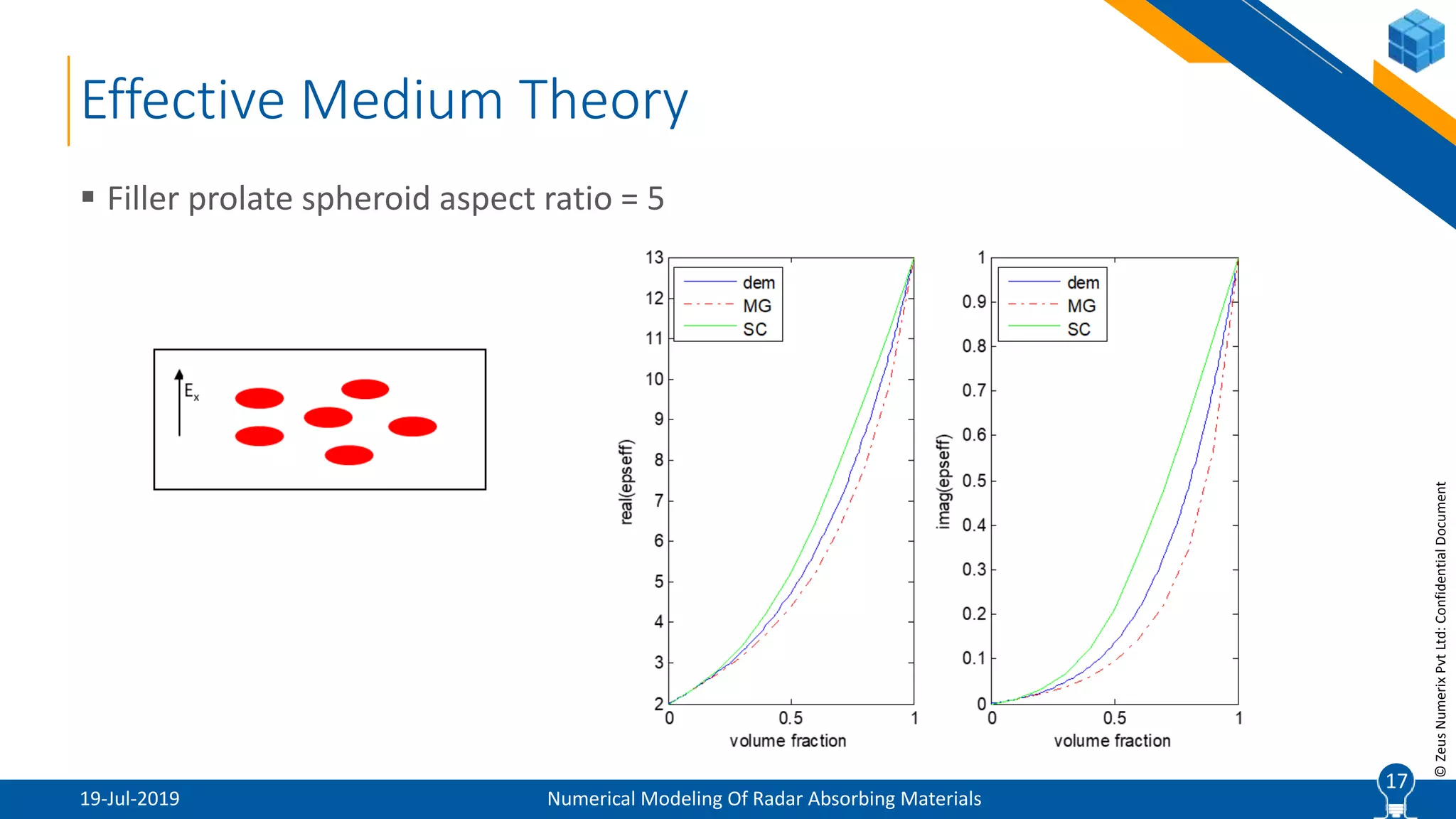
 Filler prolate spheroid aspect ratio = 5
17
18
©ZeusNumerixPvtLtd:ConfidentialDocument
Effective Medium Theory
19-Jul-2019 Numerical Modeling Of Radar Absorbing Materials
 Filler prolate spheroid aspect ratio = 8
18
19
©ZeusNumerixPvtLtd:ConfidentialDocument
Effective Medium Theory
19-Jul-2019 Numerical Modeling Of Radar Absorbing Materials
 Filler prolate spheroid aspect ratio = 10
19
20
©ZeusNumerixPvtLtd:ConfidentialDocument
Effective Medium Theory
19-Jul-2019 Numerical Modeling Of Radar Absorbing Materials
 More accurate values of effective properties can be obtained by computer
simulation by taking into account many particle correlations
 Create various random distributions with a fixed volume fraction of fillers and
checking numerically the correlations
 Can give better estimates of upper and lower bounds
 However, simple model reported above is sufficient for predicting effective
properties for calculating reflection properties of various composites
20
21
©ZeusNumerixPvtLtd:ConfidentialDocument
Effective Medium Theory
19-Jul-2019 Numerical Modeling Of Radar Absorbing Materials
 Statistically based algorithm
 Reconstruct the microgeometry
 Must allow systems with both arbitrary shapes and arbitrary EM characteristics to be
considered
 An initial random configuration of particles in a unit cell is generated
 Variants of traditional 2D METROPOLIS sampling scheme adapted to generate
equilibrated sets of realizations in 3D
 The basic parameters in this model simulation are the length L of the square
primitive cell side, the number N of hard disks, their diameter D, and their surface
fraction f2
21
22
©ZeusNumerixPvtLtd:ConfidentialDocument
Effective Medium Theory
19-Jul-2019 Numerical Modeling Of Radar Absorbing Materials
 After an initial configuration is generated, one attempts to move randomly the
center-of-mass coordinate of each disk. The new configuration is accepted if the
particle does not overlap with any other particles
 This process is repeated until equilibrium is achieved
 To minimize boundary effects due to the finite size of the system, periodic boundary
conditions are employed
22
23
©ZeusNumerixPvtLtd:ConfidentialDocument
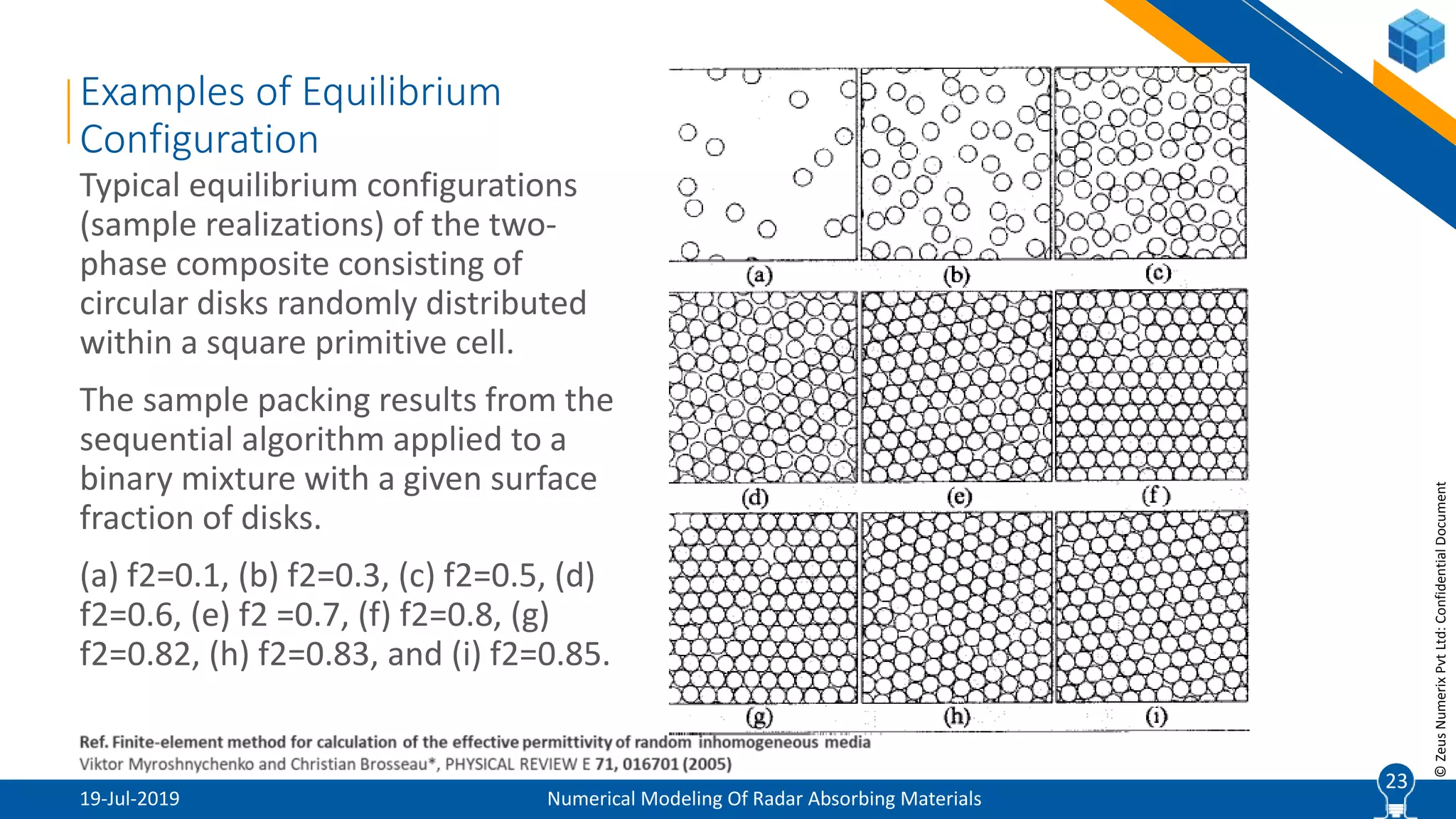
Typical equilibrium configurations
(sample realizations) of the two-
phase composite consisting of
circular disks randomly distributed
within a square primitive cell.
The sample packing results from the
sequential algorithm applied to a
binary mixture with a given surface
fraction of disks.
(a) f2=0.1, (b) f2=0.3, (c) f2=0.5, (d)
f2=0.6, (e) f2 =0.7, (f) f2=0.8, (g)
f2=0.82, (h) f2=0.83, and (i) f2=0.85.
19-Jul-2019 Numerical Modeling Of Radar Absorbing Materials
23
Examples of Equilibrium
Configuration
24
©ZeusNumerixPvtLtd:ConfidentialDocument
Assume cubic shape of inclusion
[Xi, Yj, Zk] coordinates / sites
i = 1,..,Nx
Nx = no. of unit cells along X =
Length of X axis / unit cell dimension along X
axis
j = 1,..,Ny
k = 1,..,Nz
Random nos. along X = ( 3√f * Nx )
f = volume fraction of inclusion
Run random no. generation engine (1+ 3√f *
Ny * 3√f * Nz) times to get 3D profile of
composite
19-Jul-2019 Numerical Modeling Of Radar Absorbing Materials
24
Alternate Method
25
©ZeusNumerixPvtLtd:ConfidentialDocument
19-Jul-2019 Numerical Modeling Of Radar Absorbing Materials
25
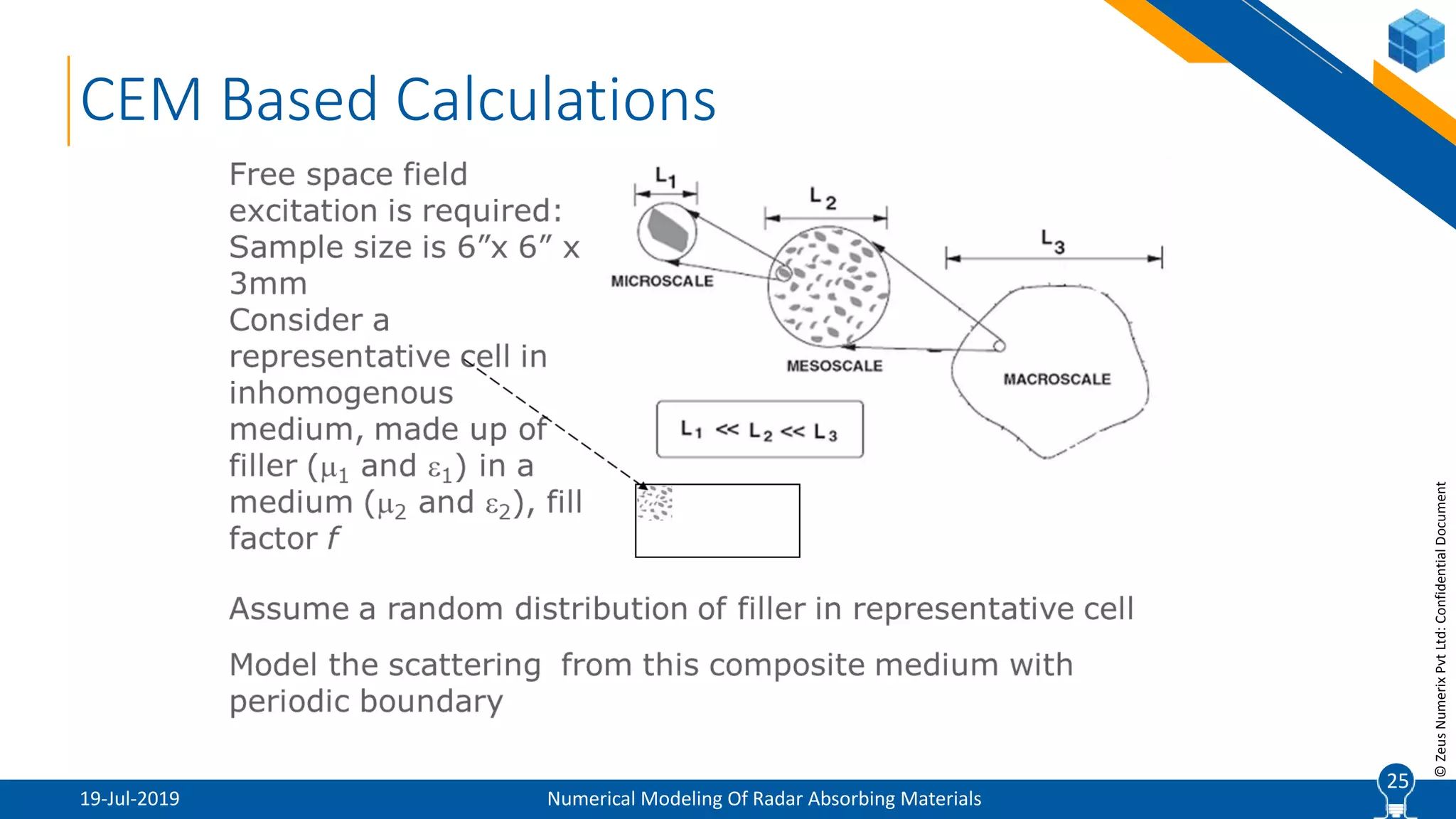
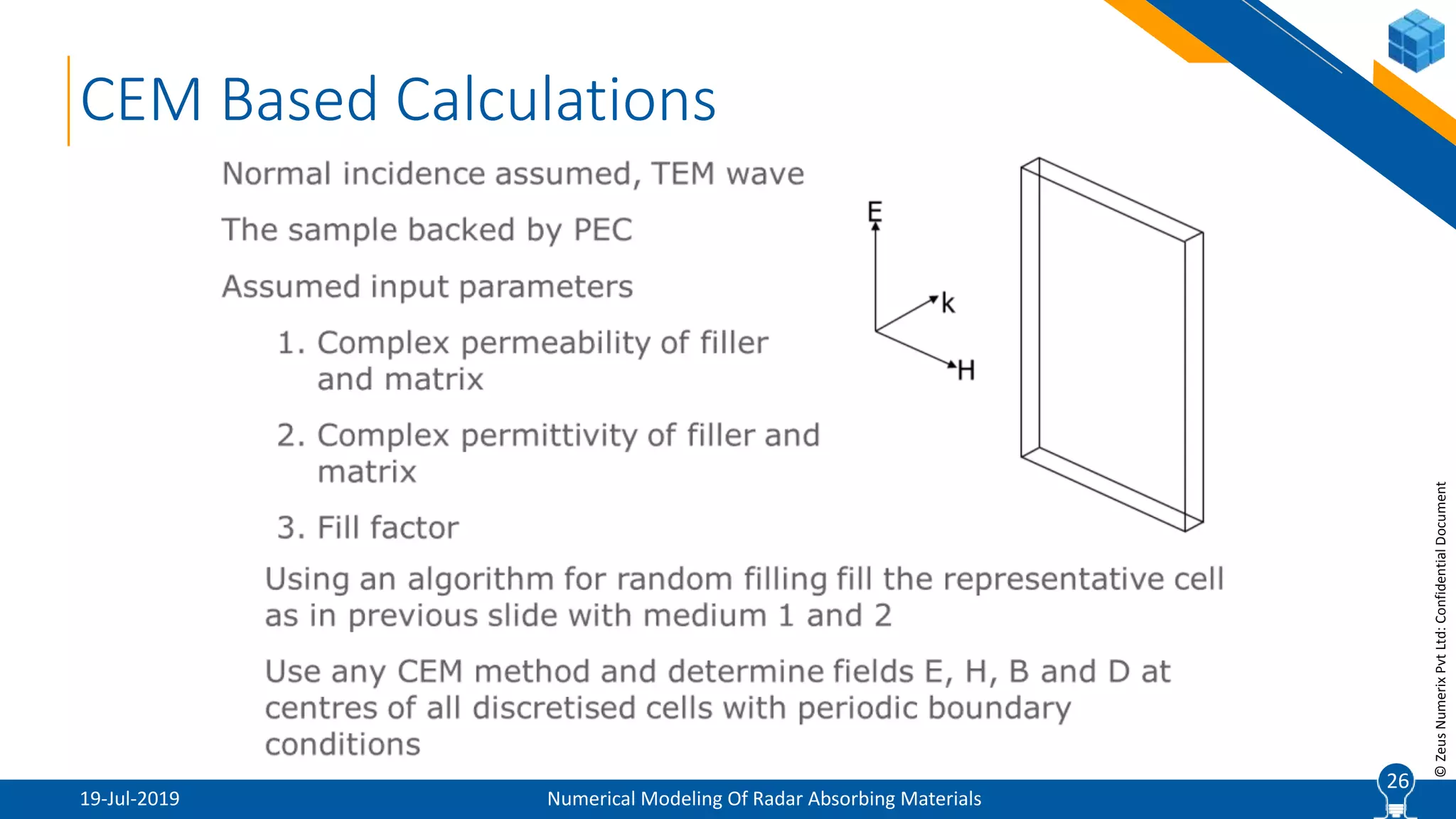
CEM Based Calculations
26
©ZeusNumerixPvtLtd:ConfidentialDocument
19-Jul-2019 Numerical Modeling Of Radar Absorbing Materials
26
CEM Based Calculations
27
©ZeusNumerixPvtLtd:ConfidentialDocument
Methodology
19-Jul-2019 Numerical Modeling Of Radar Absorbing Materials
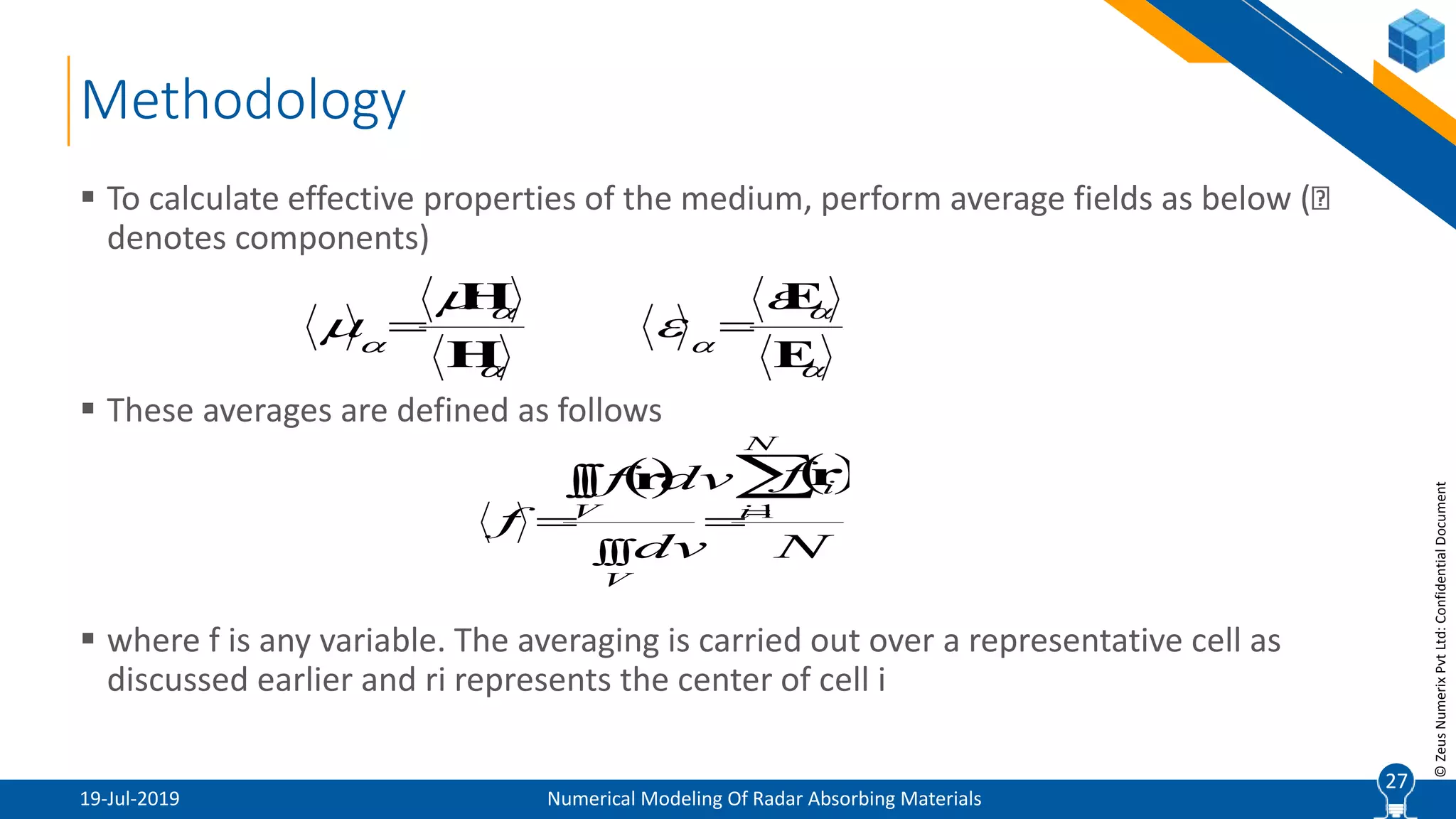
 To calculate effective properties of the medium, perform average fields as below (
denotes components)
 These averages are defined as follows
 where f is any variable. The averaging is carried out over a representative cell as
discussed earlier and ri represents the center of cell i
27





H
H






E
E



 
N
f
dv
dvf
f
N
i
i
V
V

 1
rr
28
©ZeusNumerixPvtLtd:ConfidentialDocument
Methodology
19-Jul-2019 Numerical Modeling Of Radar Absorbing Materials
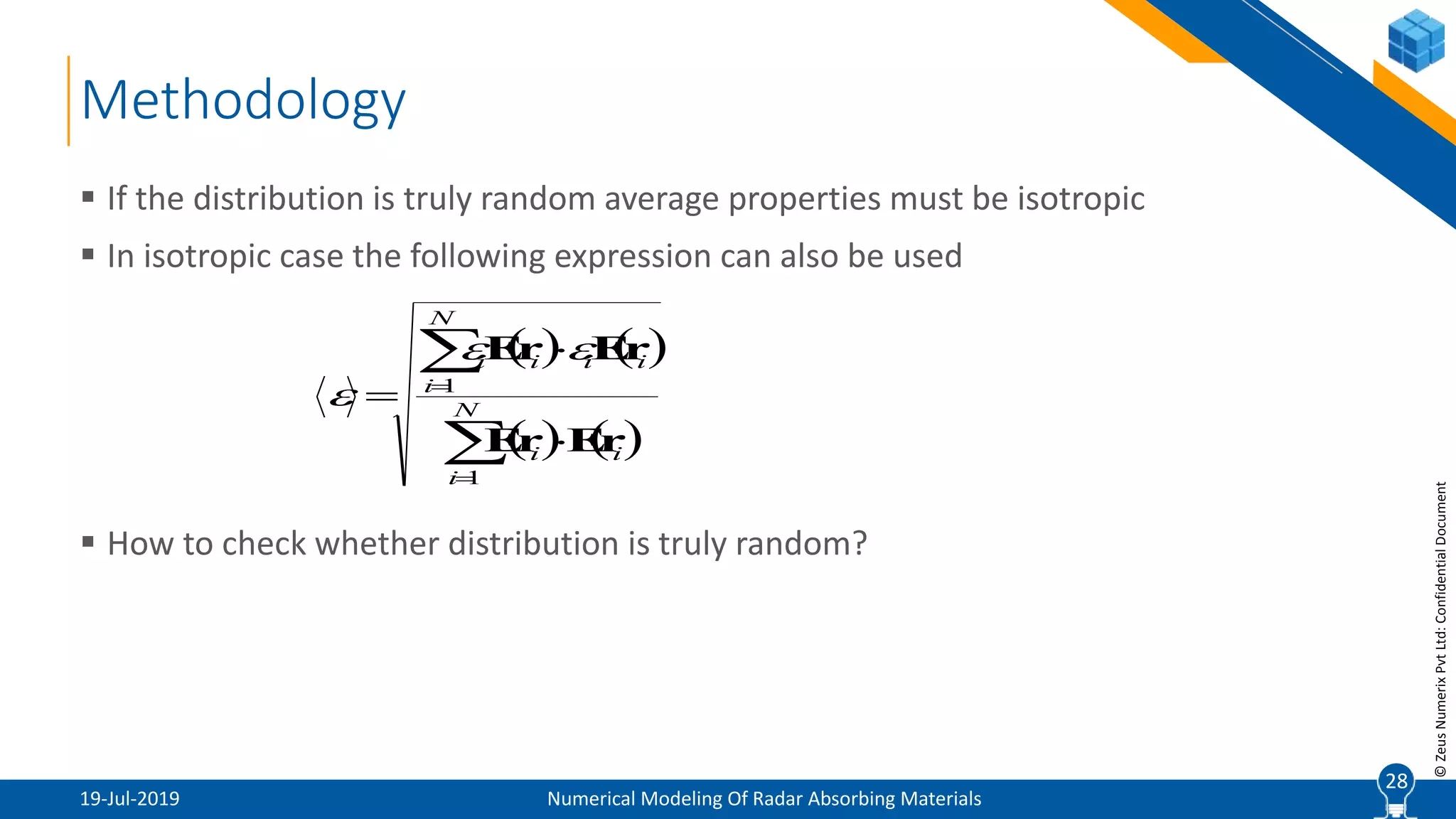
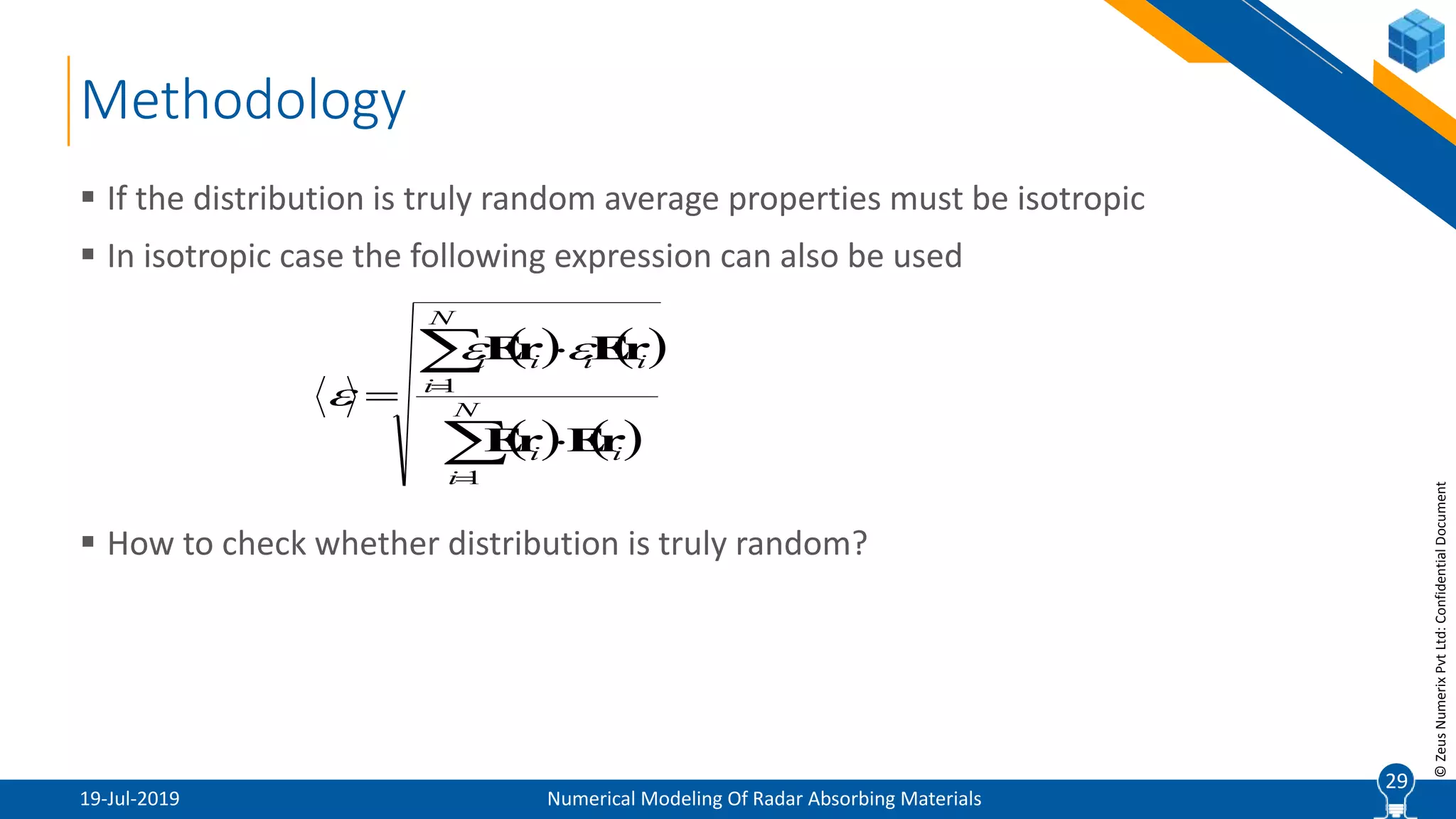
 If the distribution is truly random average properties must be isotropic
 In isotropic case the following expression can also be used
 How to check whether distribution is truly random?
28
   
   





 N
i
ii
N
i
iiii
1
1
rErE
rErE 

29
©ZeusNumerixPvtLtd:ConfidentialDocument
Methodology
19-Jul-2019 Numerical Modeling Of Radar Absorbing Materials
 If the distribution is truly random average properties must be isotropic
 In isotropic case the following expression can also be used
 How to check whether distribution is truly random?
29
   
   





 N
i
ii
N
i
iiii
1
1
rErE
rErE 

30
©ZeusNumerixPvtLtd:ConfidentialDocument
Methodology
19-Jul-2019 Numerical Modeling Of Radar Absorbing Materials
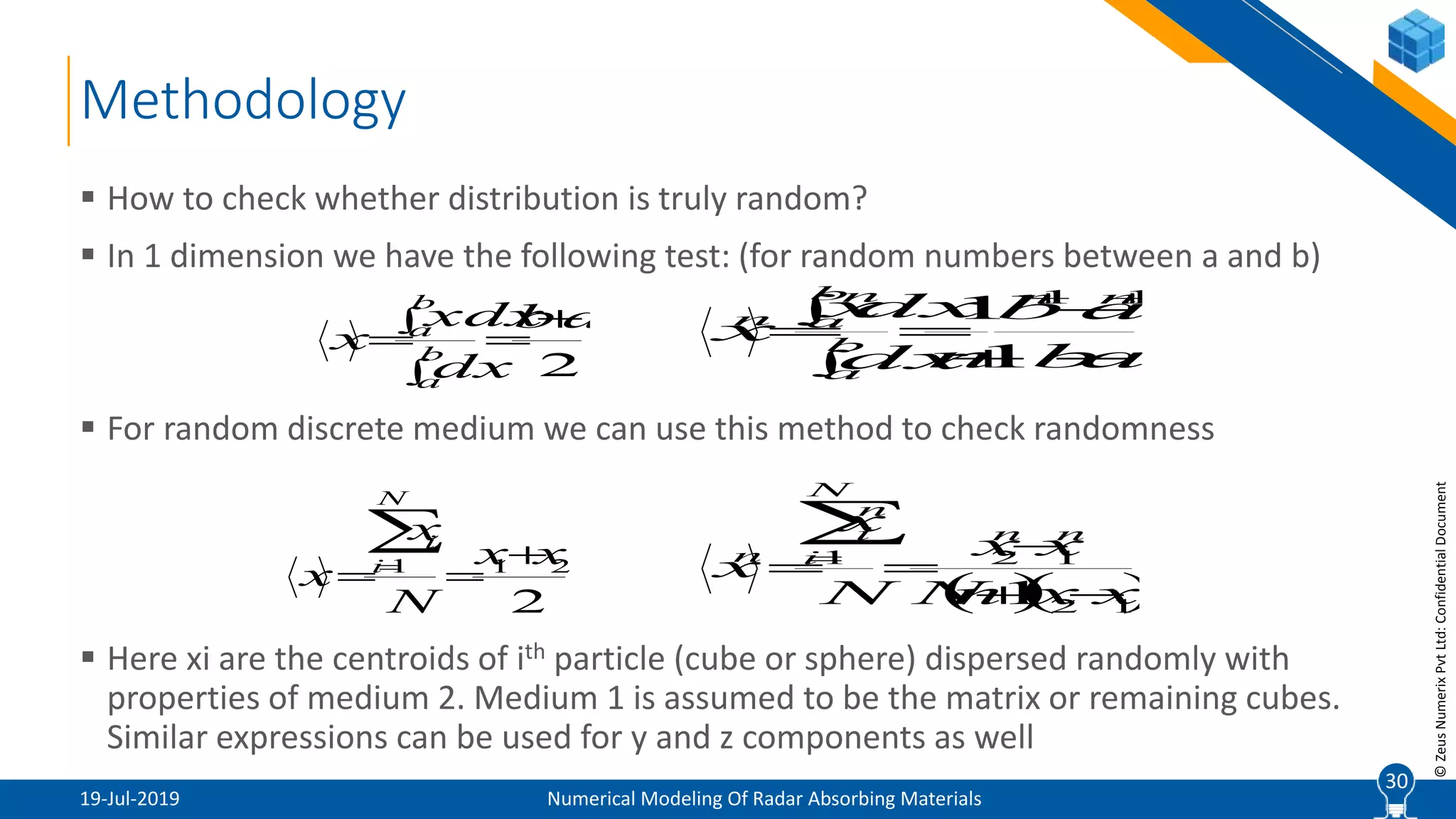
 How to check whether distribution is truly random?
 In 1 dimension we have the following test: (for random numbers between a and b)
 For random discrete medium we can use this method to check randomness
 Here xi are the centroids of ith particle (cube or sphere) dispersed randomly with
properties of medium 2. Medium 1 is assumed to be the matrix or remaining cubes.
Similar expressions can be used for y and z components as well
30

 2
ab
dx
xdx
x b
a
b
a 


 ab
ab
ndx
dxx
x
nn
b
a
b
a
n
n




 11
1
1
2
211 xx
N
x
x
N
i
i



  12
121
1 xxnN
xx
N
x
x
nn
N
i
n
i
n




31
©ZeusNumerixPvtLtd:ConfidentialDocument
Example of Simulation
19-Jul-2019 Numerical Modeling Of Radar Absorbing Materials
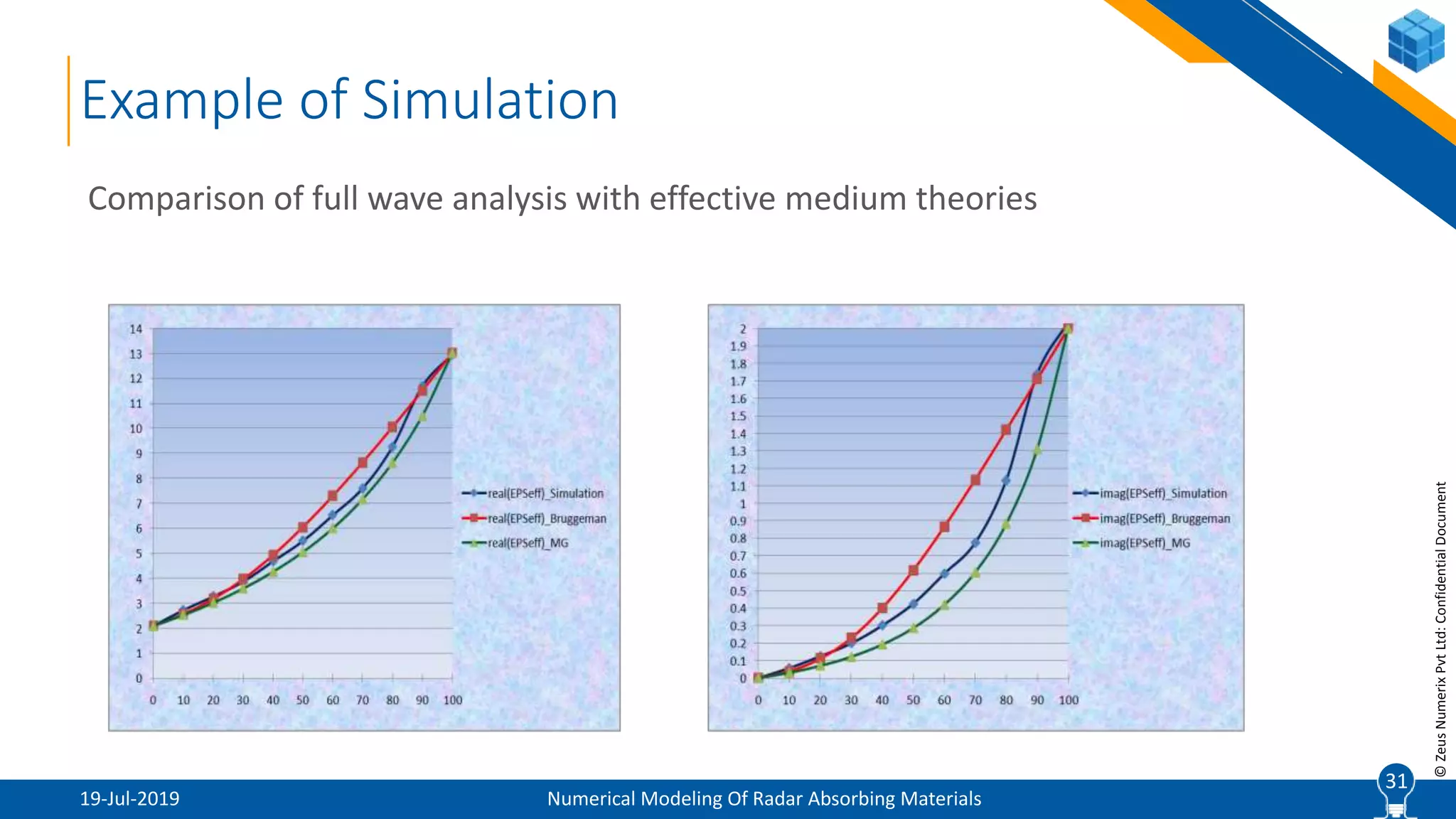
Comparison of full wave analysis with effective medium theories
31
32
www.zeusnumerix.com
+91 72760 31511
Abhishek Jain
contact@zeusnumerix.com
Thank You !

CEM Workshop Lectures (10/11): Numerical Modeling of Radar Absorbing Materials

  • 1.
    1Build-to-Specifications | ProductApproval | Engineering Services | Software Development Numerical Modeling Of Radar Absorbing Materials RAM simulations V3
  • 2.
    2 ©ZeusNumerixPvtLtd:ConfidentialDocument Contents 19-Jul-2019 Numerical ModelingOf Radar Absorbing Materials  Design of radar absorbing materials  Why pure materials do not work as RAM, need for composite materials  Calculation of effective properties of composite medium using various effective medium models along with examples of simulation  Simulation of random simulation and use of CEM methods in effective medium theory along with example of simulation 2
  • 3.
    3 ©ZeusNumerixPvtLtd:ConfidentialDocument RADAR Absorbing Materials 19-Jul-2019Numerical Modeling Of Radar Absorbing Materials  Radar cross section has implications to survivability and mission capability  The materials for reduction of radar cross section rely on magnetic permeability and electric permittivity, while principles from physical optics are used to design absorber structure. It is a combination of optics and materials that lead to signature reduction  Advanced techniques are used for absorber optimization  Radar absorbers can be classified as impedance matching or resonant absorbers  Dynamic absorbers should be studied in order to counter frequency agile radars 3
  • 4.
    4 ©ZeusNumerixPvtLtd:ConfidentialDocument Types of RAM 19-Jul-2019Numerical Modeling Of Radar Absorbing Materials  Large volume RAM is usually resistive carbon loading added to fiberglass hexagonal cell aircraft structures or other non-conducting components. Fins of resistive materials can also be added. Thin resistive sheets spaced by foam or aerogel may be suitable for space craft.  Thin coatings made of only dielectrics and conductors have very limited absorbing bandwidth, so magnetic materials are used when weight and cost permit, either in resonant RAM or as non-resonant RAM 4
  • 5.
    5 ©ZeusNumerixPvtLtd:ConfidentialDocument Types of RAM 19-Jul-2019Numerical Modeling Of Radar Absorbing Materials  Resonant but somewhat 'lossy' materials are applied to the reflecting surfaces of the target. The thickness of the material corresponds to /4 of the incident radar-wave. The incident radar energy is reflected from the outside and inside surfaces of the RAM to create a destructive wave interference pattern. Deviation from the resonant frequency will cause losses in radar absorption, so this type of RAM is only useful against radar with a single frequency  Non-resonant magnetic RAM uses ferrite particles suspended in epoxy or paint to reduce the reflectivity of the surface to incident radar waves. Because the non- resonant RAM dissipates incident radar energy over a larger surface area, it usually results in a trivial increase in surface temperature, thus reducing RCS at the cost of an increase in infrared signature. A major advantage of non-resonant RAM is that it can be effective over a wide range of frequencies, whereas resonant RAM is limited to a narrow range of design frequencies. 5
  • 6.
    6 ©ZeusNumerixPvtLtd:ConfidentialDocument Design of RAM 19-Jul-2019Numerical Modeling Of Radar Absorbing Materials  Requires application of electromagnetic theory and CEM along with Materials Science and statistical principles (For modelling random heterogenous media)  EM theory requires impedance matching at interface between free space and coating of RAM on PEC- This is possible only if = for the RAM material  Pure ferrites have  ~ 1 and  ~ 15, hence desirable to disperse ferrite in low  material (epoxy) for better impedance matching  Computational problem is thus study of dispersion of particles with specified , in host matrix with different = as a function of volume/ weight fill factor  Need to calculate effective properties of this composite medium  Approximate effective medium theory 6
  • 7.
    7 ©ZeusNumerixPvtLtd:ConfidentialDocument Effective Medium Theory 19-Jul-2019Numerical Modeling Of Radar Absorbing Materials  Importance of microstructure:  The simplest level of information that can be quantified - volume fraction of each constituent  The effective properties in general cannot be obtained using simple mixture rules 7
  • 8.
    8 ©ZeusNumerixPvtLtd:ConfidentialDocument  Importance ofmicrostructure:  Various features of the microstructure  Volume fraction  Orientation, size and shape of inclusions  Spatial distribution of inclusions  Connectivity of phases etc.  Quantitatively described by n point correlation functions  Cluster formation  Maxwell Garnett (MG)  Percolation  Mainly three models for calculation of effective properties  Self consistent approximation (SC)  Differential effective medium (DEM) approximation 19-Jul-2019 Numerical Modeling Of Radar Absorbing Materials 8 Effective Medium Theory
  • 9.
    9 ©ZeusNumerixPvtLtd:ConfidentialDocument Effective Medium Theory 19-Jul-2019Numerical Modeling Of Radar Absorbing Materials  Є, Є1, and Є2 denote, respectively, the effective permittivity of the composite material, the permittivity of the matrix with surface fraction f1, and the permittivity of the inclusion phase with a surface fraction f2. A(0<A<1) is the depolarization factor which depends on the shape of the inclusions. For disks A= 1/2, for spheres A = 1/3 .  The most popular mixing laws or EMT are those of Maxwell-Garnett:  Self consistent approximation  Effect of all material outside an inclusion is to produce a homogeneous medium with effective properties e  Impose the condition that the perturbation to a uniform field is zero on an average 9      1211 12111 1 1      Af AffAf
  • 10.
    10 ©ZeusNumerixPvtLtd:ConfidentialDocument Effective Medium Theory 19-Jul-2019Numerical Modeling Of Radar Absorbing Materials  Differential Effective Medium Approximation (DEM):  Similar to SC approximation (incremental homogenization)  Phase 2 treated as matrix phase with volume fraction v2 and property 2  Phase 1 with volume fraction f1 property 1 is treated as filler  Assume the effective property e (f1) known  Treat e (f1) as host matrix dielectric constant and lete(f1+f1) represent effective property after a fraction f1 (1- f1 ) has been replaced by inclusion of phase 1  Using the dilute inclusion formula obtain a differential equation for e with initial condition e (f1=0) = 2.  Solve the differential equation to get the effective properties 10
  • 11.
    11 ©ZeusNumerixPvtLtd:ConfidentialDocument Effective Medium Theory 19-Jul-2019Numerical Modeling Of Radar Absorbing Materials  In general Maxwell and DEM approximation fail for dispersion which forms clusters  SC approximation gives better results in such cases  Summary :  Maxwell approximation works only for dilute dispersions  SC works only for dispersion with phase inversion symmetry in which no connectivity exists between any phase It can consider cluster formation  DEM works well even for connected phase even in high concentration but can not account for clusters 11
  • 12.
    12 ©ZeusNumerixPvtLtd:ConfidentialDocument Effective Medium Theory 19-Jul-2019Numerical Modeling Of Radar Absorbing Materials  Filler prolate spheroid aspect ratio = 1 (spherical) 12
  • 13.
    13 ©ZeusNumerixPvtLtd:ConfidentialDocument Effective Medium Theory 19-Jul-2019Numerical Modeling Of Radar Absorbing Materials  Filler prolate spheroid aspect ratio = 1.5 13
  • 14.
    14 ©ZeusNumerixPvtLtd:ConfidentialDocument Effective Medium Theory 19-Jul-2019Numerical Modeling Of Radar Absorbing Materials  Filler prolate spheroid aspect ratio = 2 14
  • 15.
    15 ©ZeusNumerixPvtLtd:ConfidentialDocument Effective Medium Theory 19-Jul-2019Numerical Modeling Of Radar Absorbing Materials  Filler prolate spheroid aspect ratio = 3 15
  • 16.
    16 ©ZeusNumerixPvtLtd:ConfidentialDocument Effective Medium Theory 19-Jul-2019Numerical Modeling Of Radar Absorbing Materials  Filler prolate spheroid aspect ratio = 4 16
  • 17.
    17 ©ZeusNumerixPvtLtd:ConfidentialDocument Effective Medium Theory 19-Jul-2019Numerical Modeling Of Radar Absorbing Materials  Filler prolate spheroid aspect ratio = 5 17
  • 18.
    18 ©ZeusNumerixPvtLtd:ConfidentialDocument Effective Medium Theory 19-Jul-2019Numerical Modeling Of Radar Absorbing Materials  Filler prolate spheroid aspect ratio = 8 18
  • 19.
    19 ©ZeusNumerixPvtLtd:ConfidentialDocument Effective Medium Theory 19-Jul-2019Numerical Modeling Of Radar Absorbing Materials  Filler prolate spheroid aspect ratio = 10 19
  • 20.
    20 ©ZeusNumerixPvtLtd:ConfidentialDocument Effective Medium Theory 19-Jul-2019Numerical Modeling Of Radar Absorbing Materials  More accurate values of effective properties can be obtained by computer simulation by taking into account many particle correlations  Create various random distributions with a fixed volume fraction of fillers and checking numerically the correlations  Can give better estimates of upper and lower bounds  However, simple model reported above is sufficient for predicting effective properties for calculating reflection properties of various composites 20
  • 21.
    21 ©ZeusNumerixPvtLtd:ConfidentialDocument Effective Medium Theory 19-Jul-2019Numerical Modeling Of Radar Absorbing Materials  Statistically based algorithm  Reconstruct the microgeometry  Must allow systems with both arbitrary shapes and arbitrary EM characteristics to be considered  An initial random configuration of particles in a unit cell is generated  Variants of traditional 2D METROPOLIS sampling scheme adapted to generate equilibrated sets of realizations in 3D  The basic parameters in this model simulation are the length L of the square primitive cell side, the number N of hard disks, their diameter D, and their surface fraction f2 21
  • 22.
    22 ©ZeusNumerixPvtLtd:ConfidentialDocument Effective Medium Theory 19-Jul-2019Numerical Modeling Of Radar Absorbing Materials  After an initial configuration is generated, one attempts to move randomly the center-of-mass coordinate of each disk. The new configuration is accepted if the particle does not overlap with any other particles  This process is repeated until equilibrium is achieved  To minimize boundary effects due to the finite size of the system, periodic boundary conditions are employed 22
  • 23.
    23 ©ZeusNumerixPvtLtd:ConfidentialDocument Typical equilibrium configurations (samplerealizations) of the two- phase composite consisting of circular disks randomly distributed within a square primitive cell. The sample packing results from the sequential algorithm applied to a binary mixture with a given surface fraction of disks. (a) f2=0.1, (b) f2=0.3, (c) f2=0.5, (d) f2=0.6, (e) f2 =0.7, (f) f2=0.8, (g) f2=0.82, (h) f2=0.83, and (i) f2=0.85. 19-Jul-2019 Numerical Modeling Of Radar Absorbing Materials 23 Examples of Equilibrium Configuration
  • 24.
    24 ©ZeusNumerixPvtLtd:ConfidentialDocument Assume cubic shapeof inclusion [Xi, Yj, Zk] coordinates / sites i = 1,..,Nx Nx = no. of unit cells along X = Length of X axis / unit cell dimension along X axis j = 1,..,Ny k = 1,..,Nz Random nos. along X = ( 3√f * Nx ) f = volume fraction of inclusion Run random no. generation engine (1+ 3√f * Ny * 3√f * Nz) times to get 3D profile of composite 19-Jul-2019 Numerical Modeling Of Radar Absorbing Materials 24 Alternate Method
  • 25.
    25 ©ZeusNumerixPvtLtd:ConfidentialDocument 19-Jul-2019 Numerical ModelingOf Radar Absorbing Materials 25 CEM Based Calculations
  • 26.
    26 ©ZeusNumerixPvtLtd:ConfidentialDocument 19-Jul-2019 Numerical ModelingOf Radar Absorbing Materials 26 CEM Based Calculations
  • 27.
    27 ©ZeusNumerixPvtLtd:ConfidentialDocument Methodology 19-Jul-2019 Numerical ModelingOf Radar Absorbing Materials  To calculate effective properties of the medium, perform average fields as below ( denotes components)  These averages are defined as follows  where f is any variable. The averaging is carried out over a representative cell as discussed earlier and ri represents the center of cell i 27      H H       E E      N f dv dvf f N i i V V   1 rr
  • 28.
    28 ©ZeusNumerixPvtLtd:ConfidentialDocument Methodology 19-Jul-2019 Numerical ModelingOf Radar Absorbing Materials  If the distribution is truly random average properties must be isotropic  In isotropic case the following expression can also be used  How to check whether distribution is truly random? 28               N i ii N i iiii 1 1 rErE rErE  
  • 29.
    29 ©ZeusNumerixPvtLtd:ConfidentialDocument Methodology 19-Jul-2019 Numerical ModelingOf Radar Absorbing Materials  If the distribution is truly random average properties must be isotropic  In isotropic case the following expression can also be used  How to check whether distribution is truly random? 29               N i ii N i iiii 1 1 rErE rErE  
  • 30.
    30 ©ZeusNumerixPvtLtd:ConfidentialDocument Methodology 19-Jul-2019 Numerical ModelingOf Radar Absorbing Materials  How to check whether distribution is truly random?  In 1 dimension we have the following test: (for random numbers between a and b)  For random discrete medium we can use this method to check randomness  Here xi are the centroids of ith particle (cube or sphere) dispersed randomly with properties of medium 2. Medium 1 is assumed to be the matrix or remaining cubes. Similar expressions can be used for y and z components as well 30   2 ab dx xdx x b a b a     ab ab ndx dxx x nn b a b a n n      11 1 1 2 211 xx N x x N i i      12 121 1 xxnN xx N x x nn N i n i n    
  • 31.
    31 ©ZeusNumerixPvtLtd:ConfidentialDocument Example of Simulation 19-Jul-2019Numerical Modeling Of Radar Absorbing Materials Comparison of full wave analysis with effective medium theories 31
  • 32.
    32 www.zeusnumerix.com +91 72760 31511 AbhishekJain contact@zeusnumerix.com Thank You !