Asteroids
               LACC: Ch §12.1, 13.1, 13.2

           •      Understand what conditions and processes
                  shaped the asteroid belt
           •      Understand how Asteroids are classified
           •      Know the Asteroid that is a dwarf planet


              An attempt to answer the “big questions”: what is
                         out there? Are we alone?


Thursday, March 25, 2010                                          1
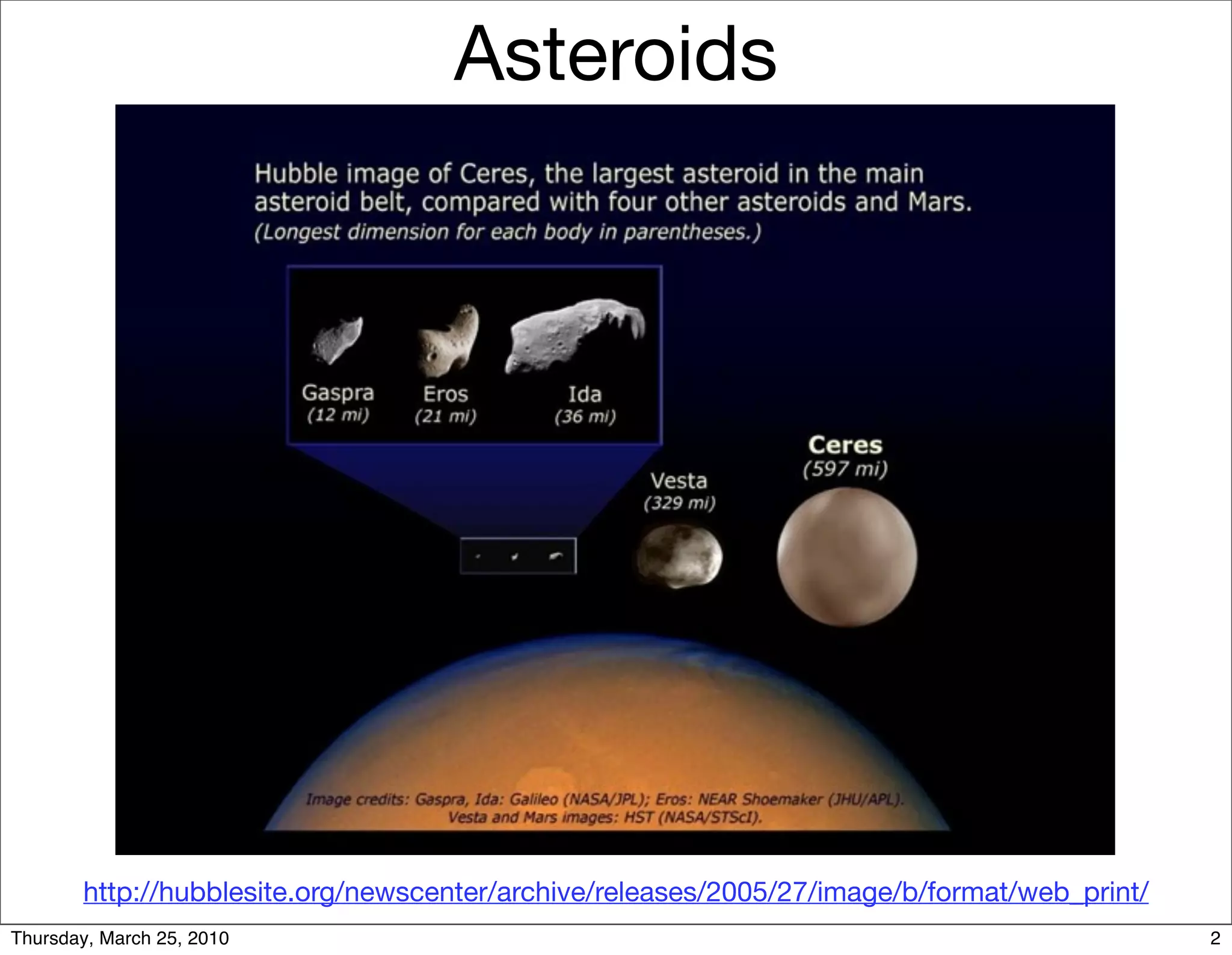
Asteroids


       http://hubblesite.org/newscenter/archive/releases/2005/27/image/b/format/web_print/
Thursday, March 25, 2010                                                                     2
n

                                            Asteroids
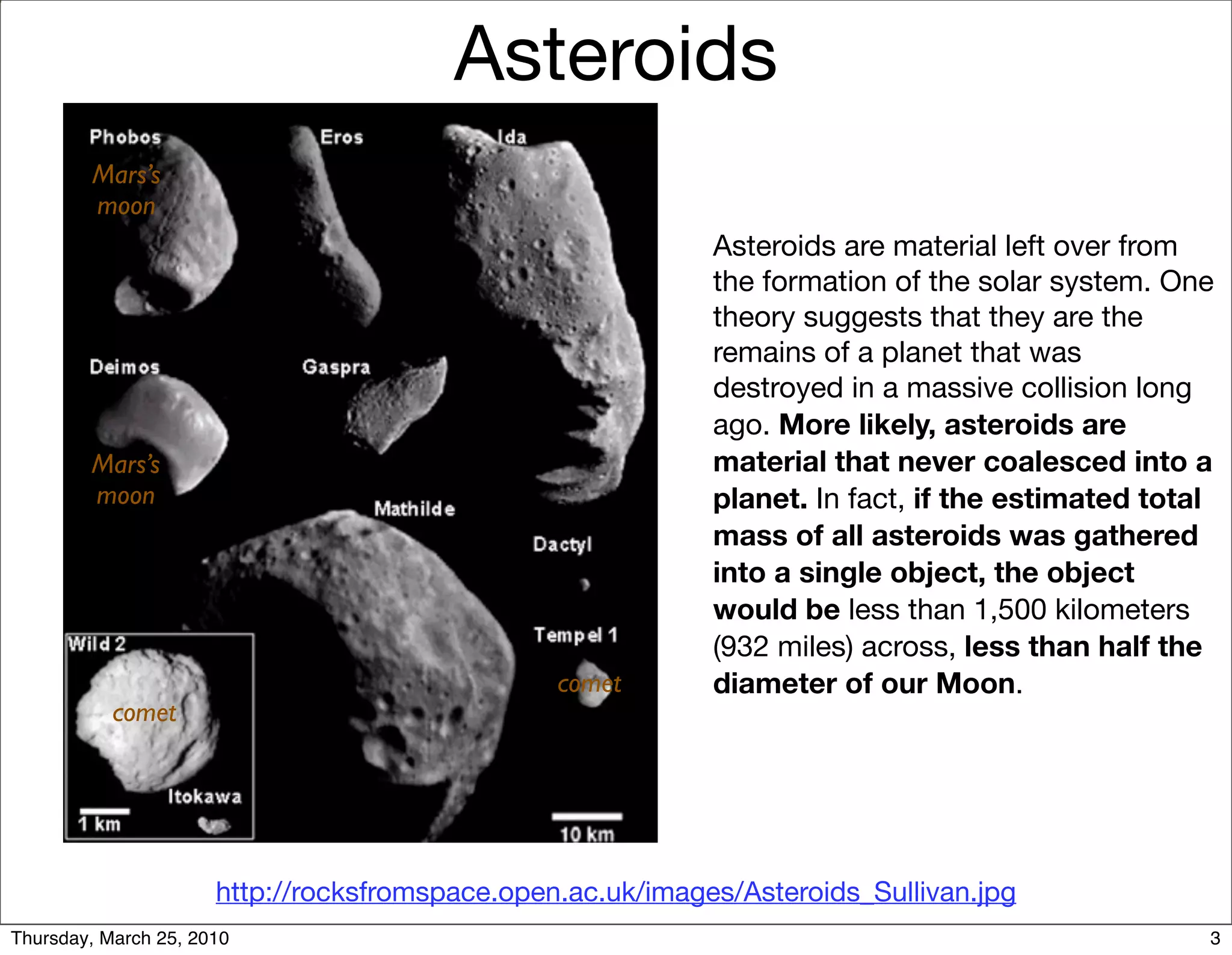
            Mars’s
            moon
                                                                Asteroids are material left over from
                                                                the formation of the solar system. One
                                                                theory suggests that they are the
                                                                remains of a planet that was
                                                                destroyed in a massive collision long
                                                                ago. More likely, asteroids are
            Mars’s                                              material that never coalesced into a
            moon                                                planet. In fact, if the estimated total
                                                                mass of all asteroids was gathered
                                                                into a single object, the object
                                                                would be less than 1,500 kilometers
                                                                (932 miles) across, less than half the
                                                    comet       diameter of our Moon.
               comet


                          http://rocksfromspace.open.ac.uk/images/Asteroids_Sullivan.jpg
    Thursday, March 25, 2010                                                                          3
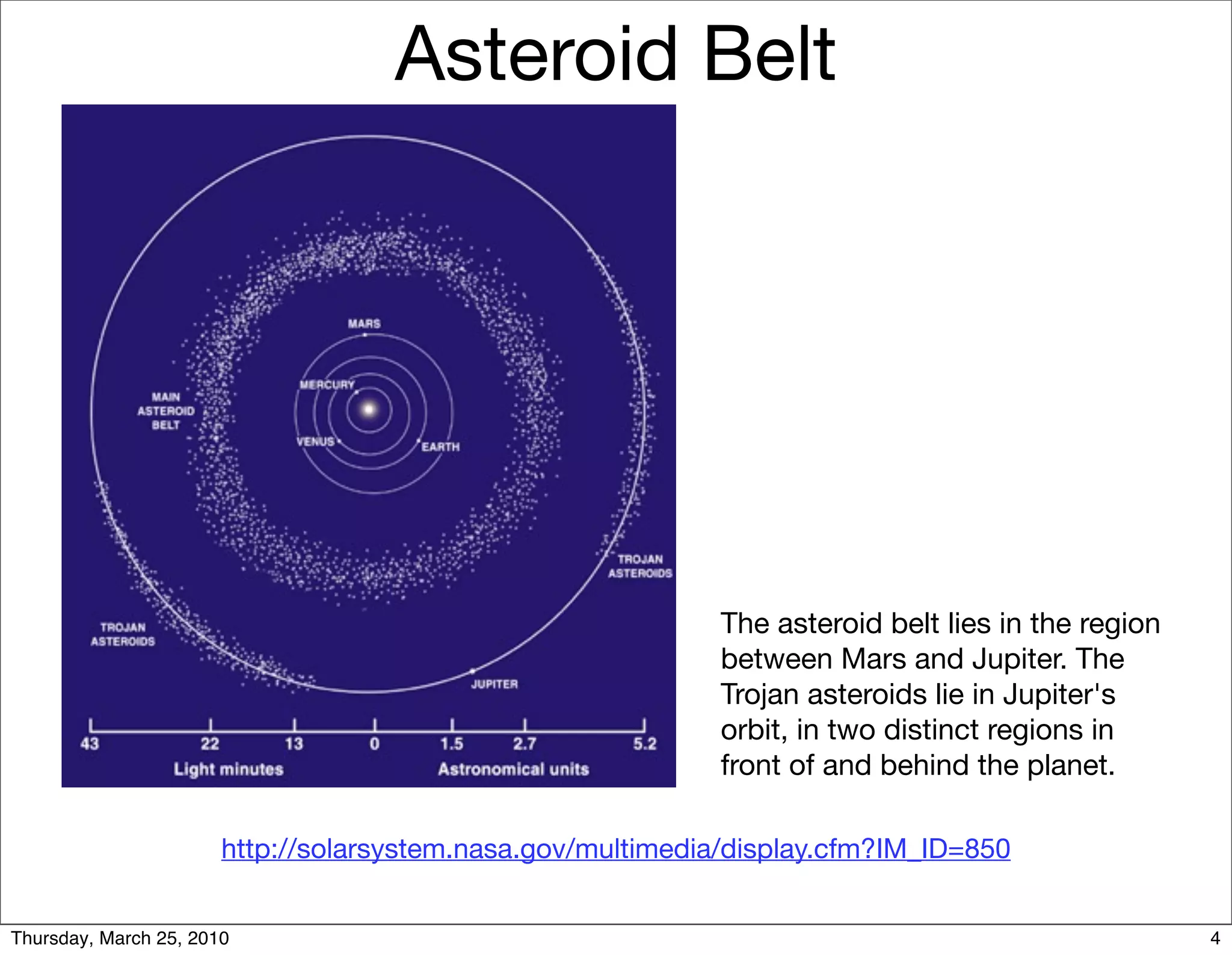
Asteroid Belt


                                                            The asteroid belt lies in the region
                                                            between Mars and Jupiter. The
                                                            Trojan asteroids lie in Jupiter's
                                                            orbit, in two distinct regions in
                                                            front of and behind the planet.

                       http://solarsystem.nasa.gov/multimedia/display.cfm?IM_ID=850


Thursday, March 25, 2010                                                                           4
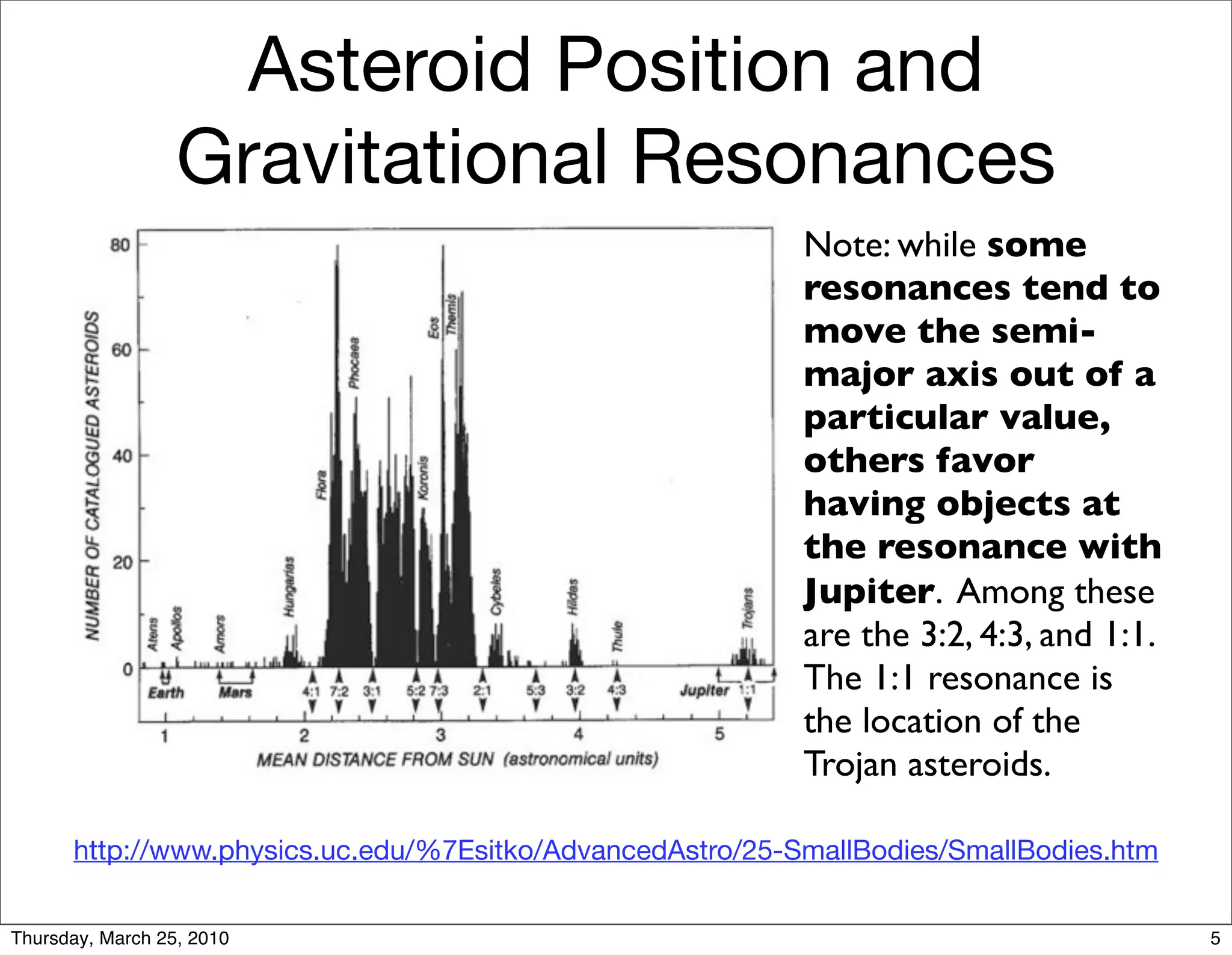
Asteroid Position and
                  Gravitational Resonances
                                                           Note: while some
                                                           resonances tend to
                                                           move the semi-
                                                           major axis out of a
                                                           particular value,
                                                           others favor
                                                           having objects at
                                                           the resonance with
                                                           Jupiter. Among these
                                                           are the 3:2, 4:3, and 1:1.
                                                           The 1:1 resonance is
                                                           the location of the
                                                           Trojan asteroids.

      http://www.physics.uc.edu/%7Esitko/AdvancedAstro/25-SmallBodies/SmallBodies.htm


Thursday, March 25, 2010                                                                5
Types of Asteroids by
                               Composition
        •      C-type, includes more than 75% of known asteroids: extremely
               dark (albedo 0.03); similar to carbonaceous chondrite
               meteorites; approximately the same chemical composition as the
               Sun minus hydrogen, helium and other volatiles;
        •      S-type, 17%: relatively bright (albedo .10-.22); metallic nickel-iron
               mixed with iron- and magnesium-silicates;
        •      M-type, most of the rest: bright (albedo .10-.18); pure nickel-iron
               [metals].
        •      There are also a dozen or so other rare types.
     Because of biases involved in the observations (e.g. the dark C-types
     are harder to see), the percentages above may not be representative of
     the true distribution of asteroids. (There are actually several classification
     schemes in use today.)
                              http://www.nineplanets.org/asteroids.html


Thursday, March 25, 2010                                                               6
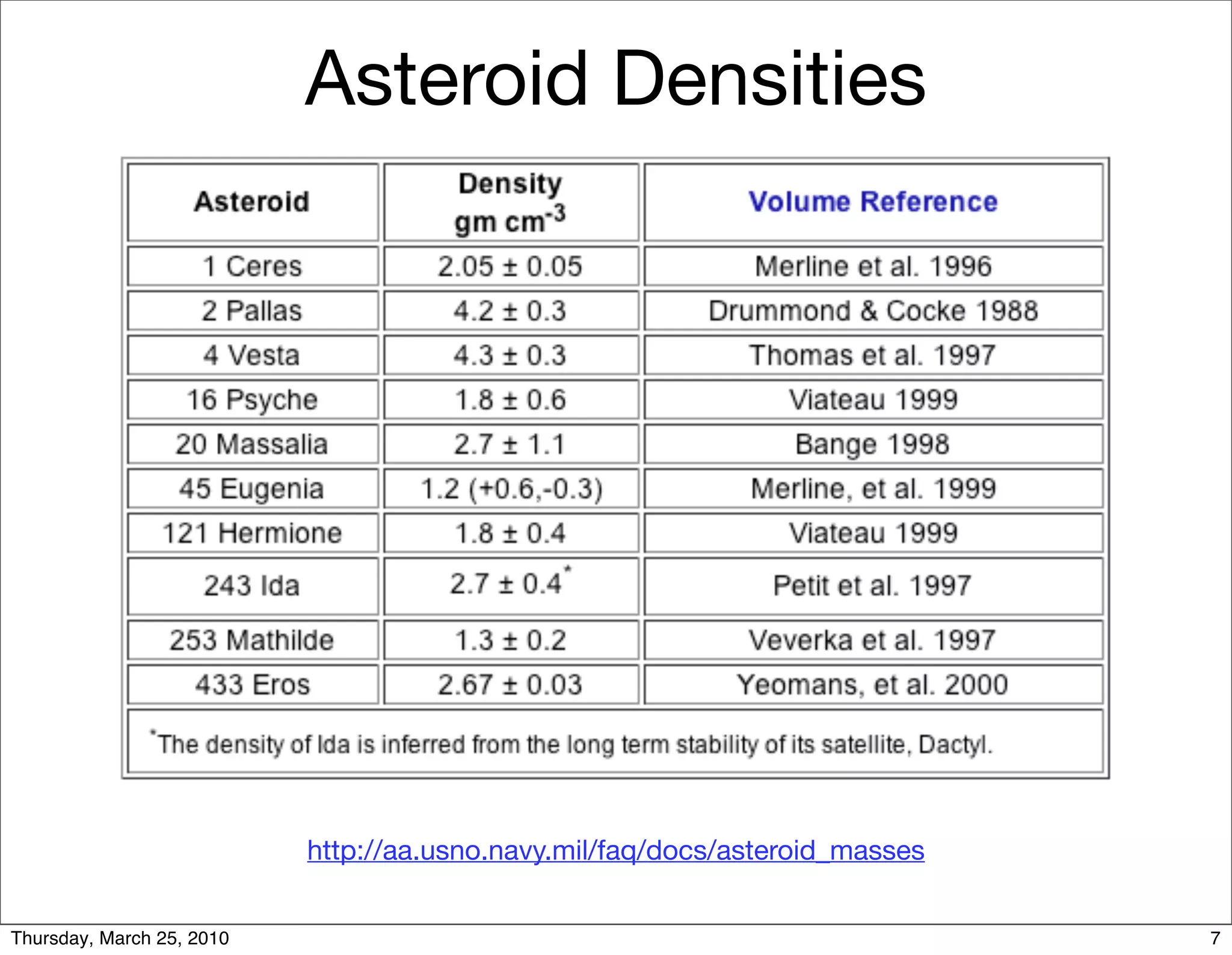
Asteroid Densities


                           http://aa.usno.navy.mil/faq/docs/asteroid_masses


Thursday, March 25, 2010                                                      7
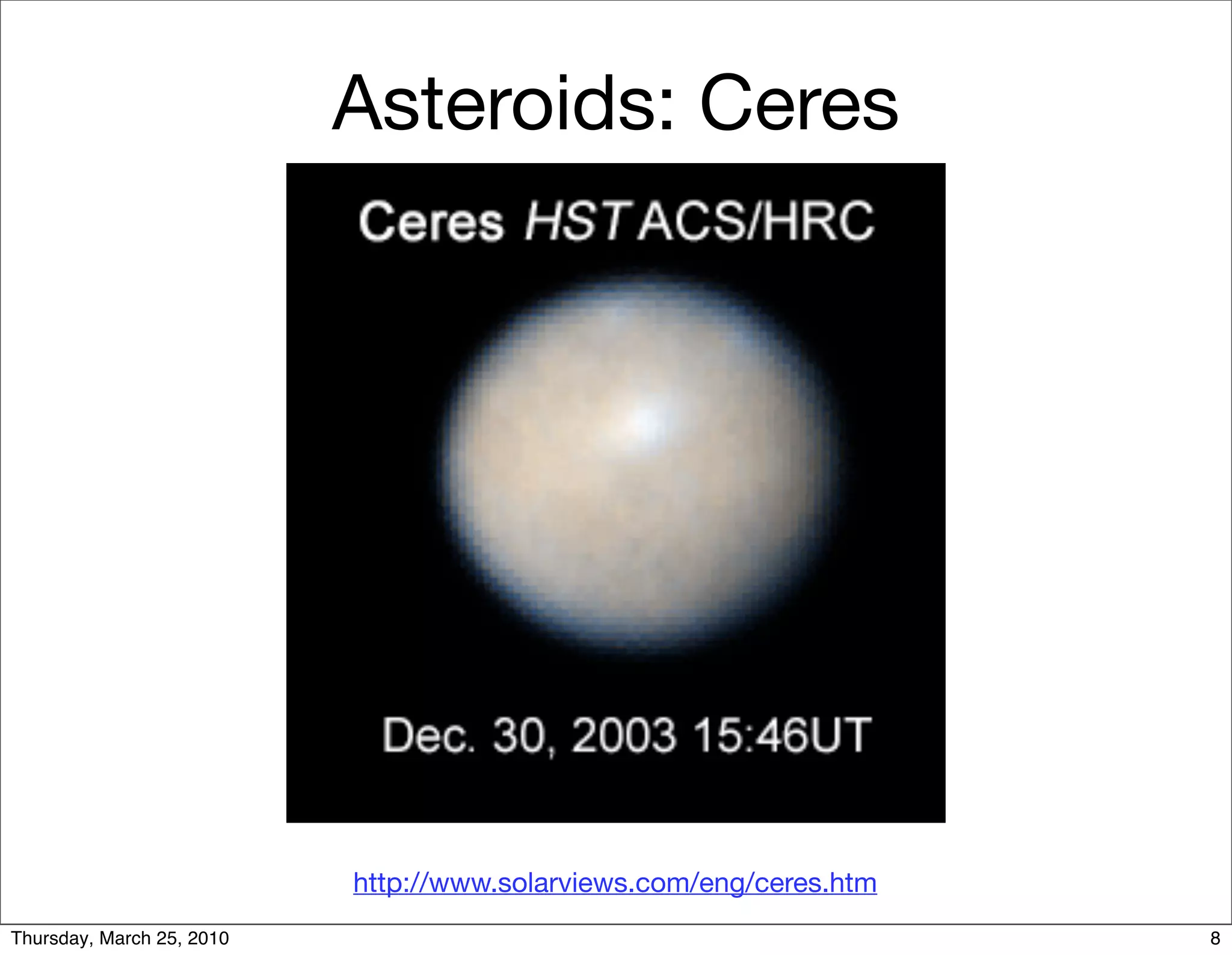
Asteroids: Ceres


                           http://www.solarviews.com/eng/ceres.htm
Thursday, March 25, 2010                                             8
Asteroids: Ceres
      With a diameter of about 975x909 km, Ceres is by far the largest and most
      massive body in the asteroid belt, and contains approximately a third of
      the mass of all the asteroids in the solar system. Recent observations have
      revealed that Ceres is nearly spherical in shape, unlike the irregular shapes of
      smaller bodies with less gravity. Having sufficient mass for self-gravity to
      overcome rigid body forces is one of the requirements for classification as a
      planet or dwarf planet.

      Ceres has a very primitive surface and like a young planet, contains water-
      bearing minerals, and possibly a very weak atmosphere and frost. Infrared
      observations show that the surface is warm with a possible maximum
      temperature of 235 K (-38°C).

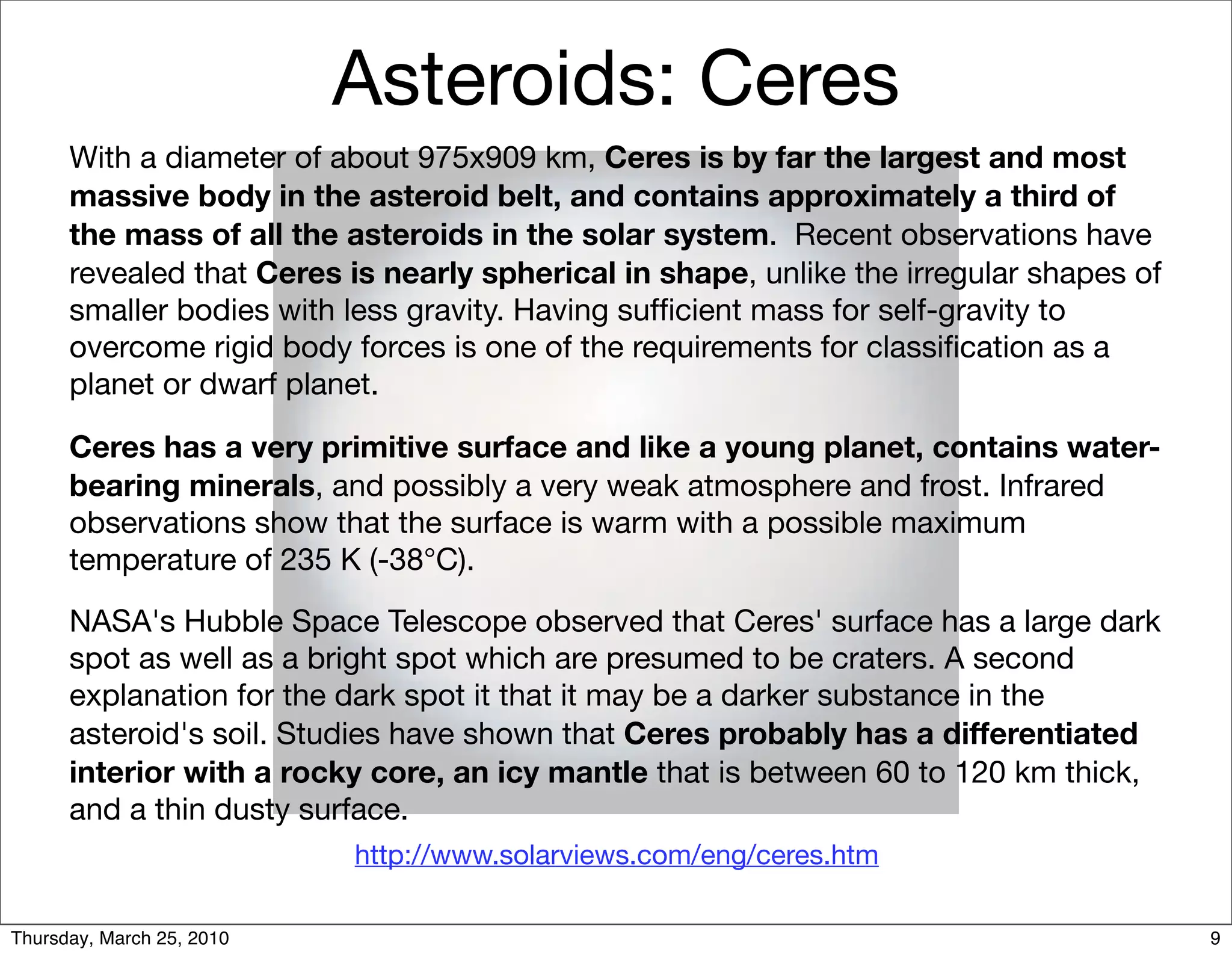
      NASA's Hubble Space Telescope observed that Ceres' surface has a large dark
      spot as well as a bright spot which are presumed to be craters. A second
      explanation for the dark spot it that it may be a darker substance in the
      asteroid's soil. Studies have shown that Ceres probably has a differentiated
      interior with a rocky core, an icy mantle that is between 60 to 120 km thick,
      and a thin dusty surface.
                           http://www.solarviews.com/eng/ceres.htm

Thursday, March 25, 2010                                                                 9
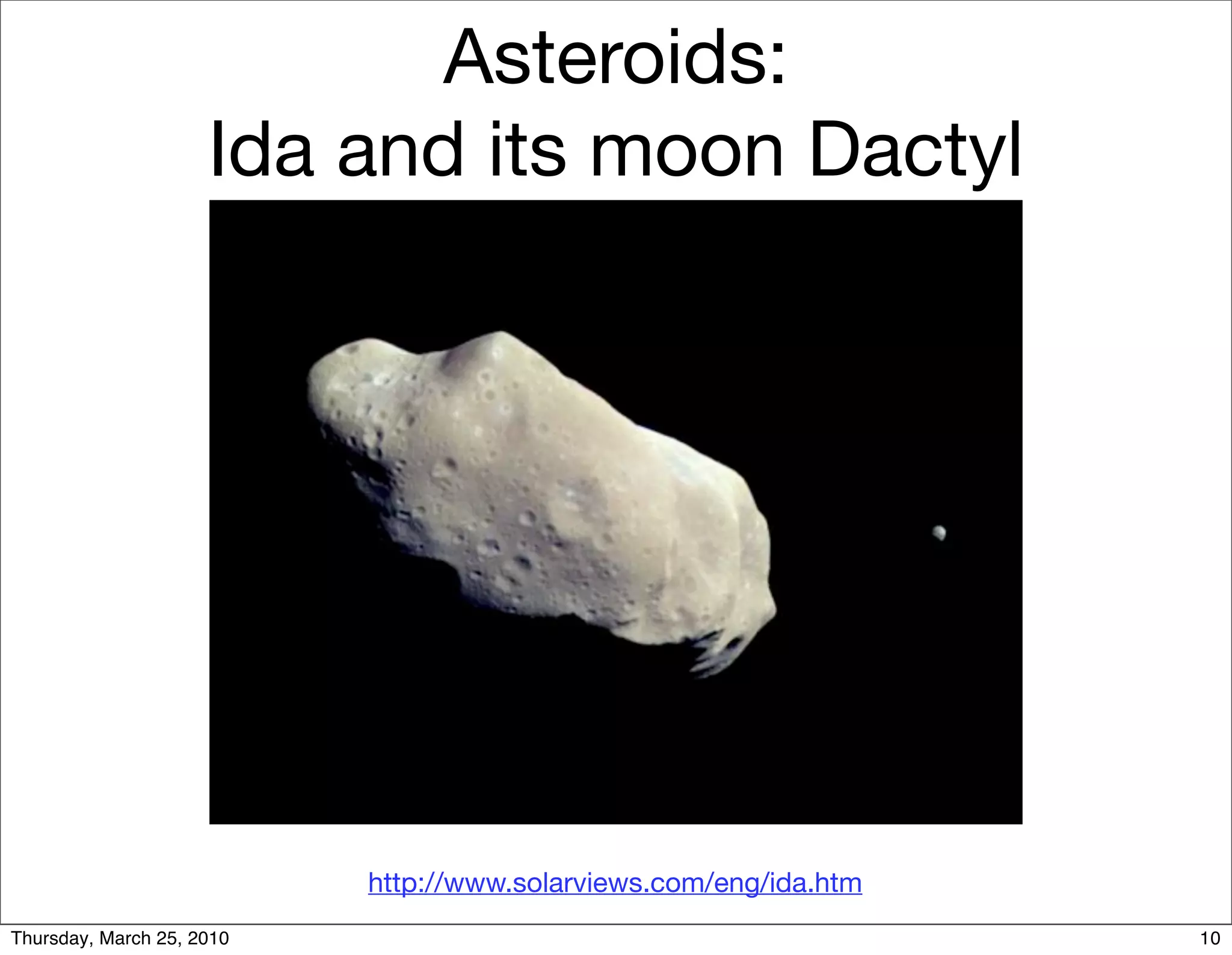
Asteroids:
                     Ida and its moon Dactyl


                           http://www.solarviews.com/eng/ida.htm
Thursday, March 25, 2010                                           10
Asteroids: Eros


       NEAR Shoemaker touched down on the surface of Eros at 3:01:52 p.m.
          EST (20:01:52 UT) Monday, 12 February [2001].... The spacecraft
         impacted at a velocity of about 1.5 to 1.8 m/s (3.4 to 4.0 mph). The
        spacecraft obtained 69 high-resolution images before touchdown, the
       final image showing an area 6 meters across. NEAR was not designed as
              a lander, but survived the low-velocity, low-gravity impact,.
                           http://nssdc.gsfc.nasa.gov/planetary/near.html


Thursday, March 25, 2010                                                        11
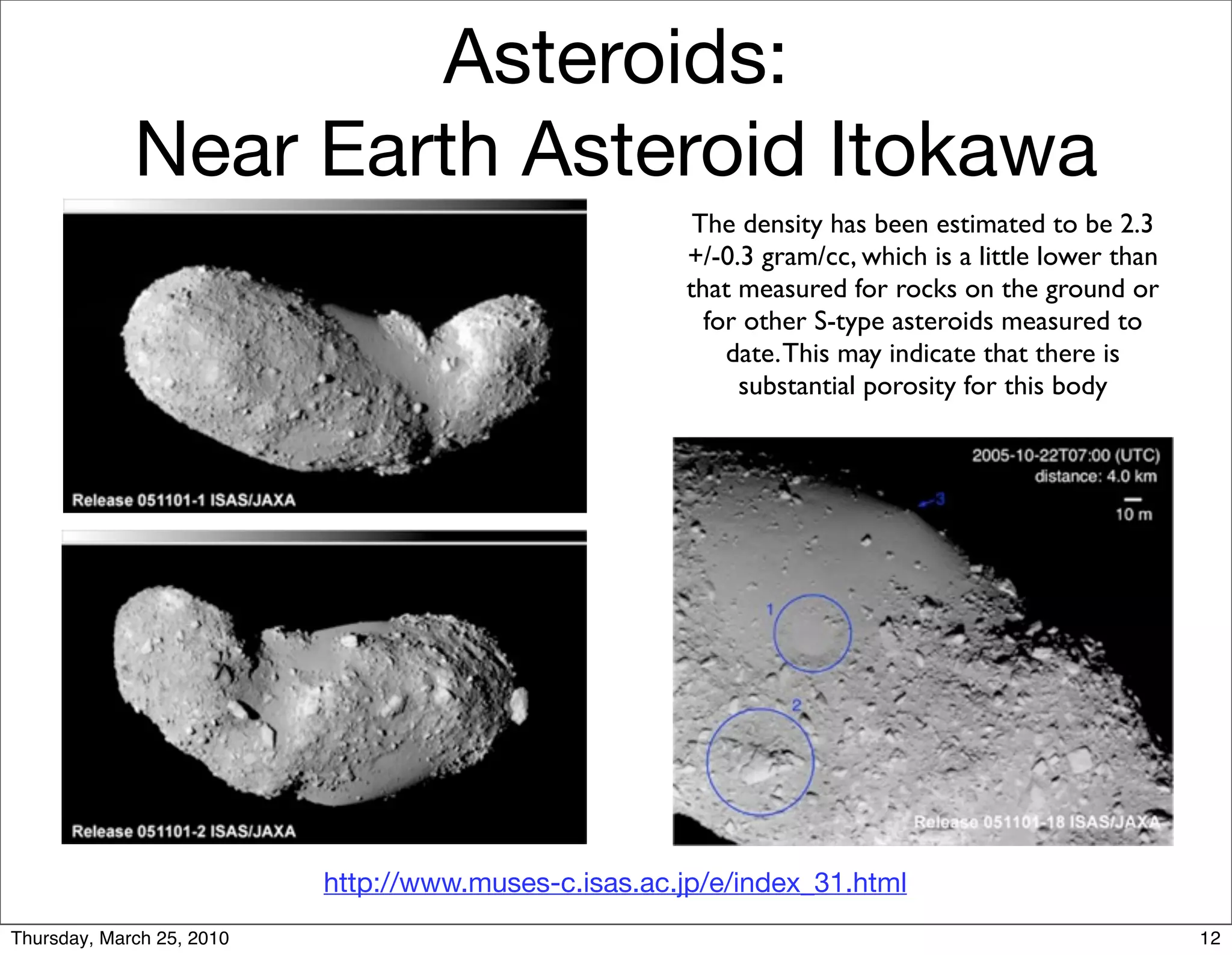
Asteroids:
             Near Earth Asteroid Itokawa
                                                        The density has been estimated to be 2.3
                                                       +/-0.3 gram/cc, which is a little lower than
                                                       that measured for rocks on the ground or
                                                         for other S-type asteroids measured to
                                                           date. This may indicate that there is
                                                            substantial porosity for this body


                           http://www.muses-c.isas.ac.jp/e/index_31.html
Thursday, March 25, 2010                                                                              12
Asteroids
               LACC: Ch §12.1, 13.1, 13.2
           •      Understand what conditions and processes
                  shaped the asteroid belt: Jupiter’s influence (or
                  a massive collision destroyed a planet)
           •      Understand how Asteroids are classified:
                  composition (usual spectral analysis) and
                  location (gravitation resonances)
           •      Know the Asteroid that is a dwarf planet: Ceres
                  (1/3 mass of all asteroid belt).
              An attempt to answer the “big questions”: what is
                         out there? Are we alone?

Thursday, March 25, 2010                                             13
LACC HW: Franknoi, Morrison, and
               Wolff, Voyages Through the Universe,
                              3rd ed.


                      •     Ch 13, p. 308: 2.


                       Due at the beginning of first class period
                                   after this week.
                           Be working your Solar System project.


Thursday, March 25, 2010                                           14
Meteorites
              LACC: Ch §12.1, 13.1, 13.2

      •      Know where Meteorites and Meteors come from
      •      Know how Meteorites are classified
      •      Know what Meteorites tell us about the conditions
             and processes shaped our solar system


          An attempt to answer the “big questions”: what is out
                         there? Are we alone?


Thursday, March 25, 2010                                          15
Meteor/Meteoroids/Meteorites
     It is estimated that 1,000 tons to more than 10,000 tons of interplanetary material falls on
     the Earth each day. Most of this material is very tiny in the form of micrometeoroids or
     dust-like grains a few micrometers in size. These particles are so tiny that the air
     resistance is enough to slow them sufficiently that they do not burn up, but rather fall
     gently to Earth.

     "Shooting stars" or meteors are bits of material falling through Earth's atmosphere
     at altitudes of 50-100 km. They are heated to incandescence by [ram pressure]. The
     surface melts and vaporizes leaving behind an ionized trail of gas and dust. The bright
     trails as they are coming through the Earth's atmosphere are termed meteors,
     and these chunks as they are hurtling through space are called meteoroids. As
     the object penetrates to 20 km it will have slowed enough that heating no longer makes
     it glow and it will continue to fall to Earth. Large pieces that do not vaporize
     completely and reach the surface of the Earth are called meteorites.

     On occasions a large meteoroid will strike the earth and at 120 km glow as bright as the
     sun. These fireballs are called bolides and often are accompanied by sonic booms.

                      http://www.physics.uq.edu.au/people/ross/phys2081/meteor.htm


Thursday, March 25, 2010                                                                            16
Types of Meteorites by
                           Composition
                                                          • Iron (Fe/Ni) are the most
                                                           likely finds (they look more
                                                           unusual),

                                                          • Stony (C/O/Mg/Si) are the
                                                           most likely falls (the most
                                                           common type) and

                                             % by falls   • Stoney Iron (Si/Fe/Ni -
                                             ± a few %     pretty rare).
        http://rst.gsfc.nasa.gov/Sect19/Sect19_2.html
      The stony meteorites are further subdivided into chondrites and
      achondrites. Most meteorites are chondrites, so named because of the
      presence of small rounded grains called chondrules. These grains are a
      few mm diameter and rich in olivine and pyroxine. [silicates, e.g. SiO42-]
                             http://www.physics.uq.edu.au/people/ross/phys2081/meteor.htm


Thursday, March 25, 2010                                                                    17
Carbonaceous Chondrites
     A few chondrites have high concentrations of Al, Mg and
     Ca, and rich in O, and have almost no metallic Fe-Ni.
     These meteorites are dark in color and called
     carbonaceous chondrites. ...the composition matches
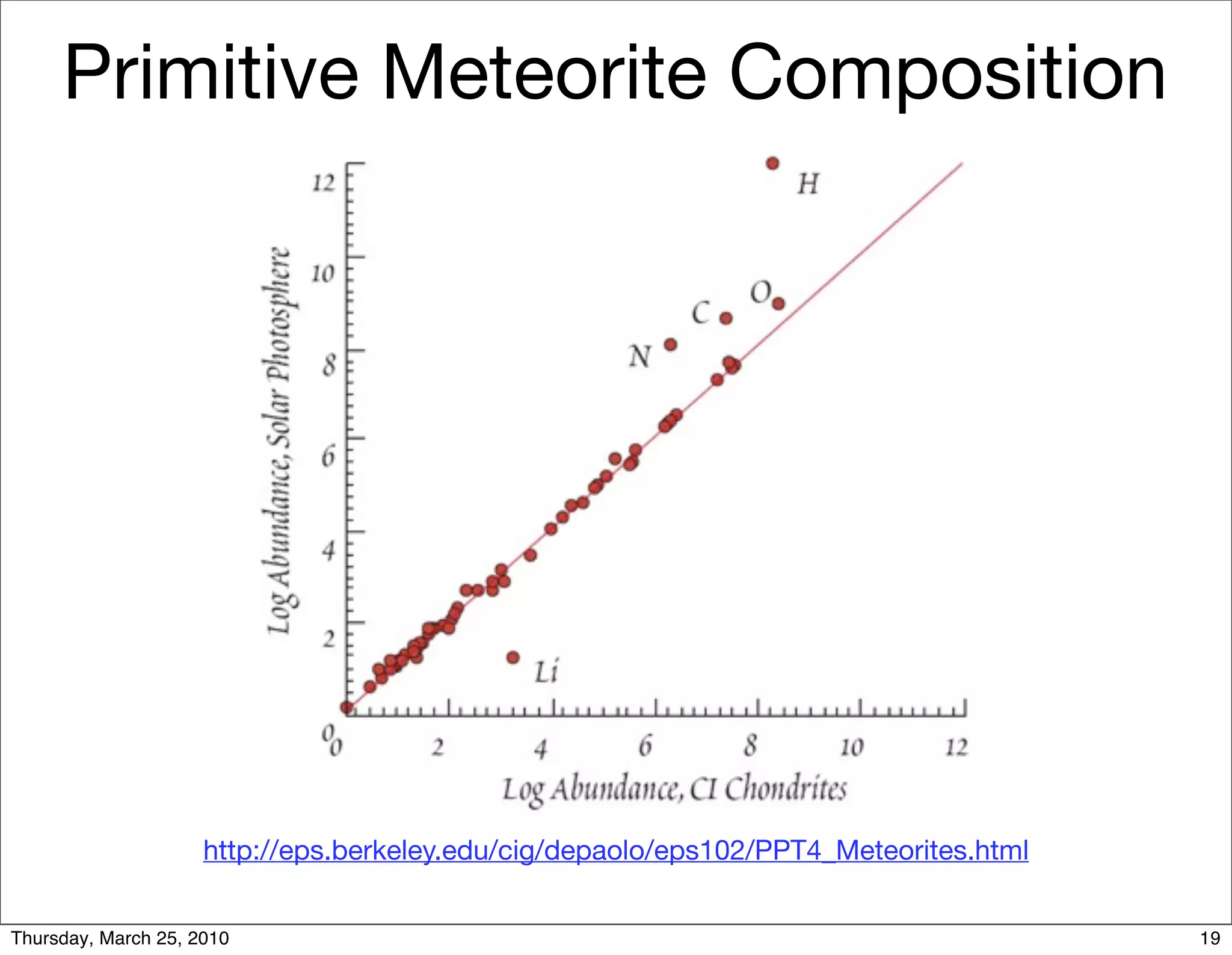
     the non volatile composition of the sun. If you took the
     primordial material of the solar system, as we suspect the
     sun is composed, then condense it, discarding volatiles
     such as H and He, you would end up with such material.
     This mixture is called "chondritic". Carbonaceous
     chondrites are some of the most complex of all
     meteorites. They are rare, primitive and contain organic
     compounds. Most importantly they contain water-bearing
     minerals which is evidence of water moving slowly through
     their interiors not long after formation.
                      http://www.physics.uq.edu.au/people/ross/phys2081/meteor.htm
Thursday, March 25, 2010                                                             18
Primitive Meteorite Composition


                     http://eps.berkeley.edu/cig/depaolo/eps102/PPT4_Meteorites.html


Thursday, March 25, 2010                                                               19
Section of the Allende, Mexico
                CV3 meteorite


     [This carbonaceous chondrite is] classed as CV3 and represents some
     of the oldest known matter. The meteorite formed 4.56 billion years
     ago and contains interstellar grains within calcium/aluminum rich
     inclusions (CAIs). Interstellar grains are remnants of a prior star that lived
     out its life and exploded before the formation of our Sun. It is possible
     that this explosion was the trigger for the formation of our solar system.
                      http://www.meteorlab.com/METEORLAB2001dev/carbchon.htm
Thursday, March 25, 2010                                                              20
The Murchison, Australia,
         carbonaceous chondrite, CM2


     [This carbonaceous chondrite is] a CM2 chondrite and believed to be of
     cometary origin because of its high water content, 12%. To date 92
     amino acids (the building blocks of protein) have been found in
     Murchison. Only nineteen of them are found on Earth.


                      http://www.meteorlab.com/METEORLAB2001dev/carbchon.htm
Thursday, March 25, 2010                                                       21
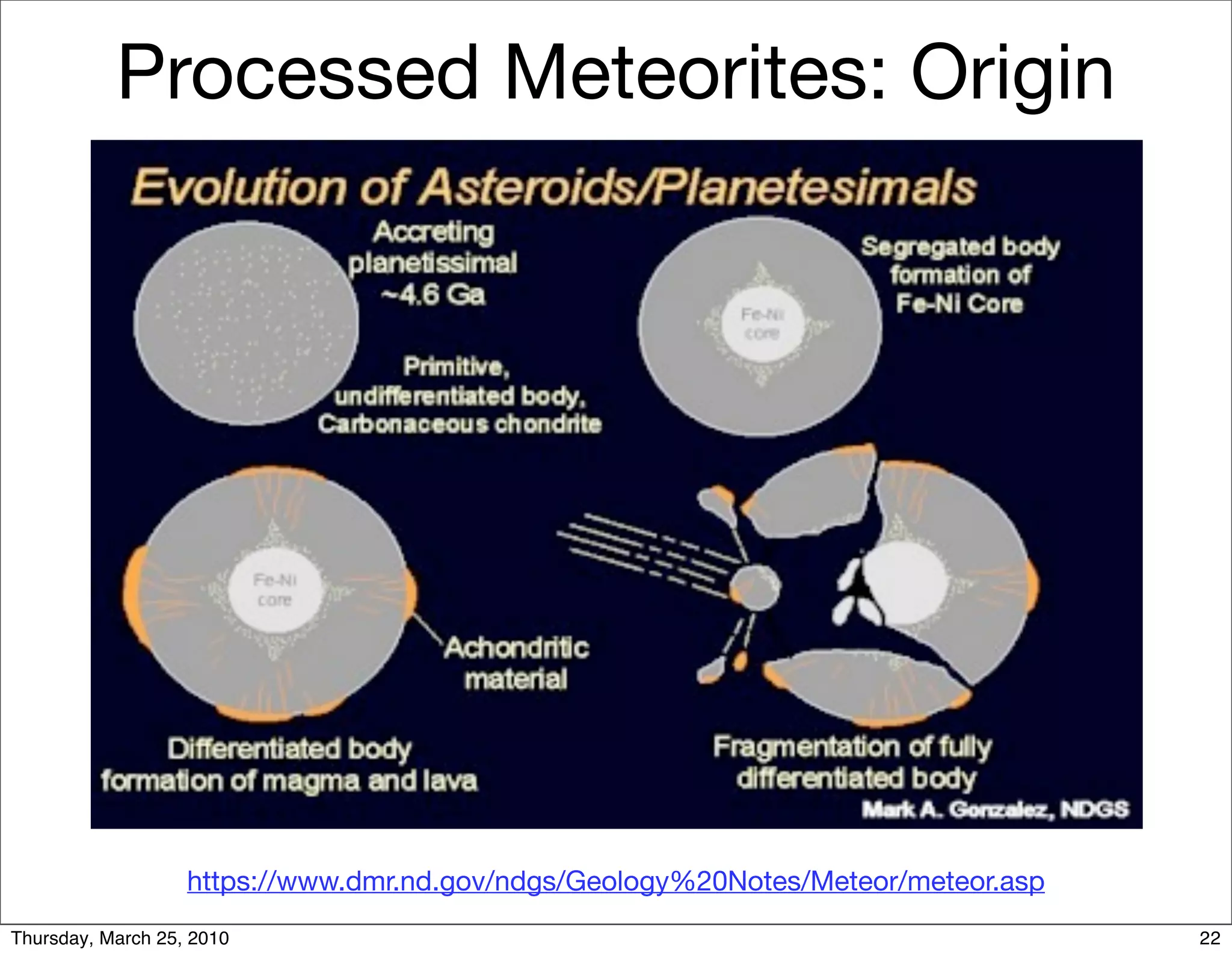
Processed Meteorites: Origin


                   https://www.dmr.nd.gov/ndgs/Geology%20Notes/Meteor/meteor.asp
Thursday, March 25, 2010                                                           22
Lunaites (Moon Meteorites)


      There is a growing realization that many of the Achondrites may
      be pieces of the Moon or Mars expelled from these bodies by
      impact. Lunar meteorites may directly strike the Earth after thrown
      off by a lunar impact or fall after being captured in orbit... [Above
      are] meteorite samples of probably lunar origin, as determined by
      age and composition.
                           http://rst.gsfc.nasa.gov/Sect19/Sect19_2.html


Thursday, March 25, 2010                                                      23
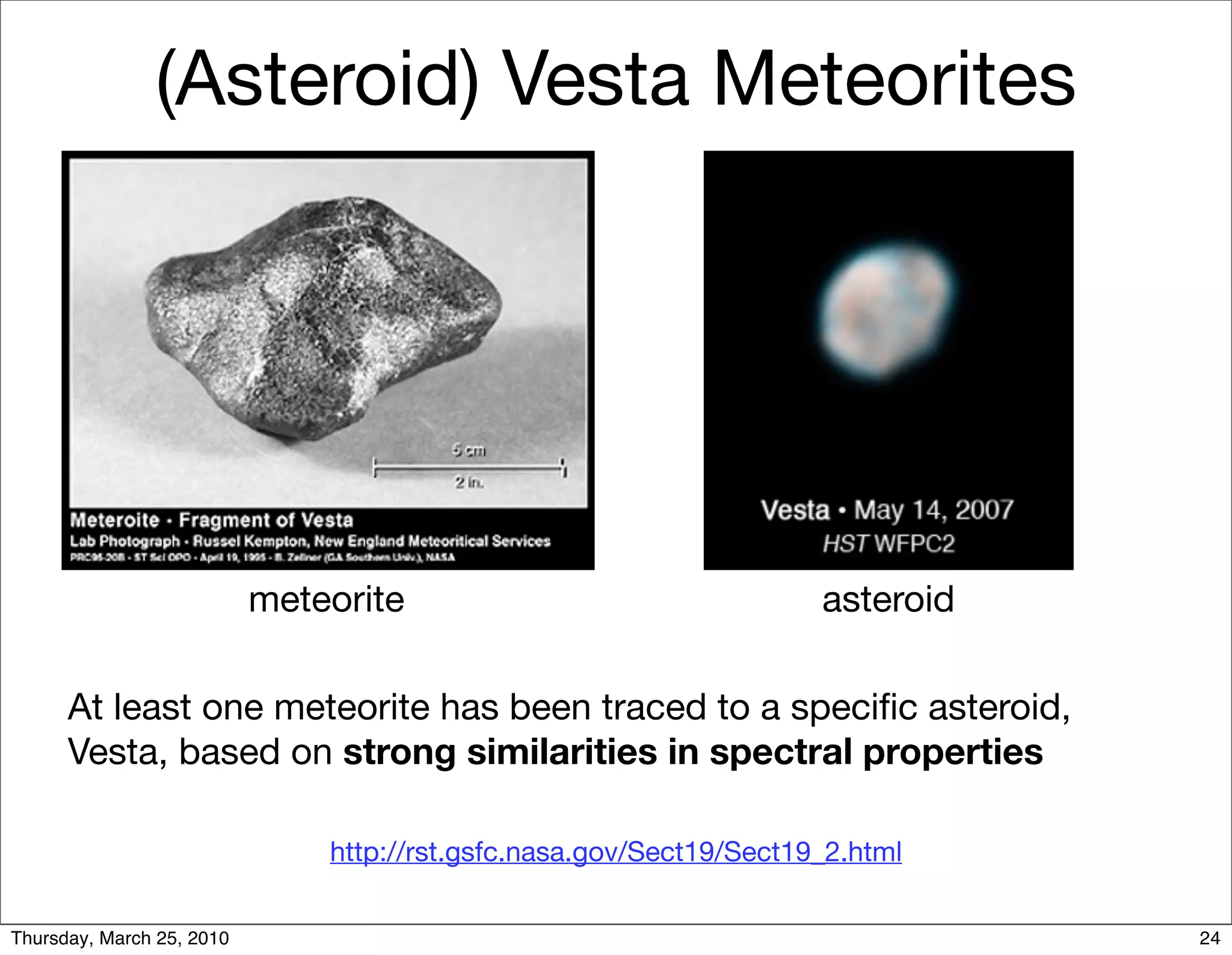
(Asteroid) Vesta Meteorites


                           meteorite                                 asteroid

      At least one meteorite has been traced to a specific asteroid,
      Vesta, based on strong similarities in spectral properties

                               http://rst.gsfc.nasa.gov/Sect19/Sect19_2.html


Thursday, March 25, 2010                                                        24
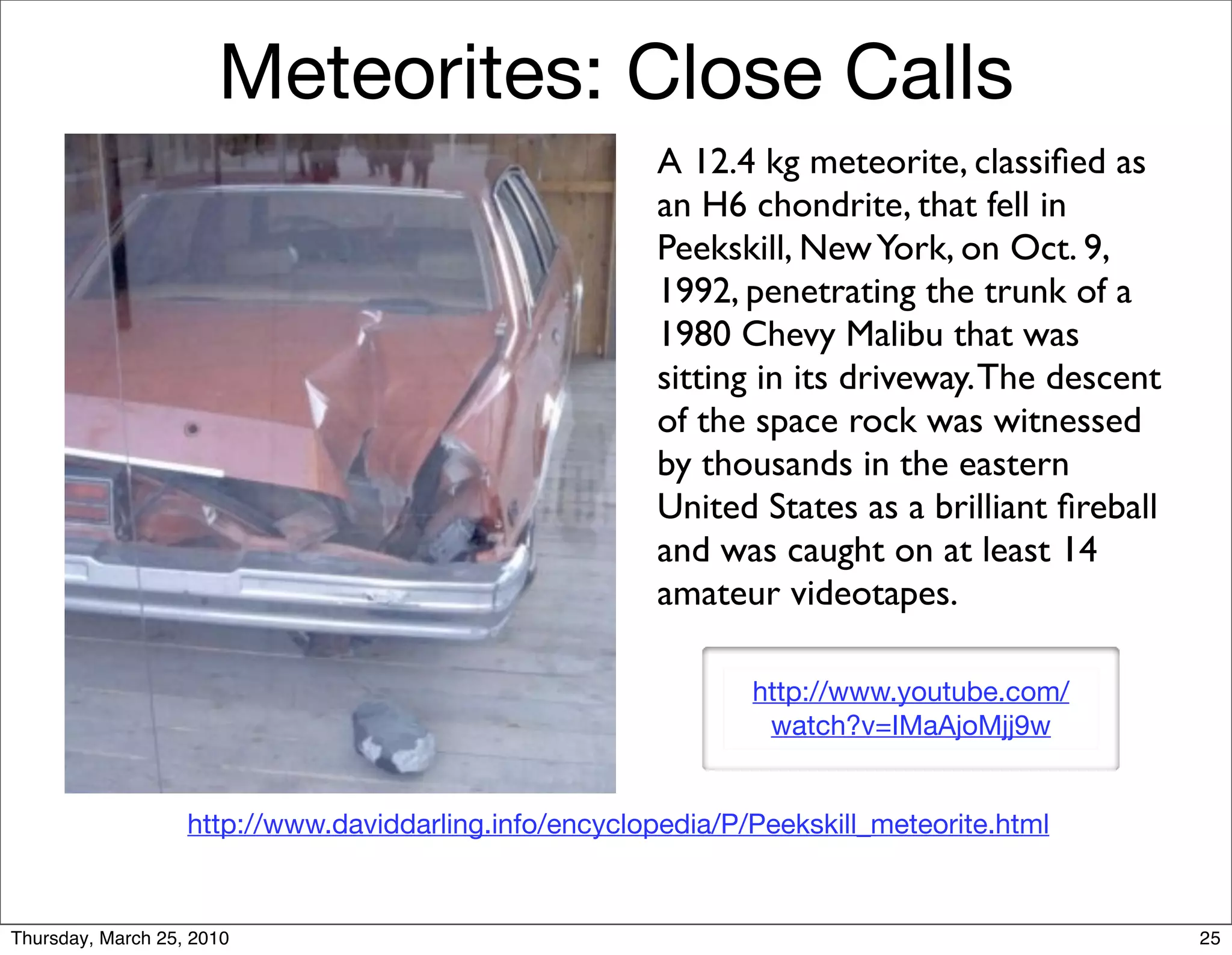
Meteorites: Close Calls
                                                        A 12.4 kg meteorite, classified as
                                                        an H6 chondrite, that fell in
                                                        Peekskill, New York, on Oct. 9,
                                                        1992, penetrating the trunk of a
                                                        1980 Chevy Malibu that was
                                                        sitting in its driveway. The descent
                                                        of the space rock was witnessed
                                                        by thousands in the eastern
                                                        United States as a brilliant fireball
                                                        and was caught on at least 14
                                                        amateur videotapes.

                                                               http://www.youtube.com/
                                                                watch?v=IMaAjoMjj9w


                   http://www.daviddarling.info/encyclopedia/P/Peekskill_meteorite.html


Thursday, March 25, 2010                                                                       25
Meteorites: Close Calls
                                        Ed Howard, then Sylacauga mayor, Ann Hodges and then
                                        Sylacauga Police Chief W.D. Ashcraft pose with a meteorite
                                        underneath the point where it crashed through Hodges' house
                                        in 1954. Hodges donated the meteorite to UA's Alabama
                                        Museum of Natural History in 1956.
                                                 http://uanews.ua.edu/anews2004/nov04/
                                                           meteorite112404.htm


      On the 30 March 1954 Mrs. Hodges was asleep on her sofa when a
      3.86 kg (= 8.51 lbs unit conversion) stony meteorite crashed
      though her roof [struck the radio, bounced off the floor] and hit
      her, causing abdominal injuries which, fortunately, were not serious.
         http://www.michaelbloodmeteorites.com/Hammers.html


Thursday, March 25, 2010                                                                              26
LACC HW: Franknoi, Morrison, and
               Wolff, Voyages Through the Universe,
                              3rd ed.


                      •     Ch 13, p. 308: 4.


                       Due at the beginning of first class period
                                   after this week.
                           Be working your Solar System project.


Thursday, March 25, 2010                                           27
Meteorites
              LACC: Ch §12.1, 13.1, 13.2
      •      Know where Meteorites and Meteors come from:
             Meteors: mostly asteroids, sometimes comets (or
             Moon/Mars); Meteors (mostly comet dust)
      •      Know how Meteorites are classified: composition
             (laboratory analysis)
      •      Know what Meteorites tell us about the conditions
             and processes shaped our solar system:
             undifferentiated = primitive carbonaceous chondrites
             vs. differentiated = processed irons
          An attempt to answer the “big questions”: what is out
                         there? Are we alone?

Thursday, March 25, 2010                                            28

A1 13 Asteroids

  • 1.
    Asteroids LACC: Ch §12.1, 13.1, 13.2 • Understand what conditions and processes shaped the asteroid belt • Understand how Asteroids are classified • Know the Asteroid that is a dwarf planet An attempt to answer the “big questions”: what is out there? Are we alone? Thursday, March 25, 2010 1
  • 2.
    Asteroids http://hubblesite.org/newscenter/archive/releases/2005/27/image/b/format/web_print/ Thursday, March 25, 2010 2
  • 3.
    n Asteroids Mars’s moon Asteroids are material left over from the formation of the solar system. One theory suggests that they are the remains of a planet that was destroyed in a massive collision long ago. More likely, asteroids are Mars’s material that never coalesced into a moon planet. In fact, if the estimated total mass of all asteroids was gathered into a single object, the object would be less than 1,500 kilometers (932 miles) across, less than half the comet diameter of our Moon. comet http://rocksfromspace.open.ac.uk/images/Asteroids_Sullivan.jpg Thursday, March 25, 2010 3
  • 4.
    Asteroid Belt The asteroid belt lies in the region between Mars and Jupiter. The Trojan asteroids lie in Jupiter's orbit, in two distinct regions in front of and behind the planet. http://solarsystem.nasa.gov/multimedia/display.cfm?IM_ID=850 Thursday, March 25, 2010 4
  • 5.
    Asteroid Position and Gravitational Resonances Note: while some resonances tend to move the semi- major axis out of a particular value, others favor having objects at the resonance with Jupiter. Among these are the 3:2, 4:3, and 1:1. The 1:1 resonance is the location of the Trojan asteroids. http://www.physics.uc.edu/%7Esitko/AdvancedAstro/25-SmallBodies/SmallBodies.htm Thursday, March 25, 2010 5
  • 6.
    Types of Asteroidsby Composition • C-type, includes more than 75% of known asteroids: extremely dark (albedo 0.03); similar to carbonaceous chondrite meteorites; approximately the same chemical composition as the Sun minus hydrogen, helium and other volatiles; • S-type, 17%: relatively bright (albedo .10-.22); metallic nickel-iron mixed with iron- and magnesium-silicates; • M-type, most of the rest: bright (albedo .10-.18); pure nickel-iron [metals]. • There are also a dozen or so other rare types. Because of biases involved in the observations (e.g. the dark C-types are harder to see), the percentages above may not be representative of the true distribution of asteroids. (There are actually several classification schemes in use today.) http://www.nineplanets.org/asteroids.html Thursday, March 25, 2010 6
  • 7.
    Asteroid Densities http://aa.usno.navy.mil/faq/docs/asteroid_masses Thursday, March 25, 2010 7
  • 8.
    Asteroids: Ceres http://www.solarviews.com/eng/ceres.htm Thursday, March 25, 2010 8
  • 9.
    Asteroids: Ceres With a diameter of about 975x909 km, Ceres is by far the largest and most massive body in the asteroid belt, and contains approximately a third of the mass of all the asteroids in the solar system. Recent observations have revealed that Ceres is nearly spherical in shape, unlike the irregular shapes of smaller bodies with less gravity. Having sufficient mass for self-gravity to overcome rigid body forces is one of the requirements for classification as a planet or dwarf planet. Ceres has a very primitive surface and like a young planet, contains water- bearing minerals, and possibly a very weak atmosphere and frost. Infrared observations show that the surface is warm with a possible maximum temperature of 235 K (-38°C). NASA's Hubble Space Telescope observed that Ceres' surface has a large dark spot as well as a bright spot which are presumed to be craters. A second explanation for the dark spot it that it may be a darker substance in the asteroid's soil. Studies have shown that Ceres probably has a differentiated interior with a rocky core, an icy mantle that is between 60 to 120 km thick, and a thin dusty surface. http://www.solarviews.com/eng/ceres.htm Thursday, March 25, 2010 9
  • 10.
    Asteroids: Ida and its moon Dactyl http://www.solarviews.com/eng/ida.htm Thursday, March 25, 2010 10
  • 11.
    Asteroids: Eros NEAR Shoemaker touched down on the surface of Eros at 3:01:52 p.m. EST (20:01:52 UT) Monday, 12 February [2001].... The spacecraft impacted at a velocity of about 1.5 to 1.8 m/s (3.4 to 4.0 mph). The spacecraft obtained 69 high-resolution images before touchdown, the final image showing an area 6 meters across. NEAR was not designed as a lander, but survived the low-velocity, low-gravity impact,. http://nssdc.gsfc.nasa.gov/planetary/near.html Thursday, March 25, 2010 11
  • 12.
    Asteroids: Near Earth Asteroid Itokawa The density has been estimated to be 2.3 +/-0.3 gram/cc, which is a little lower than that measured for rocks on the ground or for other S-type asteroids measured to date. This may indicate that there is substantial porosity for this body http://www.muses-c.isas.ac.jp/e/index_31.html Thursday, March 25, 2010 12
  • 13.
    Asteroids LACC: Ch §12.1, 13.1, 13.2 • Understand what conditions and processes shaped the asteroid belt: Jupiter’s influence (or a massive collision destroyed a planet) • Understand how Asteroids are classified: composition (usual spectral analysis) and location (gravitation resonances) • Know the Asteroid that is a dwarf planet: Ceres (1/3 mass of all asteroid belt). An attempt to answer the “big questions”: what is out there? Are we alone? Thursday, March 25, 2010 13
  • 14.
    LACC HW: Franknoi,Morrison, and Wolff, Voyages Through the Universe, 3rd ed. • Ch 13, p. 308: 2. Due at the beginning of first class period after this week. Be working your Solar System project. Thursday, March 25, 2010 14
  • 15.
    Meteorites LACC: Ch §12.1, 13.1, 13.2 • Know where Meteorites and Meteors come from • Know how Meteorites are classified • Know what Meteorites tell us about the conditions and processes shaped our solar system An attempt to answer the “big questions”: what is out there? Are we alone? Thursday, March 25, 2010 15
  • 16.
    Meteor/Meteoroids/Meteorites It is estimated that 1,000 tons to more than 10,000 tons of interplanetary material falls on the Earth each day. Most of this material is very tiny in the form of micrometeoroids or dust-like grains a few micrometers in size. These particles are so tiny that the air resistance is enough to slow them sufficiently that they do not burn up, but rather fall gently to Earth. "Shooting stars" or meteors are bits of material falling through Earth's atmosphere at altitudes of 50-100 km. They are heated to incandescence by [ram pressure]. The surface melts and vaporizes leaving behind an ionized trail of gas and dust. The bright trails as they are coming through the Earth's atmosphere are termed meteors, and these chunks as they are hurtling through space are called meteoroids. As the object penetrates to 20 km it will have slowed enough that heating no longer makes it glow and it will continue to fall to Earth. Large pieces that do not vaporize completely and reach the surface of the Earth are called meteorites. On occasions a large meteoroid will strike the earth and at 120 km glow as bright as the sun. These fireballs are called bolides and often are accompanied by sonic booms. http://www.physics.uq.edu.au/people/ross/phys2081/meteor.htm Thursday, March 25, 2010 16
  • 17.
    Types of Meteoritesby Composition • Iron (Fe/Ni) are the most likely finds (they look more unusual), • Stony (C/O/Mg/Si) are the most likely falls (the most common type) and % by falls • Stoney Iron (Si/Fe/Ni - ± a few % pretty rare). http://rst.gsfc.nasa.gov/Sect19/Sect19_2.html The stony meteorites are further subdivided into chondrites and achondrites. Most meteorites are chondrites, so named because of the presence of small rounded grains called chondrules. These grains are a few mm diameter and rich in olivine and pyroxine. [silicates, e.g. SiO42-] http://www.physics.uq.edu.au/people/ross/phys2081/meteor.htm Thursday, March 25, 2010 17
  • 18.
    Carbonaceous Chondrites A few chondrites have high concentrations of Al, Mg and Ca, and rich in O, and have almost no metallic Fe-Ni. These meteorites are dark in color and called carbonaceous chondrites. ...the composition matches the non volatile composition of the sun. If you took the primordial material of the solar system, as we suspect the sun is composed, then condense it, discarding volatiles such as H and He, you would end up with such material. This mixture is called "chondritic". Carbonaceous chondrites are some of the most complex of all meteorites. They are rare, primitive and contain organic compounds. Most importantly they contain water-bearing minerals which is evidence of water moving slowly through their interiors not long after formation. http://www.physics.uq.edu.au/people/ross/phys2081/meteor.htm Thursday, March 25, 2010 18
  • 19.
    Primitive Meteorite Composition http://eps.berkeley.edu/cig/depaolo/eps102/PPT4_Meteorites.html Thursday, March 25, 2010 19
  • 20.
    Section of theAllende, Mexico CV3 meteorite [This carbonaceous chondrite is] classed as CV3 and represents some of the oldest known matter. The meteorite formed 4.56 billion years ago and contains interstellar grains within calcium/aluminum rich inclusions (CAIs). Interstellar grains are remnants of a prior star that lived out its life and exploded before the formation of our Sun. It is possible that this explosion was the trigger for the formation of our solar system. http://www.meteorlab.com/METEORLAB2001dev/carbchon.htm Thursday, March 25, 2010 20
  • 21.
    The Murchison, Australia, carbonaceous chondrite, CM2 [This carbonaceous chondrite is] a CM2 chondrite and believed to be of cometary origin because of its high water content, 12%. To date 92 amino acids (the building blocks of protein) have been found in Murchison. Only nineteen of them are found on Earth. http://www.meteorlab.com/METEORLAB2001dev/carbchon.htm Thursday, March 25, 2010 21
  • 22.
    Processed Meteorites: Origin https://www.dmr.nd.gov/ndgs/Geology%20Notes/Meteor/meteor.asp Thursday, March 25, 2010 22
  • 23.
    Lunaites (Moon Meteorites) There is a growing realization that many of the Achondrites may be pieces of the Moon or Mars expelled from these bodies by impact. Lunar meteorites may directly strike the Earth after thrown off by a lunar impact or fall after being captured in orbit... [Above are] meteorite samples of probably lunar origin, as determined by age and composition. http://rst.gsfc.nasa.gov/Sect19/Sect19_2.html Thursday, March 25, 2010 23
  • 24.
    (Asteroid) Vesta Meteorites meteorite asteroid At least one meteorite has been traced to a specific asteroid, Vesta, based on strong similarities in spectral properties http://rst.gsfc.nasa.gov/Sect19/Sect19_2.html Thursday, March 25, 2010 24
  • 25.
    Meteorites: Close Calls A 12.4 kg meteorite, classified as an H6 chondrite, that fell in Peekskill, New York, on Oct. 9, 1992, penetrating the trunk of a 1980 Chevy Malibu that was sitting in its driveway. The descent of the space rock was witnessed by thousands in the eastern United States as a brilliant fireball and was caught on at least 14 amateur videotapes. http://www.youtube.com/ watch?v=IMaAjoMjj9w http://www.daviddarling.info/encyclopedia/P/Peekskill_meteorite.html Thursday, March 25, 2010 25
  • 26.
    Meteorites: Close Calls Ed Howard, then Sylacauga mayor, Ann Hodges and then Sylacauga Police Chief W.D. Ashcraft pose with a meteorite underneath the point where it crashed through Hodges' house in 1954. Hodges donated the meteorite to UA's Alabama Museum of Natural History in 1956. http://uanews.ua.edu/anews2004/nov04/ meteorite112404.htm On the 30 March 1954 Mrs. Hodges was asleep on her sofa when a 3.86 kg (= 8.51 lbs unit conversion) stony meteorite crashed though her roof [struck the radio, bounced off the floor] and hit her, causing abdominal injuries which, fortunately, were not serious. http://www.michaelbloodmeteorites.com/Hammers.html Thursday, March 25, 2010 26
  • 27.
    LACC HW: Franknoi,Morrison, and Wolff, Voyages Through the Universe, 3rd ed. • Ch 13, p. 308: 4. Due at the beginning of first class period after this week. Be working your Solar System project. Thursday, March 25, 2010 27
  • 28.
    Meteorites LACC: Ch §12.1, 13.1, 13.2 • Know where Meteorites and Meteors come from: Meteors: mostly asteroids, sometimes comets (or Moon/Mars); Meteors (mostly comet dust) • Know how Meteorites are classified: composition (laboratory analysis) • Know what Meteorites tell us about the conditions and processes shaped our solar system: undifferentiated = primitive carbonaceous chondrites vs. differentiated = processed irons An attempt to answer the “big questions”: what is out there? Are we alone? Thursday, March 25, 2010 28