Typical Stellar Evolution
                     LACC §: 20.2, 21.4, 21.5

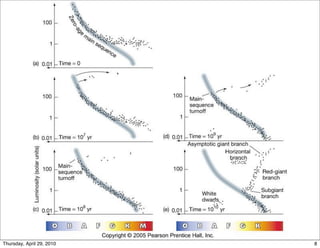
           • Red Giant Branch
           • Horizontal Giant Branch
           • Asymptotic Giant Branch

             An attempt to answer the “big questions”: What is
                    out there? Where did I come from?


Thursday, April 29, 2010                                         1
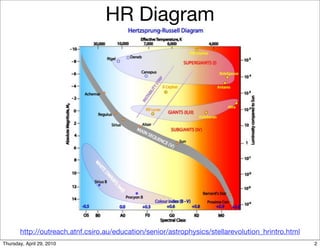
HR Diagram


       http://outreach.atnf.csiro.au/education/senior/astrophysics/stellarevolution_hrintro.html
Thursday, April 29, 2010                                                                           2
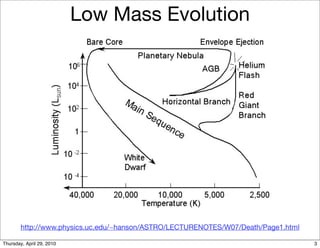
Low Mass Evolution


        http://www.physics.uc.edu/~hanson/ASTRO/LECTURENOTES/W07/Death/Page1.html

Thursday, April 29, 2010                                                            3
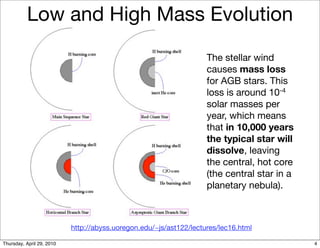
Low and High Mass Evolution

                                                                    The stellar wind
                                                                    causes mass loss
                                                                    for AGB stars. This
                                                                    loss is around 10-4
                                                                    solar masses per
                                                                    year, which means
                                                                    that in 10,000 years
                                                                    the typical star will
                                                                    dissolve, leaving
                                                                    the central, hot core
                                                                    (the central star in a
                                                                    planetary nebula).


                           http://abyss.uoregon.edu/~js/ast122/lectures/lec16.html

Thursday, April 29, 2010                                                                     4
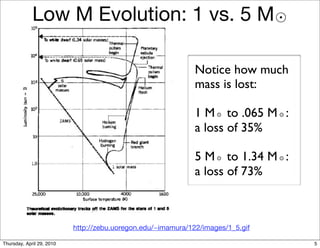
Low M Evolution: 1 vs. 5 M

                                                              Notice how much
                                                              mass is lost:

                                                              1 M to .065 M :
                                                              a loss of 35%

                                                              5 M to 1.34 M :
                                                              a loss of 73%


                           http://zebu.uoregon.edu/~imamura/122/images/1_5.gif

Thursday, April 29, 2010                                                         5
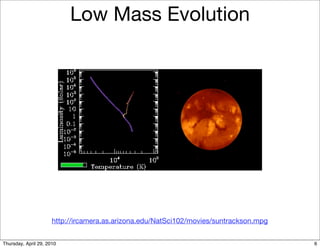
Low Mass Evolution


                      http://ircamera.as.arizona.edu/NatSci102/movies/suntrackson.mpg


Thursday, April 29, 2010                                                                6
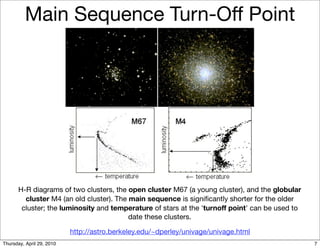
Main Sequence Turn-Off Point


       H-R diagrams of two clusters, the open cluster M67 (a young cluster), and the globular
         cluster M4 (an old cluster). The main sequence is significantly shorter for the older
        cluster; the luminosity and temperature of stars at the 'turnoff point' can be used to
                                          date these clusters.

                           http://astro.berkeley.edu/~dperley/univage/univage.html
Thursday, April 29, 2010                                                                         7
HR Diagram and Mass


                     http://physics.uoregon.edu/~jimbrau/astr122/Notes/Chapter17.html
Thursday, April 29, 2010                                                                8
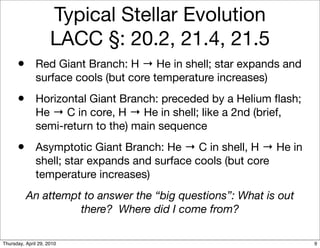
Typical Stellar Evolution
                     LACC §: 20.2, 21.4, 21.5
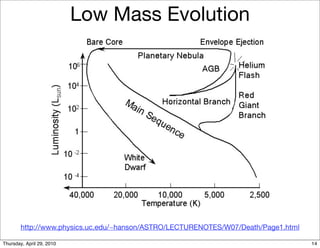
      • Red Giant Branch: H → He in shell; star expands and
              surface cools (but core temperature increases)
      • Horizontal Giant Branch: preceded by a Helium flash;
              He → C in core, H → He in shell; like a 2nd (brief,
              semi-return to the) main sequence
      • Asymptotic Giant Branch: He → C in shell, H → He in
              shell; star expands and surface cools (but core
              temperature increases)
          An attempt to answer the “big questions”: What is out
                    there? Where did I come from?

Thursday, April 29, 2010                                            9
LACC HW: Franknoi, Morrison, and
                Wolff, Voyages Through the Universe,
                               3rd ed.

             •       Ch 20, pp. 461-462: 13.

             •       Ch 22: Tutorial Quizzes accessible from:              http://
                     www.brookscole.com/cgi-brookscole/course_products_bc.pl?
                     fid=M20b&product_isbn_issn=9780495017899&discipline_number=19


                   Due first class period of the next week (unless
                   there is a test this week, in which case it’s due
                                    before the test).
             AstroTeams, be working on your Distance Ladders.


Thursday, April 29, 2010                                                             10
Low Mass Stellar Evolution
                 LACC §: 20.2, 21.4, 21.5


              • Hayashi Track
              • Typical Evolution
              • Planetary Nebula
              An attempt to answer the “big questions”: What is
                     out there? Where did I come from?


Thursday, April 29, 2010                                          11
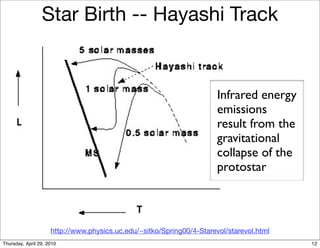
Star Birth -- Hayashi Track


                                                                       Infrared energy
                                                                       emissions
                                                                       result from the
                                                                       gravitational
                                                                       collapse of the
                                                                       protostar


                     http://www.physics.uc.edu/~sitko/Spring00/4-Starevol/starevol.html
Thursday, April 29, 2010                                                                  12
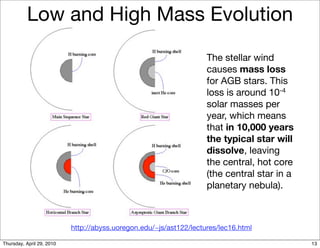
Low and High Mass Evolution

                                                                    The stellar wind
                                                                    causes mass loss
                                                                    for AGB stars. This
                                                                    loss is around 10-4
                                                                    solar masses per
                                                                    year, which means
                                                                    that in 10,000 years
                                                                    the typical star will
                                                                    dissolve, leaving
                                                                    the central, hot core
                                                                    (the central star in a
                                                                    planetary nebula).


                           http://abyss.uoregon.edu/~js/ast122/lectures/lec16.html

Thursday, April 29, 2010                                                                     13
Low Mass Evolution


        http://www.physics.uc.edu/~hanson/ASTRO/LECTURENOTES/W07/Death/Page1.html

Thursday, April 29, 2010                                                            14
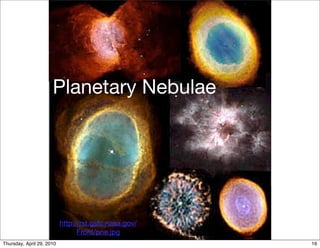
Planetary Nebulae
      With some complications
      glossed over, the envelope
      and as much as 50% of
      the stellar mass is
      detached from the
      star and expelled into
      space leaving the AGB star
      very hot core exposed.
      The high temperature of the "central star" (it is not REALLY a star as
      there is no fusion energy source) means it has a Planck [or thermal
      spectrum] curve that peaks way out in the UV and produces many UV
      and even soft X-ray photons. These collide with the H, He, C and O
      atoms in the former envelope that we now call a PN. These atoms get
      ionized, and on recombination the e- drop through the energy levels
      giving off various lower energy photons (that add up in energy to the
      original UV or X-ray ionizing photon) as they head for the ground state.
                  http://www.ucolick.org/%7Ebolte/AY4_00/week7/low-mass_deathC.html


Thursday, April 29, 2010                                                              15
Planetary Nebulae


                           http://rst.gsfc.nasa.gov/
                                 Front/pne.jpg
Thursday, April 29, 2010                               16
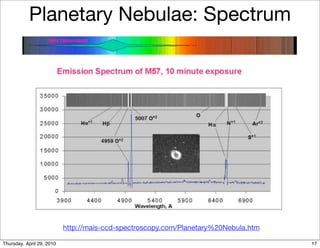
Planetary Nebulae: Spectrum


                           http://mais-ccd-spectroscopy.com/Planetary%20Nebula.htm

Thursday, April 29, 2010                                                             17
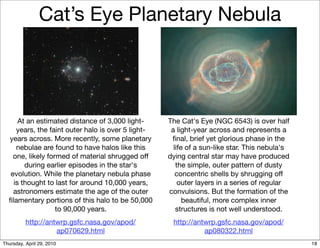
Cat’s Eye Planetary Nebula


      At an estimated distance of 3,000 light-      The Cat's Eye (NGC 6543) is over half
     years, the faint outer halo is over 5 light-    a light-year across and represents a
  years across. More recently, some planetary        final, brief yet glorious phase in the
     nebulae are found to have halos like this        life of a sun-like star. This nebula's
   one, likely formed of material shrugged off      dying central star may have produced
        during earlier episodes in the star's          the simple, outer pattern of dusty
  evolution. While the planetary nebula phase          concentric shells by shrugging off
    is thought to last for around 10,000 years,         outer layers in a series of regular
   astronomers estimate the age of the outer        convulsions. But the formation of the
  filamentary portions of this halo to be 50,000           beautiful, more complex inner
                  to 90,000 years.                     structures is not well understood.
          http://antwrp.gsfc.nasa.gov/apod/          http://antwrp.gsfc.nasa.gov/apod/
                    ap070629.html                              ap080322.html
Thursday, April 29, 2010                                                                       18
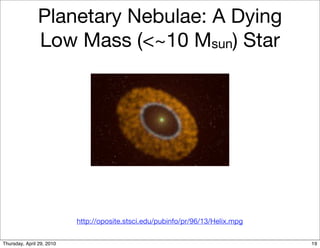
Planetary Nebulae: A Dying
               Low Mass (<~10 Msun) Star


                           http://oposite.stsci.edu/pubinfo/pr/96/13/Helix.mpg


Thursday, April 29, 2010                                                         19
Low Mass Stellar Evolution
                 LACC §: 20.2, 21.4, 21.5

              • Hayashi Track: for all stars--low and high
                      mass; gravitation contraction heats protostar
              • Typical Evolution: Main Sequence → Red
                      Giant → Helium Flash → Horizontal Giant
                      Branch → Asymptotic Giant Branch →
              • Planetary Nebula with White Dwarf
              An attempt to answer the “big questions”: What is
                     out there? Where did I come from?


Thursday, April 29, 2010                                              20
LACC HW: Franknoi, Morrison, and
                Wolff, Voyages Through the Universe,
                               3rd ed.
             •       Ch 21, p. 485-486: 2 (I want a one word answer), 4&5
                     (Mention how and where the thermal energy is coming from for each
                     stage: protostar, main sequence, red giant, helium flash, horizontal giant
                     branch, asymptotic giant branch)


             •       Ch 23: Tutorial Quizzes accessible from:
                     www.brookscole.com/cgi-brookscole/course_products_bc.pl?
                                                                                      http://

                     fid=M20b&product_isbn_issn=9780495017899&discipline_number=19

                   Due first class period of the next week (unless
                   there is a test this week, in which case it’s due
                                    before the test).
             AstroTeams, be working on your Distance Ladders.


Thursday, April 29, 2010                                                                         21

A1 18 Stellar Evolution

  • 1.
    Typical Stellar Evolution LACC §: 20.2, 21.4, 21.5 • Red Giant Branch • Horizontal Giant Branch • Asymptotic Giant Branch An attempt to answer the “big questions”: What is out there? Where did I come from? Thursday, April 29, 2010 1
  • 2.
    HR Diagram http://outreach.atnf.csiro.au/education/senior/astrophysics/stellarevolution_hrintro.html Thursday, April 29, 2010 2
  • 3.
    Low Mass Evolution http://www.physics.uc.edu/~hanson/ASTRO/LECTURENOTES/W07/Death/Page1.html Thursday, April 29, 2010 3
  • 4.
    Low and HighMass Evolution The stellar wind causes mass loss for AGB stars. This loss is around 10-4 solar masses per year, which means that in 10,000 years the typical star will dissolve, leaving the central, hot core (the central star in a planetary nebula). http://abyss.uoregon.edu/~js/ast122/lectures/lec16.html Thursday, April 29, 2010 4
  • 5.
    Low M Evolution:1 vs. 5 M Notice how much mass is lost: 1 M to .065 M : a loss of 35% 5 M to 1.34 M : a loss of 73% http://zebu.uoregon.edu/~imamura/122/images/1_5.gif Thursday, April 29, 2010 5
  • 6.
    Low Mass Evolution http://ircamera.as.arizona.edu/NatSci102/movies/suntrackson.mpg Thursday, April 29, 2010 6
  • 7.
    Main Sequence Turn-OffPoint H-R diagrams of two clusters, the open cluster M67 (a young cluster), and the globular cluster M4 (an old cluster). The main sequence is significantly shorter for the older cluster; the luminosity and temperature of stars at the 'turnoff point' can be used to date these clusters. http://astro.berkeley.edu/~dperley/univage/univage.html Thursday, April 29, 2010 7
  • 8.
    HR Diagram andMass http://physics.uoregon.edu/~jimbrau/astr122/Notes/Chapter17.html Thursday, April 29, 2010 8
  • 9.
    Typical Stellar Evolution LACC §: 20.2, 21.4, 21.5 • Red Giant Branch: H → He in shell; star expands and surface cools (but core temperature increases) • Horizontal Giant Branch: preceded by a Helium flash; He → C in core, H → He in shell; like a 2nd (brief, semi-return to the) main sequence • Asymptotic Giant Branch: He → C in shell, H → He in shell; star expands and surface cools (but core temperature increases) An attempt to answer the “big questions”: What is out there? Where did I come from? Thursday, April 29, 2010 9
  • 10.
    LACC HW: Franknoi,Morrison, and Wolff, Voyages Through the Universe, 3rd ed. • Ch 20, pp. 461-462: 13. • Ch 22: Tutorial Quizzes accessible from: http:// www.brookscole.com/cgi-brookscole/course_products_bc.pl? fid=M20b&product_isbn_issn=9780495017899&discipline_number=19 Due first class period of the next week (unless there is a test this week, in which case it’s due before the test). AstroTeams, be working on your Distance Ladders. Thursday, April 29, 2010 10
  • 11.
    Low Mass StellarEvolution LACC §: 20.2, 21.4, 21.5 • Hayashi Track • Typical Evolution • Planetary Nebula An attempt to answer the “big questions”: What is out there? Where did I come from? Thursday, April 29, 2010 11
  • 12.
    Star Birth --Hayashi Track Infrared energy emissions result from the gravitational collapse of the protostar http://www.physics.uc.edu/~sitko/Spring00/4-Starevol/starevol.html Thursday, April 29, 2010 12
  • 13.
    Low and HighMass Evolution The stellar wind causes mass loss for AGB stars. This loss is around 10-4 solar masses per year, which means that in 10,000 years the typical star will dissolve, leaving the central, hot core (the central star in a planetary nebula). http://abyss.uoregon.edu/~js/ast122/lectures/lec16.html Thursday, April 29, 2010 13
  • 14.
    Low Mass Evolution http://www.physics.uc.edu/~hanson/ASTRO/LECTURENOTES/W07/Death/Page1.html Thursday, April 29, 2010 14
  • 15.
    Planetary Nebulae With some complications glossed over, the envelope and as much as 50% of the stellar mass is detached from the star and expelled into space leaving the AGB star very hot core exposed. The high temperature of the "central star" (it is not REALLY a star as there is no fusion energy source) means it has a Planck [or thermal spectrum] curve that peaks way out in the UV and produces many UV and even soft X-ray photons. These collide with the H, He, C and O atoms in the former envelope that we now call a PN. These atoms get ionized, and on recombination the e- drop through the energy levels giving off various lower energy photons (that add up in energy to the original UV or X-ray ionizing photon) as they head for the ground state. http://www.ucolick.org/%7Ebolte/AY4_00/week7/low-mass_deathC.html Thursday, April 29, 2010 15
  • 16.
    Planetary Nebulae http://rst.gsfc.nasa.gov/ Front/pne.jpg Thursday, April 29, 2010 16
  • 17.
    Planetary Nebulae: Spectrum http://mais-ccd-spectroscopy.com/Planetary%20Nebula.htm Thursday, April 29, 2010 17
  • 18.
    Cat’s Eye PlanetaryNebula At an estimated distance of 3,000 light- The Cat's Eye (NGC 6543) is over half years, the faint outer halo is over 5 light- a light-year across and represents a years across. More recently, some planetary final, brief yet glorious phase in the nebulae are found to have halos like this life of a sun-like star. This nebula's one, likely formed of material shrugged off dying central star may have produced during earlier episodes in the star's the simple, outer pattern of dusty evolution. While the planetary nebula phase concentric shells by shrugging off is thought to last for around 10,000 years, outer layers in a series of regular astronomers estimate the age of the outer convulsions. But the formation of the filamentary portions of this halo to be 50,000 beautiful, more complex inner to 90,000 years. structures is not well understood. http://antwrp.gsfc.nasa.gov/apod/ http://antwrp.gsfc.nasa.gov/apod/ ap070629.html ap080322.html Thursday, April 29, 2010 18
  • 19.
    Planetary Nebulae: ADying Low Mass (<~10 Msun) Star http://oposite.stsci.edu/pubinfo/pr/96/13/Helix.mpg Thursday, April 29, 2010 19
  • 20.
    Low Mass StellarEvolution LACC §: 20.2, 21.4, 21.5 • Hayashi Track: for all stars--low and high mass; gravitation contraction heats protostar • Typical Evolution: Main Sequence → Red Giant → Helium Flash → Horizontal Giant Branch → Asymptotic Giant Branch → • Planetary Nebula with White Dwarf An attempt to answer the “big questions”: What is out there? Where did I come from? Thursday, April 29, 2010 20
  • 21.
    LACC HW: Franknoi,Morrison, and Wolff, Voyages Through the Universe, 3rd ed. • Ch 21, p. 485-486: 2 (I want a one word answer), 4&5 (Mention how and where the thermal energy is coming from for each stage: protostar, main sequence, red giant, helium flash, horizontal giant branch, asymptotic giant branch) • Ch 23: Tutorial Quizzes accessible from: www.brookscole.com/cgi-brookscole/course_products_bc.pl? http:// fid=M20b&product_isbn_issn=9780495017899&discipline_number=19 Due first class period of the next week (unless there is a test this week, in which case it’s due before the test). AstroTeams, be working on your Distance Ladders. Thursday, April 29, 2010 21