Luna
                           LACC §8.2, 4, 5

             • Know Luna’s (Earth’s Moon) interior and origin
             • Know Luna’s (Earth’s Moon) surface features
                     and age
             • Understand the Earth-Moon system
               An attempt to answer the “big question”: what is
                         out there? Are we alone?


Thursday, March 4, 2010                                           1
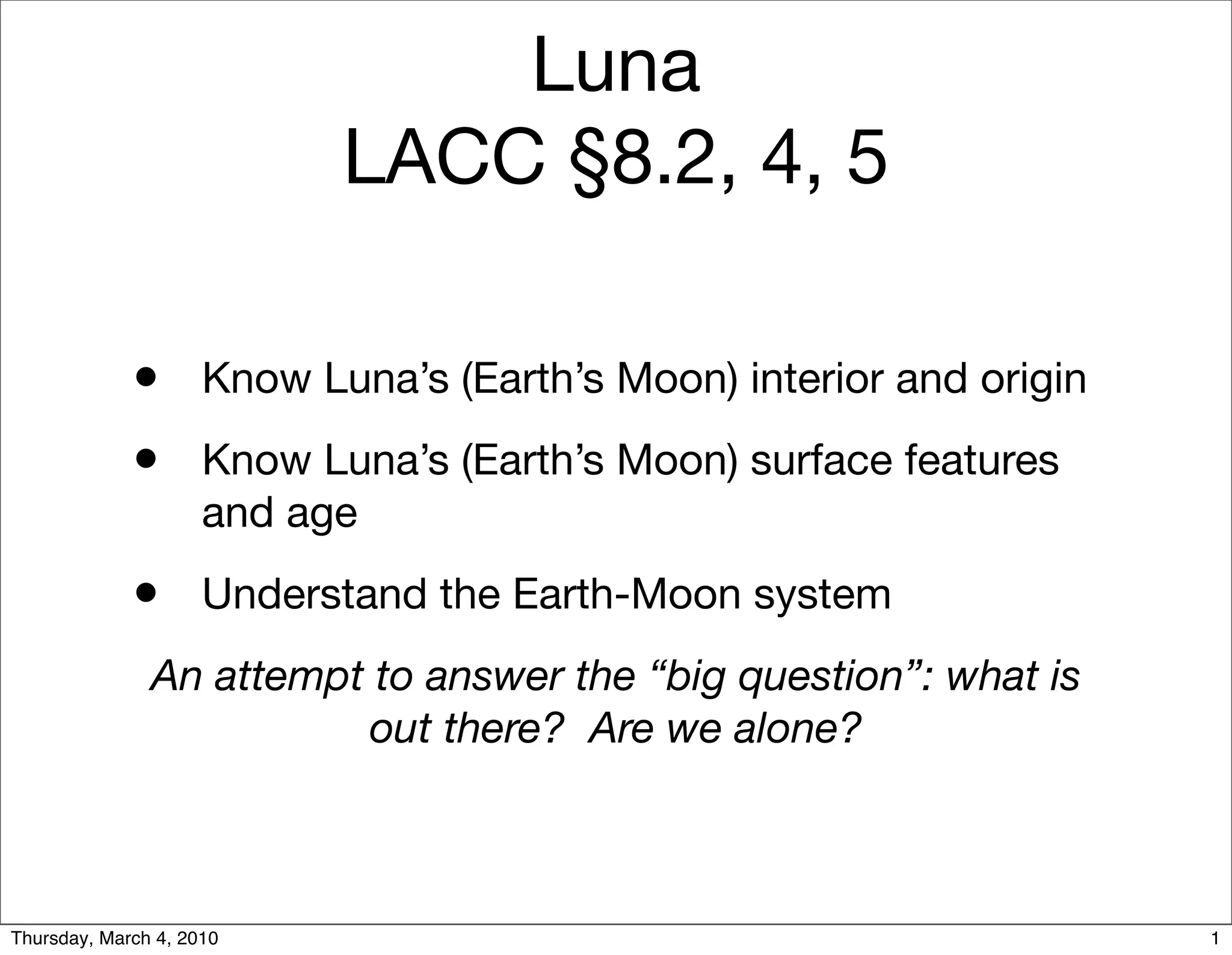
Luna: Earth’s Moon

                                                             (red light)


                          http://www.lpi.usra.edu/lunar/missions/clementine/images/


Thursday, March 4, 2010                                                               2
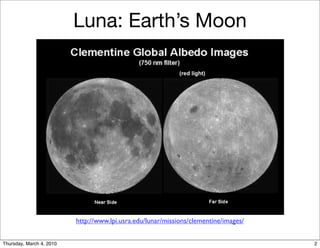
Luna: Size

                                                       (red light)


                          http://www.astronomy.org/programs/moon/moon.html


Thursday, March 4, 2010                                                      3
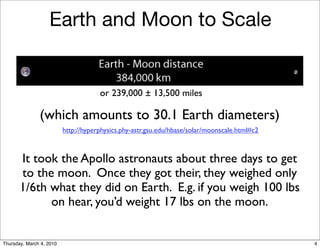
Earth and Moon to Scale


                                      or 239,000 ± 13,500 miles

               (which amounts to 30.1 Earth diameters)
                          http://hyperphysics.phy-astr.gsu.edu/hbase/solar/moonscale.html#c2


       It took the Apollo astronauts about three days to get
       to the moon. Once they got their, they weighed only
       1/6th what they did on Earth. E.g. if you weigh 100 lbs
             on hear, you’d weight 17 lbs on the moon.


Thursday, March 4, 2010                                                                        4
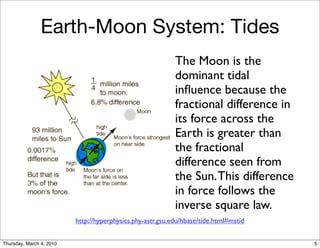
Earth-Moon System: Tides
                                                            The Moon is the
                                                            dominant tidal
                                                            influence because the
                                                            fractional difference in
                                                            its force across the
                                                            Earth is greater than
                                                            the fractional
                                                            difference seen from
                                                            the Sun. This difference
                                                            in force follows the
                                                            inverse square law.
                          http://hyperphysics.phy-astr.gsu.edu/hbase/tide.html#mstid


Thursday, March 4, 2010                                                                5
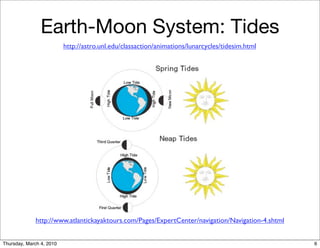
Earth-Moon System: Tides
                          http://astro.unl.edu/classaction/animations/lunarcycles/tidesim.html


             http://www.atlantickayaktours.com/Pages/ExpertCenter/navigation/Navigation-4.shtml


Thursday, March 4, 2010                                                                           6
Earth-Moon System:
                 Moon’s Tide Locked Orbit


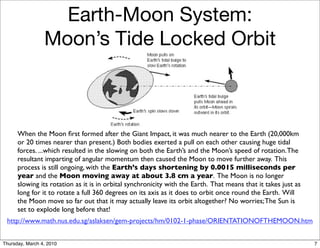
      When the Moon first formed after the Giant Impact, it was much nearer to the Earth (20,000km
      or 20 times nearer than present.) Both bodies exerted a pull on each other causing huge tidal
      forces. ...which resulted in the slowing on both the Earth’s and the Moon’s speed of rotation. The
      resultant imparting of angular momentum then caused the Moon to move further away. This
      process is still ongoing, with the Earth’s days shortening by 0.0015 milliseconds per
      year and the Moon moving away at about 3.8 cm a year. The Moon is no longer
      slowing its rotation as it is in orbital synchronicity with the Earth. That means that it takes just as
      long for it to rotate a full 360 degrees on its axis as it does to orbit once round the Earth. Will
      the Moon move so far out that it may actually leave its orbit altogether? No worries; The Sun is
      set to explode long before that!
 http://www.math.nus.edu.sg/aslaksen/gem-projects/hm/0102-1-phase/ORIENTATIONOFTHEMOON.htm


Thursday, March 4, 2010                                                                                         7
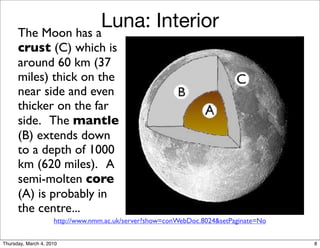
The Moon has a
                    Luna: Interior
      crust (C) which is
      around 60 km (37
      miles) thick on the                                (red light)


      near side and even
      thicker on the far
      side. The mantle
      (B) extends down
      to a depth of 1000
      km (620 miles). A
      semi-molten core
      (A) is probably in
      the centre...
                     http://www.nmm.ac.uk/server?show=conWebDoc.8024&setPaginate=No


Thursday, March 4, 2010                                                               8
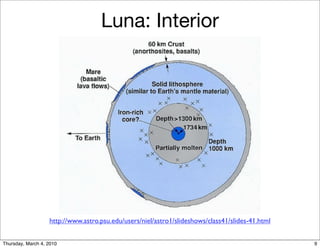
Luna: Interior

                                                               (red light)


                   http://www.astro.psu.edu/users/niel/astro1/slideshows/class41/slides-41.html


Thursday, March 4, 2010                                                                           9
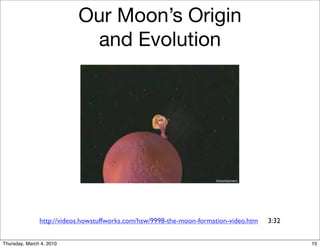
Our Moon’s Origin
                            and Evolution


               http://videos.howstuffworks.com/hsw/9998-the-moon-formation-video.htm   3:32


Thursday, March 4, 2010                                                                       10
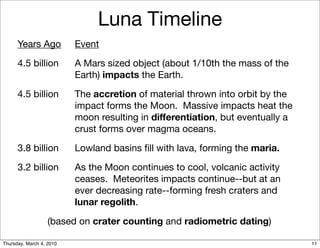
Luna Timeline
      Years Ago	          Event

      4.5 billion	        A Mars sized object (about 1/10th the mass of the
                          Earth) impacts the Earth.

      4.5 billion	        The accretion of material thrown into orbit by the
                          impact forms the Moon. Massive impacts heat the
                          moon resulting in differentiation, but eventually a
                          crust forms over magma oceans.

      3.8 billion	        Lowland basins fill with lava, forming the maria.

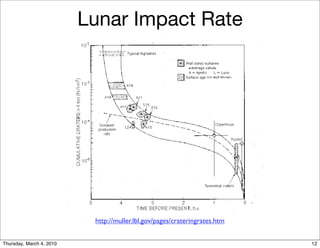
      3.2 billion	        As the Moon continues to cool, volcanic activity
                          ceases. Meteorites impacts continue--but at an
                          ever decreasing rate--forming fresh craters and
                          lunar regolith.

                   (based on crater counting and radiometric dating)

Thursday, March 4, 2010                                                         11
Lunar Impact Rate


                           http://muller.lbl.gov/pages/crateringrates.htm


Thursday, March 4, 2010                                                     12
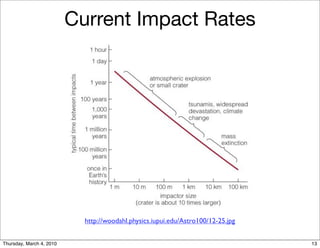
Current Impact Rates


                            http://woodahl.physics.iupui.edu/Astro100/12-25.jpg


Thursday, March 4, 2010                                                           13
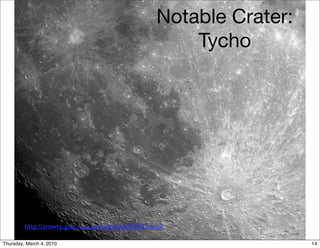
Notable Crater:
                                                         Tycho


         http://antwrp.gsfc.nasa.gov/apod/ap050305.html

Thursday, March 4, 2010                                                14
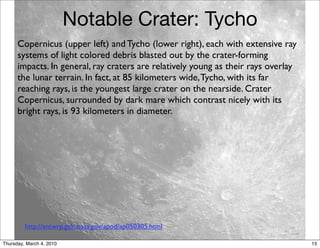
Notable Crater: Tycho
      Copernicus (upper left) and Tycho (lower right), each with extensive ray
      systems of light colored debris blasted out by the crater-forming
      impacts. In general, ray craters are relatively young as their rays overlay
      the lunar terrain. In fact, at 85 kilometers wide, Tycho, with its far
      reaching rays, is the youngest large crater on the nearside. Crater
      Copernicus, surrounded by dark mare which contrast nicely with its
      bright rays, is 93 kilometers in diameter.


         http://antwrp.gsfc.nasa.gov/apod/ap050305.html

Thursday, March 4, 2010                                                             15
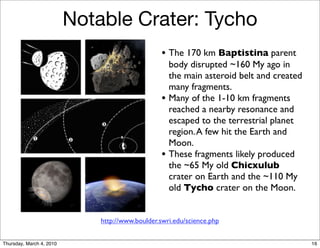
Notable Crater: Tycho
                                                  • The 170 km Baptistina parent
                                                      body disrupted ~160 My ago in
                                                      the main asteroid belt and created
                                                      many fragments.
                                                  •   Many of the 1-10 km fragments
                                                      reached a nearby resonance and
                                                      escaped to the terrestrial planet
                                                      region. A few hit the Earth and
                                                      Moon.
                                                  •   These fragments likely produced
                                                      the ~65 My old Chicxulub
                                                      crater on Earth and the ~110 My
                                                      old Tycho crater on the Moon.


                              http://www.boulder.swri.edu/science.php


Thursday, March 4, 2010                                                                    16
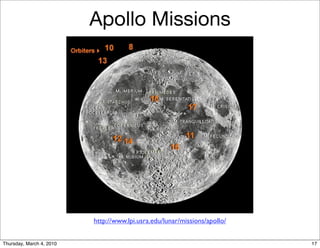
Apollo Missions


                          http://www.lpi.usra.edu/lunar/missions/apollo/


Thursday, March 4, 2010                                                    17
Ice (H2O) on the Moon
                                                               Surface Temperature
                                                                 Day: 107°C (225°F)
                                                                 Night: 153°C (-243°F)

                                                               The Moon has no
                                                               atmosphere...this means
                                                               [ice] will rapidly sublime
                                                               directly into water
                                                               vapor and escape into
                                                               space.... Over the course
                                                               of a lunar day (~29
                                                               Earth days), all regions
                                                               of the Moon are
                                                               exposed to sunlight
                                                               [unless you’re] in a
                                                               permanently shadowed
                     http://www.cmf.nrl.navy.mil/clementine/
                                                               area.

Thursday, March 4, 2010                                                                     18
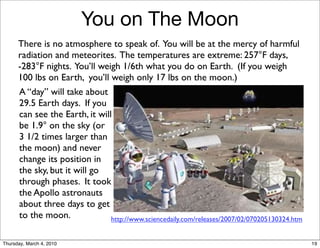
You on The Moon
      There is no atmosphere to speak of. You will be at the mercy of harmful
      radiation and meteorites. The temperatures are extreme: 257°F days,
      -283°F nights. You’ll weigh 1/6th what you do on Earth. (If you weigh
      100 lbs on Earth, you’ll weigh only 17 lbs on the moon.)
      A “day” will take about
      29.5 Earth days. If you
      can see the Earth, it will
      be 1.9° on the sky (or
      3 1/2 times larger than
      the moon) and never
      change its position in
      the sky, but it will go
      through phases. It took
      the Apollo astronauts
      about three days to get
      to the moon.              http://www.sciencedaily.com/releases/2007/02/070205130324.htm


Thursday, March 4, 2010                                                                         19
Luna
                            LACC §8.2, 4, 5
             • Know Luna’s (Earth’s Moon) interior (mantle is
                     solid, core is unusually small) and origin
                     (impact theory)
             • Know Luna’s (Earth’s Moon) surface features
                     (highlands, maria, craters, regolith, water ice!)
                     and age (highlands--4.4 billion, maria--3.5
                     billion; young crater vs old crater)
             • Understand the Earth-Moon system: tides,
                     tide locked orbit
               An attempt to answer the “big question”: what is
                         out there? Are we alone?
Thursday, March 4, 2010                                                  20
LACC HW: Franknoi, Morrison, and Wolff,
          Voyages Through the Universe, 3rd ed.


            •       Ch. 8, pp. 192-193: 14.


                  Due at the beginning of the next class period.
                    Be thinking about the Solar System Project.


Thursday, March 4, 2010                                            21
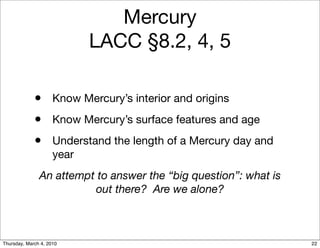
Mercury
                            LACC §8.2, 4, 5

             • Know Mercury’s interior and origins
             • Know Mercury’s surface features and age
             • Understand the length of a Mercury day and
                     year
               An attempt to answer the “big question”: what is
                         out there? Are we alone?


Thursday, March 4, 2010                                           22
Mercury: A Planet of Craters

                                                                        This spectacular
                                                                        image ... was snapped
                                                                        [6 Oct 2008] ... about
                                                                        90 minutes after
                                                                        MESSENGER's closest
                                                                        approach to Mercury,
                                                                        when the spacecraft was
                                                                        at a distance of about
                                                                        27,000 kilometers
                                                                        (about 17,000 miles)


                          http://science.nasa.gov/headlines/y2008/07oct_firstresults.htm

Thursday, March 4, 2010                                                                           23
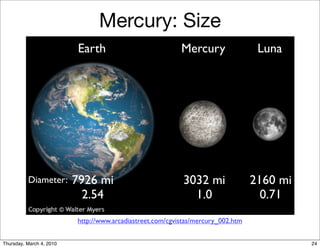
Mercury: Size
                           Earth                           Mercury                 Luna


          Diameter:       7926 mi                           3032 mi               2160 mi
                            2.54                              1.0                   0.71
                          http://www.arcadiastreet.com/cgvistas/mercury_002.htm
       Diameter:
Thursday, March 4, 2010                                                                     24
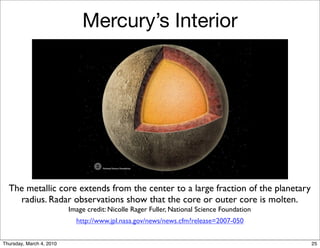
Mercury’s Interior


  The metallic core extends from the center to a large fraction of the planetary
    radius. Radar observations show that the core or outer core is molten.
                          Image credit: Nicolle Rager Fuller, National Science Foundation
                            http://www.jpl.nasa.gov/news/news.cfm?release=2007-050


Thursday, March 4, 2010                                                                     25
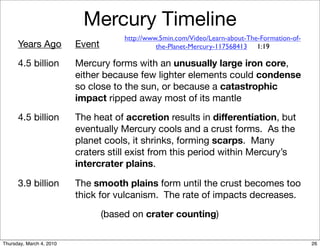
Mercury Timeline
                                       http://www.5min.com/Video/Learn-about-The-Formation-of-
      Years Ago	          Event                  the-Planet-Mercury-117568413 1:19

      4.5 billion	        Mercury forms with an unusually large iron core,
                          either because few lighter elements could condense
                          so close to the sun, or because a catastrophic
                          impact ripped away most of its mantle

      4.5 billion
        The heat of accretion results in differentiation, but
                          eventually Mercury cools and a crust forms. As the
                          planet cools, it shrinks, forming scarps. Many
                          craters still exist from this period within Mercury’s
                          intercrater plains.

      3.9 billion	        The smooth plains form until the crust becomes too
                          thick for vulcanism. The rate of impacts decreases.

                                  (based on crater counting)

Thursday, March 4, 2010                                                                          26
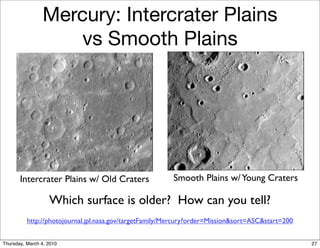
Mercury: Intercrater Plains
                   vs Smooth Plains


       Intercrater Plains w/ Old Craters                 Smooth Plains w/ Young Craters

                   Which surface is older? How can you tell?
          http://photojournal.jpl.nasa.gov/targetFamily/Mercury?order=Mission&sort=ASC&start=200


Thursday, March 4, 2010                                                                            27
Mercury: Scarps


      This scarp is about 350 km (220
      mi) long and transects two
      craters.... The maximum height of
      the scarp south of the [lower]
      crater is about 3 kilometers.
      Notice the shallow older crater
      perched on the crest of the scarp.                       Ridges, Scarps, Craters

          http://photojournal.jpl.nasa.gov/targetFamily/Mercury?order=Mission&sort=ASC&start=200


Thursday, March 4, 2010                                                                            28
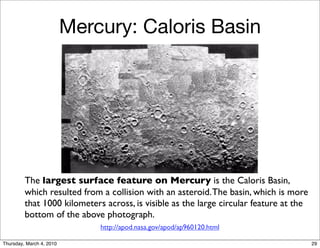
Mercury: Caloris Basin


         The largest surface feature on Mercury is the Caloris Basin,
         which resulted from a collision with an asteroid. The basin, which is more
         that 1000 kilometers across, is visible as the large circular feature at the
         bottom of the above photograph.
                              http://apod.nasa.gov/apod/ap960120.html

Thursday, March 4, 2010                                                                 29
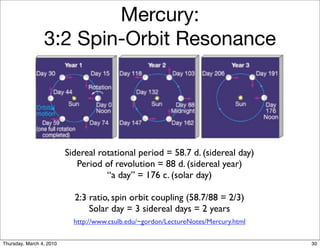
Mercury:
                 3:2 Spin-Orbit Resonance


                          Sidereal rotational period = 58.7 d. (sidereal day)
                             Period of revolution = 88 d. (sidereal year)
                                     “a day” = 176 c. (solar day)

                            2:3 ratio, spin orbit coupling (58.7/88 = 2/3)
                                Solar day = 3 sidereal days = 2 years
                            http://www.csulb.edu/~gordon/LectureNotes/Mercury.html

Thursday, March 4, 2010                                                              30
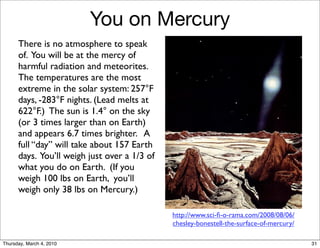
You on Mercury
      There is no atmosphere to speak
      of. You will be at the mercy of
      harmful radiation and meteorites.
      The temperatures are the most
      extreme in the solar system: 257°F
      days, -283°F nights. (Lead melts at
      622°F.) The sun is 1.4° on the sky
      (or 3 times larger than on Earth)
      and appears 6.7 times brighter. A
      full “day” will take about 157 Earth
      days. You’ll weigh just over a 1/3 of
      what you do on Earth. (If you
      weigh 100 lbs on Earth, you’ll
      weigh only 38 lbs on Mercury.)

                                              http://www.sci-fi-o-rama.com/2008/08/06/
                                              chesley-bonestell-the-surface-of-mercury/

Thursday, March 4, 2010                                                                   31
Mercury
                            LACC §8.2, 4, 5
             • Know Mercury’s interior (large iron core) and
                     origins (condensation vs impact theory)
             • Know Mercury’s surface features (intercrater
                     planes, smooth planes, scarps, Caloris Basin)
                     and age (4.5 billion years)
             • Understand the length of a Mercury day
                     (solar--157 days, sidereal--59 days) and
                     year (--88 days): spin-orbit resonance
               An attempt to answer the “big question”: what is
                         out there? Are we alone?

Thursday, March 4, 2010                                              32
LACC HW: Franknoi, Morrison, and Wolff,
          Voyages Through the Universe, 3rd ed.


            •       Ch. 8, pp. 192-193: 18.

            •       Ch 9: Tutorial Quiz accessible from:               http://
                    www.brookscole.com/cgi-brookscole/course_products_bc.pl?
                    fid=M20b&product_isbn_issn=9780495017899&discipline_number=19


                  Due at the beginning of the next class period.
                    Be thinking about the Solar System Project.


Thursday, March 4, 2010                                                            33

A1 07 Moon Mercury

  • 1.
    Luna LACC §8.2, 4, 5 • Know Luna’s (Earth’s Moon) interior and origin • Know Luna’s (Earth’s Moon) surface features and age • Understand the Earth-Moon system An attempt to answer the “big question”: what is out there? Are we alone? Thursday, March 4, 2010 1
  • 2.
    Luna: Earth’s Moon (red light) http://www.lpi.usra.edu/lunar/missions/clementine/images/ Thursday, March 4, 2010 2
  • 3.
    Luna: Size (red light) http://www.astronomy.org/programs/moon/moon.html Thursday, March 4, 2010 3
  • 4.
    Earth and Moonto Scale or 239,000 ± 13,500 miles (which amounts to 30.1 Earth diameters) http://hyperphysics.phy-astr.gsu.edu/hbase/solar/moonscale.html#c2 It took the Apollo astronauts about three days to get to the moon. Once they got their, they weighed only 1/6th what they did on Earth. E.g. if you weigh 100 lbs on hear, you’d weight 17 lbs on the moon. Thursday, March 4, 2010 4
  • 5.
    Earth-Moon System: Tides The Moon is the dominant tidal influence because the fractional difference in its force across the Earth is greater than the fractional difference seen from the Sun. This difference in force follows the inverse square law. http://hyperphysics.phy-astr.gsu.edu/hbase/tide.html#mstid Thursday, March 4, 2010 5
  • 6.
    Earth-Moon System: Tides http://astro.unl.edu/classaction/animations/lunarcycles/tidesim.html http://www.atlantickayaktours.com/Pages/ExpertCenter/navigation/Navigation-4.shtml Thursday, March 4, 2010 6
  • 7.
    Earth-Moon System: Moon’s Tide Locked Orbit When the Moon first formed after the Giant Impact, it was much nearer to the Earth (20,000km or 20 times nearer than present.) Both bodies exerted a pull on each other causing huge tidal forces. ...which resulted in the slowing on both the Earth’s and the Moon’s speed of rotation. The resultant imparting of angular momentum then caused the Moon to move further away. This process is still ongoing, with the Earth’s days shortening by 0.0015 milliseconds per year and the Moon moving away at about 3.8 cm a year. The Moon is no longer slowing its rotation as it is in orbital synchronicity with the Earth. That means that it takes just as long for it to rotate a full 360 degrees on its axis as it does to orbit once round the Earth. Will the Moon move so far out that it may actually leave its orbit altogether? No worries; The Sun is set to explode long before that! http://www.math.nus.edu.sg/aslaksen/gem-projects/hm/0102-1-phase/ORIENTATIONOFTHEMOON.htm Thursday, March 4, 2010 7
  • 8.
    The Moon hasa Luna: Interior crust (C) which is around 60 km (37 miles) thick on the (red light) near side and even thicker on the far side. The mantle (B) extends down to a depth of 1000 km (620 miles). A semi-molten core (A) is probably in the centre... http://www.nmm.ac.uk/server?show=conWebDoc.8024&setPaginate=No Thursday, March 4, 2010 8
  • 9.
    Luna: Interior (red light) http://www.astro.psu.edu/users/niel/astro1/slideshows/class41/slides-41.html Thursday, March 4, 2010 9
  • 10.
    Our Moon’s Origin and Evolution http://videos.howstuffworks.com/hsw/9998-the-moon-formation-video.htm 3:32 Thursday, March 4, 2010 10
  • 11.
    Luna Timeline Years Ago Event 4.5 billion A Mars sized object (about 1/10th the mass of the Earth) impacts the Earth. 4.5 billion The accretion of material thrown into orbit by the impact forms the Moon. Massive impacts heat the moon resulting in differentiation, but eventually a crust forms over magma oceans. 3.8 billion Lowland basins fill with lava, forming the maria. 3.2 billion As the Moon continues to cool, volcanic activity ceases. Meteorites impacts continue--but at an ever decreasing rate--forming fresh craters and lunar regolith. (based on crater counting and radiometric dating) Thursday, March 4, 2010 11
  • 12.
    Lunar Impact Rate http://muller.lbl.gov/pages/crateringrates.htm Thursday, March 4, 2010 12
  • 13.
    Current Impact Rates http://woodahl.physics.iupui.edu/Astro100/12-25.jpg Thursday, March 4, 2010 13
  • 14.
    Notable Crater: Tycho http://antwrp.gsfc.nasa.gov/apod/ap050305.html Thursday, March 4, 2010 14
  • 15.
    Notable Crater: Tycho Copernicus (upper left) and Tycho (lower right), each with extensive ray systems of light colored debris blasted out by the crater-forming impacts. In general, ray craters are relatively young as their rays overlay the lunar terrain. In fact, at 85 kilometers wide, Tycho, with its far reaching rays, is the youngest large crater on the nearside. Crater Copernicus, surrounded by dark mare which contrast nicely with its bright rays, is 93 kilometers in diameter. http://antwrp.gsfc.nasa.gov/apod/ap050305.html Thursday, March 4, 2010 15
  • 16.
    Notable Crater: Tycho • The 170 km Baptistina parent body disrupted ~160 My ago in the main asteroid belt and created many fragments. • Many of the 1-10 km fragments reached a nearby resonance and escaped to the terrestrial planet region. A few hit the Earth and Moon. • These fragments likely produced the ~65 My old Chicxulub crater on Earth and the ~110 My old Tycho crater on the Moon. http://www.boulder.swri.edu/science.php Thursday, March 4, 2010 16
  • 17.
    Apollo Missions http://www.lpi.usra.edu/lunar/missions/apollo/ Thursday, March 4, 2010 17
  • 18.
    Ice (H2O) onthe Moon Surface Temperature Day: 107°C (225°F) Night: 153°C (-243°F) The Moon has no atmosphere...this means [ice] will rapidly sublime directly into water vapor and escape into space.... Over the course of a lunar day (~29 Earth days), all regions of the Moon are exposed to sunlight [unless you’re] in a permanently shadowed http://www.cmf.nrl.navy.mil/clementine/ area. Thursday, March 4, 2010 18
  • 19.
    You on TheMoon There is no atmosphere to speak of. You will be at the mercy of harmful radiation and meteorites. The temperatures are extreme: 257°F days, -283°F nights. You’ll weigh 1/6th what you do on Earth. (If you weigh 100 lbs on Earth, you’ll weigh only 17 lbs on the moon.) A “day” will take about 29.5 Earth days. If you can see the Earth, it will be 1.9° on the sky (or 3 1/2 times larger than the moon) and never change its position in the sky, but it will go through phases. It took the Apollo astronauts about three days to get to the moon. http://www.sciencedaily.com/releases/2007/02/070205130324.htm Thursday, March 4, 2010 19
  • 20.
    Luna LACC §8.2, 4, 5 • Know Luna’s (Earth’s Moon) interior (mantle is solid, core is unusually small) and origin (impact theory) • Know Luna’s (Earth’s Moon) surface features (highlands, maria, craters, regolith, water ice!) and age (highlands--4.4 billion, maria--3.5 billion; young crater vs old crater) • Understand the Earth-Moon system: tides, tide locked orbit An attempt to answer the “big question”: what is out there? Are we alone? Thursday, March 4, 2010 20
  • 21.
    LACC HW: Franknoi,Morrison, and Wolff, Voyages Through the Universe, 3rd ed. • Ch. 8, pp. 192-193: 14. Due at the beginning of the next class period. Be thinking about the Solar System Project. Thursday, March 4, 2010 21
  • 22.
    Mercury LACC §8.2, 4, 5 • Know Mercury’s interior and origins • Know Mercury’s surface features and age • Understand the length of a Mercury day and year An attempt to answer the “big question”: what is out there? Are we alone? Thursday, March 4, 2010 22
  • 23.
    Mercury: A Planetof Craters This spectacular image ... was snapped [6 Oct 2008] ... about 90 minutes after MESSENGER's closest approach to Mercury, when the spacecraft was at a distance of about 27,000 kilometers (about 17,000 miles) http://science.nasa.gov/headlines/y2008/07oct_firstresults.htm Thursday, March 4, 2010 23
  • 24.
    Mercury: Size Earth Mercury Luna Diameter: 7926 mi 3032 mi 2160 mi 2.54 1.0 0.71 http://www.arcadiastreet.com/cgvistas/mercury_002.htm Diameter: Thursday, March 4, 2010 24
  • 25.
    Mercury’s Interior The metallic core extends from the center to a large fraction of the planetary radius. Radar observations show that the core or outer core is molten. Image credit: Nicolle Rager Fuller, National Science Foundation http://www.jpl.nasa.gov/news/news.cfm?release=2007-050 Thursday, March 4, 2010 25
  • 26.
    Mercury Timeline http://www.5min.com/Video/Learn-about-The-Formation-of- Years Ago Event the-Planet-Mercury-117568413 1:19 4.5 billion Mercury forms with an unusually large iron core, either because few lighter elements could condense so close to the sun, or because a catastrophic impact ripped away most of its mantle 4.5 billion The heat of accretion results in differentiation, but eventually Mercury cools and a crust forms. As the planet cools, it shrinks, forming scarps. Many craters still exist from this period within Mercury’s intercrater plains. 3.9 billion The smooth plains form until the crust becomes too thick for vulcanism. The rate of impacts decreases. (based on crater counting) Thursday, March 4, 2010 26
  • 27.
    Mercury: Intercrater Plains vs Smooth Plains Intercrater Plains w/ Old Craters Smooth Plains w/ Young Craters Which surface is older? How can you tell? http://photojournal.jpl.nasa.gov/targetFamily/Mercury?order=Mission&sort=ASC&start=200 Thursday, March 4, 2010 27
  • 28.
    Mercury: Scarps This scarp is about 350 km (220 mi) long and transects two craters.... The maximum height of the scarp south of the [lower] crater is about 3 kilometers. Notice the shallow older crater perched on the crest of the scarp. Ridges, Scarps, Craters http://photojournal.jpl.nasa.gov/targetFamily/Mercury?order=Mission&sort=ASC&start=200 Thursday, March 4, 2010 28
  • 29.
    Mercury: Caloris Basin The largest surface feature on Mercury is the Caloris Basin, which resulted from a collision with an asteroid. The basin, which is more that 1000 kilometers across, is visible as the large circular feature at the bottom of the above photograph. http://apod.nasa.gov/apod/ap960120.html Thursday, March 4, 2010 29
  • 30.
    Mercury: 3:2 Spin-Orbit Resonance Sidereal rotational period = 58.7 d. (sidereal day) Period of revolution = 88 d. (sidereal year) “a day” = 176 c. (solar day) 2:3 ratio, spin orbit coupling (58.7/88 = 2/3) Solar day = 3 sidereal days = 2 years http://www.csulb.edu/~gordon/LectureNotes/Mercury.html Thursday, March 4, 2010 30
  • 31.
    You on Mercury There is no atmosphere to speak of. You will be at the mercy of harmful radiation and meteorites. The temperatures are the most extreme in the solar system: 257°F days, -283°F nights. (Lead melts at 622°F.) The sun is 1.4° on the sky (or 3 times larger than on Earth) and appears 6.7 times brighter. A full “day” will take about 157 Earth days. You’ll weigh just over a 1/3 of what you do on Earth. (If you weigh 100 lbs on Earth, you’ll weigh only 38 lbs on Mercury.) http://www.sci-fi-o-rama.com/2008/08/06/ chesley-bonestell-the-surface-of-mercury/ Thursday, March 4, 2010 31
  • 32.
    Mercury LACC §8.2, 4, 5 • Know Mercury’s interior (large iron core) and origins (condensation vs impact theory) • Know Mercury’s surface features (intercrater planes, smooth planes, scarps, Caloris Basin) and age (4.5 billion years) • Understand the length of a Mercury day (solar--157 days, sidereal--59 days) and year (--88 days): spin-orbit resonance An attempt to answer the “big question”: what is out there? Are we alone? Thursday, March 4, 2010 32
  • 33.
    LACC HW: Franknoi,Morrison, and Wolff, Voyages Through the Universe, 3rd ed. • Ch. 8, pp. 192-193: 18. • Ch 9: Tutorial Quiz accessible from: http:// www.brookscole.com/cgi-brookscole/course_products_bc.pl? fid=M20b&product_isbn_issn=9780495017899&discipline_number=19 Due at the beginning of the next class period. Be thinking about the Solar System Project. Thursday, March 4, 2010 33