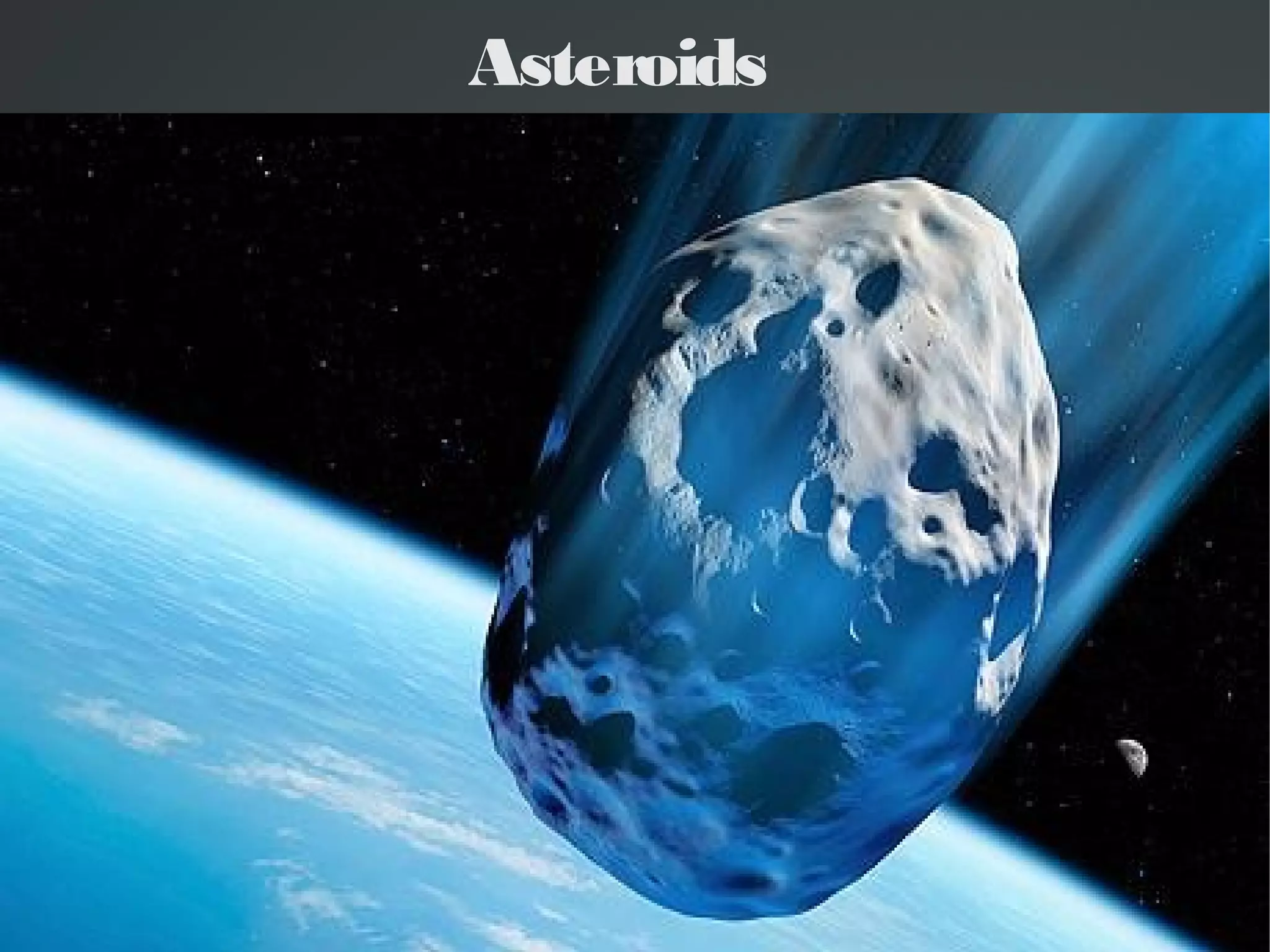
Asteroids
What are asteroids? 
Asteroids are minor planets, especially those of the inner 
Solar System. The larger ones have also been called 
planetoids.he term asteroid has come increasingly to 
refer specifically to the small bodies of the inner Solar 
System out to the orbit of Jupiter.
What form the asteroids? 
 It is believed that planetesimals in the asteroid belt 
evolved much like the rest of the solar nebula 
until Jupiter 
 
 It has heavy metallic elements sinking to the core, 
leaving rocky minerals in the crust.
Size distribution 
Asteroids vary greatly in size, from almost 1,000 
km for the largest down to rocks just tens of 
metres across The mass of all the objects of the 
asteroid belt, lying between the orbits of Mars and 
Jupiter, is estimated to be about 2.8–3.2×10²¹ kg, 
or about 4% of the mass of the Moon. Of this, 
Ceres comprises 0.95×10²¹ kg, a third of the total
Composition 
The physical composition of asteroids is varied 
and in most cases poorly understood. Ceres 
appears to be composed of a rocky core covered 
by an icy mantle, where Vesta is thought to have 
a nickel-iron core, olivine mantle, and basaltic 
crust.
Classifation Color 
Asteroids are commonly 
classified according to 
two criteria: the 
characteristics of their 
orbits, and features of 
their reflectance 
spectrum. 
Asteroids become darker and 
redder with age due to space 
weathering.However 
evidence suggests most of 
the color change occurs 
rapidly, in the first hundred 
thousands years, limiting the 
usefulness of spectral 
measurement for 
determining the age of 
asteroids.
Exploration 
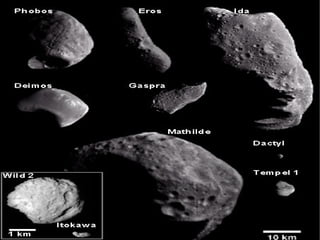
Until the age of space travel, objects in the asteroid belt 
were merely pinpricks of light in even the largest 
telescopes and their shapes and terrain remained a 
mystery.The first close-up photographs of asteroid-like 
objects were taken in 1971 when the Mariner 9 probe 
imaged Phobos and Deimos, the two small moons of 
Mars, which are probably captured asteroids

Asteroids *

  • 1.
  • 2.
    What are asteroids? Asteroids are minor planets, especially those of the inner Solar System. The larger ones have also been called planetoids.he term asteroid has come increasingly to refer specifically to the small bodies of the inner Solar System out to the orbit of Jupiter.
  • 3.
    What form theasteroids?  It is believed that planetesimals in the asteroid belt evolved much like the rest of the solar nebula until Jupiter   It has heavy metallic elements sinking to the core, leaving rocky minerals in the crust.
  • 4.
    Size distribution Asteroidsvary greatly in size, from almost 1,000 km for the largest down to rocks just tens of metres across The mass of all the objects of the asteroid belt, lying between the orbits of Mars and Jupiter, is estimated to be about 2.8–3.2×10²¹ kg, or about 4% of the mass of the Moon. Of this, Ceres comprises 0.95×10²¹ kg, a third of the total
  • 5.
    Composition The physicalcomposition of asteroids is varied and in most cases poorly understood. Ceres appears to be composed of a rocky core covered by an icy mantle, where Vesta is thought to have a nickel-iron core, olivine mantle, and basaltic crust.
  • 6.
    Classifation Color Asteroidsare commonly classified according to two criteria: the characteristics of their orbits, and features of their reflectance spectrum. Asteroids become darker and redder with age due to space weathering.However evidence suggests most of the color change occurs rapidly, in the first hundred thousands years, limiting the usefulness of spectral measurement for determining the age of asteroids.
  • 8.
    Exploration Until theage of space travel, objects in the asteroid belt were merely pinpricks of light in even the largest telescopes and their shapes and terrain remained a mystery.The first close-up photographs of asteroid-like objects were taken in 1971 when the Mariner 9 probe imaged Phobos and Deimos, the two small moons of Mars, which are probably captured asteroids