Geology of Venus
                         LACC §9.1, 9.2, 9.4

      • Know Venus’s interior and evolution
      • Know Venus’s surface features and age
      • Understand Venus’s day

           An attempt to answer the “big question”: what is out
                          there? Are we alone?


Tuesday, March 9, 2010                                            1
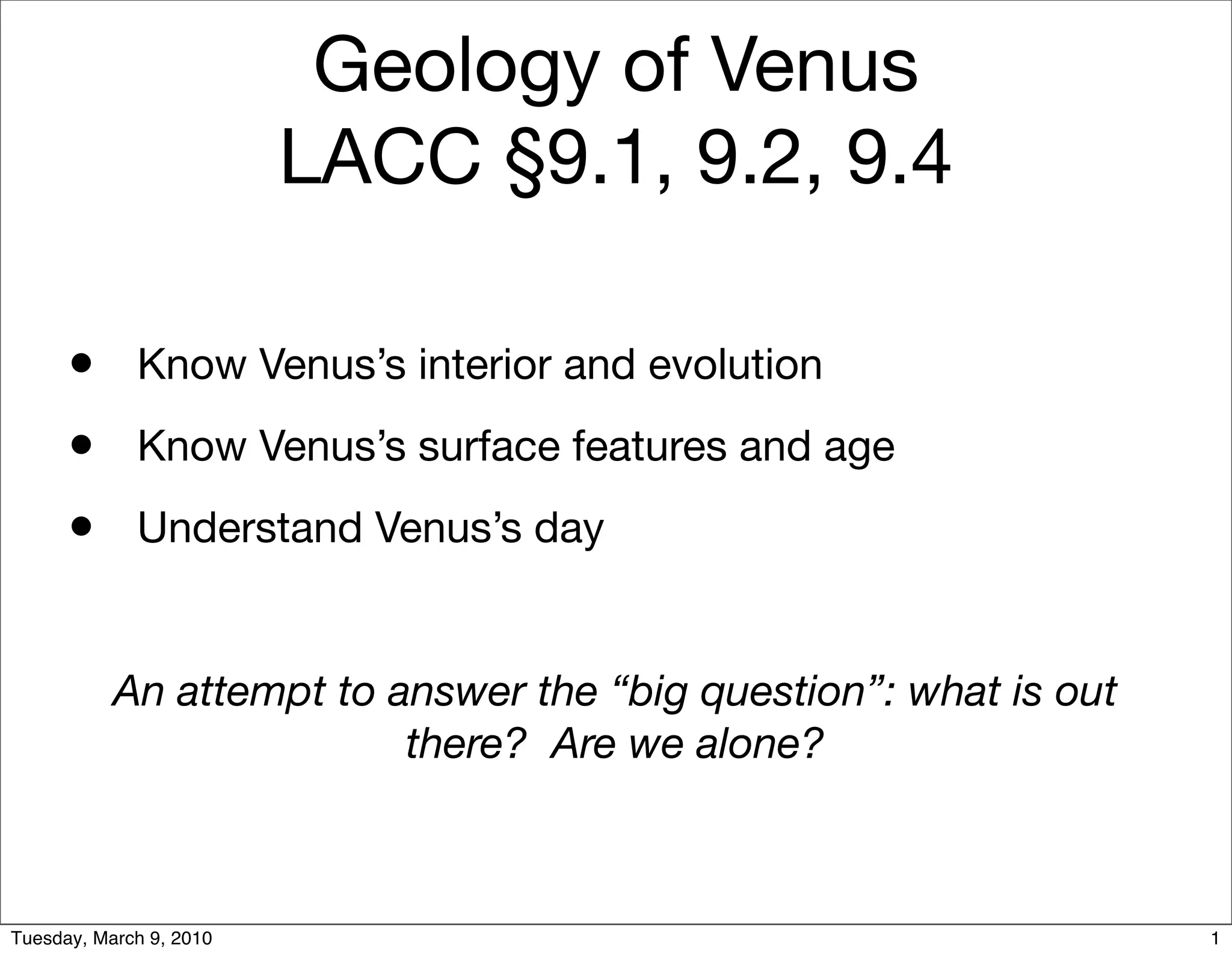
Terrestrial Planets: Interiors


                                  http://www.star.le.ac.uk/edu/Solar_System.shtml


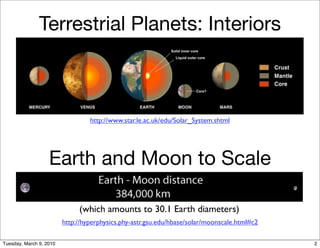
                   Earth and Moon to Scale

                              (which amounts to 30.1 Earth diameters)
                         http://hyperphysics.phy-astr.gsu.edu/hbase/solar/moonscale.html#c2

Tuesday, March 9, 2010                                                                        2
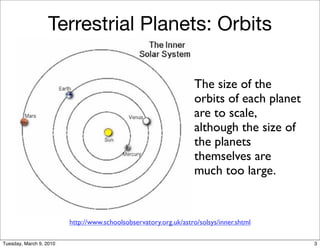
Terrestrial Planets: Orbits

                                                                   The size of the
                                                                   orbits of each planet
                                                                   are to scale,
                                                                   although the size of
                                                                   the planets
                                                                   themselves are
                                                                   much too large.


                         http://www.schoolsobservatory.org.uk/astro/solsys/inner.shtml

Tuesday, March 9, 2010                                                                     3
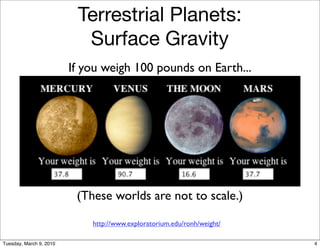
Terrestrial Planets:
                           Surface Gravity
                         If you weigh 100 pounds on Earth...


                          (These worlds are not to scale.)

                             http://www.exploratorium.edu/ronh/weight/

Tuesday, March 9, 2010                                                   4
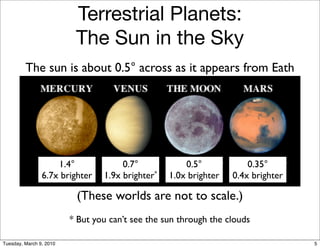
Terrestrial Planets:
                          The Sun in the Sky
         The sun is about 0.5° across as it appears from Eath


                    1.4°              0.7°            0.5°            0.35°
                6.7x brighter    1.9x brighter*   1.0x brighter   0.4x brighter

                          (These worlds are not to scale.)
                         * But you can’t see the sun through the clouds

Tuesday, March 9, 2010                                                            5
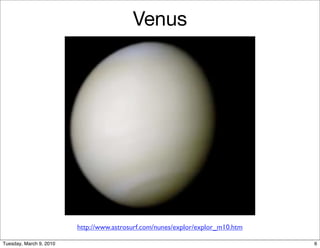
Venus


                         http://www.astrosurf.com/nunes/explor/explor_m10.htm

Tuesday, March 9, 2010                                                          6
Venus: Surface Features
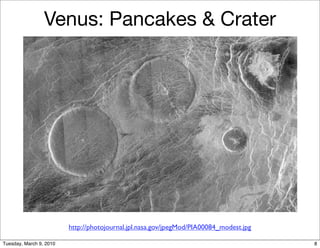
                    Impact craters indicate a surface age of 500
                    million years (15% as old as lunar maria and
                    between the age of Earth’s younger ocean
                    sea-floor and older continents); yet erosion
                    rates are very low.
                    Volcanoes on Venus are about as common as
                    on Earth, but Venus has “pancake” volcanoes
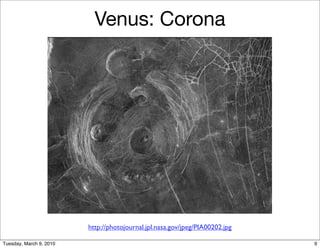
                    in addition to shield, volcanoes. Coronae
                    (circular bulges) are more common on Venus.
                    Tectonic activity does occur on Venus: ridges,
                    cracks, mountains, the coronae; but no plate
                    tectonics.

Tuesday, March 9, 2010                                               7
Venus: Pancakes & Crater


                         http://photojournal.jpl.nasa.gov/jpegMod/PIA00084_modest.jpg

Tuesday, March 9, 2010                                                                  8
Venus: Corona


                         http://photojournal.jpl.nasa.gov/jpeg/PIA00202.jpg

Tuesday, March 9, 2010                                                        9
Venus: Oddities


              Venus rotates backwards and slowly. A solar day on
              Venus is 117 days, and the sun rises in the west and
              sets in the east, not that you would ever see the sun
              through the dense clouds.
              Venus’s slow rotation (sidereal day: 243 days (longer
              than its year: 225 days!)) results in low wind
              velocities and low erosion rates on the surface.


Tuesday, March 9, 2010                                                10
Geology of Venus
                         LACC §9.1, 9.2, 9.4
      • Know Venus’s interior (volcanically inactive?) and
             evolution (resurfaced about 0.5 billion years ago)
      • Know Venus’s surface features (coronae, pancake
             lave domes, impact craters) and age (0.5 billion
             years)
      • Understand Venus’s day (orbits backwards--CW
             when most planets are CCW, solar day is 117 days
             (its sidereal day: 243 days, is longer than its year:
             225 days)
           An attempt to answer the “big question”: what is out
                          there? Are we alone?
Tuesday, March 9, 2010                                               11
LACC HW: Franknoi, Morrison, and Wolff,
          Voyages Through the Universe, 3rd ed.


            •       Ch. 9, pp. 219-220: 10.


                  Due at the beginning of the next class period.
                    Be thinking about the Solar System Project.


Tuesday, March 9, 2010                                             12
Geology of Mars
                         LACC §9.1, 9.2, 9.4

      • Know Mars’s interior and evolution
      • Know Mars’s surface features and age
      • Know Phobos and Deimos, Mars’s moons

           An attempt to answer the “big question”: what is out
                          there? Are we alone?


Tuesday, March 9, 2010                                            13
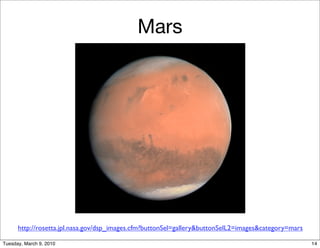
Mars


      http://rosetta.jpl.nasa.gov/dsp_images.cfm?buttonSel=gallery&buttonSelL2=images&category=mars

Tuesday, March 9, 2010                                                                                14
Mars: Surface Features
                    Impact craters indicate a surface age of 3 - 4
                    billion years (same as lunar maria) for the
                    Martian lowlands.
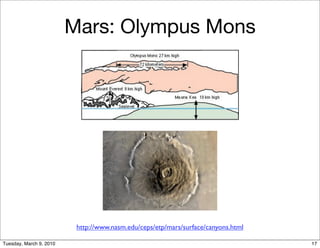
                    Olympus Mons, the largest volcano in the
                    solar system, maybe be intermittently active.
                    Tectonic activity does occur, but not as much
                    evidence for it as Earth or Venus.
                    Polar caps of H2O and CO2 ice.
                    Channels and gullies indicate liquid water
                    flowed, but over 3 billion years ago.
                    Wind erosion occurs.
Tuesday, March 9, 2010                                               15
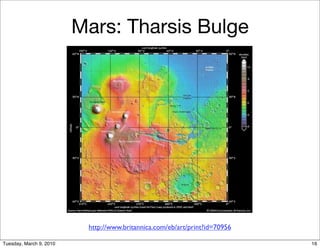
Mars: Tharsis Bulge


                          http://www.britannica.com/eb/art/print?id=70956

Tuesday, March 9, 2010                                                      16
Mars: Olympus Mons


                          http://www.nasm.edu/ceps/etp/mars/surface/canyons.html

Tuesday, March 9, 2010                                                             17
Mars: Oddities

             In a way, Mars is so much like the Earth, it’s odd:
             • Mars’s day is only 42 min. longer than Earth’s
             • Mars’s axial tilt is 25°; Earths is 23.5°.
             • Mars’s diameter is about 0.53 Earth diameters,
                   which means Mars’s total surface area is about
                   the same as Earth’s land surface area.
             Mars has two moons: Phobos and Deimos.
             Mars had liquid water at some point in its past,
             and may have had life.

Tuesday, March 9, 2010                                              18
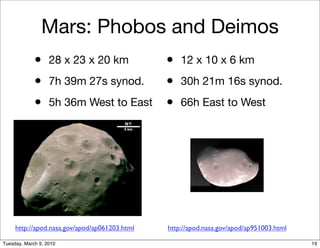
Mars: Phobos and Deimos
             • 28 x 23 x 20 km                 • 12 x 10 x 6 km
             • 7h 39m 27s synod.               • 30h 21m 16s synod.
             • 5h 36m West to East • 66h East to West


     http://apod.nasa.gov/apod/ap061203.html   http://apod.nasa.gov/apod/ap951003.html

Tuesday, March 9, 2010                                                                   19
Mars: Phobos and Deimos
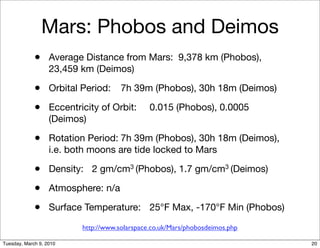
             • Average Distance from Mars:	 9,378 km (Phobos),
                   23,459 km (Deimos)

             • Orbital Period:	 7h 39m (Phobos), 30h 18m (Deimos)
             • Eccentricity of Orbit:	 0.015 (Phobos), 0.0005
                   (Deimos)

             • Rotation Period:	7h 39m (Phobos), 30h 18m (Deimos),
                   i.e. both moons are tide locked to Mars

             • Density:	 2 gm/cm3 (Phobos), 1.7 gm/cm3 (Deimos)
             • Atmosphere:	n/a
             • Surface Temperature:
 25°F Max, -170°F Min (Phobos)
                          http://www.solarspace.co.uk/Mars/phobosdeimos.php

Tuesday, March 9, 2010                                                        20
Mars: “Months”
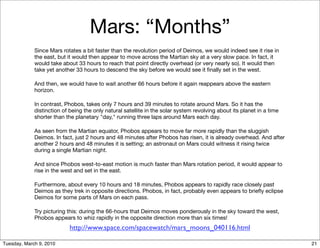
             Since Mars rotates a bit faster than the revolution period of Deimos, we would indeed see it rise in
             the east, but it would then appear to move across the Martian sky at a very slow pace. In fact, it
             would take about 33 hours to reach that point directly overhead (or very nearly so). It would then
             take yet another 33 hours to descend the sky before we would see it finally set in the west.

             And then, we would have to wait another 66 hours before it again reappears above the eastern
             horizon.

             In contrast, Phobos, takes only 7 hours and 39 minutes to rotate around Mars. So it has the
             distinction of being the only natural satellite in the solar system revolving about its planet in a time
             shorter than the planetary "day," running three laps around Mars each day.

             As seen from the Martian equator, Phobos appears to move far more rapidly than the sluggish
             Deimos. In fact, just 2 hours and 48 minutes after Phobos has risen, it is already overhead. And after
             another 2 hours and 48 minutes it is setting; an astronaut on Mars could witness it rising twice
             during a single Martian night.

             And since Phobos west-to-east motion is much faster than Mars rotation period, it would appear to
             rise in the west and set in the east.

             Furthermore, about every 10 hours and 18 minutes, Phobos appears to rapidly race closely past
             Deimos as they trek in opposite directions. Phobos, in fact, probably even appears to briefly eclipse
             Deimos for some parts of Mars on each pass.

             Try picturing this: during the 66-hours that Deimos moves ponderously in the sky toward the west,
             Phobos appears to whiz rapidly in the opposite direction more than six times!
                            http://www.space.com/spacewatch/mars_moons_040116.html

Tuesday, March 9, 2010                                                                                                  21
Mars: Moon Phases
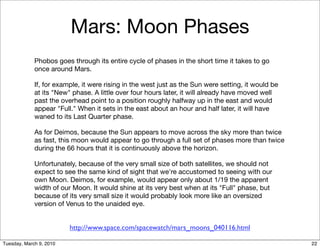
             Phobos goes through its entire cycle of phases in the short time it takes to go
             once around Mars.

             If, for example, it were rising in the west just as the Sun were setting, it would be
             at its "New" phase. A little over four hours later, it will already have moved well
             past the overhead point to a position roughly halfway up in the east and would
             appear "Full." When it sets in the east about an hour and half later, it will have
             waned to its Last Quarter phase.

             As for Deimos, because the Sun appears to move across the sky more than twice
             as fast, this moon would appear to go through a full set of phases more than twice
             during the 66 hours that it is continuously above the horizon.

             Unfortunately, because of the very small size of both satellites, we should not
             expect to see the same kind of sight that we're accustomed to seeing with our
             own Moon. Deimos, for example, would appear only about 1/19 the apparent
             width of our Moon. It would shine at its very best when at its "Full" phase, but
             because of its very small size it would probably look more like an oversized
             version of Venus to the unaided eye.


                         http://www.space.com/spacewatch/mars_moons_040116.html

Tuesday, March 9, 2010                                                                               22
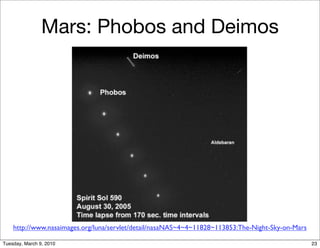
Mars: Phobos and Deimos


    http://www.nasaimages.org/luna/servlet/detail/nasaNAS~4~4~11828~113853:The-Night-Sky-on-Mars

Tuesday, March 9, 2010                                                                             23
Mars: Phobos and Deimos

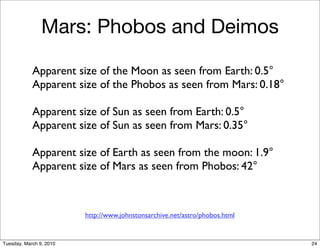
            Apparent size of the Moon as seen from Earth: 0.5°
            Apparent size of the Phobos as seen from Mars: 0.18°

            Apparent size of Sun as seen from Earth: 0.5°
            Apparent size of Sun as seen from Mars: 0.35°

            Apparent size of Earth as seen from the moon: 1.9°
            Apparent size of Mars as seen from Phobos: 42°


                         http://www.johnstonsarchive.net/astro/phobos.html


Tuesday, March 9, 2010                                                       24
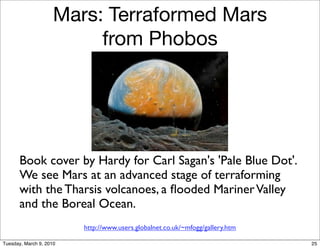
Mars: Terraformed Mars
                          from Phobos


       Book cover by Hardy for Carl Sagan's 'Pale Blue Dot'.
       We see Mars at an advanced stage of terraforming
       with the Tharsis volcanoes, a flooded Mariner Valley
       and the Boreal Ocean.
                         http://www.users.globalnet.co.uk/~mfogg/gallery.htm

Tuesday, March 9, 2010                                                         25
Geology of Mars
                         LACC §9.1, 9.2, 9.4
      • Know Mars’s interior (volcanically inactive?) and
             evolution (some meteorites came from Mars, water
             once flowed on surface)
      • Know Mars’s surface features (poles of H2O and CO2
             ice, Valles Marineris, Tharsis Bulge, Olympus Mons--
             largest volcano) and age (3 to 4 billion years)
      • Know Phobos (larger, orbits in less than a day) and
             Deimos (small, takes 66 hours to cross the sky),
             Mars’s moons (captured asteroids)
           An attempt to answer the “big question”: what is out
                          there? Are we alone?
Tuesday, March 9, 2010                                              26
LACC HW: Franknoi, Morrison, and Wolff,
          Voyages Through the Universe, 3rd ed.


            •       Ch. 9, pp. 219-220: 15.

            •       Ch 9: Tutorial Quiz accessible from:
                    www.brookscole.com/cgi-brookscole/course_products_bc.pl?
                                                                                 http://

                    fid=M20b&product_isbn_issn=9780495017899&discipline_number=19
                    Must Know: 2, 3, 4, 5, 6, 7, 8, 9, 10, 11, 13, 14, 15, 16, 17, 18
                    Important: 1, 12, 19, 20


                  Due at the beginning of the next class period.
                    Be thinking about the Solar System Project.


Tuesday, March 9, 2010                                                                     27

A1 08 Venus Mars Geo

  • 1.
    Geology of Venus LACC §9.1, 9.2, 9.4 • Know Venus’s interior and evolution • Know Venus’s surface features and age • Understand Venus’s day An attempt to answer the “big question”: what is out there? Are we alone? Tuesday, March 9, 2010 1
  • 2.
    Terrestrial Planets: Interiors http://www.star.le.ac.uk/edu/Solar_System.shtml Earth and Moon to Scale (which amounts to 30.1 Earth diameters) http://hyperphysics.phy-astr.gsu.edu/hbase/solar/moonscale.html#c2 Tuesday, March 9, 2010 2
  • 3.
    Terrestrial Planets: Orbits The size of the orbits of each planet are to scale, although the size of the planets themselves are much too large. http://www.schoolsobservatory.org.uk/astro/solsys/inner.shtml Tuesday, March 9, 2010 3
  • 4.
    Terrestrial Planets: Surface Gravity If you weigh 100 pounds on Earth... (These worlds are not to scale.) http://www.exploratorium.edu/ronh/weight/ Tuesday, March 9, 2010 4
  • 5.
    Terrestrial Planets: The Sun in the Sky The sun is about 0.5° across as it appears from Eath 1.4° 0.7° 0.5° 0.35° 6.7x brighter 1.9x brighter* 1.0x brighter 0.4x brighter (These worlds are not to scale.) * But you can’t see the sun through the clouds Tuesday, March 9, 2010 5
  • 6.
    Venus http://www.astrosurf.com/nunes/explor/explor_m10.htm Tuesday, March 9, 2010 6
  • 7.
    Venus: Surface Features Impact craters indicate a surface age of 500 million years (15% as old as lunar maria and between the age of Earth’s younger ocean sea-floor and older continents); yet erosion rates are very low. Volcanoes on Venus are about as common as on Earth, but Venus has “pancake” volcanoes in addition to shield, volcanoes. Coronae (circular bulges) are more common on Venus. Tectonic activity does occur on Venus: ridges, cracks, mountains, the coronae; but no plate tectonics. Tuesday, March 9, 2010 7
  • 8.
    Venus: Pancakes &Crater http://photojournal.jpl.nasa.gov/jpegMod/PIA00084_modest.jpg Tuesday, March 9, 2010 8
  • 9.
    Venus: Corona http://photojournal.jpl.nasa.gov/jpeg/PIA00202.jpg Tuesday, March 9, 2010 9
  • 10.
    Venus: Oddities Venus rotates backwards and slowly. A solar day on Venus is 117 days, and the sun rises in the west and sets in the east, not that you would ever see the sun through the dense clouds. Venus’s slow rotation (sidereal day: 243 days (longer than its year: 225 days!)) results in low wind velocities and low erosion rates on the surface. Tuesday, March 9, 2010 10
  • 11.
    Geology of Venus LACC §9.1, 9.2, 9.4 • Know Venus’s interior (volcanically inactive?) and evolution (resurfaced about 0.5 billion years ago) • Know Venus’s surface features (coronae, pancake lave domes, impact craters) and age (0.5 billion years) • Understand Venus’s day (orbits backwards--CW when most planets are CCW, solar day is 117 days (its sidereal day: 243 days, is longer than its year: 225 days) An attempt to answer the “big question”: what is out there? Are we alone? Tuesday, March 9, 2010 11
  • 12.
    LACC HW: Franknoi,Morrison, and Wolff, Voyages Through the Universe, 3rd ed. • Ch. 9, pp. 219-220: 10. Due at the beginning of the next class period. Be thinking about the Solar System Project. Tuesday, March 9, 2010 12
  • 13.
    Geology of Mars LACC §9.1, 9.2, 9.4 • Know Mars’s interior and evolution • Know Mars’s surface features and age • Know Phobos and Deimos, Mars’s moons An attempt to answer the “big question”: what is out there? Are we alone? Tuesday, March 9, 2010 13
  • 14.
    Mars http://rosetta.jpl.nasa.gov/dsp_images.cfm?buttonSel=gallery&buttonSelL2=images&category=mars Tuesday, March 9, 2010 14
  • 15.
    Mars: Surface Features Impact craters indicate a surface age of 3 - 4 billion years (same as lunar maria) for the Martian lowlands. Olympus Mons, the largest volcano in the solar system, maybe be intermittently active. Tectonic activity does occur, but not as much evidence for it as Earth or Venus. Polar caps of H2O and CO2 ice. Channels and gullies indicate liquid water flowed, but over 3 billion years ago. Wind erosion occurs. Tuesday, March 9, 2010 15
  • 16.
    Mars: Tharsis Bulge http://www.britannica.com/eb/art/print?id=70956 Tuesday, March 9, 2010 16
  • 17.
    Mars: Olympus Mons http://www.nasm.edu/ceps/etp/mars/surface/canyons.html Tuesday, March 9, 2010 17
  • 18.
    Mars: Oddities In a way, Mars is so much like the Earth, it’s odd: • Mars’s day is only 42 min. longer than Earth’s • Mars’s axial tilt is 25°; Earths is 23.5°. • Mars’s diameter is about 0.53 Earth diameters, which means Mars’s total surface area is about the same as Earth’s land surface area. Mars has two moons: Phobos and Deimos. Mars had liquid water at some point in its past, and may have had life. Tuesday, March 9, 2010 18
  • 19.
    Mars: Phobos andDeimos • 28 x 23 x 20 km • 12 x 10 x 6 km • 7h 39m 27s synod. • 30h 21m 16s synod. • 5h 36m West to East • 66h East to West http://apod.nasa.gov/apod/ap061203.html http://apod.nasa.gov/apod/ap951003.html Tuesday, March 9, 2010 19
  • 20.
    Mars: Phobos andDeimos • Average Distance from Mars: 9,378 km (Phobos), 23,459 km (Deimos) • Orbital Period: 7h 39m (Phobos), 30h 18m (Deimos) • Eccentricity of Orbit: 0.015 (Phobos), 0.0005 (Deimos) • Rotation Period: 7h 39m (Phobos), 30h 18m (Deimos), i.e. both moons are tide locked to Mars • Density: 2 gm/cm3 (Phobos), 1.7 gm/cm3 (Deimos) • Atmosphere: n/a • Surface Temperature: 25°F Max, -170°F Min (Phobos) http://www.solarspace.co.uk/Mars/phobosdeimos.php Tuesday, March 9, 2010 20
  • 21.
    Mars: “Months” Since Mars rotates a bit faster than the revolution period of Deimos, we would indeed see it rise in the east, but it would then appear to move across the Martian sky at a very slow pace. In fact, it would take about 33 hours to reach that point directly overhead (or very nearly so). It would then take yet another 33 hours to descend the sky before we would see it finally set in the west. And then, we would have to wait another 66 hours before it again reappears above the eastern horizon. In contrast, Phobos, takes only 7 hours and 39 minutes to rotate around Mars. So it has the distinction of being the only natural satellite in the solar system revolving about its planet in a time shorter than the planetary "day," running three laps around Mars each day. As seen from the Martian equator, Phobos appears to move far more rapidly than the sluggish Deimos. In fact, just 2 hours and 48 minutes after Phobos has risen, it is already overhead. And after another 2 hours and 48 minutes it is setting; an astronaut on Mars could witness it rising twice during a single Martian night. And since Phobos west-to-east motion is much faster than Mars rotation period, it would appear to rise in the west and set in the east. Furthermore, about every 10 hours and 18 minutes, Phobos appears to rapidly race closely past Deimos as they trek in opposite directions. Phobos, in fact, probably even appears to briefly eclipse Deimos for some parts of Mars on each pass. Try picturing this: during the 66-hours that Deimos moves ponderously in the sky toward the west, Phobos appears to whiz rapidly in the opposite direction more than six times! http://www.space.com/spacewatch/mars_moons_040116.html Tuesday, March 9, 2010 21
  • 22.
    Mars: Moon Phases Phobos goes through its entire cycle of phases in the short time it takes to go once around Mars. If, for example, it were rising in the west just as the Sun were setting, it would be at its "New" phase. A little over four hours later, it will already have moved well past the overhead point to a position roughly halfway up in the east and would appear "Full." When it sets in the east about an hour and half later, it will have waned to its Last Quarter phase. As for Deimos, because the Sun appears to move across the sky more than twice as fast, this moon would appear to go through a full set of phases more than twice during the 66 hours that it is continuously above the horizon. Unfortunately, because of the very small size of both satellites, we should not expect to see the same kind of sight that we're accustomed to seeing with our own Moon. Deimos, for example, would appear only about 1/19 the apparent width of our Moon. It would shine at its very best when at its "Full" phase, but because of its very small size it would probably look more like an oversized version of Venus to the unaided eye. http://www.space.com/spacewatch/mars_moons_040116.html Tuesday, March 9, 2010 22
  • 23.
    Mars: Phobos andDeimos http://www.nasaimages.org/luna/servlet/detail/nasaNAS~4~4~11828~113853:The-Night-Sky-on-Mars Tuesday, March 9, 2010 23
  • 24.
    Mars: Phobos andDeimos Apparent size of the Moon as seen from Earth: 0.5° Apparent size of the Phobos as seen from Mars: 0.18° Apparent size of Sun as seen from Earth: 0.5° Apparent size of Sun as seen from Mars: 0.35° Apparent size of Earth as seen from the moon: 1.9° Apparent size of Mars as seen from Phobos: 42° http://www.johnstonsarchive.net/astro/phobos.html Tuesday, March 9, 2010 24
  • 25.
    Mars: Terraformed Mars from Phobos Book cover by Hardy for Carl Sagan's 'Pale Blue Dot'. We see Mars at an advanced stage of terraforming with the Tharsis volcanoes, a flooded Mariner Valley and the Boreal Ocean. http://www.users.globalnet.co.uk/~mfogg/gallery.htm Tuesday, March 9, 2010 25
  • 26.
    Geology of Mars LACC §9.1, 9.2, 9.4 • Know Mars’s interior (volcanically inactive?) and evolution (some meteorites came from Mars, water once flowed on surface) • Know Mars’s surface features (poles of H2O and CO2 ice, Valles Marineris, Tharsis Bulge, Olympus Mons-- largest volcano) and age (3 to 4 billion years) • Know Phobos (larger, orbits in less than a day) and Deimos (small, takes 66 hours to cross the sky), Mars’s moons (captured asteroids) An attempt to answer the “big question”: what is out there? Are we alone? Tuesday, March 9, 2010 26
  • 27.
    LACC HW: Franknoi,Morrison, and Wolff, Voyages Through the Universe, 3rd ed. • Ch. 9, pp. 219-220: 15. • Ch 9: Tutorial Quiz accessible from: www.brookscole.com/cgi-brookscole/course_products_bc.pl? http:// fid=M20b&product_isbn_issn=9780495017899&discipline_number=19 Must Know: 2, 3, 4, 5, 6, 7, 8, 9, 10, 11, 13, 14, 15, 16, 17, 18 Important: 1, 12, 19, 20 Due at the beginning of the next class period. Be thinking about the Solar System Project. Tuesday, March 9, 2010 27