Life
                     LACC: §29.1, 29.2, 29.3
      •      The Drake Equation: How many communicating
             civilizations are in our galaxy? Could be just about
             any number, but 10 to 10,000 isn’t unreasonable.
      •      The Fermi Paradox: Where is everybody? Since we
             don’t see anybody, we’re probably alone.
      •      SETI: The Search for Extraterrestrial Intelligence--is it
             worth it? Even if they are out there, it could take
             millennia for signals to be passed back and forth.
          An attempt to answer the “big questions”: What is out
              there? How did we get here? Are we alone?

Thursday, May 27, 2010                                                   1
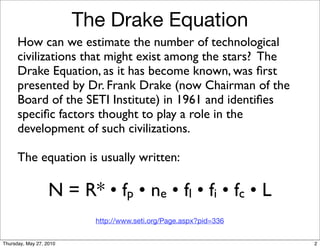
The Drake Equation
      How can we estimate the number of technological
      civilizations that might exist among the stars? The
      Drake Equation, as it has become known, was first
      presented by Dr. Frank Drake (now Chairman of the
      Board of the SETI Institute) in 1961 and identifies
      specific factors thought to play a role in the
      development of such civilizations.

      The equation is usually written:

                   N = R* • fp • ne • fl • fi • fc • L
                           http://www.seti.org/Page.aspx?pid=336


Thursday, May 27, 2010                                             2
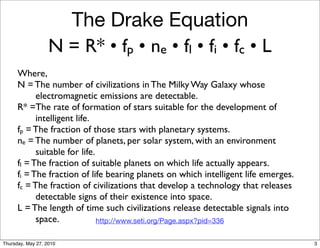
The Drake Equation
                   N = R* • fp • ne • fl • fi • fc • L
      Where,
      N = The number of civilizations in The Milky Way Galaxy whose
            electromagnetic emissions are detectable.
      R* =The rate of formation of stars suitable for the development of
            intelligent life.
      fp = The fraction of those stars with planetary systems.
      ne = The number of planets, per solar system, with an environment
            suitable for life.
      fl = The fraction of suitable planets on which life actually appears.
      fi = The fraction of life bearing planets on which intelligent life emerges.
      fc = The fraction of civilizations that develop a technology that releases
            detectable signs of their existence into space.
      L = The length of time such civilizations release detectable signals into
            space.             http://www.seti.org/Page.aspx?pid=336


Thursday, May 27, 2010                                                               3
The Drake Equation
                 N = R* • fp • ne • fl • fi • fc • L
      R* = The rate of formation of Suitable Stars in the Milky Way Galaxy

      Estimates for the number of stars in the Milky Way vary from a low of
      100 billion to a high of 400 billion. Estimates for the age of the Milky Way
      also vary from a low of 800 million years [!!!] to a high of 13 billion
      years. [200 billion stars / 10 billion years = 15 stars/year]

      An important caveat to the above values is that the rate of star
      formation in the galaxy is not constant over time. In the galaxy's younger
      days, stars were being formed at a much higher rate. Today, estimates for
      the overall star formation rate range from 5 to 20.

      [But, which stars are “suitable”? O? B? A? F? G? K? M?]
                         http://www.astrodigital.org/astronomy/drake_equation.html


Thursday, May 27, 2010                                                               4
The Drake Equation
                 N = R* • fp • ne • fl • fi • fc • L
      R* = The rate of formation of Suitable Stars in the Milky Way Galaxy

      However, the criteria that these stars be suitable means that they must
      be F, G or K stars, and these stars account for about 10% of the stars in
      the Galaxy. [15 stars/year x 10% F, G, or K = 1 suitable star per year]
                         http://www.airynothing.com/smackerels/DrakeEquation.html


      ...astronomers have recently determined that stars
      formed at a higher rate several billion years ago, when
      the stars that might now bear intelligent life were
      being born. So a value of R = 3 is more realistic.
        http://www.skyandtelescope.com/resources/seti/3304541.html?page=2&c=y


Thursday, May 27, 2010                                                              5
The Drake Equation
                  N = R* • fp • ne • fl • fi • fc • L
      fp = the fraction of stars that have planetary systems

      Reasonable guesses might be 20 to nearly 100 percent. (A September
      2003 paper by Charles Lineweaver and Daniel Grether delves into this.)
        At least half of the young stars seen in [the
         Orion Nebula] are surrounded by thick,
         dusty disks — excellent planet-forming
                           material.


                                                         The planet is thought to be one to two times as
                                                          massive as Jupiter, according to the scientists
                                                         who imaged it. It orbits a star similar to a young
                                                                        version of our Sun.
        http://www.skyandtelescope.com/resources/seti/        http://www.space.com/scienceastronomy/
                  3304541.html?page=2&c=y                       050401_first_extrasolarplanet_pic.html


Thursday, May 27, 2010                                                                                        6
The Drake Equation
                  N = R* • fp • ne • fl • fi • fc • L
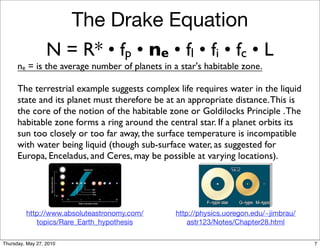
      ne = is the average number of planets in a star's habitable zone.

      The terrestrial example suggests complex life requires water in the liquid
      state and its planet must therefore be at an appropriate distance. This is
      the core of the notion of the habitable zone or Goldilocks Principle . The
      habitable zone forms a ring around the central star. If a planet orbits its
      sun too closely or too far away, the surface temperature is incompatible
      with water being liquid (though sub-surface water, as suggested for
      Europa, Enceladus, and Ceres, may be possible at varying locations).


         http://www.absoluteastronomy.com/      http://physics.uoregon.edu/~jimbrau/
            topics/Rare_Earth_hypothesis            astr123/Notes/Chapter28.html

Thursday, May 27, 2010                                                                 7
The Drake Equation
                  N = R* • fp • ne • fl • fi • fc • L
       fl= The fraction of life bearing planets on which life emerges.
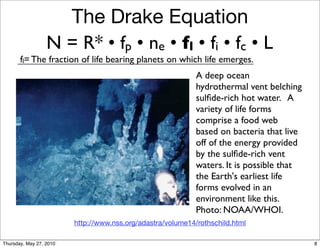
                                                             A deep ocean
                                                             hydrothermal vent belching
                                                             sulfide-rich hot water. A
                                                             variety of life forms
                                                             comprise a food web
                                                             based on bacteria that live
                                                             off of the energy provided
                                                             by the sulfide-rich vent
                                                             waters. It is possible that
                                                             the Earth's earliest life
                                                             forms evolved in an
                                                             environment like this.
                                                             Photo: NOAA/WHOI.
                         http://www.nss.org/adastra/volume14/rothschild.html

Thursday, May 27, 2010                                                                     8
The Drake Equation
                  N = R* • fp • ne • fl • fi • fc • L
       fl= The fraction of life bearing planets on which life emerges.

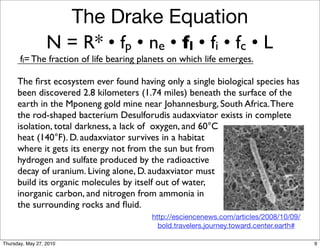
      The first ecosystem ever found having only a single biological species has
      been discovered 2.8 kilometers (1.74 miles) beneath the surface of the
      earth in the Mponeng gold mine near Johannesburg, South Africa. There
      the rod-shaped bacterium Desulforudis audaxviator exists in complete
      isolation, total darkness, a lack of oxygen, and 60°C
      heat (140°F). D. audaxviator survives in a habitat
      where it gets its energy not from the sun but from
      hydrogen and sulfate produced by the radioactive
      decay of uranium. Living alone, D. audaxviator must
      build its organic molecules by itself out of water,
      inorganic carbon, and nitrogen from ammonia in
      the surrounding rocks and fluid.
                                          http://esciencenews.com/articles/2008/10/09/
                                            bold.travelers.journey.toward.center.earth#

Thursday, May 27, 2010                                                                    9
The Drake Equation
                  N = R* • fp • ne • fl • fi • fc • L
       fi= The fraction of life bearing planets on which intelligent life emerges.

      It is also true that, although simple forms of life on Earth arose quickly, it
      took billions of years before complex life forms appeared and longer still
      before intelligent life arose. Thus even if evolution will eventually bring
      about intelligent life, it could well require a stable environment for a
      significant fraction of the lifetime of a suitable star.
                         http://www.lifeinuniverse.org/noflash/Drakefi-07-02-06.html

      Top Six Most Intelligent Animals in the World
      6. Pigs                                 3. Smaller Toothed Whales
      5. Elephants                            2. Octopus
      4. Dolphins                             1. Chimpanzees*
                                   *: including other monkeys that are related...
        http://www.scienceray.com/Biology/Zoology/Top-Six-Most-Intelligent-Animals-in-the-
                                         World.623017

Thursday, May 27, 2010                                                                       10
The Drake Equation
                  N = R* • fp • ne • fl • fi • fc • L
      fc = The fraction of communicative planets

      Though not a SETI League "hit," no
      discussion of SETI results would be
      complete without this one. The most
      famous of all SETI candidate signals (it was
      even mentioned on The X-Files), the Ohio State University "Wow!" signal
      was detected on 15 August 1977. Twenty years later, after more than
      100 follow-on studies, it remains an intriguing unexplained phenomenon.
      These articles discuss the signal and its implications to The SETI League's
      present search.


                         http://www.setileague.org/photos/hits.htm


Thursday, May 27, 2010                                                              11
The Drake Equation
                  N = R* • fp • ne • fl • fi • fc • L
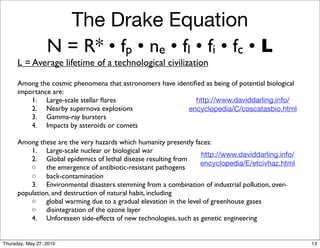
      L = Average lifetime of a technological civilization

      Among the cosmic phenomena that astronomers have identified as being of potential biological
      importance are:
      	

 1.	

 Large-scale stellar flares                     http://www.daviddarling.info/
      	

 2.	

 Nearby supernova explosions                encyclopedia/C/coscatasbio.html
      	

 3.	

 Gamma-ray bursters
      	

 4.	

 Impacts by asteroids or comets

      Among these are the very hazards which humanity presently faces:
      	

 1.	

 Large-scale nuclear or biological war
                                                                     http://www.daviddarling.info/
      	

 2.	

 Global epidemics of lethal disease resulting from
                                                                     encyclopedia/E/etcivhaz.html
      	

 ◦	

 the emergence of antibiotic-resistant pathogens
      	

 ◦	

 back-contamination
      	

 3.	

 Environmental disasters stemming from a combination of industrial pollution, over-
      population, and destruction of natural habit, including
      	

 ◦	

 global warming due to a gradual elevation in the level of greenhouse gases
      	

 ◦	

 disintegration of the ozone layer
      	

 4.	

 Unforeseen side-effects of new technologies, such as genetic engineering


Thursday, May 27, 2010                                                                               12
The Drake Equation

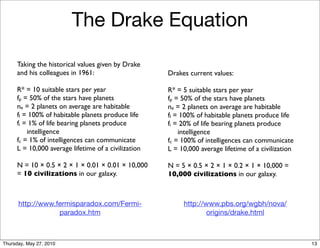
      Taking the historical values given by Drake
      and his colleagues in 1961:                     Drakes current values:

      R* = 10 suitable stars per year                 R* = 5 suitable stars per year
      fp = 50% of the stars have planets              fp = 50% of the stars have planets
      ne = 2 planets on average are habitable         ne = 2 planets on average are habitable
      fl = 100% of habitable planets produce life     fl = 100% of habitable planets produce life
      fi = 1% of life bearing planets produce         fi = 20% of life bearing planets produce
          intelligence                                    intelligence
      fc = 1% of intelligences can communicate        fc = 100% of intelligences can communicate
      L = 10,000 average lifetime of a civilization   L = 10,000 average lifetime of a civilization

      N = 10 × 0.5 × 2 × 1 × 0.01 × 0.01 × 10,000     N = 5 × 0.5 × 2 × 1 × 0.2 × 1 × 10,000 =
      = 10 civilizations in our galaxy.               10,000 civilizations in our galaxy.


      http://www.fermisparadox.com/Fermi-                  http://www.pbs.org/wgbh/nova/
                  paradox.htm                                      origins/drake.html


Thursday, May 27, 2010                                                                                13
The Fermi Paradox
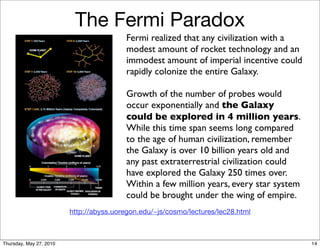
                                         Fermi realized that any civilization with a
                                         modest amount of rocket technology and an
                                         immodest amount of imperial incentive could
                                         rapidly colonize the entire Galaxy.

                                         Growth of the number of probes would
                                         occur exponentially and the Galaxy
                                         could be explored in 4 million years.
                                         While this time span seems long compared
                                         to the age of human civilization, remember
                                         the Galaxy is over 10 billion years old and
                                         any past extraterrestrial civilization could
                                         have explored the Galaxy 250 times over.
                                         Within a few million years, every star system
                                         could be brought under the wing of empire.
                         http://abyss.uoregon.edu/~js/cosmo/lectures/lec28.html


Thursday, May 27, 2010                                                                   14
SETI: Should we bother?
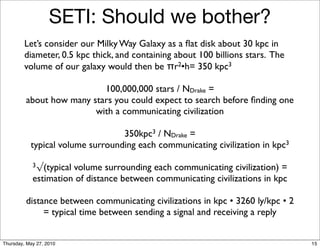
         Let’s consider our Milky Way Galaxy as a flat disk about 30 kpc in
         diameter, 0.5 kpc thick, and containing about 100 billions stars. The
         volume of our galaxy would then be πr2•h= 350 kpc3

                           100,000,000 stars / NDrake =
         about how many stars you could expect to search before finding one
                         with a communicating civilization

                                  350kpc3 / NDrake =
           typical volume surrounding each communicating civilization in kpc3

            3√(typicalvolume surrounding each communicating civilization) =
            estimation of distance between communicating civilizations in kpc

         distance between communicating civilizations in kpc • 3260 ly/kpc • 2
              = typical time between sending a signal and receiving a reply


Thursday, May 27, 2010                                                           15
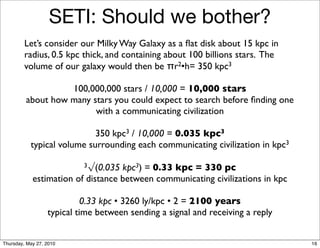
SETI: Should we bother?
         Let’s consider our Milky Way Galaxy as a flat disk about 15 kpc in
         radius, 0.5 kpc thick, and containing about 100 billions stars. The
         volume of our galaxy would then be πr2•h= 350 kpc3

                   100,000,000 stars / 10,000 = 10,000 stars
         about how many stars you could expect to search before finding one
                         with a communicating civilization

                            350 kpc3 / 10,000 = 0.035 kpc3
           typical volume surrounding each communicating civilization in kpc3

                           3√(0.035kpc3) = 0.33 kpc = 330 pc
            estimation of distance between communicating civilizations in kpc

                           0.33 kpc • 3260 ly/kpc • 2 = 2100 years
                  typical time between sending a signal and receiving a reply


Thursday, May 27, 2010                                                          16
LACC Ch 29: Franknoi, Morrison, and
              Wolff, Voyages Through the Universe,
                             3rd ed.


                         Study for you Final.


Thursday, May 27, 2010                               17

A1 25 Life

  • 1.
    Life LACC: §29.1, 29.2, 29.3 • The Drake Equation: How many communicating civilizations are in our galaxy? Could be just about any number, but 10 to 10,000 isn’t unreasonable. • The Fermi Paradox: Where is everybody? Since we don’t see anybody, we’re probably alone. • SETI: The Search for Extraterrestrial Intelligence--is it worth it? Even if they are out there, it could take millennia for signals to be passed back and forth. An attempt to answer the “big questions”: What is out there? How did we get here? Are we alone? Thursday, May 27, 2010 1
  • 2.
    The Drake Equation How can we estimate the number of technological civilizations that might exist among the stars? The Drake Equation, as it has become known, was first presented by Dr. Frank Drake (now Chairman of the Board of the SETI Institute) in 1961 and identifies specific factors thought to play a role in the development of such civilizations. The equation is usually written: N = R* • fp • ne • fl • fi • fc • L http://www.seti.org/Page.aspx?pid=336 Thursday, May 27, 2010 2
  • 3.
    The Drake Equation N = R* • fp • ne • fl • fi • fc • L Where, N = The number of civilizations in The Milky Way Galaxy whose electromagnetic emissions are detectable. R* =The rate of formation of stars suitable for the development of intelligent life. fp = The fraction of those stars with planetary systems. ne = The number of planets, per solar system, with an environment suitable for life. fl = The fraction of suitable planets on which life actually appears. fi = The fraction of life bearing planets on which intelligent life emerges. fc = The fraction of civilizations that develop a technology that releases detectable signs of their existence into space. L = The length of time such civilizations release detectable signals into space. http://www.seti.org/Page.aspx?pid=336 Thursday, May 27, 2010 3
  • 4.
    The Drake Equation N = R* • fp • ne • fl • fi • fc • L R* = The rate of formation of Suitable Stars in the Milky Way Galaxy Estimates for the number of stars in the Milky Way vary from a low of 100 billion to a high of 400 billion. Estimates for the age of the Milky Way also vary from a low of 800 million years [!!!] to a high of 13 billion years. [200 billion stars / 10 billion years = 15 stars/year] An important caveat to the above values is that the rate of star formation in the galaxy is not constant over time. In the galaxy's younger days, stars were being formed at a much higher rate. Today, estimates for the overall star formation rate range from 5 to 20. [But, which stars are “suitable”? O? B? A? F? G? K? M?] http://www.astrodigital.org/astronomy/drake_equation.html Thursday, May 27, 2010 4
  • 5.
    The Drake Equation N = R* • fp • ne • fl • fi • fc • L R* = The rate of formation of Suitable Stars in the Milky Way Galaxy However, the criteria that these stars be suitable means that they must be F, G or K stars, and these stars account for about 10% of the stars in the Galaxy. [15 stars/year x 10% F, G, or K = 1 suitable star per year] http://www.airynothing.com/smackerels/DrakeEquation.html ...astronomers have recently determined that stars formed at a higher rate several billion years ago, when the stars that might now bear intelligent life were being born. So a value of R = 3 is more realistic. http://www.skyandtelescope.com/resources/seti/3304541.html?page=2&c=y Thursday, May 27, 2010 5
  • 6.
    The Drake Equation N = R* • fp • ne • fl • fi • fc • L fp = the fraction of stars that have planetary systems Reasonable guesses might be 20 to nearly 100 percent. (A September 2003 paper by Charles Lineweaver and Daniel Grether delves into this.) At least half of the young stars seen in [the Orion Nebula] are surrounded by thick, dusty disks — excellent planet-forming material. The planet is thought to be one to two times as massive as Jupiter, according to the scientists who imaged it. It orbits a star similar to a young version of our Sun. http://www.skyandtelescope.com/resources/seti/ http://www.space.com/scienceastronomy/ 3304541.html?page=2&c=y 050401_first_extrasolarplanet_pic.html Thursday, May 27, 2010 6
  • 7.
    The Drake Equation N = R* • fp • ne • fl • fi • fc • L ne = is the average number of planets in a star's habitable zone. The terrestrial example suggests complex life requires water in the liquid state and its planet must therefore be at an appropriate distance. This is the core of the notion of the habitable zone or Goldilocks Principle . The habitable zone forms a ring around the central star. If a planet orbits its sun too closely or too far away, the surface temperature is incompatible with water being liquid (though sub-surface water, as suggested for Europa, Enceladus, and Ceres, may be possible at varying locations). http://www.absoluteastronomy.com/ http://physics.uoregon.edu/~jimbrau/ topics/Rare_Earth_hypothesis astr123/Notes/Chapter28.html Thursday, May 27, 2010 7
  • 8.
    The Drake Equation N = R* • fp • ne • fl • fi • fc • L fl= The fraction of life bearing planets on which life emerges. A deep ocean hydrothermal vent belching sulfide-rich hot water. A variety of life forms comprise a food web based on bacteria that live off of the energy provided by the sulfide-rich vent waters. It is possible that the Earth's earliest life forms evolved in an environment like this. Photo: NOAA/WHOI. http://www.nss.org/adastra/volume14/rothschild.html Thursday, May 27, 2010 8
  • 9.
    The Drake Equation N = R* • fp • ne • fl • fi • fc • L fl= The fraction of life bearing planets on which life emerges. The first ecosystem ever found having only a single biological species has been discovered 2.8 kilometers (1.74 miles) beneath the surface of the earth in the Mponeng gold mine near Johannesburg, South Africa. There the rod-shaped bacterium Desulforudis audaxviator exists in complete isolation, total darkness, a lack of oxygen, and 60°C heat (140°F). D. audaxviator survives in a habitat where it gets its energy not from the sun but from hydrogen and sulfate produced by the radioactive decay of uranium. Living alone, D. audaxviator must build its organic molecules by itself out of water, inorganic carbon, and nitrogen from ammonia in the surrounding rocks and fluid. http://esciencenews.com/articles/2008/10/09/ bold.travelers.journey.toward.center.earth# Thursday, May 27, 2010 9
  • 10.
    The Drake Equation N = R* • fp • ne • fl • fi • fc • L fi= The fraction of life bearing planets on which intelligent life emerges. It is also true that, although simple forms of life on Earth arose quickly, it took billions of years before complex life forms appeared and longer still before intelligent life arose. Thus even if evolution will eventually bring about intelligent life, it could well require a stable environment for a significant fraction of the lifetime of a suitable star. http://www.lifeinuniverse.org/noflash/Drakefi-07-02-06.html Top Six Most Intelligent Animals in the World 6. Pigs 3. Smaller Toothed Whales 5. Elephants 2. Octopus 4. Dolphins 1. Chimpanzees* *: including other monkeys that are related... http://www.scienceray.com/Biology/Zoology/Top-Six-Most-Intelligent-Animals-in-the- World.623017 Thursday, May 27, 2010 10
  • 11.
    The Drake Equation N = R* • fp • ne • fl • fi • fc • L fc = The fraction of communicative planets Though not a SETI League "hit," no discussion of SETI results would be complete without this one. The most famous of all SETI candidate signals (it was even mentioned on The X-Files), the Ohio State University "Wow!" signal was detected on 15 August 1977. Twenty years later, after more than 100 follow-on studies, it remains an intriguing unexplained phenomenon. These articles discuss the signal and its implications to The SETI League's present search. http://www.setileague.org/photos/hits.htm Thursday, May 27, 2010 11
  • 12.
    The Drake Equation N = R* • fp • ne • fl • fi • fc • L L = Average lifetime of a technological civilization Among the cosmic phenomena that astronomers have identified as being of potential biological importance are: 1. Large-scale stellar flares http://www.daviddarling.info/ 2. Nearby supernova explosions encyclopedia/C/coscatasbio.html 3. Gamma-ray bursters 4. Impacts by asteroids or comets Among these are the very hazards which humanity presently faces: 1. Large-scale nuclear or biological war http://www.daviddarling.info/ 2. Global epidemics of lethal disease resulting from encyclopedia/E/etcivhaz.html ◦ the emergence of antibiotic-resistant pathogens ◦ back-contamination 3. Environmental disasters stemming from a combination of industrial pollution, over- population, and destruction of natural habit, including ◦ global warming due to a gradual elevation in the level of greenhouse gases ◦ disintegration of the ozone layer 4. Unforeseen side-effects of new technologies, such as genetic engineering Thursday, May 27, 2010 12
  • 13.
    The Drake Equation Taking the historical values given by Drake and his colleagues in 1961: Drakes current values: R* = 10 suitable stars per year R* = 5 suitable stars per year fp = 50% of the stars have planets fp = 50% of the stars have planets ne = 2 planets on average are habitable ne = 2 planets on average are habitable fl = 100% of habitable planets produce life fl = 100% of habitable planets produce life fi = 1% of life bearing planets produce fi = 20% of life bearing planets produce intelligence intelligence fc = 1% of intelligences can communicate fc = 100% of intelligences can communicate L = 10,000 average lifetime of a civilization L = 10,000 average lifetime of a civilization N = 10 × 0.5 × 2 × 1 × 0.01 × 0.01 × 10,000 N = 5 × 0.5 × 2 × 1 × 0.2 × 1 × 10,000 = = 10 civilizations in our galaxy. 10,000 civilizations in our galaxy. http://www.fermisparadox.com/Fermi- http://www.pbs.org/wgbh/nova/ paradox.htm origins/drake.html Thursday, May 27, 2010 13
  • 14.
    The Fermi Paradox Fermi realized that any civilization with a modest amount of rocket technology and an immodest amount of imperial incentive could rapidly colonize the entire Galaxy. Growth of the number of probes would occur exponentially and the Galaxy could be explored in 4 million years. While this time span seems long compared to the age of human civilization, remember the Galaxy is over 10 billion years old and any past extraterrestrial civilization could have explored the Galaxy 250 times over. Within a few million years, every star system could be brought under the wing of empire. http://abyss.uoregon.edu/~js/cosmo/lectures/lec28.html Thursday, May 27, 2010 14
  • 15.
    SETI: Should webother? Let’s consider our Milky Way Galaxy as a flat disk about 30 kpc in diameter, 0.5 kpc thick, and containing about 100 billions stars. The volume of our galaxy would then be πr2•h= 350 kpc3 100,000,000 stars / NDrake = about how many stars you could expect to search before finding one with a communicating civilization 350kpc3 / NDrake = typical volume surrounding each communicating civilization in kpc3 3√(typicalvolume surrounding each communicating civilization) = estimation of distance between communicating civilizations in kpc distance between communicating civilizations in kpc • 3260 ly/kpc • 2 = typical time between sending a signal and receiving a reply Thursday, May 27, 2010 15
  • 16.
    SETI: Should webother? Let’s consider our Milky Way Galaxy as a flat disk about 15 kpc in radius, 0.5 kpc thick, and containing about 100 billions stars. The volume of our galaxy would then be πr2•h= 350 kpc3 100,000,000 stars / 10,000 = 10,000 stars about how many stars you could expect to search before finding one with a communicating civilization 350 kpc3 / 10,000 = 0.035 kpc3 typical volume surrounding each communicating civilization in kpc3 3√(0.035kpc3) = 0.33 kpc = 330 pc estimation of distance between communicating civilizations in kpc 0.33 kpc • 3260 ly/kpc • 2 = 2100 years typical time between sending a signal and receiving a reply Thursday, May 27, 2010 16
  • 17.
    LACC Ch 29:Franknoi, Morrison, and Wolff, Voyages Through the Universe, 3rd ed. Study for you Final. Thursday, May 27, 2010 17