MATHEMATICAL 
MODELLING
 Mathematical modeling is an attempt to study some 
part of some real life problems in mathematical 
terms. ie; the conversion of a physical situation into 
mathematics using suitable conditions 
 Mathematical modeling is an activity in which we 
make model to describe the behavior of various 
phenomenal activities of our interest in many ways 
using words, drawings or sketches, computer 
programs, mathematical formulae etc…
Students are aware of the solution of word problems in 
arithmetic, algebra, trigonometry and linear 
programming etc…Sometimes we solve the problems 
without going into the physical insight of the 
situational problems. 
Situational problems need physical insight that is 
‘introduction’ of physical laws and some symbols to 
compare the mathematical results obtained with 
practical values. To solve many problems faced by us, 
we need a technique and this is what is known as 
‘Mathematical Modeling’.
Let us consider the following problems : 
• To find the width of a river 
• To find the optimal angle in case of shot put 
• To find the height of a tower 
• To find the temperature at the surface of the sun 
• Why heart patients are not allowed to use the lift? 
• To find the mass of the earth 
• Estimate the yield of pulses in India from the standing crops 
• To find the volume of blood inside the body of a person 
• Estimate the population of India in 2020 
All of these problems can be solved and infact have 
been solved with the help of Mathematics using Mathematical 
Modeling.
PRINCIPLES OF MATHEMATICS MODELLING 
• Identify the need for the model 
• List the parameters / variables which are required for the 
model 
• Identify the available relevant data 
• Identify the circumstances that can be applied 
• Identify the governing physical principles Identify 
(a) the equation that will be used 
(b) the calculations that will be made 
(c) the solution which will follow 
• Identify tests that can check the 
(a) consistency of the model 
(b) utility of the model 
• Identify the parameter values that can improve the model
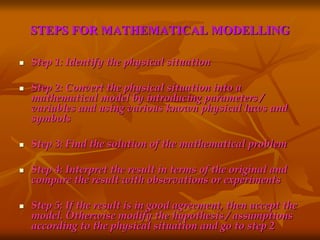
STEPS FOR MATHEMATICAL MODELLING 
 Step 1: Identify the physical situation 
 Step 2: Convert the physical situation into a 
mathematical model by introducing parameters / 
variables and using various known physical laws and 
symbols 
 Step 3: Find the solution of the mathematical problem 
 Step 4: Interpret the result in terms of the original and 
compare the result with observations or experiments 
 Step 5: If the result is in good agreement, then accept the 
model. Otherwise modify the hypothesis / assumptions 
according to the physical situation and go to step 2
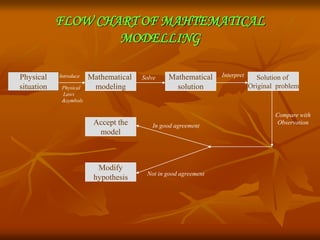
FLOW CHART OF MAHTEMATICAL 
MODELLING 
Physical 
situation 
Mathematical 
modeling 
Mathematical 
solution 
Solution of 
Original problem 
Accept the 
model 
Modify 
hypothesis 
Introduce 
Physical 
Laws 
&symbols 
Solve Interpret 
In good agreement 
Not in good agreement 
Compare with 
Observation
Examples 
(i) Find the height of a given tower using mathematical modeling 
Step1 : Given physical situation is “to find the height of a given 
tower” 
Step2 : Let AB be the given tower. Let PQ be an observer 
measuring the height of the tower with his eye at P. Let PQ=h 
and let height of tower be H. Let x be the angle of elevation 
from the eye of the observer to the top of the tower.
Let l=PC=QB 
Now tan x = AC / PC 
= H – h / l 
H = h + l tan x ………… (1) 
Step3 : Note that the values of the parameters h, l, and x (using 
secant) are known to be the observer and so (1) gives the 
solution of the problem.
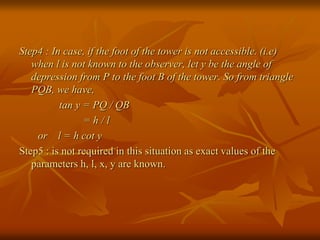
Step4 : In case, if the foot of the tower is not accessible. (i.e) 
when l is not known to the observer, let y be the angle of 
depression from P to the foot B of the tower. So from triangle 
PQB, we have, 
tan y = PQ / QB 
= h / l 
or l = h cot y 
Step5 : is not required in this situation as exact values of the 
parameters h, l, x, y are known.
(ii) Let a tank contains 1000 liters of brine which contains 250g 
of salt per liter. Brine containing 200g of salt per liter flows 
into the tank at the rate of 25 liters per minute and the mixture 
flows out at the same rate. Assume that the mixture is kept 
uniform all the time by stirring what would be the amount of 
salt in the tank at any time t ? 
Step1 : The situation is easily identifiable. 
Step2 : Let y = y (t) denote the amount of salt (in kg) in the tank 
at time t (in minutes) after the inflow, outflow starts. Further 
assume that y is a differentiable function. 
when t = 0, ie; before the inflow- outflow of the brine starts, 
y = 250g * 1000 = 250kg
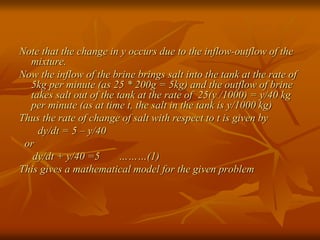
Note that the change in y occurs due to the inflow-outflow of the 
mixture. 
Now the inflow of the brine brings salt into the tank at the rate of 
5kg per minute (as 25 * 200g = 5kg) and the outflow of brine 
takes salt out of the tank at the rate of 25(y /1000) = y/40 kg 
per minute (as at time t, the salt in the tank is y/1000 kg) 
Thus the rate of change of salt with respect to t is given by 
dy/dt = 5 – y/40 
or 
dy/dt + y/40 =5 ………(1) 
This gives a mathematical model for the given problem
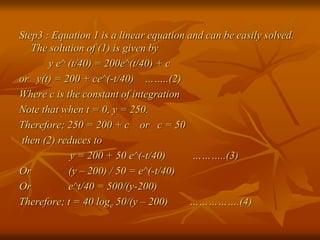
Step3 : Equation 1 is a linear equation and can be easily solved. 
The solution of (1) is given by 
y e^ (t/40) = 200e^(t/40) + c 
or y(t) = 200 + ce^(-t/40) ……..(2) 
Where c is the constant of integration 
Note that when t = 0, y = 250. 
Therefore; 250 = 200 + c or c = 50 
then (2) reduces to 
y = 200 + 50 e^(-t/40) ………..(3) 
Or (y – 200) / 50 = e^(-t/40) 
Or e^t/40 = 500/(y-200) 
Therefore; t = 40 loge 50/(y – 200) …………….(4)
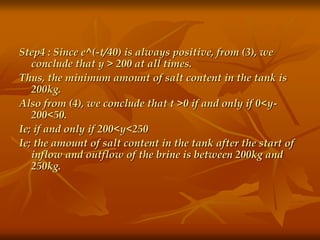
Step4 : Since e^(-t/40) is always positive, from (3), we 
conclude that y > 200 at all times. 
Thus, the minimum amount of salt content in the tank is 
200kg. 
Also from (4), we conclude that t >0 if and only if 0<y- 
200<50. 
Ie; if and only if 200<y<250 
Ie; the amount of salt content in the tank after the start of 
inflow and outflow of the brine is between 200kg and 
250kg.
LIMITATIONS OF MATHEMATICAL 
MODELLING 
Till today many mathematical modeling have been 
developed and applied successfully to 
understand and get an insight into thousands 
of situations. Some of the subjects like 
mathematical physics, mathematical economics, 
operation research, bio-mathematics etc…are 
almost synonyms with mathematical modeling.
But there are still a large number of situations which 
are yet to be modeled. The reason behind this is that 
either the situation are found to be very complex or 
the mathematical models formed are mathematically 
intractable. 
The development of the powerful computers and super 
computers has enabled us to mathematically model a 
large number of situations (even complex situation). 
Due to these fast and advanced computers, it has 
been possible to prepare more realistic models which 
can obtain better agreements with observations.
However, we do not have good guidelines for choosing 
various parameters / variables and also for estimating 
the values of these parameters / variables used in a 
mathematical model. Infact, we can prepare 
reasonably accurate models to fit any data by 
choosing five or six parameters / variables. We require 
a minimal number of parameters / variables to be able 
to estimate them accurately.
Mathematical modeling of large and complex situations 
has its own special problems. These type of situations 
usually occur in the study of world models of 
environment, oceanography, pollution control 
etc…Mathematical modelers from all disciplines-mathematics, 
computer science, physics, engineering, 
social sciences etc…are involved in meeting these 
challenges with courage.
Nandini.N.L 
Presented By 
Mathematics optional 
Reg.no:13971010 
KUCTE Kumarapuram 
Thiruvananthapuram
The END
Mathematical modelling

Mathematical modelling

  • 1.
  • 2.
     Mathematical modelingis an attempt to study some part of some real life problems in mathematical terms. ie; the conversion of a physical situation into mathematics using suitable conditions  Mathematical modeling is an activity in which we make model to describe the behavior of various phenomenal activities of our interest in many ways using words, drawings or sketches, computer programs, mathematical formulae etc…
  • 3.
    Students are awareof the solution of word problems in arithmetic, algebra, trigonometry and linear programming etc…Sometimes we solve the problems without going into the physical insight of the situational problems. Situational problems need physical insight that is ‘introduction’ of physical laws and some symbols to compare the mathematical results obtained with practical values. To solve many problems faced by us, we need a technique and this is what is known as ‘Mathematical Modeling’.
  • 4.
    Let us considerthe following problems : • To find the width of a river • To find the optimal angle in case of shot put • To find the height of a tower • To find the temperature at the surface of the sun • Why heart patients are not allowed to use the lift? • To find the mass of the earth • Estimate the yield of pulses in India from the standing crops • To find the volume of blood inside the body of a person • Estimate the population of India in 2020 All of these problems can be solved and infact have been solved with the help of Mathematics using Mathematical Modeling.
  • 5.
    PRINCIPLES OF MATHEMATICSMODELLING • Identify the need for the model • List the parameters / variables which are required for the model • Identify the available relevant data • Identify the circumstances that can be applied • Identify the governing physical principles Identify (a) the equation that will be used (b) the calculations that will be made (c) the solution which will follow • Identify tests that can check the (a) consistency of the model (b) utility of the model • Identify the parameter values that can improve the model
  • 6.
    STEPS FOR MATHEMATICALMODELLING  Step 1: Identify the physical situation  Step 2: Convert the physical situation into a mathematical model by introducing parameters / variables and using various known physical laws and symbols  Step 3: Find the solution of the mathematical problem  Step 4: Interpret the result in terms of the original and compare the result with observations or experiments  Step 5: If the result is in good agreement, then accept the model. Otherwise modify the hypothesis / assumptions according to the physical situation and go to step 2
  • 7.
    FLOW CHART OFMAHTEMATICAL MODELLING Physical situation Mathematical modeling Mathematical solution Solution of Original problem Accept the model Modify hypothesis Introduce Physical Laws &symbols Solve Interpret In good agreement Not in good agreement Compare with Observation
  • 8.
    Examples (i) Findthe height of a given tower using mathematical modeling Step1 : Given physical situation is “to find the height of a given tower” Step2 : Let AB be the given tower. Let PQ be an observer measuring the height of the tower with his eye at P. Let PQ=h and let height of tower be H. Let x be the angle of elevation from the eye of the observer to the top of the tower.
  • 9.
    Let l=PC=QB Nowtan x = AC / PC = H – h / l H = h + l tan x ………… (1) Step3 : Note that the values of the parameters h, l, and x (using secant) are known to be the observer and so (1) gives the solution of the problem.
  • 10.
    Step4 : Incase, if the foot of the tower is not accessible. (i.e) when l is not known to the observer, let y be the angle of depression from P to the foot B of the tower. So from triangle PQB, we have, tan y = PQ / QB = h / l or l = h cot y Step5 : is not required in this situation as exact values of the parameters h, l, x, y are known.
  • 11.
    (ii) Let atank contains 1000 liters of brine which contains 250g of salt per liter. Brine containing 200g of salt per liter flows into the tank at the rate of 25 liters per minute and the mixture flows out at the same rate. Assume that the mixture is kept uniform all the time by stirring what would be the amount of salt in the tank at any time t ? Step1 : The situation is easily identifiable. Step2 : Let y = y (t) denote the amount of salt (in kg) in the tank at time t (in minutes) after the inflow, outflow starts. Further assume that y is a differentiable function. when t = 0, ie; before the inflow- outflow of the brine starts, y = 250g * 1000 = 250kg
  • 12.
    Note that thechange in y occurs due to the inflow-outflow of the mixture. Now the inflow of the brine brings salt into the tank at the rate of 5kg per minute (as 25 * 200g = 5kg) and the outflow of brine takes salt out of the tank at the rate of 25(y /1000) = y/40 kg per minute (as at time t, the salt in the tank is y/1000 kg) Thus the rate of change of salt with respect to t is given by dy/dt = 5 – y/40 or dy/dt + y/40 =5 ………(1) This gives a mathematical model for the given problem
  • 13.
    Step3 : Equation1 is a linear equation and can be easily solved. The solution of (1) is given by y e^ (t/40) = 200e^(t/40) + c or y(t) = 200 + ce^(-t/40) ……..(2) Where c is the constant of integration Note that when t = 0, y = 250. Therefore; 250 = 200 + c or c = 50 then (2) reduces to y = 200 + 50 e^(-t/40) ………..(3) Or (y – 200) / 50 = e^(-t/40) Or e^t/40 = 500/(y-200) Therefore; t = 40 loge 50/(y – 200) …………….(4)
  • 14.
    Step4 : Sincee^(-t/40) is always positive, from (3), we conclude that y > 200 at all times. Thus, the minimum amount of salt content in the tank is 200kg. Also from (4), we conclude that t >0 if and only if 0<y- 200<50. Ie; if and only if 200<y<250 Ie; the amount of salt content in the tank after the start of inflow and outflow of the brine is between 200kg and 250kg.
  • 15.
    LIMITATIONS OF MATHEMATICAL MODELLING Till today many mathematical modeling have been developed and applied successfully to understand and get an insight into thousands of situations. Some of the subjects like mathematical physics, mathematical economics, operation research, bio-mathematics etc…are almost synonyms with mathematical modeling.
  • 16.
    But there arestill a large number of situations which are yet to be modeled. The reason behind this is that either the situation are found to be very complex or the mathematical models formed are mathematically intractable. The development of the powerful computers and super computers has enabled us to mathematically model a large number of situations (even complex situation). Due to these fast and advanced computers, it has been possible to prepare more realistic models which can obtain better agreements with observations.
  • 17.
    However, we donot have good guidelines for choosing various parameters / variables and also for estimating the values of these parameters / variables used in a mathematical model. Infact, we can prepare reasonably accurate models to fit any data by choosing five or six parameters / variables. We require a minimal number of parameters / variables to be able to estimate them accurately.
  • 18.
    Mathematical modeling oflarge and complex situations has its own special problems. These type of situations usually occur in the study of world models of environment, oceanography, pollution control etc…Mathematical modelers from all disciplines-mathematics, computer science, physics, engineering, social sciences etc…are involved in meeting these challenges with courage.
  • 19.
    Nandini.N.L Presented By Mathematics optional Reg.no:13971010 KUCTE Kumarapuram Thiruvananthapuram
  • 20.