International Journal of Trend in Scientific Research and Development (IJTSRD)
Volume 5 Issue 5, July-August 2021 Available Online: www.ijtsrd.com e-ISSN: 2456 – 6470
@ IJTSRD | Unique Paper ID – IJTSRD44968 | Volume – 5 | Issue – 5 | Jul-Aug 2021 Page 971
A Study on Inventory Management
K Ravi Sai1
, Dr. P. Jaya Rami Reddy2
1
Student, 2
M. Com, M.B.A, Ph.D.,
1,2
JNTUA School of Management Studies,
1,2
Jawaharlalnehru Technologial University, Anantapur, Andhra Pradesh, India
ABSTRACT
Inventory management system which is helpful for the business
operators, where shopkeeper keep the records of purchase and sales.
This inventory management system will have the abilityto track sales
and available inventory, tells a shopkeeper when it's time to reorder
and how much to purchase.
KEYWORDS: Inventory Management, EOQ Analysis, ABC Analysis,
Inventory Turnover Ratios
How to cite this paper: K Ravi Sai | Dr.
P. Jaya Rami Reddy
"A Study on
Inventory
Management"
Published in
International Journal
of Trend in
Scientific Research
and Development (ijtsrd), ISSN: 2456-
6470, Volume-5 | Issue-5, August 2021,
pp.971-975, URL:
www.ijtsrd.com/papers/ijtsrd44968.pdf
Copyright Ā© 2021 by author (s) and
International Journal of Trend in
Scientific Research
and Development
Journal. This is an
Open Access article distributed under
the terms of the Creative Commons
Attribution License (CC BY 4.0)
(http://creativecommons.org/licenses/by/4.0)
INTRODUCTION
Inventory means stock of goods like raw material,
work in progress, finished goods etc.
Inventory management means planning, organizing,
handling and storing adequate level of inventory with
optimized cost to meet consumer’s demand.
Inventory occupy 50–80% of the total current assets
of the business concern. It is very essential part of
working capital management and production
management.
Need for the study
As inventory management is the necessary
activity that helps for continuous production in
the company.
Inventory management is must for every
organization to maintain the adequate stock.
Scope of the study
This study is confined to the ANANTHA PVC
PRIVATE LIMITED only from a period of
2015-16 to 2019-20.
Objectives of the study
To Study the inventory management techniques in
Anantha PVC Pipes Pvt. Ltd.
To analyses the inventory turnover ratios of
Anantha PVC Pipes Pvt. Ltd.
To evaluate the efficiency of inventory
management Anantha PVC Pipes Pvt. Ltd.
Research methodology
SECONDARY DATA:
The study is based on secondary data. It was collected
from the company annual reports, websites and
journals.
Limitations
The study is limited to Anantha pvc pipes Pvt.Ltd
only.
The study is limited to the 5 years data i.e., from
2015-16 to 2019-20 of Anantha pvc pipes Pvt.
Ltd.
EOQ ANALYSIS
The economic order quantity is that inventory level,
which minimizes the total of ordering cost and
carrying cost.
IJTSRD44968
International Journal of Trend in Scientific Research and Development @ www.ijtsrd.com eISSN: 2456-6470
@ IJTSRD | Unique Paper ID – IJTSRD44968 | Volume – 5 | Issue – 5 | Jul-Aug 2021 Page 972
It is defined as the quantity of materials to be ordered
at one time which minimizes the wastage and costs.
The basic objective of EOQ is to have an ideal order
quantity for any item and to economize on the cost of
the purchase.
Economic Order Quantity is given by the formula:
EOQ= Where,
A = Annual consumption
O = Ordering cost and
C = Carrying cost
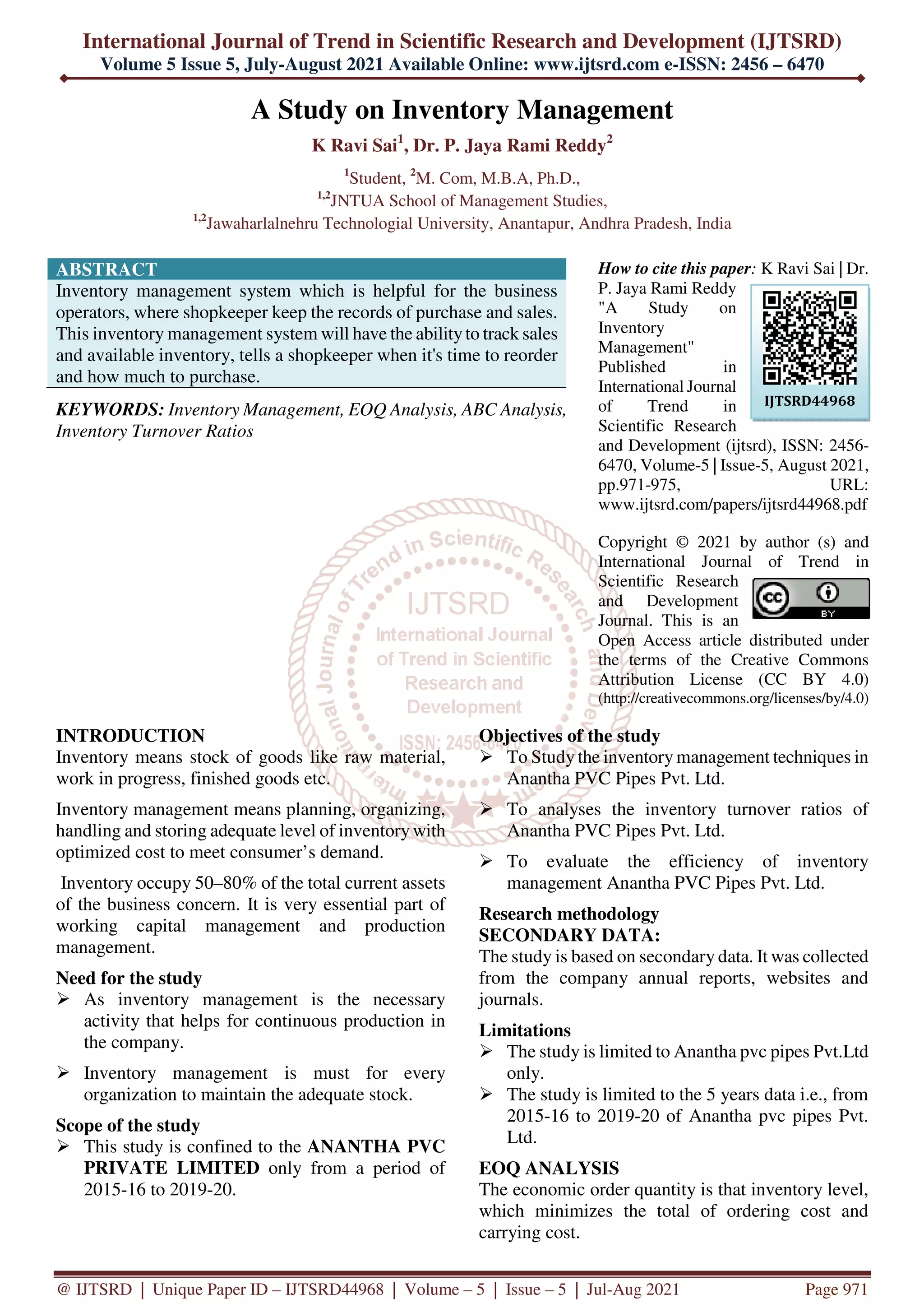
Calculation of EOQ during the years 2015-16 to
2019-20
Interpretation:
From the above graph it is observed that EOQ is
highest in the year 2019-20 i.e.,23052.3 units and it is
lowest in the year 2015-16 i.e., 19,176.33 units. In
2016-17 it is 21380.08 and decreased to 20230.84 in
the year 2017-18. carrying cost and ordering cost is
increased when compared to last year.
ABC Analysis
ABC analysis is a basic analytical management tool.
The greatest effort for the greatest results is ultimate
yield of such analysis of materials.
"A item" with very tight control and accurate records,
"B items" with less tightly controlled and good
records, and
"C items" with the simplest controls possible and
minimal records.
ABC Analysis for The Financial Year 2015-16
Interpretation:
In the year 2015-16 the company has invested
61.80% of annual consumption value in A class
items, 36.88% of annual consumption value in B class
items and 1.32% of annual consumption value in C
class items.
ABC Analysis for The Financial Year 2016-17
Interpretation:
In the year 2016-17 the company has invested
41.50% of annual consumption value in A class
items, 42.72% of annual consumption value in B class
items and 15.78% of annual consumption value in C
class items.
International Journal of Trend in Scientific Research and Development @ www.ijtsrd.com eISSN: 2456-6470
@ IJTSRD | Unique Paper ID – IJTSRD44968 | Volume – 5 | Issue – 5 | Jul-Aug 2021 Page 973
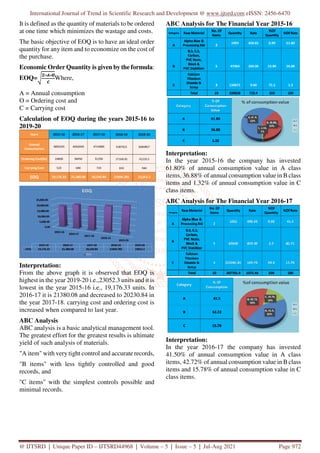
ABC Analysis for the Financial Year 2017-18
Interpretation:
In the year 2017-18 the company has invested
57.22% of annual consumption value in A class
items, 35.59% of annual consumption value in B class
items and 7.18% of annual consumption value in C
class items.
ABC Analysis for The Financial Year 2018-19
Interpretation:
In the year 2018-19 the company has invested
49.95% of annual consumption value in A class
items, 37.03% of annual consumption value in B class
items and 13.03% of annual consumption value in C
class items.
ABC Analysis for the Financial Year 2019-20
Interpretation:
In the year 2019-20 the company has invested
48.45% of annual consumption value in A class
items, 36.08% of annual consumption value in B class
items and 15.46% of annual consumption value in C
class items.
Inventory Turnover Ratio
Inventory turnover ratio is concerned with the cost of
goods and average inventory. Total inventory
turnover ratio is showing how many times inventory
is replaced during the year symbolically,
Cost of goods sold
Inventory turnover ratio= --------------------------
Average Inventory
International Journal of Trend in Scientific Research and Development @ www.ijtsrd.com eISSN: 2456-6470
@ IJTSRD | Unique Paper ID – IJTSRD44968 | Volume – 5 | Issue – 5 | Jul-Aug 2021 Page 974
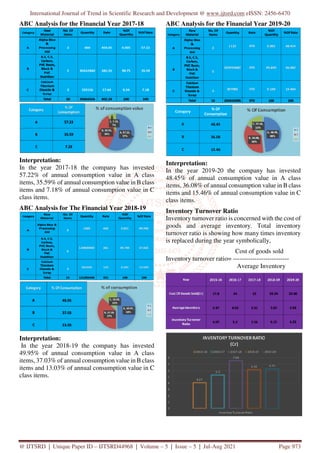
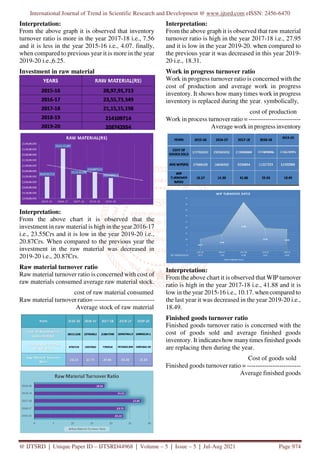
Interpretation:
From the above graph it is observed that inventory
turnover ratio is more in the year 2017-18 i.e., 7.56
and it is less in the year 2015-16 i.e., 4.07. finally,
when compared to previous year it is more in the year
2019-20 i.e.,6.25.
Investment in raw material
Interpretation:
From the above chart it is observed that the
investment in raw material is high in the year 2016-17
i.e., 23.55Crs and it is low in the year 2019-20 i.e.,
20.87Crs. When compared to the previous year the
investment in the raw material was decreased in
2019-20 i.e., 20.87Crs.
Raw material turnover ratio
Raw material turnover ratio is concerned with cost of
raw materials consumed average raw material stock.
cost of raw material consumed
Raw material turnover ratio= -----------------------------
Average stock of raw material
Interpretation:
From the above graph it is observed that raw material
turnover ratio is high in the year 2017-18 i.e., 27.95
and it is low in the year 2019-20. when compared to
the previous year it was decreased in this year 2019-
20 i.e., 18.31.
Work in progress turnover ratio
Work in progress turnover ratio is concerned with the
cost of production and average work in progress
inventory. It shows how many times work in progress
inventory is replaced during the year. symbolically,
cost of production
Work in process turnover ratio = -------------------------
Average work in progress inventory
Interpretation:
From the above chart it is observed that WIP turnover
ratio is high in the year 2017-18 i.e., 41.88 and it is
low in the year 2015-16 i.e., 10.17. when compared to
the last year it was decreased in the year 2019-20 i.e.,
18.49.
Finished goods turnover ratio
Finished goods turnover ratio is concerned with the
cost of goods sold and average finished goods
inventory. It indicates how many times finished goods
are replacing then during the year.
Cost of goods sold
Finished goods turnover ratio = -------------------------
Average finished goods
International Journal of Trend in Scientific Research and Development @ www.ijtsrd.com eISSN: 2456-6470
@ IJTSRD | Unique Paper ID – IJTSRD44968 | Volume – 5 | Issue – 5 | Jul-Aug 2021 Page 975
Interpretation:
From the above chart it is observed that finished
goods turnover ratio is high in the year 2019-20 i.e.,
134.73 and it is low in the year 2015-16 i.e., 34.13.
when compared to the last year it was increased in the
year 2019-20 i.e., 134.73.
Inventory conversion period
Formula: 365/ inventory turnover ratio
Inventory turnover ratios are calculated to
indicate whether inventories have been used
efficient or not.
Inventory conversion period may also be
calculated to find the average time taken to clear
the stock.
Interpretation:
From the above chart it is observed that the
conversion period high in the financial year 2015-16
i.e., 89 days and it is low in the year 2017-18 i.e., 48
days. when compared to previous year the conversion
period is less in the year 2019-20 i.e., 58days
Findings
EOQ is highest in the year 2019-20 i.e., 23,052.3
units and it is lowest in the year 2015-16 i.e.,
19,176.33 units.
The inventory conversion period is 48 days during the
year 2017-18, which indicates the inventory is
converted in to sales in a lesstime when compared to
other years. But in the following years it is increasing
it indicates company performance is not sufficient.
The ordering cost and carrying cost per unit is high
because of material transportation, insurance, tax and
storage cost is high.
Conclusion
A survey has been done to know about the inventory
management of the ANANTHA PVC PIPES PVT
LTD., with standard tools and techniques of inventory
management.
This study found out that the inventory management
of the company should concentrate on reduction of
different types of costs and also systematic
maintenance of inventory. Company has to reduce
inventory and it has to increase inventory turnover
ratio.
SUGGESTIONS
Company should order in optimum quantitywith help
of EOQ analysis so that carrying and ordering cost
should not go high.
The company can reduce carrying cost by following
proper inventory management techniques like JIT
(just in time).
The company inventory conversion period is more.it
indicates company, company performance is not
sufficient. The company is suggested to focus on
reducing the conversion period of inventory to
convert into sales.
Reference:
[1] I. M. Pandey: Financial Management
[2] Prasanna Chandra: Financial Management
[3] Ks Menon: Purchasing and Inventory Control
[4] Joseph G. Monks: Operations Management
[5] S. N. Charry: Production Management

A Study on Inventory Management

  • 1.
    International Journal ofTrend in Scientific Research and Development (IJTSRD) Volume 5 Issue 5, July-August 2021 Available Online: www.ijtsrd.com e-ISSN: 2456 – 6470 @ IJTSRD | Unique Paper ID – IJTSRD44968 | Volume – 5 | Issue – 5 | Jul-Aug 2021 Page 971 A Study on Inventory Management K Ravi Sai1 , Dr. P. Jaya Rami Reddy2 1 Student, 2 M. Com, M.B.A, Ph.D., 1,2 JNTUA School of Management Studies, 1,2 Jawaharlalnehru Technologial University, Anantapur, Andhra Pradesh, India ABSTRACT Inventory management system which is helpful for the business operators, where shopkeeper keep the records of purchase and sales. This inventory management system will have the abilityto track sales and available inventory, tells a shopkeeper when it's time to reorder and how much to purchase. KEYWORDS: Inventory Management, EOQ Analysis, ABC Analysis, Inventory Turnover Ratios How to cite this paper: K Ravi Sai | Dr. P. Jaya Rami Reddy "A Study on Inventory Management" Published in International Journal of Trend in Scientific Research and Development (ijtsrd), ISSN: 2456- 6470, Volume-5 | Issue-5, August 2021, pp.971-975, URL: www.ijtsrd.com/papers/ijtsrd44968.pdf Copyright Ā© 2021 by author (s) and International Journal of Trend in Scientific Research and Development Journal. This is an Open Access article distributed under the terms of the Creative Commons Attribution License (CC BY 4.0) (http://creativecommons.org/licenses/by/4.0) INTRODUCTION Inventory means stock of goods like raw material, work in progress, finished goods etc. Inventory management means planning, organizing, handling and storing adequate level of inventory with optimized cost to meet consumer’s demand. Inventory occupy 50–80% of the total current assets of the business concern. It is very essential part of working capital management and production management. Need for the study As inventory management is the necessary activity that helps for continuous production in the company. Inventory management is must for every organization to maintain the adequate stock. Scope of the study This study is confined to the ANANTHA PVC PRIVATE LIMITED only from a period of 2015-16 to 2019-20. Objectives of the study To Study the inventory management techniques in Anantha PVC Pipes Pvt. Ltd. To analyses the inventory turnover ratios of Anantha PVC Pipes Pvt. Ltd. To evaluate the efficiency of inventory management Anantha PVC Pipes Pvt. Ltd. Research methodology SECONDARY DATA: The study is based on secondary data. It was collected from the company annual reports, websites and journals. Limitations The study is limited to Anantha pvc pipes Pvt.Ltd only. The study is limited to the 5 years data i.e., from 2015-16 to 2019-20 of Anantha pvc pipes Pvt. Ltd. EOQ ANALYSIS The economic order quantity is that inventory level, which minimizes the total of ordering cost and carrying cost. IJTSRD44968
  • 2.
    International Journal ofTrend in Scientific Research and Development @ www.ijtsrd.com eISSN: 2456-6470 @ IJTSRD | Unique Paper ID – IJTSRD44968 | Volume – 5 | Issue – 5 | Jul-Aug 2021 Page 972 It is defined as the quantity of materials to be ordered at one time which minimizes the wastage and costs. The basic objective of EOQ is to have an ideal order quantity for any item and to economize on the cost of the purchase. Economic Order Quantity is given by the formula: EOQ= Where, A = Annual consumption O = Ordering cost and C = Carrying cost Calculation of EOQ during the years 2015-16 to 2019-20 Interpretation: From the above graph it is observed that EOQ is highest in the year 2019-20 i.e.,23052.3 units and it is lowest in the year 2015-16 i.e., 19,176.33 units. In 2016-17 it is 21380.08 and decreased to 20230.84 in the year 2017-18. carrying cost and ordering cost is increased when compared to last year. ABC Analysis ABC analysis is a basic analytical management tool. The greatest effort for the greatest results is ultimate yield of such analysis of materials. "A item" with very tight control and accurate records, "B items" with less tightly controlled and good records, and "C items" with the simplest controls possible and minimal records. ABC Analysis for The Financial Year 2015-16 Interpretation: In the year 2015-16 the company has invested 61.80% of annual consumption value in A class items, 36.88% of annual consumption value in B class items and 1.32% of annual consumption value in C class items. ABC Analysis for The Financial Year 2016-17 Interpretation: In the year 2016-17 the company has invested 41.50% of annual consumption value in A class items, 42.72% of annual consumption value in B class items and 15.78% of annual consumption value in C class items.
  • 3.
    International Journal ofTrend in Scientific Research and Development @ www.ijtsrd.com eISSN: 2456-6470 @ IJTSRD | Unique Paper ID – IJTSRD44968 | Volume – 5 | Issue – 5 | Jul-Aug 2021 Page 973 ABC Analysis for the Financial Year 2017-18 Interpretation: In the year 2017-18 the company has invested 57.22% of annual consumption value in A class items, 35.59% of annual consumption value in B class items and 7.18% of annual consumption value in C class items. ABC Analysis for The Financial Year 2018-19 Interpretation: In the year 2018-19 the company has invested 49.95% of annual consumption value in A class items, 37.03% of annual consumption value in B class items and 13.03% of annual consumption value in C class items. ABC Analysis for the Financial Year 2019-20 Interpretation: In the year 2019-20 the company has invested 48.45% of annual consumption value in A class items, 36.08% of annual consumption value in B class items and 15.46% of annual consumption value in C class items. Inventory Turnover Ratio Inventory turnover ratio is concerned with the cost of goods and average inventory. Total inventory turnover ratio is showing how many times inventory is replaced during the year symbolically, Cost of goods sold Inventory turnover ratio= -------------------------- Average Inventory
  • 4.
    International Journal ofTrend in Scientific Research and Development @ www.ijtsrd.com eISSN: 2456-6470 @ IJTSRD | Unique Paper ID – IJTSRD44968 | Volume – 5 | Issue – 5 | Jul-Aug 2021 Page 974 Interpretation: From the above graph it is observed that inventory turnover ratio is more in the year 2017-18 i.e., 7.56 and it is less in the year 2015-16 i.e., 4.07. finally, when compared to previous year it is more in the year 2019-20 i.e.,6.25. Investment in raw material Interpretation: From the above chart it is observed that the investment in raw material is high in the year 2016-17 i.e., 23.55Crs and it is low in the year 2019-20 i.e., 20.87Crs. When compared to the previous year the investment in the raw material was decreased in 2019-20 i.e., 20.87Crs. Raw material turnover ratio Raw material turnover ratio is concerned with cost of raw materials consumed average raw material stock. cost of raw material consumed Raw material turnover ratio= ----------------------------- Average stock of raw material Interpretation: From the above graph it is observed that raw material turnover ratio is high in the year 2017-18 i.e., 27.95 and it is low in the year 2019-20. when compared to the previous year it was decreased in this year 2019- 20 i.e., 18.31. Work in progress turnover ratio Work in progress turnover ratio is concerned with the cost of production and average work in progress inventory. It shows how many times work in progress inventory is replaced during the year. symbolically, cost of production Work in process turnover ratio = ------------------------- Average work in progress inventory Interpretation: From the above chart it is observed that WIP turnover ratio is high in the year 2017-18 i.e., 41.88 and it is low in the year 2015-16 i.e., 10.17. when compared to the last year it was decreased in the year 2019-20 i.e., 18.49. Finished goods turnover ratio Finished goods turnover ratio is concerned with the cost of goods sold and average finished goods inventory. It indicates how many times finished goods are replacing then during the year. Cost of goods sold Finished goods turnover ratio = ------------------------- Average finished goods
  • 5.
    International Journal ofTrend in Scientific Research and Development @ www.ijtsrd.com eISSN: 2456-6470 @ IJTSRD | Unique Paper ID – IJTSRD44968 | Volume – 5 | Issue – 5 | Jul-Aug 2021 Page 975 Interpretation: From the above chart it is observed that finished goods turnover ratio is high in the year 2019-20 i.e., 134.73 and it is low in the year 2015-16 i.e., 34.13. when compared to the last year it was increased in the year 2019-20 i.e., 134.73. Inventory conversion period Formula: 365/ inventory turnover ratio Inventory turnover ratios are calculated to indicate whether inventories have been used efficient or not. Inventory conversion period may also be calculated to find the average time taken to clear the stock. Interpretation: From the above chart it is observed that the conversion period high in the financial year 2015-16 i.e., 89 days and it is low in the year 2017-18 i.e., 48 days. when compared to previous year the conversion period is less in the year 2019-20 i.e., 58days Findings EOQ is highest in the year 2019-20 i.e., 23,052.3 units and it is lowest in the year 2015-16 i.e., 19,176.33 units. The inventory conversion period is 48 days during the year 2017-18, which indicates the inventory is converted in to sales in a lesstime when compared to other years. But in the following years it is increasing it indicates company performance is not sufficient. The ordering cost and carrying cost per unit is high because of material transportation, insurance, tax and storage cost is high. Conclusion A survey has been done to know about the inventory management of the ANANTHA PVC PIPES PVT LTD., with standard tools and techniques of inventory management. This study found out that the inventory management of the company should concentrate on reduction of different types of costs and also systematic maintenance of inventory. Company has to reduce inventory and it has to increase inventory turnover ratio. SUGGESTIONS Company should order in optimum quantitywith help of EOQ analysis so that carrying and ordering cost should not go high. The company can reduce carrying cost by following proper inventory management techniques like JIT (just in time). The company inventory conversion period is more.it indicates company, company performance is not sufficient. The company is suggested to focus on reducing the conversion period of inventory to convert into sales. Reference: [1] I. M. Pandey: Financial Management [2] Prasanna Chandra: Financial Management [3] Ks Menon: Purchasing and Inventory Control [4] Joseph G. Monks: Operations Management [5] S. N. Charry: Production Management