GCT Semiconductor, Inc.
RFIT 2022
A Refined Skew Matrix Model of the CIM3 in the Up-Mixer
Extending the Duality of I/Q Imbalance
Ealwan Lee
GCT Semiconductor, Inc.
Aug 30, 2022
Session T3B.4 (2:30 pm ~ 2: 50 pm)
Advanced Circuit and System Designs
1/16
GCT Semiconductor, Inc.
RFIT 2022
Table of Contents
❑ Introduction
◆ Meaning of the study on the CIM3-only DPD model.
◆ Review of the previous work of joint I/Q-imbalance and CIM3 model.
❑ Duality between the components of I/Q gain/phase mismatch
◆ Review of the duality in I/Q imbalance model.
◆ Extension and application to CIM3 model with conjugate signal representation
❑ Correction/Enhancement to the CIM3 models introduced in 5 years ago
◆ Identification of missing terms in prior works.
◆ Evaluation of the improvement after the correction.
❑ LMS adaptation revisited and its simplification
◆ Frequency domain => Time domain : Parseval’s theorem
◆ Link to other works already established for I/Q imbalance : circularity
❑ Conclusion
◆ Refined version of joint CIM3 + I/Q imbalance model
[ pp. 2 ~ 5 ]
[ pp. 6 ~ 8 ]
[ pp. 9 ~ 10 ]
[ pp. 11 ~ 15 ]
[ p. 16 ]
2/16
GCT Semiconductor, Inc.
RFIT 2022
Introduction
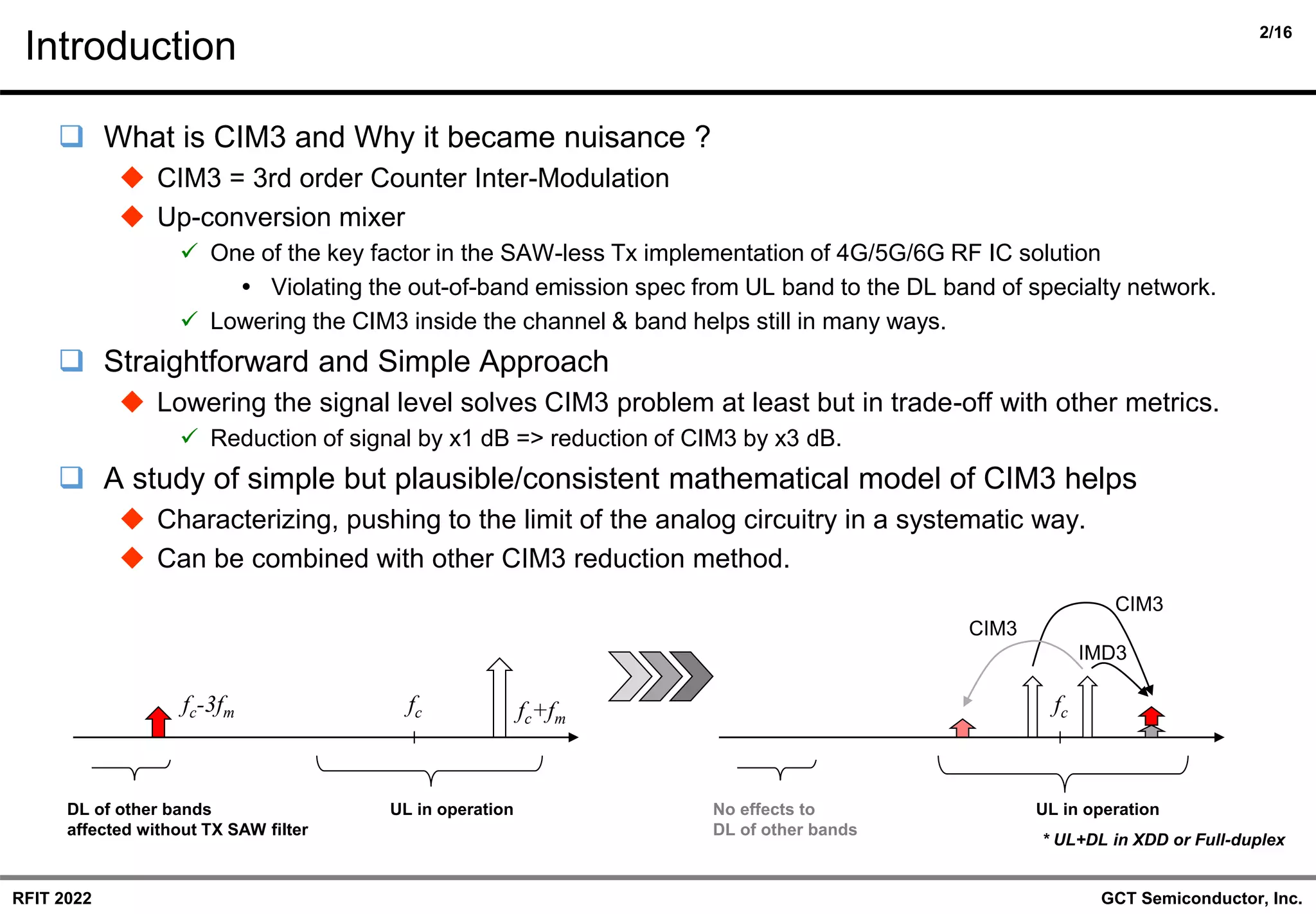
❑ What is CIM3 and Why it became nuisance ?
◆ CIM3 = 3rd order Counter Inter-Modulation
◆ Up-conversion mixer
✓ One of the key factor in the SAW-less Tx implementation of 4G/5G/6G RF IC solution
 Violating the out-of-band emission spec from UL band to the DL band of specialty network.
✓ Lowering the CIM3 inside the channel & band helps still in many ways.
❑ Straightforward and Simple Approach
◆ Lowering the signal level solves CIM3 problem at least but in trade-off with other metrics.
✓ Reduction of signal by x1 dB => reduction of CIM3 by x3 dB.
❑ A study of simple but plausible/consistent mathematical model of CIM3 helps
◆ Characterizing, pushing to the limit of the analog circuitry in a systematic way.
◆ Can be combined with other CIM3 reduction method.
DL of other bands
affected without TX SAW filter
UL in operation
fc fc+fm
fc-3fm
No effects to
DL of other bands
UL in operation
fc
IMD3
CIM3
* UL+DL in XDD or Full-duplex
CIM3
3/16
GCT Semiconductor, Inc.
RFIT 2022
Review of Prior Works in RFIT2017
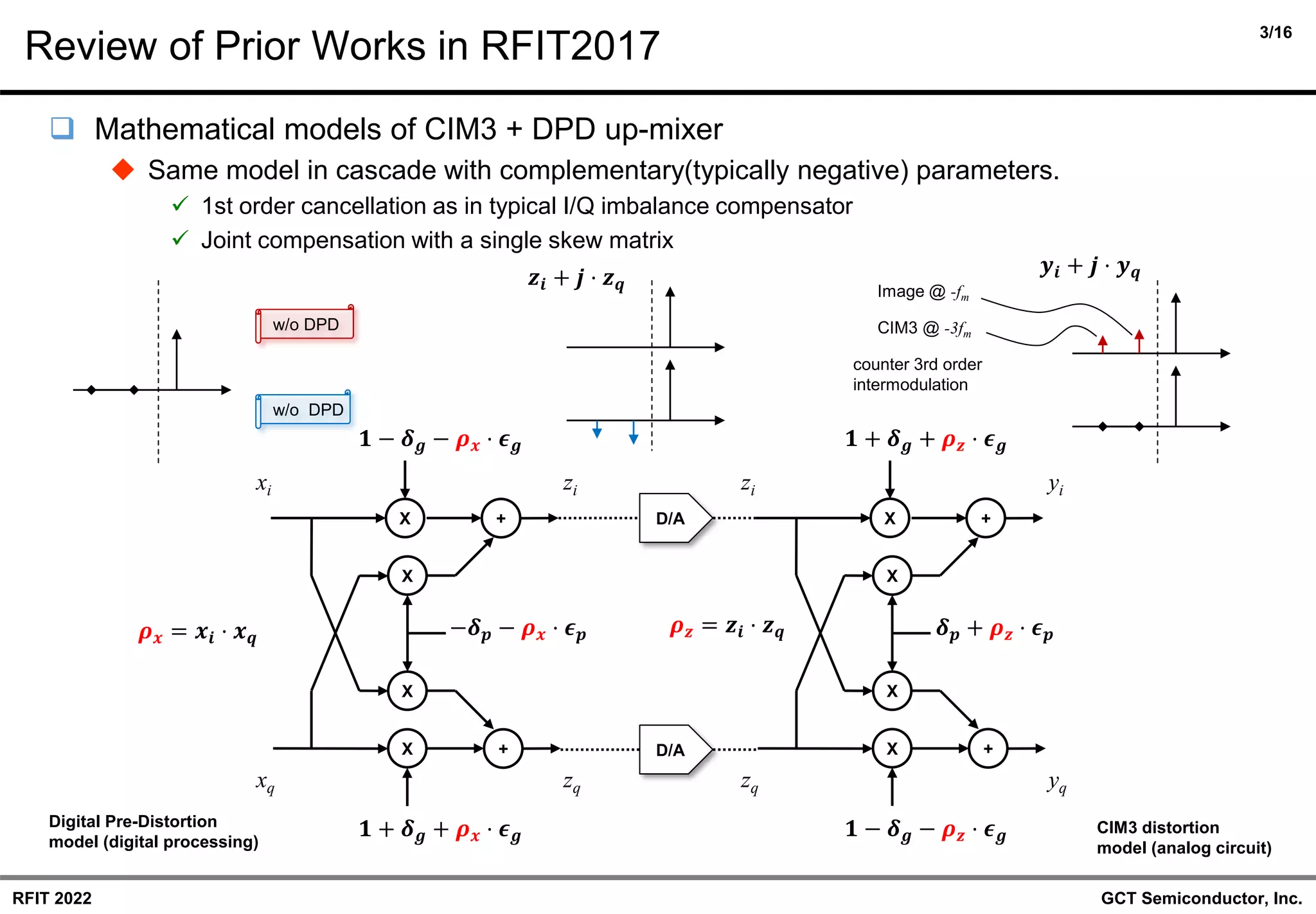
❑ Mathematical models of CIM3 + DPD up-mixer
◆ Same model in cascade with complementary(typically negative) parameters.
✓ 1st order cancellation as in typical I/Q imbalance compensator
✓ Joint compensation with a single skew matrix
+
X
X
X
X +
zi
zq
yi
yq
𝟏 + 𝜹𝒈 + 𝝆𝒛 ⋅ 𝝐𝒈
𝟏 − 𝜹𝒈 − 𝝆𝒛 ⋅ 𝝐𝒈
𝜹𝒑 + 𝝆𝒛 ⋅ 𝝐𝒑
+
X
X
X
X +
xi
xq
zi
zq
𝟏 − 𝜹𝒈 − 𝝆𝒙 ⋅ 𝝐𝒈
𝟏 + 𝜹𝒈 + 𝝆𝒙 ⋅ 𝝐𝒈
−𝜹𝒑 − 𝝆𝒙 ⋅ 𝝐𝒑
CIM3 distortion
model (analog circuit)
Digital Pre-Distortion
model (digital processing)
𝝆𝒙 = 𝒙𝒊 ⋅ 𝒙𝒒
𝝆𝒛 = 𝒛𝒊 ⋅ 𝒛𝒒
D/A
D/A
w/o DPD
w/o DPD
𝒛𝒊 + 𝒋 ⋅ 𝒛𝒒
𝒚𝒊 + 𝒋 ⋅ 𝒚𝒒
Image @ -fm
CIM3 @ -3fm
counter 3rd order
intermodulation
4/16
GCT Semiconductor, Inc.
RFIT 2022
CIM3 in spectrum and phasor diagram
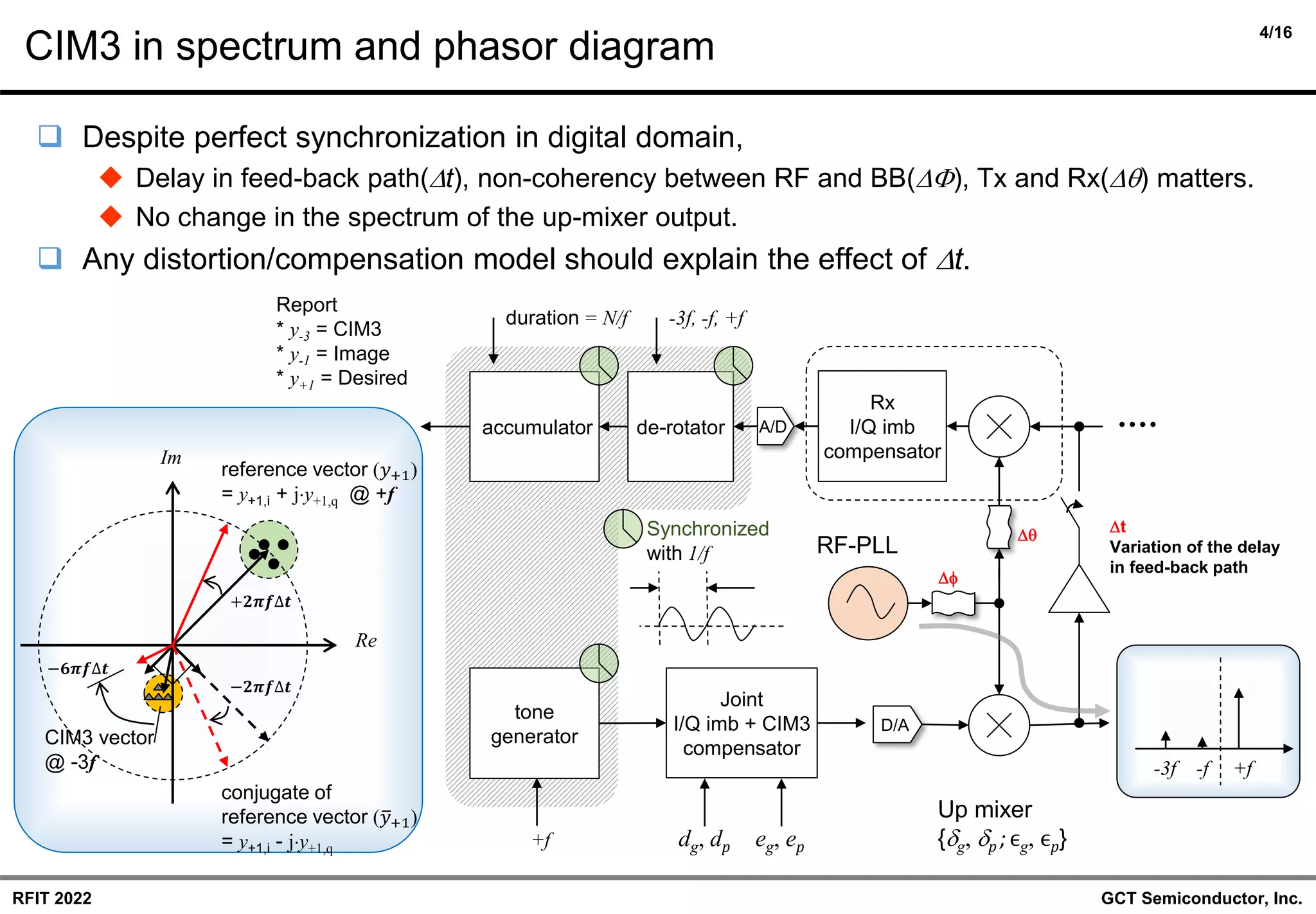
❑ Despite perfect synchronization in digital domain,
◆ Delay in feed-back path(t), non-coherency between RF and BB(), Tx and Rx() matters.
◆ No change in the spectrum of the up-mixer output.
❑ Any distortion/compensation model should explain the effect of t.
reference vector (𝑦+1)
= y+1,i + jy+1,q @ +f
CIM3 vector
@ -3f
conjugate of
reference vector (ത
𝑦+1)
= y+1,i - jy+1,q
Re
Im
Joint
I/Q imb + CIM3
compensator
tone
generator
accumulator de-rotator
+f
-3f, -f, +f
duration = N/f
Synchronized
with 1/f
Up mixer
{g, p ;ϵg, ϵp}
RF-PLL
Report
* y-3 = CIM3
* y-1 = Image
* y+1 = Desired
eg, ep
dg, dp
Rx
I/Q imb
compensator
D/A
t
Variation of the delay
in feed-back path
+𝟐𝝅𝒇∆𝒕
−𝟐𝝅𝒇∆𝒕
−𝟔𝝅𝒇∆𝒕
+f
-f
-3f
A/D


5/16
GCT Semiconductor, Inc.
RFIT 2022
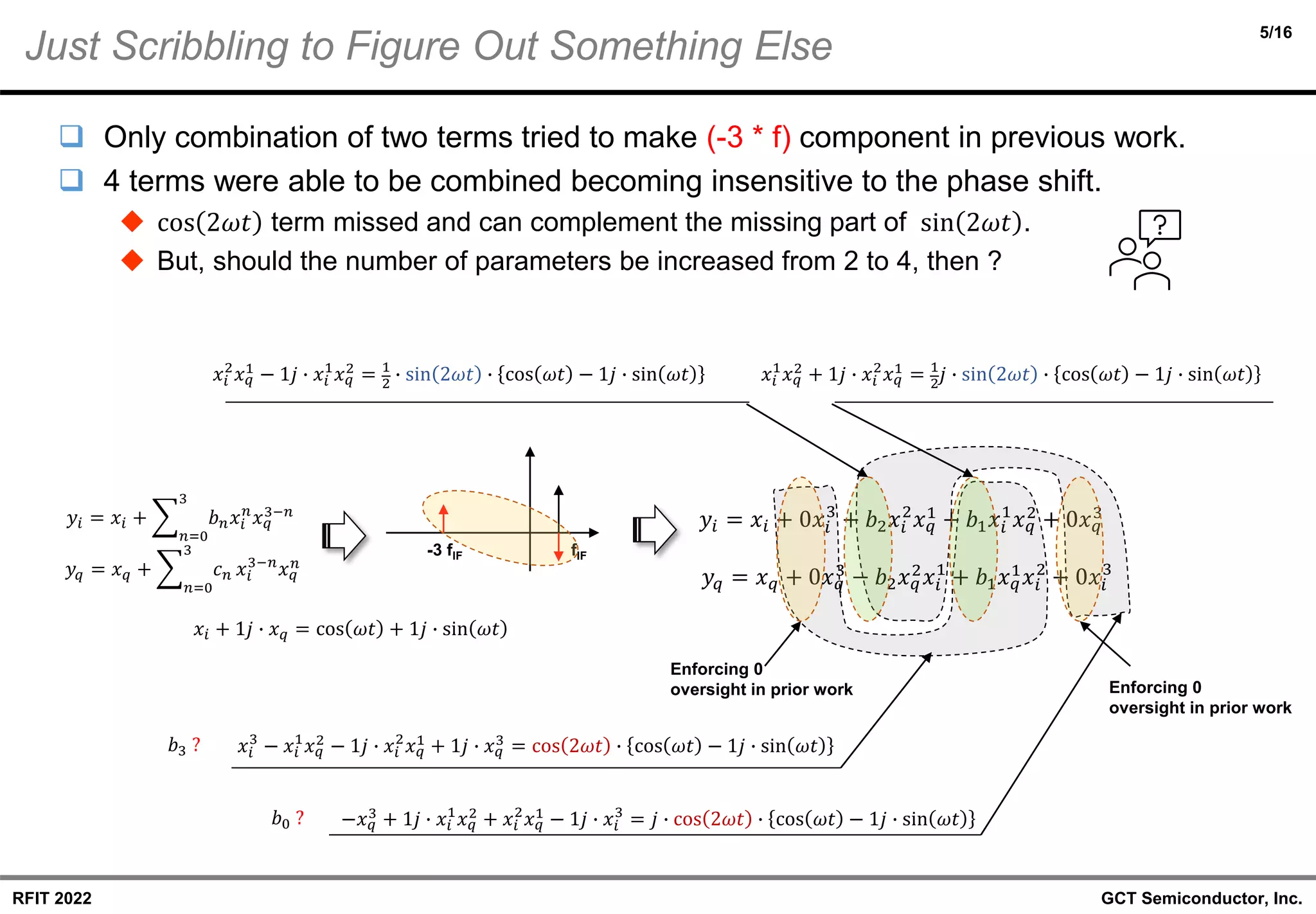
Just Scribbling to Figure Out Something Else
❑ Only combination of two terms tried to make (-3 * f) component in previous work.
❑ 4 terms were able to be combined becoming insensitive to the phase shift.
◆ cos 2𝜔𝑡 term missed and can complement the missing part of sin 2𝜔𝑡 .
◆ But, should the number of parameters be increased from 2 to 4, then ?
𝑦𝑖 = 𝑥𝑖 + 0𝑥𝑖
3
+ 𝑏2𝑥𝑖
2
𝑥𝑞
1
+ 𝑏1𝑥𝑖
1
𝑥𝑞
2
+ 0𝑥𝑞
3
𝑦𝑞 = 𝑥𝑞 + 0𝑥𝑞
3
− 𝑏2𝑥𝑞
2
𝑥𝑖
1
+ 𝑏1𝑥𝑞
1
𝑥𝑖
2
+ 0𝑥𝑖
3
𝑦𝑖 = 𝑥𝑖 + ෍
𝑛=0
3
𝑏𝑛𝑥𝑖
𝑛
𝑥𝑞
3−𝑛
𝑦𝑞 = 𝑥𝑞 + ෍
𝑛=0
3
𝑐𝑛 𝑥𝑖
3−𝑛
𝑥𝑞
𝑛
Enforcing 0
oversight in prior work
𝑥𝑖 + 1𝑗 ∙ 𝑥𝑞 = cos 𝜔𝑡 + 1𝑗 ∙ sin 𝜔𝑡
𝑥𝑖
2
𝑥𝑞
1
− 1𝑗 ∙ 𝑥𝑖
1
𝑥𝑞
2
= 1
2
∙ sin 2𝜔𝑡 ∙ cos 𝜔𝑡 − 1𝑗 ∙ sin 𝜔𝑡
Enforcing 0
oversight in prior work
𝑥𝑖
1
𝑥𝑞
2
+ 1𝑗 ∙ 𝑥𝑖
2
𝑥𝑞
1
= 1
2
𝑗 ∙ sin 2𝜔𝑡 ∙ cos 𝜔𝑡 − 1𝑗 ∙ sin 𝜔𝑡
𝑥𝑖
3
− 𝑥𝑖
1
𝑥𝑞
2
− 1𝑗 ∙ 𝑥𝑖
2
𝑥𝑞
1
+ 1𝑗 ∙ 𝑥𝑞
3
= cos 2𝜔𝑡 ∙ cos 𝜔𝑡 − 1𝑗 ∙ sin 𝜔𝑡
−𝑥𝑞
3
+ 1𝑗 ∙ 𝑥𝑖
1
𝑥𝑞
2
+ 𝑥𝑖
2
𝑥𝑞
1
− 1𝑗 ∙ 𝑥𝑖
3
= 𝑗 ∙ cos 2𝜔𝑡 ∙ cos 𝜔𝑡 − 1𝑗 ∙ sin 𝜔𝑡
𝑏3 ?
𝑏0 ?
fIF
-3 fIF
6/16
GCT Semiconductor, Inc.
RFIT 2022
Duality of I/Q imbalance model in the (down)-mixer
❑ gain mismatch(ϵg) and phase mismatch(ϵp) are exchangeable under signal rotation.
◆ explaining the consistency of image signal and IRR in spectrum against co-ordinate rotation.
Another proof by (2nd)
geometric interpretation
Down-mixer [2018]
1. L1-norm based
LMS calibration
2. Completeness of
symmetric skew matrix
Applied to up-mixer
in this paper.
(ϵg/2, ϵg/2) => (g,g)
Proof by (1st)
simple arithmetic
7/16
GCT Semiconductor, Inc.
RFIT 2022
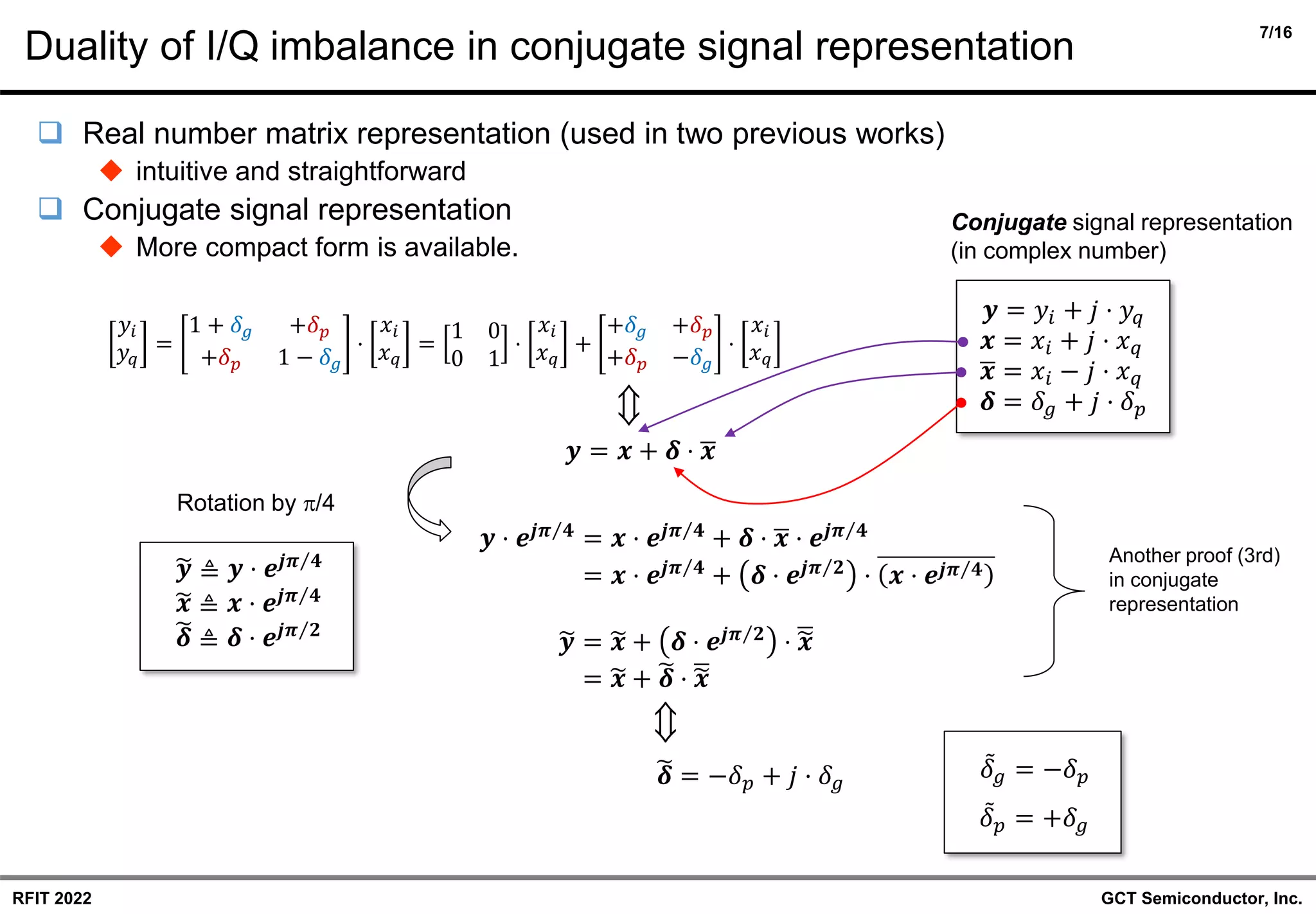
Duality of I/Q imbalance in conjugate signal representation
❑ Real number matrix representation (used in two previous works)
◆ intuitive and straightforward
❑ Conjugate signal representation
◆ More compact form is available.
𝒚 = 𝒙 + 𝜹 ⋅ ഥ
𝒙
𝒚 ⋅ 𝒆𝒋 Τ
𝝅 𝟒
= 𝒙 ⋅ 𝒆𝒋 Τ
𝝅 𝟒
+ 𝜹 ⋅ ഥ
𝒙 ⋅ 𝒆𝒋 Τ
𝝅 𝟒
= 𝒙 ⋅ 𝒆𝒋 Τ
𝝅 𝟒
+ 𝜹 ⋅ 𝒆𝒋 Τ
𝝅 𝟐
⋅ 𝒙 ⋅ 𝒆𝒋 Τ
𝝅 𝟒
෥
𝒚 = ෥
𝒙 + 𝜹 ⋅ 𝒆𝒋 Τ
𝝅 𝟐
⋅ ഥ
෥
𝒙
= ෥
𝒙 + ෩
𝜹 ⋅ ഥ
෥
𝒙
෥
𝒚 ≜ 𝒚 ⋅ 𝒆𝒋 Τ
𝝅 𝟒
෥
𝒙 ≜ 𝒙 ⋅ 𝒆𝒋 Τ
𝝅 𝟒
෩
𝜹 ≜ 𝜹 ⋅ 𝒆𝒋 Τ
𝝅 𝟐
𝑦𝑖
𝑦𝑞
=
1 + 𝛿𝑔 +𝛿𝑝
+𝛿𝑝 1 − 𝛿𝑔
⋅
𝑥𝑖
𝑥𝑞
=
1 0
0 1
⋅
𝑥𝑖
𝑥𝑞
+
+𝛿𝑔 +𝛿𝑝
+𝛿𝑝 −𝛿𝑔
⋅
𝑥𝑖
𝑥𝑞
𝒚 = 𝑦𝑖 + 𝑗 ⋅ 𝑦𝑞
𝒙 = 𝑥𝑖 + 𝑗 ⋅ 𝑥𝑞
ഥ
𝒙 = 𝑥𝑖 − 𝑗 ⋅ 𝑥𝑞
𝜹 = 𝛿𝑔 + 𝑗 ⋅ 𝛿𝑝

Rotation by /4
෩
𝜹 = −𝛿𝑝 + 𝑗 ⋅ 𝛿𝑔

ሚ
𝛿𝑔 = −𝛿𝑝
ሚ
𝛿𝑝 = +𝛿𝑔
Conjugate signal representation
(in complex number)
Another proof (3rd)
in conjugate
representation
8/16
GCT Semiconductor, Inc.
RFIT 2022
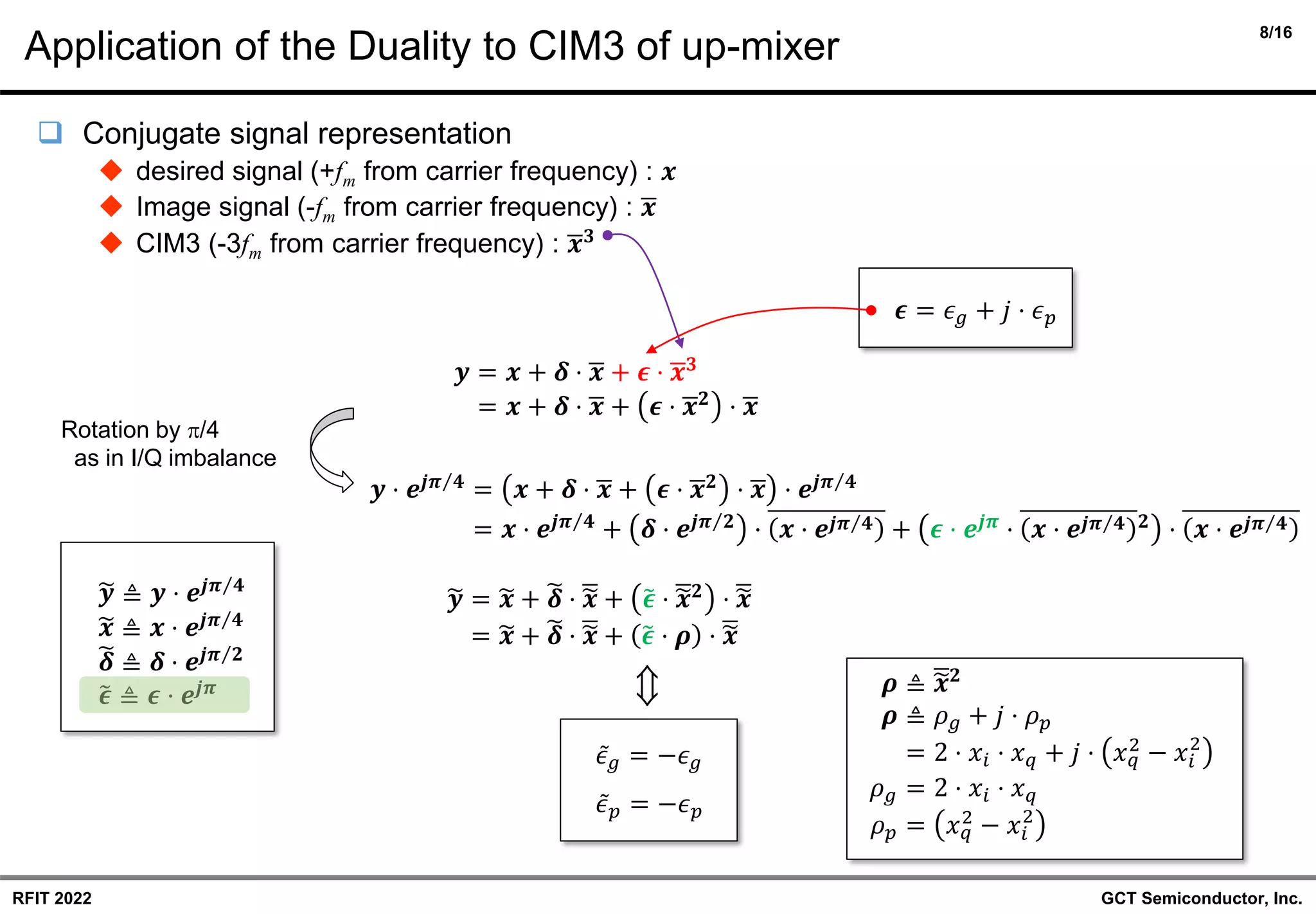
Application of the Duality to CIM3 of up-mixer
❑ Conjugate signal representation
◆ desired signal (+fm from carrier frequency) : 𝒙
◆ Image signal (-fm from carrier frequency) : ഥ
𝒙
◆ CIM3 (-3fm from carrier frequency) : ഥ
𝒙𝟑
𝒚 = 𝒙 + 𝜹 ⋅ ഥ
𝒙 + 𝝐 ⋅ ഥ
𝒙𝟑
= 𝒙 + 𝜹 ⋅ ഥ
𝒙 + 𝝐 ⋅ ഥ
𝒙𝟐
⋅ ഥ
𝒙
𝒚 ⋅ 𝒆𝒋 Τ
𝝅 𝟒
= 𝒙 + 𝜹 ⋅ ഥ
𝒙 + 𝝐 ⋅ ഥ
𝒙𝟐
⋅ ഥ
𝒙 ⋅ 𝒆𝒋 Τ
𝝅 𝟒
= 𝒙 ⋅ 𝒆𝒋 Τ
𝝅 𝟒
+ 𝜹 ⋅ 𝒆𝒋 Τ
𝝅 𝟐
⋅ 𝒙 ⋅ 𝒆𝒋 Τ
𝝅 𝟒 + 𝝐 ⋅ 𝒆𝒋𝝅
⋅ 𝒙 ⋅ 𝒆𝒋 Τ
𝝅 𝟒 𝟐
⋅ 𝒙 ⋅ 𝒆𝒋 Τ
𝝅 𝟒
෥
𝒚 = ෥
𝒙 + ෩
𝜹 ⋅ ഥ
෥
𝒙 + ෤
𝝐 ⋅ ഥ
෥
𝒙𝟐
⋅ ഥ
෥
𝒙
= ෥
𝒙 + ෩
𝜹 ⋅ ഥ
෥
𝒙 + ෤
𝝐 ⋅ 𝝆 ⋅ ഥ
෥
𝒙
෥
𝒚 ≜ 𝒚 ⋅ 𝒆𝒋 Τ
𝝅 𝟒
෥
𝒙 ≜ 𝒙 ⋅ 𝒆𝒋 Τ
𝝅 𝟒
෩
𝜹 ≜ 𝜹 ⋅ 𝒆𝒋 Τ
𝝅 𝟐
෤
𝝐 ≜ 𝝐 ⋅ 𝒆𝒋𝝅
ǁ
𝜖𝑔 = −𝜖𝑔
ǁ
𝜖𝑝 = −𝜖𝑝
Rotation by /4
as in I/Q imbalance

𝝐 = 𝜖𝑔 + 𝑗 ⋅ 𝜖𝑝
𝝆 ≜ ഥ
෥
𝒙𝟐
𝝆 ≜ 𝜌𝑔 + 𝑗 ⋅ 𝜌𝑝
= 2 ⋅ 𝑥𝑖 ⋅ 𝑥𝑞 + 𝑗 ⋅ 𝑥𝑞
2
− 𝑥𝑖
2
𝜌𝑔 = 2 ⋅ 𝑥𝑖 ⋅ 𝑥𝑞
𝜌𝑝 = 𝑥𝑞
2
− 𝑥𝑖
2
9/16
GCT Semiconductor, Inc.
RFIT 2022
Don’t be confused
with (ϵg, ϵg)
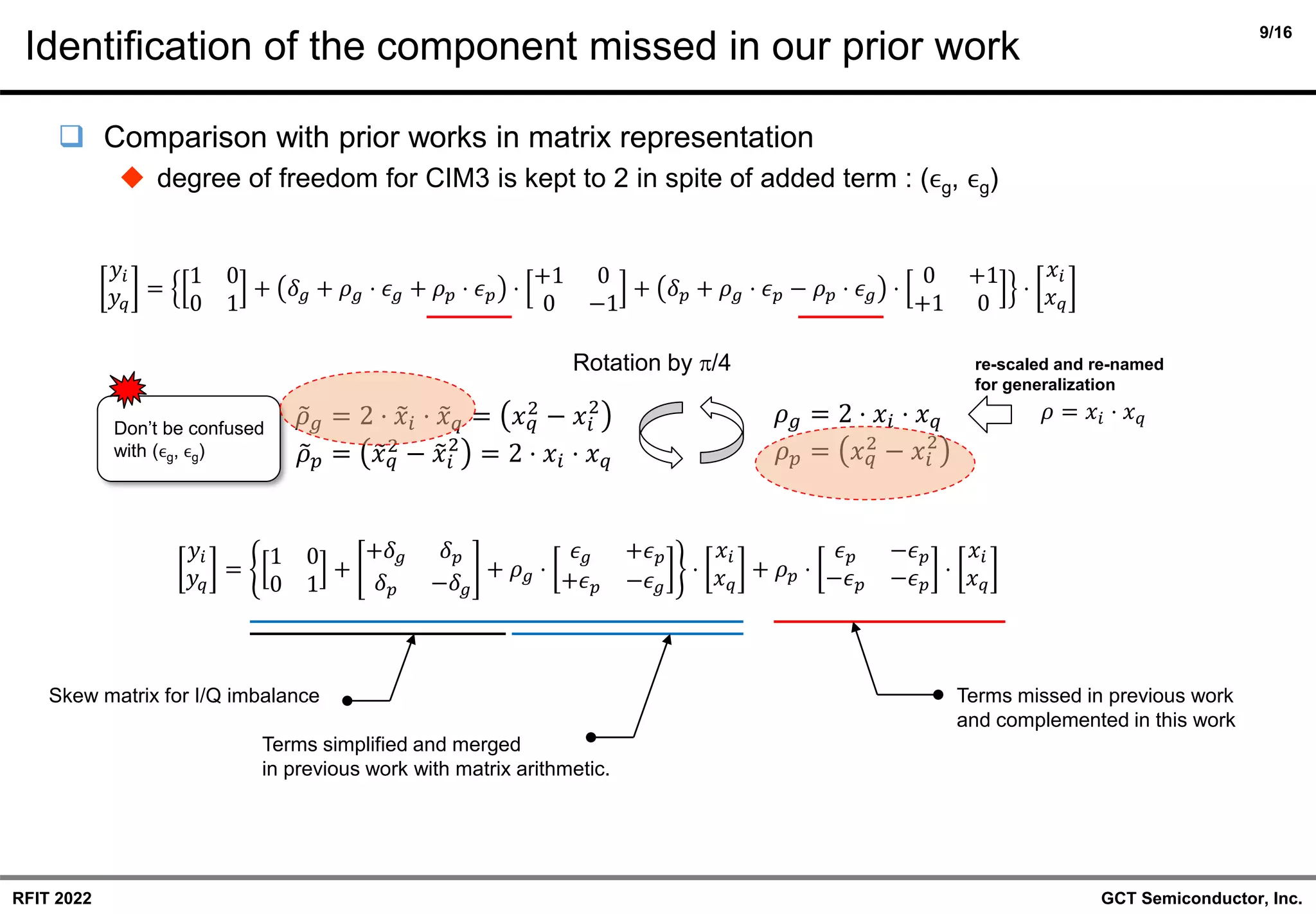
Identification of the component missed in our prior work
❑ Comparison with prior works in matrix representation
◆ degree of freedom for CIM3 is kept to 2 in spite of added term : (ϵg, ϵg)
𝑦𝑖
𝑦𝑞
=
1 0
0 1
+ 𝛿𝑔 + 𝜌𝑔 ⋅ 𝜖𝑔 + 𝜌𝑝 ⋅ 𝜖𝑝 ⋅
+1 0
0 −1
+ 𝛿𝑝 + 𝜌𝑔 ⋅ 𝜖𝑝 − 𝜌𝑝 ⋅ 𝜖𝑔 ⋅
0 +1
+1 0
⋅
𝑥𝑖
𝑥𝑞
𝜌𝑔 = 2 ⋅ 𝑥𝑖 ⋅ 𝑥𝑞
𝜌𝑝 = 𝑥𝑞
2
− 𝑥𝑖
2
𝜌 = 𝑥𝑖 ⋅ 𝑥𝑞
𝑦𝑖
𝑦𝑞
=
1 0
0 1
+
+𝛿𝑔 𝛿𝑝
𝛿𝑝 −𝛿𝑔
+ 𝜌𝑔 ⋅
𝜖𝑔 +𝜖𝑝
+𝜖𝑝 −𝜖𝑔
⋅
𝑥𝑖
𝑥𝑞
+ 𝜌𝑝 ⋅
𝜖𝑝 −𝜖𝑝
−𝜖𝑝 −𝜖𝑝
⋅
𝑥𝑖
𝑥𝑞
Terms missed in previous work
and complemented in this work
Terms simplified and merged
in previous work with matrix arithmetic.
Skew matrix for I/Q imbalance
෤
𝜌𝑔 = 2 ⋅ ෤
𝑥𝑖 ⋅ ෤
𝑥𝑞 = 𝑥𝑞
2
− 𝑥𝑖
2
෤
𝜌𝑝 = ෤
𝑥𝑞
2
− ෤
𝑥𝑖
2
= 2 ⋅ 𝑥𝑖 ⋅ 𝑥𝑞
re-scaled and re-named
for generalization
Rotation by /4
10/16
GCT Semiconductor, Inc.
RFIT 2022
Comparison of two models side-by-side
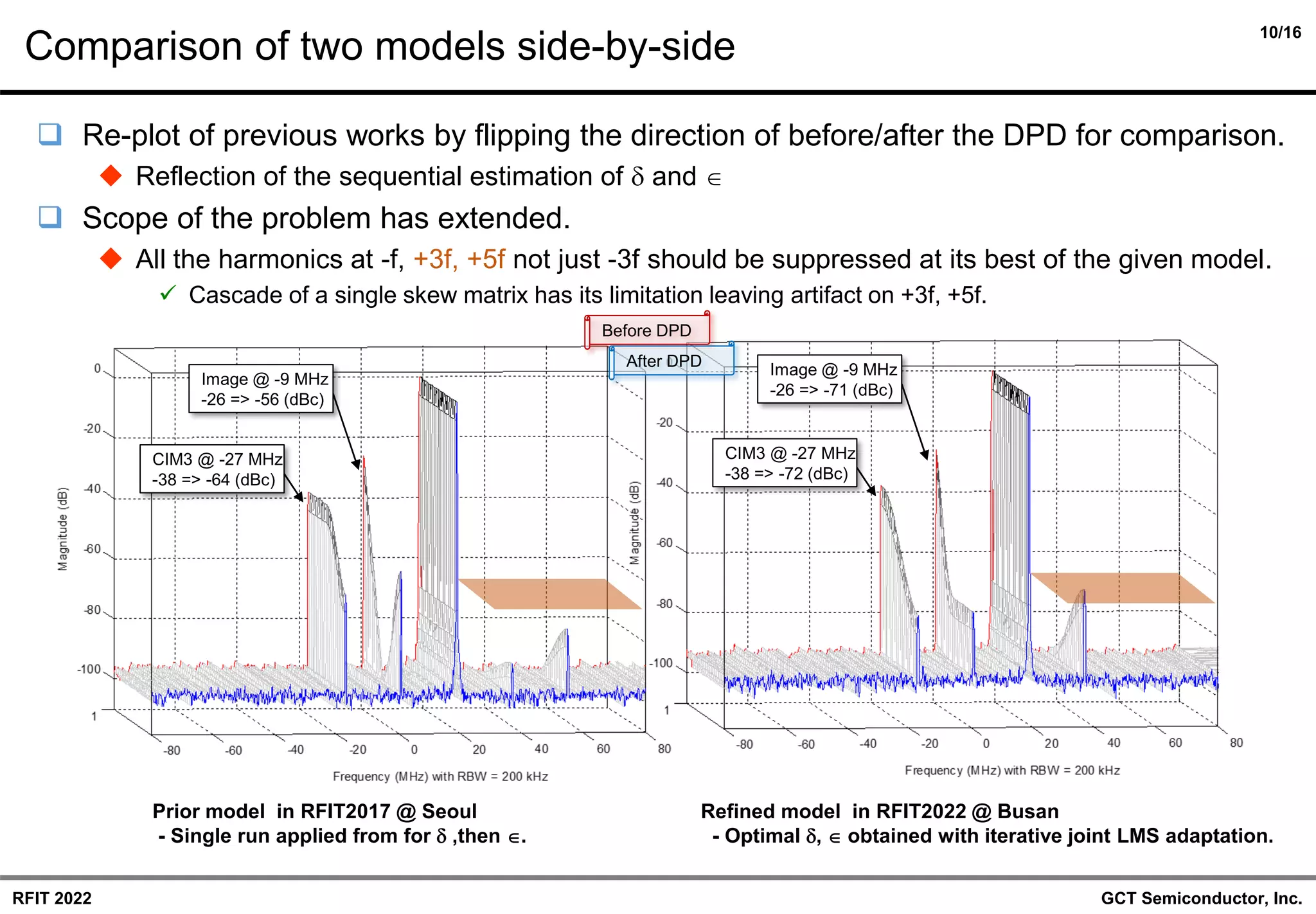
❑ Re-plot of previous works by flipping the direction of before/after the DPD for comparison.
◆ Reflection of the sequential estimation of  and 
❑ Scope of the problem has extended.
◆ All the harmonics at -f, +3f, +5f not just -3f should be suppressed at its best of the given model.
✓ Cascade of a single skew matrix has its limitation leaving artifact on +3f, +5f.
Before DPD
After DPD
Image @ -9 MHz
-26 => -56 (dBc)
CIM3 @ -27 MHz
-38 => -64 (dBc)
Image @ -9 MHz
-26 => -71 (dBc)
CIM3 @ -27 MHz
-38 => -72 (dBc)
Prior model in RFIT2017 @ Seoul
- Single run applied from for  ,then .
Refined model in RFIT2022 @ Busan
- Optimal ,  obtained with iterative joint LMS adaptation.
11/16
GCT Semiconductor, Inc.
RFIT 2022
Derivation of LMS Adaptation Formulae
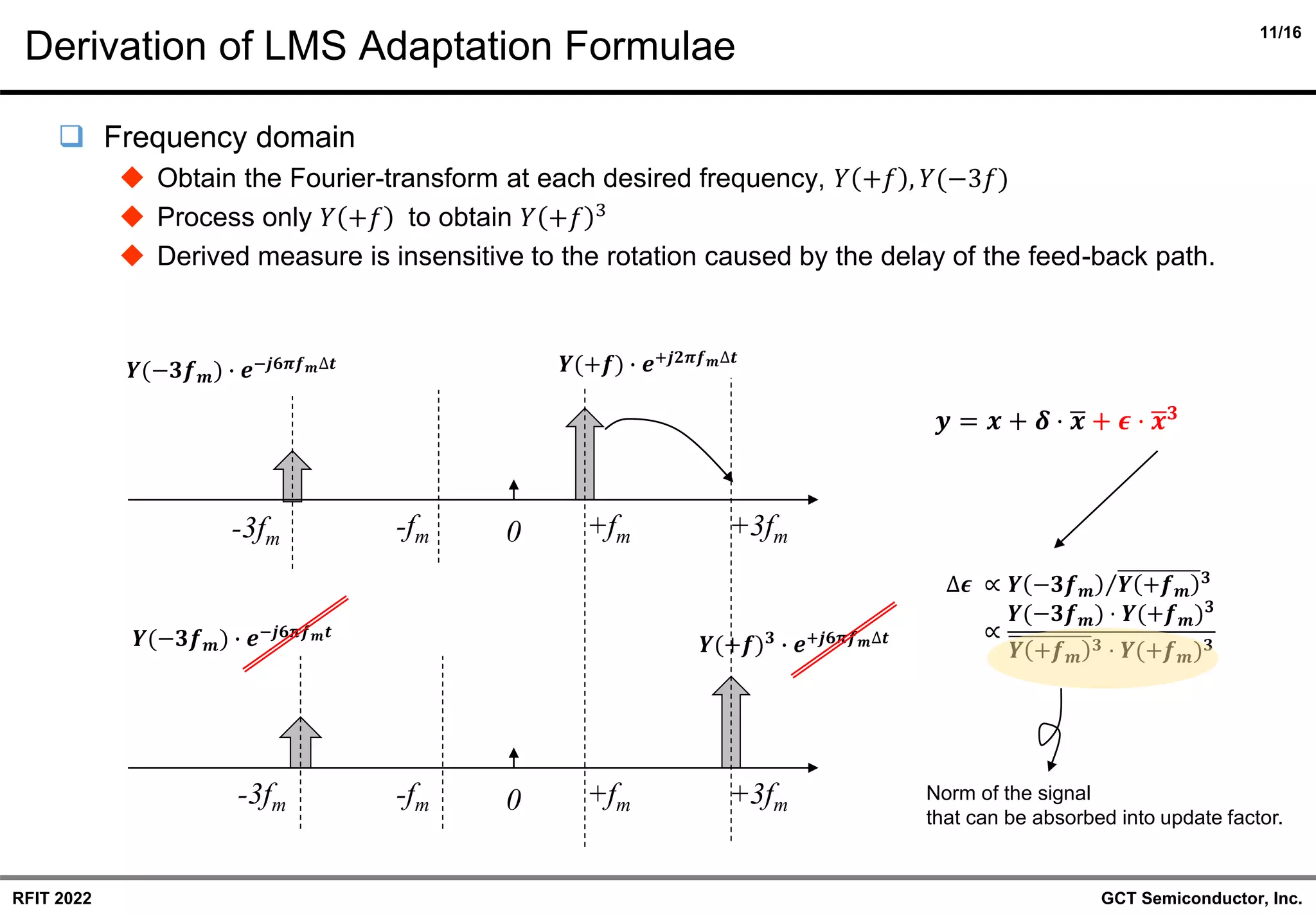
❑ Frequency domain
◆ Obtain the Fourier-transform at each desired frequency, 𝑌 +𝑓 , 𝑌(−3𝑓)
◆ Process only 𝑌 +𝑓 to obtain 𝑌 +𝑓 3
◆ Derived measure is insensitive to the rotation caused by the delay of the feed-back path.
+fm +3fm
-3fm -fm 0
𝒀(−𝟑𝒇𝒎) ∙ 𝒆−𝒋𝟔𝝅𝒇𝒎∆𝒕 𝒀(+𝒇) ∙ 𝒆+𝒋𝟐𝝅𝒇𝒎∆𝒕
+fm +3fm
-3fm -fm 0
𝒀(+𝒇)𝟑
∙ 𝒆+𝒋𝟔𝝅𝒇𝒎∆𝒕
𝒀(−𝟑𝒇𝒎) ∙ 𝒆−𝒋𝟔𝝅𝒇𝒎𝒕
∆𝝐 ∝ Τ
𝒀 −𝟑𝒇𝒎 𝒀 +𝒇𝒎
𝟑
∝
𝒀(−𝟑𝒇𝒎) ⋅ 𝒀(+𝒇𝒎)𝟑
𝒀 +𝒇𝒎
𝟑 ⋅ 𝒀(+𝒇𝒎)𝟑
𝒚 = 𝒙 + 𝜹 ⋅ ഥ
𝒙 + 𝝐 ⋅ ഥ
𝒙𝟑
Norm of the signal
that can be absorbed into update factor.
12/16
GCT Semiconductor, Inc.
RFIT 2022
Derivation of LMS Adaptation Formulae (cont’d)
❑ Frequency domain
◆ How to align the desired and distorted component with the same offset from carrier(DC) ?
◆ Squaring in time-domain => Convolution in freq-domain.
✓ Previous method did not pre-processed time-domain signal before DFT.
✓ This measure is also insensitive to the rotation caused by the delay of the feed-back path.
❑ Frequency domain => Time domain : next page
𝒚[𝒏]𝟐
+fm +2fm
-3fm -fm 0
𝒀(+𝒇𝒎)𝟐
∙ 𝒆+𝒋𝟒𝝅𝒇𝒎𝒕
-2fm
𝒀(−𝟑𝒇𝒎)∙𝒀(+𝒇𝒎)∙𝒆−𝒋𝟒𝝅𝒇𝒎𝒕
-6fm
+fm +2fm
-3fm -fm 0
𝒀(−𝟑𝒇𝒎) ∙ 𝒆−𝒋𝟔𝝅𝒇𝒎𝒕
𝒀(+𝒇𝒎)∙𝒆+𝒋𝟐𝝅𝒇𝒎𝒕
-2fm
𝒚[𝒏]
∆𝝐 ∝ 𝒀 −𝟑𝒇𝒎 ⋅ 𝒀 𝒇𝒎
𝟑
∝ 𝒀(−𝟑𝒇𝒎) ⋅ 𝒀(𝒇𝒎) ⋅ 𝒀(𝒇𝒎)𝟐
+𝟐 ⋅ 𝒇𝒎
−𝟐 ⋅ 𝒇𝒎
+𝟐 ⋅ 𝒇𝒎
−𝟐 ⋅ 𝒇𝒎
13/16
GCT Semiconductor, Inc.
RFIT 2022
Time domain : Circularity in I/Q imbalance => Circularity in CIM3
❑ Real and Imaginary part of higher order statistics should be zero, respectively.
◆ Time-domain formula from the frequency-domain relation is derived using Parseval’s theorem.
◆ Circularity is preserved under the signal rotation including +/4.
෡
𝜹 𝒏 ≔ ෡
𝜹 𝒏 − 𝟏 + 𝝁𝜹 ⋅ 𝒀(−𝒇) ⋅ 𝒀(+𝒇)
෡
𝜹 𝒏 ≔ ෡
𝜹 𝒏 − 𝟏 + 𝝁𝜹 ⋅ 𝒚[𝒏]𝟐
ො
𝝐 𝒏 ≔ ො
𝝐 𝒏 − 𝟏 + 𝝁𝝐 ⋅ 𝒀 −𝟑𝒇 ⋅ 𝒀 +𝒇 −𝟑
≔ ො
𝝐 𝒏 − 𝟏 + 𝝁𝝐 ⋅ 𝒀 −𝟑𝒇 ⋅ 𝒀 +𝒇 +𝟑
= ො
𝝐 𝒏 − 𝟏 + 𝝁𝝐 ⋅ 𝒀 −𝟑𝒇 ⋅ 𝒀 +𝒇 ⋅ 𝒀 +𝒇 +𝟐
𝑬 𝒚𝒊[𝒏] ⋅ 𝒚𝒒[𝒏] → 𝟎
𝑬 𝒚𝒊
𝟐
𝒏 − 𝒚𝒒
𝟐
𝒏 → 𝟎
𝑬 𝒚𝒊 𝒏 + 𝒚𝒒 𝒏 ⋅ 𝒚𝒊 𝒏 − 𝒚𝒒 𝒏 → 𝟎
𝑬 𝒚𝒊[𝒏] ⋅ 𝒚𝒒[𝒏] ⋅ 𝒚𝒊 𝒏 + 𝒚𝒒[𝒏] ⋅ 𝒚𝒊[𝒏] − 𝒚𝒒[𝒏] → 𝟎
𝑬 𝒚𝒊 𝒏 + 𝒚𝒒[𝒏]
𝟐
⋅ 𝒚𝒊[𝒏] − 𝒚𝒒[𝒏]
𝟐
− 𝟐 ⋅ 𝒚𝒊[𝒏] ⋅ 𝒚𝒒[𝒏]
𝟐
→ 𝟎
ො
𝝐 𝒏 ≔ ො
𝝐 𝒏 − 𝟏 + 𝝁𝝐 ⋅ 𝒚[𝒏]𝟒
𝒚[𝒏]𝟒
∆𝝐[𝒏]
∆𝜹[𝒏]
𝒚[𝒏]
CIM3
I/Q imbalance(Image)
𝒚[𝒏]𝟐
Parseval’s
Theorem
Parseval’s
Theorem
@ ±𝟐 ⋅ 𝒇𝒎
@ ±𝟏 ⋅ 𝒇𝒎
14/16
GCT Semiconductor, Inc.
RFIT 2022
Joint Compensation Model => Joint LMS adaptation
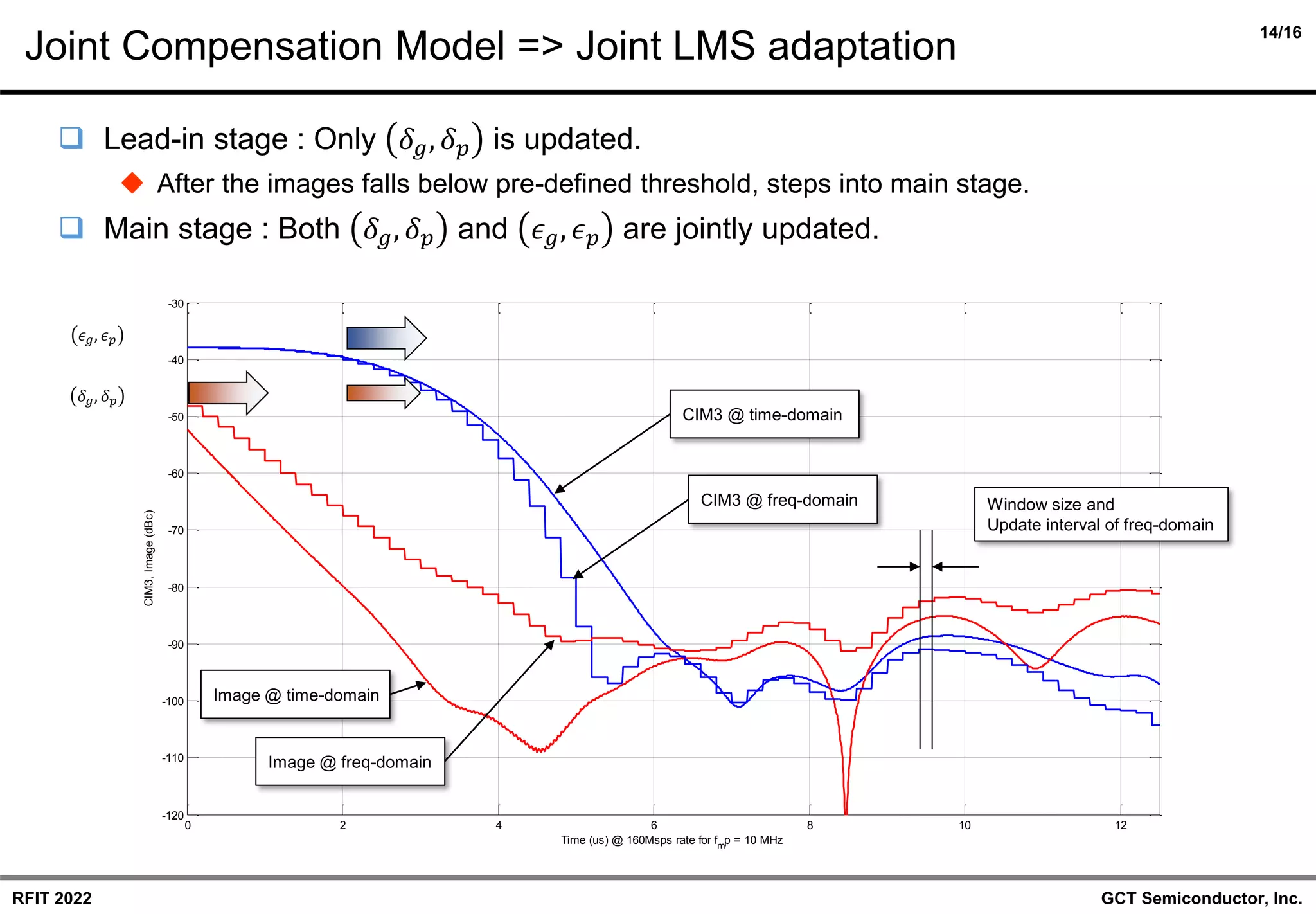
❑ Lead-in stage : Only 𝛿𝑔, 𝛿𝑝 is updated.
◆ After the images falls below pre-defined threshold, steps into main stage.
❑ Main stage : Both 𝛿𝑔, 𝛿𝑝 and 𝜖𝑔, 𝜖𝑝 are jointly updated.
0 2 4 6 8 10 12
-120
-110
-100
-90
-80
-70
-60
-50
-40
-30
Time (us) @ 160Msps rate for fm
p = 10 MHz
CIM3,
Image
(dBc)
CIM3 @ time-domain
CIM3 @ freq-domain
Image @ time-domain
Image @ freq-domain
Window size and
Update interval of freq-domain
𝜖𝑔, 𝜖𝑝
𝛿𝑔, 𝛿𝑝
15/16
GCT Semiconductor, Inc.
RFIT 2022
Trivia and Tips for the Sake of Reference
❑ Parseval’s theorem
◆ Well-known form in Electrical Engineering
✓ Energy measured in time domain or frequency domain(Fourier-transform) are same.
◆ Generalized form with two functions
✓ Inner product of two functions in two spaces under unitary transforms are same.
❑ Dependency between signal domain and update method.
◆ Frequency domain update can be done at sampling rate if DFT is done with sliding window.
✓ Currently only a single value is obtained per non-overlapping block for efficient implementation.
◆ Time domain update can also be done in block-wise manner as with Frequency domain.
✓ However, update at sampling rate in time domain requires less hardware than block-wise one.
✓ Especially, 𝑦4
can be obtained from 𝑦2
already obtained for the I/Q imbalance calibration.
෍
𝒏=−∞
+∞
𝒂[𝒏] 𝟐
= න
−𝝅
+𝝅
𝑨(𝒇) ⋅ 𝑨(𝒇)𝒅𝒇 ෍
𝒏=−∞
+∞
𝒂[𝒏] ⋅ 𝒃[𝒏] = න
−𝝅
+𝝅
𝑨(𝒇) ⋅ 𝑩(𝒇)𝒅𝒇
𝒚[𝒏]
𝒀𝒇[𝒌]
𝟏/𝒇
𝒚[𝒏]
𝒀𝒇[𝒌]
𝟏/𝒇
16/16
GCT Semiconductor, Inc.
RFIT 2022
Conclusion
❑ A refined model for joint CIM3 and I/Q imbalance model has been proposed.
◆ Duality similar to that of I/Q imbalance has been also applied to CIM3.
◆ Missing components identified and complemented.
❑ Framework for the proposed model unified to get the help from
◆ Conjugate signal representation
◆ Circularity of the signal.
❑ Derivation of the joint LMS adaptation formulae.
◆ Optimization => LMS
◆ Frequency domain => Time domain
◆ Block-wise => Sample-wise
❑ URL of the slide/presentation
◆ [4] Duality of the I/Q imbalance : https://lnkd.in/gy24S4kF
◆ [5] CIM3 in RFIT2017 : https://lnkd.in/gwJhqgb8

A Refined Skew Matrix Model of the CIM3 in the Up-Mixer Extending the Duality of I/Q Imbalance (RFIT-2022)

  • 1.
    GCT Semiconductor, Inc. RFIT2022 A Refined Skew Matrix Model of the CIM3 in the Up-Mixer Extending the Duality of I/Q Imbalance Ealwan Lee GCT Semiconductor, Inc. Aug 30, 2022 Session T3B.4 (2:30 pm ~ 2: 50 pm) Advanced Circuit and System Designs
  • 2.
    1/16 GCT Semiconductor, Inc. RFIT2022 Table of Contents ❑ Introduction ◆ Meaning of the study on the CIM3-only DPD model. ◆ Review of the previous work of joint I/Q-imbalance and CIM3 model. ❑ Duality between the components of I/Q gain/phase mismatch ◆ Review of the duality in I/Q imbalance model. ◆ Extension and application to CIM3 model with conjugate signal representation ❑ Correction/Enhancement to the CIM3 models introduced in 5 years ago ◆ Identification of missing terms in prior works. ◆ Evaluation of the improvement after the correction. ❑ LMS adaptation revisited and its simplification ◆ Frequency domain => Time domain : Parseval’s theorem ◆ Link to other works already established for I/Q imbalance : circularity ❑ Conclusion ◆ Refined version of joint CIM3 + I/Q imbalance model [ pp. 2 ~ 5 ] [ pp. 6 ~ 8 ] [ pp. 9 ~ 10 ] [ pp. 11 ~ 15 ] [ p. 16 ]
  • 3.
    2/16 GCT Semiconductor, Inc. RFIT2022 Introduction ❑ What is CIM3 and Why it became nuisance ? ◆ CIM3 = 3rd order Counter Inter-Modulation ◆ Up-conversion mixer ✓ One of the key factor in the SAW-less Tx implementation of 4G/5G/6G RF IC solution  Violating the out-of-band emission spec from UL band to the DL band of specialty network. ✓ Lowering the CIM3 inside the channel & band helps still in many ways. ❑ Straightforward and Simple Approach ◆ Lowering the signal level solves CIM3 problem at least but in trade-off with other metrics. ✓ Reduction of signal by x1 dB => reduction of CIM3 by x3 dB. ❑ A study of simple but plausible/consistent mathematical model of CIM3 helps ◆ Characterizing, pushing to the limit of the analog circuitry in a systematic way. ◆ Can be combined with other CIM3 reduction method. DL of other bands affected without TX SAW filter UL in operation fc fc+fm fc-3fm No effects to DL of other bands UL in operation fc IMD3 CIM3 * UL+DL in XDD or Full-duplex CIM3
  • 4.
    3/16 GCT Semiconductor, Inc. RFIT2022 Review of Prior Works in RFIT2017 ❑ Mathematical models of CIM3 + DPD up-mixer ◆ Same model in cascade with complementary(typically negative) parameters. ✓ 1st order cancellation as in typical I/Q imbalance compensator ✓ Joint compensation with a single skew matrix + X X X X + zi zq yi yq 𝟏 + 𝜹𝒈 + 𝝆𝒛 ⋅ 𝝐𝒈 𝟏 − 𝜹𝒈 − 𝝆𝒛 ⋅ 𝝐𝒈 𝜹𝒑 + 𝝆𝒛 ⋅ 𝝐𝒑 + X X X X + xi xq zi zq 𝟏 − 𝜹𝒈 − 𝝆𝒙 ⋅ 𝝐𝒈 𝟏 + 𝜹𝒈 + 𝝆𝒙 ⋅ 𝝐𝒈 −𝜹𝒑 − 𝝆𝒙 ⋅ 𝝐𝒑 CIM3 distortion model (analog circuit) Digital Pre-Distortion model (digital processing) 𝝆𝒙 = 𝒙𝒊 ⋅ 𝒙𝒒 𝝆𝒛 = 𝒛𝒊 ⋅ 𝒛𝒒 D/A D/A w/o DPD w/o DPD 𝒛𝒊 + 𝒋 ⋅ 𝒛𝒒 𝒚𝒊 + 𝒋 ⋅ 𝒚𝒒 Image @ -fm CIM3 @ -3fm counter 3rd order intermodulation
  • 5.
    4/16 GCT Semiconductor, Inc. RFIT2022 CIM3 in spectrum and phasor diagram ❑ Despite perfect synchronization in digital domain, ◆ Delay in feed-back path(t), non-coherency between RF and BB(), Tx and Rx() matters. ◆ No change in the spectrum of the up-mixer output. ❑ Any distortion/compensation model should explain the effect of t. reference vector (𝑦+1) = y+1,i + jy+1,q @ +f CIM3 vector @ -3f conjugate of reference vector (ത 𝑦+1) = y+1,i - jy+1,q Re Im Joint I/Q imb + CIM3 compensator tone generator accumulator de-rotator +f -3f, -f, +f duration = N/f Synchronized with 1/f Up mixer {g, p ;ϵg, ϵp} RF-PLL Report * y-3 = CIM3 * y-1 = Image * y+1 = Desired eg, ep dg, dp Rx I/Q imb compensator D/A t Variation of the delay in feed-back path +𝟐𝝅𝒇∆𝒕 −𝟐𝝅𝒇∆𝒕 −𝟔𝝅𝒇∆𝒕 +f -f -3f A/D  
  • 6.
    5/16 GCT Semiconductor, Inc. RFIT2022 Just Scribbling to Figure Out Something Else ❑ Only combination of two terms tried to make (-3 * f) component in previous work. ❑ 4 terms were able to be combined becoming insensitive to the phase shift. ◆ cos 2𝜔𝑡 term missed and can complement the missing part of sin 2𝜔𝑡 . ◆ But, should the number of parameters be increased from 2 to 4, then ? 𝑦𝑖 = 𝑥𝑖 + 0𝑥𝑖 3 + 𝑏2𝑥𝑖 2 𝑥𝑞 1 + 𝑏1𝑥𝑖 1 𝑥𝑞 2 + 0𝑥𝑞 3 𝑦𝑞 = 𝑥𝑞 + 0𝑥𝑞 3 − 𝑏2𝑥𝑞 2 𝑥𝑖 1 + 𝑏1𝑥𝑞 1 𝑥𝑖 2 + 0𝑥𝑖 3 𝑦𝑖 = 𝑥𝑖 + ෍ 𝑛=0 3 𝑏𝑛𝑥𝑖 𝑛 𝑥𝑞 3−𝑛 𝑦𝑞 = 𝑥𝑞 + ෍ 𝑛=0 3 𝑐𝑛 𝑥𝑖 3−𝑛 𝑥𝑞 𝑛 Enforcing 0 oversight in prior work 𝑥𝑖 + 1𝑗 ∙ 𝑥𝑞 = cos 𝜔𝑡 + 1𝑗 ∙ sin 𝜔𝑡 𝑥𝑖 2 𝑥𝑞 1 − 1𝑗 ∙ 𝑥𝑖 1 𝑥𝑞 2 = 1 2 ∙ sin 2𝜔𝑡 ∙ cos 𝜔𝑡 − 1𝑗 ∙ sin 𝜔𝑡 Enforcing 0 oversight in prior work 𝑥𝑖 1 𝑥𝑞 2 + 1𝑗 ∙ 𝑥𝑖 2 𝑥𝑞 1 = 1 2 𝑗 ∙ sin 2𝜔𝑡 ∙ cos 𝜔𝑡 − 1𝑗 ∙ sin 𝜔𝑡 𝑥𝑖 3 − 𝑥𝑖 1 𝑥𝑞 2 − 1𝑗 ∙ 𝑥𝑖 2 𝑥𝑞 1 + 1𝑗 ∙ 𝑥𝑞 3 = cos 2𝜔𝑡 ∙ cos 𝜔𝑡 − 1𝑗 ∙ sin 𝜔𝑡 −𝑥𝑞 3 + 1𝑗 ∙ 𝑥𝑖 1 𝑥𝑞 2 + 𝑥𝑖 2 𝑥𝑞 1 − 1𝑗 ∙ 𝑥𝑖 3 = 𝑗 ∙ cos 2𝜔𝑡 ∙ cos 𝜔𝑡 − 1𝑗 ∙ sin 𝜔𝑡 𝑏3 ? 𝑏0 ? fIF -3 fIF
  • 7.
    6/16 GCT Semiconductor, Inc. RFIT2022 Duality of I/Q imbalance model in the (down)-mixer ❑ gain mismatch(ϵg) and phase mismatch(ϵp) are exchangeable under signal rotation. ◆ explaining the consistency of image signal and IRR in spectrum against co-ordinate rotation. Another proof by (2nd) geometric interpretation Down-mixer [2018] 1. L1-norm based LMS calibration 2. Completeness of symmetric skew matrix Applied to up-mixer in this paper. (ϵg/2, ϵg/2) => (g,g) Proof by (1st) simple arithmetic
  • 8.
    7/16 GCT Semiconductor, Inc. RFIT2022 Duality of I/Q imbalance in conjugate signal representation ❑ Real number matrix representation (used in two previous works) ◆ intuitive and straightforward ❑ Conjugate signal representation ◆ More compact form is available. 𝒚 = 𝒙 + 𝜹 ⋅ ഥ 𝒙 𝒚 ⋅ 𝒆𝒋 Τ 𝝅 𝟒 = 𝒙 ⋅ 𝒆𝒋 Τ 𝝅 𝟒 + 𝜹 ⋅ ഥ 𝒙 ⋅ 𝒆𝒋 Τ 𝝅 𝟒 = 𝒙 ⋅ 𝒆𝒋 Τ 𝝅 𝟒 + 𝜹 ⋅ 𝒆𝒋 Τ 𝝅 𝟐 ⋅ 𝒙 ⋅ 𝒆𝒋 Τ 𝝅 𝟒 ෥ 𝒚 = ෥ 𝒙 + 𝜹 ⋅ 𝒆𝒋 Τ 𝝅 𝟐 ⋅ ഥ ෥ 𝒙 = ෥ 𝒙 + ෩ 𝜹 ⋅ ഥ ෥ 𝒙 ෥ 𝒚 ≜ 𝒚 ⋅ 𝒆𝒋 Τ 𝝅 𝟒 ෥ 𝒙 ≜ 𝒙 ⋅ 𝒆𝒋 Τ 𝝅 𝟒 ෩ 𝜹 ≜ 𝜹 ⋅ 𝒆𝒋 Τ 𝝅 𝟐 𝑦𝑖 𝑦𝑞 = 1 + 𝛿𝑔 +𝛿𝑝 +𝛿𝑝 1 − 𝛿𝑔 ⋅ 𝑥𝑖 𝑥𝑞 = 1 0 0 1 ⋅ 𝑥𝑖 𝑥𝑞 + +𝛿𝑔 +𝛿𝑝 +𝛿𝑝 −𝛿𝑔 ⋅ 𝑥𝑖 𝑥𝑞 𝒚 = 𝑦𝑖 + 𝑗 ⋅ 𝑦𝑞 𝒙 = 𝑥𝑖 + 𝑗 ⋅ 𝑥𝑞 ഥ 𝒙 = 𝑥𝑖 − 𝑗 ⋅ 𝑥𝑞 𝜹 = 𝛿𝑔 + 𝑗 ⋅ 𝛿𝑝  Rotation by /4 ෩ 𝜹 = −𝛿𝑝 + 𝑗 ⋅ 𝛿𝑔  ሚ 𝛿𝑔 = −𝛿𝑝 ሚ 𝛿𝑝 = +𝛿𝑔 Conjugate signal representation (in complex number) Another proof (3rd) in conjugate representation
  • 9.
    8/16 GCT Semiconductor, Inc. RFIT2022 Application of the Duality to CIM3 of up-mixer ❑ Conjugate signal representation ◆ desired signal (+fm from carrier frequency) : 𝒙 ◆ Image signal (-fm from carrier frequency) : ഥ 𝒙 ◆ CIM3 (-3fm from carrier frequency) : ഥ 𝒙𝟑 𝒚 = 𝒙 + 𝜹 ⋅ ഥ 𝒙 + 𝝐 ⋅ ഥ 𝒙𝟑 = 𝒙 + 𝜹 ⋅ ഥ 𝒙 + 𝝐 ⋅ ഥ 𝒙𝟐 ⋅ ഥ 𝒙 𝒚 ⋅ 𝒆𝒋 Τ 𝝅 𝟒 = 𝒙 + 𝜹 ⋅ ഥ 𝒙 + 𝝐 ⋅ ഥ 𝒙𝟐 ⋅ ഥ 𝒙 ⋅ 𝒆𝒋 Τ 𝝅 𝟒 = 𝒙 ⋅ 𝒆𝒋 Τ 𝝅 𝟒 + 𝜹 ⋅ 𝒆𝒋 Τ 𝝅 𝟐 ⋅ 𝒙 ⋅ 𝒆𝒋 Τ 𝝅 𝟒 + 𝝐 ⋅ 𝒆𝒋𝝅 ⋅ 𝒙 ⋅ 𝒆𝒋 Τ 𝝅 𝟒 𝟐 ⋅ 𝒙 ⋅ 𝒆𝒋 Τ 𝝅 𝟒 ෥ 𝒚 = ෥ 𝒙 + ෩ 𝜹 ⋅ ഥ ෥ 𝒙 + ෤ 𝝐 ⋅ ഥ ෥ 𝒙𝟐 ⋅ ഥ ෥ 𝒙 = ෥ 𝒙 + ෩ 𝜹 ⋅ ഥ ෥ 𝒙 + ෤ 𝝐 ⋅ 𝝆 ⋅ ഥ ෥ 𝒙 ෥ 𝒚 ≜ 𝒚 ⋅ 𝒆𝒋 Τ 𝝅 𝟒 ෥ 𝒙 ≜ 𝒙 ⋅ 𝒆𝒋 Τ 𝝅 𝟒 ෩ 𝜹 ≜ 𝜹 ⋅ 𝒆𝒋 Τ 𝝅 𝟐 ෤ 𝝐 ≜ 𝝐 ⋅ 𝒆𝒋𝝅 ǁ 𝜖𝑔 = −𝜖𝑔 ǁ 𝜖𝑝 = −𝜖𝑝 Rotation by /4 as in I/Q imbalance  𝝐 = 𝜖𝑔 + 𝑗 ⋅ 𝜖𝑝 𝝆 ≜ ഥ ෥ 𝒙𝟐 𝝆 ≜ 𝜌𝑔 + 𝑗 ⋅ 𝜌𝑝 = 2 ⋅ 𝑥𝑖 ⋅ 𝑥𝑞 + 𝑗 ⋅ 𝑥𝑞 2 − 𝑥𝑖 2 𝜌𝑔 = 2 ⋅ 𝑥𝑖 ⋅ 𝑥𝑞 𝜌𝑝 = 𝑥𝑞 2 − 𝑥𝑖 2
  • 10.
    9/16 GCT Semiconductor, Inc. RFIT2022 Don’t be confused with (ϵg, ϵg) Identification of the component missed in our prior work ❑ Comparison with prior works in matrix representation ◆ degree of freedom for CIM3 is kept to 2 in spite of added term : (ϵg, ϵg) 𝑦𝑖 𝑦𝑞 = 1 0 0 1 + 𝛿𝑔 + 𝜌𝑔 ⋅ 𝜖𝑔 + 𝜌𝑝 ⋅ 𝜖𝑝 ⋅ +1 0 0 −1 + 𝛿𝑝 + 𝜌𝑔 ⋅ 𝜖𝑝 − 𝜌𝑝 ⋅ 𝜖𝑔 ⋅ 0 +1 +1 0 ⋅ 𝑥𝑖 𝑥𝑞 𝜌𝑔 = 2 ⋅ 𝑥𝑖 ⋅ 𝑥𝑞 𝜌𝑝 = 𝑥𝑞 2 − 𝑥𝑖 2 𝜌 = 𝑥𝑖 ⋅ 𝑥𝑞 𝑦𝑖 𝑦𝑞 = 1 0 0 1 + +𝛿𝑔 𝛿𝑝 𝛿𝑝 −𝛿𝑔 + 𝜌𝑔 ⋅ 𝜖𝑔 +𝜖𝑝 +𝜖𝑝 −𝜖𝑔 ⋅ 𝑥𝑖 𝑥𝑞 + 𝜌𝑝 ⋅ 𝜖𝑝 −𝜖𝑝 −𝜖𝑝 −𝜖𝑝 ⋅ 𝑥𝑖 𝑥𝑞 Terms missed in previous work and complemented in this work Terms simplified and merged in previous work with matrix arithmetic. Skew matrix for I/Q imbalance ෤ 𝜌𝑔 = 2 ⋅ ෤ 𝑥𝑖 ⋅ ෤ 𝑥𝑞 = 𝑥𝑞 2 − 𝑥𝑖 2 ෤ 𝜌𝑝 = ෤ 𝑥𝑞 2 − ෤ 𝑥𝑖 2 = 2 ⋅ 𝑥𝑖 ⋅ 𝑥𝑞 re-scaled and re-named for generalization Rotation by /4
  • 11.
    10/16 GCT Semiconductor, Inc. RFIT2022 Comparison of two models side-by-side ❑ Re-plot of previous works by flipping the direction of before/after the DPD for comparison. ◆ Reflection of the sequential estimation of  and  ❑ Scope of the problem has extended. ◆ All the harmonics at -f, +3f, +5f not just -3f should be suppressed at its best of the given model. ✓ Cascade of a single skew matrix has its limitation leaving artifact on +3f, +5f. Before DPD After DPD Image @ -9 MHz -26 => -56 (dBc) CIM3 @ -27 MHz -38 => -64 (dBc) Image @ -9 MHz -26 => -71 (dBc) CIM3 @ -27 MHz -38 => -72 (dBc) Prior model in RFIT2017 @ Seoul - Single run applied from for  ,then . Refined model in RFIT2022 @ Busan - Optimal ,  obtained with iterative joint LMS adaptation.
  • 12.
    11/16 GCT Semiconductor, Inc. RFIT2022 Derivation of LMS Adaptation Formulae ❑ Frequency domain ◆ Obtain the Fourier-transform at each desired frequency, 𝑌 +𝑓 , 𝑌(−3𝑓) ◆ Process only 𝑌 +𝑓 to obtain 𝑌 +𝑓 3 ◆ Derived measure is insensitive to the rotation caused by the delay of the feed-back path. +fm +3fm -3fm -fm 0 𝒀(−𝟑𝒇𝒎) ∙ 𝒆−𝒋𝟔𝝅𝒇𝒎∆𝒕 𝒀(+𝒇) ∙ 𝒆+𝒋𝟐𝝅𝒇𝒎∆𝒕 +fm +3fm -3fm -fm 0 𝒀(+𝒇)𝟑 ∙ 𝒆+𝒋𝟔𝝅𝒇𝒎∆𝒕 𝒀(−𝟑𝒇𝒎) ∙ 𝒆−𝒋𝟔𝝅𝒇𝒎𝒕 ∆𝝐 ∝ Τ 𝒀 −𝟑𝒇𝒎 𝒀 +𝒇𝒎 𝟑 ∝ 𝒀(−𝟑𝒇𝒎) ⋅ 𝒀(+𝒇𝒎)𝟑 𝒀 +𝒇𝒎 𝟑 ⋅ 𝒀(+𝒇𝒎)𝟑 𝒚 = 𝒙 + 𝜹 ⋅ ഥ 𝒙 + 𝝐 ⋅ ഥ 𝒙𝟑 Norm of the signal that can be absorbed into update factor.
  • 13.
    12/16 GCT Semiconductor, Inc. RFIT2022 Derivation of LMS Adaptation Formulae (cont’d) ❑ Frequency domain ◆ How to align the desired and distorted component with the same offset from carrier(DC) ? ◆ Squaring in time-domain => Convolution in freq-domain. ✓ Previous method did not pre-processed time-domain signal before DFT. ✓ This measure is also insensitive to the rotation caused by the delay of the feed-back path. ❑ Frequency domain => Time domain : next page 𝒚[𝒏]𝟐 +fm +2fm -3fm -fm 0 𝒀(+𝒇𝒎)𝟐 ∙ 𝒆+𝒋𝟒𝝅𝒇𝒎𝒕 -2fm 𝒀(−𝟑𝒇𝒎)∙𝒀(+𝒇𝒎)∙𝒆−𝒋𝟒𝝅𝒇𝒎𝒕 -6fm +fm +2fm -3fm -fm 0 𝒀(−𝟑𝒇𝒎) ∙ 𝒆−𝒋𝟔𝝅𝒇𝒎𝒕 𝒀(+𝒇𝒎)∙𝒆+𝒋𝟐𝝅𝒇𝒎𝒕 -2fm 𝒚[𝒏] ∆𝝐 ∝ 𝒀 −𝟑𝒇𝒎 ⋅ 𝒀 𝒇𝒎 𝟑 ∝ 𝒀(−𝟑𝒇𝒎) ⋅ 𝒀(𝒇𝒎) ⋅ 𝒀(𝒇𝒎)𝟐 +𝟐 ⋅ 𝒇𝒎 −𝟐 ⋅ 𝒇𝒎 +𝟐 ⋅ 𝒇𝒎 −𝟐 ⋅ 𝒇𝒎
  • 14.
    13/16 GCT Semiconductor, Inc. RFIT2022 Time domain : Circularity in I/Q imbalance => Circularity in CIM3 ❑ Real and Imaginary part of higher order statistics should be zero, respectively. ◆ Time-domain formula from the frequency-domain relation is derived using Parseval’s theorem. ◆ Circularity is preserved under the signal rotation including +/4. ෡ 𝜹 𝒏 ≔ ෡ 𝜹 𝒏 − 𝟏 + 𝝁𝜹 ⋅ 𝒀(−𝒇) ⋅ 𝒀(+𝒇) ෡ 𝜹 𝒏 ≔ ෡ 𝜹 𝒏 − 𝟏 + 𝝁𝜹 ⋅ 𝒚[𝒏]𝟐 ො 𝝐 𝒏 ≔ ො 𝝐 𝒏 − 𝟏 + 𝝁𝝐 ⋅ 𝒀 −𝟑𝒇 ⋅ 𝒀 +𝒇 −𝟑 ≔ ො 𝝐 𝒏 − 𝟏 + 𝝁𝝐 ⋅ 𝒀 −𝟑𝒇 ⋅ 𝒀 +𝒇 +𝟑 = ො 𝝐 𝒏 − 𝟏 + 𝝁𝝐 ⋅ 𝒀 −𝟑𝒇 ⋅ 𝒀 +𝒇 ⋅ 𝒀 +𝒇 +𝟐 𝑬 𝒚𝒊[𝒏] ⋅ 𝒚𝒒[𝒏] → 𝟎 𝑬 𝒚𝒊 𝟐 𝒏 − 𝒚𝒒 𝟐 𝒏 → 𝟎 𝑬 𝒚𝒊 𝒏 + 𝒚𝒒 𝒏 ⋅ 𝒚𝒊 𝒏 − 𝒚𝒒 𝒏 → 𝟎 𝑬 𝒚𝒊[𝒏] ⋅ 𝒚𝒒[𝒏] ⋅ 𝒚𝒊 𝒏 + 𝒚𝒒[𝒏] ⋅ 𝒚𝒊[𝒏] − 𝒚𝒒[𝒏] → 𝟎 𝑬 𝒚𝒊 𝒏 + 𝒚𝒒[𝒏] 𝟐 ⋅ 𝒚𝒊[𝒏] − 𝒚𝒒[𝒏] 𝟐 − 𝟐 ⋅ 𝒚𝒊[𝒏] ⋅ 𝒚𝒒[𝒏] 𝟐 → 𝟎 ො 𝝐 𝒏 ≔ ො 𝝐 𝒏 − 𝟏 + 𝝁𝝐 ⋅ 𝒚[𝒏]𝟒 𝒚[𝒏]𝟒 ∆𝝐[𝒏] ∆𝜹[𝒏] 𝒚[𝒏] CIM3 I/Q imbalance(Image) 𝒚[𝒏]𝟐 Parseval’s Theorem Parseval’s Theorem @ ±𝟐 ⋅ 𝒇𝒎 @ ±𝟏 ⋅ 𝒇𝒎
  • 15.
    14/16 GCT Semiconductor, Inc. RFIT2022 Joint Compensation Model => Joint LMS adaptation ❑ Lead-in stage : Only 𝛿𝑔, 𝛿𝑝 is updated. ◆ After the images falls below pre-defined threshold, steps into main stage. ❑ Main stage : Both 𝛿𝑔, 𝛿𝑝 and 𝜖𝑔, 𝜖𝑝 are jointly updated. 0 2 4 6 8 10 12 -120 -110 -100 -90 -80 -70 -60 -50 -40 -30 Time (us) @ 160Msps rate for fm p = 10 MHz CIM3, Image (dBc) CIM3 @ time-domain CIM3 @ freq-domain Image @ time-domain Image @ freq-domain Window size and Update interval of freq-domain 𝜖𝑔, 𝜖𝑝 𝛿𝑔, 𝛿𝑝
  • 16.
    15/16 GCT Semiconductor, Inc. RFIT2022 Trivia and Tips for the Sake of Reference ❑ Parseval’s theorem ◆ Well-known form in Electrical Engineering ✓ Energy measured in time domain or frequency domain(Fourier-transform) are same. ◆ Generalized form with two functions ✓ Inner product of two functions in two spaces under unitary transforms are same. ❑ Dependency between signal domain and update method. ◆ Frequency domain update can be done at sampling rate if DFT is done with sliding window. ✓ Currently only a single value is obtained per non-overlapping block for efficient implementation. ◆ Time domain update can also be done in block-wise manner as with Frequency domain. ✓ However, update at sampling rate in time domain requires less hardware than block-wise one. ✓ Especially, 𝑦4 can be obtained from 𝑦2 already obtained for the I/Q imbalance calibration. ෍ 𝒏=−∞ +∞ 𝒂[𝒏] 𝟐 = න −𝝅 +𝝅 𝑨(𝒇) ⋅ 𝑨(𝒇)𝒅𝒇 ෍ 𝒏=−∞ +∞ 𝒂[𝒏] ⋅ 𝒃[𝒏] = න −𝝅 +𝝅 𝑨(𝒇) ⋅ 𝑩(𝒇)𝒅𝒇 𝒚[𝒏] 𝒀𝒇[𝒌] 𝟏/𝒇 𝒚[𝒏] 𝒀𝒇[𝒌] 𝟏/𝒇
  • 17.
    16/16 GCT Semiconductor, Inc. RFIT2022 Conclusion ❑ A refined model for joint CIM3 and I/Q imbalance model has been proposed. ◆ Duality similar to that of I/Q imbalance has been also applied to CIM3. ◆ Missing components identified and complemented. ❑ Framework for the proposed model unified to get the help from ◆ Conjugate signal representation ◆ Circularity of the signal. ❑ Derivation of the joint LMS adaptation formulae. ◆ Optimization => LMS ◆ Frequency domain => Time domain ◆ Block-wise => Sample-wise ❑ URL of the slide/presentation ◆ [4] Duality of the I/Q imbalance : https://lnkd.in/gy24S4kF ◆ [5] CIM3 in RFIT2017 : https://lnkd.in/gwJhqgb8