Topic 3
Fourier Analysis of Discrete Time LTI Systems
EBB3043/ECB3113 - Digital Signal
Processing 1
Introduction
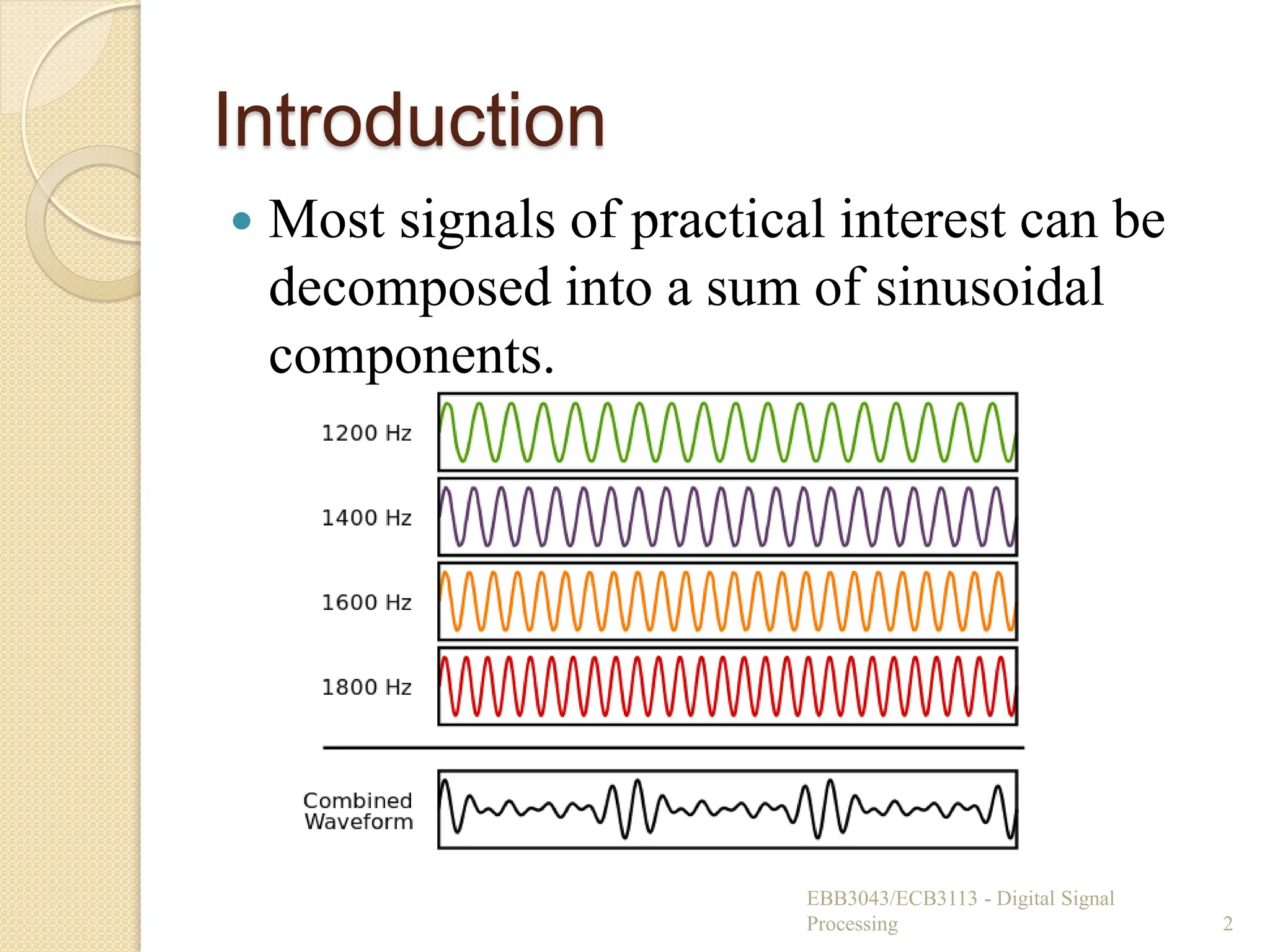
 Most signals of practical interest can be
decomposed into a sum of sinusoidal
components.
EBB3043/ECB3113 - Digital Signal
Processing 2
Introduction
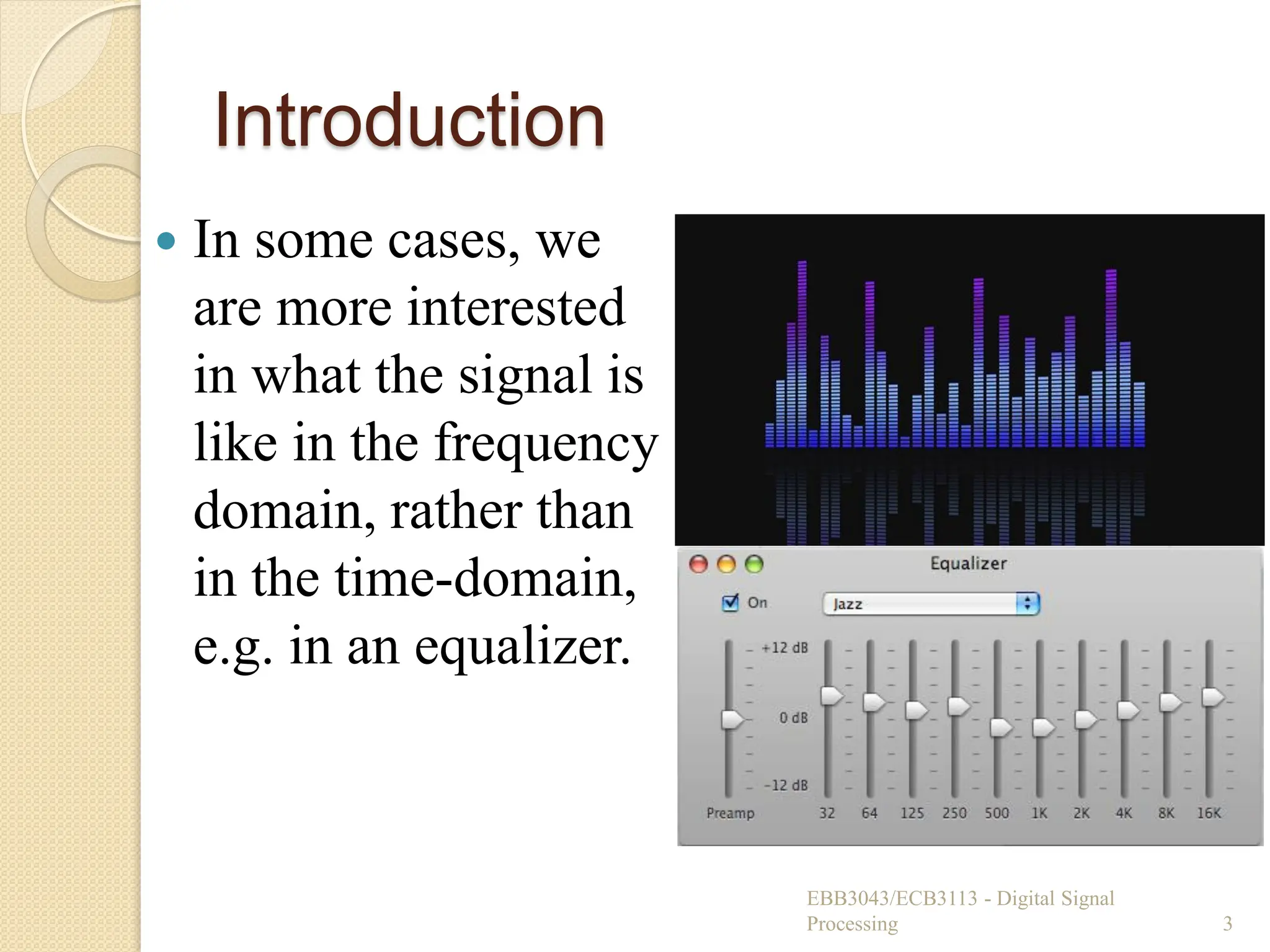
 In some cases, we
are more interested
in what the signal is
like in the frequency
domain, rather than
in the time-domain,
e.g. in an equalizer.
EBB3043/ECB3113 - Digital Signal
Processing 3
Introduction
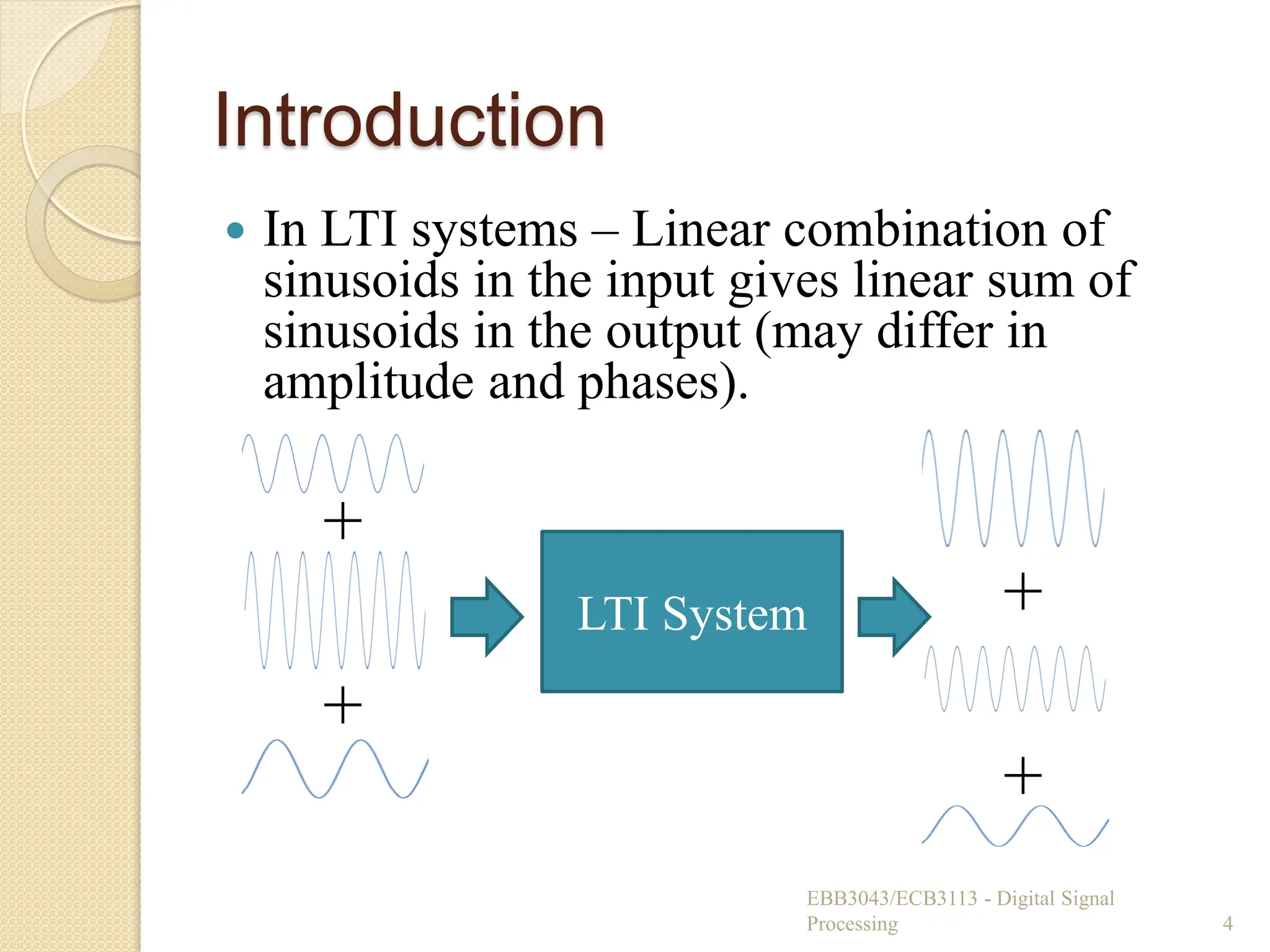
 In LTI systems – Linear combination of
sinusoids in the input gives linear sum of
sinusoids in the output (may differ in
amplitude and phases).
EBB3043/ECB3113 - Digital Signal
Processing 4
LTI System
+
+
+
+
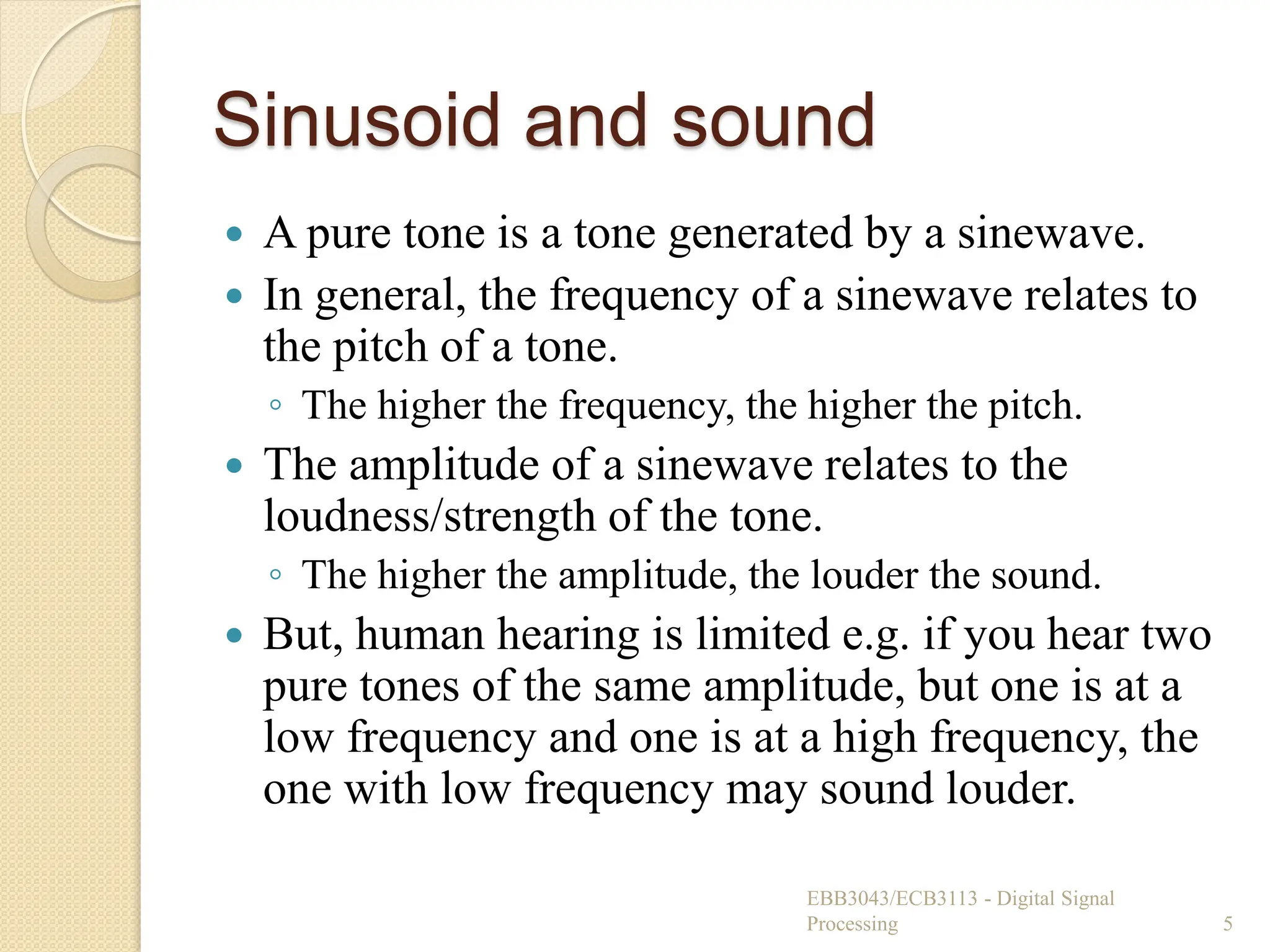
Sinusoid and sound
 A pure tone is a tone generated by a sinewave.
 In general, the frequency of a sinewave relates to
the pitch of a tone.
◦ The higher the frequency, the higher the pitch.
 The amplitude of a sinewave relates to the
loudness/strength of the tone.
◦ The higher the amplitude, the louder the sound.
 But, human hearing is limited e.g. if you hear two
pure tones of the same amplitude, but one is at a
low frequency and one is at a high frequency, the
one with low frequency may sound louder.
EBB3043/ECB3113 - Digital Signal
Processing 5
Try this…
 Run the following MATLAB code which generates a pure
tone with amplitude=0.1 and freq.=110Hz for 1 sec. Listen to
the sound.
 Create 2 other sinewaves:
◦ y2: amplitude = 0.1, frequency = 110 Hz
◦ y3: amplitude = 1, frequency = 880 Hz
 Compare:
◦ y1 and y2 – which sounds louder?
◦ y2 and y3 – which has the higher pitch?
 Does y1 sound louder than y3 even though they both have the
same amplitude?
EBB3043/ECB3113 - Digital Signal
Processing 6
y1=1*sin(2*pi*110/44100*[0:44099]);
sound(y1,44100)
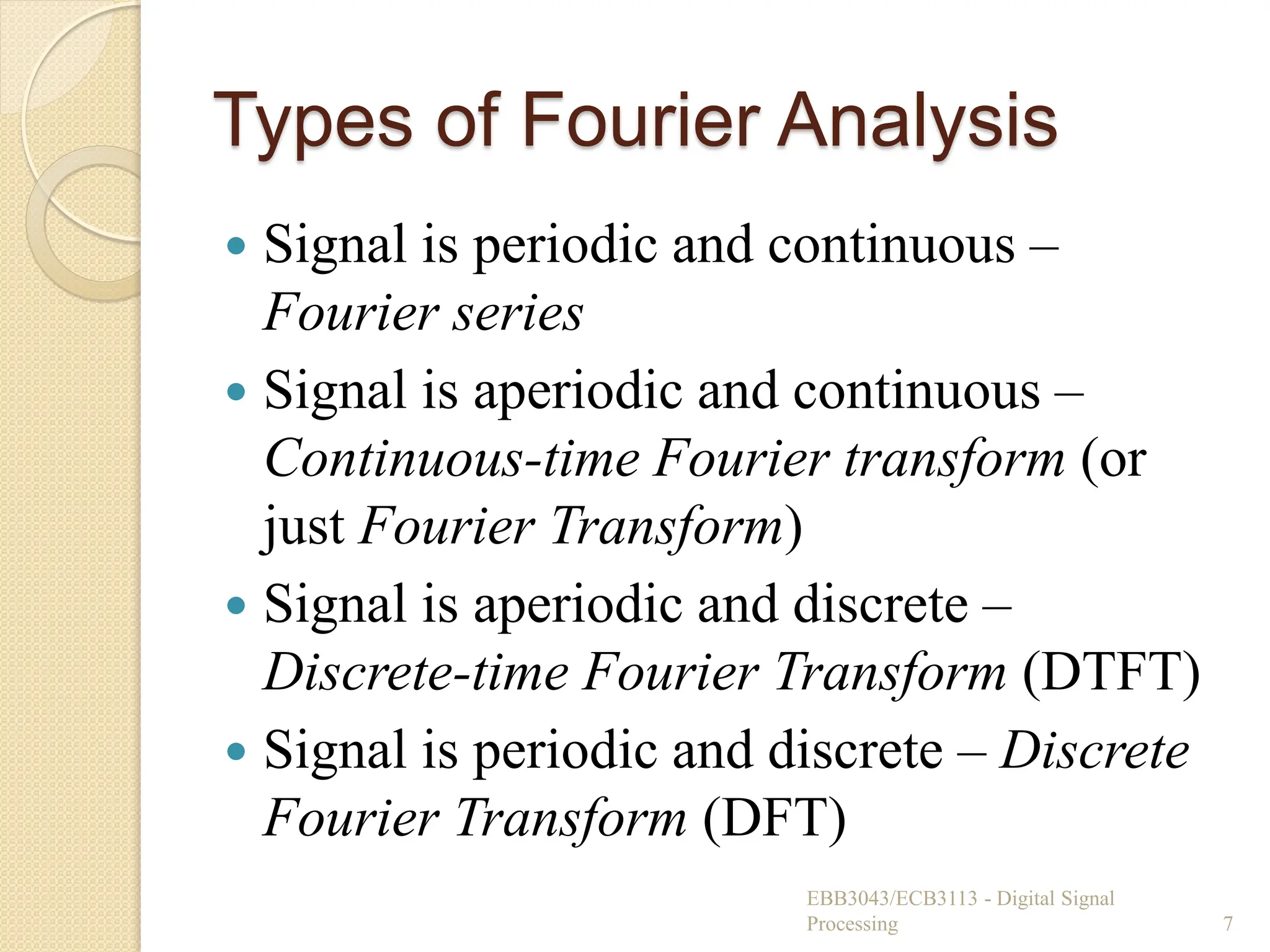
Types of Fourier Analysis
 Signal is periodic and continuous –
Fourier series
 Signal is aperiodic and continuous –
Continuous-time Fourier transform (or
just Fourier Transform)
 Signal is aperiodic and discrete –
Discrete-time Fourier Transform (DTFT)
 Signal is periodic and discrete – Discrete
Fourier Transform (DFT)
EBB3043/ECB3113 - Digital Signal
Processing 7
Discrete Time Fourier Transform
(DTFT)
 The DTFT of a sequence, x[n] is given as:
 The DTFT represents the frequency content
of x[n].
 The transformation can be represented by:
 X(ej) is also called the frequency spectrum
of the DT signal, x[n].
 The DTFT exists only for signals that are
absolutely summable i.e.
EBB3043/ECB3113 - Digital Signal
Processing 8






n
n
j
j
e
n
x
e
X 

]
[
)
(
.
]
[ 





n
n
x
)
(
]
[
)
(
]
[ 
 j
j
e
X
n
x
or
e
X
n
x 
 


 DTFT
F
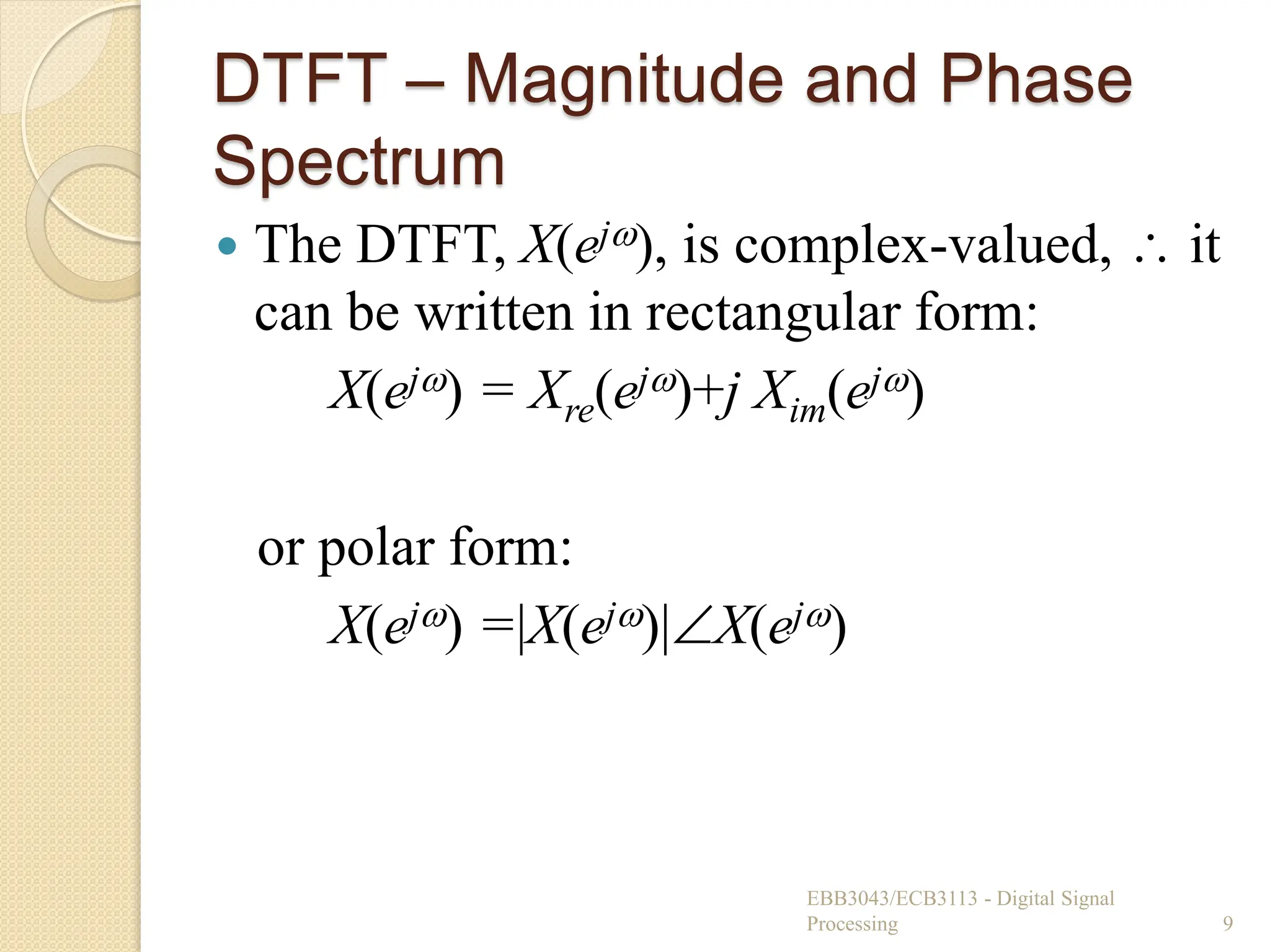
DTFT – Magnitude and Phase
Spectrum
 The DTFT, X(ej), is complex-valued,  it
can be written in rectangular form:
X(ej) = Xre(ej)+j Xim(ej)
or polar form:
X(ej) =|X(ej)|X(ej)
EBB3043/ECB3113 - Digital Signal
Processing 9
)
(
)
(
)
(
)
(
)
( 2
2
* 



 j
im
j
re
j
j
j
e
X
e
X
e
X
e
X
e
X 


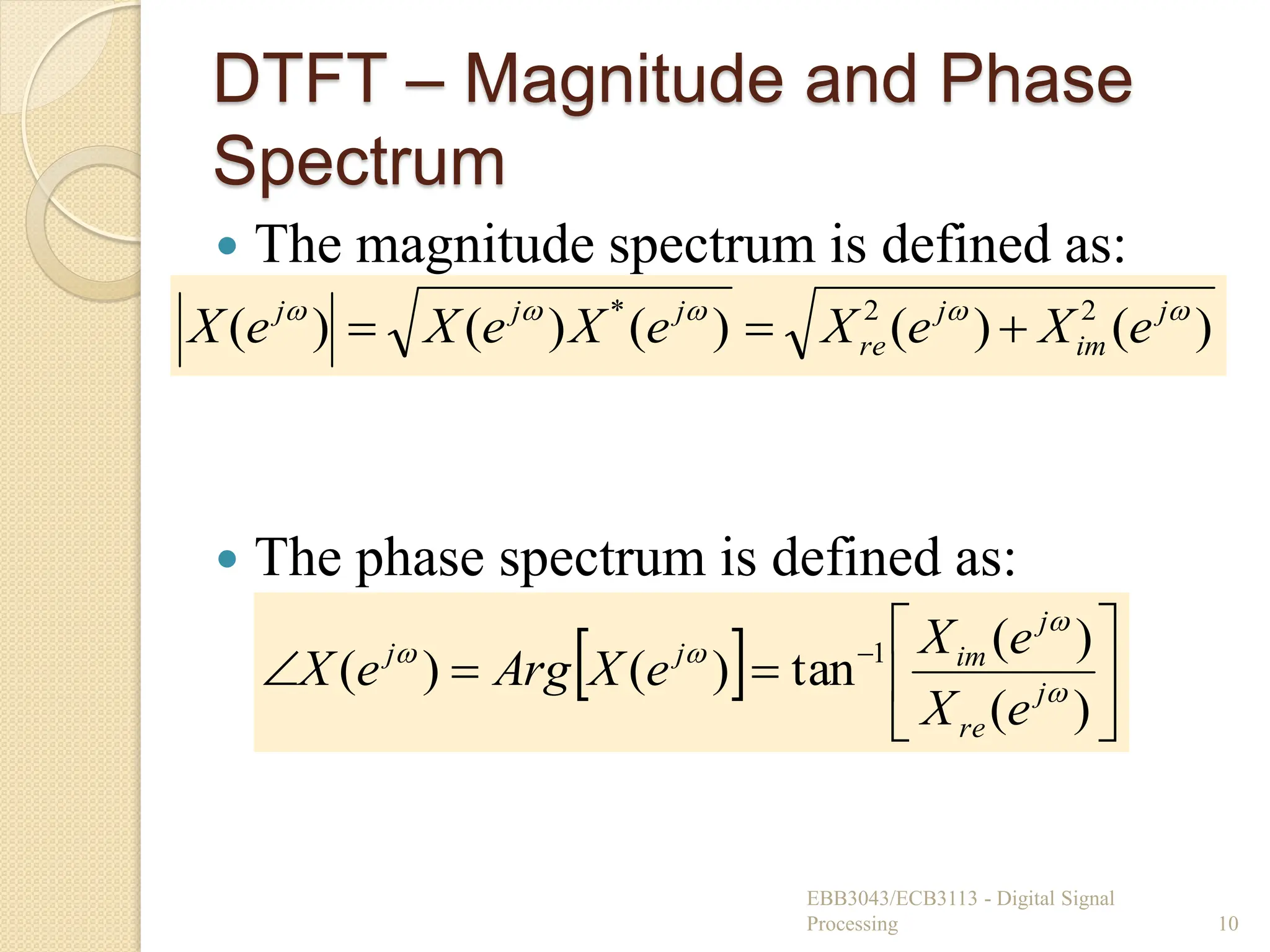
DTFT – Magnitude and Phase
Spectrum
 The magnitude spectrum is defined as:
 The phase spectrum is defined as:
EBB3043/ECB3113 - Digital Signal
Processing 10
  







 
)
(
)
(
tan
)
(
)
( 1




j
re
j
im
j
j
e
X
e
X
e
X
Arg
e
X
Properties of DTFT
 Linearity
◦ The DTFT of a linear weighted sum
combination of two signals is the linear
weighted sum of the DTFTs of the two signals.
 Periodicity
◦ The DTFT is periodic with period of 2,
where k is an integer.
EBB3043/ECB3113 - Digital Signal
Processing 11
)
(
)
(
]
[
]
[
)
(
]
[
)
(
]
[




j
j
j
j
e
bY
e
aX
n
by
n
ax
then
e
Y
n
y
and
e
X
n
x
If








F
F
F
)
(
)
( 2 

 j
k
j
e
X
e
X 

Properties of DTFT
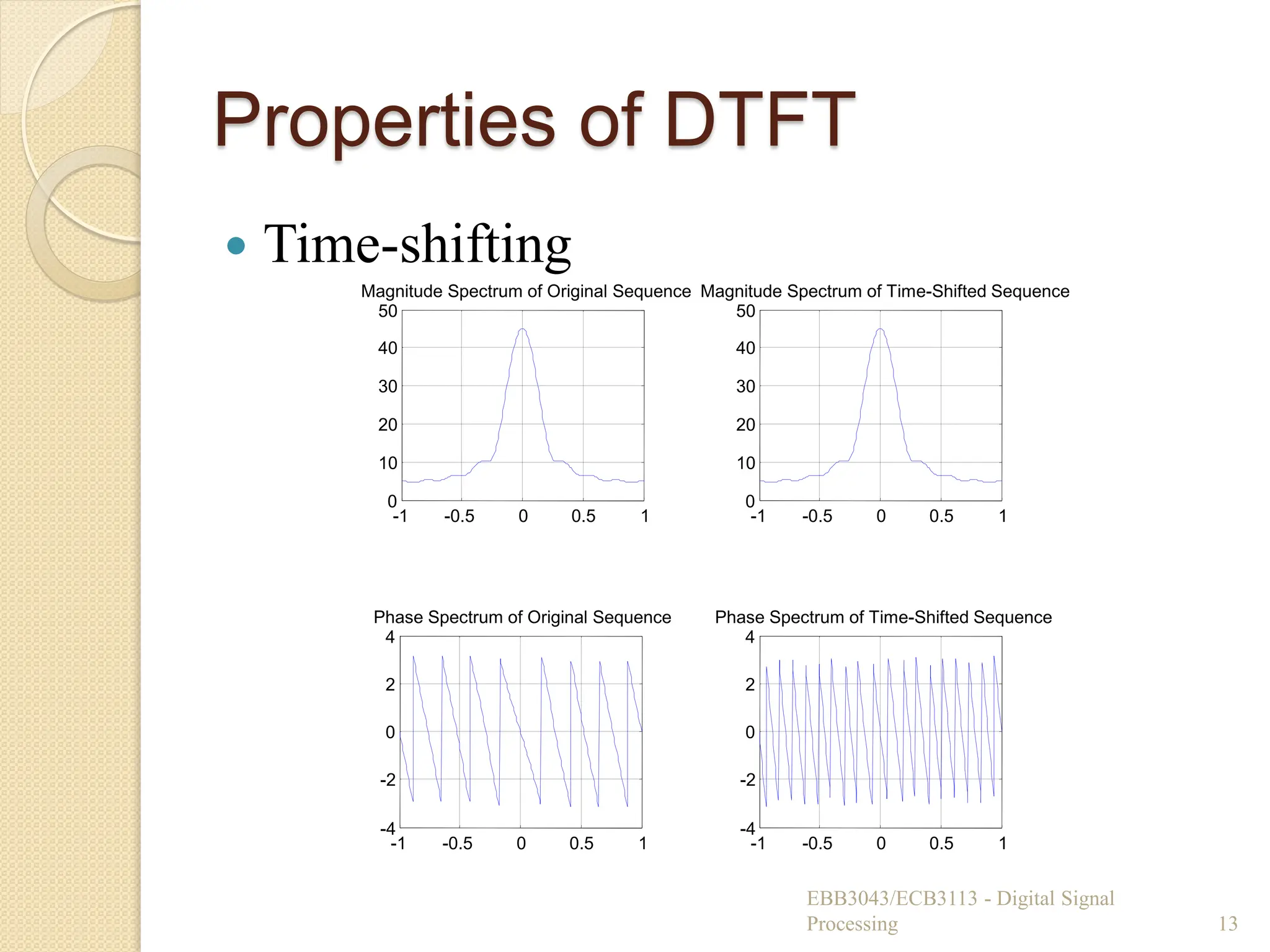
 Time-shifting
◦ If signal is time-shifted by k samples, its
magnitude spectrum remains unchanged.
◦ The phase spectrum will change by amount -k.
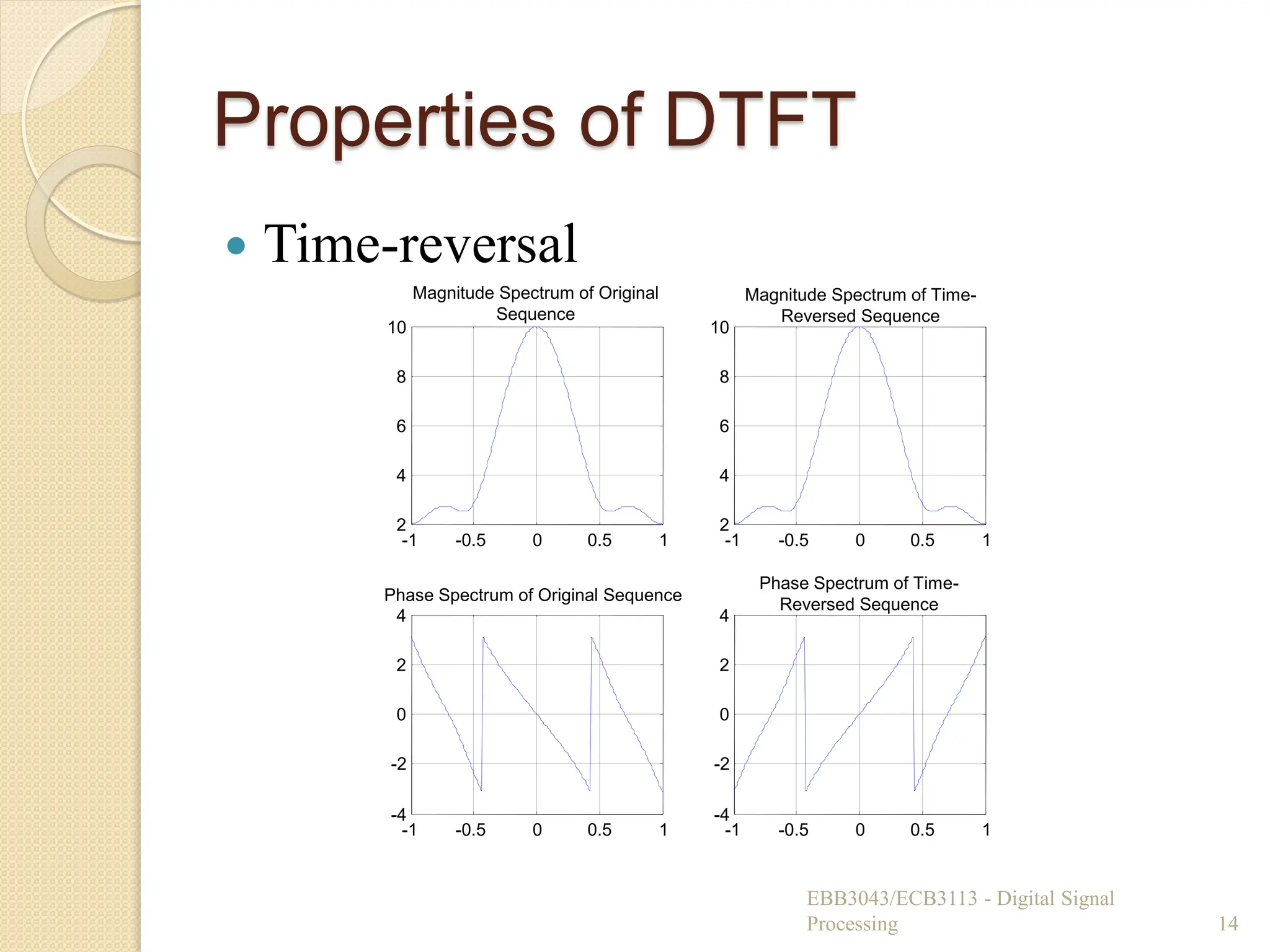
 Time-reversal
◦ If signal is folded about the origin in time, its
magnitude spectrum remains unchanged.
◦ Change in sign in the phase spectrum (Phase
reversal).
EBB3043/ECB3113 - Digital Signal
Processing 12
)
(
]
[
)
(
]
[ 

 j
k
j
j
e
X
e
k
n
x
then
e
X
n
x
If 




 F
F
)
(
]
[
)
(
]
[ 
 j
j
e
X
n
x
then
e
X
n
x
If 




 F
F
Properties of DTFT
 Time-shifting
EBB3043/ECB3113 - Digital Signal
Processing 13
-1 -0.5 0 0.5 1
0
10
20
30
40
50
Magnitude Spectrum of Original Sequence
-1 -0.5 0 0.5 1
0
10
20
30
40
50
Magnitude Spectrum of Time-Shifted Sequence
-1 -0.5 0 0.5 1
-4
-2
0
2
4
Phase Spectrum of Original Sequence
-1 -0.5 0 0.5 1
-4
-2
0
2
4
Phase Spectrum of Time-Shifted Sequence
Properties of DTFT
 Time-reversal
EBB3043/ECB3113 - Digital Signal
Processing 14
-1 -0.5 0 0.5 1
2
4
6
8
10
Magnitude Spectrum of Original
Sequence
-1 -0.5 0 0.5 1
2
4
6
8
10
Magnitude Spectrum of Time-
Reversed Sequence
-1 -0.5 0 0.5 1
-4
-2
0
2
4
Phase Spectrum of Original Sequence
-1 -0.5 0 0.5 1
-4
-2
0
2
4
Phase Spectrum of Time-
Reversed Sequence
Properties of DTFT
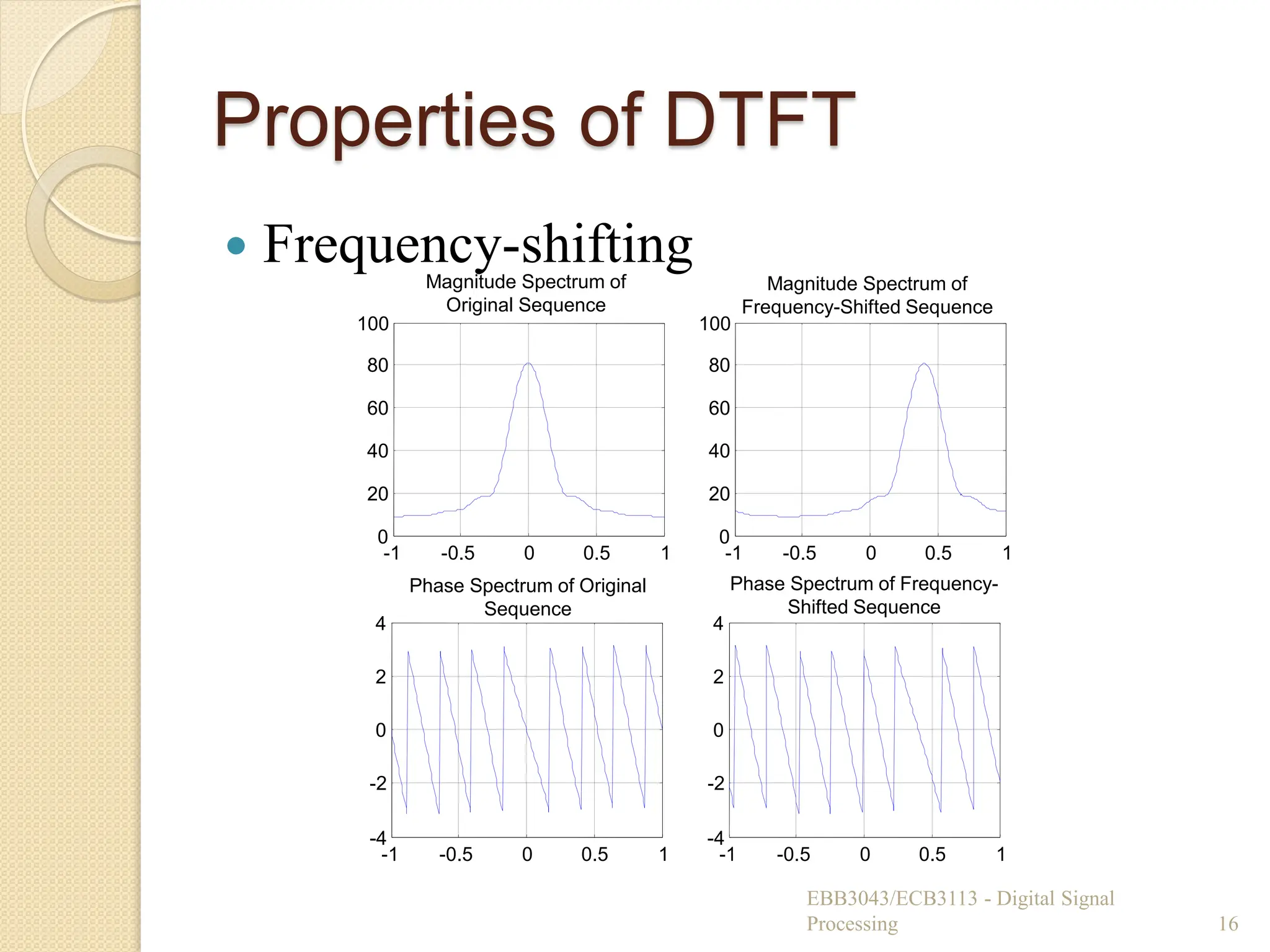
 Frequency-shifting
◦ If signal is multiplied by , the spectrum is
shifted by 0.
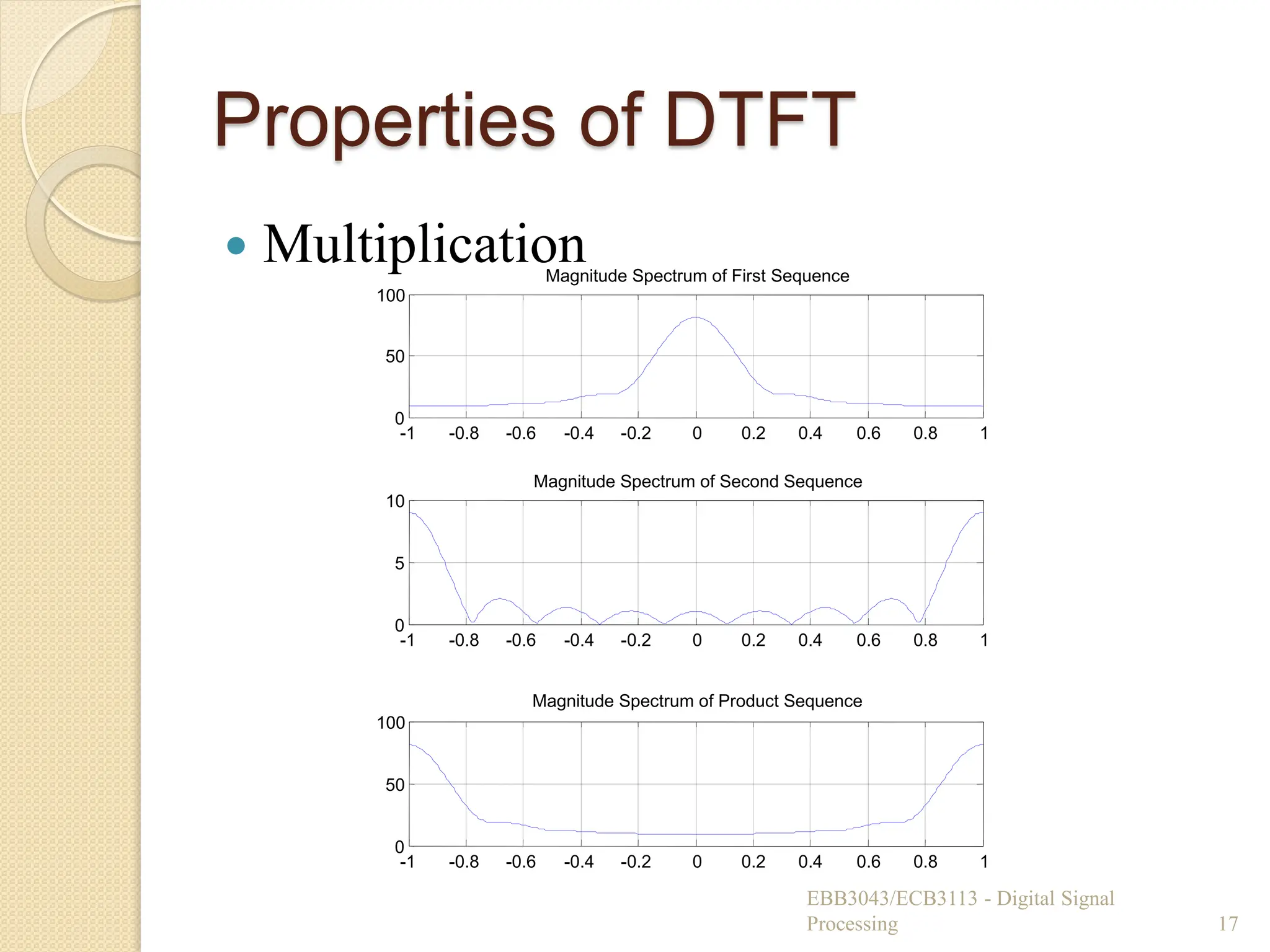
 Multiplication
◦ The DTFT of the product of two sequences is
the convolution of the individual DTFTs of the
two sequences.
EBB3043/ECB3113 - Digital Signal
Processing 15
)
(
]
[
)
(
]
[ )
( 0
0 


 




 j
n
j
j
e
X
n
x
e
then
e
X
n
x
If F
F
n
j
e 0


)
(
)
(
]
[
]
[
)
(
]
[
)
(
]
[




j
j
j
j
e
Y
e
X
n
y
n
x
then
e
Y
n
y
and
e
X
n
x
If







F
F
F
Properties of DTFT
 Frequency-shifting
EBB3043/ECB3113 - Digital Signal
Processing 16
-1 -0.5 0 0.5 1
0
20
40
60
80
100
Magnitude Spectrum of
Original Sequence
-1 -0.5 0 0.5 1
0
20
40
60
80
100
Magnitude Spectrum of
Frequency-Shifted Sequence
-1 -0.5 0 0.5 1
-4
-2
0
2
4
Phase Spectrum of Original
Sequence
-1 -0.5 0 0.5 1
-4
-2
0
2
4
Phase Spectrum of Frequency-
Shifted Sequence
Properties of DTFT
 Multiplication
EBB3043/ECB3113 - Digital Signal
Processing 17
-1 -0.8 -0.6 -0.4 -0.2 0 0.2 0.4 0.6 0.8 1
0
50
100
Magnitude Spectrum of First Sequence
-1 -0.8 -0.6 -0.4 -0.2 0 0.2 0.4 0.6 0.8 1
0
5
10
Magnitude Spectrum of Second Sequence
-1 -0.8 -0.6 -0.4 -0.2 0 0.2 0.4 0.6 0.8 1
0
50
100
Magnitude Spectrum of Product Sequence
Properties of DTFT
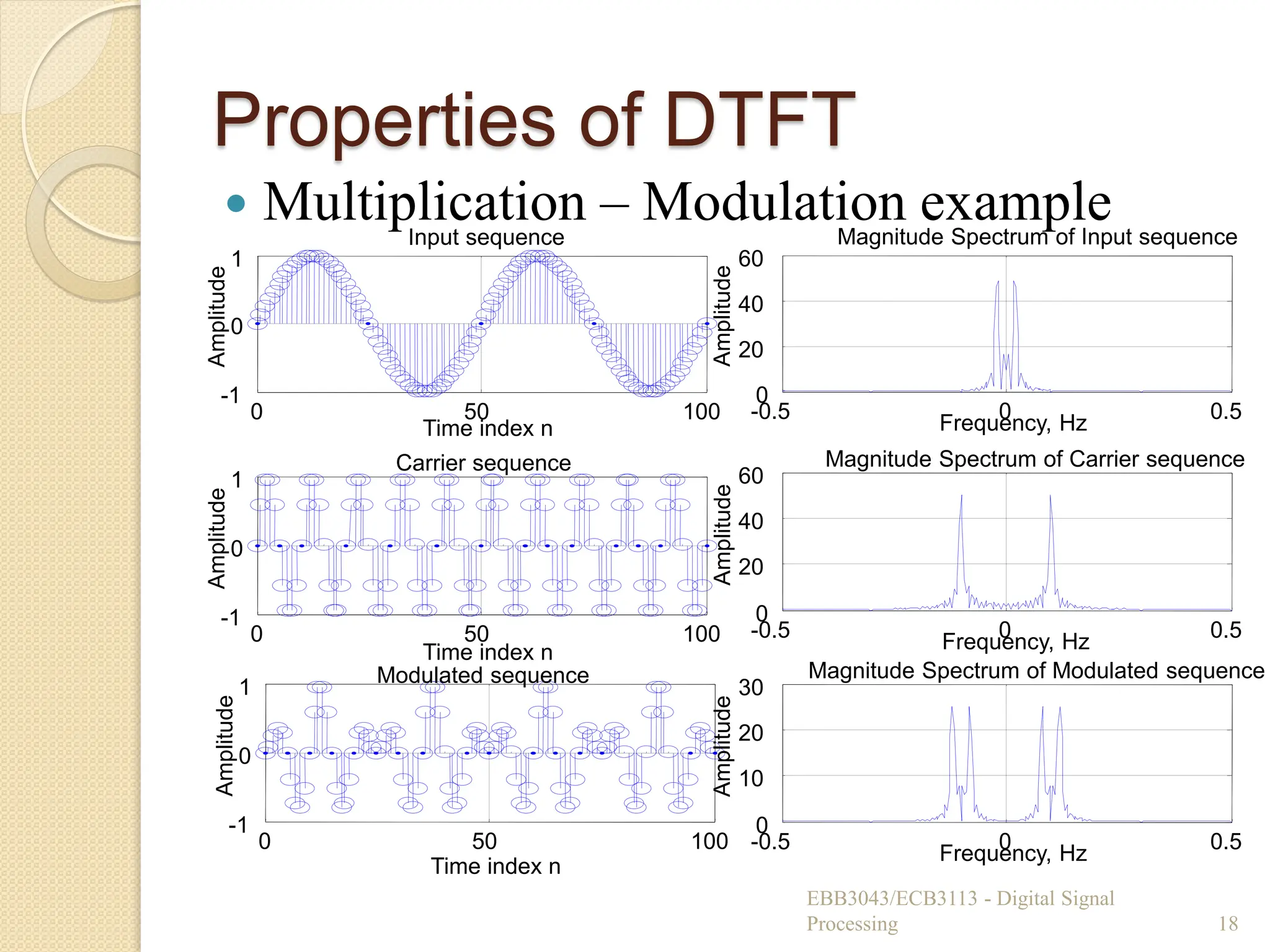
 Multiplication – Modulation example
EBB3043/ECB3113 - Digital Signal
Processing 18
Time index n
0 50 100
-1
0
1
Amplitude
Input sequence
Carrier sequence
0 50 100
-1
0
1
Amplitude
Time index n
0 50 100
-1
0
1
Time index n
Amplitude
Modulated sequence
-0.5 0 0.5
0
20
40
60
Frequency, Hz
Amplitude
Magnitude Spectrum of Input sequence
-0.5 0 0.5
0
20
40
60
Frequency, Hz
Amplitude
Magnitude Spectrum of Carrier sequence
-0.5 0 0.5
0
10
20
30
Frequency, Hz
Amplitude
Magnitude Spectrum of Modulated sequence
Properties of DTFT
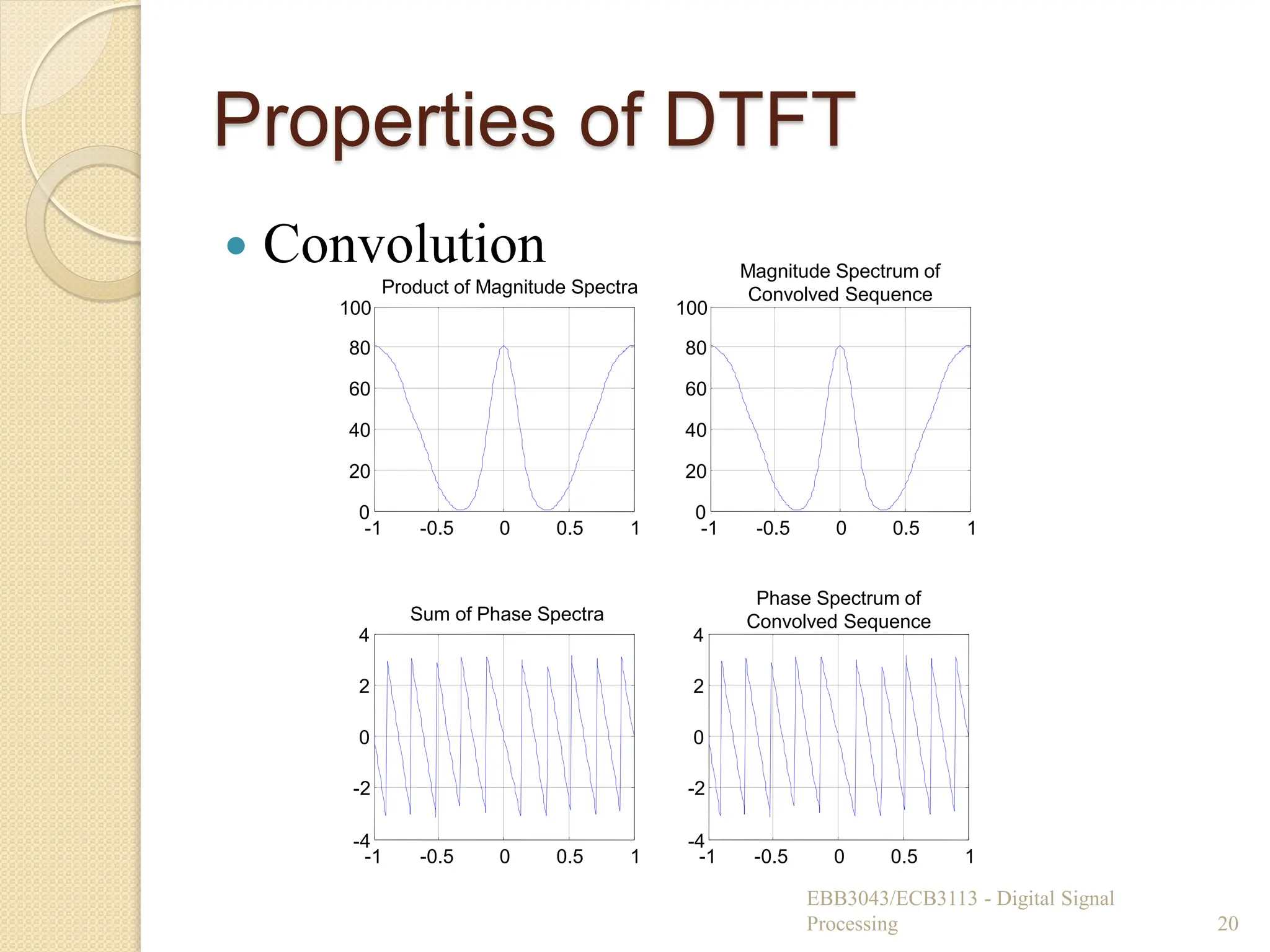
 Convolution
◦ If we convolve two sequences in the time-
domain, it is equivalent to multiplying their
DTFTs in the frequency domain.
EBB3043/ECB3113 - Digital Signal
Processing 19
)
(
)
(
]
[
]
[
)
(
]
[
)
(
]
[




j
j
j
j
e
Y
e
X
n
y
n
x
then
e
Y
n
y
and
e
X
n
x
If







F
F
F
Properties of DTFT
 Convolution
EBB3043/ECB3113 - Digital Signal
Processing 20
-1 -0.5 0 0.5 1
0
20
40
60
80
100
Product of Magnitude Spectra
-1 -0.5 0 0.5 1
0
20
40
60
80
100
Magnitude Spectrum of
Convolved Sequence
-1 -0.5 0 0.5 1
-4
-2
0
2
4
Sum of Phase Spectra
-1 -0.5 0 0.5 1
-4
-2
0
2
4
Phase Spectrum of
Convolved Sequence
Properties of DTFT
 Conjugation
 Differentiation
 Parseval’s Theorem
◦ Energy is conserved when going from the time
domain to the frequency domain.
EBB3043/ECB3113 - Digital Signal
Processing 21
)
(
]
[
)
(
]
[ 
 j
j
e
X
n
x
then
e
X
n
x
If 





 F
F
)
(
]
[
)
(
]
[ 


j
j
e
X
d
d
j
n
nx
then
e
X
n
x
If 


 F
F












d
e
X
n
x j
n
2
2
)
(
2
1
]
[
Common DTFT Pairs
EBB3043/ECB3113 - Digital Signal
Processing 22
)
2
(
)
2
(
cos
1
],
[
]
1
[
1
],
1
[
1
],
[
)
2
(
]
[
)
2
(
2
)
2
(
2
1
]
[
1
]
[
0
0
0
)
1
(
1
1
1
1
1
1
1
0
0
2
0
0
k
k
n
a
n
u
a
n
a
n
u
a
a
n
u
a
k
n
u
k
e
k
e
n
n
n
k
ae
n
ae
n
ae
n
k
e
k
jn
k
jn
j
j
j
j






































































Sequence DTFT
Inverse DTFT
 The IDTFT allows us to convert the
sequence from frequency domain to time
domain.
 The inverse DTFT is defined as:
 We can also represent the IDTFT as:
 Alternatively, we can use tables of DTFT
pairs to determine the IDTFT, or express ,
X(ej), as a power series of ej.
EDB2073- Digital Signal Processing © Nasreen Badruddin 23









d
e
e
X
n
x n
j
j
)
(
2
1
]
[
]
[
)
(
]
[
)
( n
x
e
X
or
n
x
e
X j
j

 


 IDTFT
F-1


Performing Convolution using
DTFT
 Convolution in the time domain is
equivalent to multiplication in the
frequency domain.
 To find the output of a system with
impulse response, h[n], when the input is
x[n], we do the following:
1. Find the DTFTs H(ej) and X(ej).
2. Perform the multiplication
Y (ej) =H(ej) X(ej).
3. Get the IDTFT of Y (ej) to obtain y[n].
EBB3043/ECB3113 - Digital Signal
Processing 24
The Frequency Response
 Recall that for an LTI system:
 Using the Convolution property of DTFT, we
have:
 H(ej) is called the frequency response of the
LTI system.
 It is the ratio of the DTFT of the output and
the DTFT of the input.
 It is also the DTFT of the impulse response.
EBB3043/ECB3113 - Digital Signal
Processing 25
]
[
]
[
]
[ n
h
n
x
n
y 

)
(
)
(
)
(
)
(
)
(
)
(
]
[
]
[
]
[






j
j
j
j
j
j
e
X
e
Y
e
H
e
H
e
X
e
Y
n
h
n
x
n
y






 F
)
(
]
[ 
j
e
H
n
h 
F
The Frequency Response
 The impulse response describes the
characteristics of the LTI system in the time
domain.
 Similarly, the frequency response describes
the characteristics of the LTI system in the
frequency domain.
 The drawback of the frequency response
using DTFT is that it is a continuous
function. Hence it cannot be processed by
digital systems.
 This problem is overcome by using the
Discrete Fourier Transform (DFT).
EBB3043/ECB3113 - Digital Signal
Processing 26
The Frequency Response
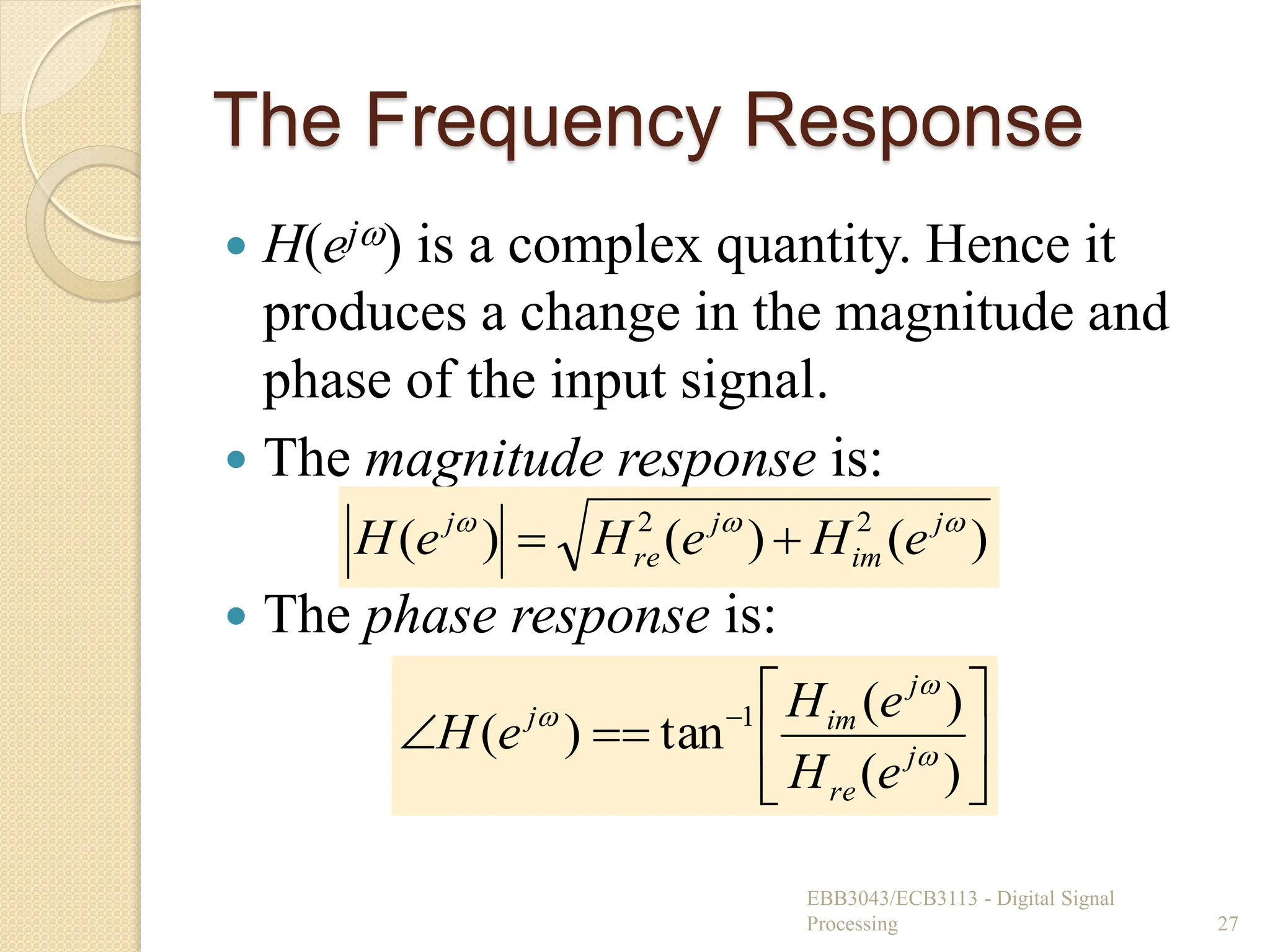
 H(ej) is a complex quantity. Hence it
produces a change in the magnitude and
phase of the input signal.
 The magnitude response is:
 The phase response is:
EBB3043/ECB3113 - Digital Signal
Processing 27
)
(
)
(
)
( 2
2 

 j
im
j
re
j
e
H
e
H
e
H 








 
)
(
)
(
tan
)
( 1



j
re
j
im
j
e
H
e
H
e
H
Solving LCCDE using DTFT
 Recall that the LCCDE has the general
form:
 Using linearity and shift properties of
DTFT, we can express the DE in the
frequency domain as:
EBB3043/ECB3113 - Digital Signal
Processing 28

 





N
k
k
M
k
k k
n
y
a
k
n
x
b
n
y
1
0
]
[
]
[
]
[
















N
k
j
k
j
k
M
k
j
k
j
k
j
N
k
k
M
k
k
e
Y
e
a
e
X
e
b
e
Y
k
n
y
a
k
n
x
b
n
y
1
0
1
0
)
(
)
(
)
(
]
[
]
[
]
[





Solving LCCDE using DTFT
 The DTFT can be used to solve LCCDE
to obtain the frequency response or the
impulse response.
 Steps:
1. Transform each term in the LCCDE into its
DTFT.
2. To get H(ej), manipulate the DTFT
equation to get the ratio Y(ej)/ X(ej).
3. To get h[n] perform IDTFT on H(ej).
EBB3043/ECB3113 - Digital Signal
Processing 29

Digital Signals Topic 3 Fourier Analysis (std).pdf

  • 1.
    Topic 3 Fourier Analysisof Discrete Time LTI Systems EBB3043/ECB3113 - Digital Signal Processing 1
  • 2.
    Introduction  Most signalsof practical interest can be decomposed into a sum of sinusoidal components. EBB3043/ECB3113 - Digital Signal Processing 2
  • 3.
    Introduction  In somecases, we are more interested in what the signal is like in the frequency domain, rather than in the time-domain, e.g. in an equalizer. EBB3043/ECB3113 - Digital Signal Processing 3
  • 4.
    Introduction  In LTIsystems – Linear combination of sinusoids in the input gives linear sum of sinusoids in the output (may differ in amplitude and phases). EBB3043/ECB3113 - Digital Signal Processing 4 LTI System + + + +
  • 5.
    Sinusoid and sound A pure tone is a tone generated by a sinewave.  In general, the frequency of a sinewave relates to the pitch of a tone. ◦ The higher the frequency, the higher the pitch.  The amplitude of a sinewave relates to the loudness/strength of the tone. ◦ The higher the amplitude, the louder the sound.  But, human hearing is limited e.g. if you hear two pure tones of the same amplitude, but one is at a low frequency and one is at a high frequency, the one with low frequency may sound louder. EBB3043/ECB3113 - Digital Signal Processing 5
  • 6.
    Try this…  Runthe following MATLAB code which generates a pure tone with amplitude=0.1 and freq.=110Hz for 1 sec. Listen to the sound.  Create 2 other sinewaves: ◦ y2: amplitude = 0.1, frequency = 110 Hz ◦ y3: amplitude = 1, frequency = 880 Hz  Compare: ◦ y1 and y2 – which sounds louder? ◦ y2 and y3 – which has the higher pitch?  Does y1 sound louder than y3 even though they both have the same amplitude? EBB3043/ECB3113 - Digital Signal Processing 6 y1=1*sin(2*pi*110/44100*[0:44099]); sound(y1,44100)
  • 7.
    Types of FourierAnalysis  Signal is periodic and continuous – Fourier series  Signal is aperiodic and continuous – Continuous-time Fourier transform (or just Fourier Transform)  Signal is aperiodic and discrete – Discrete-time Fourier Transform (DTFT)  Signal is periodic and discrete – Discrete Fourier Transform (DFT) EBB3043/ECB3113 - Digital Signal Processing 7
  • 8.
    Discrete Time FourierTransform (DTFT)  The DTFT of a sequence, x[n] is given as:  The DTFT represents the frequency content of x[n].  The transformation can be represented by:  X(ej) is also called the frequency spectrum of the DT signal, x[n].  The DTFT exists only for signals that are absolutely summable i.e. EBB3043/ECB3113 - Digital Signal Processing 8       n n j j e n x e X   ] [ ) ( . ] [       n n x ) ( ] [ ) ( ] [   j j e X n x or e X n x       DTFT F
  • 9.
    DTFT – Magnitudeand Phase Spectrum  The DTFT, X(ej), is complex-valued,  it can be written in rectangular form: X(ej) = Xre(ej)+j Xim(ej) or polar form: X(ej) =|X(ej)|X(ej) EBB3043/ECB3113 - Digital Signal Processing 9
  • 10.
    ) ( ) ( ) ( ) ( ) ( 2 2 *     j im j re j j j e X e X e X e X e X    DTFT – Magnitude and Phase Spectrum  The magnitude spectrum is defined as:  The phase spectrum is defined as: EBB3043/ECB3113 - Digital Signal Processing 10             ) ( ) ( tan ) ( ) ( 1     j re j im j j e X e X e X Arg e X
  • 11.
    Properties of DTFT Linearity ◦ The DTFT of a linear weighted sum combination of two signals is the linear weighted sum of the DTFTs of the two signals.  Periodicity ◦ The DTFT is periodic with period of 2, where k is an integer. EBB3043/ECB3113 - Digital Signal Processing 11 ) ( ) ( ] [ ] [ ) ( ] [ ) ( ] [     j j j j e bY e aX n by n ax then e Y n y and e X n x If         F F F ) ( ) ( 2    j k j e X e X  
  • 12.
    Properties of DTFT Time-shifting ◦ If signal is time-shifted by k samples, its magnitude spectrum remains unchanged. ◦ The phase spectrum will change by amount -k.  Time-reversal ◦ If signal is folded about the origin in time, its magnitude spectrum remains unchanged. ◦ Change in sign in the phase spectrum (Phase reversal). EBB3043/ECB3113 - Digital Signal Processing 12 ) ( ] [ ) ( ] [    j k j j e X e k n x then e X n x If       F F ) ( ] [ ) ( ] [   j j e X n x then e X n x If       F F
  • 13.
    Properties of DTFT Time-shifting EBB3043/ECB3113 - Digital Signal Processing 13 -1 -0.5 0 0.5 1 0 10 20 30 40 50 Magnitude Spectrum of Original Sequence -1 -0.5 0 0.5 1 0 10 20 30 40 50 Magnitude Spectrum of Time-Shifted Sequence -1 -0.5 0 0.5 1 -4 -2 0 2 4 Phase Spectrum of Original Sequence -1 -0.5 0 0.5 1 -4 -2 0 2 4 Phase Spectrum of Time-Shifted Sequence
  • 14.
    Properties of DTFT Time-reversal EBB3043/ECB3113 - Digital Signal Processing 14 -1 -0.5 0 0.5 1 2 4 6 8 10 Magnitude Spectrum of Original Sequence -1 -0.5 0 0.5 1 2 4 6 8 10 Magnitude Spectrum of Time- Reversed Sequence -1 -0.5 0 0.5 1 -4 -2 0 2 4 Phase Spectrum of Original Sequence -1 -0.5 0 0.5 1 -4 -2 0 2 4 Phase Spectrum of Time- Reversed Sequence
  • 15.
    Properties of DTFT Frequency-shifting ◦ If signal is multiplied by , the spectrum is shifted by 0.  Multiplication ◦ The DTFT of the product of two sequences is the convolution of the individual DTFTs of the two sequences. EBB3043/ECB3113 - Digital Signal Processing 15 ) ( ] [ ) ( ] [ ) ( 0 0           j n j j e X n x e then e X n x If F F n j e 0   ) ( ) ( ] [ ] [ ) ( ] [ ) ( ] [     j j j j e Y e X n y n x then e Y n y and e X n x If        F F F
  • 16.
    Properties of DTFT Frequency-shifting EBB3043/ECB3113 - Digital Signal Processing 16 -1 -0.5 0 0.5 1 0 20 40 60 80 100 Magnitude Spectrum of Original Sequence -1 -0.5 0 0.5 1 0 20 40 60 80 100 Magnitude Spectrum of Frequency-Shifted Sequence -1 -0.5 0 0.5 1 -4 -2 0 2 4 Phase Spectrum of Original Sequence -1 -0.5 0 0.5 1 -4 -2 0 2 4 Phase Spectrum of Frequency- Shifted Sequence
  • 17.
    Properties of DTFT Multiplication EBB3043/ECB3113 - Digital Signal Processing 17 -1 -0.8 -0.6 -0.4 -0.2 0 0.2 0.4 0.6 0.8 1 0 50 100 Magnitude Spectrum of First Sequence -1 -0.8 -0.6 -0.4 -0.2 0 0.2 0.4 0.6 0.8 1 0 5 10 Magnitude Spectrum of Second Sequence -1 -0.8 -0.6 -0.4 -0.2 0 0.2 0.4 0.6 0.8 1 0 50 100 Magnitude Spectrum of Product Sequence
  • 18.
    Properties of DTFT Multiplication – Modulation example EBB3043/ECB3113 - Digital Signal Processing 18 Time index n 0 50 100 -1 0 1 Amplitude Input sequence Carrier sequence 0 50 100 -1 0 1 Amplitude Time index n 0 50 100 -1 0 1 Time index n Amplitude Modulated sequence -0.5 0 0.5 0 20 40 60 Frequency, Hz Amplitude Magnitude Spectrum of Input sequence -0.5 0 0.5 0 20 40 60 Frequency, Hz Amplitude Magnitude Spectrum of Carrier sequence -0.5 0 0.5 0 10 20 30 Frequency, Hz Amplitude Magnitude Spectrum of Modulated sequence
  • 19.
    Properties of DTFT Convolution ◦ If we convolve two sequences in the time- domain, it is equivalent to multiplying their DTFTs in the frequency domain. EBB3043/ECB3113 - Digital Signal Processing 19 ) ( ) ( ] [ ] [ ) ( ] [ ) ( ] [     j j j j e Y e X n y n x then e Y n y and e X n x If        F F F
  • 20.
    Properties of DTFT Convolution EBB3043/ECB3113 - Digital Signal Processing 20 -1 -0.5 0 0.5 1 0 20 40 60 80 100 Product of Magnitude Spectra -1 -0.5 0 0.5 1 0 20 40 60 80 100 Magnitude Spectrum of Convolved Sequence -1 -0.5 0 0.5 1 -4 -2 0 2 4 Sum of Phase Spectra -1 -0.5 0 0.5 1 -4 -2 0 2 4 Phase Spectrum of Convolved Sequence
  • 21.
    Properties of DTFT Conjugation  Differentiation  Parseval’s Theorem ◦ Energy is conserved when going from the time domain to the frequency domain. EBB3043/ECB3113 - Digital Signal Processing 21 ) ( ] [ ) ( ] [   j j e X n x then e X n x If        F F ) ( ] [ ) ( ] [    j j e X d d j n nx then e X n x If     F F             d e X n x j n 2 2 ) ( 2 1 ] [
  • 22.
    Common DTFT Pairs EBB3043/ECB3113- Digital Signal Processing 22 ) 2 ( ) 2 ( cos 1 ], [ ] 1 [ 1 ], 1 [ 1 ], [ ) 2 ( ] [ ) 2 ( 2 ) 2 ( 2 1 ] [ 1 ] [ 0 0 0 ) 1 ( 1 1 1 1 1 1 1 0 0 2 0 0 k k n a n u a n a n u a a n u a k n u k e k e n n n k ae n ae n ae n k e k jn k jn j j j j                                                                       Sequence DTFT
  • 23.
    Inverse DTFT  TheIDTFT allows us to convert the sequence from frequency domain to time domain.  The inverse DTFT is defined as:  We can also represent the IDTFT as:  Alternatively, we can use tables of DTFT pairs to determine the IDTFT, or express , X(ej), as a power series of ej. EDB2073- Digital Signal Processing © Nasreen Badruddin 23          d e e X n x n j j ) ( 2 1 ] [ ] [ ) ( ] [ ) ( n x e X or n x e X j j       IDTFT F-1  
  • 24.
    Performing Convolution using DTFT Convolution in the time domain is equivalent to multiplication in the frequency domain.  To find the output of a system with impulse response, h[n], when the input is x[n], we do the following: 1. Find the DTFTs H(ej) and X(ej). 2. Perform the multiplication Y (ej) =H(ej) X(ej). 3. Get the IDTFT of Y (ej) to obtain y[n]. EBB3043/ECB3113 - Digital Signal Processing 24
  • 25.
    The Frequency Response Recall that for an LTI system:  Using the Convolution property of DTFT, we have:  H(ej) is called the frequency response of the LTI system.  It is the ratio of the DTFT of the output and the DTFT of the input.  It is also the DTFT of the impulse response. EBB3043/ECB3113 - Digital Signal Processing 25 ] [ ] [ ] [ n h n x n y   ) ( ) ( ) ( ) ( ) ( ) ( ] [ ] [ ] [       j j j j j j e X e Y e H e H e X e Y n h n x n y        F ) ( ] [  j e H n h  F
  • 26.
    The Frequency Response The impulse response describes the characteristics of the LTI system in the time domain.  Similarly, the frequency response describes the characteristics of the LTI system in the frequency domain.  The drawback of the frequency response using DTFT is that it is a continuous function. Hence it cannot be processed by digital systems.  This problem is overcome by using the Discrete Fourier Transform (DFT). EBB3043/ECB3113 - Digital Signal Processing 26
  • 27.
    The Frequency Response H(ej) is a complex quantity. Hence it produces a change in the magnitude and phase of the input signal.  The magnitude response is:  The phase response is: EBB3043/ECB3113 - Digital Signal Processing 27 ) ( ) ( ) ( 2 2    j im j re j e H e H e H            ) ( ) ( tan ) ( 1    j re j im j e H e H e H
  • 28.
    Solving LCCDE usingDTFT  Recall that the LCCDE has the general form:  Using linearity and shift properties of DTFT, we can express the DE in the frequency domain as: EBB3043/ECB3113 - Digital Signal Processing 28         N k k M k k k n y a k n x b n y 1 0 ] [ ] [ ] [                 N k j k j k M k j k j k j N k k M k k e Y e a e X e b e Y k n y a k n x b n y 1 0 1 0 ) ( ) ( ) ( ] [ ] [ ] [     
  • 29.
    Solving LCCDE usingDTFT  The DTFT can be used to solve LCCDE to obtain the frequency response or the impulse response.  Steps: 1. Transform each term in the LCCDE into its DTFT. 2. To get H(ej), manipulate the DTFT equation to get the ratio Y(ej)/ X(ej). 3. To get h[n] perform IDTFT on H(ej). EBB3043/ECB3113 - Digital Signal Processing 29