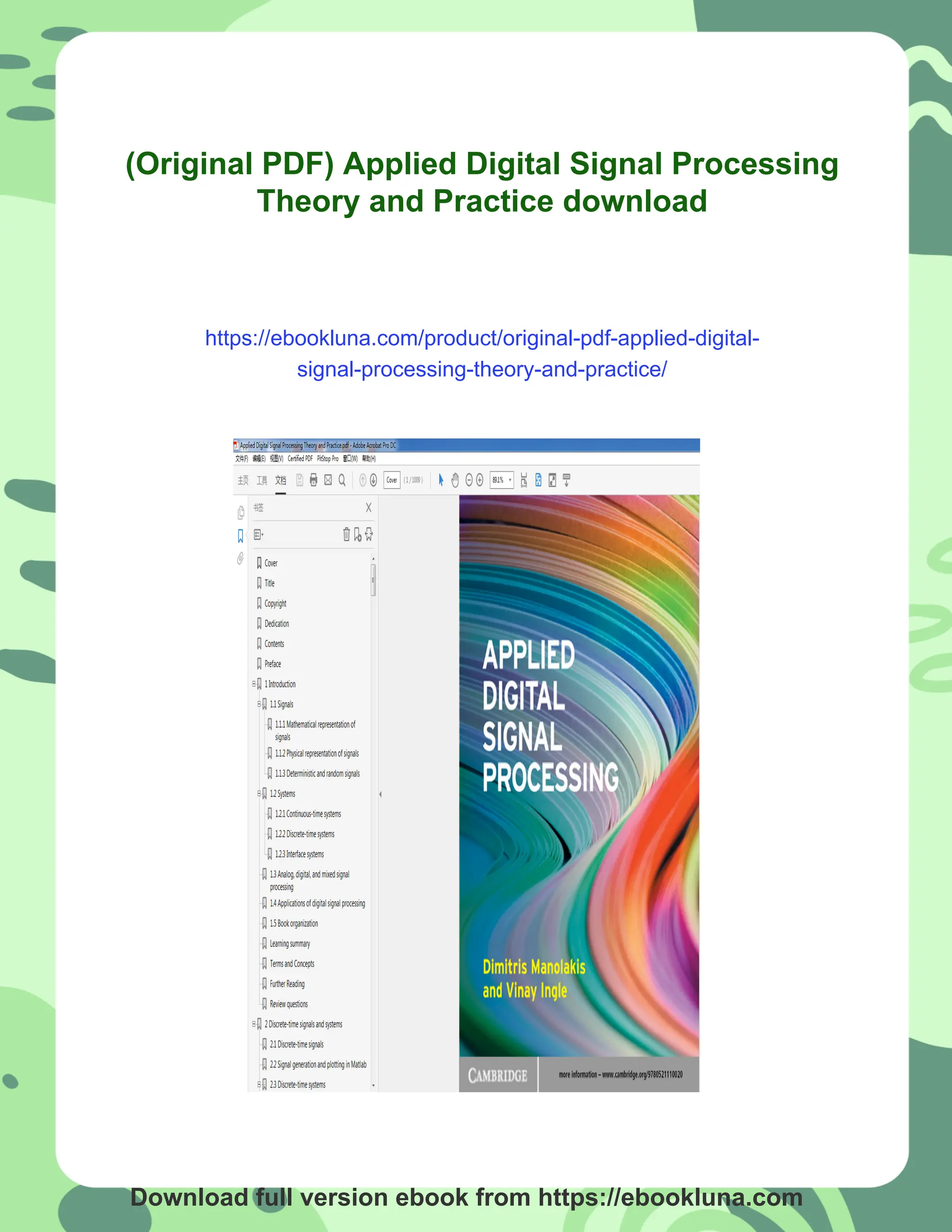
(Original PDF) Applied Digital Signal Processing Theory and Practice
(Original PDF) Applied Digital Signal Processing Theory and Practice
(Original PDF) Applied Digital Signal Processing Theory and Practice
(Original PDF) Applied Digital Signal Processing Theory and Practice
(Original PDF) Applied Digital Signal Processing Theory and Practice
1.
(Original PDF) AppliedDigital Signal Processing
Theory and Practice download
https://ebookluna.com/product/original-pdf-applied-digital-
signal-processing-theory-and-practice/
Download full version ebook from https://ebookluna.com
2.
We believe theseproducts will be a great fit for you. Click
the link to download now, or visit ebookluna.com
to discover even more!
(eBook PDF) Digital Signal Processing First, eBook, Global Edition
https://ebookluna.com/product/ebook-pdf-digital-signal-processing-first-
ebook-global-edition/
(Original PDF) Signal Processing in Auditory Neuroscience: Temporal and
Spatial
https://ebookluna.com/product/original-pdf-signal-processing-in-auditory-
neuroscience-temporal-and-spatial/
(eBook PDF) Compressed Sensing in Radar Signal Processing
https://ebookluna.com/product/ebook-pdf-compressed-sensing-in-radar-signal-
processing/
Multiresolution and Multirate Signal Processing: Introduction, Principles
and Applications 1st Edition - eBook PDF
https://ebookluna.com/download/multiresolution-and-multirate-signal-
processing-introduction-principles-and-applications-ebook-pdf/
3.
Signal processing forneuroscientists 2nd ed Edition Drongelen - eBook PDF
https://ebookluna.com/download/signal-processing-for-neuroscientists-ebook-
pdf/
Discover Digital Libraries. Theory and Practice 1st Edition Iris Xie -
eBook PDF
https://ebookluna.com/download/discover-digital-libraries-theory-and-
practice-ebook-pdf/
Classical and Analytical Mechanics: Theory, Applied Examples, and Practice
1st Edition Poznyak - eBook PDF
https://ebookluna.com/download/classical-and-analytical-mechanics-theory-
applied-examples-and-practice-ebook-pdf/
(eBook PDF) Digital Image Processing, Global Edition 4th Edition
https://ebookluna.com/product/ebook-pdf-digital-image-processing-global-
edition-4th-edition/
Digital Image Processing Using MATLAB 1st edition - eBook PDF
https://ebookluna.com/download/digital-image-processing-using-matlab-ebook-
pdf/
7.
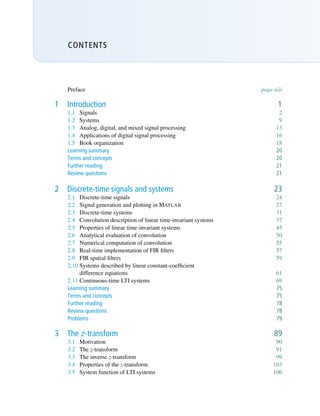
CONTENTS
Preface page xiii
1Introduction 1
1.1 Signals 2
1.2 Systems 9
1.3 Analog, digital, and mixed signal processing 13
1.4 Applications of digital signal processing 16
1.5 Book organization 18
Learning summary 20
Terms and concepts 20
Further reading 21
Review questions 21
2 Discrete-time signals and systems 23
2.1 Discrete-time signals 24
2.2 Signal generation and plotting in MATLAB 27
2.3 Discrete-time systems 31
2.4 Convolution description of linear time-invariant systems 37
2.5 Properties of linear time-invariant systems 45
2.6 Analytical evaluation of convolution 50
2.7 Numerical computation of convolution 55
2.8 Real-time implementation of FIR filters 57
2.9 FIR spatial filters 59
2.10 Systems described by linear constant-coefficient
difference equations 61
2.11 Continuous-time LTI systems 69
Learning summary 75
Terms and concepts 75
Further reading 78
Review questions 78
Problems 79
3 The z-transform 89
3.1 Motivation 90
3.2 The z-transform 91
3.3 The inverse z-transform 99
3.4 Properties of the z-transform 103
3.5 System function of LTI systems 106
8.
viii Contents
3.6 LTIsystems characterized by linear constant-coefficient
difference equations 110
3.7 Connections between pole-zero locations
and time-domain behavior 114
3.8 The one-sided z-transform 118
Learning summary 121
Terms and concepts 122
Further reading 123
Review questions 123
Problems 124
4 Fourier representation of signals 134
4.1 Sinusoidal signals and their properties 135
4.2 Fourier representation of continuous-time signals 142
4.3 Fourier representation of discrete-time signals 157
4.4 Summary of Fourier series and Fourier transforms 169
4.5 Properties of the discrete-time Fourier transform 171
Learning summary 188
Terms and concepts 189
Further reading 191
Review questions 191
Problems 192
5 Transform analysis of LTI systems 201
5.1 Sinusoidal response of LTI systems 202
5.2 Response of LTI systems in the frequency domain 210
5.3 Distortion of signals passing through LTI systems 215
5.4 Ideal and practical filters 221
5.5 Frequency response for rational system functions 224
5.6 Dependence of frequency response on poles and zeros 231
5.7 Design of simple filters by pole-zero placement 237
5.8 Relationship between magnitude and phase responses 247
5.9 Allpass systems 249
5.10 Invertibility and minimum-phase systems 254
5.11 Transform analysis of continuous-time LTI systems 258
Learning summary 274
Terms and concepts 275
Further reading 276
Review questions 277
Problems 278
6 Sampling of continuous-time signals 292
6.1 Ideal periodic sampling of continuous-time signals 293
6.2 Reconstruction of a bandlimited signal from its samples 297
6.3 The effect of undersampling: aliasing 300
9.
ix Contents
6.4 Discrete-timeprocessing of continuous-time signals 311
6.5 Practical sampling and reconstruction 318
6.6 Sampling of bandpass signals 327
6.7 Image sampling and reconstruction 333
Learning summary 339
Terms and concepts 340
Further reading 341
Review questions 342
Problems 343
7 The Discrete Fourier Transform 353
7.1 Computational Fourier analysis 354
7.2 The Discrete Fourier Transform (DFT) 357
7.3 Sampling the Discrete-Time Fourier Transform 363
7.4 Properties of the Discrete Fourier Transform 374
7.5 Linear convolution using the DFT 392
7.6 Fourier analysis of signals using the DFT 396
Learning summary 418
Terms and concepts 419
Further reading 421
Review questions 422
Problems 423
8 Computation of the Discrete Fourier
Transform 434
8.1 Direct computation of the Discrete Fourier Transform 435
8.2 The FFT idea using a matrix approach 436
8.3 Decimation-in-time FFT algorithms 440
8.4 Decimation-in-frequency FFT algorithms 450
8.5 Generalizations and additional FFT algorithms 454
8.6 Practical considerations 456
8.7 Computation of DFT for special applications 459
Learning summary 470
Terms and concepts 470
Further reading 472
Review questions 473
Problems 474
9 Structures for discrete-time systems 485
9.1 Block diagrams and signal flow graphs 486
9.2 IIR system structures 488
9.3 FIR system structures 501
9.4 Lattice structures 511
9.5 Structure conversion, simulation, and verification 519
Learning summary 522
10.
x Contents
Terms andconcepts 522
Further reading 524
Review questions 525
Problems 526
10 Design of FIR filters 537
10.1 The filter design problem 538
10.2 FIR filters with linear phase 544
10.3 Design of FIR filters by windowing 556
10.4 Design of FIR filters by frequency sampling 573
10.5 Chebyshev polynomials and minimax approximation 582
10.6 Equiripple optimum Chebyshev FIR filter design 586
10.7 Design of some special FIR filters 601
Learning summary 608
Terms and concepts 608
Further reading 610
Review questions 610
Problems 612
11 Design of IIR filters 624
11.1 Introduction to IIR filter design 625
11.2 Design of continuous-time lowpass filters 627
11.3 Transformation of continuous-time filters
to discrete-time IIR filters 653
11.4 Design examples for lowpass IIR filters 668
11.5 Frequency transformations of lowpass filters 673
11.6 Design examples of IIR filters using MATLAB 680
Learning summary 687
Terms and concepts 687
Further reading 689
Review questions 689
Problems 691
12 Multirate signal processing 705
12.1 Sampling rate conversion 706
12.2 Implementation of multirate systems 727
12.3 Filter design for multirate systems 736
12.4 Two-channel filter banks 746
12.5 Multichannel filter banks 759
Learning summary 764
Terms and concepts 764
Further reading 766
Review questions 766
Problems 768
11.
xi Contents
13 Randomsignals 777
13.1 Probability models and random variables 778
13.2 Jointly distributed random variables 786
13.3 Covariance, correlation, and linear estimation 792
13.4 Random processes 796
13.5 Some useful random process models 809
Learning summary 815
Terms and concepts 816
Further reading 818
Review questions 818
Problems 820
14 Random signal processing 829
14.1 Estimation of mean, variance, and covariance 830
14.2 Spectral analysis of stationary processes 834
14.3 Optimum linear filters 858
14.4 Linear prediction and all-pole signal modeling 866
14.5 Optimum orthogonal transforms 877
Learning summary 884
Terms and concepts 885
Further reading 886
Review questions 887
Problems 888
15 Finite wordlength effects 902
15.1 Number representation 903
15.2 Statistical analysis of quantization error 909
15.3 Oversampling A/D and D/A conversion 919
15.4 Quantization of filter coefficients 928
15.5 Effects of finite wordlength on digital filters 936
15.6 Finite wordlength effects in FFT algorithms 950
Learning summary 952
Terms and concepts 953
Further reading 954
Review questions 955
Problems 956
References 968
Index 977
13.
PREFACE
During the lastthree decades Digital Signal Processing (DSP) has evolved into a core area
of study in electrical and computer engineering. Today, DSP provides the methodology
and algorithms for the solution of a continuously growing number of practical problems in
scientific, engineering, and multimedia applications.
Despite the existence of a number of excellent textbooks focusing either on the theory
of DSP or on the application of DSP algorithms using interactive software packages, we
feel there is a strong need for a book bridging the two approaches by combining the best
of both worlds. This was our motivation for writing this book, that is, to help students and
practicing engineers understand the fundamental mathematical principles underlying the
operation of a DSP method, appreciate its practical limitations, and grasp, with sufficient
details, its practical implementation.
Objectives
The principal objective of this book is to provide a systematic introduction to the basic
concepts and methodologies for digital signal processing, based whenever possible on fun-
damental principles. A secondary objective is to develop a foundation that can be used by
students, researchers, and practicing engineers as the basis for further study and research in
this field. To achieve these objectives, we have focused on material that is fundamental and
where the scope of application is not limited to the solution of specialized problems, that
is, material that has a broad scope of application. Our aim is to help the student develop
sufficient intuition as to how a DSP technique works, be able to apply the technique, and
be capable of interpreting the results of the application. We believe this approach will
also help students to become intelligent users of DSP techniques and good critics of DSP
techniques performed by others.
Pedagogical philosophy
Our experience in teaching undergraduate and graduate courses in digital signal process-
ing has reaffirmed the belief that the ideal blend of simplified mathematical analysis and
computer-based reasoning and simulations enhances both the teaching and the learning of
digital signal processing. To achieve these objectives, we have used mathematics to support
underlying intuition rather than as a substitute for it, and we have emphasized practical-
ity without turning the book into a simplistic “cookbook.” The purpose of MATLAB R
code integrated with the text is to illustrate the implementation of core signal process-
ing algorithms; therefore, we use standard language commands and functions that have
remained relatively stable during the most recent releases. We also believe that in-depth
14.
xiv Preface
understanding andfull appreciation of DSP is not possible without familiarity with the
fundamentals of continuous-time signals and systems. To help the reader grasp the full
potential of DSP theory and its application to practical problems, which primarily involve
continuous-time signals, we have integrated relevant continuous-time background into the
text. This material can be quickly reviewed or skipped by readers already exposed to the
theory of continuous-time signals and systems. Another advantage of this approach is that
some concepts are easier to explain and analyze in continuous-time than in discrete-time
or vice versa.
Instructional aids
We have put in a considerable amount of effort to produce instructional aids that enhance
both the teaching and learning of DSP. These aids, which constitute an integral part of the
textbook, include:
• Figures The graphical illustrations in each figure are designed to provide a mental pic-
ture of how each method works or to demonstrate the performance of a specific DSP
method.
• Examples A large number of examples are provided, many generated by MATLAB R
to
reflect realistic cases, which illustrate important concepts and guide the reader to easily
implement various methods.
• MATLAB R
functions and scripts To help the reader apply the various algorithms
and models to real-world problems, we provide MATLAB R
functions for all major
algorithms along with examples illustrating their use.
• Learning summaries At the end of each chapter, these provide a review of the basic yet
important concepts discussed in that chapter in the form of a bullet point list.
• Review questions Conceptual questions are provided at the end of each chapter to
reinforce the theory, clarify important concepts, and help relate theory to applications.
• Terms and concepts Important phrases and notions introduced in the chapter are again
explained in a concise manner for a quick overview.
• Problems A large number of problems, ranging from simple applications of theory and
computations to more advanced analysis and design tasks, have been developed for each
chapter. These problems are organized in up to four sections. The first set of problems
termed as Tutorial Problems contains problems whose solutions are available on the
website. The next section, Basic Problems, belongs to problems with answers available
on the website. The third section, Assessment Problems, contains problems based on
topics discussed in the chapter. Finally, the last section, Review Problems, introduces
applications, review, or extension problems.
• Book website This website will contain additional in-depth material, signal datasets,
MATLAB R
functions, power-point slides with all figures in the book, etc., for those
who want to delve intensely into topics. This site will be constantly updated. It will also
provide tutorials that support readers who need a review of background material.
• Solutions manual This manual, which contains solutions for all problems in the text, is
available to instructors from the publisher.
15.
xv Preface
Audience andprerequisites
The book is primarily aimed as a textbook for upper-level undergraduate and for first-year
graduate students in electrical and computer engineering. However, researchers, engineers,
and industry practitioners can use the book to learn how to analyze or process data for
scientific or engineering applications. The mathematical complexity has been kept at a
level suitable for seniors and first-year graduate students in almost any technical discipline.
More specifically, the reader should have a background in calculus, complex numbers and
variables, and the basics of linear algebra (vectors, matrices, and their manipulation).
Course configurations
The material covered in this text is intended for teaching to upper-level undergraduate
or first-year graduate students. However, it can be used flexibly for the preparation of a
number of courses. The first six chapters can be used in a junior level signals and systems
course with emphasis on discrete-time. The first 11 chapters can be used in a typical one-
semester undergraduate or graduate DSP course in which the first six chapters are reviewed
and the remaining five chapters are emphasized. Finally, an advanced graduate level course
on modern signal processing can be taught by combining some appropriate material from
the first 11 chapters and emphasizing the last four chapters. The pedagogical coverage of
the material also lends itself to a well-rounded graduate level course in DSP by choosing
selected topics from all chapters.
Feedback
Experience has taught us that errors – typos or just plain mistakes – are an inescapable
byproduct of any textbook writing endeavor. We apologize in advance for any errors
you may find and we urge you to bring them or additional feedback to our attention at
vingle@ece.neu.edu
Acknowledgments
We wish to express our sincere appreciation to the many individuals who have helped
us with their constructive comments and suggestions. Special thanks go to Sidi Niu for
the preparation of the Solutions Manual. Phil Meyler persuaded us to choose Cambridge
University Press as our publisher, and we have been happy with that decision. We are
grateful to Phil for his enthusiasm and his influence in shaping the scope and the objectives
of our book. The fine team at CUP, including Catherine Flack, Chris Miller, and Richard
Smith, has made the publication of this book an exciting and pleasant experience. Finally,
we express our deepest thanks to our wives, Anna and Usha, for their saintly understanding
and patience.
Dimitris G. Manolakis
Vinay K. Ingle
17.
1 Introduction
Signal processingis a discipline concerned with the acquisition, representation, manip-
ulation, and transformation of signals required in a wide range of practical applications.
In this chapter, we introduce the concepts of signals, systems, and signal processing.
We first discuss different classes of signals, based on their mathematical and physical
representations. Then, we focus on continuous-time and discrete-time signals and the
systems required for their processing: continuous-time systems, discrete-time systems,
and interface systems between these classes of signal. We continue with a discussion
of analog signal processing, digital signal processing, and a brief outline of the book.
Study objectives
After studying this chapter you should be able to:
• Understand the concept of signal and explain the differences between
continuous-time, discrete-time, and digital signals.
• Explain how the physical representation of signals influences their mathematical
representation and vice versa.
• Explain the concepts of continuous-time and discrete-time systems and justify
the need for interface systems between the analog and digital worlds.
• Recognize the differences between analog and digital signal processing and
explain the key advantages of digital over analog processing.
18.
2 Introduction
1.1 Signals
•• • • • • • • • • • • • • • • • • • • • • • • • • • • • • • • • • • • • • • • • • • • • • • • • • • • • • • • • • • • • • • • • • • • • • • • • • • • • • • • • • • • • • • • • • • • • • • • • • • • • •
For our purposes a signal is defined as any physical quantity that varies as a function of
time, space, or any other variable or variables. Signals convey information in their pat-
terns of variation. The manipulation of this information involves the acquisition, storage,
transmission, and transformation of signals.
There are many signals that could be used as examples in this section. However, we
shall restrict our attention to a few signals that can be used to illustrate several important
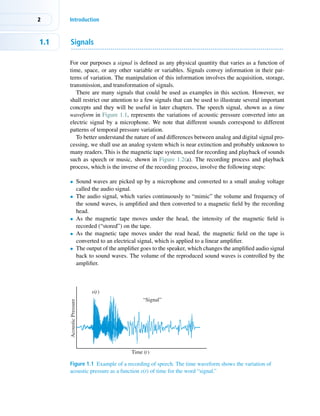
concepts and they will be useful in later chapters. The speech signal, shown as a time
waveform in Figure 1.1, represents the variations of acoustic pressure converted into an
electric signal by a microphone. We note that different sounds correspond to different
patterns of temporal pressure variation.
To better understand the nature of and differences between analog and digital signal pro-
cessing, we shall use an analog system which is near extinction and probably unknown to
many readers. This is the magnetic tape system, used for recording and playback of sounds
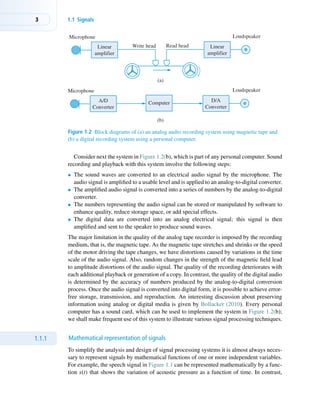
such as speech or music, shown in Figure 1.2(a). The recording process and playback
process, which is the inverse of the recording process, involve the following steps:
• Sound waves are picked up by a microphone and converted to a small analog voltage
called the audio signal.
• The audio signal, which varies continuously to “mimic” the volume and frequency of
the sound waves, is amplified and then converted to a magnetic field by the recording
head.
• As the magnetic tape moves under the head, the intensity of the magnetic field is
recorded (“stored”) on the tape.
• As the magnetic tape moves under the read head, the magnetic field on the tape is
converted to an electrical signal, which is applied to a linear amplifier.
• The output of the amplifier goes to the speaker, which changes the amplified audio signal
back to sound waves. The volume of the reproduced sound waves is controlled by the
amplifier.
Time (t)
Acoustic
Pressure
s(t)
“Signal”
Figure 1.1 Example of a recording of speech. The time waveform shows the variation of
acoustic pressure as a function s(t) of time for the word “signal.”
19.
3 1.1 Signals
Readhead
Write head
Microphone Loudspeaker
Microphone Loudspeaker
Computer
(a)
(b)
D/A
Converter
A/D
Converter
Linear
amplifier
Linear
amplifier
Figure 1.2 Block diagrams of (a) an analog audio recording system using magnetic tape and
(b) a digital recording system using a personal computer.
Consider next the system in Figure 1.2(b), which is part of any personal computer. Sound
recording and playback with this system involve the following steps:
• The sound waves are converted to an electrical audio signal by the microphone. The
audio signal is amplified to a usable level and is applied to an analog-to-digital converter.
• The amplified audio signal is converted into a series of numbers by the analog-to-digital
converter.
• The numbers representing the audio signal can be stored or manipulated by software to
enhance quality, reduce storage space, or add special effects.
• The digital data are converted into an analog electrical signal; this signal is then
amplified and sent to the speaker to produce sound waves.
The major limitation in the quality of the analog tape recorder is imposed by the recording
medium, that is, the magnetic tape. As the magnetic tape stretches and shrinks or the speed
of the motor driving the tape changes, we have distortions caused by variations in the time
scale of the audio signal. Also, random changes in the strength of the magnetic field lead
to amplitude distortions of the audio signal. The quality of the recording deteriorates with
each additional playback or generation of a copy. In contrast, the quality of the digital audio
is determined by the accuracy of numbers produced by the analog-to-digital conversion
process. Once the audio signal is converted into digital form, it is possible to achieve error-
free storage, transmission, and reproduction. An interesting discussion about preserving
information using analog or digital media is given by Bollacker (2010). Every personal
computer has a sound card, which can be used to implement the system in Figure 1.2(b);
we shall make frequent use of this system to illustrate various signal processing techniques.
1.1.1 Mathematical representation of signals
To simplify the analysis and design of signal processing systems it is almost always neces-
sary to represent signals by mathematical functions of one or more independent variables.
For example, the speech signal in Figure 1.1 can be represented mathematically by a func-
tion s(t) that shows the variation of acoustic pressure as a function of time. In contrast,
20.
4 Introduction
Space (x)
Brightness
s(x)
x
y
(a)
(b)
f(x,y)
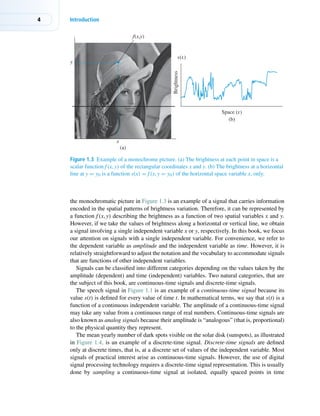
Figure1.3 Example of a monochrome picture. (a) The brightness at each point in space is a
scalar function f(x, y) of the rectangular coordinates x and y. (b) The brightness at a horizontal
line at y = y0 is a function s(x) = f(x, y = y0) of the horizontal space variable x, only.
the monochromatic picture in Figure 1.3 is an example of a signal that carries information
encoded in the spatial patterns of brightness variation. Therefore, it can be represented by
a function f(x, y) describing the brightness as a function of two spatial variables x and y.
However, if we take the values of brightness along a horizontal or vertical line, we obtain
a signal involving a single independent variable x or y, respectively. In this book, we focus
our attention on signals with a single independent variable. For convenience, we refer to
the dependent variable as amplitude and the independent variable as time. However, it is
relatively straightforward to adjust the notation and the vocabulary to accommodate signals
that are functions of other independent variables.
Signals can be classified into different categories depending on the values taken by the
amplitude (dependent) and time (independent) variables. Two natural categories, that are
the subject of this book, are continuous-time signals and discrete-time signals.
The speech signal in Figure 1.1 is an example of a continuous-time signal because its
value s(t) is defined for every value of time t. In mathematical terms, we say that s(t) is a
function of a continuous independent variable. The amplitude of a continuous-time signal
may take any value from a continuous range of real numbers. Continuous-time signals are
also known as analog signals because their amplitude is “analogous” (that is, proportional)
to the physical quantity they represent.
The mean yearly number of dark spots visible on the solar disk (sunspots), as illustrated
in Figure 1.4, is an example of a discrete-time signal. Discrete-time signals are defined
only at discrete times, that is, at a discrete set of values of the independent variable. Most
signals of practical interest arise as continuous-time signals. However, the use of digital
signal processing technology requires a discrete-time signal representation. This is usually
done by sampling a continuous-time signal at isolated, equally spaced points in time
demonstrates that, whilehis judgment is crippled, his ambition
stands as tall and as straight as a mountain pine.
The tickets are brought to the field—the General against
Machiavelli Clay, with ex-Cabineteer Van Buren, and a Whig obscurity
named Sargent running for second place. The issue presents the
alternative—the General or the Bank, humanity in a death-hug with
Money.
Machiavelli Clay and Banker Biddle have no fears; for they are
gold-blind and can see nothing beyond themselves. They are given a
rude awakening. The people speak; and when the sound of that
speaking dies out, the General has overwhelmed Machiavelli Clay
with two hundred and nineteen electoral votes against the latter's
sixty-nine. Machiavelli Clay and Banker Biddle and the Bank go
down, while the General—ever the conqueror and never once the
conquered—sweeps back to the presidency. Also ex-Cabineteer Van
Buren is made Vice-President, as aforetime resolved upon by the
General and Wizard Lewis, and from that Senate eminence, so lately
vacated by Statesman Calhoun, will wield the gavel over togaed
discussion.
The General, President the second time, picks up the reins, settles
himself upon the box, and proceeds to drive his governmental times
after this wise. He kills out what few sparks of life still animate the
Biddle Bank. He removes the Creeks and Cherokees from Florida and
Georgia, and thereby guarantees the scalp on many an innocent
head. He throws open the public lands for settlement at nominal
figures. He fosters a gold currency and discourages paper.
He pays off the last splinter of the national debt, and offers to the
wondering eyes of history the spectacle of a country that doesn't
owe a dollar. He makes commercial treaties with every tribe of
Europe. Finally, he compels France to pay five millions in gold for
outrages long ago committed upon the sailors of America.
The last is not brought about without some show of force. France,
at the General's demand, falls into a white heat of rage and froths
for instant war. The General takes France at her warlike word,
23.
notifies Congress, andorders his fleet into the Mediterranean, the
flagship Constitution in the van.
The cool vigor of the move sets France gasping. She consults
England across the Channel, and is privily assured that whipping a
Yankee eighty-gun ship is a feat so difficult of marine
accomplishment that, like the blossoming of the century plant, it
would be foolish to look for it oftener than once in one hundred
years. It is England's impression, whispered in the Frankish ear, that
it will be cheaper to pay the five millions. Whereupon, France breaks
into diplomatic smiles, assures the General that her late war-rage
was mere humor and her froth a jest. And pays.
By way of a little junket, the General visits New England, and at
the genial sight of him that chill region thaws like icicles in July.
Indeed, the New England temperature rises to a height where
Harvard College confers upon the General the degree of Doctor of
Laws. At which Statesman Adams nurses his wrath with this entry in
his sour diary:
“Seminaries of learning have been timeservers and sycophants in
every age.”
The General has done his people many a service. He has defended
them from savage Red Stick Creeks, and savage Red-coat English
with their war cry of “Beauty and Booty!” Now he will do his
foremost work of all, and buckler them against the javelins of
treason, save them from between the jaws of a conspiracy—wolfish
and widespread for national destruction.
The conspiracy has its birth in the ambition-crazed bosom of
Statesman Calhoun; its shiboleth is “Nullification!”
“I would sooner,” said Caesar, when his courtiers were laughing at
the pompous mayor of a little mud town in Spain—“I would sooner
be first here than second in Rome!” And, centuries after, the
sentiment wakes a responsive echo in the jealous breast of
Statesman Calhoun.
Statesman Calhoun aims to follow the General in the headship of
American affairs. Defeated of that, he is resolved to sever those
24.
constitutional links whichbind his home-state of South Carolina to
her sister States in Federal Union, and declare her a nation by and of
herself.
In his new rôle of “seceder,” Statesman Calhoun makes this
impression on the English Harriet Martineau. After speaking of him
as involving himself tighter and tighter in spinnings of political
mysticism and fantastic speculation, she calls him a “cast-iron man”
and says:
“He (Calhoun) is eager, absorbed, overspeculative. I know of no
one who lives in such intellectual solitude. He meets men and
harangues them by the fireside as in the Senate. He is wrought like
a piece of machinery, set going vehemently by a weight, and stops
while you answer. He either passes by what you say, or twists it into
suitability with what is in his head, and begins to lecture again. He is
full of his 'Nullification,' and those who know the force that is in him
and his utter incapacity for modification by other minds, will no more
expect repose and self-retention from him than from a volcano in full
force. Relaxation is no longer in the power of his will. I never saw
anyone who gave me so completely the idea of 'possession.'”
By which the English woman would say that she thinks Statesman
Calhoun insane. She overstates, however, his “incapacity for
modification” and “self-retention.” There will come a day when he
does not pause, nor close his eyes in sleep, between Washington
and his home in South Carolina, such is his fear-spurred eagerness—
with the shadow of the gibbet all across him!—to stamp out what
fires of treason he has been at pains to kindle, and avoid that halter
which the General promises as their reward.
It is in Senate debate that Statesman Calhoun removes the mask
from his intended treason, and gives the world a glimpse of its
blackness. He threatens, unless the tariff be changed to match his
pleasure, that South Carolina will prevent its enforcement within her
borders. He declares South Carolina superior to the nation in her
powers, and proclaims for her the right to “nullify” what Federal laws
she deems inimical to her peculiar interest. He shows how South
Carolina will, as against the tariff contemplated, invoke that inherent
25.
right to “nullify,”and says, should the Washington government
attempt to coerce her, she will take herself out of the Union.
To this exposition of States rights, the General in the White House
listens with gathering scorn. He turns to Wizard Lewis:
“Why, sir,” he cries, addressing that Merlin of politics, “if one is to
believe Calhoun, the Union is like a bag of meal open at both ends.
No matter how you pick it up, the meal all runs out. I shall tie the
bag and save the country!”
Treason, however base, will have its friends, and Statesman
Calhoun goes not without “Nullification” followers. In his own
mischievous State the doctrine is received with open arms. The
Governor issues his proclamation; a convention of the people is
authorized by the Legislature. They are to meet at Columbia and
settle the details of “Nullification” in its practical workings out. They
do meet; and adopt unanimously an “Ordinance of Nullification”
which declares the tariff just made in Washington “Null, void, and no
law, nor binding upon this State, its officers or citizens.” They decree
that no duties, enjoined by such tariff, shall be paid or permitted to
be paid in any port of South Carolina. The closing assertion of the
“Ordinance” runs that, should the Government of the United States
try by force to collect the tariff duties, “The people of South Carolina
will thenceforth hold themselves absolved from all further obligation
to maintain or preserve their political connection with the people of
the other States, and will proceed to organize a separate
government, and do all other acts and things which sovereign and
independent States may of right do.”
26.
Following this doughtysetting-out of what one might call the
Palmetto-rattlesnake position, the Governor suggests military
associations on the model of the Minute Men of the Revolution, and
makes ready for what blood-letting shall be required to sustain
Statesman Calhoun in his new preachment. Altogether it is a South
Carolina day of bombast and blue cockades, with Statesman Calhoun
already chosen as the president of a coming “Southern Confederacy.”
While these dour matters are in process of Palmetto transaction,
Statesman Hayne encounters the lion-faced Webster on the floor of
the Senate, and the latter establishes forever the rightful supremacy
of the Federal Union, and demonstrates that the “Nullification” set
up by Statesman Calhoun is but the chimera of a jaundiced,
27.
ambition-bitten mind. Thuscanters the hour in the Senate and in
South Carolina; while up in the White House the General sits reading
a book.
28.
T
CHAPTER XXIII—THE FEDERAL
UNION:IT MUST BE PRESERVED
HE General is reading his book, when in walks Wizard Lewis.
The latter necromancer casually alludes to Statesman
Calhoun, and his pet infamy of “Nullification.” At this the
General's honest rage begins to mount.
“You bear witness, Major,” he cries—“you bear witness how
Calhoun is trying me! But by the living heavens, I'll uphold the law!”
Then, shaking the ponderous tome at Wizard Lewis, his finger
marking the place—“Here! I've been reading what old John Marshall
said in the case of Aaron Burr. He makes treason in its definition as
plain as a pikestaff. A man can't think treason; he can't talk treason;
he can only act treason. It requires an act—an overt act! Calhoun is
safe while he only talks or conspires. But let one of his followers
perform one act of opposition to the law, even if it be no more than
hand on sword hilt or just the snapping of a fireless flint against an
empty rifle-pan, and I have him. There would be the overt act
demanded by old Marshall; and he goes on to say that the overt act,
once committed, attaches to all of the conspirators and becomes the
act of each. I shall keep my ear as well as my eye, Major, on
Calhoun's State of South Carolina; and, at the first crackling of a
treasonable twig beneath a traitorous foot, into a felon's cell goes
he. Then we shall see what a hempen noose will do for him and his
'Nullification.'”
The General, the better to deliver this long oration, gets up and
walks the floor. Having concluded, down he drops into his chair
again, and to grubbing at old John Marshall.
The General and Wizard Lewis decide that a perfect White House
silence concerning “Nullification” is the proper course. The General
will sit mute, and never by so much as the arching of a bushy brow
29.
intimate what hewill do, should Statesman Calhoun push his treason
to that last extreme—that overt act of opposition to the Federal law
and its enforcement, demanded by the great Chief Justice. And so,
while arises all this turmoil of treason in the Senate and South
Carolina, the White House is as voiceless as a tomb.
While the General is silent, he is in no sort idle. He makes secret
preparations to bruise the head of the serpent of secession with a
heel of steel. He sends General Scott to South Carolina. Into Castle
Pinckney he conveys thousands of rifles. One by one his warships
drop into Charleston harbor, until, with broadsides trained upon the
town, scores of them ride at ominous anchor.
The General gets word to his ever-reliable Coffee. In those well-
nigh twenty years which have come and gone since the English were
swept up in fire at New Orleans, the hunting-shirt men in the
General's country of Tennessee have increased and multiplied. Their
numbers are such that at the end of twenty days the energetic
Coffee stands ready to cataract twenty-five thousand of them into
South Carolina at the lifting of the General's bony finger, and follow
these in forty days with twenty-five thousand more. Not content with
his fifty thousand hunting-shirt men from Tennessee, the General
arranges for an equal force from North Carolina and Georgia.
If ever a people stood within the shadow of doom it is our
treason-forging ones of South Carolina in these days of Nullification,
Columbia Conventions, Minute Men, and Blue Cockades.
Some of them are not so dim of eye but what they perceive as
much, and begin to catch their breath. Still a wrong, once it be set
rolling like a stone down hill, is difficult to overtake and stop. So,
while the heart of would-be Treason beats a little faster, and its
cheek turns a little whiter, as inklings of what the wordless General is
doing begin to creep about among Palmetto-rattlesnake coteries, the
work of making ready for black revolt proceeds.
In Washington, that grim silence of the White House grows
oppressive. There be prudent ones, among the nullifying adherents
of Statesman Calhoun, who are willing to play the part of traitor if no
30.
peril attend therôle. They are highly averse to the character if it
promise to thrust their sensitive necks into gallows danger. The
questions everywhere on the whispering lips of these timid treason
mongers are:
“What is the Jackson intention? What will the President do? Will he
look upon Nullification as merely some minor sin of politics? Or, will
he treat it as stark treason, and fall back on courts and hangman's
ropes?”
No one answers, for no one knows. As for the General himself, his
lips are as dumb as a statue's. Traitors may go wrong, or go right;
he will light no lamp for their guidance. The awful suspense is
carrying many of the treason mongers to the brink of hysteria. Even
Statesman Calhoun, morbid and ambition-mad, is made to pause.
He himself begins to wonder if it would not be as well and as wise to
measure in advance those iron-bound anti-treason lengths to which
the General stands ready to go.
To help them in their perplexity, Statesman
Calhoun and his Nullifying followers evolve a cunning scheme. In
its amiable execution, it should lay bare, they think, the purposes of
the General. Statesman Calhoun and his coconspirators have long
ago laid claim to the dead Jefferson as their patron saint of
“Nullification,” asserting that precious tenet to be his invention. They
decide to give a dinner in honor of the departed publicist. The dinner
shall take place on the dead Jefferson's birthday at the Indian
Queen. The General shall come as a guest. Statesman Calhoun and
his co-conspirators will be there. Statesman Calhoun will offer a
toast, declaratory of those superior rights over the Federal
government which he asserts in favor of the separate States. It shall
be a Nullification toast, one redolent of a State's right to secede from
the Federal Union.
Statesman Calhoun having launched his fireship of sentiment, the
General will be requested to give a toast. Should he comply, it is
believed by Statesman Calhoun and his co-conspirators that he will
in partial measure at least unlock his plans. If he refuse—why then,
31.
under the circumstances,his refusal will be pregnant of meaning. In
either event, he will be beneath the batteries of five hundred eyes,
and much should be read in his face.
That Jefferson dinner is an admirable device, one adapted to draw
the General's fire. Its authors go about felicitating themselves upon
their sagacity in evolving it.
“What say you, Major?” asks the General, when he receives the
invitation upon which so much of national good or ill may pend;
“what say you? Shall we humor them? You know what these
Calhoun traitors are after.”
“True!” responds Wizard Lewis; “they want to count us, and
measure us, in that business of their proposed treason.”
“I'll tell you what I think,” says the General, after a pause. “I'll fail
to attend; but you shall go, and be counted in my stead. Also, since
they'll expect a toast from me, I'll send them one in your care. I
hope they may find it to their villain liking—they and their archtraitor
Calhoun!”
The Indian Queen is a crowded hostelry that Jefferson night. The
halls and waiting rooms are thronged of eminent folk. Some are
there to attend the dinner; others for gossip and to hear the news.
As Wizard Lewis climbs the stairs to the banquet room on the
second floor, he encounters the lion-faced Webster coming down.
“There's too much secession in the air for me,” says the lion-faced
one, shrugging his heavy shoulders.
“If that be so,” returns Wizard Lewis, “it's a reason for remaining.”
Wizard Lewis mingles with the groups in the corridors and parlors,
for the banquet hall is not yet thrown open. Among these, he nods
his recognition of Colonel Johnson, of Kentucky, tall of form, grave of
brow, he who slew Tecumseh; Senator Benton, once of that safe
receptive cellar; the lean Rufus Choate, eaten of Federalism and the
worship of caste; Tom Corwin, round, humorous, with a face of
ruddy fun; Isaac Hill, gray and lame, the General's Senate friend
from New Hampshire whose insulted credit started the war on
Banker Biddle's bank; Editor Noah, of New York, as Hebraic and as
32.
red of headas Absalom; the quick-eyed Amos Kendall; Editor Blair,
who conducts the Globe, the General's mouthpiece in Washington;
the reckless Marcy, who declares that he sees “no harm in the
aphorism that 'to the victor belong the spoils of the enemy.'”
The dinner is spread. The decorations are studied in their
democracy. Hundreds of candles in many-armed iron branches blaze
and gutter about the great room. The high ceilings and the walls are
festooned of flags. The stars and stripes are draped over a portrait
of the dead Jefferson. Here and there are hung the flags of the
several States. With peculiar ostentation, and as though for
challenge, next to the national colors flows the Palmetto-rattlesnake
flag of South Carolina—Statesman Calhoun's emblem.
The dinner is profuse, and folk of appetite and fineness declare it
elegant. There is none of your long-drawn courses, so dear to Whigs
and Federalists. Black servants come and go, to shift plates and
knives, and carve at the call of a guest. At hopeful intervals along
the tables repose huge sirloins, and steaming rounds of beef. There
are quail pies; chickens fried and turkeys roasted; pies of venison
and rabbits, and pot pies of squirrels; soups and fishes and
vegetables; boiled hams, and giant dishes of earthenware holding
baked beans; roast suckling pigs, each with a crab-apple in his jaws;
corn breads and flour breads, and pancakes rolled with jellies;
puddings—Indian, rice, and plum; mammoth quaking custards.
Everywhere bristle ranks and double ranks of bottles and decanters;
a widest range of drinks, from whisky to wine of the Cape, is at
everybody's elbow. Also on side tables stand wooden bowls of
salads, supported by weighty cheeses; and, to close in the flanks,
pies—mince, pumpkin, and apple; with final coffee and slim, long
pipes of clay in which to smoke tobacco of Trinidad.
As the guests seat themselves, Chairman Lee proposes:
“The memory of Thomas Jefferson.”
The toast is drunk in silence. Then, with clatter of knife and fork,
clink of glasses, and hum of conversation, the feast begins.
33.
The General's absenceis a daunting surprise to many who do not
know how to construe it. Wizard Lewis, through Chairman Lee,
presents the General's regrets. He expected to be present, but is
unavoidably detained at the White House. The “regrets” are received
uneasily; the General's absence plainly gives concern to more than
one.
As the dinner marches forward, “Nullification” and secession are
much and loudly talked. They become so openly the burden of
conversation and are withal so loosely in the common air, that
sundry gentlemen—more timorous than loyal perhaps—make
pointless excuses, and withdraw.
Statesman Calhoun sits on the right hand of Chairman Lee. The
festival approaches the glass and bottle stage, and toasts are
offered. There are a round score of these; each smells of secession
and State's rights. The speeches which follow are even more
malodorous of treason than the toasts.
The hour is hurrying toward the late. Statesman Calhoun whispers
a word to Chairman Lee; evidently the urgent moment is at hand.
Statesman Calhoun hands a slip of paper to Chairman Lee. There
falls a stillness; laughter dies and talk is hushed.
Chairman Lee rises to his feet. He pays Statesman Calhoun many
flowery compliments.
“The distinguished statesman from South Carolina,” says Chairman
Lee in conclusion, “begs to propose this sentiment.” He reads from
the slip: “'The Federal Union! Next to our liberty, the most dear! May
we all remember that it can only be preserved by respecting the
rights of the States, and distributing equally the burdens and the
benefits of that Union!'”
The stillness of death continues—marked and profound; for, as
Chairman Lee resumes his seat, Wizard Lewis rises. All know his
relations with the General; every eye is on him with a look of
interrogation. Now when the Calhoun toast has been read, they scan
the face of Wizard Lewis, representative of the absent General, to
34.
note the effectof the shot. Wizard Lewis is admirable, and notably
steady.
“The President,” says Wizard Lewis, “when he sent his regrets,
sent also a sentiment.”
Wizard Lewis passes a folded paper to Chairman Lee, who opens
it and reads:
“'The Federal Union! It must be preserved!”'
The words fall clear as a bell—for some, perhaps, a bell of
warning. Statesman Calhoun's face is high and insolent. But only for
a moment. Then his glance falls; his brow becomes pallid, and
breaks into a pin-point sprinkle of sweat. He seems to shrink and
sear and wither, as though given some fleeting picture of the future,
and the gallows prophecy thereof. In the end he sits as though in a
kind of blackness of despair. The General is not there, but his words
are there, and Statesman Calhoun is not wanting of an impression of
the terrible meaning, personal to himself, which underlies them.
It is a moment ominous and mighty—a moment when a plot to
stampede history is foiled by a sentiment, and Treason's heart and
Treason's hand are palsied by a toast of seven words. And while
Statesman Calhoun, white and frightened and broken, is helpless in
the midst of his followers, the General sits alone and thoughtful with
his quiet White House pipe.
For all the plain sureness of that toast, the would-be rebellionists
now crave a surer sign. A member of Congress from South Carolina,
polite and insinuating, calls on the General.
“Mr. President,” says the insinuating signseeking one, suavely
deferential, “to-morrow I go back to my home. Have you any
message for the good folk of South Carolina?”
“Yes,” returns the General grimly, his hard blue eyes upon the
insinuating one, while his heavy brows are lowered in that falcon-
trick of menace—“yes; I have a message for the 'good folk of South
Carolina.' You may say to the 'good folk of South Carolina' that if one
of them so much as lift finger in defiance of the laws of this
35.
government, I shallcome down there. And I'll hang the first man I
lay hands on, to the first tree I can reach.”
36.
D
CHAPTER XXIV—THE ROUTOF
TREASON
EMOCRACY goes not without its defects, and there be times
when that very freedom wherewith it invests the citizen
spreads a snare to his feet. For a chief fault, Democracy is
apt to mislead ambitious ones, dominated of ego and a want of
patriotism in even parts. Such are prone to run liberty into license in
following forth the appetites of their own selfishness, and forget
where the frontiers of loyalty leave off and those of black treason
begin.
In a democracy, for your clambering narrowist to turn traitor is
never a far-fetched task. Being free to speak as he politically will
and, per incident, think as he politically will, he finds it no mighty
journey to the perilous assumption that he may act as he politically
will. Knowing his duty to guard the temple, he argues therefrom his
right to deface it. Treason fades into a mere abstraction—a crime
curious in this, that it is impossible of concrete commission.
Statesman Calhoun is among these ill-guided ones of topsy-turvy
patriotism. Blurred by ambition, soured of disappointment, license
and liberty have grown with him to be unconscious synonyms. The
laws against treason carry only a remonstrance, never a warning,
and—as he reads them—but deplore that civic villainy, while
threatening nothing of grief for what dark souls shall be guilty of it.
In this frame the General's stark sentiment, “The Federal Union! It
must be preserved!” and that subsequent hanging promise which, by
the mouth of the suave insinuating one, he sends to “the good folk
of South Carolina,” go beyond surprise with Statesman Calhoun, and
provide a shock. It is as though, walking in a trance of treason, he
knocks his head against the White House wall; his awakening is
rudely, painfully complete. That dream of a separate nation, with
37.
himself at itshead, gives way to hangman visions of rope and
gallows tree; and, from bending his energies to methods by which
he may take South Carolina out of the Union, he gives himself wholly
to the more tremulous enterprise of keeping himself out of jail.
Some hint of that recent literature, which the General found so
interesting, gets abroad, and many go reading the lucid dictum of
old Marshall. Treason as a crime becomes better understood; and—
by Statesman Calhoun at least—better feared. Moved of these fears,
Statesman Calhoun sends message after message into his restless
Palmetto-rattlesnake State of South Carolina commanding, nay
imploring, a present suspension of “Nullification.” His Palmetto-
rattlesnake adherents, while not understanding the danger which
fringes them about, have already found enough that is alarming in
the very air; and, for their own safety as much as his, are heedful to
regard that prayer for a “Nullification” passivity. The South Carolina
shouting ceases; the Minute Men rest on their traitorous arms; the
manufacture of blue cockades is abandoned; while the Columbia
convention devotes itself to innocuous adjournments from innocent
day to day.
While Palmetto-rattlesnake affairs are thus timidly quiescent, the
Senate itself—having read old Marshall, and being, moreover,
somewhat instructed by the watchful attitude of the General, who
sits in the White House a figure of frowning menace, both relentless
and fateful—devotes itself to the scaffold extrication of Statesman
Calhoun. Machiavelli Clay leads the rescue party. His is of an
opposite political church to that of Statesman Calhoun; but the pair
meet on the warm, common ground of a deathless hatred of the
General. Under the mollifying guidance of Machiavelli Clay, Senator
after Senator surrenders those pet schedules of tariff desired of his
own people, and puts the surrender on the expressive basis of
“saving the neck of Calhoun.”
When every possible tariff cut has been arranged, and Congress
adjourns, Statesman Calhoun makes his memorable homeward
flight. Horse after horse he rides down, night becomes as day; for
Death crouches on his crupper, and he must stay the Nullifying hand
38.
of South Carolinato save his own neck. He succeeds beyond his
deserts, and comes powdering into Columbia, worn and wan and
anxious, yet none the less ahead of that “overt act” whereof old
Marshall spoke, and for which the somber General waits.
Once among his own treason-hatching coterie, Statesman Calhoun
loses no moments, but breaks up the “Nullification” nest. Secession
dies in the shell, and the Columbia convention, with more speed
even than it displayed in passing it, repeals that “Ordinance of
Nullification.” Thereupon Statesman Calhoun draws his breath more
freely, as one who has been grazed by the sinister fangs of Fate;
while the inveterate General heaves a sigh of regret.
Wizard Lewis overhears the sigh, and questions it. At this the
General explains his disappointment.
“It would have been better,” says he, “had we shed a little blood.
This is not the end, Major; the serpent of treason is only bruised, not
slain. Had Calhoun run his course, a handful of hundreds might have
died. As affairs stand, however, the country must one day wade
knee-deep in blood to save itself. These men are not honest. Their
true purpose is the downfall of the Union. Their present pretext is
tariff; next time it will be slavery.”
By way of bringing the iniquity of “Nullification” before the people,
together with his views concerning it, the General seizes his big iron
pen, and scratches off a proclamation.
“I consider,” says he, “the power to annul a law of the United
States, assumed by one State, incompatible with the existence of
the Union, contradicted expressly by the Constitution, unauthorized
by either its letter or its spirit, inconsistent with every principle upon
which it was founded, and destructive of the great object for which it
was formed.”
The country, reading the General's exposition of the Union and its
Gibraltar-like character, breaks into bonfires, oratory, dinners,
barbecues, parades, and what other schemes of jubilation are
practiced by a free people. That is to say the country breaks into
these sundry jubilant things, if one except the truant State of South
39.
Carolina. In thatPalmetto-rattlesnake-ridden commonwealth there
prevails a sulky silence. No bonfires blaze, no barbecues scorch, no
dinners smoke, no parades march. Baffled in its would-be treasons,
afraid to stretch forth its nullifying hand lest the sword of retribution
strike it off at the wrist, it comports itself like a spoiled child
thwarted, and upholds its little dignity with a pout. No one heeds,
however; and, beyond an occasional baleful glance from the
General, the rest of the world leaves it to recover from that pout in
its own time and way.
When Congress reconvenes, Statesman Calhoun creeps back to
his Senate place. But the perils through which he has passed have
left their furrowing traces, and now he offers nothing, says nothing,
does nothing. His heart is water; his evil potentialities have oozed
away. Haunted of that hangman fear which still hag-rides him, he
abides mute, motionless, impotent, like some Satan in chains.
To further wound Statesman Calhoun, and in the mean, protesting
teeth of Machiavelli Clay, the Senate expunges from its record the
vote of censure it once passed upon the General. The resolution to
expunge is offered by Senator Benton who, as against a far-off
Nashville hour when only a generous cellar saved him from the
General's saw-handle, is to-day the latter's partisan and friend. The
General is hugely pleased by the censure-expunging resolution, and
has what Senate ones supported it—being fairly the whole Senate,
when one forgets Machiavelli Clay, and our chained, embittered
Satan, Statesman Calhoun—to a grand dinner in the East Room.
And now the official times wag prosperously with the General. His
friends are everywhere dominant, his enemies everywhere in retreat.
Also his hair, from iron gray, fades to milk-white.
Since nothing peculiar presses upon him in the way of opposition,
the General falls ill. He makes little of this, however; and cures
himself with tobacco, coffee, calomel, and lancets, while outraged
doctors groan. Likewise, he burns midnight oil in planning with
Wizard Lewis the elevation of Vice-President Van Buren, who he is
resolved shall have the presidency after him.
40.
While thus theGeneral lays his Van Buren plans, misguided
admirers bombard him with such marks of their regard as a phaëton
built of unbarked hickory, and a cheese weighing fourteen hundred
pounds. The latter sturdy confection is trundled into the White
House kitchen, from which coign of vantage it sends on high a
perfume so utterly urgent that none may stay in the White House
until it is removed. Following its going, the executive windows are
thrown open throughout a wind-swept afternoon, to the end that the
last suffocating reminder of that cheese shall be eliminated.
The General's hours as President are drawing to a close. His hopes
touching a successor carry through triumphantly, and Vice-President
Van Buren is selected to follow him. Neither Machiavelli Clay for the
Whigs, nor Statesman Calhoun among the Democrats, has the
courage to offer his own name to the people.
41.
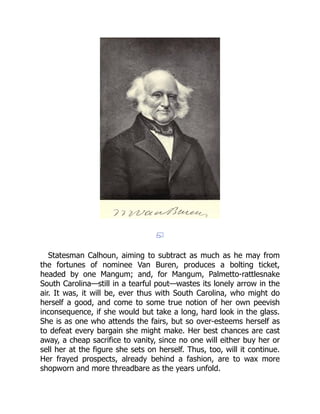
Statesman Calhoun, aimingto subtract as much as he may from
the fortunes of nominee Van Buren, produces a bolting ticket,
headed by one Mangum; and, for Mangum, Palmetto-rattlesnake
South Carolina—still in a tearful pout—wastes its lonely arrow in the
air. It was, it will be, ever thus with South Carolina, who might do
herself a good, and come to some true notion of her own peevish
inconsequence, if she would but take a long, hard look in the glass.
She is as one who attends the fairs, but so over-esteems herself as
to defeat every bargain she might make. Her best chances are cast
away, a cheap sacrifice to vanity, since no one will either buy her or
sell her at the figure she sets on herself. Thus, too, will it continue.
Her frayed prospects, already behind a fashion, are to wax more
shopworn and more threadbare as the years unfold.
42.
Nominee Van Burenis elected to succeed the General in the White
House, and every friend of the latter votes for the little polite man of
Kinderhook. The General is delighted, since the elevation of nominee
Van Buren provides for a continuation of his darling policies.
Wizard Lewis is delighted, because the new situation permits the
return of himself and his beloved General to their homes by the
Cumberland. Nor does it detract from the satisfaction of either that,
with the presidential coming of the Kinderhook one, the final door of
political hope is barred fast in the faces of Machiavelli Clay and
Statesman Calhoun; for both the General and Wizard Lewis hate
these two as though that hatred were a religious rite.
At last dawns President Van Buren's inauguration morning, and
the General stands for the last time before a people whose good and
whose honor he has so jealously guarded. Of this farewell
appearance, poet Willis writes:
“The air was elastic; the day bright and still. More than twenty
thousand people had assembled. The procession, the General and
Mr. Van Buren riding uncovered, arrived a little after noon. Their
carriage, drawn by four grays, paused. Descending from it at the
foot of the steps, a passage was made through the crowd, and the
tall white head of the old chieftain went steadily up. The crowd of
diplomats and senators to the rear gave way. A murmur of feeling
rose up from the moving mass below, as the infirm old General,
coming as he had from a sick chamber which his physicians had
thought it impossible he should leave, stood bowed before the
people.”
In his address the General touches many things. He closes by
saying: “My own race is nearly run. Advanced age and failing health
warn me that I must soon pass beyond the reach of human events. I
thank God my life has been spent in a land of liberty, and that He
gave me a heart wherewith to love my country. Filled with gratitude,
I bid you farewell.”
44.
T
CHAPTER XXV—THE GRAVEAT THE
GARDEN'S FOOT
HE General wends his slow way homeward, and is two months
about the journey. His progress, broken by many stops, is like
both a triumph and a funeral; for double ranks of worshipers
line the route and sob or cheer as he passes. The harsh horse-face
is seamed of care and worn by sickness; but the slim form is still
erect and lance-like, and the blue eyes gleam as hawkishly
dangerous as when, behind his low mud walls with the faithful
Coffee and his hunting-shirt men, he broke down England's pride at
New Orleans. Everywhere the people press about him; for republics
are not ungrateful, and for once in a way of politics it is the setting,
not the rising sun upon which all eyes are centered. In the end he
reaches home, and his country of the Cumberland, as on many a
former day, opens its arms to receive him.
And now the General, for all his sickness and his well-nigh
threescore years and ten, must bend himself to his labors as a
planter; for he has come back very poor. He has his acres and his
slaves; but debts have piled themselves high, and the tooth of decay
can do a devastating deal in eight years.
The General goes to work as though life is just begun. The fences
are renewed, the buildings repaired, while the plow breaks fresh
furrows in fields that have lain fallow too long. To finance his plans,
he borrows ten thousand dollars from Editor Blair. Later, by a huddle
of months, Congress repays him that one-thousand-dollar fine, of
which a quarter of a century before he was mulcted in New Orleans.
This latter, interest swollen, is twenty-seven hundred dollars—a sum
not treated lightly in this hour of his narrowed fortunes!
All goes prosperously. The generous soil, as though for welcome
to the General, grants such crops of cotton that the wondering
45.
Cumberland folk, asonce they did aforetime, come miles to view his
fields. When not busy with his planting, the General is immersed in
politics. Each day he rides down to Wizard Lewis four miles below;
or Wizard Lewis rides those four miles up to the Hermitage. Being
together, the pair, over pipe and moderate glass, sagely consider the
state of the nation.
Down by the General's gate is a large-stomached mail box. Each
morning finds it stuffed to suffocation with sheaves of letters and
papers tied in bundles. Also there are shoals and shoals of visitors.
For the General's home is a Mecca of politics, to which pilgrims of
party turn their steps by ones and twos and tens. Some come to do
the stark old General honor; some are one-time comrades, or friends
who rose up around him on fields of party war. For the most,
however, and because humanity is selfish before it is either just or
generous, the visitors are office-seeking folk, who ask the magic of
the General's signature to their appeals.
These selfish ones become, in their vermin number and
persistency, a very plague. They wring from the suffering General
the following:
“The good book, Major,” says he to Wizard Lewis, “tells us that at
the beginning there were in Eden a man, a woman, and an office
seeker who had been kicked out of heaven for preaching
'Nullification' I To judge of the visiting procession, as it streams in
and out of my front gate, I should say that the latter in his
descendants has increased and multiplied far beyond the other two.”
The French king forgets and forgives those grievous five millions,
and dispatches an artist of celebration to paint the General's portrait.
The artist finds the latter of a mind to humor the French king. The
portrait is painted—a striking likeness!—and the gratified artist
carries it victoriously across seas to his royal master.
46.
The General becomesconcerned in keeping England from stealing
Oregon, and writes letters to the Government at Washington in
protest against it.
“Oregon or war!” is his counsel.
Just as deeply does he involve himself for the admission of Texas
into the Union, declaring that of right the nation's boundary should
be, and, save for the criminal carelessness of Statesman Adams on
the occasion of the last treaty with Spain—made in a Monroe hour—
would be, the Rio Grande. Statesman Adams, now in his icy old age,
makes a speech in Boston and denies this; whereat the General
retorts in an open letter that Statesman Adams is “a monarchist in
disguise,” a “traitor,” a “falsifier,” and his “entire address full of
47.
statements at warwith truth, and sentiments hostile to every dictate
of patriotism.”
Machiavelli Clay foolishly invades the Cumberland country on a
broad mission of personal politics, and he like Statesman Adams
makes a speech. Machiavelli Clay, however, does not talk of Oregon,
or Texas, or what shall be the nation's foreign policy, whether timid
or warlike. His is wholly and solely a party oration, and in it he pays
left-handed tribute to Aaron Burr, dead a decade. Machiavelli Clay
escapes no better with his offensive eloquence than does Statesman
Adams. The perilous old General from his Hermitage is instantly out
upon him with another open letter, of which the closing paragraph
says:
“How contemptible does this lying demagogue appear, when he
descends from his high place in the Senate, and roams over the
country retailing slanders against the dead.”
The General is much refreshed by these outbursts, and, in that
contentment of soul which follows, resolves to join the church. Long
ago he promised the blooming Rachel, fast asleep at the foot of the
garden, that once he be free from the muddy yoke of politics he will
accept religion, and now he keeps his word. He unites himself with
the congregation which worships in that little chapel, aforetime built
for the blooming Rachel, and, upon his coming into the fold, there
arises vast rejoicing throughout the ardent length and breadth of
Cumberland Presbyterianism.
The pastor, Dominie Edgar, calls often at the Hermitage; for he
feels that the General may require some special spiritual grooming.
One day he observes that convert's saw-handles, oiled and neat and
ready for blood, on a mantel, prayerfully crossed beneath a portrait
of the blooming Rachel. The good dominie is shocked, but does not
show it. He picks up one of the saw-handles.
“This has seen service, doubtless,” he remarks tentatively.
“Ay!” responds the General grimly; “it has seen good service.”
Dominie Edgar puts the saw-handle back in place, and his
curiosity pushes no farther afield. He rightly conjectures it to be the
48.
weapon which cutdown the slanderous Dickinson, and mentally
holds that it will more advantage the soul of his convert to touch as
scantily as may be upon topics so ferocious. Shifting his ground,
Dominie Edgar asks:
“General, do you forgive your enemies?”
“Parson,” says the convert, “I forgive my enemies, and welcome.
But I shall never”—here he points up at the portrait of the blooming
Rachel, which seems to lovingly follow his every motion with its
painted patient eyes—“I shall never forgive her enemies. My feud
shall follow them, and the memory of them, to the end of time.”
Dominie Edgar sits down with his convert to show him the error of
his obdurate ways. He lectures cogently. It is to be feared, however,
that his doctrinal seed of forgiveness falls upon hard, intractable
ground; for, while the convert says never a word, the lecture serves
but to light again in those blue eyes what lamps of hateful battle
burned there on a certain fierce May morning in that popular
Kentucky wood.
The long days come and go, and the General lives on in fortune,
peace, and honor. Then the end draws down; for the General has
run his threescore years and ten, and well-nigh ten years more.
Wizard Lewis sits by his bedside, and never leaves him.
“I want to go, Major,” murmurs the General to Wizard Lewis; “for
she is over there.” He raises his eyes to the portrait of the blooming
Rachel, and looks upon it long and lovingly. “Major!”—Wizard Lewis
presses the thin hand—“see that they make my grave by her side at
the garden's foot!”
The General drifts into a stupor, Wizard Lewis holding fast his
hand. The good dominie Edgar is on his knees at prayer. From the
porch outside the sick room are heard the sobs and moans of the
mourning blacks.
Wizard Lewis attempts to recall the dying General.
“What would you have done with Calhoun,” he asks, “had he
persisted in his 'Nullification' designs?”
The blue eyes rouse, and sparkle and glance with old-time fire.
49.
“What would Ihave done with Calhoun?” repeats the General, his
voice renewed and strong; “Hanged him, sir!—hanged him as high
as Haman! He should have been a warning to traitors for all time!”
The sparkle subsides; the blue eyes close again in the dullness of
coming death. Wizard Lewis holds the poor thin hand, while Dominie
Edgar prays on to the accompaniment of the sobbing and the
moaning of the sorrowing blacks.
The prayer ends; the good dominie rises to his feet.
“Do you know me, General?” he whispers. The dim eyes are lifted
to those of Dominie Edgar. The latter goes on: “The love of the Lord
is infinite! In it you shall find heaven!”
The General turns with looks of love to the portrait of the
blooming Rachel.
“Parson,” says he, “I must meet her there, or it will be no heaven
for me.”
The General's head droops heavily forward. Dominie Edgar falls
upon his knees, and the voice of his praying goes upward with the
moaning and the sobbing of the slaves. Wizard Lewis places his
hand on the General's breast. He sighs, and shakes his head. That
mighty heart, all love, all iron, is still.
THE END
50.
Welcome to ourwebsite – the ideal destination for book lovers and
knowledge seekers. With a mission to inspire endlessly, we offer a
vast collection of books, ranging from classic literary works to
specialized publications, self-development books, and children's
literature. Each book is a new journey of discovery, expanding
knowledge and enriching the soul of the reade
Our website is not just a platform for buying books, but a bridge
connecting readers to the timeless values of culture and wisdom. With
an elegant, user-friendly interface and an intelligent search system,
we are committed to providing a quick and convenient shopping
experience. Additionally, our special promotions and home delivery
services ensure that you save time and fully enjoy the joy of reading.
Let us accompany you on the journey of exploring knowledge and
personal growth!
ebookluna.com