WISCONSIN INTERNATIONAL
UNIVERSITY, GHANA
GYNAECOLOGY: Mid 407
CLASS: Midwifery (Weekend)
LEVEL: 400L
PRESENTERS:
NAME INDEX NO.
PRISCILLA TETTEY-ASHER 1150470
ZAKIYATU SUHUYINI ABDULAI WIUC150202
PRESENTATION TOPIC
PREVENTION OF
MOTHER TO CHILD
TRANSMISSION OF HIV
INTRODUCTION
HIV/AIDS remains a global health challenge,
affecting millions of people worldwide.
Among the most vulnerable are infants born
to HIV-positive mothers. Mother-to-child
transmission (MTCT) of HIV, also known as
vertical transmission, can occur during
pregnancy, childbirth, or breastfeeding.
However, with effective interventions and
strategies, it is possible to prevent the
transmission of HIV from mother to child.
Understanding PMTCT
PMTCT, or Prevention of Mother-to-Child
Transmission, is a comprehensive approach
aimed at reducing the risk of HIV
transmission from an HIV-positive mother to
her child. PMTCT encompasses a series of
strategies, including antenatal care, HIV
testing, antiretroviral therapy (ART), safe
delivery practices, postnatal care, and
breastfeeding guidelines.
Key Components of PMTCT
o Antenatal Care
o HIV Testing and Counselling
o Antiretroviral Therapy (ART)
o Safe Delivery Practices
o Postnatal Care
o Breastfeeding and PMTCT
1. Early and regular prenatal check-ups.
2. Routine HIV testing for all pregnant women.
3. Detection of HIV infection to initiate
interventions early in pregnancy
Antenatal Care
1. Voluntary Counseling and Testing (VCT)
services.
2. Encouraging pregnant women and their partners
to know their HIV status.
3. Reducing stigma and discrimination associated
with HIV testing.
HIV Testing and Counselling
• Administering antiretroviral drugs to HIV-positive
pregnant women.
• Reducing the viral load, lowering the risk of
transmission.
• Ensuring adherence to ART to maintain low viral
loads.
Antiretroviral Therapy (ART)
• Choosing the appropriate delivery method
(Cesarean section or vaginal delivery).
• Taking measures to minimize the risk of rupturing
membranes during labor.
• Reducing the chances of exposure to the virus
during childbirth.
Safe Delivery Practices
• Continuous monitoring of the mother's health and
viral load.
• Initiating or maintaining ART for the mother.
• Providing care, support, and follow-up for the
newborn.
Postnatal Care
• Promoting exclusive breastfeeding for the first six
months.
• Administering ART to both mother and baby
during the breastfeeding period.
• Balancing the benefits of breastfeeding with the
risk of transmission.
Breastfeeding and PMTCT
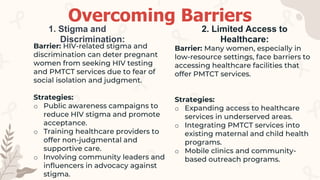
Barrier: HIV-related stigma and
discrimination can deter pregnant
women from seeking HIV testing
and PMTCT services due to fear of
social isolation and judgment.
Strategies:
o Public awareness campaigns to
reduce HIV stigma and promote
acceptance.
o Training healthcare providers to
offer non-judgmental and
supportive care.
o Involving community leaders and
influencers in advocacy against
stigma.
1. Stigma and
Discrimination:
Barrier: Many women, especially in
low-resource settings, face barriers to
accessing healthcare facilities that
offer PMTCT services.
Strategies:
o Expanding access to healthcare
services in underserved areas.
o Integrating PMTCT services into
existing maternal and child health
programs.
o Mobile clinics and community-
based outreach programs.
2. Limited Access to
Healthcare:
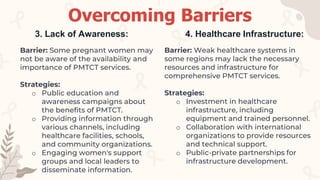
Overcoming Barriers
Barrier: Some pregnant women may
not be aware of the availability and
importance of PMTCT services.
Strategies:
o Public education and
awareness campaigns about
the benefits of PMTCT.
o Providing information through
various channels, including
healthcare facilities, schools,
and community organizations.
o Engaging women's support
groups and local leaders to
disseminate information.
3. Lack of Awareness:
Barrier: Weak healthcare systems in
some regions may lack the necessary
resources and infrastructure for
comprehensive PMTCT services.
Strategies:
o Investment in healthcare
infrastructure, including
equipment and trained personnel.
o Collaboration with international
organizations to provide resources
and technical support.
o Public-private partnerships for
infrastructure development.
4. Healthcare Infrastructure:
Overcoming Barriers
Success Stories
PMTCT programs have seen significant
successes in various parts of the world, where
comprehensive strategies and interventions
have resulted in a significant reduction in
pediatric HIV infections. Real-life stories of
women and children who have benefited from
PMTCT can be a source of inspiration and
hope.
National and International Efforts
Governments, international organizations,
healthcare institutions, and non-
governmental organizations are working
together to strengthen PMTCT initiatives.
These efforts include policy development,
education, and increased access to
healthcare services for pregnant women.
CONCLUSION
In conclusion, PMTCT is a vital component of the
global effort to combat HIV/AIDS. Through
comprehensive strategies that encompass antenatal
care, HIV testing, ART, safe delivery, postnatal care,
and informed breastfeeding practices, we can
significantly reduce the risk of mother-to-child
transmission and give children a healthier start in
life.
REFERENCES
o De Cock KM, et al. Prevention of mother-to-child HIV transmission in
resource-poor countries: translating research into policy and practice.
JAMA. 2000;283(9):1175–82.
o Orne-Gliemann J, et al. Children and HIV/AIDS: from research to
policy and action in resource-limited settings. AIDS. 2008;22(7):797–
805.
o Kuhn L, et al. Effects of early, abrupt weaning on HIV-free survival of
children in Zambia. N Engl J Med. 2008;359:130–41.
o Kafulafula G, et al. Frequency of gastroenteritis and gastroenteritis-
associated mortality with early weaning of HIV-1 uninfected children
born to HIV-infected women in Malawi. JAIDS. 2010;53(1):6–13.
THANK YOU
FOR YOUR
ATTENTION

PMTCT.pptx

  • 1.
    WISCONSIN INTERNATIONAL UNIVERSITY, GHANA GYNAECOLOGY:Mid 407 CLASS: Midwifery (Weekend) LEVEL: 400L
  • 2.
    PRESENTERS: NAME INDEX NO. PRISCILLATETTEY-ASHER 1150470 ZAKIYATU SUHUYINI ABDULAI WIUC150202
  • 3.
    PRESENTATION TOPIC PREVENTION OF MOTHERTO CHILD TRANSMISSION OF HIV
  • 4.
    INTRODUCTION HIV/AIDS remains aglobal health challenge, affecting millions of people worldwide. Among the most vulnerable are infants born to HIV-positive mothers. Mother-to-child transmission (MTCT) of HIV, also known as vertical transmission, can occur during pregnancy, childbirth, or breastfeeding. However, with effective interventions and strategies, it is possible to prevent the transmission of HIV from mother to child.
  • 5.
    Understanding PMTCT PMTCT, orPrevention of Mother-to-Child Transmission, is a comprehensive approach aimed at reducing the risk of HIV transmission from an HIV-positive mother to her child. PMTCT encompasses a series of strategies, including antenatal care, HIV testing, antiretroviral therapy (ART), safe delivery practices, postnatal care, and breastfeeding guidelines.
  • 6.
    Key Components ofPMTCT o Antenatal Care o HIV Testing and Counselling o Antiretroviral Therapy (ART) o Safe Delivery Practices o Postnatal Care o Breastfeeding and PMTCT
  • 7.
    1. Early andregular prenatal check-ups. 2. Routine HIV testing for all pregnant women. 3. Detection of HIV infection to initiate interventions early in pregnancy Antenatal Care
  • 8.
    1. Voluntary Counselingand Testing (VCT) services. 2. Encouraging pregnant women and their partners to know their HIV status. 3. Reducing stigma and discrimination associated with HIV testing. HIV Testing and Counselling
  • 9.
    • Administering antiretroviraldrugs to HIV-positive pregnant women. • Reducing the viral load, lowering the risk of transmission. • Ensuring adherence to ART to maintain low viral loads. Antiretroviral Therapy (ART)
  • 10.
    • Choosing theappropriate delivery method (Cesarean section or vaginal delivery). • Taking measures to minimize the risk of rupturing membranes during labor. • Reducing the chances of exposure to the virus during childbirth. Safe Delivery Practices
  • 11.
    • Continuous monitoringof the mother's health and viral load. • Initiating or maintaining ART for the mother. • Providing care, support, and follow-up for the newborn. Postnatal Care
  • 12.
    • Promoting exclusivebreastfeeding for the first six months. • Administering ART to both mother and baby during the breastfeeding period. • Balancing the benefits of breastfeeding with the risk of transmission. Breastfeeding and PMTCT
  • 13.
    Barrier: HIV-related stigmaand discrimination can deter pregnant women from seeking HIV testing and PMTCT services due to fear of social isolation and judgment. Strategies: o Public awareness campaigns to reduce HIV stigma and promote acceptance. o Training healthcare providers to offer non-judgmental and supportive care. o Involving community leaders and influencers in advocacy against stigma. 1. Stigma and Discrimination: Barrier: Many women, especially in low-resource settings, face barriers to accessing healthcare facilities that offer PMTCT services. Strategies: o Expanding access to healthcare services in underserved areas. o Integrating PMTCT services into existing maternal and child health programs. o Mobile clinics and community- based outreach programs. 2. Limited Access to Healthcare: Overcoming Barriers
  • 14.
    Barrier: Some pregnantwomen may not be aware of the availability and importance of PMTCT services. Strategies: o Public education and awareness campaigns about the benefits of PMTCT. o Providing information through various channels, including healthcare facilities, schools, and community organizations. o Engaging women's support groups and local leaders to disseminate information. 3. Lack of Awareness: Barrier: Weak healthcare systems in some regions may lack the necessary resources and infrastructure for comprehensive PMTCT services. Strategies: o Investment in healthcare infrastructure, including equipment and trained personnel. o Collaboration with international organizations to provide resources and technical support. o Public-private partnerships for infrastructure development. 4. Healthcare Infrastructure: Overcoming Barriers
  • 15.
    Success Stories PMTCT programshave seen significant successes in various parts of the world, where comprehensive strategies and interventions have resulted in a significant reduction in pediatric HIV infections. Real-life stories of women and children who have benefited from PMTCT can be a source of inspiration and hope.
  • 16.
    National and InternationalEfforts Governments, international organizations, healthcare institutions, and non- governmental organizations are working together to strengthen PMTCT initiatives. These efforts include policy development, education, and increased access to healthcare services for pregnant women.
  • 17.
    CONCLUSION In conclusion, PMTCTis a vital component of the global effort to combat HIV/AIDS. Through comprehensive strategies that encompass antenatal care, HIV testing, ART, safe delivery, postnatal care, and informed breastfeeding practices, we can significantly reduce the risk of mother-to-child transmission and give children a healthier start in life.
  • 18.
    REFERENCES o De CockKM, et al. Prevention of mother-to-child HIV transmission in resource-poor countries: translating research into policy and practice. JAMA. 2000;283(9):1175–82. o Orne-Gliemann J, et al. Children and HIV/AIDS: from research to policy and action in resource-limited settings. AIDS. 2008;22(7):797– 805. o Kuhn L, et al. Effects of early, abrupt weaning on HIV-free survival of children in Zambia. N Engl J Med. 2008;359:130–41. o Kafulafula G, et al. Frequency of gastroenteritis and gastroenteritis- associated mortality with early weaning of HIV-1 uninfected children born to HIV-infected women in Malawi. JAIDS. 2010;53(1):6–13.
  • 19.