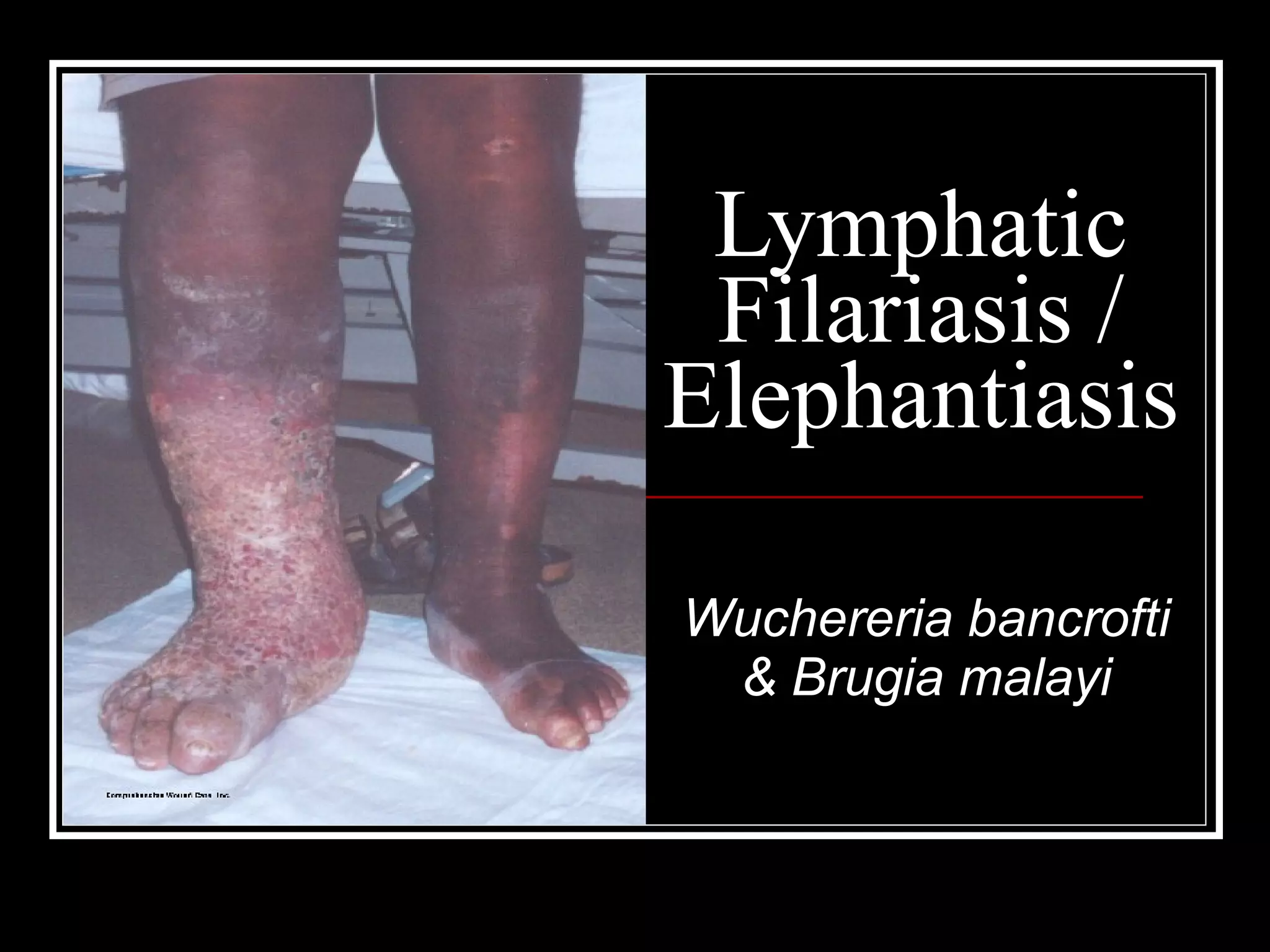
Lymphatic
Filariasis /
Elephantiasis
Wuchereria bancrofti
& Brugia malayi
What is it?
 Wuchereria bancrofti and Brugia malayi
are filarial nematodes
 Spread by several species of night -
feeding mosquitoes
 Causes lymphatic filariasis, also known
as Elephantiasis
 Commonly and incorrectly referred to as
“Elephantitis”
+
+ = ?
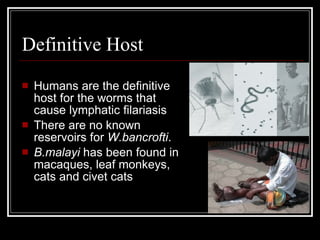
Definitive Host
 Humans are the definitive
host for the worms that
cause lymphatic filariasis
 There are no known
reservoirs for W.bancrofti.
 B.malayi has been found in
macaques, leaf monkeys,
cats and civet cats
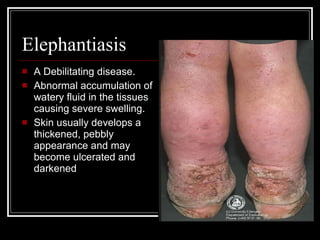
Elephantiasis
 A Debilitating disease.
 Abnormal accumulation of
watery fluid in the tissues
causing severe swelling.
 Skin usually develops a
thickened, pebbly
appearance and may
become ulcerated and
darkened
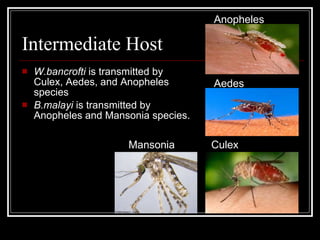
Intermediate Host
 W.bancrofti is transmitted by
Culex, Aedes, and Anopheles
species
 B.malayi is transmitted by
Anopheles and Mansonia species.
Anopheles
Aedes
Culex
Mansonia
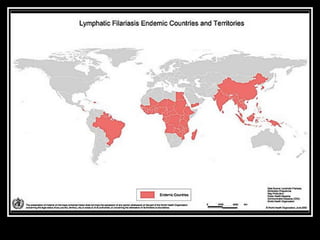
Geographic Range
 Lymphatic filariasis occurs in the tropics of
India, Africa, Southern Asia, the Pacific,
and Central and South America.
Terms to Know
 Elephantiasis: is a disease that is
characterized by the thickening of the skin and
underlying tissues, especially in the legs and
genitals.
 Filariasis: is a parasitic disease caused by
roundworms
 Lymph Edema: Is a condition of localized
fluid retention caused by a compromised
lymphatic system.
 Brugia malayi: a causative agent of human
lymphatic filariasis leading to lymph edema and
swelling of the legs
 Genome: a complete DNA sequence of one set
of chromosomes.
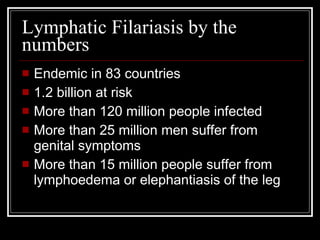
Lymphatic Filariasis by the
numbers
 Endemic in 83 countries
 1.2 billion at risk
 More than 120 million people infected
 More than 25 million men suffer from
genital symptoms
 More than 15 million people suffer from
lymphoedema or elephantiasis of the leg
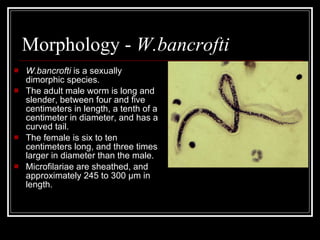
Morphology - W.bancrofti
 W.bancrofti is a sexually
dimorphic species.
 The adult male worm is long and
slender, between four and five
centimeters in length, a tenth of a
centimeter in diameter, and has a
curved tail.
 The female is six to ten
centimeters long, and three times
larger in diameter than the male.
 Microfilariae are sheathed, and
approximately 245 to 300 µm in
length.
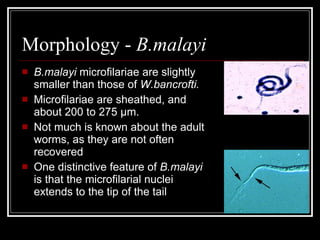
Morphology - B.malayi
 B.malayi microfilariae are slightly
smaller than those of W.bancrofti.
 Microfilariae are sheathed, and
about 200 to 275 µm.
 Not much is known about the adult
worms, as they are not often
recovered
 One distinctive feature of B.malayi
is that the microfilarial nuclei
extends to the tip of the tail
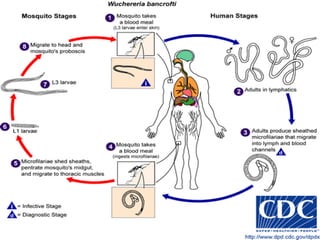
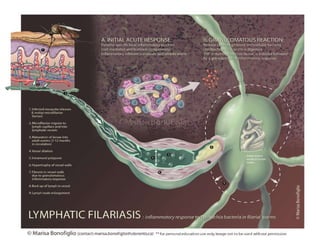
Wuchereria Life Cycle
Symptoms
 1. Asymptomatic: patients have hidden
damage to the lymphatic system and kidneys.
 2. Acute: attacks of ‘filarial fever’ (pain and
inflammation of lymph nodes and ducts, often
accompanied by fever, nausea and vomiting)
increase with severity of chronic disease.
 3. Chronic: may cause elephantiasis and
hydrocoele (swelling of the scrotum) in males
or enlarged breasts in females.
Diagnosis
 The standard method for diagnosing active
infection is the identification of microfilariae by
microscopic examination
 However, microfilariae circulate nocturnally,
making blood collection an issue
 A “card test” for parasite antigens requring only a
small amount of blood has been developed
 Does not require laboratory equipment
 Blood drawn by finger stick
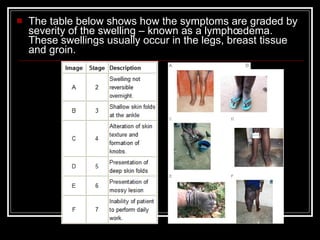
 The table below shows how the symptoms are graded by
severity of the swelling – known as a lymphœdema.
These swellings usually occur in the legs, breast tissue
and groin.
Control
 As with malaria, the most effective method
of controlling the spread of W.bancrofti and
B.malayi is to avoid mosquito bites
 The CDC recommends that anyone in at-
risk areas:
 Sleep under a bed net
 Wear long sleeves and trousers
 Wear insect repellent on exposed skin, especially
at night
Vector control
 Covering water-storage containers and
improving waste-water and solid-waste
treatment systems can help by reducing the
amount of standing water in which
mosquitoes can lay eggs.
 Killing eggs (oviciding) and killing or
disrupting larva (larviciding) in bodies of
stagnant water can further reduce mosquito
populations.
Treatment
 Treatment of filariasis involves two
components:
 Getting rid of the microfilariae in people's
blood
 Maintaining careful hygiene in infected
persons to reduce the incidence and
severity of secondary (e.g., bacterial)
infections.
Drugs, Drugs, Drugs!
 Anti-filariasis medicines commonly used include:
 Diethylcarbamazine (DEC)
 reduces microfilariae concentrations
 kills adult worms
 Albendazole
 kills adult worms
 Ivermectin
 kills the microfilariae produced by adult worms
…And more drugs!
 The disease is usually treated with single-
dose regimens of a combination of two
drugs, one targeting microfilariae and one
targeting adult worms (i.e.,either
diethylcarbamazine and albenadazole, or
ivermectin and albendazole
 In some areas, DEC laced table salt is used
as a prophylactic
Treatment 2: Manchester United 0
 If a high enough coverage of anti-filariasis drug
treatment can be achieved (treating greater than
80% of the people in a community), the disease
can be eradicated from an area.

 Attempts to eliminate the disease are being
helped considerably by Merck and Co., which is
donating ivermectin to treatment efforts, and
Smith Kline Beecham, which is donating
albendazole.
 The Gates Foundation has also donated millions
towards eliminating lymphatic filariasis
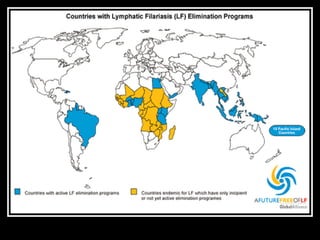
Elimination programs
Finally…
 http://youtube.com/watch?v=SkIryQ6Paqg

elephantiasisppt2783.pdf

  • 1.
  • 2.
    What is it? Wuchereria bancrofti and Brugia malayi are filarial nematodes  Spread by several species of night - feeding mosquitoes  Causes lymphatic filariasis, also known as Elephantiasis  Commonly and incorrectly referred to as “Elephantitis”
  • 3.
  • 4.
    Definitive Host  Humansare the definitive host for the worms that cause lymphatic filariasis  There are no known reservoirs for W.bancrofti.  B.malayi has been found in macaques, leaf monkeys, cats and civet cats
  • 5.
    Elephantiasis  A Debilitatingdisease.  Abnormal accumulation of watery fluid in the tissues causing severe swelling.  Skin usually develops a thickened, pebbly appearance and may become ulcerated and darkened
  • 6.
    Intermediate Host  W.bancroftiis transmitted by Culex, Aedes, and Anopheles species  B.malayi is transmitted by Anopheles and Mansonia species. Anopheles Aedes Culex Mansonia
  • 7.
    Geographic Range  Lymphaticfilariasis occurs in the tropics of India, Africa, Southern Asia, the Pacific, and Central and South America.
  • 8.
    Terms to Know Elephantiasis: is a disease that is characterized by the thickening of the skin and underlying tissues, especially in the legs and genitals.  Filariasis: is a parasitic disease caused by roundworms  Lymph Edema: Is a condition of localized fluid retention caused by a compromised lymphatic system.
  • 9.
     Brugia malayi:a causative agent of human lymphatic filariasis leading to lymph edema and swelling of the legs  Genome: a complete DNA sequence of one set of chromosomes.
  • 10.
    Lymphatic Filariasis bythe numbers  Endemic in 83 countries  1.2 billion at risk  More than 120 million people infected  More than 25 million men suffer from genital symptoms  More than 15 million people suffer from lymphoedema or elephantiasis of the leg
  • 11.
    Morphology - W.bancrofti W.bancrofti is a sexually dimorphic species.  The adult male worm is long and slender, between four and five centimeters in length, a tenth of a centimeter in diameter, and has a curved tail.  The female is six to ten centimeters long, and three times larger in diameter than the male.  Microfilariae are sheathed, and approximately 245 to 300 µm in length.
  • 12.
    Morphology - B.malayi B.malayi microfilariae are slightly smaller than those of W.bancrofti.  Microfilariae are sheathed, and about 200 to 275 µm.  Not much is known about the adult worms, as they are not often recovered  One distinctive feature of B.malayi is that the microfilarial nuclei extends to the tip of the tail
  • 13.
  • 15.
    Symptoms  1. Asymptomatic:patients have hidden damage to the lymphatic system and kidneys.  2. Acute: attacks of ‘filarial fever’ (pain and inflammation of lymph nodes and ducts, often accompanied by fever, nausea and vomiting) increase with severity of chronic disease.  3. Chronic: may cause elephantiasis and hydrocoele (swelling of the scrotum) in males or enlarged breasts in females.
  • 16.
    Diagnosis  The standardmethod for diagnosing active infection is the identification of microfilariae by microscopic examination  However, microfilariae circulate nocturnally, making blood collection an issue  A “card test” for parasite antigens requring only a small amount of blood has been developed  Does not require laboratory equipment  Blood drawn by finger stick
  • 17.
     The tablebelow shows how the symptoms are graded by severity of the swelling – known as a lymphœdema. These swellings usually occur in the legs, breast tissue and groin.
  • 18.
    Control  As withmalaria, the most effective method of controlling the spread of W.bancrofti and B.malayi is to avoid mosquito bites  The CDC recommends that anyone in at- risk areas:  Sleep under a bed net  Wear long sleeves and trousers  Wear insect repellent on exposed skin, especially at night
  • 19.
    Vector control  Coveringwater-storage containers and improving waste-water and solid-waste treatment systems can help by reducing the amount of standing water in which mosquitoes can lay eggs.  Killing eggs (oviciding) and killing or disrupting larva (larviciding) in bodies of stagnant water can further reduce mosquito populations.
  • 20.
    Treatment  Treatment offilariasis involves two components:  Getting rid of the microfilariae in people's blood  Maintaining careful hygiene in infected persons to reduce the incidence and severity of secondary (e.g., bacterial) infections.
  • 21.
    Drugs, Drugs, Drugs! Anti-filariasis medicines commonly used include:  Diethylcarbamazine (DEC)  reduces microfilariae concentrations  kills adult worms  Albendazole  kills adult worms  Ivermectin  kills the microfilariae produced by adult worms
  • 22.
    …And more drugs! The disease is usually treated with single- dose regimens of a combination of two drugs, one targeting microfilariae and one targeting adult worms (i.e.,either diethylcarbamazine and albenadazole, or ivermectin and albendazole  In some areas, DEC laced table salt is used as a prophylactic
  • 23.
    Treatment 2: ManchesterUnited 0  If a high enough coverage of anti-filariasis drug treatment can be achieved (treating greater than 80% of the people in a community), the disease can be eradicated from an area.  Attempts to eliminate the disease are being helped considerably by Merck and Co., which is donating ivermectin to treatment efforts, and Smith Kline Beecham, which is donating albendazole.  The Gates Foundation has also donated millions towards eliminating lymphatic filariasis
  • 24.
  • 25.