Prof. Dr. Sabine Seufert
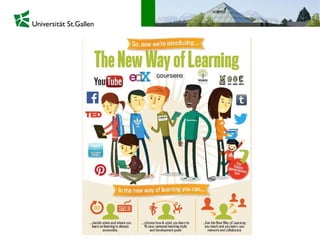
A pedagogical perspective on MOOCs:
Implications for Learning and Teaching in HE?
2
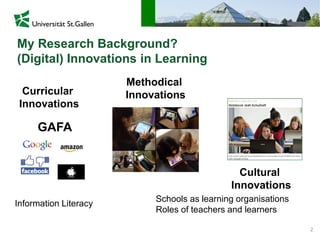
My Research Background?
(Digital) Innovations in Learning
GAFA
Curricular
Innovations
Cultural
Innovations
Methodical
Innovations
Information Literacy
Schools as learning organisations
Roles of teachers and learners
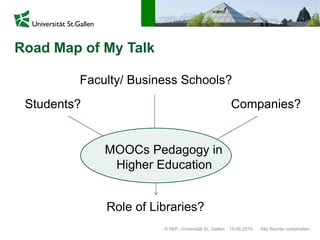
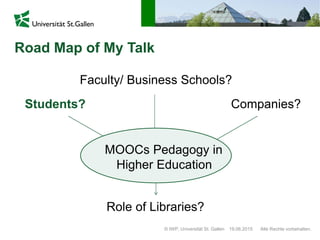
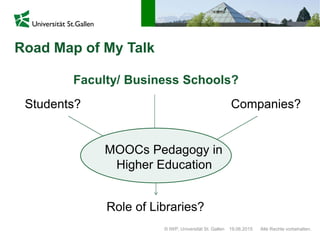
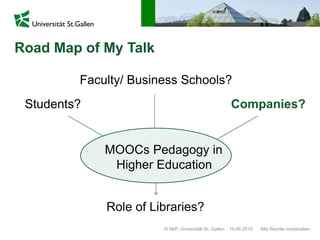
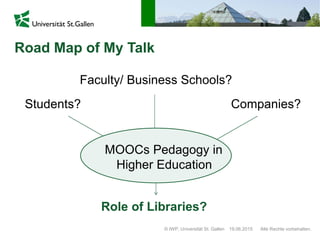
Road Map of My Talk
© IWP, Universität St. Gallen Alle Rechte vorbehalten.19.06.2015
Students? Companies?
Faculty/ Business Schools?
Role of Libraries?
MOOCs Pedagogy in
Higher Education
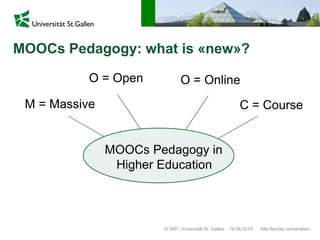
MOOCs Pedagogy: what is «new»?
© IWP, Universität St. Gallen Alle Rechte vorbehalten.19.06.2015
M = Massive
O = Open
C = Course
O = Online
MOOCs Pedagogy in
Higher Education
© IWP, Universität St. Gallen Alle Rechte vorbehalten.19.06.2015
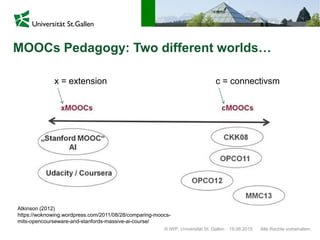
MOOCs Pedagogy: Two different worlds…
c = connectivsmx = extension
Atkinson (2012)
https://woknowing.wordpress.com/2011/08/28/comparing-moocs-
mits-opencourseware-and-stanfords-massive-ai-course/
© IWP, Universität St. Gallen Alle Rechte vorbehalten.19.06.2015
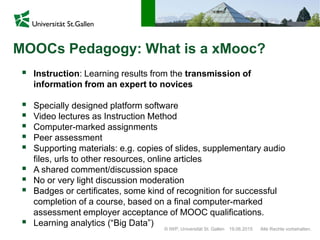
MOOCs Pedagogy: What is a xMooc?
 Instruction: Learning results from the transmission of
information from an expert to novices
 Specially designed platform software
 Video lectures as Instruction Method
 Computer-marked assignments
 Peer assessment
 Supporting materials: e.g. copies of slides, supplementary audio
files, urls to other resources, online articles
 A shared comment/discussion space
 No or very light discussion moderation
 Badges or certificates, some kind of recognition for successful
completion of a course, based on a final computer-marked
assessment employer acceptance of MOOC qualifications.
 Learning analytics (“Big Data”)
© IWP, Universität St. Gallen Alle Rechte vorbehalten.19.06.2015
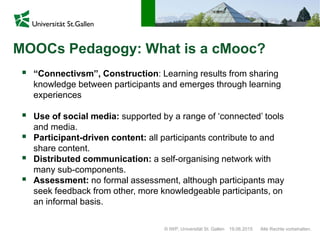
MOOCs Pedagogy: What is a cMooc?
 “Connectivsm”, Construction: Learning results from sharing
knowledge between participants and emerges through learning
experiences
 Use of social media: supported by a range of ‘connected’ tools
and media.
 Participant-driven content: all participants contribute to and
share content.
 Distributed communication: a self-organising network with
many sub-components.
 Assessment: no formal assessment, although participants may
seek feedback from other, more knowledgeable participants, on
an informal basis.
© IWP, Universität St. Gallen Alle Rechte vorbehalten.19.06.2015
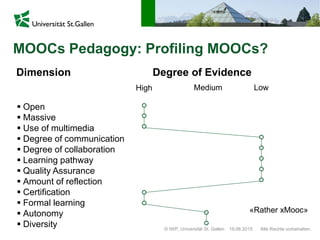
MOOCs Pedagogy: Profiling MOOCs?
 Open
 Massive
 Use of multimedia
 Degree of communication
 Degree of collaboration
 Learning pathway
 Quality Assurance
 Amount of reflection
 Certification
 Formal learning
 Autonomy
 Diversity
Degree of Evidence
LowMediumHigh
Dimension
«Rather xMooc»
© IWP, Universität St. Gallen Alle Rechte vorbehalten.19.06.2015
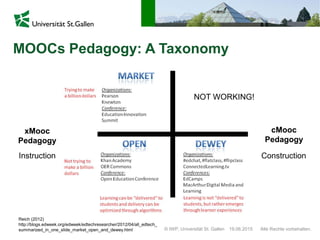
MOOCs Pedagogy: A Taxonomy
NOT WORKING!
xMooc
Pedagogy
cMooc
Pedagogy
Instruction Construction
Reich (2012)
http://blogs.edweek.org/edweek/edtechresearcher/2012/04/all_edtech_
summarized_in_one_slide_market_open_and_dewey.html
Road Map of My Talk
© IWP, Universität St. Gallen Alle Rechte vorbehalten.19.06.2015
Students? Companies?
Faculty/ Business Schools?
Role of Libraries?
MOOCs Pedagogy in
Higher Education
© IWP, Universität St. Gallen Alle Rechte vorbehalten.19.06.2015
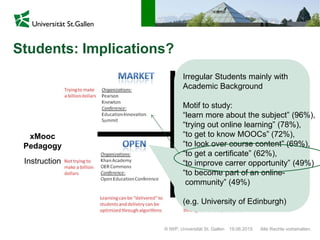
Students: Implications?
NOT WORKING!
cMooc
Pedagogy
Construction
Irregular Students mainly with
Academic Background
Motif to study:
“learn more about the subject” (96%),
“trying out online learning” (78%),
“to get to know MOOCs” (72%),
“to look over course content” (69%),
“to get a certificate” (62%),
“to improve carrer opportunity” (49%)
“to become part of an online-
community” (49%)
(e.g. University of Edinburgh)
xMooc
Pedagogy
Instruction
© IWP, Universität St. Gallen Alle Rechte vorbehalten.19.06.2015
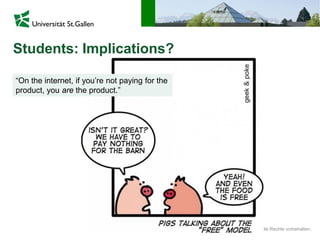
Students: Implications?
“On the internet, if you’re not paying for the
product, you are the product.”
© IWP, Universität St. Gallen Alle Rechte vorbehalten.19.06.2015
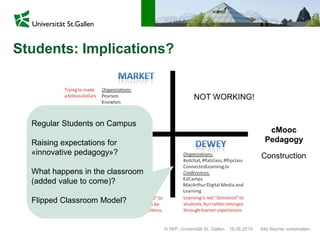
Students: Implications?
NOT WORKING!
Regular Students on Campus
Raising expectations for
«innovative pedagogy»?
What happens in the classroom
(added value to come)?
Flipped Classroom Model?
cMooc
Pedagogy
Construction
© IWP, Universität St. Gallen Alle Rechte vorbehalten.19.06.2015
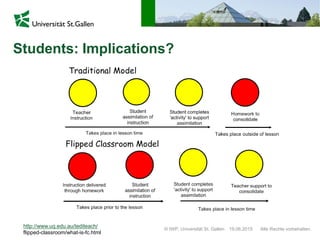
Students: Implications?
http://www.uq.edu.au/tediteach/
flipped-classroom/what-is-fc.html
Road Map of My Talk
© IWP, Universität St. Gallen Alle Rechte vorbehalten.19.06.2015
Students? Companies?
Faculty/ Business Schools?
Role of Libraries?
MOOCs Pedagogy in
Higher Education
© IWP, Universität St. Gallen Alle Rechte vorbehalten.19.06.2015
NOT WORKING!
xMooc
Pedagogy
cMooc
Pedagogy
Instruction Construction
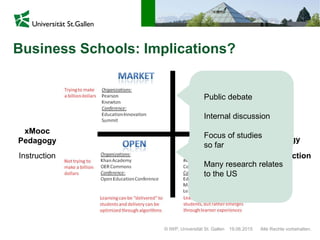
Public debate
Internal discussion
Focus of studies
so far
Many research relates
to the US
Business Schools: Implications?
© IWP, Universität St. Gallen Alle Rechte vorbehalten.19.06.2015
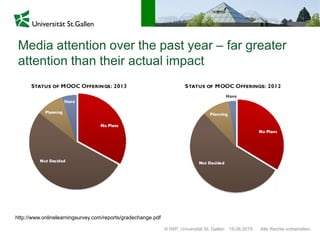
Media attention over the past year – far greater
attention than their actual impact
http://www.onlinelearningsurvey.com/reports/gradechange.pdf
© IWP, Universität St. Gallen Alle Rechte vorbehalten.19.06.2015
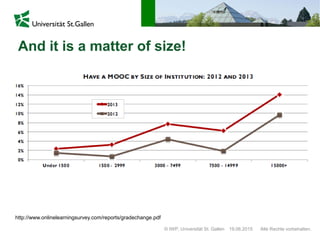
And it is a matter of size!
http://www.onlinelearningsurvey.com/reports/gradechange.pdf
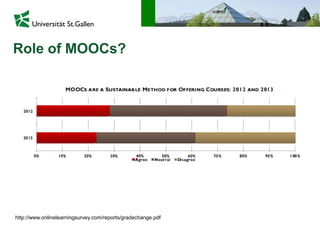
Role of MOOCs?
http://www.onlinelearningsurvey.com/reports/gradechange.pdf
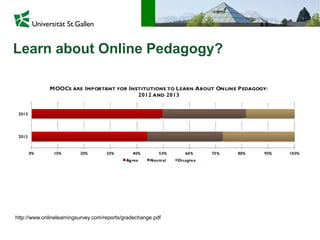
Learn about Online Pedagogy?
http://www.onlinelearningsurvey.com/reports/gradechange.pdf
© IWP, Universität St. Gallen Alle Rechte vorbehalten.19.06.2015
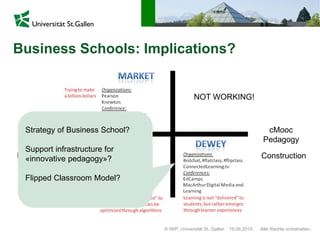
Business Schools: Implications?
NOT WORKING!
xMooc
Pedagogy
cMooc
Pedagogy
Instruction Construction
Strategy of Business School?
Support infrastructure for
«innovative pedagogy»?
Flipped Classroom Model?
Road Map of My Talk
© IWP, Universität St. Gallen Alle Rechte vorbehalten.19.06.2015
Students? Companies?
Faculty/ Business Schools?
Role of Libraries?
MOOCs Pedagogy in
Higher Education
© IWP, Universität St. Gallen Alle Rechte vorbehalten.19.06.2015
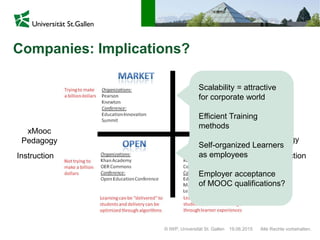
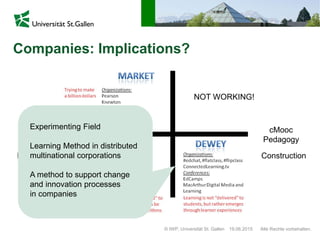
Companies: Implications?
NOT WORKING!
xMooc
Pedagogy
cMooc
Pedagogy
Instruction Construction
Scalability = attractive
for corporate world
Efficient Training
methods
Self-organized Learners
as employees
Employer acceptance
of MOOC qualifications?
Kearns, P. (2000). Reifegrad einer Bildungsorganisation
© IWP, Universität St. Gallen Alle Rechte vorbehalten.19.06.2015
Companies: Implications?
NOT WORKING!
xMooc
Pedagogy
cMooc
Pedagogy
Instruction Construction
Experimenting Field
Learning Method in distributed
multinational corporations
A method to support change
and innovation processes
in companies
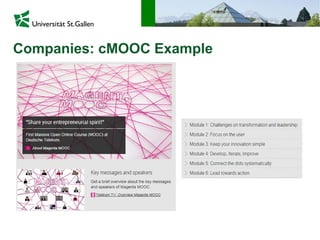
Companies: cMOOC Example
Road Map of My Talk
© IWP, Universität St. Gallen Alle Rechte vorbehalten.19.06.2015
Students? Companies?
Faculty/ Business Schools?
Role of Libraries?
MOOCs Pedagogy in
Higher Education
© IWP, Universität St. Gallen Alle Rechte vorbehalten.19.06.2015
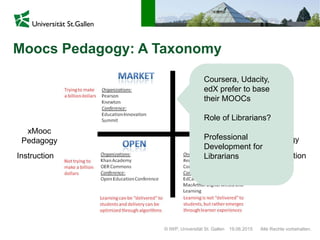
Moocs Pedagogy: A Taxonomy
NOT WORKING!
xMooc
Pedagogy
cMooc
Pedagogy
Instruction Construction
Coursera, Udacity,
edX prefer to base
their MOOCs
Role of Librarians?
Professional
Development for
Librarians
© IWP, Universität St. Gallen Alle Rechte vorbehalten.19.06.2015
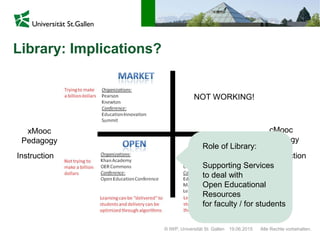
Library: Implications?
NOT WORKING!
xMooc
Pedagogy
cMooc
Pedagogy
Instruction Construction
Role of Library:
Supporting Services
to deal with
Open Educational
Resources
for faculty / for students
© IWP, Universität St. Gallen Alle Rechte vorbehalten.19.06.2015
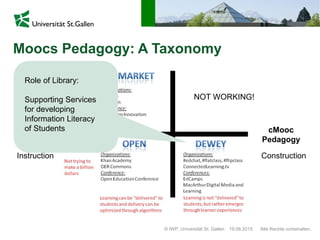
Moocs Pedagogy: A Taxonomy
NOT WORKING!
xMooc
Pedagogy
cMooc
Pedagogy
Instruction Construction
Role of Library:
Supporting Services
for developing
Information Literacy
of Students
© IWP, Universität St. Gallen Alle Rechte vorbehalten.19.06.2015
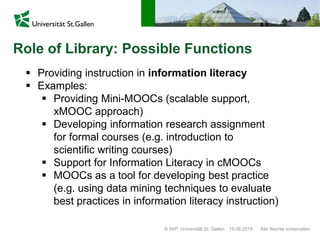
Role of Library: Possible Functions
 Copyright clearance
 Content licensing
 Alerting MOOC developers to open content
 Helping to ensure that MOOC content is accessible
to all users, including those using assistive technologies
 Encouraging the use of open licensing
 Providing instruction in information literacy
Barnes, C. (2015) MOOCs: The Challenges for Academic Librarians. Australian
Academic & Research Libraries, 44:3, 163-175
© IWP, Universität St. Gallen Alle Rechte vorbehalten.19.06.2015
Role of Library: Possible Functions
 Providing instruction in information literacy
 Examples:
 Providing Mini-MOOCs (scalable support,
xMOOC approach)
 Developing information research assignment
for formal courses (e.g. introduction to
scientific writing courses)
 Support for Information Literacy in cMOOCs
 MOOCs as a tool for developing best practice
(e.g. using data mining techniques to evaluate
best practices in information literacy instruction)
© IWP, Universität St. Gallen Alle Rechte vorbehalten.19.06.2015
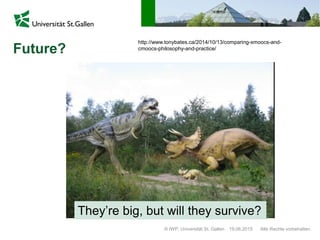
Future?
http://www.tonybates.ca/2014/10/13/comparing-xmoocs-and-
cmoocs-philosophy-and-practice/
They’re big, but will they survive?
© IWP, Universität St. Gallen Alle Rechte vorbehalten.19.06.2015
 Barnes, Cameron. MOOCs: The Challenges for Academic Librarians. Australian Academic &
Research Libraries, 44:3, 163-175, 2015, DOI: 10.1080/00048623.2013.821048
 Butler, Brandon. Issue Brief: Massive Open Online Courses: Legal and Policy Issues for
Research Libraries. (Washington, D.C.: Association of Research Libraries, 2012).
http://www.arl.org/storage/documents/publications/issuebrief-mooc-22oct12.pdf
 Educause Executive Briefing. “What Campus Leaders need to know about MOOCs,”
Educause, December 12, 2012, http://net.educause.edu/ir/library/pdf/PUB4005.pdf.
 Kazakoff-Lane, Carmen. Environmental Scan and Assessment of OERs, MOOCs and Libraries:
What Effectiveness and Sustainability Means for Libraries Impact on Open Education.
(Chicago, IL. Association of College and Research Libraries, 2014).
http://www.ala.org/acrl/sites/ala.org.acrl/files/content/publications/whitepapers/Environmental%
20Scan%20and%20Assessment.pdf
 OCLC. “MOOCs and Libraries: Massive Opportunity or Overwhelming Challenge”? Symposium
held at University of Pennsylvania, Philadelphia, Pennsylvania, March 18-19, 2013.
http://www.oclc.org/research/events/2013/03-
18.html?utm_source=WhatCountsEmail&utm_medium=OCLC%20Abstracts%20Test%20Group
%201&utm_campaign=OCLC%20Abstracts.
 Robertson, R. John. “What do Academic Libraries have to do with Open Educational
Resources?” In Open Ed 2010 Conference Proceedings, (Barcelona, Spain, 2010).
http://hdl.handle.net/10609/4847.
 Yuan, Li, Sheila MacNeill, and Wilbert Kraan. Open Educational Resources - Opportunities and
Challenges for Higher Education. (United Kingdom: JISC CETIS, 2008).
http://wiki.cetis.ac.uk/images/0/0b/OER_Briefing_Paper.pdf.
Recommended Readings

A pedagogical perspective on MOOCs: What are the implications for learning and teaching in Higher Education?

  • 1.
    Prof. Dr. SabineSeufert A pedagogical perspective on MOOCs: Implications for Learning and Teaching in HE?
  • 2.
    2 My Research Background? (Digital)Innovations in Learning GAFA Curricular Innovations Cultural Innovations Methodical Innovations Information Literacy Schools as learning organisations Roles of teachers and learners
  • 3.
    Road Map ofMy Talk © IWP, Universität St. Gallen Alle Rechte vorbehalten.19.06.2015 Students? Companies? Faculty/ Business Schools? Role of Libraries? MOOCs Pedagogy in Higher Education
  • 4.
    MOOCs Pedagogy: whatis «new»? © IWP, Universität St. Gallen Alle Rechte vorbehalten.19.06.2015 M = Massive O = Open C = Course O = Online MOOCs Pedagogy in Higher Education
  • 5.
    © IWP, UniversitätSt. Gallen Alle Rechte vorbehalten.19.06.2015 MOOCs Pedagogy: Two different worlds… c = connectivsmx = extension Atkinson (2012) https://woknowing.wordpress.com/2011/08/28/comparing-moocs- mits-opencourseware-and-stanfords-massive-ai-course/
  • 6.
    © IWP, UniversitätSt. Gallen Alle Rechte vorbehalten.19.06.2015 MOOCs Pedagogy: What is a xMooc?  Instruction: Learning results from the transmission of information from an expert to novices  Specially designed platform software  Video lectures as Instruction Method  Computer-marked assignments  Peer assessment  Supporting materials: e.g. copies of slides, supplementary audio files, urls to other resources, online articles  A shared comment/discussion space  No or very light discussion moderation  Badges or certificates, some kind of recognition for successful completion of a course, based on a final computer-marked assessment employer acceptance of MOOC qualifications.  Learning analytics (“Big Data”)
  • 7.
    © IWP, UniversitätSt. Gallen Alle Rechte vorbehalten.19.06.2015 MOOCs Pedagogy: What is a cMooc?  “Connectivsm”, Construction: Learning results from sharing knowledge between participants and emerges through learning experiences  Use of social media: supported by a range of ‘connected’ tools and media.  Participant-driven content: all participants contribute to and share content.  Distributed communication: a self-organising network with many sub-components.  Assessment: no formal assessment, although participants may seek feedback from other, more knowledgeable participants, on an informal basis.
  • 8.
    © IWP, UniversitätSt. Gallen Alle Rechte vorbehalten.19.06.2015 MOOCs Pedagogy: Profiling MOOCs?  Open  Massive  Use of multimedia  Degree of communication  Degree of collaboration  Learning pathway  Quality Assurance  Amount of reflection  Certification  Formal learning  Autonomy  Diversity Degree of Evidence LowMediumHigh Dimension «Rather xMooc»
  • 9.
    © IWP, UniversitätSt. Gallen Alle Rechte vorbehalten.19.06.2015 MOOCs Pedagogy: A Taxonomy NOT WORKING! xMooc Pedagogy cMooc Pedagogy Instruction Construction Reich (2012) http://blogs.edweek.org/edweek/edtechresearcher/2012/04/all_edtech_ summarized_in_one_slide_market_open_and_dewey.html
  • 10.
    Road Map ofMy Talk © IWP, Universität St. Gallen Alle Rechte vorbehalten.19.06.2015 Students? Companies? Faculty/ Business Schools? Role of Libraries? MOOCs Pedagogy in Higher Education
  • 11.
    © IWP, UniversitätSt. Gallen Alle Rechte vorbehalten.19.06.2015 Students: Implications? NOT WORKING! cMooc Pedagogy Construction Irregular Students mainly with Academic Background Motif to study: “learn more about the subject” (96%), “trying out online learning” (78%), “to get to know MOOCs” (72%), “to look over course content” (69%), “to get a certificate” (62%), “to improve carrer opportunity” (49%) “to become part of an online- community” (49%) (e.g. University of Edinburgh) xMooc Pedagogy Instruction
  • 12.
    © IWP, UniversitätSt. Gallen Alle Rechte vorbehalten.19.06.2015 Students: Implications? “On the internet, if you’re not paying for the product, you are the product.”
  • 13.
    © IWP, UniversitätSt. Gallen Alle Rechte vorbehalten.19.06.2015 Students: Implications? NOT WORKING! Regular Students on Campus Raising expectations for «innovative pedagogy»? What happens in the classroom (added value to come)? Flipped Classroom Model? cMooc Pedagogy Construction
  • 14.
    © IWP, UniversitätSt. Gallen Alle Rechte vorbehalten.19.06.2015 Students: Implications? http://www.uq.edu.au/tediteach/ flipped-classroom/what-is-fc.html
  • 15.
    Road Map ofMy Talk © IWP, Universität St. Gallen Alle Rechte vorbehalten.19.06.2015 Students? Companies? Faculty/ Business Schools? Role of Libraries? MOOCs Pedagogy in Higher Education
  • 16.
    © IWP, UniversitätSt. Gallen Alle Rechte vorbehalten.19.06.2015 NOT WORKING! xMooc Pedagogy cMooc Pedagogy Instruction Construction Public debate Internal discussion Focus of studies so far Many research relates to the US Business Schools: Implications?
  • 17.
    © IWP, UniversitätSt. Gallen Alle Rechte vorbehalten.19.06.2015 Media attention over the past year – far greater attention than their actual impact http://www.onlinelearningsurvey.com/reports/gradechange.pdf
  • 18.
    © IWP, UniversitätSt. Gallen Alle Rechte vorbehalten.19.06.2015 And it is a matter of size! http://www.onlinelearningsurvey.com/reports/gradechange.pdf
  • 19.
  • 20.
    Learn about OnlinePedagogy? http://www.onlinelearningsurvey.com/reports/gradechange.pdf
  • 21.
    © IWP, UniversitätSt. Gallen Alle Rechte vorbehalten.19.06.2015 Business Schools: Implications? NOT WORKING! xMooc Pedagogy cMooc Pedagogy Instruction Construction Strategy of Business School? Support infrastructure for «innovative pedagogy»? Flipped Classroom Model?
  • 22.
    Road Map ofMy Talk © IWP, Universität St. Gallen Alle Rechte vorbehalten.19.06.2015 Students? Companies? Faculty/ Business Schools? Role of Libraries? MOOCs Pedagogy in Higher Education
  • 23.
    © IWP, UniversitätSt. Gallen Alle Rechte vorbehalten.19.06.2015 Companies: Implications? NOT WORKING! xMooc Pedagogy cMooc Pedagogy Instruction Construction Scalability = attractive for corporate world Efficient Training methods Self-organized Learners as employees Employer acceptance of MOOC qualifications?
  • 24.
    Kearns, P. (2000).Reifegrad einer Bildungsorganisation
  • 25.
    © IWP, UniversitätSt. Gallen Alle Rechte vorbehalten.19.06.2015 Companies: Implications? NOT WORKING! xMooc Pedagogy cMooc Pedagogy Instruction Construction Experimenting Field Learning Method in distributed multinational corporations A method to support change and innovation processes in companies
  • 26.
  • 27.
    Road Map ofMy Talk © IWP, Universität St. Gallen Alle Rechte vorbehalten.19.06.2015 Students? Companies? Faculty/ Business Schools? Role of Libraries? MOOCs Pedagogy in Higher Education
  • 28.
    © IWP, UniversitätSt. Gallen Alle Rechte vorbehalten.19.06.2015 Moocs Pedagogy: A Taxonomy NOT WORKING! xMooc Pedagogy cMooc Pedagogy Instruction Construction Coursera, Udacity, edX prefer to base their MOOCs Role of Librarians? Professional Development for Librarians
  • 29.
    © IWP, UniversitätSt. Gallen Alle Rechte vorbehalten.19.06.2015 Library: Implications? NOT WORKING! xMooc Pedagogy cMooc Pedagogy Instruction Construction Role of Library: Supporting Services to deal with Open Educational Resources for faculty / for students
  • 30.
    © IWP, UniversitätSt. Gallen Alle Rechte vorbehalten.19.06.2015 Moocs Pedagogy: A Taxonomy NOT WORKING! xMooc Pedagogy cMooc Pedagogy Instruction Construction Role of Library: Supporting Services for developing Information Literacy of Students
  • 31.
    © IWP, UniversitätSt. Gallen Alle Rechte vorbehalten.19.06.2015 Role of Library: Possible Functions  Copyright clearance  Content licensing  Alerting MOOC developers to open content  Helping to ensure that MOOC content is accessible to all users, including those using assistive technologies  Encouraging the use of open licensing  Providing instruction in information literacy Barnes, C. (2015) MOOCs: The Challenges for Academic Librarians. Australian Academic & Research Libraries, 44:3, 163-175
  • 32.
    © IWP, UniversitätSt. Gallen Alle Rechte vorbehalten.19.06.2015 Role of Library: Possible Functions  Providing instruction in information literacy  Examples:  Providing Mini-MOOCs (scalable support, xMOOC approach)  Developing information research assignment for formal courses (e.g. introduction to scientific writing courses)  Support for Information Literacy in cMOOCs  MOOCs as a tool for developing best practice (e.g. using data mining techniques to evaluate best practices in information literacy instruction)
  • 33.
    © IWP, UniversitätSt. Gallen Alle Rechte vorbehalten.19.06.2015 Future? http://www.tonybates.ca/2014/10/13/comparing-xmoocs-and- cmoocs-philosophy-and-practice/ They’re big, but will they survive?
  • 34.
    © IWP, UniversitätSt. Gallen Alle Rechte vorbehalten.19.06.2015  Barnes, Cameron. MOOCs: The Challenges for Academic Librarians. Australian Academic & Research Libraries, 44:3, 163-175, 2015, DOI: 10.1080/00048623.2013.821048  Butler, Brandon. Issue Brief: Massive Open Online Courses: Legal and Policy Issues for Research Libraries. (Washington, D.C.: Association of Research Libraries, 2012). http://www.arl.org/storage/documents/publications/issuebrief-mooc-22oct12.pdf  Educause Executive Briefing. “What Campus Leaders need to know about MOOCs,” Educause, December 12, 2012, http://net.educause.edu/ir/library/pdf/PUB4005.pdf.  Kazakoff-Lane, Carmen. Environmental Scan and Assessment of OERs, MOOCs and Libraries: What Effectiveness and Sustainability Means for Libraries Impact on Open Education. (Chicago, IL. Association of College and Research Libraries, 2014). http://www.ala.org/acrl/sites/ala.org.acrl/files/content/publications/whitepapers/Environmental% 20Scan%20and%20Assessment.pdf  OCLC. “MOOCs and Libraries: Massive Opportunity or Overwhelming Challenge”? Symposium held at University of Pennsylvania, Philadelphia, Pennsylvania, March 18-19, 2013. http://www.oclc.org/research/events/2013/03- 18.html?utm_source=WhatCountsEmail&utm_medium=OCLC%20Abstracts%20Test%20Group %201&utm_campaign=OCLC%20Abstracts.  Robertson, R. John. “What do Academic Libraries have to do with Open Educational Resources?” In Open Ed 2010 Conference Proceedings, (Barcelona, Spain, 2010). http://hdl.handle.net/10609/4847.  Yuan, Li, Sheila MacNeill, and Wilbert Kraan. Open Educational Resources - Opportunities and Challenges for Higher Education. (United Kingdom: JISC CETIS, 2008). http://wiki.cetis.ac.uk/images/0/0b/OER_Briefing_Paper.pdf. Recommended Readings