



OER adaptation, development
and use
as integrated within curriculum
Dr. Airina Volungevičienė
Prof. Habil. Dr. Margarita Teresevičienė,
Vytautas Magnus University, Lithuania
ICT tools for OER, Unesco ICT
Forum, India, 2016
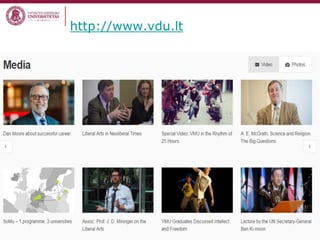
Vytautas Magnus University
http://vdu.lt
http://www.vdu.lt
Studyonline.lt
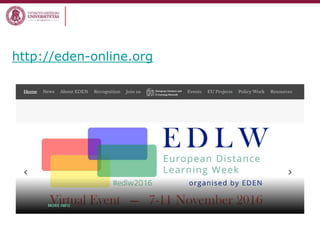
http://eden-online.org
Back to Open Education
Open Educational Resources
Problem addressed
• Despite the rapid development of Open Education movement, there are still many
challenges identified by education organizations, teachers and trainers, e-learning
centre staff members and also learners themselves that prevent the uptake and
mainstreaming of open education using and developing of Open Educational
Resources (OERs)
• One of the major challenge is to integrate OERs in curriculum designing because of
lack of skills and competences of participants:
– to find and use OER
– to find and adapt OER
– to develop OERs
– to select ICT tools that meet the didactical requirements and are most suitable
for one or another purpose
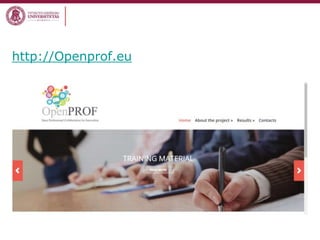
http://Openprof.eu
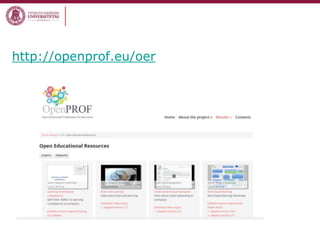
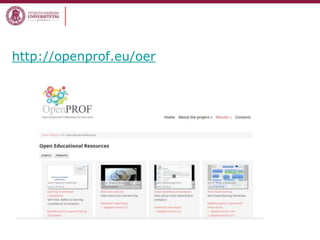
http://openprof.eu/oer
Collaborative online
document for hands – on
activities
https://goo.gl/KHtyvN
The aim of the session
to experiment the training material enabling learners
to develop the following competences:
1. to select the best ICT tools to adapt/ develop OERs
for a learning activity
2. to design a learning activity integrating OERs
1) to select the best ICT tools to adapt/
develop OERs for a learning activity
a) set the requirements for ICT tool for OER
development/adaptation
b) choose ICT tool for OER
development/adaptation according the
functionality
c) develop/adapt OER using selected ICT
tool
d) choose the license and mark
developed/adapted OER with CC license
2) to design a learning activity integrating OERs
a) to identify the “place” of OERs in
curriculum (learning activities)
b) to contextualize OERs systematically with the
learning curriculum (from the point of view of
conscious curriculum designing and quality
assurance)
Training material
The session will be organized in a step – by – step
activities composed of presentation of the session
moderators and hands – on practical learning using
training material „ICT tools to develop and adapt OER“
developed during European Union Erasmus+ program
Project „Open Professional Collaboration for
Innovation“ (2014-1-LT01-KA202-000562)
a) setting requirements for ICT tool for OER
development/adaptation
Step 1. Think about the type of OER you are going
to develop
• Will you develop:
– A document?
– A presentation?
– A video/ audio file?
– A collaborative artefact?
1) to select the best ICT tools to adapt/ develop
OERs for a learning activity
a) setting requirements for ICT tool for OER development/adaptation
Step 2. What functionality do you need from a
chosen ICT tool?
• Will you need to upload the document
online?
• Will you need to collaborate with other
people?
• Will you need formatting (various text
formats, colors, etc.)?
• Will you need to add pictures?
• What other functions of ICT tool do you
need?
a) setting requirements for ICT tool for OER
development/adaptation
Step 3. What requirements will you
raise for the editability of OER?
• Download (possibility to download OER in editable version)
• Online (possibility to edit OER online)
• Limited access (possibility to edit OER for registered users)
• Unlimited access (possibility to edit OER without
registration)
• Individual development (possibility to edit OER individually)
• Collaborative development (possibility to edit OER
collaboratively)
• Other requirements??
a) setting requirements for ICT tool for OER development/adaptation
Step 4. What requirements will you raise for
the usability and accessibility of an OER?
• does the tool allow the use free of charge?
• is it intuitive to use?
• how attractive it is?
• can you add Creative Commons license on you
work?
• do you have further requirements for usability
and accessibility that you have?
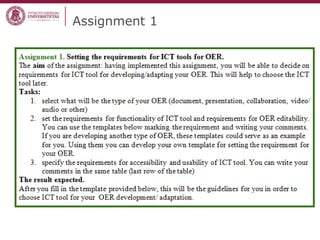
Assignment 1
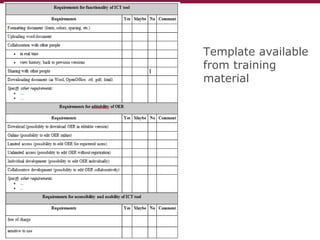
Template available
from training
material
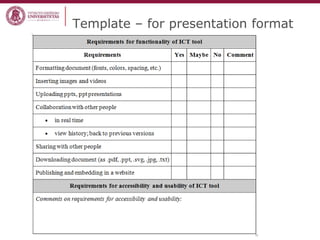
Template – for presentation format
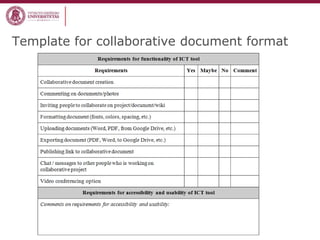
Template for collaborative document format
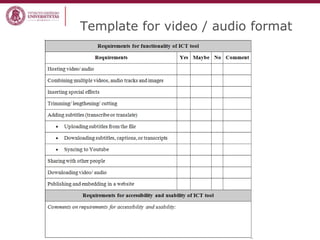
Template for video / audio format
b) choosing ICT tools for OER development/adaptation
according the functionality
Step 1. Examples of ICT tools for different OER
types and formats
1) to select the best ICT tools to adapt/ develop OERs for a
learning activity
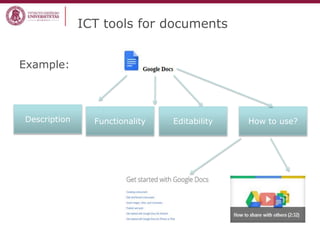
ICT tools for documents
Example:
Description Functionality How to use?Editability
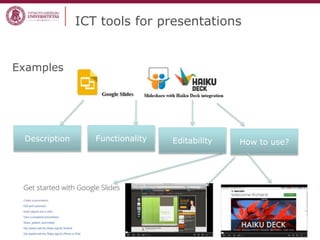
ICT tools for presentations
Examples
Description Functionality How to use?Editability
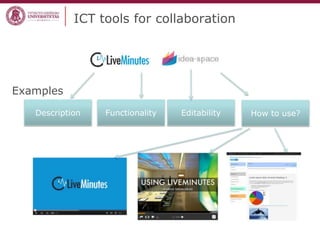
ICT tools for collaboration
Examples
Description Functionality How to use?Editability
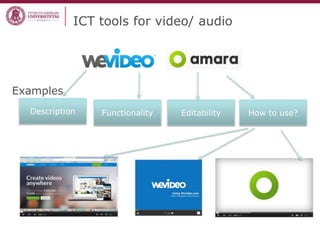
ICT tools for video/ audio
Examples
Description Functionality How to use?Editability
b) choosing ICT tools for OER development/adaptation
according the functionality
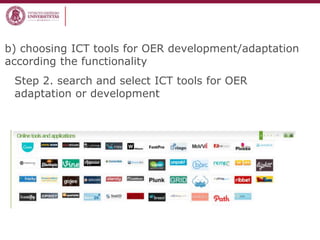
Step 2. search and select ICT tools for OER
adaptation or development
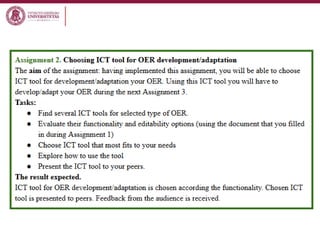
Assignment 2
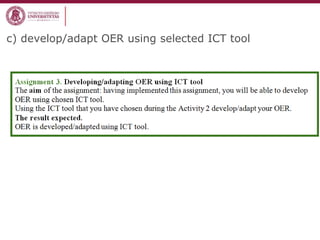
c) develop/adapt OER using selected ICT tool
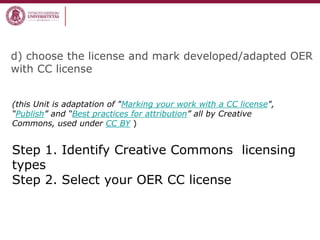
d) choose the license and mark developed/adapted OER
with CC license
(this Unit is adaptation of "Marking your work with a CC license",
“Publish” and “Best practices for attribution” all by Creative
Commons, used under CC BY )
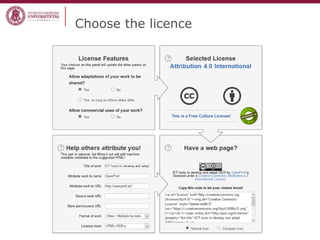
Step 1. Identify Creative Commons licensing
types
Step 2. Select your OER CC license
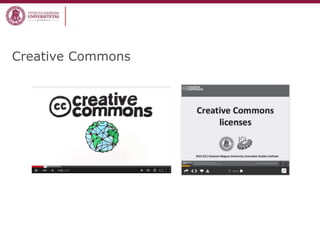
Creative Commons
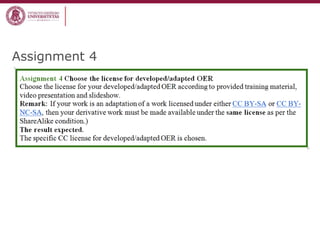
Assignment 4
Choose the licence
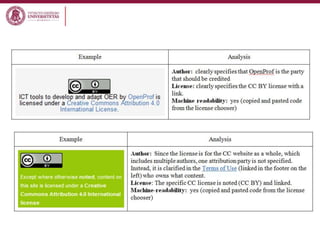
Examples: website licencing
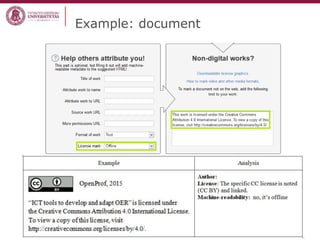
Example: document
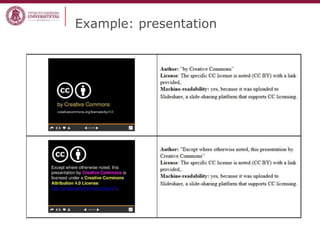
Example: presentation
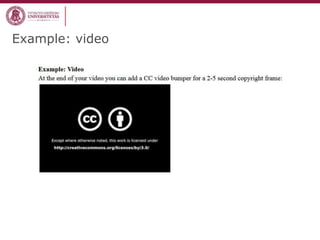
Example: video
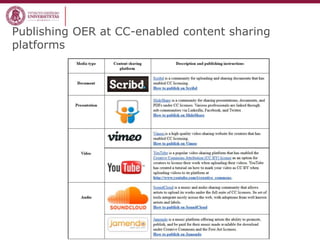
Publishing OER at CC-enabled content sharing
platforms
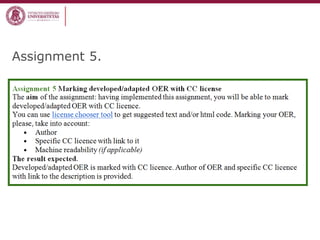
Assignment 5.
Contribution
Training material on “ICT tools to develop and adapt
OERs“ was developed in the framework of Erasmus+
program project
OpenPROF – Open Professional Collaboration for
Innovation
TM is available at
http://openprof.eu/training-
material/Training_material_on_ICT_tools
http://openprof.eu/oer
Discussion:
how was your process of
developing/ adapting OERs?
2) to design a learning activity integrating OERs
a) to identify the “place” of OERs in
curriculum (learning activities)
b) to contextualize OERs systematically with the
learning curriculum (from the point of view of
conscious curriculum designing and quality
assurance)
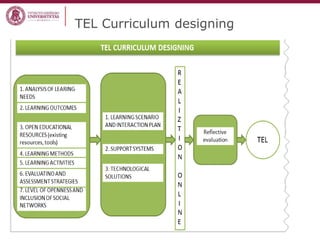
TEL Curriculum designing
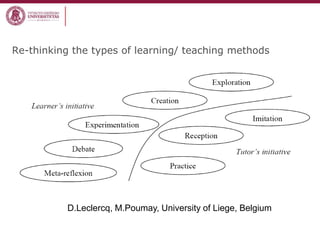
Re-thinking the types of learning/ teaching methods
D.Leclercq, M.Poumay, University of Liege, Belgium
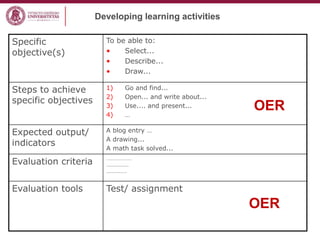
Specific
objective(s)
To be able to:
• Select...
• Describe...
• Draw...
Steps to achieve
specific objectives
1) Go and find...
2) Open... and write about...
3) Use.... and present...
4) …
Expected output/
indicators
A blog entry …
A drawing...
A math task solved...
Evaluation criteria …………………
..............
.............
Evaluation tools Test/ assignment
Developing learning activities
OER
OER
Resources: The JISC Open Educational Resources infoKit quality
considerations
• Can the content be described as follows?
– Relevant, accurate, appropriate level of detail, objective, current
and jargon-free
– Of good provenance (consider the reputation of the
author/institution), with a list of references if appropriate
– Free of advertising
• Does it fit my chosen pedagogy?
– Learning outcomes are stated and match with learner’s needs
– Engaging and interactive
– Set at the appropriate level, with any prerequisite
skills/understandings state
– The time required to study is stated and equates to the
importance of the learning outcomes achieved
https://oersynth.pbworks.com/w/page/51320241/EvaluationToolkit
Discussion
What role do you see for OERs in
curriculum designing?
Thank you for your
participation.
Dr. Airina Volungevičienė
Prof. Habil. Dr. Margarita Teresevičienė,
Vytautas Magnus University, Lithuania
Airina.volungeviciene,
margarita.tereseviciene
[at]vdu.lt

Selecting ICT tools for OER adaptation and use

  • 1.
    OER adaptation, development anduse as integrated within curriculum Dr. Airina Volungevičienė Prof. Habil. Dr. Margarita Teresevičienė, Vytautas Magnus University, Lithuania ICT tools for OER, Unesco ICT Forum, India, 2016
  • 2.
  • 4.
  • 5.
  • 7.
  • 8.
    Back to OpenEducation Open Educational Resources
  • 9.
    Problem addressed • Despitethe rapid development of Open Education movement, there are still many challenges identified by education organizations, teachers and trainers, e-learning centre staff members and also learners themselves that prevent the uptake and mainstreaming of open education using and developing of Open Educational Resources (OERs) • One of the major challenge is to integrate OERs in curriculum designing because of lack of skills and competences of participants: – to find and use OER – to find and adapt OER – to develop OERs – to select ICT tools that meet the didactical requirements and are most suitable for one or another purpose
  • 10.
  • 11.
  • 12.
    Collaborative online document forhands – on activities https://goo.gl/KHtyvN
  • 13.
    The aim ofthe session to experiment the training material enabling learners to develop the following competences: 1. to select the best ICT tools to adapt/ develop OERs for a learning activity 2. to design a learning activity integrating OERs
  • 14.
    1) to selectthe best ICT tools to adapt/ develop OERs for a learning activity a) set the requirements for ICT tool for OER development/adaptation b) choose ICT tool for OER development/adaptation according the functionality c) develop/adapt OER using selected ICT tool d) choose the license and mark developed/adapted OER with CC license
  • 15.
    2) to designa learning activity integrating OERs a) to identify the “place” of OERs in curriculum (learning activities) b) to contextualize OERs systematically with the learning curriculum (from the point of view of conscious curriculum designing and quality assurance)
  • 16.
    Training material The sessionwill be organized in a step – by – step activities composed of presentation of the session moderators and hands – on practical learning using training material „ICT tools to develop and adapt OER“ developed during European Union Erasmus+ program Project „Open Professional Collaboration for Innovation“ (2014-1-LT01-KA202-000562)
  • 17.
    a) setting requirementsfor ICT tool for OER development/adaptation Step 1. Think about the type of OER you are going to develop • Will you develop: – A document? – A presentation? – A video/ audio file? – A collaborative artefact? 1) to select the best ICT tools to adapt/ develop OERs for a learning activity
  • 18.
    a) setting requirementsfor ICT tool for OER development/adaptation Step 2. What functionality do you need from a chosen ICT tool? • Will you need to upload the document online? • Will you need to collaborate with other people? • Will you need formatting (various text formats, colors, etc.)? • Will you need to add pictures? • What other functions of ICT tool do you need?
  • 19.
    a) setting requirementsfor ICT tool for OER development/adaptation Step 3. What requirements will you raise for the editability of OER? • Download (possibility to download OER in editable version) • Online (possibility to edit OER online) • Limited access (possibility to edit OER for registered users) • Unlimited access (possibility to edit OER without registration) • Individual development (possibility to edit OER individually) • Collaborative development (possibility to edit OER collaboratively) • Other requirements??
  • 20.
    a) setting requirementsfor ICT tool for OER development/adaptation Step 4. What requirements will you raise for the usability and accessibility of an OER? • does the tool allow the use free of charge? • is it intuitive to use? • how attractive it is? • can you add Creative Commons license on you work? • do you have further requirements for usability and accessibility that you have?
  • 21.
  • 22.
  • 23.
    Template – forpresentation format
  • 24.
  • 25.
    Template for video/ audio format
  • 26.
    b) choosing ICTtools for OER development/adaptation according the functionality Step 1. Examples of ICT tools for different OER types and formats 1) to select the best ICT tools to adapt/ develop OERs for a learning activity
  • 27.
    ICT tools fordocuments Example: Description Functionality How to use?Editability
  • 28.
    ICT tools forpresentations Examples Description Functionality How to use?Editability
  • 29.
    ICT tools forcollaboration Examples Description Functionality How to use?Editability
  • 30.
    ICT tools forvideo/ audio Examples Description Functionality How to use?Editability
  • 31.
    b) choosing ICTtools for OER development/adaptation according the functionality Step 2. search and select ICT tools for OER adaptation or development
  • 32.
  • 33.
    c) develop/adapt OERusing selected ICT tool
  • 34.
    d) choose thelicense and mark developed/adapted OER with CC license (this Unit is adaptation of "Marking your work with a CC license", “Publish” and “Best practices for attribution” all by Creative Commons, used under CC BY ) Step 1. Identify Creative Commons licensing types Step 2. Select your OER CC license
  • 35.
  • 36.
  • 37.
  • 38.
  • 39.
  • 40.
  • 41.
  • 42.
    Publishing OER atCC-enabled content sharing platforms
  • 43.
  • 44.
    Contribution Training material on“ICT tools to develop and adapt OERs“ was developed in the framework of Erasmus+ program project OpenPROF – Open Professional Collaboration for Innovation TM is available at http://openprof.eu/training- material/Training_material_on_ICT_tools
  • 45.
  • 46.
    Discussion: how was yourprocess of developing/ adapting OERs?
  • 47.
    2) to designa learning activity integrating OERs a) to identify the “place” of OERs in curriculum (learning activities) b) to contextualize OERs systematically with the learning curriculum (from the point of view of conscious curriculum designing and quality assurance)
  • 48.
  • 49.
    Re-thinking the typesof learning/ teaching methods D.Leclercq, M.Poumay, University of Liege, Belgium
  • 50.
    Specific objective(s) To be ableto: • Select... • Describe... • Draw... Steps to achieve specific objectives 1) Go and find... 2) Open... and write about... 3) Use.... and present... 4) … Expected output/ indicators A blog entry … A drawing... A math task solved... Evaluation criteria ………………… .............. ............. Evaluation tools Test/ assignment Developing learning activities OER OER
  • 51.
    Resources: The JISCOpen Educational Resources infoKit quality considerations • Can the content be described as follows? – Relevant, accurate, appropriate level of detail, objective, current and jargon-free – Of good provenance (consider the reputation of the author/institution), with a list of references if appropriate – Free of advertising • Does it fit my chosen pedagogy? – Learning outcomes are stated and match with learner’s needs – Engaging and interactive – Set at the appropriate level, with any prerequisite skills/understandings state – The time required to study is stated and equates to the importance of the learning outcomes achieved https://oersynth.pbworks.com/w/page/51320241/EvaluationToolkit
  • 52.
    Discussion What role doyou see for OERs in curriculum designing?
  • 53.
    Thank you foryour participation. Dr. Airina Volungevičienė Prof. Habil. Dr. Margarita Teresevičienė, Vytautas Magnus University, Lithuania Airina.volungeviciene, margarita.tereseviciene [at]vdu.lt