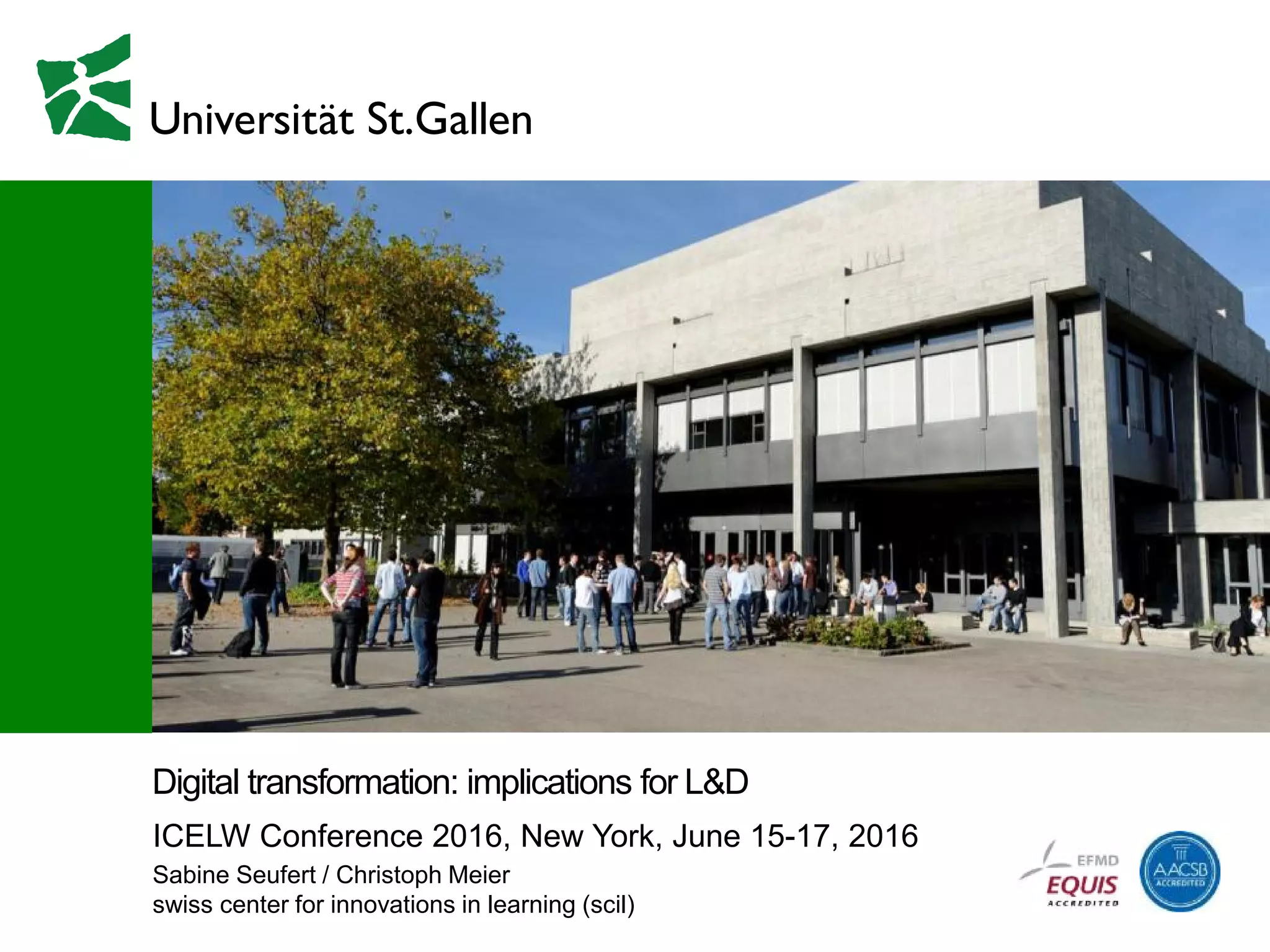
Digital transformation: implications for L&D
ICELW Conference 2016, New York, June 15-17, 2016
Sabine Seufert / Christoph Meier
swiss center for innovations in learning (scil)
2
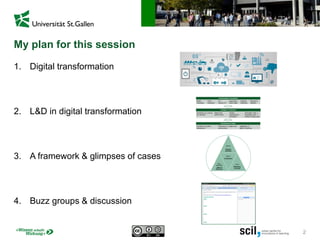
My plan for this session
1. Digital transformation
2. L&D in digital transformation
3. A framework & glimpses of cases
4. Buzz groups & discussion
3
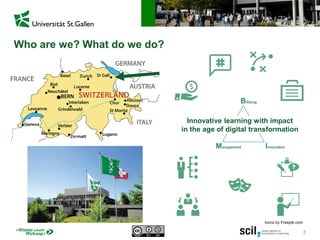
Who are we? What do we do?
Icons by Freepik.com
Innovative learning with impact
in the age of digital transformation
4
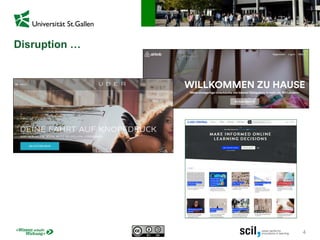
Disruption …
5
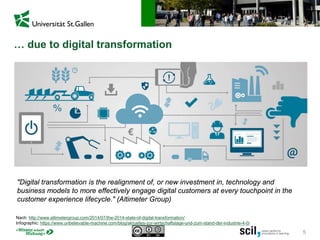
… due to digital transformation
Nach: http://www.altimetergroup.com/2014/07/the-2014-state-of-digital-transformation/
Infographic: https://www.unbelievable-machine.com/blog/aktuelles-zur-wirtschaftslage-und-zum-stand-der-industrie-4-0/
"Digital transformation is the realignment of, or new investment in, technology and
business models to more effectively engage digital customers at every touchpoint in the
customer experience lifecycle." (Altimeter Group)
6
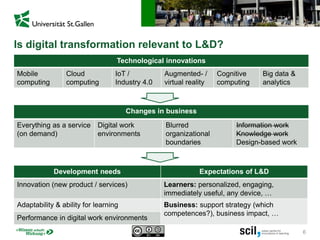
Is digital transformation relevant to L&D?
Technological innovations
Mobile
computing
Cloud
computing
IoT /
Industry 4.0
Augmented- /
virtual reality
Cognitive
computing
Big data &
analytics
Changes in business
Everything as a service
(on demand)
Digital work
environments
Blurred
organizational
boundaries
Information work
Knowledge work
Design-based work
Development needs Expectations of L&D
Innovation (new product / services) Learners: personalized, engaging,
immediately useful, any device, …
Adaptability & ability for learning Business: support strategy (which
competences?), business impact, …
Performance in digital work environments
7
What?
Service
portfolio
Sus-
tainable?
Value &
Revenue
Who?
Customers
How?
Business
process
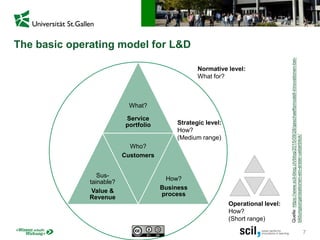
The basic operating model for L&D
Quelle:https://www.scil-blog.ch/blog/2015/09/28/geschaeftsmodell-innovationen-bei-
bildungsorganisationen-ein-erster-ueberblick/
Normative level:
What for?
Strategic level:
How?
(Medium range)
Operational level:
How?
(Short range)
8
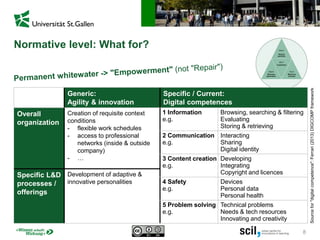
Normative level: What for?
Generic:
Agility & innovation
Specific / Current:
Digital competences
Overall
organization
Creation of requisite context
conditions
- flexible work schedules
- access to professional
networks (inside & outside
company)
- …
1 Information
e.g.
Browsing, searching & filtering
Evaluating
Storing & retrieving
2 Communication
e.g.
Interacting
Sharing
Digital identity
3 Content creation
e.g.
Developing
Integrating
Copyright and licencesSpecific L&D
processes /
offerings
Development of adaptive &
innovative personalities 4 Safety
e.g.
Devices
Personal data
Personal health
5 Problem solving
e.g.
Technical problems
Needs & tech resources
Innovating and creativity
Sourcefor"digitalcompetence":Ferrari(2013)DIGCOMPframework
9
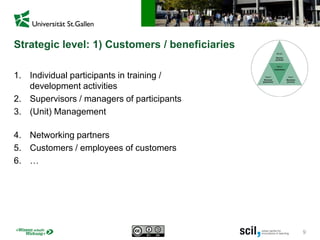
Strategic level: 1) Customers / beneficiaries
1. Individual participants in training /
development activities
2. Supervisors / managers of participants
3. (Unit) Management
4. Networking partners
5. Customers / employees of customers
6. …
10
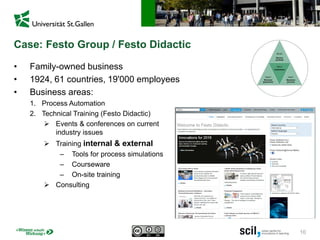
• Family-owned business
• 1924, 61 countries, 19'000 employees
• Business areas:
1. Process Automation
2. Technical Training (Festo Didactic)
 Events & conferences on current
industry issues
 Training internal & external
– Tools for process simulations
– Courseware
– On-site training
 Consulting
Case: Festo Group / Festo Didactic
11
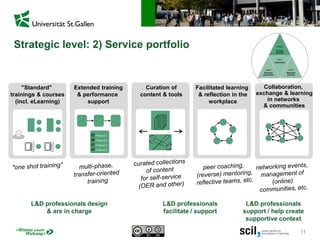
Strategic level: 2) Service portfolio
 Prüfpunkt 1
 Prüfpunkt 2
 Prüfpunkt 3
 Prüfpunkt 4

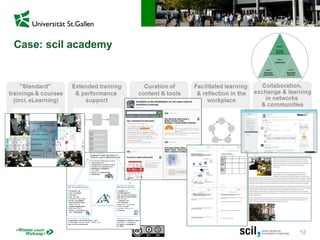
Extended training
& performance
support
"Standard"
trainings & courses
(incl. eLearning)
Facilitated learning
& reflection in the
workplace
Collaboration,
exchange & learning
in networks
& communities
Curation of
content & tools
L&D professionals design
& are in charge
L&D professionals
support / help create
supportive context
L&D professionals
facilitate / support
12
Case: scil academy
13
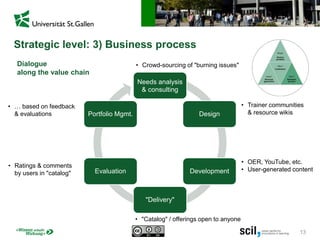
Strategic level: 3) Business process
Needs analysis
& consulting
Design
Development
"Delivery"
Evaluation
Portfolio Mgmt.
• Crowd-sourcing of "burning issues"Dialogue
along the value chain
• Trainer communities
& resource wikis
• OER, YouTube, etc.
• User-generated content
• "Catalog" / offerings open to anyone
• Ratings & comments
by users in "catalog"
• … based on feedback
& evaluations
14
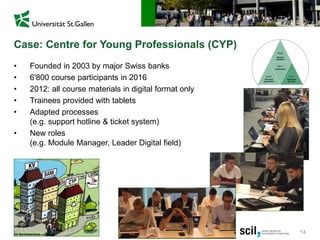
Case: Centre for Young Professionals (CYP)
• Founded in 2003 by major Swiss banks
• 6'800 course participants in 2016
• 2012: all course materials in digital format only
• Trainees provided with tablets
• Adapted processes
(e.g. support hotline & ticket system)
• New roles
(e.g. Module Manager, Leader Digital field)
15
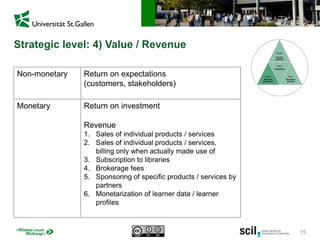
Strategic level: 4) Value / Revenue
Non-monetary Return on expectations
(customers, stakeholders)
Monetary Return on investment
Revenue
1. Sales of individual products / services
2. Sales of individual products / services,
billing only when actually made use of
3. Subscription to libraries
4. Brokerage fees
5. Sponsoring of specific products / services by
partners
6. Monetarization of learner data / learner
profiles
16
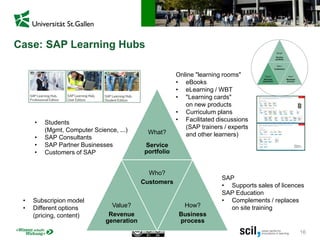
Case: SAP Learning Hubs
• Subscripion model
• Different options
(pricing, content)
SAP
• Supports sales of licences
SAP Education
• Complements / replaces
on site training
• Students
(Mgmt, Computer Science, ...)
• SAP Consultants
• SAP Partner Businesses
• Customers of SAP
What?
Service
portfolio
Value?
Revenue
generation
Who?
Customers
How?
Business
process
Online "learning rooms"
• eBooks
• eLearning / WBT
• "Learning cards"
on new products
• Curriculum plans
• Facilitated discussions
(SAP trainers / experts
and other learners)
17
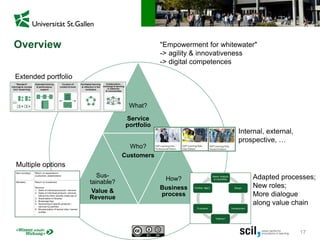
What?
Service
portfolio
Sus-
tainable?
Value &
Revenue
Who?
Customers
How?
Business
process
Overview "Empowerment for whitewater"
-> agility & innovativeness
-> digital competences
Adapted processes;
New roles;
More dialogue
along value chain
Internal, external,
prospective, …
Multiple options
Extended portfolio
18
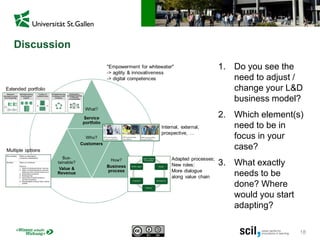
Discussion
1. Do you see the
need to adjust /
change your L&D
business model?
2. Which element(s)
need to be in
focus in your
case?
3. What exactly
needs to be
done? Where
would you start
adapting?
19
Thanks for participating!
Contact / more information
Dr. Christoph Meier
swiss centre for innovations in learning (scil)
University of St.Gallen
christoph.meier@unisg.ch

Digital transformation: implications for the L&D function (ICELW 2016)

  • 1.
    Digital transformation: implicationsfor L&D ICELW Conference 2016, New York, June 15-17, 2016 Sabine Seufert / Christoph Meier swiss center for innovations in learning (scil)
  • 2.
    2 My plan forthis session 1. Digital transformation 2. L&D in digital transformation 3. A framework & glimpses of cases 4. Buzz groups & discussion
  • 3.
    3 Who are we?What do we do? Icons by Freepik.com Innovative learning with impact in the age of digital transformation
  • 4.
  • 5.
    5 … due todigital transformation Nach: http://www.altimetergroup.com/2014/07/the-2014-state-of-digital-transformation/ Infographic: https://www.unbelievable-machine.com/blog/aktuelles-zur-wirtschaftslage-und-zum-stand-der-industrie-4-0/ "Digital transformation is the realignment of, or new investment in, technology and business models to more effectively engage digital customers at every touchpoint in the customer experience lifecycle." (Altimeter Group)
  • 6.
    6 Is digital transformationrelevant to L&D? Technological innovations Mobile computing Cloud computing IoT / Industry 4.0 Augmented- / virtual reality Cognitive computing Big data & analytics Changes in business Everything as a service (on demand) Digital work environments Blurred organizational boundaries Information work Knowledge work Design-based work Development needs Expectations of L&D Innovation (new product / services) Learners: personalized, engaging, immediately useful, any device, … Adaptability & ability for learning Business: support strategy (which competences?), business impact, … Performance in digital work environments
  • 7.
    7 What? Service portfolio Sus- tainable? Value & Revenue Who? Customers How? Business process The basicoperating model for L&D Quelle:https://www.scil-blog.ch/blog/2015/09/28/geschaeftsmodell-innovationen-bei- bildungsorganisationen-ein-erster-ueberblick/ Normative level: What for? Strategic level: How? (Medium range) Operational level: How? (Short range)
  • 8.
    8 Normative level: Whatfor? Generic: Agility & innovation Specific / Current: Digital competences Overall organization Creation of requisite context conditions - flexible work schedules - access to professional networks (inside & outside company) - … 1 Information e.g. Browsing, searching & filtering Evaluating Storing & retrieving 2 Communication e.g. Interacting Sharing Digital identity 3 Content creation e.g. Developing Integrating Copyright and licencesSpecific L&D processes / offerings Development of adaptive & innovative personalities 4 Safety e.g. Devices Personal data Personal health 5 Problem solving e.g. Technical problems Needs & tech resources Innovating and creativity Sourcefor"digitalcompetence":Ferrari(2013)DIGCOMPframework
  • 9.
    9 Strategic level: 1)Customers / beneficiaries 1. Individual participants in training / development activities 2. Supervisors / managers of participants 3. (Unit) Management 4. Networking partners 5. Customers / employees of customers 6. …
  • 10.
    10 • Family-owned business •1924, 61 countries, 19'000 employees • Business areas: 1. Process Automation 2. Technical Training (Festo Didactic)  Events & conferences on current industry issues  Training internal & external – Tools for process simulations – Courseware – On-site training  Consulting Case: Festo Group / Festo Didactic
  • 11.
    11 Strategic level: 2)Service portfolio  Prüfpunkt 1  Prüfpunkt 2  Prüfpunkt 3  Prüfpunkt 4  Extended training & performance support "Standard" trainings & courses (incl. eLearning) Facilitated learning & reflection in the workplace Collaboration, exchange & learning in networks & communities Curation of content & tools L&D professionals design & are in charge L&D professionals support / help create supportive context L&D professionals facilitate / support
  • 12.
  • 13.
    13 Strategic level: 3)Business process Needs analysis & consulting Design Development "Delivery" Evaluation Portfolio Mgmt. • Crowd-sourcing of "burning issues"Dialogue along the value chain • Trainer communities & resource wikis • OER, YouTube, etc. • User-generated content • "Catalog" / offerings open to anyone • Ratings & comments by users in "catalog" • … based on feedback & evaluations
  • 14.
    14 Case: Centre forYoung Professionals (CYP) • Founded in 2003 by major Swiss banks • 6'800 course participants in 2016 • 2012: all course materials in digital format only • Trainees provided with tablets • Adapted processes (e.g. support hotline & ticket system) • New roles (e.g. Module Manager, Leader Digital field)
  • 15.
    15 Strategic level: 4)Value / Revenue Non-monetary Return on expectations (customers, stakeholders) Monetary Return on investment Revenue 1. Sales of individual products / services 2. Sales of individual products / services, billing only when actually made use of 3. Subscription to libraries 4. Brokerage fees 5. Sponsoring of specific products / services by partners 6. Monetarization of learner data / learner profiles
  • 16.
    16 Case: SAP LearningHubs • Subscripion model • Different options (pricing, content) SAP • Supports sales of licences SAP Education • Complements / replaces on site training • Students (Mgmt, Computer Science, ...) • SAP Consultants • SAP Partner Businesses • Customers of SAP What? Service portfolio Value? Revenue generation Who? Customers How? Business process Online "learning rooms" • eBooks • eLearning / WBT • "Learning cards" on new products • Curriculum plans • Facilitated discussions (SAP trainers / experts and other learners)
  • 17.
    17 What? Service portfolio Sus- tainable? Value & Revenue Who? Customers How? Business process Overview "Empowermentfor whitewater" -> agility & innovativeness -> digital competences Adapted processes; New roles; More dialogue along value chain Internal, external, prospective, … Multiple options Extended portfolio
  • 18.
    18 Discussion 1. Do yousee the need to adjust / change your L&D business model? 2. Which element(s) need to be in focus in your case? 3. What exactly needs to be done? Where would you start adapting?
  • 19.
    19 Thanks for participating! Contact/ more information Dr. Christoph Meier swiss centre for innovations in learning (scil) University of St.Gallen christoph.meier@unisg.ch