Communication Theory II
Lecture 10: Convolution, Trellis Codes
Convolutional coding
➢ Convolutional coding is an error-correcting technique used
in digital communication systems.
➢ It adds redundancy to data to enhance error detection and
correction during transmission.
➢ Widely applied in wireless communication, satellite links,
and digital broadcasting.
➢ Convolutional coding is not based on blocks of bits but
rather the output code bits are determined by logic
operations on the present bit in a stream and a small
number of previous bits
Convolutional coding
➢ Shift Registers: Convolutional encoders use
shift registers to store recent input data bits.
➢ Encoding Process: Binary operations like XOR
are applied to shift register contents to
generate new encoded bits.
➢ Code Rate: Code rate defines the ratio of
output bits to input bits, e.g., 1/2, 2/3.
Convolutional coding
➢ Higher code rate implies more redundancy in
the encoded data.
➢ Redundancy aids in detecting and correcting
errors at the receiver.
➢ Convolutional coding enables error detection
and correction.
➢ Short Constraint Length: Less error correction,
lower complexity.
➢ Long Constraint Length: Stronger error
correction, higher complexity.
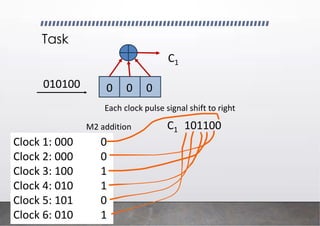
Task
010100
C1 101100
0 0 0
Clock 1: 000 0
Clock 2: 000 0
Clock 3: 100 1
Clock 4: 010 1
Clock 5: 101 0
Clock 6: 010 1
M2 addition
C1
Each clock pulse signal shift to right
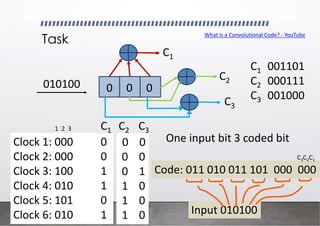
Task
010100
Code: 011 010 011 101 000 000
0 0 0
Clock 1: 000 0
Clock 2: 000 0
Clock 3: 100 1
Clock 4: 010 1
Clock 5: 101 0
Clock 6: 010 1
C1
C2
C3
C1 C2 C3
1 2 3
0 0
0 0
0 1
1 0
1 0
1 0
C1 001101
C2 000111
C3 001000
Input 010100
C3C2C1
One input bit 3 coded bit
What is a Convolutional Code? - YouTube
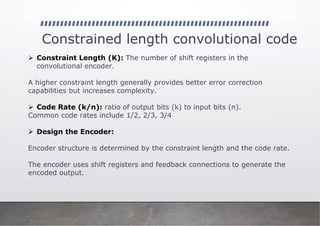
Constrained length convolutional code
➢ Constraint Length (K): The number of shift registers in the
convolutional encoder.
A higher constraint length generally provides better error correction
capabilities but increases complexity.
➢ Code Rate (k/n): ratio of output bits (k) to input bits (n).
Common code rates include 1/2, 2/3, 3/4
➢ Design the Encoder:
Encoder structure is determined by the constraint length and the code rate.
The encoder uses shift registers and feedback connections to generate the
encoded output.
Constrained length convolutional code
➢ State Transition Diagram: State transition diagram that illustrates how
the shift register contents change over time based on the input data.
➢ Generator Polynomials:
Generator polynomials determine the feedback connections and binary
operations (usually XOR) used in the encoder.
The generator polynomials are usually expressed in terms of octal or
hexadecimal numbers.
These polynomials are derived from the state transition diagram
Convolutional Codes
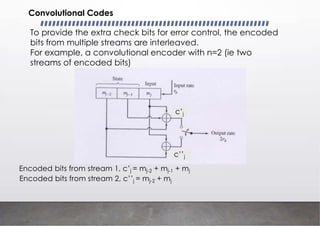
To provide the extra check bits for error control, the encoded
bits from multiple streams are interleaved.
For example, a convolutional encoder with n=2 (ie two
streams of encoded bits)
c’j
c’’j
Encoded bits from stream 1, c’j = mj-2 + mj-1 + mj
Encoded bits from stream 2, c’’j = mj-2 + mj
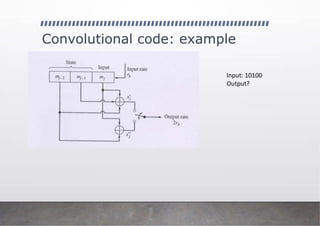
Convolutional code: example
Input: 10100
Output?
Convolutional code
0 0 0
C1
C2
C3
g1 = [111]
g2 = [011]
g3 = [101]
c(1) = u * g1
c(2) = u * g2
c(3) = u * g3
* Convolution operator
Code sequence is given by
c = c1
(1) , c1
(2), c1
(3), c2
(1) , c2
(2), c2
(3), …
convolutional operation is equivalent to multiplication
in the transform domain
g1(D) = 1 + D + D2
g2(D) = D + D2
g3(D) = 1 + D2
c(1) = u (D) g1 (D)
c(2) = u (D) g2 (D)
c(3) = u (D) g3 (D)
impulse response
transform of the encoder output c is given by
Convolutional code
Generator Polynomials:
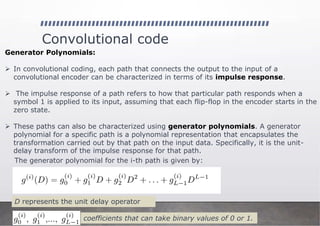
➢ In convolutional coding, each path that connects the output to the input of a
convolutional encoder can be characterized in terms of its impulse response.
➢ The impulse response of a path refers to how that particular path responds when a
symbol 1 is applied to its input, assuming that each flip-flop in the encoder starts in the
zero state.
➢ These paths can also be characterized using generator polynomials. A generator
polynomial for a specific path is a polynomial representation that encapsulates the
transformation carried out by that path on the input data. Specifically, it is the unit-
delay transform of the impulse response for that path.
The generator polynomial for the i-th path is given by:
D represents the unit delay operator
coefficients that can take binary values of 0 or 1.
Convolutional code
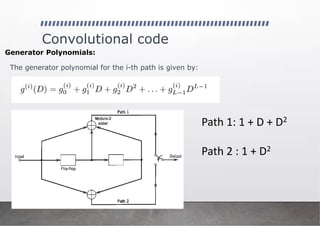
Generator Polynomials:
The generator polynomial for the i-th path is given by:
Path 1: 1 + D + D2
Path 2 : 1 + D2
Convolutional code
Generator Polynomials:
The generator polynomial for the i-th path is given by:
Path 1: 1 + D + D2
Path 2 : D + D2
Path 3 : 1 + D2
0 0 0
C1
C2
C3
g1 = [111]
g2 = [011]
g3 = [101]
impulse response
Convolutional code
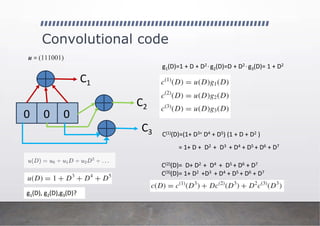
u = (111001)
0 0 0
C1
C2
C3
u(D)
g1(D)=1 + D + D2 , g2(D)=D + D2 , g3(D)= 1 + D2
g1(D), g2(D),g3(D)?
C(1)(D)=(1+ D3+ D4 + D5) (1 + D + D2 )
= 1+ D + D2 + D3 + D4 + D5 + D6 + D7
C(2)(D)= D+ D2 + D4 + D5 + D6 + D7
C(3)(D)= 1+ D2 +D3 + D4 + D5 + D6 + D7
Convolutional code
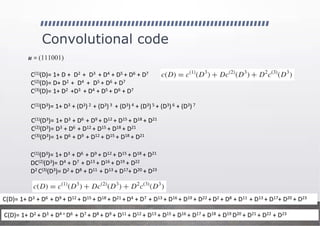
u = (111001)
C(1)(D)= 1+ D + D2 + D3 + D4 + D5 + D6 + D7
C(2)(D)= D+ D2 + D4 + D5 + D6 + D7
C(3)(D)= 1+ D2 +D3 + D4 + D5 + D6 + D7
C(1)(D3)= 1+ D3 + (D3) 2 + (D3) 3 + (D3) 4 + (D3) 5 + (D3) 6 + (D3) 7
C(1)(D3)= 1+ D3 + D6 + D9 + D12 + D15 + D18 + D21
C(2)(D3)= D3 + D6 + D12 + D15 + D18 + D21
C(3)(D3)= 1+ D6 + D9 + D12 + D15 + D18 + D21
C(1)(D3)= 1+ D3 + D6 + D9 + D12 + D15 + D18 + D21
DC(2)(D3)= D4 + D7 + D13 + D16 + D19 + D22
D2 C(3)(D3)= D2 + D8 + D11 + D13 + D17+ D20 + D23
C(D)= 1+ D3 + D6 + D9 + D12 + D15 + D18 + D21 + D4 + D7 + D13 + D16 + D19 + D22 + D2 + D8 + D11 + D13 + D17+ D20 + D23
C(D)= 1+ D2 + D3 + D4 + D6 + D7 + D8 + D9 + D11 + D12 + D13 + D15 + D16 + D17 + D18 + D19 D20 + D21 + D22 + D23
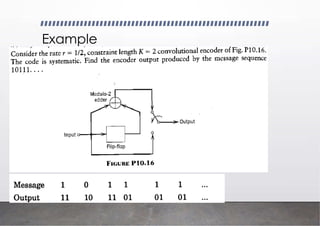
Example
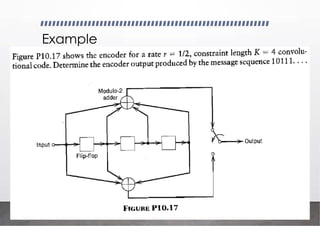
Example
Tree diagram, the trellis diagram,
and the state diagram
Three common approaches to explaining a convolutional code are
using a tree diagram, a trellis diagram, and a state diagram
➢ Tree Diagram: Shows encoding paths in convolutional codes.
➢ Trellis Diagram: Displays code states for decoding decisions.
➢ State Diagram: Illustrates code encoder/decoder transitions.
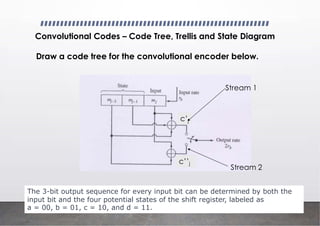
Convolutional Codes – Code Tree, Trellis and State Diagram
c’j
c’’j
Draw a code tree for the convolutional encoder below.
Stream 1
Stream 2
The 3-bit output sequence for every input bit can be determined by both the
input bit and the four potential states of the shift register, labeled as
a = 00, b = 01, c = 10, and d = 11.
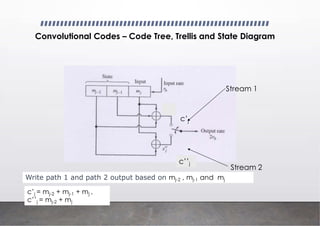
Convolutional Codes – Code Tree, Trellis and State Diagram
c’j
c’’j
Stream 1
Stream 2
Write path 1 and path 2 output based on mj-2 , mj-1 and mj
c’j = mj-2 + mj-1 + mj ,
c’’j = mj-2 + mj
Convolutional Codes – Code Tree, Trellis and State Diagram
Assuming flipflops are initialized as 000, What is the output for input bit 1
C1 = mj-2 + mj-1 + mj ,
C2 = mj-2 + mj
Assuming flipflops are initialized as 000, What is the output for input bit 0
C1
C2
Assuming flipflops are initialized as 000, What is the output for input bit 0 after bit 1
Assuming flipflops are initialized as 000, What is the output for input bit 1 after bit 1
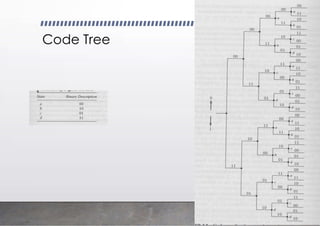
Code Tree
Code Tree
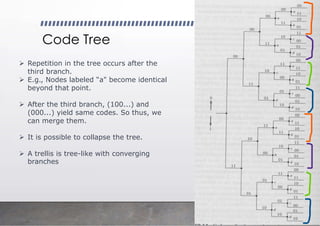
➢ Repetition in the tree occurs after the
third branch.
➢ E.g., Nodes labeled “a" become identical
beyond that point.
➢ After the third branch, (100...) and
(000...) yield same codes. So thus, we
can merge them.
➢ It is possible to collapse the tree.
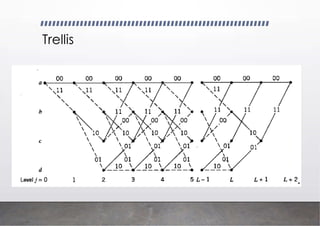
➢ A trellis is tree-like with converging
branches
Trellis
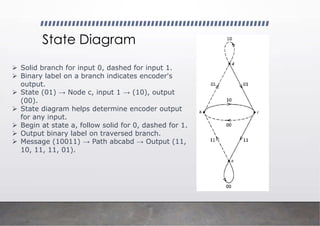
State Diagram
➢ Solid branch for input 0, dashed for input 1.
➢ Binary label on a branch indicates encoder's
output.
➢ State (01) → Node c, input 1 → (10), output
(00).
➢ State diagram helps determine encoder output
for any input.
➢ Begin at state a, follow solid for 0, dashed for 1.
➢ Output binary label on traversed branch.
➢ Message (10011) → Path abcabd → Output (11,
10, 11, 11, 01).

Communication Theory II_ Lecture 10.pdf

  • 1.
    Communication Theory II Lecture10: Convolution, Trellis Codes
  • 2.
    Convolutional coding ➢ Convolutionalcoding is an error-correcting technique used in digital communication systems. ➢ It adds redundancy to data to enhance error detection and correction during transmission. ➢ Widely applied in wireless communication, satellite links, and digital broadcasting. ➢ Convolutional coding is not based on blocks of bits but rather the output code bits are determined by logic operations on the present bit in a stream and a small number of previous bits
  • 3.
    Convolutional coding ➢ ShiftRegisters: Convolutional encoders use shift registers to store recent input data bits. ➢ Encoding Process: Binary operations like XOR are applied to shift register contents to generate new encoded bits. ➢ Code Rate: Code rate defines the ratio of output bits to input bits, e.g., 1/2, 2/3.
  • 4.
    Convolutional coding ➢ Highercode rate implies more redundancy in the encoded data. ➢ Redundancy aids in detecting and correcting errors at the receiver. ➢ Convolutional coding enables error detection and correction. ➢ Short Constraint Length: Less error correction, lower complexity. ➢ Long Constraint Length: Stronger error correction, higher complexity.
  • 5.
    Task 010100 C1 101100 0 00 Clock 1: 000 0 Clock 2: 000 0 Clock 3: 100 1 Clock 4: 010 1 Clock 5: 101 0 Clock 6: 010 1 M2 addition C1 Each clock pulse signal shift to right
  • 6.
    Task 010100 Code: 011 010011 101 000 000 0 0 0 Clock 1: 000 0 Clock 2: 000 0 Clock 3: 100 1 Clock 4: 010 1 Clock 5: 101 0 Clock 6: 010 1 C1 C2 C3 C1 C2 C3 1 2 3 0 0 0 0 0 1 1 0 1 0 1 0 C1 001101 C2 000111 C3 001000 Input 010100 C3C2C1 One input bit 3 coded bit What is a Convolutional Code? - YouTube
  • 7.
    Constrained length convolutionalcode ➢ Constraint Length (K): The number of shift registers in the convolutional encoder. A higher constraint length generally provides better error correction capabilities but increases complexity. ➢ Code Rate (k/n): ratio of output bits (k) to input bits (n). Common code rates include 1/2, 2/3, 3/4 ➢ Design the Encoder: Encoder structure is determined by the constraint length and the code rate. The encoder uses shift registers and feedback connections to generate the encoded output.
  • 8.
    Constrained length convolutionalcode ➢ State Transition Diagram: State transition diagram that illustrates how the shift register contents change over time based on the input data. ➢ Generator Polynomials: Generator polynomials determine the feedback connections and binary operations (usually XOR) used in the encoder. The generator polynomials are usually expressed in terms of octal or hexadecimal numbers. These polynomials are derived from the state transition diagram
  • 9.
    Convolutional Codes To providethe extra check bits for error control, the encoded bits from multiple streams are interleaved. For example, a convolutional encoder with n=2 (ie two streams of encoded bits) c’j c’’j Encoded bits from stream 1, c’j = mj-2 + mj-1 + mj Encoded bits from stream 2, c’’j = mj-2 + mj
  • 10.
  • 11.
    Convolutional code 0 00 C1 C2 C3 g1 = [111] g2 = [011] g3 = [101] c(1) = u * g1 c(2) = u * g2 c(3) = u * g3 * Convolution operator Code sequence is given by c = c1 (1) , c1 (2), c1 (3), c2 (1) , c2 (2), c2 (3), … convolutional operation is equivalent to multiplication in the transform domain g1(D) = 1 + D + D2 g2(D) = D + D2 g3(D) = 1 + D2 c(1) = u (D) g1 (D) c(2) = u (D) g2 (D) c(3) = u (D) g3 (D) impulse response transform of the encoder output c is given by
  • 12.
    Convolutional code Generator Polynomials: ➢In convolutional coding, each path that connects the output to the input of a convolutional encoder can be characterized in terms of its impulse response. ➢ The impulse response of a path refers to how that particular path responds when a symbol 1 is applied to its input, assuming that each flip-flop in the encoder starts in the zero state. ➢ These paths can also be characterized using generator polynomials. A generator polynomial for a specific path is a polynomial representation that encapsulates the transformation carried out by that path on the input data. Specifically, it is the unit- delay transform of the impulse response for that path. The generator polynomial for the i-th path is given by: D represents the unit delay operator coefficients that can take binary values of 0 or 1.
  • 13.
    Convolutional code Generator Polynomials: Thegenerator polynomial for the i-th path is given by: Path 1: 1 + D + D2 Path 2 : 1 + D2
  • 14.
    Convolutional code Generator Polynomials: Thegenerator polynomial for the i-th path is given by: Path 1: 1 + D + D2 Path 2 : D + D2 Path 3 : 1 + D2 0 0 0 C1 C2 C3 g1 = [111] g2 = [011] g3 = [101] impulse response
  • 15.
    Convolutional code u =(111001) 0 0 0 C1 C2 C3 u(D) g1(D)=1 + D + D2 , g2(D)=D + D2 , g3(D)= 1 + D2 g1(D), g2(D),g3(D)? C(1)(D)=(1+ D3+ D4 + D5) (1 + D + D2 ) = 1+ D + D2 + D3 + D4 + D5 + D6 + D7 C(2)(D)= D+ D2 + D4 + D5 + D6 + D7 C(3)(D)= 1+ D2 +D3 + D4 + D5 + D6 + D7
  • 16.
    Convolutional code u =(111001) C(1)(D)= 1+ D + D2 + D3 + D4 + D5 + D6 + D7 C(2)(D)= D+ D2 + D4 + D5 + D6 + D7 C(3)(D)= 1+ D2 +D3 + D4 + D5 + D6 + D7 C(1)(D3)= 1+ D3 + (D3) 2 + (D3) 3 + (D3) 4 + (D3) 5 + (D3) 6 + (D3) 7 C(1)(D3)= 1+ D3 + D6 + D9 + D12 + D15 + D18 + D21 C(2)(D3)= D3 + D6 + D12 + D15 + D18 + D21 C(3)(D3)= 1+ D6 + D9 + D12 + D15 + D18 + D21 C(1)(D3)= 1+ D3 + D6 + D9 + D12 + D15 + D18 + D21 DC(2)(D3)= D4 + D7 + D13 + D16 + D19 + D22 D2 C(3)(D3)= D2 + D8 + D11 + D13 + D17+ D20 + D23 C(D)= 1+ D3 + D6 + D9 + D12 + D15 + D18 + D21 + D4 + D7 + D13 + D16 + D19 + D22 + D2 + D8 + D11 + D13 + D17+ D20 + D23 C(D)= 1+ D2 + D3 + D4 + D6 + D7 + D8 + D9 + D11 + D12 + D13 + D15 + D16 + D17 + D18 + D19 D20 + D21 + D22 + D23
  • 17.
  • 18.
  • 20.
    Tree diagram, thetrellis diagram, and the state diagram Three common approaches to explaining a convolutional code are using a tree diagram, a trellis diagram, and a state diagram ➢ Tree Diagram: Shows encoding paths in convolutional codes. ➢ Trellis Diagram: Displays code states for decoding decisions. ➢ State Diagram: Illustrates code encoder/decoder transitions.
  • 21.
    Convolutional Codes –Code Tree, Trellis and State Diagram c’j c’’j Draw a code tree for the convolutional encoder below. Stream 1 Stream 2 The 3-bit output sequence for every input bit can be determined by both the input bit and the four potential states of the shift register, labeled as a = 00, b = 01, c = 10, and d = 11.
  • 22.
    Convolutional Codes –Code Tree, Trellis and State Diagram c’j c’’j Stream 1 Stream 2 Write path 1 and path 2 output based on mj-2 , mj-1 and mj c’j = mj-2 + mj-1 + mj , c’’j = mj-2 + mj
  • 23.
    Convolutional Codes –Code Tree, Trellis and State Diagram Assuming flipflops are initialized as 000, What is the output for input bit 1 C1 = mj-2 + mj-1 + mj , C2 = mj-2 + mj Assuming flipflops are initialized as 000, What is the output for input bit 0 C1 C2 Assuming flipflops are initialized as 000, What is the output for input bit 0 after bit 1 Assuming flipflops are initialized as 000, What is the output for input bit 1 after bit 1
  • 24.
  • 25.
    Code Tree ➢ Repetitionin the tree occurs after the third branch. ➢ E.g., Nodes labeled “a" become identical beyond that point. ➢ After the third branch, (100...) and (000...) yield same codes. So thus, we can merge them. ➢ It is possible to collapse the tree. ➢ A trellis is tree-like with converging branches
  • 26.
  • 27.
    State Diagram ➢ Solidbranch for input 0, dashed for input 1. ➢ Binary label on a branch indicates encoder's output. ➢ State (01) → Node c, input 1 → (10), output (00). ➢ State diagram helps determine encoder output for any input. ➢ Begin at state a, follow solid for 0, dashed for 1. ➢ Output binary label on traversed branch. ➢ Message (10011) → Path abcabd → Output (11, 10, 11, 11, 01).