Download to read offline
![16
Clements, M. A. & Ellerton, N. (1991). Polya, Krutetskii and the restaurant problem:
Reflections on problem solving in school mathematics. Geelong: Deakin University
Press.
Fortunato, I., Hecht, D., Tittle, C. K., & Alvarez, L. (1991). Metacognition and problem
solving. Arithmetic Teacher, 39(4), 38-40.
Good, T. L., Mulryan, C., & McCaslin, M. (1992). Grouping for instruction in
mathematics: A call for programmatic research on small-group processes. In
D. A. Grouws (Ed.), Handbook of research on mathematics teaching and learning
(pp. 165-196). New York: Macmillan.
Goos, M. (1997). Self-directed and peer-assisted thinking in a secondary mathematics
classroom. 1997 Australian Association for Research in Education Annual
Conference Papers [Online]. Available
http://www.swin.edu.au/aare/97pap/GOOSM264.htm [7 November 1998].
Goos, M. (1998). “I don’t know if I’m doing it right or I’m doing it wrong!” Unresolved
uncertainty in the collaborative learning of mathematics. In C. Kanes, M. Goos & E.
Warren (Eds.), Teaching Mathematics in New Times: Proceedings of the Twenty-
First Annual Conference of the Mathematics Education Research Group of
Australasia, Gold Coast, 5–8 July 1998 (pp. 225-232). Brisbane: MERGA.
Goos, M. (2000). Metacognition in context: A study of collaborative metacognitive
activity in a classroom community of mathematical inquiry, Unpublished doctoral
thesis. The University of Queensland, Brisbane.
Goos, M. & Galbraith, P. (1996). Do it this way! Metacognitive strategies in
collaborative mathematical problem solving. Educational Studies in Mathematics, 30,
229-260.
Goos, M., Galbraith, P. & Renshaw, P. (1999). Establishing a community of practice in
a secondary mathematics classroom. In L. Burton (Ed.), Learning Mathematics:
From Hierarchies to Networks (pp. 36-61). London: Falmer Press.
Goos, M. & Geiger, V. (1995). Metacognitive activity and collaborative interactions in
the mathematics classroom: A case study. In W. Atweh and S. Flavel (Eds.), Galtha.
Proceedings of the Eighteenth Annual Conference of the Mathematics Education
Research Group of Australasia, Darwin, 7-10 July (pp. 307-313). MERGA:
Darwin.
Lester, F. K., Jr. (1994). Musings about mathematical problem-solving research: 1970-
1994. Journal for Research in Mathematics Education, 25, 660-675.
National Council of Teachers of Mathematics (1989). Curriculum and evaluation
standards for school mathematics. Reston, Va: National Council of Teachers of
Mathematics.
National Council of Teachers of Mathematics (1991). Professional standards for
teaching mathematics. Reston, Va: National Council of Teachers of Mathematics.
Schoenfeld, A. H. (1985). Mathematical problem solving. Orlando: Academic Press.
Schoenfeld, A. H. (1992). Learning to think mathematically: Problem solving,
metacognition and sense making in mathematics. In D. A. Grouws (Ed.), Handbook
of research on mathematics teaching and learning (pp. 334-370). New York:
Macmillan.](https://image.slidesharecdn.com/amoneyproblemasourceofinsightintoproblemsolvingaction-230806120434-c64250d6/85/A-Money-Problem-A-Source-Of-Insight-Into-Problem-Solving-Action-16-320.jpg)
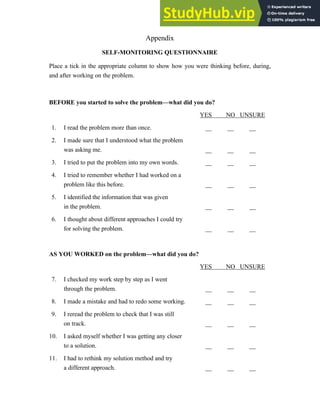
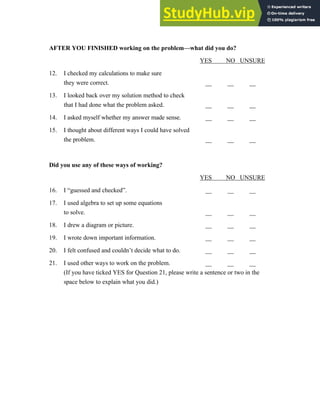
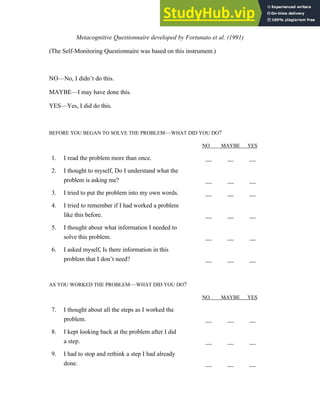
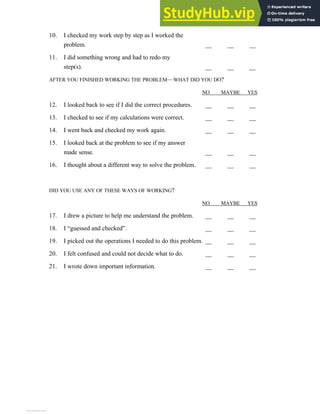

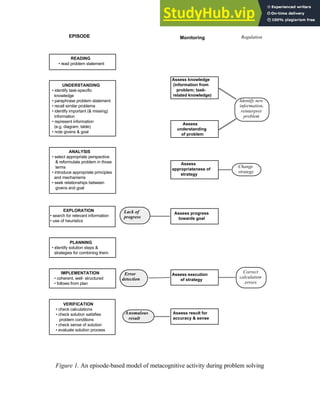
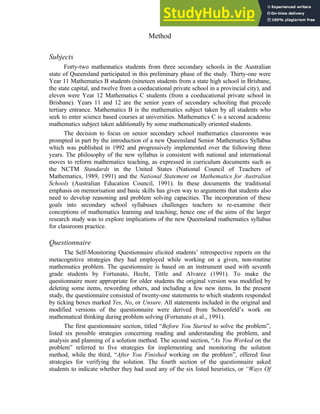
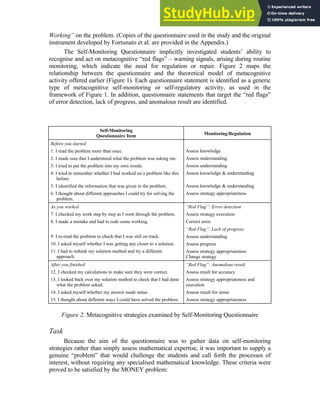
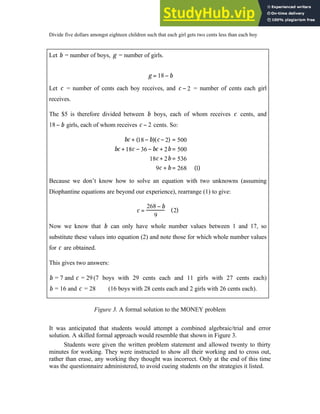
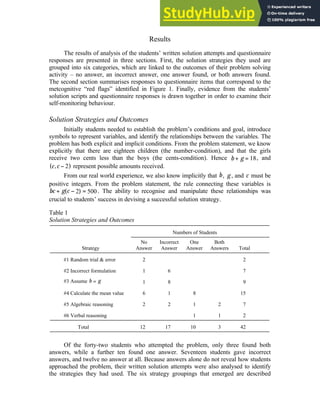
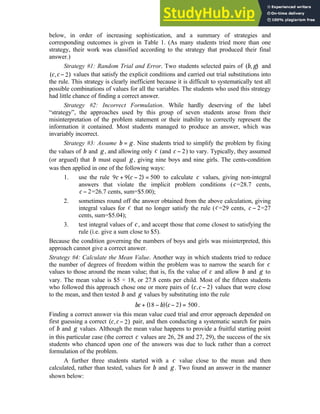
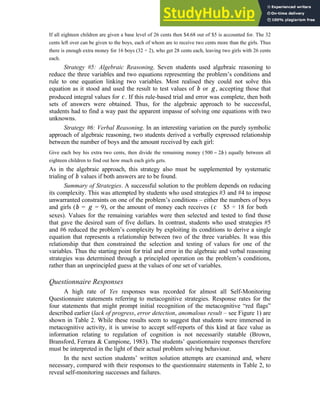
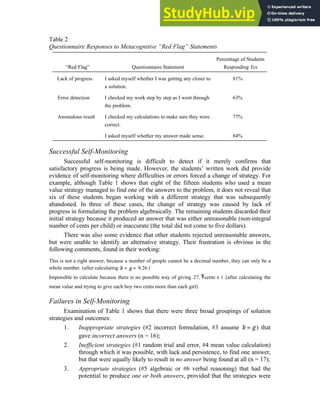
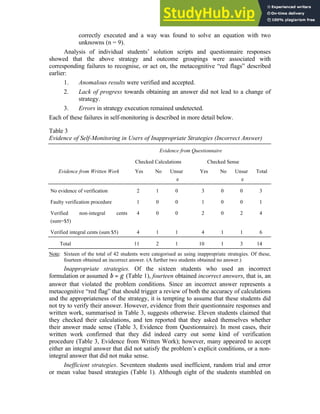
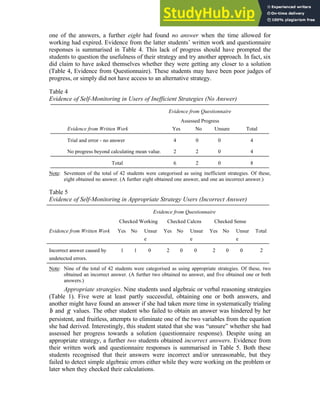
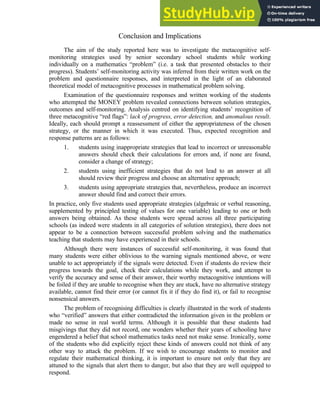
This study investigated the metacognitive strategies used by senior secondary students when solving mathematical problems individually. Students attempted a non-routine money division problem and completed a questionnaire about the strategies they used. The questionnaire responses revealed instances of successful self-monitoring as well as occasions where monitoring was inadequate or lacking. Analyzing different solution strategies and associated metacognitive failures highlighted the distinction between recognizing errors and obstacles, and correcting or overcoming them.


