INTRODUCTION
TO WRITING
TASK 1
GENERAL
TRAINING
IELTS Writing
 IELTS WRITING - GENERAL TRAINING: TASK 1
IN TASK 1 GENERAL TRAINING TEST, YOU WILL BE ASKED TO WRITE A
LETTER: A FORMAL LETTER or AN INFORMAL LETTER
The purpose of part 1 of the general training test is to check that you can communicate in an
appropriate and effective way, in writing a letter or email. To do this, you must decide on the following
three points:
THE IMAGINARY RECIPIENT OF THE LETTER.
THE CORRECT STYLE TO USE.
THE CONTENT OF THE LETTER.
Depending on the instructions, you then need to decide whether to write your letter or email in a
formal, semi-formal or personal style, and create the appropriate content ideas for this imaginary
recipient.
1. THE IMAGINARY RECIPIENT OF THE LETTER.
The imaginary recipient (the person who receives and reads it)
may be a friend, a stranger, or a social or professional contact.
‘Imaginary’ means it exists only in imagination; don’t base your
answer on a real person that you know.
2. THE CORRECT STYLE TO USE.
As far as style is concerned, the letter may need to be in a
personal style, or a formal style. Occasionally, a task may require a
semi-formal style.
3. THE CONTENT OF THE LETTER.
The task will ask you to write a letter or an email in which the content ideas are a mix of:
Complaining about something.
Requesting something.
Explaining and/or apologising about something.
Suggesting something.
(There will be a combination of these ideas, not just one.)
BEFORE WRITING THE LETTER, ASK YOURSELF.
RECIPIENT: Is the imaginary recipient of this a letter a person you know personally, or
someone you don’t know? Is this person a friend, a stranger or a professional contact?
STYLE: Therefore, should it be in a personal or formal style? Because of the style, how should
you complete the ‘dear -------’ part? And how should you end the letter.
CONTENT: Why are you writing the letter? Which combination of the four possible content
ideas is it asking you to create (complaining, requesting, explaining/apologising, suggesting)?
INFORMAL, SEMI
FORMAL AND FORMAL.
 Your first task is to
identify your audience.
This is really important
as it will help you decide
on the formality of the
language.
Besides the formality of
the language, each type
has a different beginning
and a different way of
sign off.
INFORMAL
•An informal letter or a personal letter is to someone
you have a close relationship.
•If the question is to write to a ‘friend’, it is always an
informal letter.
•In this case, normally you will be asked to write on a
social situation.
•In this case, you will be asked to begin your letter as
“Dear….”
FORMAL
• A formal letter is addressed to people you only have a
formal relationship. In most cases, you have not met
the person like a manager incharge of a local council,
municipality office or government department.
• A situation called formal if you are writing to the local
council for some complains, hotel manager for some
recommendations or a covering letter to the HR
manager for a job application.
• These are all formal situations and require formal
language and style. In these cases mostly you are
writing to someone you have not met or know his/her
name.
SEMI-FORMAL
Don’t get confused informal and
semi-formal. Basically, all you need
is formal and informal. However,
this is only for your information.
• Occasionally, a task will give you a situation which is between
formal and personal, which the examiners call ‘semi-formal.’
This will usually be to a person you do not know well, but there
is no need to be highly formal.
• if you are not sure, write it in a formal style – that’s better than
writing in a style which is too personal.
• Remember that formal and personal letter tasks are more
common than semi-formal letter tasks.
• In semi-formal letters, the surname should be used when
addressing like Dear Mrs. D’Souza or Dear Mr. Jones. (However,
in the test you do not have to worry about surnames. You will
be asked to begin the letter as Dear Sir/Madam in both the
cases; formal or semi-formal.
• In semi-formal letters, you can also use - 'With best wishes' and
'With regards ’ before ‘Sincerely Yours’
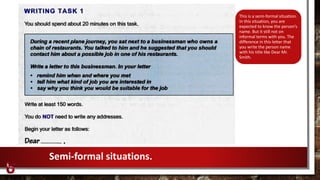
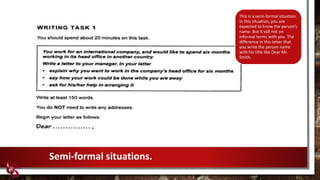
This is a semi-formal situation.
In this situation, you are
expected to know the person’s
name. But it still not on
informal terms with you. The
difference in this letter that
you write the person name
with his title like Dear Mr.
Smith.
Semi-formal situations.
This is a semi-formal situation.
In this situation, you are
expected to know the person’s
name. But it still not on
informal terms with you. The
difference in this letter that
you write the person name
with his title like Dear Mr.
Smith.
 GENERAL
TRAINING
TASK 1
QUESTION
FORMAT
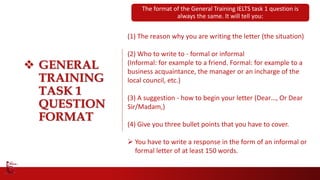
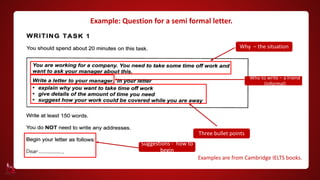
(1) The reason why you are writing the letter (the situation)
(2) Who to write to - formal or informal
(Informal: for example to a friend. Formal: for example to a
business acquaintance, the manager or an incharge of the
local council, etc.)
(3) A suggestion - how to begin your letter (Dear…, Or Dear
Sir/Madam,)
(4) Give you three bullet points that you have to cover.
 You have to write a response in the form of an informal or
formal letter of at least 150 words.
The format of the General Training IELTS task 1 question is
always the same. It will tell you:
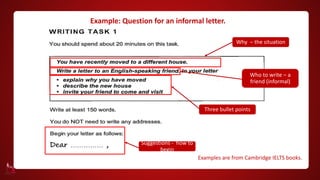
Why – the situation
Who to write – a
friend (informal)
Three bullet points
Examples are from Cambridge IELTS books.
Suggestions - how to
begin
Example: Question for an informal letter.
Why – the situation
Who to write – a friend
(informal)
Three bullet points
Examples are from Cambridge IELTS books.
Suggestions - how to
begin
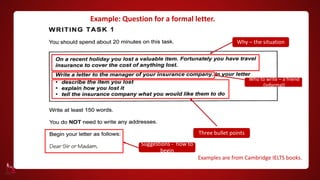
Example: Question for a formal letter.
Why – the situation
Who to write – a friend
(informal)
Three bullet points
Examples are from Cambridge IELTS books.
Suggestions - how to
begin
Example: Question for a semi formal letter.
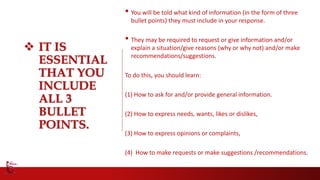
 IT IS
ESSENTIAL
THAT YOU
INCLUDE
ALL 3
BULLET
POINTS.
• You will be told what kind of information (in the form of three
bullet points) they must include in your response.
• They may be required to request or give information and/or
explain a situation/give reasons (why or why not) and/or make
recommendations/suggestions.
To do this, you should learn:
(1) How to ask for and/or provide general information.
(2) How to express needs, wants, likes or dislikes,
(3) How to express opinions or complaints,
(4) How to make requests or make suggestions /recommendations.
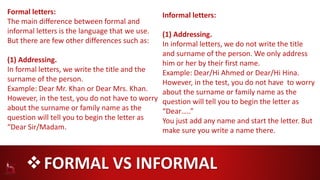
FORMAL VS INFORMAL
Formal letters:
The main difference between formal and
informal letters is the language that we use.
But there are few other differences such as:
(1) Addressing.
In formal letters, we write the title and the
surname of the person.
Example: Dear Mr. Khan or Dear Mrs. Khan.
However, in the test, you do not have to worry
about the surname or family name as the
question will tell you to begin the letter as
“Dear Sir/Madam.
Informal letters:
(1) Addressing.
In informal letters, we do not write the title
and surname of the person. We only address
him or her by their first name.
Example: Dear/Hi Ahmed or Dear/Hi Hina.
However, in the test, you do not have to worry
about the surname or family name as the
question will tell you to begin the letter as
“Dear…..”
You just add any name and start the letter. But
make sure you write a name there.
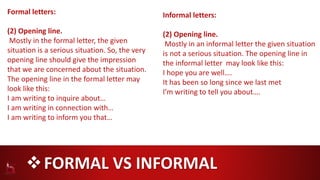
FORMAL VS INFORMAL
Formal letters:
(2) Opening line.
Mostly in the formal letter, the given
situation is a serious situation. So, the very
opening line should give the impression
that we are concerned about the situation.
The opening line in the formal letter may
look like this:
I am writing to inquire about…
I am writing in connection with…
I am writing to inform you that…
Informal letters:
(2) Opening line.
Mostly in an informal letter the given situation
is not a serious situation. The opening line in
the informal letter may look like this:
I hope you are well….
It has been so long since we last met
I’m writing to tell you about….
FORMAL VS INFORMAL
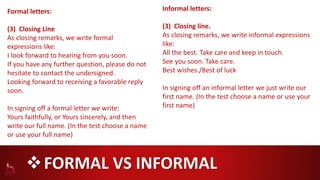
Formal letters:
(3) Closing Line
As closing remarks, we write formal
expressions like:
I look forward to hearing from you soon.
If you have any further question, please do not
hesitate to contact the undersigned.
Looking forward to receiving a favorable reply
soon.
In signing off a formal letter we write:
Yours faithfully, or Yours sincerely, and then
write our full name. (In the test choose a name
or use your full name)
Informal letters:
(3) Closing line.
As closing remarks, we write informal expressions
like:
All the best. Take care and keep in touch.
See you soon. Take care.
Best wishes./Best of luck
In signing off an informal letter we just write our
first name. (In the test choose a name or use your
first name)
 FORMAL LETTER STRUCTURE
Dear Sir or Madam,
paragraph 1- opening statement – the reason for writing. (I am writing to inform you…/with regard
to…)
paragraph 2- bullet point 1 (use your imagination to write supporting details for all bullet points)
paragraph 3- bullet point 2
paragraph 4- bullet point 3
Closing statement (I look forward to hearing from you soon.)
Best Regards,
[your full name.]
There is no condition for any specific
structure from IELTS, but a
predictable format ensures that we cover all
of the various points.
 INFORMAL LETTER STRUCTURE
Dear Ahmed, [Only the first name of a friend]
paragraph 1- opening statement – the reason for writing. (I hope you are well. I am just writing to tell you…)
paragraph 2- bullet point 1 (use your imagination to write supporting details for all bullet points)
paragraph 3- bullet point 2
paragraph 4- bullet point 3
Closing statement. ( All the best. Take care and keep in touch.)
(Your first name only)
OPENING STATEMENT
Start with an opening statement which
explains the reason for writing the letter. The
opening statement is quite important. It
varies depending on whether you are writing
a formal or informal letter.
 ORGANIZING THE LETTER INTO PARAGRAPHS
•Organizing the letter into paragraphs is essential. Spend
some time in deciding your paragraphing clearly.
•Begin each paragraph referring to one of the bullet points to
show the examiner that you have clearly covered all the
bullet points well.
 PLAN BEFORE WRITING - SPEND FEW MINUTE TO PLAN
THE LETTER:
Identify the style of the letter – formal/ informal.
Think what information you like to add to each point.
Decide how to open the letter.
Plan how to close the letter.
USEFUL TIPS
GENERAL
TRAINING
WRITING TASK 1
Don’t spend more than 20 minutes on task 1. Letter in task 1 worth only 33% of your
final score.
Plan before writing. Spend 3 to 5 minutes on planning and keep some time for
checking mistakes at the end. Aim 160-180 words on the safe side.
Each article is also counted as one word.
Useful Tips
Don’t have to write address on the letter.
Pay attention to the question to establish if it is asking for a formal or informal
letter. Begin the letter by addressing the person in an appropriate manner. Pay
attention to the opening line and always signing off according to the requirement of
the style.
It is important to include clearly three built points in your letter.
Useful Tips
Contracted forms are not allowed in the formal letter. It is a good idea to use
contractions like ‘I’ve’, ‘I’d’ and ‘I’m’ in an informal letter. This is one of the ways
that you can show the examiner that you know how to write an informal letter
use the full name at the end of a formal letter and just the first name at the
end of an informal letter.
Punctuation is important too. Name on the top and “Yours ……….,” always
followed by a comma.
Useful Tips
USEFUL
EXPRESSIONS
GENERAL
TRAINING
WRITING TASK 1
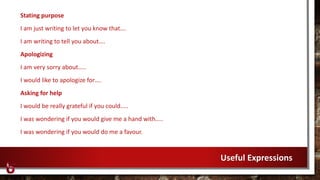
Stating purpose
I am just writing to let you know that….
I am writing to tell you about….
Apologizing
I am very sorry about…..
I would like to apologize for….
Asking for help
I would be really grateful if you could…..
I was wondering if you would give me a hand with…..
I was wondering if you would do me a favour.
Useful Expressions
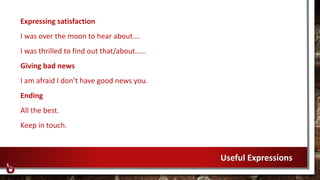
Expressing satisfaction
I was over the moon to hear about….
I was thrilled to find out that/about……
Giving bad news
I am afraid I don’t have good news you.
Ending
All the best.
Keep in touch.
Useful Expressions
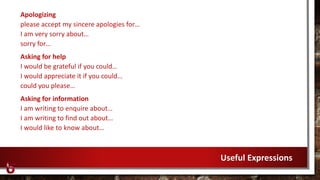
Apologizing
please accept my sincere apologies for…
I am very sorry about…
sorry for…
Asking for help
I would be grateful if you could…
I would appreciate it if you could…
could you please…
Asking for information
I am writing to enquire about…
I am writing to find out about…
I would like to know about…
Useful Expressions
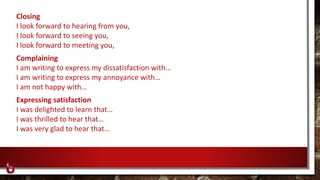
Closing
I look forward to hearing from you,
I look forward to seeing you,
I look forward to meeting you,
Complaining
I am writing to express my dissatisfaction with…
I am writing to express my annoyance with…
I am not happy with…
Expressing satisfaction
I was delighted to learn that…
I was thrilled to hear that…
I was very glad to hear that…
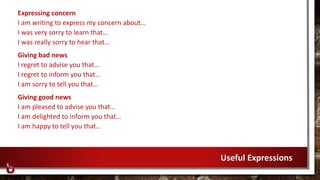
Expressing concern
I am writing to express my concern about…
I was very sorry to learn that…
I was really sorry to hear that…
Giving bad news
I regret to advise you that…
I regret to inform you that…
I am sorry to tell you that…
Giving good news
I am pleased to advise you that…
I am delighted to inform you that…
I am happy to tell you that…
Useful Expressions
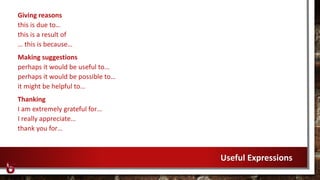
Giving reasons
this is due to…
this is a result of
… this is because…
Making suggestions
perhaps it would be useful to…
perhaps it would be possible to…
it might be helpful to…
Thanking
I am extremely grateful for…
I really appreciate…
thank you for…
Useful Expressions
for watching
This is the end of this presentation
For a complete IELTS training course and
practice.
Visit: www.ieltsbackup.com
Send us your feedback and suggestions on
info@ieltsbackup.com
Hi,
I have developed a systematic approach for all question types frequently
appearing in IELTS. Students who tired them in their IELTS exams have
received amazing results.
(Zafar Yar Khan)
Author and Publisher
If you need help in achieving your goals in IELTS,
write to me at info@ieltsbackup.com or visit
www.ieltsbackup.com
and click on “IELTS Tuition”.
I will contact you as soon as I can.

IETLS Writing Task 1 - GT - Introduction

  • 2.
  • 3.
     IELTS WRITING- GENERAL TRAINING: TASK 1 IN TASK 1 GENERAL TRAINING TEST, YOU WILL BE ASKED TO WRITE A LETTER: A FORMAL LETTER or AN INFORMAL LETTER
  • 4.
    The purpose ofpart 1 of the general training test is to check that you can communicate in an appropriate and effective way, in writing a letter or email. To do this, you must decide on the following three points: THE IMAGINARY RECIPIENT OF THE LETTER. THE CORRECT STYLE TO USE. THE CONTENT OF THE LETTER. Depending on the instructions, you then need to decide whether to write your letter or email in a formal, semi-formal or personal style, and create the appropriate content ideas for this imaginary recipient.
  • 5.
    1. THE IMAGINARYRECIPIENT OF THE LETTER. The imaginary recipient (the person who receives and reads it) may be a friend, a stranger, or a social or professional contact. ‘Imaginary’ means it exists only in imagination; don’t base your answer on a real person that you know.
  • 6.
    2. THE CORRECTSTYLE TO USE. As far as style is concerned, the letter may need to be in a personal style, or a formal style. Occasionally, a task may require a semi-formal style.
  • 7.
    3. THE CONTENTOF THE LETTER. The task will ask you to write a letter or an email in which the content ideas are a mix of: Complaining about something. Requesting something. Explaining and/or apologising about something. Suggesting something. (There will be a combination of these ideas, not just one.)
  • 8.
    BEFORE WRITING THELETTER, ASK YOURSELF. RECIPIENT: Is the imaginary recipient of this a letter a person you know personally, or someone you don’t know? Is this person a friend, a stranger or a professional contact? STYLE: Therefore, should it be in a personal or formal style? Because of the style, how should you complete the ‘dear -------’ part? And how should you end the letter. CONTENT: Why are you writing the letter? Which combination of the four possible content ideas is it asking you to create (complaining, requesting, explaining/apologising, suggesting)?
  • 9.
  • 10.
     Your firsttask is to identify your audience. This is really important as it will help you decide on the formality of the language. Besides the formality of the language, each type has a different beginning and a different way of sign off. INFORMAL •An informal letter or a personal letter is to someone you have a close relationship. •If the question is to write to a ‘friend’, it is always an informal letter. •In this case, normally you will be asked to write on a social situation. •In this case, you will be asked to begin your letter as “Dear….”
  • 11.
    FORMAL • A formalletter is addressed to people you only have a formal relationship. In most cases, you have not met the person like a manager incharge of a local council, municipality office or government department. • A situation called formal if you are writing to the local council for some complains, hotel manager for some recommendations or a covering letter to the HR manager for a job application. • These are all formal situations and require formal language and style. In these cases mostly you are writing to someone you have not met or know his/her name.
  • 12.
    SEMI-FORMAL Don’t get confusedinformal and semi-formal. Basically, all you need is formal and informal. However, this is only for your information. • Occasionally, a task will give you a situation which is between formal and personal, which the examiners call ‘semi-formal.’ This will usually be to a person you do not know well, but there is no need to be highly formal. • if you are not sure, write it in a formal style – that’s better than writing in a style which is too personal. • Remember that formal and personal letter tasks are more common than semi-formal letter tasks. • In semi-formal letters, the surname should be used when addressing like Dear Mrs. D’Souza or Dear Mr. Jones. (However, in the test you do not have to worry about surnames. You will be asked to begin the letter as Dear Sir/Madam in both the cases; formal or semi-formal. • In semi-formal letters, you can also use - 'With best wishes' and 'With regards ’ before ‘Sincerely Yours’
  • 13.
    This is asemi-formal situation. In this situation, you are expected to know the person’s name. But it still not on informal terms with you. The difference in this letter that you write the person name with his title like Dear Mr. Smith. Semi-formal situations.
  • 14.
    Semi-formal situations. This isa semi-formal situation. In this situation, you are expected to know the person’s name. But it still not on informal terms with you. The difference in this letter that you write the person name with his title like Dear Mr. Smith.
  • 15.
     GENERAL TRAINING TASK 1 QUESTION FORMAT (1)The reason why you are writing the letter (the situation) (2) Who to write to - formal or informal (Informal: for example to a friend. Formal: for example to a business acquaintance, the manager or an incharge of the local council, etc.) (3) A suggestion - how to begin your letter (Dear…, Or Dear Sir/Madam,) (4) Give you three bullet points that you have to cover.  You have to write a response in the form of an informal or formal letter of at least 150 words. The format of the General Training IELTS task 1 question is always the same. It will tell you:
  • 16.
    Why – thesituation Who to write – a friend (informal) Three bullet points Examples are from Cambridge IELTS books. Suggestions - how to begin Example: Question for an informal letter.
  • 17.
    Why – thesituation Who to write – a friend (informal) Three bullet points Examples are from Cambridge IELTS books. Suggestions - how to begin Example: Question for a formal letter.
  • 18.
    Why – thesituation Who to write – a friend (informal) Three bullet points Examples are from Cambridge IELTS books. Suggestions - how to begin Example: Question for a semi formal letter.
  • 19.
     IT IS ESSENTIAL THATYOU INCLUDE ALL 3 BULLET POINTS. • You will be told what kind of information (in the form of three bullet points) they must include in your response. • They may be required to request or give information and/or explain a situation/give reasons (why or why not) and/or make recommendations/suggestions. To do this, you should learn: (1) How to ask for and/or provide general information. (2) How to express needs, wants, likes or dislikes, (3) How to express opinions or complaints, (4) How to make requests or make suggestions /recommendations.
  • 20.
    FORMAL VS INFORMAL Formalletters: The main difference between formal and informal letters is the language that we use. But there are few other differences such as: (1) Addressing. In formal letters, we write the title and the surname of the person. Example: Dear Mr. Khan or Dear Mrs. Khan. However, in the test, you do not have to worry about the surname or family name as the question will tell you to begin the letter as “Dear Sir/Madam. Informal letters: (1) Addressing. In informal letters, we do not write the title and surname of the person. We only address him or her by their first name. Example: Dear/Hi Ahmed or Dear/Hi Hina. However, in the test, you do not have to worry about the surname or family name as the question will tell you to begin the letter as “Dear…..” You just add any name and start the letter. But make sure you write a name there.
  • 21.
    FORMAL VS INFORMAL Formalletters: (2) Opening line. Mostly in the formal letter, the given situation is a serious situation. So, the very opening line should give the impression that we are concerned about the situation. The opening line in the formal letter may look like this: I am writing to inquire about… I am writing in connection with… I am writing to inform you that… Informal letters: (2) Opening line. Mostly in an informal letter the given situation is not a serious situation. The opening line in the informal letter may look like this: I hope you are well…. It has been so long since we last met I’m writing to tell you about….
  • 22.
    FORMAL VS INFORMAL Formalletters: (3) Closing Line As closing remarks, we write formal expressions like: I look forward to hearing from you soon. If you have any further question, please do not hesitate to contact the undersigned. Looking forward to receiving a favorable reply soon. In signing off a formal letter we write: Yours faithfully, or Yours sincerely, and then write our full name. (In the test choose a name or use your full name) Informal letters: (3) Closing line. As closing remarks, we write informal expressions like: All the best. Take care and keep in touch. See you soon. Take care. Best wishes./Best of luck In signing off an informal letter we just write our first name. (In the test choose a name or use your first name)
  • 23.
     FORMAL LETTERSTRUCTURE Dear Sir or Madam, paragraph 1- opening statement – the reason for writing. (I am writing to inform you…/with regard to…) paragraph 2- bullet point 1 (use your imagination to write supporting details for all bullet points) paragraph 3- bullet point 2 paragraph 4- bullet point 3 Closing statement (I look forward to hearing from you soon.) Best Regards, [your full name.] There is no condition for any specific structure from IELTS, but a predictable format ensures that we cover all of the various points.
  • 24.
     INFORMAL LETTERSTRUCTURE Dear Ahmed, [Only the first name of a friend] paragraph 1- opening statement – the reason for writing. (I hope you are well. I am just writing to tell you…) paragraph 2- bullet point 1 (use your imagination to write supporting details for all bullet points) paragraph 3- bullet point 2 paragraph 4- bullet point 3 Closing statement. ( All the best. Take care and keep in touch.) (Your first name only)
  • 25.
    OPENING STATEMENT Start withan opening statement which explains the reason for writing the letter. The opening statement is quite important. It varies depending on whether you are writing a formal or informal letter.
  • 26.
     ORGANIZING THELETTER INTO PARAGRAPHS •Organizing the letter into paragraphs is essential. Spend some time in deciding your paragraphing clearly. •Begin each paragraph referring to one of the bullet points to show the examiner that you have clearly covered all the bullet points well.
  • 27.
     PLAN BEFOREWRITING - SPEND FEW MINUTE TO PLAN THE LETTER: Identify the style of the letter – formal/ informal. Think what information you like to add to each point. Decide how to open the letter. Plan how to close the letter.
  • 28.
  • 29.
    Don’t spend morethan 20 minutes on task 1. Letter in task 1 worth only 33% of your final score. Plan before writing. Spend 3 to 5 minutes on planning and keep some time for checking mistakes at the end. Aim 160-180 words on the safe side. Each article is also counted as one word. Useful Tips
  • 30.
    Don’t have towrite address on the letter. Pay attention to the question to establish if it is asking for a formal or informal letter. Begin the letter by addressing the person in an appropriate manner. Pay attention to the opening line and always signing off according to the requirement of the style. It is important to include clearly three built points in your letter. Useful Tips
  • 31.
    Contracted forms arenot allowed in the formal letter. It is a good idea to use contractions like ‘I’ve’, ‘I’d’ and ‘I’m’ in an informal letter. This is one of the ways that you can show the examiner that you know how to write an informal letter use the full name at the end of a formal letter and just the first name at the end of an informal letter. Punctuation is important too. Name on the top and “Yours ……….,” always followed by a comma. Useful Tips
  • 32.
  • 33.
    Stating purpose I amjust writing to let you know that…. I am writing to tell you about…. Apologizing I am very sorry about….. I would like to apologize for…. Asking for help I would be really grateful if you could….. I was wondering if you would give me a hand with….. I was wondering if you would do me a favour. Useful Expressions
  • 34.
    Expressing satisfaction I wasover the moon to hear about…. I was thrilled to find out that/about…… Giving bad news I am afraid I don’t have good news you. Ending All the best. Keep in touch. Useful Expressions
  • 35.
    Apologizing please accept mysincere apologies for… I am very sorry about… sorry for… Asking for help I would be grateful if you could… I would appreciate it if you could… could you please… Asking for information I am writing to enquire about… I am writing to find out about… I would like to know about… Useful Expressions
  • 36.
    Closing I look forwardto hearing from you, I look forward to seeing you, I look forward to meeting you, Complaining I am writing to express my dissatisfaction with… I am writing to express my annoyance with… I am not happy with… Expressing satisfaction I was delighted to learn that… I was thrilled to hear that… I was very glad to hear that…
  • 37.
    Expressing concern I amwriting to express my concern about… I was very sorry to learn that… I was really sorry to hear that… Giving bad news I regret to advise you that… I regret to inform you that… I am sorry to tell you that… Giving good news I am pleased to advise you that… I am delighted to inform you that… I am happy to tell you that… Useful Expressions
  • 38.
    Giving reasons this isdue to… this is a result of … this is because… Making suggestions perhaps it would be useful to… perhaps it would be possible to… it might be helpful to… Thanking I am extremely grateful for… I really appreciate… thank you for… Useful Expressions
  • 39.
    for watching This isthe end of this presentation For a complete IELTS training course and practice. Visit: www.ieltsbackup.com Send us your feedback and suggestions on info@ieltsbackup.com
  • 40.
    Hi, I have developeda systematic approach for all question types frequently appearing in IELTS. Students who tired them in their IELTS exams have received amazing results. (Zafar Yar Khan) Author and Publisher If you need help in achieving your goals in IELTS, write to me at info@ieltsbackup.com or visit www.ieltsbackup.com and click on “IELTS Tuition”. I will contact you as soon as I can.