IELTS
International Exam
LISTENING TEST
Presented by:
Carolina Cubillos
Karent Barajas
William Castillo
Carlos Escalante
 It tests the four macro skills:
 Listening
 Reading
 Writing
 Speaking
IELTS: THE INTERNATIONAL ENGLISH
LANGUAGE TESTING SYSTEM
IELTS Listening about the IELTS Listening test
1. You will listen to 4 different recordings and answer 40 questions
2. The test takes approximately 30 minutes. You will have an
additional ten minutes to transfer your answers to an answer sheet
3. You only hear the audio once
4. A variety of voices and native-speaker accents are used
5. Different topic
6. A variety of question types are used.
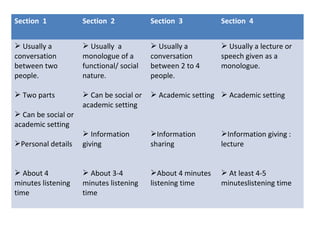
Section 1 Section 2 Section 3 Section 4
 Usually a
conversation
between two
people.
 Two parts
 Can be social or
academic setting
Personal details
 About 4
minutes listening
time
 Usually a
monologue of a
functional/ social
nature.
 Can be social or
academic setting
 Information
giving
 About 3-4
minutes listening
time
 Usually a
conversation
between 2 to 4
people.
 Academic setting
Information
sharing
About 4 minutes
listening time
 Usually a lecture or
speech given as a
monologue.
 Academic setting
Information giving :
lecture
 At least 4-5
minuteslistening time
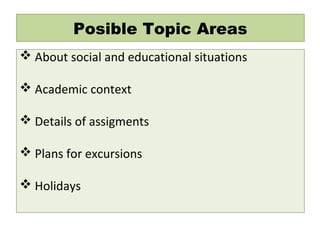
Posible Topic Areas
 About social and educational situations
 Academic context
 Details of assigments
 Plans for excursions
 Holidays
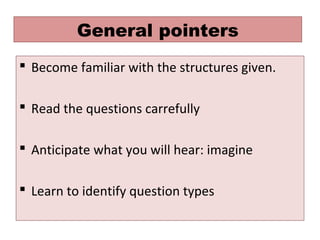
General pointers
 Become familiar with the structures given.
 Read the questions carrefully
 Anticipate what you will hear: imagine
 Learn to identify question types
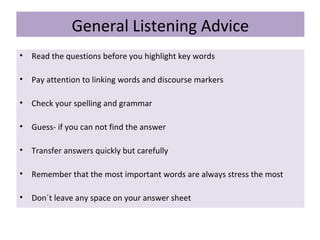
General Listening Advice
• Read the questions before you highlight key words
• Pay attention to linking words and discourse markers
• Check your spelling and grammar
• Guess- if you can not find the answer
• Transfer answers quickly but carefully
• Remember that the most important words are always stress the most
• Don´t leave any space on your answer sheet
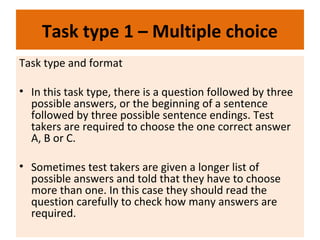
Task type 1 – Multiple choice
Task type and format
• In this task type, there is a question followed by three
possible answers, or the beginning of a sentence
followed by three possible sentence endings. Test
takers are required to choose the one correct answer
A, B or C.
• Sometimes test takers are given a longer list of
possible answers and told that they have to choose
more than one. In this case they should read the
question carefully to check how many answers are
required.
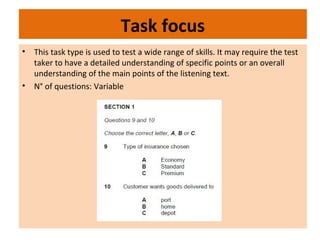
Task focus
• This task type is used to test a wide range of skills. It may require the test
taker to have a detailed understanding of specific points or an overall
understanding of the main points of the listening text.
• N° of questions: Variable
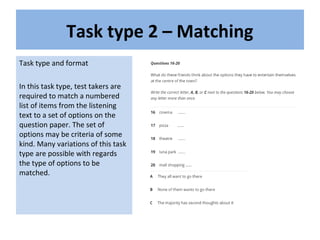
Task type 2 – Matching
Task type and format
In this task type, test takers are
required to match a numbered
list of items from the listening
text to a set of options on the
question paper. The set of
options may be criteria of some
kind. Many variations of this task
type are possible with regards
the type of options to be
matched.
Task focus
• This task type assesses the skill of listening for detail. It assesses whether
a test taker can understand information given in a conversation on an
everyday topic such as different types of hotel or guest house
accommodation. It also assesses the ability to follow a conversation
involving interaction between two people. It may also be used to assess
test takers’ ability to recognise relationships and connections between
facts in the listening text.
• No. of questions: Variable
Strategies.
Be ready to listen.
The moment you hear the words "Section 1", "Section 2" etc. you should:
•Be prepared and ready to listen for the instructions that are given.
•Listen for details about the information contained in the coming passage, (e.g. who? what? where?
when? why?).
Learn to predict
In the Listening Test you use four skills at once. It is not surprising that candidates often find this
the most demanding of the four tests. You need to be able to:
• read the instructions and questions
• listen for general information
• listen for specific information
• write the answers as you listen for the answers to the questions that follow.
Tips for Multiple Choice
1. Read the questions and predict the types of information you need before starting the module.
2. Be alert for: synonyms for words and phrases in the options
• the same idea expressed during different parts of speech
• specific information, e.g., dates or numbers
3. Keep track of the time. You have a few seconds to read each section before you listen. You will
however have ten (10) minutes at the end to put your answers on the answer sheet.
4. Each listening text will only be heard once; it is important that you look for key words and phrases
before you actually start the exam.
5. The questions are in the same order as you hear the answers.
6. Don't spend too much time trying to think of an answer.
7. If you need to make a guess, base it on key words and phrases you have heard.
Tips for Matching
• 1. Before starting to listen, carefully read the numbered and
lettered lists.
• 2. The numbered list would always be in the same order as you
would hear it in the recording.
• 3. The ideas in the lists might not be expressed in the same way as
those in the recording.
• 4. In this type of question, you should listen for ideas; never listen
for particular words or phrases.
• 5. When you've chosen something from the list, put a line through
it so you won't get to use it again.
Task type 3 – Plan, map, diagram
labelling
Understand relationships between words (discourse
markers)
Sequencing and following chronological order.
Listening for specific information.
Strategies
Brainstorm any vocabulary or knowledge that you have
of the picture or topics.
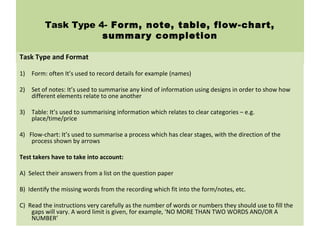
Task Type 4- Form, note, table, flow-chart,
summary completion
Task Type and Format
1) Form: often It’s used to record details for example (names)
2) Set of notes: It’s used to summarise any kind of information using designs in order to show how
different elements relate to one another
3) Table: It’s used to summarising information which relates to clear categories – e.g.
place/time/price
4) Flow-chart: It’s used to summarise a process which has clear stages, with the direction of the
process shown by arrows
Test takers have to take into account:
A) Select their answers from a list on the question paper
B) Identify the missing words from the recording which fit into the form/notes, etc.
C) Read the instructions very carefully as the number of words or numbers they should use to fill the
gaps will vary. A word limit is given, for example, ‘NO MORE THAN TWO WORDS AND/OR A
NUMBER’
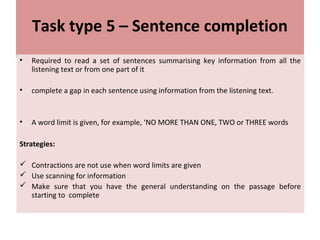
Task type 5 – Sentence completion
• Required to read a set of sentences summarising key information from all the
listening text or from one part of it
• complete a gap in each sentence using information from the listening text.
• A word limit is given, for example, ‘NO MORE THAN ONE, TWO or THREE words
Strategies:
 Contractions are not use when word limits are given
 Use scanning for information
 Make sure that you have the general understanding on the passage before
starting to complete
Task type 6 – Short-answer questions
Short answer questions
Taks type and format
Task focus
Number of questions
Strategies
 Remenber the answer is short no more tan three words
and- or number.
 Contractions are not used when word- limits are given.
 Listening the specific information.
 Look at the given information to identify the type of
information required.
 Look and read the questions before of start the listening
test.
References
• http://ieltsliz.com/ielts-listening-for-diagrams-practice-and-tips/
• https://drive.google.com/drive/folders/0B0xs4JxDJAriLXpKY19VU3BFaTg
• https://www.ielts.org/about-the-test/test-format-in-detail
• http://www.dori-ielts.com/what-about-form-completion-tasks-in-
listening/

Ielts listening 7219

  • 1.
    IELTS International Exam LISTENING TEST Presentedby: Carolina Cubillos Karent Barajas William Castillo Carlos Escalante
  • 2.
     It teststhe four macro skills:  Listening  Reading  Writing  Speaking IELTS: THE INTERNATIONAL ENGLISH LANGUAGE TESTING SYSTEM
  • 3.
    IELTS Listening aboutthe IELTS Listening test 1. You will listen to 4 different recordings and answer 40 questions 2. The test takes approximately 30 minutes. You will have an additional ten minutes to transfer your answers to an answer sheet 3. You only hear the audio once 4. A variety of voices and native-speaker accents are used 5. Different topic 6. A variety of question types are used.
  • 4.
    Section 1 Section2 Section 3 Section 4  Usually a conversation between two people.  Two parts  Can be social or academic setting Personal details  About 4 minutes listening time  Usually a monologue of a functional/ social nature.  Can be social or academic setting  Information giving  About 3-4 minutes listening time  Usually a conversation between 2 to 4 people.  Academic setting Information sharing About 4 minutes listening time  Usually a lecture or speech given as a monologue.  Academic setting Information giving : lecture  At least 4-5 minuteslistening time
  • 5.
    Posible Topic Areas About social and educational situations  Academic context  Details of assigments  Plans for excursions  Holidays
  • 6.
    General pointers  Becomefamiliar with the structures given.  Read the questions carrefully  Anticipate what you will hear: imagine  Learn to identify question types
  • 7.
    General Listening Advice •Read the questions before you highlight key words • Pay attention to linking words and discourse markers • Check your spelling and grammar • Guess- if you can not find the answer • Transfer answers quickly but carefully • Remember that the most important words are always stress the most • Don´t leave any space on your answer sheet
  • 8.
    Task type 1– Multiple choice Task type and format • In this task type, there is a question followed by three possible answers, or the beginning of a sentence followed by three possible sentence endings. Test takers are required to choose the one correct answer A, B or C. • Sometimes test takers are given a longer list of possible answers and told that they have to choose more than one. In this case they should read the question carefully to check how many answers are required.
  • 9.
    Task focus • Thistask type is used to test a wide range of skills. It may require the test taker to have a detailed understanding of specific points or an overall understanding of the main points of the listening text. • N° of questions: Variable
  • 10.
    Task type 2– Matching Task type and format In this task type, test takers are required to match a numbered list of items from the listening text to a set of options on the question paper. The set of options may be criteria of some kind. Many variations of this task type are possible with regards the type of options to be matched.
  • 11.
    Task focus • Thistask type assesses the skill of listening for detail. It assesses whether a test taker can understand information given in a conversation on an everyday topic such as different types of hotel or guest house accommodation. It also assesses the ability to follow a conversation involving interaction between two people. It may also be used to assess test takers’ ability to recognise relationships and connections between facts in the listening text. • No. of questions: Variable
  • 12.
    Strategies. Be ready tolisten. The moment you hear the words "Section 1", "Section 2" etc. you should: •Be prepared and ready to listen for the instructions that are given. •Listen for details about the information contained in the coming passage, (e.g. who? what? where? when? why?). Learn to predict In the Listening Test you use four skills at once. It is not surprising that candidates often find this the most demanding of the four tests. You need to be able to: • read the instructions and questions • listen for general information • listen for specific information • write the answers as you listen for the answers to the questions that follow.
  • 13.
    Tips for MultipleChoice 1. Read the questions and predict the types of information you need before starting the module. 2. Be alert for: synonyms for words and phrases in the options • the same idea expressed during different parts of speech • specific information, e.g., dates or numbers 3. Keep track of the time. You have a few seconds to read each section before you listen. You will however have ten (10) minutes at the end to put your answers on the answer sheet. 4. Each listening text will only be heard once; it is important that you look for key words and phrases before you actually start the exam. 5. The questions are in the same order as you hear the answers. 6. Don't spend too much time trying to think of an answer. 7. If you need to make a guess, base it on key words and phrases you have heard.
  • 14.
    Tips for Matching •1. Before starting to listen, carefully read the numbered and lettered lists. • 2. The numbered list would always be in the same order as you would hear it in the recording. • 3. The ideas in the lists might not be expressed in the same way as those in the recording. • 4. In this type of question, you should listen for ideas; never listen for particular words or phrases. • 5. When you've chosen something from the list, put a line through it so you won't get to use it again.
  • 15.
    Task type 3– Plan, map, diagram labelling Understand relationships between words (discourse markers) Sequencing and following chronological order. Listening for specific information. Strategies Brainstorm any vocabulary or knowledge that you have of the picture or topics.
  • 16.
    Task Type 4-Form, note, table, flow-chart, summary completion Task Type and Format 1) Form: often It’s used to record details for example (names) 2) Set of notes: It’s used to summarise any kind of information using designs in order to show how different elements relate to one another 3) Table: It’s used to summarising information which relates to clear categories – e.g. place/time/price 4) Flow-chart: It’s used to summarise a process which has clear stages, with the direction of the process shown by arrows Test takers have to take into account: A) Select their answers from a list on the question paper B) Identify the missing words from the recording which fit into the form/notes, etc. C) Read the instructions very carefully as the number of words or numbers they should use to fill the gaps will vary. A word limit is given, for example, ‘NO MORE THAN TWO WORDS AND/OR A NUMBER’
  • 17.
    Task type 5– Sentence completion • Required to read a set of sentences summarising key information from all the listening text or from one part of it • complete a gap in each sentence using information from the listening text. • A word limit is given, for example, ‘NO MORE THAN ONE, TWO or THREE words Strategies:  Contractions are not use when word limits are given  Use scanning for information  Make sure that you have the general understanding on the passage before starting to complete
  • 18.
    Task type 6– Short-answer questions Short answer questions Taks type and format Task focus Number of questions
  • 19.
    Strategies  Remenber theanswer is short no more tan three words and- or number.  Contractions are not used when word- limits are given.  Listening the specific information.  Look at the given information to identify the type of information required.  Look and read the questions before of start the listening test.
  • 20.
    References • http://ieltsliz.com/ielts-listening-for-diagrams-practice-and-tips/ • https://drive.google.com/drive/folders/0B0xs4JxDJAriLXpKY19VU3BFaTg •https://www.ielts.org/about-the-test/test-format-in-detail • http://www.dori-ielts.com/what-about-form-completion-tasks-in- listening/